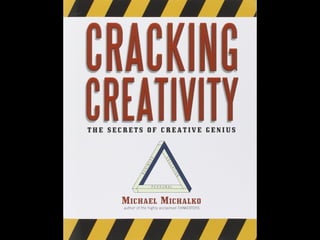
CRACKING CREATIVITY
De Angela L. Duff
Co-Director, Integrated Digital Media
!
!
!
!
Agenda
Define Creativity
Identify Obstacles to Creativity
Discuss Tools & Techniques to Identify New Ideas
Discuss Prototyping
Discuss The Psychology of a Creative Mindset
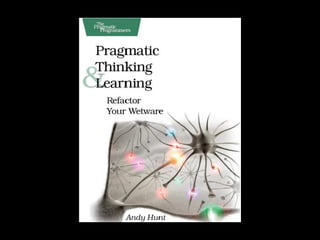
Recommended Resources
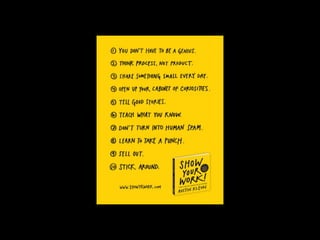
Austin Kleon
Michael Michalko
Edward De Bono
Mihaly Csikszentmihalyi
Steven Pressfield
(Contrary to popular belief)
!
CREATIVITY IS NOT
SYNONYMOUS WITH ART
STYLE is being CONFUSED
with CREATIVITY
CREATIVITY means bringing into being
something that was not there before.
!
!
!


~ Edward de Bono from the book, Serious Creativity
CREATIVITY is any act, idea, or product
that changes an existing domain, or that
transforms an existing domain into a new
one.


from Mihaly Csikszentmihalyi from the book, Creativity
!
!
And the definition of a creative person is:
someone whose thoughts or actions
change a domain, or establish a new
domain.


from Mihaly Csikszentmihalyi from the book, Creativity
!
!
It is important to remember, however,
that a domain cannot be changed
without the explicit or implicit consent of
a field responsible for it.
!
!
from Mihaly Csikszentmihalyi from the book, Creativity
!
!
!
The Psychology
of a Creative Mindset

PLAY & FLOW
!
Improvisation and Practice
FLOW - The state in which people are so
involved in an activity that nothing else
seems to matter; the experience itself is so
enjoyable that people will do it even at
great cost, for the sheer sake of doing it.
!
Mihaly Csikszentmihalyi from the book, 

Flow: The The Psychology of Optimal Experience
Contrary to what we usually believe,
moments like these, the best moments in
our lives, are not the passive, receptive,
relaxing times—although such experiences
can also be enjoyable, if we have worked
hard to attain them…
!
Mihaly Csikszentmihalyi from the book, 

Flow: The The Psychology of Optimal Experience
!
!
The best moments usually occur when a
person’s body or mind is stretched to its
limits in a voluntary effort to accomplish
something difficult and worthwhile.
Optimal experience is thus something that
we make happen.”
!
Mihaly Csikszentmihalyi from the book, 

Flow: The The Psychology of Optimal Experience
!
!
What’s so Funny about Science?
by Sidney Harris (1977)
CREATIVITY requires time, effort,
& focus
!
!
!


from Edward de Bono from the book, Serious Creativity
If you think you are not creative, you will not be.
Fear, limiting or rational
thoughts, self-deprecation,
negative talk from others (also
known as forms of “Resistance”
coined by Steven Pressfield),
and many others are all
obstacles to creativity.
“Inspiration is for amateurs; the rest of
us just show up and get to work. If you
wait around for the clouds to part and a
bolt of lightning to strike you in the
brain, you are not going to make an
awful lot of work. All the best ideas
come out of the process; they come out
of the work itself.” 


~ Chuck Close
Do The Work by Steven Pressfield
CREATIVITY as Style or Expression
“art is theft”
pablo picasso
“Good artists copy; great artists steal.”
!
http://everythingisaremix.info by Kirby Ferguson
a four part video series
TOOLS & TECHNIQUES
to identify new ideas
BRAINSTORMING
The traditional process of brainstorming
sometimes gives the impression that
deliberate creativity consists of shooting
out a stream of crazy ideas in the hope
that one of them might hit a useful target.
!
from Edward de Bono from the book, Serious Creativity
But in almost every other field a scatter-
gun approach to creativity makes no
more sense than having a thousand
monkeys banging away on typewriters in
the hope that one of them might produce
a Shakespeare play.
!
from Edward de Bono from the book, Serious Creativity
Individuals working on their own produce
far more ideas and a far wider range of
ideas than when they are working
together in a group.
!
from Edward de Bono from the book, Serious Creativity
…individuals are much better at
generating ideas and fresh directions.
Once the idea has been born then a
group may be better able to develop the
idea and take it in more directions than
can the originator.
!
from Edward de Bono from the book, Serious Creativity
Brainstorming | Mind Mapping
Mind Mapping by hand is highly recommended
but, if you must go digital, try Freemind (free)
!
Other Digital Mind Mapping Tools
http://lifehacker.com/five-best-mind-
mapping-tools-476534555
Brainstorming | The SCAMPER Technique
SCAMPER is a mnemonic that stands for
!
Substitute
Combine
Adapt
Modify or Magnify
Put to another use
Eliminate
Reverse
Substitute
!
What materials or resources can you substitute to
improve the product or process?

What other product or process could you use?
!
Can you use this product or process somewhere else,
or as a substitute for something else?
Combine
!
What would happen if you combined this product or
process with another to create something new?
!
Adapt
!
How could you adapt or readjust this product or
process to serve another purpose or use?
!
What other context could you put your product or
process into?
!
Modify
!
How could you change the shape, look, or feel of
your product or process?
!
What could you emphasize or highlight to create
more value?
!
What element of this product or process could you
strengthen to create something new?
Put to Another Use
!
Can you use this product or process somewhere else,
perhaps in another industry?
!
Who else could use this product or process?
!
How would this product or process behave differently
in another setting?
!
Could you recycle the waste from this product or
process to make something new?
Eliminate
!
What features, parts, or rules could you eliminate?
!
How could you streamline or simplify this product or
process?
!
How could you make it smaller, faster, lighter, or
more fun?
Reverse
!
What would happen if you reversed this process or
sequenced things differently? How could you
reorganize this product or process?
!
What if you try to do the exact opposite of what
you're trying to do now?
!
What roles could you reverse or swap?
Brainstorming | The Card Sorting Technique
Card Sorting
!
Use a dark pen or sharpie
!
Get four different colors of post-it notes or index cards
!
Take pictures of each step along the way. Make sure
the photos are lit well and have good contrast.
Card Sorting
Step 1: PROJECT, PRODUCT or PROCESS CARDS
!
Identify 15 projects, products or processes that
are of interest to you. One card per project,
product, or process. All the p cards should be the
same color.
Card Sorting
Step 2: DESCRIPTOR CARDS
!
Choose a second color of card and create a set of
descriptor cards for each project, product or
process by listing adjectives or traits of those
projects. Try to extract at least 5 descriptor cards
per p card.
Card Sorting
Step 3: ENABLER CARDS
!
Choose a third color of card and create 3 enabler
cards for each p card. The enabler cards are
resources that enable the project to exist -- the
technology, software, environment, or tools that
are needed.
Card Sorting
Step 4: IDEA CARDS
!
Make associations between the cards to form new
ideas. Once you have an idea, write it on a new
idea card.
!
Play with the idea of contrast, pairing
complementary or opposite things together.
Think about what interests you in the existing p
cards. Look closely at the relationships between
the elements of your newly created ideas.
Card Sorting
Step 5: IDEA LIST
!
Make a ranked list of the idea cards.
PROTOTYPING
Making Your Thinking Quickly Visible
Paper Prototyping
Rapidly sketch, layout, and evaluate concepts
Source: http://www.boardofinnovation.com/wp-content/uploads/2013/04/paperprotoyping.jpg
Quick-and-Dirty Prototyping
Using any materials available (i.e. cardboard), quickly
assemble possible forms or interactions for evaluation.
Source: http://fab.cba.mit.edu/classes/863.12/people/pip/WK2/wk2.html
Wireframes
A screen blueprint or schematic
Source: http://www.iafactory.fr/wireframes/en/wireframes-en.html
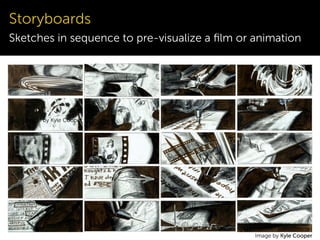
Storyboards
Sketches in sequence to pre-visualize a film or animation
Image by Kyle Cooper
Competitive Analysis
Collect, compare, and conduct
evaluations of competing products
or processes.
OTHER CREATIVITY RESOURCES
The 5 Whys
Ask “Why?” questions in response to
5 consecutive answers.
Wicked Problems by Jon Kolko
el fin!
Thank You!
De ANGELA L. DUFF
Co-Director, Integrated Digital Media
deangela.duff@nyu.edu

Raising The Bar NYC 6/2/2015: Cracking Creativity

  • 1.
    CRACKING CREATIVITY De AngelaL. Duff Co-Director, Integrated Digital Media ! ! ! !
  • 3.
    Agenda Define Creativity Identify Obstaclesto Creativity Discuss Tools & Techniques to Identify New Ideas Discuss Prototyping Discuss The Psychology of a Creative Mindset
  • 4.
    Recommended Resources Austin Kleon MichaelMichalko Edward De Bono Mihaly Csikszentmihalyi Steven Pressfield
  • 5.
    (Contrary to popularbelief) ! CREATIVITY IS NOT SYNONYMOUS WITH ART
  • 6.
    STYLE is beingCONFUSED with CREATIVITY
  • 8.
    CREATIVITY means bringinginto being something that was not there before. ! ! ! 
 ~ Edward de Bono from the book, Serious Creativity
  • 10.
    CREATIVITY is anyact, idea, or product that changes an existing domain, or that transforms an existing domain into a new one. 
 from Mihaly Csikszentmihalyi from the book, Creativity ! !
  • 11.
    And the definitionof a creative person is: someone whose thoughts or actions change a domain, or establish a new domain. 
 
 from Mihaly Csikszentmihalyi from the book, Creativity ! !
  • 12.
    It is importantto remember, however, that a domain cannot be changed without the explicit or implicit consent of a field responsible for it. ! ! from Mihaly Csikszentmihalyi from the book, Creativity ! ! !
  • 13.
    The Psychology of aCreative Mindset
 PLAY & FLOW !
  • 15.
  • 17.
    FLOW - Thestate in which people are so involved in an activity that nothing else seems to matter; the experience itself is so enjoyable that people will do it even at great cost, for the sheer sake of doing it. ! Mihaly Csikszentmihalyi from the book, 
 Flow: The The Psychology of Optimal Experience
  • 18.
    Contrary to whatwe usually believe, moments like these, the best moments in our lives, are not the passive, receptive, relaxing times—although such experiences can also be enjoyable, if we have worked hard to attain them… ! Mihaly Csikszentmihalyi from the book, 
 Flow: The The Psychology of Optimal Experience ! !
  • 19.
    The best momentsusually occur when a person’s body or mind is stretched to its limits in a voluntary effort to accomplish something difficult and worthwhile. Optimal experience is thus something that we make happen.” ! Mihaly Csikszentmihalyi from the book, 
 Flow: The The Psychology of Optimal Experience ! !
  • 20.
    What’s so Funnyabout Science? by Sidney Harris (1977)
  • 22.
    CREATIVITY requires time,effort, & focus ! ! ! 
 from Edward de Bono from the book, Serious Creativity
  • 24.
    If you thinkyou are not creative, you will not be.
  • 25.
    Fear, limiting orrational thoughts, self-deprecation, negative talk from others (also known as forms of “Resistance” coined by Steven Pressfield), and many others are all obstacles to creativity.
  • 27.
    “Inspiration is foramateurs; the rest of us just show up and get to work. If you wait around for the clouds to part and a bolt of lightning to strike you in the brain, you are not going to make an awful lot of work. All the best ideas come out of the process; they come out of the work itself.” 
 
 ~ Chuck Close
  • 28.
    Do The Workby Steven Pressfield
  • 29.
    CREATIVITY as Styleor Expression
  • 31.
  • 32.
    “Good artists copy;great artists steal.” !
  • 39.
    http://everythingisaremix.info by KirbyFerguson a four part video series
  • 42.
    TOOLS & TECHNIQUES toidentify new ideas
  • 43.
  • 44.
    The traditional processof brainstorming sometimes gives the impression that deliberate creativity consists of shooting out a stream of crazy ideas in the hope that one of them might hit a useful target. ! from Edward de Bono from the book, Serious Creativity
  • 45.
    But in almostevery other field a scatter- gun approach to creativity makes no more sense than having a thousand monkeys banging away on typewriters in the hope that one of them might produce a Shakespeare play. ! from Edward de Bono from the book, Serious Creativity
  • 46.
    Individuals working ontheir own produce far more ideas and a far wider range of ideas than when they are working together in a group. ! from Edward de Bono from the book, Serious Creativity
  • 47.
    …individuals are muchbetter at generating ideas and fresh directions. Once the idea has been born then a group may be better able to develop the idea and take it in more directions than can the originator. ! from Edward de Bono from the book, Serious Creativity
  • 48.
  • 50.
    Mind Mapping byhand is highly recommended but, if you must go digital, try Freemind (free) !
  • 51.
    Other Digital MindMapping Tools http://lifehacker.com/five-best-mind- mapping-tools-476534555
  • 53.
    Brainstorming | TheSCAMPER Technique
  • 54.
    SCAMPER is amnemonic that stands for ! Substitute Combine Adapt Modify or Magnify Put to another use Eliminate Reverse
  • 55.
    Substitute ! What materials orresources can you substitute to improve the product or process?
 What other product or process could you use? ! Can you use this product or process somewhere else, or as a substitute for something else?
  • 56.
    Combine ! What would happenif you combined this product or process with another to create something new? !
  • 57.
    Adapt ! How could youadapt or readjust this product or process to serve another purpose or use? ! What other context could you put your product or process into? !
  • 58.
    Modify ! How could youchange the shape, look, or feel of your product or process? ! What could you emphasize or highlight to create more value? ! What element of this product or process could you strengthen to create something new?
  • 59.
    Put to AnotherUse ! Can you use this product or process somewhere else, perhaps in another industry? ! Who else could use this product or process? ! How would this product or process behave differently in another setting? ! Could you recycle the waste from this product or process to make something new?
  • 60.
    Eliminate ! What features, parts,or rules could you eliminate? ! How could you streamline or simplify this product or process? ! How could you make it smaller, faster, lighter, or more fun?
  • 61.
    Reverse ! What would happenif you reversed this process or sequenced things differently? How could you reorganize this product or process? ! What if you try to do the exact opposite of what you're trying to do now? ! What roles could you reverse or swap?
  • 62.
    Brainstorming | TheCard Sorting Technique
  • 63.
    Card Sorting ! Use adark pen or sharpie ! Get four different colors of post-it notes or index cards ! Take pictures of each step along the way. Make sure the photos are lit well and have good contrast.
  • 64.
    Card Sorting Step 1:PROJECT, PRODUCT or PROCESS CARDS ! Identify 15 projects, products or processes that are of interest to you. One card per project, product, or process. All the p cards should be the same color.
  • 65.
    Card Sorting Step 2:DESCRIPTOR CARDS ! Choose a second color of card and create a set of descriptor cards for each project, product or process by listing adjectives or traits of those projects. Try to extract at least 5 descriptor cards per p card.
  • 66.
    Card Sorting Step 3:ENABLER CARDS ! Choose a third color of card and create 3 enabler cards for each p card. The enabler cards are resources that enable the project to exist -- the technology, software, environment, or tools that are needed.
  • 67.
    Card Sorting Step 4:IDEA CARDS ! Make associations between the cards to form new ideas. Once you have an idea, write it on a new idea card. ! Play with the idea of contrast, pairing complementary or opposite things together. Think about what interests you in the existing p cards. Look closely at the relationships between the elements of your newly created ideas.
  • 68.
    Card Sorting Step 5:IDEA LIST ! Make a ranked list of the idea cards.
  • 69.
  • 70.
    Paper Prototyping Rapidly sketch,layout, and evaluate concepts Source: http://www.boardofinnovation.com/wp-content/uploads/2013/04/paperprotoyping.jpg
  • 71.
    Quick-and-Dirty Prototyping Using anymaterials available (i.e. cardboard), quickly assemble possible forms or interactions for evaluation. Source: http://fab.cba.mit.edu/classes/863.12/people/pip/WK2/wk2.html
  • 72.
    Wireframes A screen blueprintor schematic Source: http://www.iafactory.fr/wireframes/en/wireframes-en.html
  • 73.
    Storyboards Sketches in sequenceto pre-visualize a film or animation Image by Kyle Cooper Image by Kyle Cooper
  • 74.
    Competitive Analysis Collect, compare,and conduct evaluations of competing products or processes.
  • 75.
  • 77.
    The 5 Whys Ask“Why?” questions in response to 5 consecutive answers.
  • 78.
  • 81.
  • 82.
    De ANGELA L.DUFF Co-Director, Integrated Digital Media deangela.duff@nyu.edu