Santa Cruz Integrated National High School
Brgy. Oogong, Santa Cruz, Laguna
Creative Writing Quarter 2 – Module 1: Various
Elements, Techniques, and Literary Devices of Drama
What I Know
Let me see how depth your knowledge is about this lesson.
Are you ready? You can begin now.
A. Directions: Write True if the statement is correct and
False if it is incorrect. Use the space provided.
__________ 1. A drama is a type of literature that is written
for the purpose of being read in front of an audience.
__________ 2. Scene is a single situation or unit of dialogue
in a play.
__________ 3. Act is composed of many scenes.
__________ 4. Comedy is a form of drama in which there is
a display of human suffering and catharsis for the audience
__________ 5. Tragedy is a form of entertainment meant to
be humorous.
B. Directions: Read the statements. Determine the letter of
the correct answer.
__________ 6. Someone who writes plays and also known
as a dramatist.
A. Actors B. Author C. Playwright D. Characters
__________ 7. It is a piece of writing in the form of drama
composed of dialogue, stage directions and instructions to
the actors and director.
A. Comedy B. Drama C. Script D. Playwright
__________ 8. The conversation between two or more
characters in a literary work.
A. Drama B. Dialogue C. Script D. Playwright
__________ 9. The form of live theatre in which the plot,
characters and dialogue
of a game, scene or story are made up in the moment.
A. Comedy B. Drama C. Theatre D. Improvisation
__________ 10. The main idea or an underlying meaning of
a literary work, which may be stated directly or indirectly.
A. Conflict B. Drama C. Theme D. Theatre
__________ 11. The person who portrays a character in a
performance.
A. Actors B. Author C. Playwright D. Scriptwriter
__________ 12. The audience knows something the
characters don’t.
A. Drama B. Improvisation C. Dramatic Irony
D. Tragic Irony
__________ 13. It is a literary element that involves a
struggle between two opposing forces, usually a
protagonist and an antagonist.
A. Actors B. Conflict C. Problem D. Theme
__________ 14. A drama or literary work that depicts
calamitous events and has an unhappy but meaningful
ending.
A. Drama B. Comedy C. Dialogue D. Tragedy
__________ 15. It is a device in which an object, person or
situation is given another meaning beyond its literal one.
A. Act B. Audience C. Improvisation D. Symbolism
Good Job! You have successfully answered the first tasks.
Were you able to answer all the items correctly? If not, do
not worry because I am here to help you throughout
this lesson.
Lesson 1 :Elements, Techniques and Literary Devices of
Drama
Drama also known as a play, is a form of literature written
intentionally for theatrical performance. It is usually
fictional and most of its parts are consisted of
scripted dialogues, or only the acting in some cases,
between characters intended to be performed.
It is one of the first forms of storytelling in human history.
Also, drama was popular in many other parts of the world.
Drama examples have continued to be significant in
different areas of the world and throughout different time
periods. One of the reasons that drama has continued to
have such an important place in literature is its unique way
of presenting a narrative in real time.
Did you know that there are various elements, techniques
and literary devices in drama? This module will help you
learn the various elements, techniques and literary devices
in drama. This is your Lesson 1 for Quarter 2.
What’s In
Now, let’s take a look at what you have learned from your
previous lesson/experiences. Can you still remember them?
If yes, let’s answer the next activity.
Activity 1: Match Up
Directions: Let us recall important points. Match column A
with column B. Write the letter of your answer on the space
provided.
A B
________ 1. Plot A. a word or phrase that goes
beyond its literal meaning
________ 2. Theme B. an author's use of vivid and
descriptive language to add
depth to their work
________ 3. Setting C. the sequence of events in a
story
________ 4. Conflict D. a person or another being in a
text
A B
________ 5. Imagery E. the struggle or problem
between two opposing forces
________ 6. Character F. the central topic, subject, or
message within a narrative
________ 7. Assonance G. the time and place (or when
and where) of the story
________ 8. Alliteration H. the repetition of the sound of
a vowel sound
________ 9. Point of View
I. repetition of identical initial
consonant sounds in
successive or closely associated
syllables within a group
of words
________ 10. Figures of Speech
J. refers to who is telling or
narrating a story
Well done! Thank you for trying to remember your previous
lesson. I know it could be hard for you to remember it but
you did your best. Now, I think you are ready. Let’s start
with our lesson.
What’s New
Activity 2: Double Trouble
Directions: You have learned about prose and poetry in
your previous modules. Study the two forms of text below.
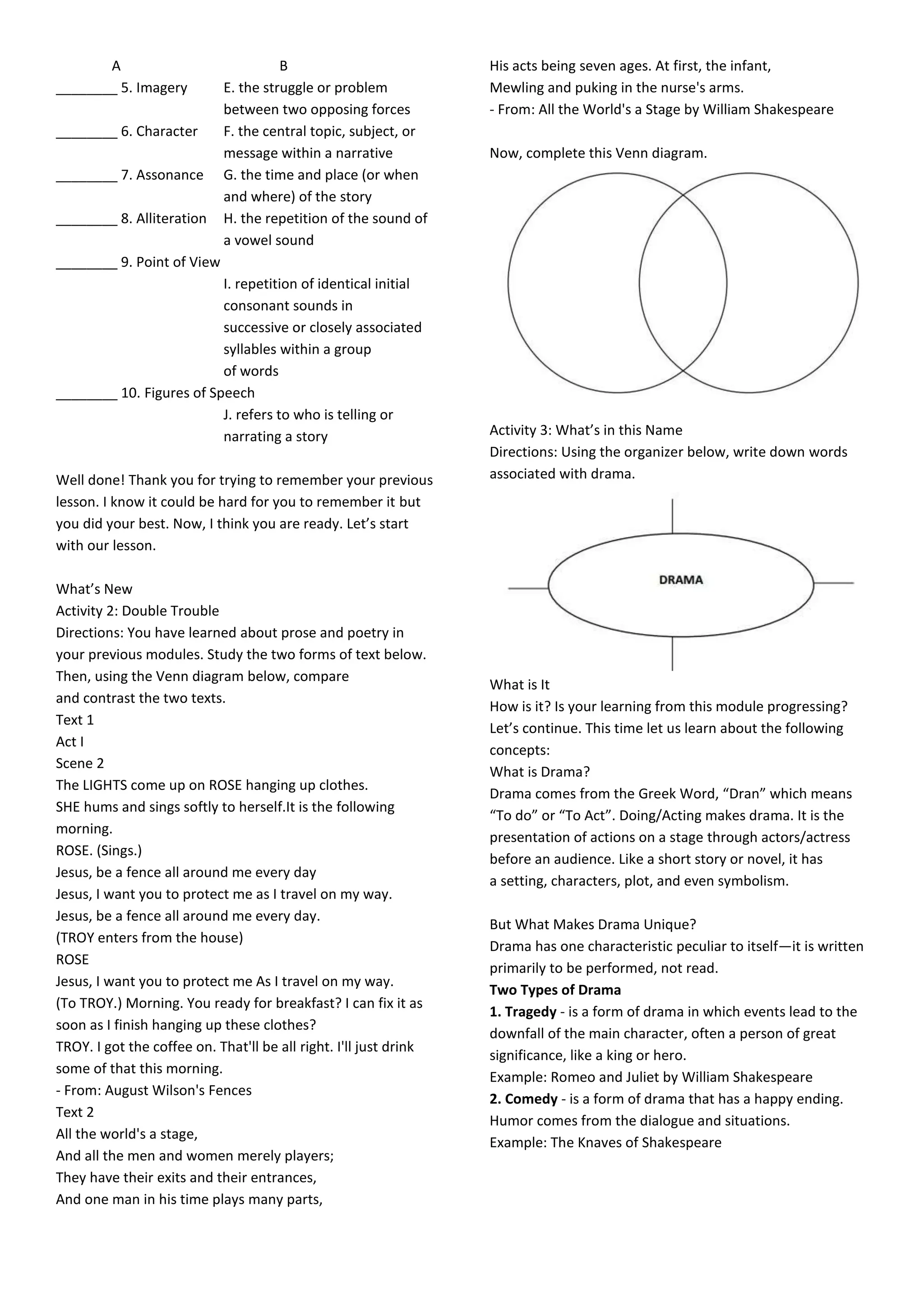
Then, using the Venn diagram below, compare
and contrast the two texts.
Text 1
Act I
Scene 2
The LIGHTS come up on ROSE hanging up clothes.
SHE hums and sings softly to herself.It is the following
morning.
ROSE. (Sings.)
Jesus, be a fence all around me every day
Jesus, I want you to protect me as I travel on my way.
Jesus, be a fence all around me every day.
(TROY enters from the house)
ROSE
Jesus, I want you to protect me As I travel on my way.
(To TROY.) Morning. You ready for breakfast? I can fix it as
soon as I finish hanging up these clothes?
TROY. I got the coffee on. That'll be all right. I'll just drink
some of that this morning.
- From: August Wilson's Fences
Text 2
All the world's a stage,
And all the men and women merely players;
They have their exits and their entrances,
And one man in his time plays many parts,
His acts being seven ages. At first, the infant,
Mewling and puking in the nurse's arms.
- From: All the World's a Stage by William Shakespeare
Now, complete this Venn diagram.
Activity 3: What’s in this Name
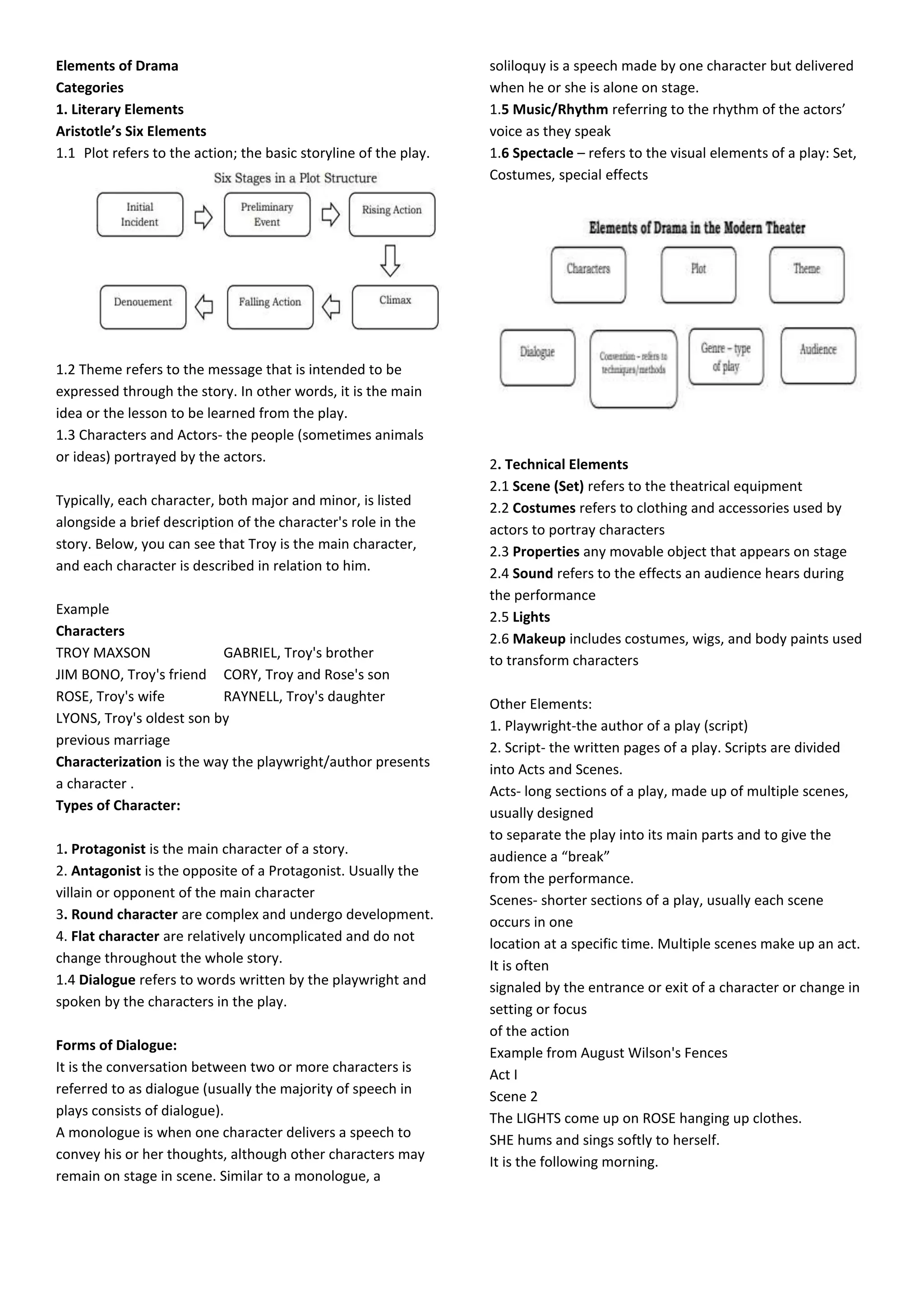
Directions: Using the organizer below, write down words
associated with drama.
What is It
How is it? Is your learning from this module progressing?
Let’s continue. This time let us learn about the following
concepts:
What is Drama?
Drama comes from the Greek Word, “Dran” which means
“To do” or “To Act”. Doing/Acting makes drama. It is the
presentation of actions on a stage through actors/actress
before an audience. Like a short story or novel, it has
a setting, characters, plot, and even symbolism.
But What Makes Drama Unique?
Drama has one characteristic peculiar to itself—it is written
primarily to be performed, not read.
Two Types of Drama
1. Tragedy - is a form of drama in which events lead to the
downfall of the main character, often a person of great
significance, like a king or hero.
Example: Romeo and Juliet by William Shakespeare
2. Comedy - is a form of drama that has a happy ending.
Humor comes from the dialogue and situations.
Example: The Knaves of Shakespeare
Elements of Drama
Categories
1. Literary Elements
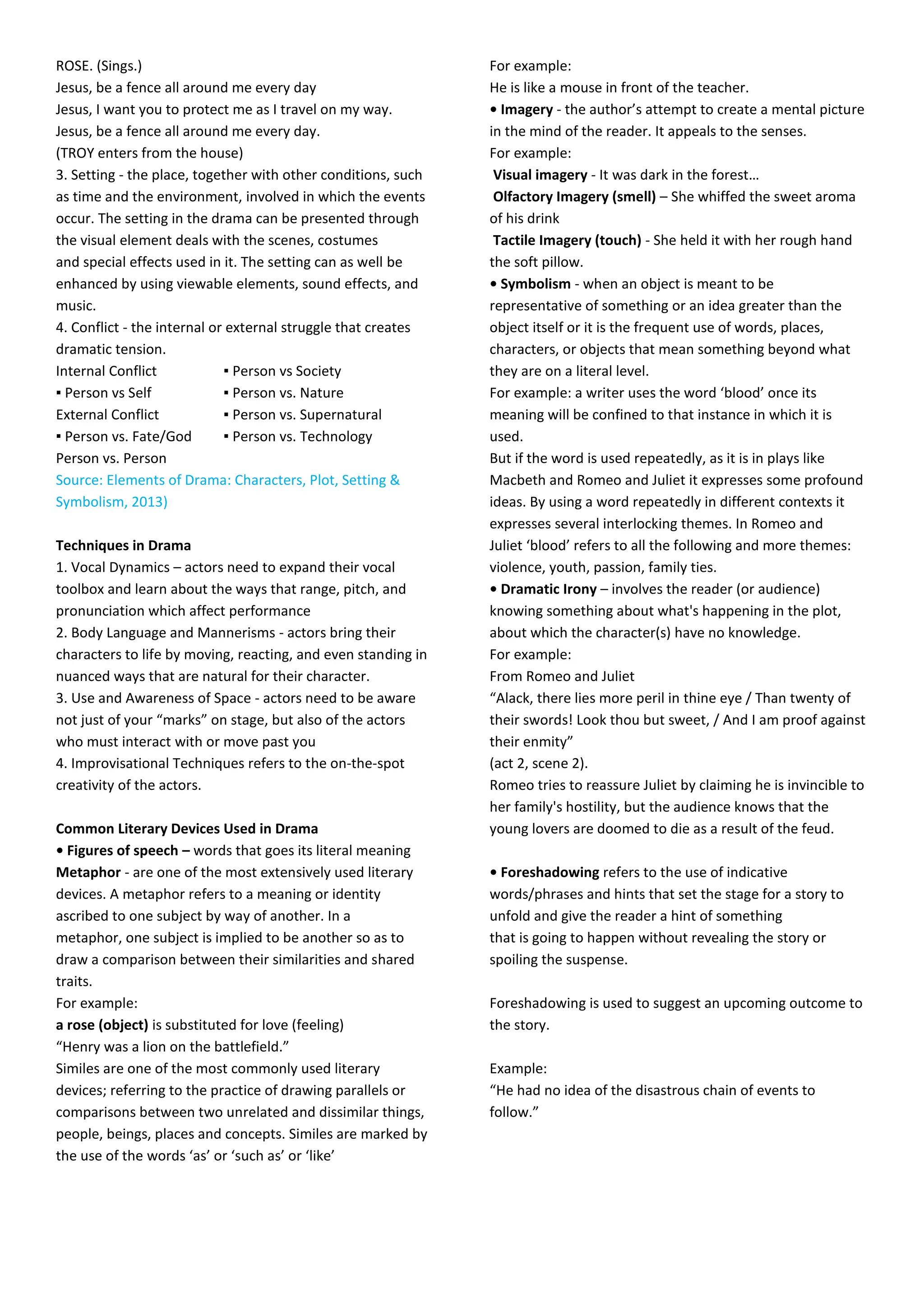
Aristotle’s Six Elements
1.1 Plot refers to the action; the basic storyline of the play.
1.2 Theme refers to the message that is intended to be
expressed through the story. In other words, it is the main
idea or the lesson to be learned from the play.
1.3 Characters and Actors- the people (sometimes animals
or ideas) portrayed by the actors.
Typically, each character, both major and minor, is listed
alongside a brief description of the character's role in the
story. Below, you can see that Troy is the main character,
and each character is described in relation to him.
Example
Characters
TROY MAXSON GABRIEL, Troy's brother
JIM BONO, Troy's friend CORY, Troy and Rose's son
ROSE, Troy's wife RAYNELL, Troy's daughter
LYONS, Troy's oldest son by
previous marriage
Characterization is the way the playwright/author presents
a character .
Types of Character:
1. Protagonist is the main character of a story.
2. Antagonist is the opposite of a Protagonist. Usually the
villain or opponent of the main character
3. Round character are complex and undergo development.
4. Flat character are relatively uncomplicated and do not
change throughout the whole story.
1.4 Dialogue refers to words written by the playwright and
spoken by the characters in the play.
Forms of Dialogue:
It is the conversation between two or more characters is
referred to as dialogue (usually the majority of speech in
plays consists of dialogue).
A monologue is when one character delivers a speech to
convey his or her thoughts, although other characters may
remain on stage in scene. Similar to a monologue, a
soliloquy is a speech made by one character but delivered
when he or she is alone on stage.
1.5 Music/Rhythm referring to the rhythm of the actors’
voice as they speak
1.6 Spectacle – refers to the visual elements of a play: Set,
Costumes, special effects
2. Technical Elements
2.1 Scene (Set) refers to the theatrical equipment
2.2 Costumes refers to clothing and accessories used by
actors to portray characters
2.3 Properties any movable object that appears on stage
2.4 Sound refers to the effects an audience hears during
the performance
2.5 Lights
2.6 Makeup includes costumes, wigs, and body paints used
to transform characters
Other Elements:
1. Playwright-the author of a play (script)
2. Script- the written pages of a play. Scripts are divided
into Acts and Scenes.
Acts- long sections of a play, made up of multiple scenes,
usually designed
to separate the play into its main parts and to give the
audience a “break”
from the performance.
Scenes- shorter sections of a play, usually each scene
occurs in one
location at a specific time. Multiple scenes make up an act.
It is often
signaled by the entrance or exit of a character or change in
setting or focus
of the action
Example from August Wilson's Fences
Act I
Scene 2
The LIGHTS come up on ROSE hanging up clothes.
SHE hums and sings softly to herself.
It is the following morning.
ROSE. (Sings.)
Jesus, be a fence all around me every day
Jesus, I want you to protect me as I travel on my way.
Jesus, be a fence all around me every day.
(TROY enters from the house)
3. Setting - the place, together with other conditions, such
as time and the environment, involved in which the events
occur. The setting in the drama can be presented through
the visual element deals with the scenes, costumes
and special effects used in it. The setting can as well be
enhanced by using viewable elements, sound effects, and
music.
4. Conflict - the internal or external struggle that creates
dramatic tension.
Internal Conflict ▪ Person vs Society
▪ Person vs Self ▪ Person vs. Nature
External Conflict ▪ Person vs. Supernatural
▪ Person vs. Fate/God ▪ Person vs. Technology
Person vs. Person
Source: Elements of Drama: Characters, Plot, Setting &
Symbolism, 2013)
Techniques in Drama
1. Vocal Dynamics – actors need to expand their vocal
toolbox and learn about the ways that range, pitch, and
pronunciation which affect performance
2. Body Language and Mannerisms - actors bring their
characters to life by moving, reacting, and even standing in
nuanced ways that are natural for their character.
3. Use and Awareness of Space - actors need to be aware
not just of your “marks” on stage, but also of the actors
who must interact with or move past you
4. Improvisational Techniques refers to the on-the-spot
creativity of the actors.
Common Literary Devices Used in Drama
• Figures of speech – words that goes its literal meaning
Metaphor - are one of the most extensively used literary
devices. A metaphor refers to a meaning or identity
ascribed to one subject by way of another. In a
metaphor, one subject is implied to be another so as to
draw a comparison between their similarities and shared
traits.
For example:
a rose (object) is substituted for love (feeling)
“Henry was a lion on the battlefield.”
Similes are one of the most commonly used literary
devices; referring to the practice of drawing parallels or
comparisons between two unrelated and dissimilar things,
people, beings, places and concepts. Similes are marked by
the use of the words ‘as’ or ‘such as’ or ‘like’
For example:
He is like a mouse in front of the teacher.
• Imagery - the author’s attempt to create a mental picture
in the mind of the reader. It appeals to the senses.
For example:
Visual imagery - It was dark in the forest…
Olfactory Imagery (smell) – She whiffed the sweet aroma
of his drink
Tactile Imagery (touch) - She held it with her rough hand
the soft pillow.
• Symbolism - when an object is meant to be
representative of something or an idea greater than the
object itself or it is the frequent use of words, places,
characters, or objects that mean something beyond what
they are on a literal level.
For example: a writer uses the word ‘blood’ once its
meaning will be confined to that instance in which it is
used.
But if the word is used repeatedly, as it is in plays like
Macbeth and Romeo and Juliet it expresses some profound
ideas. By using a word repeatedly in different contexts it
expresses several interlocking themes. In Romeo and
Juliet ‘blood’ refers to all the following and more themes:
violence, youth, passion, family ties.
• Dramatic Irony – involves the reader (or audience)
knowing something about what's happening in the plot,
about which the character(s) have no knowledge.
For example:
From Romeo and Juliet
“Alack, there lies more peril in thine eye / Than twenty of
their swords! Look thou but sweet, / And I am proof against
their enmity”
(act 2, scene 2).
Romeo tries to reassure Juliet by claiming he is invincible to
her family's hostility, but the audience knows that the
young lovers are doomed to die as a result of the feud.
• Foreshadowing refers to the use of indicative
words/phrases and hints that set the stage for a story to
unfold and give the reader a hint of something
that is going to happen without revealing the story or
spoiling the suspense.
Foreshadowing is used to suggest an upcoming outcome to
the story.
Example:
“He had no idea of the disastrous chain of events to
follow.”
What’s More
You’ve done a great job in the previous activities. Now, I
think you are equipped with ideas and ready for more
challenging and exciting tasks. Try to answer
this.
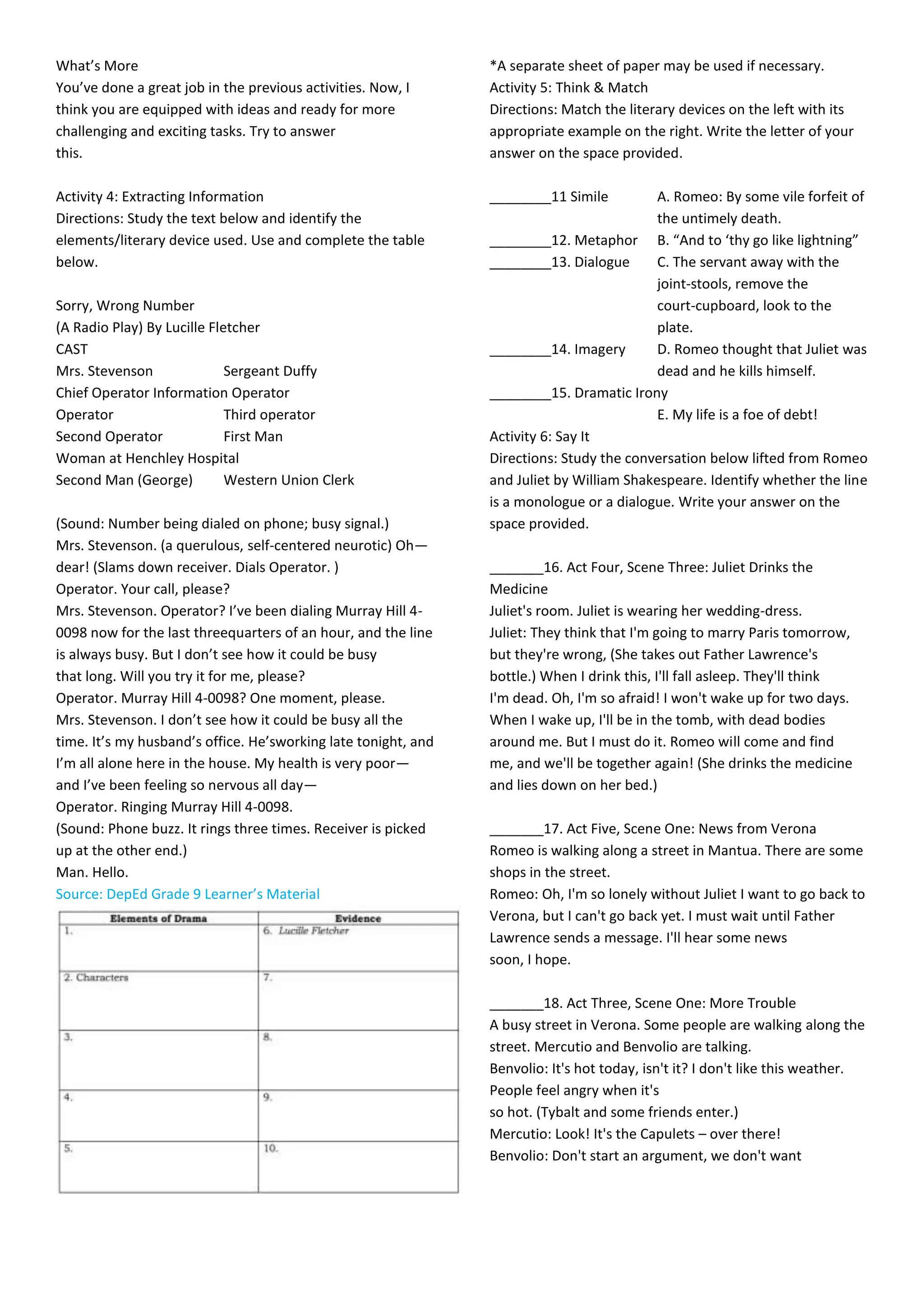
Activity 4: Extracting Information
Directions: Study the text below and identify the
elements/literary device used. Use and complete the table
below.
Sorry, Wrong Number
(A Radio Play) By Lucille Fletcher
CAST
Mrs. Stevenson Sergeant Duffy
Chief Operator Information Operator
Operator Third operator
Second Operator First Man
Woman at Henchley Hospital
Second Man (George) Western Union Clerk
(Sound: Number being dialed on phone; busy signal.)
Mrs. Stevenson. (a querulous, self-centered neurotic) Oh—
dear! (Slams down receiver. Dials Operator. )
Operator. Your call, please?
Mrs. Stevenson. Operator? I’ve been dialing Murray Hill 4-
0098 now for the last threequarters of an hour, and the line
is always busy. But I don’t see how it could be busy
that long. Will you try it for me, please?
Operator. Murray Hill 4-0098? One moment, please.
Mrs. Stevenson. I don’t see how it could be busy all the
time. It’s my husband’s office. He’sworking late tonight, and
I’m all alone here in the house. My health is very poor—
and I’ve been feeling so nervous all day—
Operator. Ringing Murray Hill 4-0098.
(Sound: Phone buzz. It rings three times. Receiver is picked
up at the other end.)
Man. Hello.
Source: DepEd Grade 9 Learner’s Material
*A separate sheet of paper may be used if necessary.
Activity 5: Think & Match
Directions: Match the literary devices on the left with its
appropriate example on the right. Write the letter of your
answer on the space provided.
________11 Simile A. Romeo: By some vile forfeit of
the untimely death.
________12. Metaphor B. “And to ‘thy go like lightning”
________13. Dialogue C. The servant away with the
joint-stools, remove the
court-cupboard, look to the
plate.
________14. Imagery D. Romeo thought that Juliet was
dead and he kills himself.
________15. Dramatic Irony
E. My life is a foe of debt!
Activity 6: Say It
Directions: Study the conversation below lifted from Romeo
and Juliet by William Shakespeare. Identify whether the line
is a monologue or a dialogue. Write your answer on the
space provided.
_______16. Act Four, Scene Three: Juliet Drinks the
Medicine
Juliet's room. Juliet is wearing her wedding-dress.
Juliet: They think that I'm going to marry Paris tomorrow,
but they're wrong, (She takes out Father Lawrence's
bottle.) When I drink this, I'll fall asleep. They'll think
I'm dead. Oh, I'm so afraid! I won't wake up for two days.
When I wake up, I'll be in the tomb, with dead bodies
around me. But I must do it. Romeo will come and find
me, and we'll be together again! (She drinks the medicine
and lies down on her bed.)
_______17. Act Five, Scene One: News from Verona
Romeo is walking along a street in Mantua. There are some
shops in the street.
Romeo: Oh, I'm so lonely without Juliet I want to go back to
Verona, but I can't go back yet. I must wait until Father
Lawrence sends a message. I'll hear some news
soon, I hope.
_______18. Act Three, Scene One: More Trouble
A busy street in Verona. Some people are walking along the
street. Mercutio and Benvolio are talking.
Benvolio: It's hot today, isn't it? I don't like this weather.
People feel angry when it's
so hot. (Tybalt and some friends enter.)
Mercutio: Look! It's the Capulets – over there!
Benvolio: Don't start an argument, we don't want
Activity 7: Write it
Directions: Based on the samples given, try to write your
own dialogue. Use the spaces below.
19-20.
________________________________________________
__________________________________
________________________________________________
__________________________________
________________________________________________
__________________________________
________________________________________________
__________________________________
Wow! Congratulations, you made it! Take time to rest for
now. You have done so much.
What I Have Learned
Did you learn something from this lesson? If so, then tell
me.
My journey through this lesson enabled me to learn that
drama
________________________________________________
__________________________________
________________________________________________
__________________________________
________________________________________________
__________________________________
________________________________________________
_________________________________.
It made me realize that
________________________________________________
__________________________________
________________________________________________
__________________________________
________________________________________________
__________________________________
______________________________________________.
Remember the points below:
✓ Drama is a written work intended to be performed.
✓ There are various elements, techniques, and literary
device used in drama.
What I Can Do
You’re doing great! How do you feel about it? Do you want
to add more proof of your understanding? Try this.
Activity 8: Real-Life-Extension
Directions:
• Interview someone about their favorite drama or play; or
• Recall a recent drama/play that you have read, watch or
heard.
• Asks him/her the reasons why he/she likes the drama or
play.
• Look/Ask for a copy of the drama.
• Choose a part of the drama.
• Identify the various elements, techniques, and literary
devices used in that particular scene chosen.
• Use the spaces provided below or you may use an
additional sheet of paper.
Title:
________________________________________________
___
Author:
________________________________________________
_
Reasons:
________________________________________________
__________________________________
________________________________________________
__________________________________
________________________________________________
__________________________________
________________________________________________
__________________________________
________________________________________________
__________________________________
________________________________________________
__________________________________
Assessment
Well done! We are now close to the finish line of this
module. But, before we say goodbye, kindly take this test to
check how much you have learned from this module.
Activity 9: Final Task
Directions: Study and complete each statement below.
Write letter of your answer on a separate answer sheet.
1. In drama, a/an _______________________ is any
conversation between two or more people.
A. Actors B. Dialogue C. Monologue D. Script
2. _________________ refers to the range, pitch, and
pronunciation of the actors which affect performance.
A. Improvisational Techniques
B. Mannerisms
C. Space
D. Vocal Dynamics
3. A/an ____________________________ is lines spoken
by one person (it can be to someone else, to
himself/herself, or to the audience).
A. Actors B. Dialogue C. Monologue D. Script
4. A/an _________________ is the the sequence of events
in a story.
A. Act B. Plot C. Scene D. Climax
5. A _________________ is a type of literature that is
written for the purpose of being read in front of an
audience.
A. Drama B. Dialogue C. Scene D. Script
6. _________________ is a single situation or unit of
dialogue in a play.
A. Act B. Drama C. Dialogue D. Scene
7. _________________ is a form of drama in which there is
a display of human suffering and catharsis for the audience.
A. Comedy B. Drama C. Dialogue D. Tragedy
8. A/an _________________ is composed of many scenes.
A. Act B. Drama C. Dialogue D. Scene
9. A _________________ is a form of entertainment meant
to be humorous
A. Comedy B. Drama C. Dialogue D. Tragedy
10. _________________ is author’s attempt to create a
mental picture in the mind of the reader. It appeals to the
senses.
A. Imagery B. Metaphor C. Simile D. Symbolism
11. _________________ refers to the on-the-spot creativity
of the actors.
A. Improvisational Techniques
B. Mannerisms
C. Space
D. Vocal Dynamics
12. A___________ is a piece of writing in the form of drama
composed of dialogue, stage directions and instructions to
the actors and director.
A. Comedy B. Drama C. Script D. Playwright
13. ____________ is used to suggest an upcoming outcome
to the story.
A. Imagery B. Dramatic Irony
C. Foreshadowing D. Symbolism
14. A____________ refers to the visual elements of a play.
A. Costume B. Props C. Set D. Spectacle
15. A type of character that undergo changes in the text.
A. Actors B. Antagonist C. Flat D. Round
Additional Activities
Good job! We are nearly done.
Directions: Write you own one-scene for a one-act play
considering the various elements, techniques, and literary
devices of drama. You may write a common scenario at
home. Use the spaces below. You may also use a separate
sheet of paper if necessary. The rubric below shall be used
for evaluating your work.
________________________________________________
__________________________________
________________________________________________
__________________________________
________________________________________________
__________________________________
________________________________________________
__________________________________
________________________________________________
__________________________________
________________________________________________
__________________________________
________________________________________________
__________________________________
________________________________________________
__________________________________
________________________________________________
__________________________________
________________________________________________
__________________________________
________________________________________________
__________________________________
________________________________________________
__________________________________
________________________________________________
__________________________________
CREATIVE WRITING Q2MODULE 1 CREATIVE WRITING Q2MODULE 1
Santa Cruz Integrated National High School
Brgy. Oogong, Santa Cruz, Laguna
Creative Writing Quarter 2 – Module 1: Various Elements,
Techniques, and Literary Devices of Drama
What I Know Directions: Read the statements carefully.
Identify what is being defined in each number. Choose the
letter of the correct answer in the box. Write your answers on
your answer sheet. This is just a pretest. Your score on this part
will not be graded.
1. This refers to a person or individual in the drama that may have
defined personal qualities and/or histories.
2. This refers to the words used, the accent, tone, pattern of
speech, and even the pauses in speech, say a lot about the
character and help reveal not just his personality, but also his
social status, past, and family background as given by the play.
3. This pertains to the message that the play gives to the audience.
4. This pertains to the order of events occurring in a play, exposing
the past or background of the main and other characters, and the
point of conflict, then proceeds to giving the central theme or
climax.
5. This refers to the time and place where a story is set is one of its
important parts.
6. This includes what the character wears and how the character
carries himself on stage.
7. This includes the use of sounds and rhythm in dialogs as well as
music compositions that are used in the plays.
8. This deals with the scenes, costumes, and special effects used
in it.
9. This defines how the play is presented to the audiences. The
use and organization of stage properties and the overall setting of
a play.
10. These are often used to give hints of the future events in the
story as these complement the other elements of a scene and
make it more effective.
What’s In Learning Task 1: Arrange to Know Directions:
Arrange the jumbled letter to identify the words that are
relevant to our topic. Definitions will help you to determine the
hidden words. Write your answers on your answer sheet.
What is It
In this part of your journey, we provide something for you to
deepen your understanding about the various elements,
techniques, and literary devices in drama Please continue reading
with comprehension as you discover further knowledge that will
help you out in your quest on the remaining phases of this lesson.
What is Drama?
-Drama in literature refers to the performance of written dialogue
and stage action. It’s a literary genre that allows actors to act out a
writer’s words directly to an audience.
- It is a composition in prose or verse presenting in dialogue
or pantomime a story involving conflict or contrast of
character, especially one intended to be acted on the stage
- It is a mode of fictional representation through dialogue and
performance. It is one of the literary genres, which is an
imitation of some action. Drama is also a type of a play written
for theater, television, radio, and film.
Different Types of Literary Drama
Comedies are usually humorous plays which uses clever wordplay
or turns of phrase. Farce is a comic dramatic work using
buffoonery and horseplay and typically including crude
characterization and ludicrously improbable situations.
Melodrama is a dramatic work wherein the plot, which is typically
sensational and designed to appeal strongly to the emotions, takes
precedence over detailed characterization. Melodramas typically
concentrate on dialogue, which is often bombastic or excessively
sentimental, rather than action.
Musical drama is an opera in which the musical and dramatic
elements are equally important; the music is appropriate to the
action. opera - a drama set to music; consists of singing with
orchestral accompaniment and an orchestral overture and
interludes.
Tragedy is a genre of story in which a hero is brought down by
his/her own flaws, usually by ordinary human flaws – flaws like
greed, over-ambition, or even an excess of love, honor, or loyalty.
Tragicomedy is a literary genre that blends aspects of both tragic
and comic forms. Most often seen in dramatic literature, the term
can describe either a tragic play which contains enough comic
elements to lighten the overall mood or a serious play with a happy
ending.
Elements of Drama
In literature, drama is the specific mode of fiction represented in
performance. The story progresses through interactions between
its characters and ends with a message for the audience. The six
Aristotelian elements of drama are the plot, character, thought,
diction, spectacle, and song.
Plot refers to the order of events occurring in a play make its plot.
Essentially, the plot is the story that the play narrates. The
entertainment value of a play depends largely on the sequence of
events in the story.
Most stories have a beginning, middle and an end. However, your
drama doesn’t have to run in this linear order. Some work is non-
linear in structure.
At the most basic level, there are five primary elements of plot:
exposition, rising action, climax, falling action, and resolution. This
is also referred to as dramatic structure, as it originated from plays.
A linear plot consists of a series of events that have a clear
beginning, middle and end. The story unfolds in a chronological
order, which means they are told in the order they happened. The
structure shown above is an example of a linear plot.
Nonlinear plots describe events out of chronological order.
Present events may be interrupted to describe past situations, or a
story may start at the middle or end instead of the beginning. In
nonlinear plots, authors may employ different literary techniques to
tell their stories. Some common techniques include flashback,
foreshadowing, subplots, and parallel plots.
Characters refers a person or individual in the drama that may
have defined personal qualities and/or histories. Most writers have
an inherent understanding of how to categorize their characters
based on classic, “comic book-style” labels: heroes, villains,
sidekicks, etc.
There are many ways to categorize main characters: protagonist or
antagonist, dynamic or static character, and round or flat
characters. A character can also often fit into more than one
category or move through categories.
A protagonist is a main character who generates the action of a
story and engages the reader's interest and empathy. The
protagonist is often the hero or heroine.
An antagonist is a character who opposes the protagonist.
A dynamic character is one who goes through some sort of
change; they show character development. A protagonist is usually
a dynamic character.
A static character refers to those who do not change throughout
the course of the story. They serve to show contrast to dynamic
ones, refusing to grow and remaining in one place or mentality.
A flat character refers to the two-dimensional in that they are
relatively uncomplicated and do not change throughout the course
of a work.
A round character is complex and undergo development,
sometimes sufficiently to surprise the reader.
Thought or called to be the theme refers to its central idea. It can
either be clearly stated through dialog or action, or can be inferred
after watching the entire performance. The theme is the philosophy
that forms the base of the story or a moral lesson that the
characters learn.
Plays may often be written about an idea, but the playwright will
probably focus more on plot and character to get idea across,
plays are seldom about an idea.Some general themes in play are:
Diction is the language used to depart information, reveal
characters, characterize, direct attention, reveal themes and ideas,
establish mood / tone, establish tempo / rhythm appropriate to
character.
Diction pertains to the words used, the accent, tone, pattern of
speech, and even the pauses in speech, say a lot about the
character and help reveal not just his personality, but also his
social status, past, and family background as given by the
play. Monologues and soliloquies that are speeches given to
oneself or to other characters help put forward points that would
have been difficult to express through dialogs.
There are various forms of dialogs which are:
Spectacle is the most immediate element which is appropriate and
distinctive in a play. This refers to the visual elements of a play:
sets, costumes, special effects, etc. Spectacle is everything that
the audience sees as they watch the play.
Spectacle refers to the visual elements which leads to performance
as this defines how the play is presented to the audiences. The
use and organization of stage properties and the overall setting of
a play.
Songs refers to the sound of the dialog, etc. musicality, rhythm,
pace, etc. which helps establish mood, characterize, lend variety,
pleasurable.
This element includes the use of sounds and rhythm in dialogs as
well as music compositions that are used in the plays. The
background score, the songs, and the sound effects used should
complement the situation and the characters in it. The right kind of
sound effects or music, if placed at the right points in the story,
act as a great supplement to the high and low points in the play.
The music and the lyrics should go well with the play’s theme. If
the scenes are accompanied by pieces of music, they become
more effective on the audiences.
The structure of the story comprises the way in which it is
dramatized. How well the actors play their roles and the story’s
framework constitute the structure of drama. Direction is an
essential constituent of a play. A well-directed story is more
effective.
Stagecraft defines how the play is presented to the audiences.
The use and organization of stage properties and the overall
setting of a play are a part of stagecraft, which is a key element of
drama.
Symbols are often used to give hints of the future events in the
story. They complement the other elements of a scene and make it
more effective.
Techniques in Drama
In play, even if you’re a natural performer who can cry on
command and memorize lines, you’ll need to learn the following
fundamental drama techniques to really master the art of acting.
The following are the techniques in drama.
Body, in drama character is conveyed through posture, gesture
and facial expression. In this way the audience can instantly
identify with a character type or understand a situation without a
word being spoken
Space, in drama, the positioning of objects and bodies on the
stage and the relationship between them are vital means of making
meaning.Grouping Levels, Pathways and Personal Space are all
important aspects of space.
Voice pertains on how actors speak their lines instantly identify
personality and emotion.Volume, pitch, pausing intonation, pace
and accent can all influence audience
understanding of a character and the tension of the scene.
Movement refers to the use of timing, direction and energy to build
a sustained sequence of movement can enhance understanding of
character and the meaning of the scene.
Literary Devices in Drama
To understand the literary devices in drama, Shakespeare used
many literary devices (and also many poetic devices), below are
the most important ones, most central to his work.
Allusion is a reference to a person, place, event, usually without
explicit identification. Allusions can be references to mythology, the
bible, historical events, geography, legends, or other literary works.
Authors often use allusion to establish a tone, create an implied
association, contrast two objects or people, make an unusual
juxtaposition of references, or bring the reader into a world of
experience outside the limitations of the story itself.
Dramatic device is a convention used in drama as a substitution
for reality that the audience accepts as real although they know
them to be false. These techniques give the audience information
they could not get from straightforward presentation of action.
plays.
Dramatic irony is a literary device by which the audience’s or
reader’s understanding of events or individuals in a work
surpasses that of its characters.
Dramatic irony is a form of irony that is expressed through a work’s
structure: an audience’s awareness of the situation in which a
work’s characters exist differs substantially from that of the
characters’, and the words and actions of the characters therefore
take on a different—often contradictory—meaning for the
audience than they have for the work’s characters.
Monologue is a long, uninterrupted speech that is spoken in the
presence of other characters. Unlike a soliloquy a monologue is
heard by other characters
Soliloquy is a speech in which a character, who is usually alone
on the stage, expresses his or her thoughts aloud. It is a very
useful device, as it allows the writer to convey a character’s most
intimate thoughts and feelings directly to the audience.
Symbolism expresses some profound ideas by using a word
repeatedly in different contexts. It expresses several interlocking
themes in frequent use of words, places, characters, or objects that
mean something beyond what they are on a literal level.
What’s More
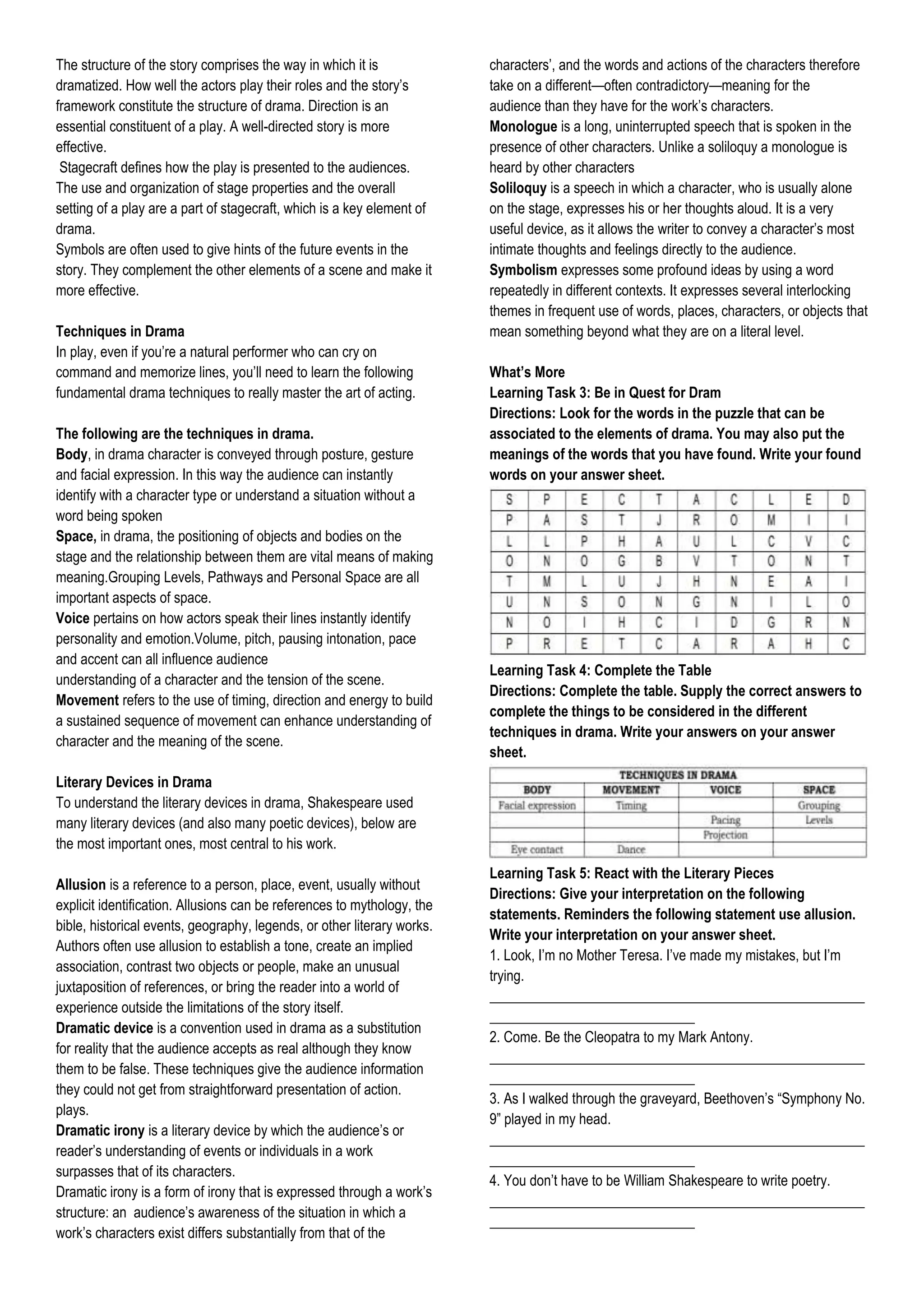
Learning Task 3: Be in Quest for Dram
Directions: Look for the words in the puzzle that can be
associated to the elements of drama. You may also put the
meanings of the words that you have found. Write your found
words on your answer sheet.
Learning Task 4: Complete the Table
Directions: Complete the table. Supply the correct answers to
complete the things to be considered in the different
techniques in drama. Write your answers on your answer
sheet.
Learning Task 5: React with the Literary Pieces
Directions: Give your interpretation on the following
statements. Reminders the following statement use allusion.
Write your interpretation on your answer sheet.
1. Look, I’m no Mother Teresa. I’ve made my mistakes, but I’m
trying.
_____________________________________________________
_____________________________
2. Come. Be the Cleopatra to my Mark Antony.
_____________________________________________________
_____________________________
3. As I walked through the graveyard, Beethoven’s “Symphony No.
9” played in my head.
_____________________________________________________
_____________________________
4. You don’t have to be William Shakespeare to write poetry.
_____________________________________________________
_____________________________
5. Well, I’m no Hercules, but I could open that jelly jar for you.
What I Have Learned
Learning Task 6: “T-M-L Phrase
Complete the following phrases.
The Topic was about
_____________________________________________________
_________________
It Matters because
_____________________________________________________
_________________
I’ve Learned today that
Assessment
Writing Time! Directions: With your learnings with the
different elements,
techniques and literary devices in drama, do the outlining or
planning of your story
to be written. Do this on your answer sheet.
I. Characters (Consider the kinds of characters)
II. Setting (Consider the elements of setting)
III. Plot (Identify the five parts of a plot)
IV. Theme, Tone, Subject, Motif
V. Conflict and Point of View
VI. Plot Device, Vision and Finale used in the story
VII. Symbolism:
VIII. Diction:
IX. Spectacle:
X. Song:
Santa Cruz Integrated National High School
Brgy. Oogong, Santa Cruz, Laguna
Creative Writing Quarter 2 – Module 2: Understanding
Intertextuality as a Technique of Drama
What I Know
Directions: Using a mind map, present your idea on what the terms
mean and how will you use your knowledge in writing outputs in
Creative Writing. Do this on your answer sheet.
What’s In
Learning Task 1: Identify the purpose
Directions: Knowing your writing preferences will help you be more
successful in your writing process. To determine your idiosyncratic
writing preferences, answer the following questions on your paper:
1. What is intertextuality?
2. How do I identify implicit and explicit intertextuality in a text?
3. What is the purpose of intertextuality?
4. How does intertextuality deepen our understanding of the ideas,
themes and perspectives in texts?
What is It
In this part of your journey, we provide something for you to
deepen your understanding about intertextuality as a technique of
drama.
Please continue reading with comprehension as you discover
further knowledge that will help you out in your quest on the
remaining phases of this lesson.
What is Intertextuality?
Intertextuality is a word coined by Julia Kristeva, a French linguist
who has written much on this topic. This word has a broader
meaning in today′s context than the theories she expounds in her
seminal work on intertextuality which are "word, dialogue and
novel". Her notion of Intertextuality refers to the literal and effective
presence in a text of another text. ‘’A text’’, according to her, ‘’is a
permutation of texts, an Intertextuality in the space of a given text,
in which several utterances, taken from other texts, intersect and
neutralize one another”
Intertextuality is the shaping of a text's meaning by another text. It
is the interconnection between similar or related works of literature
that reflect and influence an audience's interpretation of the text.
Intertextuality is the relation between texts that are inflicted by
means of quotations and allusion.
When writers borrow from previous texts, their work acquires
layers of meaning. In addition, when a text is read in the light of
another text, all the assumptions and effects of the other text give a
new meaning and influence the way of interpreting the original text.
Intertextuality is when a text implicitly and explicitly refers to
another text, by using common or recognizable elements of the
referenced text.
An implicit reference is when the composer alludes to another text
through ideas, symbols, genre or style.
An explicit reference is when the composer directly mentions
quotes or references another text in their work.
Different Types of Intertextuality
Allusion is a subtle or indirect reference to another text, historical
period or religious belief.
Parody is an imitation of another text for satirical purpose, usually
to mock.
Quotation is a direct reference to another text with an
acknowledgement of its composer.
Appropriation is a reworking or the reimagination of a well-known
text to change or extend its meaning.
Adaptation is a film, TV drama or stage play that is based on a
written work.
How does Intertextuality work?
Writing and art will be intertextual whether you want them
to be or not. Latent intertextuality is inescapable! But when should
you employ deliberate intertextuality?
Deliberate intertextuality has a place both in creative
writing and formal essays. In creative writing, it’s a great way to get
inspiration for stories. You can draw on other authors’ stories and
characters, or you can use other art forms to get inspiration. Either
way, when you make deliberate references to these other works
you are employing intertextuality.
A complex use of intertextuality is considered a
sophisticated tool in writing. Rather than referencing phrases from
other works, a refined use of intertextuality involves drawing upon
an ideology, a concept, or even rhetoric from others. Thus,
you may explore the political ideology in your story by drawing
upon the current rhetoric in politics. Alternatively, you may use a
text source and explore it further.
What’s More
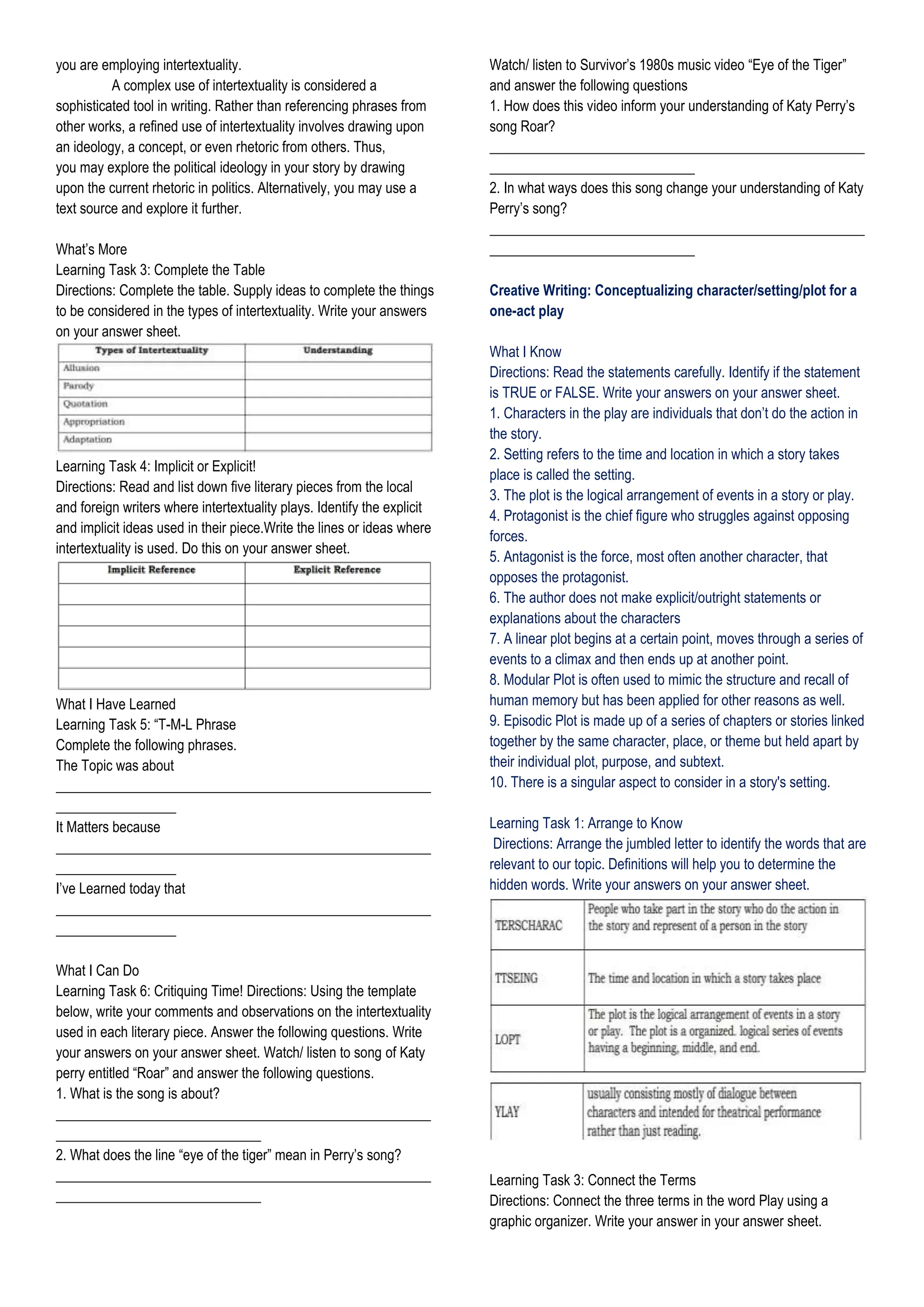
Learning Task 3: Complete the Table
Directions: Complete the table. Supply ideas to complete the things
to be considered in the types of intertextuality. Write your answers
on your answer sheet.
Learning Task 4: Implicit or Explicit!
Directions: Read and list down five literary pieces from the local
and foreign writers where intertextuality plays. Identify the explicit
and implicit ideas used in their piece.Write the lines or ideas where
intertextuality is used. Do this on your answer sheet.
What I Have Learned
Learning Task 5: “T-M-L Phrase
Complete the following phrases.
The Topic was about
_____________________________________________________
_________________
It Matters because
_____________________________________________________
_________________
I’ve Learned today that
_____________________________________________________
_________________
What I Can Do
Learning Task 6: Critiquing Time! Directions: Using the template
below, write your comments and observations on the intertextuality
used in each literary piece. Answer the following questions. Write
your answers on your answer sheet. Watch/ listen to song of Katy
perry entitled “Roar” and answer the following questions.
1. What is the song is about?
_____________________________________________________
_____________________________
2. What does the line “eye of the tiger” mean in Perry’s song?
_____________________________________________________
_____________________________
Watch/ listen to Survivor’s 1980s music video “Eye of the Tiger”
and answer the following questions
1. How does this video inform your understanding of Katy Perry’s
song Roar?
_____________________________________________________
_____________________________
2. In what ways does this song change your understanding of Katy
Perry’s song?
_____________________________________________________
_____________________________
Creative Writing: Conceptualizing character/setting/plot for a
one-act play
What I Know
Directions: Read the statements carefully. Identify if the statement
is TRUE or FALSE. Write your answers on your answer sheet.
1. Characters in the play are individuals that don’t do the action in
the story.
2. Setting refers to the time and location in which a story takes
place is called the setting.
3. The plot is the logical arrangement of events in a story or play.
4. Protagonist is the chief figure who struggles against opposing
forces.
5. Antagonist is the force, most often another character, that
opposes the protagonist.
6. The author does not make explicit/outright statements or
explanations about the characters
7. A linear plot begins at a certain point, moves through a series of
events to a climax and then ends up at another point.
8. Modular Plot is often used to mimic the structure and recall of
human memory but has been applied for other reasons as well.
9. Episodic Plot is made up of a series of chapters or stories linked
together by the same character, place, or theme but held apart by
their individual plot, purpose, and subtext.
10. There is a singular aspect to consider in a story's setting.
Learning Task 1: Arrange to Know
Directions: Arrange the jumbled letter to identify the words that are
relevant to our topic. Definitions will help you to determine the
hidden words. Write your answers on your answer sheet.
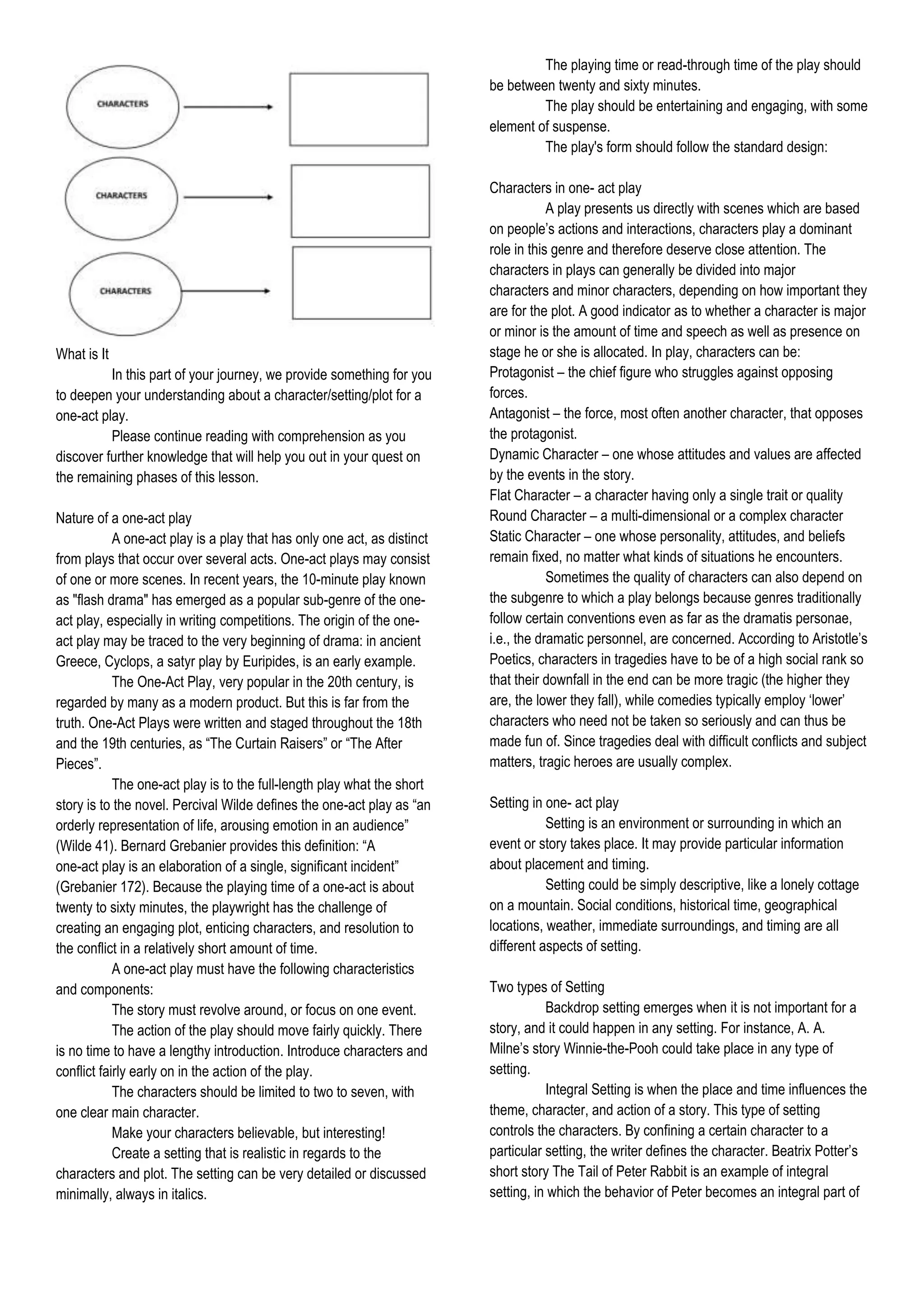
Learning Task 3: Connect the Terms
Directions: Connect the three terms in the word Play using a
graphic organizer. Write your answer in your answer sheet.
What is It
In this part of your journey, we provide something for you
to deepen your understanding about a character/setting/plot for a
one-act play.
Please continue reading with comprehension as you
discover further knowledge that will help you out in your quest on
the remaining phases of this lesson.
Nature of a one-act play
A one-act play is a play that has only one act, as distinct
from plays that occur over several acts. One-act plays may consist
of one or more scenes. In recent years, the 10-minute play known
as "flash drama" has emerged as a popular sub-genre of the one-
act play, especially in writing competitions. The origin of the one-
act play may be traced to the very beginning of drama: in ancient
Greece, Cyclops, a satyr play by Euripides, is an early example.
The One-Act Play, very popular in the 20th century, is
regarded by many as a modern product. But this is far from the
truth. One-Act Plays were written and staged throughout the 18th
and the 19th centuries, as “The Curtain Raisers” or “The After
Pieces”.
The one-act play is to the full-length play what the short
story is to the novel. Percival Wilde defines the one-act play as “an
orderly representation of life, arousing emotion in an audience”
(Wilde 41). Bernard Grebanier provides this definition: “A
one-act play is an elaboration of a single, significant incident”
(Grebanier 172). Because the playing time of a one-act is about
twenty to sixty minutes, the playwright has the challenge of
creating an engaging plot, enticing characters, and resolution to
the conflict in a relatively short amount of time.
A one-act play must have the following characteristics
and components:
The story must revolve around, or focus on one event.
The action of the play should move fairly quickly. There
is no time to have a lengthy introduction. Introduce characters and
conflict fairly early on in the action of the play.
The characters should be limited to two to seven, with
one clear main character.
Make your characters believable, but interesting!
Create a setting that is realistic in regards to the
characters and plot. The setting can be very detailed or discussed
minimally, always in italics.
The playing time or read-through time of the play should
be between twenty and sixty minutes.
The play should be entertaining and engaging, with some
element of suspense.
The play's form should follow the standard design:
Characters in one- act play
A play presents us directly with scenes which are based
on people’s actions and interactions, characters play a dominant
role in this genre and therefore deserve close attention. The
characters in plays can generally be divided into major
characters and minor characters, depending on how important they
are for the plot. A good indicator as to whether a character is major
or minor is the amount of time and speech as well as presence on
stage he or she is allocated. In play, characters can be:
Protagonist – the chief figure who struggles against opposing
forces.
Antagonist – the force, most often another character, that opposes
the protagonist.
Dynamic Character – one whose attitudes and values are affected
by the events in the story.
Flat Character – a character having only a single trait or quality
Round Character – a multi-dimensional or a complex character
Static Character – one whose personality, attitudes, and beliefs
remain fixed, no matter what kinds of situations he encounters.
Sometimes the quality of characters can also depend on
the subgenre to which a play belongs because genres traditionally
follow certain conventions even as far as the dramatis personae,
i.e., the dramatic personnel, are concerned. According to Aristotle’s
Poetics, characters in tragedies have to be of a high social rank so
that their downfall in the end can be more tragic (the higher they
are, the lower they fall), while comedies typically employ ‘lower’
characters who need not be taken so seriously and can thus be
made fun of. Since tragedies deal with difficult conflicts and subject
matters, tragic heroes are usually complex.
Setting in one- act play
Setting is an environment or surrounding in which an
event or story takes place. It may provide particular information
about placement and timing.
Setting could be simply descriptive, like a lonely cottage
on a mountain. Social conditions, historical time, geographical
locations, weather, immediate surroundings, and timing are all
different aspects of setting.
Two types of Setting
Backdrop setting emerges when it is not important for a
story, and it could happen in any setting. For instance, A. A.
Milne’s story Winnie-the-Pooh could take place in any type of
setting.
Integral Setting is when the place and time influences the
theme, character, and action of a story. This type of setting
controls the characters. By confining a certain character to a
particular setting, the writer defines the character. Beatrix Potter’s
short story The Tail of Peter Rabbit is an example of integral
setting, in which the behavior of Peter becomes an integral part of
the setting. Another good example of this type of setting can be
seen in E. B. White’s novel Charlotte’s Web.
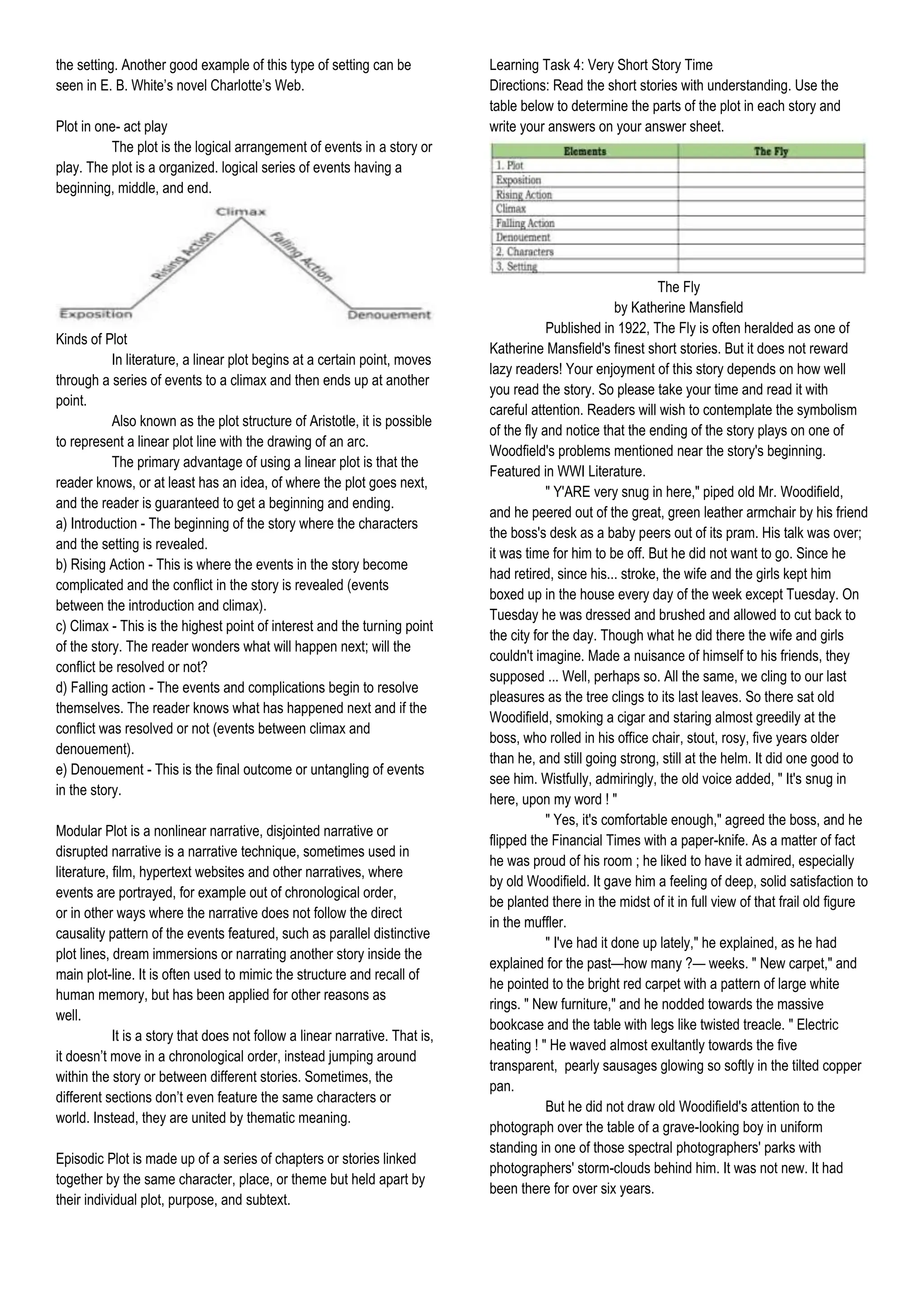
Plot in one- act play
The plot is the logical arrangement of events in a story or
play. The plot is a organized. logical series of events having a
beginning, middle, and end.
Kinds of Plot
In literature, a linear plot begins at a certain point, moves
through a series of events to a climax and then ends up at another
point.
Also known as the plot structure of Aristotle, it is possible
to represent a linear plot line with the drawing of an arc.
The primary advantage of using a linear plot is that the
reader knows, or at least has an idea, of where the plot goes next,
and the reader is guaranteed to get a beginning and ending.
a) Introduction - The beginning of the story where the characters
and the setting is revealed.
b) Rising Action - This is where the events in the story become
complicated and the conflict in the story is revealed (events
between the introduction and climax).
c) Climax - This is the highest point of interest and the turning point
of the story. The reader wonders what will happen next; will the
conflict be resolved or not?
d) Falling action - The events and complications begin to resolve
themselves. The reader knows what has happened next and if the
conflict was resolved or not (events between climax and
denouement).
e) Denouement - This is the final outcome or untangling of events
in the story.
Modular Plot is a nonlinear narrative, disjointed narrative or
disrupted narrative is a narrative technique, sometimes used in
literature, film, hypertext websites and other narratives, where
events are portrayed, for example out of chronological order,
or in other ways where the narrative does not follow the direct
causality pattern of the events featured, such as parallel distinctive
plot lines, dream immersions or narrating another story inside the
main plot-line. It is often used to mimic the structure and recall of
human memory, but has been applied for other reasons as
well.
It is a story that does not follow a linear narrative. That is,
it doesn’t move in a chronological order, instead jumping around
within the story or between different stories. Sometimes, the
different sections don’t even feature the same characters or
world. Instead, they are united by thematic meaning.
Episodic Plot is made up of a series of chapters or stories linked
together by the same character, place, or theme but held apart by
their individual plot, purpose, and subtext.
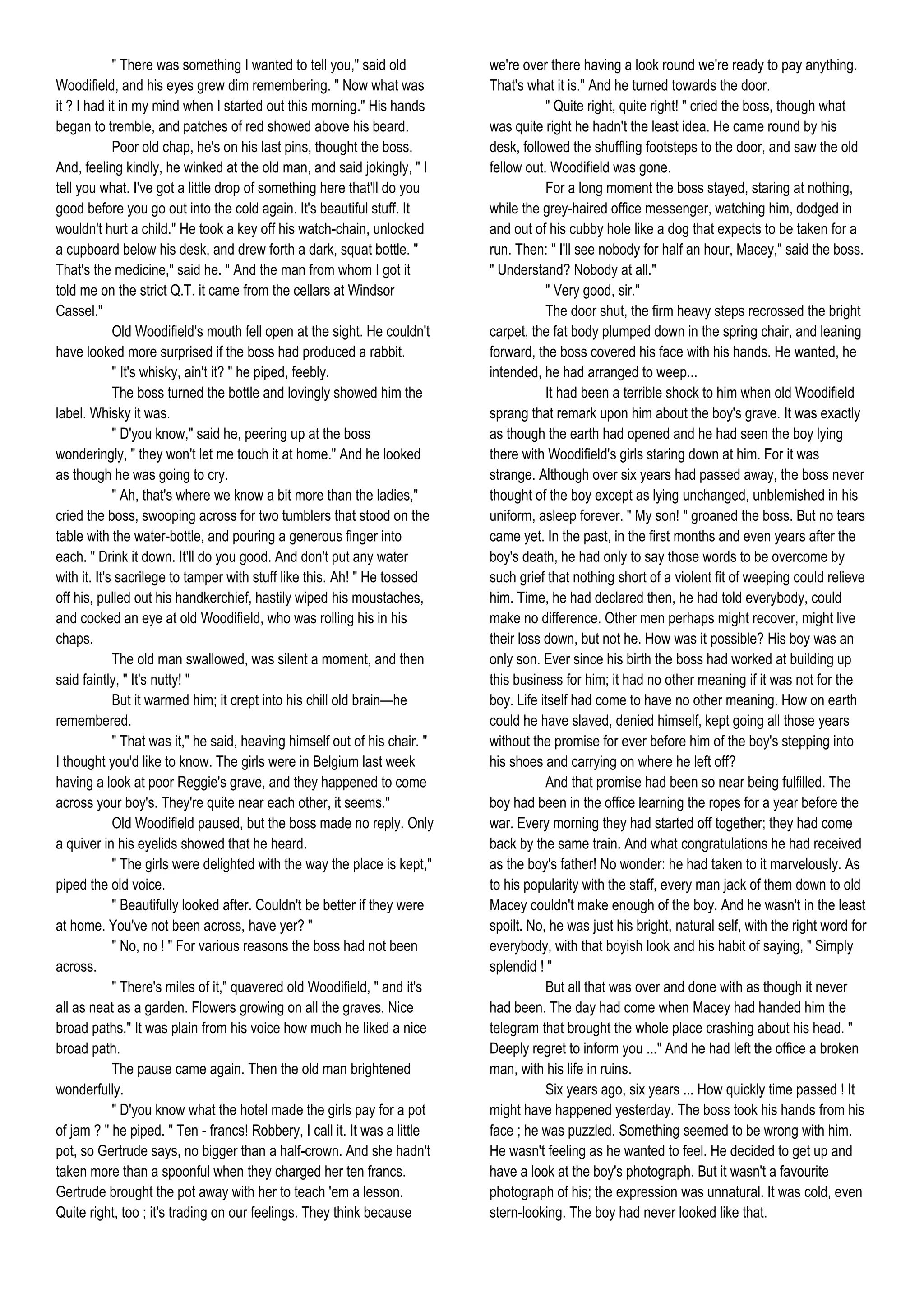
Learning Task 4: Very Short Story Time
Directions: Read the short stories with understanding. Use the
table below to determine the parts of the plot in each story and
write your answers on your answer sheet.
The Fly
by Katherine Mansfield
Published in 1922, The Fly is often heralded as one of
Katherine Mansfield's finest short stories. But it does not reward
lazy readers! Your enjoyment of this story depends on how well
you read the story. So please take your time and read it with
careful attention. Readers will wish to contemplate the symbolism
of the fly and notice that the ending of the story plays on one of
Woodfield's problems mentioned near the story's beginning.
Featured in WWI Literature.
" Y'ARE very snug in here," piped old Mr. Woodifield,
and he peered out of the great, green leather armchair by his friend
the boss's desk as a baby peers out of its pram. His talk was over;
it was time for him to be off. But he did not want to go. Since he
had retired, since his... stroke, the wife and the girls kept him
boxed up in the house every day of the week except Tuesday. On
Tuesday he was dressed and brushed and allowed to cut back to
the city for the day. Though what he did there the wife and girls
couldn't imagine. Made a nuisance of himself to his friends, they
supposed ... Well, perhaps so. All the same, we cling to our last
pleasures as the tree clings to its last leaves. So there sat old
Woodifield, smoking a cigar and staring almost greedily at the
boss, who rolled in his office chair, stout, rosy, five years older
than he, and still going strong, still at the helm. It did one good to
see him. Wistfully, admiringly, the old voice added, " It's snug in
here, upon my word ! "
" Yes, it's comfortable enough," agreed the boss, and he
flipped the Financial Times with a paper-knife. As a matter of fact
he was proud of his room ; he liked to have it admired, especially
by old Woodifield. It gave him a feeling of deep, solid satisfaction to
be planted there in the midst of it in full view of that frail old figure
in the muffler.
" I've had it done up lately," he explained, as he had
explained for the past—how many ?— weeks. " New carpet," and
he pointed to the bright red carpet with a pattern of large white
rings. " New furniture," and he nodded towards the massive
bookcase and the table with legs like twisted treacle. " Electric
heating ! " He waved almost exultantly towards the five
transparent, pearly sausages glowing so softly in the tilted copper
pan.
But he did not draw old Woodifield's attention to the
photograph over the table of a grave-looking boy in uniform
standing in one of those spectral photographers' parks with
photographers' storm-clouds behind him. It was not new. It had
been there for over six years.
" There was something I wanted to tell you," said old
Woodifield, and his eyes grew dim remembering. " Now what was
it ? I had it in my mind when I started out this morning." His hands
began to tremble, and patches of red showed above his beard.
Poor old chap, he's on his last pins, thought the boss.
And, feeling kindly, he winked at the old man, and said jokingly, " I
tell you what. I've got a little drop of something here that'll do you
good before you go out into the cold again. It's beautiful stuff. It
wouldn't hurt a child." He took a key off his watch-chain, unlocked
a cupboard below his desk, and drew forth a dark, squat bottle. "
That's the medicine," said he. " And the man from whom I got it
told me on the strict Q.T. it came from the cellars at Windsor
Cassel."
Old Woodifield's mouth fell open at the sight. He couldn't
have looked more surprised if the boss had produced a rabbit.
" It's whisky, ain't it? " he piped, feebly.
The boss turned the bottle and lovingly showed him the
label. Whisky it was.
" D'you know," said he, peering up at the boss
wonderingly, " they won't let me touch it at home." And he looked
as though he was going to cry.
" Ah, that's where we know a bit more than the ladies,"
cried the boss, swooping across for two tumblers that stood on the
table with the water-bottle, and pouring a generous finger into
each. " Drink it down. It'll do you good. And don't put any water
with it. It's sacrilege to tamper with stuff like this. Ah! " He tossed
off his, pulled out his handkerchief, hastily wiped his moustaches,
and cocked an eye at old Woodifield, who was rolling his in his
chaps.
The old man swallowed, was silent a moment, and then
said faintly, " It's nutty! "
But it warmed him; it crept into his chill old brain—he
remembered.
" That was it," he said, heaving himself out of his chair. "
I thought you'd like to know. The girls were in Belgium last week
having a look at poor Reggie's grave, and they happened to come
across your boy's. They're quite near each other, it seems."
Old Woodifield paused, but the boss made no reply. Only
a quiver in his eyelids showed that he heard.
" The girls were delighted with the way the place is kept,"
piped the old voice.
" Beautifully looked after. Couldn't be better if they were
at home. You've not been across, have yer? "
" No, no ! " For various reasons the boss had not been
across.
" There's miles of it," quavered old Woodifield, " and it's
all as neat as a garden. Flowers growing on all the graves. Nice
broad paths." It was plain from his voice how much he liked a nice
broad path.
The pause came again. Then the old man brightened
wonderfully.
" D'you know what the hotel made the girls pay for a pot
of jam ? " he piped. " Ten - francs! Robbery, I call it. It was a little
pot, so Gertrude says, no bigger than a half-crown. And she hadn't
taken more than a spoonful when they charged her ten francs.
Gertrude brought the pot away with her to teach 'em a lesson.
Quite right, too ; it's trading on our feelings. They think because
we're over there having a look round we're ready to pay anything.
That's what it is." And he turned towards the door.
" Quite right, quite right! " cried the boss, though what
was quite right he hadn't the least idea. He came round by his
desk, followed the shuffling footsteps to the door, and saw the old
fellow out. Woodifield was gone.
For a long moment the boss stayed, staring at nothing,
while the grey-haired office messenger, watching him, dodged in
and out of his cubby hole like a dog that expects to be taken for a
run. Then: " I'll see nobody for half an hour, Macey," said the boss.
" Understand? Nobody at all."
" Very good, sir."
The door shut, the firm heavy steps recrossed the bright
carpet, the fat body plumped down in the spring chair, and leaning
forward, the boss covered his face with his hands. He wanted, he
intended, he had arranged to weep...
It had been a terrible shock to him when old Woodifield
sprang that remark upon him about the boy's grave. It was exactly
as though the earth had opened and he had seen the boy lying
there with Woodifield's girls staring down at him. For it was
strange. Although over six years had passed away, the boss never
thought of the boy except as lying unchanged, unblemished in his
uniform, asleep forever. " My son! " groaned the boss. But no tears
came yet. In the past, in the first months and even years after the
boy's death, he had only to say those words to be overcome by
such grief that nothing short of a violent fit of weeping could relieve
him. Time, he had declared then, he had told everybody, could
make no difference. Other men perhaps might recover, might live
their loss down, but not he. How was it possible? His boy was an
only son. Ever since his birth the boss had worked at building up
this business for him; it had no other meaning if it was not for the
boy. Life itself had come to have no other meaning. How on earth
could he have slaved, denied himself, kept going all those years
without the promise for ever before him of the boy's stepping into
his shoes and carrying on where he left off?
And that promise had been so near being fulfilled. The
boy had been in the office learning the ropes for a year before the
war. Every morning they had started off together; they had come
back by the same train. And what congratulations he had received
as the boy's father! No wonder: he had taken to it marvelously. As
to his popularity with the staff, every man jack of them down to old
Macey couldn't make enough of the boy. And he wasn't in the least
spoilt. No, he was just his bright, natural self, with the right word for
everybody, with that boyish look and his habit of saying, " Simply
splendid ! "
But all that was over and done with as though it never
had been. The day had come when Macey had handed him the
telegram that brought the whole place crashing about his head. "
Deeply regret to inform you ..." And he had left the office a broken
man, with his life in ruins.
Six years ago, six years ... How quickly time passed ! It
might have happened yesterday. The boss took his hands from his
face ; he was puzzled. Something seemed to be wrong with him.
He wasn't feeling as he wanted to feel. He decided to get up and
have a look at the boy's photograph. But it wasn't a favourite
photograph of his; the expression was unnatural. It was cold, even
stern-looking. The boy had never looked like that.
At that moment the boss noticed that a fly had fallen into
his broad inkpot and was trying feebly but desperately to clamber
out again. Help! help! said those struggling legs. But the sides of
the inkpot were wet and slippery; it fell back again and began to
swim. The boss took up a pen, picked the fly out of the ink, and
shook it on to a piece of blotting-paper. For a fraction of a second it
lay still on the dark patch that oozed round it. Then the front legs
waved, took hold, and, pulling its small, sodden body up it began
the immense task of cleaning the ink from its wings. Over and
under, over and under, went a leg along a wing, as the stone goes
over and under the scythe. Then there was a pause, while the fly,
seeming to stand on the tips of its toes, tried to expand first one
wing and then the other. It succeeded at last, and, sitting down, it
began, like a minute cat, to clean its face. Now one could imagine
that the little front legs rubbed against each other lightly, joyfully.
The horrible danger was over; it had escaped; it was ready for life
again.
But just then the boss had an idea. He plunged his pen
back into the ink, leaned his thick wrist on the blotting paper, and
as the fly tried its wings down came a great heavy blot. What would
it make of that? What indeed! The little beggar seemed absolutely
cowed, stunned, and afraid to move because of what would
happen next. But then, as if painfully, it dragged itself forward. The
front legs waved, caught hold, and, more slowly this time, the task
began from the beginning.
He's a plucky little devil, thought the boss, and he felt a
real admiration for the fly's courage. That was the way to tackle
things; that was the right spirit. Never say die; it was only a
question of ... But the fly had again finished its laborious task,
and the boss had just time to refill his pen, to shake fair and square
on the newcleaned body yet another dark drop. What about it this
time? A painful moment of suspense followed. But behold, the front
legs were again waving; the boss felt a rush of relief. He leaned
over the fly and said to it tenderly, " You artful little b . . ." And he
actually had the brilliant notion of breathing on it to help the drying
process. All the same, there was something timid and weak about
its efforts now, and the boss decided that this time should be the
last, as he dipped the pen deep into the inkpot.
It was. The last blot fell on the soaked blotting-paper, and
the draggled fly lay in it and did not stir. The back legs were stuck
to the body; the front legs were not to be seen.
" Come on," said the boss. " Look sharp! " And he stirred
it with his pen—in vain. Nothing happened or was likely to happen.
The fly was dead.
The boss lifted the corpse on the end of the paperknife
and flung it into the waste-paper basket. But such a grinding
feeling of wretchedness seized him that he felt positively
frightened. He started forward and pressed the bell for Macey.
" Bring me some fresh blotting-paper," he said, sternly, "
and look sharp about it." And while the old dog padded away, he
fell to wondering what it was he had been thinking about before.
What was it? It was... He took out his handkerchief and
passed it inside his collar. For the life of him he could not
remember.
Learning Task 5: Take Time
Directions: Using the literary text in Learning Task 4. Answer the
following questions. Write your answers on your answer sheet.
1. What is the dynamic between Mr. Woodifield and the boss at the
start of "The
Fly," and how does that dynamic evolve throughout the story?
_____________________________________________________
_____________________________
2. What do you think "The Fly" represents?
What I Have Learned
Learning Task 6: “T-M-L Phrase
Complete the following phrases.
The Topic was about
_____________________________________________________
_________________
It Matters because
_____________________________________________________
_________________
I’ve Learned today that
_____________________________________________________
_________________
Assessment
Writing Time! Directions: With your learnings with  a
character/setting/plot for a oneact play, do the outlining or planning
of your story to be written. Do this on your
answer sheet.
I. Characters (Consider the kinds of characters)
II. Setting (Consider the elements of setting)
III. Plot (Identify the five parts of a plot)
Creative Writing Quarter 2 Module 2 Weeks 1-8
Answer Key
Week 1 Lesson 1
Pre- assessment: 1. a 2. e 3. b 4. c 5. f 6. g 7. d 8. h 9. k 10. I
Learning Task 2: Answers may vary
Learning Task 3:
1. Plot 2. Characters3. Thought 4.Diction 5. Spectacle 6. Song
Learning Task 4: Body- Posture, Gesture Movement- Direction,
Energy
Voice- Volume, Accent Space- Personal Space, Pathways
Learning Task 5: Answers may vary
Learning Task 6: Answers may vary
Assessment: Answers may vary
Week 1 Lesson 2
What I Know: Answers may vary
Learning Task 1: Answers may vary
Learning Task 2: Answers may vary
Learning Task 3:
1. Allusion is a subtle or indirect reference to another text, historical
period or religious belief.
2. Parody is an imitation of another text for satirical purpose,
usually to mock.
3. Quotation is a direct reference to another text with an
acknowledgement of its composer.
4. Appropriation is a reworking or the reimagination of a well-
known text to change or extend its meaning.
5. Adaptation is a film, TV drama
or stage play that is based on a written work.
Learning Task 4: Answers may vary
Learning Task 5: Answers may vary
Learning Task 6: Answers may vary
Week 2 Lesson 3
Pre- assessment: 1. False 2. True 3. True 4. True 5. True 6. False
7. True 8. True 9.
True 10. False
Learning Task 2: 1. Characters 2. Setting 3. Plot 4. Play
Learning Task 3: Answers may vary
Learning Task 4: Answers may vary
Learning Task 5: Answers may vary
Learning Task 6: Answers may vary
Assessment: Answers may vary
Weeks 3-4 Lesson 4
Pre- assessment: 1. B 2. I 3. F 4. A 5. D 6. E 7. C 8. H 9. J 10. G
Learning Task 2:
1. Proscenium 2. End 3. Thrust 4. Arena 5. Traverse 6. Flexible
Learning Task 3: Answers may vary
Learning Task 4: Answers may vary
Assessment: Answers may vary
Weeks 5-6 Lesson 5 - Answers may vary
Weeks 7-8 Lesson 6 - Answers may vary
Creative Writing Quarter 2 Module 2 Weeks 1-8
Answer Key
Week 1 Lesson 1
Pre- assessment: 1. a 2. e 3. b 4. c 5. f 6. g 7. d 8. h 9. k 10. I
Learning Task 2: Answers may vary
Learning Task 3:
1. Plot 2. Characters3. Thought 4.Diction 5. Spectacle 6. Song
Learning Task 4: Body- Posture, Gesture Movement- Direction,
Energy
Voice- Volume, Accent Space- Personal Space, Pathways
Learning Task 5: Answers may vary
Learning Task 6: Answers may vary
Assessment: Answers may vary
Week 1 Lesson 2
What I Know: Answers may vary
Learning Task 1: Answers may vary
Learning Task 2: Answers may vary
Learning Task 3:
1. Allusion is a subtle or indirect reference to another text, historical
period or religious belief.
2. Parody is an imitation of another text for satirical purpose,
usually to mock.
3. Quotation is a direct reference to another text with an
acknowledgement of its composer.
4. Appropriation is a reworking or the reimagination of a well-
known text to change or extend its meaning.
5. Adaptation is a film, TV drama
or stage play that is based on a written work.
Learning Task 4: Answers may vary
Learning Task 5: Answers may vary
Learning Task 6: Answers may vary
Week 2 Lesson 3
Pre- assessment: 1. False 2. True 3. True 4. True 5. True 6. False
7. True 8. True 9.
True 10. False
Learning Task 2: 1. Characters 2. Setting 3. Plot 4. Play
Learning Task 3: Answers may vary
Learning Task 4: Answers may vary
Learning Task 5: Answers may vary
Learning Task 6: Answers may vary
Assessment: Answers may vary
Weeks 3-4 Lesson 4
Pre- assessment: 1. B 2. I 3. F 4. A 5. D 6. E 7. C 8. H 9. J 10. G
Learning Task 2:
1. Proscenium 2. End 3. Thrust 4. Arena 5. Traverse 6. Flexible
Learning Task 3: Answers may vary
Learning Task 4: Answers may vary
Assessment: Answers may vary
Weeks 5-6 Lesson 5 - Answers may vary
Weeks 7-8 Lesson 6 - Answers may vary

Creative Writing Quarter 2 Resized Modules.docx

  • 1.
    Santa Cruz IntegratedNational High School Brgy. Oogong, Santa Cruz, Laguna Creative Writing Quarter 2 – Module 1: Various Elements, Techniques, and Literary Devices of Drama What I Know Let me see how depth your knowledge is about this lesson. Are you ready? You can begin now. A. Directions: Write True if the statement is correct and False if it is incorrect. Use the space provided. __________ 1. A drama is a type of literature that is written for the purpose of being read in front of an audience. __________ 2. Scene is a single situation or unit of dialogue in a play. __________ 3. Act is composed of many scenes. __________ 4. Comedy is a form of drama in which there is a display of human suffering and catharsis for the audience __________ 5. Tragedy is a form of entertainment meant to be humorous. B. Directions: Read the statements. Determine the letter of the correct answer. __________ 6. Someone who writes plays and also known as a dramatist. A. Actors B. Author C. Playwright D. Characters __________ 7. It is a piece of writing in the form of drama composed of dialogue, stage directions and instructions to the actors and director. A. Comedy B. Drama C. Script D. Playwright __________ 8. The conversation between two or more characters in a literary work. A. Drama B. Dialogue C. Script D. Playwright __________ 9. The form of live theatre in which the plot, characters and dialogue of a game, scene or story are made up in the moment. A. Comedy B. Drama C. Theatre D. Improvisation __________ 10. The main idea or an underlying meaning of a literary work, which may be stated directly or indirectly. A. Conflict B. Drama C. Theme D. Theatre __________ 11. The person who portrays a character in a performance. A. Actors B. Author C. Playwright D. Scriptwriter __________ 12. The audience knows something the characters don’t. A. Drama B. Improvisation C. Dramatic Irony D. Tragic Irony __________ 13. It is a literary element that involves a struggle between two opposing forces, usually a protagonist and an antagonist. A. Actors B. Conflict C. Problem D. Theme __________ 14. A drama or literary work that depicts calamitous events and has an unhappy but meaningful ending. A. Drama B. Comedy C. Dialogue D. Tragedy __________ 15. It is a device in which an object, person or situation is given another meaning beyond its literal one. A. Act B. Audience C. Improvisation D. Symbolism Good Job! You have successfully answered the first tasks. Were you able to answer all the items correctly? If not, do not worry because I am here to help you throughout this lesson. Lesson 1 :Elements, Techniques and Literary Devices of Drama Drama also known as a play, is a form of literature written intentionally for theatrical performance. It is usually fictional and most of its parts are consisted of scripted dialogues, or only the acting in some cases, between characters intended to be performed. It is one of the first forms of storytelling in human history. Also, drama was popular in many other parts of the world. Drama examples have continued to be significant in different areas of the world and throughout different time periods. One of the reasons that drama has continued to have such an important place in literature is its unique way of presenting a narrative in real time. Did you know that there are various elements, techniques and literary devices in drama? This module will help you learn the various elements, techniques and literary devices in drama. This is your Lesson 1 for Quarter 2. What’s In Now, let’s take a look at what you have learned from your previous lesson/experiences. Can you still remember them? If yes, let’s answer the next activity. Activity 1: Match Up Directions: Let us recall important points. Match column A with column B. Write the letter of your answer on the space provided. A B ________ 1. Plot A. a word or phrase that goes beyond its literal meaning ________ 2. Theme B. an author's use of vivid and descriptive language to add depth to their work ________ 3. Setting C. the sequence of events in a story ________ 4. Conflict D. a person or another being in a text
  • 2.
    A B ________ 5.Imagery E. the struggle or problem between two opposing forces ________ 6. Character F. the central topic, subject, or message within a narrative ________ 7. Assonance G. the time and place (or when and where) of the story ________ 8. Alliteration H. the repetition of the sound of a vowel sound ________ 9. Point of View I. repetition of identical initial consonant sounds in successive or closely associated syllables within a group of words ________ 10. Figures of Speech J. refers to who is telling or narrating a story Well done! Thank you for trying to remember your previous lesson. I know it could be hard for you to remember it but you did your best. Now, I think you are ready. Let’s start with our lesson. What’s New Activity 2: Double Trouble Directions: You have learned about prose and poetry in your previous modules. Study the two forms of text below. Then, using the Venn diagram below, compare and contrast the two texts. Text 1 Act I Scene 2 The LIGHTS come up on ROSE hanging up clothes. SHE hums and sings softly to herself.It is the following morning. ROSE. (Sings.) Jesus, be a fence all around me every day Jesus, I want you to protect me as I travel on my way. Jesus, be a fence all around me every day. (TROY enters from the house) ROSE Jesus, I want you to protect me As I travel on my way. (To TROY.) Morning. You ready for breakfast? I can fix it as soon as I finish hanging up these clothes? TROY. I got the coffee on. That'll be all right. I'll just drink some of that this morning. - From: August Wilson's Fences Text 2 All the world's a stage, And all the men and women merely players; They have their exits and their entrances, And one man in his time plays many parts, His acts being seven ages. At first, the infant, Mewling and puking in the nurse's arms. - From: All the World's a Stage by William Shakespeare Now, complete this Venn diagram. Activity 3: What’s in this Name Directions: Using the organizer below, write down words associated with drama. What is It How is it? Is your learning from this module progressing? Let’s continue. This time let us learn about the following concepts: What is Drama? Drama comes from the Greek Word, “Dran” which means “To do” or “To Act”. Doing/Acting makes drama. It is the presentation of actions on a stage through actors/actress before an audience. Like a short story or novel, it has a setting, characters, plot, and even symbolism. But What Makes Drama Unique? Drama has one characteristic peculiar to itself—it is written primarily to be performed, not read. Two Types of Drama 1. Tragedy - is a form of drama in which events lead to the downfall of the main character, often a person of great significance, like a king or hero. Example: Romeo and Juliet by William Shakespeare 2. Comedy - is a form of drama that has a happy ending. Humor comes from the dialogue and situations. Example: The Knaves of Shakespeare
  • 3.
    Elements of Drama Categories 1.Literary Elements Aristotle’s Six Elements 1.1 Plot refers to the action; the basic storyline of the play. 1.2 Theme refers to the message that is intended to be expressed through the story. In other words, it is the main idea or the lesson to be learned from the play. 1.3 Characters and Actors- the people (sometimes animals or ideas) portrayed by the actors. Typically, each character, both major and minor, is listed alongside a brief description of the character's role in the story. Below, you can see that Troy is the main character, and each character is described in relation to him. Example Characters TROY MAXSON GABRIEL, Troy's brother JIM BONO, Troy's friend CORY, Troy and Rose's son ROSE, Troy's wife RAYNELL, Troy's daughter LYONS, Troy's oldest son by previous marriage Characterization is the way the playwright/author presents a character . Types of Character: 1. Protagonist is the main character of a story. 2. Antagonist is the opposite of a Protagonist. Usually the villain or opponent of the main character 3. Round character are complex and undergo development. 4. Flat character are relatively uncomplicated and do not change throughout the whole story. 1.4 Dialogue refers to words written by the playwright and spoken by the characters in the play. Forms of Dialogue: It is the conversation between two or more characters is referred to as dialogue (usually the majority of speech in plays consists of dialogue). A monologue is when one character delivers a speech to convey his or her thoughts, although other characters may remain on stage in scene. Similar to a monologue, a soliloquy is a speech made by one character but delivered when he or she is alone on stage. 1.5 Music/Rhythm referring to the rhythm of the actors’ voice as they speak 1.6 Spectacle – refers to the visual elements of a play: Set, Costumes, special effects 2. Technical Elements 2.1 Scene (Set) refers to the theatrical equipment 2.2 Costumes refers to clothing and accessories used by actors to portray characters 2.3 Properties any movable object that appears on stage 2.4 Sound refers to the effects an audience hears during the performance 2.5 Lights 2.6 Makeup includes costumes, wigs, and body paints used to transform characters Other Elements: 1. Playwright-the author of a play (script) 2. Script- the written pages of a play. Scripts are divided into Acts and Scenes. Acts- long sections of a play, made up of multiple scenes, usually designed to separate the play into its main parts and to give the audience a “break” from the performance. Scenes- shorter sections of a play, usually each scene occurs in one location at a specific time. Multiple scenes make up an act. It is often signaled by the entrance or exit of a character or change in setting or focus of the action Example from August Wilson's Fences Act I Scene 2 The LIGHTS come up on ROSE hanging up clothes. SHE hums and sings softly to herself. It is the following morning.
  • 4.
    ROSE. (Sings.) Jesus, bea fence all around me every day Jesus, I want you to protect me as I travel on my way. Jesus, be a fence all around me every day. (TROY enters from the house) 3. Setting - the place, together with other conditions, such as time and the environment, involved in which the events occur. The setting in the drama can be presented through the visual element deals with the scenes, costumes and special effects used in it. The setting can as well be enhanced by using viewable elements, sound effects, and music. 4. Conflict - the internal or external struggle that creates dramatic tension. Internal Conflict ▪ Person vs Society ▪ Person vs Self ▪ Person vs. Nature External Conflict ▪ Person vs. Supernatural ▪ Person vs. Fate/God ▪ Person vs. Technology Person vs. Person Source: Elements of Drama: Characters, Plot, Setting & Symbolism, 2013) Techniques in Drama 1. Vocal Dynamics – actors need to expand their vocal toolbox and learn about the ways that range, pitch, and pronunciation which affect performance 2. Body Language and Mannerisms - actors bring their characters to life by moving, reacting, and even standing in nuanced ways that are natural for their character. 3. Use and Awareness of Space - actors need to be aware not just of your “marks” on stage, but also of the actors who must interact with or move past you 4. Improvisational Techniques refers to the on-the-spot creativity of the actors. Common Literary Devices Used in Drama • Figures of speech – words that goes its literal meaning Metaphor - are one of the most extensively used literary devices. A metaphor refers to a meaning or identity ascribed to one subject by way of another. In a metaphor, one subject is implied to be another so as to draw a comparison between their similarities and shared traits. For example: a rose (object) is substituted for love (feeling) “Henry was a lion on the battlefield.” Similes are one of the most commonly used literary devices; referring to the practice of drawing parallels or comparisons between two unrelated and dissimilar things, people, beings, places and concepts. Similes are marked by the use of the words ‘as’ or ‘such as’ or ‘like’ For example: He is like a mouse in front of the teacher. • Imagery - the author’s attempt to create a mental picture in the mind of the reader. It appeals to the senses. For example: Visual imagery - It was dark in the forest… Olfactory Imagery (smell) – She whiffed the sweet aroma of his drink Tactile Imagery (touch) - She held it with her rough hand the soft pillow. • Symbolism - when an object is meant to be representative of something or an idea greater than the object itself or it is the frequent use of words, places, characters, or objects that mean something beyond what they are on a literal level. For example: a writer uses the word ‘blood’ once its meaning will be confined to that instance in which it is used. But if the word is used repeatedly, as it is in plays like Macbeth and Romeo and Juliet it expresses some profound ideas. By using a word repeatedly in different contexts it expresses several interlocking themes. In Romeo and Juliet ‘blood’ refers to all the following and more themes: violence, youth, passion, family ties. • Dramatic Irony – involves the reader (or audience) knowing something about what's happening in the plot, about which the character(s) have no knowledge. For example: From Romeo and Juliet “Alack, there lies more peril in thine eye / Than twenty of their swords! Look thou but sweet, / And I am proof against their enmity” (act 2, scene 2). Romeo tries to reassure Juliet by claiming he is invincible to her family's hostility, but the audience knows that the young lovers are doomed to die as a result of the feud. • Foreshadowing refers to the use of indicative words/phrases and hints that set the stage for a story to unfold and give the reader a hint of something that is going to happen without revealing the story or spoiling the suspense. Foreshadowing is used to suggest an upcoming outcome to the story. Example: “He had no idea of the disastrous chain of events to follow.”
  • 5.
    What’s More You’ve donea great job in the previous activities. Now, I think you are equipped with ideas and ready for more challenging and exciting tasks. Try to answer this. Activity 4: Extracting Information Directions: Study the text below and identify the elements/literary device used. Use and complete the table below. Sorry, Wrong Number (A Radio Play) By Lucille Fletcher CAST Mrs. Stevenson Sergeant Duffy Chief Operator Information Operator Operator Third operator Second Operator First Man Woman at Henchley Hospital Second Man (George) Western Union Clerk (Sound: Number being dialed on phone; busy signal.) Mrs. Stevenson. (a querulous, self-centered neurotic) Oh— dear! (Slams down receiver. Dials Operator. ) Operator. Your call, please? Mrs. Stevenson. Operator? I’ve been dialing Murray Hill 4- 0098 now for the last threequarters of an hour, and the line is always busy. But I don’t see how it could be busy that long. Will you try it for me, please? Operator. Murray Hill 4-0098? One moment, please. Mrs. Stevenson. I don’t see how it could be busy all the time. It’s my husband’s office. He’sworking late tonight, and I’m all alone here in the house. My health is very poor— and I’ve been feeling so nervous all day— Operator. Ringing Murray Hill 4-0098. (Sound: Phone buzz. It rings three times. Receiver is picked up at the other end.) Man. Hello. Source: DepEd Grade 9 Learner’s Material *A separate sheet of paper may be used if necessary. Activity 5: Think & Match Directions: Match the literary devices on the left with its appropriate example on the right. Write the letter of your answer on the space provided. ________11 Simile A. Romeo: By some vile forfeit of the untimely death. ________12. Metaphor B. “And to ‘thy go like lightning” ________13. Dialogue C. The servant away with the joint-stools, remove the court-cupboard, look to the plate. ________14. Imagery D. Romeo thought that Juliet was dead and he kills himself. ________15. Dramatic Irony E. My life is a foe of debt! Activity 6: Say It Directions: Study the conversation below lifted from Romeo and Juliet by William Shakespeare. Identify whether the line is a monologue or a dialogue. Write your answer on the space provided. _______16. Act Four, Scene Three: Juliet Drinks the Medicine Juliet's room. Juliet is wearing her wedding-dress. Juliet: They think that I'm going to marry Paris tomorrow, but they're wrong, (She takes out Father Lawrence's bottle.) When I drink this, I'll fall asleep. They'll think I'm dead. Oh, I'm so afraid! I won't wake up for two days. When I wake up, I'll be in the tomb, with dead bodies around me. But I must do it. Romeo will come and find me, and we'll be together again! (She drinks the medicine and lies down on her bed.) _______17. Act Five, Scene One: News from Verona Romeo is walking along a street in Mantua. There are some shops in the street. Romeo: Oh, I'm so lonely without Juliet I want to go back to Verona, but I can't go back yet. I must wait until Father Lawrence sends a message. I'll hear some news soon, I hope. _______18. Act Three, Scene One: More Trouble A busy street in Verona. Some people are walking along the street. Mercutio and Benvolio are talking. Benvolio: It's hot today, isn't it? I don't like this weather. People feel angry when it's so hot. (Tybalt and some friends enter.) Mercutio: Look! It's the Capulets – over there! Benvolio: Don't start an argument, we don't want
  • 6.
    Activity 7: Writeit Directions: Based on the samples given, try to write your own dialogue. Use the spaces below. 19-20. ________________________________________________ __________________________________ ________________________________________________ __________________________________ ________________________________________________ __________________________________ ________________________________________________ __________________________________ Wow! Congratulations, you made it! Take time to rest for now. You have done so much. What I Have Learned Did you learn something from this lesson? If so, then tell me. My journey through this lesson enabled me to learn that drama ________________________________________________ __________________________________ ________________________________________________ __________________________________ ________________________________________________ __________________________________ ________________________________________________ _________________________________. It made me realize that ________________________________________________ __________________________________ ________________________________________________ __________________________________ ________________________________________________ __________________________________ ______________________________________________. Remember the points below: ✓ Drama is a written work intended to be performed. ✓ There are various elements, techniques, and literary device used in drama. What I Can Do You’re doing great! How do you feel about it? Do you want to add more proof of your understanding? Try this. Activity 8: Real-Life-Extension Directions: • Interview someone about their favorite drama or play; or • Recall a recent drama/play that you have read, watch or heard. • Asks him/her the reasons why he/she likes the drama or play. • Look/Ask for a copy of the drama. • Choose a part of the drama. • Identify the various elements, techniques, and literary devices used in that particular scene chosen. • Use the spaces provided below or you may use an additional sheet of paper. Title: ________________________________________________ ___ Author: ________________________________________________ _ Reasons: ________________________________________________ __________________________________ ________________________________________________ __________________________________ ________________________________________________ __________________________________ ________________________________________________ __________________________________ ________________________________________________ __________________________________ ________________________________________________ __________________________________ Assessment Well done! We are now close to the finish line of this module. But, before we say goodbye, kindly take this test to check how much you have learned from this module. Activity 9: Final Task Directions: Study and complete each statement below. Write letter of your answer on a separate answer sheet.
  • 7.
    1. In drama,a/an _______________________ is any conversation between two or more people. A. Actors B. Dialogue C. Monologue D. Script 2. _________________ refers to the range, pitch, and pronunciation of the actors which affect performance. A. Improvisational Techniques B. Mannerisms C. Space D. Vocal Dynamics 3. A/an ____________________________ is lines spoken by one person (it can be to someone else, to himself/herself, or to the audience). A. Actors B. Dialogue C. Monologue D. Script 4. A/an _________________ is the the sequence of events in a story. A. Act B. Plot C. Scene D. Climax 5. A _________________ is a type of literature that is written for the purpose of being read in front of an audience. A. Drama B. Dialogue C. Scene D. Script 6. _________________ is a single situation or unit of dialogue in a play. A. Act B. Drama C. Dialogue D. Scene 7. _________________ is a form of drama in which there is a display of human suffering and catharsis for the audience. A. Comedy B. Drama C. Dialogue D. Tragedy 8. A/an _________________ is composed of many scenes. A. Act B. Drama C. Dialogue D. Scene 9. A _________________ is a form of entertainment meant to be humorous A. Comedy B. Drama C. Dialogue D. Tragedy 10. _________________ is author’s attempt to create a mental picture in the mind of the reader. It appeals to the senses. A. Imagery B. Metaphor C. Simile D. Symbolism 11. _________________ refers to the on-the-spot creativity of the actors. A. Improvisational Techniques B. Mannerisms C. Space D. Vocal Dynamics 12. A___________ is a piece of writing in the form of drama composed of dialogue, stage directions and instructions to the actors and director. A. Comedy B. Drama C. Script D. Playwright 13. ____________ is used to suggest an upcoming outcome to the story. A. Imagery B. Dramatic Irony C. Foreshadowing D. Symbolism 14. A____________ refers to the visual elements of a play. A. Costume B. Props C. Set D. Spectacle 15. A type of character that undergo changes in the text. A. Actors B. Antagonist C. Flat D. Round Additional Activities Good job! We are nearly done. Directions: Write you own one-scene for a one-act play considering the various elements, techniques, and literary devices of drama. You may write a common scenario at home. Use the spaces below. You may also use a separate sheet of paper if necessary. The rubric below shall be used for evaluating your work. ________________________________________________ __________________________________ ________________________________________________ __________________________________ ________________________________________________ __________________________________ ________________________________________________ __________________________________ ________________________________________________ __________________________________ ________________________________________________ __________________________________ ________________________________________________ __________________________________ ________________________________________________ __________________________________ ________________________________________________ __________________________________ ________________________________________________ __________________________________ ________________________________________________ __________________________________ ________________________________________________ __________________________________ ________________________________________________ __________________________________
  • 8.
    CREATIVE WRITING Q2MODULE1 CREATIVE WRITING Q2MODULE 1
  • 9.
    Santa Cruz IntegratedNational High School Brgy. Oogong, Santa Cruz, Laguna Creative Writing Quarter 2 – Module 1: Various Elements, Techniques, and Literary Devices of Drama What I Know Directions: Read the statements carefully. Identify what is being defined in each number. Choose the letter of the correct answer in the box. Write your answers on your answer sheet. This is just a pretest. Your score on this part will not be graded. 1. This refers to a person or individual in the drama that may have defined personal qualities and/or histories. 2. This refers to the words used, the accent, tone, pattern of speech, and even the pauses in speech, say a lot about the character and help reveal not just his personality, but also his social status, past, and family background as given by the play. 3. This pertains to the message that the play gives to the audience. 4. This pertains to the order of events occurring in a play, exposing the past or background of the main and other characters, and the point of conflict, then proceeds to giving the central theme or climax. 5. This refers to the time and place where a story is set is one of its important parts. 6. This includes what the character wears and how the character carries himself on stage. 7. This includes the use of sounds and rhythm in dialogs as well as music compositions that are used in the plays. 8. This deals with the scenes, costumes, and special effects used in it. 9. This defines how the play is presented to the audiences. The use and organization of stage properties and the overall setting of a play. 10. These are often used to give hints of the future events in the story as these complement the other elements of a scene and make it more effective. What’s In Learning Task 1: Arrange to Know Directions: Arrange the jumbled letter to identify the words that are relevant to our topic. Definitions will help you to determine the hidden words. Write your answers on your answer sheet. What is It In this part of your journey, we provide something for you to deepen your understanding about the various elements, techniques, and literary devices in drama Please continue reading with comprehension as you discover further knowledge that will help you out in your quest on the remaining phases of this lesson. What is Drama? -Drama in literature refers to the performance of written dialogue and stage action. It’s a literary genre that allows actors to act out a writer’s words directly to an audience. - It is a composition in prose or verse presenting in dialogue or pantomime a story involving conflict or contrast of character, especially one intended to be acted on the stage - It is a mode of fictional representation through dialogue and performance. It is one of the literary genres, which is an imitation of some action. Drama is also a type of a play written for theater, television, radio, and film. Different Types of Literary Drama Comedies are usually humorous plays which uses clever wordplay or turns of phrase. Farce is a comic dramatic work using buffoonery and horseplay and typically including crude characterization and ludicrously improbable situations. Melodrama is a dramatic work wherein the plot, which is typically sensational and designed to appeal strongly to the emotions, takes precedence over detailed characterization. Melodramas typically concentrate on dialogue, which is often bombastic or excessively sentimental, rather than action. Musical drama is an opera in which the musical and dramatic elements are equally important; the music is appropriate to the action. opera - a drama set to music; consists of singing with orchestral accompaniment and an orchestral overture and interludes. Tragedy is a genre of story in which a hero is brought down by his/her own flaws, usually by ordinary human flaws – flaws like greed, over-ambition, or even an excess of love, honor, or loyalty. Tragicomedy is a literary genre that blends aspects of both tragic and comic forms. Most often seen in dramatic literature, the term can describe either a tragic play which contains enough comic elements to lighten the overall mood or a serious play with a happy ending. Elements of Drama In literature, drama is the specific mode of fiction represented in performance. The story progresses through interactions between its characters and ends with a message for the audience. The six Aristotelian elements of drama are the plot, character, thought, diction, spectacle, and song.
  • 10.
    Plot refers tothe order of events occurring in a play make its plot. Essentially, the plot is the story that the play narrates. The entertainment value of a play depends largely on the sequence of events in the story. Most stories have a beginning, middle and an end. However, your drama doesn’t have to run in this linear order. Some work is non- linear in structure. At the most basic level, there are five primary elements of plot: exposition, rising action, climax, falling action, and resolution. This is also referred to as dramatic structure, as it originated from plays. A linear plot consists of a series of events that have a clear beginning, middle and end. The story unfolds in a chronological order, which means they are told in the order they happened. The structure shown above is an example of a linear plot. Nonlinear plots describe events out of chronological order. Present events may be interrupted to describe past situations, or a story may start at the middle or end instead of the beginning. In nonlinear plots, authors may employ different literary techniques to tell their stories. Some common techniques include flashback, foreshadowing, subplots, and parallel plots. Characters refers a person or individual in the drama that may have defined personal qualities and/or histories. Most writers have an inherent understanding of how to categorize their characters based on classic, “comic book-style” labels: heroes, villains, sidekicks, etc. There are many ways to categorize main characters: protagonist or antagonist, dynamic or static character, and round or flat characters. A character can also often fit into more than one category or move through categories. A protagonist is a main character who generates the action of a story and engages the reader's interest and empathy. The protagonist is often the hero or heroine. An antagonist is a character who opposes the protagonist. A dynamic character is one who goes through some sort of change; they show character development. A protagonist is usually a dynamic character. A static character refers to those who do not change throughout the course of the story. They serve to show contrast to dynamic ones, refusing to grow and remaining in one place or mentality. A flat character refers to the two-dimensional in that they are relatively uncomplicated and do not change throughout the course of a work. A round character is complex and undergo development, sometimes sufficiently to surprise the reader. Thought or called to be the theme refers to its central idea. It can either be clearly stated through dialog or action, or can be inferred after watching the entire performance. The theme is the philosophy that forms the base of the story or a moral lesson that the characters learn. Plays may often be written about an idea, but the playwright will probably focus more on plot and character to get idea across, plays are seldom about an idea.Some general themes in play are: Diction is the language used to depart information, reveal characters, characterize, direct attention, reveal themes and ideas, establish mood / tone, establish tempo / rhythm appropriate to character. Diction pertains to the words used, the accent, tone, pattern of speech, and even the pauses in speech, say a lot about the character and help reveal not just his personality, but also his social status, past, and family background as given by the play. Monologues and soliloquies that are speeches given to oneself or to other characters help put forward points that would have been difficult to express through dialogs. There are various forms of dialogs which are: Spectacle is the most immediate element which is appropriate and distinctive in a play. This refers to the visual elements of a play: sets, costumes, special effects, etc. Spectacle is everything that the audience sees as they watch the play. Spectacle refers to the visual elements which leads to performance as this defines how the play is presented to the audiences. The use and organization of stage properties and the overall setting of a play. Songs refers to the sound of the dialog, etc. musicality, rhythm, pace, etc. which helps establish mood, characterize, lend variety, pleasurable. This element includes the use of sounds and rhythm in dialogs as well as music compositions that are used in the plays. The background score, the songs, and the sound effects used should complement the situation and the characters in it. The right kind of sound effects or music, if placed at the right points in the story, act as a great supplement to the high and low points in the play. The music and the lyrics should go well with the play’s theme. If the scenes are accompanied by pieces of music, they become more effective on the audiences.
  • 11.
    The structure ofthe story comprises the way in which it is dramatized. How well the actors play their roles and the story’s framework constitute the structure of drama. Direction is an essential constituent of a play. A well-directed story is more effective. Stagecraft defines how the play is presented to the audiences. The use and organization of stage properties and the overall setting of a play are a part of stagecraft, which is a key element of drama. Symbols are often used to give hints of the future events in the story. They complement the other elements of a scene and make it more effective. Techniques in Drama In play, even if you’re a natural performer who can cry on command and memorize lines, you’ll need to learn the following fundamental drama techniques to really master the art of acting. The following are the techniques in drama. Body, in drama character is conveyed through posture, gesture and facial expression. In this way the audience can instantly identify with a character type or understand a situation without a word being spoken Space, in drama, the positioning of objects and bodies on the stage and the relationship between them are vital means of making meaning.Grouping Levels, Pathways and Personal Space are all important aspects of space. Voice pertains on how actors speak their lines instantly identify personality and emotion.Volume, pitch, pausing intonation, pace and accent can all influence audience understanding of a character and the tension of the scene. Movement refers to the use of timing, direction and energy to build a sustained sequence of movement can enhance understanding of character and the meaning of the scene. Literary Devices in Drama To understand the literary devices in drama, Shakespeare used many literary devices (and also many poetic devices), below are the most important ones, most central to his work. Allusion is a reference to a person, place, event, usually without explicit identification. Allusions can be references to mythology, the bible, historical events, geography, legends, or other literary works. Authors often use allusion to establish a tone, create an implied association, contrast two objects or people, make an unusual juxtaposition of references, or bring the reader into a world of experience outside the limitations of the story itself. Dramatic device is a convention used in drama as a substitution for reality that the audience accepts as real although they know them to be false. These techniques give the audience information they could not get from straightforward presentation of action. plays. Dramatic irony is a literary device by which the audience’s or reader’s understanding of events or individuals in a work surpasses that of its characters. Dramatic irony is a form of irony that is expressed through a work’s structure: an audience’s awareness of the situation in which a work’s characters exist differs substantially from that of the characters’, and the words and actions of the characters therefore take on a different—often contradictory—meaning for the audience than they have for the work’s characters. Monologue is a long, uninterrupted speech that is spoken in the presence of other characters. Unlike a soliloquy a monologue is heard by other characters Soliloquy is a speech in which a character, who is usually alone on the stage, expresses his or her thoughts aloud. It is a very useful device, as it allows the writer to convey a character’s most intimate thoughts and feelings directly to the audience. Symbolism expresses some profound ideas by using a word repeatedly in different contexts. It expresses several interlocking themes in frequent use of words, places, characters, or objects that mean something beyond what they are on a literal level. What’s More Learning Task 3: Be in Quest for Dram Directions: Look for the words in the puzzle that can be associated to the elements of drama. You may also put the meanings of the words that you have found. Write your found words on your answer sheet. Learning Task 4: Complete the Table Directions: Complete the table. Supply the correct answers to complete the things to be considered in the different techniques in drama. Write your answers on your answer sheet. Learning Task 5: React with the Literary Pieces Directions: Give your interpretation on the following statements. Reminders the following statement use allusion. Write your interpretation on your answer sheet. 1. Look, I’m no Mother Teresa. I’ve made my mistakes, but I’m trying. _____________________________________________________ _____________________________ 2. Come. Be the Cleopatra to my Mark Antony. _____________________________________________________ _____________________________ 3. As I walked through the graveyard, Beethoven’s “Symphony No. 9” played in my head. _____________________________________________________ _____________________________ 4. You don’t have to be William Shakespeare to write poetry. _____________________________________________________ _____________________________
  • 12.
    5. Well, I’mno Hercules, but I could open that jelly jar for you. What I Have Learned Learning Task 6: “T-M-L Phrase Complete the following phrases. The Topic was about _____________________________________________________ _________________ It Matters because _____________________________________________________ _________________ I’ve Learned today that Assessment Writing Time! Directions: With your learnings with the different elements, techniques and literary devices in drama, do the outlining or planning of your story to be written. Do this on your answer sheet. I. Characters (Consider the kinds of characters) II. Setting (Consider the elements of setting) III. Plot (Identify the five parts of a plot) IV. Theme, Tone, Subject, Motif V. Conflict and Point of View VI. Plot Device, Vision and Finale used in the story VII. Symbolism: VIII. Diction: IX. Spectacle: X. Song: Santa Cruz Integrated National High School Brgy. Oogong, Santa Cruz, Laguna Creative Writing Quarter 2 – Module 2: Understanding Intertextuality as a Technique of Drama What I Know Directions: Using a mind map, present your idea on what the terms mean and how will you use your knowledge in writing outputs in Creative Writing. Do this on your answer sheet. What’s In Learning Task 1: Identify the purpose Directions: Knowing your writing preferences will help you be more successful in your writing process. To determine your idiosyncratic writing preferences, answer the following questions on your paper: 1. What is intertextuality? 2. How do I identify implicit and explicit intertextuality in a text? 3. What is the purpose of intertextuality? 4. How does intertextuality deepen our understanding of the ideas, themes and perspectives in texts? What is It In this part of your journey, we provide something for you to deepen your understanding about intertextuality as a technique of drama. Please continue reading with comprehension as you discover further knowledge that will help you out in your quest on the remaining phases of this lesson. What is Intertextuality? Intertextuality is a word coined by Julia Kristeva, a French linguist who has written much on this topic. This word has a broader meaning in today′s context than the theories she expounds in her seminal work on intertextuality which are "word, dialogue and novel". Her notion of Intertextuality refers to the literal and effective presence in a text of another text. ‘’A text’’, according to her, ‘’is a permutation of texts, an Intertextuality in the space of a given text, in which several utterances, taken from other texts, intersect and neutralize one another” Intertextuality is the shaping of a text's meaning by another text. It is the interconnection between similar or related works of literature that reflect and influence an audience's interpretation of the text. Intertextuality is the relation between texts that are inflicted by means of quotations and allusion. When writers borrow from previous texts, their work acquires layers of meaning. In addition, when a text is read in the light of another text, all the assumptions and effects of the other text give a new meaning and influence the way of interpreting the original text. Intertextuality is when a text implicitly and explicitly refers to another text, by using common or recognizable elements of the referenced text. An implicit reference is when the composer alludes to another text through ideas, symbols, genre or style. An explicit reference is when the composer directly mentions quotes or references another text in their work. Different Types of Intertextuality Allusion is a subtle or indirect reference to another text, historical period or religious belief. Parody is an imitation of another text for satirical purpose, usually to mock. Quotation is a direct reference to another text with an acknowledgement of its composer. Appropriation is a reworking or the reimagination of a well-known text to change or extend its meaning. Adaptation is a film, TV drama or stage play that is based on a written work. How does Intertextuality work? Writing and art will be intertextual whether you want them to be or not. Latent intertextuality is inescapable! But when should you employ deliberate intertextuality? Deliberate intertextuality has a place both in creative writing and formal essays. In creative writing, it’s a great way to get inspiration for stories. You can draw on other authors’ stories and characters, or you can use other art forms to get inspiration. Either way, when you make deliberate references to these other works
  • 13.
    you are employingintertextuality. A complex use of intertextuality is considered a sophisticated tool in writing. Rather than referencing phrases from other works, a refined use of intertextuality involves drawing upon an ideology, a concept, or even rhetoric from others. Thus, you may explore the political ideology in your story by drawing upon the current rhetoric in politics. Alternatively, you may use a text source and explore it further. What’s More Learning Task 3: Complete the Table Directions: Complete the table. Supply ideas to complete the things to be considered in the types of intertextuality. Write your answers on your answer sheet. Learning Task 4: Implicit or Explicit! Directions: Read and list down five literary pieces from the local and foreign writers where intertextuality plays. Identify the explicit and implicit ideas used in their piece.Write the lines or ideas where intertextuality is used. Do this on your answer sheet. What I Have Learned Learning Task 5: “T-M-L Phrase Complete the following phrases. The Topic was about _____________________________________________________ _________________ It Matters because _____________________________________________________ _________________ I’ve Learned today that _____________________________________________________ _________________ What I Can Do Learning Task 6: Critiquing Time! Directions: Using the template below, write your comments and observations on the intertextuality used in each literary piece. Answer the following questions. Write your answers on your answer sheet. Watch/ listen to song of Katy perry entitled “Roar” and answer the following questions. 1. What is the song is about? _____________________________________________________ _____________________________ 2. What does the line “eye of the tiger” mean in Perry’s song? _____________________________________________________ _____________________________ Watch/ listen to Survivor’s 1980s music video “Eye of the Tiger” and answer the following questions 1. How does this video inform your understanding of Katy Perry’s song Roar? _____________________________________________________ _____________________________ 2. In what ways does this song change your understanding of Katy Perry’s song? _____________________________________________________ _____________________________ Creative Writing: Conceptualizing character/setting/plot for a one-act play What I Know Directions: Read the statements carefully. Identify if the statement is TRUE or FALSE. Write your answers on your answer sheet. 1. Characters in the play are individuals that don’t do the action in the story. 2. Setting refers to the time and location in which a story takes place is called the setting. 3. The plot is the logical arrangement of events in a story or play. 4. Protagonist is the chief figure who struggles against opposing forces. 5. Antagonist is the force, most often another character, that opposes the protagonist. 6. The author does not make explicit/outright statements or explanations about the characters 7. A linear plot begins at a certain point, moves through a series of events to a climax and then ends up at another point. 8. Modular Plot is often used to mimic the structure and recall of human memory but has been applied for other reasons as well. 9. Episodic Plot is made up of a series of chapters or stories linked together by the same character, place, or theme but held apart by their individual plot, purpose, and subtext. 10. There is a singular aspect to consider in a story's setting. Learning Task 1: Arrange to Know Directions: Arrange the jumbled letter to identify the words that are relevant to our topic. Definitions will help you to determine the hidden words. Write your answers on your answer sheet. Learning Task 3: Connect the Terms Directions: Connect the three terms in the word Play using a graphic organizer. Write your answer in your answer sheet.
  • 14.
    What is It Inthis part of your journey, we provide something for you to deepen your understanding about a character/setting/plot for a one-act play. Please continue reading with comprehension as you discover further knowledge that will help you out in your quest on the remaining phases of this lesson. Nature of a one-act play A one-act play is a play that has only one act, as distinct from plays that occur over several acts. One-act plays may consist of one or more scenes. In recent years, the 10-minute play known as "flash drama" has emerged as a popular sub-genre of the one- act play, especially in writing competitions. The origin of the one- act play may be traced to the very beginning of drama: in ancient Greece, Cyclops, a satyr play by Euripides, is an early example. The One-Act Play, very popular in the 20th century, is regarded by many as a modern product. But this is far from the truth. One-Act Plays were written and staged throughout the 18th and the 19th centuries, as “The Curtain Raisers” or “The After Pieces”. The one-act play is to the full-length play what the short story is to the novel. Percival Wilde defines the one-act play as “an orderly representation of life, arousing emotion in an audience” (Wilde 41). Bernard Grebanier provides this definition: “A one-act play is an elaboration of a single, significant incident” (Grebanier 172). Because the playing time of a one-act is about twenty to sixty minutes, the playwright has the challenge of creating an engaging plot, enticing characters, and resolution to the conflict in a relatively short amount of time. A one-act play must have the following characteristics and components: The story must revolve around, or focus on one event. The action of the play should move fairly quickly. There is no time to have a lengthy introduction. Introduce characters and conflict fairly early on in the action of the play. The characters should be limited to two to seven, with one clear main character. Make your characters believable, but interesting! Create a setting that is realistic in regards to the characters and plot. The setting can be very detailed or discussed minimally, always in italics. The playing time or read-through time of the play should be between twenty and sixty minutes. The play should be entertaining and engaging, with some element of suspense. The play's form should follow the standard design: Characters in one- act play A play presents us directly with scenes which are based on people’s actions and interactions, characters play a dominant role in this genre and therefore deserve close attention. The characters in plays can generally be divided into major characters and minor characters, depending on how important they are for the plot. A good indicator as to whether a character is major or minor is the amount of time and speech as well as presence on stage he or she is allocated. In play, characters can be: Protagonist – the chief figure who struggles against opposing forces. Antagonist – the force, most often another character, that opposes the protagonist. Dynamic Character – one whose attitudes and values are affected by the events in the story. Flat Character – a character having only a single trait or quality Round Character – a multi-dimensional or a complex character Static Character – one whose personality, attitudes, and beliefs remain fixed, no matter what kinds of situations he encounters. Sometimes the quality of characters can also depend on the subgenre to which a play belongs because genres traditionally follow certain conventions even as far as the dramatis personae, i.e., the dramatic personnel, are concerned. According to Aristotle’s Poetics, characters in tragedies have to be of a high social rank so that their downfall in the end can be more tragic (the higher they are, the lower they fall), while comedies typically employ ‘lower’ characters who need not be taken so seriously and can thus be made fun of. Since tragedies deal with difficult conflicts and subject matters, tragic heroes are usually complex. Setting in one- act play Setting is an environment or surrounding in which an event or story takes place. It may provide particular information about placement and timing. Setting could be simply descriptive, like a lonely cottage on a mountain. Social conditions, historical time, geographical locations, weather, immediate surroundings, and timing are all different aspects of setting. Two types of Setting Backdrop setting emerges when it is not important for a story, and it could happen in any setting. For instance, A. A. Milne’s story Winnie-the-Pooh could take place in any type of setting. Integral Setting is when the place and time influences the theme, character, and action of a story. This type of setting controls the characters. By confining a certain character to a particular setting, the writer defines the character. Beatrix Potter’s short story The Tail of Peter Rabbit is an example of integral setting, in which the behavior of Peter becomes an integral part of
  • 15.
    the setting. Anothergood example of this type of setting can be seen in E. B. White’s novel Charlotte’s Web. Plot in one- act play The plot is the logical arrangement of events in a story or play. The plot is a organized. logical series of events having a beginning, middle, and end. Kinds of Plot In literature, a linear plot begins at a certain point, moves through a series of events to a climax and then ends up at another point. Also known as the plot structure of Aristotle, it is possible to represent a linear plot line with the drawing of an arc. The primary advantage of using a linear plot is that the reader knows, or at least has an idea, of where the plot goes next, and the reader is guaranteed to get a beginning and ending. a) Introduction - The beginning of the story where the characters and the setting is revealed. b) Rising Action - This is where the events in the story become complicated and the conflict in the story is revealed (events between the introduction and climax). c) Climax - This is the highest point of interest and the turning point of the story. The reader wonders what will happen next; will the conflict be resolved or not? d) Falling action - The events and complications begin to resolve themselves. The reader knows what has happened next and if the conflict was resolved or not (events between climax and denouement). e) Denouement - This is the final outcome or untangling of events in the story. Modular Plot is a nonlinear narrative, disjointed narrative or disrupted narrative is a narrative technique, sometimes used in literature, film, hypertext websites and other narratives, where events are portrayed, for example out of chronological order, or in other ways where the narrative does not follow the direct causality pattern of the events featured, such as parallel distinctive plot lines, dream immersions or narrating another story inside the main plot-line. It is often used to mimic the structure and recall of human memory, but has been applied for other reasons as well. It is a story that does not follow a linear narrative. That is, it doesn’t move in a chronological order, instead jumping around within the story or between different stories. Sometimes, the different sections don’t even feature the same characters or world. Instead, they are united by thematic meaning. Episodic Plot is made up of a series of chapters or stories linked together by the same character, place, or theme but held apart by their individual plot, purpose, and subtext. Learning Task 4: Very Short Story Time Directions: Read the short stories with understanding. Use the table below to determine the parts of the plot in each story and write your answers on your answer sheet. The Fly by Katherine Mansfield Published in 1922, The Fly is often heralded as one of Katherine Mansfield's finest short stories. But it does not reward lazy readers! Your enjoyment of this story depends on how well you read the story. So please take your time and read it with careful attention. Readers will wish to contemplate the symbolism of the fly and notice that the ending of the story plays on one of Woodfield's problems mentioned near the story's beginning. Featured in WWI Literature. " Y'ARE very snug in here," piped old Mr. Woodifield, and he peered out of the great, green leather armchair by his friend the boss's desk as a baby peers out of its pram. His talk was over; it was time for him to be off. But he did not want to go. Since he had retired, since his... stroke, the wife and the girls kept him boxed up in the house every day of the week except Tuesday. On Tuesday he was dressed and brushed and allowed to cut back to the city for the day. Though what he did there the wife and girls couldn't imagine. Made a nuisance of himself to his friends, they supposed ... Well, perhaps so. All the same, we cling to our last pleasures as the tree clings to its last leaves. So there sat old Woodifield, smoking a cigar and staring almost greedily at the boss, who rolled in his office chair, stout, rosy, five years older than he, and still going strong, still at the helm. It did one good to see him. Wistfully, admiringly, the old voice added, " It's snug in here, upon my word ! " " Yes, it's comfortable enough," agreed the boss, and he flipped the Financial Times with a paper-knife. As a matter of fact he was proud of his room ; he liked to have it admired, especially by old Woodifield. It gave him a feeling of deep, solid satisfaction to be planted there in the midst of it in full view of that frail old figure in the muffler. " I've had it done up lately," he explained, as he had explained for the past—how many ?— weeks. " New carpet," and he pointed to the bright red carpet with a pattern of large white rings. " New furniture," and he nodded towards the massive bookcase and the table with legs like twisted treacle. " Electric heating ! " He waved almost exultantly towards the five transparent, pearly sausages glowing so softly in the tilted copper pan. But he did not draw old Woodifield's attention to the photograph over the table of a grave-looking boy in uniform standing in one of those spectral photographers' parks with photographers' storm-clouds behind him. It was not new. It had been there for over six years.
  • 16.
    " There wassomething I wanted to tell you," said old Woodifield, and his eyes grew dim remembering. " Now what was it ? I had it in my mind when I started out this morning." His hands began to tremble, and patches of red showed above his beard. Poor old chap, he's on his last pins, thought the boss. And, feeling kindly, he winked at the old man, and said jokingly, " I tell you what. I've got a little drop of something here that'll do you good before you go out into the cold again. It's beautiful stuff. It wouldn't hurt a child." He took a key off his watch-chain, unlocked a cupboard below his desk, and drew forth a dark, squat bottle. " That's the medicine," said he. " And the man from whom I got it told me on the strict Q.T. it came from the cellars at Windsor Cassel." Old Woodifield's mouth fell open at the sight. He couldn't have looked more surprised if the boss had produced a rabbit. " It's whisky, ain't it? " he piped, feebly. The boss turned the bottle and lovingly showed him the label. Whisky it was. " D'you know," said he, peering up at the boss wonderingly, " they won't let me touch it at home." And he looked as though he was going to cry. " Ah, that's where we know a bit more than the ladies," cried the boss, swooping across for two tumblers that stood on the table with the water-bottle, and pouring a generous finger into each. " Drink it down. It'll do you good. And don't put any water with it. It's sacrilege to tamper with stuff like this. Ah! " He tossed off his, pulled out his handkerchief, hastily wiped his moustaches, and cocked an eye at old Woodifield, who was rolling his in his chaps. The old man swallowed, was silent a moment, and then said faintly, " It's nutty! " But it warmed him; it crept into his chill old brain—he remembered. " That was it," he said, heaving himself out of his chair. " I thought you'd like to know. The girls were in Belgium last week having a look at poor Reggie's grave, and they happened to come across your boy's. They're quite near each other, it seems." Old Woodifield paused, but the boss made no reply. Only a quiver in his eyelids showed that he heard. " The girls were delighted with the way the place is kept," piped the old voice. " Beautifully looked after. Couldn't be better if they were at home. You've not been across, have yer? " " No, no ! " For various reasons the boss had not been across. " There's miles of it," quavered old Woodifield, " and it's all as neat as a garden. Flowers growing on all the graves. Nice broad paths." It was plain from his voice how much he liked a nice broad path. The pause came again. Then the old man brightened wonderfully. " D'you know what the hotel made the girls pay for a pot of jam ? " he piped. " Ten - francs! Robbery, I call it. It was a little pot, so Gertrude says, no bigger than a half-crown. And she hadn't taken more than a spoonful when they charged her ten francs. Gertrude brought the pot away with her to teach 'em a lesson. Quite right, too ; it's trading on our feelings. They think because we're over there having a look round we're ready to pay anything. That's what it is." And he turned towards the door. " Quite right, quite right! " cried the boss, though what was quite right he hadn't the least idea. He came round by his desk, followed the shuffling footsteps to the door, and saw the old fellow out. Woodifield was gone. For a long moment the boss stayed, staring at nothing, while the grey-haired office messenger, watching him, dodged in and out of his cubby hole like a dog that expects to be taken for a run. Then: " I'll see nobody for half an hour, Macey," said the boss. " Understand? Nobody at all." " Very good, sir." The door shut, the firm heavy steps recrossed the bright carpet, the fat body plumped down in the spring chair, and leaning forward, the boss covered his face with his hands. He wanted, he intended, he had arranged to weep... It had been a terrible shock to him when old Woodifield sprang that remark upon him about the boy's grave. It was exactly as though the earth had opened and he had seen the boy lying there with Woodifield's girls staring down at him. For it was strange. Although over six years had passed away, the boss never thought of the boy except as lying unchanged, unblemished in his uniform, asleep forever. " My son! " groaned the boss. But no tears came yet. In the past, in the first months and even years after the boy's death, he had only to say those words to be overcome by such grief that nothing short of a violent fit of weeping could relieve him. Time, he had declared then, he had told everybody, could make no difference. Other men perhaps might recover, might live their loss down, but not he. How was it possible? His boy was an only son. Ever since his birth the boss had worked at building up this business for him; it had no other meaning if it was not for the boy. Life itself had come to have no other meaning. How on earth could he have slaved, denied himself, kept going all those years without the promise for ever before him of the boy's stepping into his shoes and carrying on where he left off? And that promise had been so near being fulfilled. The boy had been in the office learning the ropes for a year before the war. Every morning they had started off together; they had come back by the same train. And what congratulations he had received as the boy's father! No wonder: he had taken to it marvelously. As to his popularity with the staff, every man jack of them down to old Macey couldn't make enough of the boy. And he wasn't in the least spoilt. No, he was just his bright, natural self, with the right word for everybody, with that boyish look and his habit of saying, " Simply splendid ! " But all that was over and done with as though it never had been. The day had come when Macey had handed him the telegram that brought the whole place crashing about his head. " Deeply regret to inform you ..." And he had left the office a broken man, with his life in ruins. Six years ago, six years ... How quickly time passed ! It might have happened yesterday. The boss took his hands from his face ; he was puzzled. Something seemed to be wrong with him. He wasn't feeling as he wanted to feel. He decided to get up and have a look at the boy's photograph. But it wasn't a favourite photograph of his; the expression was unnatural. It was cold, even stern-looking. The boy had never looked like that.
  • 17.
    At that momentthe boss noticed that a fly had fallen into his broad inkpot and was trying feebly but desperately to clamber out again. Help! help! said those struggling legs. But the sides of the inkpot were wet and slippery; it fell back again and began to swim. The boss took up a pen, picked the fly out of the ink, and shook it on to a piece of blotting-paper. For a fraction of a second it lay still on the dark patch that oozed round it. Then the front legs waved, took hold, and, pulling its small, sodden body up it began the immense task of cleaning the ink from its wings. Over and under, over and under, went a leg along a wing, as the stone goes over and under the scythe. Then there was a pause, while the fly, seeming to stand on the tips of its toes, tried to expand first one wing and then the other. It succeeded at last, and, sitting down, it began, like a minute cat, to clean its face. Now one could imagine that the little front legs rubbed against each other lightly, joyfully. The horrible danger was over; it had escaped; it was ready for life again. But just then the boss had an idea. He plunged his pen back into the ink, leaned his thick wrist on the blotting paper, and as the fly tried its wings down came a great heavy blot. What would it make of that? What indeed! The little beggar seemed absolutely cowed, stunned, and afraid to move because of what would happen next. But then, as if painfully, it dragged itself forward. The front legs waved, caught hold, and, more slowly this time, the task began from the beginning. He's a plucky little devil, thought the boss, and he felt a real admiration for the fly's courage. That was the way to tackle things; that was the right spirit. Never say die; it was only a question of ... But the fly had again finished its laborious task, and the boss had just time to refill his pen, to shake fair and square on the newcleaned body yet another dark drop. What about it this time? A painful moment of suspense followed. But behold, the front legs were again waving; the boss felt a rush of relief. He leaned over the fly and said to it tenderly, " You artful little b . . ." And he actually had the brilliant notion of breathing on it to help the drying process. All the same, there was something timid and weak about its efforts now, and the boss decided that this time should be the last, as he dipped the pen deep into the inkpot. It was. The last blot fell on the soaked blotting-paper, and the draggled fly lay in it and did not stir. The back legs were stuck to the body; the front legs were not to be seen. " Come on," said the boss. " Look sharp! " And he stirred it with his pen—in vain. Nothing happened or was likely to happen. The fly was dead. The boss lifted the corpse on the end of the paperknife and flung it into the waste-paper basket. But such a grinding feeling of wretchedness seized him that he felt positively frightened. He started forward and pressed the bell for Macey. " Bring me some fresh blotting-paper," he said, sternly, " and look sharp about it." And while the old dog padded away, he fell to wondering what it was he had been thinking about before. What was it? It was... He took out his handkerchief and passed it inside his collar. For the life of him he could not remember. Learning Task 5: Take Time Directions: Using the literary text in Learning Task 4. Answer the following questions. Write your answers on your answer sheet. 1. What is the dynamic between Mr. Woodifield and the boss at the start of "The Fly," and how does that dynamic evolve throughout the story? _____________________________________________________ _____________________________ 2. What do you think "The Fly" represents? What I Have Learned Learning Task 6: “T-M-L Phrase Complete the following phrases. The Topic was about _____________________________________________________ _________________ It Matters because _____________________________________________________ _________________ I’ve Learned today that _____________________________________________________ _________________ Assessment Writing Time! Directions: With your learnings with a character/setting/plot for a oneact play, do the outlining or planning of your story to be written. Do this on your answer sheet. I. Characters (Consider the kinds of characters) II. Setting (Consider the elements of setting) III. Plot (Identify the five parts of a plot)
  • 18.
    Creative Writing Quarter2 Module 2 Weeks 1-8 Answer Key Week 1 Lesson 1 Pre- assessment: 1. a 2. e 3. b 4. c 5. f 6. g 7. d 8. h 9. k 10. I Learning Task 2: Answers may vary Learning Task 3: 1. Plot 2. Characters3. Thought 4.Diction 5. Spectacle 6. Song Learning Task 4: Body- Posture, Gesture Movement- Direction, Energy Voice- Volume, Accent Space- Personal Space, Pathways Learning Task 5: Answers may vary Learning Task 6: Answers may vary Assessment: Answers may vary Week 1 Lesson 2 What I Know: Answers may vary Learning Task 1: Answers may vary Learning Task 2: Answers may vary Learning Task 3: 1. Allusion is a subtle or indirect reference to another text, historical period or religious belief. 2. Parody is an imitation of another text for satirical purpose, usually to mock. 3. Quotation is a direct reference to another text with an acknowledgement of its composer. 4. Appropriation is a reworking or the reimagination of a well- known text to change or extend its meaning. 5. Adaptation is a film, TV drama or stage play that is based on a written work. Learning Task 4: Answers may vary Learning Task 5: Answers may vary Learning Task 6: Answers may vary Week 2 Lesson 3 Pre- assessment: 1. False 2. True 3. True 4. True 5. True 6. False 7. True 8. True 9. True 10. False Learning Task 2: 1. Characters 2. Setting 3. Plot 4. Play Learning Task 3: Answers may vary Learning Task 4: Answers may vary Learning Task 5: Answers may vary Learning Task 6: Answers may vary Assessment: Answers may vary Weeks 3-4 Lesson 4 Pre- assessment: 1. B 2. I 3. F 4. A 5. D 6. E 7. C 8. H 9. J 10. G Learning Task 2: 1. Proscenium 2. End 3. Thrust 4. Arena 5. Traverse 6. Flexible Learning Task 3: Answers may vary Learning Task 4: Answers may vary Assessment: Answers may vary Weeks 5-6 Lesson 5 - Answers may vary Weeks 7-8 Lesson 6 - Answers may vary Creative Writing Quarter 2 Module 2 Weeks 1-8 Answer Key Week 1 Lesson 1 Pre- assessment: 1. a 2. e 3. b 4. c 5. f 6. g 7. d 8. h 9. k 10. I Learning Task 2: Answers may vary Learning Task 3: 1. Plot 2. Characters3. Thought 4.Diction 5. Spectacle 6. Song Learning Task 4: Body- Posture, Gesture Movement- Direction, Energy Voice- Volume, Accent Space- Personal Space, Pathways Learning Task 5: Answers may vary Learning Task 6: Answers may vary Assessment: Answers may vary Week 1 Lesson 2 What I Know: Answers may vary Learning Task 1: Answers may vary Learning Task 2: Answers may vary Learning Task 3: 1. Allusion is a subtle or indirect reference to another text, historical period or religious belief. 2. Parody is an imitation of another text for satirical purpose, usually to mock. 3. Quotation is a direct reference to another text with an acknowledgement of its composer. 4. Appropriation is a reworking or the reimagination of a well- known text to change or extend its meaning. 5. Adaptation is a film, TV drama or stage play that is based on a written work. Learning Task 4: Answers may vary Learning Task 5: Answers may vary Learning Task 6: Answers may vary Week 2 Lesson 3 Pre- assessment: 1. False 2. True 3. True 4. True 5. True 6. False 7. True 8. True 9. True 10. False Learning Task 2: 1. Characters 2. Setting 3. Plot 4. Play Learning Task 3: Answers may vary Learning Task 4: Answers may vary Learning Task 5: Answers may vary Learning Task 6: Answers may vary Assessment: Answers may vary Weeks 3-4 Lesson 4 Pre- assessment: 1. B 2. I 3. F 4. A 5. D 6. E 7. C 8. H 9. J 10. G Learning Task 2: 1. Proscenium 2. End 3. Thrust 4. Arena 5. Traverse 6. Flexible Learning Task 3: Answers may vary Learning Task 4: Answers may vary Assessment: Answers may vary Weeks 5-6 Lesson 5 - Answers may vary Weeks 7-8 Lesson 6 - Answers may vary