Cites specific sources to
support claims
1. I cite sources to give credit to the author of a
work.
2. I cite sources to reflect the principles of
scholarly writing.
3. I cite sources to help my audience identify the
original source.
4. I use in-text and reference citations.
5. I use the appropriate style guide when I write
an academic paper.
A citation is a reference to the
source of information used in
your research. Any time you
directly quote, paraphrase, or
summarize the essential
elements of someone else's
idea in your work, an in-text
citation should follow.
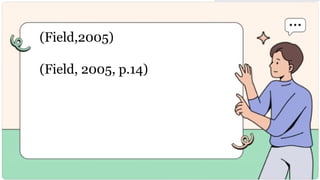
(Field,2005)
(Field, 2005, p.14)
PURPOSES FOR CITING SOURCES
❑ To give credit to the original author of
a work
❑ To promote scholarly writing
❑ To help your target audience identify
your original source.
Claim: The Importance of Effective
Communication
1.Source: Guffey, M. E., & Loewy, D.
(2016). Business Communication:
Process and Product. Cengage Learning.
1.Supporting Detail: This book
discusses how clear communication
can enhance teamwork and improve
organizational effectiveness.
Claim: The Role of Digital Literacy in
Education
2.Source: Partnership for 21st Century
Skills. (2019). Framework for 21st
Century Learning.
2.Supporting Detail: This framework
emphasizes the necessity of digital
literacy as a key skill for students to
thrive in a technology-driven world.
Claim: The Impact of Cultural Awareness on
Communication
3.Source: Hofstede, G. (2001). Culture's
Consequences: Comparing Values, Behaviors,
Institutions, and Organizations Across
Nations. SAGE Publications.
3.Supporting Detail: Hofstede's research
highlights how cultural differences affect
communication styles and can lead to
misunderstandings.
Claim: The Necessity of Critical Thinking in
Academic Writing
4.Source: Facione, P. A. (2015). Critical
Thinking: What It Is and Why It Counts.
Insight Assessment.
4.Supporting Detail: This document
outlines the significance of critical
thinking skills in analyzing and
constructing effective arguments in
writing.
•CITATION STYLES
•APA: Author, A. A. (Year). Title
of work: Capital letter also for
subtitle. Publisher.
•MLA: Author Last Name, First
Name. Title of Work. Publisher,
Year.
•APA citation style, developed by the American
Psychological Association, is a format used for citing
sources in academic writing, particularly in the social
sciences. It emphasizes the author's name and the
date of publication, providing readers with a clear
way to locate the original sources. Key features
include specific formatting rules for in-text citations
and a reference list at the end of the document. This
style helps ensure clarity and consistency in scholarly
communication.
APA Citation Examples
1. Book:
Format: Author, A. A. (Year). Title of work:
Capital letter also for subtitle. Publisher.
Example: Smith, J. A. (2020). Understanding
psychology: A comprehensive guide.
Academic Press.
APA Citation Examples
2. Journal Article:
Format: Author, A. A. (Year). Title of article. Title of
Journal, Volume(Issue), Page range.
https://doi.org/xx.xxx/yyyy
Example: Doe, J. (2021). The impact of social media
on youth. Journal of Youth Studies, 24(2), 123-145.
https://doi.org/10.1080/12345678.2021.1234567
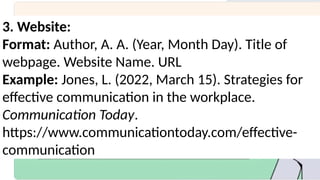
3. Website:
Format: Author, A. A. (Year, Month Day). Title of
webpage. Website Name. URL
Example: Jones, L. (2022, March 15). Strategies for
effective communication in the workplace.
Communication Today.
https://www.communicationtoday.com/effective-
communication
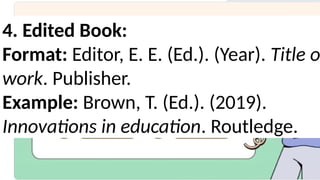
4. Edited Book:
Format: Editor, E. E. (Ed.). (Year). Title o
work. Publisher.
Example: Brown, T. (Ed.). (2019).
Innovations in education. Routledge.
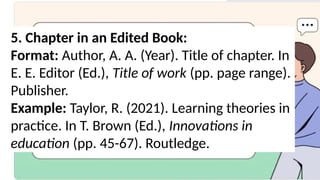
5. Chapter in an Edited Book:
Format: Author, A. A. (Year). Title of chapter. In
E. E. Editor (Ed.), Title of work (pp. page range).
Publisher.
Example: Taylor, R. (2021). Learning theories in
practice. In T. Brown (Ed.), Innovations in
education (pp. 45-67). Routledge.
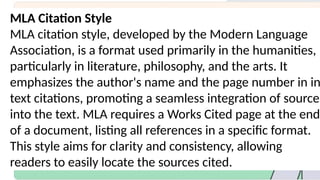
MLA Citation Style
MLA citation style, developed by the Modern Language
Association, is a format used primarily in the humanities,
particularly in literature, philosophy, and the arts. It
emphasizes the author's name and the page number in in
text citations, promoting a seamless integration of sources
into the text. MLA requires a Works Cited page at the end
of a document, listing all references in a specific format.
This style aims for clarity and consistency, allowing
readers to easily locate the sources cited.
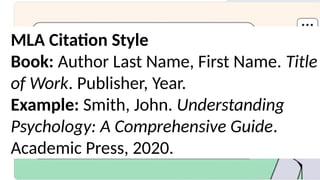
MLA Citation Style
Book: Author Last Name, First Name. Title
of Work. Publisher, Year.
Example: Smith, John. Understanding
Psychology: A Comprehensive Guide.
Academic Press, 2020.
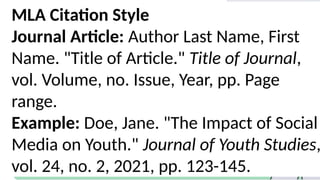
MLA Citation Style
Journal Article: Author Last Name, First
Name. "Title of Article." Title of Journal,
vol. Volume, no. Issue, Year, pp. Page
range.
Example: Doe, Jane. "The Impact of Social
Media on Youth." Journal of Youth Studies,
vol. 24, no. 2, 2021, pp. 123-145.
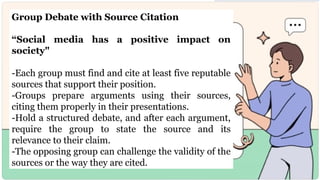
Group Debate with Source Citation
“Social media has a positive impact on
society"
-Each group must find and cite at least five reputable
sources that support their position.
-Groups prepare arguments using their sources,
citing them properly in their presentations.
-Hold a structured debate, and after each argument,
require the group to state the source and its
relevance to their claim.
-The opposing group can challenge the validity of the
sources or the way they are cited.

CITES SPECIFIC SOURCES TO SUPPORT CLAIMS pptx

  • 1.
    Cites specific sourcesto support claims
  • 2.
    1. I citesources to give credit to the author of a work. 2. I cite sources to reflect the principles of scholarly writing. 3. I cite sources to help my audience identify the original source. 4. I use in-text and reference citations. 5. I use the appropriate style guide when I write an academic paper.
  • 3.
    A citation isa reference to the source of information used in your research. Any time you directly quote, paraphrase, or summarize the essential elements of someone else's idea in your work, an in-text citation should follow.
  • 4.
  • 5.
    PURPOSES FOR CITINGSOURCES ❑ To give credit to the original author of a work ❑ To promote scholarly writing ❑ To help your target audience identify your original source.
  • 6.
    Claim: The Importanceof Effective Communication 1.Source: Guffey, M. E., & Loewy, D. (2016). Business Communication: Process and Product. Cengage Learning. 1.Supporting Detail: This book discusses how clear communication can enhance teamwork and improve organizational effectiveness.
  • 7.
    Claim: The Roleof Digital Literacy in Education 2.Source: Partnership for 21st Century Skills. (2019). Framework for 21st Century Learning. 2.Supporting Detail: This framework emphasizes the necessity of digital literacy as a key skill for students to thrive in a technology-driven world.
  • 8.
    Claim: The Impactof Cultural Awareness on Communication 3.Source: Hofstede, G. (2001). Culture's Consequences: Comparing Values, Behaviors, Institutions, and Organizations Across Nations. SAGE Publications. 3.Supporting Detail: Hofstede's research highlights how cultural differences affect communication styles and can lead to misunderstandings.
  • 9.
    Claim: The Necessityof Critical Thinking in Academic Writing 4.Source: Facione, P. A. (2015). Critical Thinking: What It Is and Why It Counts. Insight Assessment. 4.Supporting Detail: This document outlines the significance of critical thinking skills in analyzing and constructing effective arguments in writing.
  • 10.
    •CITATION STYLES •APA: Author,A. A. (Year). Title of work: Capital letter also for subtitle. Publisher. •MLA: Author Last Name, First Name. Title of Work. Publisher, Year.
  • 11.
    •APA citation style,developed by the American Psychological Association, is a format used for citing sources in academic writing, particularly in the social sciences. It emphasizes the author's name and the date of publication, providing readers with a clear way to locate the original sources. Key features include specific formatting rules for in-text citations and a reference list at the end of the document. This style helps ensure clarity and consistency in scholarly communication.
  • 12.
    APA Citation Examples 1.Book: Format: Author, A. A. (Year). Title of work: Capital letter also for subtitle. Publisher. Example: Smith, J. A. (2020). Understanding psychology: A comprehensive guide. Academic Press.
  • 13.
    APA Citation Examples 2.Journal Article: Format: Author, A. A. (Year). Title of article. Title of Journal, Volume(Issue), Page range. https://doi.org/xx.xxx/yyyy Example: Doe, J. (2021). The impact of social media on youth. Journal of Youth Studies, 24(2), 123-145. https://doi.org/10.1080/12345678.2021.1234567
  • 14.
    3. Website: Format: Author,A. A. (Year, Month Day). Title of webpage. Website Name. URL Example: Jones, L. (2022, March 15). Strategies for effective communication in the workplace. Communication Today. https://www.communicationtoday.com/effective- communication
  • 15.
    4. Edited Book: Format:Editor, E. E. (Ed.). (Year). Title o work. Publisher. Example: Brown, T. (Ed.). (2019). Innovations in education. Routledge.
  • 16.
    5. Chapter inan Edited Book: Format: Author, A. A. (Year). Title of chapter. In E. E. Editor (Ed.), Title of work (pp. page range). Publisher. Example: Taylor, R. (2021). Learning theories in practice. In T. Brown (Ed.), Innovations in education (pp. 45-67). Routledge.
  • 17.
    MLA Citation Style MLAcitation style, developed by the Modern Language Association, is a format used primarily in the humanities, particularly in literature, philosophy, and the arts. It emphasizes the author's name and the page number in in text citations, promoting a seamless integration of sources into the text. MLA requires a Works Cited page at the end of a document, listing all references in a specific format. This style aims for clarity and consistency, allowing readers to easily locate the sources cited.
  • 18.
    MLA Citation Style Book:Author Last Name, First Name. Title of Work. Publisher, Year. Example: Smith, John. Understanding Psychology: A Comprehensive Guide. Academic Press, 2020.
  • 19.
    MLA Citation Style JournalArticle: Author Last Name, First Name. "Title of Article." Title of Journal, vol. Volume, no. Issue, Year, pp. Page range. Example: Doe, Jane. "The Impact of Social Media on Youth." Journal of Youth Studies, vol. 24, no. 2, 2021, pp. 123-145.
  • 20.
    Group Debate withSource Citation “Social media has a positive impact on society" -Each group must find and cite at least five reputable sources that support their position. -Groups prepare arguments using their sources, citing them properly in their presentations. -Hold a structured debate, and after each argument, require the group to state the source and its relevance to their claim. -The opposing group can challenge the validity of the sources or the way they are cited.

Editor's Notes

  • #2 tell whether you USUALLY, SOMETIMES, SELDOM OR NEVER do the following task.
  • #3 1. How important citing sources is? 2. Did you try using/borrowing someone else’s work without citing it?
  • #4 1. How important citing sources is? 2. Did you try using/borrowing someone else’s work without citing it?
  • #5 1. TO GIVE CREDIT TO THE ORIGINAL AUTHOR OF A WORK Plagiarism is a serious offense in which someone takes and uses the ideas, information, concepts, arguments, or information of someone else, intentionally, or unintentionally, without proper citations. 2. TO PROMOTE SCHOLARLY WRITING Scholarly writing means that you are able to exhaustively use related and existing ideas, information, concepts or arguments of an expert and to properly attribute these to the original source. 3.TO HELP YOUR TARGET AUDIENCE IDENTIFY YOUR ORIGINAL SOURCE ➢ More often than not, your target audience or readers want to either verify the information or learn more about the information from the original source. ➢ With your proper citations, your target audience can easily identify the location of the original source used in your paper.