Santa Cruz Integrated National High School
Santa Cruz, Laguna
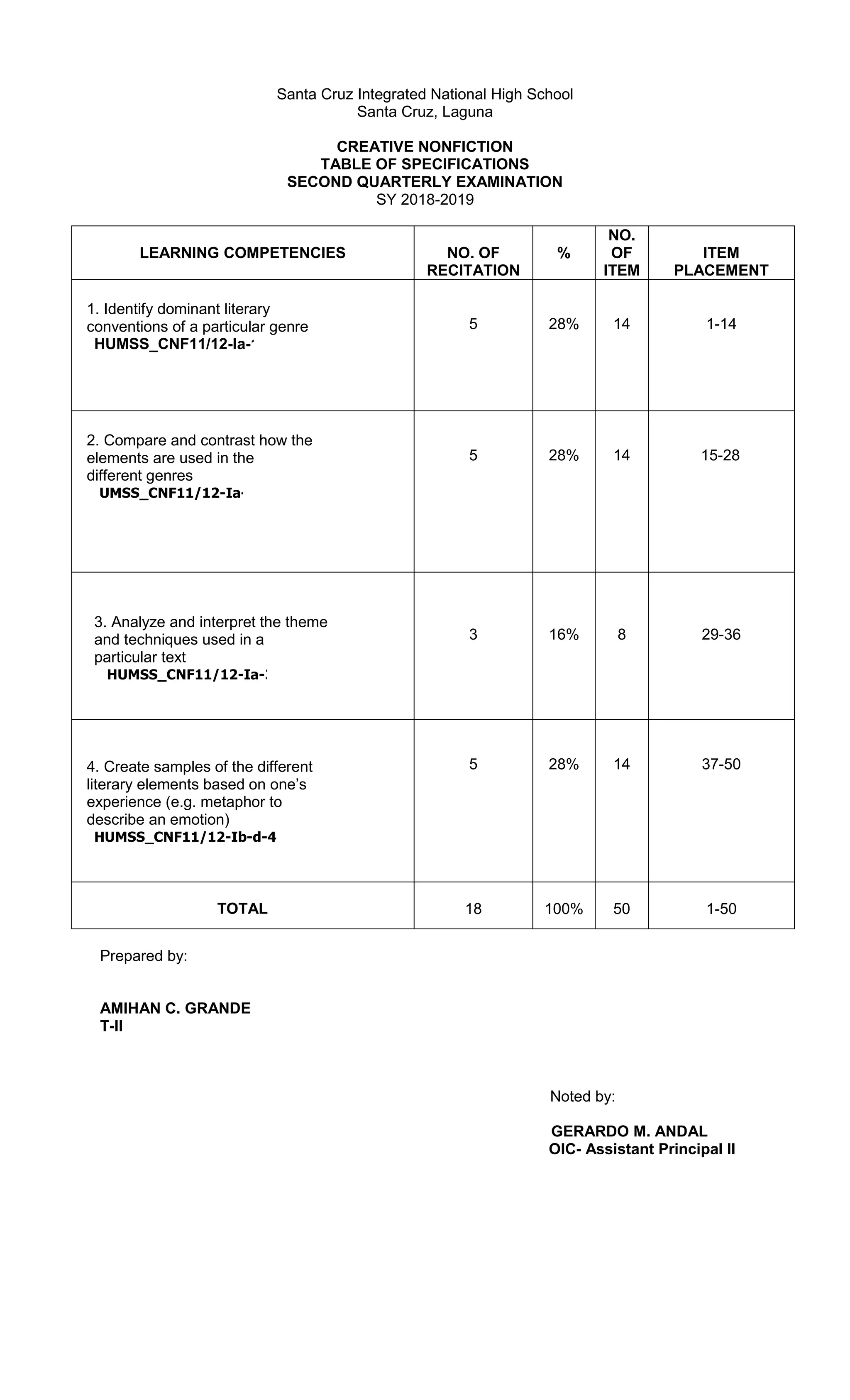
CREATIVE NONFICTION
TABLE OF SPECIFICATIONS
SECOND QUARTERLY EXAMINATION
SY 2018-2019
LEARNING COMPETENCIES NO. OF
RECITATION
%
NO.
OF
ITEM
ITEM
PLACEMENT
1. Identify dominant literary
conventions of a particular genre
HUMSS_CNF11/12-Ia-1
5 28% 14 1-14
2. Compare and contrast how the
elements are used in the
different genres
UMSS_CNF11/12-Ia-2
5 28% 14 15-28
3. Analyze and interpret the theme
and techniques used in a
particular text
HUMSS_CNF11/12-Ia-3
3 16% 8 29-36
4. Create samples of the different
literary elements based on one’s
experience (e.g. metaphor to
describe an emotion)
HUMSS_CNF11/12-Ib-d-4
5 28% 14 37-50
TOTAL 18 100% 50 1-50
Prepared by:
AMIHAN C. GRANDE
T-II
Noted by:
GERARDO M. ANDAL
OIC- Assistant Principal II
Santa Cruz Integrated National High School
Santa Cruz, Laguna
READING AND WRITING
THIRD QUARTERLY EXAMINATION
SY 2018-2019
Name:___________________________ Grade &Section _____________
LRN:_____________________________ Date:____________________________
I.
KEY TO CORRECTION
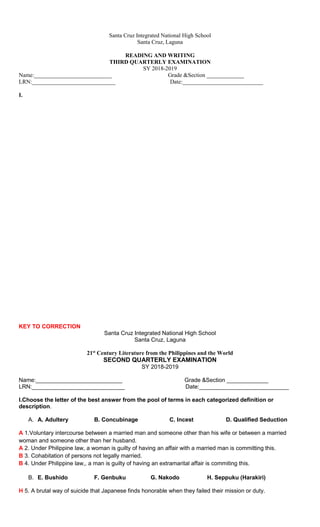
Santa Cruz Integrated National High School
Santa Cruz, Laguna
21st
Century Literature from the Philippines and the World
SECOND QUARTERLY EXAMINATION
SY 2018-2019
Name:___________________________ Grade &Section _____________
LRN:_____________________________ Date:____________________________
I.Choose the letter of the best answer from the pool of terms in each categorized definition or
description.
A. A. Adultery B. Concubinage C. Incest D. Qualified Seduction
A 1.Voluntary intercourse between a married man and someone other than his wife or between a married
woman and someone other than her husband.
A 2. Under Philippine law, a woman is guilty of having an affair with a married man is committing this.
B 3. Cohabitation of persons not legally married.
B 4. Under Philippine law,, a man is guilty of having an extramarital affair is commiting this.
B. E. Bushido F. Genbuku G. Nakodo H. Seppuku (Harakiri)
H 5. A brutal way of suicide that Japanese finds honorable when they failed their mission or duty.
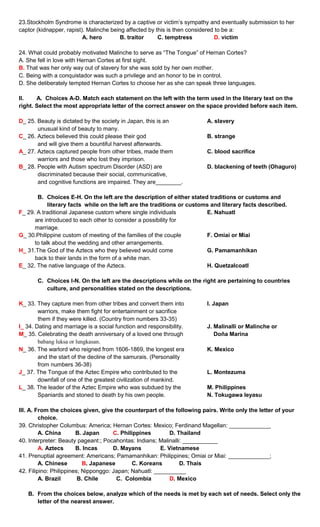
G 6. The go-between or the matchmaker who is literally an intermediary or middle person who charges a fee to
provide pictures and resumes of potential mates for rich, cultural, and well-educated.
E. 7. The seven principles or virtues of the samurai (way of the warrior).
F 8. Japanese boys ages 13-15 took part in this ceremony as he received an adult name, a haircut shaved,
and styled into a topknot, and a suit of armor.
C. I. artisans K. emperor M. peasants O. samurai
J. daimyo L. merchants N. ronin P. shogun
L 9. They are at the bottom of the feudal social class of Japan. They sell whatever the farmers and laborers
produced..
K 10. The highest official or authority but has less power and act only as the figure head.
N 11. The lost warriors who were deprived of their sponsorship due to untimely death of their warlords.
M 12. The farmers who cultivate and till the soil who comprise most of Japan’s population.
I 13. The laborers who earn through wages. They are either craftsman, armor or swords smiths who produce
things through the skills of their hands.
P 14. Considered to be more powerful than the emperor for they are mighty and skilled warriors (generals) of
the imperial court.
O 15. Warriors belonging to a category of elite shi families that included nobles, members of the imperial court,
and priests. They are extremely loyal to their feudal lord.
J 16. The provincial leader, feudal lord or warlord who owns most of Japan’s vast lands.
II.Find the relationship between the term given and the reason for having applied the name. Give the
letter of the nearest answer.
17. The Fujis are samurai warriors. What seems so special about them is that:
A. Fuji is an active volcano that is associated with strength.
B. Fuji has the sweetest apples which peasants produced to feed the samurais.
C. Fuji has plains which became ideal for family of samurais to live and exchange trades.
D. Fuji became the training ground of all samurai warriors since 1198 during the Kamakura feudal government.
18. The principle of Chekhov’s gun explains:
A. Named after playwright Anton Chekhov who is a target shooter and a gun collector.
B. .Named after playwright Anton Chekhov whose genre is related to crime and action.
C. “If you have hung a pistol on the wall, the next time, it should be fired. Otherwise don’t put it there.”
D. Guns according to Chekov must be owned only by policemen and not by civilians when legality speaks.
19. Nenita accepted the dried purple leaves her herbalista friend gave her.
A. She just kept them in one of their kitchen drawers.
B. She used them to take revenge on her in-laws and husband for cheating on her.
C. She would never use the herbs though she felt a sense of security and calmness in keeping them.
D. She had that little packet hidden and kept on coming back touching them and felt empowered for having
them.
20. At the end of the story “Preludes, Nenita imagined herself as a young woman dancing with her husband.
Hearing her husband choked and heaved a breath before singing, she joined laughing at her silliness could
mean:
A. Nenita realized she succeeded in killing the husband and eventually became insane (crazy).
B. She thought it could be due to her husband’s long time coughing and the sound was funny.
C. She thought the husband could probably be intoxicated already, he will go home at once..
D. She like it when her husband makes a mistake and be laughed at.
21. What proved Chie’s agreement to the go-between process at the end of the story?
A. She liked the way Kan looked at her in their first meeting.
B. They loved the teahouse as the venue of the matchmaking.
C. Chie flashed a glance of surprise when she heard Kan’s interest to marry her.
D. When Chie absent-mindedly though half-heartedly said yes to Kan’s marriage proposal.
22. What could probably drove Chie into such agreement?
A. She liked the way Kan blushed upon seeing her.
B. She wanted to annoy her parents for always turning down a proposal.
C. She didn’t want to experience another long series of failed arrange-marriage meetings.
D. She looked at Kan as a submissive husband who was willing to allow her to have it her way.
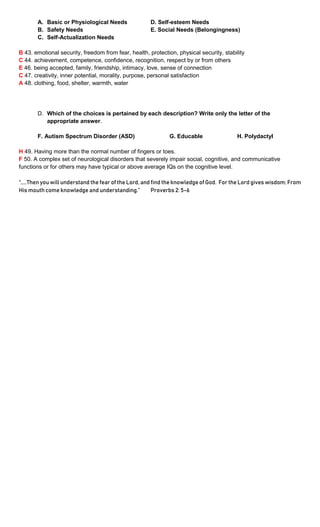
23.Stockholm Syndrome is characterized by a captive or victim’s sympathy and eventually submission to her
captor (kidnapper, rapist). Malinche being affected by this is then considered to be a:
A. hero B. traitor C. temptress D. victim
24. What could probably motivated Malinche to serve as “The Tongue” of Hernan Cortes?
A. She fell in love with Hernan Cortes at first sight.
B. That was her only way out of slavery for she was sold by her own mother.
C. Being with a conquistador was such a privilege and an honor to be in control.
D. She deliberately tempted Hernan Cortes to choose her as she can speak three languages.
II. A. Choices A-D. Match each statement on the left with the term used in the literary text on the
right. Select the most appropriate letter of the correct answer on the space provided before each item.
D_ 25. Beauty is dictated by the society in Japan, this is an A. slavery
unusual kind of beauty to many.
C_ 26. Aztecs believed this could please their god B. strange
and will give them a bountiful harvest afterwards.
A_ 27. Aztecs captured people from other tribes, made them C. blood sacrifice
warriors and those who lost they imprison.
B_ 28. People with Autism spectrum Disorder (ASD) are D. blackening of teeth (Ohaguro)
discriminated because their social, communicative,
and cognitive functions are impaired. They are________.
B. Choices E-H. On the left are the description of either stated traditions or customs and
literary facts while on the left are the traditions or customs and literary facts described.
F_ 29. A traditional Japanese custom where single individuals E. Nahuatl
are introduced to each other to consider a possibility for
marriage.
G_ 30.Philippine custom of meeting of the families of the couple F. Omiai or Miai
to talk about the wedding and other arrangements.
H_ 31.The God of the Aztecs who they believed would come G. Pamamanhikan
back to their lands in the form of a white man.
E_ 32. The native language of the Aztecs. H. Quetzalcoatl
C. Choices I-N. On the left are the descriptions while on the right are pertaining to countries
culture, and personalities stated on the descriptions.
K_ 33. They capture men from other tribes and convert them into I. Japan
warriors, make them fight for entertainment or sacrifice
them if they were killed. (Country from numbers 33-35)
I_ 34. Dating and marriage is a social function and responsibility. J. Malinalli or Malinche or
M_ 35. Celebrating the death anniversary of a loved one through Doña Marina
babang luksa or lungkasan.
N_ 36. The warlord who reigned from 1606-1869, the longest era K. Mexico
and the start of the decline of the samurais. (Personality
from numbers 36-38)
J_ 37. The Tongue of the Aztec Empire who contributed to the L. Montezuma
downfall of one of the greatest civilization of mankind.
L_ 38. The leader of the Aztec Empire who was subdued by the M. Philippines
Spaniards and stoned to death by his own people. N. Tokugawa Ieyasu
III. A. From the choices given, give the counterpart of the following pairs. Write only the letter of your
choice.
39. Christopher Columbus: America; Hernan Cortes: Mexico; Ferdinand Magellan: _____________
A. China B. Japan C. Philippines D. Thailand
40. Interpreter: Beauty pageant:; Pocahontas: Indians; Malinalli: ___________
A. Aztecs B. Incas D. Mayans E. Vietnamese
41. Prenuptial agreement: Americans; Pamamanhikan: Philippines; Omiai or Miai: _____________;
A. Chinese B. Japanese C. Koreans D. Thais
42. Filipino: Philippines; Nipponggo: Japan; Nahuatl: __________
A. Brazil B. Chile C. Colombia D. Mexico
B. From the choices below, analyze which of the needs is met by each set of needs. Select only the
letter of the nearest answer.
A. Basic or Physiological Needs D. Self-esteem Needs
B. Safety Needs E. Social Needs (Belongingness)
C. Self-Actualization Needs
B 43. emotional security, freedom from fear, health, protection, physical security, stability
C 44. achievement, competence, confidence, recognition, respect by or from others
E 46. being accepted, family, friendship, intimacy, love, sense of connection
C 47. creativity, inner potential, morality, purpose, personal satisfaction
A 48. clothing, food, shelter, warmth, water
D. Which of the choices is pertained by each description? Write only the letter of the
appropriate answer.
F. Autism Spectrum Disorder (ASD) G. Educable H. Polydactyl
H 49. Having more than the normal number of fingers or toes.
F 50. A complex set of neurological disorders that severely impair social, cognitive, and communicative
functions or for others may have typical or above average IQs on the cognitive level.
“…..Then you will understand the fear of the Lord, and find the knowledge of God. For the Lord gives wisdom; From
His mouth come knowledge and understanding.” Proverbs 2: 5-6

3RD QUARTERLY EXAM-Creative Nonfiction-TOS.docx

  • 1.
    Santa Cruz IntegratedNational High School Santa Cruz, Laguna CREATIVE NONFICTION TABLE OF SPECIFICATIONS SECOND QUARTERLY EXAMINATION SY 2018-2019 LEARNING COMPETENCIES NO. OF RECITATION % NO. OF ITEM ITEM PLACEMENT 1. Identify dominant literary conventions of a particular genre HUMSS_CNF11/12-Ia-1 5 28% 14 1-14 2. Compare and contrast how the elements are used in the different genres UMSS_CNF11/12-Ia-2 5 28% 14 15-28 3. Analyze and interpret the theme and techniques used in a particular text HUMSS_CNF11/12-Ia-3 3 16% 8 29-36 4. Create samples of the different literary elements based on one’s experience (e.g. metaphor to describe an emotion) HUMSS_CNF11/12-Ib-d-4 5 28% 14 37-50 TOTAL 18 100% 50 1-50 Prepared by: AMIHAN C. GRANDE T-II Noted by: GERARDO M. ANDAL OIC- Assistant Principal II
  • 2.
    Santa Cruz IntegratedNational High School Santa Cruz, Laguna READING AND WRITING THIRD QUARTERLY EXAMINATION SY 2018-2019 Name:___________________________ Grade &Section _____________ LRN:_____________________________ Date:____________________________ I. KEY TO CORRECTION Santa Cruz Integrated National High School Santa Cruz, Laguna 21st Century Literature from the Philippines and the World SECOND QUARTERLY EXAMINATION SY 2018-2019 Name:___________________________ Grade &Section _____________ LRN:_____________________________ Date:____________________________ I.Choose the letter of the best answer from the pool of terms in each categorized definition or description. A. A. Adultery B. Concubinage C. Incest D. Qualified Seduction A 1.Voluntary intercourse between a married man and someone other than his wife or between a married woman and someone other than her husband. A 2. Under Philippine law, a woman is guilty of having an affair with a married man is committing this. B 3. Cohabitation of persons not legally married. B 4. Under Philippine law,, a man is guilty of having an extramarital affair is commiting this. B. E. Bushido F. Genbuku G. Nakodo H. Seppuku (Harakiri) H 5. A brutal way of suicide that Japanese finds honorable when they failed their mission or duty.
  • 3.
    G 6. Thego-between or the matchmaker who is literally an intermediary or middle person who charges a fee to provide pictures and resumes of potential mates for rich, cultural, and well-educated. E. 7. The seven principles or virtues of the samurai (way of the warrior). F 8. Japanese boys ages 13-15 took part in this ceremony as he received an adult name, a haircut shaved, and styled into a topknot, and a suit of armor. C. I. artisans K. emperor M. peasants O. samurai J. daimyo L. merchants N. ronin P. shogun L 9. They are at the bottom of the feudal social class of Japan. They sell whatever the farmers and laborers produced.. K 10. The highest official or authority but has less power and act only as the figure head. N 11. The lost warriors who were deprived of their sponsorship due to untimely death of their warlords. M 12. The farmers who cultivate and till the soil who comprise most of Japan’s population. I 13. The laborers who earn through wages. They are either craftsman, armor or swords smiths who produce things through the skills of their hands. P 14. Considered to be more powerful than the emperor for they are mighty and skilled warriors (generals) of the imperial court. O 15. Warriors belonging to a category of elite shi families that included nobles, members of the imperial court, and priests. They are extremely loyal to their feudal lord. J 16. The provincial leader, feudal lord or warlord who owns most of Japan’s vast lands. II.Find the relationship between the term given and the reason for having applied the name. Give the letter of the nearest answer. 17. The Fujis are samurai warriors. What seems so special about them is that: A. Fuji is an active volcano that is associated with strength. B. Fuji has the sweetest apples which peasants produced to feed the samurais. C. Fuji has plains which became ideal for family of samurais to live and exchange trades. D. Fuji became the training ground of all samurai warriors since 1198 during the Kamakura feudal government. 18. The principle of Chekhov’s gun explains: A. Named after playwright Anton Chekhov who is a target shooter and a gun collector. B. .Named after playwright Anton Chekhov whose genre is related to crime and action. C. “If you have hung a pistol on the wall, the next time, it should be fired. Otherwise don’t put it there.” D. Guns according to Chekov must be owned only by policemen and not by civilians when legality speaks. 19. Nenita accepted the dried purple leaves her herbalista friend gave her. A. She just kept them in one of their kitchen drawers. B. She used them to take revenge on her in-laws and husband for cheating on her. C. She would never use the herbs though she felt a sense of security and calmness in keeping them. D. She had that little packet hidden and kept on coming back touching them and felt empowered for having them. 20. At the end of the story “Preludes, Nenita imagined herself as a young woman dancing with her husband. Hearing her husband choked and heaved a breath before singing, she joined laughing at her silliness could mean: A. Nenita realized she succeeded in killing the husband and eventually became insane (crazy). B. She thought it could be due to her husband’s long time coughing and the sound was funny. C. She thought the husband could probably be intoxicated already, he will go home at once.. D. She like it when her husband makes a mistake and be laughed at. 21. What proved Chie’s agreement to the go-between process at the end of the story? A. She liked the way Kan looked at her in their first meeting. B. They loved the teahouse as the venue of the matchmaking. C. Chie flashed a glance of surprise when she heard Kan’s interest to marry her. D. When Chie absent-mindedly though half-heartedly said yes to Kan’s marriage proposal. 22. What could probably drove Chie into such agreement? A. She liked the way Kan blushed upon seeing her. B. She wanted to annoy her parents for always turning down a proposal. C. She didn’t want to experience another long series of failed arrange-marriage meetings. D. She looked at Kan as a submissive husband who was willing to allow her to have it her way.
  • 4.
    23.Stockholm Syndrome ischaracterized by a captive or victim’s sympathy and eventually submission to her captor (kidnapper, rapist). Malinche being affected by this is then considered to be a: A. hero B. traitor C. temptress D. victim 24. What could probably motivated Malinche to serve as “The Tongue” of Hernan Cortes? A. She fell in love with Hernan Cortes at first sight. B. That was her only way out of slavery for she was sold by her own mother. C. Being with a conquistador was such a privilege and an honor to be in control. D. She deliberately tempted Hernan Cortes to choose her as she can speak three languages. II. A. Choices A-D. Match each statement on the left with the term used in the literary text on the right. Select the most appropriate letter of the correct answer on the space provided before each item. D_ 25. Beauty is dictated by the society in Japan, this is an A. slavery unusual kind of beauty to many. C_ 26. Aztecs believed this could please their god B. strange and will give them a bountiful harvest afterwards. A_ 27. Aztecs captured people from other tribes, made them C. blood sacrifice warriors and those who lost they imprison. B_ 28. People with Autism spectrum Disorder (ASD) are D. blackening of teeth (Ohaguro) discriminated because their social, communicative, and cognitive functions are impaired. They are________. B. Choices E-H. On the left are the description of either stated traditions or customs and literary facts while on the left are the traditions or customs and literary facts described. F_ 29. A traditional Japanese custom where single individuals E. Nahuatl are introduced to each other to consider a possibility for marriage. G_ 30.Philippine custom of meeting of the families of the couple F. Omiai or Miai to talk about the wedding and other arrangements. H_ 31.The God of the Aztecs who they believed would come G. Pamamanhikan back to their lands in the form of a white man. E_ 32. The native language of the Aztecs. H. Quetzalcoatl C. Choices I-N. On the left are the descriptions while on the right are pertaining to countries culture, and personalities stated on the descriptions. K_ 33. They capture men from other tribes and convert them into I. Japan warriors, make them fight for entertainment or sacrifice them if they were killed. (Country from numbers 33-35) I_ 34. Dating and marriage is a social function and responsibility. J. Malinalli or Malinche or M_ 35. Celebrating the death anniversary of a loved one through Doña Marina babang luksa or lungkasan. N_ 36. The warlord who reigned from 1606-1869, the longest era K. Mexico and the start of the decline of the samurais. (Personality from numbers 36-38) J_ 37. The Tongue of the Aztec Empire who contributed to the L. Montezuma downfall of one of the greatest civilization of mankind. L_ 38. The leader of the Aztec Empire who was subdued by the M. Philippines Spaniards and stoned to death by his own people. N. Tokugawa Ieyasu III. A. From the choices given, give the counterpart of the following pairs. Write only the letter of your choice. 39. Christopher Columbus: America; Hernan Cortes: Mexico; Ferdinand Magellan: _____________ A. China B. Japan C. Philippines D. Thailand 40. Interpreter: Beauty pageant:; Pocahontas: Indians; Malinalli: ___________ A. Aztecs B. Incas D. Mayans E. Vietnamese 41. Prenuptial agreement: Americans; Pamamanhikan: Philippines; Omiai or Miai: _____________; A. Chinese B. Japanese C. Koreans D. Thais 42. Filipino: Philippines; Nipponggo: Japan; Nahuatl: __________ A. Brazil B. Chile C. Colombia D. Mexico B. From the choices below, analyze which of the needs is met by each set of needs. Select only the letter of the nearest answer.
  • 5.
    A. Basic orPhysiological Needs D. Self-esteem Needs B. Safety Needs E. Social Needs (Belongingness) C. Self-Actualization Needs B 43. emotional security, freedom from fear, health, protection, physical security, stability C 44. achievement, competence, confidence, recognition, respect by or from others E 46. being accepted, family, friendship, intimacy, love, sense of connection C 47. creativity, inner potential, morality, purpose, personal satisfaction A 48. clothing, food, shelter, warmth, water D. Which of the choices is pertained by each description? Write only the letter of the appropriate answer. F. Autism Spectrum Disorder (ASD) G. Educable H. Polydactyl H 49. Having more than the normal number of fingers or toes. F 50. A complex set of neurological disorders that severely impair social, cognitive, and communicative functions or for others may have typical or above average IQs on the cognitive level. “…..Then you will understand the fear of the Lord, and find the knowledge of God. For the Lord gives wisdom; From His mouth come knowledge and understanding.” Proverbs 2: 5-6