


KARMA
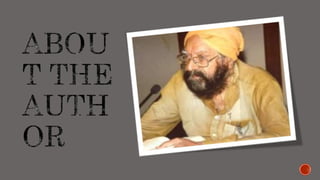
Khushwant Singh
KHUSHWANT
SINGHBorn on Feb. 2, 1915- March 20, 2014
Indian novelist, lawyer, journalist,
politician
Born and raised in Hadali, Punjab
(now in Pakistan)
Studied law at St. Stephen’s College,
Delhi and King’s College London
Married to Kawal Malik
After working as a lawyer in Lahore Court for
8 years, he joined the Indian Foreign Service
upon the Independence of India from British
Empire in 1947.
Appointed journalist in the All India Radio
(1951)
Moved to the Department of Mass
Communications of UNESCO at Paris (1956)
Best known for his trenchant secularism,
humour, sarcasm and an abiding love of poetry
(literary career)
Served as the editor of several literary and news
magazines, as well as two newspapers (1970’s and
1980’s)
Bet. 1980-1986, served as Member of Parliament
in Rajya Sabha, the upper house of the Parliament
of India
Decorated with the Padma Bhushan (1974) but he
returned the award in 1984 in protest against
Operation Blue Star in which the Indian Army
raided Amritsar.
In 2007, he was awarded the Padma Vibhushan,
the 2nd highest civilian award in India.
"Karma" is a story written by Indian
writer Khushwant Singh. It was
originally published in 1989 in
Singh's The Collected
Stories. Karma is about an Indian
"Gentleman" who tries to adopt upper
class English culture and lifestyle such
as speaking the "Queen's English", and
about his relation with his wife etc.
THE
CHARACTE
RSMohan Lal
Mohan Lal is one of the main characters in
the short story. His characterization is done
both directly by the narrator, his wife and
himself, and indirectly through his actions
and attitude.
Outer characterization
Mohan Lal is a middle-aged Indian man,
educated in England, who works as a lawyer
and a vizier in his native country (p. 179, l. 28)
Inner characterization
The defining personality trait of Mohan Lal is
his arrogance which can be identified based on
his attitude towards Indians and his wife.
He treats his wife with indifference and
superiority. While waiting for the train, the two
of them never speak.
Lachmi
Lachmi is Mohan Lal’s wife and the second important
character in the story. Her presence in the short story
helps emphasize Mohan’s arrogance through contrast,
as the woman is very different from her husband, being
a typically Indian wife.
Outer characterization
The first contrast between the two characters is in
terms of physical appearance. While Mohan Lal is
clean and dresses like a westerner, his wife is dressed
in a dirty traditional sari:
Inner characterization
When it comes to the woman’s personality, her main
traits are her modesty as she knows where she belongs
in the Indian society, and her carelessness with regards
to everything around her.
The bearer and the coolie
The bearer and the coolie are secondary
characters and they are only briefly
sketched in the short story.
The English soldiers
The English soldiers are also secondary
characters, but they function as
‘instruments’ of karma in the short story.
Their discriminating and aggressive
attitudes teach Mohan Lal a lesson about
SETTI
NGThe short story “Karma” by Kushwant Singh is
set somewhere in India, in a railway station.
Though we do not know the exact time
setting of the narrative, the presence of the
English soldiers and the date when the short
story was written (1950) indicate the action
might be set sometime before India’s
independence.
Physical setting
The elements of the physical setting are the
railway station waiting room, the train platform
and the train compartments.
The waiting room for the first class is only depicted
from Mohan Lal’s perspective, which focuses on the
poorly made Indian mirror:
Social setting
The social setting of the short story is more
important than the physical one, which only helps
present the former. The story depicts a class
Indian society, in which both women and lower-
class Indians are treated in a different way.
Lachmi travels in a special compartment for
women and not with her husband in his first-class
coupe. The bearer and the porter are servant
labourers and treated as such:
 It is a first class waiting room at the
railway station. Sir Mohan Lal is
found standing before the mirror. The
mirror is worn-out and partly broken.
He hates the mirror as he hates
everything of India. But he admires
his own appearance. He looks perfectly
like a sahib. The train is yet to come.
He calls the bearer and orders a drink.
Outside the waiting room, Lachmi, his wife
is sitting on a small grey steel trunk. She
is chewing a betel leaf. She is a traditional
Indian woman and is commonly dressed.
She requests a coolie to carry her luggage
to the end of the platform. She will get into
the inter-class woman compartment. She is
not allowed to accompany her husband in
the first class compartment, because her
husband is a high government official, a
barrister
He will meet many officials in the compartment.
But Lachmi cannot speak English and does not
know their ways. Obviously, she cannot travel with
her husband. She hardly enjoys the company of
her husband. He visits her rarely at night. Then
Lachmi plays the role of a passive partner. They
have no child.
 The train arrives at the platform. Lachmi enters
the inter-class compartment. It is almost empty.
She prepares some betel-leaves and starts chewing
one.
 There is a lot of noise. Passengers are jostling on the
platform. Sir Mohan Lal totally detests them. He is calm and
quiet. He is still enjoying his drink. He has spent five years in
Oxford University. He strictly follows the manners of the
English. He rarely speaks Hindustani. He speaks in English
with a foreign accent. He can talk on any subject like a
cultured Englishman. Indeed, he always feels at home with
the English. He expects some Englishmen as co-passengers.
In that case it will be an enjoyable journey for him. But he
shows no sign of urge to talk to the English like most of the
Indians. He pretends to read The Times. He has already his
Balliol tie. He orders whisky. And lastly, he opens his gold
cigarette case full of English cigarettes. He knows well that
all these things will automatically arrest the attention of the
Englishmen. Now he recalls his five-year glorious life of
England. He loves everything of the country. Even the
prostitutes of England are more charming to him than his
wife Lachmi.
 However, Sir Mohan enters his reserved first class
coupe. It is empty and so he is sad. He begins to read The
Times. Just then two English soldiers appear. They are
looking for a suitable compartment. Sir Mohan is ready
to welcome them. The two soldiers ultimately choose Sir
Mohan’s compartment. But they order him to get out
from the compartment. Though it is reserved, the
soldiers do not care for it. Sir Mohan protests mildly. His
royal English, sahib like appearance and The Times come
of no use. The soldiers throw all the belongings of Sir
Mohan out of the train. Finally they push him out of the
train. The train quickly passes the station leaving him on
the platform. His wife, totally unaware of his condition,
chews the betel leaves, spits and sends a jet of red dribble
flying across like a dart.
THE
FEATURE
S The word karma is a Sanskrit one and literally means
destiny. It also has a Hindu theological idea, but it has
been used as the title of the story only to speak about the
identity crisis of a person who blindly imitates the western
culture and fashion under the impact of British colonialism
in India.
 Irony forms one of the basic characteristics in Khushwant
Singh’s style of writing. The consequence of Sir Mohan’s
babu-culture is ironical. The irony lies in the fact that he is
neither a British nor an Indian. He has no real identity. He
himself has lost it. Khushwant Singh has portrayed a deep
ironical view of the world around him through this story.
 Mohan Lal and Lachmi are totally opposite characters
though they are couple to each other. Mohan Lal is a
blind follower of the English culture, whereas his wife
Lachmi is a typical Indian woman. Finally, Mohan Lal
loses his identity, but Lachmi has no such crisis.
 Through this story, Khushwant Singh warns us against
our false belief in foreign excellence. It teaches us not to
cut our roots off with our own soil, men and civilization.
Otherwise, we are sure to face humiliation and tragic
doom.
 The story shows Khushwant Sing’s art of presenting the
psychological aspects of human beings nicely. His power
to study of man is as remarkable here as the glamour of
his linguistic style to present them vividly.
THE
MESBrute versus Refined
The story revolves around the contrast between
brute, visceral behaviour, and an educated,
refined attitude.
Mohan Lal represents the refined man. Though
an Indian, he has been educated in Oxford and
has acquired the English manners and the
English dress code. Even if he returned to India
and had been living there most of his life, he
stubbornly continues to conform to British
etiquette.
Power and Symbols
The theme of power and symbols is more subtly explored by the
author. At a first sight, the story seems a very simple account of
a man receiving a karmic lesson for his arrogance. However, at a
closer look, the text has a lot of hidden symbolism.
Motifs: arrogance, discrimination and class
The themes of the short story are enhanced by several motifs.
The story shows that refinement leads to arrogance. Mohan Lal
acts arrogantly towards his wife and fellow countrymen because
he sees himself as an educated gentleman, a citizen of the
British Empire. But the English soldiers also act arrogantly,
even if they are not educated, for the simple reason that they
were born English and India is a colony.
The story Karma illustrates the famous proverb "Pride Comes
Before a Fall". It is the story of an arrogant person who feels
bad about his country's culture, lifestyle etc. He is
condescending to his wife because she is an ordinary woman
unable to appreciate his aristocratic English culture
The Theme:
Imitation of foreign culture
Unhappy married life
Contrast of culture and life-style
Aristocracy and patriotism

Lit.2 Karma by Khushwant Singh

  • 1.
  • 3.
    KHUSHWANT SINGHBorn on Feb.2, 1915- March 20, 2014 Indian novelist, lawyer, journalist, politician Born and raised in Hadali, Punjab (now in Pakistan) Studied law at St. Stephen’s College, Delhi and King’s College London Married to Kawal Malik
  • 4.
    After working asa lawyer in Lahore Court for 8 years, he joined the Indian Foreign Service upon the Independence of India from British Empire in 1947. Appointed journalist in the All India Radio (1951) Moved to the Department of Mass Communications of UNESCO at Paris (1956) Best known for his trenchant secularism, humour, sarcasm and an abiding love of poetry (literary career)
  • 5.
    Served as theeditor of several literary and news magazines, as well as two newspapers (1970’s and 1980’s) Bet. 1980-1986, served as Member of Parliament in Rajya Sabha, the upper house of the Parliament of India Decorated with the Padma Bhushan (1974) but he returned the award in 1984 in protest against Operation Blue Star in which the Indian Army raided Amritsar. In 2007, he was awarded the Padma Vibhushan, the 2nd highest civilian award in India.
  • 6.
    "Karma" is astory written by Indian writer Khushwant Singh. It was originally published in 1989 in Singh's The Collected Stories. Karma is about an Indian "Gentleman" who tries to adopt upper class English culture and lifestyle such as speaking the "Queen's English", and about his relation with his wife etc.
  • 7.
    THE CHARACTE RSMohan Lal Mohan Lalis one of the main characters in the short story. His characterization is done both directly by the narrator, his wife and himself, and indirectly through his actions and attitude.
  • 8.
    Outer characterization Mohan Lalis a middle-aged Indian man, educated in England, who works as a lawyer and a vizier in his native country (p. 179, l. 28) Inner characterization The defining personality trait of Mohan Lal is his arrogance which can be identified based on his attitude towards Indians and his wife. He treats his wife with indifference and superiority. While waiting for the train, the two of them never speak.
  • 9.
    Lachmi Lachmi is MohanLal’s wife and the second important character in the story. Her presence in the short story helps emphasize Mohan’s arrogance through contrast, as the woman is very different from her husband, being a typically Indian wife. Outer characterization The first contrast between the two characters is in terms of physical appearance. While Mohan Lal is clean and dresses like a westerner, his wife is dressed in a dirty traditional sari: Inner characterization When it comes to the woman’s personality, her main traits are her modesty as she knows where she belongs in the Indian society, and her carelessness with regards to everything around her.
  • 10.
    The bearer andthe coolie The bearer and the coolie are secondary characters and they are only briefly sketched in the short story. The English soldiers The English soldiers are also secondary characters, but they function as ‘instruments’ of karma in the short story. Their discriminating and aggressive attitudes teach Mohan Lal a lesson about
  • 11.
    SETTI NGThe short story“Karma” by Kushwant Singh is set somewhere in India, in a railway station. Though we do not know the exact time setting of the narrative, the presence of the English soldiers and the date when the short story was written (1950) indicate the action might be set sometime before India’s independence.
  • 12.
    Physical setting The elementsof the physical setting are the railway station waiting room, the train platform and the train compartments. The waiting room for the first class is only depicted from Mohan Lal’s perspective, which focuses on the poorly made Indian mirror:
  • 13.
    Social setting The socialsetting of the short story is more important than the physical one, which only helps present the former. The story depicts a class Indian society, in which both women and lower- class Indians are treated in a different way. Lachmi travels in a special compartment for women and not with her husband in his first-class coupe. The bearer and the porter are servant labourers and treated as such:
  • 15.
     It isa first class waiting room at the railway station. Sir Mohan Lal is found standing before the mirror. The mirror is worn-out and partly broken. He hates the mirror as he hates everything of India. But he admires his own appearance. He looks perfectly like a sahib. The train is yet to come. He calls the bearer and orders a drink.
  • 16.
    Outside the waitingroom, Lachmi, his wife is sitting on a small grey steel trunk. She is chewing a betel leaf. She is a traditional Indian woman and is commonly dressed. She requests a coolie to carry her luggage to the end of the platform. She will get into the inter-class woman compartment. She is not allowed to accompany her husband in the first class compartment, because her husband is a high government official, a barrister
  • 17.
    He will meetmany officials in the compartment. But Lachmi cannot speak English and does not know their ways. Obviously, she cannot travel with her husband. She hardly enjoys the company of her husband. He visits her rarely at night. Then Lachmi plays the role of a passive partner. They have no child.  The train arrives at the platform. Lachmi enters the inter-class compartment. It is almost empty. She prepares some betel-leaves and starts chewing one.
  • 18.
     There isa lot of noise. Passengers are jostling on the platform. Sir Mohan Lal totally detests them. He is calm and quiet. He is still enjoying his drink. He has spent five years in Oxford University. He strictly follows the manners of the English. He rarely speaks Hindustani. He speaks in English with a foreign accent. He can talk on any subject like a cultured Englishman. Indeed, he always feels at home with the English. He expects some Englishmen as co-passengers. In that case it will be an enjoyable journey for him. But he shows no sign of urge to talk to the English like most of the Indians. He pretends to read The Times. He has already his Balliol tie. He orders whisky. And lastly, he opens his gold cigarette case full of English cigarettes. He knows well that all these things will automatically arrest the attention of the Englishmen. Now he recalls his five-year glorious life of England. He loves everything of the country. Even the prostitutes of England are more charming to him than his wife Lachmi.
  • 19.
     However, SirMohan enters his reserved first class coupe. It is empty and so he is sad. He begins to read The Times. Just then two English soldiers appear. They are looking for a suitable compartment. Sir Mohan is ready to welcome them. The two soldiers ultimately choose Sir Mohan’s compartment. But they order him to get out from the compartment. Though it is reserved, the soldiers do not care for it. Sir Mohan protests mildly. His royal English, sahib like appearance and The Times come of no use. The soldiers throw all the belongings of Sir Mohan out of the train. Finally they push him out of the train. The train quickly passes the station leaving him on the platform. His wife, totally unaware of his condition, chews the betel leaves, spits and sends a jet of red dribble flying across like a dart.
  • 20.
    THE FEATURE S The wordkarma is a Sanskrit one and literally means destiny. It also has a Hindu theological idea, but it has been used as the title of the story only to speak about the identity crisis of a person who blindly imitates the western culture and fashion under the impact of British colonialism in India.  Irony forms one of the basic characteristics in Khushwant Singh’s style of writing. The consequence of Sir Mohan’s babu-culture is ironical. The irony lies in the fact that he is neither a British nor an Indian. He has no real identity. He himself has lost it. Khushwant Singh has portrayed a deep ironical view of the world around him through this story.
  • 21.
     Mohan Laland Lachmi are totally opposite characters though they are couple to each other. Mohan Lal is a blind follower of the English culture, whereas his wife Lachmi is a typical Indian woman. Finally, Mohan Lal loses his identity, but Lachmi has no such crisis.  Through this story, Khushwant Singh warns us against our false belief in foreign excellence. It teaches us not to cut our roots off with our own soil, men and civilization. Otherwise, we are sure to face humiliation and tragic doom.  The story shows Khushwant Sing’s art of presenting the psychological aspects of human beings nicely. His power to study of man is as remarkable here as the glamour of his linguistic style to present them vividly.
  • 22.
    THE MESBrute versus Refined Thestory revolves around the contrast between brute, visceral behaviour, and an educated, refined attitude. Mohan Lal represents the refined man. Though an Indian, he has been educated in Oxford and has acquired the English manners and the English dress code. Even if he returned to India and had been living there most of his life, he stubbornly continues to conform to British etiquette.
  • 23.
    Power and Symbols Thetheme of power and symbols is more subtly explored by the author. At a first sight, the story seems a very simple account of a man receiving a karmic lesson for his arrogance. However, at a closer look, the text has a lot of hidden symbolism. Motifs: arrogance, discrimination and class The themes of the short story are enhanced by several motifs. The story shows that refinement leads to arrogance. Mohan Lal acts arrogantly towards his wife and fellow countrymen because he sees himself as an educated gentleman, a citizen of the British Empire. But the English soldiers also act arrogantly, even if they are not educated, for the simple reason that they were born English and India is a colony.
  • 24.
    The story Karmaillustrates the famous proverb "Pride Comes Before a Fall". It is the story of an arrogant person who feels bad about his country's culture, lifestyle etc. He is condescending to his wife because she is an ordinary woman unable to appreciate his aristocratic English culture The Theme: Imitation of foreign culture Unhappy married life Contrast of culture and life-style Aristocracy and patriotism