Creative Commons
Licensing Workshop
Regina Gong
Librarian and OER Project Manager
Lansing Community College
This work is licensed under the Creative Commons Attribution 4.0 International License.
What we’ll cover today:
• Copyright Basics
• Fair Use
• Creative Commons
• CC Licenses
• License Compatibility
• Attribution
• Hands on
Creative Commons is a replacement for
copyright.
When creators use a Creative Commons license,
they are forfeiting their copyright.
TRUE OR FALSE
A form of protection grounded in the U.S.
Constitution and granted by law for original
works of authorship fixed in a tangible medium
of expression. Copyright covers both
published and unpublished works.
Copyright
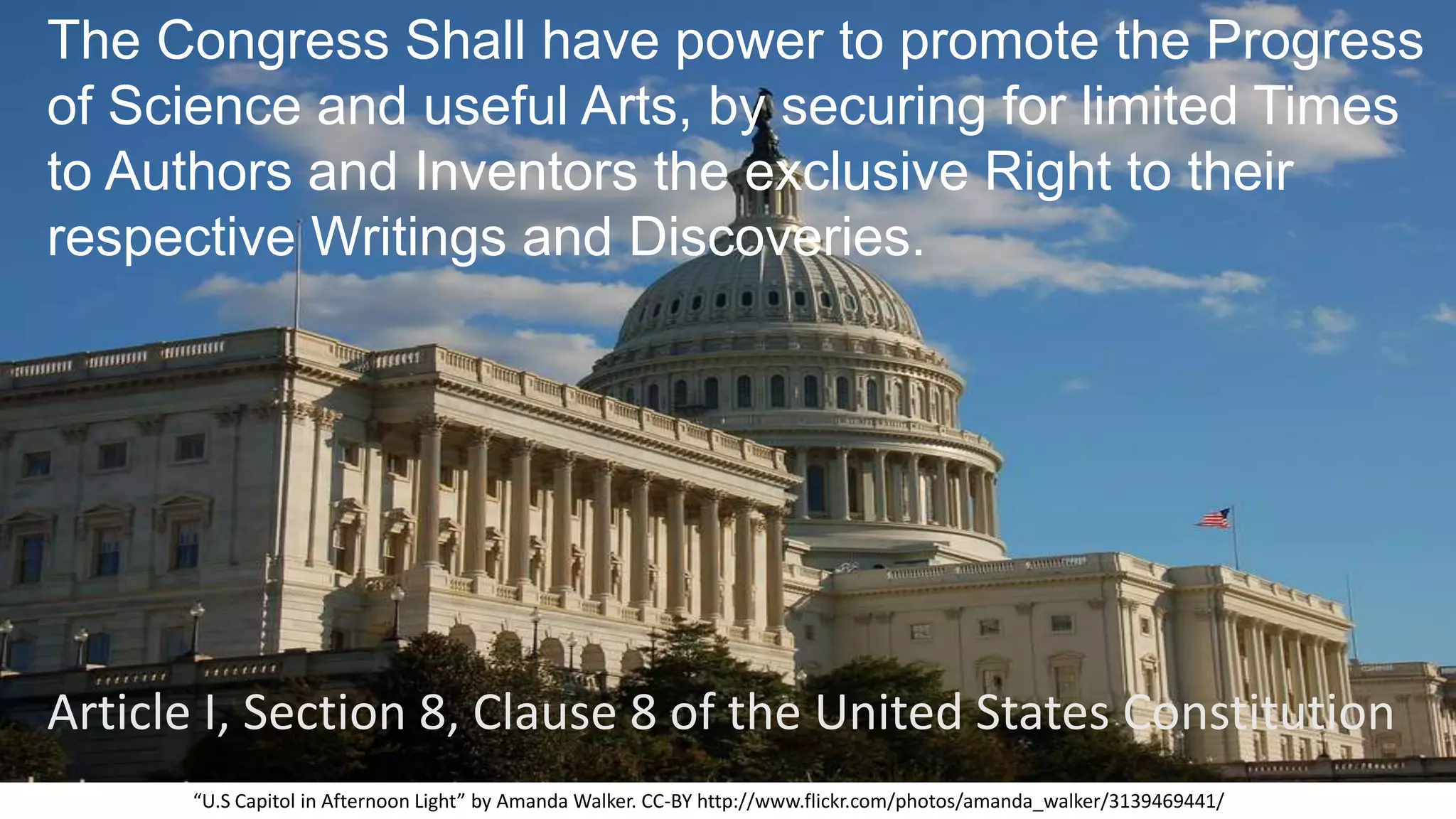
The Congress Shall have power to promote the Progress
of Science and useful Arts, by securing for limited Times
to Authors and Inventors the exclusive Right to their
respective Writings and Discoveries.
“U.S Capitol in Afternoon Light” by Amanda Walker. CC-BY http://www.flickr.com/photos/amanda_walker/3139469441/
Article I, Section 8, Clause 8 of the United States Constitution
Source: https://www.copyright.gov/title17/
Purpose of Copyright
• To promote the progress of the
sciences and the useful arts”—
so as to encourage creation of
new works.
• To grant authors/creators
exclusive monopoly and
ownership of their works for a
given time period.
• applies to original works created in a
tangible medium.
• is automatic with no application needed
to be protected.
Copyright
Copyright is a bundle of rights:
• The right to reproduce the work
• The right to distribute the work
• The right to prepare derivative works
• The right to perform the work
• The right to display the work
• The right to digitally transmit sound recordings by means of
digital audio transmission
Exclusive rights, and limitations
Section 106 outlines the exclusive rights of copyright
holders.
Sections 107 through 122 outline all of the limitations
on and exemptions from those exclusive rights.
Who is the copyright holder?
• The creator is usually the initial copyright holder.
• If two or more people jointly create a work, they are
joint copyright holders, with equal rights.
• With some exceptions, work created as a part of a
person's employment is a "work made for hire" and
the copyright belongs to the employer.
How is copyright transferred?
• Exclusive transfer, a.k.a. Assignment
•Copyright holder loses rights
•Must occur in writing
• Non-exclusive license, a.k.a. Permission
•Copyright holder retains rights
•Can be in writing or verbal
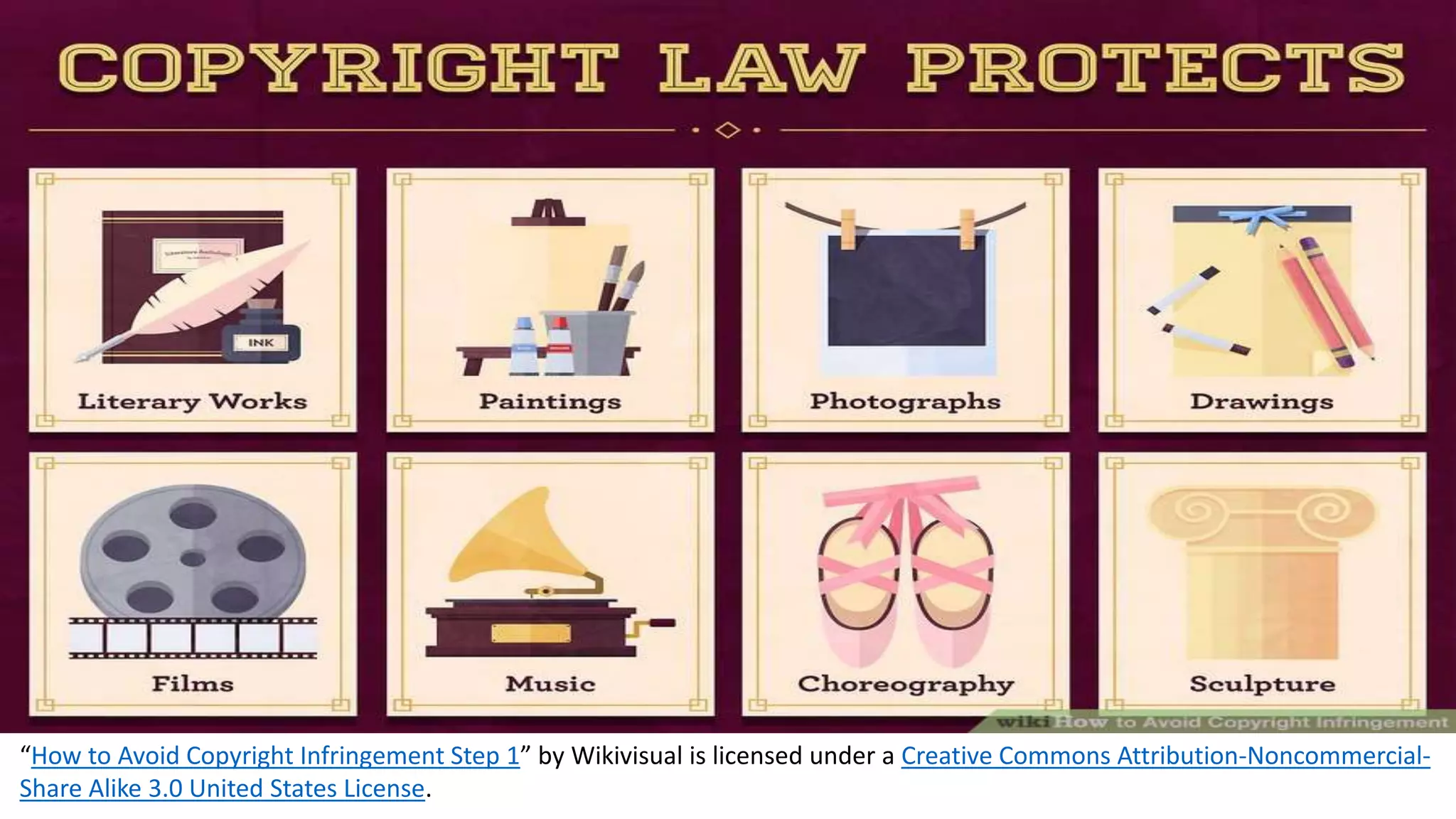
“How to Avoid Copyright Infringement Step 1” by Wikivisual is licensed under a Creative Commons Attribution-Noncommercial-
Share Alike 3.0 United States License.
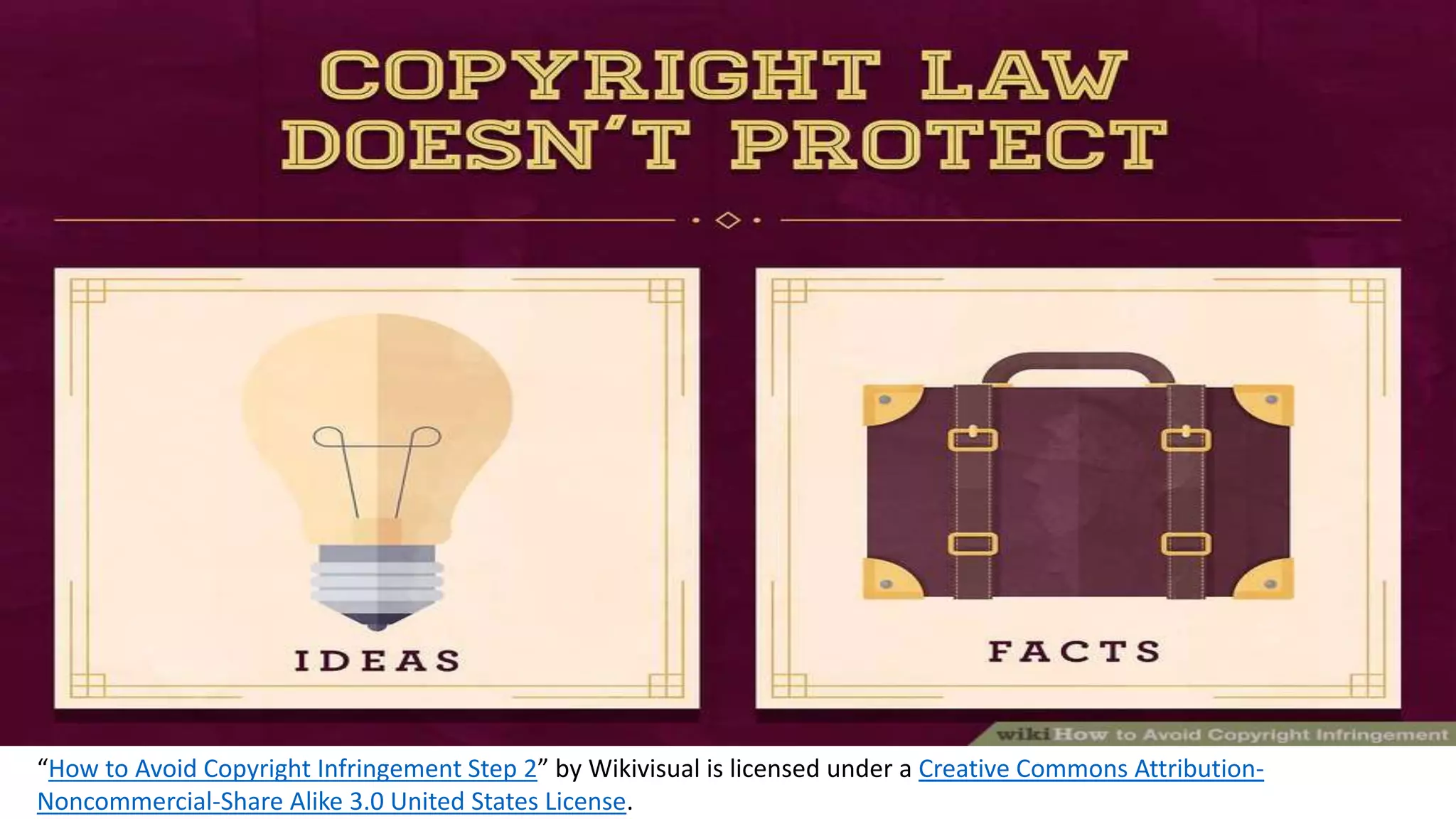
“How to Avoid Copyright Infringement Step 2” by Wikivisual is licensed under a Creative Commons Attribution-
Noncommercial-Share Alike 3.0 United States License.
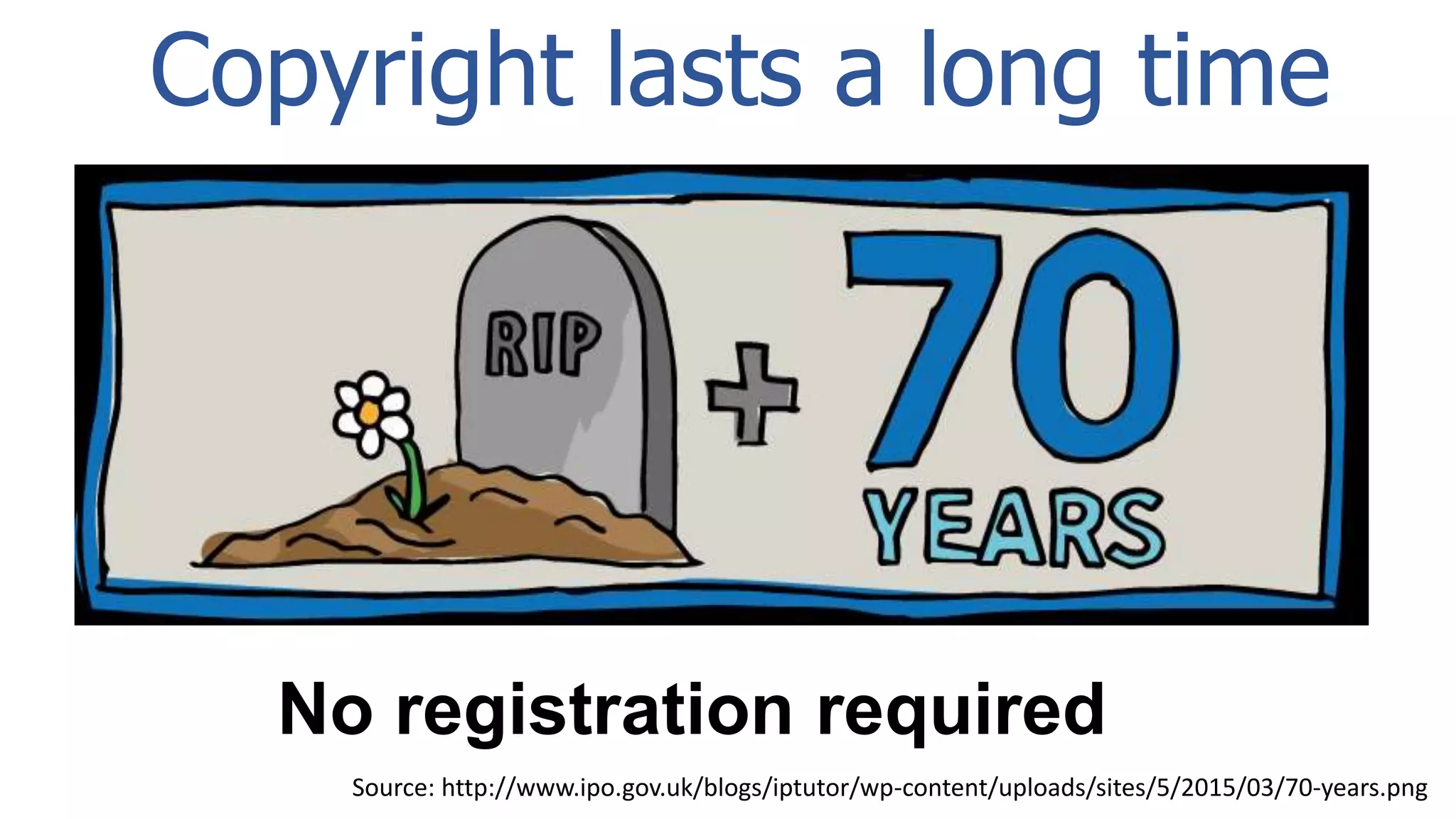
Source: http://www.ipo.gov.uk/blogs/iptutor/wp-content/uploads/sites/5/2015/03/70-years.png
Copyright lasts a long time
No registration required
(unless you want to sue)
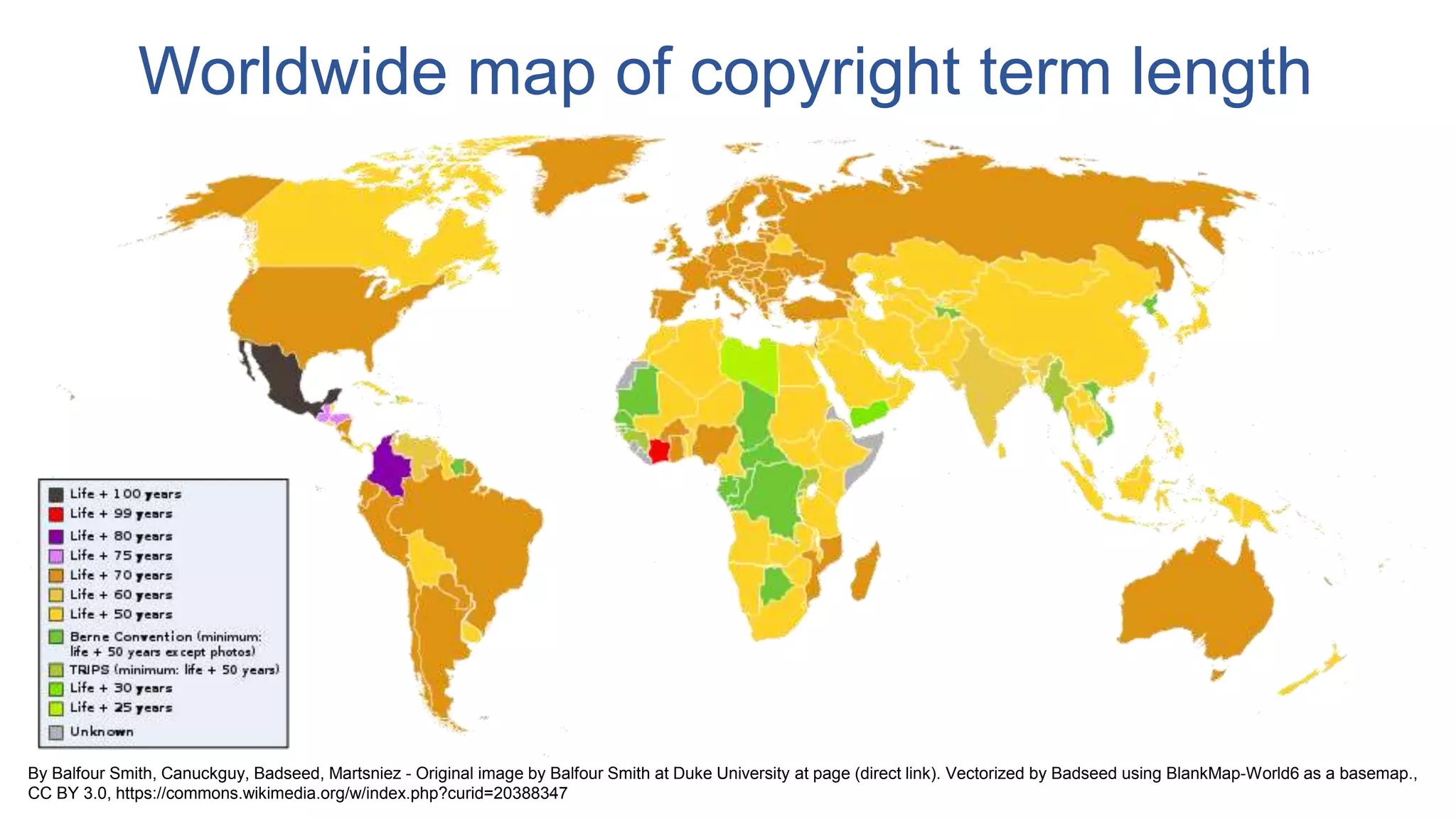
By Balfour Smith, Canuckguy, Badseed, Martsniez - Original image by Balfour Smith at Duke University at page (direct link). Vectorized by Badseed using BlankMap-World6 as a basemap.,
CC BY 3.0, https://commons.wikimedia.org/w/index.php?curid=20388347
Worldwide map of copyright term length
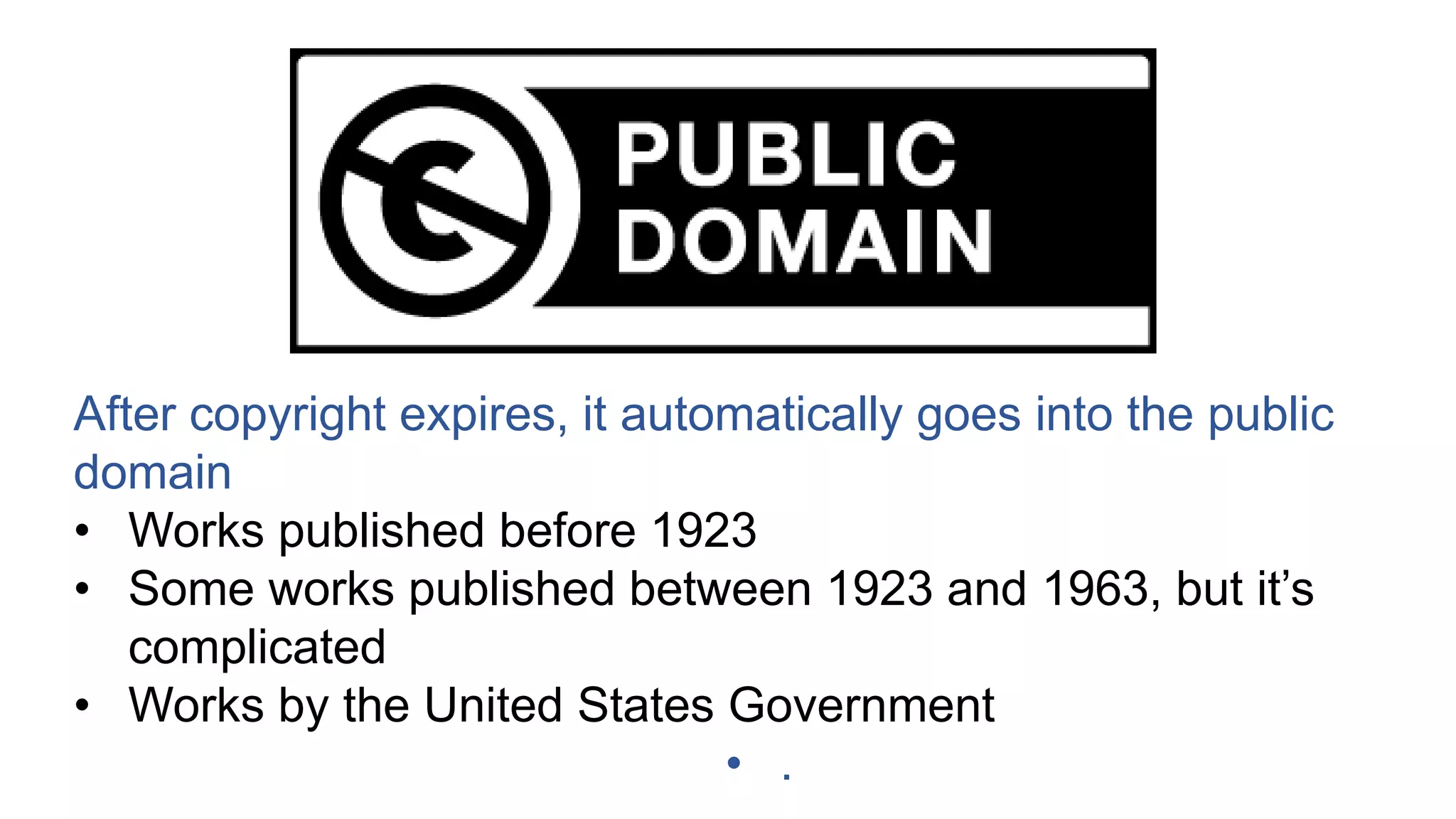
After copyright expires, it automatically goes into the public
domain
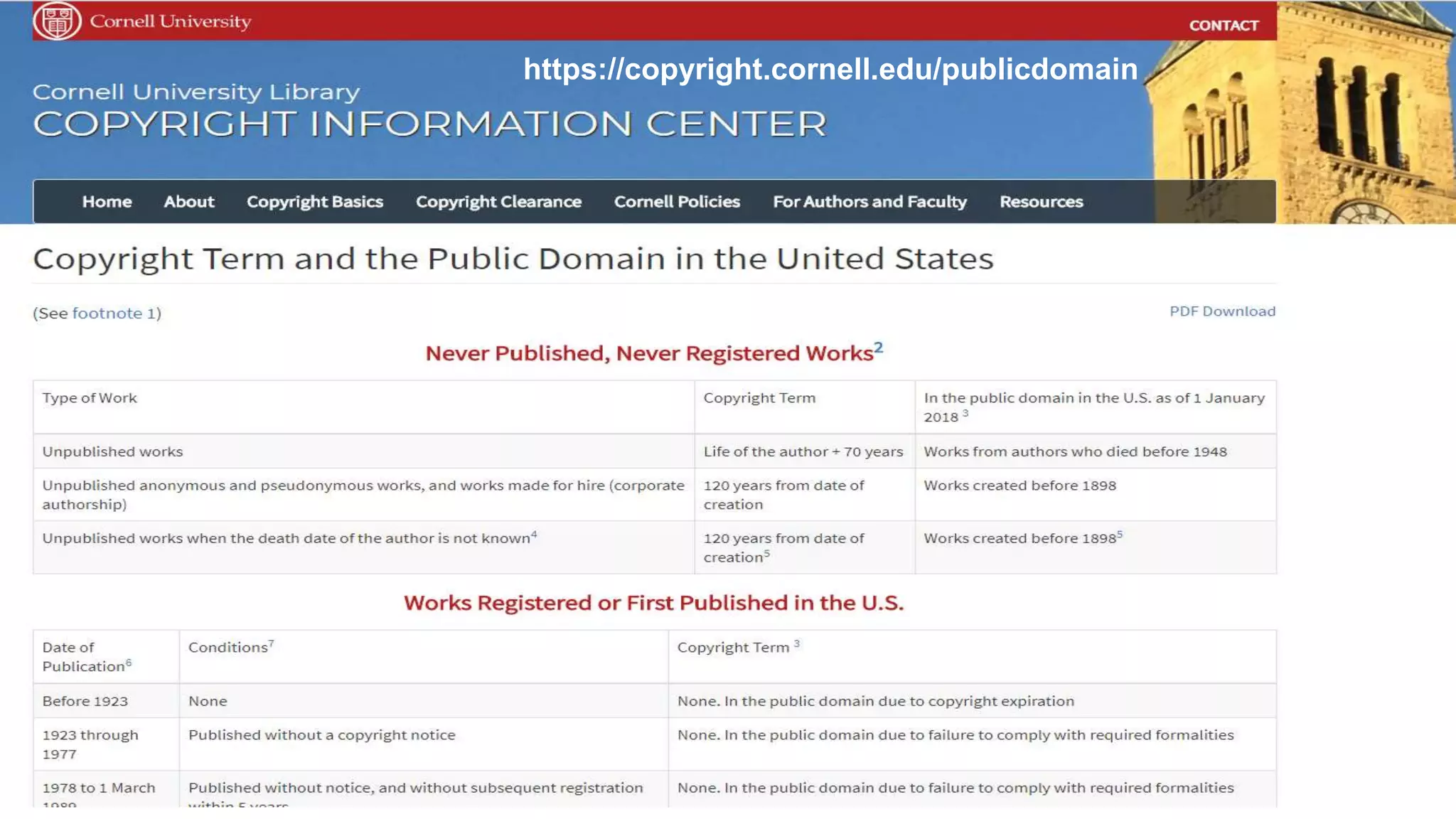
• Works published before 1923
• Some works published between 1923 and 1963, but it’s
complicated
• Works by the United States Government
• .
https://copyright.cornell.edu/publicdomain
The creator dedicates the work to the
public domain before copyright has expired
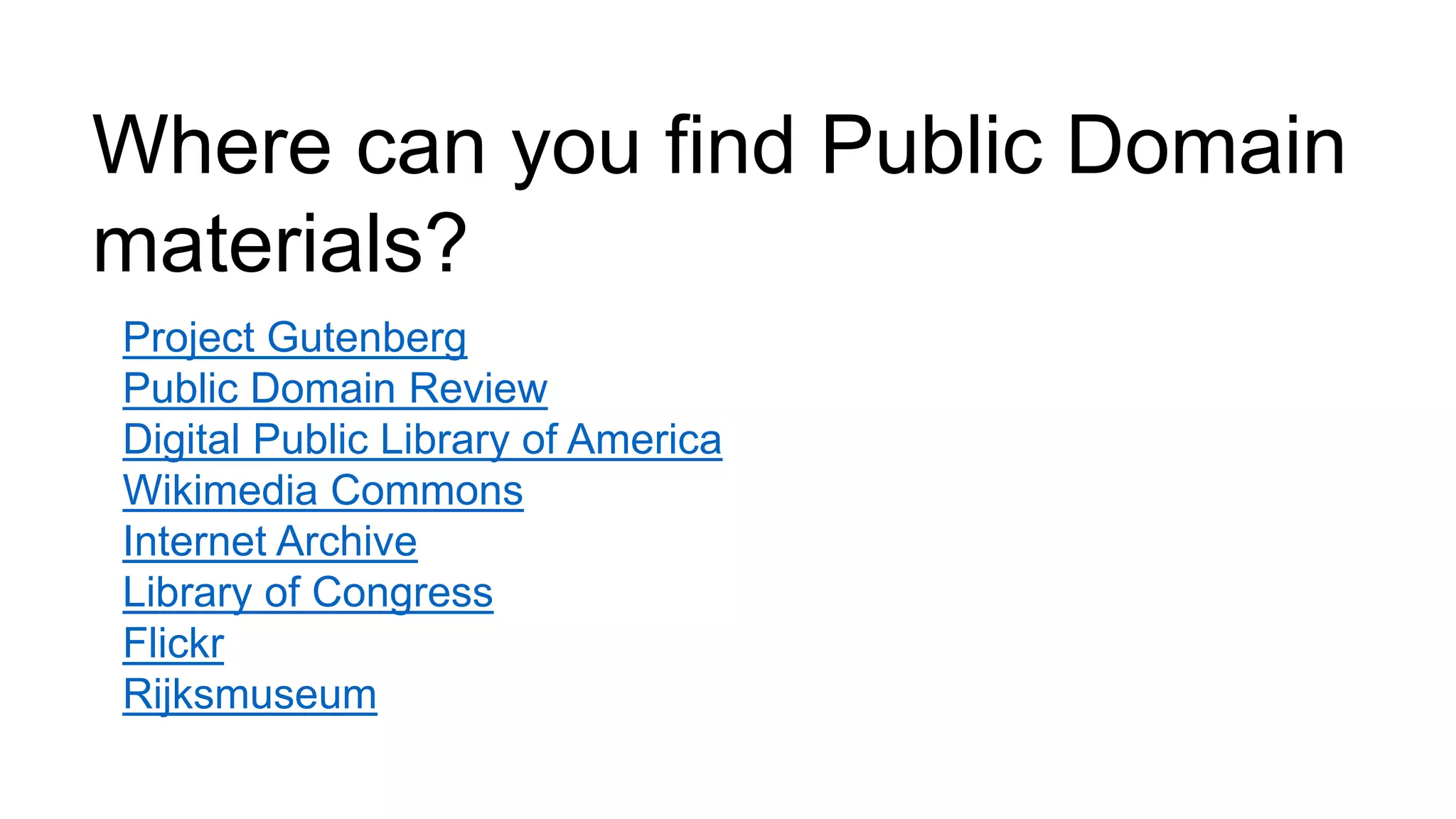
Project Gutenberg
Public Domain Review
Digital Public Library of America
Wikimedia Commons
Internet Archive
Library of Congress
Flickr
Rijksmuseum
Where can you find Public Domain
materials?
Exceptions and
Limitations to Copyright
Fair Use
Section 107
There is no easy formula for determining fair use, but
there are four factors to consider:
1) The nature of the work (factual, creative)
2) The purpose of the use (educational, for-profit)
3) Amount of the work being used
4) The potential impact of the use on the market for the
original.
First Sale Doctrine (Section 109)
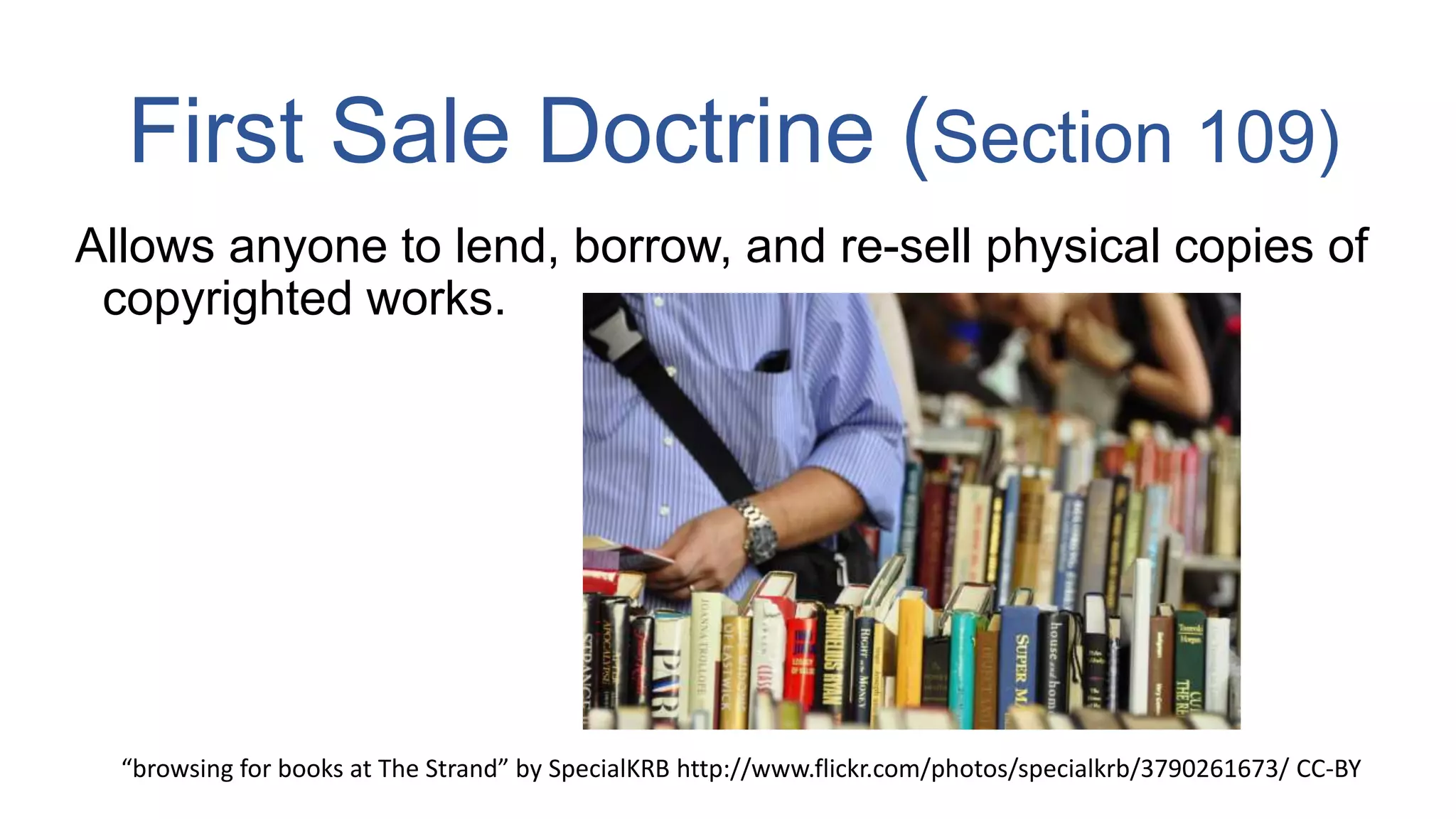
Allows anyone to lend, borrow, and re-sell physical copies of
copyrighted works.
“browsing for books at The Strand” by SpecialKRB http://www.flickr.com/photos/specialkrb/3790261673/ CC-BY
Exemptions for teaching purposes
Section 110
• Often referred to as the TEACH Act,
which is only the most recent update
• Applies to educational use, both in
face-to-face classrooms and online
• Allows teachers to show or display all
kinds of content, including music and
movies, as long as it is relevant to the
curriculum.
Image is in the public domain. Source: http://www.flickr.com/photos/perpetualplum/2279403795/
What is Creative Commons?
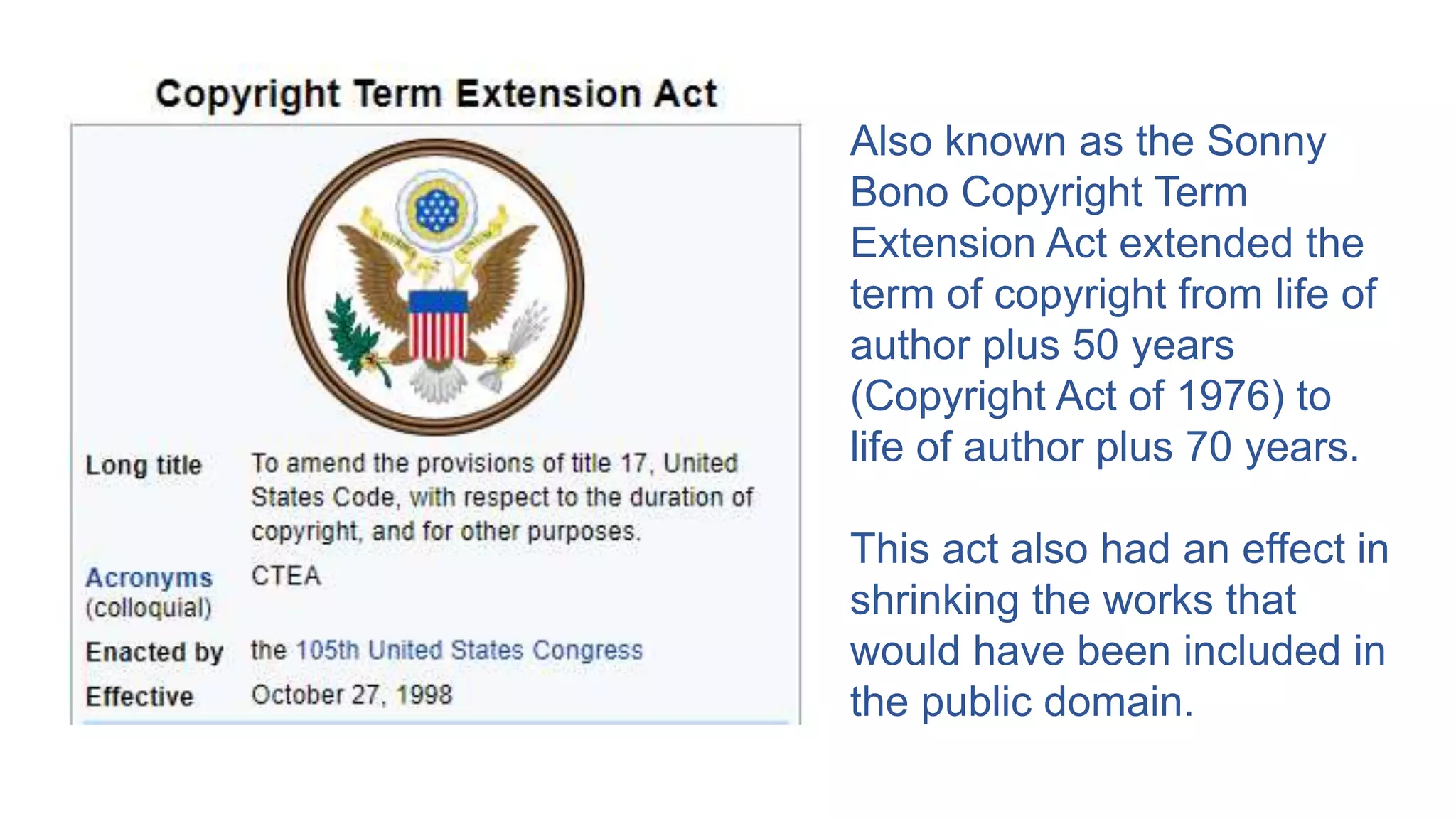
Also known as the Sonny
Bono Copyright Term
Extension Act extended the
term of copyright from life of
author plus 50 years
(Copyright Act of 1976) to
life of author plus 70 years.
This act also had an effect in
shrinking the works that
would have been included in
the public domain.
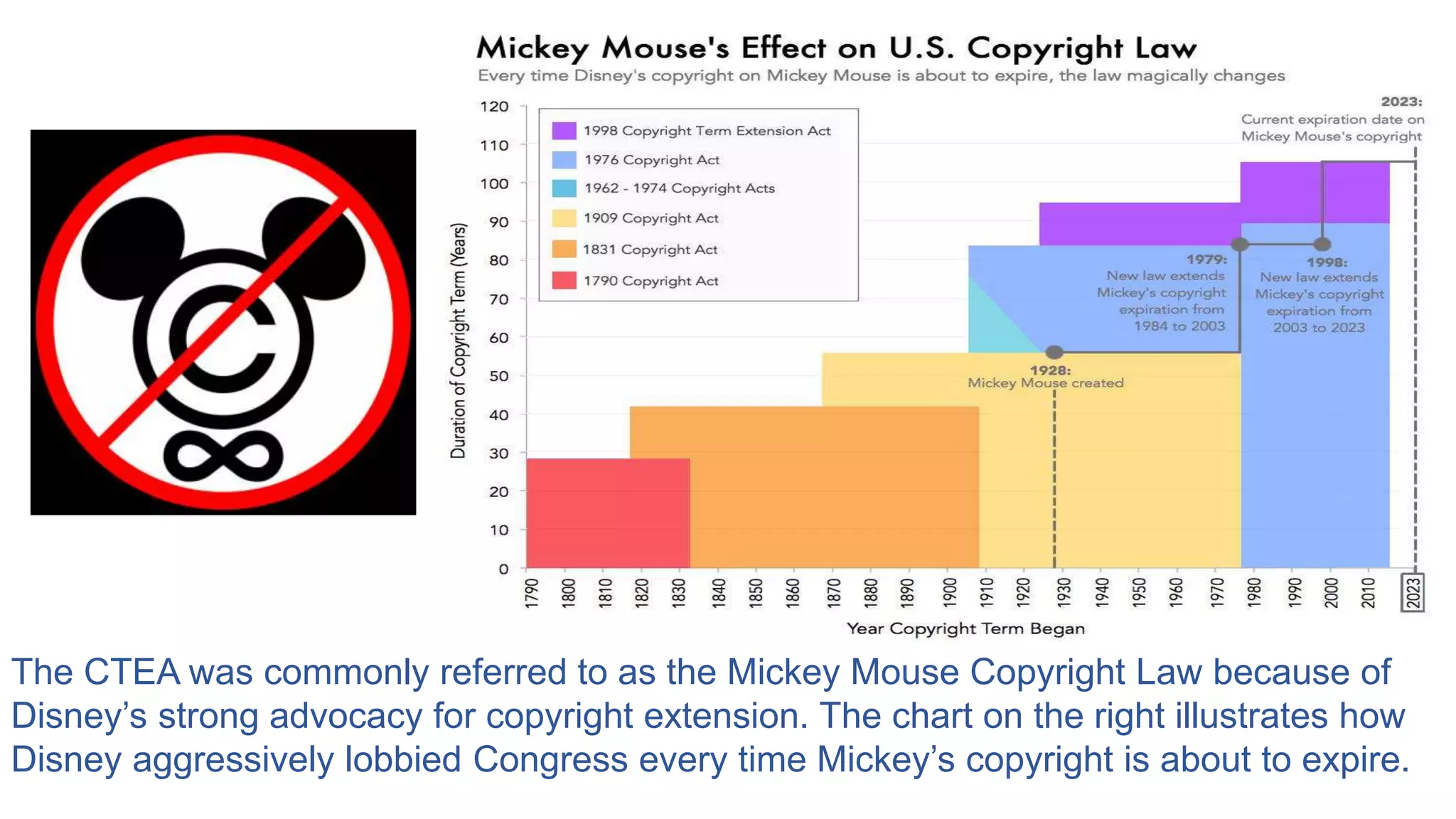
The CTEA was commonly referred to as the Mickey Mouse Copyright Law because of
Disney’s strong advocacy for copyright extension. The chart on the right illustrates how
Disney aggressively lobbied Congress every time Mickey’s copyright is about to expire.
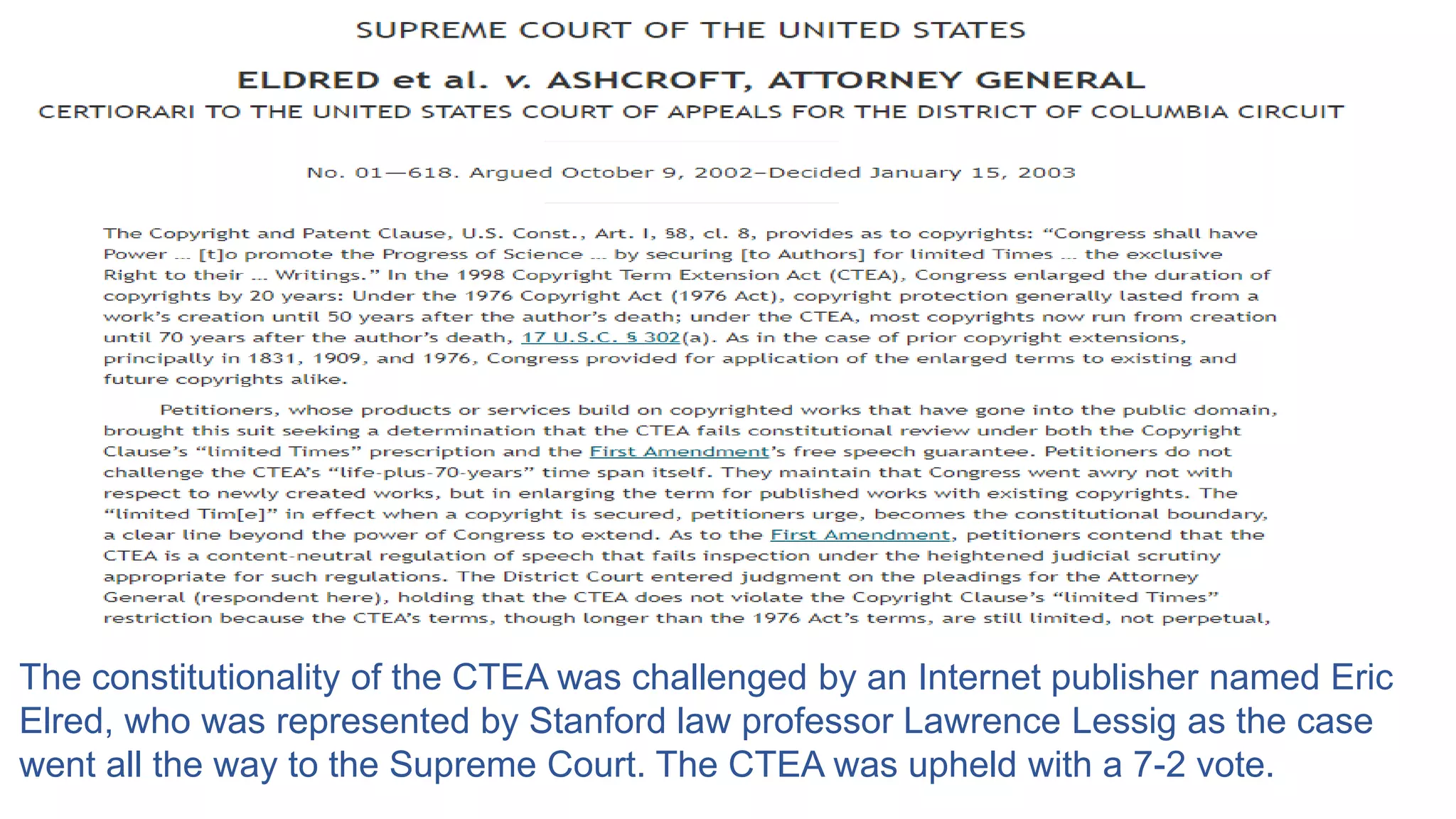
The constitutionality of the CTEA was challenged by an Internet publisher named Eric
Elred, who was represented by Stanford law professor Lawrence Lessig as the case
went all the way to the Supreme Court. The CTEA was upheld with a 7-2 vote.
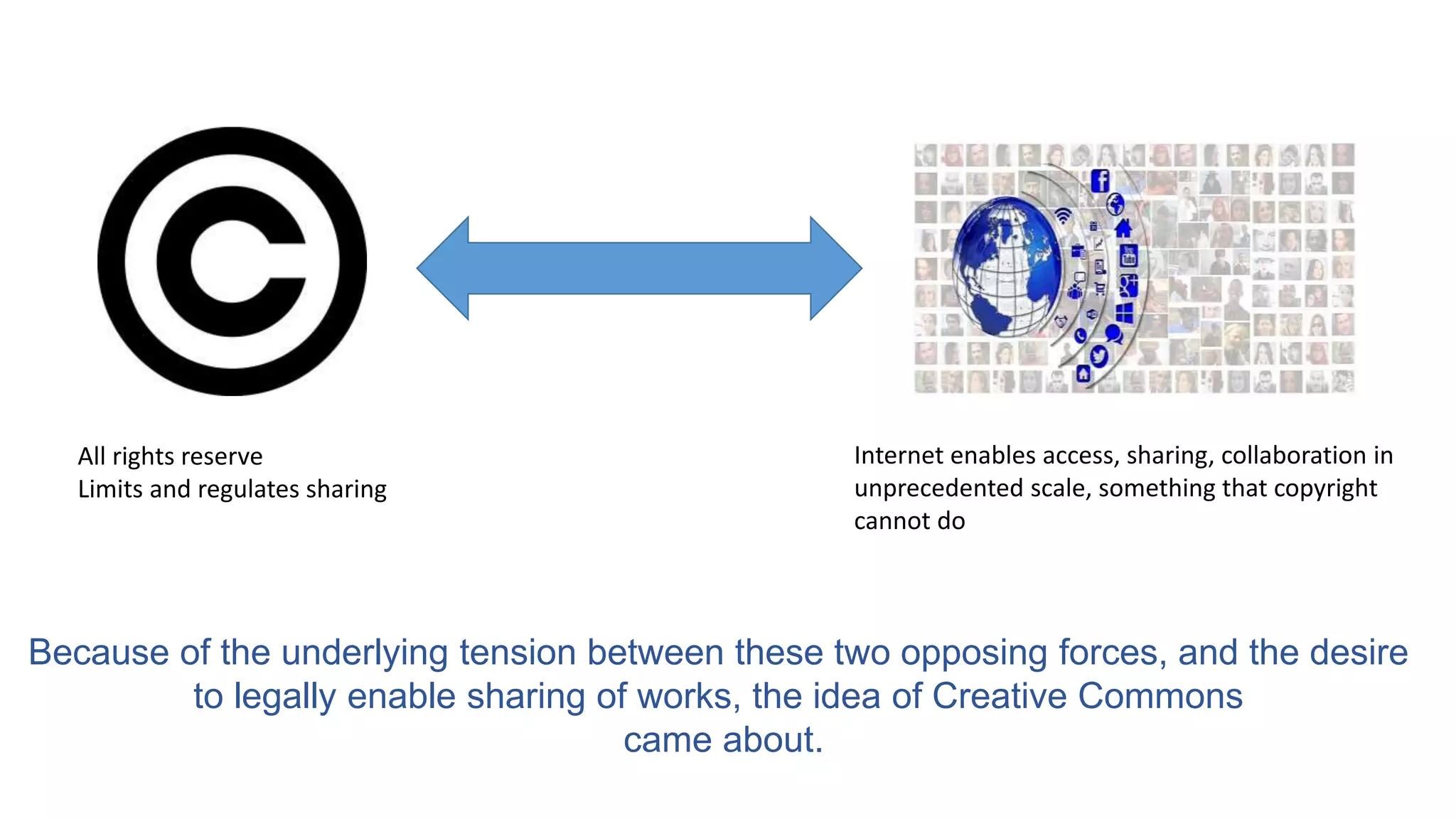
All rights reserve
Limits and regulates sharing
Internet enables access, sharing, collaboration in
unprecedented scale, something that copyright
cannot do
Because of the underlying tension between these two opposing forces, and the desire
to legally enable sharing of works, the idea of Creative Commons
came about.
Non-profit organization founded in 2001 by Lawrence Lessig. The next
year, the Creative Commons licenses were released to enable
everyone to legally share works without circumventing copyright.
Provides free legal tools that let authors, scientists, artists,
and educators easily mark their creative work with the
freedoms they want it to carry.
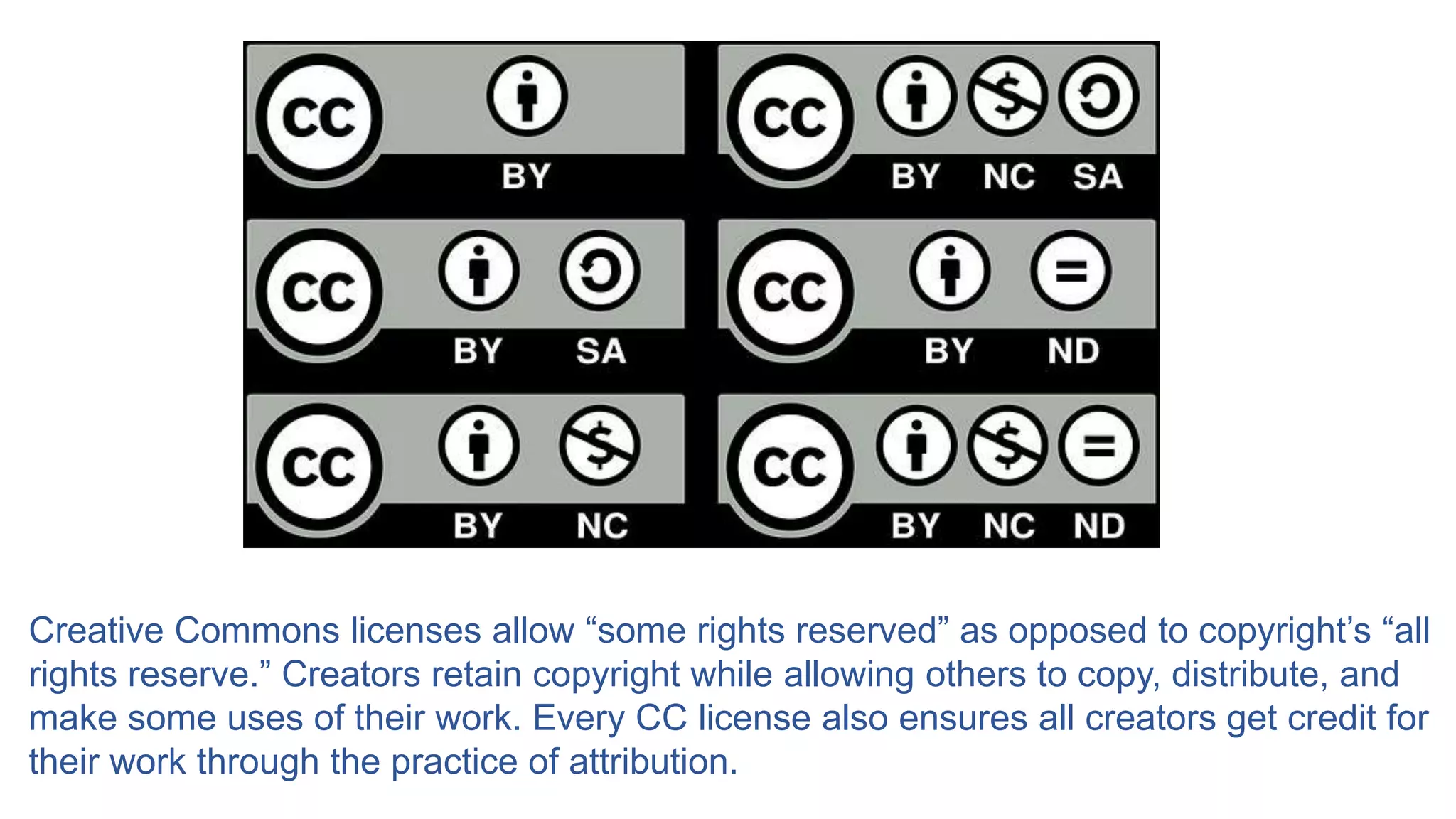
Creative Commons licenses allow “some rights reserved” as opposed to copyright’s “all
rights reserve.” Creators retain copyright while allowing others to copy, distribute, and
make some uses of their work. Every CC license also ensures all creators get credit for
their work through the practice of attribution.
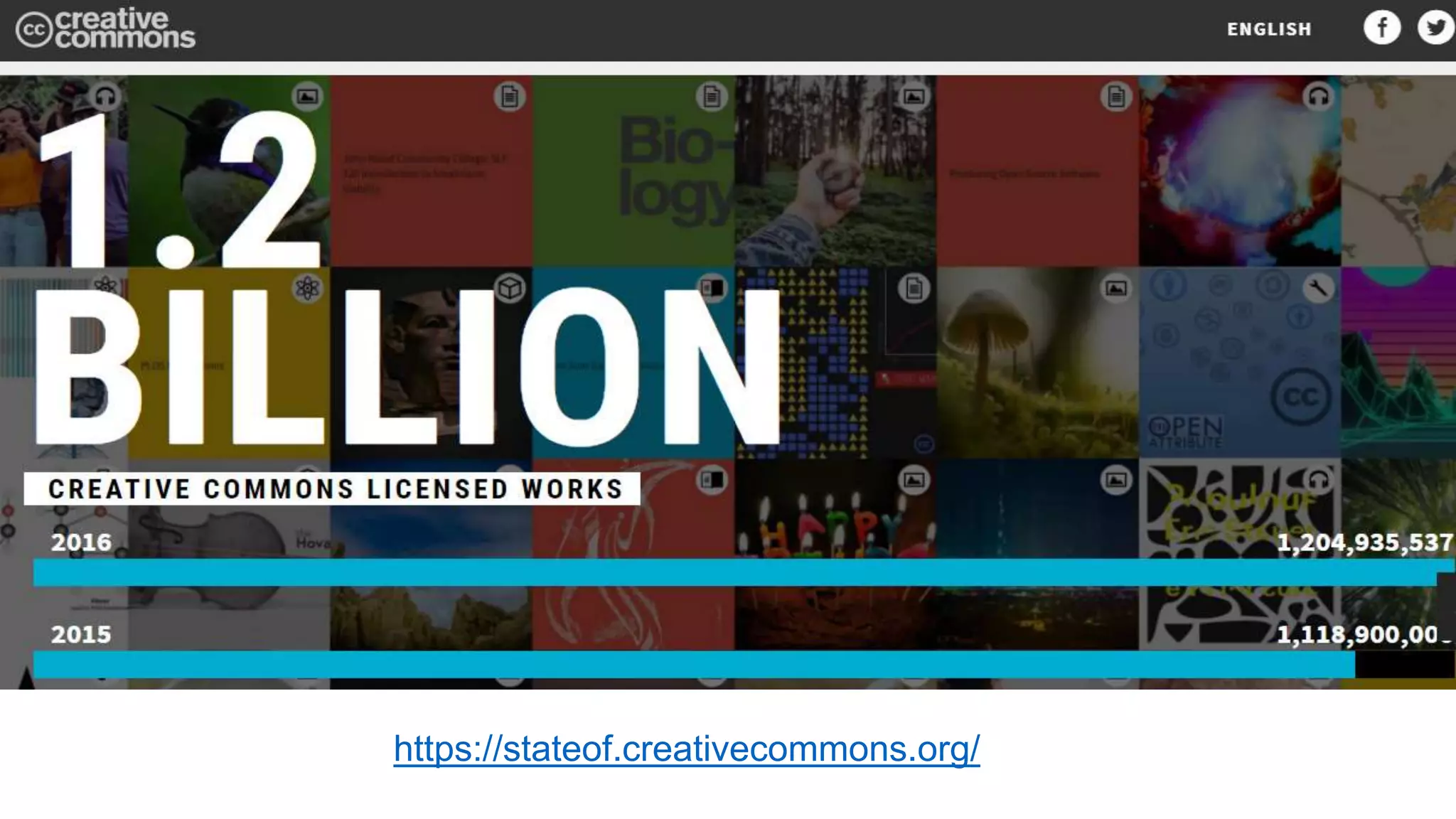
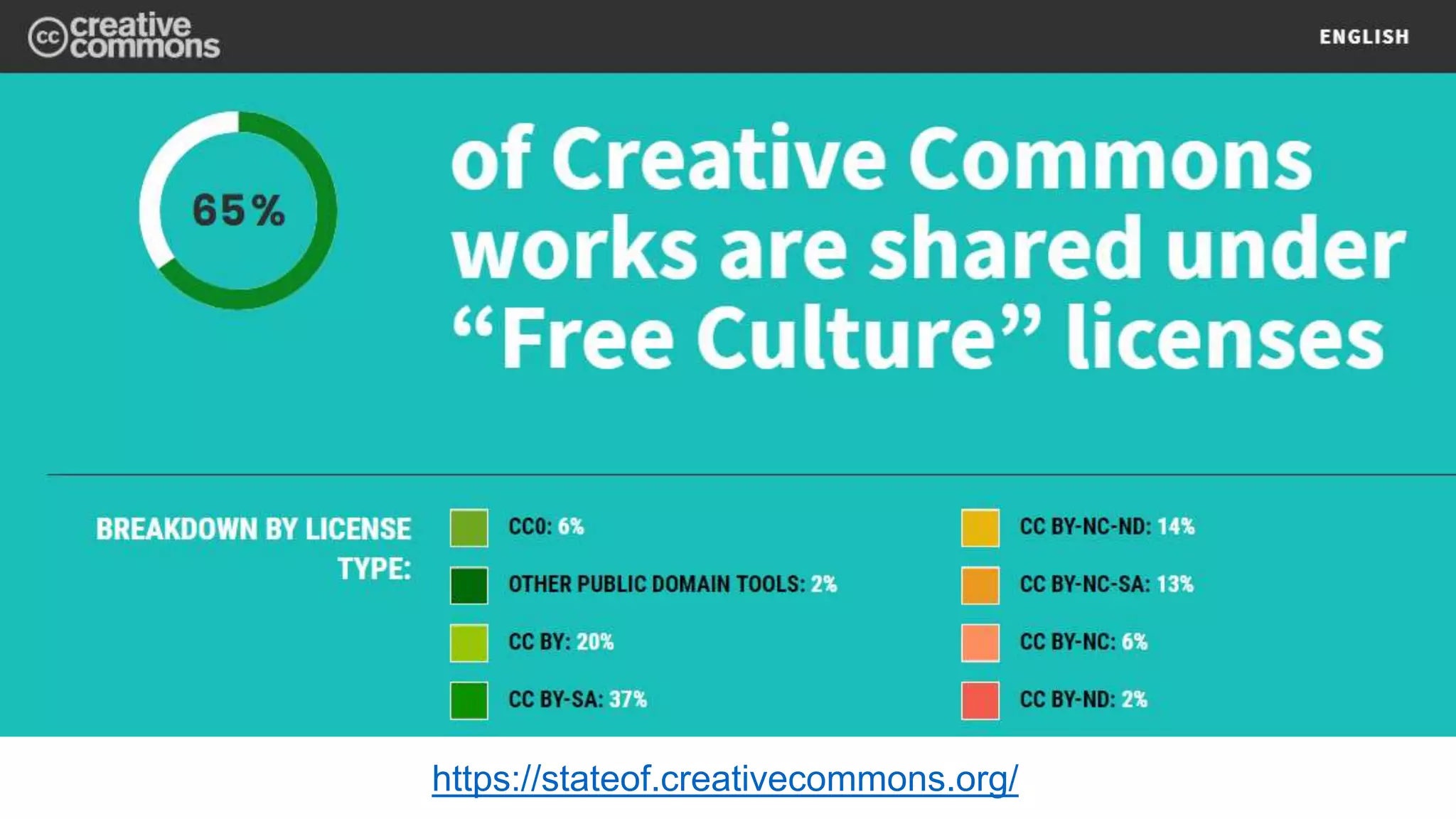
https://stateof.creativecommons.org/
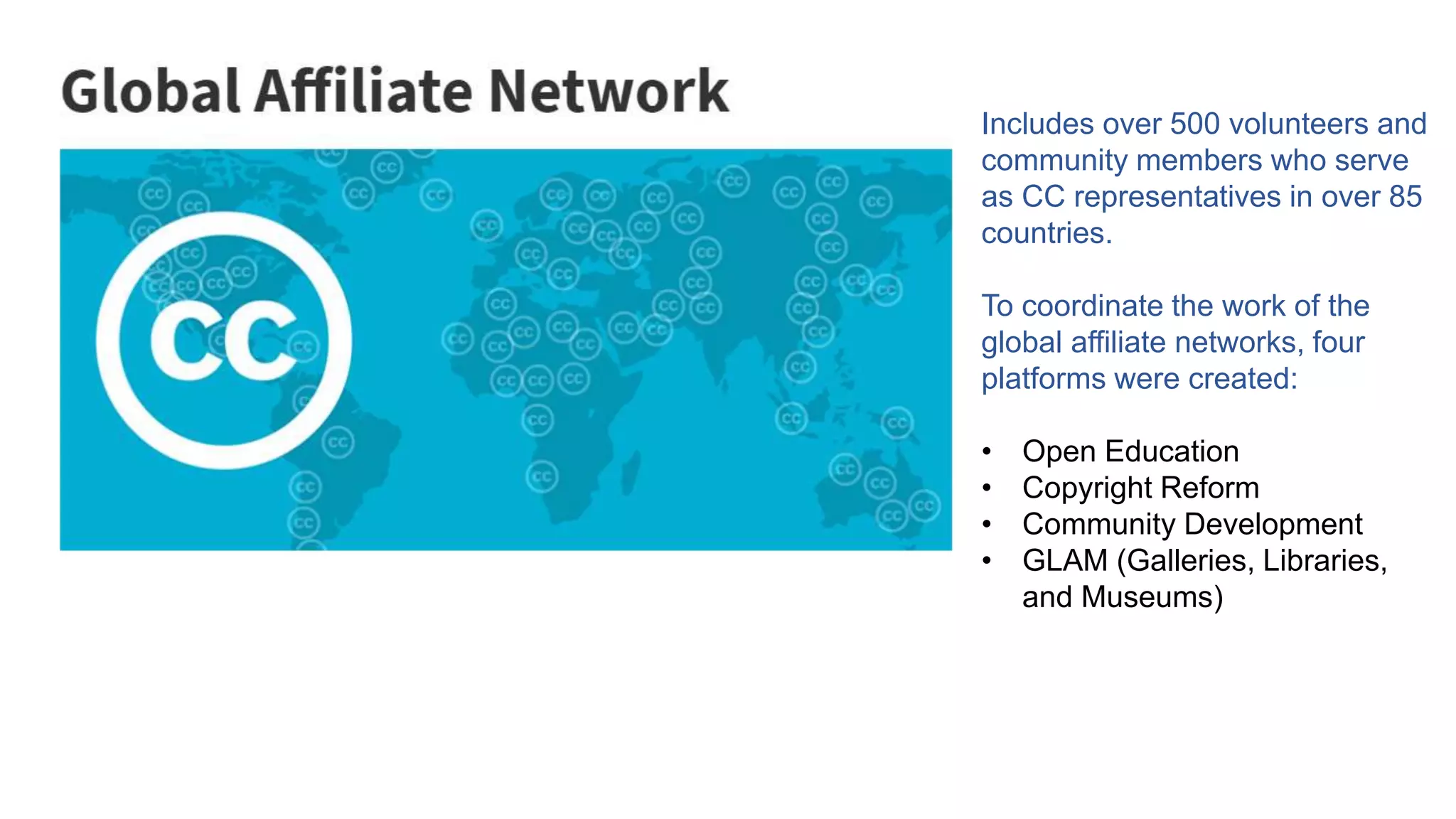
Includes over 500 volunteers and
community members who serve
as CC representatives in over 85
countries.
To coordinate the work of the
global affiliate networks, four
platforms were created:
• Open Education
• Copyright Reform
• Community Development
• GLAM (Galleries, Libraries,
and Museums)
Image Credits
• Copyright symbol: https://pixabay.com/en/copyright-symbol-intellectual-30343/
• Internet: https://pixabay.com/en/social-media-icon-human-personal-2537391/
• Mickey Mouse image and copyright
https://en.wikipedia.org/wiki/Copyright_Term_Extension_Act#/media/File:Disney-infinite-
copyright.svg
• Mickey Mouse effect on copyright law: https://pix-media.priceonomics-
media.com/blog/1105/mickeymouseFINAL.jpg
• Creative Commons Licenses: https://pixabay.com/en/creative-commons-licenses-icons-
by-783531/
• Creative Commons Visual Thinkery: https://www.flickr.com/photos/gforsythe/9102402492
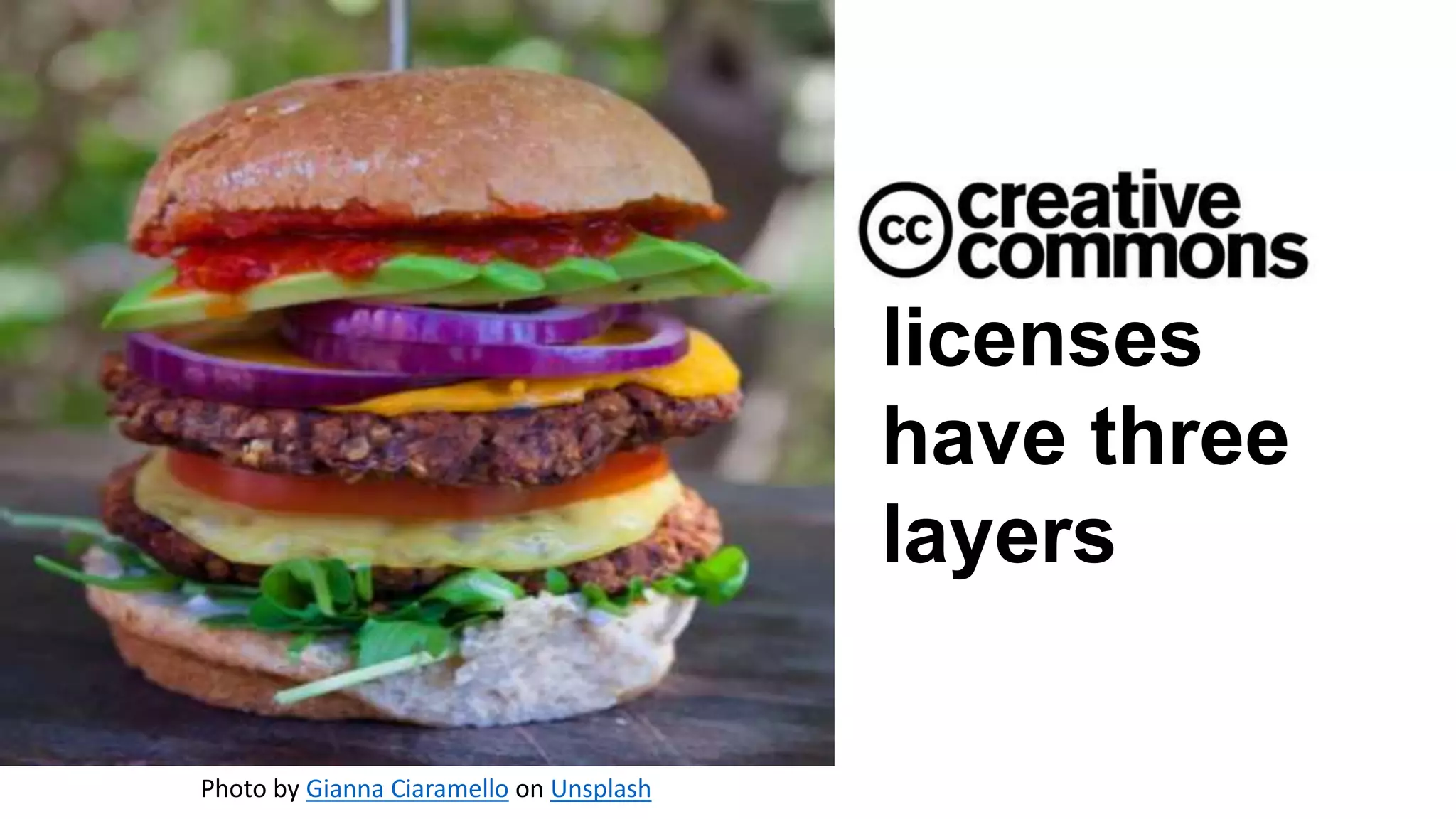
Anatomy of Creative
Commons Licenses
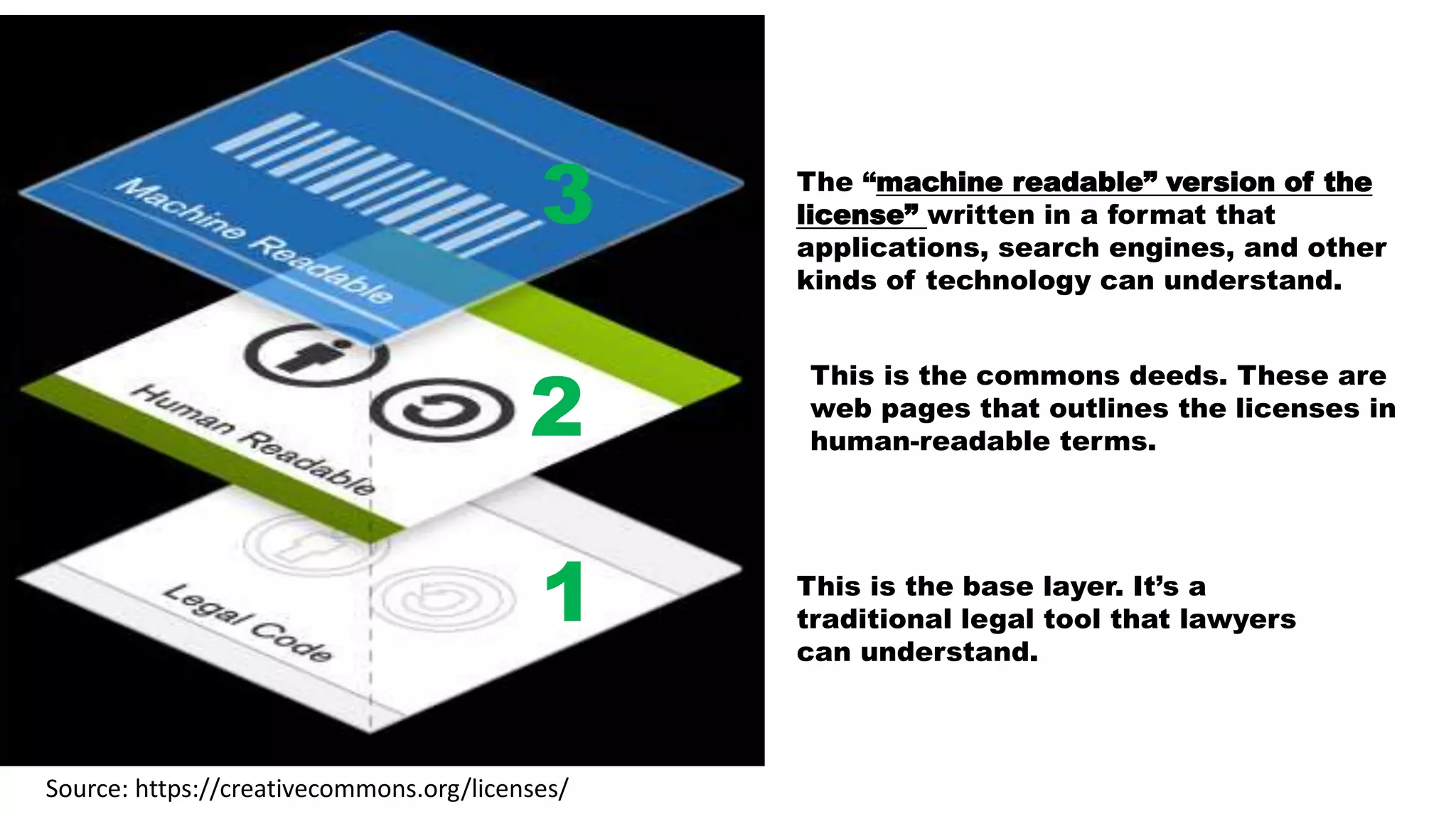
licenses
have three
layers
Photo by Gianna Ciaramello on Unsplash
1
2
3
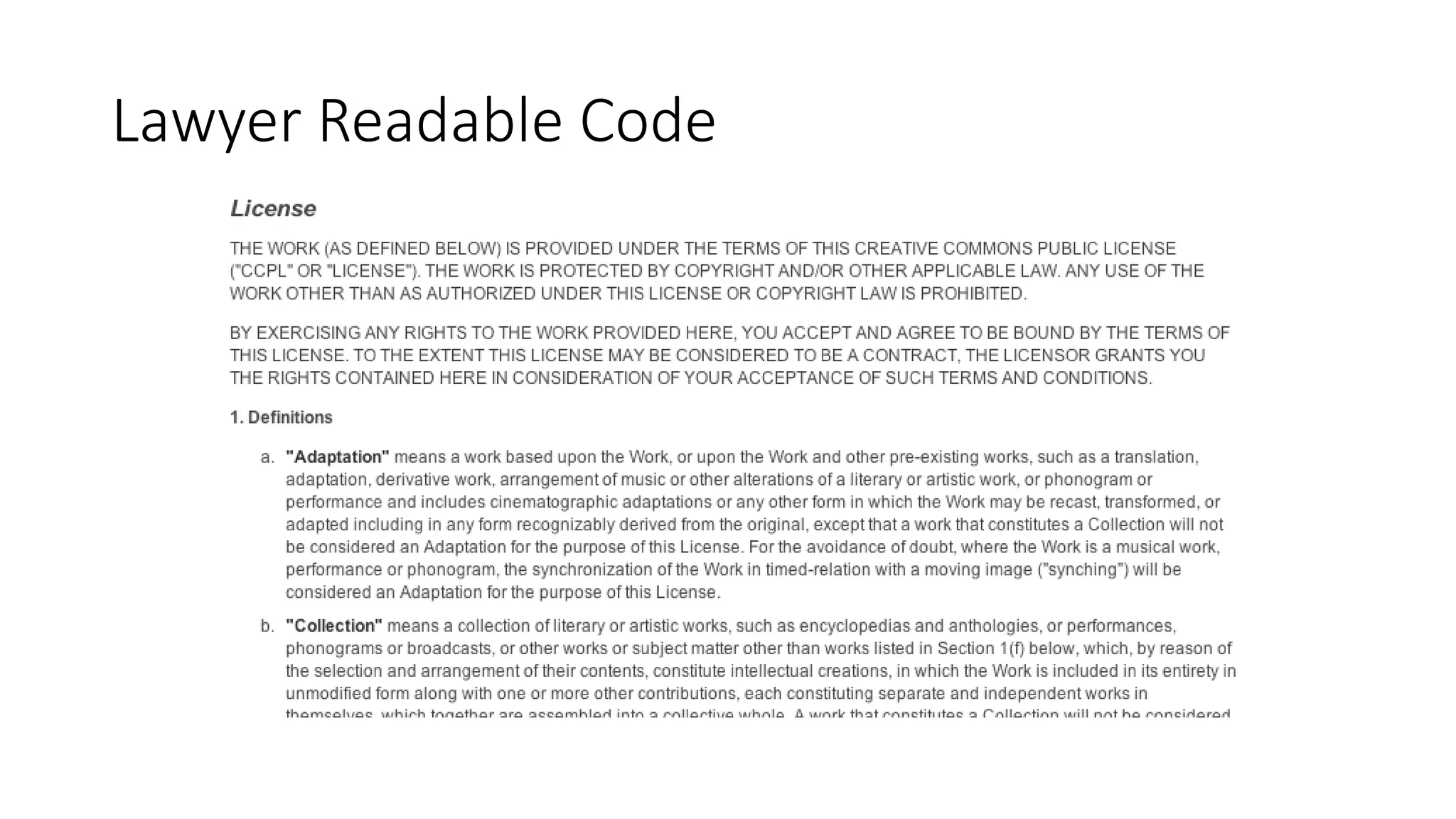
This is the base layer. It’s a
traditional legal tool that lawyers
can understand.
This is the commons deeds. These are
web pages that outlines the licenses in
human-readable terms.
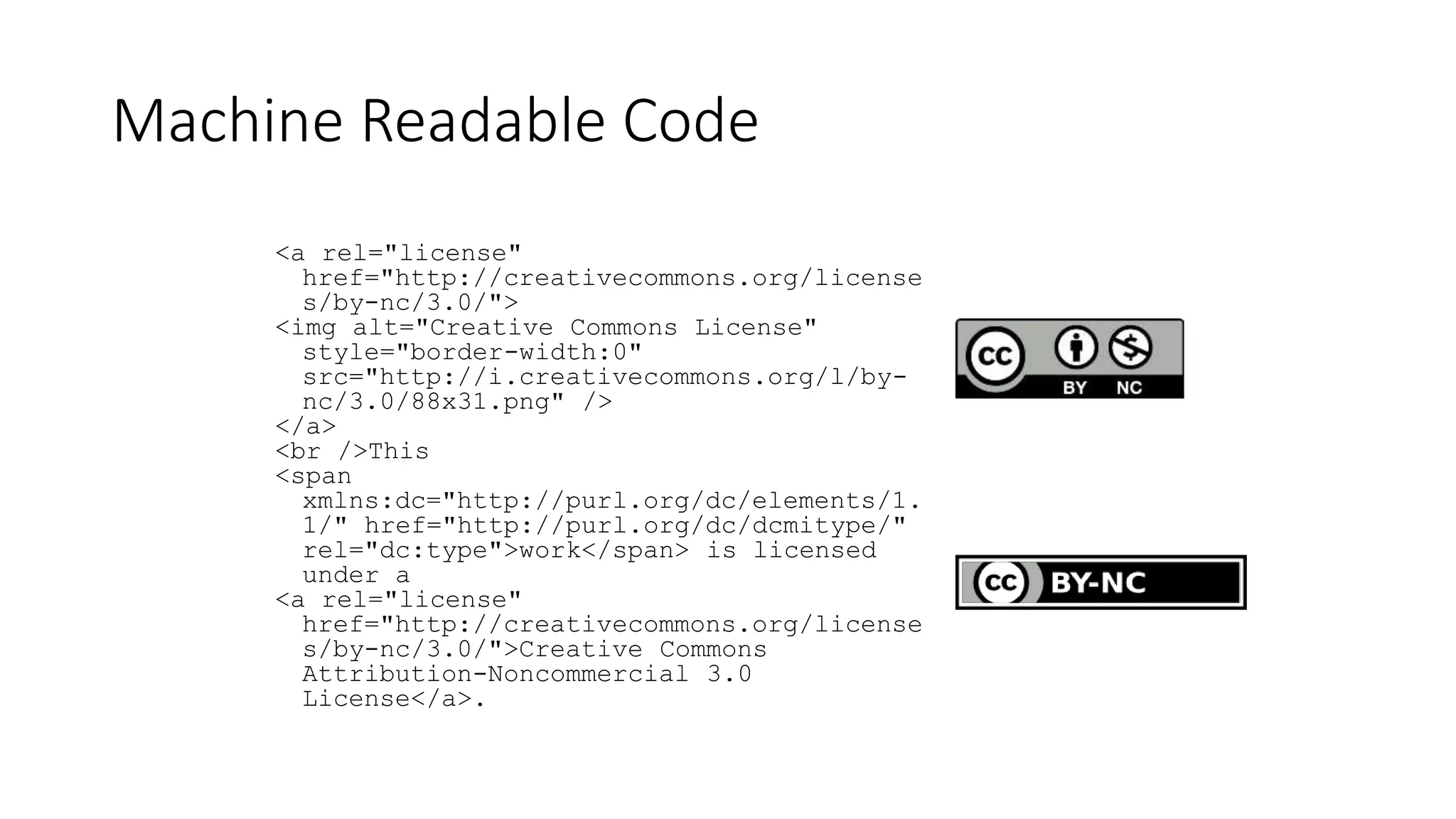
The “machine readable” version of the
license” written in a format that
applications, search engines, and other
kinds of technology can understand.
Source: https://creativecommons.org/licenses/
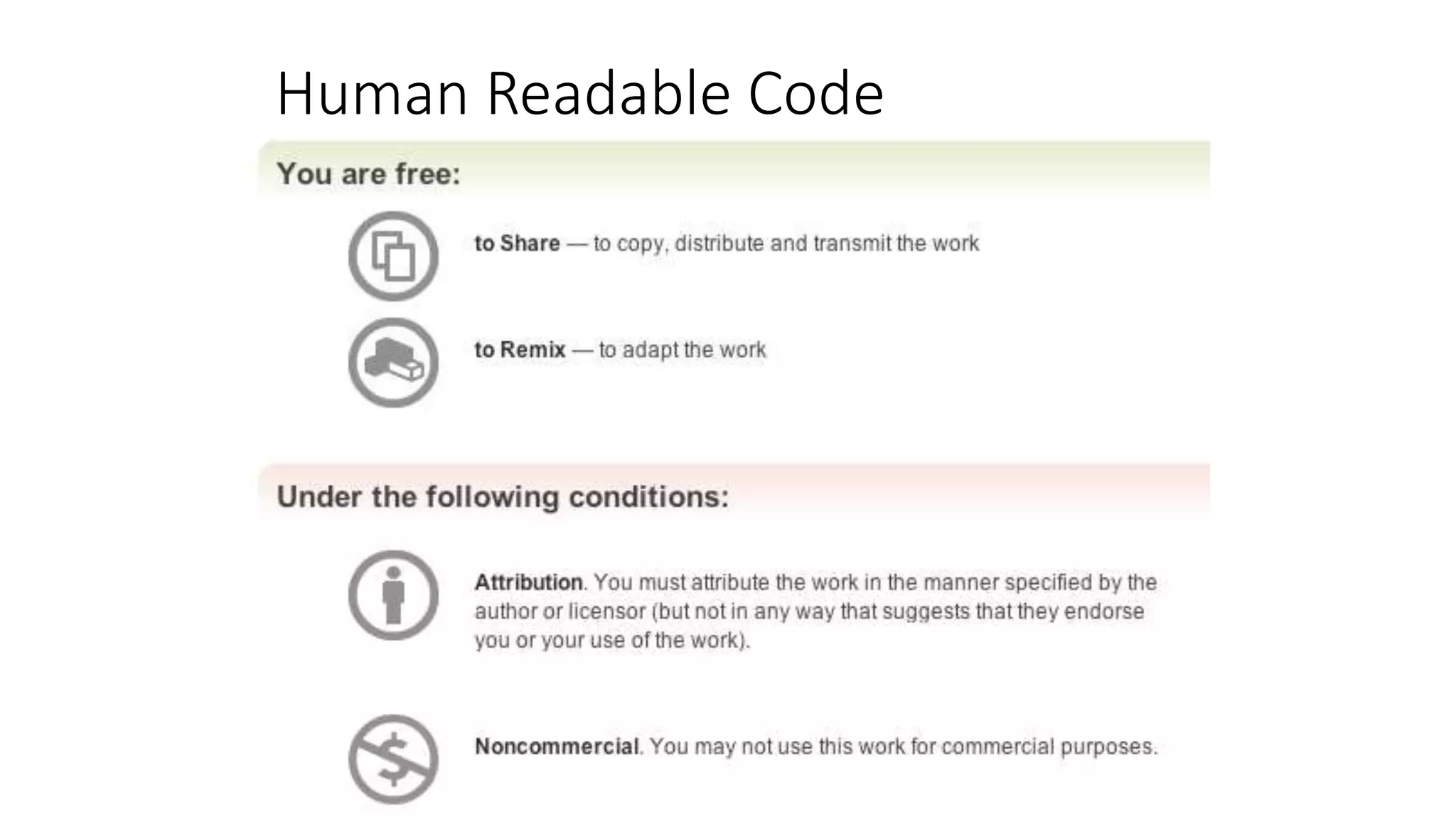
Human Readable Code
Lawyer Readable Code
Machine Readable Code
<a rel="license"
href="http://creativecommons.org/license
s/by-nc/3.0/">
<img alt="Creative Commons License"
style="border-width:0"
src="http://i.creativecommons.org/l/by-
nc/3.0/88x31.png" />
</a>
<br />This
<span
xmlns:dc="http://purl.org/dc/elements/1.
1/" href="http://purl.org/dc/dcmitype/"
rel="dc:type">work</span> is licensed
under a
<a rel="license"
href="http://creativecommons.org/license
s/by-nc/3.0/">Creative Commons
Attribution-Noncommercial 3.0
License</a>.
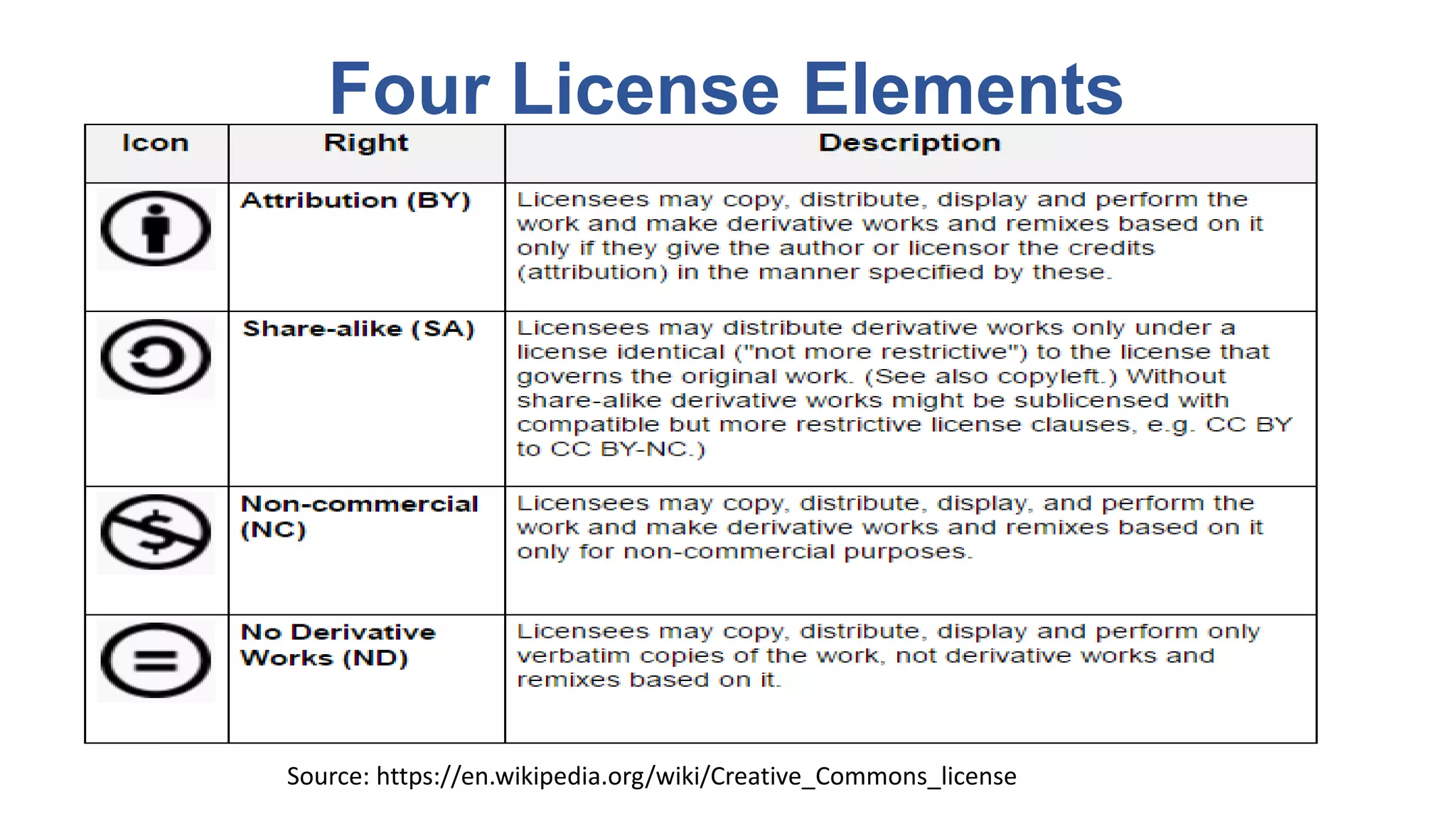
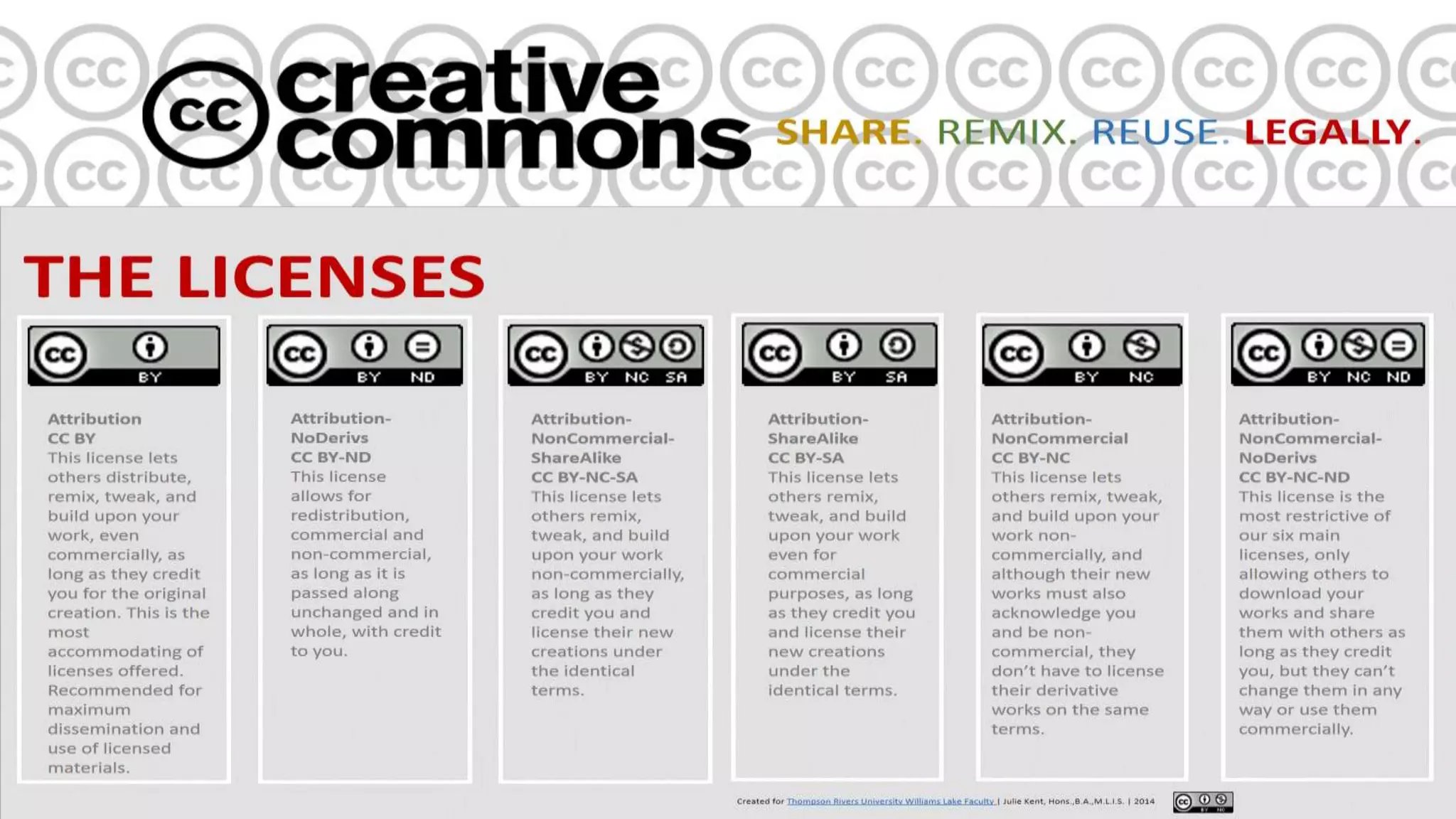
Four License Elements
Source: https://en.wikipedia.org/wiki/Creative_Commons_license
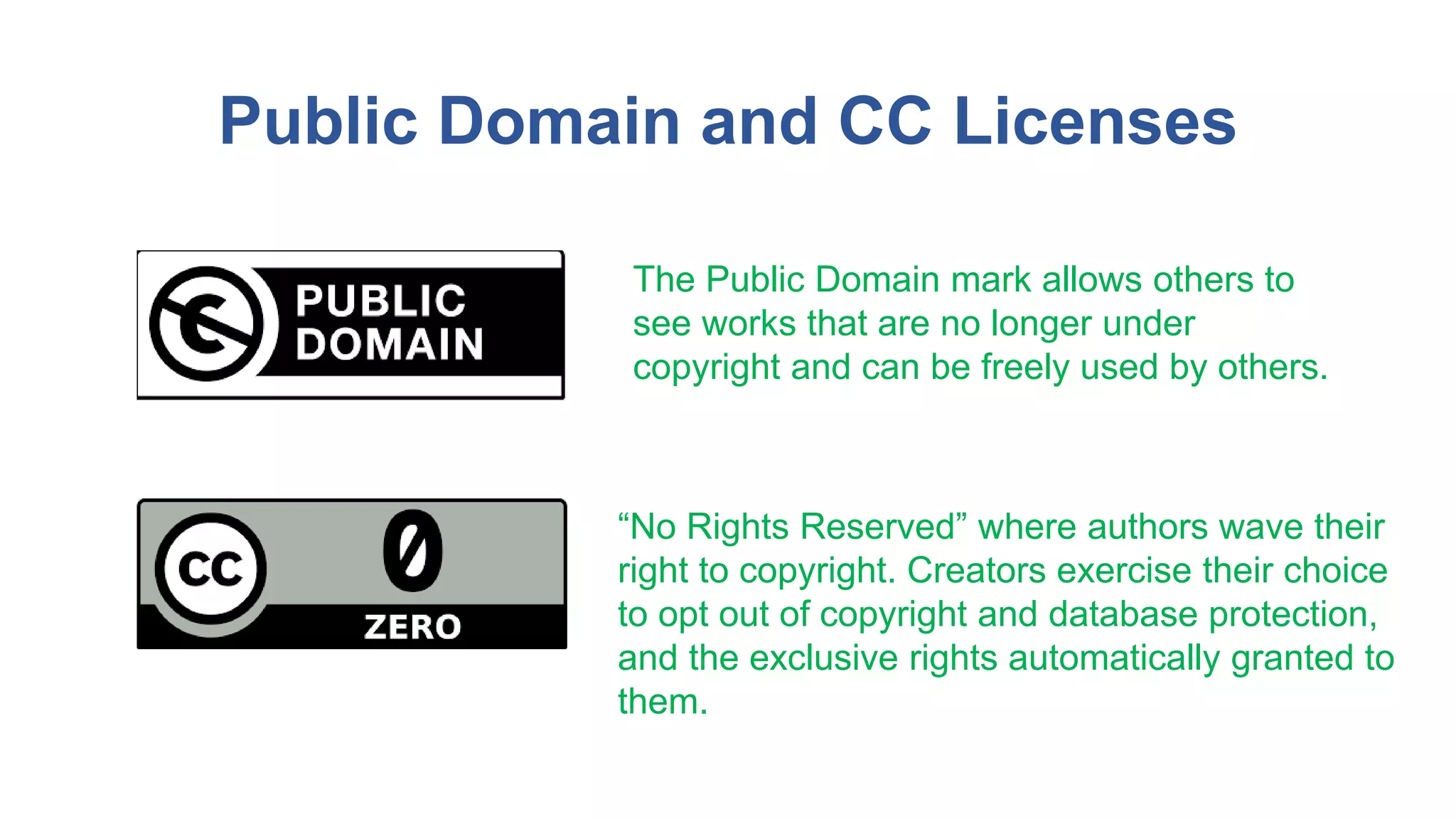
Public Domain and CC Licenses
The Public Domain mark allows others to
see works that are no longer under
copyright and can be freely used by others.
“No Rights Reserved” where authors wave their
right to copyright. Creators exercise their choice
to opt out of copyright and database protection,
and the exclusive rights automatically granted to
them.
Creative Commons licenses sit on top of
copyright. It works with copyright because you
can’t assign a CC license if you don’t own the
copyright to the work. CC licenses gives legal
permissions to anyone to copy, modify, create
derivatives or adaptations of a work without
asking permission from the copyright holder
each time. Allows creators to assign
permissions to their works while still retaining
copyright.
If someone is using a CC-licensed work without
giving attribution or otherwise following the license,
a person’s right to use the work ends automatically
as soon as they violate the license terms. Unless
the person using the work got separate permission
or is relying upon fair use or some other exception
to copyright, they are potentially liable for copyright
infringement.
Over the course of CC’s history, there have been
very few legal disputes and decisions involving CC
legal tools. Each court that has rendered a
decision has made it without questioning the
enforceability of the CC license at issue.
Source: https://pixabay.com/en/law-justice-court-judge-legal-1063249/
License Enforceability
Choosing and Applying
CC Licenses
Important things to remember about
Creative Commons Licenses:
•The licenses and CC0 are irrevocable.
•You must own or control copyright in the work.
Ask yourself these questions
before you apply a CC License:
• Do you hold the copyright?
• Are you comfortable with people profiting from
your work?
• Are you comfortable with people changing your
work?
• Do you want derivatives of your work to carry
Creative Commons licenses?
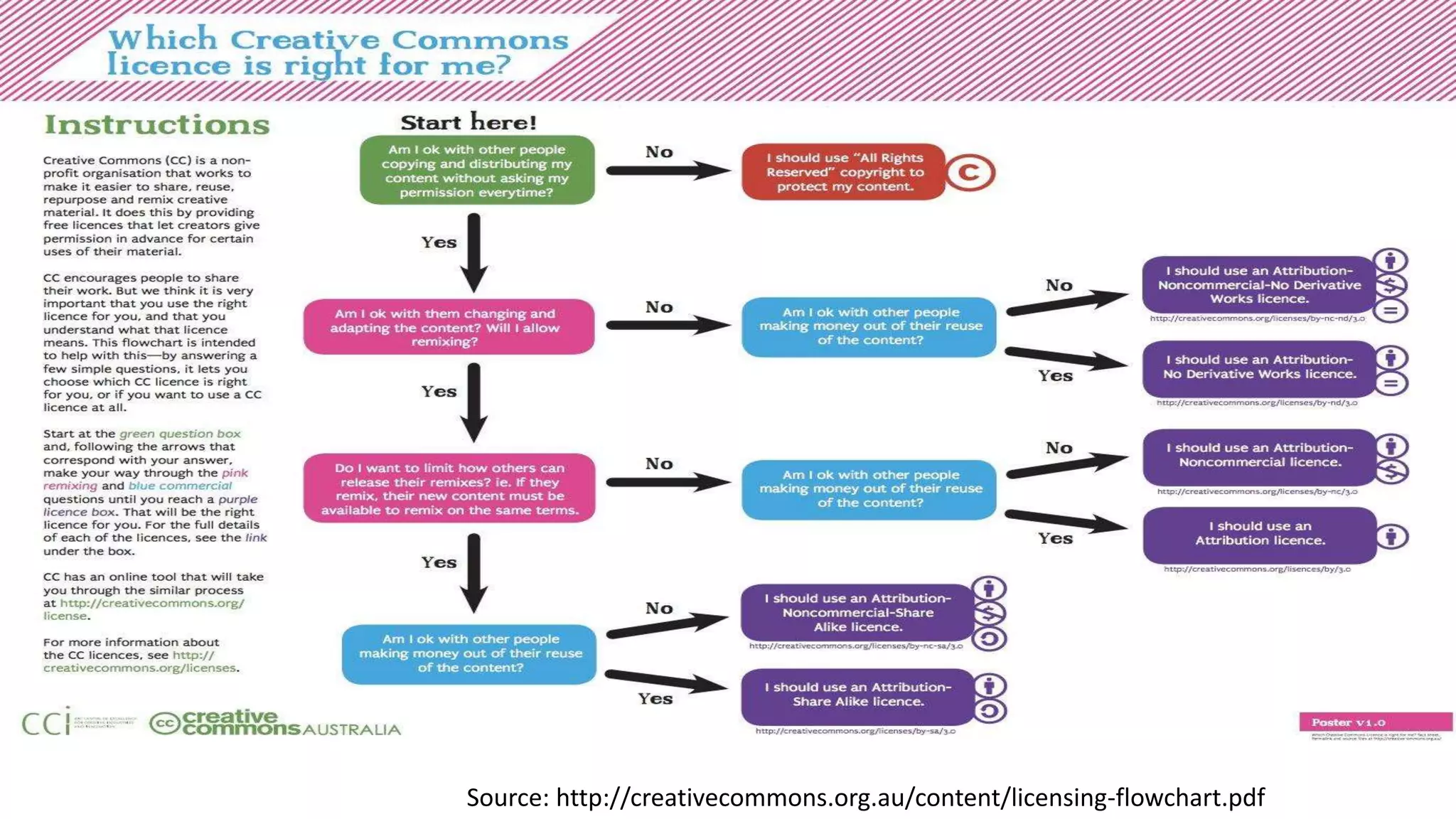
Source: http://creativecommons.org.au/content/licensing-flowchart.pdf
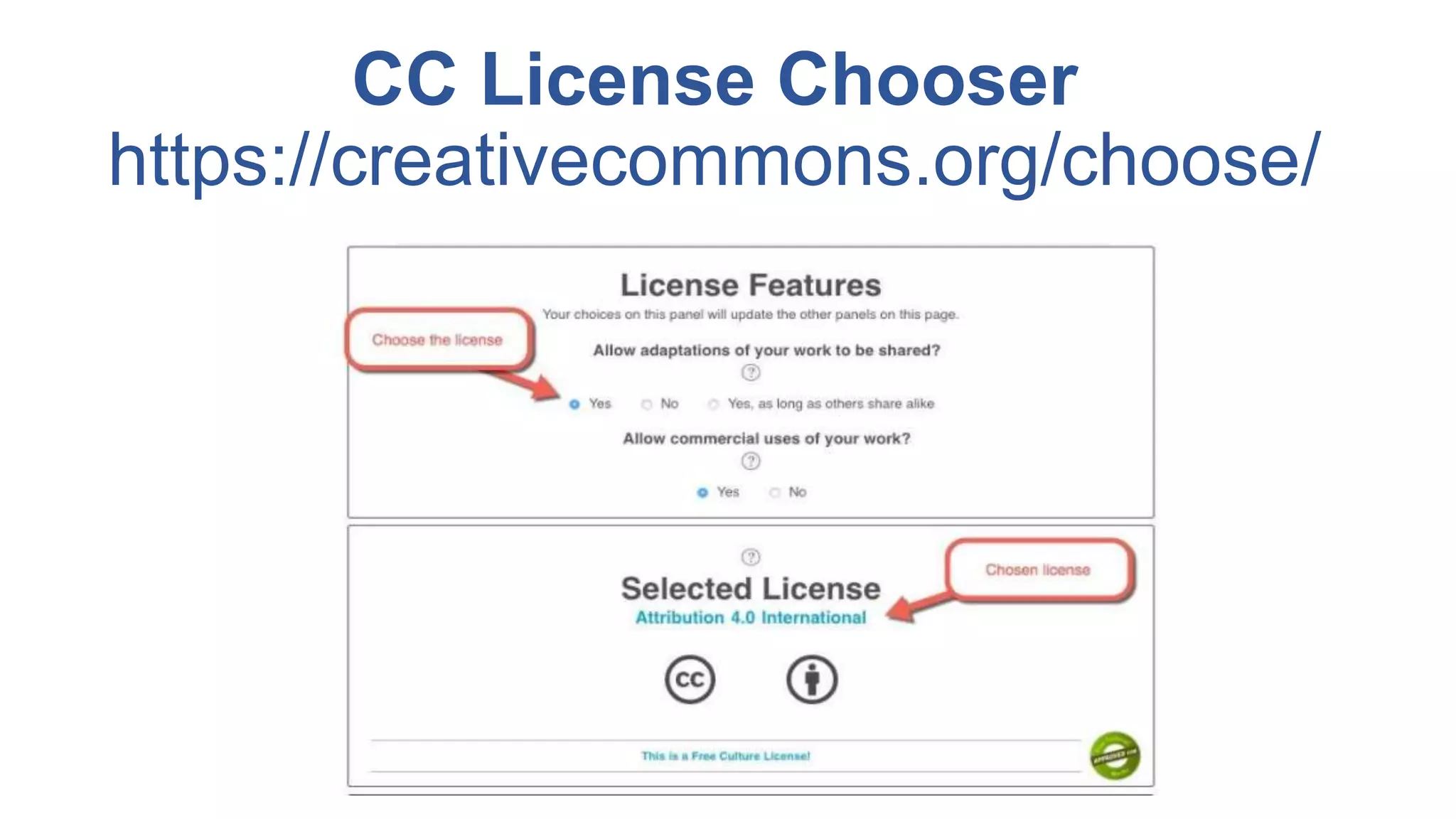
CC License Chooser
https://creativecommons.org/choose/
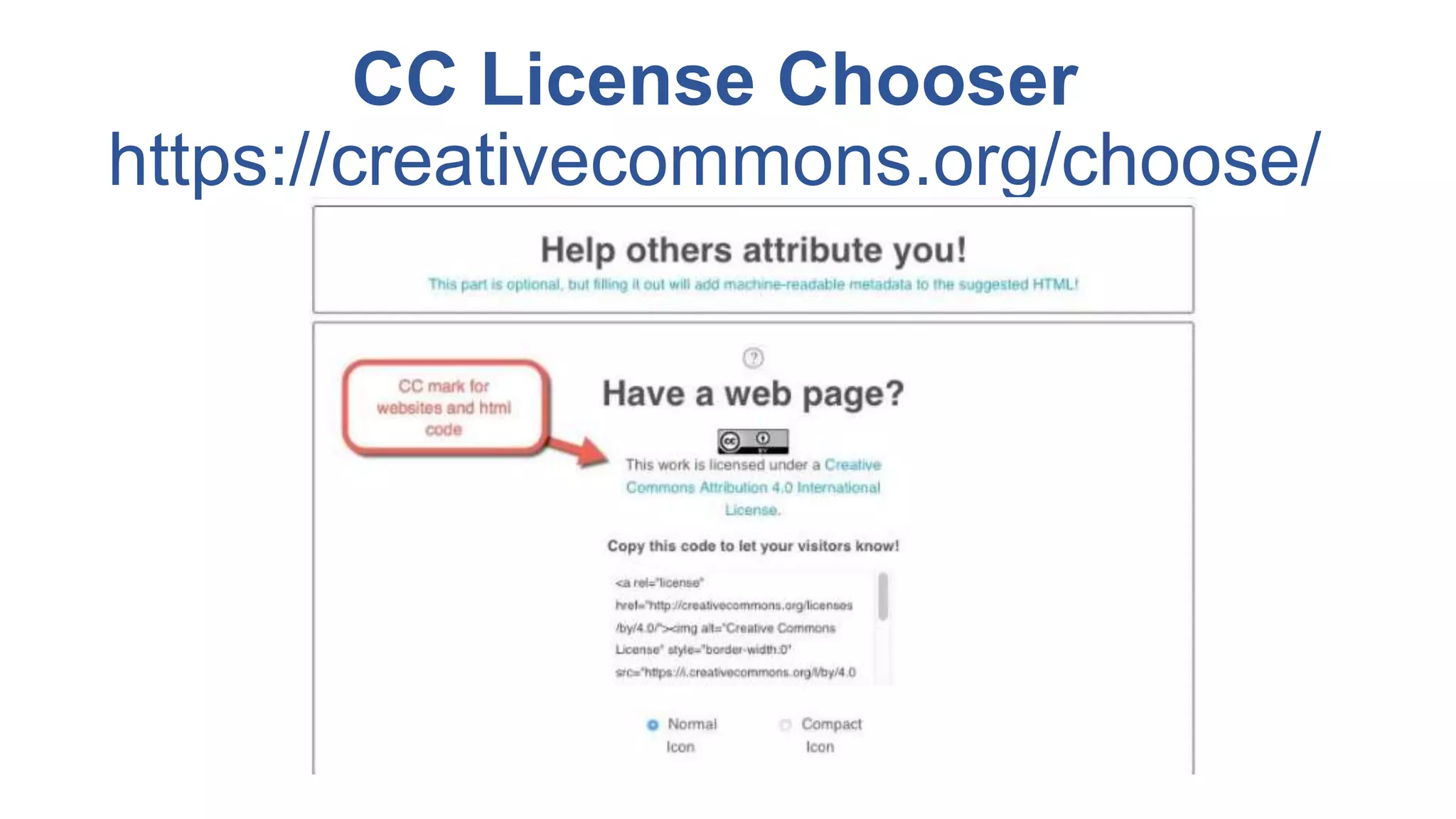
CC License Chooser
https://creativecommons.org/choose/
If you want to mark the work in a different way or
need to use a different format like closing titles in
a video, you can visit:
https://creativecommons.org/about/downloads/
to access downloadable versions of all of the CC
icons.
Proper Attributions:
TASL
T = title
A = author (tell reusers who to give credit to)
S = source (give reusers a link to the source of any third
party material you used)
L = license (tell reusers what license applies to which
content and provide a link to the relevant deed(s))
Example of Proper Attribution - Remix
This work by Regina Gong is derived from the OER
Workflow v1.1 created by Billy Meinke and University of
Hawaiʻi at Mānoa Outreach College, is licensed under a
CC BY 4.0 International License.
Ideal attribution
This tutorial was adapted from the book Concepts of
Biology by Samantha Fowler, Rebecca Roush, and
James Wise, available under a Creative Commons
Attribution 4.0 license. © 2016, OpenStax.
A license notice
This work is licensed under a Creative Commons Attribution 4.0
license.
Example of a Proper Attribution Using
TASL (Title, Author, Source, License)
Introduction to Logic and Critical Thinking by Matthew J. Van Cleave is
licensed under a Creative Commons Attribution 4.0 International
License. To view a copy of this license, visit
http://creativecommons.org/licenses/by/4.0/.
How to use licensed works
• Make sure that your use complies with the terms of the
license
• Include a link back to the original work
• Attribute the original creator
• Include a mention of or link to the Creative Commons license
• Include the copyright notice, if there is one.
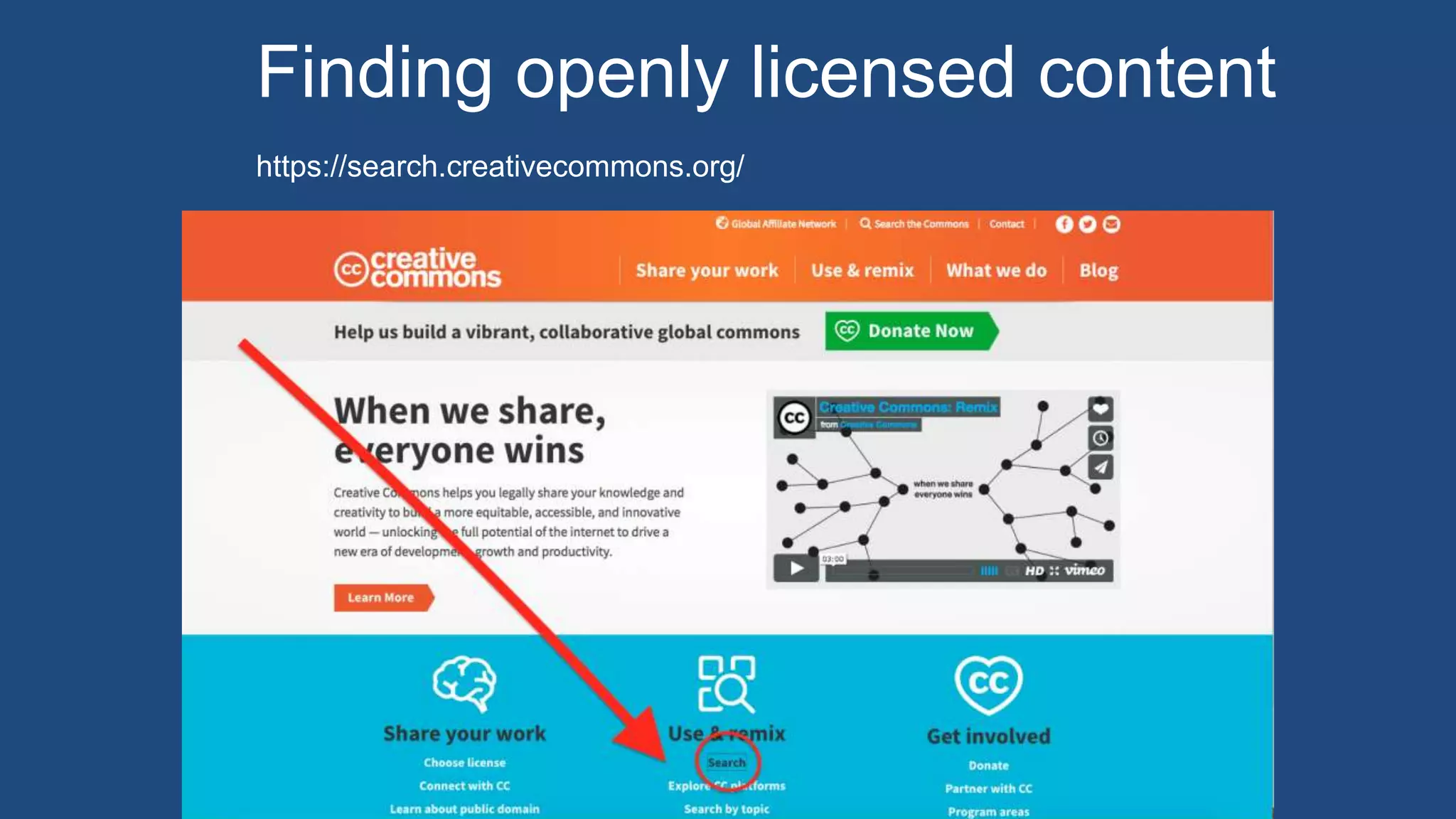
Finding openly licensed content
https://search.creativecommons.org/
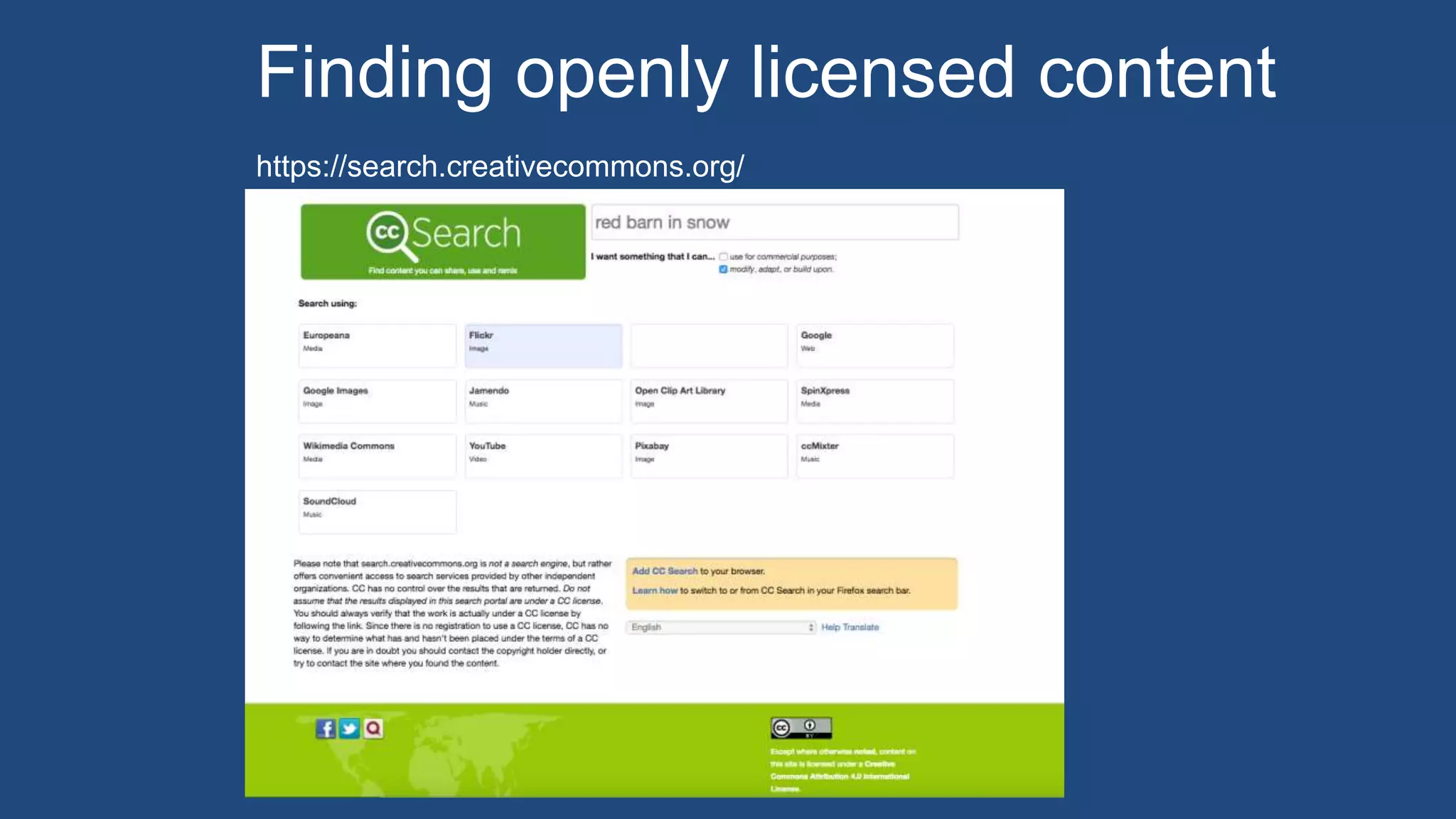
Finding openly licensed content
https://search.creativecommons.org/
Finding openly licensed content
images.google.com
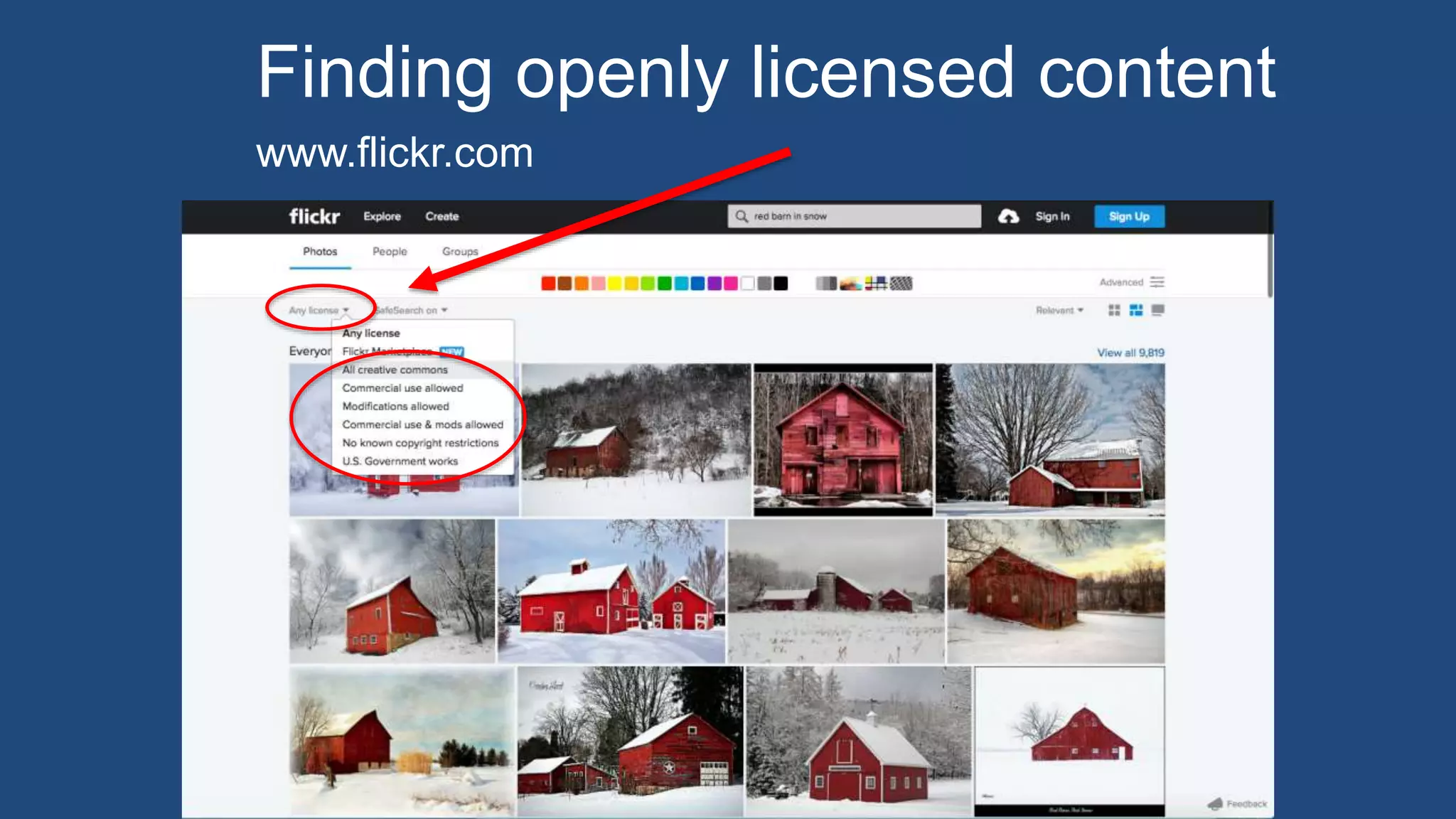
Finding openly licensed content
www.flickr.com
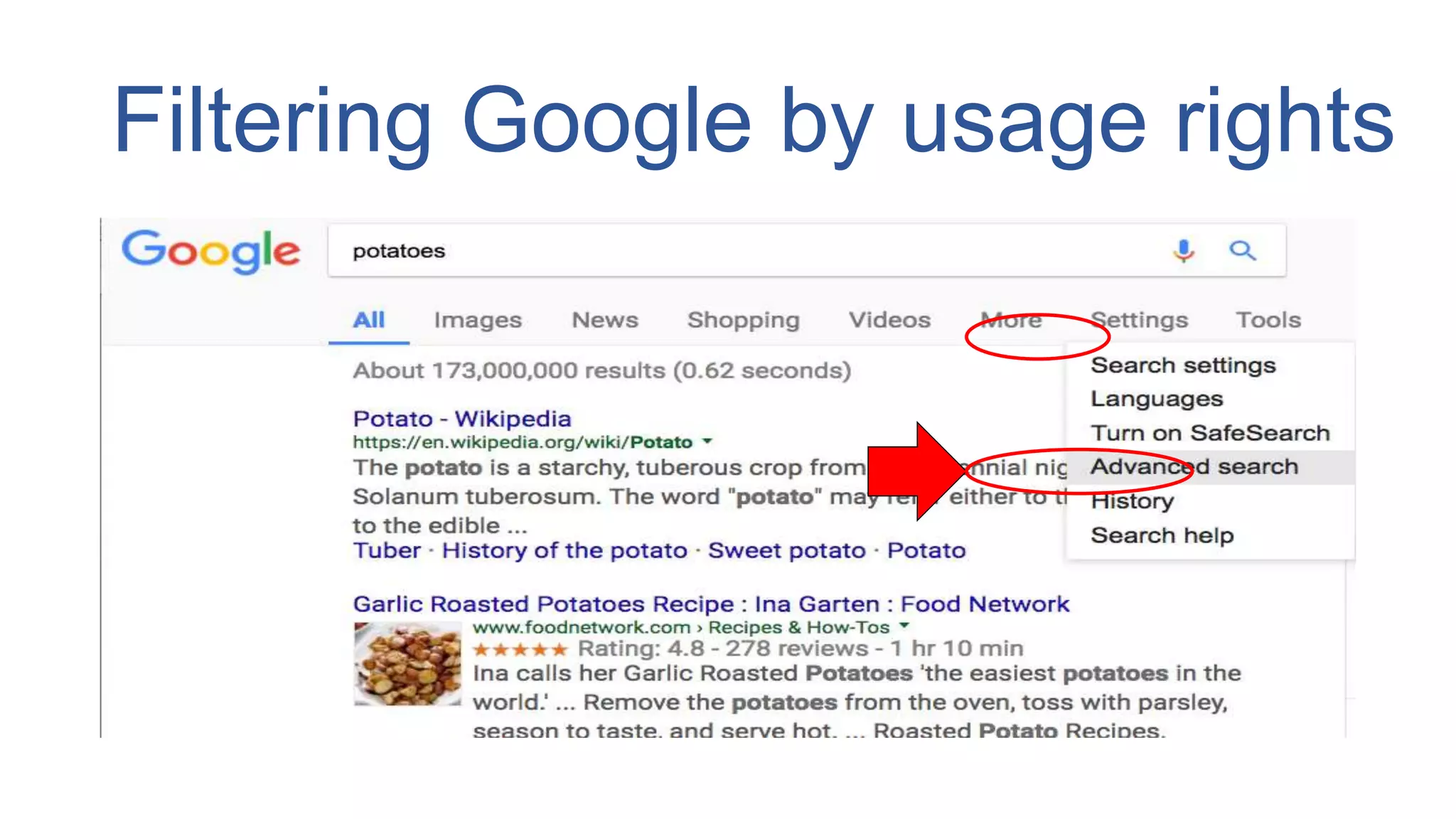
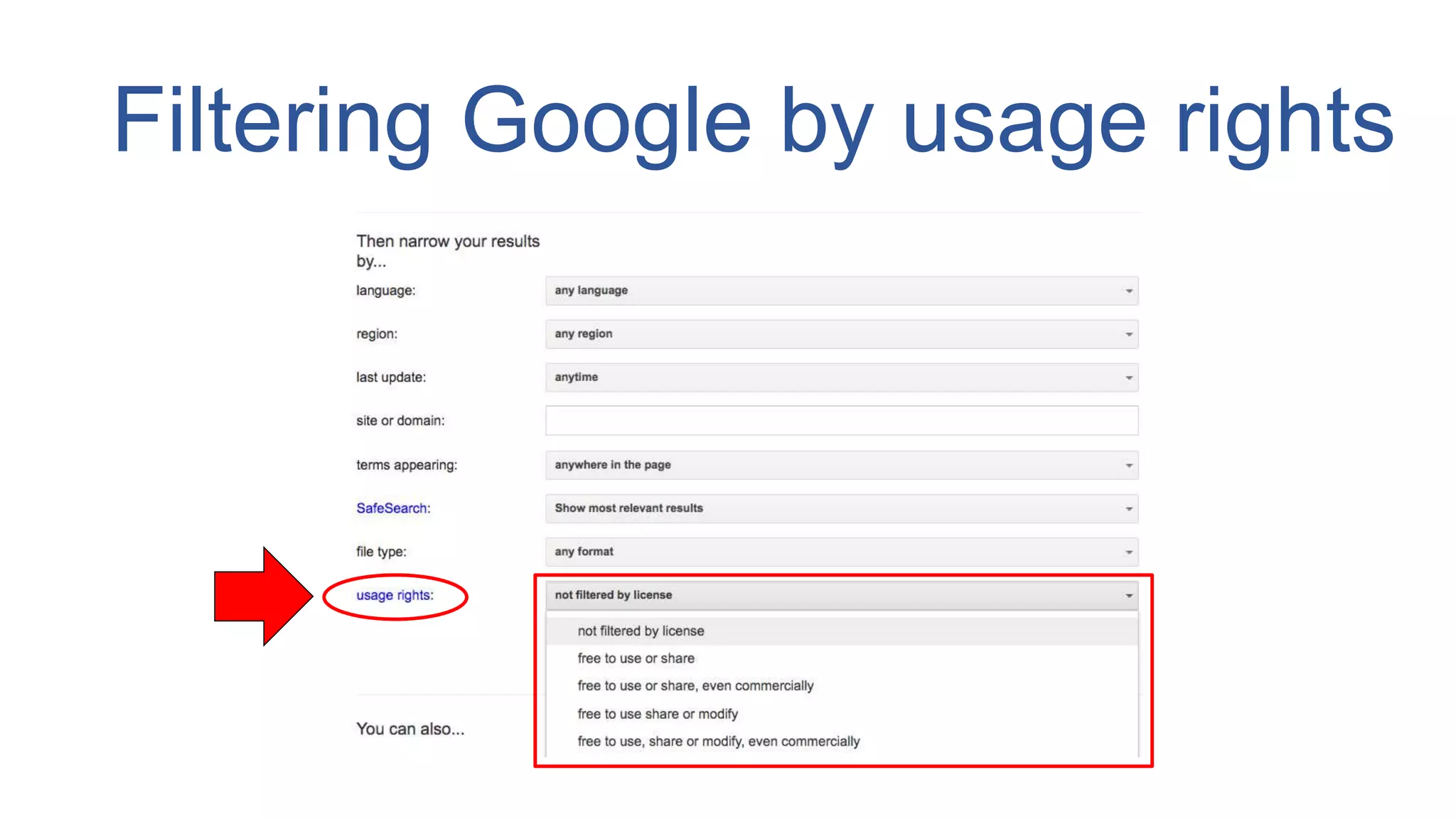
Filtering Google by usage rights
Remixing Creative
Commons Licensed
Materials
This work is licensed under the Creative Commons Attribution 4.0 International License.
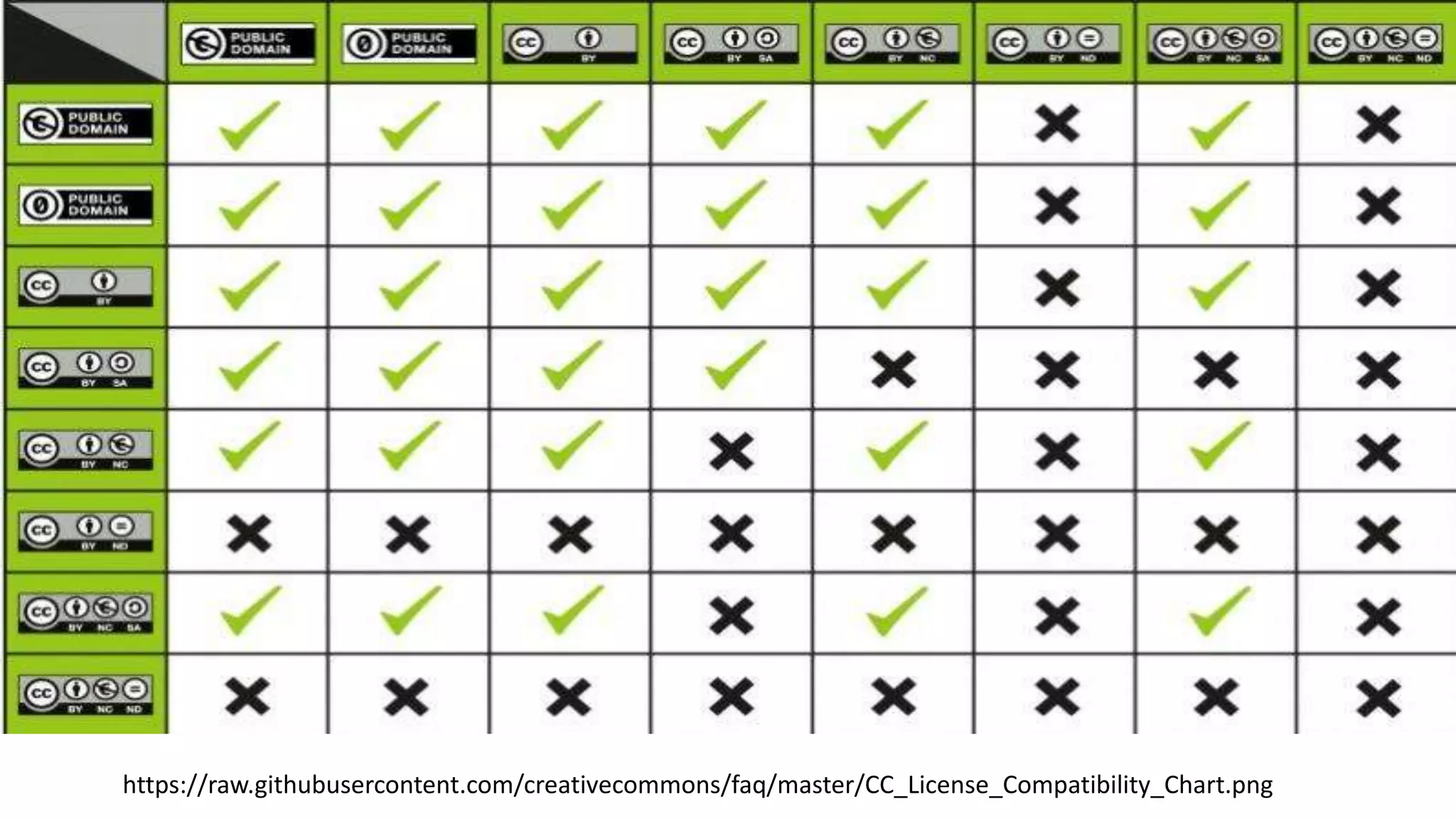
https://raw.githubusercontent.com/creativecommons/faq/master/CC_License_Compatibility_Chart.png
Using the CC License Compatibility chart above answer the
following question. A work licensed CC BY can be remixed
with works having what other license(s)?
(Select all correct answers)
 CC-BY
 CC-BY-SA
 CC-BY-NC
 CC-BY-ND
Using the CC License Compatibility chart above answer the
following question. A work licensed CC BY-SA can be
remixed with works having what other license(s):
 CC-BY
 CC-BY-NC
 CC-BY-NC-SA
 CC-BY-NC-ND
 None of the above
Using the CC License Compatibility chart above answer the
following question. A work licensed CC-BY-ND can be
remixed with works having what other license(s)?
 CC-BY
 CC-BY-SA
 CC-BY-NC
 CC-BY-ND
 None of the above
Remixing involves combining
several openly licensed materials to
create new work or a derivative of
the original.
However, we need to make a
distinction between collection and a
remix.
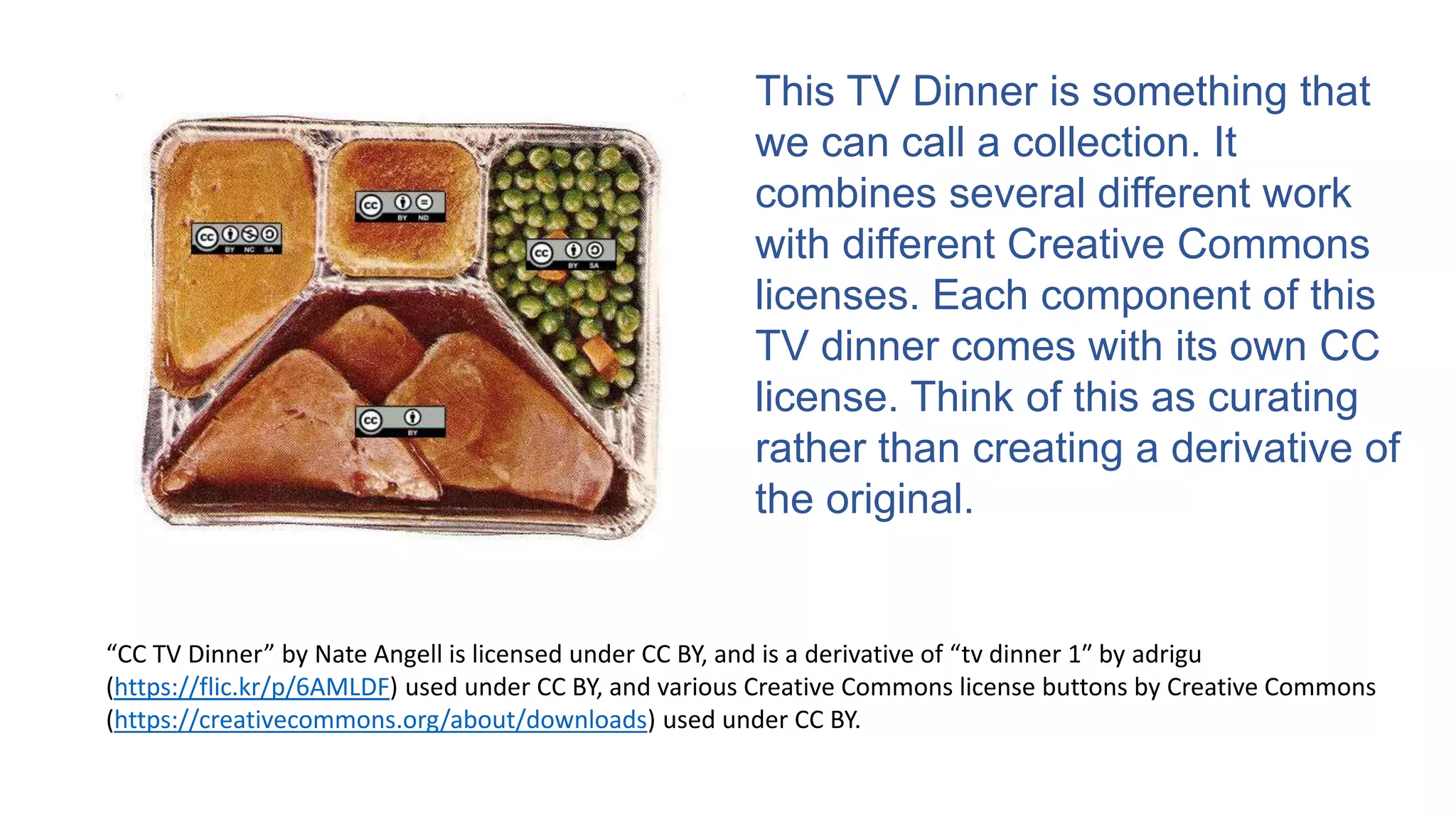
This TV Dinner is something that
we can call a collection. It
combines several different work
with different Creative Commons
licenses. Each component of this
TV dinner comes with its own CC
license. Think of this as curating
rather than creating a derivative of
the original.
“CC TV Dinner” by Nate Angell is licensed under CC BY, and is a derivative of “tv dinner 1″ by adrigu
(https://flic.kr/p/6AMLDF) used under CC BY, and various Creative Commons license buttons by Creative Commons
(https://creativecommons.org/about/downloads) used under CC BY.
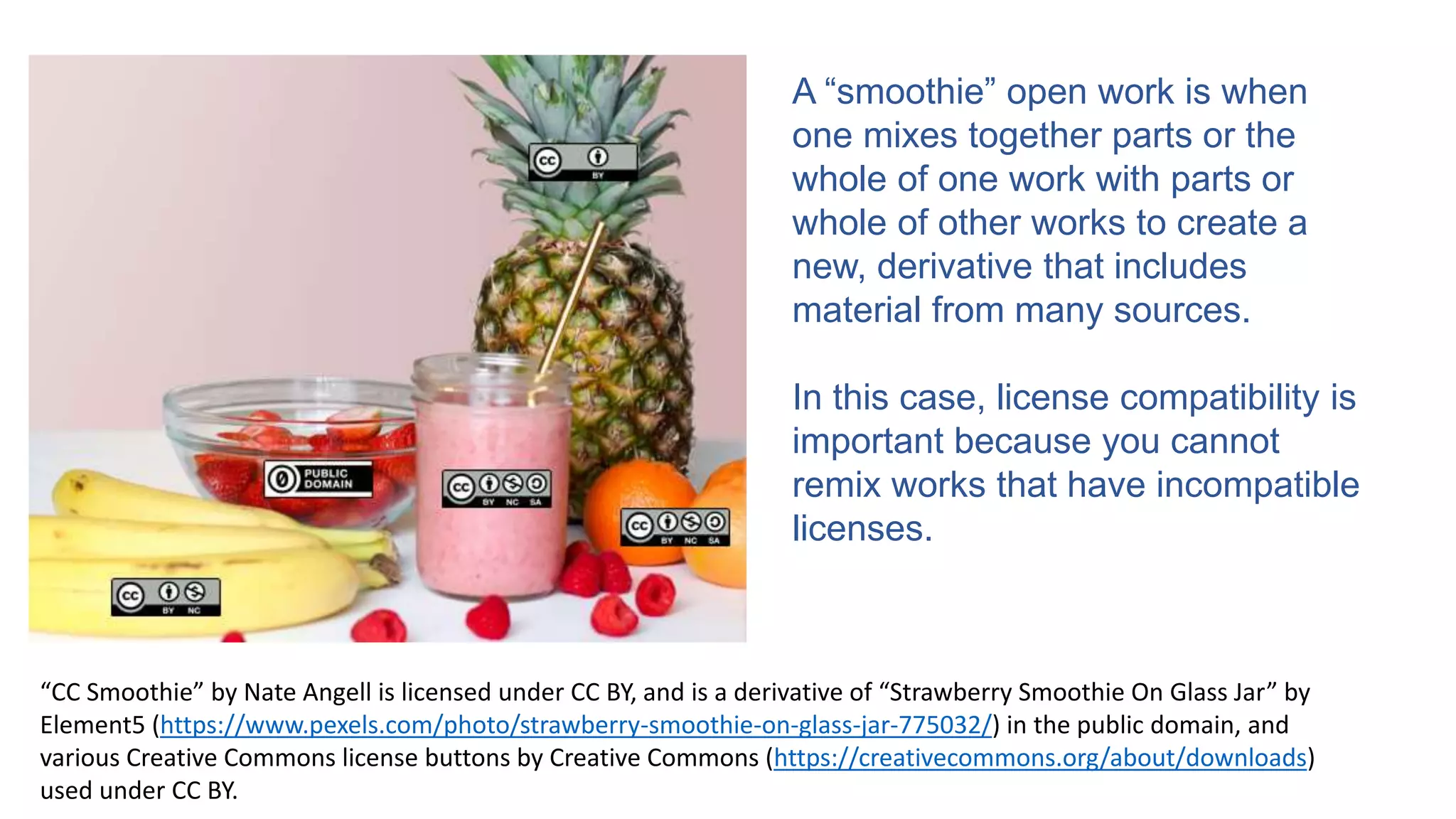
A “smoothie” open work is when
one mixes together parts or the
whole of one work with parts or
whole of other works to create a
new, derivative that includes
material from many sources.
In this case, license compatibility is
important because you cannot
remix works that have incompatible
licenses.
“CC Smoothie” by Nate Angell is licensed under CC BY, and is a derivative of “Strawberry Smoothie On Glass Jar” by
Element5 (https://www.pexels.com/photo/strawberry-smoothie-on-glass-jar-775032/) in the public domain, and
various Creative Commons license buttons by Creative Commons (https://creativecommons.org/about/downloads)
used under CC BY.
Which of the following are
adaptations?
1. Minor technical corrections, like correcting problems
with spelling or punctuation.
2. Putting works together into a collection, like combining
stand-alone essays by several authors into an open
textbook.
3. Synchronizing a musical work with a moving image,
like making a music video.
4. Technical format-shifting, like printing a physical copy
of an electronic book.
Attributions summarized
Give credit for works you reuse.
Avoid legal and ethical issues.
Include the title of the work, creator, URL, and
license type.
Tool to write good attributions:
http://www.openwa.org/open-attrib-builder/
Questions?
Attribution issues? License compatibility?
Vetting of sources? Not sure about
copyright?
Send me an email gongr1@lcc.edu

Creative Commons Licensing

  • 1.
    Creative Commons Licensing Workshop ReginaGong Librarian and OER Project Manager Lansing Community College This work is licensed under the Creative Commons Attribution 4.0 International License.
  • 2.
    What we’ll covertoday: • Copyright Basics • Fair Use • Creative Commons • CC Licenses • License Compatibility • Attribution • Hands on
  • 3.
    Creative Commons isa replacement for copyright. When creators use a Creative Commons license, they are forfeiting their copyright. TRUE OR FALSE
  • 4.
    A form ofprotection grounded in the U.S. Constitution and granted by law for original works of authorship fixed in a tangible medium of expression. Copyright covers both published and unpublished works. Copyright
  • 5.
    The Congress Shallhave power to promote the Progress of Science and useful Arts, by securing for limited Times to Authors and Inventors the exclusive Right to their respective Writings and Discoveries. “U.S Capitol in Afternoon Light” by Amanda Walker. CC-BY http://www.flickr.com/photos/amanda_walker/3139469441/ Article I, Section 8, Clause 8 of the United States Constitution
  • 6.
    Source: https://www.copyright.gov/title17/ Purpose ofCopyright • To promote the progress of the sciences and the useful arts”— so as to encourage creation of new works. • To grant authors/creators exclusive monopoly and ownership of their works for a given time period.
  • 7.
    • applies tooriginal works created in a tangible medium. • is automatic with no application needed to be protected. Copyright
  • 8.
    Copyright is abundle of rights: • The right to reproduce the work • The right to distribute the work • The right to prepare derivative works • The right to perform the work • The right to display the work • The right to digitally transmit sound recordings by means of digital audio transmission
  • 9.
    Exclusive rights, andlimitations Section 106 outlines the exclusive rights of copyright holders. Sections 107 through 122 outline all of the limitations on and exemptions from those exclusive rights.
  • 10.
    Who is thecopyright holder? • The creator is usually the initial copyright holder. • If two or more people jointly create a work, they are joint copyright holders, with equal rights. • With some exceptions, work created as a part of a person's employment is a "work made for hire" and the copyright belongs to the employer.
  • 11.
    How is copyrighttransferred? • Exclusive transfer, a.k.a. Assignment •Copyright holder loses rights •Must occur in writing • Non-exclusive license, a.k.a. Permission •Copyright holder retains rights •Can be in writing or verbal
  • 12.
    “How to AvoidCopyright Infringement Step 1” by Wikivisual is licensed under a Creative Commons Attribution-Noncommercial- Share Alike 3.0 United States License.
  • 13.
    “How to AvoidCopyright Infringement Step 2” by Wikivisual is licensed under a Creative Commons Attribution- Noncommercial-Share Alike 3.0 United States License.
  • 14.
  • 15.
    By Balfour Smith,Canuckguy, Badseed, Martsniez - Original image by Balfour Smith at Duke University at page (direct link). Vectorized by Badseed using BlankMap-World6 as a basemap., CC BY 3.0, https://commons.wikimedia.org/w/index.php?curid=20388347 Worldwide map of copyright term length
  • 16.
    After copyright expires,it automatically goes into the public domain • Works published before 1923 • Some works published between 1923 and 1963, but it’s complicated • Works by the United States Government • .
  • 17.
  • 18.
    The creator dedicatesthe work to the public domain before copyright has expired
  • 19.
    Project Gutenberg Public DomainReview Digital Public Library of America Wikimedia Commons Internet Archive Library of Congress Flickr Rijksmuseum Where can you find Public Domain materials?
  • 20.
  • 21.
    Fair Use Section 107 Thereis no easy formula for determining fair use, but there are four factors to consider: 1) The nature of the work (factual, creative) 2) The purpose of the use (educational, for-profit) 3) Amount of the work being used 4) The potential impact of the use on the market for the original.
  • 22.
    First Sale Doctrine(Section 109) Allows anyone to lend, borrow, and re-sell physical copies of copyrighted works. “browsing for books at The Strand” by SpecialKRB http://www.flickr.com/photos/specialkrb/3790261673/ CC-BY
  • 23.
    Exemptions for teachingpurposes Section 110 • Often referred to as the TEACH Act, which is only the most recent update • Applies to educational use, both in face-to-face classrooms and online • Allows teachers to show or display all kinds of content, including music and movies, as long as it is relevant to the curriculum. Image is in the public domain. Source: http://www.flickr.com/photos/perpetualplum/2279403795/
  • 24.
  • 25.
    Also known asthe Sonny Bono Copyright Term Extension Act extended the term of copyright from life of author plus 50 years (Copyright Act of 1976) to life of author plus 70 years. This act also had an effect in shrinking the works that would have been included in the public domain.
  • 26.
    The CTEA wascommonly referred to as the Mickey Mouse Copyright Law because of Disney’s strong advocacy for copyright extension. The chart on the right illustrates how Disney aggressively lobbied Congress every time Mickey’s copyright is about to expire.
  • 27.
    The constitutionality ofthe CTEA was challenged by an Internet publisher named Eric Elred, who was represented by Stanford law professor Lawrence Lessig as the case went all the way to the Supreme Court. The CTEA was upheld with a 7-2 vote.
  • 28.
    All rights reserve Limitsand regulates sharing Internet enables access, sharing, collaboration in unprecedented scale, something that copyright cannot do Because of the underlying tension between these two opposing forces, and the desire to legally enable sharing of works, the idea of Creative Commons came about.
  • 29.
    Non-profit organization foundedin 2001 by Lawrence Lessig. The next year, the Creative Commons licenses were released to enable everyone to legally share works without circumventing copyright.
  • 30.
    Provides free legaltools that let authors, scientists, artists, and educators easily mark their creative work with the freedoms they want it to carry.
  • 31.
    Creative Commons licensesallow “some rights reserved” as opposed to copyright’s “all rights reserve.” Creators retain copyright while allowing others to copy, distribute, and make some uses of their work. Every CC license also ensures all creators get credit for their work through the practice of attribution.
  • 32.
  • 33.
  • 34.
    Includes over 500volunteers and community members who serve as CC representatives in over 85 countries. To coordinate the work of the global affiliate networks, four platforms were created: • Open Education • Copyright Reform • Community Development • GLAM (Galleries, Libraries, and Museums)
  • 35.
    Image Credits • Copyrightsymbol: https://pixabay.com/en/copyright-symbol-intellectual-30343/ • Internet: https://pixabay.com/en/social-media-icon-human-personal-2537391/ • Mickey Mouse image and copyright https://en.wikipedia.org/wiki/Copyright_Term_Extension_Act#/media/File:Disney-infinite- copyright.svg • Mickey Mouse effect on copyright law: https://pix-media.priceonomics- media.com/blog/1105/mickeymouseFINAL.jpg • Creative Commons Licenses: https://pixabay.com/en/creative-commons-licenses-icons- by-783531/ • Creative Commons Visual Thinkery: https://www.flickr.com/photos/gforsythe/9102402492
  • 36.
  • 37.
    licenses have three layers Photo byGianna Ciaramello on Unsplash
  • 38.
    1 2 3 This is thebase layer. It’s a traditional legal tool that lawyers can understand. This is the commons deeds. These are web pages that outlines the licenses in human-readable terms. The “machine readable” version of the license” written in a format that applications, search engines, and other kinds of technology can understand. Source: https://creativecommons.org/licenses/
  • 39.
  • 40.
  • 41.
    Machine Readable Code <arel="license" href="http://creativecommons.org/license s/by-nc/3.0/"> <img alt="Creative Commons License" style="border-width:0" src="http://i.creativecommons.org/l/by- nc/3.0/88x31.png" /> </a> <br />This <span xmlns:dc="http://purl.org/dc/elements/1. 1/" href="http://purl.org/dc/dcmitype/" rel="dc:type">work</span> is licensed under a <a rel="license" href="http://creativecommons.org/license s/by-nc/3.0/">Creative Commons Attribution-Noncommercial 3.0 License</a>.
  • 42.
    Four License Elements Source:https://en.wikipedia.org/wiki/Creative_Commons_license
  • 44.
    Public Domain andCC Licenses The Public Domain mark allows others to see works that are no longer under copyright and can be freely used by others. “No Rights Reserved” where authors wave their right to copyright. Creators exercise their choice to opt out of copyright and database protection, and the exclusive rights automatically granted to them.
  • 45.
    Creative Commons licensessit on top of copyright. It works with copyright because you can’t assign a CC license if you don’t own the copyright to the work. CC licenses gives legal permissions to anyone to copy, modify, create derivatives or adaptations of a work without asking permission from the copyright holder each time. Allows creators to assign permissions to their works while still retaining copyright.
  • 46.
    If someone isusing a CC-licensed work without giving attribution or otherwise following the license, a person’s right to use the work ends automatically as soon as they violate the license terms. Unless the person using the work got separate permission or is relying upon fair use or some other exception to copyright, they are potentially liable for copyright infringement. Over the course of CC’s history, there have been very few legal disputes and decisions involving CC legal tools. Each court that has rendered a decision has made it without questioning the enforceability of the CC license at issue. Source: https://pixabay.com/en/law-justice-court-judge-legal-1063249/ License Enforceability
  • 48.
  • 49.
    Important things toremember about Creative Commons Licenses: •The licenses and CC0 are irrevocable. •You must own or control copyright in the work.
  • 50.
    Ask yourself thesequestions before you apply a CC License: • Do you hold the copyright? • Are you comfortable with people profiting from your work? • Are you comfortable with people changing your work? • Do you want derivatives of your work to carry Creative Commons licenses?
  • 51.
  • 52.
  • 53.
  • 54.
    If you wantto mark the work in a different way or need to use a different format like closing titles in a video, you can visit: https://creativecommons.org/about/downloads/ to access downloadable versions of all of the CC icons.
  • 55.
    Proper Attributions: TASL T =title A = author (tell reusers who to give credit to) S = source (give reusers a link to the source of any third party material you used) L = license (tell reusers what license applies to which content and provide a link to the relevant deed(s))
  • 56.
    Example of ProperAttribution - Remix This work by Regina Gong is derived from the OER Workflow v1.1 created by Billy Meinke and University of Hawaiʻi at Mānoa Outreach College, is licensed under a CC BY 4.0 International License.
  • 57.
    Ideal attribution This tutorialwas adapted from the book Concepts of Biology by Samantha Fowler, Rebecca Roush, and James Wise, available under a Creative Commons Attribution 4.0 license. © 2016, OpenStax.
  • 58.
    A license notice Thiswork is licensed under a Creative Commons Attribution 4.0 license.
  • 59.
    Example of aProper Attribution Using TASL (Title, Author, Source, License) Introduction to Logic and Critical Thinking by Matthew J. Van Cleave is licensed under a Creative Commons Attribution 4.0 International License. To view a copy of this license, visit http://creativecommons.org/licenses/by/4.0/.
  • 60.
    How to uselicensed works • Make sure that your use complies with the terms of the license • Include a link back to the original work • Attribute the original creator • Include a mention of or link to the Creative Commons license • Include the copyright notice, if there is one.
  • 61.
    Finding openly licensedcontent https://search.creativecommons.org/
  • 62.
    Finding openly licensedcontent https://search.creativecommons.org/
  • 63.
    Finding openly licensedcontent images.google.com
  • 64.
    Finding openly licensedcontent www.flickr.com
  • 65.
    Filtering Google byusage rights
  • 66.
    Filtering Google byusage rights
  • 67.
    Remixing Creative Commons Licensed Materials Thiswork is licensed under the Creative Commons Attribution 4.0 International License.
  • 68.
  • 69.
    Using the CCLicense Compatibility chart above answer the following question. A work licensed CC BY can be remixed with works having what other license(s)? (Select all correct answers)  CC-BY  CC-BY-SA  CC-BY-NC  CC-BY-ND
  • 70.
    Using the CCLicense Compatibility chart above answer the following question. A work licensed CC BY-SA can be remixed with works having what other license(s):  CC-BY  CC-BY-NC  CC-BY-NC-SA  CC-BY-NC-ND  None of the above
  • 71.
    Using the CCLicense Compatibility chart above answer the following question. A work licensed CC-BY-ND can be remixed with works having what other license(s)?  CC-BY  CC-BY-SA  CC-BY-NC  CC-BY-ND  None of the above
  • 72.
    Remixing involves combining severalopenly licensed materials to create new work or a derivative of the original. However, we need to make a distinction between collection and a remix.
  • 73.
    This TV Dinneris something that we can call a collection. It combines several different work with different Creative Commons licenses. Each component of this TV dinner comes with its own CC license. Think of this as curating rather than creating a derivative of the original. “CC TV Dinner” by Nate Angell is licensed under CC BY, and is a derivative of “tv dinner 1″ by adrigu (https://flic.kr/p/6AMLDF) used under CC BY, and various Creative Commons license buttons by Creative Commons (https://creativecommons.org/about/downloads) used under CC BY.
  • 74.
    A “smoothie” openwork is when one mixes together parts or the whole of one work with parts or whole of other works to create a new, derivative that includes material from many sources. In this case, license compatibility is important because you cannot remix works that have incompatible licenses. “CC Smoothie” by Nate Angell is licensed under CC BY, and is a derivative of “Strawberry Smoothie On Glass Jar” by Element5 (https://www.pexels.com/photo/strawberry-smoothie-on-glass-jar-775032/) in the public domain, and various Creative Commons license buttons by Creative Commons (https://creativecommons.org/about/downloads) used under CC BY.
  • 75.
    Which of thefollowing are adaptations? 1. Minor technical corrections, like correcting problems with spelling or punctuation. 2. Putting works together into a collection, like combining stand-alone essays by several authors into an open textbook. 3. Synchronizing a musical work with a moving image, like making a music video. 4. Technical format-shifting, like printing a physical copy of an electronic book.
  • 76.
    Attributions summarized Give creditfor works you reuse. Avoid legal and ethical issues. Include the title of the work, creator, URL, and license type. Tool to write good attributions: http://www.openwa.org/open-attrib-builder/
  • 77.
    Questions? Attribution issues? Licensecompatibility? Vetting of sources? Not sure about copyright? Send me an email gongr1@lcc.edu