Creative Commons Licenses
       April 14, 2011


           Maarten Zeinstra
   Stichting Nederland Kennisland
   Creative Commons Nederland
    e: mz@kl.nl t: mzeinstra
Copyright 101

Public Domain 101

Creative Commons Licenses

How it works

Questions
Copyright 101


        Copyright is a law that gives the owner of a
        creative work like a document, book, or other
        piece of information, the right to decide what
        others can do with it.
Some characteristics of copyright
Copyright is automatically granted

No need to register

Copyright only covers works that are a form of material expression

Copyright always means: all rights reserved

Copyright has a limited duration:

           lasting 70 years after the author’s death (text)
           lasting 50 years after first recording (neighboring rights)
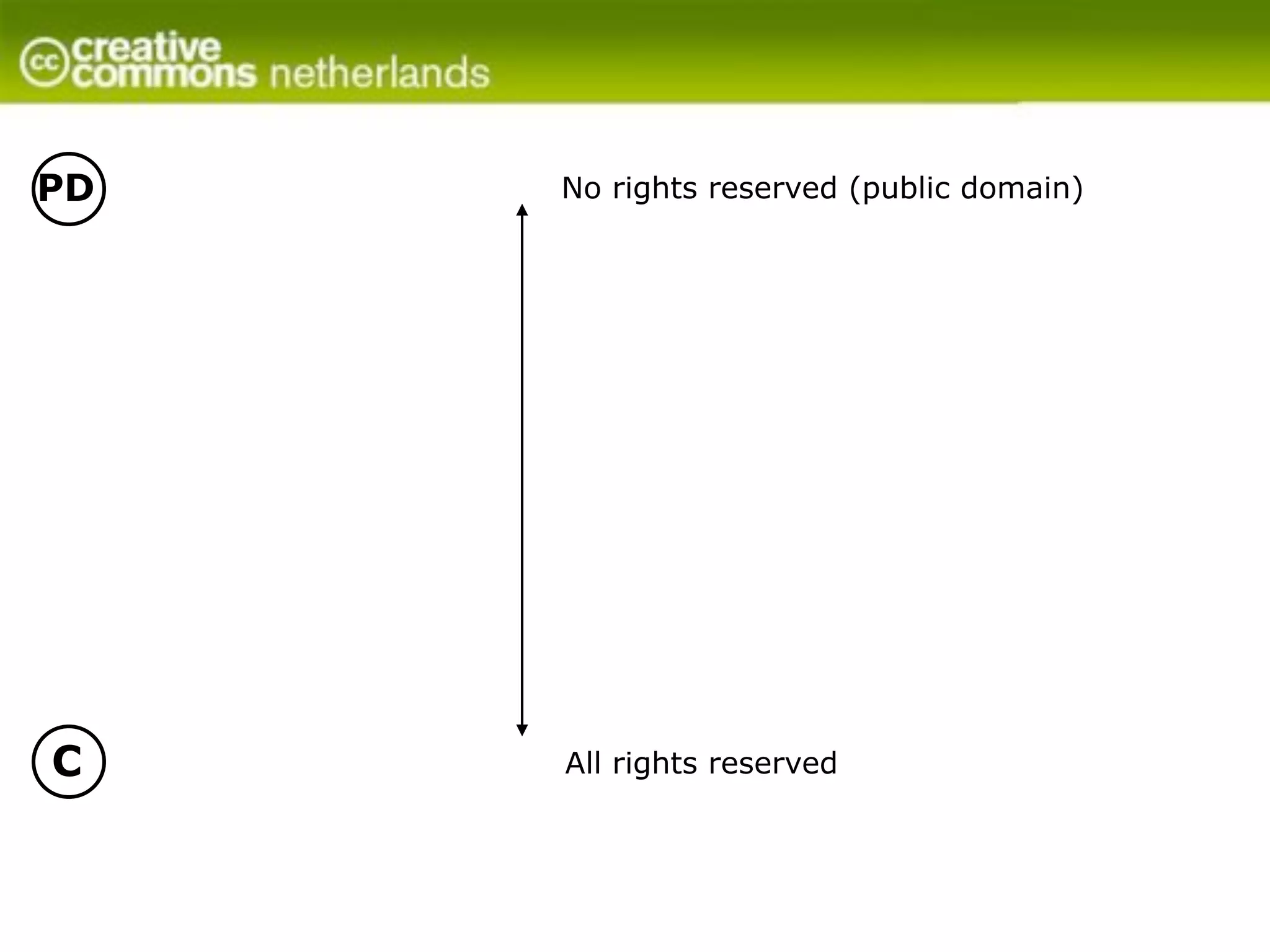
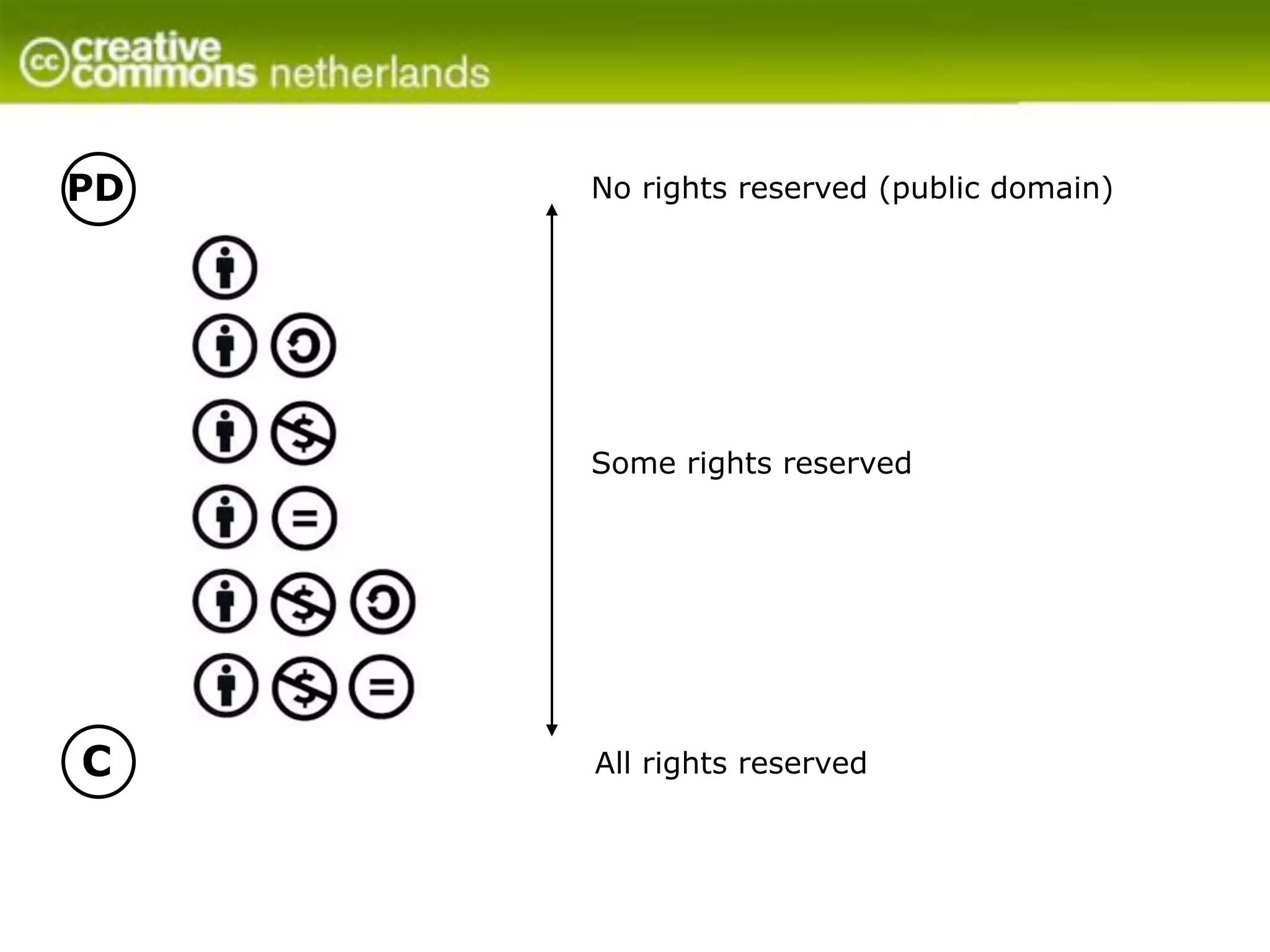
PD   No rights reserved (public domain)


C    All rights reserved
Two Objectives of Copyright


 Moral rights
       Protect the moral rights of the author as the maker of the work


 Exploitation rights
       Grant the copyright-holder the opportunity to generate returns from
       his work, to exploit the work.
Moral rights
“independently of the author's economic rights, and even after the transfer of
the said rights, the author shall have the right to claim authorship of the
work and to object to any distortion, mutilation or other modification
of, or other derogatory action in relation to, the said work, which would be
prejudicial to his honor or reputation.”
                                                      -Berne Convention(1886)-


Right of attribution (name of the author mentioned)

Right to be the first to publish the work

Right to publish the work anonymously or pseudonymously

Right to the integrity of the work
Exploitation rights (or: economic rights)
Right to make copies of the work or of parts of the work

Right to perform the work

Right to distribute the work or copies of the work

Right to use the work to create new works (create derivative works)

Right to import or export the work and copies of the work

Right to sell or assign the exploitation rights to others
Public Domain 101


        The Public Domain is the rule, copyright
        protection is the exception. Since copyright
        protection is granted only with respect to
        original forms of expression, the vast majority
        of data, information and ideas produced
        worldwide at any given time belongs to the
        Public Domain
                                 -Public Domain Charter-
Be aware of moral rights & neighboring rights
Moral rights are perpetual in some countries like France


Different parts of a work fall into the public domain at different times

      combined works

      copyright and neighboring rights
Creative Commons


       Creative Commons defines the spectrum of
       possibilities between full copyright and the
       public domain. From all rights reserved to no
       rights reserved. Our licenses help you keep
       your copyright while allowing certain uses
       of your work
                                  -creativecommons.org-
Creative Commons Licenses
A license is a document demonstrating permission. Licenses are granted by a
party (the licensor) to another party (the licensee). A license can be seen as a
promise by the licensor not to sue the licensee.


You still own the rights to your music

You describe how other people can use your music

Creative Commons offers a license system with 4 building blocks
License Building Blocks (1/4)

           Attribution
License Building Blocks (2/4)


           NonCommercial
License Building Blocks (3/4)


           NoDerivatives
License Building Blocks (4/4)


           ShareAlike
PD   No rights reserved (public domain)


     Some rights reserved


C    All rights reserved
Some additional characteristics
Licenses are granted to an anonymous public (no one can be excluded)

Licenses are irrevocable (you cannot take them off after a particular time)

Licenses last for the duration of legal copyright protection


Creative Commons is NOT involved in negotiations or (dis)agreements of
parties using Creative Commons licenses

Creative Commons does NOT register licensed work nor does it enforce the
licenses
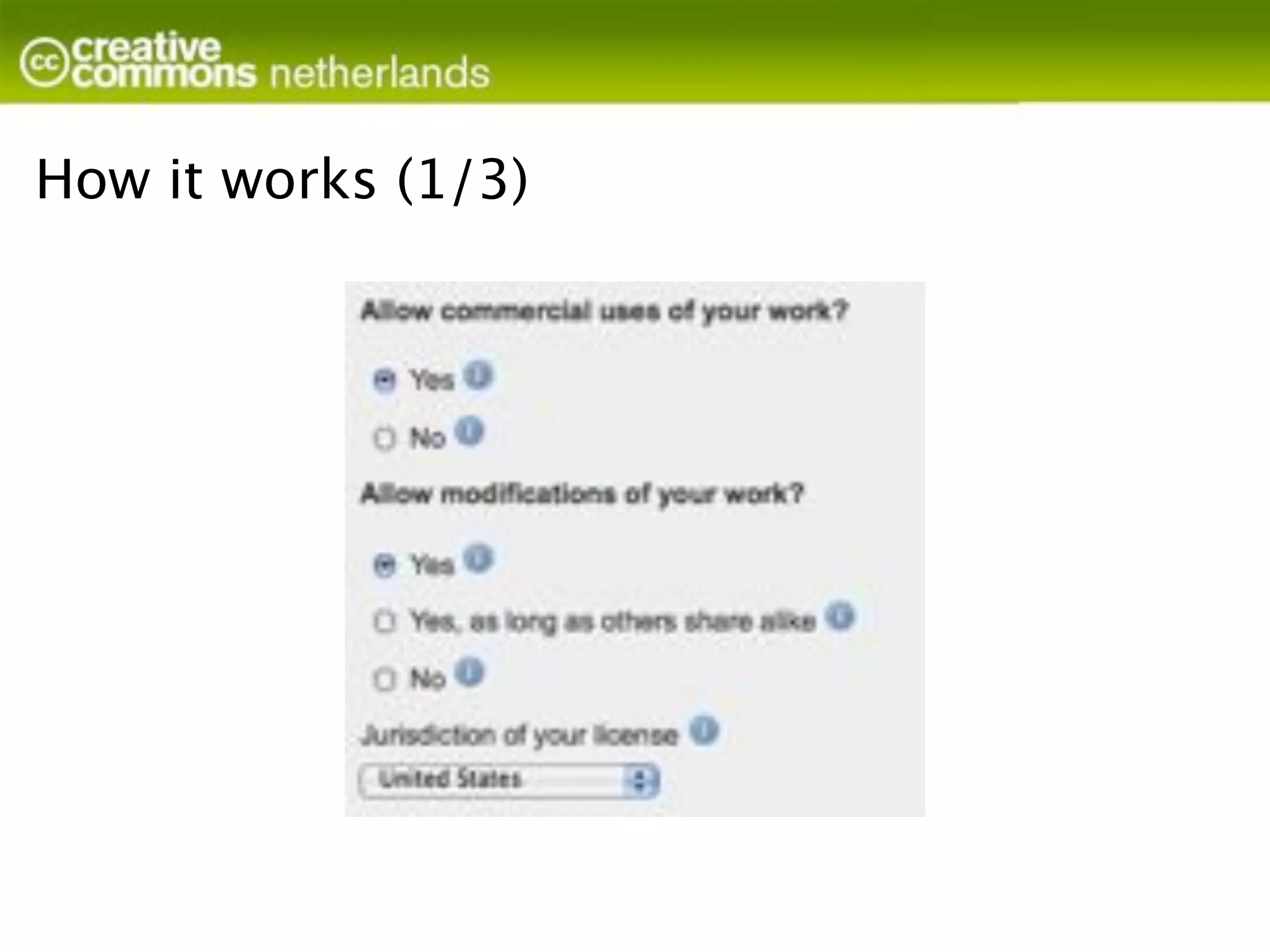
How it works (1/3)
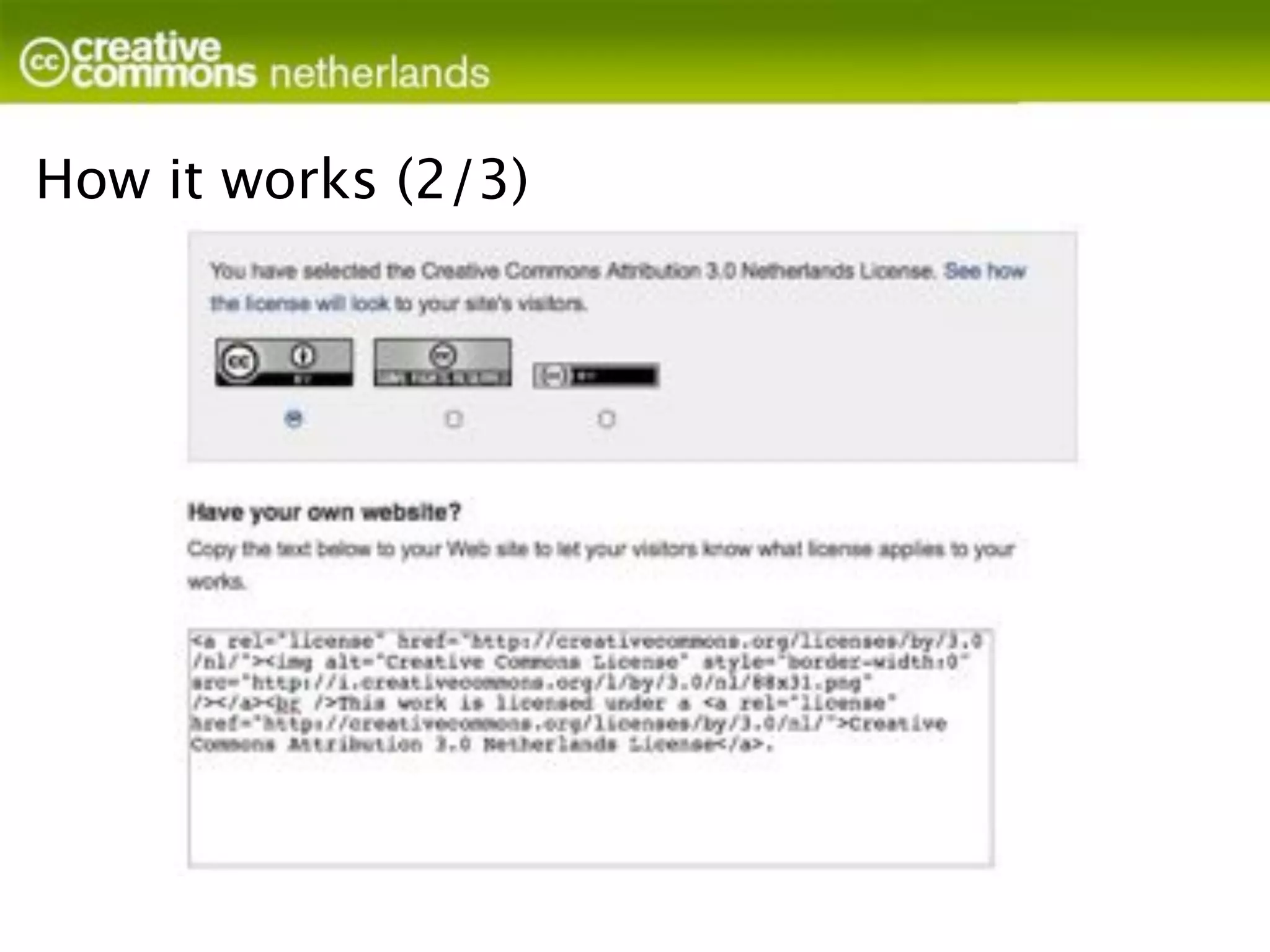
How it works (2/3)
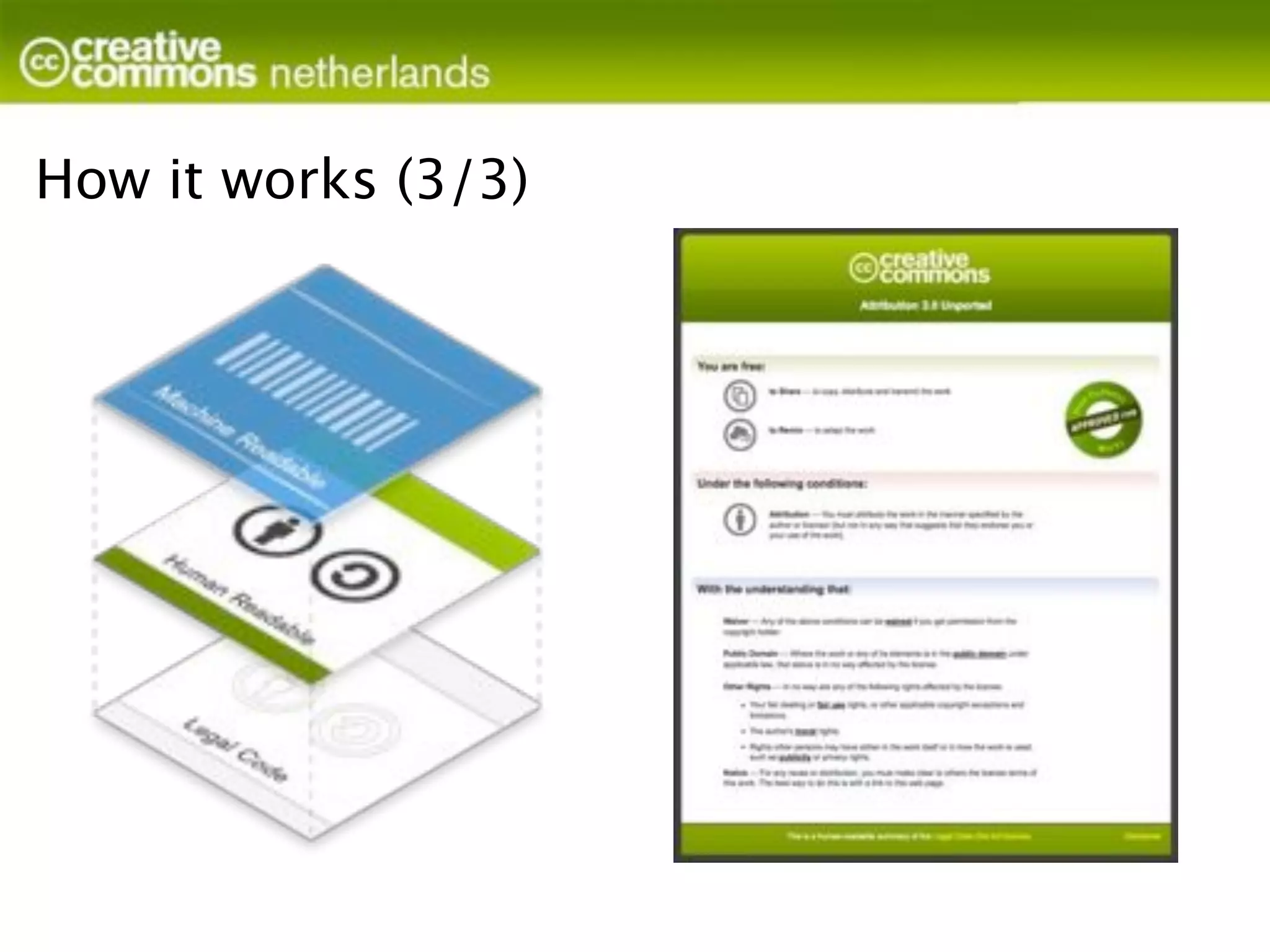
How it works (3/3)


 !
Online Documents
 Goto http://creativecommons.org/choose/


 Choose your license


 Copy the provide HTML and add it to your website
Offline Documents
 Add your name as the creator of the work


 Add the license button


 Add license restrictions
         CC-BY: You are free to copy, alter, and distribute the work as long
         as you give appropriate attribution.
         CC-BY-NC-ND: You are free to download the work and share them
         with others as long as you give credit, you are not allowed to
         change the work in any way or use the work commercially.


 Add a link to the Creative Commons license page
General Questions
 How can we re-use work made by others? Found on Google for example.
         Search for open licensed material
         Mention license and name (and source)


 Are there limitation on the use of logos?
         As long as you do not present the logo as an official affiliation.
Educational uses (1/2)
 Can I use an article from a magazine in the courses I give? (by myself or
 others)
         Open Content? If so, see deed
         Contact rights holder
         Fair use/Onderwijs Exceptie (billijke vergoeding)


 Can I refer to a scientific article on a website or internal educational
 system?
         You are always allowed to refer to a online resource
Educational uses (2/2)
 Can I re-use my own published materials in a different lay-out or
 presentation?
         Depends on the made agreement with the publisher.
 Can I publish a translated version of my article?
         Depends on the made agreement with the publisher.
Open Access Publishing
 Directory of Open Access Journals
        http://www.doaj.org/
        Watch out for exclusivity clauses


 Open Access is not always Open Content
        Free to read, not free to re-use
Questions?


mail: mz@kl.nl
web: creativecommons.org

Creative Commons presentation

  • 1.
    Creative Commons Licenses April 14, 2011 Maarten Zeinstra Stichting Nederland Kennisland Creative Commons Nederland e: mz@kl.nl t: mzeinstra
  • 2.
    Copyright 101 Public Domain101 Creative Commons Licenses How it works Questions
  • 3.
    Copyright 101 Copyright is a law that gives the owner of a creative work like a document, book, or other piece of information, the right to decide what others can do with it.
  • 4.
    Some characteristics ofcopyright Copyright is automatically granted No need to register Copyright only covers works that are a form of material expression Copyright always means: all rights reserved Copyright has a limited duration: lasting 70 years after the author’s death (text) lasting 50 years after first recording (neighboring rights)
  • 5.
    PD No rights reserved (public domain) C All rights reserved
  • 6.
    Two Objectives ofCopyright Moral rights Protect the moral rights of the author as the maker of the work Exploitation rights Grant the copyright-holder the opportunity to generate returns from his work, to exploit the work.
  • 7.
    Moral rights “independently ofthe author's economic rights, and even after the transfer of the said rights, the author shall have the right to claim authorship of the work and to object to any distortion, mutilation or other modification of, or other derogatory action in relation to, the said work, which would be prejudicial to his honor or reputation.” -Berne Convention(1886)- Right of attribution (name of the author mentioned) Right to be the first to publish the work Right to publish the work anonymously or pseudonymously Right to the integrity of the work
  • 8.
    Exploitation rights (or:economic rights) Right to make copies of the work or of parts of the work Right to perform the work Right to distribute the work or copies of the work Right to use the work to create new works (create derivative works) Right to import or export the work and copies of the work Right to sell or assign the exploitation rights to others
  • 9.
    Public Domain 101 The Public Domain is the rule, copyright protection is the exception. Since copyright protection is granted only with respect to original forms of expression, the vast majority of data, information and ideas produced worldwide at any given time belongs to the Public Domain -Public Domain Charter-
  • 10.
    Be aware ofmoral rights & neighboring rights Moral rights are perpetual in some countries like France Different parts of a work fall into the public domain at different times combined works copyright and neighboring rights
  • 11.
    Creative Commons Creative Commons defines the spectrum of possibilities between full copyright and the public domain. From all rights reserved to no rights reserved. Our licenses help you keep your copyright while allowing certain uses of your work -creativecommons.org-
  • 12.
    Creative Commons Licenses Alicense is a document demonstrating permission. Licenses are granted by a party (the licensor) to another party (the licensee). A license can be seen as a promise by the licensor not to sue the licensee. You still own the rights to your music You describe how other people can use your music Creative Commons offers a license system with 4 building blocks
  • 13.
    License Building Blocks(1/4) Attribution
  • 14.
    License Building Blocks(2/4) NonCommercial
  • 15.
    License Building Blocks(3/4) NoDerivatives
  • 16.
    License Building Blocks(4/4) ShareAlike
  • 17.
    PD No rights reserved (public domain) Some rights reserved C All rights reserved
  • 18.
    Some additional characteristics Licensesare granted to an anonymous public (no one can be excluded) Licenses are irrevocable (you cannot take them off after a particular time) Licenses last for the duration of legal copyright protection Creative Commons is NOT involved in negotiations or (dis)agreements of parties using Creative Commons licenses Creative Commons does NOT register licensed work nor does it enforce the licenses
  • 19.
  • 20.
  • 21.
    How it works(3/3) !
  • 22.
    Online Documents Gotohttp://creativecommons.org/choose/ Choose your license Copy the provide HTML and add it to your website
  • 23.
    Offline Documents Addyour name as the creator of the work Add the license button Add license restrictions CC-BY: You are free to copy, alter, and distribute the work as long as you give appropriate attribution. CC-BY-NC-ND: You are free to download the work and share them with others as long as you give credit, you are not allowed to change the work in any way or use the work commercially. Add a link to the Creative Commons license page
  • 24.
    General Questions Howcan we re-use work made by others? Found on Google for example. Search for open licensed material Mention license and name (and source) Are there limitation on the use of logos? As long as you do not present the logo as an official affiliation.
  • 25.
    Educational uses (1/2) Can I use an article from a magazine in the courses I give? (by myself or others) Open Content? If so, see deed Contact rights holder Fair use/Onderwijs Exceptie (billijke vergoeding) Can I refer to a scientific article on a website or internal educational system? You are always allowed to refer to a online resource
  • 26.
    Educational uses (2/2) Can I re-use my own published materials in a different lay-out or presentation? Depends on the made agreement with the publisher. Can I publish a translated version of my article? Depends on the made agreement with the publisher.
  • 27.
    Open Access Publishing Directory of Open Access Journals http://www.doaj.org/ Watch out for exclusivity clauses Open Access is not always Open Content Free to read, not free to re-use
  • 28.