Copyright Clarity: Using Copyrighted Materials for Digital LearningRenee HobbsTemple UniversityMedia Education LabSchool of Communications & TheaterPhiladelphia PAhttp://mediaeducationlab.com/copyright
PEER-TO-PEER FILE SHARINGGoals for Today’s SessionWhy creative people value copyright lawWhen you (and your students) can use copyrighted materials without payment or permission under some circumstancesWhen you (and your students) should ask permission or pay a license fee to use copyrighted materialsHow codes of best practice help people become more confident in understanding and using the doctrine of fair useHow the law adapts to changes in society and changes in technology
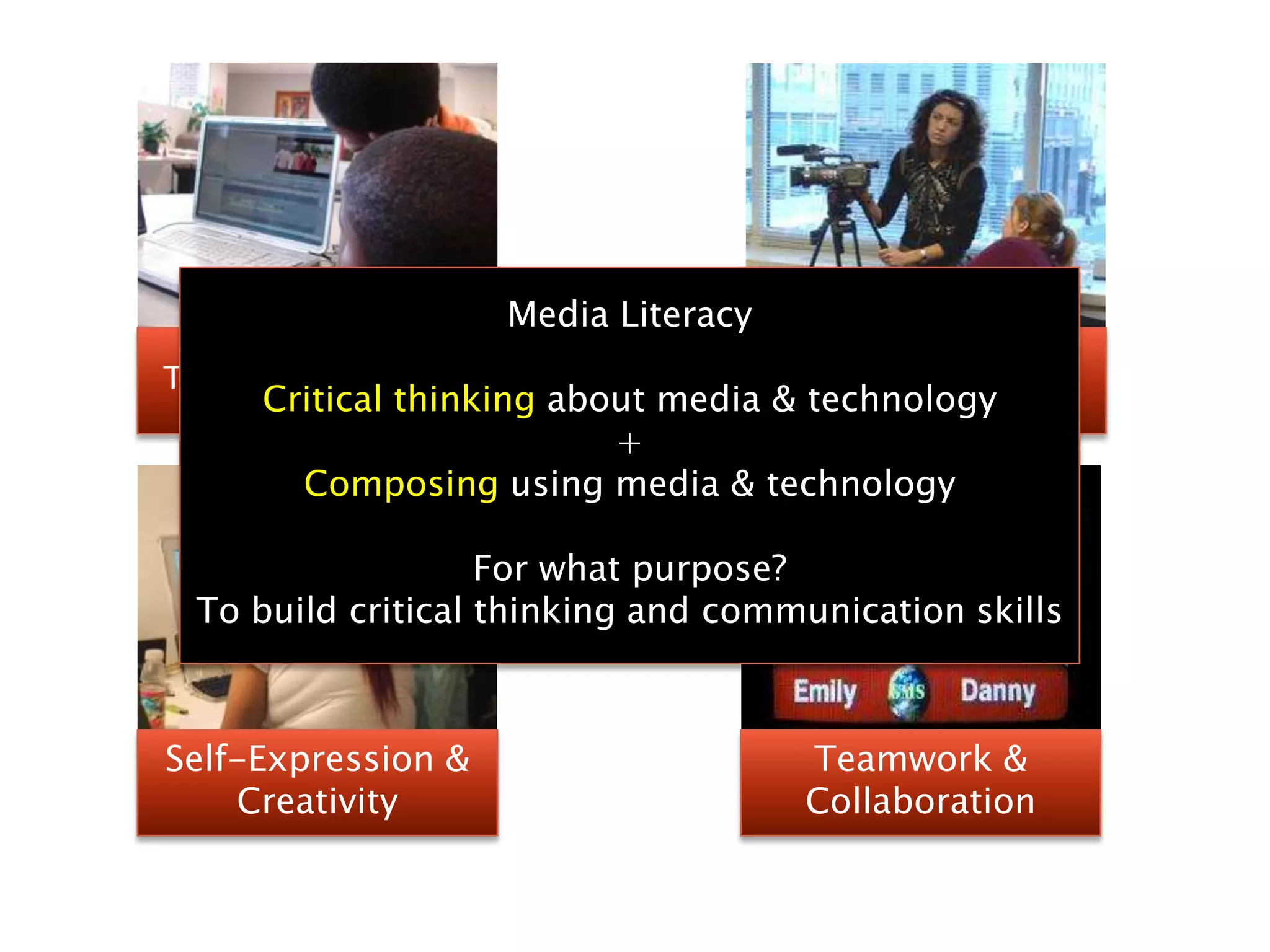
Media LiteracyCritical thinking about media & technology+ Composing using media & technologyFor what purpose? To build critical thinking and communication skillsCritical Thinking, Reflection & EthicsUsing Technology Tools WellSelf-Expression & CreativityTeamwork & Collaboration
Supported with a grant from the John D. and Catherine T. MacArthur Foundation
What is the purpose of
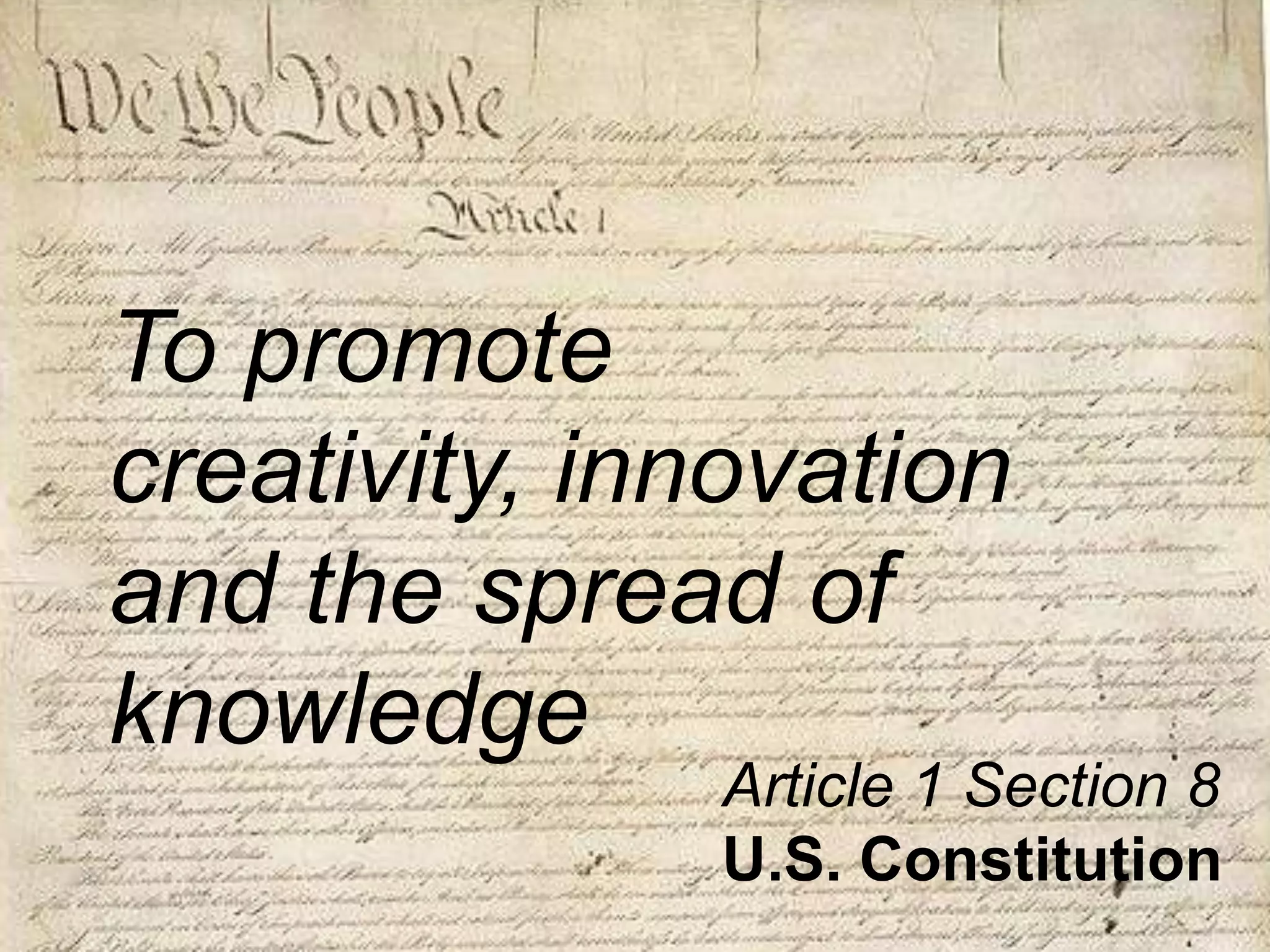
To promote creativity, innovation and the spread of knowledgeArticle 1 Section 8U.S. Constitution
Technology makes it easy to:Use and share
Copy
Modify & Repurpose
Excerpt & Quote From
DistributeOwners forcefully assert their rights to:Restrict
Limit
Charge high fees
Discourage use
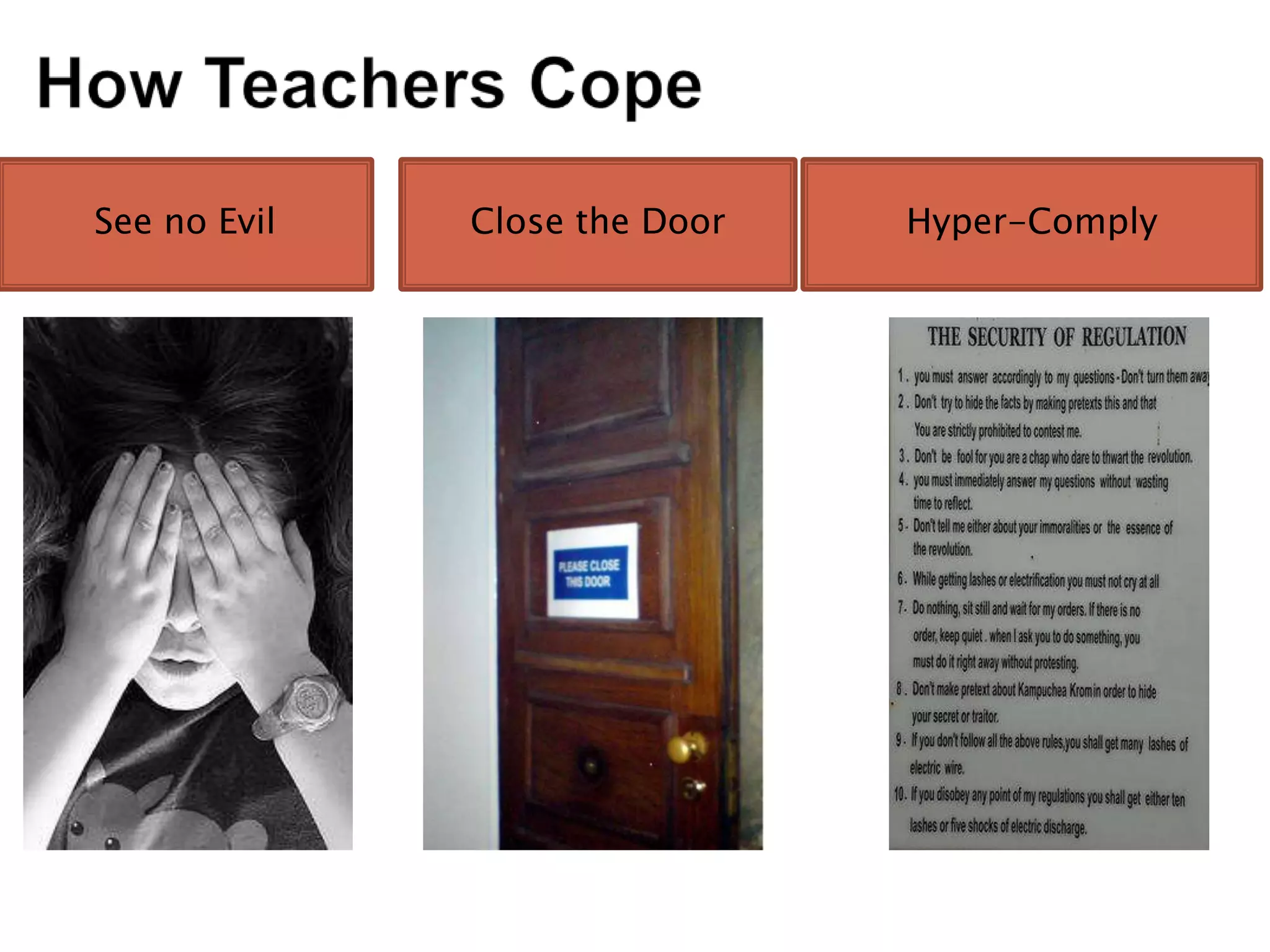
Use scare tacticsHow Teachers CopeSee no EvilClose the DoorHyper-Comply
Problem:Educational Use Guidelines are Confusing!NEGOTIATED AGREEMENTS BETWEEN MEDIA COMPANIES  AND EDUCATIONAL GROUPSAgreement on Guidelines for Classroom Copying in Not-for-Profit Educational InstitutionsFair Use Guidelines for Educational MultimediaGuidelines for the Educational Use of Music
The documents created by these negotiated agreements give them “the appearance of positive law. These qualities are merely illusory, and consequently the guidelines have had a seriously detrimental effect. They interfere with an actual understanding of the law and erode confidence in the law as created by Congress and the courts”										--Kenneth Crews, 2001Educational Use Guidelinesare NOT the Law!
It’s time to replace old knowledgewithaccurate knowledge
EVERYTHING IS COPYRIGHTEDAny work of expression in fixed or tangible form
Creative ControlThe Copyright Act grants five rights to a copyright owner:1. the right to reproduce the copyrighted work; 2. the right to prepare derivative works based upon the work; 3. the right to distribute copies of the work to the public; 4. the right to perform the copyrighted work publicly; and 5. the right to display the copyrighted work publicly.
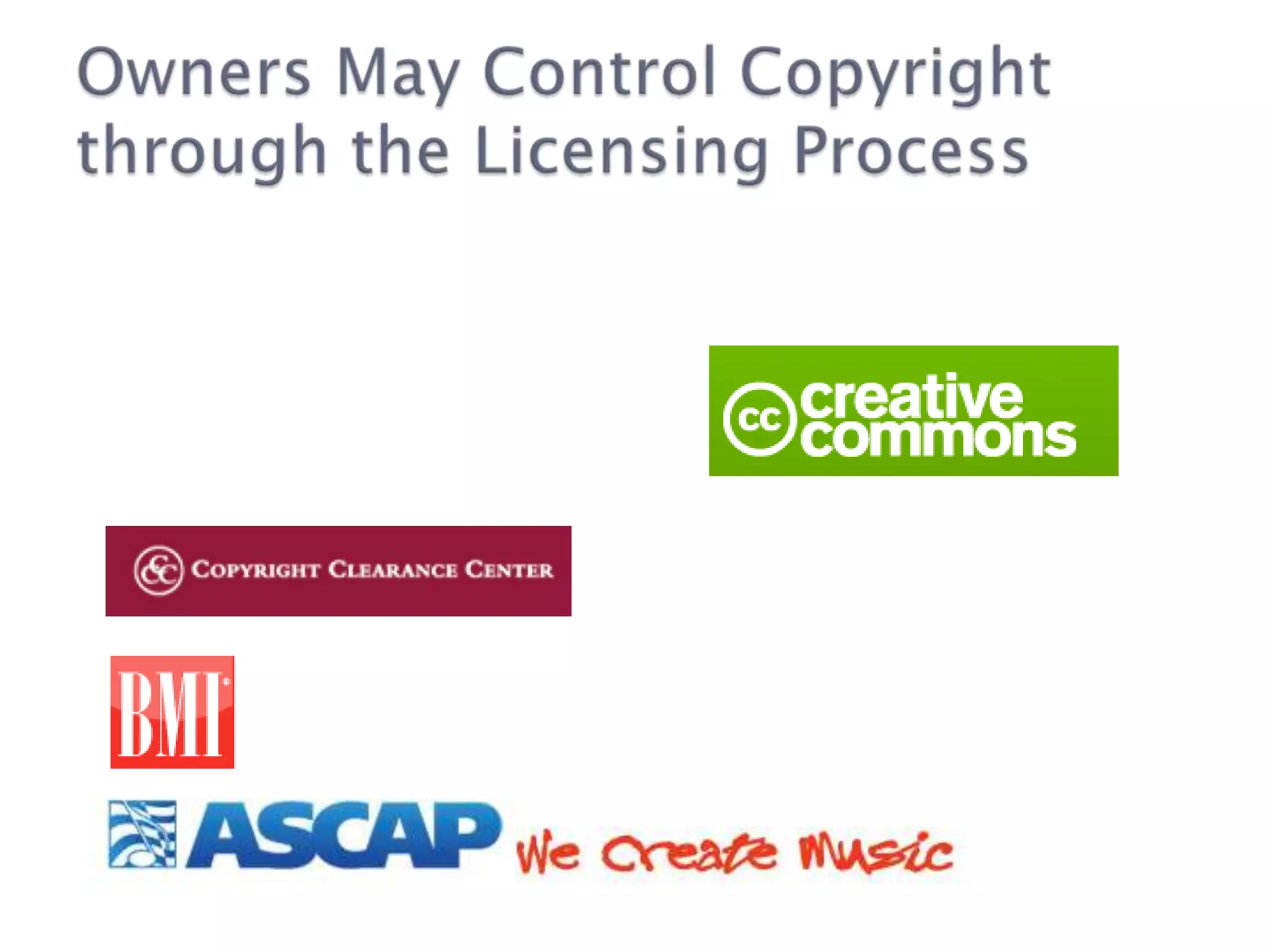
Owners May Control Copyright through the Licensing Process
LOVEHATECopyright law enables people to control the creative works they produce
LOVEHATEViolating Copyright Can Be ExpensiveThe Copyright holder may receive statutory damages for all infringements involved in the action… not less than $750 or more than $30,000 as the court considers just. [...] When infringement was committed willfully, the court in its discretion may increase the award of statutory damages to a sum of not more than $150,000."
EVERYTHING IS COPYRIGHTED..but there are exemptions
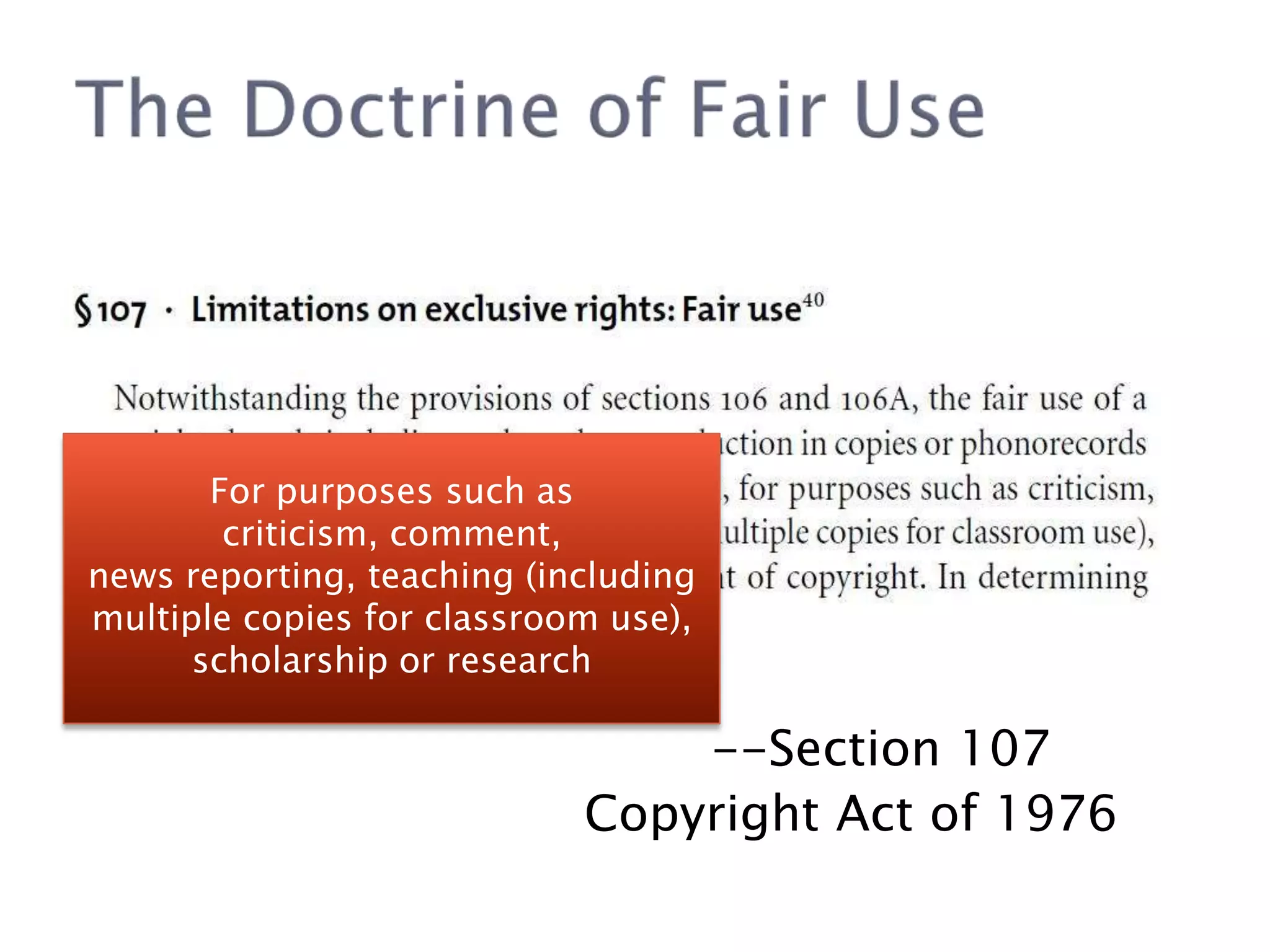
						--Section 107					Copyright Act of 1976The Doctrine of Fair UseFor purposes such as criticism, comment, news reporting, teaching (including multiple copies for classroom use), scholarship or research
The Doctrine of Fair Use“It not only allows but encourages socially beneficial uses of copyrighted works such as teaching, learning, and scholarship. Without fair use, those beneficial uses— quoting from copyrighted works, providing multiple copies to students in class, creating new knowledge based on previously published knowledge—would be infringements. Fair use is the means for assuring a robust and vigorous exchange of copyrighted information.”--Carrie Russell, American Library Association
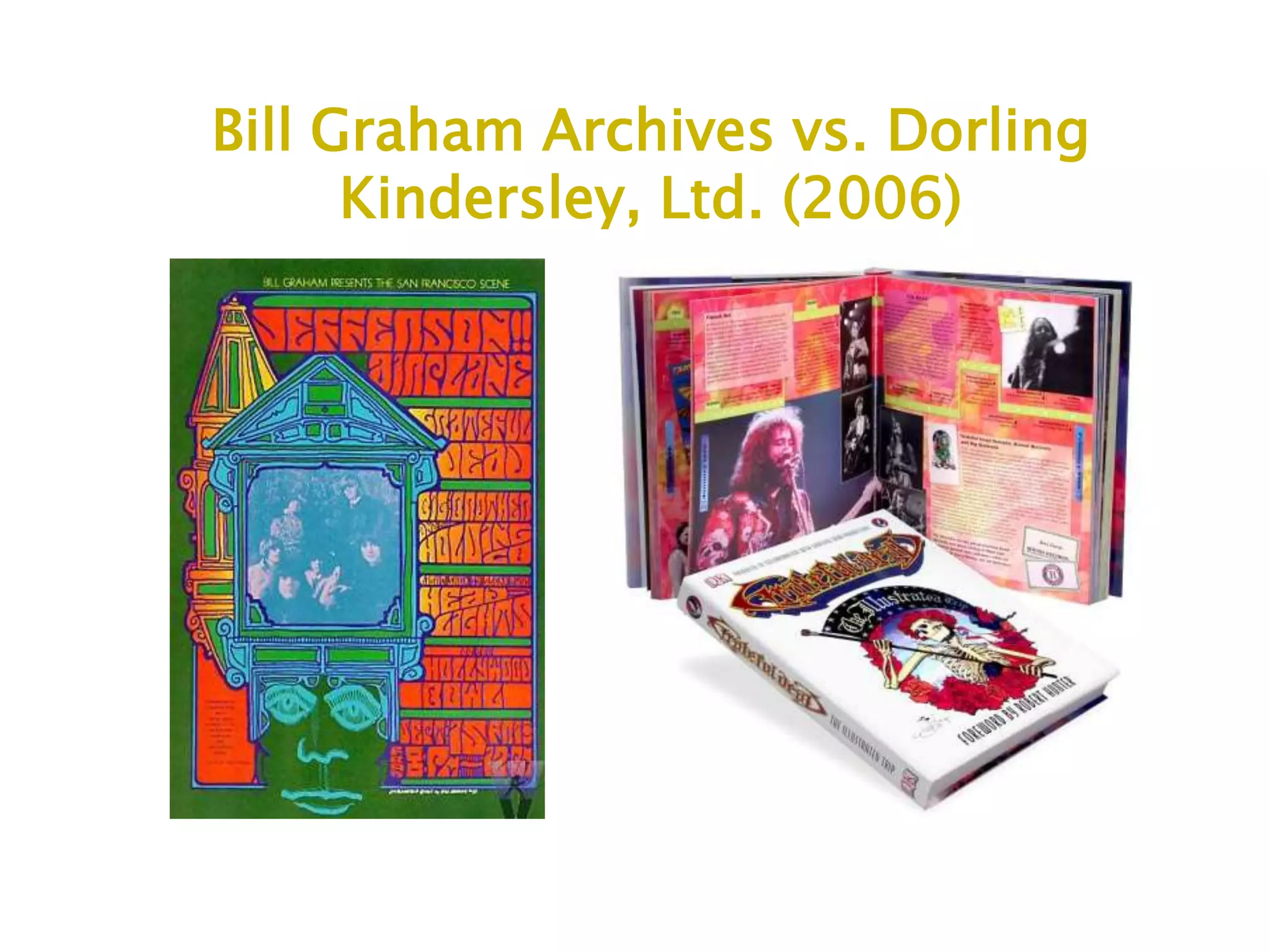
Bill Graham Archives vs. Dorling Kindersley, Ltd. (2006)
An Example of Transformative Use	The purpose of the original: To generate publicity for a concert.The purpose of the new work: To document and illustrate the concert events in historical context.
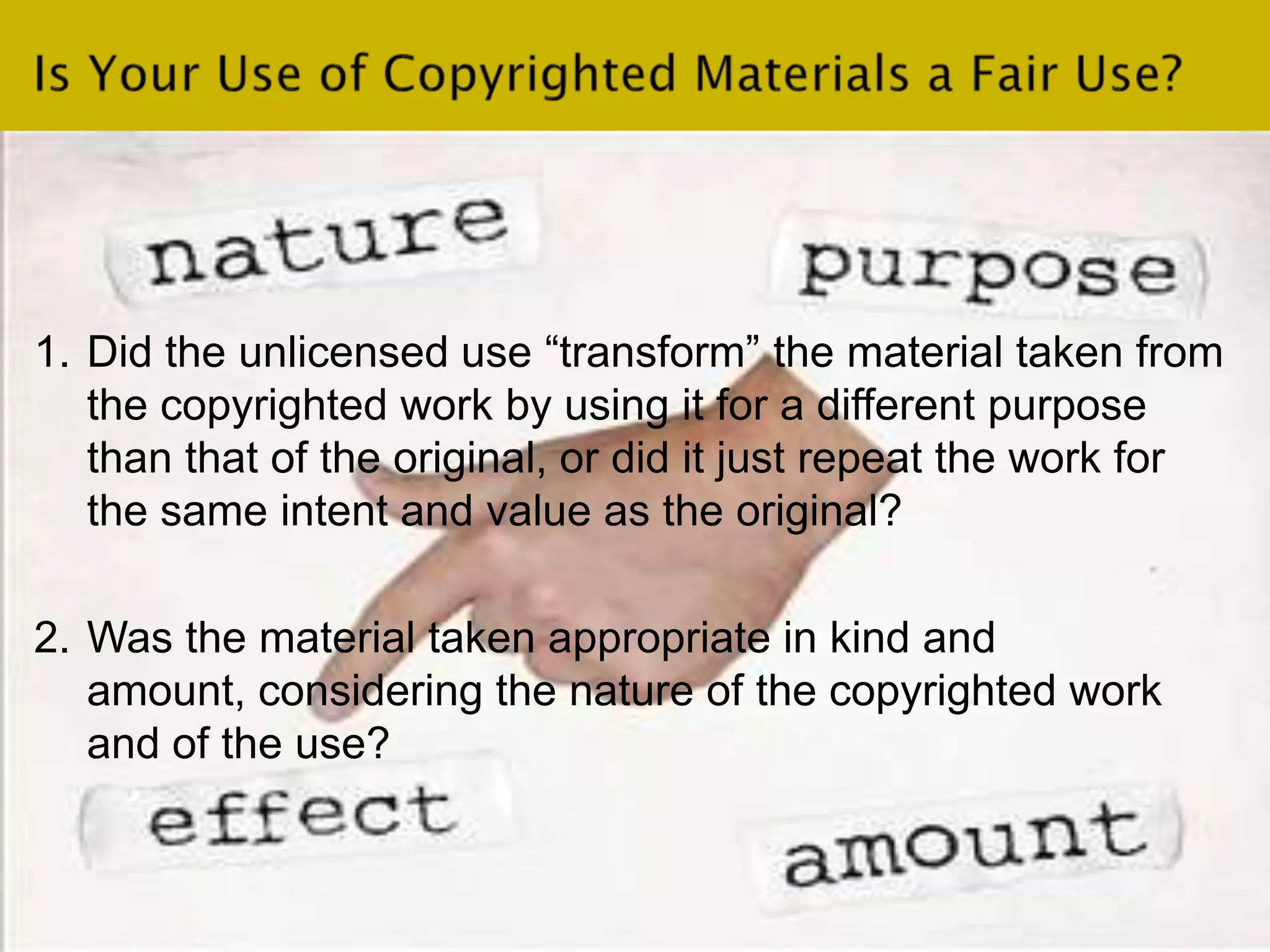
Is Your Use of Copyrighted Materials a Fair Use?Did the unlicensed use “transform” the material taken from the copyrighted work by using it for a different purpose than that of the original, or did it just repeat the work for the same intent and value as the original?Was the material taken appropriate in kind and amount, considering the nature of the copyrighted work and of the use?
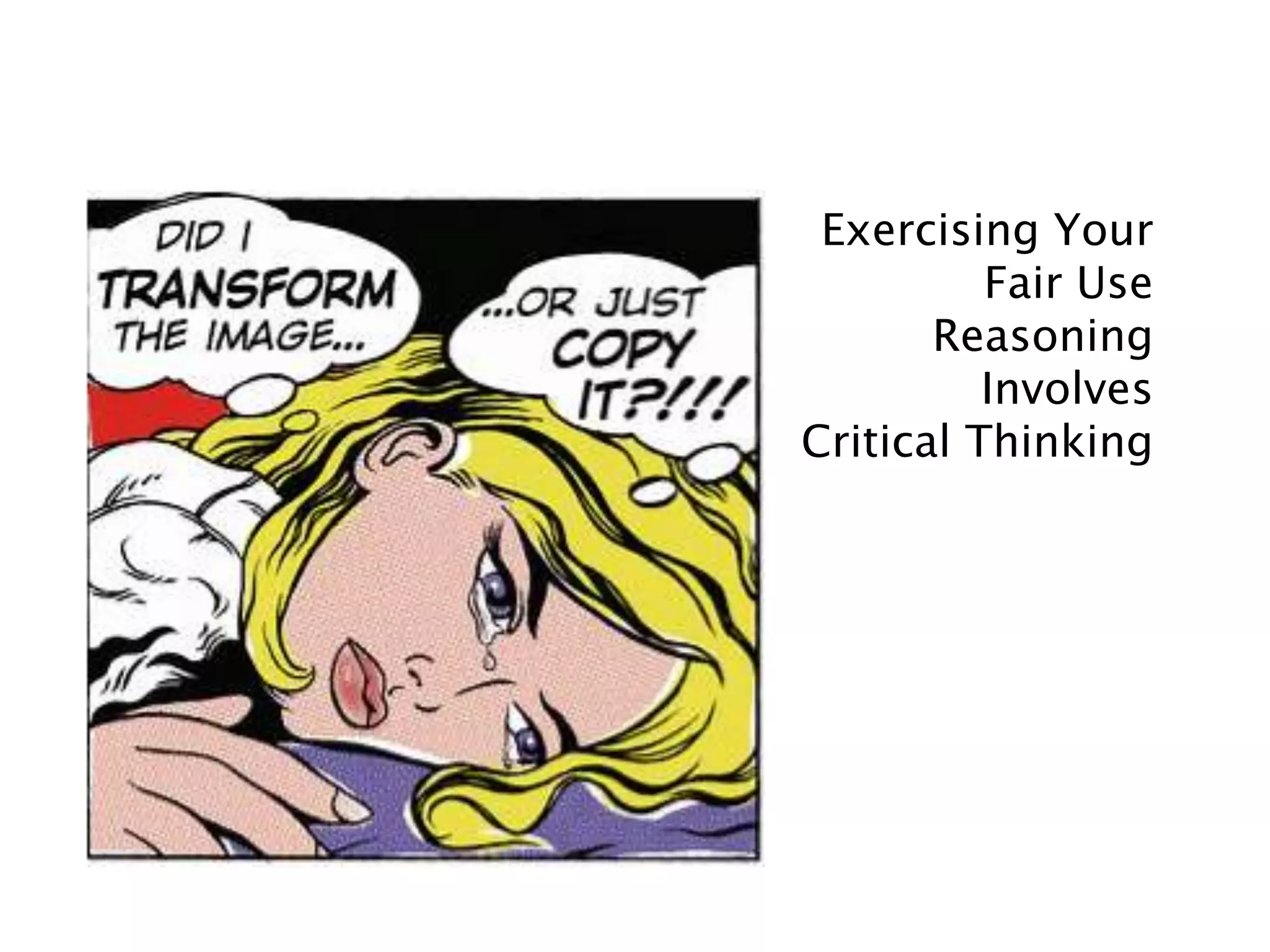
Exercising Your Fair Use ReasoningInvolves Critical Thinking
Reflects the “best practices” of educators who use copyrighted material to build critical thinking and communication skills
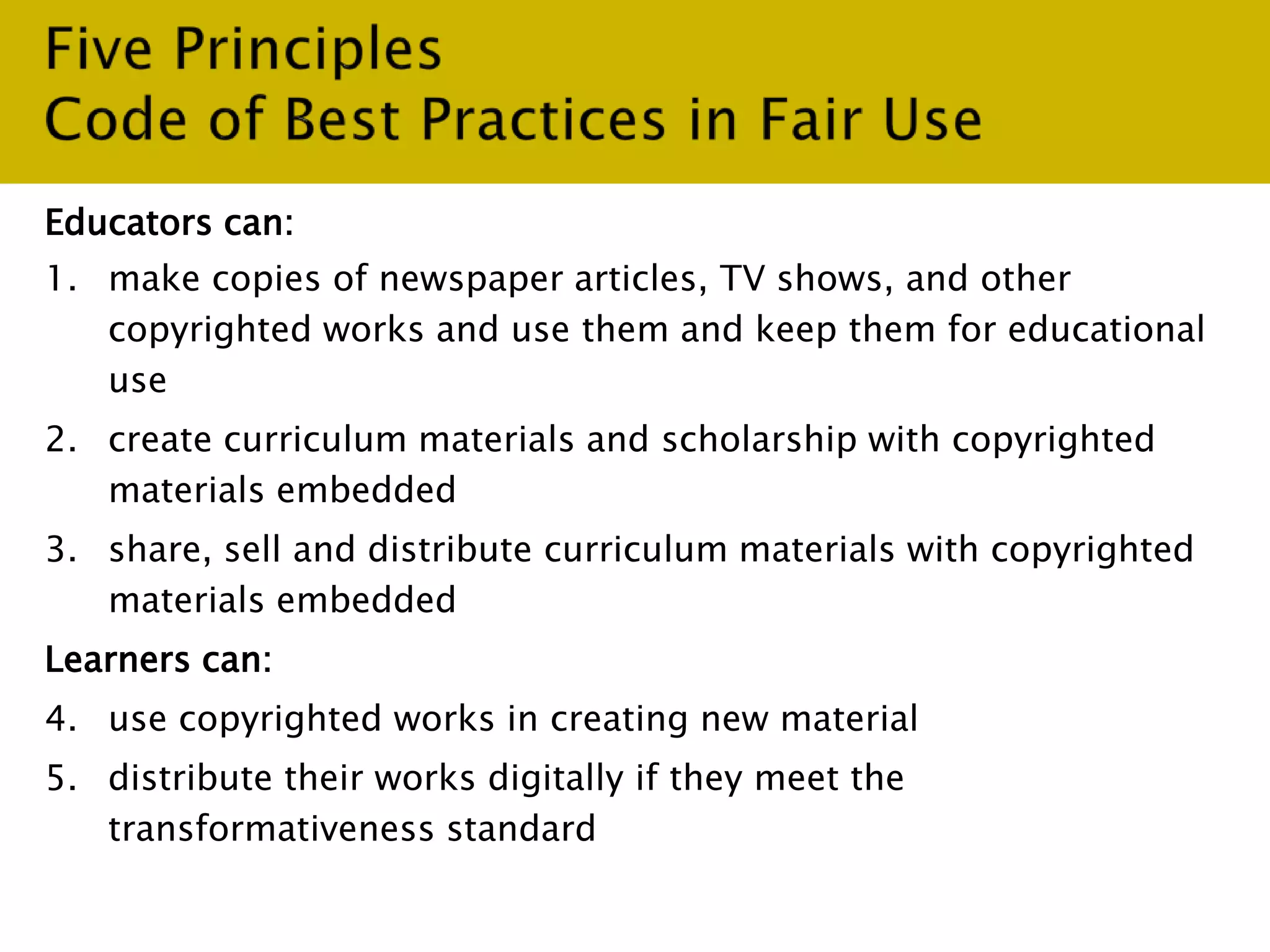
Five Principles Code of Best Practices in Fair Use Educators can:make copies of newspaper articles, TV shows, and other copyrighted works and use them and keep them for educational usecreate curriculum materials and scholarship with copyrighted materials embeddedshare, sell and distribute curriculum materials with copyrighted materials embedded  Learners can:use copyrighted works in creating new material  distribute their works digitally if they meet the transformativeness standard
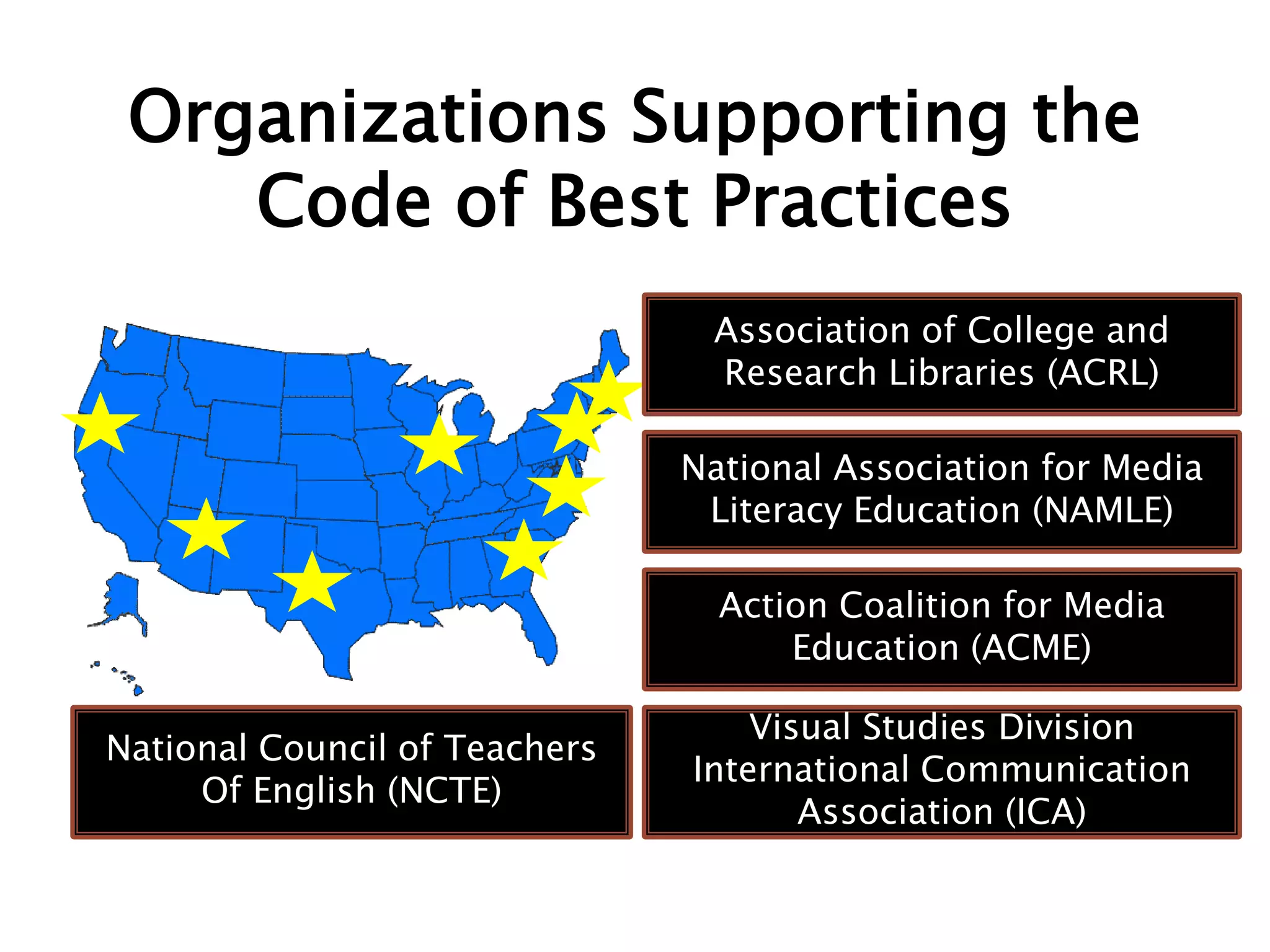
Organizations Supporting the Code of Best PracticesAssociation of College and Research Libraries (ACRL)National Association for Media Literacy Education (NAMLE)Action Coalition for Media Education (ACME)National Council of Teachers Of English (NCTE)Visual Studies DivisionInternational Communication Association (ICA)
Educators Can Rely on Fair Use  National Council of Teachers of English (NCTE) has adopted the “Code of Best Practices in Fair Use for Media Literacy  Education” as its official policy on fair use
Video Case Studies Elementary School Case Study:P.S. 124 The Silas B. Dutcher SchoolBrooklyn, NYHigh School Case Study:Upper Merion Area High School King of Prussia, PACollege Case Study: Project Look Sharp at Ithaca CollegeIthaca, NY
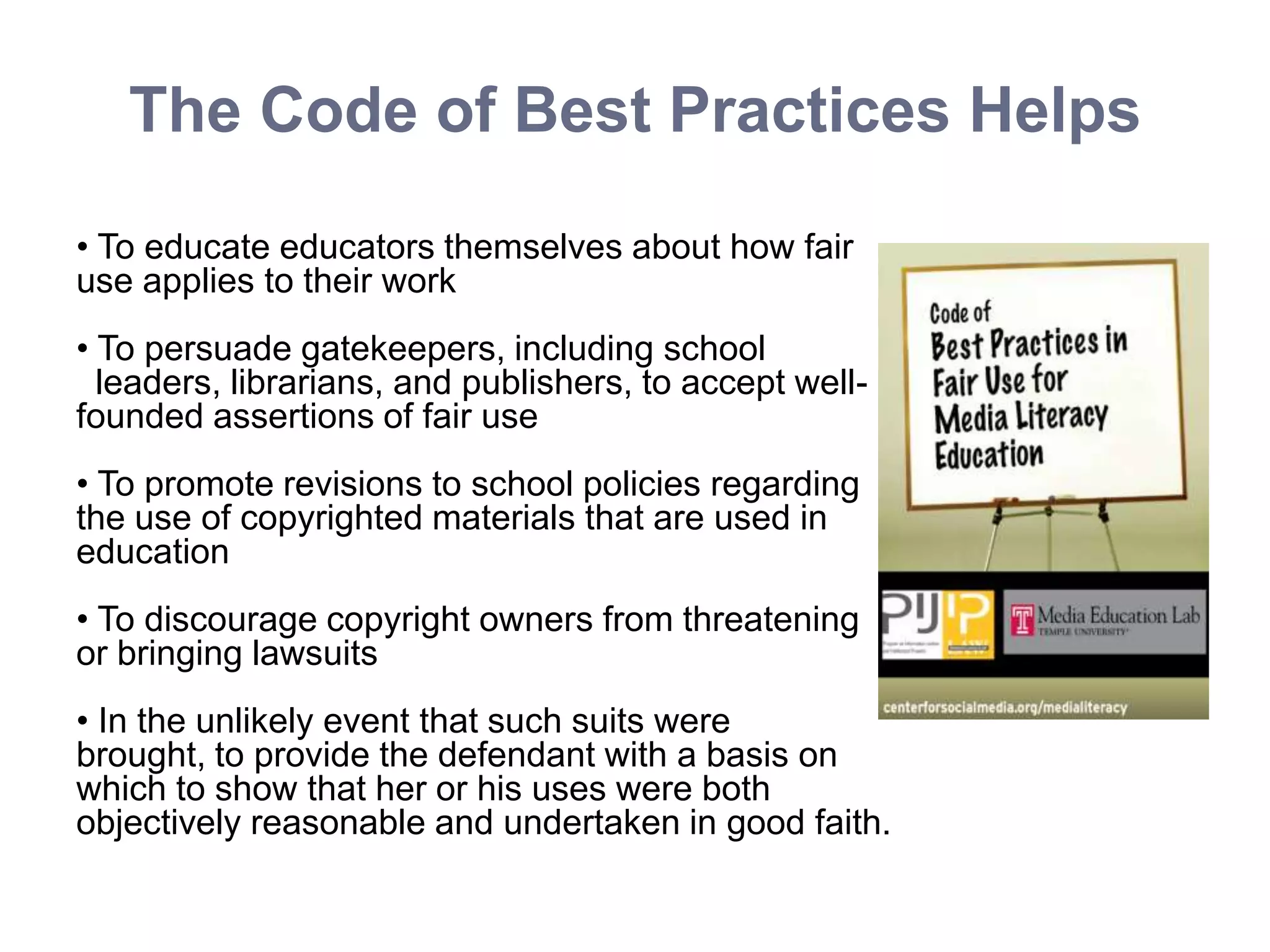
The Code of Best Practices Helps To educate educators themselves about how fair use applies to their work
 To persuade gatekeepers, including school      leaders, librarians, and publishers, to accept well-founded assertions of fair use To promote revisions to school policies regarding the use of copyrighted materials that are used in education
 To discourage copyright owners from threatening or bringing lawsuits
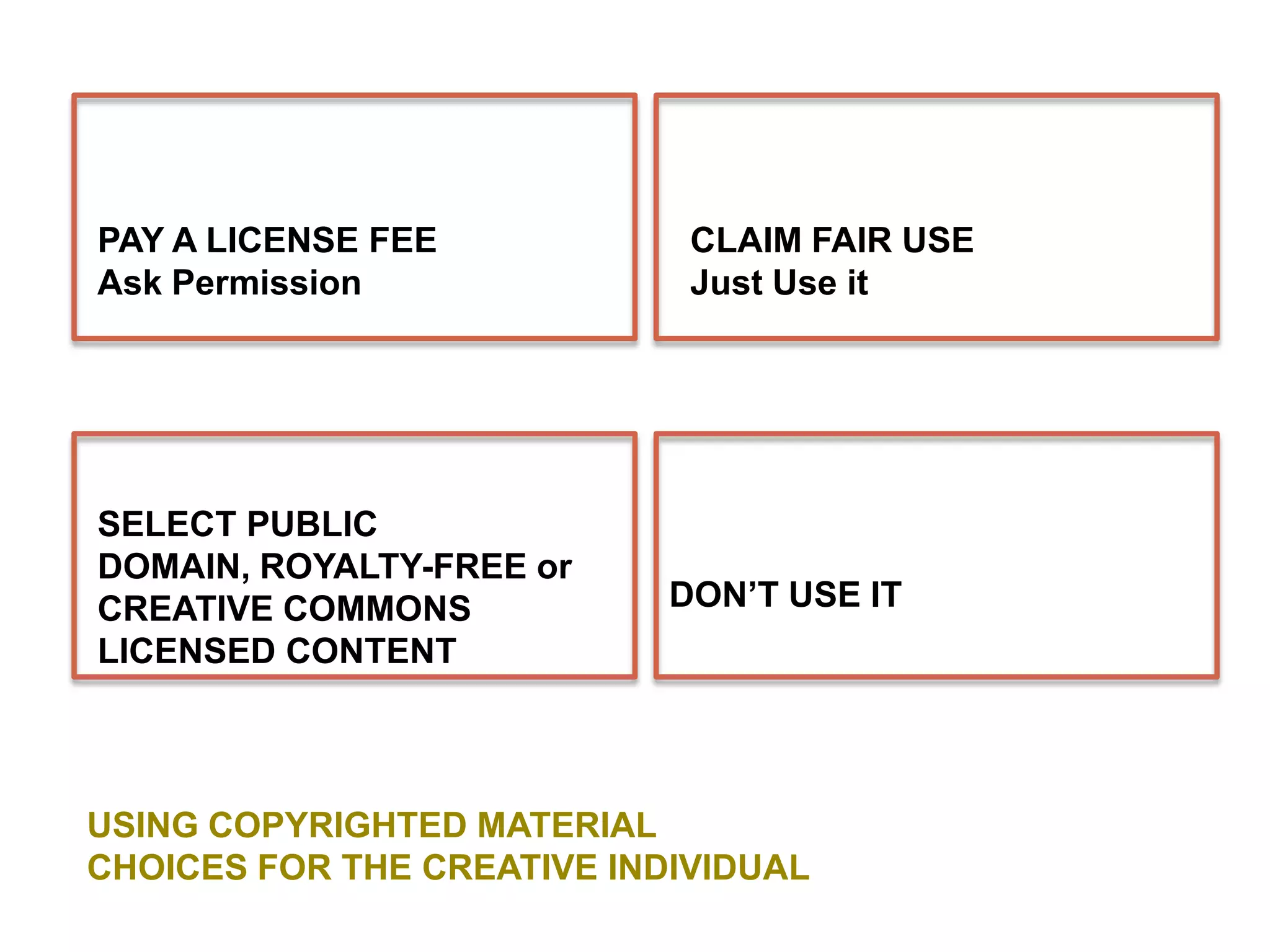
 In the unlikely event that such suits were brought, to provide the defendant with a basis on which to show that her or his uses were both objectively reasonable and undertaken in good faith.PAY A LICENSE FEE Ask PermissionCLAIM FAIR USEJust Use itSELECT PUBLIC DOMAIN, ROYALTY-FREE or CREATIVE COMMONS LICENSED CONTENTDON’T USE ITUSING COPYRIGHTED MATERIALCHOICES FOR THE CREATIVE INDIVIDUAL
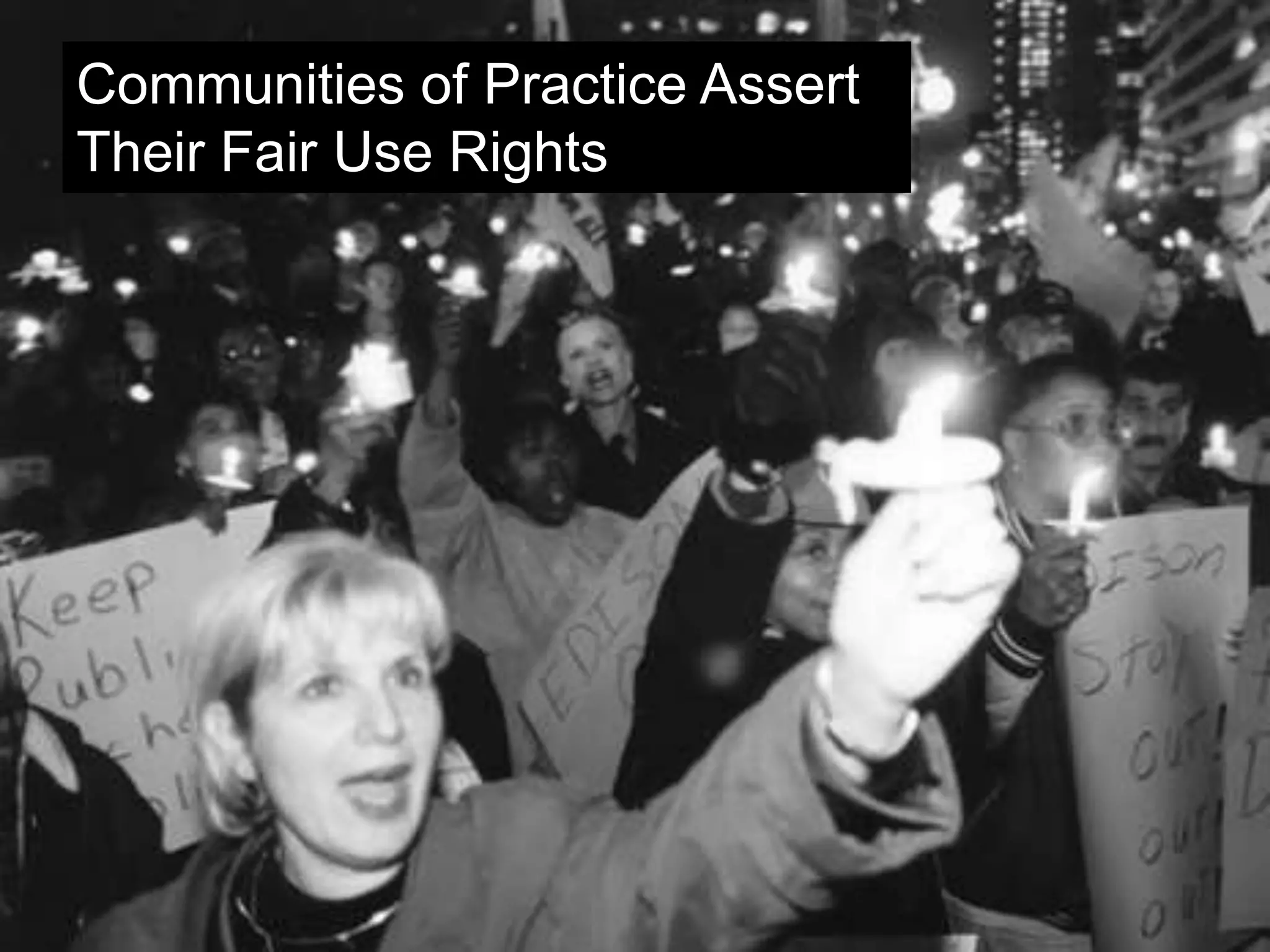
Communities of Practice Assert Their Fair Use Rights
Digital Millennium Copyright Act of 1998RIPPING. Criminalizes the use of technology, devices, or services intended to circumvent digital rights management (DRM) software that controls access to copyrighted works. ONLINE TAKEDOWNS. Protects Internet Service Providers against copyright liability if they promptly block access to allegedly infringing material (or remove such material from their systems) if notified by copyright holder; offers a counter-notification provision if use is exempted under fair use
The Results of our AdvocacyUsers may unlock DVDs protected by the Content Scrambling System when circumvention is for the purpose of criticism or comment using short sections, for educational, documentary or non-profit use.

Copyright Clarity: Using Copyrighted Materials for Digital Learning

  • 1.
    Copyright Clarity: UsingCopyrighted Materials for Digital LearningRenee HobbsTemple UniversityMedia Education LabSchool of Communications & TheaterPhiladelphia PAhttp://mediaeducationlab.com/copyright
  • 2.
    PEER-TO-PEER FILE SHARINGGoalsfor Today’s SessionWhy creative people value copyright lawWhen you (and your students) can use copyrighted materials without payment or permission under some circumstancesWhen you (and your students) should ask permission or pay a license fee to use copyrighted materialsHow codes of best practice help people become more confident in understanding and using the doctrine of fair useHow the law adapts to changes in society and changes in technology
  • 3.
    Media LiteracyCritical thinkingabout media & technology+ Composing using media & technologyFor what purpose? To build critical thinking and communication skillsCritical Thinking, Reflection & EthicsUsing Technology Tools WellSelf-Expression & CreativityTeamwork & Collaboration
  • 4.
    Supported with agrant from the John D. and Catherine T. MacArthur Foundation
  • 5.
    What is thepurpose of
  • 6.
    To promote creativity,innovation and the spread of knowledgeArticle 1 Section 8U.S. Constitution
  • 7.
    Technology makes iteasy to:Use and share
  • 8.
  • 9.
  • 10.
  • 11.
    DistributeOwners forcefully asserttheir rights to:Restrict
  • 12.
  • 13.
  • 14.
  • 15.
    Use scare tacticsHowTeachers CopeSee no EvilClose the DoorHyper-Comply
  • 16.
    Problem:Educational Use Guidelinesare Confusing!NEGOTIATED AGREEMENTS BETWEEN MEDIA COMPANIES AND EDUCATIONAL GROUPSAgreement on Guidelines for Classroom Copying in Not-for-Profit Educational InstitutionsFair Use Guidelines for Educational MultimediaGuidelines for the Educational Use of Music
  • 17.
    The documents createdby these negotiated agreements give them “the appearance of positive law. These qualities are merely illusory, and consequently the guidelines have had a seriously detrimental effect. They interfere with an actual understanding of the law and erode confidence in the law as created by Congress and the courts” --Kenneth Crews, 2001Educational Use Guidelinesare NOT the Law!
  • 18.
    It’s time toreplace old knowledgewithaccurate knowledge
  • 19.
    EVERYTHING IS COPYRIGHTEDAnywork of expression in fixed or tangible form
  • 20.
    Creative ControlThe CopyrightAct grants five rights to a copyright owner:1. the right to reproduce the copyrighted work; 2. the right to prepare derivative works based upon the work; 3. the right to distribute copies of the work to the public; 4. the right to perform the copyrighted work publicly; and 5. the right to display the copyrighted work publicly.
  • 21.
    Owners May ControlCopyright through the Licensing Process
  • 22.
    LOVEHATECopyright law enablespeople to control the creative works they produce
  • 23.
    LOVEHATEViolating Copyright CanBe ExpensiveThe Copyright holder may receive statutory damages for all infringements involved in the action… not less than $750 or more than $30,000 as the court considers just. [...] When infringement was committed willfully, the court in its discretion may increase the award of statutory damages to a sum of not more than $150,000."
  • 24.
    EVERYTHING IS COPYRIGHTED..butthere are exemptions
  • 25.
    --Section 107 Copyright Actof 1976The Doctrine of Fair UseFor purposes such as criticism, comment, news reporting, teaching (including multiple copies for classroom use), scholarship or research
  • 26.
    The Doctrine ofFair Use“It not only allows but encourages socially beneficial uses of copyrighted works such as teaching, learning, and scholarship. Without fair use, those beneficial uses— quoting from copyrighted works, providing multiple copies to students in class, creating new knowledge based on previously published knowledge—would be infringements. Fair use is the means for assuring a robust and vigorous exchange of copyrighted information.”--Carrie Russell, American Library Association
  • 28.
    Bill Graham Archivesvs. Dorling Kindersley, Ltd. (2006)
  • 29.
    An Example ofTransformative Use The purpose of the original: To generate publicity for a concert.The purpose of the new work: To document and illustrate the concert events in historical context.
  • 30.
    Is Your Useof Copyrighted Materials a Fair Use?Did the unlicensed use “transform” the material taken from the copyrighted work by using it for a different purpose than that of the original, or did it just repeat the work for the same intent and value as the original?Was the material taken appropriate in kind and amount, considering the nature of the copyrighted work and of the use?
  • 31.
    Exercising Your FairUse ReasoningInvolves Critical Thinking
  • 33.
    Reflects the “bestpractices” of educators who use copyrighted material to build critical thinking and communication skills
  • 35.
    Five Principles Codeof Best Practices in Fair Use Educators can:make copies of newspaper articles, TV shows, and other copyrighted works and use them and keep them for educational usecreate curriculum materials and scholarship with copyrighted materials embeddedshare, sell and distribute curriculum materials with copyrighted materials embedded Learners can:use copyrighted works in creating new material distribute their works digitally if they meet the transformativeness standard
  • 36.
    Organizations Supporting theCode of Best PracticesAssociation of College and Research Libraries (ACRL)National Association for Media Literacy Education (NAMLE)Action Coalition for Media Education (ACME)National Council of Teachers Of English (NCTE)Visual Studies DivisionInternational Communication Association (ICA)
  • 37.
    Educators Can Relyon Fair Use National Council of Teachers of English (NCTE) has adopted the “Code of Best Practices in Fair Use for Media Literacy Education” as its official policy on fair use
  • 38.
    Video Case StudiesElementary School Case Study:P.S. 124 The Silas B. Dutcher SchoolBrooklyn, NYHigh School Case Study:Upper Merion Area High School King of Prussia, PACollege Case Study: Project Look Sharp at Ithaca CollegeIthaca, NY
  • 40.
    The Code ofBest Practices Helps To educate educators themselves about how fair use applies to their work
  • 41.
    To persuadegatekeepers, including school leaders, librarians, and publishers, to accept well-founded assertions of fair use To promote revisions to school policies regarding the use of copyrighted materials that are used in education
  • 42.
    To discouragecopyright owners from threatening or bringing lawsuits
  • 43.
    In theunlikely event that such suits were brought, to provide the defendant with a basis on which to show that her or his uses were both objectively reasonable and undertaken in good faith.PAY A LICENSE FEE Ask PermissionCLAIM FAIR USEJust Use itSELECT PUBLIC DOMAIN, ROYALTY-FREE or CREATIVE COMMONS LICENSED CONTENTDON’T USE ITUSING COPYRIGHTED MATERIALCHOICES FOR THE CREATIVE INDIVIDUAL
  • 44.
    Communities of PracticeAssert Their Fair Use Rights
  • 45.
    Digital Millennium CopyrightAct of 1998RIPPING. Criminalizes the use of technology, devices, or services intended to circumvent digital rights management (DRM) software that controls access to copyrighted works. ONLINE TAKEDOWNS. Protects Internet Service Providers against copyright liability if they promptly block access to allegedly infringing material (or remove such material from their systems) if notified by copyright holder; offers a counter-notification provision if use is exempted under fair use
  • 47.
    The Results ofour AdvocacyUsers may unlock DVDs protected by the Content Scrambling System when circumvention is for the purpose of criticism or comment using short sections, for educational, documentary or non-profit use.
  • 48.
  • 49.
  • 50.
  • 51.
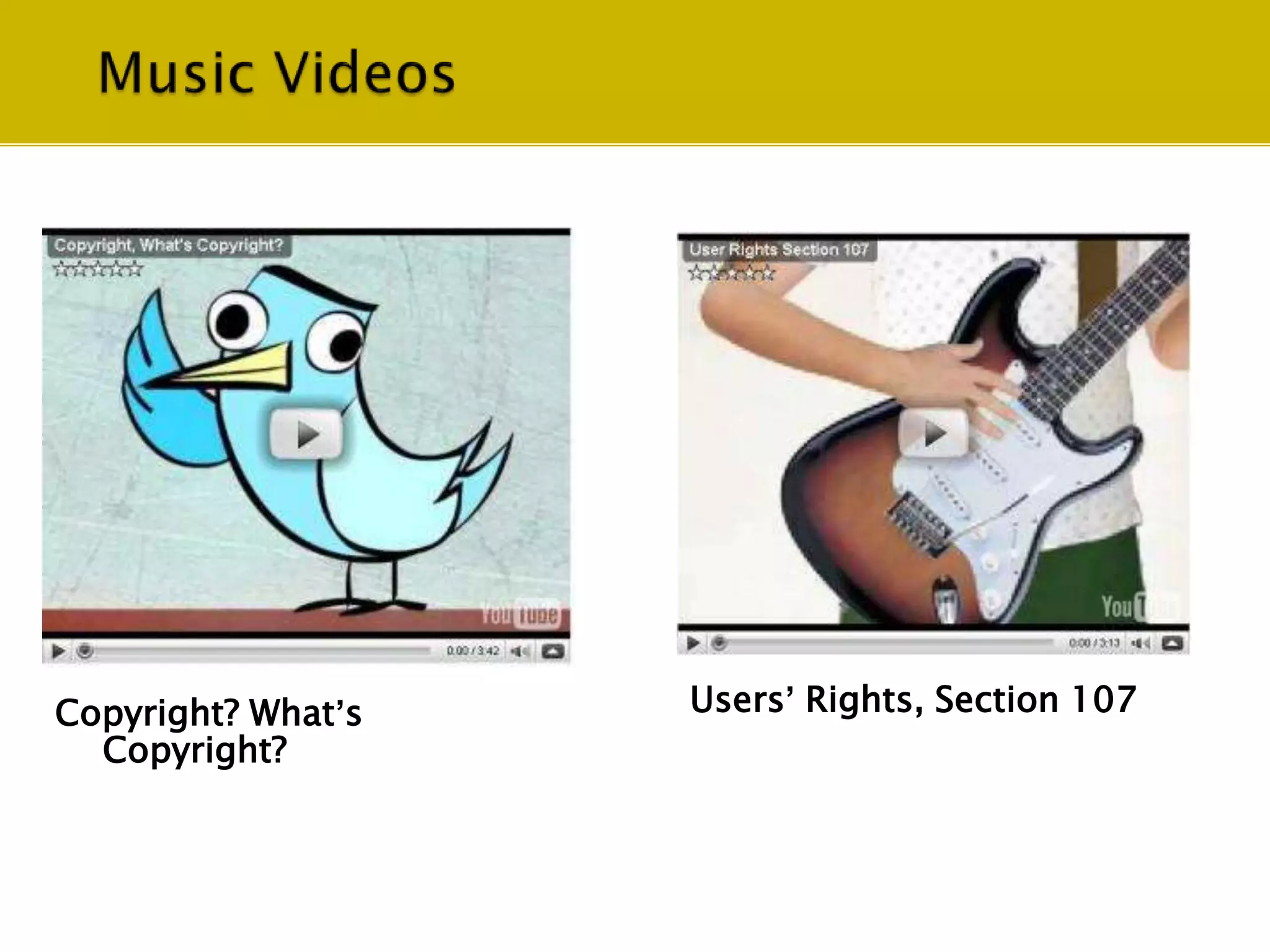
    Music VideosCopyright? What’sCopyright?Users’ Rights, Section 107
  • 52.
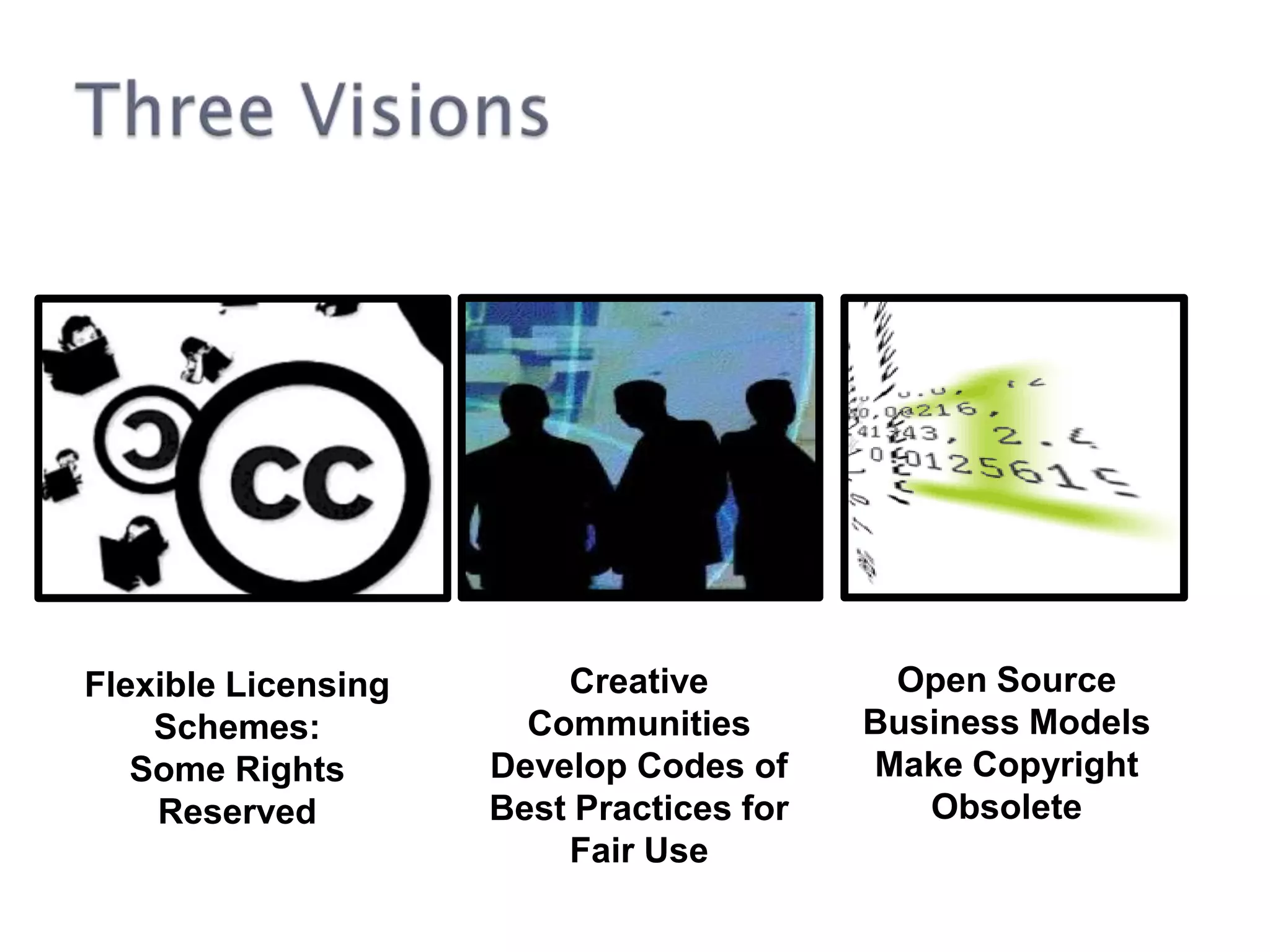
    Three VisionsOpen SourceBusiness Models Make Copyright Obsolete Creative Communities Develop Codes of Best Practices for Fair UseFlexible Licensing Schemes:Some Rights Reserved
  • 53.
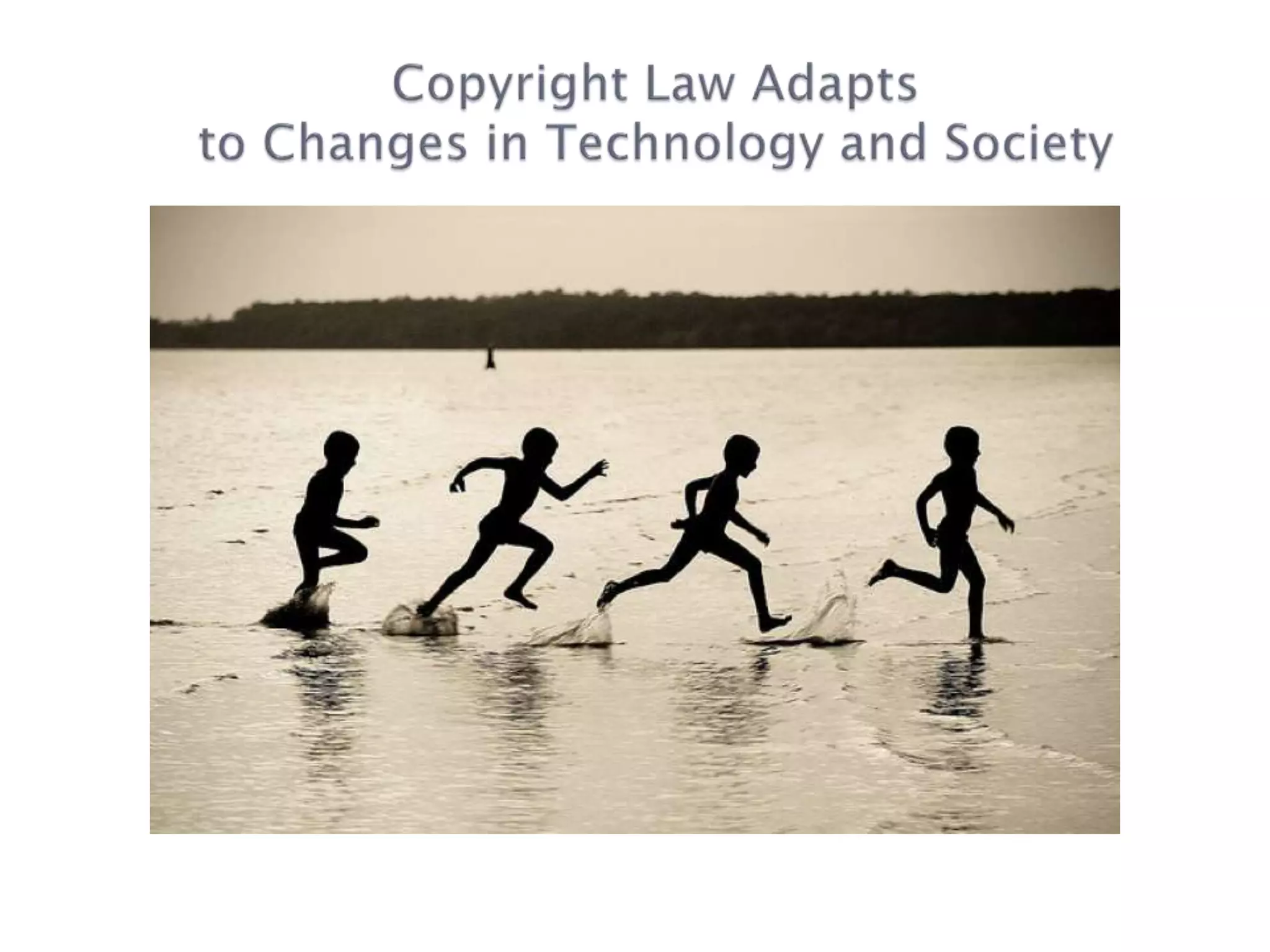
    Copyright Law Adaptsto Changes in Technology and Society
  • 54.
    PEER-TO-PEER FILE SHARINGGoalsfor Today’s SessionWhy creative people value copyright lawWhen you (and your students) can use copyrighted materials without payment or permission under some circumstancesWhen you (and your students) should ask permission or pay a license fee to use copyrighted materialsHow codes of best practice help people become more confident in understanding and using the doctrine of fair useHow the law adapts to changes in society and changes in technology
  • 55.
    You Can ShareCopyright ClarityContact:Renee HobbsTemple UniversityMedia Education LabPhiladelphia PAEmail: renee.hobbs@temple.eduPhone: (215) 204-3255Twitter: reneehobbsWeb: http://mediaeducationlab.com

Editor's Notes

  • #3 Institute for Policy Innovation global music piracy causes $12.5 billion of economic losses every year, 71,060 U.S. jobs lost, a loss of $2.7 billion in workers' earnings, and a loss of$422 million in tax revenues, $291 million in personal income tax and $131 million in lost corporate income and production taxes. FORTUNATELY: ten million licensed tracks available on more than 400 different services worldwide.  That’s great news for music fans and the industry alike.
  • #14 Worst case scenario: $3,3 million – 22 episodes at $150K eachIf you plead ignorance: possibly only $4,400 ($750 * 22 episodes)PLUS YOUR LEGAL FEES + THEIR LEGAL FEES
  • #15 Worst case scenario: $3,3 million – 22 episodes at $150K eachIf you plead ignorance: possibly only $4,400 ($750 * 22 episodes)PLUS YOUR LEGAL FEES + THEIR LEGAL FEES