IIST 601 4/5/2016
Copyright &
Creative Commons
Presented by Aurora Heller
and Brenden McCarthy
The nature of information
Information requires the expenditure of
money to create, but you have to sell
something in order to recoup the initial cost.
Unfortunately, while information is costly to
produce, it is almost costless to transfer.
This is the issue of nonappropriability.
In order to not undersupply, we have to find
the right balance between dynamic
efficiency and static efficiency. Dynamic
efficiency is about innovation and growth.
Static efficiency is about dissemination.
Intellectual property law is the mechanism
our field, information, uses in order to find
this balance.
A copyright is for things like
creative works, on the demonstration
that such works are original expressions.
Copyrights have the aspects of breadth and
duration that can be played with in order to
affect dynamic and static efficiency.
Duration is how long one holds a copyright
for. Breadth concerns when/if there are
authorized uses.
The public domain refers to
creative materials that are not
protected by intellectual property laws like
copyright.
A Creative Commons License
builds off copyright, by allowing
the holder to waive some rights. It “helps
you share your knowledge and creativity
with the world.” CC bridges the gap
between the public domain and the “all
rights reserved” default of copyright.
The four conditions used for CC licenses:
1. Attribution (BY)
2. Share-alike (SA)
3. Non-commercial (NC)
4. No Derivative Works (ND)
Example CC License:
Attribute the work, do not use for commercial
purposes,do not create derivative works from it.
Not all industries use intellectual property
law to regulate. For example, the food and
comedy industries deal in credit and respect.
Fashion has a bit of a hybrid system.
Regardless, each industry is just trying to do
what it can to encourage innovation without
squashing dissemination.
Where do I get a CC license?
Go to http://creativecommons.org/choose/
and build a Creative Commons License that
works for you.
CC 4.0 is global and ensures community,
collaboration, and sharing on the web.
Visit the wiki for best attribution practices:
https://wiki.creativecommons.org/wiki/Best_practices_for_
attribution
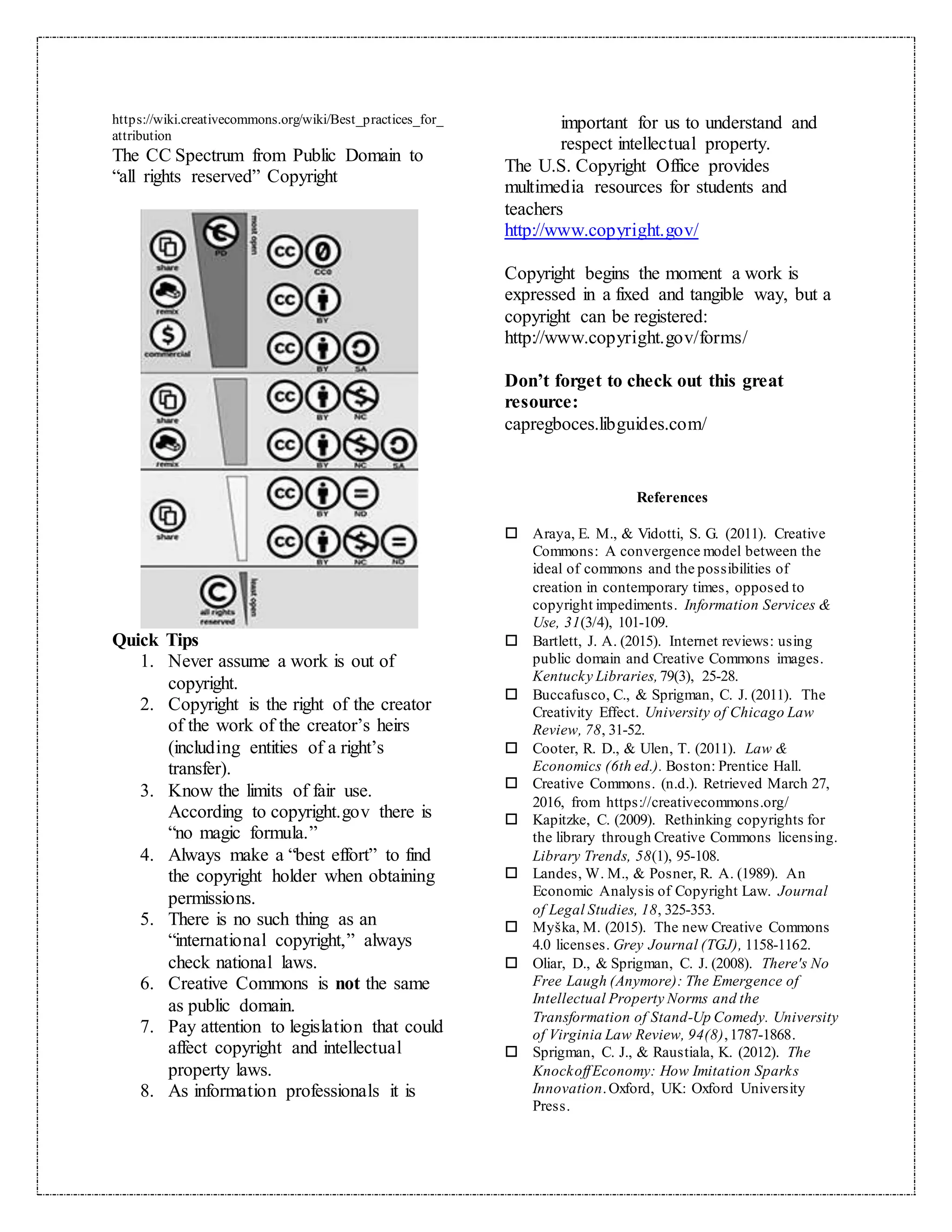
The CC Spectrum from Public Domain to
“all rights reserved” Copyright
Quick Tips
1. Never assume a work is out of
copyright.
2. Copyright is the right of the creator
of the work of the creator’s heirs
(including entities of a right’s
transfer).
3. Know the limits of fair use.
According to copyright.gov there is
“no magic formula.”
4. Always make a “best effort” to find
the copyright holder when obtaining
permissions.
5. There is no such thing as an
“international copyright,” always
check national laws.
6. Creative Commons is not the same
as public domain.
7. Pay attention to legislation that could
affect copyright and intellectual
property laws.
8. As information professionals it is
important for us to understand and
respect intellectual property.
The U.S. Copyright Office provides
multimedia resources for students and
teachers
http://www.copyright.gov/
Copyright begins the moment a work is
expressed in a fixed and tangible way, but a
copyright can be registered:
http://www.copyright.gov/forms/
Don’t forget to check out this great
resource:
capregboces.libguides.com/
References
 Araya, E. M., & Vidotti, S. G. (2011). Creative
Commons: A convergence model between the
ideal of commons and the possibilities of
creation in contemporary times, opposed to
copyright impediments. Information Services &
Use, 31(3/4), 101-109.
 Bartlett, J. A. (2015). Internet reviews: using
public domain and Creative Commons images.
Kentucky Libraries,79(3), 25-28.
 Buccafusco, C., & Sprigman, C. J. (2011). The
Creativity Effect. University of Chicago Law
Review, 78, 31-52.
 Cooter, R. D., & Ulen, T. (2011). Law &
Economics (6th ed.). Boston: Prentice Hall.
 Creative Commons. (n.d.). Retrieved March 27,
2016, from https://creativecommons.org/
 Kapitzke, C. (2009). Rethinking copyrights for
the library through Creative Commons licensing.
Library Trends, 58(1), 95-108.
 Landes, W. M., & Posner, R. A. (1989). An
Economic Analysis of Copyright Law. Journal
of Legal Studies, 18, 325-353.
 Myška, M. (2015). The new Creative Commons
4.0 licenses. Grey Journal (TGJ), 1158-1162.
 Oliar, D., & Sprigman, C. J. (2008). There's No
Free Laugh (Anymore): The Emergence of
Intellectual Property Norms and the
Transformation of Stand-Up Comedy. University
of Virginia Law Review, 94(8),1787-1868.
 Sprigman, C. J., & Raustiala, K. (2012). The
KnockoffEconomy: How Imitation Sparks
Innovation.Oxford, UK: Oxford University
Press.

Fact Sheet, Copyright and the Creative Commons

  • 1.
    IIST 601 4/5/2016 Copyright& Creative Commons Presented by Aurora Heller and Brenden McCarthy The nature of information Information requires the expenditure of money to create, but you have to sell something in order to recoup the initial cost. Unfortunately, while information is costly to produce, it is almost costless to transfer. This is the issue of nonappropriability. In order to not undersupply, we have to find the right balance between dynamic efficiency and static efficiency. Dynamic efficiency is about innovation and growth. Static efficiency is about dissemination. Intellectual property law is the mechanism our field, information, uses in order to find this balance. A copyright is for things like creative works, on the demonstration that such works are original expressions. Copyrights have the aspects of breadth and duration that can be played with in order to affect dynamic and static efficiency. Duration is how long one holds a copyright for. Breadth concerns when/if there are authorized uses. The public domain refers to creative materials that are not protected by intellectual property laws like copyright. A Creative Commons License builds off copyright, by allowing the holder to waive some rights. It “helps you share your knowledge and creativity with the world.” CC bridges the gap between the public domain and the “all rights reserved” default of copyright. The four conditions used for CC licenses: 1. Attribution (BY) 2. Share-alike (SA) 3. Non-commercial (NC) 4. No Derivative Works (ND) Example CC License: Attribute the work, do not use for commercial purposes,do not create derivative works from it. Not all industries use intellectual property law to regulate. For example, the food and comedy industries deal in credit and respect. Fashion has a bit of a hybrid system. Regardless, each industry is just trying to do what it can to encourage innovation without squashing dissemination. Where do I get a CC license? Go to http://creativecommons.org/choose/ and build a Creative Commons License that works for you. CC 4.0 is global and ensures community, collaboration, and sharing on the web. Visit the wiki for best attribution practices:
  • 2.
    https://wiki.creativecommons.org/wiki/Best_practices_for_ attribution The CC Spectrumfrom Public Domain to “all rights reserved” Copyright Quick Tips 1. Never assume a work is out of copyright. 2. Copyright is the right of the creator of the work of the creator’s heirs (including entities of a right’s transfer). 3. Know the limits of fair use. According to copyright.gov there is “no magic formula.” 4. Always make a “best effort” to find the copyright holder when obtaining permissions. 5. There is no such thing as an “international copyright,” always check national laws. 6. Creative Commons is not the same as public domain. 7. Pay attention to legislation that could affect copyright and intellectual property laws. 8. As information professionals it is important for us to understand and respect intellectual property. The U.S. Copyright Office provides multimedia resources for students and teachers http://www.copyright.gov/ Copyright begins the moment a work is expressed in a fixed and tangible way, but a copyright can be registered: http://www.copyright.gov/forms/ Don’t forget to check out this great resource: capregboces.libguides.com/ References  Araya, E. M., & Vidotti, S. G. (2011). Creative Commons: A convergence model between the ideal of commons and the possibilities of creation in contemporary times, opposed to copyright impediments. Information Services & Use, 31(3/4), 101-109.  Bartlett, J. A. (2015). Internet reviews: using public domain and Creative Commons images. Kentucky Libraries,79(3), 25-28.  Buccafusco, C., & Sprigman, C. J. (2011). The Creativity Effect. University of Chicago Law Review, 78, 31-52.  Cooter, R. D., & Ulen, T. (2011). Law & Economics (6th ed.). Boston: Prentice Hall.  Creative Commons. (n.d.). Retrieved March 27, 2016, from https://creativecommons.org/  Kapitzke, C. (2009). Rethinking copyrights for the library through Creative Commons licensing. Library Trends, 58(1), 95-108.  Landes, W. M., & Posner, R. A. (1989). An Economic Analysis of Copyright Law. Journal of Legal Studies, 18, 325-353.  Myška, M. (2015). The new Creative Commons 4.0 licenses. Grey Journal (TGJ), 1158-1162.  Oliar, D., & Sprigman, C. J. (2008). There's No Free Laugh (Anymore): The Emergence of Intellectual Property Norms and the Transformation of Stand-Up Comedy. University of Virginia Law Review, 94(8),1787-1868.  Sprigman, C. J., & Raustiala, K. (2012). The KnockoffEconomy: How Imitation Sparks Innovation.Oxford, UK: Oxford University Press.