What Difference Does It Make:
Traditional Textbook and Open
Textbook Use in Large Multi-
Section Courses
Regina Gong, OER Project Manager; @drgong
Dr. Karen Hicks, Director of Assessment
Lansing Community College
Open Education Conference, October 10, 2018
Niagara Falls, NY
This work is licensed under the Creative Commons Attribution 4.0 International License.
LCC AT A GLANCE
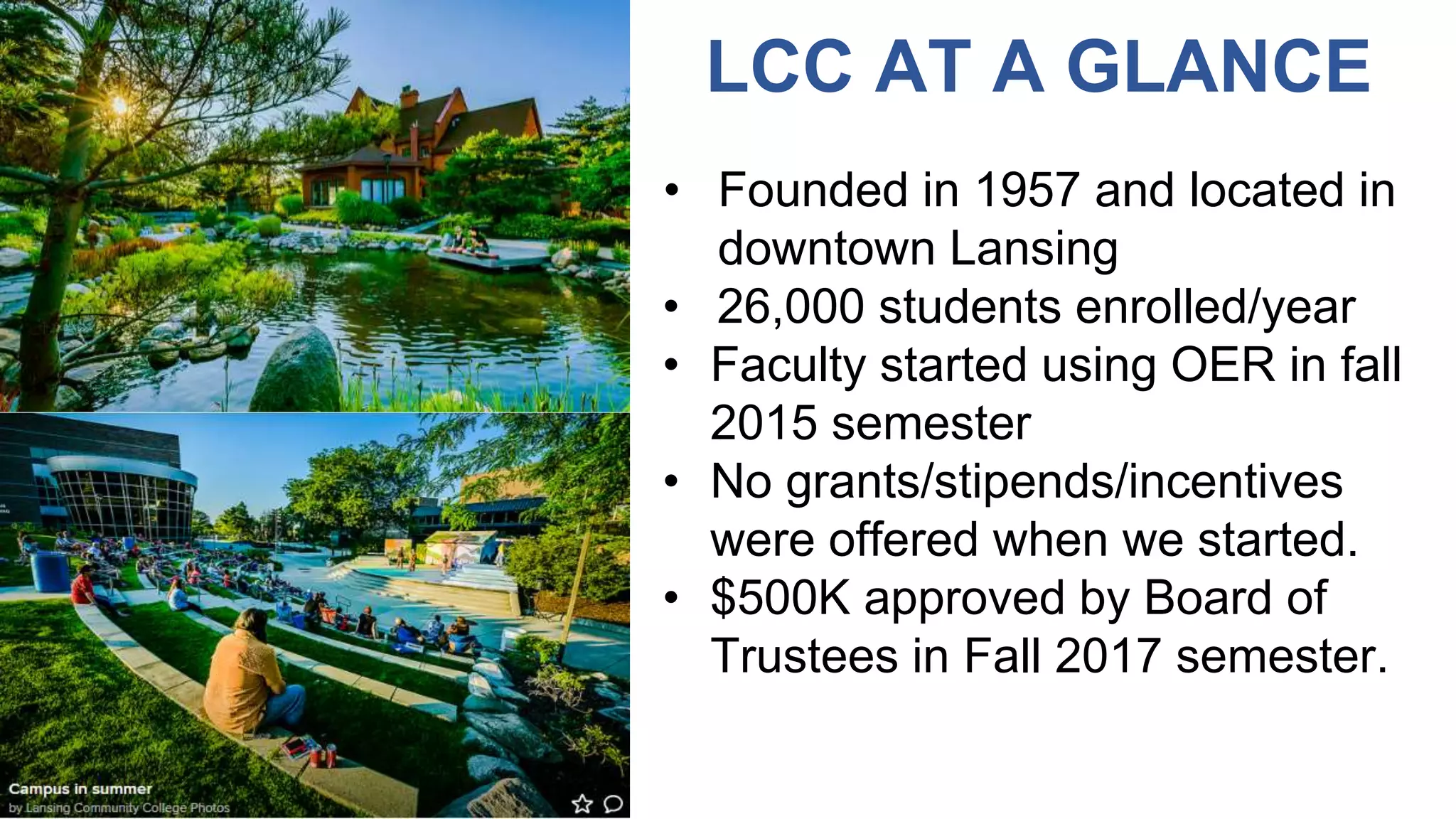
• Founded in 1957 and located in
downtown Lansing
• 26,000 students enrolled/year
• Faculty started using OER in fall
2015 semester
• No grants/stipends/incentives
were offered when we started.
• $500K approved by Board of
Trustees in Fall 2017 semester.
Textbook affordability
Allow faculty exploration and innovation in finding new,
better, and less costly ways to deliver quality learning
materials to students in addition to improved pedagogy.
Goals of the OER Initiative at LCC
OER and Open Learning are
two of the ongoing
competitiveness and
innovation projects in the
2017-2020 LCC Strategic
Plan.
Because assessment makes the world go round
Photo by John Jackson on Unsplash
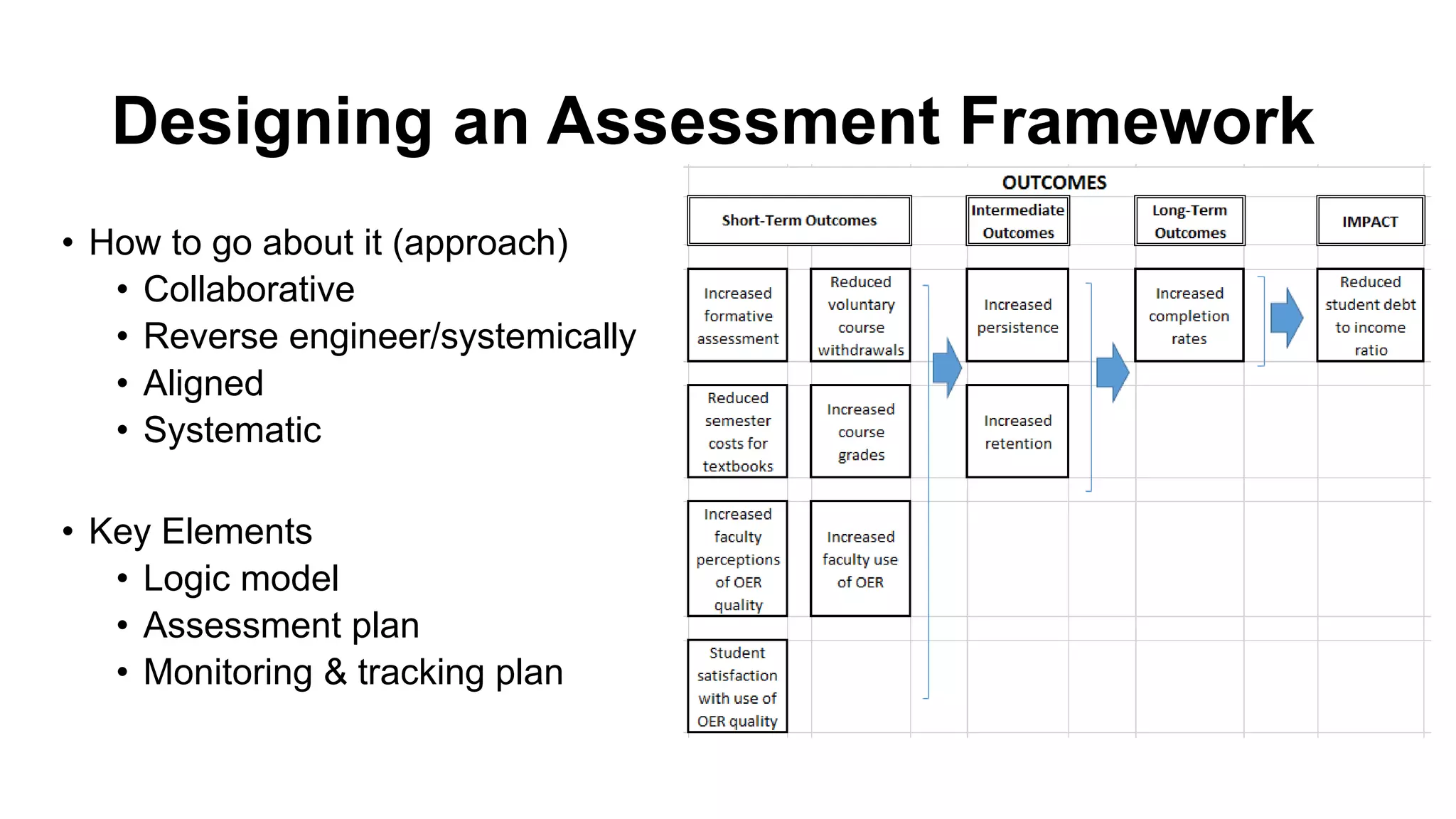
Designing an Assessment Framework
• How to go about it (approach)
• Collaborative
• Reverse engineer/systemically
• Aligned
• Systematic
• Key Elements
• Logic model
• Assessment plan
• Monitoring & tracking plan
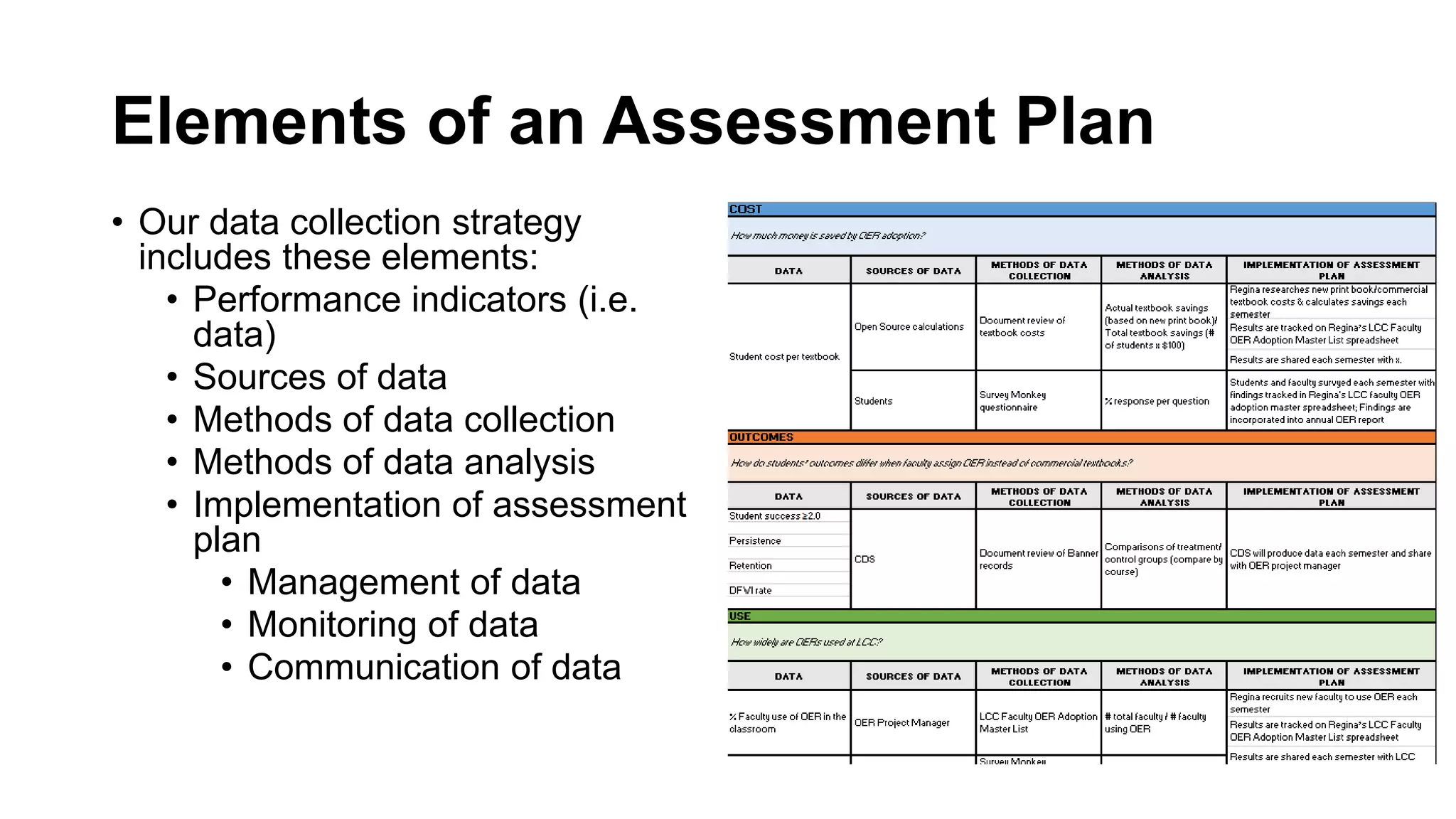
Elements of an Assessment Plan
• Our data collection strategy
includes these elements:
• Performance indicators (i.e.
data)
• Sources of data
• Methods of data collection
• Methods of data analysis
• Implementation of assessment
plan
• Management of data
• Monitoring of data
• Communication of data
Research Study Background
• PSYC 200 (Intro to Psychology)
• ECON 201 (Intro to Economics – Microeconomics)
• ECON 202 (Intro to Economics – Macroeconomics)
ALL sections adopted OpenStax textbooks starting
Fall 2016
Research Study Background
Compared publisher textbook use (AY 2015-2016)
vs. open textbook use (AY 2016-2017)
We eliminated the confounding variable of the
instructor
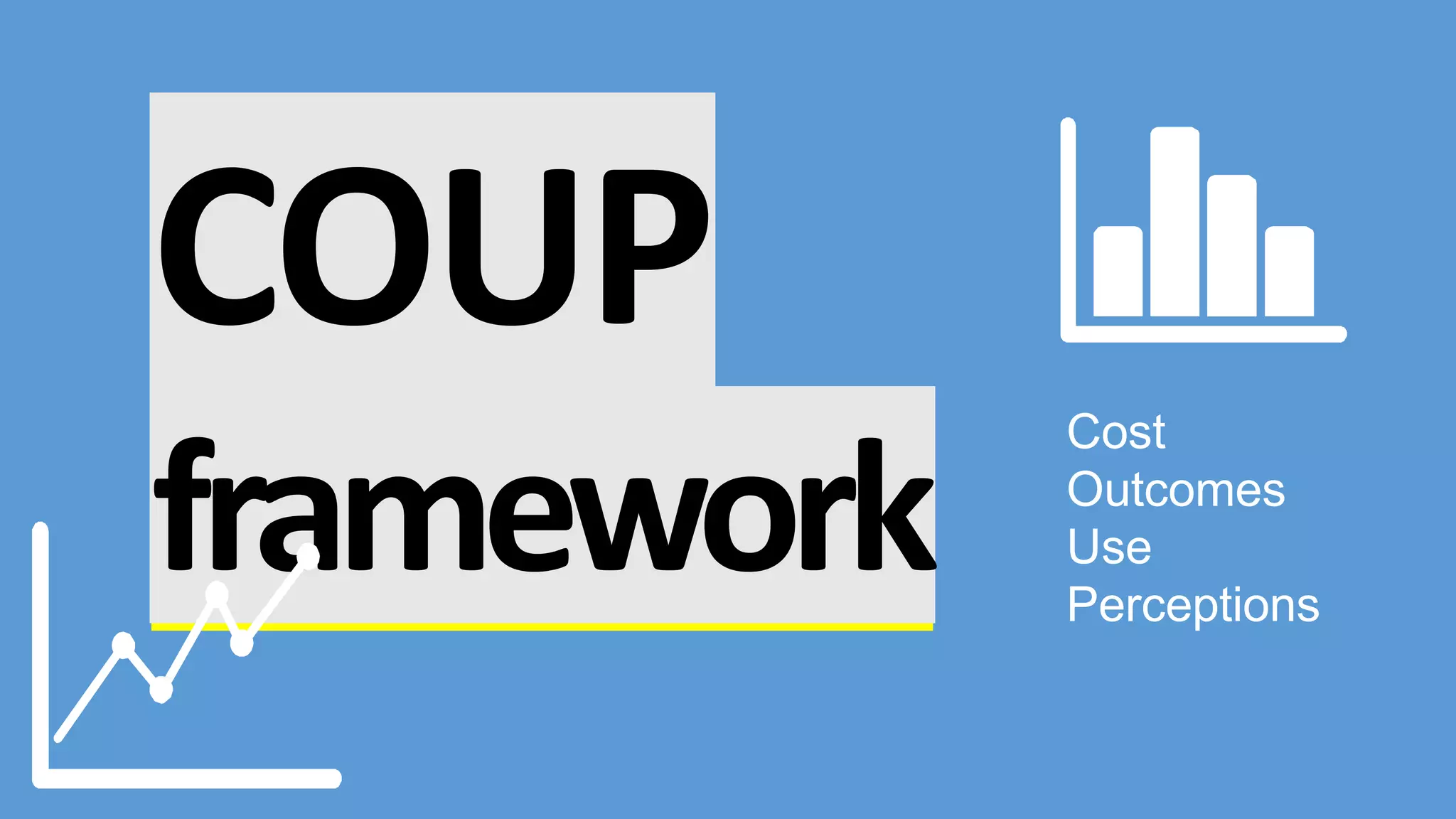
COUP
framework
Cost
Outcomes
Use
Perceptions
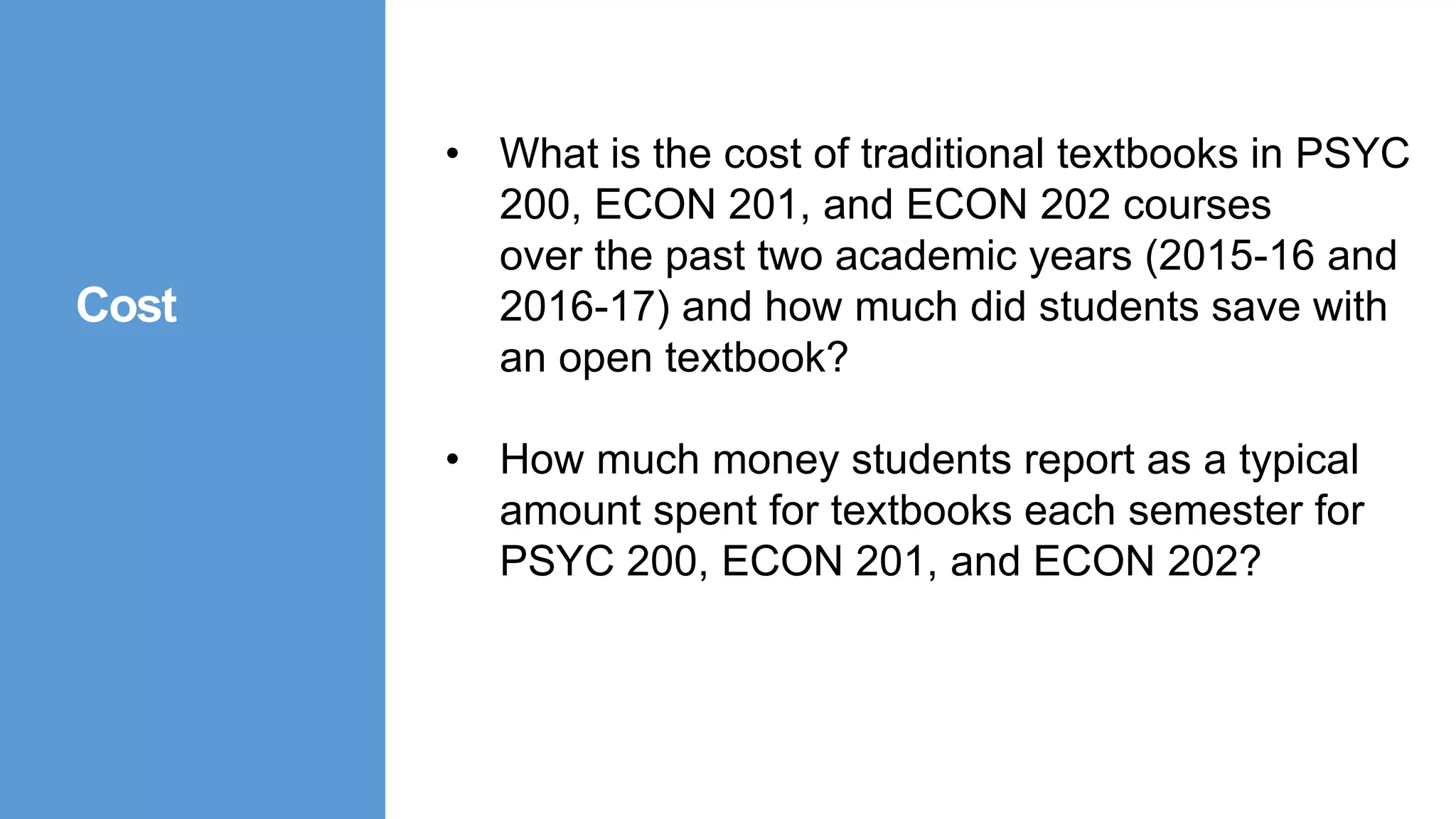
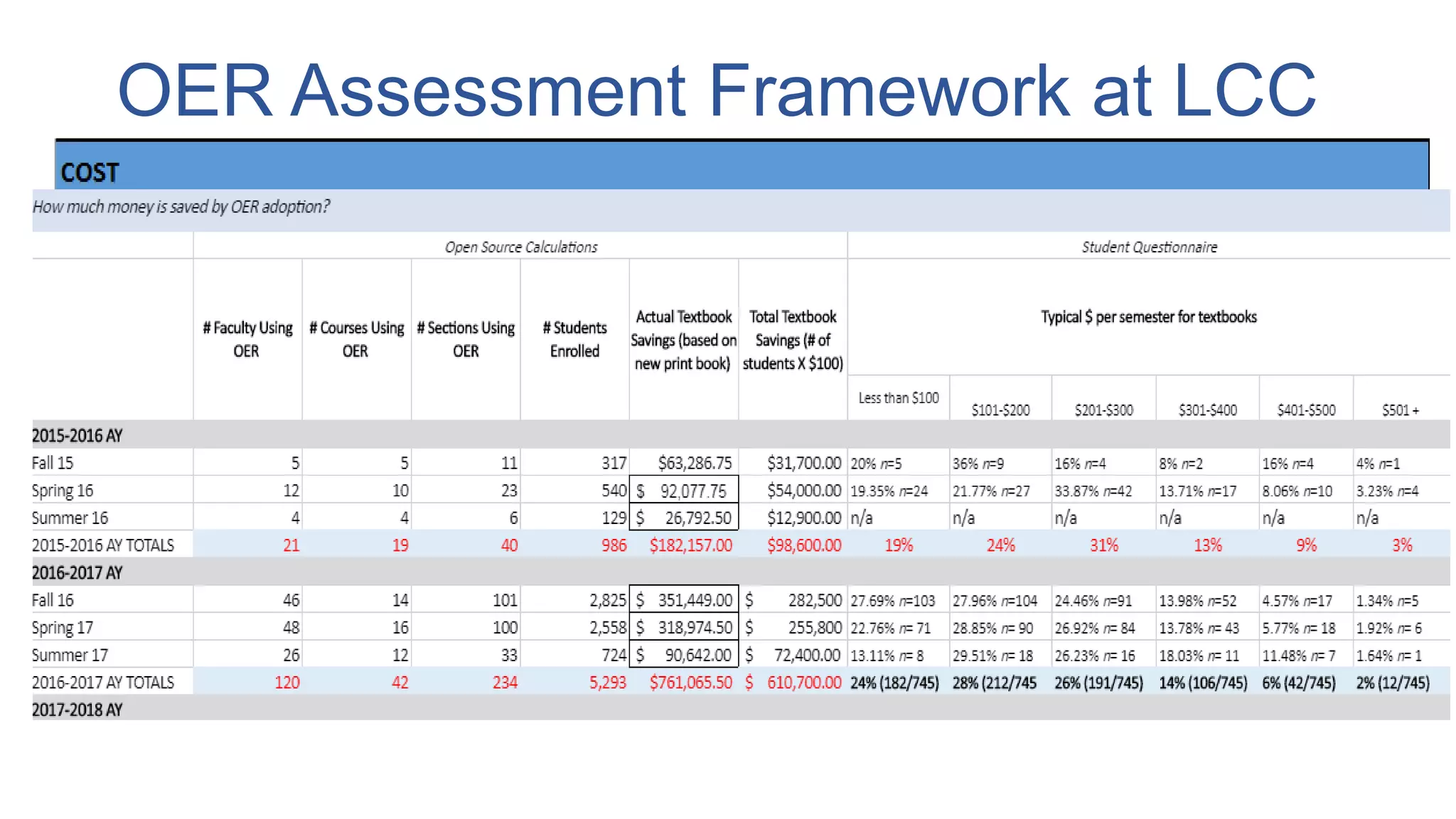
• What is the cost of traditional textbooks in PSYC
200, ECON 201, and ECON 202 courses
over the past two academic years (2015-16 and
2016-17) and how much did students save with
an open textbook?
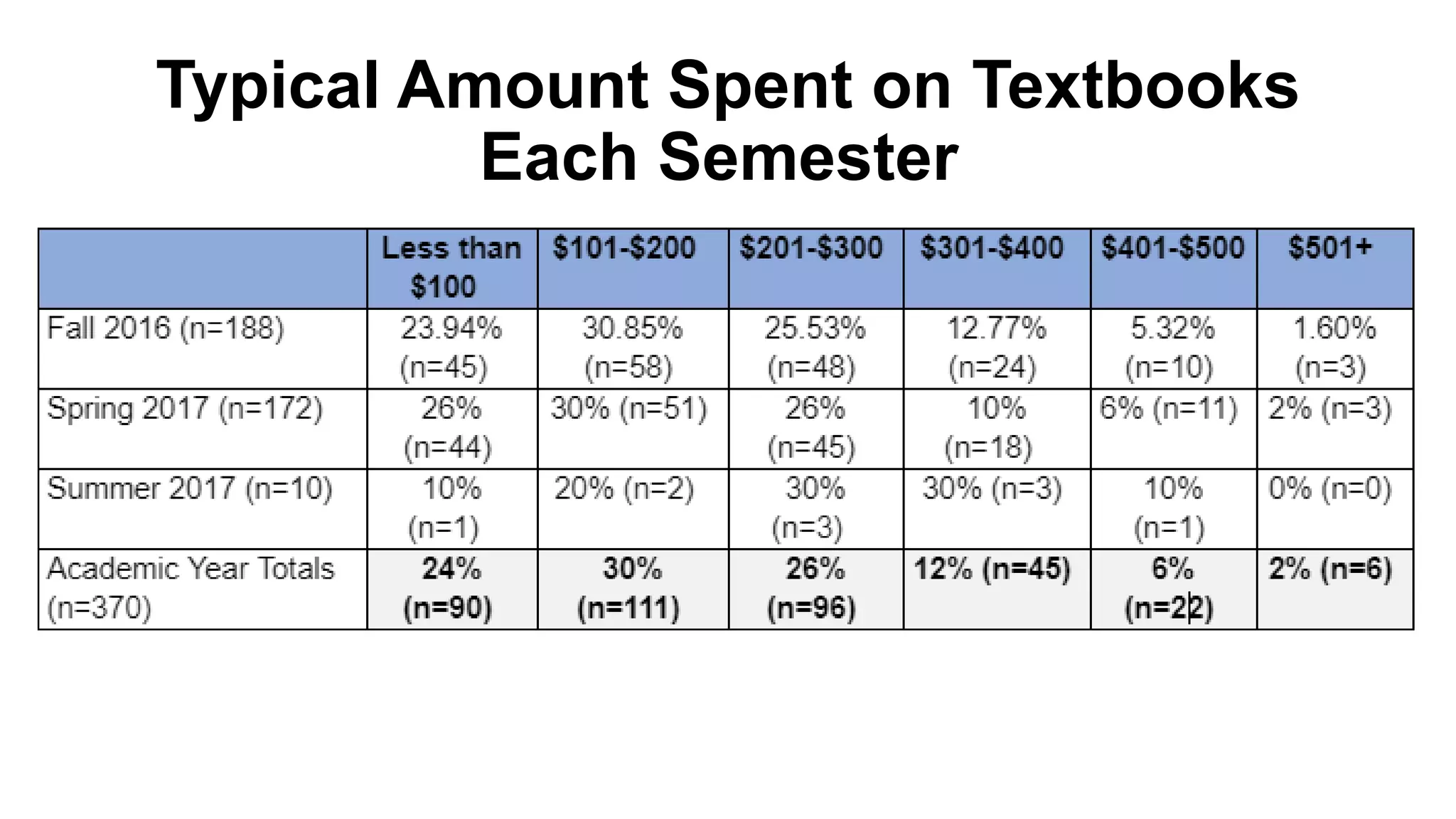
• How much money students report as a typical
amount spent for textbooks each semester for
PSYC 200, ECON 201, and ECON 202?
Cost
Outcomes
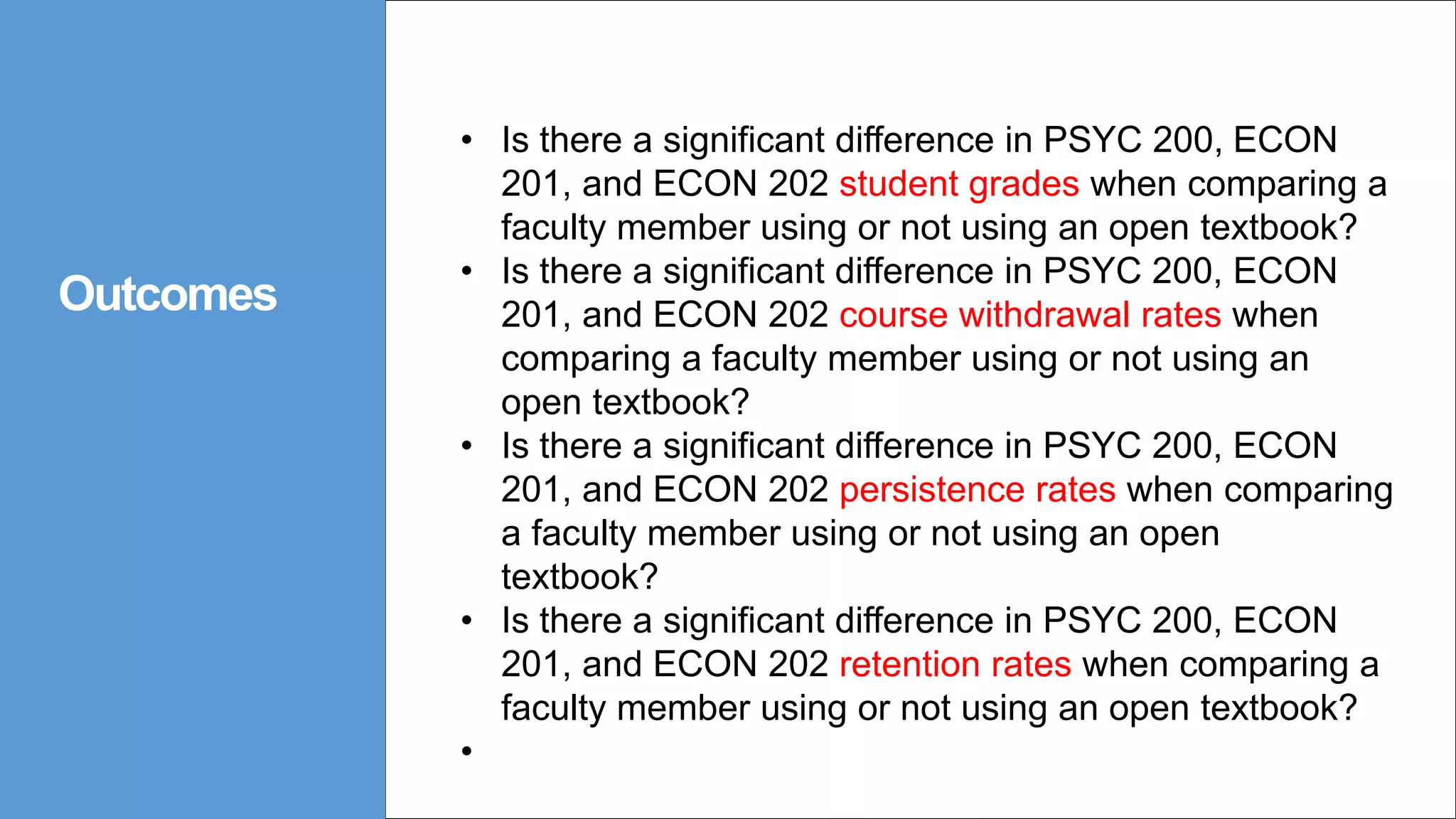
• Is there a significant difference in PSYC 200, ECON
201, and ECON 202 student grades when comparing a
faculty member using or not using an open textbook?
• Is there a significant difference in PSYC 200, ECON
201, and ECON 202 course withdrawal rates when
comparing a faculty member using or not using an
open textbook?
• Is there a significant difference in PSYC 200, ECON
201, and ECON 202 persistence rates when comparing
a faculty member using or not using an open
textbook?
• Is there a significant difference in PSYC 200, ECON
201, and ECON 202 retention rates when comparing a
faculty member using or not using an open textbook?
•
• How has the adoption of open textbooks changed
in PSYC 200 and ECON 201 and ECON 202 courses
at Lansing Community College in the past two
academic years (2015-16 and 2016-17)?
• What is student’s intent to register for PSYC
200, ECON 201, and ECON 202 courses that offer
OER textbook?
• If students had a choice, do they prefer open textbook
or traditional textbook use in their PSYC 200, ECON
201, and ECON 202 classes?
Use
• How do PSYC 200, ECON 201, and ECON
202 students perceive the quality of open
textbooks, as compared to traditional
textbooks in other courses?
Perceptions
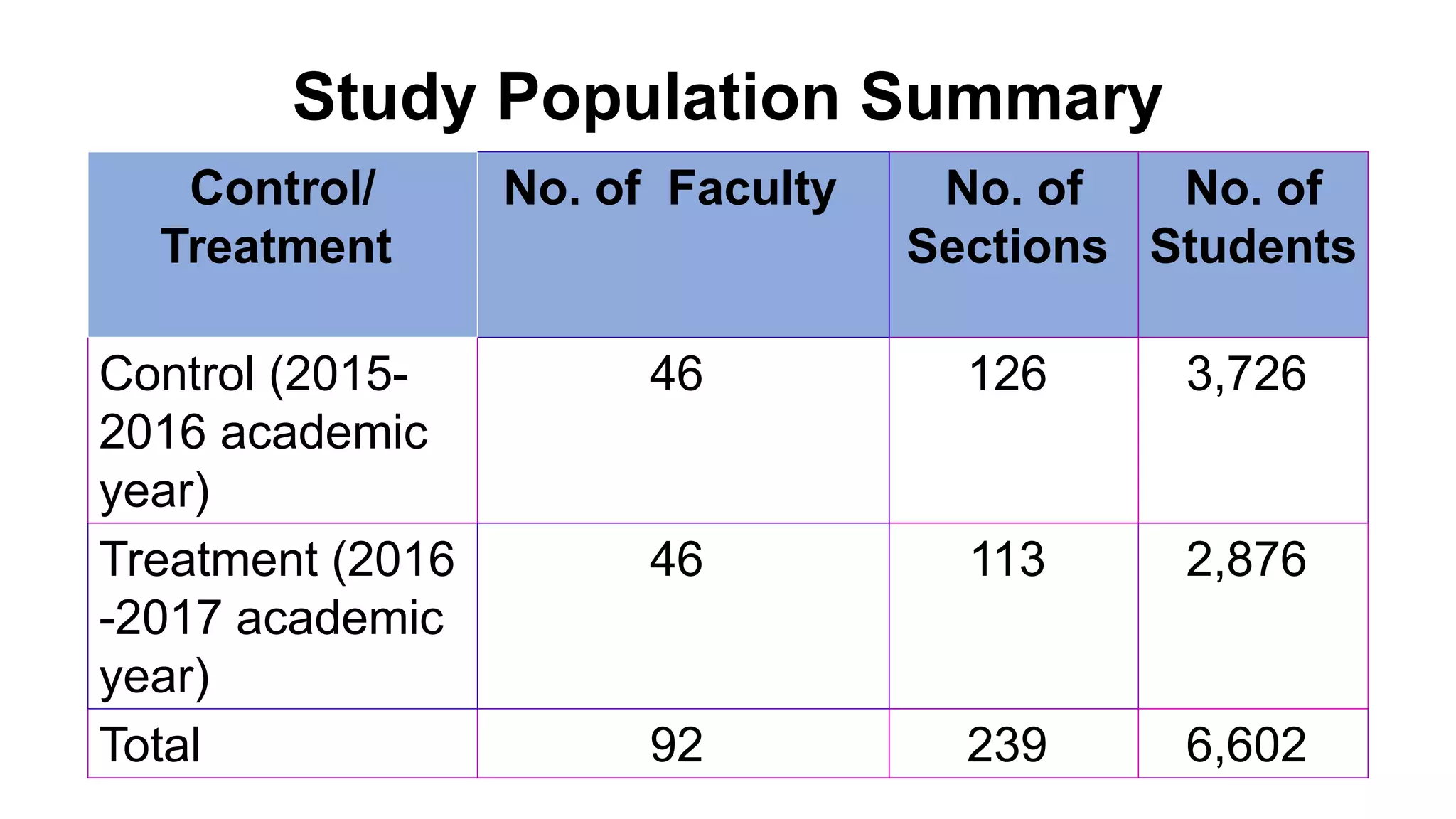
Study Population Summary
Control/
Treatment
No. of Faculty No. of
Sections
No. of
Students
Control (2015-
2016 academic
year)
46 126 3,726
Treatment (2016
-2017 academic
year)
46 113 2,876
Total 92 239 6,602
Data collection
strategies:
Student surveys
Faculty surveys
Mixed methods
• quantitative
• qualitative
Center for Data
Science supplied data
from Banner, Argos
Photo by Fancycrave on Unsplash
OER Assessment Framework at LCC
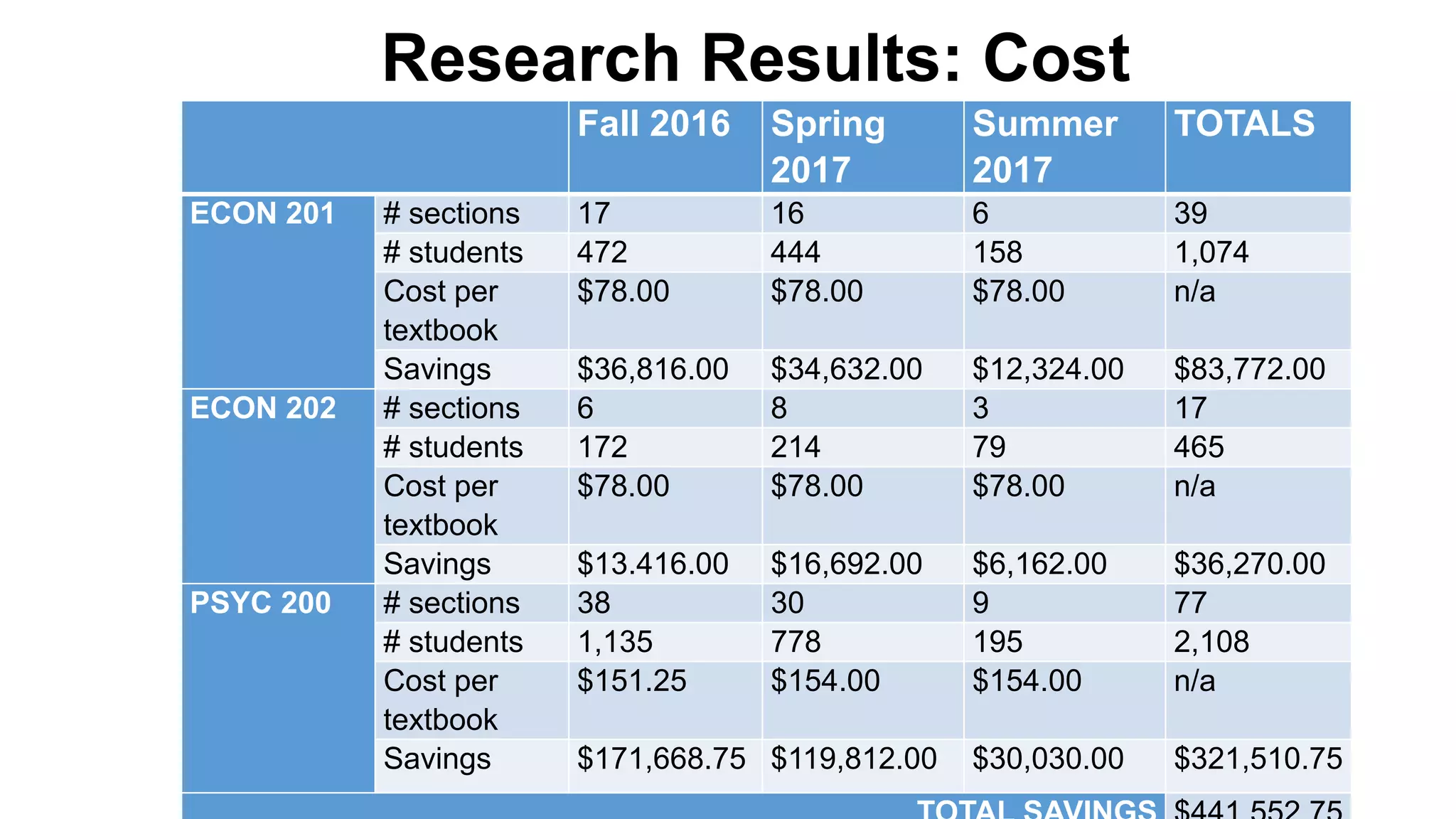
Research Results: Cost
Fall 2016 Spring
2017
Summer
2017
TOTALS
ECON 201 # sections 17 16 6 39
# students 472 444 158 1,074
Cost per
textbook
$78.00 $78.00 $78.00 n/a
Savings $36,816.00 $34,632.00 $12,324.00 $83,772.00
ECON 202 # sections 6 8 3 17
# students 172 214 79 465
Cost per
textbook
$78.00 $78.00 $78.00 n/a
Savings $13.416.00 $16,692.00 $6,162.00 $36,270.00
PSYC 200 # sections 38 30 9 77
# students 1,135 778 195 2,108
Cost per
textbook
$151.25 $154.00 $154.00 n/a
Savings $171,668.75 $119,812.00 $30,030.00 $321,510.75
Typical Amount Spent on Textbooks
Each Semester
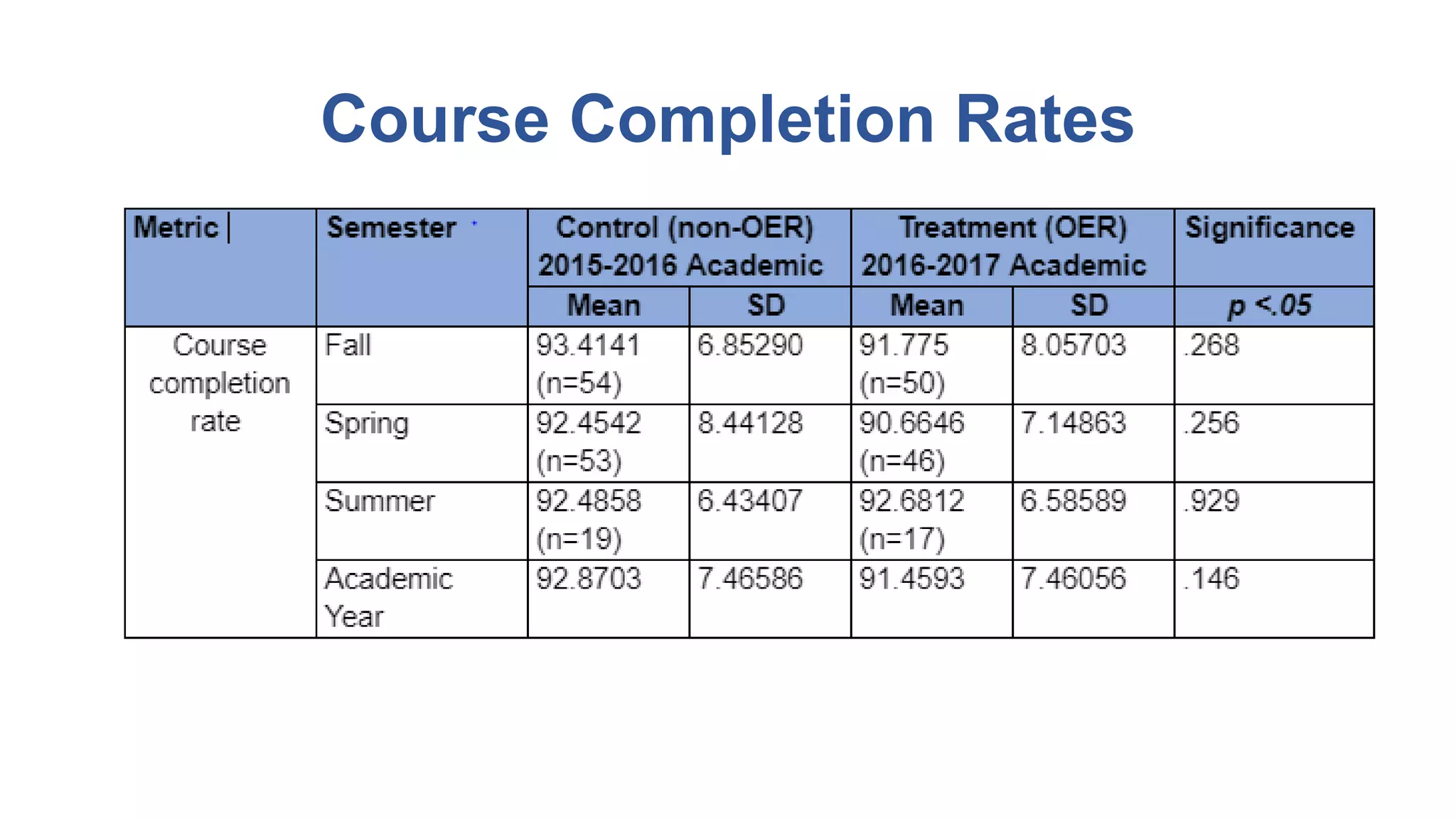
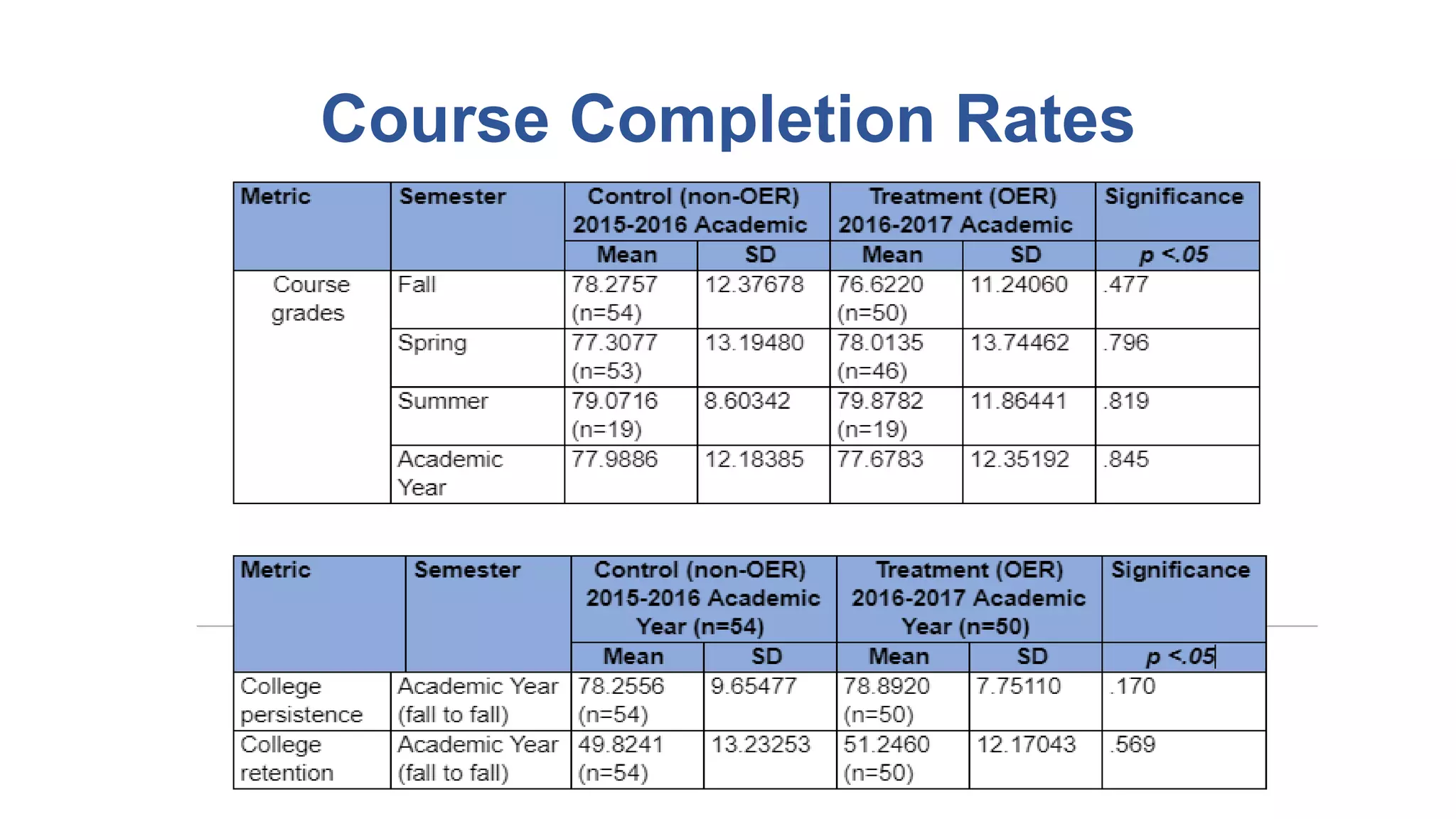
Course Completion Rates
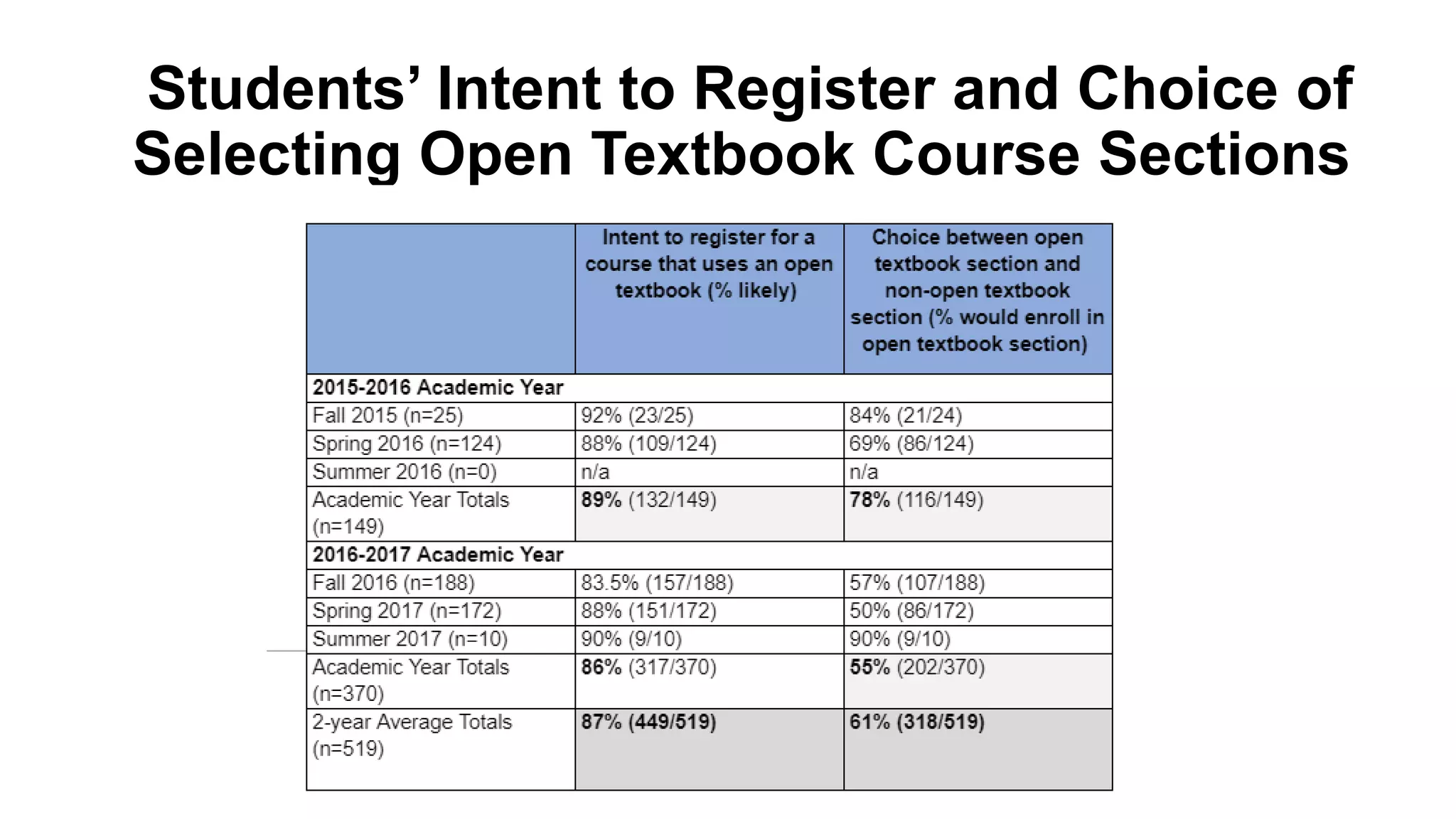
Students’ Intent to Register and Choice of
Selecting Open Textbook Course Sections
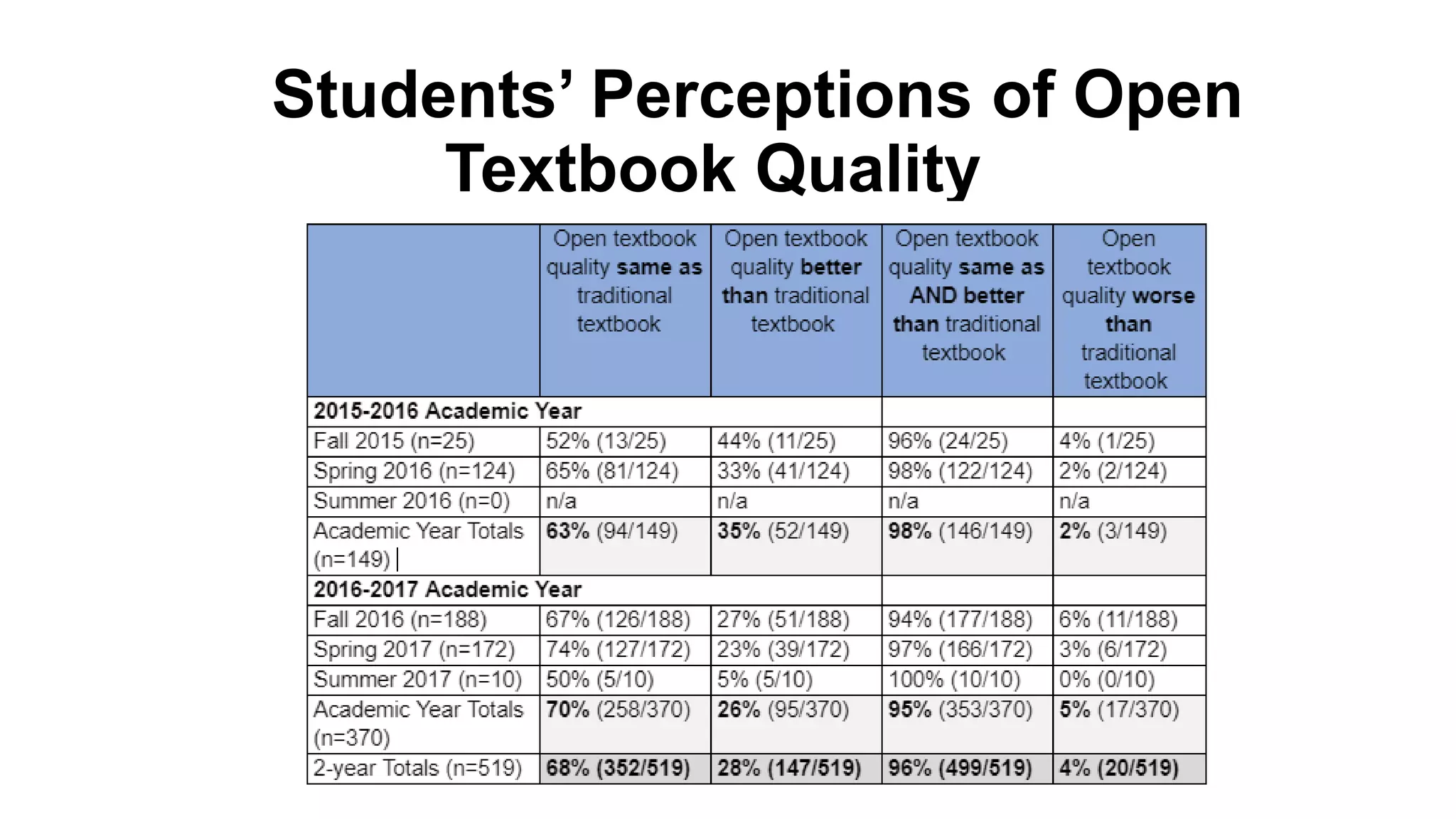
Students’ Perceptions of Open
Textbook Quality
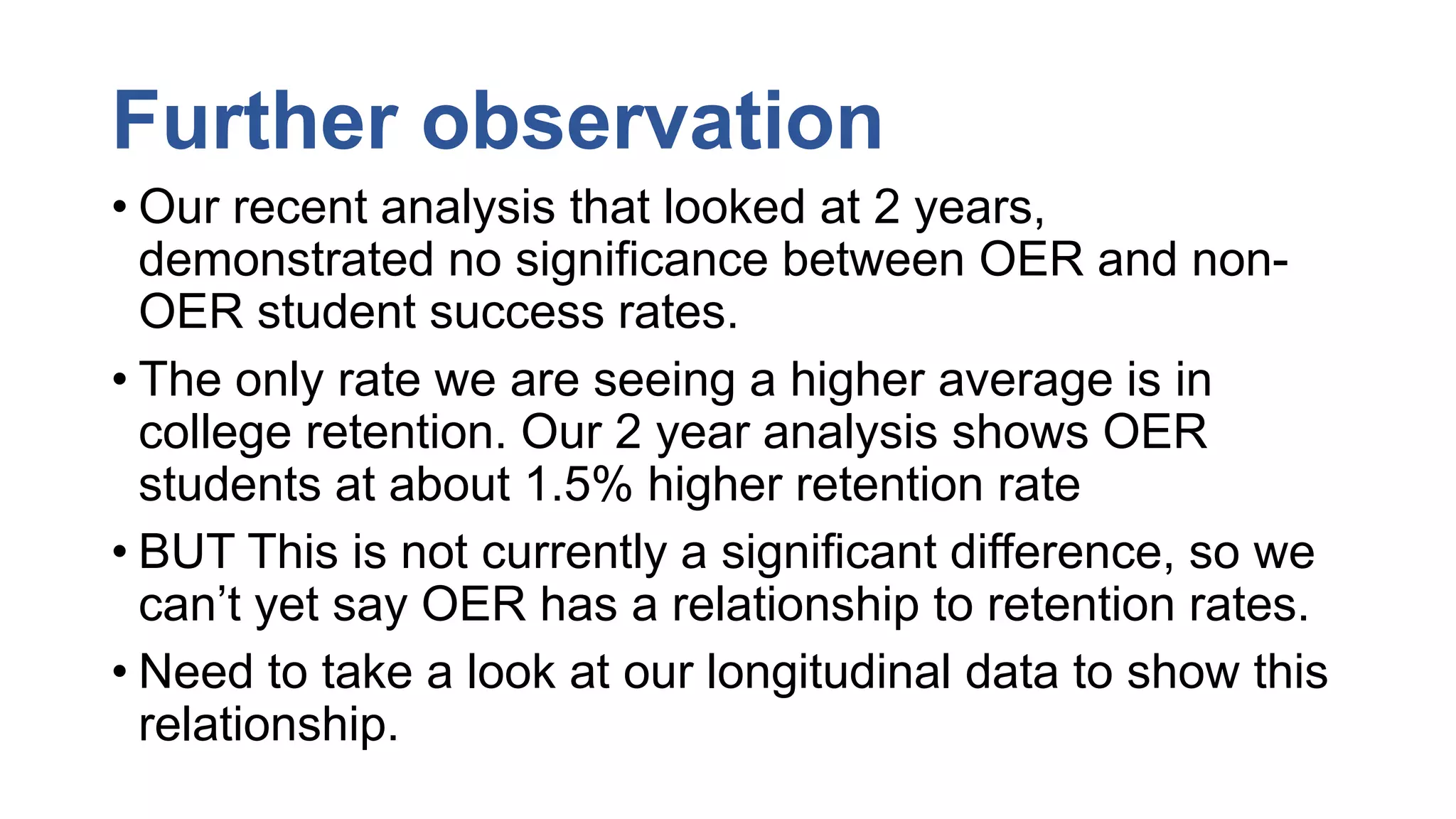
Further observation
• Our recent analysis that looked at 2 years,
demonstrated no significance between OER and non-
OER student success rates.
• The only rate we are seeing a higher average is in
college retention. Our 2 year analysis shows OER
students at about 1.5% higher retention rate
• BUT This is not currently a significant difference, so we
can’t yet say OER has a relationship to retention rates.
• Need to take a look at our longitudinal data to show this
relationship.
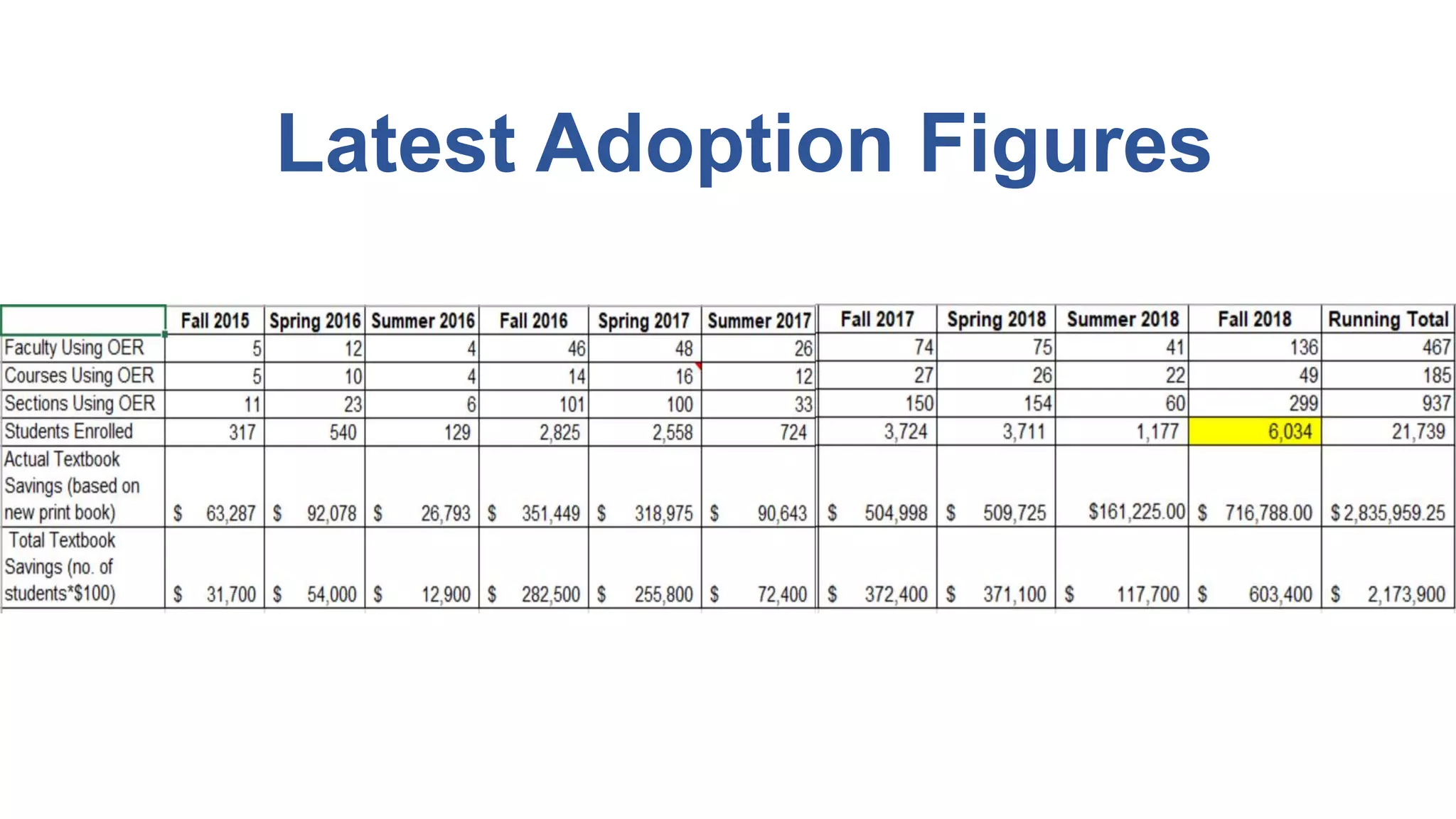
Latest Adoption Figures
Forthcoming paper
An Analysis of Cost, Outcomes, Use, and
Perceptions in a Multi-Section Adoption of
Open Textbooks in Introductory
Psychology and Economics Courses
Regina Gong and Karen Hicks
Lansing Community College
Image source: https://unsplash.com/collections/167234/questions?photo=i--IN3cvEjg
Regina Gong, gongr1@lcc.edu

What Difference Does It Make: Traditional Textbook and Open Textbook Use in Large Multi-Section Courses

  • 1.
    What Difference DoesIt Make: Traditional Textbook and Open Textbook Use in Large Multi- Section Courses Regina Gong, OER Project Manager; @drgong Dr. Karen Hicks, Director of Assessment Lansing Community College Open Education Conference, October 10, 2018 Niagara Falls, NY This work is licensed under the Creative Commons Attribution 4.0 International License.
  • 2.
    LCC AT AGLANCE • Founded in 1957 and located in downtown Lansing • 26,000 students enrolled/year • Faculty started using OER in fall 2015 semester • No grants/stipends/incentives were offered when we started. • $500K approved by Board of Trustees in Fall 2017 semester.
  • 3.
    Textbook affordability Allow facultyexploration and innovation in finding new, better, and less costly ways to deliver quality learning materials to students in addition to improved pedagogy. Goals of the OER Initiative at LCC
  • 4.
    OER and OpenLearning are two of the ongoing competitiveness and innovation projects in the 2017-2020 LCC Strategic Plan.
  • 5.
    Because assessment makesthe world go round Photo by John Jackson on Unsplash
  • 6.
    Designing an AssessmentFramework • How to go about it (approach) • Collaborative • Reverse engineer/systemically • Aligned • Systematic • Key Elements • Logic model • Assessment plan • Monitoring & tracking plan
  • 7.
    Elements of anAssessment Plan • Our data collection strategy includes these elements: • Performance indicators (i.e. data) • Sources of data • Methods of data collection • Methods of data analysis • Implementation of assessment plan • Management of data • Monitoring of data • Communication of data
  • 8.
    Research Study Background •PSYC 200 (Intro to Psychology) • ECON 201 (Intro to Economics – Microeconomics) • ECON 202 (Intro to Economics – Macroeconomics) ALL sections adopted OpenStax textbooks starting Fall 2016
  • 9.
    Research Study Background Comparedpublisher textbook use (AY 2015-2016) vs. open textbook use (AY 2016-2017) We eliminated the confounding variable of the instructor
  • 10.
  • 11.
    • What isthe cost of traditional textbooks in PSYC 200, ECON 201, and ECON 202 courses over the past two academic years (2015-16 and 2016-17) and how much did students save with an open textbook? • How much money students report as a typical amount spent for textbooks each semester for PSYC 200, ECON 201, and ECON 202? Cost
  • 12.
    Outcomes • Is therea significant difference in PSYC 200, ECON 201, and ECON 202 student grades when comparing a faculty member using or not using an open textbook? • Is there a significant difference in PSYC 200, ECON 201, and ECON 202 course withdrawal rates when comparing a faculty member using or not using an open textbook? • Is there a significant difference in PSYC 200, ECON 201, and ECON 202 persistence rates when comparing a faculty member using or not using an open textbook? • Is there a significant difference in PSYC 200, ECON 201, and ECON 202 retention rates when comparing a faculty member using or not using an open textbook? •
  • 13.
    • How hasthe adoption of open textbooks changed in PSYC 200 and ECON 201 and ECON 202 courses at Lansing Community College in the past two academic years (2015-16 and 2016-17)? • What is student’s intent to register for PSYC 200, ECON 201, and ECON 202 courses that offer OER textbook? • If students had a choice, do they prefer open textbook or traditional textbook use in their PSYC 200, ECON 201, and ECON 202 classes? Use
  • 14.
    • How doPSYC 200, ECON 201, and ECON 202 students perceive the quality of open textbooks, as compared to traditional textbooks in other courses? Perceptions
  • 15.
    Study Population Summary Control/ Treatment No.of Faculty No. of Sections No. of Students Control (2015- 2016 academic year) 46 126 3,726 Treatment (2016 -2017 academic year) 46 113 2,876 Total 92 239 6,602
  • 16.
    Data collection strategies: Student surveys Facultysurveys Mixed methods • quantitative • qualitative Center for Data Science supplied data from Banner, Argos Photo by Fancycrave on Unsplash
  • 17.
  • 18.
    Research Results: Cost Fall2016 Spring 2017 Summer 2017 TOTALS ECON 201 # sections 17 16 6 39 # students 472 444 158 1,074 Cost per textbook $78.00 $78.00 $78.00 n/a Savings $36,816.00 $34,632.00 $12,324.00 $83,772.00 ECON 202 # sections 6 8 3 17 # students 172 214 79 465 Cost per textbook $78.00 $78.00 $78.00 n/a Savings $13.416.00 $16,692.00 $6,162.00 $36,270.00 PSYC 200 # sections 38 30 9 77 # students 1,135 778 195 2,108 Cost per textbook $151.25 $154.00 $154.00 n/a Savings $171,668.75 $119,812.00 $30,030.00 $321,510.75
  • 19.
    Typical Amount Spenton Textbooks Each Semester
  • 20.
  • 21.
  • 22.
    Students’ Intent toRegister and Choice of Selecting Open Textbook Course Sections
  • 23.
    Students’ Perceptions ofOpen Textbook Quality
  • 24.
    Further observation • Ourrecent analysis that looked at 2 years, demonstrated no significance between OER and non- OER student success rates. • The only rate we are seeing a higher average is in college retention. Our 2 year analysis shows OER students at about 1.5% higher retention rate • BUT This is not currently a significant difference, so we can’t yet say OER has a relationship to retention rates. • Need to take a look at our longitudinal data to show this relationship.
  • 26.
  • 27.
    Forthcoming paper An Analysisof Cost, Outcomes, Use, and Perceptions in a Multi-Section Adoption of Open Textbooks in Introductory Psychology and Economics Courses Regina Gong and Karen Hicks Lansing Community College
  • 28.

Editor's Notes

  • #3 Located in downtown Lansing and was founded in 1957. LCC is the third largest community college in the state of Michigan and serves students in both credit and noncredit courses. LCC offers more than 230 Associate Degree and Certificate Programs. The College encompasses a service area of 6 counties and serves approximately 20,000 students each year. The College was the first College in the State of Michigan to offer online degrees. LCC offers more than 250 courses online and 26 associate degrees and certificates can be earned through online study.
  • #6 We already know that OERs can save students money. We are tracking that so we can have a benchmark figure for which we can compare ourselves with state and national OER initiative. But cost is just one metric. More importantly, and one we strive hard to do at LCC is to assess the impact of OER on student learning and faculty teaching practices. There must be more to it than just saving students money. We’re all in higher education and as you know, there has been an increased emphasis in assessment to measure the effect of various institutional projects (Guided Pathways, Co-requisite models, assessibility, Dev ed redesign, etc.) The goal is to inform leaders about the importance of these projects and how might we improve them.
  • #7 Collaboratively identify research questions (multiple audiences, different metrics communicate values and the weights of those values, often dictated by role in the college) Think systemically with these research questions (beyond the short-term) Gather expectations of what everyone thinks OER should be accomplishing. Develop hypothesis together. Then, test your hypotheses at various project stages to see where it needs some tinkering to get closer to your planned consequences (i.e. outcomes).
  • #9 Alignment Plan for outcomes, then plan for work (not the other way around) Line of sight
  • #12 Publisher textbook – control Open textbook – treatment Confounding variable – one to one comparison of faculty teaching the course. Only faculty who taught in the semesters prior to OER and who also taught using an open textbook are tracked.
  • #17 How aware are faculty and students of OER?
  • #25 N= no. of students
  • #26 No significant difference in the rates when comparing Fall 2015 and Fall 2016 course completion rates No significant difference in the rates when comparing Spring 2015 and Spring 2016 course completion rates No significant difference in the rates when comparing Summer 2015 and Summer 2016 course completion rates No significant difference in the rates when comparing the 2015/16 AY with the 2016/17 AY course completion rates P is the significance indicator. It tells us how reliable the statistic is (the results did not happen by "chance") It tells us how sure we are that a difference or relationship exists between OER and student outcomes. A p that is above .05 is an indicator that there is not a difference in student outcomes when comparing using (treatment) or not using (control) OER. 
  • #27 No significant difference in the rates when comparing Fall 2015 and Fall 2016 course grade rates No significant difference in the rates when comparing Spring 2015 and Spring 2016 course course grade rates No significant difference in the rates when comparing Summer 2015 and Summer 2016 course grade rates No significant difference in the rates when comparing the 2015/16 AY with the 2016/17 AY course grade rates 2.0 or better? The average success rate of OER students is 3% higher than students who do not use OER.  There is no significance between OER and non-OER students for persistence.  There is no significance between OER and non-OER students for retention
  • #28 This was based from our end of semester student survey
  • #31 We had some semesters (earlier on) where OER outperformed.
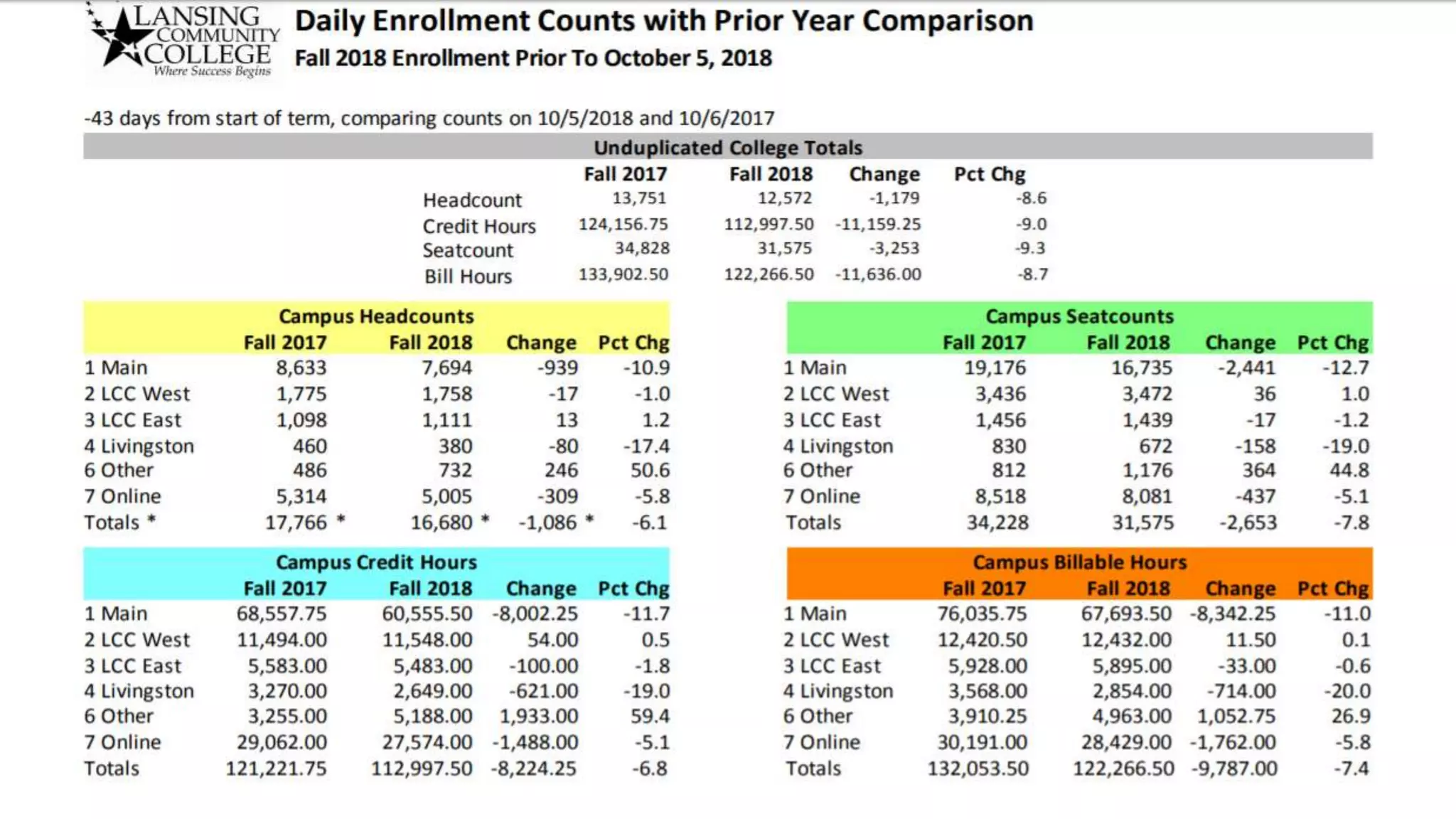
  • #32 One of the ways in which we look at the OER project’s impact is by calculating the percentage of students enrolled in OER courses for a particular semester. So in this case, if we have 6,033 students enrolled in OER courses for fall 2018 and we look at our total campus headcounts, 36% of our students are exposed to OER through their enrollment in courses using an OER. We expect that by spring 2019 semester, we will be closer to our goal of having 50% of our students at LCC enrolled in a course using OER.