Open Licensing 101:  How to Get the Most out of Your Copyrights in the Information Age
Lila Bailey, Counsel – ccLearn, Creative Commons. Raghu Seshadri, Attorney - Wilson Sonsini Goodrich & Rosati. Presenters
Roadmap Copyright Basics Presenting the Problem  Addressing Solutions Q & A
“ Only one thing is impossible for God:  To find any sense in any copyright law on the planet."    --  Mark Twain
"If you have ten thousand regulations you destroy all respect for the law."    --  Winston Churchill
"And now bills were passed, not only for national objects but for individual cases, and laws were most numerous when the commonwealth was most corrupt."    --  Tacitus
 
Copyright Nuts and Bolts Copyright automatically applies to “original works of authorship, fixed in any tangible medium of expression”  “ Anyone who violates any of the exclusive rights of the copyright owner . . . is an infringer of the copyright . . .”
Nuts and Bolts (cont’d) Exclusive Rights: Reproduce Prepare derivative works Distribute copies Publicly perform (only for certain works) Publicly display (only for certain works) Perform sound recordings by means of digital audio transmission Fair Use Other exceptions
The Problem Professor Lessig’s Four Behavioral Regulators Norms:   Impose non-legal sanctions for failure to comply with conventional standards of conduct. Architecture:  Constrains the set of possible behaviors.  Markets:  Regulate by price which sets a range of opportunities available to a consumer.  Law:  Regulates behavior by imposing sanctions ex post.
The Problem Cont’d. Copynorms:   Social norms regarding the copying, distribution, and use of expressive works.  All copynorms require the copyright owner to permit users to exercise some amount of exclusive rights. Examples:   Copying protected works, file sharing, general quotation with attribution norms, open source programming norms, e-mail quotation. Signaling:   How copyright owner’s express their normative preferences (I.e. gift giving or attribution and shunning individuals who fail to act in accordance with these norms). Signals are the currency used to build reputation. Norms
The Problem Cont’d. Internet architecture and production software provide few, if any, architectural restraints. DRM:  Specific architectural constraints.  May be hackable … BUT The difficulty for the average user of obtaining the bypassing software, along with the fact that the most users who do attempt to download the program will receive a message that their behavior is in some normative sense ‘wrong,’ may deter individuals from using the circumvention technology. Problem:   One size does not fit all (botched signals). Architecture
The Problem Cont’d. For Users  - only restraints are low cost to gain internet connection - then virtually costless copying and distribution. For Copyright Owners  - Since content can be copied so easily it has been devalued.  Value is now often built by reputation.  To build reputation the market requires allegiance to copynorms. Markets
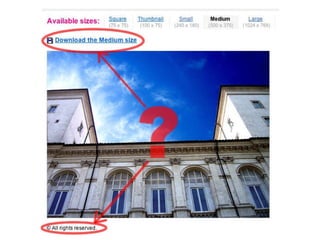
The Problem Cont’d. Impossible to adequately enforce on this scale. Laws can reinforce norms, and vice versa.  HOWEVER - copynorms and copyright are sending contradictory messages. Law
The Problem Cont’d. Law
The Problem Cont’d. Why is this a problem? Several reasons: The gap undermines the underlying purpose of copyright to encourage the spread of information to aid in the progression of science (law’s expressive function). Lessens a copyright owner’s ability to generate reputational currency (mixed messages, botched signals).  Solution? A mechanism operating within the law that is able to account for applicable social norms. Law
The Problem Cont’d. What About Fair Use? Ad hoc Turns on use rather than intended copynorm preferences Implied Licensing? Law
 
Open Licensing What about Open Licensing? What is Open Licensing Anyway? What if You Can’t Afford an Overpriced Lawyer? What if your audience can’t afford ... a lawyer, and other transaction costs, search costs
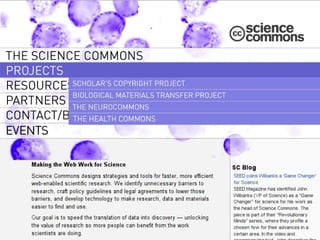
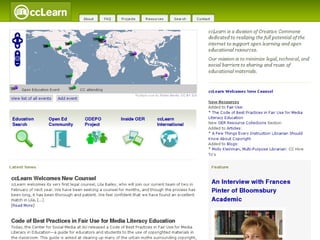
Creative Commons .ORG Nonprofit organization, launched to public December 2002 HQ and ccLearn in San Francisco Science Commons division at MIT ~60 international jurisdiction projects, coordinated from Berlin Foundation, corporate, and  individual funding Born at Stanford, supported by Silicon Valley
Enabling   Reasonable Copyright CC works within the existing system by allowing movement from “All Rights Reserved” to “Some Rights Reserved” CC improves copyright by giving creators a choice about which freedoms to grant and which rights to keep CC minimizes transaction costs by granting the public certain permissions beforehand
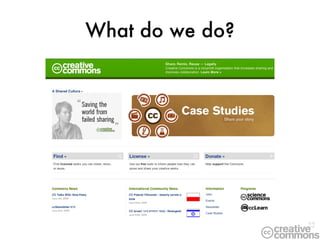
What do we do?
 
 
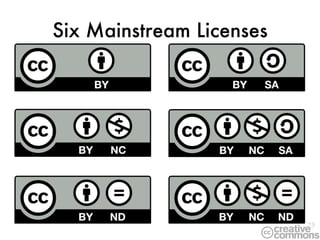
Six Mainstream Licenses
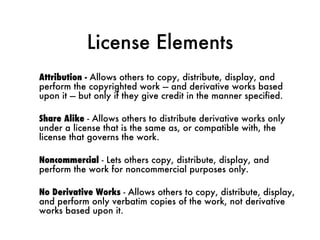
License Elements Attribution -  Allows others to copy, distribute, display, and perform the copyrighted work — and derivative works based upon it — but only if they give credit in the manner specified. Share Alike  - Allows others to distribute derivative works only under a license that is the same as, or compatible with, the license that governs the work. Noncommercial  - Lets others copy, distribute, display, and perform the work for noncommercial purposes only. No Derivative Works  - Allows others to copy, distribute, display, and perform only verbatim copies of the work, not derivative works based upon it.
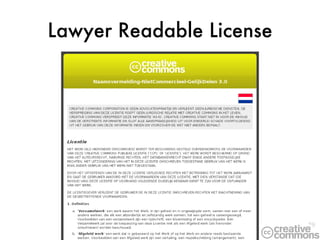
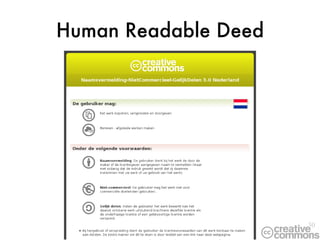
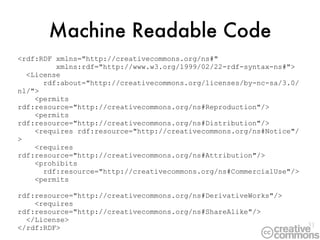
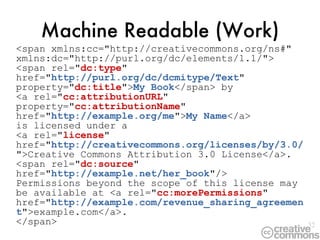
Anatomy of a CC License Icons Human Readable Deed Machine Readable Code Lawyer-proof Legal License
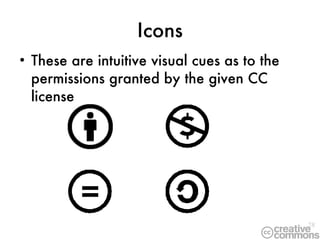
Icons These are intuitive visual cues as to the permissions granted by the given CC license
Lawyer Readable License
Human Readable Deed
Machine Readable Code <rdf:RDF xmlns=&quot;http://creativecommons.org/ns#&quot; xmlns:rdf=&quot;http://www.w3.org/1999/02/22-rdf-syntax-ns#&quot;> <License rdf:about=&quot;http://creativecommons.org/licenses/by-nc-sa/3.0/nl/&quot;> <permits rdf:resource=&quot;http://creativecommons.org/ns#Reproduction&quot;/> <permits rdf:resource=&quot;http://creativecommons.org/ns#Distribution&quot;/> <requires rdf:resource=&quot;http://creativecommons.org/ns#Notice&quot;/> <requires rdf:resource=&quot;http://creativecommons.org/ns#Attribution&quot;/> <prohibits rdf:resource=&quot;http://creativecommons.org/ns#CommercialUse&quot;/> <permits rdf:resource=&quot;http://creativecommons.org/ns#DerivativeWorks&quot;/> <requires rdf:resource=&quot;http://creativecommons.org/ns#ShareAlike&quot;/> </License> </rdf:RDF>
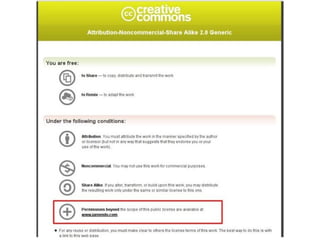
Machine Readable (Work) <span xmlns:cc=&quot;http://creativecommons.org/ns#&quot; xmlns:dc=&quot;http://purl.org/dc/elements/1.1/&quot;> <span rel=&quot; dc:type &quot; href=&quot; http://purl.org/dc/dcmitype/Text &quot; property=&quot; dc:title &quot;> My Book </span> by  <a rel=&quot; cc:attributionURL &quot; property=&quot; cc:attributionName &quot; href=&quot; http://example.org/me &quot;> My Name </a>  is licensed under a  <a rel=&quot; license &quot; href=&quot; http://creativecommons.org/licenses/by/3.0/ &quot;>Creative Commons Attribution 3.0 License</a>.  <span rel=&quot; dc:source &quot; href=&quot; http://example.net/her_book &quot;/> Permissions beyond the scope of this license may be available at <a rel=&quot; cc:morePermissions &quot; href=&quot; http://example.com/revenue_sharing_agreement &quot;>example.com</a>. </span>
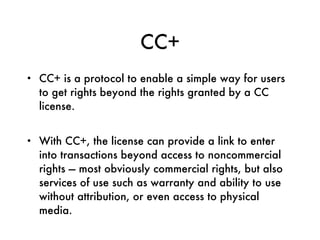
CC+ CC+ is a protocol to enable a simple way for users to get rights beyond the rights granted by a CC license.  With CC+, the license can provide a link to enter into transactions beyond access to noncommercial rights — most obviously commercial rights, but also services of use such as warranty and ability to use without attribution, or even access to physical media.
 
So why would YOU use CC? If you want people to be able to SHARE your work (so more people know who you are) If you want people to be able to REMIX your work (so you can see the creativity you inspire in others) If you want people to be able to MAKE MONEY from your work (why not?!?)
But you don’t have to take my word for it…
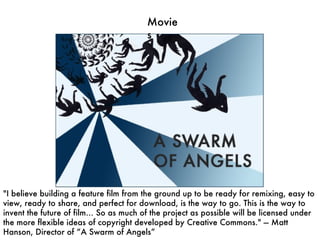
Movies &quot;I believe building a feature film from the ground up to be ready for remixing, easy to view, ready to share, and perfect for download, is the way to go. This is the way to invent the future of film… So as much of the project as possible will be licensed under the more flexible ideas of copyright developed by Creative Commons.&quot; — Matt Hanson, Director of “A Swarm of Angels”
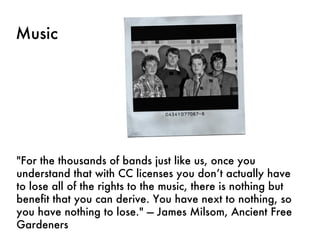
Music &quot;For the thousands of bands just like us, once you understand that with CC licenses you don’t actually have to lose all of the rights to the music, there is nothing but benefit that you can derive. You have next to nothing, so you have nothing to lose.&quot; — James Milsom, Ancient Free Gardeners
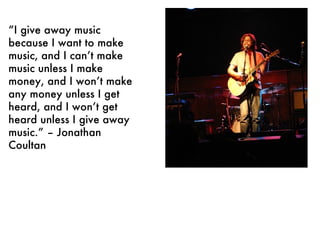
“ I give away music because I want to make music, and I can’t make music unless I make money, and I won’t make any money unless I get heard, and I won’t get heard unless I give away music.” – Jonathan Coultan
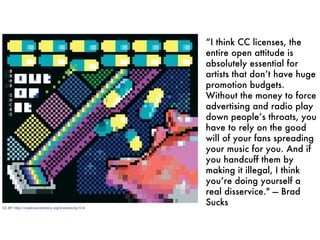
“ I think CC licenses, the entire open attitude is absolutely essential for artists that don’t have huge promotion budgets. Without the money to force advertising and radio play down people’s throats, you have to rely on the good will of your fans spreading your music for you. And if you handcuff them by making it illegal, I think you’re doing yourself a real disservice.&quot; — Brad Sucks
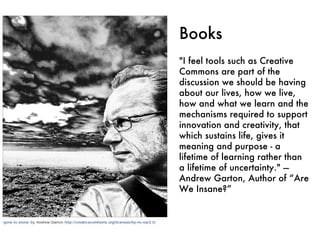
Books &quot;I feel tools such as Creative Commons are part of the discussion we should be having about our lives, how we live, how and what we learn and the mechanisms required to support innovation and creativity, that which sustains life, gives it meaning and purpose - a lifetime of learning rather than a lifetime of uncertainty.&quot; — Andrew Garton, Author of “Are We Insane?”
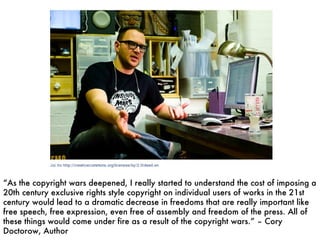
“ As the copyright wars deepened, I really started to understand the cost of imposing a 20th century exclusive rights style copyright on individual users of works in the 21st century would lead to a dramatic decrease in freedoms that are really important like free speech, free expression, even free of assembly and freedom of the press. All of these things would come under fire as a result of the copyright wars.” – Cory Doctorow, Author
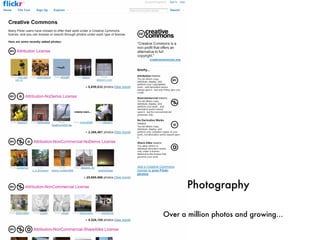
Photography Over a million photos and growing…
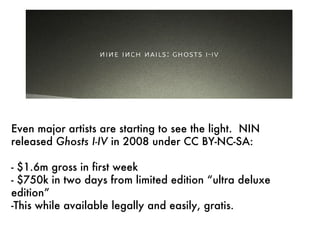
Even major artists are starting to see the light.  NIN released  Ghosts I-IV  in 2008 under CC BY-NC-SA: - $1.6m gross in first week - $750k in two days from limited edition “ultra deluxe edition” This while available legally and easily, gratis.
For More Case Studies: Large and small Business, community, individual Check out:  http://wiki.creativecommons.org/Casestudies
Questions? This presentation is opened under the CC Attribution license ... share and remix for any purpose, with credit.

Open Licensing 101

  • 1.
    Open Licensing 101: How to Get the Most out of Your Copyrights in the Information Age
  • 2.
    Lila Bailey, Counsel– ccLearn, Creative Commons. Raghu Seshadri, Attorney - Wilson Sonsini Goodrich & Rosati. Presenters
  • 3.
    Roadmap Copyright BasicsPresenting the Problem Addressing Solutions Q & A
  • 4.
    “ Only onething is impossible for God: To find any sense in any copyright law on the planet.&quot;   --  Mark Twain
  • 5.
    &quot;If you haveten thousand regulations you destroy all respect for the law.&quot;   --  Winston Churchill
  • 6.
    &quot;And now billswere passed, not only for national objects but for individual cases, and laws were most numerous when the commonwealth was most corrupt.&quot;   --  Tacitus
  • 7.
  • 8.
    Copyright Nuts andBolts Copyright automatically applies to “original works of authorship, fixed in any tangible medium of expression” “ Anyone who violates any of the exclusive rights of the copyright owner . . . is an infringer of the copyright . . .”
  • 9.
    Nuts and Bolts(cont’d) Exclusive Rights: Reproduce Prepare derivative works Distribute copies Publicly perform (only for certain works) Publicly display (only for certain works) Perform sound recordings by means of digital audio transmission Fair Use Other exceptions
  • 10.
    The Problem ProfessorLessig’s Four Behavioral Regulators Norms: Impose non-legal sanctions for failure to comply with conventional standards of conduct. Architecture: Constrains the set of possible behaviors. Markets: Regulate by price which sets a range of opportunities available to a consumer. Law: Regulates behavior by imposing sanctions ex post.
  • 11.
    The Problem Cont’d.Copynorms: Social norms regarding the copying, distribution, and use of expressive works. All copynorms require the copyright owner to permit users to exercise some amount of exclusive rights. Examples: Copying protected works, file sharing, general quotation with attribution norms, open source programming norms, e-mail quotation. Signaling: How copyright owner’s express their normative preferences (I.e. gift giving or attribution and shunning individuals who fail to act in accordance with these norms). Signals are the currency used to build reputation. Norms
  • 12.
    The Problem Cont’d.Internet architecture and production software provide few, if any, architectural restraints. DRM: Specific architectural constraints. May be hackable … BUT The difficulty for the average user of obtaining the bypassing software, along with the fact that the most users who do attempt to download the program will receive a message that their behavior is in some normative sense ‘wrong,’ may deter individuals from using the circumvention technology. Problem: One size does not fit all (botched signals). Architecture
  • 13.
    The Problem Cont’d.For Users - only restraints are low cost to gain internet connection - then virtually costless copying and distribution. For Copyright Owners - Since content can be copied so easily it has been devalued. Value is now often built by reputation. To build reputation the market requires allegiance to copynorms. Markets
  • 14.
    The Problem Cont’d.Impossible to adequately enforce on this scale. Laws can reinforce norms, and vice versa. HOWEVER - copynorms and copyright are sending contradictory messages. Law
  • 15.
  • 16.
    The Problem Cont’d.Why is this a problem? Several reasons: The gap undermines the underlying purpose of copyright to encourage the spread of information to aid in the progression of science (law’s expressive function). Lessens a copyright owner’s ability to generate reputational currency (mixed messages, botched signals). Solution? A mechanism operating within the law that is able to account for applicable social norms. Law
  • 17.
    The Problem Cont’d.What About Fair Use? Ad hoc Turns on use rather than intended copynorm preferences Implied Licensing? Law
  • 18.
  • 19.
    Open Licensing Whatabout Open Licensing? What is Open Licensing Anyway? What if You Can’t Afford an Overpriced Lawyer? What if your audience can’t afford ... a lawyer, and other transaction costs, search costs
  • 20.
    Creative Commons .ORGNonprofit organization, launched to public December 2002 HQ and ccLearn in San Francisco Science Commons division at MIT ~60 international jurisdiction projects, coordinated from Berlin Foundation, corporate, and individual funding Born at Stanford, supported by Silicon Valley
  • 21.
    Enabling Reasonable Copyright CC works within the existing system by allowing movement from “All Rights Reserved” to “Some Rights Reserved” CC improves copyright by giving creators a choice about which freedoms to grant and which rights to keep CC minimizes transaction costs by granting the public certain permissions beforehand
  • 22.
  • 23.
  • 24.
  • 25.
  • 26.
    License Elements Attribution- Allows others to copy, distribute, display, and perform the copyrighted work — and derivative works based upon it — but only if they give credit in the manner specified. Share Alike - Allows others to distribute derivative works only under a license that is the same as, or compatible with, the license that governs the work. Noncommercial - Lets others copy, distribute, display, and perform the work for noncommercial purposes only. No Derivative Works - Allows others to copy, distribute, display, and perform only verbatim copies of the work, not derivative works based upon it.
  • 27.
    Anatomy of aCC License Icons Human Readable Deed Machine Readable Code Lawyer-proof Legal License
  • 28.
    Icons These areintuitive visual cues as to the permissions granted by the given CC license
  • 29.
  • 30.
  • 31.
    Machine Readable Code<rdf:RDF xmlns=&quot;http://creativecommons.org/ns#&quot; xmlns:rdf=&quot;http://www.w3.org/1999/02/22-rdf-syntax-ns#&quot;> <License rdf:about=&quot;http://creativecommons.org/licenses/by-nc-sa/3.0/nl/&quot;> <permits rdf:resource=&quot;http://creativecommons.org/ns#Reproduction&quot;/> <permits rdf:resource=&quot;http://creativecommons.org/ns#Distribution&quot;/> <requires rdf:resource=&quot;http://creativecommons.org/ns#Notice&quot;/> <requires rdf:resource=&quot;http://creativecommons.org/ns#Attribution&quot;/> <prohibits rdf:resource=&quot;http://creativecommons.org/ns#CommercialUse&quot;/> <permits rdf:resource=&quot;http://creativecommons.org/ns#DerivativeWorks&quot;/> <requires rdf:resource=&quot;http://creativecommons.org/ns#ShareAlike&quot;/> </License> </rdf:RDF>
  • 32.
    Machine Readable (Work)<span xmlns:cc=&quot;http://creativecommons.org/ns#&quot; xmlns:dc=&quot;http://purl.org/dc/elements/1.1/&quot;> <span rel=&quot; dc:type &quot; href=&quot; http://purl.org/dc/dcmitype/Text &quot; property=&quot; dc:title &quot;> My Book </span> by <a rel=&quot; cc:attributionURL &quot; property=&quot; cc:attributionName &quot; href=&quot; http://example.org/me &quot;> My Name </a> is licensed under a <a rel=&quot; license &quot; href=&quot; http://creativecommons.org/licenses/by/3.0/ &quot;>Creative Commons Attribution 3.0 License</a>. <span rel=&quot; dc:source &quot; href=&quot; http://example.net/her_book &quot;/> Permissions beyond the scope of this license may be available at <a rel=&quot; cc:morePermissions &quot; href=&quot; http://example.com/revenue_sharing_agreement &quot;>example.com</a>. </span>
  • 33.
    CC+ CC+ isa protocol to enable a simple way for users to get rights beyond the rights granted by a CC license. With CC+, the license can provide a link to enter into transactions beyond access to noncommercial rights — most obviously commercial rights, but also services of use such as warranty and ability to use without attribution, or even access to physical media.
  • 34.
  • 35.
    So why wouldYOU use CC? If you want people to be able to SHARE your work (so more people know who you are) If you want people to be able to REMIX your work (so you can see the creativity you inspire in others) If you want people to be able to MAKE MONEY from your work (why not?!?)
  • 36.
    But you don’thave to take my word for it…
  • 37.
    Movies &quot;I believebuilding a feature film from the ground up to be ready for remixing, easy to view, ready to share, and perfect for download, is the way to go. This is the way to invent the future of film… So as much of the project as possible will be licensed under the more flexible ideas of copyright developed by Creative Commons.&quot; — Matt Hanson, Director of “A Swarm of Angels”
  • 38.
    Music &quot;For thethousands of bands just like us, once you understand that with CC licenses you don’t actually have to lose all of the rights to the music, there is nothing but benefit that you can derive. You have next to nothing, so you have nothing to lose.&quot; — James Milsom, Ancient Free Gardeners
  • 39.
    “ I giveaway music because I want to make music, and I can’t make music unless I make money, and I won’t make any money unless I get heard, and I won’t get heard unless I give away music.” – Jonathan Coultan
  • 40.
    “ I thinkCC licenses, the entire open attitude is absolutely essential for artists that don’t have huge promotion budgets. Without the money to force advertising and radio play down people’s throats, you have to rely on the good will of your fans spreading your music for you. And if you handcuff them by making it illegal, I think you’re doing yourself a real disservice.&quot; — Brad Sucks
  • 41.
    Books &quot;I feeltools such as Creative Commons are part of the discussion we should be having about our lives, how we live, how and what we learn and the mechanisms required to support innovation and creativity, that which sustains life, gives it meaning and purpose - a lifetime of learning rather than a lifetime of uncertainty.&quot; — Andrew Garton, Author of “Are We Insane?”
  • 42.
    “ As thecopyright wars deepened, I really started to understand the cost of imposing a 20th century exclusive rights style copyright on individual users of works in the 21st century would lead to a dramatic decrease in freedoms that are really important like free speech, free expression, even free of assembly and freedom of the press. All of these things would come under fire as a result of the copyright wars.” – Cory Doctorow, Author
  • 43.
    Photography Over amillion photos and growing…
  • 44.
    Even major artistsare starting to see the light. NIN released Ghosts I-IV in 2008 under CC BY-NC-SA: - $1.6m gross in first week - $750k in two days from limited edition “ultra deluxe edition” This while available legally and easily, gratis.
  • 45.
    For More CaseStudies: Large and small Business, community, individual Check out: http://wiki.creativecommons.org/Casestudies
  • 46.
    Questions? This presentationis opened under the CC Attribution license ... share and remix for any purpose, with credit.

Editor's Notes

  • #34 CC+ is just what it sounds like, a Creative Commons license plus another agreement. A copyright holder might pair a Creative Commons Attribution-NonCommercial license [CC] with a non-exclusive commercial agreement [+] enabling a company to license the work commercially for a fee. CC+ is a technological facilitation of dual licensing. A copyright holder who uses a Creative Commons license is already adding a license on top of their copyright. CC+ can make it easier for that copyright-holder to add other non-exclusive licenses/agreements as alternatives.