Anatomy of a
Creative
Commons License
Mandi Goodsett
Summer 2018
This work is licensed under a
Creative Commons Attribution
4.0 International License.
While searching
online, you may
have seen a symbol
that looks like this:
Or like this:
Or like this:
These are Creative
Commons licenses, and
they give users permissions
to use copyrighted works in
specific ways.
Let’s explore how
they work.
The anatomy of a CC
license works like this:
Creative Commons licenses do not replace copyright - they
layer over the top of it, granting public permission to use works
under standardized conditions.
The anatomy of a CC
license works like this:
Creative Commons licenses have three layers. The base layer
consists of legal code meant for lawyers to read.
The anatomy of a CC
license works like this:
The second layer is the commons deed, which lays out the
terms and summarizes the legal code in language for
non-lawyers.
The anatomy of a CC
license works like this:
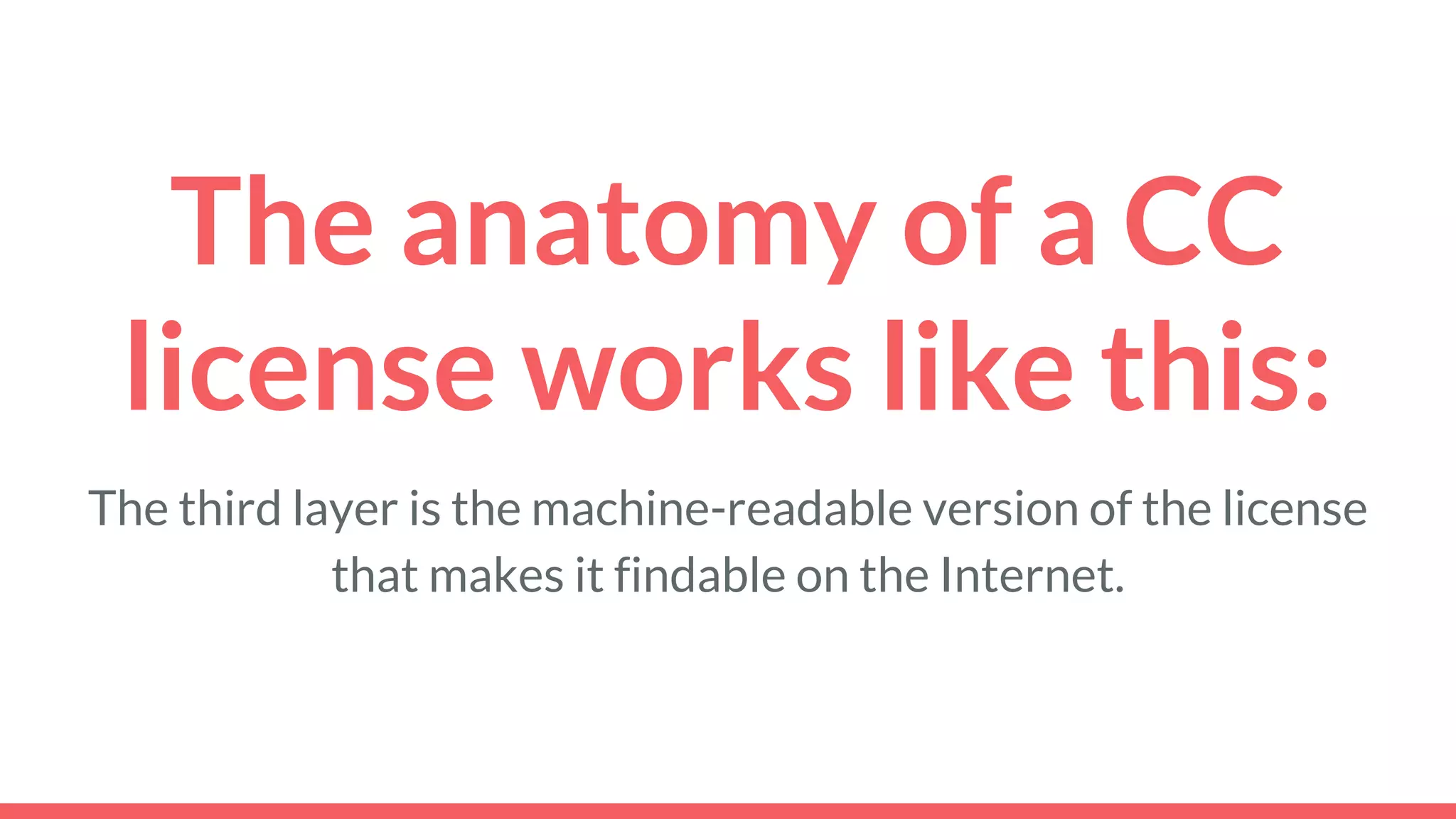
The third layer is the machine-readable version of the license
that makes it findable on the Internet.
What do CC
licenses give users
permission to do?
There are four
license pieces.
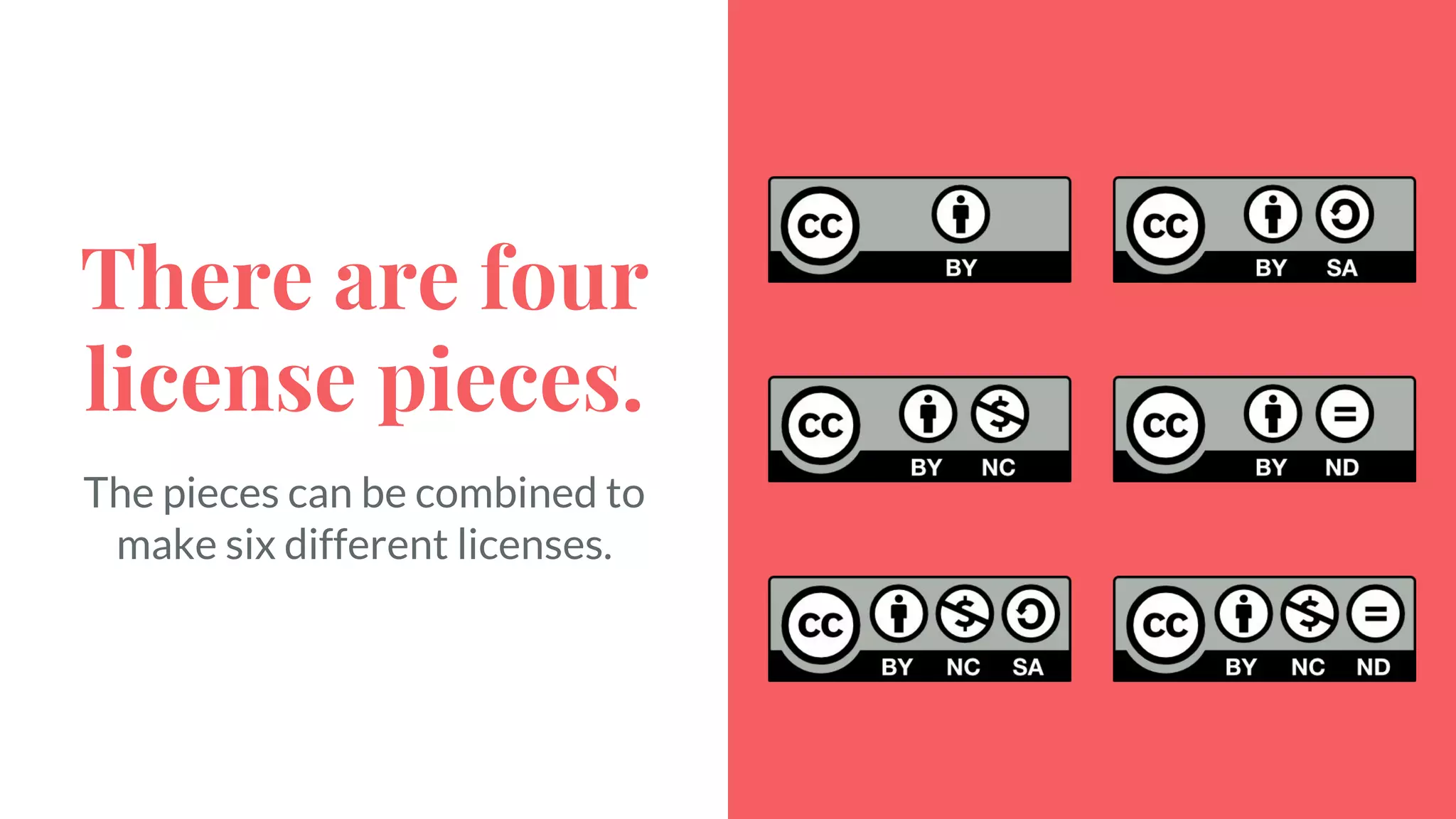
The pieces can be combined to
make six different licenses.
There are four
license pieces.
All of the licenses include at least
CC-BY (Attribution), which
means users can use the work for
any purpose, but must attribute
the work to the original author.
There are four
license pieces.
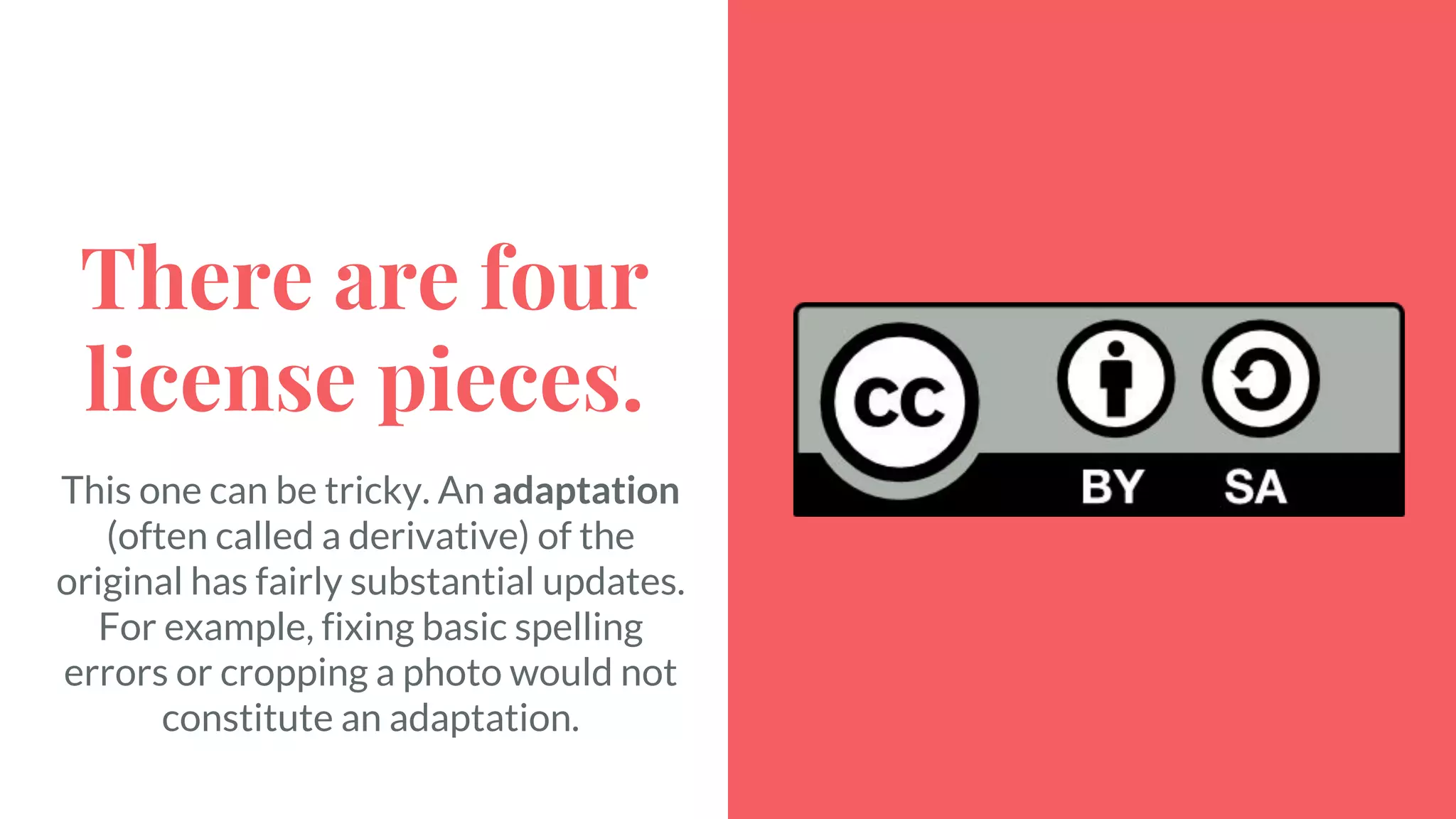
The CC-BY-SA (Share Alike) license
allows any use but requires that
users attribute the original work to
the author, and if any adaptations
are made, that they be shared with
the same license the original work
was shared with.
There are four
license pieces.
This one can be tricky. An adaptation
(often called a derivative) of the
original has fairly substantial updates.
For example, fixing basic spelling
errors or cropping a photo would not
constitute an adaptation.
There are four
license pieces.
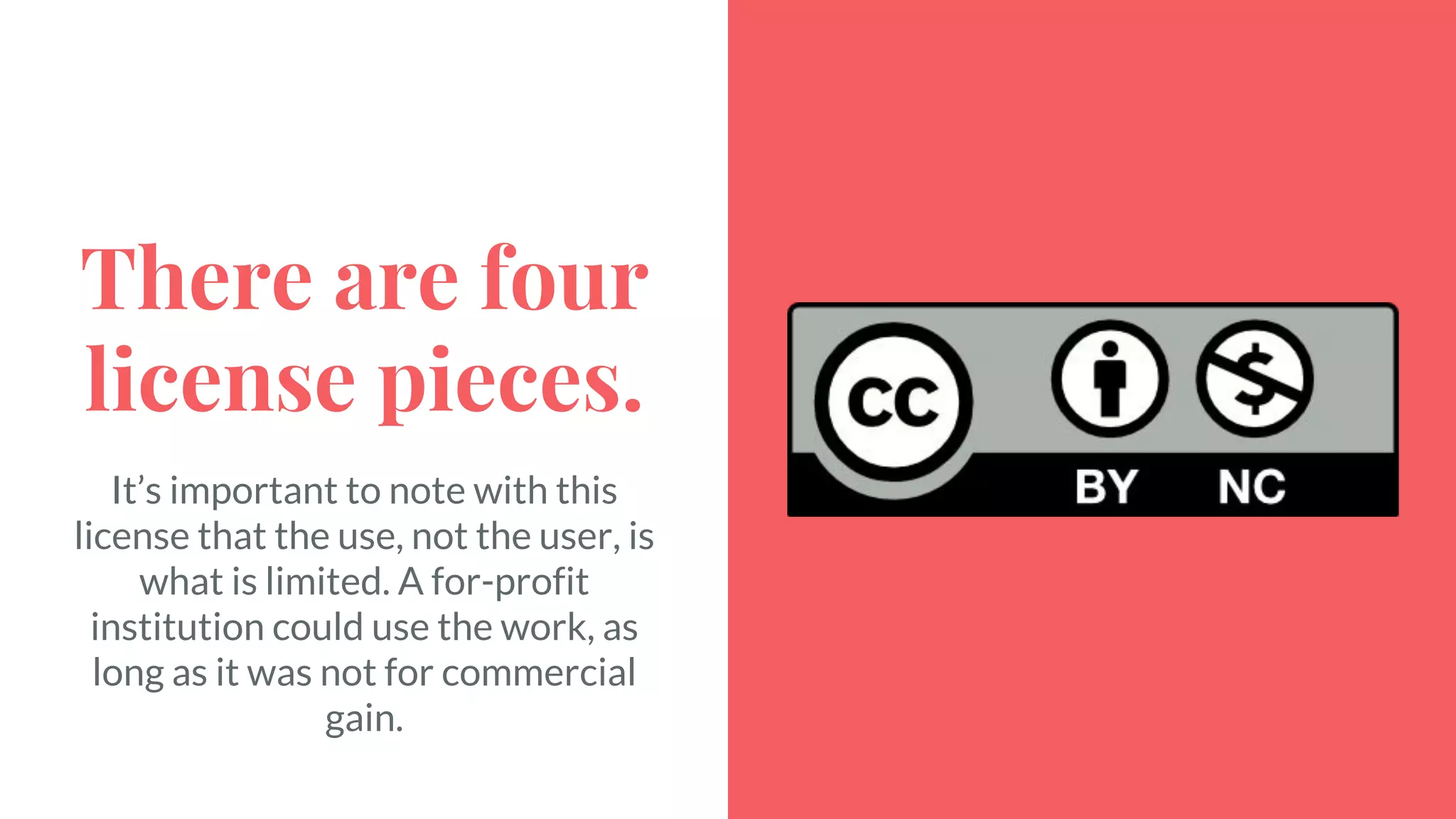
The CC-BY-NC (Non-Commercial)
license allows for any use, but
requires that users attribute the
original work to the author, and that
they refrain from using the work for
commercial gain.
There are four
license pieces.
It’s important to note with this
license that the use, not the user, is
what is limited. A for-profit
institution could use the work, as
long as it was not for commercial
gain.
There are four
license pieces.
The CC-BY-ND (Non-Derivative)
license allows for any use but
requires that users attribute the
original work to the author, and that
they refrain from changing the
original work without permission
from the author.
There are four
license pieces.
There are two additional
combinations of the basic licenses
pieces that are possible, as well:
CC-BY-NC-SA and CC-BY-NC-ND.
The Public
Domain
Dedication Tool
Creative Commons also created
a public domain tool that allows
users to dedicate their work
directly to the public domain.
The Public
Domain
Dedication Tool
Not all countries allow someone
to dedicate their work to the
public domain, so the tool also
includes a license that allows for
any use by anyone.
How do these
licenses interact
with copyright
exceptions?
Copyright
Exceptions & CC
A user who is invoking a
copyright exception (like
the TEACH Act or fair use)
would not be affected by
the presence (or lack) of a
Creative Commons
license.
Copyright
Exceptions & CC
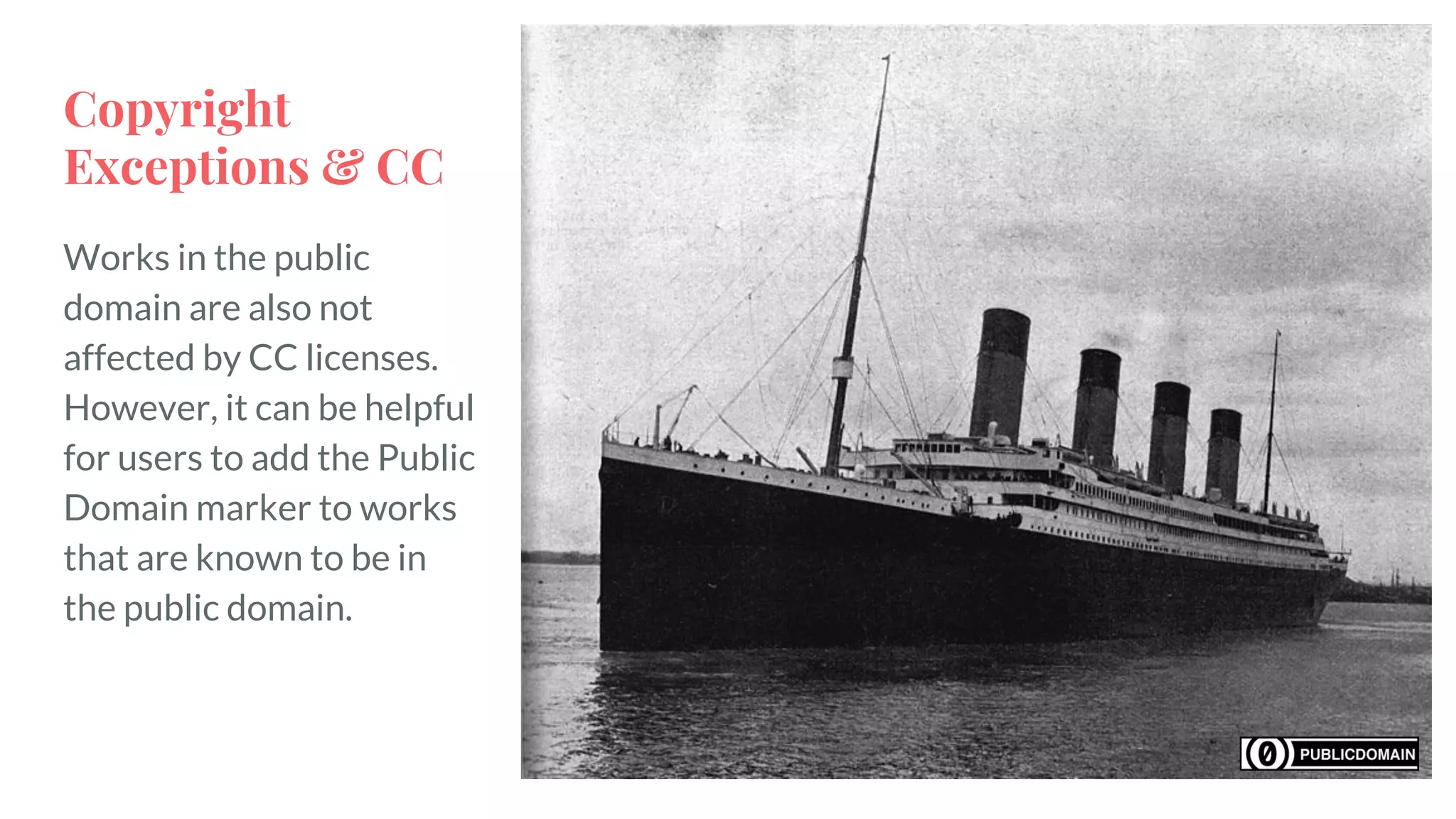
Works in the public
domain are also not
affected by CC licenses.
However, it can be helpful
for users to add the Public
Domain marker to works
that are known to be in
the public domain.
Creative Commons
licenses have been
upheld in court and their
legal enforceability
contributes greatly to
their value for users.
For more information and to
apply a Creative Commons
license to your own work,
visit creativecommons.org.
References, in order of appearance
● “Creative Commons Certificate Course content” by Creative Commons is
licensed under a CC-BY 4.0 license.
● Creative Commons license symbols downloaded from the Creative Commons
Logo Site.
● CCDHS Classroom, Miles City by David Schott is licensed under a CC-BY 2.0
Generic License.
● RMS Titanic 4 is in the Public Domain.

Anatomy of a Creative Commons License

  • 1.
    Anatomy of a Creative CommonsLicense Mandi Goodsett Summer 2018 This work is licensed under a Creative Commons Attribution 4.0 International License.
  • 2.
    While searching online, youmay have seen a symbol that looks like this:
  • 3.
  • 4.
  • 5.
    These are Creative Commonslicenses, and they give users permissions to use copyrighted works in specific ways.
  • 6.
  • 7.
    The anatomy ofa CC license works like this: Creative Commons licenses do not replace copyright - they layer over the top of it, granting public permission to use works under standardized conditions.
  • 8.
    The anatomy ofa CC license works like this: Creative Commons licenses have three layers. The base layer consists of legal code meant for lawyers to read.
  • 9.
    The anatomy ofa CC license works like this: The second layer is the commons deed, which lays out the terms and summarizes the legal code in language for non-lawyers.
  • 10.
    The anatomy ofa CC license works like this: The third layer is the machine-readable version of the license that makes it findable on the Internet.
  • 11.
    What do CC licensesgive users permission to do?
  • 12.
    There are four licensepieces. The pieces can be combined to make six different licenses.
  • 13.
    There are four licensepieces. All of the licenses include at least CC-BY (Attribution), which means users can use the work for any purpose, but must attribute the work to the original author.
  • 14.
    There are four licensepieces. The CC-BY-SA (Share Alike) license allows any use but requires that users attribute the original work to the author, and if any adaptations are made, that they be shared with the same license the original work was shared with.
  • 15.
    There are four licensepieces. This one can be tricky. An adaptation (often called a derivative) of the original has fairly substantial updates. For example, fixing basic spelling errors or cropping a photo would not constitute an adaptation.
  • 16.
    There are four licensepieces. The CC-BY-NC (Non-Commercial) license allows for any use, but requires that users attribute the original work to the author, and that they refrain from using the work for commercial gain.
  • 17.
    There are four licensepieces. It’s important to note with this license that the use, not the user, is what is limited. A for-profit institution could use the work, as long as it was not for commercial gain.
  • 18.
    There are four licensepieces. The CC-BY-ND (Non-Derivative) license allows for any use but requires that users attribute the original work to the author, and that they refrain from changing the original work without permission from the author.
  • 19.
    There are four licensepieces. There are two additional combinations of the basic licenses pieces that are possible, as well: CC-BY-NC-SA and CC-BY-NC-ND.
  • 20.
    The Public Domain Dedication Tool CreativeCommons also created a public domain tool that allows users to dedicate their work directly to the public domain.
  • 21.
    The Public Domain Dedication Tool Notall countries allow someone to dedicate their work to the public domain, so the tool also includes a license that allows for any use by anyone.
  • 22.
    How do these licensesinteract with copyright exceptions?
  • 23.
    Copyright Exceptions & CC Auser who is invoking a copyright exception (like the TEACH Act or fair use) would not be affected by the presence (or lack) of a Creative Commons license.
  • 24.
    Copyright Exceptions & CC Worksin the public domain are also not affected by CC licenses. However, it can be helpful for users to add the Public Domain marker to works that are known to be in the public domain.
  • 25.
    Creative Commons licenses havebeen upheld in court and their legal enforceability contributes greatly to their value for users.
  • 26.
    For more informationand to apply a Creative Commons license to your own work, visit creativecommons.org.
  • 27.
    References, in orderof appearance ● “Creative Commons Certificate Course content” by Creative Commons is licensed under a CC-BY 4.0 license. ● Creative Commons license symbols downloaded from the Creative Commons Logo Site. ● CCDHS Classroom, Miles City by David Schott is licensed under a CC-BY 2.0 Generic License. ● RMS Titanic 4 is in the Public Domain.