copyright,
                       C and
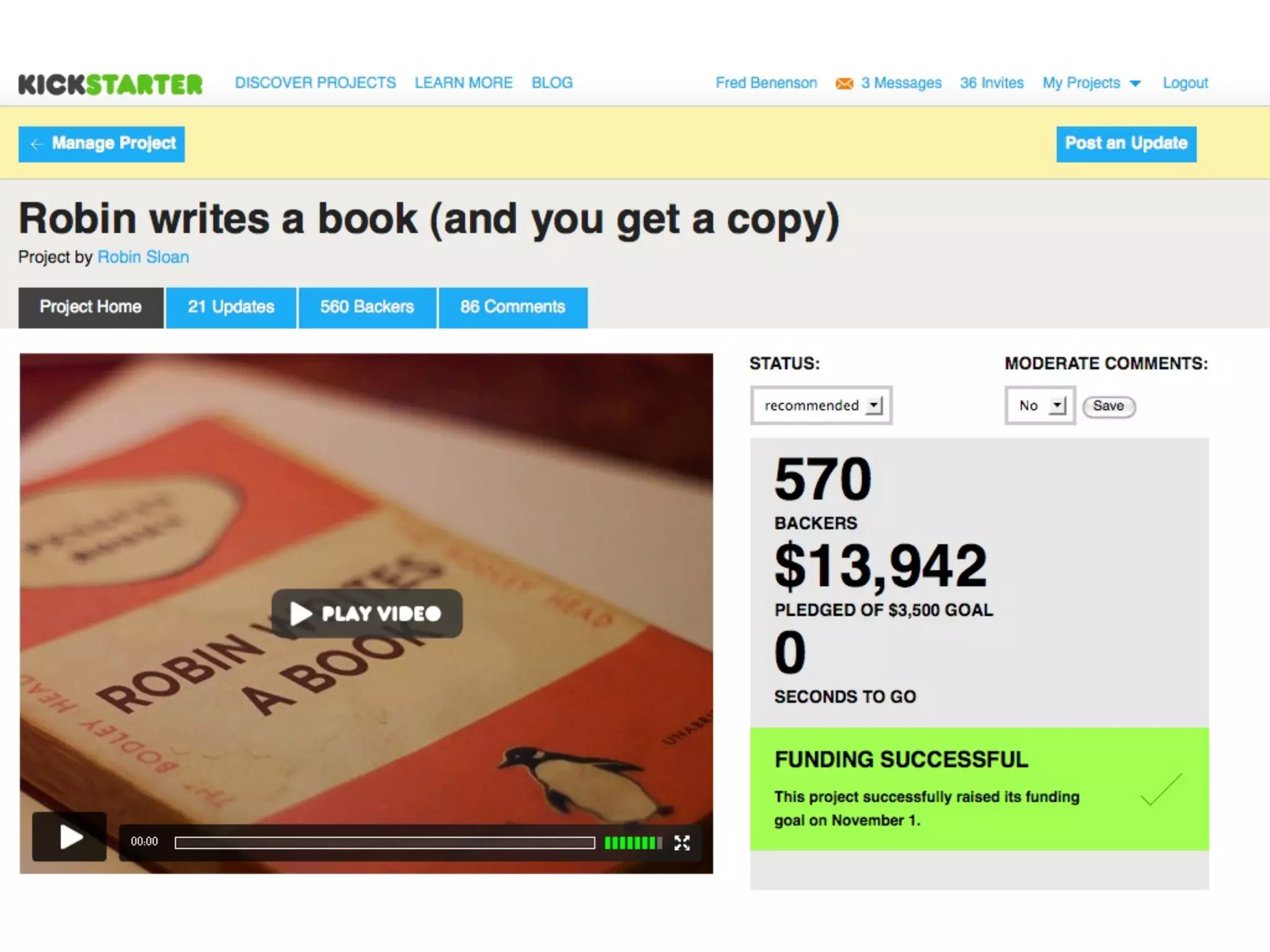
                       kickstarter
Fred Benenson
fred@kickstarter.com
January 28th, 2010
What is        C?
A 501c3 corporation headquartered in San
 Francisco with 30 employees around the world.
  CC is a non-profit.
  CC does not offer legal services per se.

CC  offers free legal and technology tools that
 allow creators to publish their works on more
 flexible terms than standard copyright.
Terms that allow public sharing, reuse, and
 remix.
First, a crash slide in ©
   Fixed creative expression
Not    Ideas
Not    facts
All   rights reserved
    Reproduce,  display, distribute, perform,
     perform (transmit), create derivatives.
70    years after author’s death
95    for work for hire
Why?
#1
Analog Media


    Uses
 Implicating
                  All
   © Law       Possible
               Uses of a
                Work
     Fair
     Uses
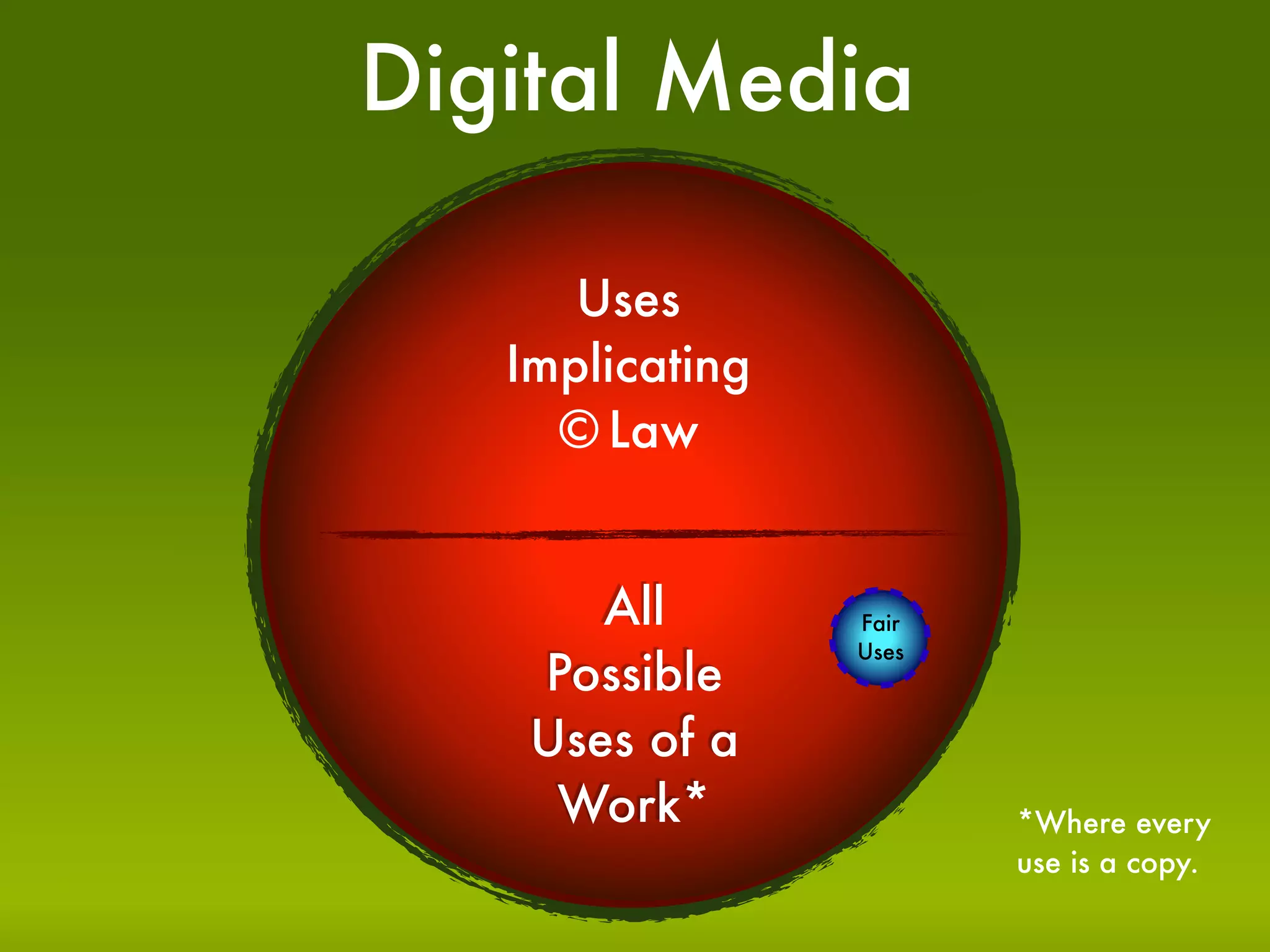
Digital Media

      Uses
   Implicating
     © Law


       All       Fair
                 Uses
    Possible
    Uses of a
     Work*              *Where every
                        use is a copy.
#2
The State of the
   Commons Prior to 2002
        Public Domain
                                          Default Automatic © All Rights Reserved
      No Rights Reserved


                           Orphan Works


Pre-1923 works, Federal              Everything from Disney films
Government Works, etc.               to your notes, to most of the
                                     web.
Introducing:
                                   C
         No Rights Reserved   Some Rights Reserved           All Rights Reserved


                                                     Orphan Works
Pre-1923 works, Federal
Government Works, etc.                                              Everything from Disney films


                               c                                    to your notes, to most of the
                                                                    web.
#3
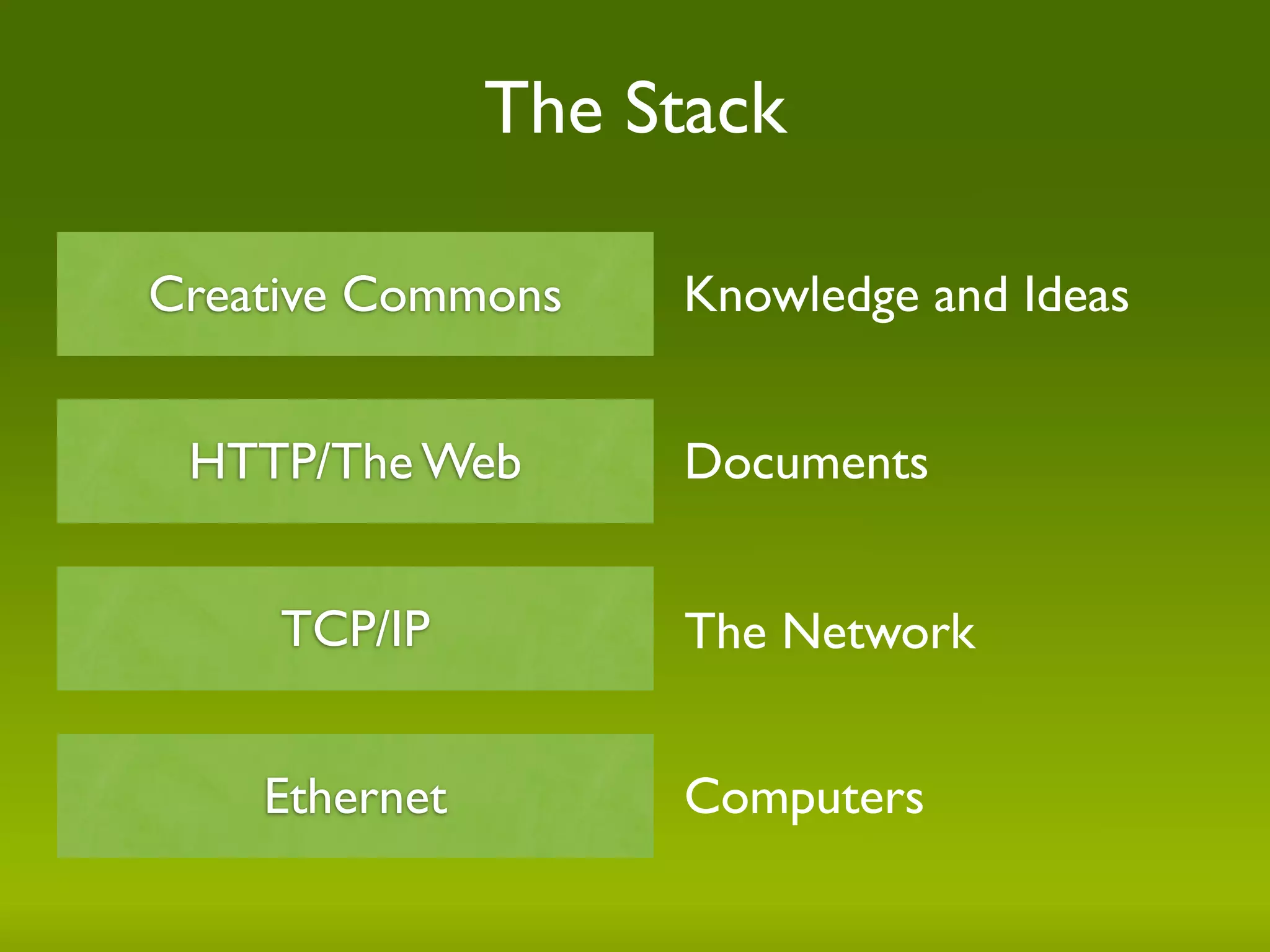
The Stack

Creative Commons    Knowledge and Ideas


 HTTP/The Web       Documents


     TCP/IP         The Network


    Ethernet        Computers
What does   C actually do?
Licensing
Step 1: Choose Conditions


    Attribution             Share Alike


    Non-Commercial          No Derivative Works
Licensing
Step 2: Receive a License
Some Considerations
Publiclicenses are irrevocable and
 perpetual
 However   works can be removed from public
  and their licenses can be changed
CC   licenses are non-exclusive
 Dual    licensing
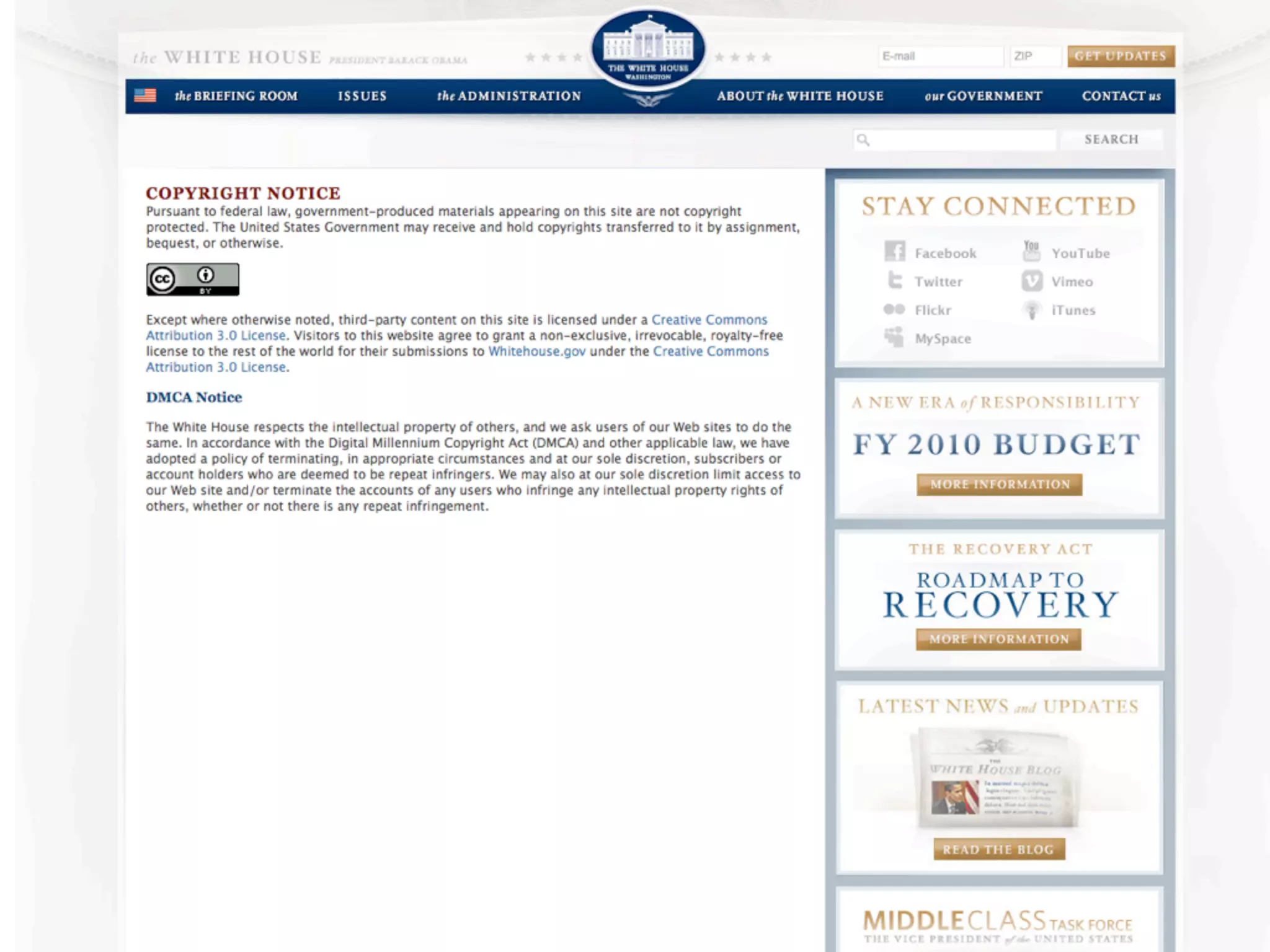
Creative Commons licenses do not
 preclude fair uses, fair dealing, etc.
Most Importantly

CC   Licenses are built on top of © law
Violate   the terms of a CC license?
 Your   rights to use the work are terminated.
 Creator  eligible for remedies under
  traditional © law for infringement.
CC  Licenses do not replace, substitute, or
 provide an alternative to ©.
Three Different Formats
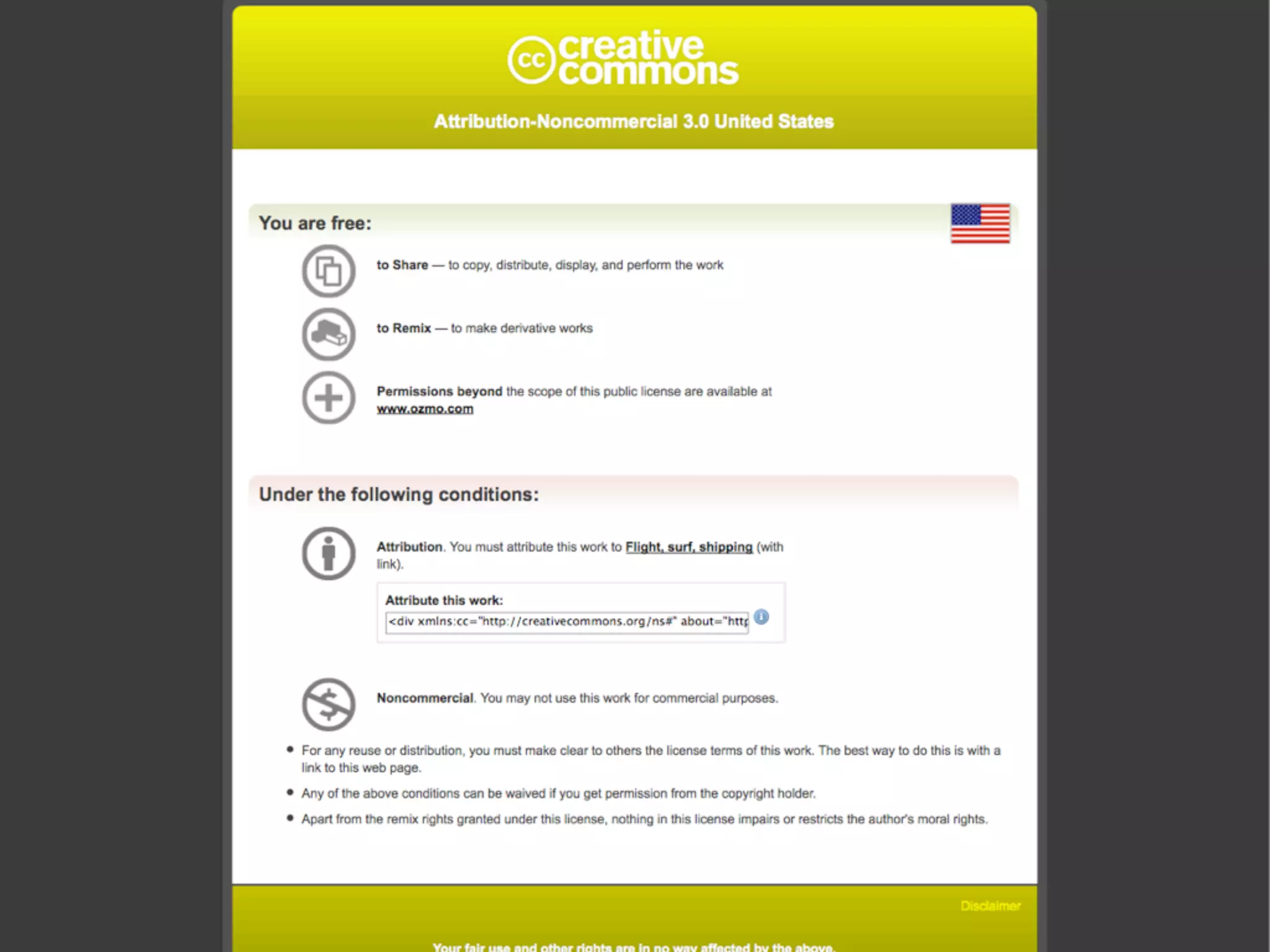
Format #1: Human Readable Deed
Format #2: Lawyer Readable Legal Code
Format #3: Machine Readable Metadata

<span xmlns:cc="http://creativecommons.org/ns#" xmlns:dc="http://
purl.org/dc/elements/1.1/">

<span rel="dc:type" href="http://purl.org/dc/dcmitype/Text"
property="dc:title">My Photo</span> by
<a rel="cc:attributionURL" property="cc:attributionName" href="http://
joi.ito.com/my_book">Fred Benenson</a>
is licensed under a

<a rel="license" href="http://creativecommons.org/licenses/by/
3.0/">Creative Commons Attribution 3.0 License</a>.

<span rel="dc:source" href="http://fredbenenson.com/photo"/>
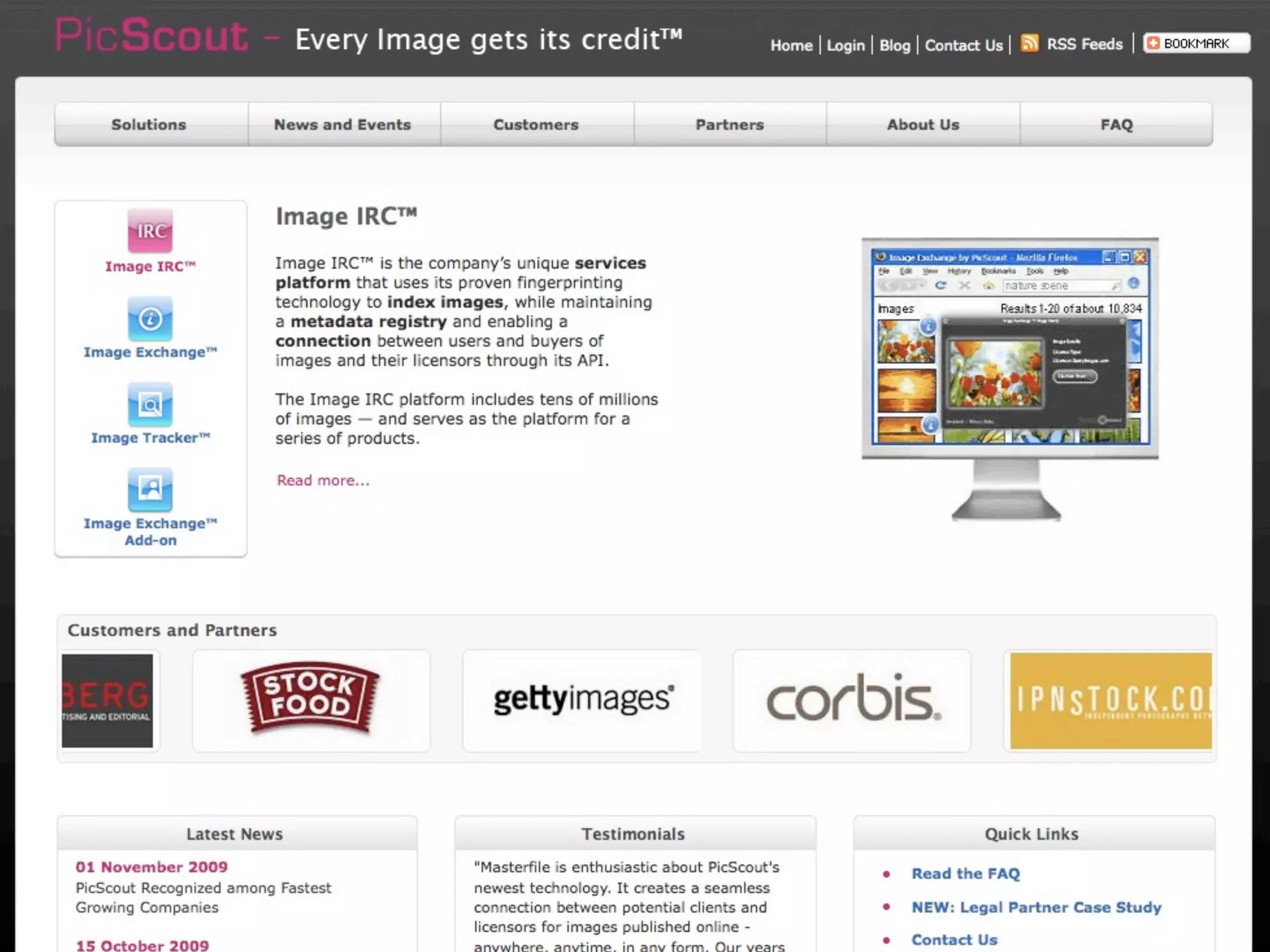
Permissions beyond the scope of this license may be available at <a
rel="cc:morePermissions" href="http://ozmo.com/
revenue_sharing_agreement">OZMO</a>.</span>
</span>
International Jurisdictions
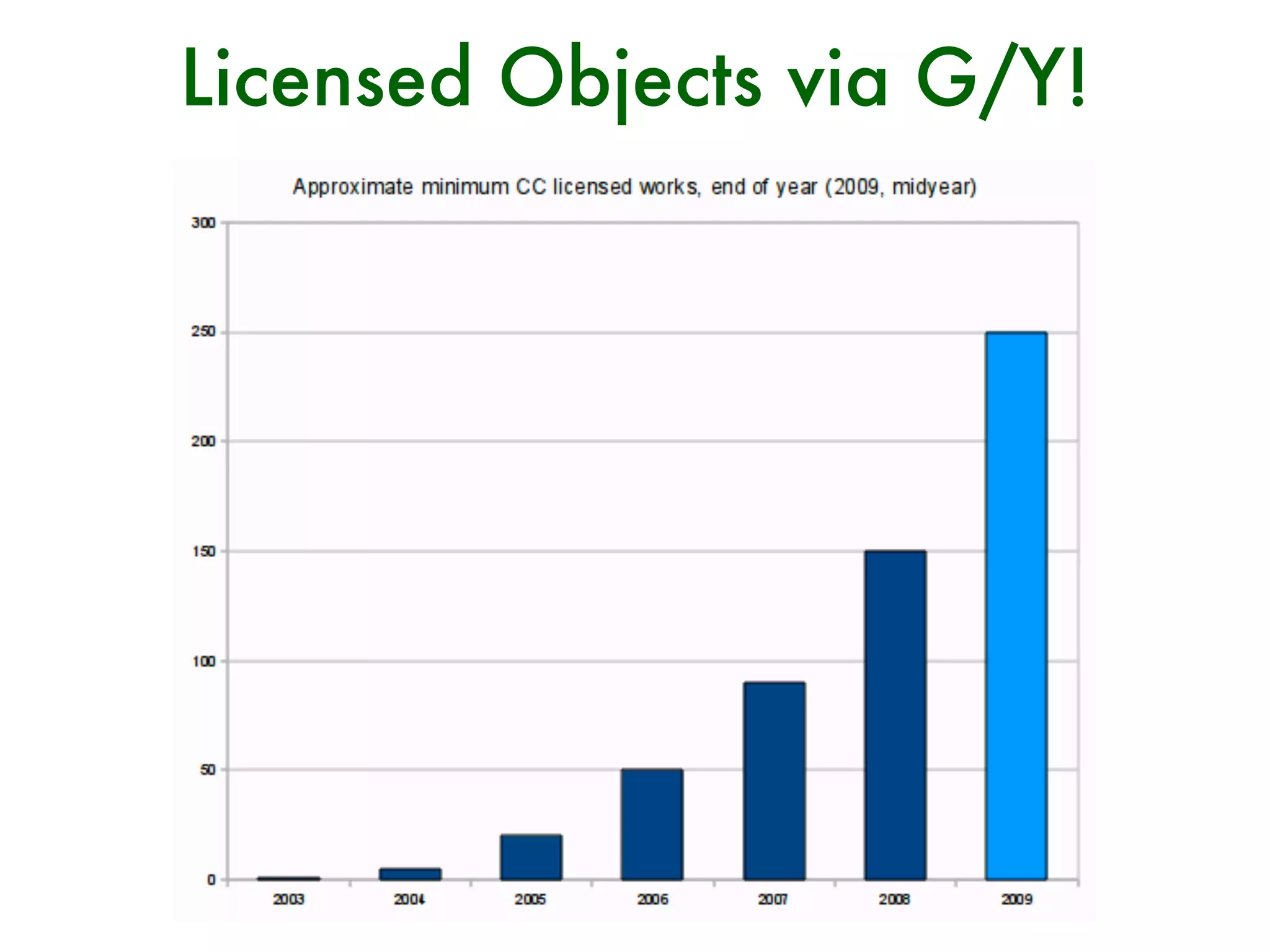
Licensed Objects via G/Y!
120+ Million CC Licensed Photos on Flickr
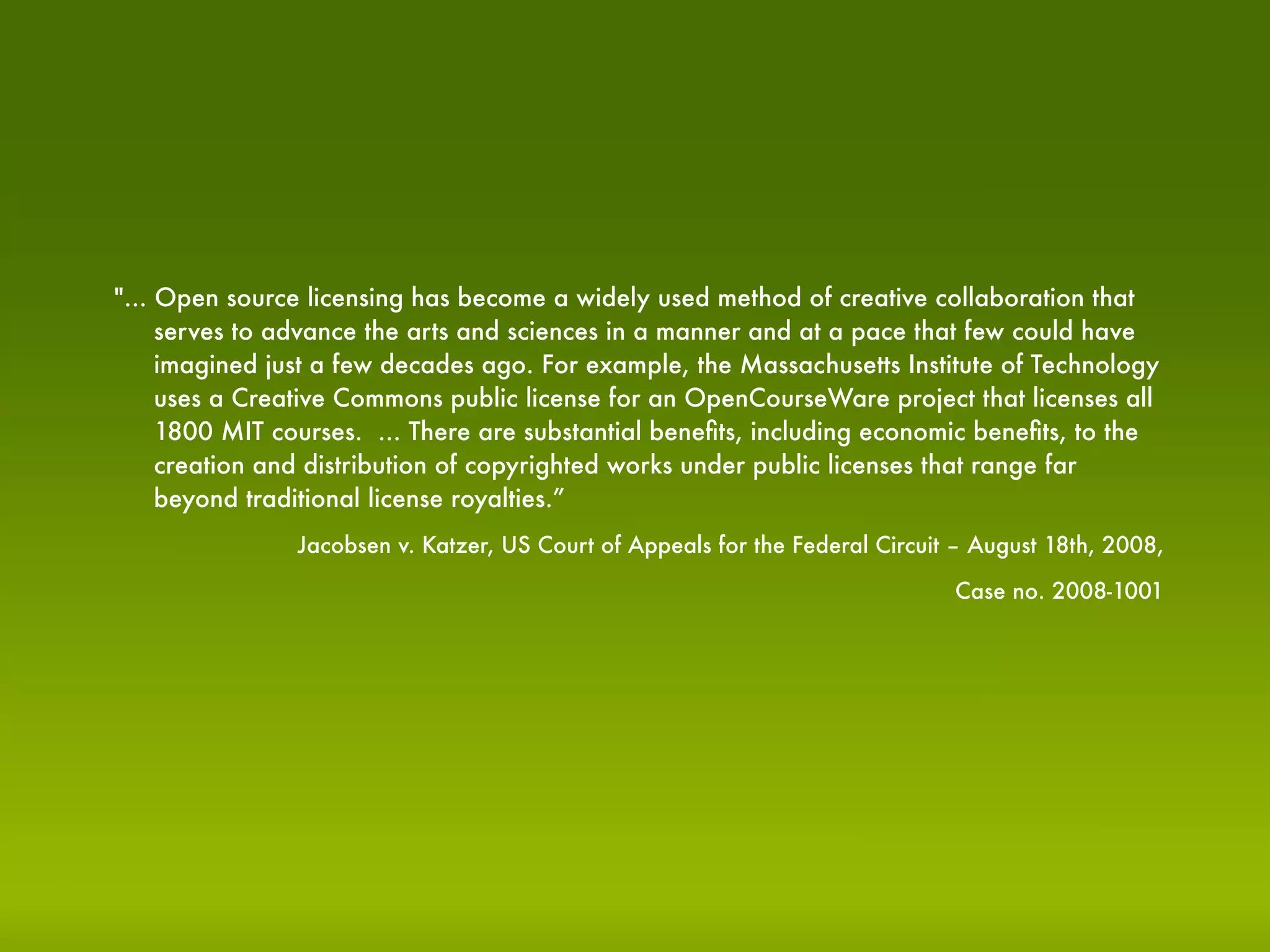
Jacobsen v. Katzer
"... Open source licensing has become a widely used method of creative collaboration that
     serves to advance the arts and sciences in a manner and at a pace that few could have
     imagined just a few decades ago. For example, the Massachusetts Institute of Technology
     uses a Creative Commons public license for an OpenCourseWare project that licenses all
     1800 MIT courses. ... There are substantial benefits, including economic benefits, to the
     creation and distribution of copyrighted works under public licenses that range far
     beyond traditional license royalties.”
                Jacobsen v. Katzer, US Court of Appeals for the Federal Circuit – August 18th, 2008,

                                                                               Case no. 2008-1001
http://creativecommons.org/projects/ccplus
+
    COMPANY
COMMERCIAL LICENSE
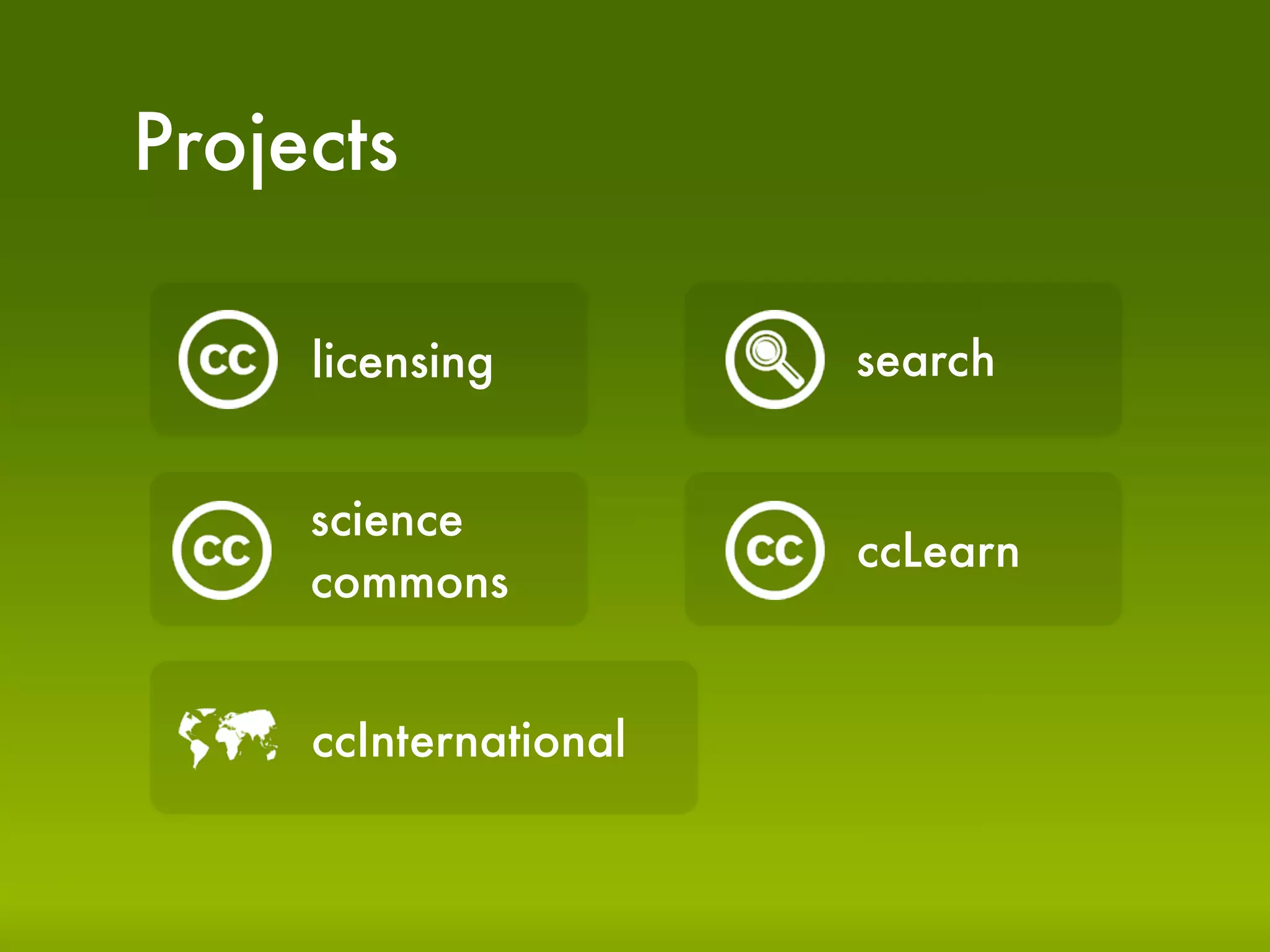
Projects

     licensing         search


     science
                       ccLearn
     commons


     ccInternational
Jonathan Coulton
Jonathan Coulton
                                  Commoner Letter
“ ... It’s hard to overstate the degree to which CC has contributed to my career as a musician. In 2005 I started Thing a
Week, a project in which I recorded a new song every week and released it for free on my website and in a podcast feed, licensing
everything with Creative Commons. Over the course of that year, my growing audience started to feed back to me things they had
created based on my music: videos, artwork, remixes, card games, coloring books. I long ago lost track of this torrent of fan-made
stuff, and of course I’ll never know how many people simply shared my music with friends, but there’s no question in my mind that
Creative Commons is a big part of why I’m now able to make a living this way. Indeed, it’s where much of my audience comes from -
there are some fan-made music videos on YouTube that have been viewed millions of times. That’s an enormous amount of exposure to
new potential fans, and it costs me exactly zero dollars.

When you’re an artist, it’s a wonderful thing to hear from a fan who likes what you do. But it’s even more thrilling to see that someone
was moved enough to make something brand new based on it - that your creative work has inspired someone to do more creative
work, that your little song had a child and that child was a YouTube video that a million people watched. A Creative Commons
license is like a joy multiplier. The art you create adds to the world whenever someone appreciates it, but you also get
karma credit for every new piece of art it inspires. And around and around. This is my favorite thing about Creative
Commons: the act of creation becomes not the end, but the beginning of a creative process that links complete strangers
together in collaboration. To me it’s a deeply satisfying and beautiful vision of what art and culture can be. ...”
NYU January 27th
NYU January 27th
NYU January 27th
NYU January 27th
NYU January 27th
NYU January 27th
NYU January 27th
NYU January 27th
NYU January 27th
NYU January 27th
NYU January 27th
NYU January 27th
NYU January 27th
NYU January 27th
NYU January 27th
NYU January 27th
NYU January 27th
NYU January 27th
NYU January 27th
NYU January 27th
NYU January 27th
NYU January 27th

NYU January 27th

  • 1.
    copyright, C and kickstarter Fred Benenson fred@kickstarter.com January 28th, 2010
  • 2.
    What is C? A 501c3 corporation headquartered in San Francisco with 30 employees around the world. CC is a non-profit. CC does not offer legal services per se. CC offers free legal and technology tools that allow creators to publish their works on more flexible terms than standard copyright. Terms that allow public sharing, reuse, and remix.
  • 3.
    First, a crashslide in ©  Fixed creative expression Not Ideas Not facts All rights reserved Reproduce, display, distribute, perform, perform (transmit), create derivatives. 70 years after author’s death 95 for work for hire
  • 4.
  • 5.
  • 6.
    Analog Media Uses Implicating All © Law Possible Uses of a Work Fair Uses
  • 7.
    Digital Media Uses Implicating © Law All Fair Uses Possible Uses of a Work* *Where every use is a copy.
  • 8.
  • 9.
    The State ofthe Commons Prior to 2002 Public Domain Default Automatic © All Rights Reserved No Rights Reserved Orphan Works Pre-1923 works, Federal Everything from Disney films Government Works, etc. to your notes, to most of the web.
  • 10.
    Introducing: C No Rights Reserved Some Rights Reserved All Rights Reserved Orphan Works Pre-1923 works, Federal Government Works, etc. Everything from Disney films c to your notes, to most of the web.
  • 11.
  • 12.
    The Stack Creative Commons Knowledge and Ideas HTTP/The Web Documents TCP/IP The Network Ethernet Computers
  • 13.
    What does C actually do?
  • 15.
    Licensing Step 1: ChooseConditions Attribution Share Alike Non-Commercial No Derivative Works
  • 16.
  • 17.
    Some Considerations Publiclicenses areirrevocable and perpetual However works can be removed from public and their licenses can be changed CC licenses are non-exclusive Dual licensing Creative Commons licenses do not preclude fair uses, fair dealing, etc.
  • 18.
    Most Importantly CC Licenses are built on top of © law Violate the terms of a CC license? Your rights to use the work are terminated. Creator eligible for remedies under traditional © law for infringement. CC Licenses do not replace, substitute, or provide an alternative to ©.
  • 21.
  • 23.
    Format #1: HumanReadable Deed
  • 24.
    Format #2: LawyerReadable Legal Code
  • 25.
    Format #3: MachineReadable Metadata <span xmlns:cc="http://creativecommons.org/ns#" xmlns:dc="http:// purl.org/dc/elements/1.1/"> <span rel="dc:type" href="http://purl.org/dc/dcmitype/Text" property="dc:title">My Photo</span> by <a rel="cc:attributionURL" property="cc:attributionName" href="http:// joi.ito.com/my_book">Fred Benenson</a> is licensed under a <a rel="license" href="http://creativecommons.org/licenses/by/ 3.0/">Creative Commons Attribution 3.0 License</a>. <span rel="dc:source" href="http://fredbenenson.com/photo"/> Permissions beyond the scope of this license may be available at <a rel="cc:morePermissions" href="http://ozmo.com/ revenue_sharing_agreement">OZMO</a>.</span> </span>
  • 29.
  • 30.
  • 31.
    120+ Million CCLicensed Photos on Flickr
  • 32.
  • 33.
    "... Open sourcelicensing has become a widely used method of creative collaboration that serves to advance the arts and sciences in a manner and at a pace that few could have imagined just a few decades ago. For example, the Massachusetts Institute of Technology uses a Creative Commons public license for an OpenCourseWare project that licenses all 1800 MIT courses. ... There are substantial benefits, including economic benefits, to the creation and distribution of copyrighted works under public licenses that range far beyond traditional license royalties.” Jacobsen v. Katzer, US Court of Appeals for the Federal Circuit – August 18th, 2008, Case no. 2008-1001
  • 34.
  • 38.
    + COMPANY COMMERCIAL LICENSE
  • 43.
    Projects licensing search science ccLearn commons ccInternational
  • 48.
  • 49.
    Jonathan Coulton Commoner Letter “ ... It’s hard to overstate the degree to which CC has contributed to my career as a musician. In 2005 I started Thing a Week, a project in which I recorded a new song every week and released it for free on my website and in a podcast feed, licensing everything with Creative Commons. Over the course of that year, my growing audience started to feed back to me things they had created based on my music: videos, artwork, remixes, card games, coloring books. I long ago lost track of this torrent of fan-made stuff, and of course I’ll never know how many people simply shared my music with friends, but there’s no question in my mind that Creative Commons is a big part of why I’m now able to make a living this way. Indeed, it’s where much of my audience comes from - there are some fan-made music videos on YouTube that have been viewed millions of times. That’s an enormous amount of exposure to new potential fans, and it costs me exactly zero dollars. When you’re an artist, it’s a wonderful thing to hear from a fan who likes what you do. But it’s even more thrilling to see that someone was moved enough to make something brand new based on it - that your creative work has inspired someone to do more creative work, that your little song had a child and that child was a YouTube video that a million people watched. A Creative Commons license is like a joy multiplier. The art you create adds to the world whenever someone appreciates it, but you also get karma credit for every new piece of art it inspires. And around and around. This is my favorite thing about Creative Commons: the act of creation becomes not the end, but the beginning of a creative process that links complete strangers together in collaboration. To me it’s a deeply satisfying and beautiful vision of what art and culture can be. ...”