




Opening Up Education
with OER
Regina Gong, Librarian and OER Project Manager
Lansing Community College @drgong
http://libguides.lcc.edu/oer
University Librarian Forum
Michigan State University Libraries, November 14, 2018
This work is licensed under the Creative Commons Attribution 4.0 International License.
https://www.slideshare.net/ReginaGong/
What I’ll talk about today
• Open education
• Overview of OER
• OER Project at LCC
• Affordances of OER
• OER efficacy research
• Challenges and libraries’ role in OER initiatives
• Statewide and national activities
• Q & A and discussion
Open education
Open resources
Open Educational Resources
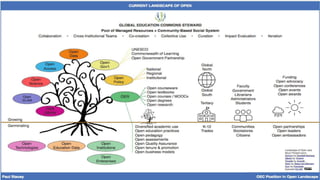
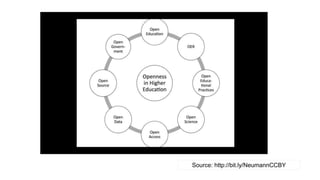
Contextualizing open education
"open education encompasses resources, tools and practices that
employ a framework of open sharing to improve educational access
and effectiveness worldwide." (Open Education Consortium)
“open education is not limited to just open educational resources. It
also draws upon open technologies that facilitate collaborative,
flexible learning and the open sharing of teaching practices that
empower educators to benefit from the best ideas of their
colleagues.” (The Cape Town Open Education Declaration, 2007,
para. 4).
Source: http://bit.ly/NeumannCCBY
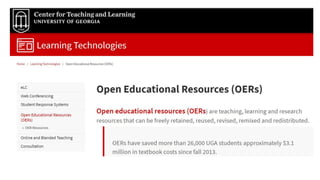
Open Educational Resources (OER)
“Open Educational Resources are teaching, learning and
research materials in any medium – digital or otherwise –
that reside in the public domain or have been released under
an open license that permits no-cost access, use, adaptation
and redistribution by others with no or limited restrictions."
~William & Flora Hewlett Foundation
OER come in many forms:
• open textbooks
• full courses
• modules
• syllabi
• lectures
• homework assignments
• quizzes
• lab activities
• games
• simulations
Why use OER?
• Provides faculty with more choices for their courses.
• Allows for permission-free editing and adaptation.
• Prevents faculty from being locked into a particular
system or platform.
• Eliminate textbook cost as barrier to student success.
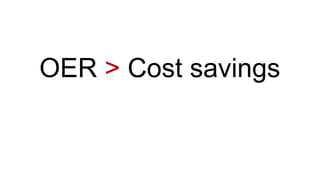
OER > Cost savings
Free OER
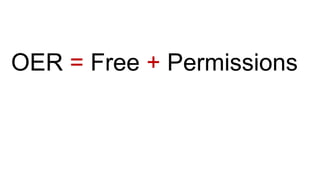
OER = Free + Permissions
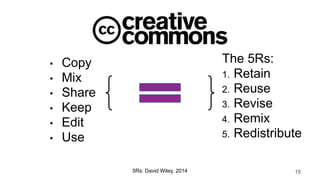
• Copy
• Mix
• Share
• Keep
• Edit
• Use
The 5Rs:
1. Retain
2. Reuse
3. Revise
4. Remix
5. Redistribute
5Rs: David Wiley, 2014 15
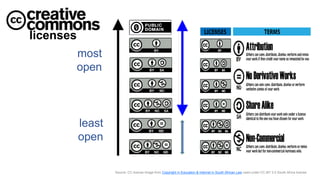
licenses
most
open
least
open
Source: CC license image from Copyright in Education & Internet in South African Law used under CC-BY 2.5 South Africa license
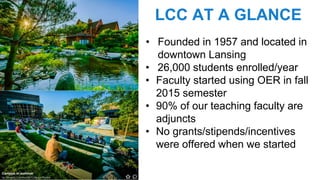
LCC AT A GLANCE
• Founded in 1957 and located in
downtown Lansing
• 26,000 students enrolled/year
• Faculty started using OER in fall
2015 semester
• 90% of our teaching faculty are
adjuncts
• No grants/stipends/incentives
were offered when we started
Textbook affordability
Allow faculty exploration and innovation in finding new,
better, and less costly ways to deliver quality learning
materials to students in addition to improved pedagogy
and teaching practices.
Goals of the OER Initiative at LCC
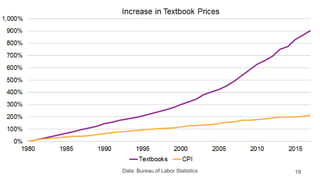
Data: Bureau of Labor Statistics 19
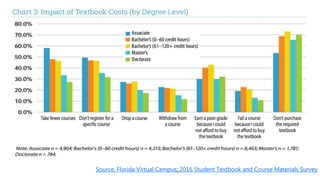
Source: Florida Virtual Campus: 2016 Student Textbook and Course Materials Survey
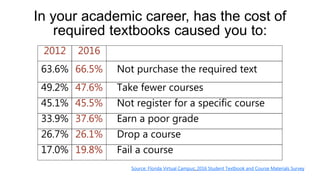
2012 2016
63.6% 66.5% Not purchase the required text
49.2% 47.6% Take fewer courses
45.1% 45.5% Not register for a specific course
33.9% 37.6% Earn a poor grade
26.7% 26.1% Drop a course
17.0% 19.8% Fail a course
In your academic career, has the cost of
required textbooks caused you to:
Source: Florida Virtual Campus: 2016 Student Textbook and Course Materials Survey
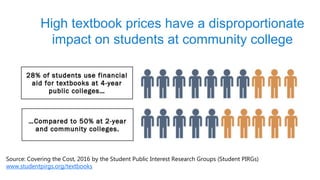
Source: Covering the Cost, 2016 by the Student Public Interest Research Groups (Student PIRGs)
www.studentpirgs.org/textbooks
High textbook prices have a disproportionate
impact on students at community college
OER and Open Learning are
two of the ongoing
competitiveness and
innovation projects in the
2017-2020 LCC Strategic
Plan.
So what are we using
here at LCC?
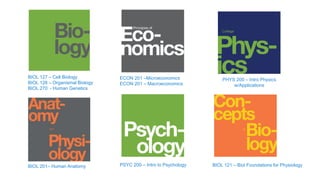
BIOL 127 – Cell Biology
BIOL 128 – Organismal Biology
BIOL 270 - Human Genetics
PSYC 200 – Intro to Psychology
ECON 201 –Microeconomics
ECON 201 – Macroeconomics
BIOL 201– Human Anatomy BIOL 121 – Biol Foundations for Physiology
PHYS 200 – Intro Physics
w/Applications
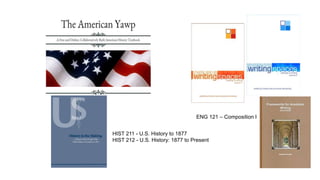
HIST 211 - U.S. History to 1877
HIST 212 - U.S. History: 1877 to Present
ENG 121 – Composition I
OER adopters OER creators
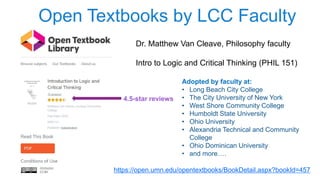
Open Textbooks by LCC Faculty
https://open.umn.edu/opentextbooks/BookDetail.aspx?bookId=457
4.5-star reviews
Dr. Matthew Van Cleave, Philosophy faculty
Intro to Logic and Critical Thinking (PHIL 151)
Adopted by faculty at:
• Long Beach City College
• The City University of New York
• West Shore Community College
• Humboldt State University
• Ohio University
• Alexandria Technical and Community
College
• Ohio Dominican University
• and more….
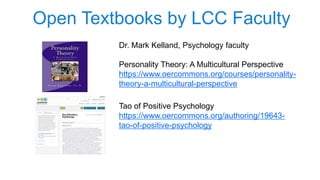
Dr. Mark Kelland, Psychology faculty
Personality Theory: A Multicultural Perspective
https://www.oercommons.org/courses/personality-
theory-a-multicultural-perspective
Open Textbooks by LCC Faculty
Tao of Positive Psychology
https://www.oercommons.org/authoring/19643-
tao-of-positive-psychology
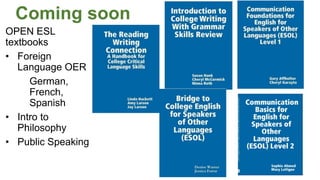
Coming soon
OPEN ESL
textbooks
• Foreign
Language OER
German,
French,
Spanish
• Intro to
Philosophy
• Public Speaking
Let’s look at our adoption
figures at LCC
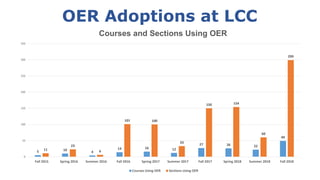
OER Adoptions at LCC
5 10
4
14 16 12
27 26 22
49
11
23
6
101 100
33
150 154
60
299
0
50
100
150
200
250
300
350
Fall 2015 Spring 2016 Summer 2016 Fall 2016 Spring 2017 Summer 2017 Fall 2017 Spring 2018 Summer 2018 Fall 2018
Courses and Sections Using OER
Courses Using OER Sections Using OER
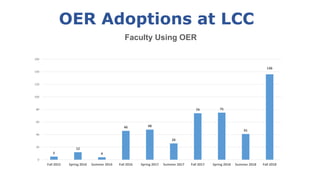
OER Adoptions at LCC
5
12
4
46 48
26
74 75
41
136
0
20
40
60
80
100
120
140
160
Fall 2015 Spring 2016 Summer 2016 Fall 2016 Spring 2017 Summer 2017 Fall 2017 Spring 2018 Summer 2018 Fall 2018
Faculty Using OER
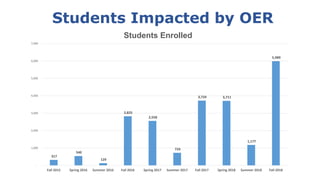
Students Impacted by OER
317
540
129
2,825
2,558
724
3,724 3,711
1,177
5,989
-
1,000
2,000
3,000
4,000
5,000
6,000
7,000
Fall 2015 Spring 2016 Summer 2016 Fall 2016 Spring 2017 Summer 2017 Fall 2017 Spring 2018 Summer 2018 Fall 2018
Students Enrolled
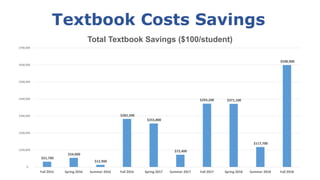
Textbook Costs Savings
$31,700
$54,000
$12,900
$282,500
$255,800
$72,400
$293,200 $371,100
$117,700
$598,900
$-
$100,000
$200,000
$300,000
$400,000
$500,000
$600,000
$700,000
Fall 2015 Spring 2016 Summer 2016 Fall 2016 Spring 2017 Summer 2017 Fall 2017 Spring 2018 Summer 2018 Fall 2018
Total Textbook Savings ($100/student)
$2.2M
Photo by Fabian Blank on Unsplash
But do we just swap publisher
textbooks with OER and call it
a day?
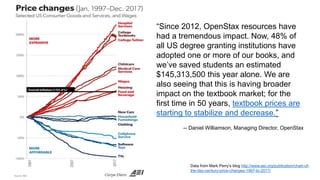
Data from Mark Perry’s blog http://www.aei.org/publication/chart-of-
the-day-century-price-changes-1997-to-2017/
“Since 2012, OpenStax resources have
had a tremendous impact. Now, 48% of
all US degree granting institutions have
adopted one or more of our books, and
we’ve saved students an estimated
$145,313,500 this year alone. We are
also seeing that this is having broader
impact on the textbook market; for the
first time in 50 years, textbook prices are
starting to stabilize and decrease.”
-- Daniel Williamson, Managing Director, OpenStax
If all we can say about OER is
that it saves students money
then we have a problem.
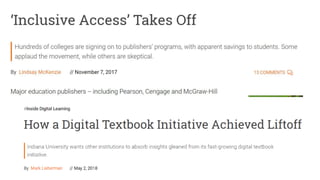
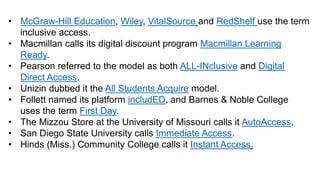
• McGraw-Hill Education, Wiley, VitalSource and RedShelf use the term
inclusive access.
• Macmillan calls its digital discount program Macmillan Learning
Ready.
• Pearson referred to the model as both ALL-INclusive and Digital
Direct Access.
• Unizin dubbed it the All Students Acquire model.
• Follett named its platform includED, and Barnes & Noble College
uses the term First Day.
• The Mizzou Store at the University of Missouri calls it AutoAccess.
• San Diego State University calls Immediate Access.
• Hinds (Miss.) Community College calls it Instant Access.
Why are we trusting the
companies who created the
problem to solve the
problem?
Photo by Sharon McCutcheon on Unsplash
Open education and open
educators have the power to
transform higher education
Affordability
Access
Teaching and Learning
Student Success
How do OER
contribute to student
success?
OER Efficacy Research
•Studies show that students assigned OER
have lower withdrawal and drop rates.
•More likely to pass with a C or better.
•Higher persistence and retention rates.
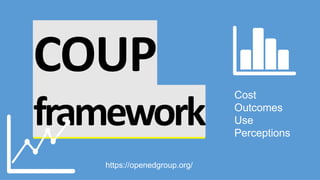
COUP
framework
Cost
Outcomes
Use
Perceptions
https://openedgroup.org/
Research Study Background
Compared publisher textbook use (AY 2015-2016)
vs. open textbook use (AY 2016-2017)
We eliminated the confounding variable of the
instructor
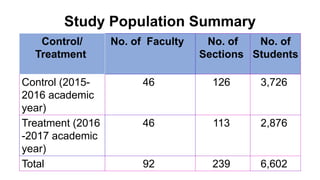
Study Population Summary
Control/
Treatment
No. of Faculty No. of
Sections
No. of
Students
Control (2015-
2016 academic
year)
46 126 3,726
Treatment (2016
-2017 academic
year)
46 113 2,876
Total 92 239 6,602
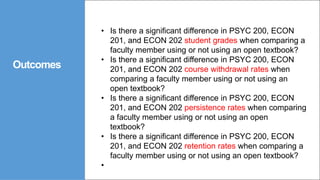
Outcomes
• Is there a significant difference in PSYC 200, ECON
201, and ECON 202 student grades when comparing a
faculty member using or not using an open textbook?
• Is there a significant difference in PSYC 200, ECON
201, and ECON 202 course withdrawal rates when
comparing a faculty member using or not using an
open textbook?
• Is there a significant difference in PSYC 200, ECON
201, and ECON 202 persistence rates when comparing
a faculty member using or not using an open
textbook?
• Is there a significant difference in PSYC 200, ECON
201, and ECON 202 retention rates when comparing a
faculty member using or not using an open textbook?
•
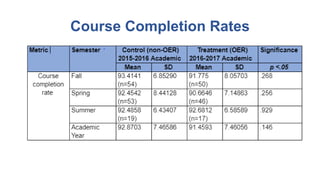
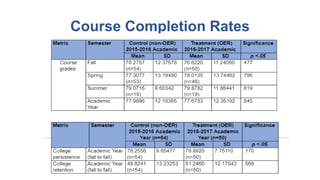
Course Completion Rates
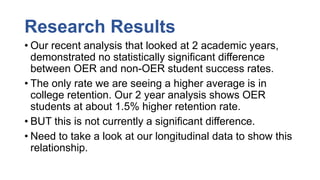
Research Results
• Our recent analysis that looked at 2 academic years,
demonstrated no statistically significant difference
between OER and non-OER student success rates.
• The only rate we are seeing a higher average is in
college retention. Our 2 year analysis shows OER
students at about 1.5% higher retention rate.
• BUT this is not currently a significant difference.
• Need to take a look at our longitudinal data to show this
relationship.
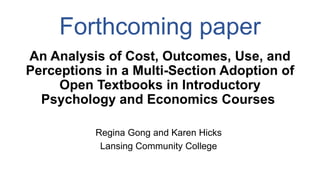
Forthcoming paper
An Analysis of Cost, Outcomes, Use, and
Perceptions in a Multi-Section Adoption of
Open Textbooks in Introductory
Psychology and Economics Courses
Regina Gong and Karen Hicks
Lansing Community College
How can we scale OER
usage and adoptions across
more courses?
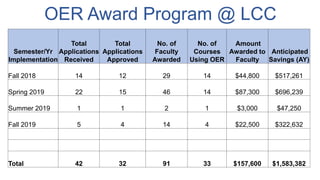
OER Award Program @ LCC
Semester/Yr
Implementation
Total
Applications
Received
Total
Applications
Approved
No. of
Faculty
Awarded
No. of
Courses
Using OER
Amount
Awarded to
Faculty
Anticipated
Savings (AY)
Fall 2018 14 12 29 14 $44,800 $517,261
Spring 2019 22 15 46 14 $87,300 $696,239
Summer 2019 1 1 2 1 $3,000 $47,250
Fall 2019 5 4 14 4 $22,500 $322,632
Total 42 32 91 33 $157,600 $1,583,382
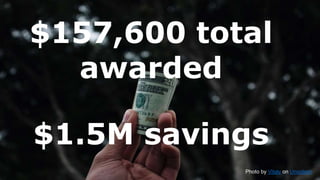
$157,600 total
awarded
Photo by Vitaly on Unsplash
$1.5M savings
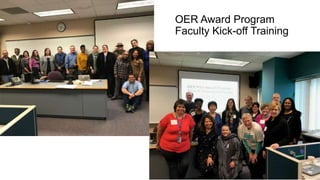
OER Award Program
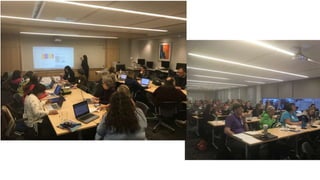
Faculty Kick-off Training
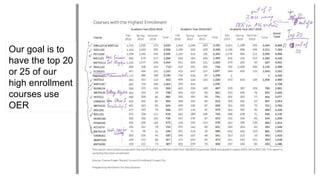
Our goal is to
have the top 20
or 25 of our
high enrollment
courses use
OER
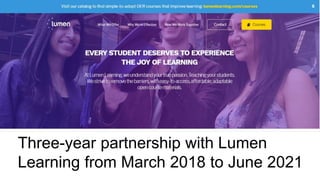
Three-year partnership with Lumen
Learning from March 2018 to June 2021
What else can OER do?
We can improve teaching
and learning with OER.
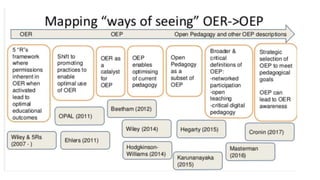
Open educational practices
Open pedagogy
Open educational practices (OEP)
“collaborative practices that include the creation,
use, and reuse of OER, as well as pedagogical
practices employing participatory technologies and
social networks for interaction, peer-learning,
knowledge creation, and empowerment of
learners.”
--- Catherine Cronin, 2017
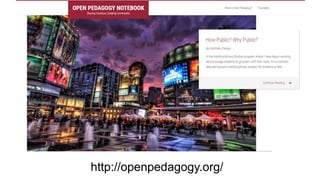
http://openpedagogy.org/
https://openamlit.pressbooks.com/
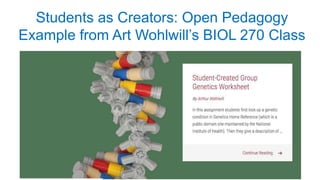
Students as Creators: Open Pedagogy
Example from Art Wohlwill’s BIOL 270 Class
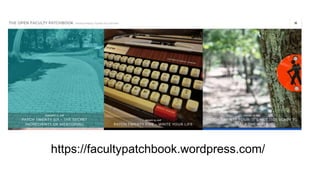
https://facultypatchbook.wordpress.com/
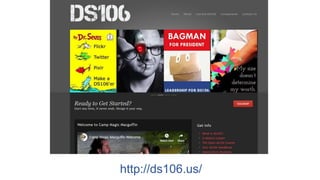
http://ds106.us/
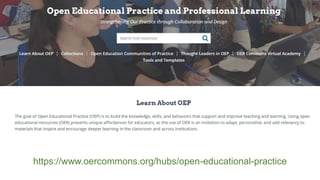
https://www.oercommons.org/hubs/open-educational-practice
Photo by Christoph Deinet on Unsplash
Challenges in
starting or
implementing an
OER initiative
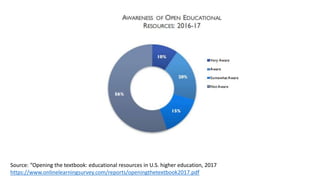
Source: “Opening the textbook: educational resources in U.S. higher education, 2017
https://www.onlinelearningsurvey.com/reports/openingthetextbook2017.pdf
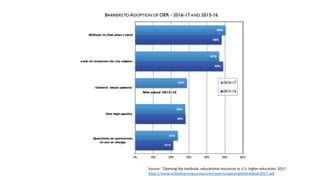
Source: “Opening the textbook: educational resources in U.S. higher education, 2017
https://www.onlinelearningsurvey.com/reports/openingthetextbook2017.pdf
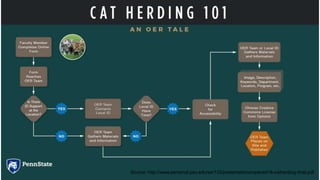
Source: http://www.personal.psu.edu/sxr133/presentations/opened18-catherding-final.pdf
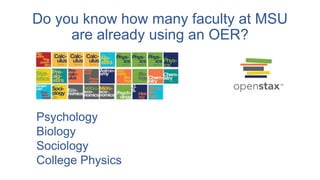
Do you know how many faculty at MSU
are already using an OER?
Psychology
Biology
Sociology
College Physics
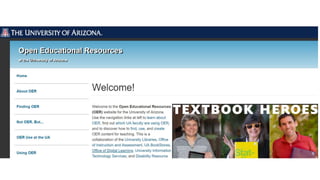
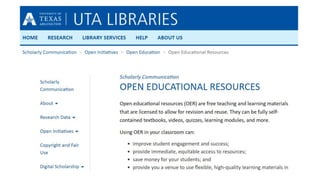
How do we even start?
• Environmental scanning
• OER readiness worksheet
• Think of your goals
• Textbook affordability?
• OER?
• Combination of both?
• Identify your stakeholders and get them involved
• Build your connections with faculty – look for your champions
• Focus on “openness” instead of resources
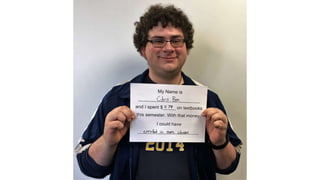
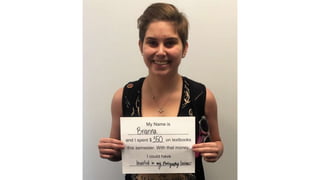
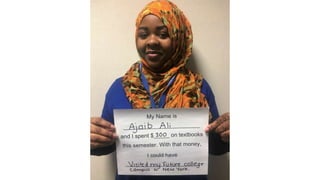
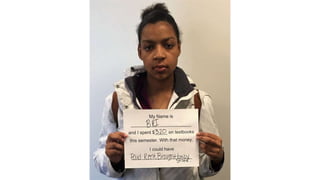
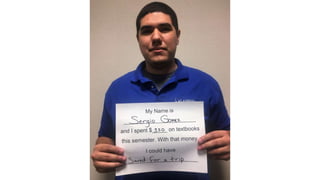
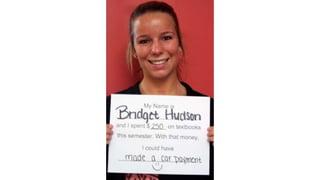
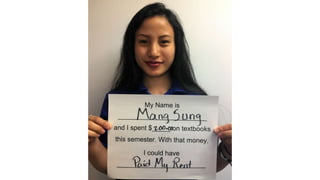
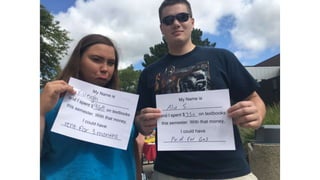
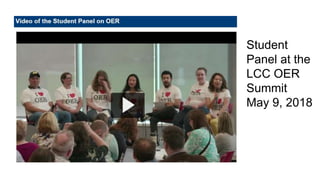
Don’t forget your students.
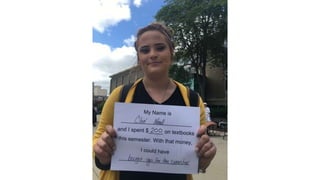
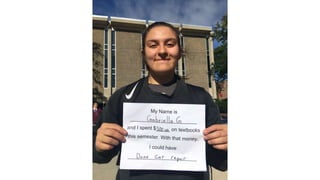
Student
Panel at the
LCC OER
Summit
May 9, 2018
down arrow by Misha from the Noun Project
Move Up by ImageCatalog from the Noun Project
Circle by Xinh Studio from the Noun Project
Our Success
Many good things
happening statewide on
OER
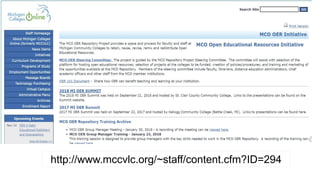
http://www.mccvlc.org/~staff/content.cfm?ID=294
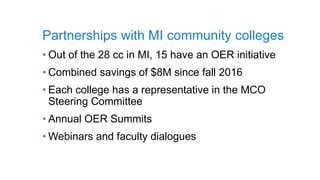
Partnerships with MI community colleges
• Out of the 28 cc in MI, 15 have an OER initiative
• Combined savings of $8M since fall 2016
• Each college has a representative in the MCO
Steering Committee
• Annual OER Summits
• Webinars and faculty dialogues
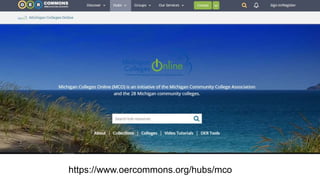
https://www.oercommons.org/hubs/mco
More exciting news
• OER State Policy and Implementation Summit for Midwestern
Higher Education Compact (MHEC) states.
• MHEC is a legislatively-created agreement among the 12
Midwestern states to work together to further higher education
within the region. The member states of the Compact are: Illinois,
Indiana, Iowa, Kansas, Michigan, Minnesota, Missouri, Nebraska,
North Dakota, Ohio, South Dakota, and Wisconsin.
• Attendees will form a state OER action team which will assess the
current scope and level of OER usage in their respective states and
craft a plan to coordinate OER efforts within their states.
•What can we do to work together?
•How can community colleges and
universities forge partnerships to better
serve our students?
•How do we change the way academia
works to move towards a sustainable
model that promotes open education?
Photo by Álvaro Serrano on Unsplash
Questions?
Regina Gong –
gongr1@lcc.edu
@drgong

Opening Up Education with OER

  • 1.
    Opening Up Education withOER Regina Gong, Librarian and OER Project Manager Lansing Community College @drgong http://libguides.lcc.edu/oer University Librarian Forum Michigan State University Libraries, November 14, 2018 This work is licensed under the Creative Commons Attribution 4.0 International License.
  • 2.
  • 3.
    What I’ll talkabout today • Open education • Overview of OER • OER Project at LCC • Affordances of OER • OER efficacy research • Challenges and libraries’ role in OER initiatives • Statewide and national activities • Q & A and discussion
  • 4.
  • 5.
    Contextualizing open education "openeducation encompasses resources, tools and practices that employ a framework of open sharing to improve educational access and effectiveness worldwide." (Open Education Consortium) “open education is not limited to just open educational resources. It also draws upon open technologies that facilitate collaborative, flexible learning and the open sharing of teaching practices that empower educators to benefit from the best ideas of their colleagues.” (The Cape Town Open Education Declaration, 2007, para. 4).
  • 7.
  • 8.
    Open Educational Resources(OER) “Open Educational Resources are teaching, learning and research materials in any medium – digital or otherwise – that reside in the public domain or have been released under an open license that permits no-cost access, use, adaptation and redistribution by others with no or limited restrictions." ~William & Flora Hewlett Foundation
  • 9.
    OER come inmany forms: • open textbooks • full courses • modules • syllabi • lectures • homework assignments • quizzes • lab activities • games • simulations
  • 10.
    Why use OER? •Provides faculty with more choices for their courses. • Allows for permission-free editing and adaptation. • Prevents faculty from being locked into a particular system or platform. • Eliminate textbook cost as barrier to student success.
  • 11.
    OER > Costsavings
  • 12.
  • 13.
    OER = Free+ Permissions
  • 14.
    • Copy • Mix •Share • Keep • Edit • Use The 5Rs: 1. Retain 2. Reuse 3. Revise 4. Remix 5. Redistribute 5Rs: David Wiley, 2014 15
  • 15.
    licenses most open least open Source: CC licenseimage from Copyright in Education & Internet in South African Law used under CC-BY 2.5 South Africa license
  • 16.
    LCC AT AGLANCE • Founded in 1957 and located in downtown Lansing • 26,000 students enrolled/year • Faculty started using OER in fall 2015 semester • 90% of our teaching faculty are adjuncts • No grants/stipends/incentives were offered when we started
  • 17.
    Textbook affordability Allow facultyexploration and innovation in finding new, better, and less costly ways to deliver quality learning materials to students in addition to improved pedagogy and teaching practices. Goals of the OER Initiative at LCC
  • 18.
    Data: Bureau ofLabor Statistics 19
  • 19.
    Source: Florida VirtualCampus: 2016 Student Textbook and Course Materials Survey
  • 20.
    2012 2016 63.6% 66.5%Not purchase the required text 49.2% 47.6% Take fewer courses 45.1% 45.5% Not register for a specific course 33.9% 37.6% Earn a poor grade 26.7% 26.1% Drop a course 17.0% 19.8% Fail a course In your academic career, has the cost of required textbooks caused you to: Source: Florida Virtual Campus: 2016 Student Textbook and Course Materials Survey
  • 21.
    Source: Covering theCost, 2016 by the Student Public Interest Research Groups (Student PIRGs) www.studentpirgs.org/textbooks High textbook prices have a disproportionate impact on students at community college
  • 33.
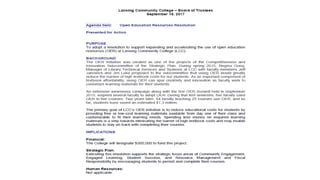
    OER and OpenLearning are two of the ongoing competitiveness and innovation projects in the 2017-2020 LCC Strategic Plan.
  • 34.
    So what arewe using here at LCC?
  • 35.
    BIOL 127 –Cell Biology BIOL 128 – Organismal Biology BIOL 270 - Human Genetics PSYC 200 – Intro to Psychology ECON 201 –Microeconomics ECON 201 – Macroeconomics BIOL 201– Human Anatomy BIOL 121 – Biol Foundations for Physiology PHYS 200 – Intro Physics w/Applications
  • 36.
    HIST 211 -U.S. History to 1877 HIST 212 - U.S. History: 1877 to Present ENG 121 – Composition I
  • 37.
  • 38.
    Open Textbooks byLCC Faculty https://open.umn.edu/opentextbooks/BookDetail.aspx?bookId=457 4.5-star reviews Dr. Matthew Van Cleave, Philosophy faculty Intro to Logic and Critical Thinking (PHIL 151) Adopted by faculty at: • Long Beach City College • The City University of New York • West Shore Community College • Humboldt State University • Ohio University • Alexandria Technical and Community College • Ohio Dominican University • and more….
  • 39.
    Dr. Mark Kelland,Psychology faculty Personality Theory: A Multicultural Perspective https://www.oercommons.org/courses/personality- theory-a-multicultural-perspective Open Textbooks by LCC Faculty Tao of Positive Psychology https://www.oercommons.org/authoring/19643- tao-of-positive-psychology
  • 40.
    Coming soon OPEN ESL textbooks •Foreign Language OER German, French, Spanish • Intro to Philosophy • Public Speaking
  • 42.
    Let’s look atour adoption figures at LCC
  • 43.
    OER Adoptions atLCC 5 10 4 14 16 12 27 26 22 49 11 23 6 101 100 33 150 154 60 299 0 50 100 150 200 250 300 350 Fall 2015 Spring 2016 Summer 2016 Fall 2016 Spring 2017 Summer 2017 Fall 2017 Spring 2018 Summer 2018 Fall 2018 Courses and Sections Using OER Courses Using OER Sections Using OER
  • 44.
    OER Adoptions atLCC 5 12 4 46 48 26 74 75 41 136 0 20 40 60 80 100 120 140 160 Fall 2015 Spring 2016 Summer 2016 Fall 2016 Spring 2017 Summer 2017 Fall 2017 Spring 2018 Summer 2018 Fall 2018 Faculty Using OER
  • 45.
    Students Impacted byOER 317 540 129 2,825 2,558 724 3,724 3,711 1,177 5,989 - 1,000 2,000 3,000 4,000 5,000 6,000 7,000 Fall 2015 Spring 2016 Summer 2016 Fall 2016 Spring 2017 Summer 2017 Fall 2017 Spring 2018 Summer 2018 Fall 2018 Students Enrolled
  • 46.
    Textbook Costs Savings $31,700 $54,000 $12,900 $282,500 $255,800 $72,400 $293,200$371,100 $117,700 $598,900 $- $100,000 $200,000 $300,000 $400,000 $500,000 $600,000 $700,000 Fall 2015 Spring 2016 Summer 2016 Fall 2016 Spring 2017 Summer 2017 Fall 2017 Spring 2018 Summer 2018 Fall 2018 Total Textbook Savings ($100/student)
  • 47.
    $2.2M Photo by FabianBlank on Unsplash
  • 48.
    But do wejust swap publisher textbooks with OER and call it a day?
  • 49.
    Data from MarkPerry’s blog http://www.aei.org/publication/chart-of- the-day-century-price-changes-1997-to-2017/ “Since 2012, OpenStax resources have had a tremendous impact. Now, 48% of all US degree granting institutions have adopted one or more of our books, and we’ve saved students an estimated $145,313,500 this year alone. We are also seeing that this is having broader impact on the textbook market; for the first time in 50 years, textbook prices are starting to stabilize and decrease.” -- Daniel Williamson, Managing Director, OpenStax
  • 50.
    If all wecan say about OER is that it saves students money then we have a problem.
  • 52.
    • McGraw-Hill Education,Wiley, VitalSource and RedShelf use the term inclusive access. • Macmillan calls its digital discount program Macmillan Learning Ready. • Pearson referred to the model as both ALL-INclusive and Digital Direct Access. • Unizin dubbed it the All Students Acquire model. • Follett named its platform includED, and Barnes & Noble College uses the term First Day. • The Mizzou Store at the University of Missouri calls it AutoAccess. • San Diego State University calls Immediate Access. • Hinds (Miss.) Community College calls it Instant Access.
  • 53.
    Why are wetrusting the companies who created the problem to solve the problem?
  • 54.
    Photo by SharonMcCutcheon on Unsplash
  • 55.
    Open education andopen educators have the power to transform higher education Affordability Access Teaching and Learning Student Success
  • 56.
    How do OER contributeto student success?
  • 57.
    OER Efficacy Research •Studiesshow that students assigned OER have lower withdrawal and drop rates. •More likely to pass with a C or better. •Higher persistence and retention rates.
  • 58.
  • 59.
    Research Study Background Comparedpublisher textbook use (AY 2015-2016) vs. open textbook use (AY 2016-2017) We eliminated the confounding variable of the instructor
  • 60.
    Study Population Summary Control/ Treatment No.of Faculty No. of Sections No. of Students Control (2015- 2016 academic year) 46 126 3,726 Treatment (2016 -2017 academic year) 46 113 2,876 Total 92 239 6,602
  • 61.
    Outcomes • Is therea significant difference in PSYC 200, ECON 201, and ECON 202 student grades when comparing a faculty member using or not using an open textbook? • Is there a significant difference in PSYC 200, ECON 201, and ECON 202 course withdrawal rates when comparing a faculty member using or not using an open textbook? • Is there a significant difference in PSYC 200, ECON 201, and ECON 202 persistence rates when comparing a faculty member using or not using an open textbook? • Is there a significant difference in PSYC 200, ECON 201, and ECON 202 retention rates when comparing a faculty member using or not using an open textbook? •
  • 62.
  • 63.
  • 64.
    Research Results • Ourrecent analysis that looked at 2 academic years, demonstrated no statistically significant difference between OER and non-OER student success rates. • The only rate we are seeing a higher average is in college retention. Our 2 year analysis shows OER students at about 1.5% higher retention rate. • BUT this is not currently a significant difference. • Need to take a look at our longitudinal data to show this relationship.
  • 65.
    Forthcoming paper An Analysisof Cost, Outcomes, Use, and Perceptions in a Multi-Section Adoption of Open Textbooks in Introductory Psychology and Economics Courses Regina Gong and Karen Hicks Lansing Community College
  • 66.
    How can wescale OER usage and adoptions across more courses?
  • 68.
    OER Award Program@ LCC Semester/Yr Implementation Total Applications Received Total Applications Approved No. of Faculty Awarded No. of Courses Using OER Amount Awarded to Faculty Anticipated Savings (AY) Fall 2018 14 12 29 14 $44,800 $517,261 Spring 2019 22 15 46 14 $87,300 $696,239 Summer 2019 1 1 2 1 $3,000 $47,250 Fall 2019 5 4 14 4 $22,500 $322,632 Total 42 32 91 33 $157,600 $1,583,382
  • 69.
    $157,600 total awarded Photo byVitaly on Unsplash $1.5M savings
  • 70.
    OER Award Program FacultyKick-off Training
  • 71.
    Our goal isto have the top 20 or 25 of our high enrollment courses use OER
  • 73.
    Three-year partnership withLumen Learning from March 2018 to June 2021
  • 75.
  • 76.
    We can improveteaching and learning with OER. Open educational practices Open pedagogy
  • 77.
    Open educational practices(OEP) “collaborative practices that include the creation, use, and reuse of OER, as well as pedagogical practices employing participatory technologies and social networks for interaction, peer-learning, knowledge creation, and empowerment of learners.” --- Catherine Cronin, 2017
  • 79.
  • 80.
  • 81.
    Students as Creators:Open Pedagogy Example from Art Wohlwill’s BIOL 270 Class
  • 82.
  • 83.
  • 84.
  • 85.
    Photo by ChristophDeinet on Unsplash Challenges in starting or implementing an OER initiative
  • 86.
    Source: “Opening thetextbook: educational resources in U.S. higher education, 2017 https://www.onlinelearningsurvey.com/reports/openingthetextbook2017.pdf
  • 87.
    Source: “Opening thetextbook: educational resources in U.S. higher education, 2017 https://www.onlinelearningsurvey.com/reports/openingthetextbook2017.pdf
  • 89.
  • 90.
    Do you knowhow many faculty at MSU are already using an OER? Psychology Biology Sociology College Physics
  • 91.
    How do weeven start? • Environmental scanning • OER readiness worksheet • Think of your goals • Textbook affordability? • OER? • Combination of both? • Identify your stakeholders and get them involved • Build your connections with faculty – look for your champions • Focus on “openness” instead of resources
  • 98.
  • 101.
    Student Panel at the LCCOER Summit May 9, 2018
  • 102.
    down arrow byMisha from the Noun Project Move Up by ImageCatalog from the Noun Project Circle by Xinh Studio from the Noun Project Our Success
  • 103.
  • 104.
  • 105.
    Partnerships with MIcommunity colleges • Out of the 28 cc in MI, 15 have an OER initiative • Combined savings of $8M since fall 2016 • Each college has a representative in the MCO Steering Committee • Annual OER Summits • Webinars and faculty dialogues
  • 106.
  • 107.
    More exciting news •OER State Policy and Implementation Summit for Midwestern Higher Education Compact (MHEC) states. • MHEC is a legislatively-created agreement among the 12 Midwestern states to work together to further higher education within the region. The member states of the Compact are: Illinois, Indiana, Iowa, Kansas, Michigan, Minnesota, Missouri, Nebraska, North Dakota, Ohio, South Dakota, and Wisconsin. • Attendees will form a state OER action team which will assess the current scope and level of OER usage in their respective states and craft a plan to coordinate OER efforts within their states.
  • 109.
    •What can wedo to work together? •How can community colleges and universities forge partnerships to better serve our students? •How do we change the way academia works to move towards a sustainable model that promotes open education?
  • 110.
    Photo by ÁlvaroSerrano on Unsplash Questions? Regina Gong – gongr1@lcc.edu @drgong