The document presents a final presentation on CMMI Maturity Level 2 Project Planning focused on defining project activities and establishing plans for effective project management. It discusses the development of an ERP software system, detailing specific goals, practices, and risks associated with the project, as well as the importance of stakeholder involvement and skilled staffing. Conclusions emphasize the necessity of a structured approach to project planning to ensure quality, commitment, and effective risk management.
Final presentation ofCMMI Maturity Level 2 Project Planning António Cerqueira , Girson Monteiro, Tiago Teixeira e Vitor Madureira. Gestão da Qualidade – MIEIC – FEUP 2008/2009
2.
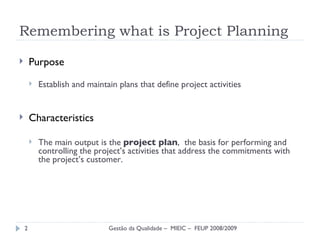
Remembering what isProject Planning Purpose Establish and maintain plans that define project activities Characteristics The main output is the project plan , the basis for performing and controlling the project’s activities that address the commitments with the project’s customer. Gestão da Qualidade – MIEIC – FEUP 2008/2009
3.
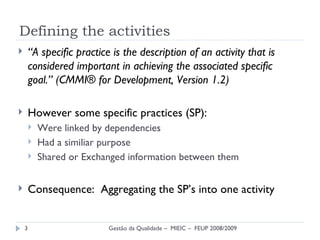
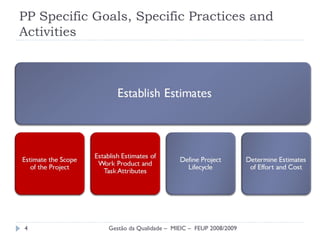
Defining the activities“ A specific practice is the description of an activity that is considered important in achieving the associated specific goal.” (CMMI® for Development, Version 1.2) However some specific practices (SP): Were linked by dependencies Had a similiar purpose Shared or Exchanged information between them Consequence: Aggregating the SP’s into one activity Gestão da Qualidade – MIEIC – FEUP 2008/2009
4.
PP Specific Goals,Specific Practices and Activities Gestão da Qualidade – MIEIC – FEUP 2008/2009
5.
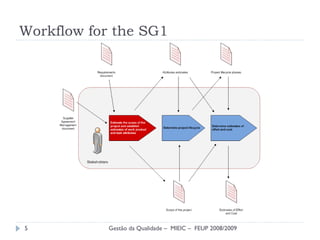
Workflow for theSG1 Gestão da Qualidade – MIEIC – FEUP 2008/2009
6.
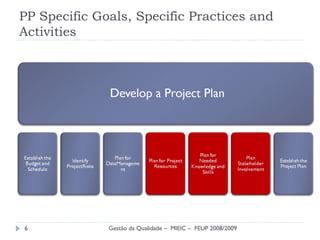
PP Specific Goals,Specific Practices and Activities Gestão da Qualidade – MIEIC – FEUP 2008/2009
7.
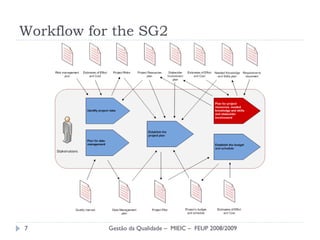
Workflow for theSG2 Gestão da Qualidade – MIEIC – FEUP 2008/2009
8.
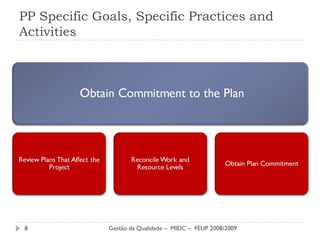
PP Specific Goals,Specific Practices and Activities Gestão da Qualidade – MIEIC – FEUP 2008/2009
9.
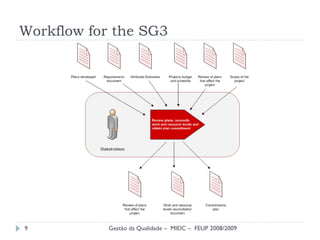
Workflow for theSG3 Gestão da Qualidade – MIEIC – FEUP 2008/2009
10.
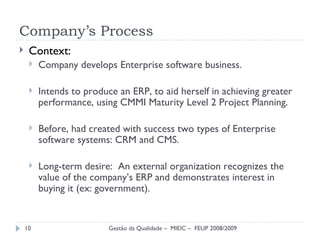
Company’s Process Context:Company develops Enterprise software business. Intends to produce an ERP, to aid herself in achieving greater performance, using CMMI Maturity Level 2 Project Planning. Before, had created with success two types of Enterprise software systems: CRM and CMS. Long-term desire: An external organization recognizes the value of the company’s ERP and demonstrates interest in buying it (ex: government). Gestão da Qualidade – MIEIC – FEUP 2008/2009
11.
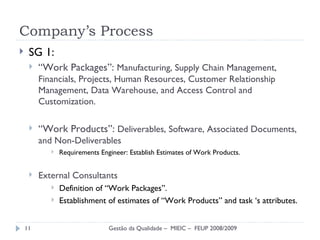
Company’s Process SG1: “ Work Packages”: Manufacturing, Supply Chain Management, Financials, Projects, Human Resources, Customer Relationship Management, Data Warehouse, and Access Control and Customization . “ Work Products”: Deliverables, Software, Associated Documents, and Non-Deliverables Requirements Engineer: Establish Estimates of Work Products. External Consultants Definition of “Work Packages”. Establishment of estimates of “Work Products” and task ‘s attributes. Gestão da Qualidade – MIEIC – FEUP 2008/2009
12.
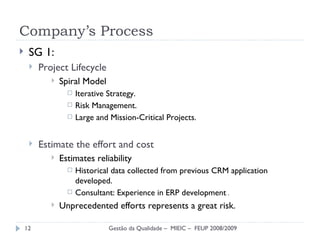
Company’s Process SG1: Project Lifecycle Spiral Model Iterative Strategy. Risk Management. Large and Mission-Critical Projects. Estimate the effort and cost Estimates reliability Historical data collected from previous CRM application developed. Consultant: Experience in ERP development . Unprecedented efforts represents a great risk. Gestão da Qualidade – MIEIC – FEUP 2008/2009
13.
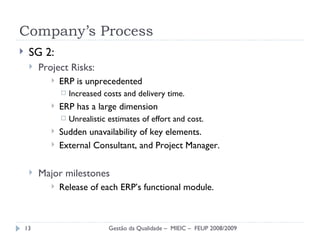
Company’s Process SG2: Project Risks : ERP is unprecedented Increased costs and delivery time. ERP has a large dimension Unrealistic estimates of effort and cost. Sudden unavailability of key elements. External Consultant, and Project Manager. Major milestones Release of each ERP’s functional module. Gestão da Qualidade – MIEIC – FEUP 2008/2009
14.
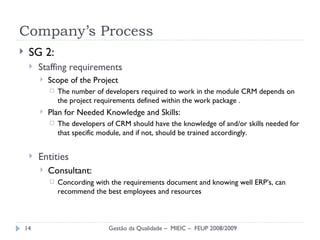
Company’s Process SG2: Staffing requirements Scope of the Project The number of developers required to work in the module CRM depends on the project requirements defined within the work package . Plan for Needed Knowledge and Skills: The developers of CRM should have the knowledge of and/or skills needed for that specific module, and if not, should be trained accordingly. Entities Consultant: Concording with the requirements document and knowing well ERP’s, can recommend the best employees and resources Gestão da Qualidade – MIEIC – FEUP 2008/2009
15.
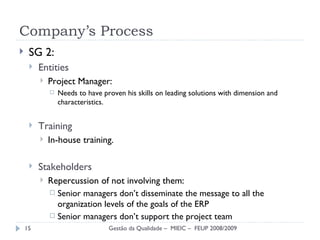
SG 2: Entities Project Manager: Needs to have proven his skills on leading solutions with dimension and characteristics. Training In-house training. Stakeholders Repercussion of not involving them: Senior managers don’t disseminate the message to all the organization levels of the goals of the ERP Senior managers don’t support the project team Company’s Process Gestão da Qualidade – MIEIC – FEUP 2008/2009
16.
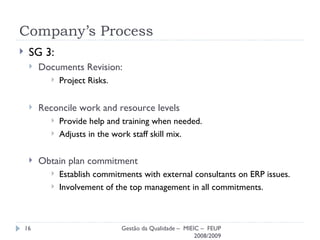
Company’s Process SG3: Documents Revision: Project Risks. Reconcile work and resource levels Provide help and training when needed. Adjusts in the work staff skill mix. Obtain plan commitment Establish commitments with external consultants on ERP issues. Involvement of the top management in all commitments. Gestão da Qualidade – MIEIC – FEUP 2008/2009
17.
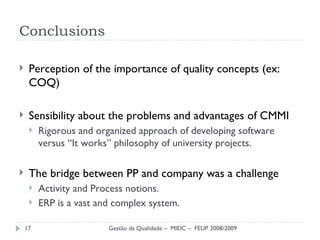
Conclusions Perception ofthe importance of quality concepts (ex: COQ) Sensibility about the problems and advantages of CMMI Rigorous and organized approach of developing software versus “It works” philosophy of university projects. The bridge between PP and company was a challenge Activity and Process notions. ERP is a vast and complex system. Gestão da Qualidade – MIEIC – FEUP 2008/2009
18.
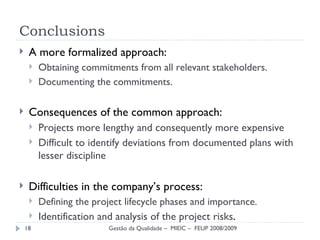
Conclusions A moreformalized approach: Obtaining commitments from all relevant stakeholders. Documenting the commitments. Consequences of the common approach: Projects more lengthy and consequently more expensive Difficult to identify deviations from documented plans with lesser discipline Difficulties in the company’s process: Defining the project lifecycle phases and importance. Identification and analysis of the project risks . Gestão da Qualidade – MIEIC – FEUP 2008/2009