© The University of Sheffield
TECHNICAL REPORT WRITING FOR ENGINEERS
CREATING GRAPHS – THE KEY POINTS
Make sure that…
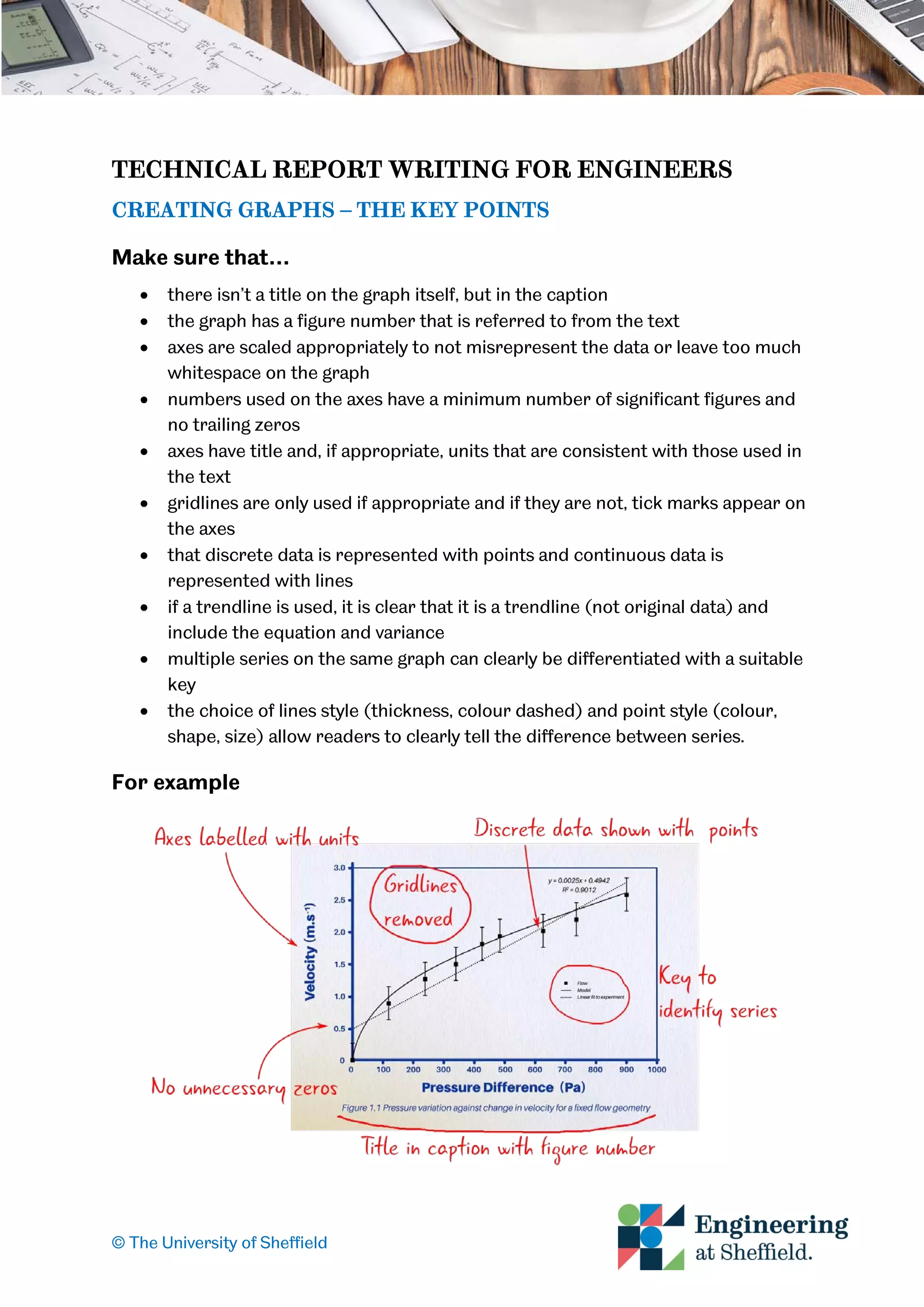
• there isn’t a title on the graph itself, but in the caption
• the graph has a figure number that is referred to from the text
• axes are scaled appropriately to not misrepresent the data or leave too much
whitespace on the graph
• numbers used on the axes have a minimum number of significant figures and
no trailing zeros
• axes have title and, if appropriate, units that are consistent with those used in
the text
• gridlines are only used if appropriate and if they are not, tick marks appear on
the axes
• that discrete data is represented with points and continuous data is
represented with lines
• if a trendline is used, it is clear that it is a trendline (not original data) and
include the equation and variance
• multiple series on the same graph can clearly be differentiated with a suitable
key
• the choice of lines style (thickness, colour dashed) and point style (colour,
shape, size) allow readers to clearly tell the difference between series.
For example

Creating graphs -_key_points

  • 1.
    © The Universityof Sheffield TECHNICAL REPORT WRITING FOR ENGINEERS CREATING GRAPHS – THE KEY POINTS Make sure that… • there isn’t a title on the graph itself, but in the caption • the graph has a figure number that is referred to from the text • axes are scaled appropriately to not misrepresent the data or leave too much whitespace on the graph • numbers used on the axes have a minimum number of significant figures and no trailing zeros • axes have title and, if appropriate, units that are consistent with those used in the text • gridlines are only used if appropriate and if they are not, tick marks appear on the axes • that discrete data is represented with points and continuous data is represented with lines • if a trendline is used, it is clear that it is a trendline (not original data) and include the equation and variance • multiple series on the same graph can clearly be differentiated with a suitable key • the choice of lines style (thickness, colour dashed) and point style (colour, shape, size) allow readers to clearly tell the difference between series. For example