Now that you have completed this exercise, take some time to review: a summary of common assumptions, their likely impact, and the actions
you can take to challenge restrictive assumptions. You can see the benefits of supportive assumptions and identify how you can take action to
maximize these benefits in your business.
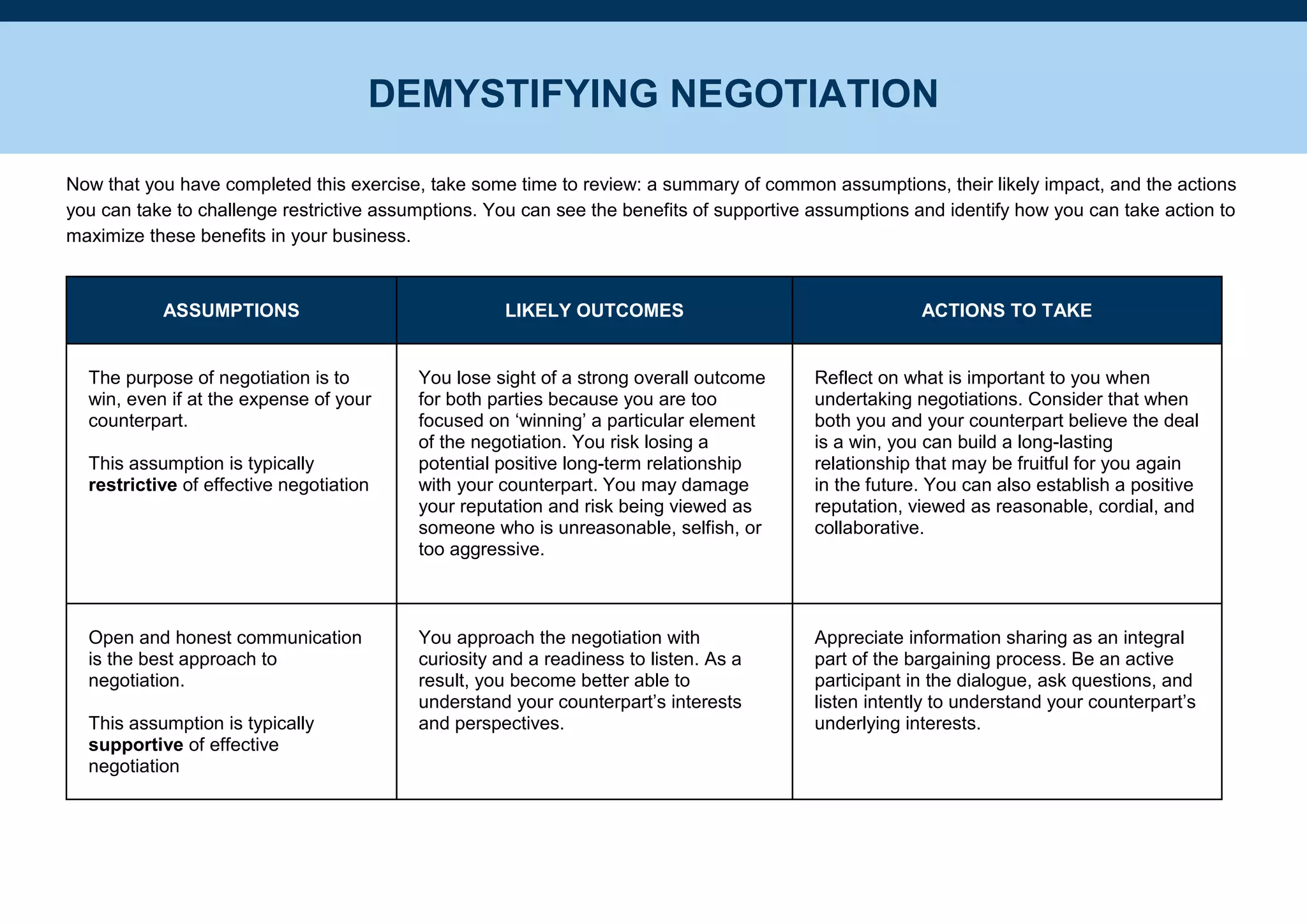
ASSUMPTIONS LIKELY OUTCOMES ACTIONS TO TAKE
The purpose of negotiation is to
win, even if at the expense of your
counterpart.
This assumption is typically
restrictive of effective negotiation
You lose sight of a strong overall outcome
for both parties because you are too
focused on ‘winning’ a particular element
of the negotiation. You risk losing a
potential positive long-term relationship
with your counterpart. You may damage
your reputation and risk being viewed as
someone who is unreasonable, selfish, or
too aggressive.
Reflect on what is important to you when
undertaking negotiations. Consider that when
both you and your counterpart believe the deal
is a win, you can build a long-lasting
relationship that may be fruitful for you again
in the future. You can also establish a positive
reputation, viewed as reasonable, cordial, and
collaborative.
Open and honest communication
is the best approach to
negotiation.
This assumption is typically
supportive of effective
negotiation
You approach the negotiation with
curiosity and a readiness to listen. As a
result, you become better able to
understand your counterpart’s interests
and perspectives.
Appreciate information sharing as an integral
part of the bargaining process. Be an active
participant in the dialogue, ask questions, and
listen intently to understand your counterpart’s
underlying interests.
DEMYSTIFYING NEGOTIATION
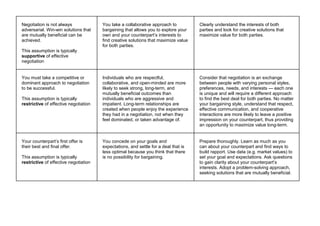
Negotiation is not always
adversarial. Win-win solutions that
are mutually beneficial can be
achieved.
This assumption is typically
supportive of effective
negotiation
You take a collaborative approach to
bargaining that allows you to explore your
own and your counterpart’s interests to
find creative solutions that maximize value
for both parties.
Clearly understand the interests of both
parties and look for creative solutions that
maximize value for both parties.
You must take a competitive or
dominant approach to negotiation
to be successful.
This assumption is typically
restrictive of effective negotiation
Individuals who are respectful,
collaborative, and open-minded are more
likely to seek strong, long-term, and
mutually beneficial outcomes than
individuals who are aggressive and
impatient. Long-term relationships are
created when people enjoy the experience
they had in a negotiation, not when they
feel dominated, or taken advantage of.
Consider that negotiation is an exchange
between people with varying personal styles,
preferences, needs, and interests — each one
is unique and will require a different approach
to find the best deal for both parties. No matter
your bargaining style, understand that respect,
effective communication, and cooperative
interactions are more likely to leave a positive
impression on your counterpart, thus providing
an opportunity to maximize value long-term.
Your counterpart’s first offer is
their best and final offer.
This assumption is typically
restrictive of effective negotiation
You concede on your goals and
expectations, and settle for a deal that is
less optimal because you think that there
is no possibility for bargaining.
Prepare thoroughly. Learn as much as you
can about your counterpart and find ways to
build rapport. Use data (e.g. market values) to
set your goal and expectations. Ask questions
to gain clarity about your counterpart’s
interests. Adopt a problem-solving approach,
seeking solutions that are mutually beneficial.

Demystifying negotiation-assumptions

  • 1.
    Now that youhave completed this exercise, take some time to review: a summary of common assumptions, their likely impact, and the actions you can take to challenge restrictive assumptions. You can see the benefits of supportive assumptions and identify how you can take action to maximize these benefits in your business. ASSUMPTIONS LIKELY OUTCOMES ACTIONS TO TAKE The purpose of negotiation is to win, even if at the expense of your counterpart. This assumption is typically restrictive of effective negotiation You lose sight of a strong overall outcome for both parties because you are too focused on ‘winning’ a particular element of the negotiation. You risk losing a potential positive long-term relationship with your counterpart. You may damage your reputation and risk being viewed as someone who is unreasonable, selfish, or too aggressive. Reflect on what is important to you when undertaking negotiations. Consider that when both you and your counterpart believe the deal is a win, you can build a long-lasting relationship that may be fruitful for you again in the future. You can also establish a positive reputation, viewed as reasonable, cordial, and collaborative. Open and honest communication is the best approach to negotiation. This assumption is typically supportive of effective negotiation You approach the negotiation with curiosity and a readiness to listen. As a result, you become better able to understand your counterpart’s interests and perspectives. Appreciate information sharing as an integral part of the bargaining process. Be an active participant in the dialogue, ask questions, and listen intently to understand your counterpart’s underlying interests. DEMYSTIFYING NEGOTIATION
  • 2.
    Negotiation is notalways adversarial. Win-win solutions that are mutually beneficial can be achieved. This assumption is typically supportive of effective negotiation You take a collaborative approach to bargaining that allows you to explore your own and your counterpart’s interests to find creative solutions that maximize value for both parties. Clearly understand the interests of both parties and look for creative solutions that maximize value for both parties. You must take a competitive or dominant approach to negotiation to be successful. This assumption is typically restrictive of effective negotiation Individuals who are respectful, collaborative, and open-minded are more likely to seek strong, long-term, and mutually beneficial outcomes than individuals who are aggressive and impatient. Long-term relationships are created when people enjoy the experience they had in a negotiation, not when they feel dominated, or taken advantage of. Consider that negotiation is an exchange between people with varying personal styles, preferences, needs, and interests — each one is unique and will require a different approach to find the best deal for both parties. No matter your bargaining style, understand that respect, effective communication, and cooperative interactions are more likely to leave a positive impression on your counterpart, thus providing an opportunity to maximize value long-term. Your counterpart’s first offer is their best and final offer. This assumption is typically restrictive of effective negotiation You concede on your goals and expectations, and settle for a deal that is less optimal because you think that there is no possibility for bargaining. Prepare thoroughly. Learn as much as you can about your counterpart and find ways to build rapport. Use data (e.g. market values) to set your goal and expectations. Ask questions to gain clarity about your counterpart’s interests. Adopt a problem-solving approach, seeking solutions that are mutually beneficial.