CPR in SPECIAL SITUATIONS
CPR in Paediatric Patients
Infants & Children
•Basic principles are same as adults - Scene safety - Checking
Responsiveness - Call for the help - High performance CPR
•Differences are due to Anatomy, Physiology & Causes of cardiac arrest
•Cardiac arrest is usually due to respiratory causes
CPR in Paediatric Patients
Infants & Children
• After checking whether scene is safe:
• Check for responsiveness –
• by tapping the shoulders in Children,
• by tapping the feet in Infants
• • Activate Emergency medical services
CPR in INFANTS & CHILDREN
• Assess for breathing & pulse for 5 to 10 seconds
• - Child: carotid or femoral pulse,
• - Infant: brachial pulse
• •Breathing & Pulse present – monitor
• •No breathing, Pulse present – Provide 1 breath every 2 to 3 seconds [20
– 30/ min]
• •Both absent – Start CPR
• - 30:2 with single rescuer, 15:2 with 2 rescuers
CPR in Paediatric Patients
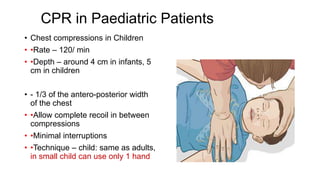
• Chest compressions in Children
• •Rate – 120/ min
• •Depth – around 4 cm in infants, 5
cm in children
• - 1/3 of the antero-posterior width
of the chest
• •Allow complete recoil in between
compressions
• •Minimal interruptions
• •Technique – child: same as adults,
in small child can use only 1 hand
CPR in Paediatric
Patients
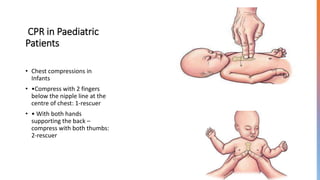
• Chest compressions in
Infants
• •Compress with 2 fingers
below the nipple line at the
centre of chest: 1-rescuer
• • With both hands
supporting the back –
compress with both thumbs:
2-rescuer
CPR in Paediatric Patients
• Key Points
• •Breaths are important as arrest is usually due to respiratory causes, -
deliver effective breaths
• • Keep infant’s head in neutral position, as hyperextension can also
obstruct the airway
• • If it is a witnessed arrest – get AED or Defibrillator as soon as possible
• • Un-witnessed cardiac arrest – Start CPR first & then call for help
• • If single rescuer – 30:2 Ratio
• • If two rescuers – 15:2 Ratio
CPR in Pregnancy
• Basic principles are same as adults - Scene safety -
Checking Responsiveness - Call for the help - High
performance CPR
•Differences are due to - Physiology
CPR in Pregnancy
•Call for the Help:
••Emergency response team
••Obstetrician
••Paediatrician
CPR in Pregnancy
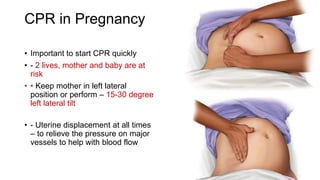
• Important to start CPR quickly
• - 2 lives, mother and baby are at
risk
• • Keep mother in left lateral
position or perform – 15-30 degree
left lateral tilt
• - Uterine displacement at all times
– to relieve the pressure on major
vessels to help with blood flow
Perimortem caesarean delivery
If no Restoration of Spontaneous Circulation
in 5 minutes of Cardiac Arrest
CPR in Pregnancy Key Points
• Basic Principle are same as ordinary adult
• Lateral displacement of uterus or 15 to 30 degree lateral tilt is a
must
•If no ROSC in 5 minutes of Cardiac arrest, - Perform Caesarean
delivery
THANKYOU
COURTSEY INDIAN RESUSCITATION COUNCIL FEDERATION &
INDIAN SOCIETY OF ANAESTHESIOLOGISTS 2017 RESUSCITATION
GUIDELINES

CPR IN SPECIAL SITUATIONS.pptx

  • 1.
    CPR in SPECIALSITUATIONS
  • 2.
    CPR in PaediatricPatients Infants & Children •Basic principles are same as adults - Scene safety - Checking Responsiveness - Call for the help - High performance CPR •Differences are due to Anatomy, Physiology & Causes of cardiac arrest •Cardiac arrest is usually due to respiratory causes
  • 3.
    CPR in PaediatricPatients Infants & Children • After checking whether scene is safe: • Check for responsiveness – • by tapping the shoulders in Children, • by tapping the feet in Infants • • Activate Emergency medical services
  • 4.
    CPR in INFANTS& CHILDREN • Assess for breathing & pulse for 5 to 10 seconds • - Child: carotid or femoral pulse, • - Infant: brachial pulse • •Breathing & Pulse present – monitor • •No breathing, Pulse present – Provide 1 breath every 2 to 3 seconds [20 – 30/ min] • •Both absent – Start CPR • - 30:2 with single rescuer, 15:2 with 2 rescuers
  • 5.
    CPR in PaediatricPatients • Chest compressions in Children • •Rate – 120/ min • •Depth – around 4 cm in infants, 5 cm in children • - 1/3 of the antero-posterior width of the chest • •Allow complete recoil in between compressions • •Minimal interruptions • •Technique – child: same as adults, in small child can use only 1 hand
  • 6.
    CPR in Paediatric Patients •Chest compressions in Infants • •Compress with 2 fingers below the nipple line at the centre of chest: 1-rescuer • • With both hands supporting the back – compress with both thumbs: 2-rescuer
  • 7.
    CPR in PaediatricPatients • Key Points • •Breaths are important as arrest is usually due to respiratory causes, - deliver effective breaths • • Keep infant’s head in neutral position, as hyperextension can also obstruct the airway • • If it is a witnessed arrest – get AED or Defibrillator as soon as possible • • Un-witnessed cardiac arrest – Start CPR first & then call for help • • If single rescuer – 30:2 Ratio • • If two rescuers – 15:2 Ratio
  • 8.
    CPR in Pregnancy •Basic principles are same as adults - Scene safety - Checking Responsiveness - Call for the help - High performance CPR •Differences are due to - Physiology
  • 9.
    CPR in Pregnancy •Callfor the Help: ••Emergency response team ••Obstetrician ••Paediatrician
  • 10.
    CPR in Pregnancy •Important to start CPR quickly • - 2 lives, mother and baby are at risk • • Keep mother in left lateral position or perform – 15-30 degree left lateral tilt • - Uterine displacement at all times – to relieve the pressure on major vessels to help with blood flow
  • 11.
    Perimortem caesarean delivery Ifno Restoration of Spontaneous Circulation in 5 minutes of Cardiac Arrest
  • 12.
    CPR in PregnancyKey Points • Basic Principle are same as ordinary adult • Lateral displacement of uterus or 15 to 30 degree lateral tilt is a must •If no ROSC in 5 minutes of Cardiac arrest, - Perform Caesarean delivery
  • 13.
    THANKYOU COURTSEY INDIAN RESUSCITATIONCOUNCIL FEDERATION & INDIAN SOCIETY OF ANAESTHESIOLOGISTS 2017 RESUSCITATION GUIDELINES