CPR Guidelines
Mr. Corbin
Overview
• CPR (cardiopulmonary respiration) for:
• Adults
• Children
• Infants
Adult CPR
Guidelines from the American Heart Association (AHA)
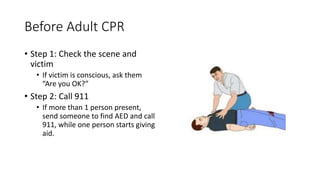
Before Adult CPR
• Step 1: Check the scene and
victim
• If victim is conscious, ask them
“Are you OK?”
• Step 2: Call 911
• If more than 1 person present,
send someone to find AED and call
911, while one person starts giving
aid.
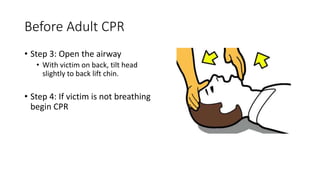
Before Adult CPR
• Step 3: Open the airway
• With victim on back, tilt head
slightly to back lift chin.
• Step 4: If victim is not breathing
begin CPR
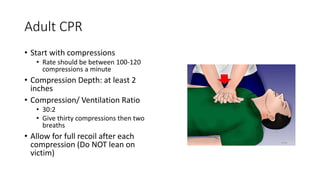
Adult CPR
• Start with compressions
• Rate should be between 100-120
compressions a minute
• Compression Depth: at least 2
inches
• Compression/ Ventilation Ratio
• 30:2
• Give thirty compressions then two
breaths
• Allow for full recoil after each
compression (Do NOT lean on
victim)
Child CPR
Guidelines from the American Heart Association (AHA)
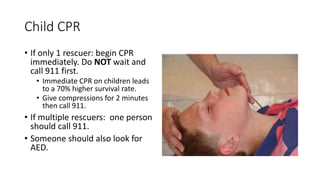
Child CPR
• If only 1 rescuer: begin CPR
immediately. Do NOT wait and
call 911 first.
• Immediate CPR on children leads
to a 70% higher survival rate.
• Give compressions for 2 minutes
then call 911.
• If multiple rescuers: one person
should call 911.
• Someone should also look for
AED.
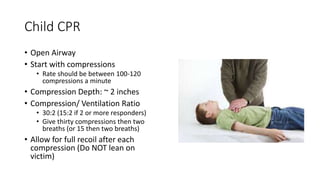
Child CPR
• Open Airway
• Start with compressions
• Rate should be between 100-120
compressions a minute
• Compression Depth: ~ 2 inches
• Compression/ Ventilation Ratio
• 30:2 (15:2 if 2 or more responders)
• Give thirty compressions then two
breaths (or 15 then two breaths)
• Allow for full recoil after each
compression (Do NOT lean on
victim)
Infant CPR
Guidelines from the American Heart Association (AHA)
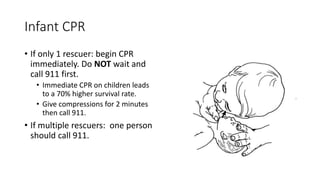
Infant CPR
• If only 1 rescuer: begin CPR
immediately. Do NOT wait and
call 911 first.
• Immediate CPR on children leads
to a 70% higher survival rate.
• Give compressions for 2 minutes
then call 911.
• If multiple rescuers: one person
should call 911.
Infant CPR
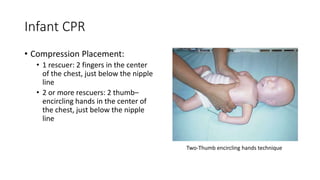
• Compression Placement:
• 1 rescuer: 2 fingers in the center
of the chest, just below the nipple
line
• 2 or more rescuers: 2 thumb–
encircling hands in the center of
the chest, just below the nipple
line
Two-Thumb encircling hands technique
Infant CPR
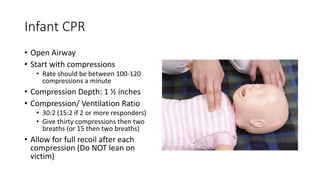
• Open Airway
• Start with compressions
• Rate should be between 100-120
compressions a minute
• Compression Depth: 1 ½ inches
• Compression/ Ventilation Ratio
• 30:2 (15:2 if 2 or more responders)
• Give thirty compressions then two
breaths (or 15 then two breaths)
• Allow for full recoil after each
compression (Do NOT lean on
victim)
General Rules
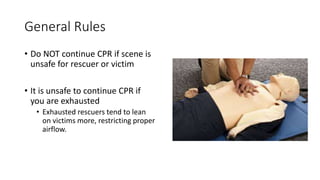
• Do NOT continue CPR if scene is
unsafe for rescuer or victim
• It is unsafe to continue CPR if
you are exhausted
• Exhausted rescuers tend to lean
on victims more, restricting proper
airflow.

CPR Guidelines

  • 1.
  • 2.
    Overview • CPR (cardiopulmonaryrespiration) for: • Adults • Children • Infants
  • 3.
    Adult CPR Guidelines fromthe American Heart Association (AHA)
  • 4.
    Before Adult CPR •Step 1: Check the scene and victim • If victim is conscious, ask them “Are you OK?” • Step 2: Call 911 • If more than 1 person present, send someone to find AED and call 911, while one person starts giving aid.
  • 5.
    Before Adult CPR •Step 3: Open the airway • With victim on back, tilt head slightly to back lift chin. • Step 4: If victim is not breathing begin CPR
  • 6.
    Adult CPR • Startwith compressions • Rate should be between 100-120 compressions a minute • Compression Depth: at least 2 inches • Compression/ Ventilation Ratio • 30:2 • Give thirty compressions then two breaths • Allow for full recoil after each compression (Do NOT lean on victim)
  • 7.
    Child CPR Guidelines fromthe American Heart Association (AHA)
  • 8.
    Child CPR • Ifonly 1 rescuer: begin CPR immediately. Do NOT wait and call 911 first. • Immediate CPR on children leads to a 70% higher survival rate. • Give compressions for 2 minutes then call 911. • If multiple rescuers: one person should call 911. • Someone should also look for AED.
  • 9.
    Child CPR • OpenAirway • Start with compressions • Rate should be between 100-120 compressions a minute • Compression Depth: ~ 2 inches • Compression/ Ventilation Ratio • 30:2 (15:2 if 2 or more responders) • Give thirty compressions then two breaths (or 15 then two breaths) • Allow for full recoil after each compression (Do NOT lean on victim)
  • 10.
    Infant CPR Guidelines fromthe American Heart Association (AHA)
  • 11.
    Infant CPR • Ifonly 1 rescuer: begin CPR immediately. Do NOT wait and call 911 first. • Immediate CPR on children leads to a 70% higher survival rate. • Give compressions for 2 minutes then call 911. • If multiple rescuers: one person should call 911.
  • 12.
    Infant CPR • CompressionPlacement: • 1 rescuer: 2 fingers in the center of the chest, just below the nipple line • 2 or more rescuers: 2 thumb– encircling hands in the center of the chest, just below the nipple line Two-Thumb encircling hands technique
  • 13.
    Infant CPR • OpenAirway • Start with compressions • Rate should be between 100-120 compressions a minute • Compression Depth: 1 ½ inches • Compression/ Ventilation Ratio • 30:2 (15:2 if 2 or more responders) • Give thirty compressions then two breaths (or 15 then two breaths) • Allow for full recoil after each compression (Do NOT lean on victim)
  • 14.
    General Rules • DoNOT continue CPR if scene is unsafe for rescuer or victim • It is unsafe to continue CPR if you are exhausted • Exhausted rescuers tend to lean on victims more, restricting proper airflow.