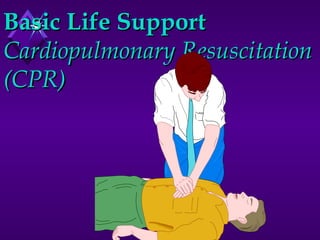
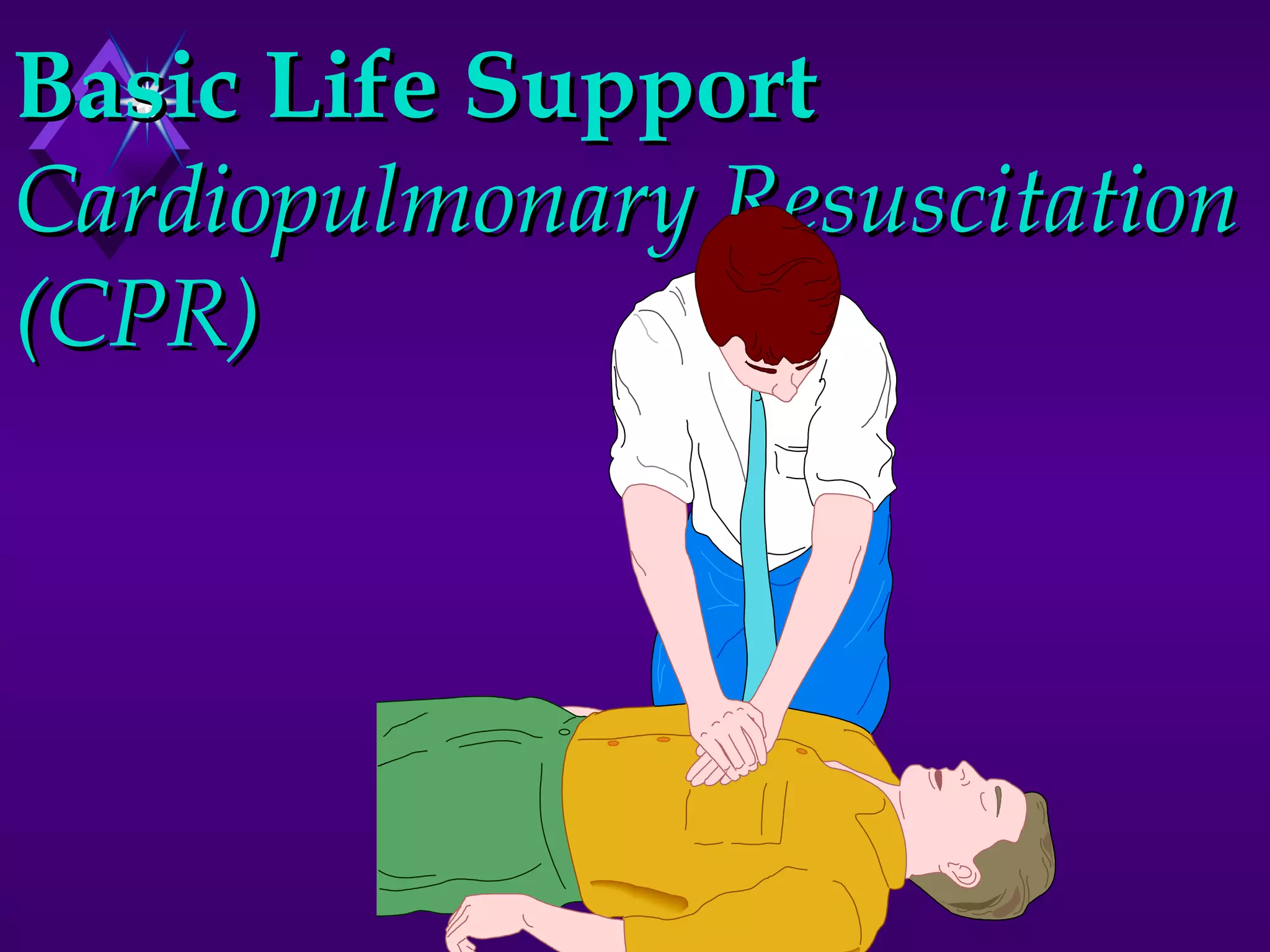
Basic Life Support Cardiopulmonary Resuscitation (CPR)
Start CPR Immediately Better chance of survival Brain damage starts in 4-6 minutes Brain damage is certain after 10 minutes without CPR
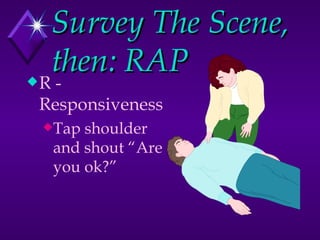
Survey The Scene, then: RAP R - Responsiveness  Tap shoulder and shout “Are you ok?”
RAP A  - Activate EMS ( if unresponsive) Call 911 (another can stay by the phone and update EMS personnel on status of paitent)
RAP P - Position on back All body parts rolled over at the same time Always be aware of head and spinal cord injuries Support neck and spinal column
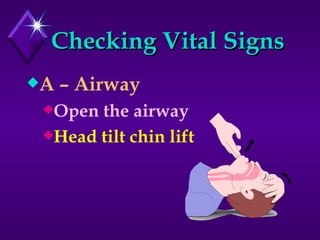
Checking Vital Signs A – Airway Open the airway Head tilt chin lift
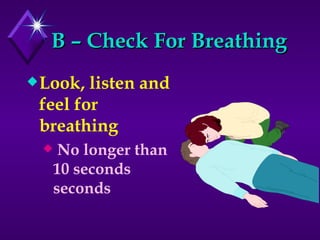
B – Check For Breathing Look, listen and feel for breathing No longer than 10 seconds seconds
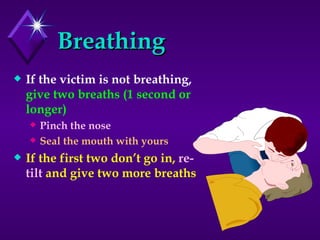
Breathing If the victim is not breathing,  give two breaths (1 second or longer) Pinch the nose Seal the mouth with yours If the first two don’t go in,  re-tilt  and give two more breaths
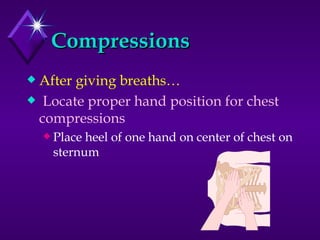
Compressions After giving breaths… Locate proper hand position for chest compressions Place heel of one hand on center of chest on sternum
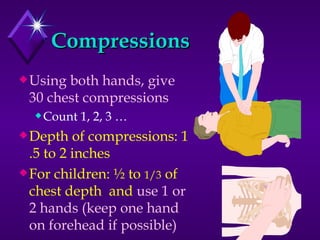
Compressions Using both hands, give 30 chest compressions Count 1, 2, 3 … Depth of compressions: 1 .5 to 2 inches For children: ½ to  1/3  of chest depth  and  use 1 or 2 hands (keep one hand on forehead if possible)
CPR After 30 chest compressions give: 2 slow breaths  Continue until help arrives or victim recovers If the victim starts moving: check breathing
When Can I Stop CPR? Victim revives Trained help arrives Too exhausted to continue Unsafe scene
Checking for CPR Effectiveness Does chest rise and fall with rescue breaths? Have a second rescuer check pulse while you give compressions
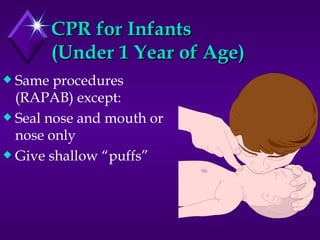
CPR for Infants  (Under 1 Year of Age) Same procedures (RAPAB) except: Seal nose and mouth or nose only Give shallow “puffs”
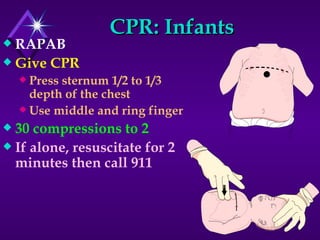
CPR: Infants RAPAB Give CPR Press sternum 1/2 to 1/3 depth of the chest  Use middle and ring finger 30 compressions to 2 If alone, resuscitate for 2 minutes then call 911

CPR Basics

  • 1.
    Basic Life SupportCardiopulmonary Resuscitation (CPR)
  • 2.
    Start CPR ImmediatelyBetter chance of survival Brain damage starts in 4-6 minutes Brain damage is certain after 10 minutes without CPR
  • 3.
    Survey The Scene,then: RAP R - Responsiveness Tap shoulder and shout “Are you ok?”
  • 4.
    RAP A - Activate EMS ( if unresponsive) Call 911 (another can stay by the phone and update EMS personnel on status of paitent)
  • 5.
    RAP P -Position on back All body parts rolled over at the same time Always be aware of head and spinal cord injuries Support neck and spinal column
  • 6.
    Checking Vital SignsA – Airway Open the airway Head tilt chin lift
  • 7.
    B – CheckFor Breathing Look, listen and feel for breathing No longer than 10 seconds seconds
  • 8.
    Breathing If thevictim is not breathing, give two breaths (1 second or longer) Pinch the nose Seal the mouth with yours If the first two don’t go in, re-tilt and give two more breaths
  • 9.
    Compressions After givingbreaths… Locate proper hand position for chest compressions Place heel of one hand on center of chest on sternum
  • 10.
    Compressions Using bothhands, give 30 chest compressions Count 1, 2, 3 … Depth of compressions: 1 .5 to 2 inches For children: ½ to 1/3 of chest depth and use 1 or 2 hands (keep one hand on forehead if possible)
  • 11.
    CPR After 30chest compressions give: 2 slow breaths Continue until help arrives or victim recovers If the victim starts moving: check breathing
  • 12.
    When Can IStop CPR? Victim revives Trained help arrives Too exhausted to continue Unsafe scene
  • 13.
    Checking for CPREffectiveness Does chest rise and fall with rescue breaths? Have a second rescuer check pulse while you give compressions
  • 14.
    CPR for Infants (Under 1 Year of Age) Same procedures (RAPAB) except: Seal nose and mouth or nose only Give shallow “puffs”
  • 15.
    CPR: Infants RAPABGive CPR Press sternum 1/2 to 1/3 depth of the chest Use middle and ring finger 30 compressions to 2 If alone, resuscitate for 2 minutes then call 911