Introduction
To
Continuous Professional
Development
(CPD) Program
Compiled By
Dr.Tariq Mehmood Qazi
G.C.E.T Islamabad
tariqmqazi@yahoo.com
0 3 4 5-5 5 5 0 1 1 2
Abbreviations 1/2
 CPD Continuous Professional Development
 DSD Directorate of Staff Development
 DTE District Teacher Educator
 TE Teacher Educator
 LTE Lead Teacher Educator (On call trainer)
Abbreviations 2/2
 CTSC Cluster Training and Support Centre
 DTSC District Training and Support Centre
 RPM Regional Programme Manager
 PST Primary School Teacher
 EST Elementary School Teacher
 LQT Least Qualified Teacher
 TNA Training Need Assessment
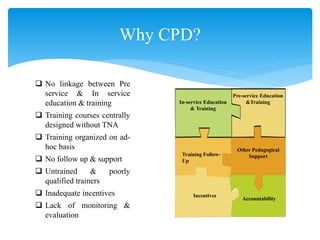
Accountability
Other Pedagogical
SupportTraining Follow-
Up
Pre-service Education
&TrainingIn-service Education
& Training
Incentives
Why CPD?
 No linkage between Pre
service & In service
education & training
 Training courses centrally
designed without TNA
 Training organized on ad-
hoc basis
 No follow up & support
 Untrained & poorly
qualified trainers
 Inadequate incentives
 Lack of monitoring &
evaluation
 Initiated in the 12 District of Punjab in 2007 (1st Phase)
 Extended to all 36 District in 2010
 Rawalpindi was in second phase
 Mentoring is the central idea of the CPD
 DTEs are responsible for the mentoring process
 Continuous process of training and follow up
 It is a decentralized approach
Background
Organogram
of
CPD
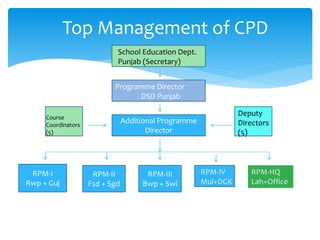
Top Management of CPD
Additional Programme
Director
School Education Dept.
Punjab (Secretary)
Programme Director
DSD Punjab
RPM-I
Rwp + Guj
RPM-II
Fsd + Sgd
RPM-III
Bwp + Swl
RPM-IV
Mul+DGK
RPM-HQ
Lah+Office
Course
Coordinators
(5)
Deputy
Directors
(5)
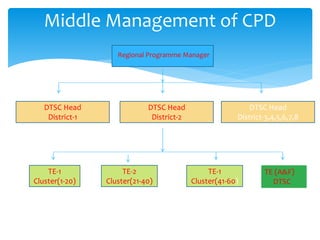
Middle Management of CPD
DTSC Head
District-1
Regional Programme Manager
TE-1
Cluster(1-20)
TE (A&F)
DTSC
TE-2
Cluster(21-40)
TE-1
Cluster(41-60)
DTSC Head
District-2
DTSC Head
District-3,4,5,6,7,8
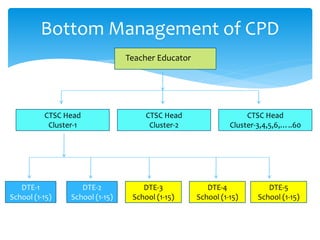
Bottom Management of CPD
CTSC Head
Cluster-1
Teacher Educator
DTE-2
School (1-15)
DTE-3
School (1-15)
CTSC Head
Cluster-2
CTSC Head
Cluster-3,4,5,6,…..60
DTE-1
School (1-15)
DTE-4
School (1-15)
DTE-5
School (1-15)
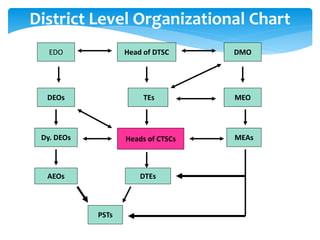
District Level Organizational Chart
Head of DTSC DMOEDO
TEs MEODEOs
Dy. DEOs Heads of CTSCs MEAs
DTEsAEOs
PSTs
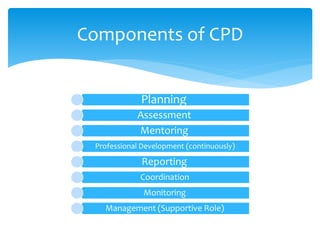
Planning
Assessment
Mentoring
Professional Development (continuously)
Reporting
Coordination
Monitoring
Management (Supportive Role)
Components of CPD
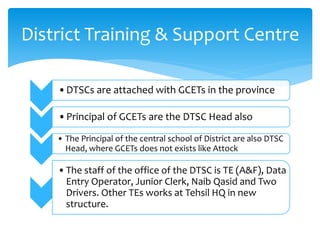
•DTSCs are attached with GCETs in the province
•Principal of GCETs are the DTSC Head also
• The Principal of the central school of District are also DTSC
Head, where GCETs does not exists like Attock
•The staff of the office of the DTSC is TE (A&F), Data
Entry Operator, Junior Clerk, Naib Qasid and Two
Drivers. Other TEs works at Tehsil HQ in new
structure.
District Training & Support Centre
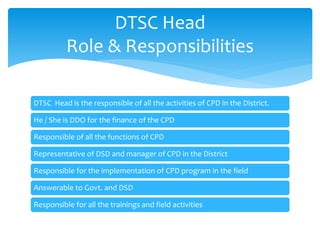
DTSC Head
Role & Responsibilities
DTSC Head is the responsible of all the activities of CPD in the District.
He / She is DDO for the finance of the CPD
Responsible of all the functions of CPD
Representative of DSD and manager of CPD in the District
Responsible for the implementation of CPD program in the field
Answerable to Govt. and DSD
Responsible for all the trainings and field activities
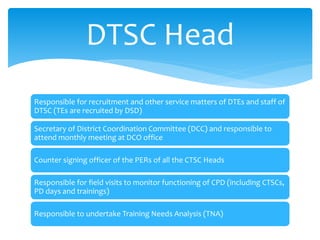
Responsible for recruitment and other service matters of DTEs and staff of
DTSC (TEs are recruited by DSD)
Secretary of District Coordination Committee (DCC) and responsible to
attend monthly meeting at DCO office
Counter signing officer of the PERs of all the CTSC Heads
Responsible for field visits to monitor functioning of CPD (including CTSCs,
PD days and trainings)
Responsible to undertake Training Needs Analysis (TNA)
DTSC Head
Cluster Training
and Support
Centre (CTSC)
 Central High or Higher Secondary school (Boys/ Girls)
in the radius of 16km normally
 One or two in a union council
 The Principal/Headmaster/Headmistress of that
school is CTSC Head
 Training center of the area, host of PD Day
 2-5 DTES and 25 to 30 primary schools
CTSC
 Responsible for implementation of CPD program in the
cluster (Assessment & Mentoring)
 Coordinate, supervise and monitor the activities of the
DTEs in the Cluster
 Responsible to visit 5 schools of the cluster (Observer)
 Countersigning officer of the PERs of all the HT of the CTSC
 Responsible to organize all field trainings (in service,
induction, PD Day etc.)
 Conduct of HT meeting on 15th of every month
CTSC Head
Assessment / Mentoring Days
 Conduct meeting of HTs on
15th of every month after
school time
 Perform at least 5
monitoring visits during
month
 Conduct daily meeting with
DTEs at 1:30 PM
 Sign minutes of daily
meetings on “CTSC Head
meeting register”
 Checking of reports
displayed at CTSC (once
per month)
PD-Day
 Management of PD-Day
at CTSC
 Conduct of problem
solving session
 Preparation of summary
of complaints for DTSC
Head
 Calculation of score
assigned by trainees to
DTEs
 Checking of CTSC File
 Email CTSC File to
concerned TE & TE(A&F)
Working of CTSC Head
Job Description
OF
Teacher Educators
(TEs))
Job Discription OF TE (A & F)
 At DTSC Office:
1. OFFICE MANAGEMENT
2. RECORD MANAGEMENT
3. DATA HANDLING
4. CORRESPONDENCE WITH EDUCATION DEPARTMENT
AND DSD.
5. FINANCIAL MANAGEMENT/ DEALING THE FINANCIAL
ISSUES
6. LOGISTIC SUPPORT IN EVENT MANAGEMENT
7. VOUCHED FILES OF TRAINIGS
 MONITORING & MENTORING OF DTEs
 IMPLEMENTATION Of TRAININGS
 COORDINATION WITH
1. EDUCATION DEPARTMENT IN THE DISTT.
2. DSD / HIGH Ups/STAKE HOLDERS
 PLANNING OF EVENTs:
1. Meetings (CTSC Heads, DCC)
2. Trainings
Cont..
JD OF TEs (FIELD OFFICERS)
 COLLECTION OF CTSC FILES FROM THE CONCERNED FIELD AND
SUBMIT TO DSD THROUGH T.E ADMIN.
 CONDUCT PD DAY OF DTEs
 HANDLING OF EVENTS
1. TRAINING (Ensure 100% attendance)
2. MEETING
 Monitoring activity in a day:
1. TE visit the target school of DTEs as per DTE’s Plan
2. Observation at least in one class
3. Fill up the TE coaching and also take entries against all
monitoring indicators from the DTE’s MVF
cont…
 After that visit at CTSC and conduct meeting with CTSC
Head about DTE’s monitoring & Checking of Record :
Attendance, Dispatch register, display board in the office
of CTSC Head
 To understand the monitoring role of TEs
we must be aware of roles and responsibilities of TEs
because TEs have to play the supervisory role.
Working & Job Description OF
District Teacher Educators
(DTEs)
DTEs Working
• Assessment Days 8 ( 4 hours )
(Two Schools per day)
• Mentoring Days 15 ( 4 hours )
(One School per day)
• PD Day at CTSC 1 (One day quarterly
• (All PSTs + ESTs of cluster) at 3 CTSCs)
• PD Days at DTSC 1 (1 day for each DTE)
(All DTEs of CTSCs)
 Reporting (Monthly) ( 1 hour daily )
 Coordination & Monitoring (1 hour daily)
 Management (1 hour daily)
 Travelling (1 hour daily)
ASSESSMENT
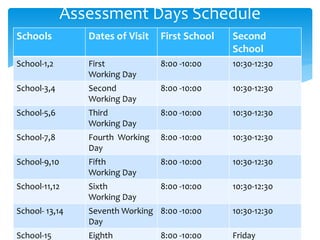
Assessment Days Schedule
Schools Dates of Visit First School Second
School
School-1,2 First
Working Day
8:00 -10:00 10:30-12:30
School-3,4 Second
Working Day
8:00 -10:00 10:30-12:30
School-5,6 Third
Working Day
8:00 -10:00 10:30-12:30
School-7,8 Fourth Working
Day
8:00 -10:00 10:30-12:30
School-9,10 Fifth
Working Day
8:00 -10:00 10:30-12:30
School-11,12 Sixth
Working Day
8:00 -10:00 10:30-12:30
School- 13,14 Seventh Working
Day
8:00 -10:00 10:30-12:30
School-15 Eighth 8:00 -10:00 Friday
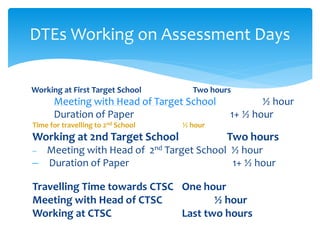
DTEs Working on Assessment Days
Working at First Target School Two hours
Meeting with Head of Target School ½ hour
Duration of Paper 1+ ½ hour
Time for travelling to 2nd School ½ hour
Working at 2nd Target School Two hours
– Meeting with Head of 2nd Target School ½ hour
– Duration of Paper 1+ ½ hour
Travelling Time towards CTSC One hour
Meeting with Head of CTSC ½ hour
Working at CTSC Last two hours
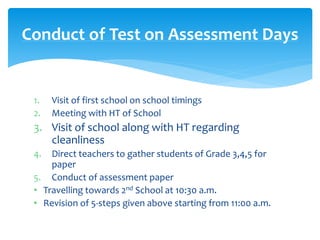
Conduct of Test on Assessment Days
1. Visit of first school on school timings
2. Meeting with HT of School
3. Visit of school along with HT regarding
cleanliness
4. Direct teachers to gather students of Grade 3,4,5 for
paper
5. Conduct of assessment paper
• Travelling towards 2nd School at 10:30 a.m.
• Revision of 5-steps given above starting from 11:00 a.m.
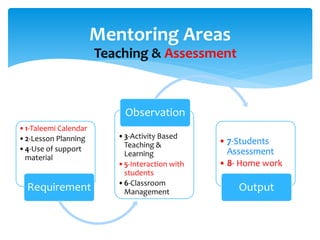
Mentoring Areas
•1-Taleemi Calendar
•2-Lesson Planning
•4-Use of support
material
Requirement
•3-Activity Based
Teaching &
Learning
•5-Interaction with
students
•6-Classroom
Management
Observation
• 7-Students
Assessment
• 8- Home work
Output
Teaching & Assessment
MENTORING
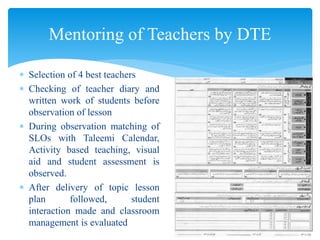
 Selection of 4 best teachers
 Checking of teacher diary and
written work of students before
observation of lesson
 During observation matching of
SLOs with Taleemi Calendar,
Activity based teaching, visual
aid and student assessment is
observed.
 After delivery of topic lesson
plan followed, student
interaction made and classroom
management is evaluated
Mentoring of Teachers by DTE
Selection of Teachers for Mentoring
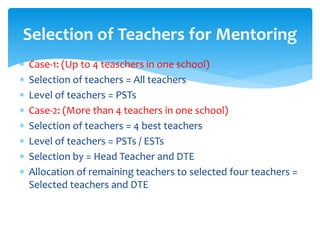
 Case-1: (Up to 4 teaschers in one school)
 Selection of teachers = All teachers
 Level of teachers = PSTs
 Case-2: (More than 4 teachers in one school)
 Selection of teachers = 4 best teachers
 Level of teachers = PSTs / ESTs
 Selection by = Head Teacher and DTE
 Allocation of remaining teachers to selected four teachers =
Selected teachers and DTE
DTEs Working on Mentoring Days
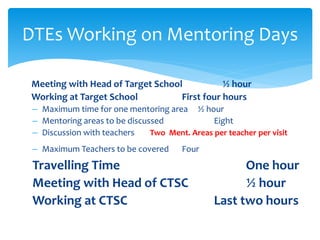
Meeting with Head of Target School ½ hour
Working at Target School First four hours
– Maximum time for one mentoring area ½ hour
– Mentoring areas to be discussed Eight
– Discussion with teachers Two Ment. Areas per teacher per visit
– Maximum Teachers to be covered Four
Travelling Time One hour
Meeting with Head of CTSC ½ hour
Working at CTSC Last two hours
Job description / Responsibilities /
Role of DTE
 To promote the quality of student learning by providing
on-site and on going professional support to fellow PSTs.
 To build capacity of PSTs in attached cluster schools
enabling them to initiate, plan and implement activities to
enhance their own competency as well as child learning.
 To participate in training courses and other professional
development activities organized by DSD or other
institutions designated by the DSD.
DTEs
 MENTORING OF MENTEES AS PER DTE GUIDE
 MONITORING OF CLASS ROOM AND SCHOOL
 ASSESSMENT
 COORDINATION
 TRAINING/ PD DAY OF PST’s
 RECORD MANAGEMENT
1. FILL UP THE MVF
2. FILL UP THE HT MEETING FORM
 REPORTING ON CTSC FILE
1. As ASSESSOR:
 Assessment on 1st eight + (1 Remedial work) working days of
every month.
 Assessment of two schools per day
 Handed over corrected assessment papers on same day
 DTE has to reach target school directly on school timing.
DTEs ARE:
DTEs ARE:
2. As Mentor:
DTE provide on spot training and guidance to PSTs on
preparation of lesson plans, teaching, by selecting
four BEST PSTs from a school.
How to Perform?
Observation in Class and Meeting for Head Teacher
before filling up DEVELOPMENT PLAN.
Other Responsibilities of DTE
 Coordination with Dy. DEOs/AEOs
 Monitor
 TRAINER ON PD DAY OF PSTs
 And Roles mentioned in Letter No 3652 issued in 2010
like;
Functions of DTEs
• Ensure Universal Primary Education campaign through
100% enrollment at Primary and Elementary levels;
• Ensure zero drop-out at Primary , Elementary and
Secondary levels;
• Ensure 100% attendance of the staff and report daily
absenteeism through e-mail to district and provincial
authorities;
• Ranking of schools, Head teachers and Teachers on results
and Key Performance Indicators (KPIs) given in the letter;
Functions of DTEs
• Ensure maintenance of school facilities like safe
drinking water, furniture, toilets, building, cleanliness
through school councils and staff ;
• Ensure optimum use of Library, Science Labs and
Computer Labs;
• Ensure implementation of English Medium Scheme in
100% schools;
Professional
Development Day
(PD DAY)
Professional Development
Professional Development Day of DTEs (Monthly)
Model lessons by LTEs on weak areas
Problem solving by LTEs, DTSC Head and
DEOs / EDO
Professional Development Day of Teachers (Quarterly)
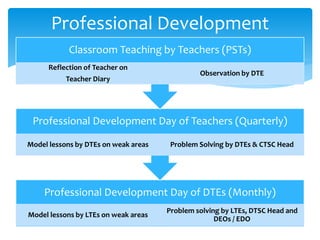
Model lessons by DTEs on weak areas Problem Solving by DTEs & CTSC Head
Classroom Teaching by Teachers (PSTs)
Reflection of Teacher on
Teacher Diary
Observation by DTE
Professional Development
Day
(PD DAY)
at
CTSC
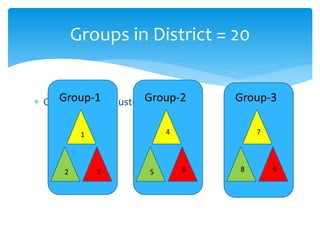
Groups in District = 20
 One Group = 3 ClustersGroup-1 Group-2 Group-3
1
2 3 5
4
98
7
6
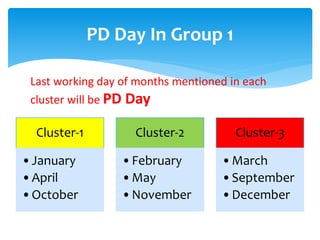
PD Day In Group 1
Cluster-1
•January
•April
•October
Cluster-2
•February
•May
•November
Cluster-3
•March
•September
•December
Last working day of months mentioned in each
cluster will be PD Day
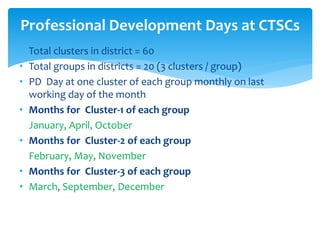
Professional Development Days at CTSCs
• Total clusters in district = 60
• Total groups in districts = 20 (3 clusters / group)
• PD Day at one cluster of each group monthly on last
working day of the month
• Months for Cluster-1 of each group
January, April, October
• Months for Cluster-2 of each group
February, May, November
• Months for Cluster-3 of each group
• March, September, December
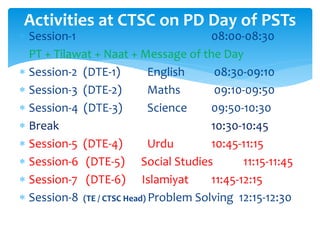
Activities at CTSC on PD Day of PSTs
 Session-1 08:00-08:30
PT + Tilawat + Naat + Message of the Day
 Session-2 (DTE-1) English 08:30-09:10
 Session-3 (DTE-2) Maths 09:10-09:50
 Session-4 (DTE-3) Science 09:50-10:30
 Break 10:30-10:45
 Session-5 (DTE-4) Urdu 10:45-11:15
 Session-6 (DTE-5) Social Studies 11:15-11:45
 Session-7 (DTE-6) Islamiyat 11:45-12:15
 Session-8 (TE / CTSC Head) Problem Solving 12:15-12:30
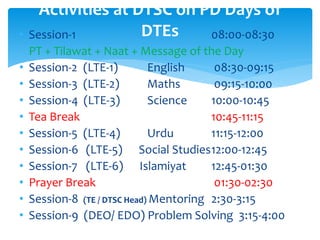
Activities at DTSC on PD Days of
DTEs• Session-1 08:00-08:30
PT + Tilawat + Naat + Message of the Day
• Session-2 (LTE-1) English 08:30-09:15
• Session-3 (LTE-2) Maths 09:15-10:00
• Session-4 (LTE-3) Science 10:00-10:45
• Tea Break 10:45-11:15
• Session-5 (LTE-4) Urdu 11:15-12:00
• Session-6 (LTE-5) Social Studies12:00-12:45
• Session-7 (LTE-6) Islamiyat 12:45-01:30
• Prayer Break 01:30-02:30
• Session-8 (TE / DTSC Head) Mentoring 2:30-3:15
• Session-9 (DEO/ EDO) Problem Solving 3:15-4:00
Professional Development
Day
(PD DAY)
at
DTSC
 Head of committee: DCO
 Secretary: DTSC head
 Member 1: EDO (Education)
 Member 2: All DEOs
 Member 3: DMO
 Member 4: CTSC heads of tehsil
 Place of meeting: DCO office
Functions:
1. To address issues reported by their subordinates
2. To propose solution to un-resolved issues
3. To send minutes of meeting to concerned RPM
Monthly DCC Meeting
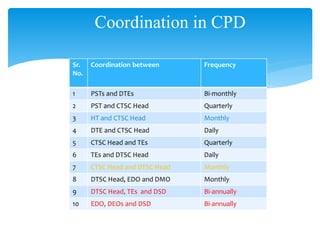
Sr.
No.
Coordination between Frequency
1 PSTs and DTEs Bi-monthly
2 PST and CTSC Head Quarterly
3 HT and CTSC Head Monthly
4 DTE and CTSC Head Daily
5 CTSC Head and TEs Quarterly
6 TEs and DTSC Head Daily
7 CTSC Head and DTSC Head Monthly
8 DTSC Head, EDO and DMO Monthly
9 DTSC Head, TEs and DSD Bi-annually
10 EDO, DEOs and DSD Bi-annually
Coordination in CPD
Thanks

CPD introduction

  • 1.
    Introduction To Continuous Professional Development (CPD) Program CompiledBy Dr.Tariq Mehmood Qazi G.C.E.T Islamabad tariqmqazi@yahoo.com 0 3 4 5-5 5 5 0 1 1 2
  • 2.
    Abbreviations 1/2  CPDContinuous Professional Development  DSD Directorate of Staff Development  DTE District Teacher Educator  TE Teacher Educator  LTE Lead Teacher Educator (On call trainer)
  • 3.
    Abbreviations 2/2  CTSCCluster Training and Support Centre  DTSC District Training and Support Centre  RPM Regional Programme Manager  PST Primary School Teacher  EST Elementary School Teacher  LQT Least Qualified Teacher  TNA Training Need Assessment
  • 4.
    Accountability Other Pedagogical SupportTraining Follow- Up Pre-serviceEducation &TrainingIn-service Education & Training Incentives Why CPD?  No linkage between Pre service & In service education & training  Training courses centrally designed without TNA  Training organized on ad- hoc basis  No follow up & support  Untrained & poorly qualified trainers  Inadequate incentives  Lack of monitoring & evaluation
  • 5.
     Initiated inthe 12 District of Punjab in 2007 (1st Phase)  Extended to all 36 District in 2010  Rawalpindi was in second phase  Mentoring is the central idea of the CPD  DTEs are responsible for the mentoring process  Continuous process of training and follow up  It is a decentralized approach Background
  • 6.
  • 7.
    Top Management ofCPD Additional Programme Director School Education Dept. Punjab (Secretary) Programme Director DSD Punjab RPM-I Rwp + Guj RPM-II Fsd + Sgd RPM-III Bwp + Swl RPM-IV Mul+DGK RPM-HQ Lah+Office Course Coordinators (5) Deputy Directors (5)
  • 8.
    Middle Management ofCPD DTSC Head District-1 Regional Programme Manager TE-1 Cluster(1-20) TE (A&F) DTSC TE-2 Cluster(21-40) TE-1 Cluster(41-60) DTSC Head District-2 DTSC Head District-3,4,5,6,7,8
  • 9.
    Bottom Management ofCPD CTSC Head Cluster-1 Teacher Educator DTE-2 School (1-15) DTE-3 School (1-15) CTSC Head Cluster-2 CTSC Head Cluster-3,4,5,6,…..60 DTE-1 School (1-15) DTE-4 School (1-15) DTE-5 School (1-15)
  • 10.
    District Level OrganizationalChart Head of DTSC DMOEDO TEs MEODEOs Dy. DEOs Heads of CTSCs MEAs DTEsAEOs PSTs
  • 11.
  • 12.
    •DTSCs are attachedwith GCETs in the province •Principal of GCETs are the DTSC Head also • The Principal of the central school of District are also DTSC Head, where GCETs does not exists like Attock •The staff of the office of the DTSC is TE (A&F), Data Entry Operator, Junior Clerk, Naib Qasid and Two Drivers. Other TEs works at Tehsil HQ in new structure. District Training & Support Centre
  • 13.
    DTSC Head Role &Responsibilities DTSC Head is the responsible of all the activities of CPD in the District. He / She is DDO for the finance of the CPD Responsible of all the functions of CPD Representative of DSD and manager of CPD in the District Responsible for the implementation of CPD program in the field Answerable to Govt. and DSD Responsible for all the trainings and field activities
  • 14.
    Responsible for recruitmentand other service matters of DTEs and staff of DTSC (TEs are recruited by DSD) Secretary of District Coordination Committee (DCC) and responsible to attend monthly meeting at DCO office Counter signing officer of the PERs of all the CTSC Heads Responsible for field visits to monitor functioning of CPD (including CTSCs, PD days and trainings) Responsible to undertake Training Needs Analysis (TNA) DTSC Head
  • 15.
  • 16.
     Central Highor Higher Secondary school (Boys/ Girls) in the radius of 16km normally  One or two in a union council  The Principal/Headmaster/Headmistress of that school is CTSC Head  Training center of the area, host of PD Day  2-5 DTES and 25 to 30 primary schools CTSC
  • 17.
     Responsible forimplementation of CPD program in the cluster (Assessment & Mentoring)  Coordinate, supervise and monitor the activities of the DTEs in the Cluster  Responsible to visit 5 schools of the cluster (Observer)  Countersigning officer of the PERs of all the HT of the CTSC  Responsible to organize all field trainings (in service, induction, PD Day etc.)  Conduct of HT meeting on 15th of every month CTSC Head
  • 18.
    Assessment / MentoringDays  Conduct meeting of HTs on 15th of every month after school time  Perform at least 5 monitoring visits during month  Conduct daily meeting with DTEs at 1:30 PM  Sign minutes of daily meetings on “CTSC Head meeting register”  Checking of reports displayed at CTSC (once per month) PD-Day  Management of PD-Day at CTSC  Conduct of problem solving session  Preparation of summary of complaints for DTSC Head  Calculation of score assigned by trainees to DTEs  Checking of CTSC File  Email CTSC File to concerned TE & TE(A&F) Working of CTSC Head
  • 19.
  • 20.
    Job Discription OFTE (A & F)  At DTSC Office: 1. OFFICE MANAGEMENT 2. RECORD MANAGEMENT 3. DATA HANDLING 4. CORRESPONDENCE WITH EDUCATION DEPARTMENT AND DSD. 5. FINANCIAL MANAGEMENT/ DEALING THE FINANCIAL ISSUES 6. LOGISTIC SUPPORT IN EVENT MANAGEMENT 7. VOUCHED FILES OF TRAINIGS
  • 21.
     MONITORING &MENTORING OF DTEs  IMPLEMENTATION Of TRAININGS  COORDINATION WITH 1. EDUCATION DEPARTMENT IN THE DISTT. 2. DSD / HIGH Ups/STAKE HOLDERS  PLANNING OF EVENTs: 1. Meetings (CTSC Heads, DCC) 2. Trainings Cont.. JD OF TEs (FIELD OFFICERS)
  • 22.
     COLLECTION OFCTSC FILES FROM THE CONCERNED FIELD AND SUBMIT TO DSD THROUGH T.E ADMIN.  CONDUCT PD DAY OF DTEs  HANDLING OF EVENTS 1. TRAINING (Ensure 100% attendance) 2. MEETING  Monitoring activity in a day: 1. TE visit the target school of DTEs as per DTE’s Plan 2. Observation at least in one class 3. Fill up the TE coaching and also take entries against all monitoring indicators from the DTE’s MVF cont…
  • 23.
     After thatvisit at CTSC and conduct meeting with CTSC Head about DTE’s monitoring & Checking of Record : Attendance, Dispatch register, display board in the office of CTSC Head  To understand the monitoring role of TEs we must be aware of roles and responsibilities of TEs because TEs have to play the supervisory role.
  • 24.
    Working & JobDescription OF District Teacher Educators (DTEs)
  • 25.
    DTEs Working • AssessmentDays 8 ( 4 hours ) (Two Schools per day) • Mentoring Days 15 ( 4 hours ) (One School per day) • PD Day at CTSC 1 (One day quarterly • (All PSTs + ESTs of cluster) at 3 CTSCs) • PD Days at DTSC 1 (1 day for each DTE) (All DTEs of CTSCs)  Reporting (Monthly) ( 1 hour daily )  Coordination & Monitoring (1 hour daily)  Management (1 hour daily)  Travelling (1 hour daily)
  • 26.
  • 27.
    Assessment Days Schedule SchoolsDates of Visit First School Second School School-1,2 First Working Day 8:00 -10:00 10:30-12:30 School-3,4 Second Working Day 8:00 -10:00 10:30-12:30 School-5,6 Third Working Day 8:00 -10:00 10:30-12:30 School-7,8 Fourth Working Day 8:00 -10:00 10:30-12:30 School-9,10 Fifth Working Day 8:00 -10:00 10:30-12:30 School-11,12 Sixth Working Day 8:00 -10:00 10:30-12:30 School- 13,14 Seventh Working Day 8:00 -10:00 10:30-12:30 School-15 Eighth 8:00 -10:00 Friday
  • 28.
    DTEs Working onAssessment Days Working at First Target School Two hours Meeting with Head of Target School ½ hour Duration of Paper 1+ ½ hour Time for travelling to 2nd School ½ hour Working at 2nd Target School Two hours – Meeting with Head of 2nd Target School ½ hour – Duration of Paper 1+ ½ hour Travelling Time towards CTSC One hour Meeting with Head of CTSC ½ hour Working at CTSC Last two hours
  • 29.
    Conduct of Teston Assessment Days 1. Visit of first school on school timings 2. Meeting with HT of School 3. Visit of school along with HT regarding cleanliness 4. Direct teachers to gather students of Grade 3,4,5 for paper 5. Conduct of assessment paper • Travelling towards 2nd School at 10:30 a.m. • Revision of 5-steps given above starting from 11:00 a.m.
  • 30.
    Mentoring Areas •1-Taleemi Calendar •2-LessonPlanning •4-Use of support material Requirement •3-Activity Based Teaching & Learning •5-Interaction with students •6-Classroom Management Observation • 7-Students Assessment • 8- Home work Output Teaching & Assessment
  • 31.
  • 32.
     Selection of4 best teachers  Checking of teacher diary and written work of students before observation of lesson  During observation matching of SLOs with Taleemi Calendar, Activity based teaching, visual aid and student assessment is observed.  After delivery of topic lesson plan followed, student interaction made and classroom management is evaluated Mentoring of Teachers by DTE
  • 33.
    Selection of Teachersfor Mentoring  Case-1: (Up to 4 teaschers in one school)  Selection of teachers = All teachers  Level of teachers = PSTs  Case-2: (More than 4 teachers in one school)  Selection of teachers = 4 best teachers  Level of teachers = PSTs / ESTs  Selection by = Head Teacher and DTE  Allocation of remaining teachers to selected four teachers = Selected teachers and DTE
  • 34.
    DTEs Working onMentoring Days Meeting with Head of Target School ½ hour Working at Target School First four hours – Maximum time for one mentoring area ½ hour – Mentoring areas to be discussed Eight – Discussion with teachers Two Ment. Areas per teacher per visit – Maximum Teachers to be covered Four Travelling Time One hour Meeting with Head of CTSC ½ hour Working at CTSC Last two hours
  • 35.
    Job description /Responsibilities / Role of DTE  To promote the quality of student learning by providing on-site and on going professional support to fellow PSTs.  To build capacity of PSTs in attached cluster schools enabling them to initiate, plan and implement activities to enhance their own competency as well as child learning.  To participate in training courses and other professional development activities organized by DSD or other institutions designated by the DSD.
  • 36.
    DTEs  MENTORING OFMENTEES AS PER DTE GUIDE  MONITORING OF CLASS ROOM AND SCHOOL  ASSESSMENT  COORDINATION  TRAINING/ PD DAY OF PST’s  RECORD MANAGEMENT 1. FILL UP THE MVF 2. FILL UP THE HT MEETING FORM  REPORTING ON CTSC FILE
  • 37.
    1. As ASSESSOR: Assessment on 1st eight + (1 Remedial work) working days of every month.  Assessment of two schools per day  Handed over corrected assessment papers on same day  DTE has to reach target school directly on school timing. DTEs ARE:
  • 38.
    DTEs ARE: 2. AsMentor: DTE provide on spot training and guidance to PSTs on preparation of lesson plans, teaching, by selecting four BEST PSTs from a school. How to Perform? Observation in Class and Meeting for Head Teacher before filling up DEVELOPMENT PLAN.
  • 39.
    Other Responsibilities ofDTE  Coordination with Dy. DEOs/AEOs  Monitor  TRAINER ON PD DAY OF PSTs  And Roles mentioned in Letter No 3652 issued in 2010 like;
  • 40.
    Functions of DTEs •Ensure Universal Primary Education campaign through 100% enrollment at Primary and Elementary levels; • Ensure zero drop-out at Primary , Elementary and Secondary levels; • Ensure 100% attendance of the staff and report daily absenteeism through e-mail to district and provincial authorities; • Ranking of schools, Head teachers and Teachers on results and Key Performance Indicators (KPIs) given in the letter;
  • 41.
    Functions of DTEs •Ensure maintenance of school facilities like safe drinking water, furniture, toilets, building, cleanliness through school councils and staff ; • Ensure optimum use of Library, Science Labs and Computer Labs; • Ensure implementation of English Medium Scheme in 100% schools;
  • 42.
  • 43.
    Professional Development Professional DevelopmentDay of DTEs (Monthly) Model lessons by LTEs on weak areas Problem solving by LTEs, DTSC Head and DEOs / EDO Professional Development Day of Teachers (Quarterly) Model lessons by DTEs on weak areas Problem Solving by DTEs & CTSC Head Classroom Teaching by Teachers (PSTs) Reflection of Teacher on Teacher Diary Observation by DTE
  • 44.
  • 45.
    Groups in District= 20  One Group = 3 ClustersGroup-1 Group-2 Group-3 1 2 3 5 4 98 7 6
  • 46.
    PD Day InGroup 1 Cluster-1 •January •April •October Cluster-2 •February •May •November Cluster-3 •March •September •December Last working day of months mentioned in each cluster will be PD Day
  • 47.
    Professional Development Daysat CTSCs • Total clusters in district = 60 • Total groups in districts = 20 (3 clusters / group) • PD Day at one cluster of each group monthly on last working day of the month • Months for Cluster-1 of each group January, April, October • Months for Cluster-2 of each group February, May, November • Months for Cluster-3 of each group • March, September, December
  • 48.
    Activities at CTSCon PD Day of PSTs  Session-1 08:00-08:30 PT + Tilawat + Naat + Message of the Day  Session-2 (DTE-1) English 08:30-09:10  Session-3 (DTE-2) Maths 09:10-09:50  Session-4 (DTE-3) Science 09:50-10:30  Break 10:30-10:45  Session-5 (DTE-4) Urdu 10:45-11:15  Session-6 (DTE-5) Social Studies 11:15-11:45  Session-7 (DTE-6) Islamiyat 11:45-12:15  Session-8 (TE / CTSC Head) Problem Solving 12:15-12:30
  • 49.
    Activities at DTSCon PD Days of DTEs• Session-1 08:00-08:30 PT + Tilawat + Naat + Message of the Day • Session-2 (LTE-1) English 08:30-09:15 • Session-3 (LTE-2) Maths 09:15-10:00 • Session-4 (LTE-3) Science 10:00-10:45 • Tea Break 10:45-11:15 • Session-5 (LTE-4) Urdu 11:15-12:00 • Session-6 (LTE-5) Social Studies12:00-12:45 • Session-7 (LTE-6) Islamiyat 12:45-01:30 • Prayer Break 01:30-02:30 • Session-8 (TE / DTSC Head) Mentoring 2:30-3:15 • Session-9 (DEO/ EDO) Problem Solving 3:15-4:00
  • 50.
  • 51.
     Head ofcommittee: DCO  Secretary: DTSC head  Member 1: EDO (Education)  Member 2: All DEOs  Member 3: DMO  Member 4: CTSC heads of tehsil  Place of meeting: DCO office Functions: 1. To address issues reported by their subordinates 2. To propose solution to un-resolved issues 3. To send minutes of meeting to concerned RPM Monthly DCC Meeting
  • 52.
    Sr. No. Coordination between Frequency 1PSTs and DTEs Bi-monthly 2 PST and CTSC Head Quarterly 3 HT and CTSC Head Monthly 4 DTE and CTSC Head Daily 5 CTSC Head and TEs Quarterly 6 TEs and DTSC Head Daily 7 CTSC Head and DTSC Head Monthly 8 DTSC Head, EDO and DMO Monthly 9 DTSC Head, TEs and DSD Bi-annually 10 EDO, DEOs and DSD Bi-annually Coordination in CPD
  • 53.