Presented By: Submitted To
Sarwat Fatma Dr. Akhlaq Ahmad Sir
B.Ed 1st Year
 One of the skill in micro teaching.
 Skill of introducing the lesson.
 How to start the teaching ?
2
 Do not start teaching directly.
 Complete the formality.
 Write the date on top-left corner, name of
subject on the top and middle and
standard on right-corner of the board.
 Do not tell the title of the unit. (chapter)
 Be pleasant.
3
 5 min. lesson.
 Lesson note - Teach lesson – discussion &
feedback – lesson note – re teach lesson -
discussion.
 Freedom to select the Std. and unit for
lesson.
 Select the unit for lesson by observing sub-
skills.
4
 Arousing curiosity.
 Revival of previous
knowledge.
 Use of teaching
aids.
 Effectiveness.
 Statement of aim.
 Title writing.
 Linking with unit.
 Creative.
 Time
management.
 Overall
impression.
5
 Racap of serials.
 Advertisements.
 Queries
6
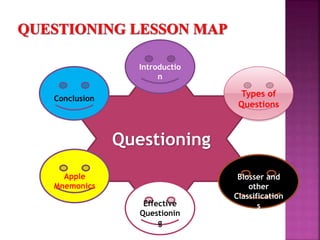
Questioning
Introductio
n
Apple
Mnemonics
Effective
Questionin
g
Blosser and
other
Classification
s
Types of
Questions
Conclusion
 A question is defined as any sentence which has an
interrogative form or function.
 They are instructional cues or stimuli that convey
to students the content elements to be learned
and directions on what they are to do and how
they are to do it (Cotton, nd.).
 The ability to ask and answer questions is central
to learning.
 The use of questioning skills in a systematic
manner is important for interactive investigation
in any subject.
 Classroom questions should be evaluated and
analyzed since questioning is an important teacher
behavior (Belland, Belland, & Price, 1971).
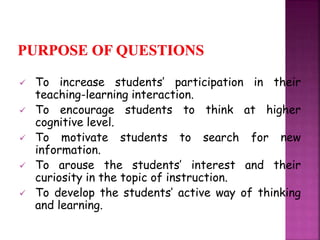
 To increase students’ participation in their
teaching-learning interaction.
 To encourage students to think at higher
cognitive level.
 To motivate students to search for new
information.
 To arouse the students’ interest and their
curiosity in the topic of instruction.
 To develop the students’ active way of thinking
and learning.
 To guide students in the process of finding a
good and correct answer.
 To help students concentrate on the topic under
discussion.
 To serve as a guide to students’ learning and
demonstration of learning (examination).
 To emphasize key points.
 To ascertain students’ knowledge level in a bid to
modify instruction.
Research on the questions teachers ask
shows that about 60 percent require only recall
of facts, 20 percent require students to think,
and 20 percent are procedural (Gall, Dunning, &
Weathersby, 1971). Generally there are always
two categories:
 Factual/ Higher Cognitive,
 Closed/ Open,
 Convergent/ Divergent,
 Low Order/ High Order, and
 Low Inquiry/ High Inquiry.

Set induction

  • 1.
    Presented By: SubmittedTo Sarwat Fatma Dr. Akhlaq Ahmad Sir B.Ed 1st Year
  • 2.
     One ofthe skill in micro teaching.  Skill of introducing the lesson.  How to start the teaching ? 2
  • 3.
     Do notstart teaching directly.  Complete the formality.  Write the date on top-left corner, name of subject on the top and middle and standard on right-corner of the board.  Do not tell the title of the unit. (chapter)  Be pleasant. 3
  • 4.
     5 min.lesson.  Lesson note - Teach lesson – discussion & feedback – lesson note – re teach lesson - discussion.  Freedom to select the Std. and unit for lesson.  Select the unit for lesson by observing sub- skills. 4
  • 5.
     Arousing curiosity. Revival of previous knowledge.  Use of teaching aids.  Effectiveness.  Statement of aim.  Title writing.  Linking with unit.  Creative.  Time management.  Overall impression. 5
  • 6.
     Racap ofserials.  Advertisements.  Queries 6
  • 8.
  • 9.
     A questionis defined as any sentence which has an interrogative form or function.  They are instructional cues or stimuli that convey to students the content elements to be learned and directions on what they are to do and how they are to do it (Cotton, nd.).  The ability to ask and answer questions is central to learning.  The use of questioning skills in a systematic manner is important for interactive investigation in any subject.  Classroom questions should be evaluated and analyzed since questioning is an important teacher behavior (Belland, Belland, & Price, 1971).
  • 10.
     To increasestudents’ participation in their teaching-learning interaction.  To encourage students to think at higher cognitive level.  To motivate students to search for new information.  To arouse the students’ interest and their curiosity in the topic of instruction.  To develop the students’ active way of thinking and learning.
  • 11.
     To guidestudents in the process of finding a good and correct answer.  To help students concentrate on the topic under discussion.  To serve as a guide to students’ learning and demonstration of learning (examination).  To emphasize key points.  To ascertain students’ knowledge level in a bid to modify instruction.
  • 12.
    Research on thequestions teachers ask shows that about 60 percent require only recall of facts, 20 percent require students to think, and 20 percent are procedural (Gall, Dunning, & Weathersby, 1971). Generally there are always two categories:  Factual/ Higher Cognitive,  Closed/ Open,  Convergent/ Divergent,  Low Order/ High Order, and  Low Inquiry/ High Inquiry.