COUNTABLE
AND
UNCOUNTABLE
Group #7
OUR TEAM
LUIS REYES ANDREA
CERCADO
JENNY
PUCHAICELA
EMILY RUIZ DEYANEIRA
TORRES
Countable nouns are nouns that can be
counted as individual items. They have
both singular and plural forms.
You can use numbers and articles like
“a” or “an” with them.
COUNTABLE
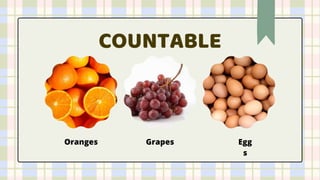
COUNTABLE
Oranges Grapes Egg
s
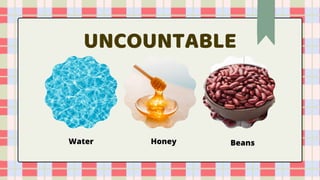
UNCOUNTABLE
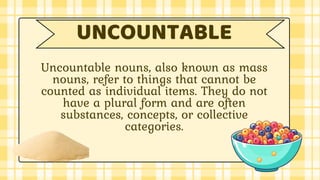
Uncountable nouns, also known as mass
nouns, refer to things that cannot be
counted as individual items. They do not
have a plural form and are often
substances, concepts, or collective
categories.
UNCOUNTABLE
Water Honey Beans
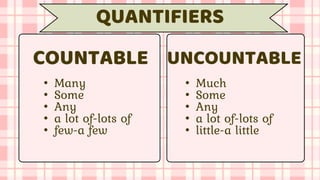
• Many
• Some
• Any
• a lot of-lots of
• few-a few
COUNTABLE UNCOUNTABLE
• Much
• Some
• Any
• a lot of-lots of
• little-a little
QUANTIFIERS
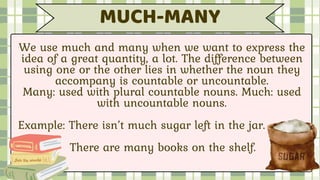
We use much and many when we want to express the
idea of a great quantity, a lot. The difference between
using one or the other lies in whether the noun they
accompany is countable or uncountable.
Many: used with plural countable nouns. Much: used
with uncountable nouns.
Example: There isn’t much sugar left in the jar.
There are many books on the shelf.
MUCH-MANY
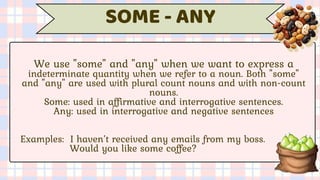
We use "some" and "any" when we want to express a
indeterminate quantity when we refer to a noun. Both "some"
and "any" are used with plural count nouns and with non-count
nouns.
Some: used in affirmative and interrogative sentences.
Any: used in interrogative and negative sentences
Examples: I haven’t received any emails from my boss.
Would you like some coffee?
SOME - ANY
As a rule we can say that a lot of and lots of are used to talk
about a great quantity in affirmative sentences and
accompanying countable and uncountable nouns, although
there are some exceptions in the use of these quantifiers. The
difference between using a lots of or lots of depends on the
context in which they are used.
Example: I have made a lot of mistakes in my life.
Lots of people came to the house to see the new baby.
A LOT OF- LOTS OF
Like little and a little are used to express little
quantity, but in this case, they are used only with
countable nouns. Similarly, using few or a few
depends on the connotation.
Examples: Few cities in the world can compete with
Paris.
I just need a few hours to finish my book.
FEW - A FEW
Both are used to express the idea of little quantity and are
only used with uncountable nouns. Using little or a little
depends on the connotation you want to give it, whether it is
positive or negative.
Little: we use it to express that it is little and not enough.
A little: we use it to say that although it is a small amount, it
is enough.
Examples:I have little money, I can’t buy a new car.
She saves a little money every month.
LITTLE-A LITTLE
THANK YOU

Countable and Uncountable12 Group #7.pptx

  • 1.
  • 2.
    OUR TEAM LUIS REYESANDREA CERCADO JENNY PUCHAICELA EMILY RUIZ DEYANEIRA TORRES
  • 3.
    Countable nouns arenouns that can be counted as individual items. They have both singular and plural forms. You can use numbers and articles like “a” or “an” with them. COUNTABLE
  • 4.
  • 5.
    UNCOUNTABLE Uncountable nouns, alsoknown as mass nouns, refer to things that cannot be counted as individual items. They do not have a plural form and are often substances, concepts, or collective categories.
  • 6.
  • 7.
    • Many • Some •Any • a lot of-lots of • few-a few COUNTABLE UNCOUNTABLE • Much • Some • Any • a lot of-lots of • little-a little QUANTIFIERS
  • 8.
    We use muchand many when we want to express the idea of a great quantity, a lot. The difference between using one or the other lies in whether the noun they accompany is countable or uncountable. Many: used with plural countable nouns. Much: used with uncountable nouns. Example: There isn’t much sugar left in the jar. There are many books on the shelf. MUCH-MANY
  • 9.
    We use "some"and "any" when we want to express a indeterminate quantity when we refer to a noun. Both "some" and "any" are used with plural count nouns and with non-count nouns. Some: used in affirmative and interrogative sentences. Any: used in interrogative and negative sentences Examples: I haven’t received any emails from my boss. Would you like some coffee? SOME - ANY
  • 10.
    As a rulewe can say that a lot of and lots of are used to talk about a great quantity in affirmative sentences and accompanying countable and uncountable nouns, although there are some exceptions in the use of these quantifiers. The difference between using a lots of or lots of depends on the context in which they are used. Example: I have made a lot of mistakes in my life. Lots of people came to the house to see the new baby. A LOT OF- LOTS OF
  • 11.
    Like little anda little are used to express little quantity, but in this case, they are used only with countable nouns. Similarly, using few or a few depends on the connotation. Examples: Few cities in the world can compete with Paris. I just need a few hours to finish my book. FEW - A FEW
  • 12.
    Both are usedto express the idea of little quantity and are only used with uncountable nouns. Using little or a little depends on the connotation you want to give it, whether it is positive or negative. Little: we use it to express that it is little and not enough. A little: we use it to say that although it is a small amount, it is enough. Examples:I have little money, I can’t buy a new car. She saves a little money every month. LITTLE-A LITTLE
  • 13.