Countable nouns are individual objects, people, places, etc. which
can be counted.


• books, Italians, pictures, stations, men, etc.
A countable noun can be both singular - a friend, a house, etc. - or
plural - a few apples, lots of trees, etc.
Use the singular form of the verb with a singular countable noun:


•There is a book on the table.
•That student is excellent!

    Use the plural form of the verb with a countable noun in the plural:

           There are some students in the classroom.
•             Those houses are very big, aren't they?
Uncountable nouns are materials, concepts, information, etc. which
are not individual objects and can not be counted


• Information, water, understanding, wood, cheese, etc.


Uncountable nouns are always singular. Use the singular form of the verb
with uncountable nouns:

• There is some water in that pitcher.
• That is the equipment we use for the project.
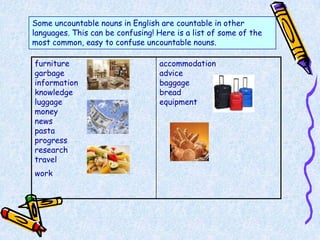
Some uncountable nouns in English are countable in other
languages. This can be confusing! Here is a list of some of the
most common, easy to confuse uncountable nouns.

furniture                         accommodation
garbage                           advice
information                       baggage
knowledge                         bread
luggage                           equipment
money
news
pasta
progress
research
travel
work
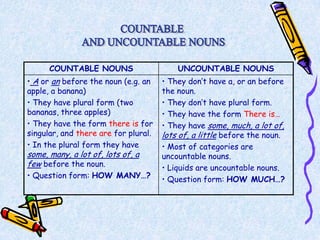
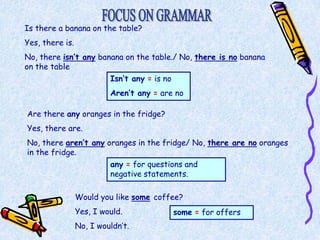
Obviously, uncountable nouns (especially different types of
food) have forms that express plural concepts. These
measurements or containers are countable:

water - a glass of water
equipment - a piece of equipment
cheese - a slice of cheese
COUNTABLE NOUNS                     UNCOUNTABLE NOUNS
• A or an before the noun (e.g. an    • They don’t have a, or an before
apple, a banana)                      the noun.
• They have plural form (two          • They don’t have plural form.
bananas, three apples)                • They have the form There is…
• They have the form there is for     • They have some, much, a lot of,
singular, and there are for plural.   lots of, a little before the noun.
• In the plural form they have        • Most of categories are
some, many, a lot of, lots of, a      uncountable nouns.
few before the noun.                  • Liquids are uncountable nouns.
• Question form: HOW MANY…?           • Question form: HOW MUCH…?
Is there a banana on the table?
Yes, there is.
No, there isn’t any banana on the table./ No, there is no banana
on the table
                       Isn’t any = is no
                          Aren’t any = are no

Are there any oranges in the fridge?
Yes, there are.
No, there aren’t any oranges in the fridge/ No, there are no oranges
in the fridge.
                      any = for questions and
                      negative statements.

                 Would you like some coffee?
                 Yes, I would.            some = for offers
                 No, I wouldn’t.
COUNTABLE AND UNCOUNTABLE - NOUN QUANTIFIERS


Identify the following objects as countable or uncountable. When
you are finished click on the "Next Question" button. There are 25
questions to this quiz. Try to use only 10 seconds per question.

Q: Rules
                            Q: Clothes
__ Countable
                            __ Countable
__ Uncountable
                            __ Uncountable
                            Q: Music
Q: Information
                            __ Uncountable
__ Countable
                            __ Countable
__ Uncountable
                            Q: Deserts
                            __ Countable
Q: Sheep
                            __ Uncountable
__ Countable
                            Q: Land
__ Uncountable
                            __ Countable
                            __ Uncountable
                            Q: Nations
                            __ Countable
                            __ Uncountable
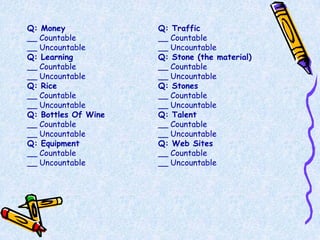
Q: Money             Q: Traffic
__ Countable         __ Countable
__ Uncountable       __ Uncountable
Q: Learning          Q: Stone (the material)
__ Countable         __ Countable
__ Uncountable       __ Uncountable
Q: Rice              Q: Stones
__ Countable         __ Countable
__ Uncountable       __ Uncountable
Q: Bottles Of Wine   Q: Talent
__ Countable         __ Countable
__ Uncountable       __ Uncountable
Q: Equipment         Q: Web Sites
__ Countable         __ Countable
__ Uncountable       __ Uncountable
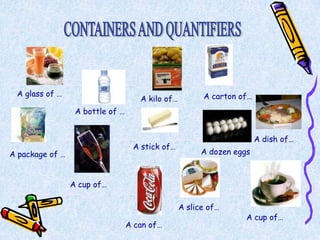
A glass of …                                           A carton of…
                                     A kilo of…
                  A bottle of …


                                                                       A dish of…
                                   A stick of…
A package of …                                          A dozen eggs


                 A cup of…

                                                  A slice of…
                                                                   A cup of…
                                  A can of…
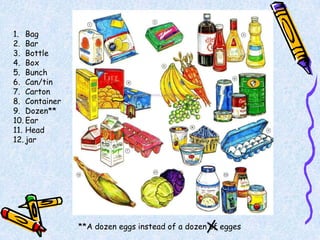
1. Bag
2. Bar
3. Bottle
4. Box
5. Bunch
6. Can/tin
7. Carton
8. Container
9. Dozen**
10. Ear
11. Head
12. jar


               **A dozen eggs instead of a dozen of egges
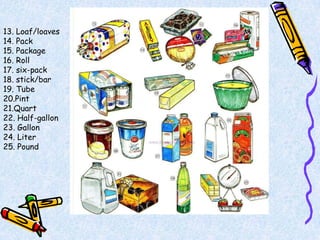
13. Loaf/loaves
14. Pack
15. Package
16. Roll
17. six-pack
18. stick/bar
19. Tube
20.Pint
21.Quart
22. Half-gallon
23. Gallon
24. Liter
25. Pound
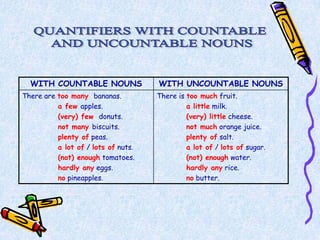
WITH COUNTABLE NOUNS               WITH UNCOUNTABLE NOUNS
There are too many bananas.          There is too much fruit.
          a few apples.                       a little milk.
          (very) few donuts.                  (very) little cheese.
          not many biscuits.                  not much orange juice.
          plenty of peas.                     plenty of salt.
          a lot of / lots of nuts.            a lot of / lots of sugar.
          (not) enough tomatoes.              (not) enough water.
          hardly any eggs.                    hardly any rice.
          no pineapples.                      no butter.
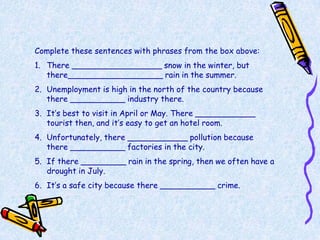
Complete these sentences with phrases from the box above:
1. There __________________ snow in the winter, but
   there___________________ rain in the summer.
2. Unemployment is high in the north of the country because
   there ___________ industry there.
3. It’s best to visit in April or May. There ____________
   tourist then, and it’s easy to get an hotel room.
4. Unfortunately, there ____________ pollution because
   there ___________ factories in the city.
5. If there _________ rain in the spring, then we often have a
   drought in July.
6. It’s a safe city because there ___________ crime.
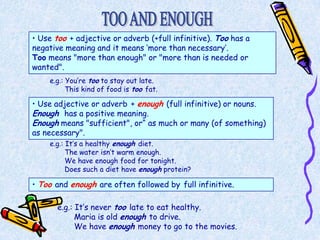
• Use too + adjective or adverb (+full infinitive). Too has a
negative meaning and it means ‘more than necessary’.
Too means "more than enough" or "more than is needed or
wanted".
    e.g.: You’re too to stay out late.
          This kind of food is too fat.

• Use adjective or adverb + enough (full infinitive) or nouns.
Enough has a positive meaning.
Enough means "sufficient", or“ as much or many (of something)
as necessary".
    e.g.: It’s a healthy enough diet.
          The water isn’t warm enough.
          We have enough food for tonight.
          Does such a diet have enough protein?

• Too and enough are often followed by full infinitive.

       e.g.: It’s never too late to eat healthy.
             Maria is old enough to drive.
             We have enough money to go to the movies.
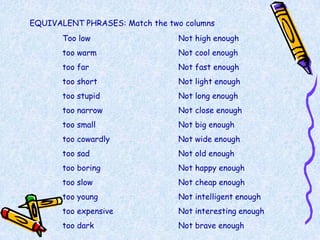
EQUIVALENT PHRASES: Match the two columns
       Too low                  Not high enough
       too warm                 Not cool enough
       too far                  Not fast enough
       too short                Not light enough
       too stupid               Not long enough
       too narrow               Not close enough
       too small                Not big enough
       too cowardly             Not wide enough
       too sad                  Not old enough
       too boring               Not happy enough
       too slow                 Not cheap enough
       too young                Not intelligent enough
       too expensive            Not interesting enough
       too dark                 Not brave enough

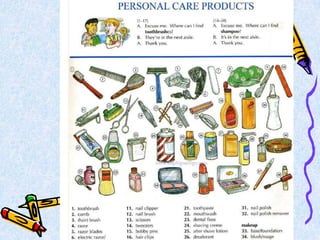
Countable and uncountable nouns personal care products- basic iii (1)

  • 2.
    Countable nouns areindividual objects, people, places, etc. which can be counted. • books, Italians, pictures, stations, men, etc. A countable noun can be both singular - a friend, a house, etc. - or plural - a few apples, lots of trees, etc. Use the singular form of the verb with a singular countable noun: •There is a book on the table. •That student is excellent! Use the plural form of the verb with a countable noun in the plural: There are some students in the classroom. • Those houses are very big, aren't they?
  • 3.
    Uncountable nouns arematerials, concepts, information, etc. which are not individual objects and can not be counted • Information, water, understanding, wood, cheese, etc. Uncountable nouns are always singular. Use the singular form of the verb with uncountable nouns: • There is some water in that pitcher. • That is the equipment we use for the project.
  • 4.
    Some uncountable nounsin English are countable in other languages. This can be confusing! Here is a list of some of the most common, easy to confuse uncountable nouns. furniture accommodation garbage advice information baggage knowledge bread luggage equipment money news pasta progress research travel work
  • 5.
    Obviously, uncountable nouns(especially different types of food) have forms that express plural concepts. These measurements or containers are countable: water - a glass of water equipment - a piece of equipment cheese - a slice of cheese
  • 6.
    COUNTABLE NOUNS UNCOUNTABLE NOUNS • A or an before the noun (e.g. an • They don’t have a, or an before apple, a banana) the noun. • They have plural form (two • They don’t have plural form. bananas, three apples) • They have the form There is… • They have the form there is for • They have some, much, a lot of, singular, and there are for plural. lots of, a little before the noun. • In the plural form they have • Most of categories are some, many, a lot of, lots of, a uncountable nouns. few before the noun. • Liquids are uncountable nouns. • Question form: HOW MANY…? • Question form: HOW MUCH…?
  • 7.
    Is there abanana on the table? Yes, there is. No, there isn’t any banana on the table./ No, there is no banana on the table Isn’t any = is no Aren’t any = are no Are there any oranges in the fridge? Yes, there are. No, there aren’t any oranges in the fridge/ No, there are no oranges in the fridge. any = for questions and negative statements. Would you like some coffee? Yes, I would. some = for offers No, I wouldn’t.
  • 8.
    COUNTABLE AND UNCOUNTABLE- NOUN QUANTIFIERS Identify the following objects as countable or uncountable. When you are finished click on the "Next Question" button. There are 25 questions to this quiz. Try to use only 10 seconds per question. Q: Rules Q: Clothes __ Countable __ Countable __ Uncountable __ Uncountable Q: Music Q: Information __ Uncountable __ Countable __ Countable __ Uncountable Q: Deserts __ Countable Q: Sheep __ Uncountable __ Countable Q: Land __ Uncountable __ Countable __ Uncountable Q: Nations __ Countable __ Uncountable
  • 9.
    Q: Money Q: Traffic __ Countable __ Countable __ Uncountable __ Uncountable Q: Learning Q: Stone (the material) __ Countable __ Countable __ Uncountable __ Uncountable Q: Rice Q: Stones __ Countable __ Countable __ Uncountable __ Uncountable Q: Bottles Of Wine Q: Talent __ Countable __ Countable __ Uncountable __ Uncountable Q: Equipment Q: Web Sites __ Countable __ Countable __ Uncountable __ Uncountable
  • 11.
    A glass of… A carton of… A kilo of… A bottle of … A dish of… A stick of… A package of … A dozen eggs A cup of… A slice of… A cup of… A can of…
  • 12.
    1. Bag 2. Bar 3.Bottle 4. Box 5. Bunch 6. Can/tin 7. Carton 8. Container 9. Dozen** 10. Ear 11. Head 12. jar **A dozen eggs instead of a dozen of egges
  • 13.
    13. Loaf/loaves 14. Pack 15.Package 16. Roll 17. six-pack 18. stick/bar 19. Tube 20.Pint 21.Quart 22. Half-gallon 23. Gallon 24. Liter 25. Pound
  • 14.
    WITH COUNTABLE NOUNS WITH UNCOUNTABLE NOUNS There are too many bananas. There is too much fruit. a few apples. a little milk. (very) few donuts. (very) little cheese. not many biscuits. not much orange juice. plenty of peas. plenty of salt. a lot of / lots of nuts. a lot of / lots of sugar. (not) enough tomatoes. (not) enough water. hardly any eggs. hardly any rice. no pineapples. no butter.
  • 15.
    Complete these sentenceswith phrases from the box above: 1. There __________________ snow in the winter, but there___________________ rain in the summer. 2. Unemployment is high in the north of the country because there ___________ industry there. 3. It’s best to visit in April or May. There ____________ tourist then, and it’s easy to get an hotel room. 4. Unfortunately, there ____________ pollution because there ___________ factories in the city. 5. If there _________ rain in the spring, then we often have a drought in July. 6. It’s a safe city because there ___________ crime.
  • 16.
    • Use too+ adjective or adverb (+full infinitive). Too has a negative meaning and it means ‘more than necessary’. Too means "more than enough" or "more than is needed or wanted". e.g.: You’re too to stay out late. This kind of food is too fat. • Use adjective or adverb + enough (full infinitive) or nouns. Enough has a positive meaning. Enough means "sufficient", or“ as much or many (of something) as necessary". e.g.: It’s a healthy enough diet. The water isn’t warm enough. We have enough food for tonight. Does such a diet have enough protein? • Too and enough are often followed by full infinitive. e.g.: It’s never too late to eat healthy. Maria is old enough to drive. We have enough money to go to the movies.
  • 17.
    EQUIVALENT PHRASES: Matchthe two columns Too low Not high enough too warm Not cool enough too far Not fast enough too short Not light enough too stupid Not long enough too narrow Not close enough too small Not big enough too cowardly Not wide enough too sad Not old enough too boring Not happy enough too slow Not cheap enough too young Not intelligent enough too expensive Not interesting enough too dark Not brave enough