Chapter 2
Cost Terminology and
Cost Behaviors
Cost Accounting
Foundations and Evolutions
Kinney, Prather, Raiborn
Learning Objectives (1 of 2)
• Explain assumptions about cost behavior
and why these assumptions are necessary
• List the cost classifications and explain why
the classifications are useful
• Describe the conversion process in service
and manufacturing companies
Learning Objectives (2 of 2)
• List product cost categories and their
components
• Calculate the Cost of Goods Manufactured
and explain how it is used in the Income
Statement
Cost
Monetary measure of resources
given up to attain an objective
(such as acquiring a good
or delivering a service)
• Insert Exhibit 2-1, is it infographic?
Cost Categories
• Association with cost object
Cost object is anything for which management wants to
collect or accumulate costs
• Reaction to changes in activity
• Classification on the financial statements
Cost Categories
• Association with cost object
– Direct - traceable to a cost object
– Indirect - not conveniently or practically
traceable to a cost object
• treated as overhead
• allocated
Cost Categories
• Association with cost object
• Reaction to changes in activity
– Variable
– Fixed
– Mixed
– Step
Relevant Range – normal operating range
Variable Cost
Fixed Cost
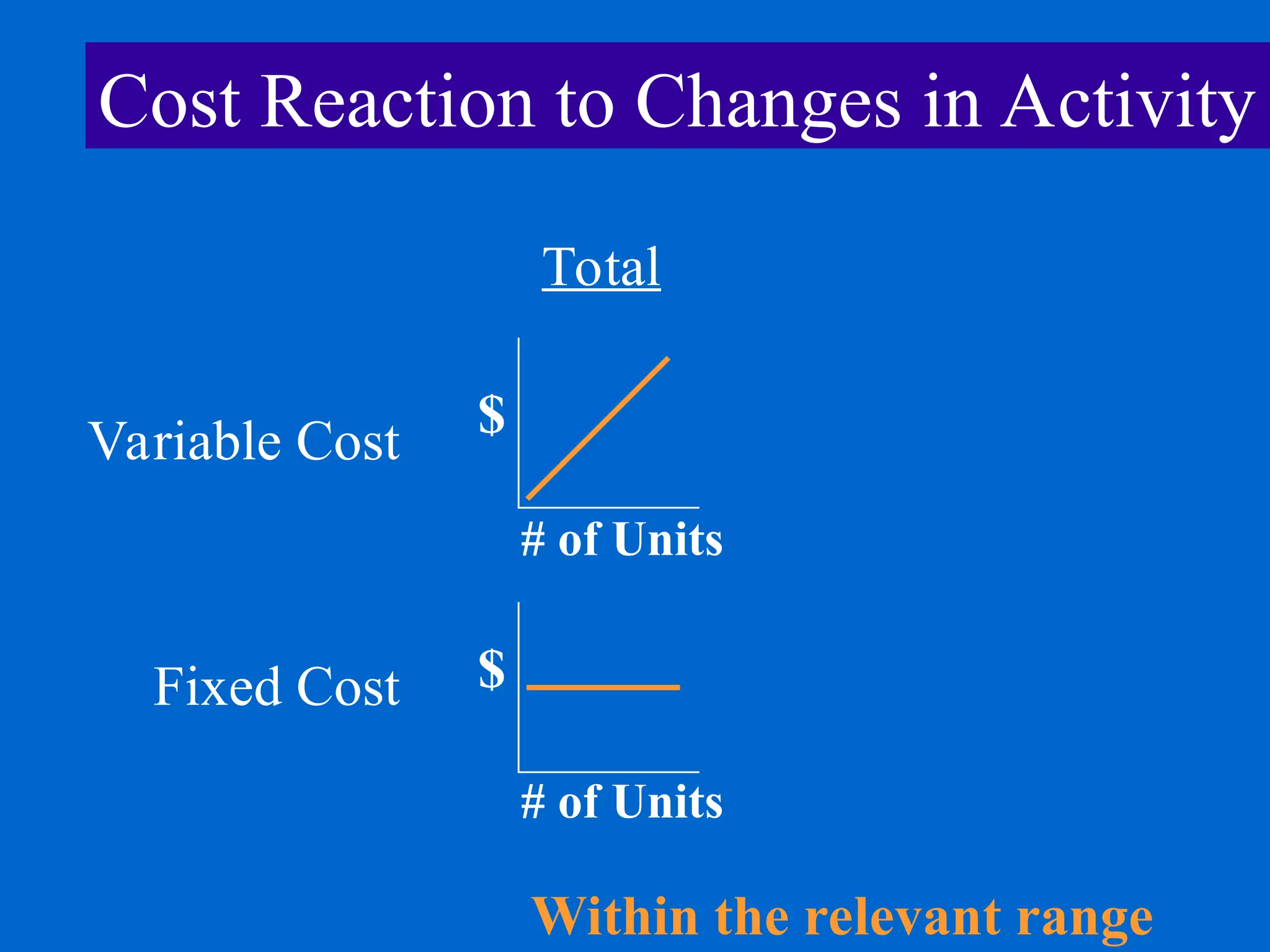
Cost Reaction to Changes in Activity
Total
$
# of Units
$
# of Units
Within the relevant range
Variable Cost
Fixed Cost
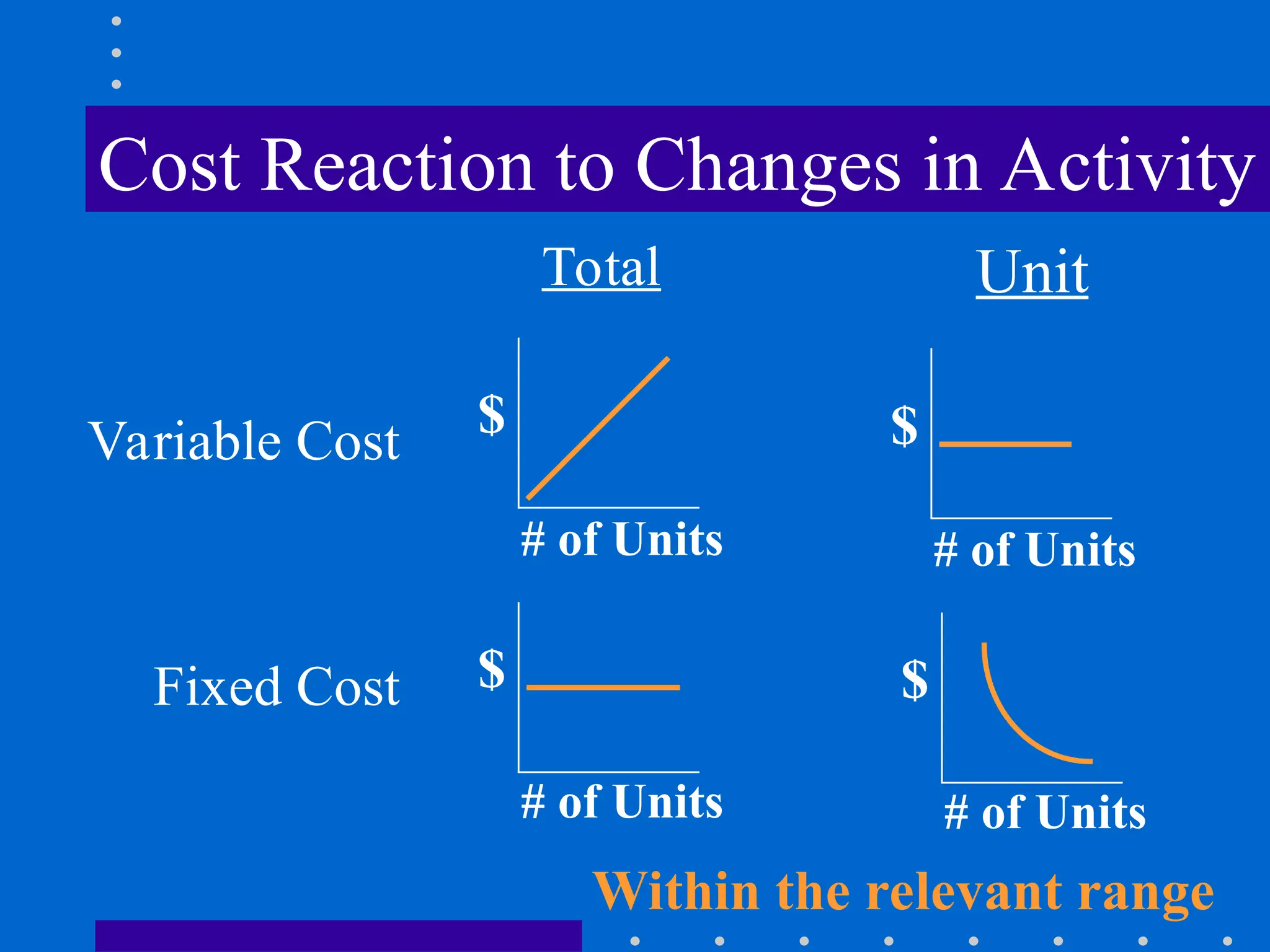
Cost Reaction to Changes in Activity
Total Unit
$
# of Units
$
$
$
# of Units
# of Units # of Units
Within the relevant range
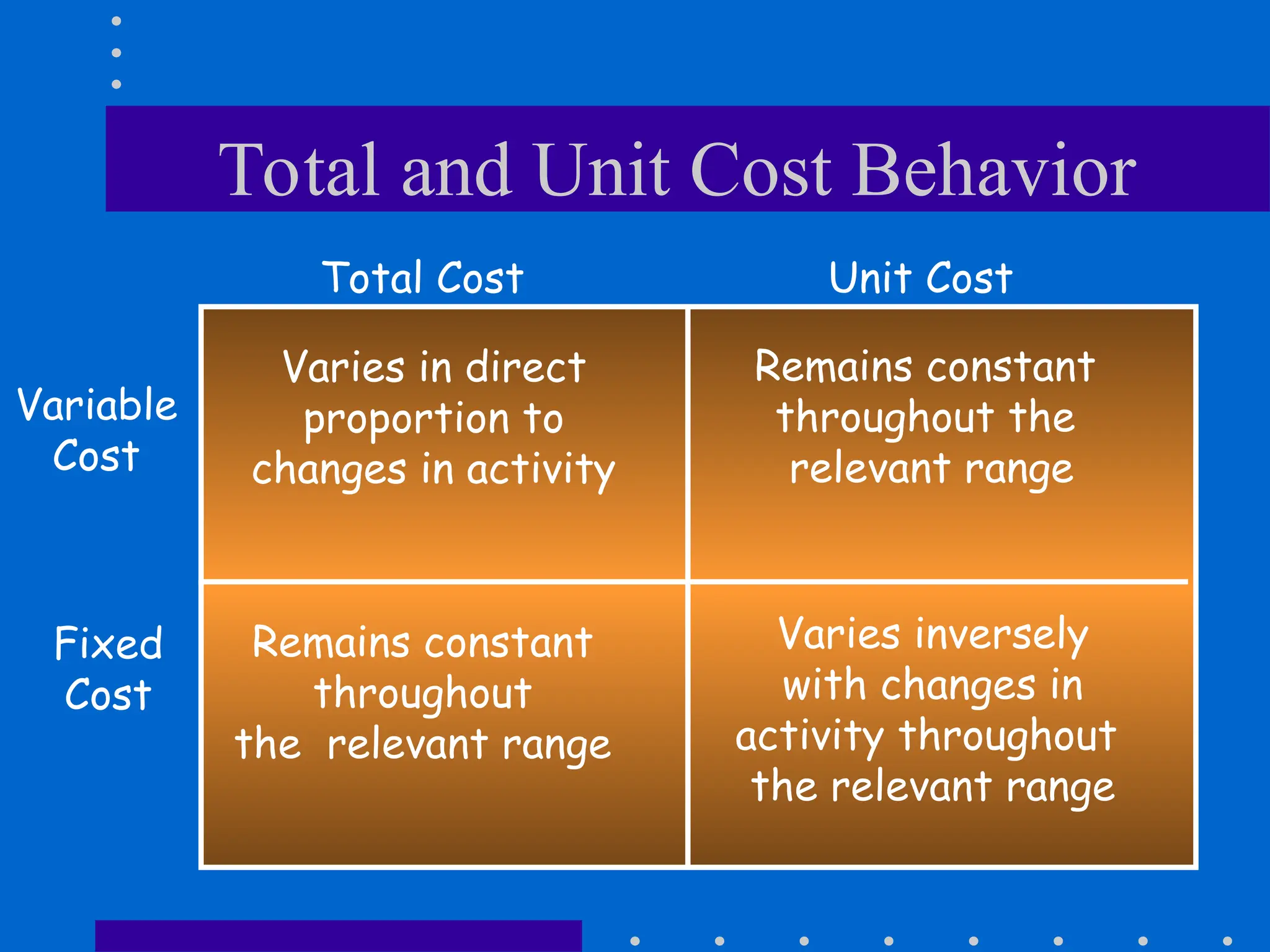
Total and Unit Cost Behavior
Varies in direct
proportion to
changes in activity
Remains constant
throughout
the relevant range
Remains constant
throughout the
relevant range
Varies inversely
with changes in
activity throughout
the relevant range
Variable
Cost
Fixed
Cost
Total Cost Unit Cost
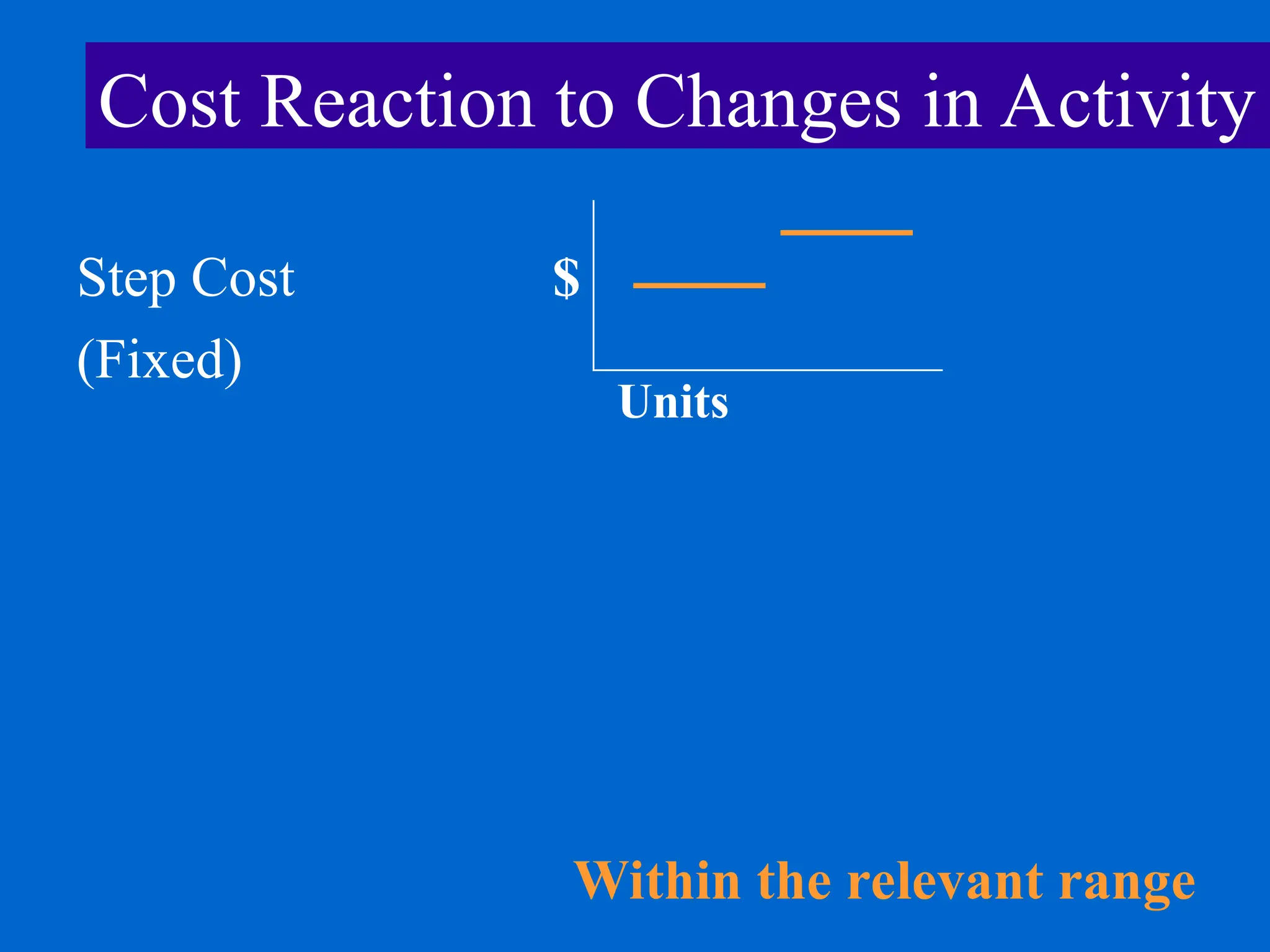
Step Cost
(Fixed)
Cost Reaction to Changes in Activity
$
Units
Within the relevant range
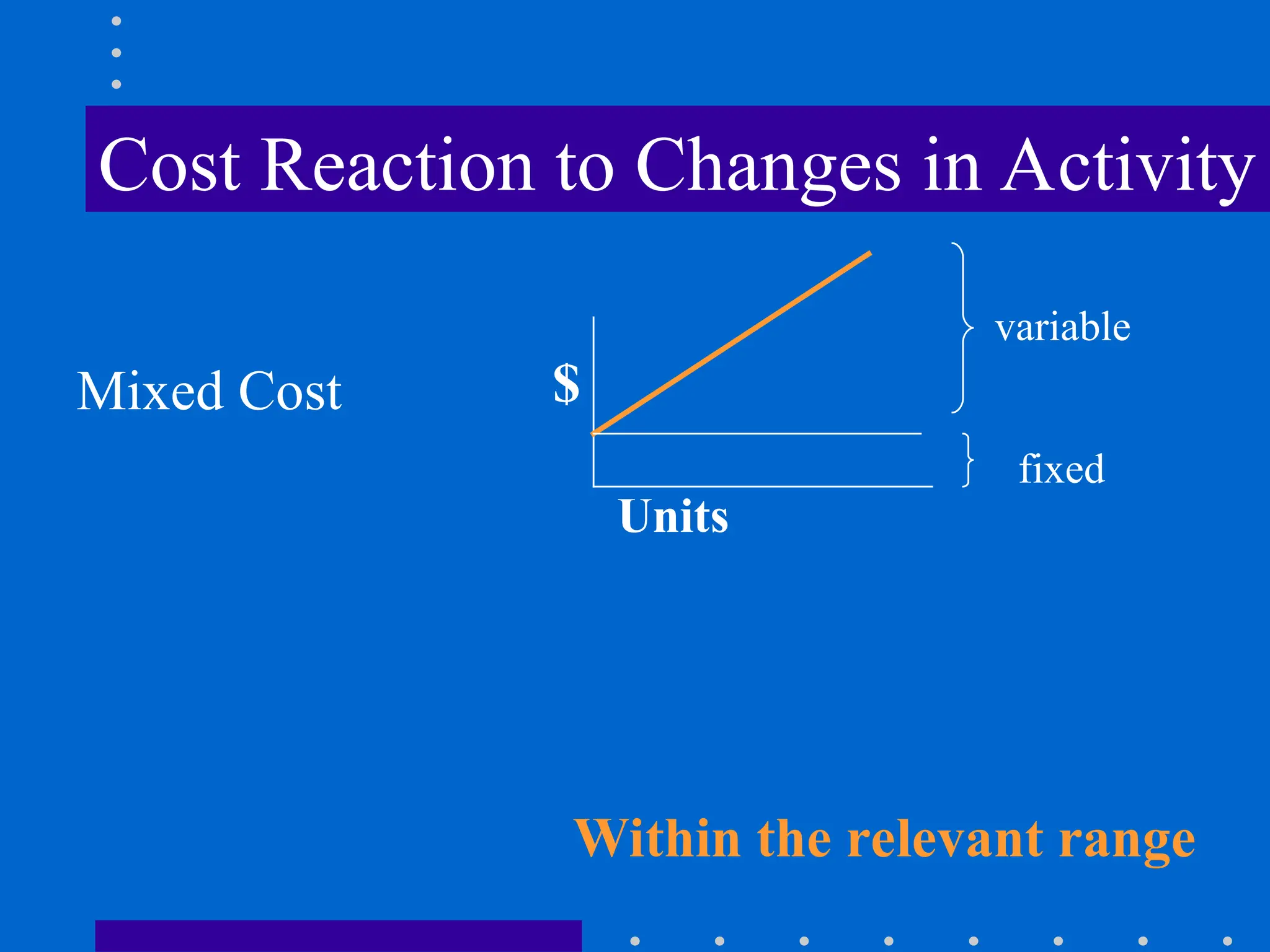
Mixed Cost
Cost Reaction to Changes in Activity
$
Units
fixed
Within the relevant range
variable
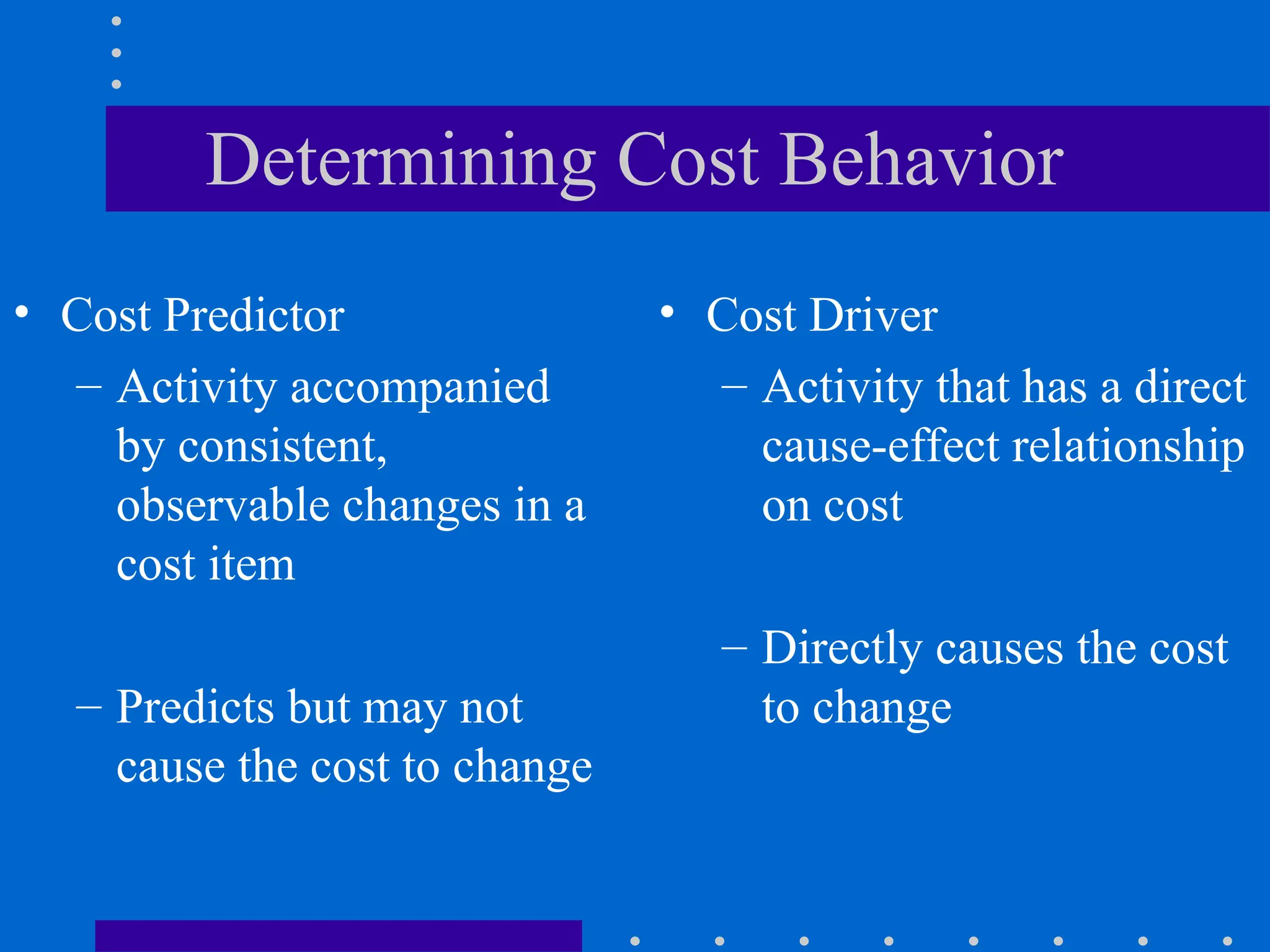
Determining Cost Behavior
• Cost Predictor
– Activity accompanied
by consistent,
observable changes in a
cost item
– Predicts but may not
cause the cost to change
• Cost Driver
– Activity that has a direct
cause-effect relationship
on cost
– Directly causes the cost
to change
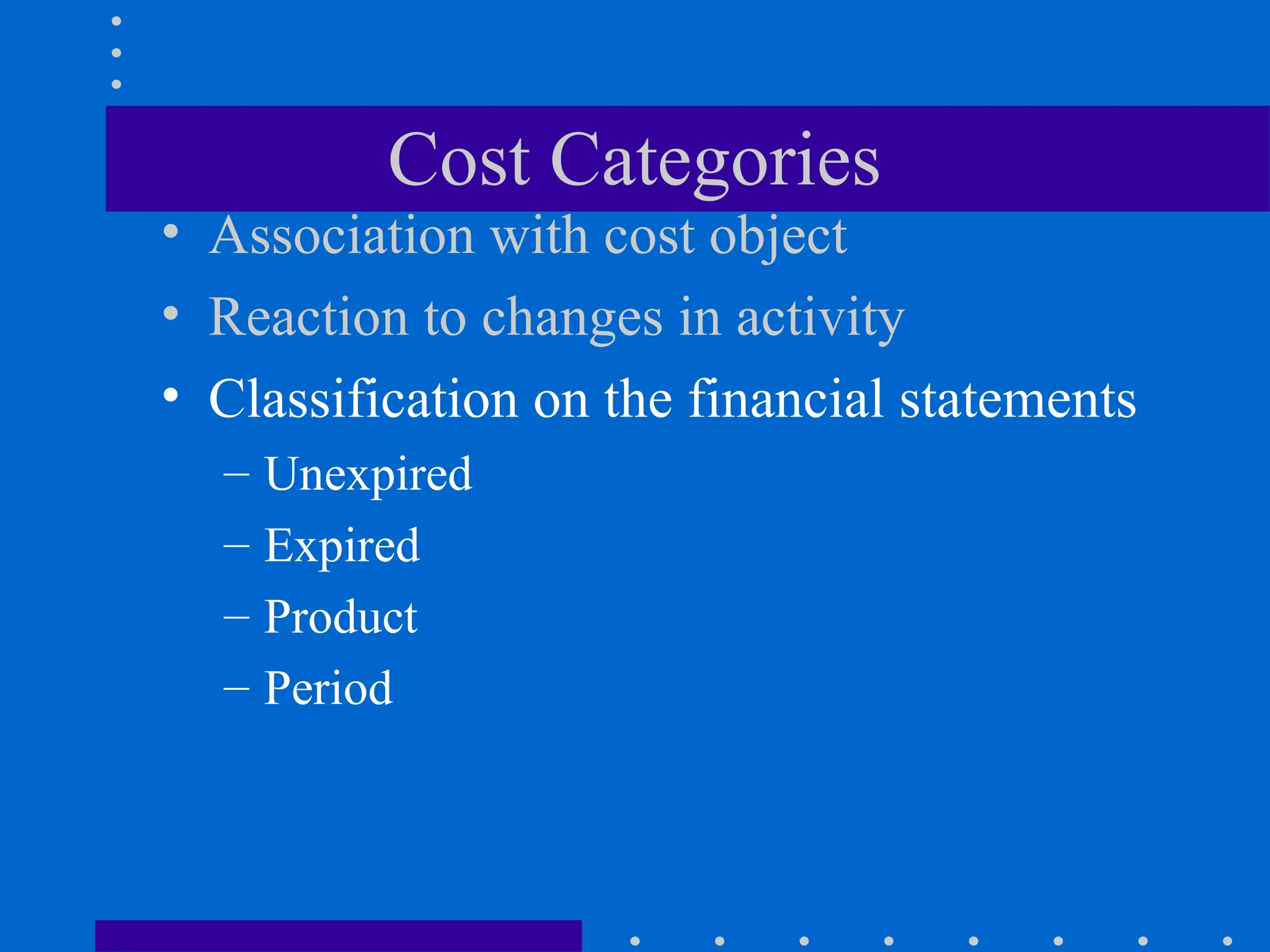
Cost Categories
• Association with cost object
• Reaction to changes in activity
• Classification on the financial statements
– Unexpired
– Expired
– Product
– Period
Cost Categories
• Classification on the financial statements
– Unexpired – balance sheet assets
– Expired – income statement expenses
– Product – inventoriable costs
• Prime – direct material and direct labor
• Conversion – direct labor and overhead
– Period – expensed in period incurred
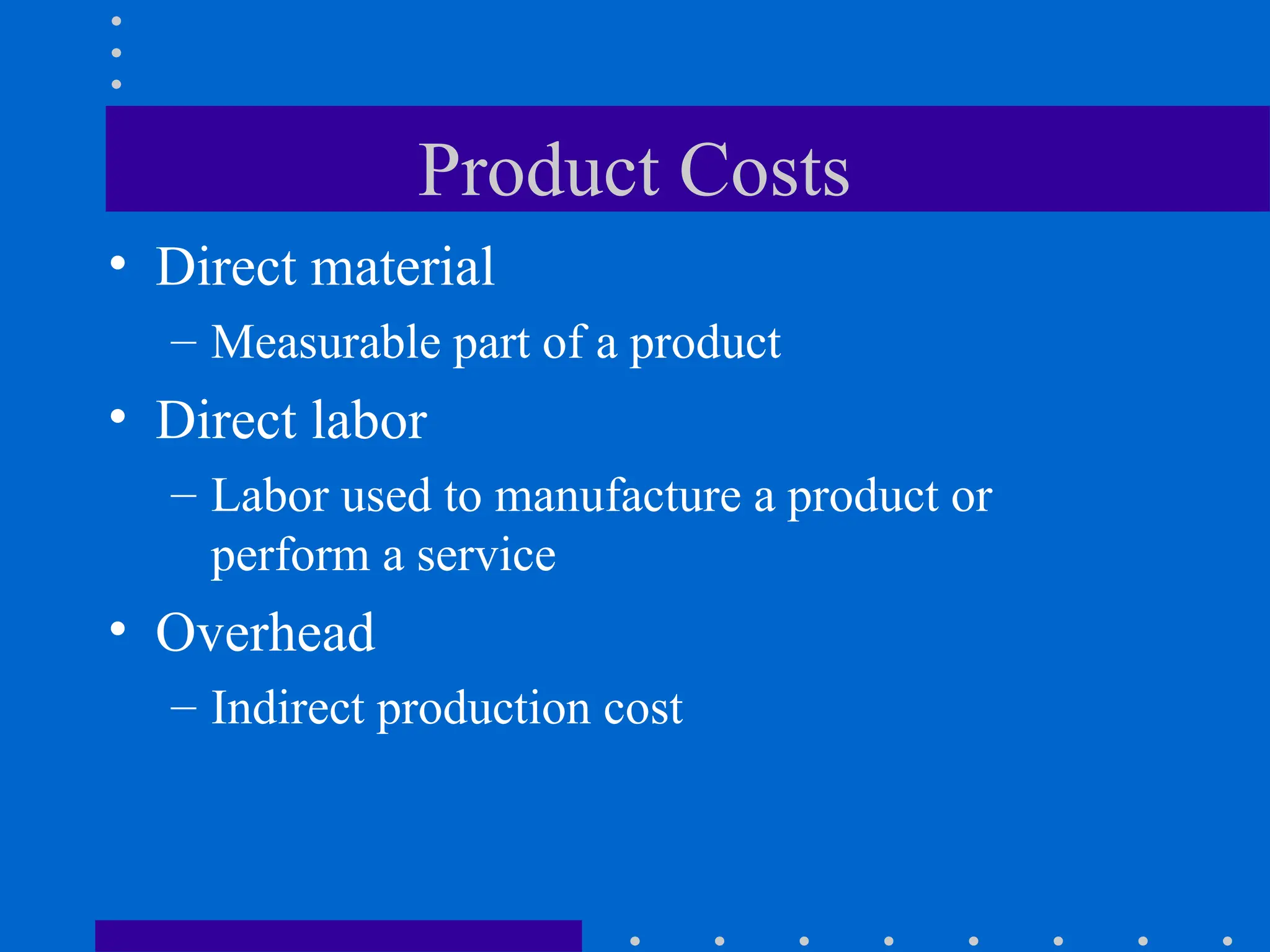
Product Costs
• Direct material
– Measurable part of a product
• Direct labor
– Labor used to manufacture a product or
perform a service
• Overhead
– Indirect production cost
Product Costs
• First appear on the balance sheet in
inventory accounts
• Transferred to the income statement when
product is sold
Period Costs
• Selling and administrative costs
• Distribution costs
– Cost to warehouse, transport, and/or deliver a
product or service
– Major impact on managerial decision making
Period Costs
• Appear on the income statement when
incurred
• Expensed when incurred
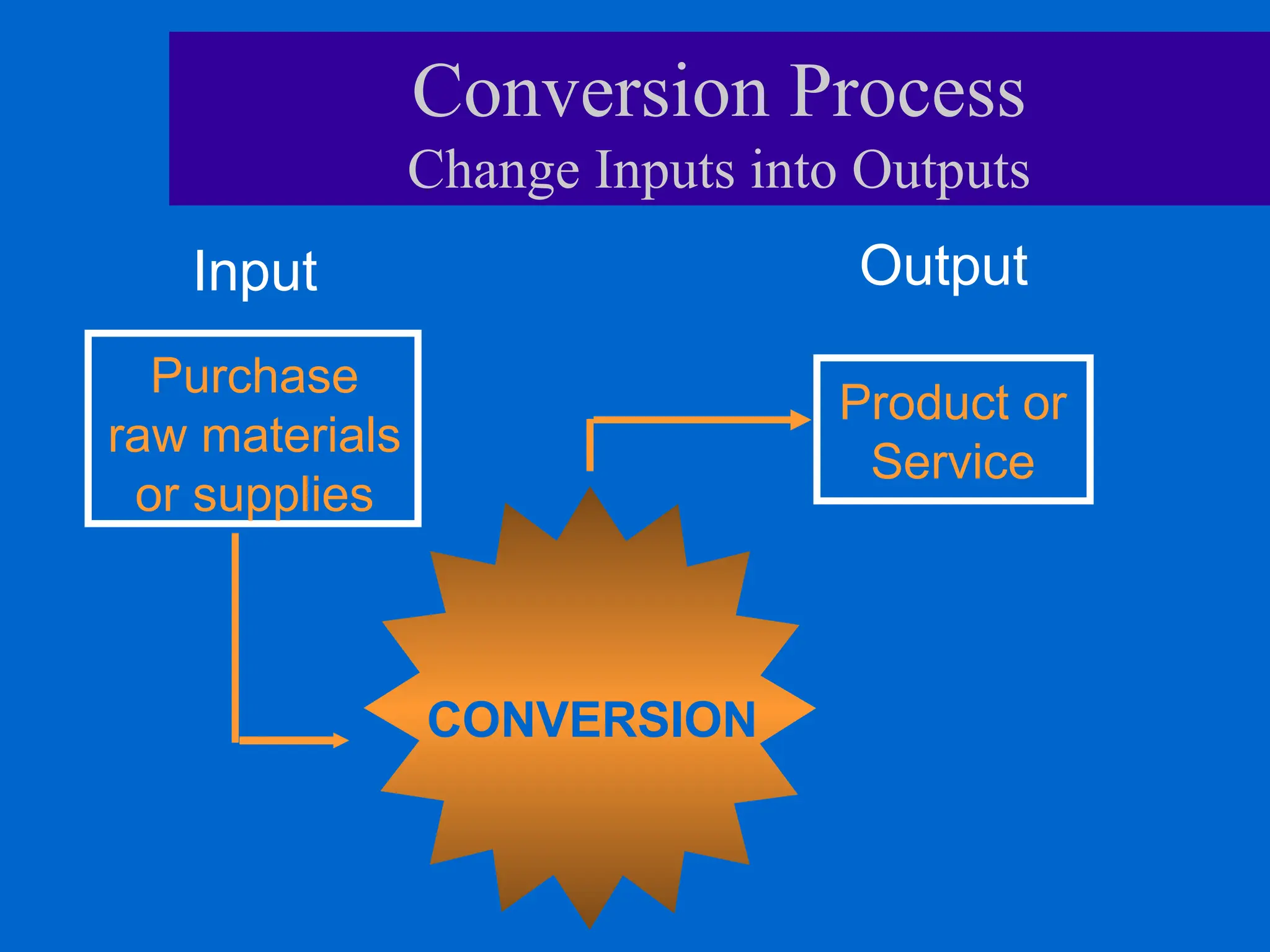
Purchase
raw materials
or supplies
Input
Product or
Service
Output
Conversion Process
Change Inputs into Outputs
CONVERSION
Low Degree of Conversion
• Department stores
• Gas stations
• Jewelry stores
• Travel agencies
Moderate Degree of Conversion
• Florists
• Meat markets
• Oil-change businesses
High Degree of Conversion
• Manufacturing
• Construction
• Agriculture
• Architecture
• Auditing
• Mining
• Printing
• Restaurants
• Insert infographic Exhibit 2-8
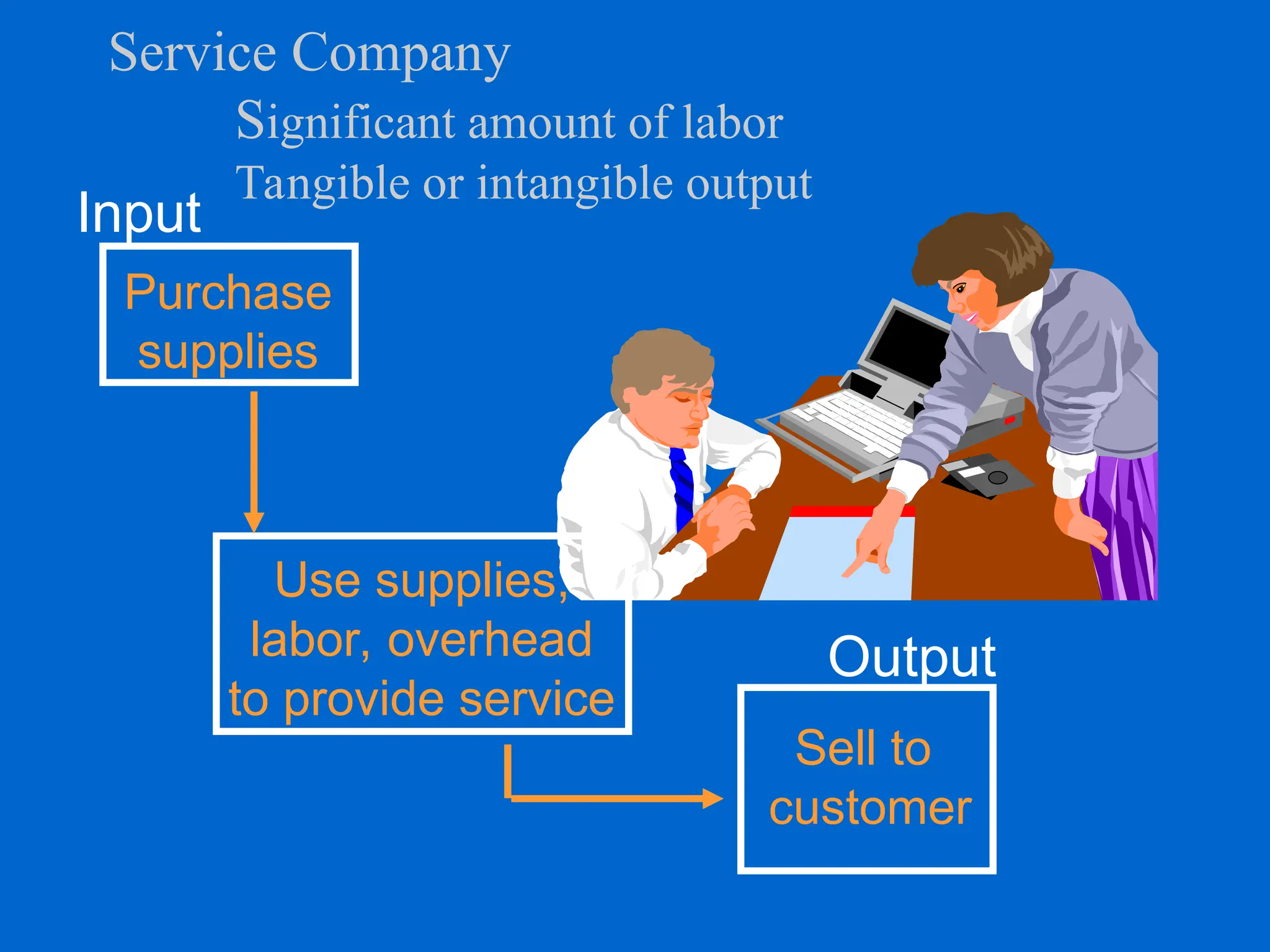
Service Company
Significant amount of labor
Tangible or intangible output
Purchase
supplies
Use supplies,
labor, overhead
to provide service
Sell to
customer
Input
Output
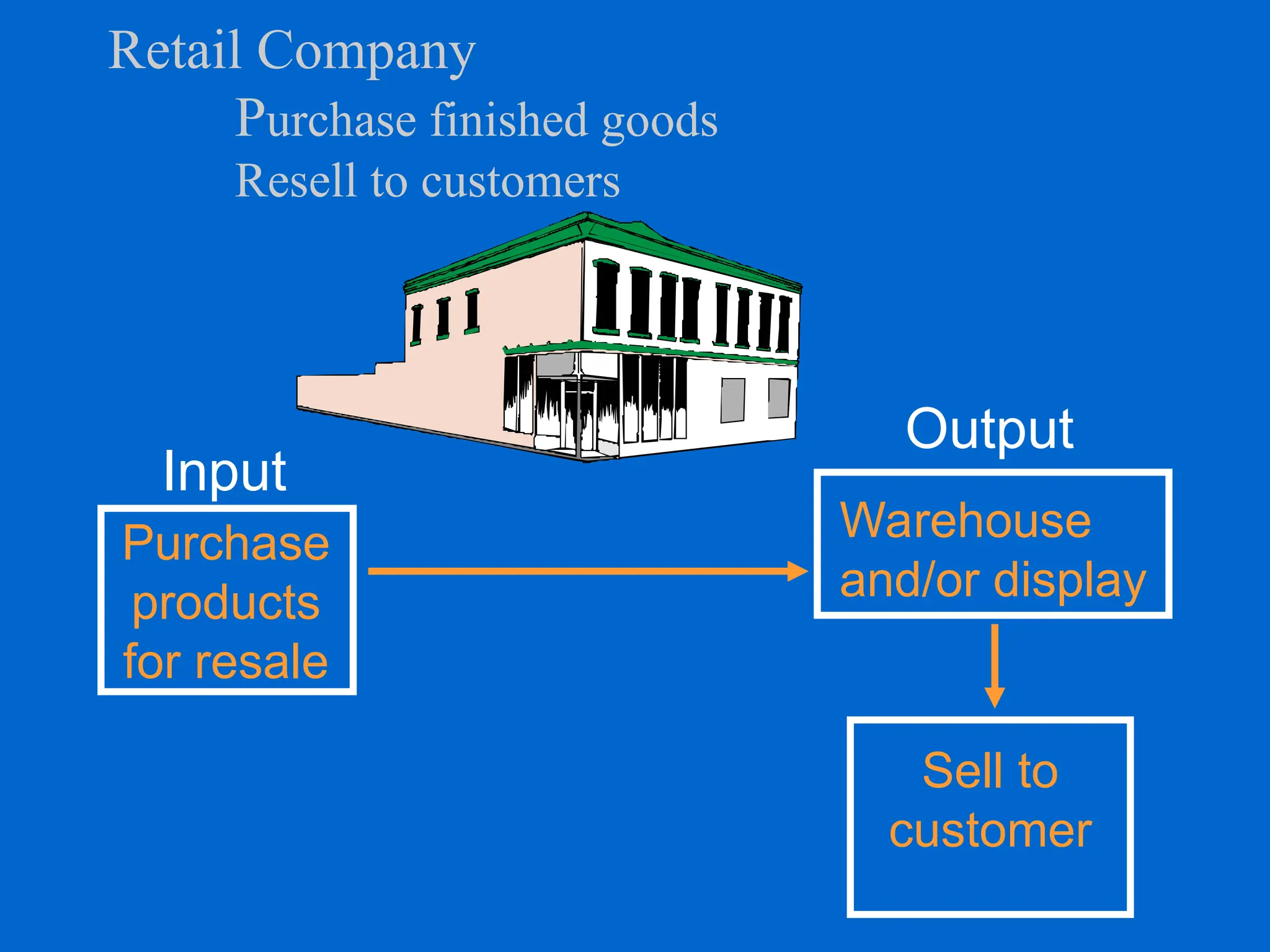
Retail Company
Purchase finished goods
Resell to customers
Purchase
products
for resale
Warehouse
and/or display
Sell to
customer
Input
Output
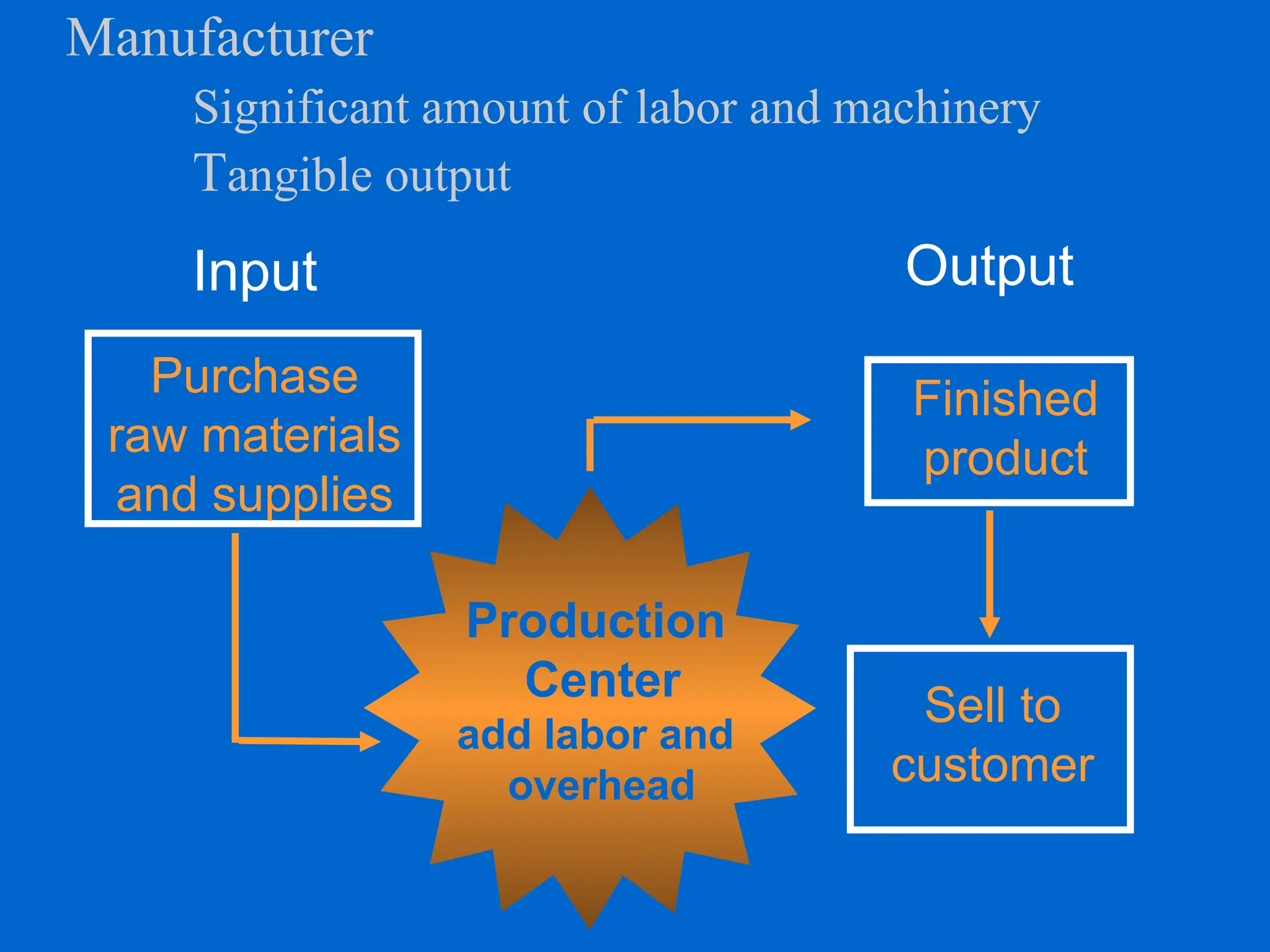
Manufacturer
Significant amount of labor and machinery
Tangible output
Purchase
raw materials
and supplies
Finished
product
Sell to
customer
Input Output
Production
Center
add labor and
overhead
• Insert infographic, Exhibit 2-9
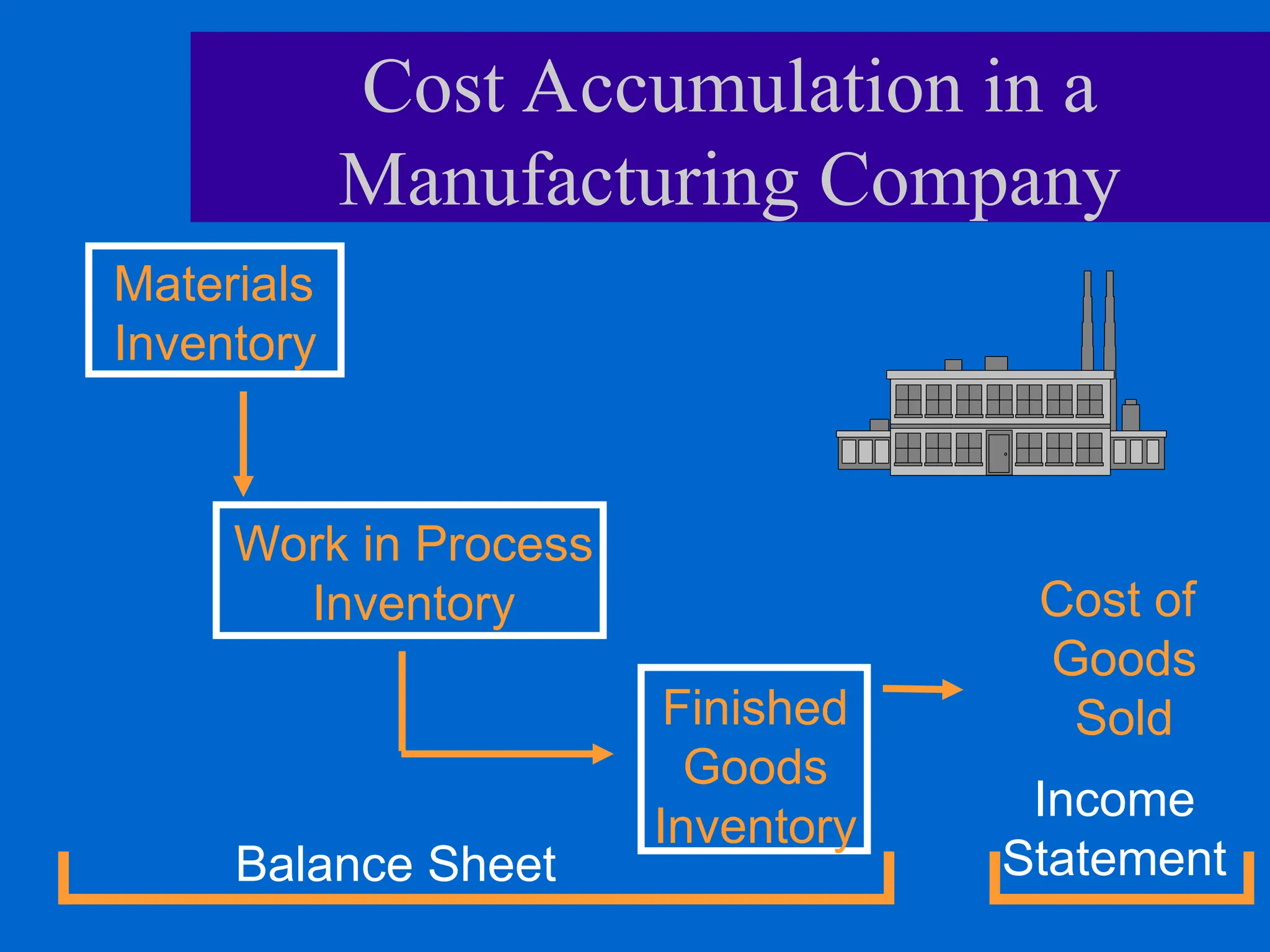
Cost Accumulation in a
Manufacturing Company
Materials
Inventory
Work in Process
Inventory
Finished
Goods
Inventory
Cost of
Goods
Sold
Balance Sheet
Income
Statement
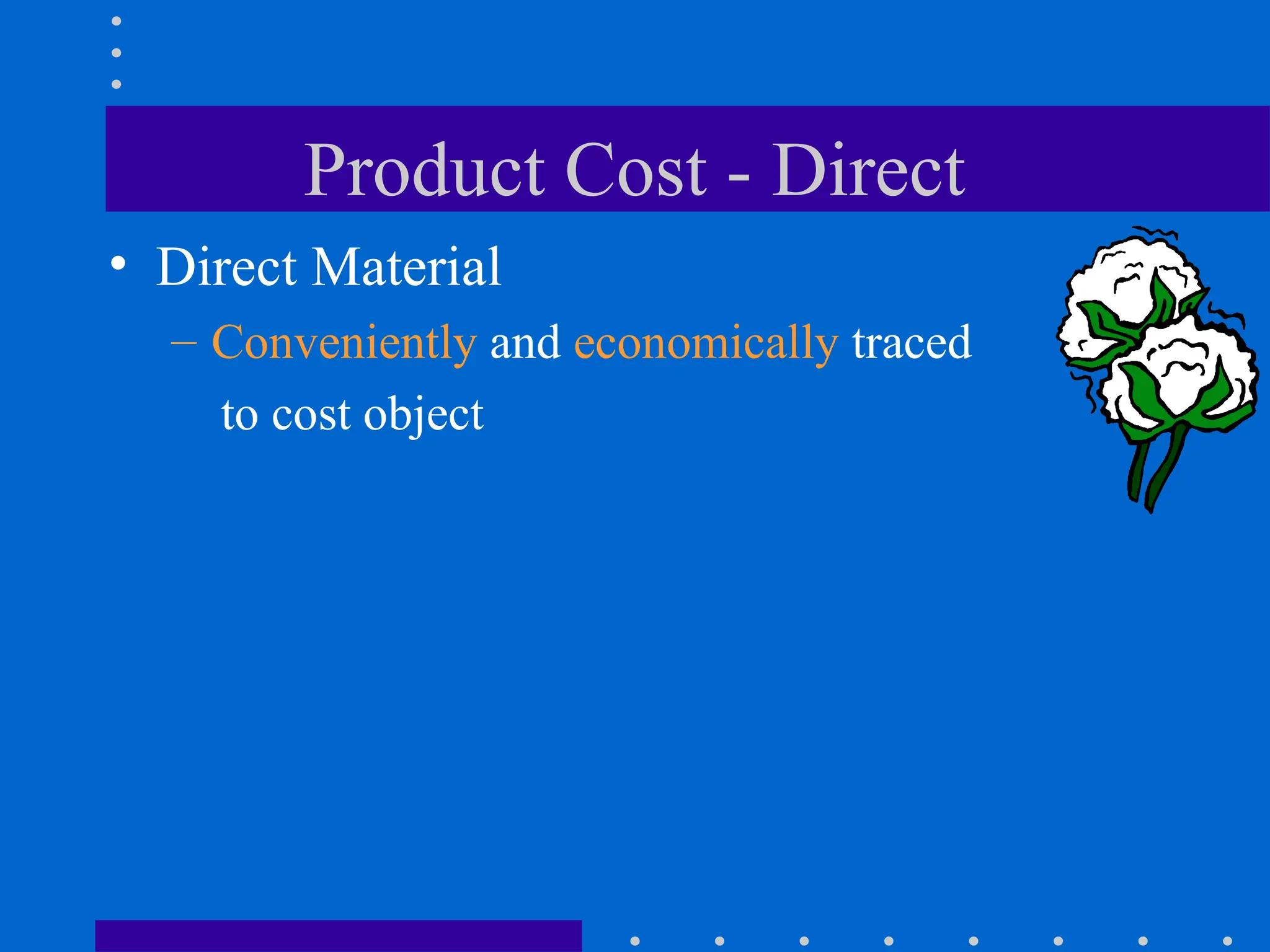
Product Cost - Direct
• Direct Material
– Conveniently and economically traced
to cost object
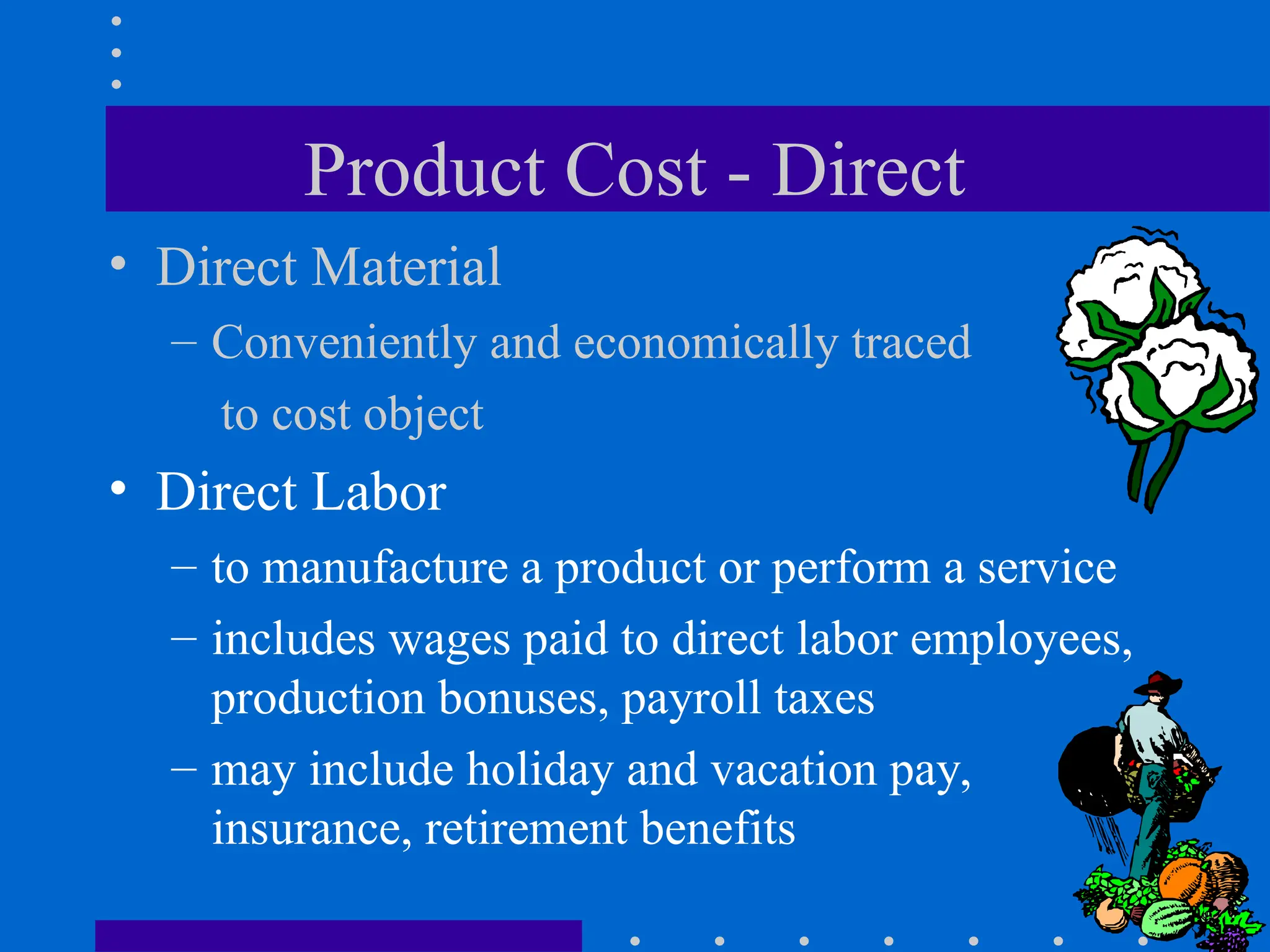
Product Cost - Direct
• Direct Material
– Conveniently and economically traced
to cost object
• Direct Labor
– to manufacture a product or perform a service
– includes wages paid to direct labor employees,
production bonuses, payroll taxes
– may include holiday and vacation pay,
insurance, retirement benefits
Product Cost - Indirect
• Overhead - indirect production costs
– Fringe benefits, if cannot be easily traced to
product
– Overtime, if due to random scheduling
– Cost of quality
• Prevention costs
• Appraisal costs
• Failure costs
Product Cost Behavior
• Direct Material Variable
• Direct Labor Variable
• Overhead Variable, fixed, or mixed
Overhead Cost Allocation
Assign indirect costs to one
or more cost objects
• To determine full absorption cost (GAAP)
• To motivate management
• To compare alternative courses of action for
planning, controlling, and decision making
Allocation process should be
rational and systematic
Allocating Overhead
Actual Cost System
Product Cost
Direct Materials
Direct Labor
Overhead
Cost Used
Actual
Actual
Actual
Allocating Overhead
Actual Cost System
• The Actual Cost System is not timely
• All costs must be known before calculating
product cost
Allocating Overhead
Actual vs. Normal
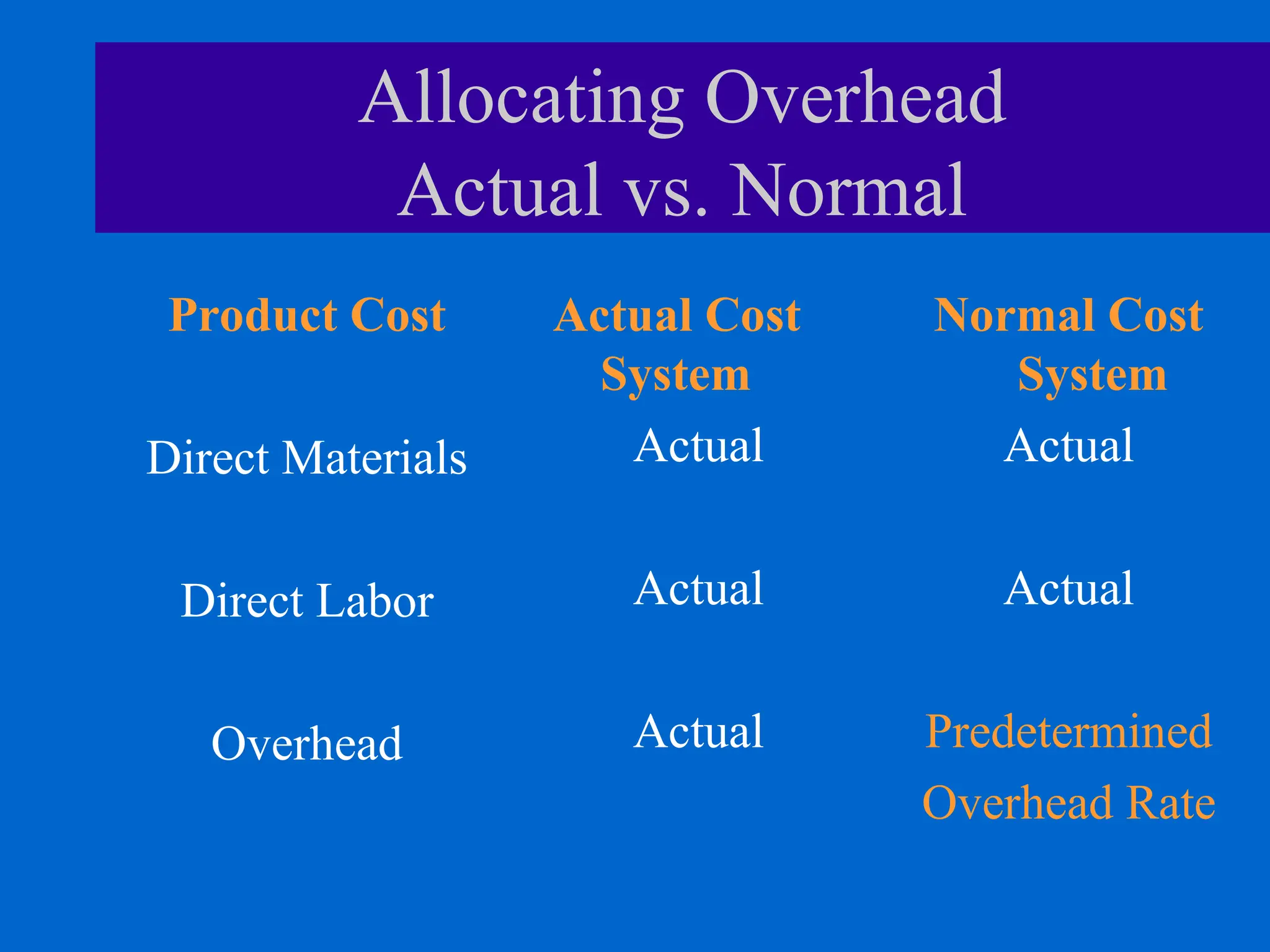
Product Cost
Direct Materials
Direct Labor
Overhead
Actual Cost
System
Actual
Actual
Actual
Normal Cost
System
Actual
Actual
Predetermined
Overhead Rate
Predetermined Overhead Rate
• Allows overhead to be assigned during the
period
• Compensates for fluctuations
– that are not related to activity level
– in activity level that do not affect fixed
overhead
• Insert infographic Exhibit 2-10
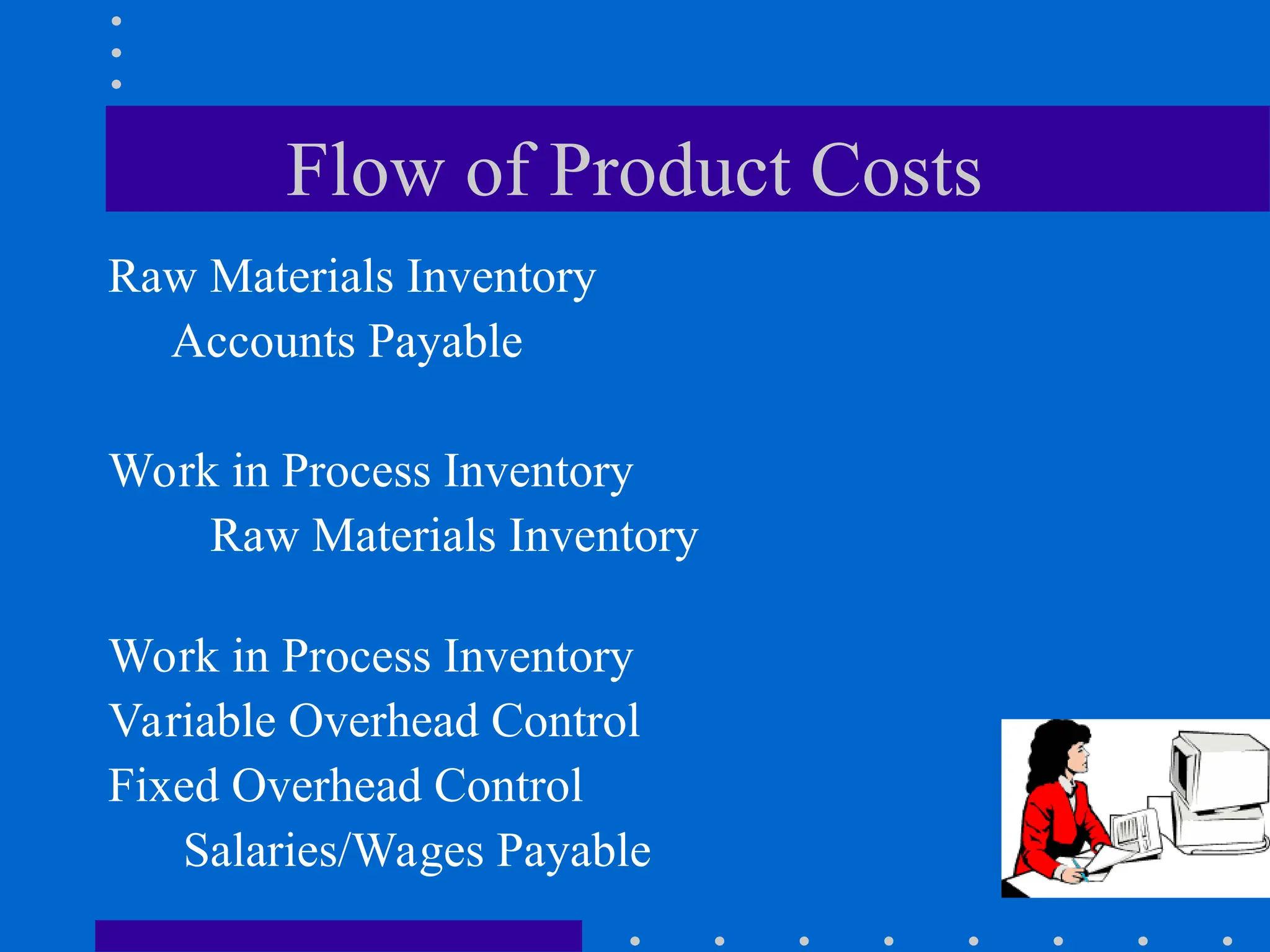
Flow of Product Costs
Raw Materials Inventory
Accounts Payable
Work in Process Inventory
Raw Materials Inventory
Work in Process Inventory
Variable Overhead Control
Fixed Overhead Control
Salaries/Wages Payable
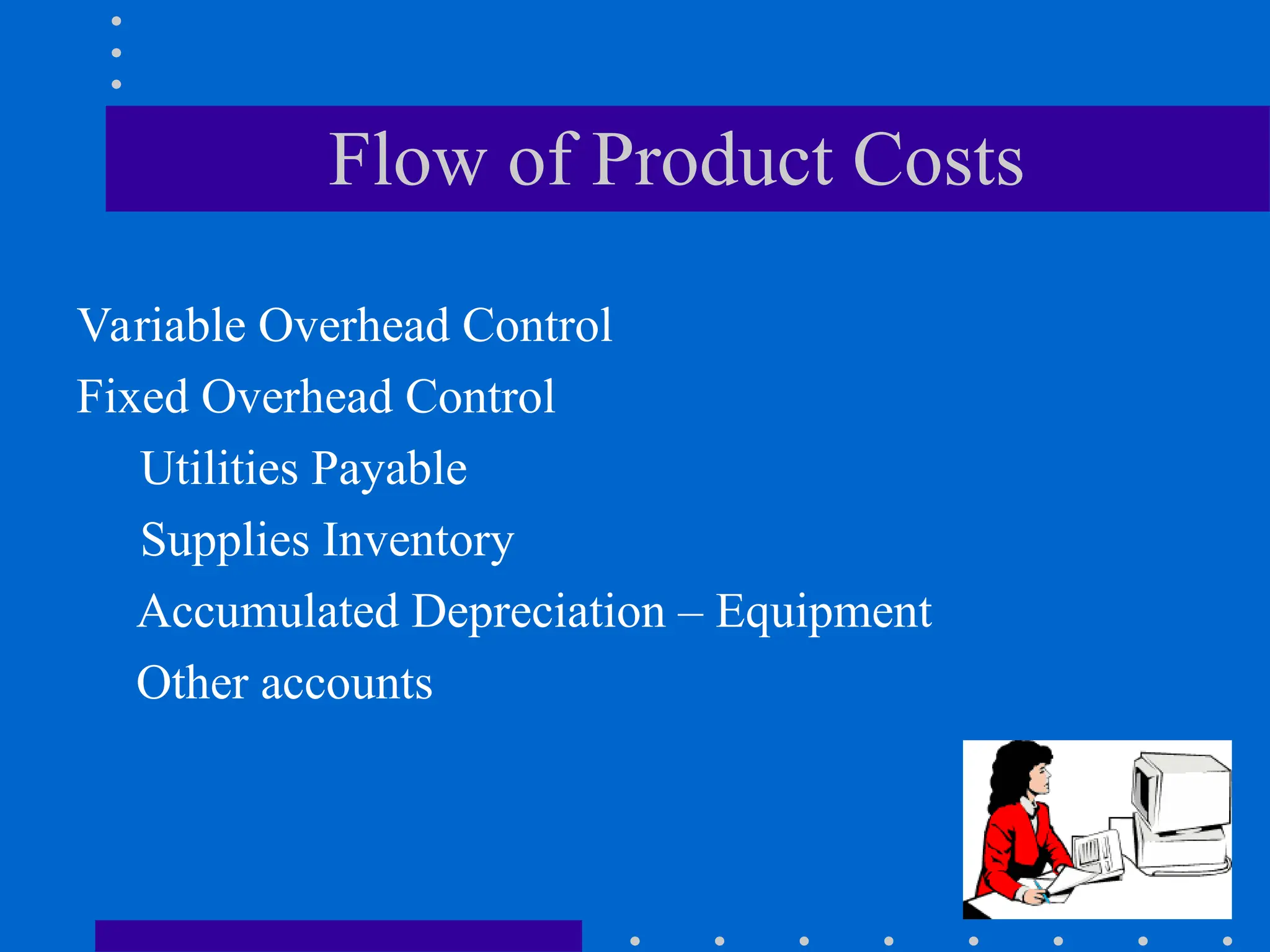
Flow of Product Costs
Variable Overhead Control
Fixed Overhead Control
Utilities Payable
Supplies Inventory
Accumulated Depreciation – Equipment
Other accounts
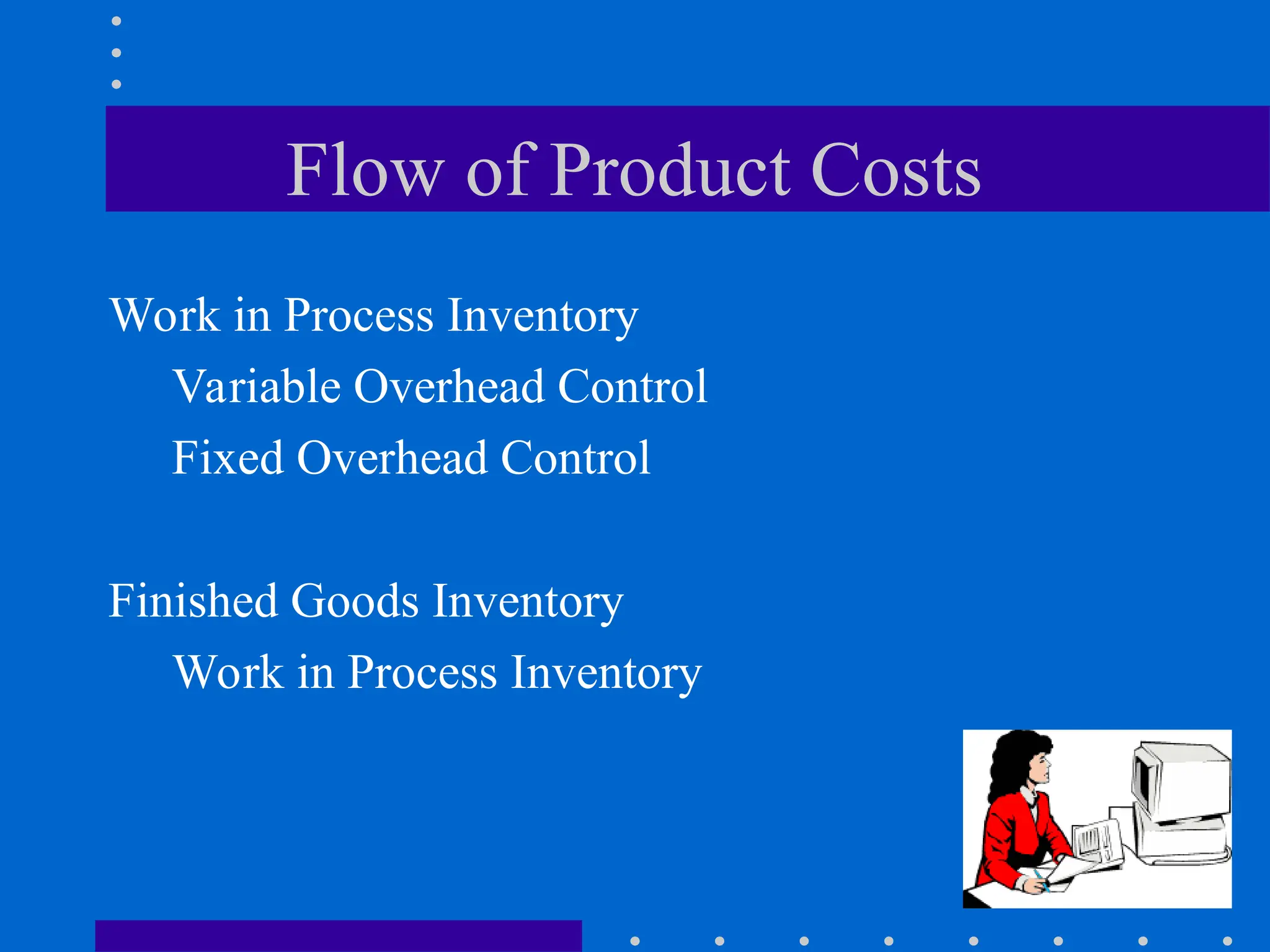
Flow of Product Costs
Work in Process Inventory
Variable Overhead Control
Fixed Overhead Control
Finished Goods Inventory
Work in Process Inventory
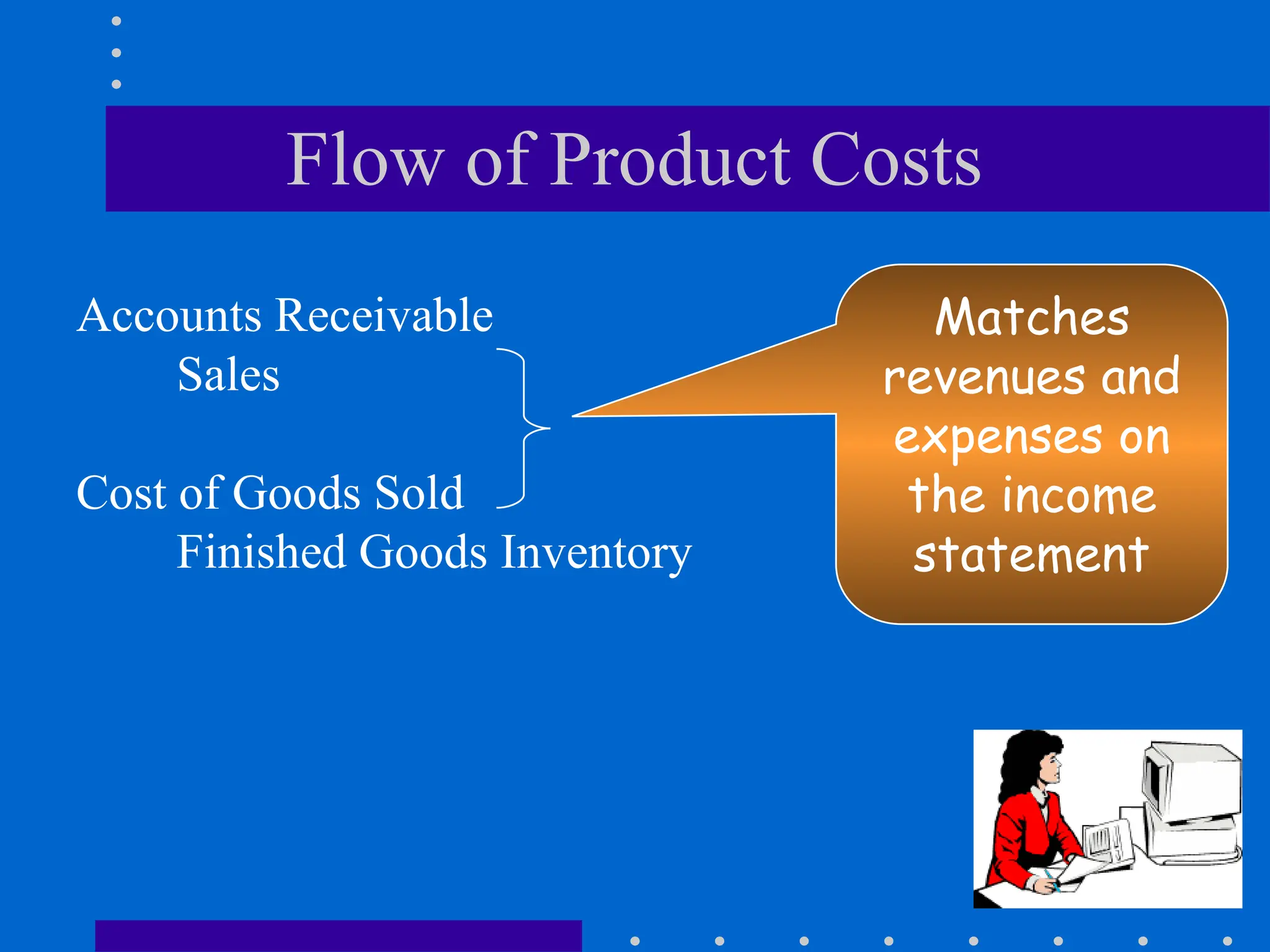
Flow of Product Costs
Accounts Receivable
Sales
Cost of Goods Sold
Finished Goods Inventory
Matches
revenues and
expenses on
the income
statement
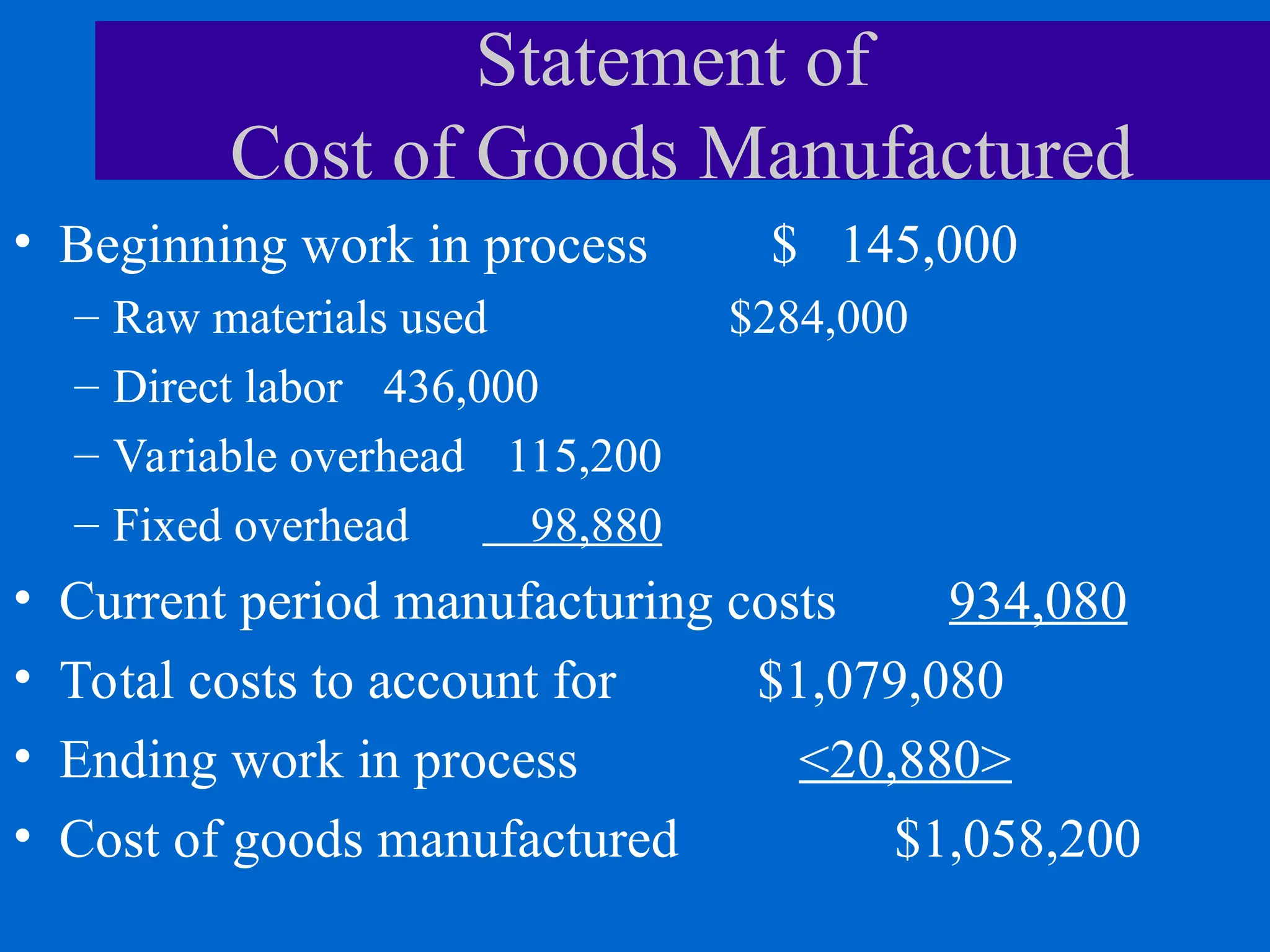
Statement of
Cost of Goods Manufactured
• Beginning work in process $ 145,000
– Raw materials used $284,000
– Direct labor 436,000
– Variable overhead 115,200
– Fixed overhead 98,880
• Current period manufacturing costs 934,080
• Total costs to account for $1,079,080
• Ending work in process <20,880>
• Cost of goods manufactured $1,058,200
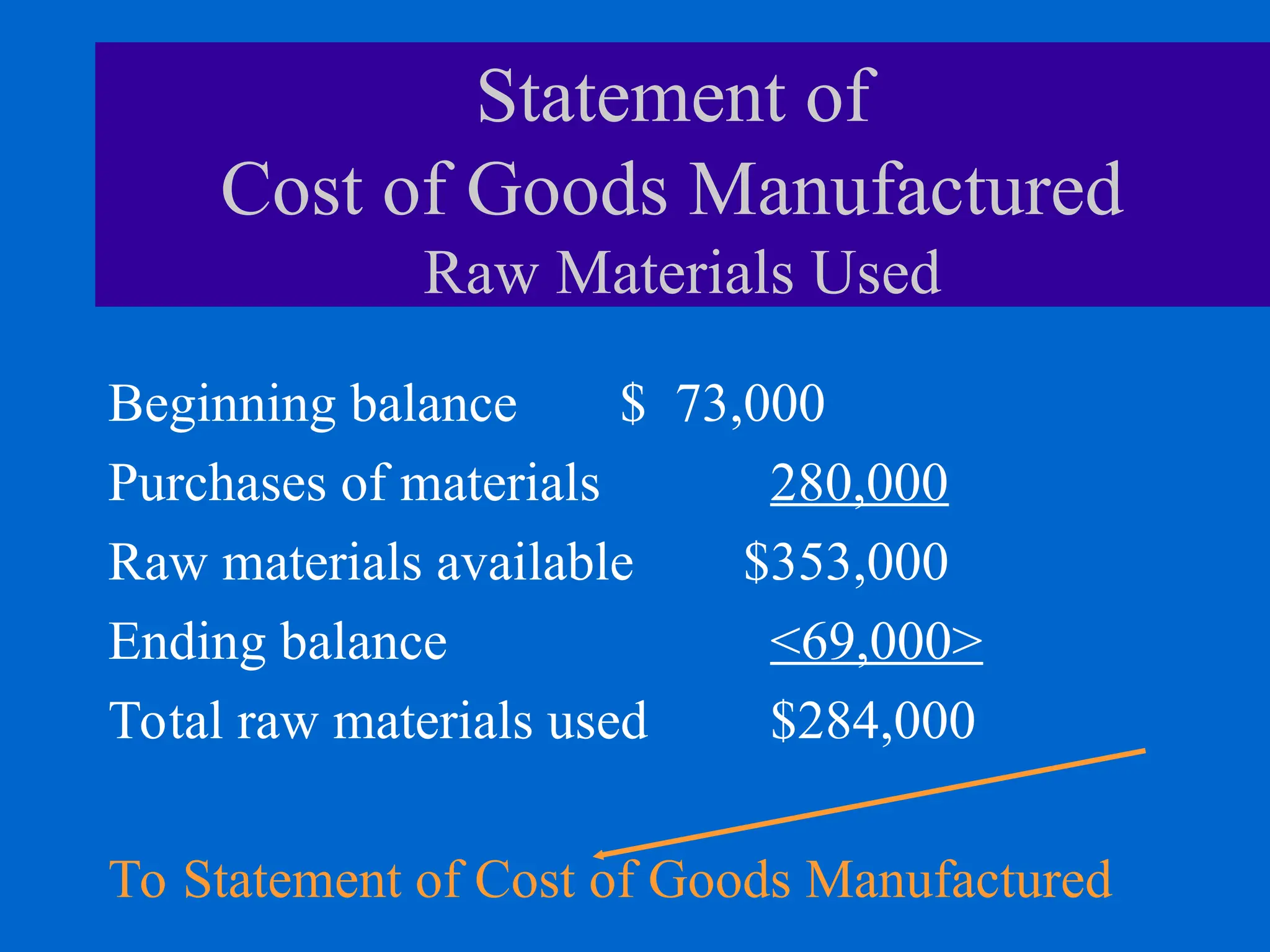
Statement of
Cost of Goods Manufactured
Raw Materials Used
Beginning balance $ 73,000
Purchases of materials 280,000
Raw materials available $353,000
Ending balance <69,000>
Total raw materials used $284,000
To Statement of Cost of Goods Manufactured
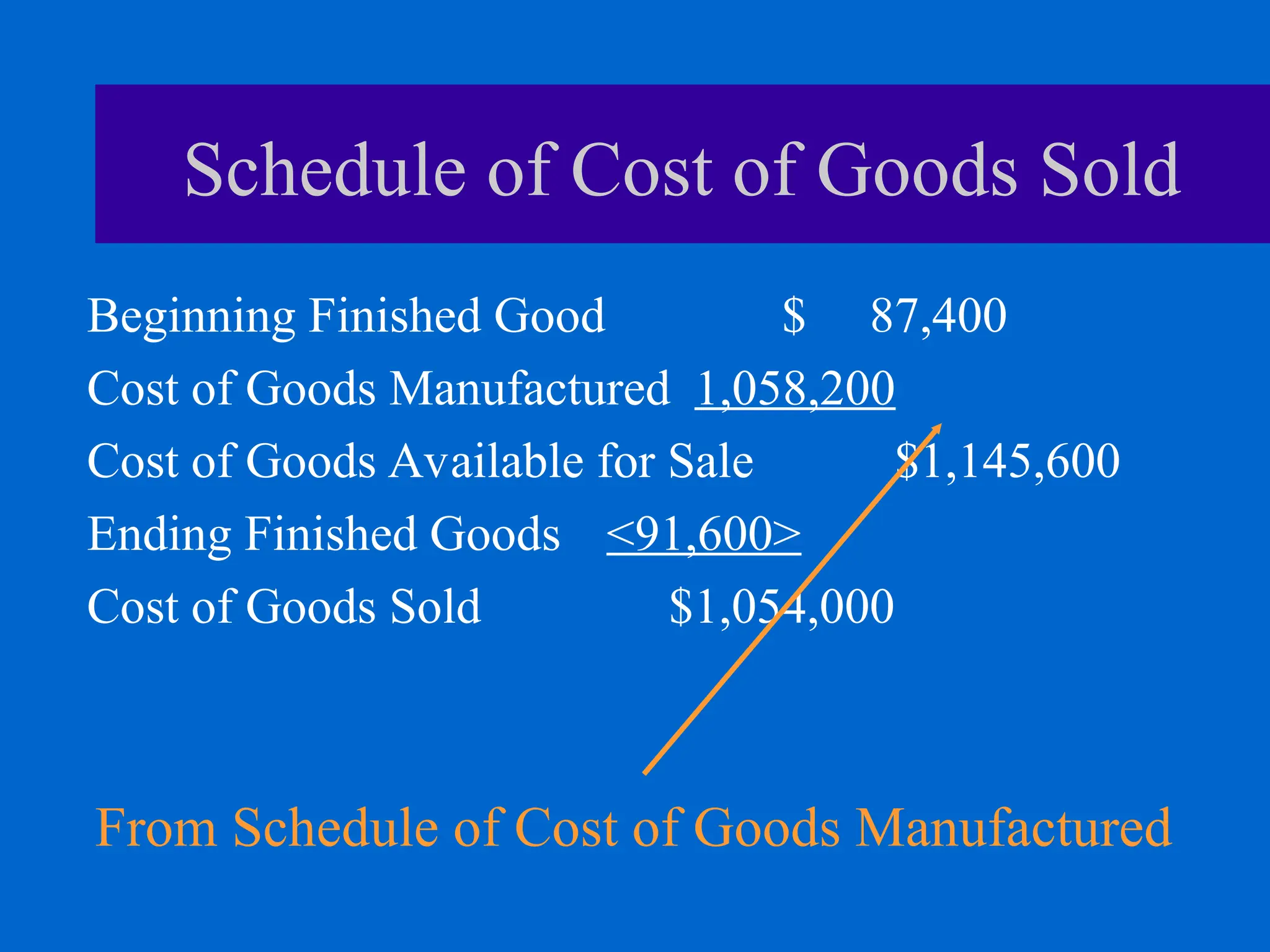
Schedule of Cost of Goods Sold
Beginning Finished Good $ 87,400
Cost of Goods Manufactured 1,058,200
Cost of Goods Available for Sale $1,145,600
Ending Finished Goods <91,600>
Cost of Goods Sold $1,054,000
From Schedule of Cost of Goods Manufactured
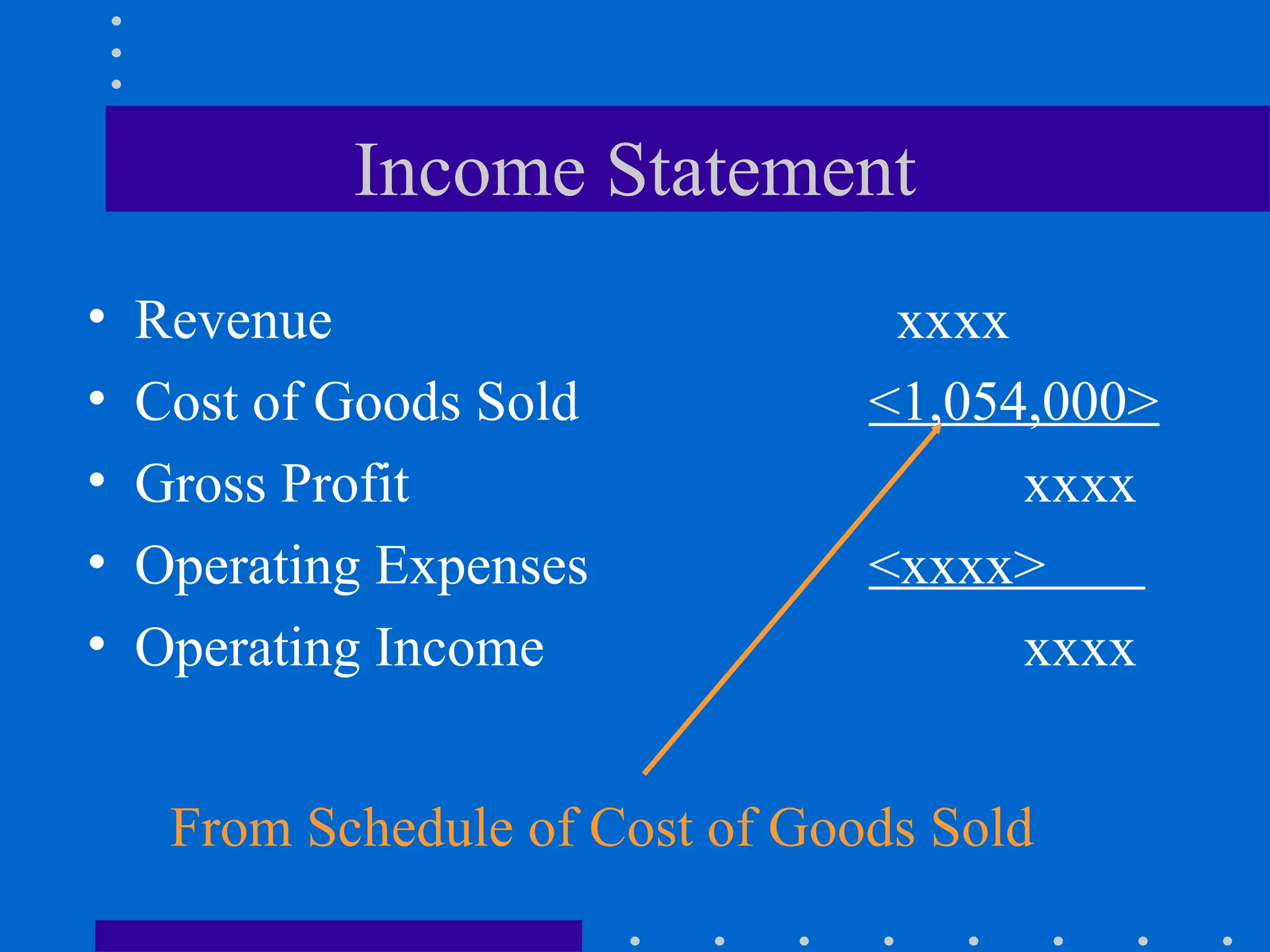
Income Statement
• Revenue xxxx
• Cost of Goods Sold <1,054,000>
• Gross Profit xxxx
• Operating Expenses <xxxx>
• Operating Income xxxx
From Schedule of Cost of Goods Sold
Questions
• What is the difference between a fixed and
variable cost?
• What are the three components of product
cost?
• What are the three inventory accounts for a
manufacturing company?

to best Cost+Behavior+and+Terminology.ppt

  • 1.
    Chapter 2 Cost Terminologyand Cost Behaviors Cost Accounting Foundations and Evolutions Kinney, Prather, Raiborn
  • 2.
    Learning Objectives (1of 2) • Explain assumptions about cost behavior and why these assumptions are necessary • List the cost classifications and explain why the classifications are useful • Describe the conversion process in service and manufacturing companies
  • 3.
    Learning Objectives (2of 2) • List product cost categories and their components • Calculate the Cost of Goods Manufactured and explain how it is used in the Income Statement
  • 4.
    Cost Monetary measure ofresources given up to attain an objective (such as acquiring a good or delivering a service)
  • 5.
    • Insert Exhibit2-1, is it infographic?
  • 6.
    Cost Categories • Associationwith cost object Cost object is anything for which management wants to collect or accumulate costs • Reaction to changes in activity • Classification on the financial statements
  • 7.
    Cost Categories • Associationwith cost object – Direct - traceable to a cost object – Indirect - not conveniently or practically traceable to a cost object • treated as overhead • allocated
  • 8.
    Cost Categories • Associationwith cost object • Reaction to changes in activity – Variable – Fixed – Mixed – Step Relevant Range – normal operating range
  • 9.
    Variable Cost Fixed Cost CostReaction to Changes in Activity Total $ # of Units $ # of Units Within the relevant range
  • 10.
    Variable Cost Fixed Cost CostReaction to Changes in Activity Total Unit $ # of Units $ $ $ # of Units # of Units # of Units Within the relevant range
  • 11.
    Total and UnitCost Behavior Varies in direct proportion to changes in activity Remains constant throughout the relevant range Remains constant throughout the relevant range Varies inversely with changes in activity throughout the relevant range Variable Cost Fixed Cost Total Cost Unit Cost
  • 12.
    Step Cost (Fixed) Cost Reactionto Changes in Activity $ Units Within the relevant range
  • 13.
    Mixed Cost Cost Reactionto Changes in Activity $ Units fixed Within the relevant range variable
  • 14.
    Determining Cost Behavior •Cost Predictor – Activity accompanied by consistent, observable changes in a cost item – Predicts but may not cause the cost to change • Cost Driver – Activity that has a direct cause-effect relationship on cost – Directly causes the cost to change
  • 15.
    Cost Categories • Associationwith cost object • Reaction to changes in activity • Classification on the financial statements – Unexpired – Expired – Product – Period
  • 16.
    Cost Categories • Classificationon the financial statements – Unexpired – balance sheet assets – Expired – income statement expenses – Product – inventoriable costs • Prime – direct material and direct labor • Conversion – direct labor and overhead – Period – expensed in period incurred
  • 17.
    Product Costs • Directmaterial – Measurable part of a product • Direct labor – Labor used to manufacture a product or perform a service • Overhead – Indirect production cost
  • 18.
    Product Costs • Firstappear on the balance sheet in inventory accounts • Transferred to the income statement when product is sold
  • 19.
    Period Costs • Sellingand administrative costs • Distribution costs – Cost to warehouse, transport, and/or deliver a product or service – Major impact on managerial decision making
  • 20.
    Period Costs • Appearon the income statement when incurred • Expensed when incurred
  • 21.
    Purchase raw materials or supplies Input Productor Service Output Conversion Process Change Inputs into Outputs CONVERSION
  • 22.
    Low Degree ofConversion • Department stores • Gas stations • Jewelry stores • Travel agencies
  • 23.
    Moderate Degree ofConversion • Florists • Meat markets • Oil-change businesses
  • 24.
    High Degree ofConversion • Manufacturing • Construction • Agriculture • Architecture • Auditing • Mining • Printing • Restaurants
  • 25.
  • 26.
    Service Company Significant amountof labor Tangible or intangible output Purchase supplies Use supplies, labor, overhead to provide service Sell to customer Input Output
  • 27.
    Retail Company Purchase finishedgoods Resell to customers Purchase products for resale Warehouse and/or display Sell to customer Input Output
  • 28.
    Manufacturer Significant amount oflabor and machinery Tangible output Purchase raw materials and supplies Finished product Sell to customer Input Output Production Center add labor and overhead
  • 29.
  • 30.
    Cost Accumulation ina Manufacturing Company Materials Inventory Work in Process Inventory Finished Goods Inventory Cost of Goods Sold Balance Sheet Income Statement
  • 31.
    Product Cost -Direct • Direct Material – Conveniently and economically traced to cost object
  • 32.
    Product Cost -Direct • Direct Material – Conveniently and economically traced to cost object • Direct Labor – to manufacture a product or perform a service – includes wages paid to direct labor employees, production bonuses, payroll taxes – may include holiday and vacation pay, insurance, retirement benefits
  • 33.
    Product Cost -Indirect • Overhead - indirect production costs – Fringe benefits, if cannot be easily traced to product – Overtime, if due to random scheduling – Cost of quality • Prevention costs • Appraisal costs • Failure costs
  • 34.
    Product Cost Behavior •Direct Material Variable • Direct Labor Variable • Overhead Variable, fixed, or mixed
  • 35.
    Overhead Cost Allocation Assignindirect costs to one or more cost objects • To determine full absorption cost (GAAP) • To motivate management • To compare alternative courses of action for planning, controlling, and decision making Allocation process should be rational and systematic
  • 36.
    Allocating Overhead Actual CostSystem Product Cost Direct Materials Direct Labor Overhead Cost Used Actual Actual Actual
  • 37.
    Allocating Overhead Actual CostSystem • The Actual Cost System is not timely • All costs must be known before calculating product cost
  • 38.
    Allocating Overhead Actual vs.Normal Product Cost Direct Materials Direct Labor Overhead Actual Cost System Actual Actual Actual Normal Cost System Actual Actual Predetermined Overhead Rate
  • 39.
    Predetermined Overhead Rate •Allows overhead to be assigned during the period • Compensates for fluctuations – that are not related to activity level – in activity level that do not affect fixed overhead
  • 40.
  • 41.
    Flow of ProductCosts Raw Materials Inventory Accounts Payable Work in Process Inventory Raw Materials Inventory Work in Process Inventory Variable Overhead Control Fixed Overhead Control Salaries/Wages Payable
  • 42.
    Flow of ProductCosts Variable Overhead Control Fixed Overhead Control Utilities Payable Supplies Inventory Accumulated Depreciation – Equipment Other accounts
  • 43.
    Flow of ProductCosts Work in Process Inventory Variable Overhead Control Fixed Overhead Control Finished Goods Inventory Work in Process Inventory
  • 44.
    Flow of ProductCosts Accounts Receivable Sales Cost of Goods Sold Finished Goods Inventory Matches revenues and expenses on the income statement
  • 45.
    Statement of Cost ofGoods Manufactured • Beginning work in process $ 145,000 – Raw materials used $284,000 – Direct labor 436,000 – Variable overhead 115,200 – Fixed overhead 98,880 • Current period manufacturing costs 934,080 • Total costs to account for $1,079,080 • Ending work in process <20,880> • Cost of goods manufactured $1,058,200
  • 46.
    Statement of Cost ofGoods Manufactured Raw Materials Used Beginning balance $ 73,000 Purchases of materials 280,000 Raw materials available $353,000 Ending balance <69,000> Total raw materials used $284,000 To Statement of Cost of Goods Manufactured
  • 47.
    Schedule of Costof Goods Sold Beginning Finished Good $ 87,400 Cost of Goods Manufactured 1,058,200 Cost of Goods Available for Sale $1,145,600 Ending Finished Goods <91,600> Cost of Goods Sold $1,054,000 From Schedule of Cost of Goods Manufactured
  • 48.
    Income Statement • Revenuexxxx • Cost of Goods Sold <1,054,000> • Gross Profit xxxx • Operating Expenses <xxxx> • Operating Income xxxx From Schedule of Cost of Goods Sold
  • 49.
    Questions • What isthe difference between a fixed and variable cost? • What are the three components of product cost? • What are the three inventory accounts for a manufacturing company?