Management Accounting:
A Business Partner
CHAPTER
four DISCUSSION POINTS:
Introduction
Accounting System
Management Accounting in Service and Nonprofit
Organizations
Management Accounting: Basic Framework
Distinction Between Financial Accounting and Management
Accounting
Accounting for Manufacturing Operations
Direct Materials
Direct Labor
Manufacturing Overhead
Product Costs Versus Period Costs
Inventories of a Manufacturing Business
The Flow of Physical Goods
Overhead Application Rates
5.1 Introduction
 Both internal parties (managers) and external
parties use accounting information, but the way in
which they use differ. The type of accounting
information they demand may also differ.
 Management accounting refers to accounting
information developed for managers within an
organization. In other words, management
accounting is the process of identifying, measuring,
accumulating, analyzing, preparing, interpreting,
and communicating information that helps
managers fulfill organizational objectives.
5.2 Accounting System
 An accounting system is a formal mechanism for
gathering, organizing, and communicating
information about an organization’s activities.
 Using one accounting system for both financial and
management purposes sometimes creates problems.
External forces (for example, tax authorities and
regulatory bodies such as the U.S. Securities and
Exchange Commission) often limit management’s
choices of accounting methods for external reports.
Many organizations develop systems primarily to satisfy legal
requirements imposed by external parties. These systems often
neglect the needs of internal users.
(Accounting Systems, Cont’d)
 Managers can create whatever kind of internal
accounting system they want – provided they are
willing to pay the cost of developing and operating
the system. In fact, satisfying internal demands for
information (as well as external demands) means
that organizations may have to keep more than one
set of records. But the cost of maintaining both
records is high. Therefore, managers in some
organizations are forced to use information designed
to meet external users’ needs instead of information
designed for their specific decisions.
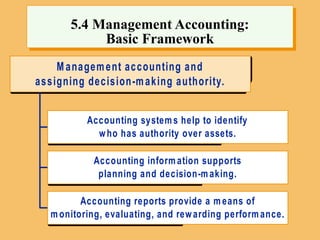
Accounting systems help to identify
who has authority over assets.
Accounting information supports
planning and decision-making.
Accounting reports provide a means of
monitoring, evaluating, and rewarding performance.
Management accounting and
assigning decision-making authority.
5.4 Management Accounting:
Basic Framework
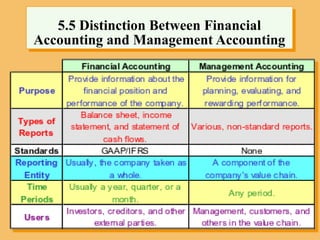
5.5 Distinction Between Financial
Accounting and Management Accounting
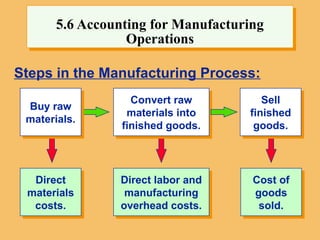
Cost of
goods
sold.
Direct labor and
manufacturing
overhead costs.
Direct
materials
costs.
Steps in the Manufacturing Process:
Convert raw
materials into
finished goods.
Sell
finished
goods.
5.6 Accounting for Manufacturing
Operations
Buy raw
materials.
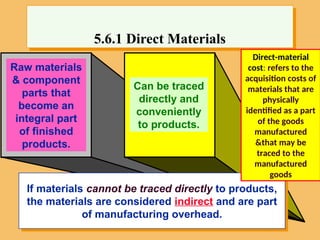
Raw materials
& component
parts that
become an
integral part
of finished
products.
Can be traced
directly and
conveniently
to products.
5.6.1 Direct Materials
If materials cannot be traced directly to products,
the materials are considered indirect and are part
of manufacturing overhead.
Direct-material
cost: refers to the
acquisition costs of
materials that are
physically
identified as a part
of the goods
manufactured
&that may be
traced to the
manufactured
goods
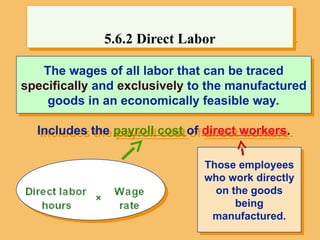
Direct-labour costs are the wages of all labor
The wages of all labor that can be traced
specifically and exclusively to the manufactured
goods in an economically feasible way.
Includes the payroll cost of direct workers.
5.6.2 Direct Labor
Those employees
who work directly
on the goods
being
manufactured.
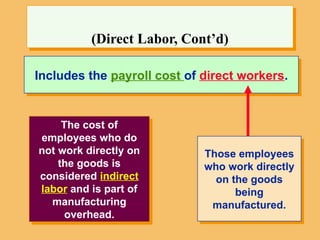
Includes the payroll cost of direct workers.
The cost of
employees who do
not work directly on
the goods is
considered indirect
labor and is part of
manufacturing
overhead.
(Direct Labor, Cont’d)
Those employees
who work directly
on the goods
being
manufactured.
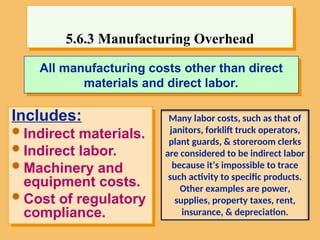
All manufacturing costs other than direct
materials and direct labor.
Includes:
Indirect materials.
Indirect labor.
Machinery and
equipment costs.
Cost of regulatory
compliance.
5.6.3 Manufacturing Overhead
Many labor costs, such as that of
janitors, forklift truck operators,
plant guards, & storeroom clerks
are considered to be indirect labor
because it’s impossible to trace
such activity to specific products.
Other examples are power,
supplies, property taxes, rent,
insurance, & depreciation.
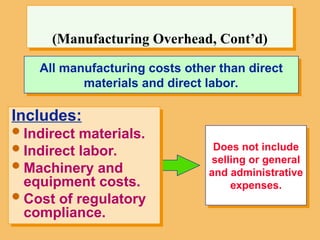
All manufacturing costs other than direct
materials and direct labor.
Does not include
selling or general
and administrative
expenses.
(Manufacturing Overhead, Cont’d)
Includes:
Indirect materials.
Indirect labor.
Machinery and
equipment costs.
Cost of regulatory
compliance.
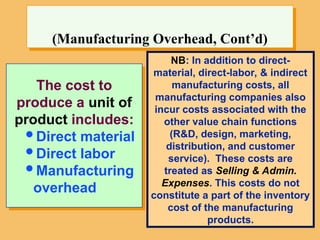
The cost to
produce a unit of
product includes:
Direct material
Direct labor
Manufacturing
overhead
(Manufacturing Overhead, Cont’d)
NB: In addition to direct-
material, direct-labor, & indirect
manufacturing costs, all
manufacturing companies also
incur costs associated with the
other value chain functions
(R&D, design, marketing,
distribution, and customer
service). These costs are
treated as Selling & Admin.
Expenses. This costs do not
constitute a part of the inventory
cost of the manufacturing
products.
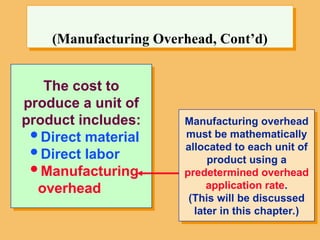
The cost to
produce a unit of
product includes:
Direct material
Direct labor
Manufacturing
overhead
(Manufacturing Overhead, Cont’d)
Manufacturing overhead
must be mathematically
allocated to each unit of
product using a
predetermined overhead
application rate.
(This will be discussed
later in this chapter.)
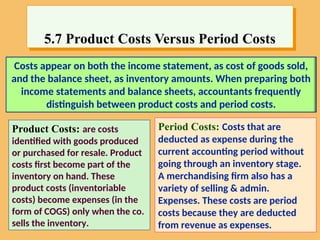
5.7 Product Costs Versus Period Costs
Costs appear on both the income statement, as cost of goods sold,
and the balance sheet, as inventory amounts. When preparing both
income statements and balance sheets, accountants frequently
distinguish between product costs and period costs.
Product Costs: are costs
identified with goods produced
or purchased for resale. Product
costs first become part of the
inventory on hand. These
product costs (inventoriable
costs) become expenses (in the
form of COGS) only when the co.
sells the inventory.
Period Costs: Costs that are
deducted as expense during the
current accounting period without
going through an inventory stage.
A merchandising firm also has a
variety of selling & admin.
Expenses. These costs are period
costs because they are deducted
from revenue as expenses.
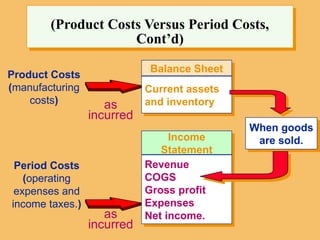
Balance Sheet
Current assets
and inventory
Product Costs
(manufacturing
costs)
Income
Statement
Revenue
COGS
Gross profit
Expenses
Net income.
When goods
are sold.
as
incurred
Period Costs
(operating
expenses and
income taxes.)
as
incurred
(Product Costs Versus Period Costs,
Cont’d)
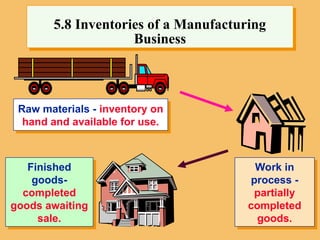
Raw materials - inventory on
hand and available for use.
Work in
process -
partially
completed
goods.
Finished
goods-
completed
goods awaiting
sale.
5.8 Inventories of a Manufacturing
Business
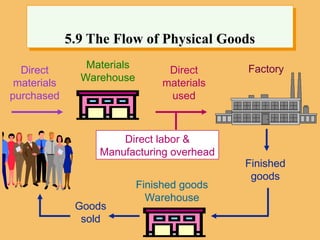
Direct
materials
purchased
Materials
Warehouse
Finished
goods
Finished goods
Warehouse
Goods
sold
Direct
materials
used
Factory
Direct labor &
Manufacturing overhead
5.9 The Flow of Physical Goods
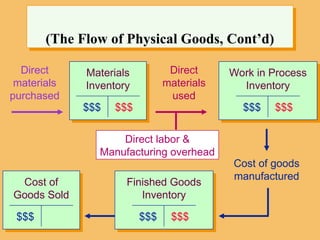
Direct
materials
purchased
Direct
materials
used
Cost of goods
manufactured
Cost of
Goods Sold
$$$
Materials
Inventory
$$$ $$$
Finished Goods
Inventory
$$$ $$$
Work in Process
Inventory
$$$ $$$
(The Flow of Physical Goods, Cont’d)
Direct labor &
Manufacturing overhead
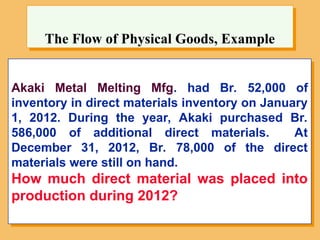
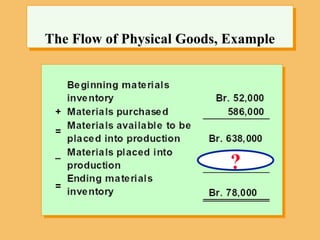
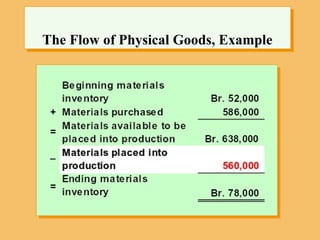
Akaki Metal Melting Mfg. had Br. 52,000 of
inventory in direct materials inventory on January
1, 2012. During the year, Akaki purchased Br.
586,000 of additional direct materials. At
December 31, 2012, Br. 78,000 of the direct
materials were still on hand.
How much direct material was placed into
production during 2012?
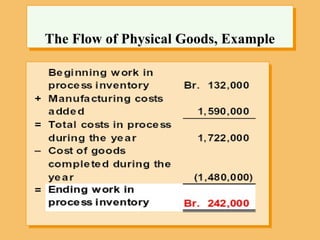
The Flow of Physical Goods, Example
?
The Flow of Physical Goods, Example
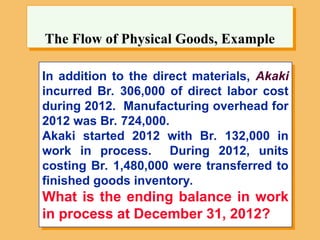
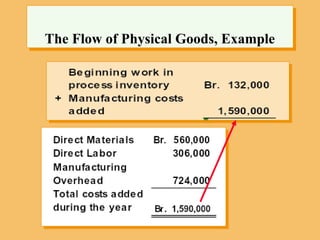
In addition to the direct materials, Akaki
incurred Br. 306,000 of direct labor cost
during 2012. Manufacturing overhead for
2012 was Br. 724,000.
Akaki started 2012 with Br. 132,000 in
work in process. During 2012, units
costing Br. 1,480,000 were transferred to
finished goods inventory.
What is the ending balance in work
in process at December 31, 2012?
The Flow of Physical Goods, Example
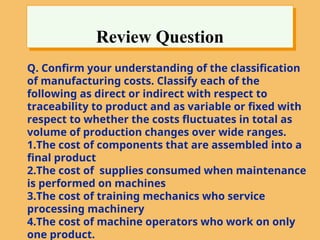
Review Question
Q. Confirm your understanding of the classification
of manufacturing costs. Classify each of the
following as direct or indirect with respect to
traceability to product and as variable or fixed with
respect to whether the costs fluctuates in total as
volume of production changes over wide ranges.
1.The cost of components that are assembled into a
final product
2.The cost of supplies consumed when maintenance
is performed on machines
3.The cost of training mechanics who service
processing machinery
4.The cost of machine operators who work on only
one product.
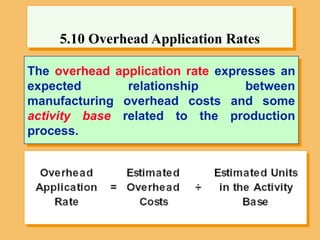
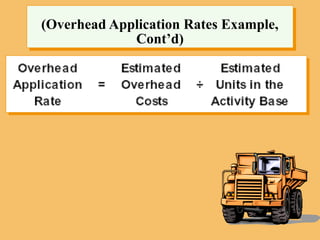
The overhead application rate expresses an
expected relationship between
manufacturing overhead costs and some
activity base related to the production
process.
5.10 Overhead Application Rates
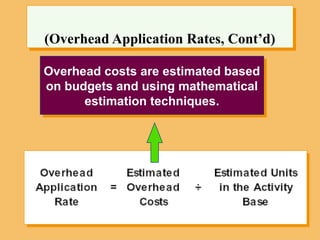
Overhead costs are estimated based
on budgets and using mathematical
estimation techniques.
(Overhead Application Rates, Cont’d)
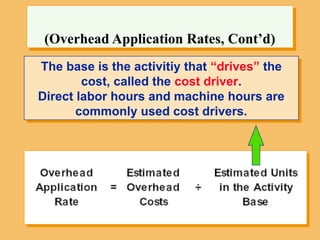
The base is the activitiy that “drives” the
cost, called the cost driver.
Direct labor hours and machine hours are
commonly used cost drivers.
(Overhead Application Rates, Cont’d)
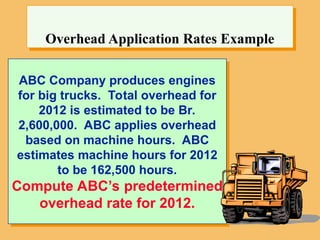
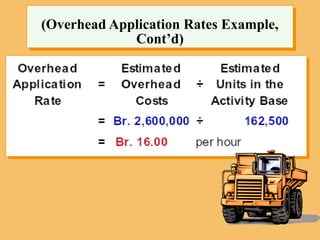
ABC Company produces engines
for big trucks. Total overhead for
2012 is estimated to be Br.
2,600,000. ABC applies overhead
based on machine hours. ABC
estimates machine hours for 2012
to be 162,500 hours.
Compute ABC’s predetermined
overhead rate for 2012.
Overhead Application Rates Example
(Overhead Application Rates Example,
Cont’d)
(Overhead Application Rates Example,
Cont’d)
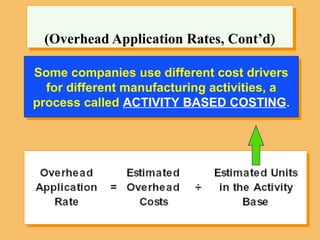
Some companies use different cost drivers
for different manufacturing activities, a
process called ACTIVITY BASED COSTING.
(Overhead Application Rates, Cont’d)
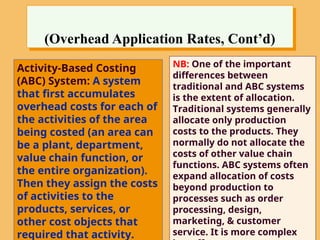
Activity-Based Costing
(ABC) System: A system
that first accumulates
overhead costs for each of
the activities of the area
being costed (an area can
be a plant, department,
value chain function, or
the entire organization).
Then they assign the costs
of activities to the
products, services, or
other cost objects that
required that activity.
NB: One of the important
differences between
traditional and ABC systems
is the extent of allocation.
Traditional systems generally
allocate only production
costs to the products. They
normally do not allocate the
costs of other value chain
functions. ABC systems often
expand allocation of costs
beyond production to
processes such as order
processing, design,
marketing, & customer
service. It is more complex
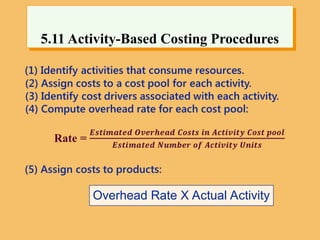
5.11 Activity-Based Costing Procedures
Overhead Rate X Actual Activity
(ABC Procedures, Cont’d)
Let’s look at an
illustration
comparing
traditional costing
with ABC.
We will start with
traditional costing.
5.12 Traditional & ABC Systems
Compared - Illustration
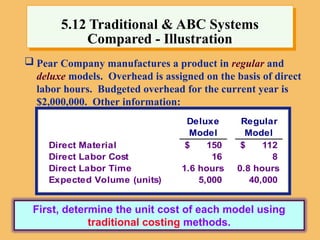
 Pear Company manufactures a product in regular and
deluxe models. Overhead is assigned on the basis of direct
labor hours. Budgeted overhead for the current year is
$2,000,000. Other information:
Deluxe Regular
Model Model
Direct Material 150
$ 112
$
Direct Labor Cost 16 8
Direct Labor Time 1.6 hours 0.8 hours
Expected Volume (units) 5,000 40,000
First, determine the unit cost of each model using
traditional costing methods.
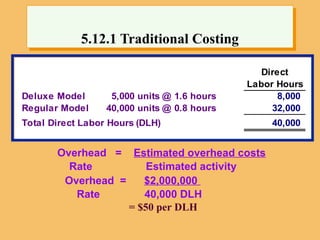
5.12.1 Traditional Costing
Direct
Labor Hours
Deluxe Model 5,000 units @ 1.6 hours 8,000
Regular Model 40,000 units @ 0.8 hours 32,000
Total Direct Labor Hours (DLH) 40,000
Overhead = Estimated overhead costs
Rate Estimated activity
Overhead = $2,000,000
Rate 40,000 DLH
= $50 per DLH
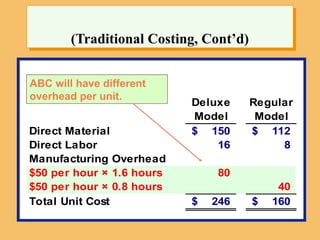
(Traditional Costing, Cont’d)
Deluxe Regular
Model Model
Direct Material 150
$ 112
$
Direct Labor 16 8
Manufacturing Overhead
$50 per hour × 1.6 hours 80
$50 per hour × 0.8 hours 40
Total Unit Cost 246
$ 160
$
ABC will have different
overhead per unit.
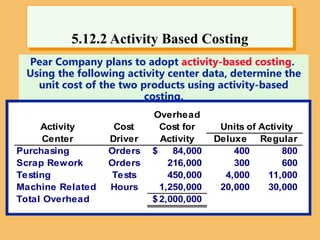
5.12.2 Activity Based Costing
Pear Company plans to adopt activity-based costing.
Using the following activity center data, determine the
unit cost of the two products using activity-based
costing.
Overhead
Activity Cost Cost for Units of Activity
Center Driver Activity Deluxe Regular
Purchasing Orders 84,000
$ 400 800
Scrap Rework Orders 216,000 300 600
Testing Tests 450,000 4,000 11,000
Machine Related Hours 1,250,000 20,000 30,000
Total Overhead 2,000,000
$
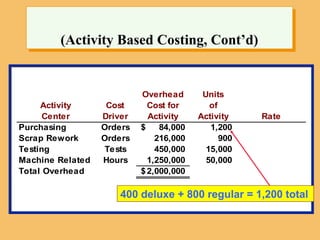
(Activity Based Costing, Cont’d)
Overhead Units
Activity Cost Cost for of
Center Driver Activity Activity Rate
Purchasing Orders 84,000
$ 1,200
Scrap Rework Orders 216,000 900
Testing Tests 450,000 15,000
Machine Related Hours 1,250,000 50,000
Total Overhead 2,000,000
$
400 deluxe + 800 regular = 1,200 total
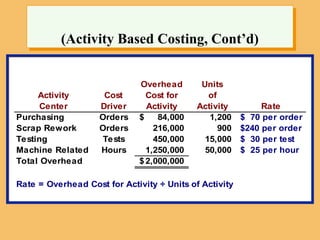
(Activity Based Costing, Cont’d)
Overhead Units
Activity Cost Cost for of
Center Driver Activity Activity Rate
Purchasing Orders 84,000
$ 1,200 $ 70 per order
Scrap Rework Orders 216,000 900 $240 per order
Testing Tests 450,000 15,000 $ 30 per test
Machine Related Hours 1,250,000 50,000 $ 25 per hour
Total Overhead 2,000,000
$
Rate = Overhead Cost for Activity ÷ Units of Activity
(Activity Based Costing, Cont’d)
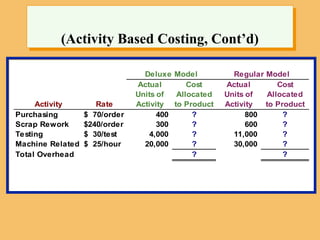
Deluxe Model Regular Model
Actual Cost Actual Cost
Units of Allocated Units of Allocated
Activity Rate Activity to Product Activity to Product
Purchasing $ 70/order 400 ? 800 ?
Scrap Rework $240/order 300 ? 600 ?
Testing $ 30/test 4,000 ? 11,000 ?
Machine Related $ 25/hour 20,000 ? 30,000 ?
Total Overhead ? ?
(Activity Based Costing, Cont’d)
Deluxe Model Regular Model
Actual Cost Actual Cost
Units of Allocated Units of Allocated
Activity Rate Activity to Product Activity to Product
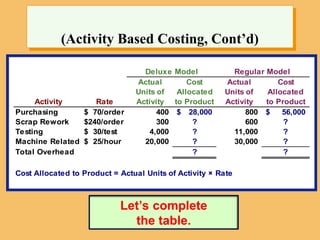
Purchasing $ 70/order 400 28,000
$ 800 56,000
$
Scrap Rework $240/order 300 ? 600 ?
Testing $ 30/test 4,000 ? 11,000 ?
Machine Related $ 25/hour 20,000 ? 30,000 ?
Total Overhead ? ?
Cost Allocated to Product = Actual Units of Activity × Rate
Let’s complete
the table.
(Activity Based Costing, Cont’d)
Deluxe Model Regular Model
Actual Cost Actual Cost
Units of Allocated Units of Allocated
Activity Rate Activity to Product Activity to Product
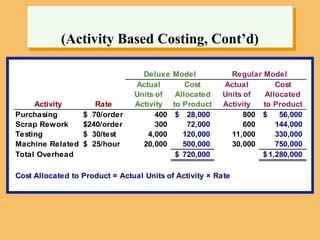
Purchasing $ 70/order 400 28,000
$ 800 56,000
$
Scrap Rework $240/order 300 72,000 600 144,000
Testing $ 30/test 4,000 120,000 11,000 330,000
Machine Related $ 25/hour 20,000 500,000 30,000 750,000
Total Overhead 720,000
$ 1,280,000
$
Cost Allocated to Product = Actual Units of Activity × Rate
(Activity Based Costing, Cont’d)
Deluxe Model Regular Model
Actual Cost Actual Cost
Units of Allocated Units of Allocated
Activity Rate Activity to Product Activity to Product
Purchasing $ 70/order 400 28,000
$ 800 56,000
$
Scrap Rework $240/order 300 72,000 600 144,000
Testing $ 30/test 4,000 120,000 11,000 330,000
Machine Related $ 25/hour 20,000 500,000 30,000 750,000
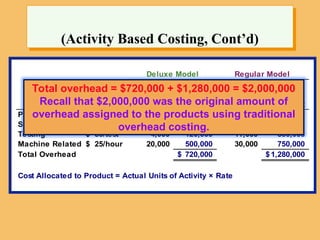
Total Overhead 720,000
$ 1,280,000
$
Cost Allocated to Product = Actual Units of Activity × Rate
Total overhead = $720,000 + $1,280,000 = $2,000,000
Recall that $2,000,000 was the original amount of
overhead assigned to the products using traditional
overhead costing.
(Activity Based Costing, Cont’d)
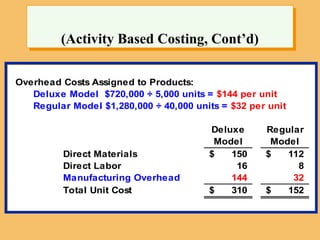
Overhead Costs Assigned to Products:
Deluxe Model $720,000 ÷ 5,000 units = $144 per unit
Regular Model $1,280,000 ÷ 40,000 units = $32 per unit
Deluxe Regular
Model Model
Direct Materials 150
$ 112
$
Direct Labor 16 8
Manufacturing Overhead 144 32
Total Unit Cost 310
$ 152
$
(Activity Based Costing, Cont’d)
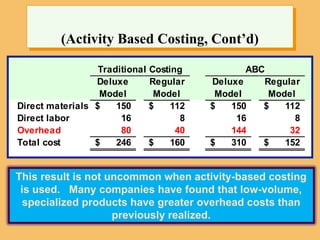
Traditional Costing ABC
Deluxe Regular Deluxe Regular
Model Model Model Model
Direct materials 150
$ 112
$ 150
$ 112
$
Direct labor 16 8 16 8
Overhead 80 40 144 32
Total cost 246
$ 160
$ 310
$ 152
$
This result is not uncommon when activity-based costing
is used. Many companies have found that low-volume,
specialized products have greater overhead costs than
previously realized.
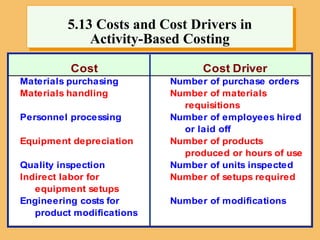
5.13 Costs and Cost Drivers in
Activity-Based Costing
Cost Cost Driver
Materials purchasing Number of purchase orders
Materials handling Number of materials
requisitions
Personnel processing Number of employees hired
or laid off
Equipment depreciation Number of products
produced or hours of use
Quality inspection Number of units inspected
Indirect labor for Number of setups required
equipment setups
Engineering costs for Number of modifications
product modifications
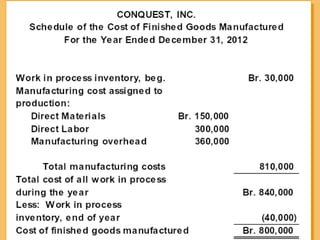
A schedule of the cost
of finished goods
manufactured is
prepared to assist
managers in
understanding and
evaluating the overall
cost of manufacturing
products.
Determining the Cost of Finished Goods
Manufactured
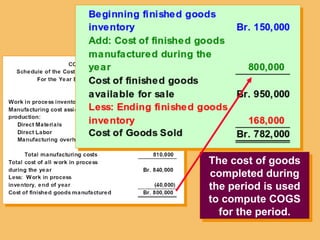
The cost of goods
completed during
the period is used
to compute COGS
for the period.
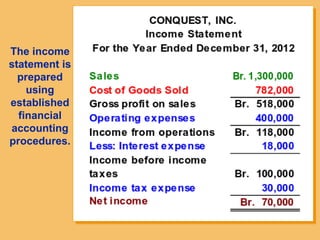
The income
statement is
prepared
using
established
financial
accounting
procedures.
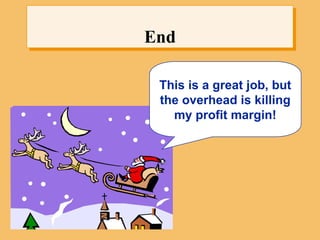
This is a great job, but
the overhead is killing
my profit margin!
End

Management Accounting: A Business Partner

  • 1.
    Management Accounting: A BusinessPartner CHAPTER four DISCUSSION POINTS: Introduction Accounting System Management Accounting in Service and Nonprofit Organizations Management Accounting: Basic Framework Distinction Between Financial Accounting and Management Accounting Accounting for Manufacturing Operations Direct Materials Direct Labor Manufacturing Overhead Product Costs Versus Period Costs Inventories of a Manufacturing Business The Flow of Physical Goods Overhead Application Rates
  • 2.
    5.1 Introduction  Bothinternal parties (managers) and external parties use accounting information, but the way in which they use differ. The type of accounting information they demand may also differ.  Management accounting refers to accounting information developed for managers within an organization. In other words, management accounting is the process of identifying, measuring, accumulating, analyzing, preparing, interpreting, and communicating information that helps managers fulfill organizational objectives.
  • 3.
    5.2 Accounting System An accounting system is a formal mechanism for gathering, organizing, and communicating information about an organization’s activities.  Using one accounting system for both financial and management purposes sometimes creates problems. External forces (for example, tax authorities and regulatory bodies such as the U.S. Securities and Exchange Commission) often limit management’s choices of accounting methods for external reports. Many organizations develop systems primarily to satisfy legal requirements imposed by external parties. These systems often neglect the needs of internal users.
  • 4.
    (Accounting Systems, Cont’d) Managers can create whatever kind of internal accounting system they want – provided they are willing to pay the cost of developing and operating the system. In fact, satisfying internal demands for information (as well as external demands) means that organizations may have to keep more than one set of records. But the cost of maintaining both records is high. Therefore, managers in some organizations are forced to use information designed to meet external users’ needs instead of information designed for their specific decisions.
  • 5.
    Accounting systems helpto identify who has authority over assets. Accounting information supports planning and decision-making. Accounting reports provide a means of monitoring, evaluating, and rewarding performance. Management accounting and assigning decision-making authority. 5.4 Management Accounting: Basic Framework
  • 6.
    5.5 Distinction BetweenFinancial Accounting and Management Accounting
  • 7.
    Cost of goods sold. Direct laborand manufacturing overhead costs. Direct materials costs. Steps in the Manufacturing Process: Convert raw materials into finished goods. Sell finished goods. 5.6 Accounting for Manufacturing Operations Buy raw materials.
  • 8.
    Raw materials & component partsthat become an integral part of finished products. Can be traced directly and conveniently to products. 5.6.1 Direct Materials If materials cannot be traced directly to products, the materials are considered indirect and are part of manufacturing overhead. Direct-material cost: refers to the acquisition costs of materials that are physically identified as a part of the goods manufactured &that may be traced to the manufactured goods
  • 9.
    Direct-labour costs arethe wages of all labor The wages of all labor that can be traced specifically and exclusively to the manufactured goods in an economically feasible way. Includes the payroll cost of direct workers. 5.6.2 Direct Labor Those employees who work directly on the goods being manufactured.
  • 10.
    Includes the payrollcost of direct workers. The cost of employees who do not work directly on the goods is considered indirect labor and is part of manufacturing overhead. (Direct Labor, Cont’d) Those employees who work directly on the goods being manufactured.
  • 11.
    All manufacturing costsother than direct materials and direct labor. Includes: Indirect materials. Indirect labor. Machinery and equipment costs. Cost of regulatory compliance. 5.6.3 Manufacturing Overhead Many labor costs, such as that of janitors, forklift truck operators, plant guards, & storeroom clerks are considered to be indirect labor because it’s impossible to trace such activity to specific products. Other examples are power, supplies, property taxes, rent, insurance, & depreciation.
  • 12.
    All manufacturing costsother than direct materials and direct labor. Does not include selling or general and administrative expenses. (Manufacturing Overhead, Cont’d) Includes: Indirect materials. Indirect labor. Machinery and equipment costs. Cost of regulatory compliance.
  • 13.
    The cost to producea unit of product includes: Direct material Direct labor Manufacturing overhead (Manufacturing Overhead, Cont’d) NB: In addition to direct- material, direct-labor, & indirect manufacturing costs, all manufacturing companies also incur costs associated with the other value chain functions (R&D, design, marketing, distribution, and customer service). These costs are treated as Selling & Admin. Expenses. This costs do not constitute a part of the inventory cost of the manufacturing products.
  • 14.
    The cost to producea unit of product includes: Direct material Direct labor Manufacturing overhead (Manufacturing Overhead, Cont’d) Manufacturing overhead must be mathematically allocated to each unit of product using a predetermined overhead application rate. (This will be discussed later in this chapter.)
  • 15.
    5.7 Product CostsVersus Period Costs Costs appear on both the income statement, as cost of goods sold, and the balance sheet, as inventory amounts. When preparing both income statements and balance sheets, accountants frequently distinguish between product costs and period costs. Product Costs: are costs identified with goods produced or purchased for resale. Product costs first become part of the inventory on hand. These product costs (inventoriable costs) become expenses (in the form of COGS) only when the co. sells the inventory. Period Costs: Costs that are deducted as expense during the current accounting period without going through an inventory stage. A merchandising firm also has a variety of selling & admin. Expenses. These costs are period costs because they are deducted from revenue as expenses.
  • 16.
    Balance Sheet Current assets andinventory Product Costs (manufacturing costs) Income Statement Revenue COGS Gross profit Expenses Net income. When goods are sold. as incurred Period Costs (operating expenses and income taxes.) as incurred (Product Costs Versus Period Costs, Cont’d)
  • 17.
    Raw materials -inventory on hand and available for use. Work in process - partially completed goods. Finished goods- completed goods awaiting sale. 5.8 Inventories of a Manufacturing Business
  • 18.
  • 19.
    Direct materials purchased Direct materials used Cost of goods manufactured Costof Goods Sold $$$ Materials Inventory $$$ $$$ Finished Goods Inventory $$$ $$$ Work in Process Inventory $$$ $$$ (The Flow of Physical Goods, Cont’d) Direct labor & Manufacturing overhead
  • 20.
    Akaki Metal MeltingMfg. had Br. 52,000 of inventory in direct materials inventory on January 1, 2012. During the year, Akaki purchased Br. 586,000 of additional direct materials. At December 31, 2012, Br. 78,000 of the direct materials were still on hand. How much direct material was placed into production during 2012? The Flow of Physical Goods, Example
  • 21.
    ? The Flow ofPhysical Goods, Example
  • 22.
    The Flow ofPhysical Goods, Example
  • 23.
    In addition tothe direct materials, Akaki incurred Br. 306,000 of direct labor cost during 2012. Manufacturing overhead for 2012 was Br. 724,000. Akaki started 2012 with Br. 132,000 in work in process. During 2012, units costing Br. 1,480,000 were transferred to finished goods inventory. What is the ending balance in work in process at December 31, 2012? The Flow of Physical Goods, Example
  • 24.
    The Flow ofPhysical Goods, Example
  • 25.
    The Flow ofPhysical Goods, Example
  • 26.
    Review Question Q. Confirmyour understanding of the classification of manufacturing costs. Classify each of the following as direct or indirect with respect to traceability to product and as variable or fixed with respect to whether the costs fluctuates in total as volume of production changes over wide ranges. 1.The cost of components that are assembled into a final product 2.The cost of supplies consumed when maintenance is performed on machines 3.The cost of training mechanics who service processing machinery 4.The cost of machine operators who work on only one product.
  • 27.
    The overhead applicationrate expresses an expected relationship between manufacturing overhead costs and some activity base related to the production process. 5.10 Overhead Application Rates
  • 28.
    Overhead costs areestimated based on budgets and using mathematical estimation techniques. (Overhead Application Rates, Cont’d)
  • 29.
    The base isthe activitiy that “drives” the cost, called the cost driver. Direct labor hours and machine hours are commonly used cost drivers. (Overhead Application Rates, Cont’d)
  • 30.
    ABC Company producesengines for big trucks. Total overhead for 2012 is estimated to be Br. 2,600,000. ABC applies overhead based on machine hours. ABC estimates machine hours for 2012 to be 162,500 hours. Compute ABC’s predetermined overhead rate for 2012. Overhead Application Rates Example
  • 31.
    (Overhead Application RatesExample, Cont’d)
  • 32.
    (Overhead Application RatesExample, Cont’d)
  • 33.
    Some companies usedifferent cost drivers for different manufacturing activities, a process called ACTIVITY BASED COSTING. (Overhead Application Rates, Cont’d)
  • 34.
    (Overhead Application Rates,Cont’d) Activity-Based Costing (ABC) System: A system that first accumulates overhead costs for each of the activities of the area being costed (an area can be a plant, department, value chain function, or the entire organization). Then they assign the costs of activities to the products, services, or other cost objects that required that activity. NB: One of the important differences between traditional and ABC systems is the extent of allocation. Traditional systems generally allocate only production costs to the products. They normally do not allocate the costs of other value chain functions. ABC systems often expand allocation of costs beyond production to processes such as order processing, design, marketing, & customer service. It is more complex
  • 35.
    5.11 Activity-Based CostingProcedures Overhead Rate X Actual Activity
  • 36.
    (ABC Procedures, Cont’d) Let’slook at an illustration comparing traditional costing with ABC. We will start with traditional costing.
  • 37.
    5.12 Traditional &ABC Systems Compared - Illustration  Pear Company manufactures a product in regular and deluxe models. Overhead is assigned on the basis of direct labor hours. Budgeted overhead for the current year is $2,000,000. Other information: Deluxe Regular Model Model Direct Material 150 $ 112 $ Direct Labor Cost 16 8 Direct Labor Time 1.6 hours 0.8 hours Expected Volume (units) 5,000 40,000 First, determine the unit cost of each model using traditional costing methods.
  • 38.
    5.12.1 Traditional Costing Direct LaborHours Deluxe Model 5,000 units @ 1.6 hours 8,000 Regular Model 40,000 units @ 0.8 hours 32,000 Total Direct Labor Hours (DLH) 40,000 Overhead = Estimated overhead costs Rate Estimated activity Overhead = $2,000,000 Rate 40,000 DLH = $50 per DLH
  • 39.
    (Traditional Costing, Cont’d) DeluxeRegular Model Model Direct Material 150 $ 112 $ Direct Labor 16 8 Manufacturing Overhead $50 per hour × 1.6 hours 80 $50 per hour × 0.8 hours 40 Total Unit Cost 246 $ 160 $ ABC will have different overhead per unit.
  • 40.
    5.12.2 Activity BasedCosting Pear Company plans to adopt activity-based costing. Using the following activity center data, determine the unit cost of the two products using activity-based costing. Overhead Activity Cost Cost for Units of Activity Center Driver Activity Deluxe Regular Purchasing Orders 84,000 $ 400 800 Scrap Rework Orders 216,000 300 600 Testing Tests 450,000 4,000 11,000 Machine Related Hours 1,250,000 20,000 30,000 Total Overhead 2,000,000 $
  • 41.
    (Activity Based Costing,Cont’d) Overhead Units Activity Cost Cost for of Center Driver Activity Activity Rate Purchasing Orders 84,000 $ 1,200 Scrap Rework Orders 216,000 900 Testing Tests 450,000 15,000 Machine Related Hours 1,250,000 50,000 Total Overhead 2,000,000 $ 400 deluxe + 800 regular = 1,200 total
  • 42.
    (Activity Based Costing,Cont’d) Overhead Units Activity Cost Cost for of Center Driver Activity Activity Rate Purchasing Orders 84,000 $ 1,200 $ 70 per order Scrap Rework Orders 216,000 900 $240 per order Testing Tests 450,000 15,000 $ 30 per test Machine Related Hours 1,250,000 50,000 $ 25 per hour Total Overhead 2,000,000 $ Rate = Overhead Cost for Activity ÷ Units of Activity
  • 43.
    (Activity Based Costing,Cont’d) Deluxe Model Regular Model Actual Cost Actual Cost Units of Allocated Units of Allocated Activity Rate Activity to Product Activity to Product Purchasing $ 70/order 400 ? 800 ? Scrap Rework $240/order 300 ? 600 ? Testing $ 30/test 4,000 ? 11,000 ? Machine Related $ 25/hour 20,000 ? 30,000 ? Total Overhead ? ?
  • 44.
    (Activity Based Costing,Cont’d) Deluxe Model Regular Model Actual Cost Actual Cost Units of Allocated Units of Allocated Activity Rate Activity to Product Activity to Product Purchasing $ 70/order 400 28,000 $ 800 56,000 $ Scrap Rework $240/order 300 ? 600 ? Testing $ 30/test 4,000 ? 11,000 ? Machine Related $ 25/hour 20,000 ? 30,000 ? Total Overhead ? ? Cost Allocated to Product = Actual Units of Activity × Rate Let’s complete the table.
  • 45.
    (Activity Based Costing,Cont’d) Deluxe Model Regular Model Actual Cost Actual Cost Units of Allocated Units of Allocated Activity Rate Activity to Product Activity to Product Purchasing $ 70/order 400 28,000 $ 800 56,000 $ Scrap Rework $240/order 300 72,000 600 144,000 Testing $ 30/test 4,000 120,000 11,000 330,000 Machine Related $ 25/hour 20,000 500,000 30,000 750,000 Total Overhead 720,000 $ 1,280,000 $ Cost Allocated to Product = Actual Units of Activity × Rate
  • 46.
    (Activity Based Costing,Cont’d) Deluxe Model Regular Model Actual Cost Actual Cost Units of Allocated Units of Allocated Activity Rate Activity to Product Activity to Product Purchasing $ 70/order 400 28,000 $ 800 56,000 $ Scrap Rework $240/order 300 72,000 600 144,000 Testing $ 30/test 4,000 120,000 11,000 330,000 Machine Related $ 25/hour 20,000 500,000 30,000 750,000 Total Overhead 720,000 $ 1,280,000 $ Cost Allocated to Product = Actual Units of Activity × Rate Total overhead = $720,000 + $1,280,000 = $2,000,000 Recall that $2,000,000 was the original amount of overhead assigned to the products using traditional overhead costing.
  • 47.
    (Activity Based Costing,Cont’d) Overhead Costs Assigned to Products: Deluxe Model $720,000 ÷ 5,000 units = $144 per unit Regular Model $1,280,000 ÷ 40,000 units = $32 per unit Deluxe Regular Model Model Direct Materials 150 $ 112 $ Direct Labor 16 8 Manufacturing Overhead 144 32 Total Unit Cost 310 $ 152 $
  • 48.
    (Activity Based Costing,Cont’d) Traditional Costing ABC Deluxe Regular Deluxe Regular Model Model Model Model Direct materials 150 $ 112 $ 150 $ 112 $ Direct labor 16 8 16 8 Overhead 80 40 144 32 Total cost 246 $ 160 $ 310 $ 152 $ This result is not uncommon when activity-based costing is used. Many companies have found that low-volume, specialized products have greater overhead costs than previously realized.
  • 49.
    5.13 Costs andCost Drivers in Activity-Based Costing Cost Cost Driver Materials purchasing Number of purchase orders Materials handling Number of materials requisitions Personnel processing Number of employees hired or laid off Equipment depreciation Number of products produced or hours of use Quality inspection Number of units inspected Indirect labor for Number of setups required equipment setups Engineering costs for Number of modifications product modifications
  • 50.
    A schedule ofthe cost of finished goods manufactured is prepared to assist managers in understanding and evaluating the overall cost of manufacturing products. Determining the Cost of Finished Goods Manufactured
  • 52.
    The cost ofgoods completed during the period is used to compute COGS for the period.
  • 53.
  • 54.
    This is agreat job, but the overhead is killing my profit margin! End