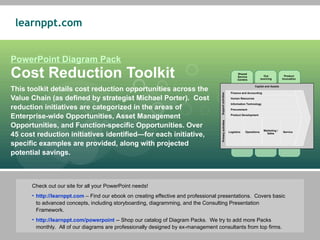
PowerPoint Diagram Pack Cost Reduction Toolkit This toolkit details cost reduction opportunities across the Value Chain (as defined by strategist Michael Porter).  Cost reduction initiatives are categorized in the areas of Enterprise-wide Opportunities, Asset Management Opportunities, and Function-specific Opportunities. Over 45 cost reduction initiatives identified—for each initiative, specific examples are provided, along with projected potential savings. Check out our site for all your PowerPoint needs! http://learnppt.com  – Find our ebook on creating effective and professional presentations.  Covers basic to advanced concepts, including storyboarding, diagramming, and the Consulting Presentation Framework. http://learnppt.com/powerpoint  -- Shop our catalog of Diagram Packs.  We try to add more Packs monthly.  All of our diagrams are professionally designed by ex-management consultants from top firms. Capital and Assets Procurement  Information Technology  Finance and Accounting Human Resources Operations Marketing / Sales Logistics Service Shared Service Centers Out sourcing Product Innovation Product Development  Primary activities Support activities
Contents Overview 4 Levers to Profitability 5 Profitability Challenges 6 Cost Reduction Opportunities 7 Cost Reduction in the Face of Downturn 8 Cost Reduction Opportunities 9 Across the Value Chain 10 Enterprise-wide Opportunities 11 Asset Management Opportunities 15 Function-specific Opportunities 17
Contents Overview Levers to Profitability Profitability Challenges Cost Reduction Opportunities Cost Reduction in the Face of Downturn Cost Reduction Opportunities Across the Value Chain Enterprise-wide Opportunities Asset Management Opportunities Function-specific Opportunities
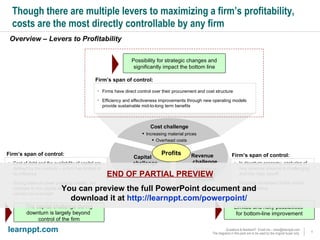
Though there are multiple levers to maximizing a firm’s profitability, costs are the most directly controllable by any firm Overview – Levers to Profitability Profits Cost challenge Increasing material prices Overhead costs Capital  challenge High cost of capital Availability of capital Revenue  challenge Declining or stagnating revenues Firms have direct control over their procurement and cost structure Efficiency and effectiveness improvements through new operating models provide sustainable mid-to-long term benefits Cost of debt and the availability of capital are defined by the markets – a firm has limited or no influence Strong balance sheet provides shelter, but changes to the capital structure are not carried out overnight In downturn economy, capturing of new revenue streams is challenging and has risky payoff Requires increased SG&A and/or R&D spending The capital challenge during downturn is largely beyond  control of the firm Possibility for strategic changes and significantly impact the bottom line Limited and risky possibilities  for bottom-line improvement Firm’s span of control:  Firm’s span of control:  Firm’s span of control:  END OF PARTIAL PREVIEW You can preview the full PowerPoint document and  download it at  http://learnppt.com/powerpoint/
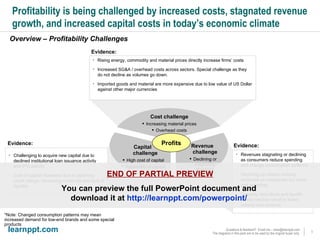
Profitability is being challenged by increased costs, stagnated revenue growth, and increased capital costs in today’s economic climate Overview – Profitability Challenges Rising energy, commodity and material prices directly increase firms’ costs Increased SG&A / overhead costs across sectors. Special challenge as they do not decline as volumes go down. Imported goods and material are more expensive due to low value of US Dollar against other major currencies  Challenging to acquire new capital due to declined institutional loan issuance activity and IPO activity Cost of capital increased due to declining credit ratings, increasing credit risk and lack of liquidity Revenues stagnating or declining as consumers reduce spending and change consumption patterns * Declining up-stream industry revenues as companies cut costs and spending Capacity reductions and layoffs across sectors result to lower volume and revenue Evidence: Evidence: Evidence: *Note: Changed consumption patterns may mean increased demand for low-end brands and some special products Profits Cost challenge Increasing material prices Overhead costs Capital  challenge High cost of capital Availability of capital Revenue  challenge Declining or stagnating revenues END OF PARTIAL PREVIEW You can preview the full PowerPoint document and  download it at  http://learnppt.com/powerpoint/
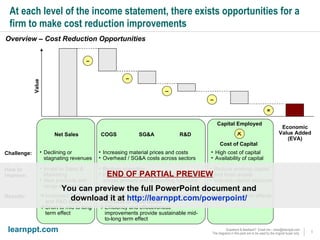
At each level of the income statement, there exists opportunities for a firm to make cost reduction improvements Overview – Cost Reduction Opportunities  Economic Value Added (EVA) = Net Sales COGS – Capital Employed Cost of Capital – Value SG&A – How to improve: Invest in Sales & Marketing New products and range extensions Reduce spending Efficiency and effectiveness improvement across primary and supporting functions R&D – Reduce working capital and fixed assets Improve capital structure Results: Challenge: Increased SG&A and R&D costs Short to mid to long term effect  Reduced spending provides immediate increase of value added Efficiency and effectiveness improvements provide sustainable mid-to-long term effect Mid to long term effects Declining or stagnating revenues Increasing material prices and costs Overhead / SG&A costs across sectors High cost of capital Availability of capital END OF PARTIAL PREVIEW You can preview the full PowerPoint document and  download it at  http://learnppt.com/powerpoint/
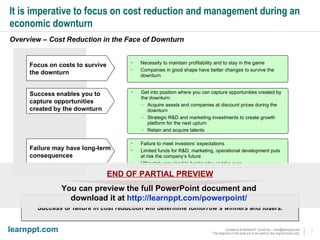
It is imperative to focus on cost reduction and management during an economic downturn Overview – Cost Reduction in the Face of Downturn Necessity to maintain profitability and to stay in the game Companies in good shape have better changes to survive the downturn Focus on costs to survive the downturn Failure may have long-term consequences Success or failure in cost reduction will determine tomorrow’s winners and losers. Failure to meet investors’ expectations Limited funds for R&D, marketing, operational development puts at risk the company’s future Ultimately may lead to bankruptcy or take over Get into position where you can capture opportunities created by the downturn: Acquire assets and companies at discount prices during the downturn Strategic R&D and marketing investments to create growth platform for the next upturn Retain and acquire talents Success enables you to capture opportunities created by the downturn END OF PARTIAL PREVIEW You can preview the full PowerPoint document and  download it at  http://learnppt.com/powerpoint/
Contents Overview Levers to Profitability Profitability Challenges Cost Reduction Opportunities Cost Reduction in the Face of Downturn Cost Reduction Opportunities Across the Value Chain Enterprise-wide Opportunities Asset Management Opportunities Function-specific Opportunities
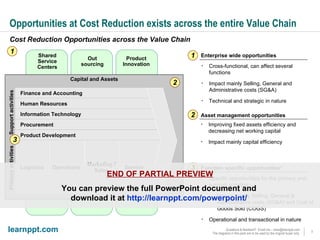
Opportunities at Cost Reduction exists across the entire Value Chain Capital and Assets Procurement  Information Technology  Finance and Accounting Human Resources Operations Marketing / Sales Logistics Service Enterprise wide opportunities Function specific opportunities*  Cross-functional, can affect several functions Impact mainly Selling, General and Administrative costs (SG&A) Technical and strategic in nature Specific opportunities for the primary and support activities: Impact mainly Selling, General & Administrative costs (SG&A) and Cost of Goods Sold (COGS) Operational and transactional in nature Shared Service Centers Out sourcing Product Innovation Product Development  Asset management opportunities 2 1 3 2 1 Improving fixed assets efficiency and decreasing net working capital Impact mainly capital efficiency Primary activities Support activities Cost Reduction Opportunities across the Value Chain 3 END OF PARTIAL PREVIEW You can preview the full PowerPoint document and  download it at  http://learnppt.com/powerpoint/
Contents Overview Levers to Profitability Profitability Challenges Cost Reduction Opportunities Cost Reduction in the Face of Downturn Cost Reduction Opportunities Across the Value Chain Enterprise-wide Opportunities Asset Management Opportunities Function-specific Opportunities
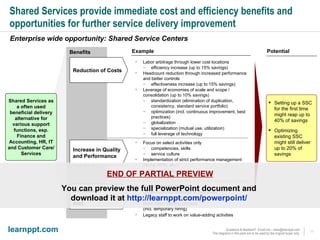
Shared Services provide immediate cost and efficiency benefits and opportunities for further service delivery improvement Enterprise wide opportunity: Shared Service Centers Benefits Example Labor arbitrage through lower cost locations efficiency increase (up to 15% savings) Headcount reduction through increased performance and better controls effectiveness increase (up to 15% savings) Leverage of economies of scale and scope / consolidation (up to 10% savings) standardization (elimination of duplication, consistency, standard service portfolio) optimization (incl. continuous improvement, best practices) globalization specialization (mutual use, utilization) full leverage of technology Reduction of Costs Setting up a SSC for the first time might reap up to 40% of savings Optimizing existing SSC might still deliver up to 20% of savings Increase in Quality and Performance Focus on select activities only competencies, skills service culture Implementation of strict performance management (SLAs, KPIs, etc.) transparency consistency  Potential Shared Services as a often used beneficial delivery alternative for various support functions, esp. Finance and Accounting, HR, IT and Customer Care/Services Increase in Flexibility and Value-Add “ Variabilization” of costs Cross-business leverage of resources  (no fiefdoms or pockets of staff) More direct staffing process  (incl. temporary hiring) Legacy staff to work on value-adding activities END OF PARTIAL PREVIEW You can preview the full PowerPoint document and  download it at  http://learnppt.com/powerpoint/
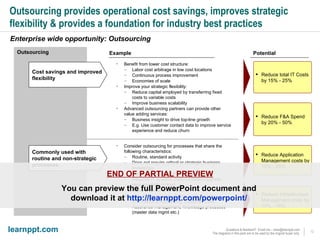
Outsourcing provides operational cost savings, improves strategic flexibility & provides a foundation for industry best practices Enterprise wide opportunity: Outsourcing Outsourcing Example Commonly used with routine and non-strategic processes Cost savings and improved flexibility  Benefit from lower cost structure: Labor cost arbitrage in low cost locations Continuous process improvement  Economies of scale Improve your strategic flexibility: Reduce capital employed by transferring fixed costs to variable costs Improve business scalability Advanced outsourcing partners can provide other value adding services: Business insight to drive top-line growth E.g. Use customer contact data to improve service experience and reduce churn Consider outsourcing for processes that share the following characteristics: Routine, standard activity Does not require critical or strategic business knowledge Significant gap against best practice Requires IT systems implementation/upgrade High variability in load Rapid improvement needed Number of functions benefit from outsourcing: IT, Finance & Accounting, Customer Care, Assurance management, Knowledge processes (master data mgmt etc.) Potential Reduce total IT Costs by 15% - 25% Reduce F&A Spend by 20% - 50% Reduce Application Management costs by 15% - 25% Reduce Infrastructure Management costs by 10% - 15% END OF PARTIAL PREVIEW You can preview the full PowerPoint document and  download it at  http://learnppt.com/powerpoint/
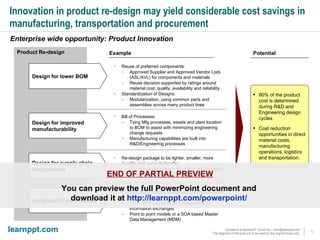
Innovation in product re-design may yield considerable cost savings in manufacturing, transportation and procurement Enterprise wide opportunity: Product Innovation Product Re-design Example Reuse of preferred components: Approved Supplier and Approved Vendor Lists (ASL/AVL) for components and materials Reuse decision supported by ratings around material cost, quality, availability and reliability Standardization of Designs: Modularization, using common parts and assemblies across many product lines Design for lower BOM Design for supply chain management Re-design package to be lighter, smaller, more durable and easier to handle: E.g. Nokia has gained ~80 million dollars yearly savings from its smaller packages 80% of the product cost is determined during R&D and Engineering design cycles Cost reduction opportunities in direct material costs, manufacturing operations, logistics and transportation. Design for improved manufacturability Bill of Processes: Tying Mfg processes, assets and plant location to BOM to assist with minimizing engineering change requests Manufacturing capabilities are built into R&D/Engineering processes Integrated IT architecture Product design improvements require improvements in IT architecture:  PLM - ERP - SCM system integrations for information exchanges Point to point models or a SOA based Master Data Management (MDM) Potential END OF PARTIAL PREVIEW You can preview the full PowerPoint document and  download it at  http://learnppt.com/powerpoint/
END OF PARTIAL PREVIEW You can preview the full PowerPoint document and  download it at  http://learnppt.com/powerpoint/
Browse our catalog of PowerPoint Diagram Packs http://learnppt.com/powerpoint   Join our mailing list and receive the  Basic Toolkit for free ! http://learnppt.com/mailinglist   Read our eBook – How to Become a PowerPoint Guru http://learnppt.com/

Cost Reduction Toolkit

  • 1.
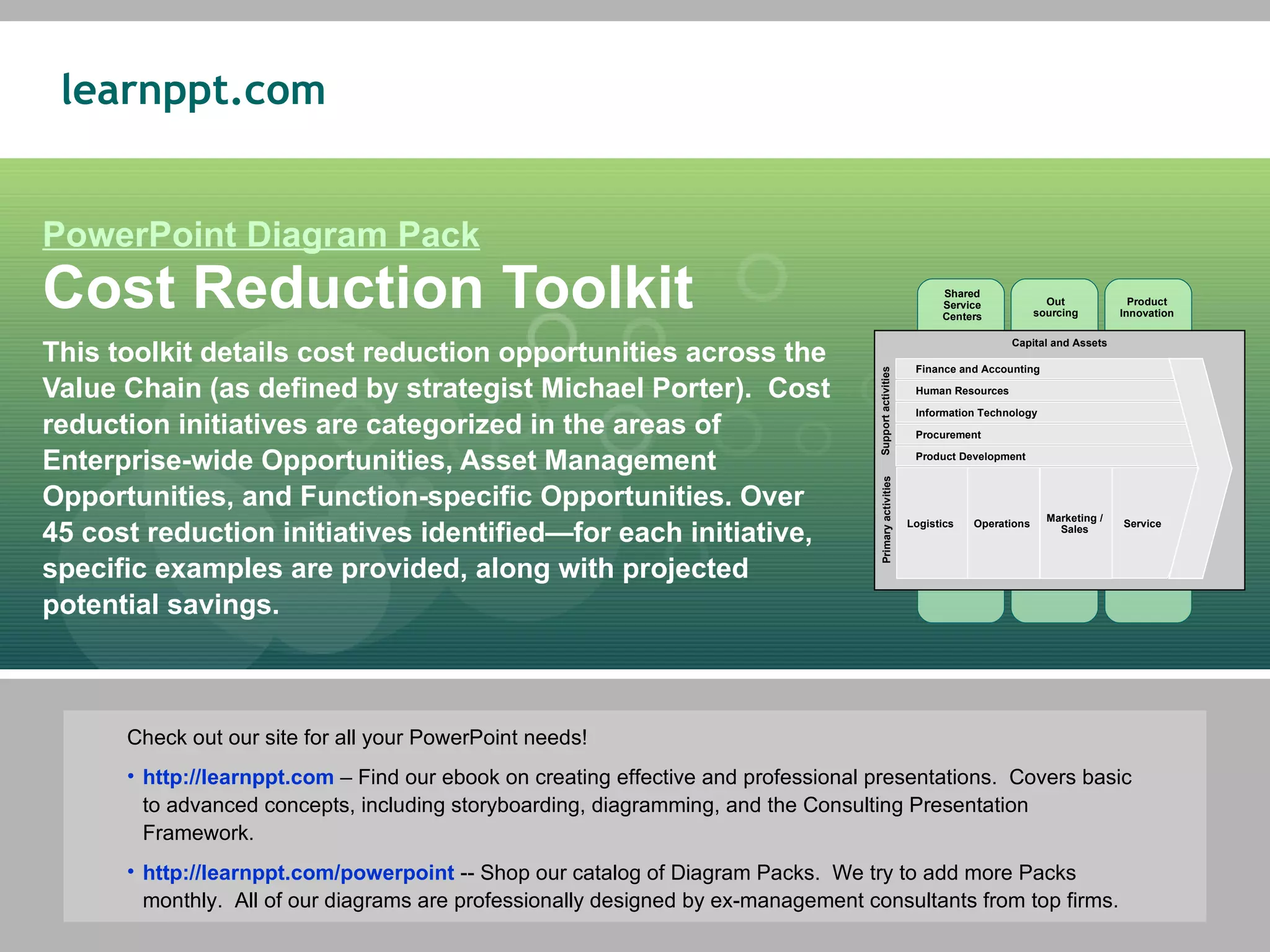
    PowerPoint Diagram PackCost Reduction Toolkit This toolkit details cost reduction opportunities across the Value Chain (as defined by strategist Michael Porter). Cost reduction initiatives are categorized in the areas of Enterprise-wide Opportunities, Asset Management Opportunities, and Function-specific Opportunities. Over 45 cost reduction initiatives identified—for each initiative, specific examples are provided, along with projected potential savings. Check out our site for all your PowerPoint needs! http://learnppt.com – Find our ebook on creating effective and professional presentations. Covers basic to advanced concepts, including storyboarding, diagramming, and the Consulting Presentation Framework. http://learnppt.com/powerpoint -- Shop our catalog of Diagram Packs. We try to add more Packs monthly. All of our diagrams are professionally designed by ex-management consultants from top firms. Capital and Assets Procurement Information Technology Finance and Accounting Human Resources Operations Marketing / Sales Logistics Service Shared Service Centers Out sourcing Product Innovation Product Development Primary activities Support activities
  • 2.
    Contents Overview 4Levers to Profitability 5 Profitability Challenges 6 Cost Reduction Opportunities 7 Cost Reduction in the Face of Downturn 8 Cost Reduction Opportunities 9 Across the Value Chain 10 Enterprise-wide Opportunities 11 Asset Management Opportunities 15 Function-specific Opportunities 17
  • 3.
    Contents Overview Leversto Profitability Profitability Challenges Cost Reduction Opportunities Cost Reduction in the Face of Downturn Cost Reduction Opportunities Across the Value Chain Enterprise-wide Opportunities Asset Management Opportunities Function-specific Opportunities
  • 4.
    Though there aremultiple levers to maximizing a firm’s profitability, costs are the most directly controllable by any firm Overview – Levers to Profitability Profits Cost challenge Increasing material prices Overhead costs Capital challenge High cost of capital Availability of capital Revenue challenge Declining or stagnating revenues Firms have direct control over their procurement and cost structure Efficiency and effectiveness improvements through new operating models provide sustainable mid-to-long term benefits Cost of debt and the availability of capital are defined by the markets – a firm has limited or no influence Strong balance sheet provides shelter, but changes to the capital structure are not carried out overnight In downturn economy, capturing of new revenue streams is challenging and has risky payoff Requires increased SG&A and/or R&D spending The capital challenge during downturn is largely beyond control of the firm Possibility for strategic changes and significantly impact the bottom line Limited and risky possibilities for bottom-line improvement Firm’s span of control: Firm’s span of control: Firm’s span of control: END OF PARTIAL PREVIEW You can preview the full PowerPoint document and download it at http://learnppt.com/powerpoint/
  • 5.
    Profitability is beingchallenged by increased costs, stagnated revenue growth, and increased capital costs in today’s economic climate Overview – Profitability Challenges Rising energy, commodity and material prices directly increase firms’ costs Increased SG&A / overhead costs across sectors. Special challenge as they do not decline as volumes go down. Imported goods and material are more expensive due to low value of US Dollar against other major currencies Challenging to acquire new capital due to declined institutional loan issuance activity and IPO activity Cost of capital increased due to declining credit ratings, increasing credit risk and lack of liquidity Revenues stagnating or declining as consumers reduce spending and change consumption patterns * Declining up-stream industry revenues as companies cut costs and spending Capacity reductions and layoffs across sectors result to lower volume and revenue Evidence: Evidence: Evidence: *Note: Changed consumption patterns may mean increased demand for low-end brands and some special products Profits Cost challenge Increasing material prices Overhead costs Capital challenge High cost of capital Availability of capital Revenue challenge Declining or stagnating revenues END OF PARTIAL PREVIEW You can preview the full PowerPoint document and download it at http://learnppt.com/powerpoint/
  • 6.
    At each levelof the income statement, there exists opportunities for a firm to make cost reduction improvements Overview – Cost Reduction Opportunities Economic Value Added (EVA) = Net Sales COGS – Capital Employed Cost of Capital – Value SG&A – How to improve: Invest in Sales & Marketing New products and range extensions Reduce spending Efficiency and effectiveness improvement across primary and supporting functions R&D – Reduce working capital and fixed assets Improve capital structure Results: Challenge: Increased SG&A and R&D costs Short to mid to long term effect  Reduced spending provides immediate increase of value added Efficiency and effectiveness improvements provide sustainable mid-to-long term effect Mid to long term effects Declining or stagnating revenues Increasing material prices and costs Overhead / SG&A costs across sectors High cost of capital Availability of capital END OF PARTIAL PREVIEW You can preview the full PowerPoint document and download it at http://learnppt.com/powerpoint/
  • 7.
    It is imperativeto focus on cost reduction and management during an economic downturn Overview – Cost Reduction in the Face of Downturn Necessity to maintain profitability and to stay in the game Companies in good shape have better changes to survive the downturn Focus on costs to survive the downturn Failure may have long-term consequences Success or failure in cost reduction will determine tomorrow’s winners and losers. Failure to meet investors’ expectations Limited funds for R&D, marketing, operational development puts at risk the company’s future Ultimately may lead to bankruptcy or take over Get into position where you can capture opportunities created by the downturn: Acquire assets and companies at discount prices during the downturn Strategic R&D and marketing investments to create growth platform for the next upturn Retain and acquire talents Success enables you to capture opportunities created by the downturn END OF PARTIAL PREVIEW You can preview the full PowerPoint document and download it at http://learnppt.com/powerpoint/
  • 8.
    Contents Overview Leversto Profitability Profitability Challenges Cost Reduction Opportunities Cost Reduction in the Face of Downturn Cost Reduction Opportunities Across the Value Chain Enterprise-wide Opportunities Asset Management Opportunities Function-specific Opportunities
  • 9.
    Opportunities at CostReduction exists across the entire Value Chain Capital and Assets Procurement Information Technology Finance and Accounting Human Resources Operations Marketing / Sales Logistics Service Enterprise wide opportunities Function specific opportunities* Cross-functional, can affect several functions Impact mainly Selling, General and Administrative costs (SG&A) Technical and strategic in nature Specific opportunities for the primary and support activities: Impact mainly Selling, General & Administrative costs (SG&A) and Cost of Goods Sold (COGS) Operational and transactional in nature Shared Service Centers Out sourcing Product Innovation Product Development Asset management opportunities 2 1 3 2 1 Improving fixed assets efficiency and decreasing net working capital Impact mainly capital efficiency Primary activities Support activities Cost Reduction Opportunities across the Value Chain 3 END OF PARTIAL PREVIEW You can preview the full PowerPoint document and download it at http://learnppt.com/powerpoint/
  • 10.
    Contents Overview Leversto Profitability Profitability Challenges Cost Reduction Opportunities Cost Reduction in the Face of Downturn Cost Reduction Opportunities Across the Value Chain Enterprise-wide Opportunities Asset Management Opportunities Function-specific Opportunities
  • 11.
    Shared Services provideimmediate cost and efficiency benefits and opportunities for further service delivery improvement Enterprise wide opportunity: Shared Service Centers Benefits Example Labor arbitrage through lower cost locations efficiency increase (up to 15% savings) Headcount reduction through increased performance and better controls effectiveness increase (up to 15% savings) Leverage of economies of scale and scope / consolidation (up to 10% savings) standardization (elimination of duplication, consistency, standard service portfolio) optimization (incl. continuous improvement, best practices) globalization specialization (mutual use, utilization) full leverage of technology Reduction of Costs Setting up a SSC for the first time might reap up to 40% of savings Optimizing existing SSC might still deliver up to 20% of savings Increase in Quality and Performance Focus on select activities only competencies, skills service culture Implementation of strict performance management (SLAs, KPIs, etc.) transparency consistency Potential Shared Services as a often used beneficial delivery alternative for various support functions, esp. Finance and Accounting, HR, IT and Customer Care/Services Increase in Flexibility and Value-Add “ Variabilization” of costs Cross-business leverage of resources (no fiefdoms or pockets of staff) More direct staffing process (incl. temporary hiring) Legacy staff to work on value-adding activities END OF PARTIAL PREVIEW You can preview the full PowerPoint document and download it at http://learnppt.com/powerpoint/
  • 12.
    Outsourcing provides operationalcost savings, improves strategic flexibility & provides a foundation for industry best practices Enterprise wide opportunity: Outsourcing Outsourcing Example Commonly used with routine and non-strategic processes Cost savings and improved flexibility Benefit from lower cost structure: Labor cost arbitrage in low cost locations Continuous process improvement Economies of scale Improve your strategic flexibility: Reduce capital employed by transferring fixed costs to variable costs Improve business scalability Advanced outsourcing partners can provide other value adding services: Business insight to drive top-line growth E.g. Use customer contact data to improve service experience and reduce churn Consider outsourcing for processes that share the following characteristics: Routine, standard activity Does not require critical or strategic business knowledge Significant gap against best practice Requires IT systems implementation/upgrade High variability in load Rapid improvement needed Number of functions benefit from outsourcing: IT, Finance & Accounting, Customer Care, Assurance management, Knowledge processes (master data mgmt etc.) Potential Reduce total IT Costs by 15% - 25% Reduce F&A Spend by 20% - 50% Reduce Application Management costs by 15% - 25% Reduce Infrastructure Management costs by 10% - 15% END OF PARTIAL PREVIEW You can preview the full PowerPoint document and download it at http://learnppt.com/powerpoint/
  • 13.
    Innovation in productre-design may yield considerable cost savings in manufacturing, transportation and procurement Enterprise wide opportunity: Product Innovation Product Re-design Example Reuse of preferred components: Approved Supplier and Approved Vendor Lists (ASL/AVL) for components and materials Reuse decision supported by ratings around material cost, quality, availability and reliability Standardization of Designs: Modularization, using common parts and assemblies across many product lines Design for lower BOM Design for supply chain management Re-design package to be lighter, smaller, more durable and easier to handle: E.g. Nokia has gained ~80 million dollars yearly savings from its smaller packages 80% of the product cost is determined during R&D and Engineering design cycles Cost reduction opportunities in direct material costs, manufacturing operations, logistics and transportation. Design for improved manufacturability Bill of Processes: Tying Mfg processes, assets and plant location to BOM to assist with minimizing engineering change requests Manufacturing capabilities are built into R&D/Engineering processes Integrated IT architecture Product design improvements require improvements in IT architecture: PLM - ERP - SCM system integrations for information exchanges Point to point models or a SOA based Master Data Management (MDM) Potential END OF PARTIAL PREVIEW You can preview the full PowerPoint document and download it at http://learnppt.com/powerpoint/
  • 14.
    END OF PARTIALPREVIEW You can preview the full PowerPoint document and download it at http://learnppt.com/powerpoint/
  • 15.
    Browse our catalogof PowerPoint Diagram Packs http://learnppt.com/powerpoint Join our mailing list and receive the Basic Toolkit for free ! http://learnppt.com/mailinglist Read our eBook – How to Become a PowerPoint Guru http://learnppt.com/

Editor's Notes

  • #3 93 09/15/98 11 25
  • #4 93 09/15/98 11 25
  • #9 93 09/15/98 11 25
  • #11 93 09/15/98 11 25