Surviving 2009  to Thrive in 2010 T.D. Decker Decker Holdings (630) 776-7681 [email_address]
Early Warning Signs of Business Failure There are certain early warning signs that troubled companies frequently exhibit.  Many of these signs can be observed up to two years before a crisis is “officially” recognized. It is important to remember, the sooner the problems are recognized and addressed, the more flexibility management has in solving problems and returning the company to heath.
Sales Characteristics Sales forecast  Can you forecast with certainty? Are there shortfalls? Does it show increases far in excess of current levels? Does it show increases far in excess of prior year performance? Is it based on growth rates that are greater than the past ? Is it greater than the industry is expected to grow? Increased in order to assure that all overhead expenses covered? Includes more low margin products? Includes many new low margin, small customers?  Negative trends in industry pricing practices Significant decline in market share & backlog Sales concentrated with customers experiencing problems Products experienced obsolescence relative to the competition
Cost Characteristics SG&A expenses growing faster than revenues Gross margin % declined Executive salaries & perks greater than industry norms Actual costs exceed budgeted costs Cost monitoring and measuring vs. budget and prior periods Need for more accurate reporting on a timely and consistent basis Need better cash flow monitoring? Need better capital expenditure controls  SBU’s or product lines that require significantly more capital than others and earning lower returns on investments?  Capital projects fallen short of the expected revenue growth Capital projects fallen short of the cost savings projected Cost accounting system need to be updated Adequate controls over discretionary spending Understand key cost drivers and customer profits
Financial Characteristics Inconsistent monthly financial results Financial bank covenants worsening Inventory & A/R growing faster than reserve accounts Cash &/or revolver declining A/R increasing A/R increasing b/c customer dissatisfaction due to poor quality, shipping delays or returned product?  Payables over 90 days increasing or vendors tightening credit terms CAPEX delaying threaten survival or competitiveness Non-critical cash spending when should be saving  If business improves do you have working capital to support growth Experienced inventory shrinkage problems Trouble reducing inventory levels on sales declines Working capital declining
Constituency Characteristics Lender raising concerns about deteriorating financial performance More frequent calls & meetings with your banker Suppliers difficult to deal with  Customers dissatisfaction with products, quality or service Losing large customers Lenders, shareholders or directors concerned about poor performance No Strategic Plan Two or more different Strategic Plans or budgets over the past year  Top management spending more time away from day to day operations and more time on financial issues Understanding of commodity risk Absorbed price increases and scared to pass them along
Industry Characteristics Shrinking or consolidating? Technology shifting away from your products Products become technologically obsolete?  Impacted significantly by economic cycles or seasonal shifts?  Large number of competitors offering similar products or services with more competitive prices/terms?  Foreign competition increased Significant OSHA or environmental problems  Company be impacted by a recession or depression Proper hedging techniques for commodity volatility
Management Characteristics Need to improve teamwork Significant changes in the company “culture”  Morale or turnover in top or middle management  Need better communication and focus Plans, programs, budgets and accountability for their results made clear to managers?  Labor unrest  Problems with absenteeism, increased workers compensation claims, poor productivity or missed production quotas?  Formal downsizing within the past year
SWOT Analysis The internal & external environment that the organization operates. To think and act strategically, you need to know and understand your  situational analysis , to look around and see what is going on inside and outside the organization.  1) What are your internal  strengths ?  2) How would you assess your internal  weaknesses ?  3) What are your external  opportunities ?  4) What are the  threats  externally to your organization’s success? Before any plans are made about where you are going, one who is wise will assess the circumstances in which your organization operates.  Out of this assessment, you can then more realistically start to make plans toward the future.
Monitor and Maximize Cash Position 13 Week Cash Flow Forecast Stop spending to at least break-even Don’t just reduce X% of people  Reduce work and strategic initiatives first Reduce people last
Financial Fundamentals  Monitor & Maximize Cash Position Forecast revenue Reduce & control monthly costs Understand fix costs & variable costs Produce a rolling 13 week cash flow report
Financial Fundamentals Tightly Manage Customer Credit Segment customers based on credit risk Only offer financing to credit worthy or strategic customers Assess trade-offs between credit risks and marginal sales
Financial Fundamentals Aggressively Manage Working Capital Reduce inventories by monitoring production & sourcing Reduce receivables by actively managing customer credit Work with vendors to extend payables
Financial Fundamentals Optimize Financial Structure Reduce debt & other liabilities Secure access to lines of credit Secure access to equity capital by tapping nonmarket sources
Reduce Costs & Increase Efficiency Eliminate long-standing activities that add little value Revive earlier efficiency initiatives too controversial to fully implement in better times Consolidate our centralize key functions Analyze current suppliers & procurement practices Reexamine the economics of outsourcing & off shoring
Aggressively Manage the Top Line Revive customer retention initiatives Realign sales force utilization & incentives to generate additional short-term revenue Reallocate marketing spending toward immediate revenue generation Consider more generous financial terms for customers in return for higher prices
Rethink Product Mix & Pricing Strategies Offer lower price versions of existing products Identify products customers are still willing to pay full price Consider creative strategies such as results-based or subscription pricing Unbundle services and adopt a la carte pricing
Rein in Planned Investments & Sell Assets Establish stringent capital allocation guidelines Shed unproductive assets that were difficult to dispose of in good times Divest non-core businesses
Denying Reality Video http://www.youtube.com/watch?v=YR71GnQ4CU4
Now What Do You Do? Don’t Just Announce a 20% RIF Remaining People will Just Work Harder Stars Might Leave Not Every Area is Overstaffed
Now What Do You Do? Get Rid of Work Work Smarter Not Harder Eliminate Things That Aren’t Getting a ROI 80/20 View Product Line Simplification Prioritize Strategic Initiatives People
80/20 View A Process for Improving  Performance
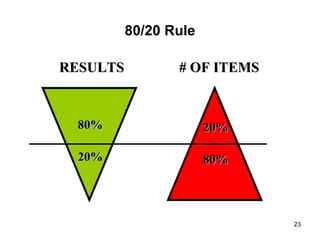
80/20 Rule RESULTS # OF ITEMS 80% 80% 20% 20%
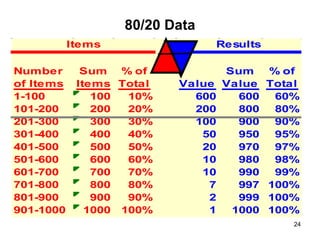
80/20 Data
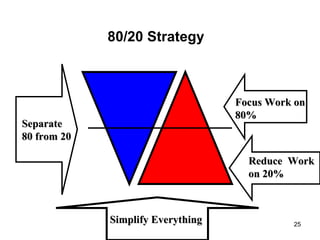
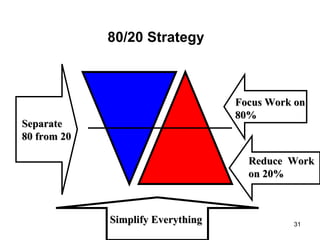
80/20 Strategy   Focus Work on 80% Reduce  Work on 20% Separate 80 from 20 Simplify Everything
Use 80/20 in every aspect of your business Products Customers Suppliers Inventory Product cost Geographic distribution
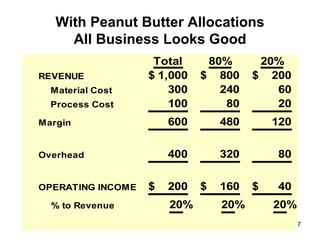
With Peanut Butter Allocations All Business Looks Good
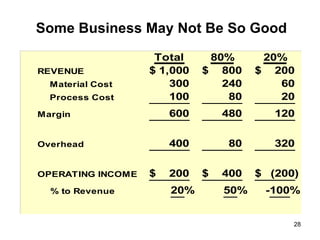
Some Business May Not Be So Good
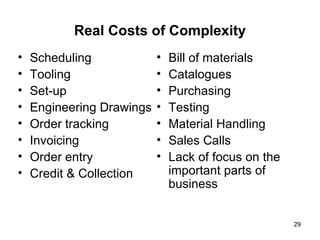
Real Costs of Complexity Scheduling Tooling Set-up Engineering Drawings Order tracking Invoicing Order entry Credit & Collection Bill of materials Catalogues Purchasing Testing Material Handling Sales Calls Lack of focus on the important parts of business
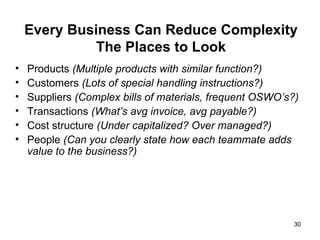
Every Business Can Reduce Complexity The Places to Look Products  (Multiple products with similar function?)  Customers  (Lots of special handling instructions?) Suppliers  (Complex bills of materials, frequent OSWO’s?)  Transactions  (What’s avg invoice, avg payable?) Cost structure  (Under capitalized? Over managed?) People  (Can you clearly state how each teammate adds value to the business?)
80/20 Strategy   Focus Work on 80% Reduce  Work on 20% Separate 80 from 20 Simplify Everything
Actions “Above the 80/20 line” Focus on the 20% of the items that account for 80% of the importance! Study them carefully! Micro-manage them! Negotiate good prices for them! Be the best at them! They are what matters!
Actions “Below the 80/20 line” They only account for 20% of the importance! Eliminate! Combine! Simplify! Do not waste resources on them! Outsource Tolerate inefficiency!
What is PLS? Product Line Simplification A systematic approach to defining and streamlining your product and service offerings.
Objectives of a PLS Program Reduce the number of discrete products or services offered. Eliminate the interference of “specials.” Alignment of capacity & capability.
Continuous Application of PLS Principles will Result in Reduced Costs Lower Inventory Levels Higher Quality Higher Service Levels
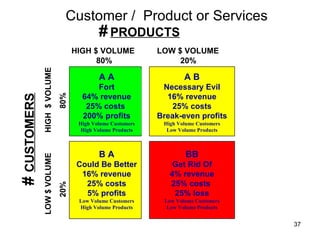
Customer /  Product or Services #   PRODUCTS HIGH $ VOLUME  LOW $ VOLUME 80%   20% #   CUSTOMERS LOW $ VOLUME  HIGH  $ VOLUME 20%   80% A A Fort 64% revenue 25% costs   200% profits High Volume Customers High Volume Products A B Necessary Evil 16% revenue 25% costs Break-even profits High Volume Customers Low Volume Products BB Get Rid Of 4% revenue 25% costs   25% loss Low Volume Customers Low Volume Products B A Could Be Better 16% revenue 25% costs 5% profits Low Volume Customers High Volume Products
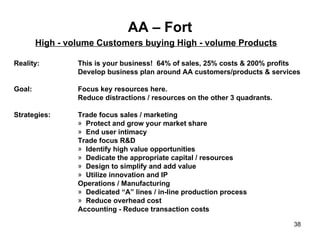
AA – Fort Reality: This is your business!  64% of sales, 25% costs & 200% profits Develop business plan around AA customers/products & services Goal: Focus key resources here.  Reduce distractions / resources on the other 3 quadrants. Strategies: Trade focus sales / marketing Protect and grow your market share End user intimacy Trade focus R&D Identify high value opportunities Dedicate the appropriate capital / resources Design to simplify and add value Utilize innovation and IP Operations / Manufacturing Dedicated “A” lines / in-line production process Reduce overhead cost Accounting - Reduce transaction costs High - volume Customers buying High - volume Products
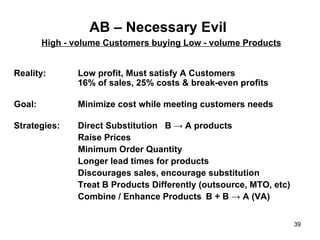
AB – Necessary Evil  Reality: Low profit, Must satisfy A Customers 16% of sales, 25% costs & break-even profits  Goal: Minimize cost while meeting customers needs Strategies: Direct Substitution  B -> A products Raise Prices Minimum Order Quantity Longer lead times for products Discourages sales, encourage substitution Treat B Products Differently (outsource, MTO, etc) Combine / Enhance Products  B + B -> A (VA) High - volume Customers buying Low - volume Products
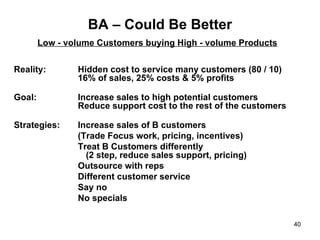
BA – Could Be Better Reality: Hidden cost to service many customers (80 / 10)  16% of sales, 25% costs & 5% profits  Goal: Increase sales to high potential customers Reduce support cost to the rest of the customers Strategies: Increase sales of B customers  (Trade Focus work, pricing, incentives) Treat B Customers differently  (2 step, reduce sales support, pricing) Outsource with reps Different customer service Say no No specials Low - volume Customers buying High - volume Products
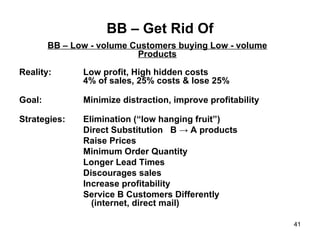
BB – Get Rid Of Reality: Low profit, High hidden costs 4% of sales, 25% costs & lose 25% Goal: Minimize distraction, improve profitability Strategies: Elimination (“low hanging fruit”) Direct Substitution  B -> A products Raise Prices Minimum Order Quantity Longer Lead Times Discourages sales Increase profitability Service B Customers Differently  (internet, direct mail) BB – Low - volume Customers buying Low - volume Products
Prioritizing Strategic Initiatives
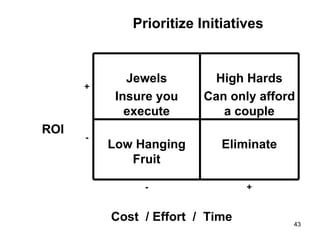
Prioritize Initiatives + Jewels Insure you execute High Hards Can only afford a couple ROI - Low Hanging Fruit Eliminate - + Cost  / Effort  /  Time
People
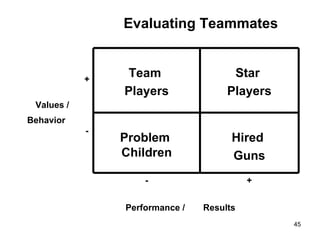
Evaluating Teammates Values / + Team  Players Star  Players Behavior - Problem  Children Hired  Guns - + Performance /  Results
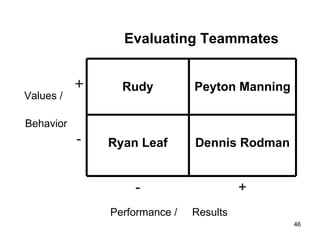
Evaluating Teammates Values / + Rudy Peyton Manning Behavior - Ryan Leaf Dennis Rodman - + Performance /  Results
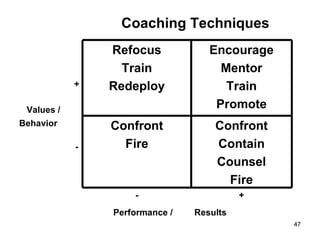
Coaching Techniques Values / + Refocus Train Redeploy Encourage Mentor Train Promote Behavior - Confront Fire Confront Contain Counsel Fire - + Performance /  Results
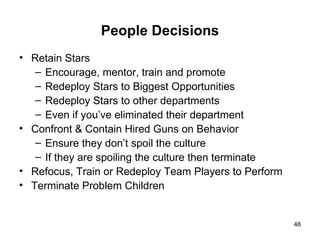
People Decisions Retain Stars Encourage, mentor, train and promote Redeploy Stars to Biggest Opportunities Redeploy Stars to other departments Even if you’ve eliminated their department Confront & Contain Hired Guns on Behavior Ensure they don’t spoil the culture If they are spoiling the culture then terminate Refocus, Train or Redeploy Team Players to Perform Terminate Problem Children
How do you know you need  to make a Firing Decision? If you’re tightly managing someone, you’ve made a hiring mistake.  The best people need to be guided and taught, but not managed. When you give 3 rd  and 4 th  chances in hopes of improvement. You continue to invest a lot of time and energy. At home, you spend a lot of time thinking about and talking with your spouse about the person.
Making the Firing Decision Would you hire the person again? If the person resigned today to pursue an exciting new opportunity, would you feel terribly disappointed or secretly relieved?
Impact of Delaying the Firing Decision When they do leave, our star players wonder what took you so long to pull the trigger. Can drive away the best new teammates. If the decision is inevitable, it’s not fair to the person, so let them get on with their career. Waiting too long usually has to do with our own convenience, not concern for the person. We neglect our star players.
When Firing Treat the person with dignity and respect by taking the high road. Decision shouldn’t be a surprise to anyone. Remember the organization shares some responsibility for hiring & not coaching this person. Consider allowing the person to land softly with 3 months severance, health care benefits and outplacement services.
Summary Understand Where You Are Early Warning Signs of Business Failure Test SWOT 13 week Cash Flow Forecast Confront Reality with a Sense of Urgency 80/20 View Product Line Simplification Prioritize Strategic Initiatives People Take Decisive Action Rightsizing to Profitability Communicate to All Stakeholders
Questions?
T.D. Decker T.D. Decker is a Turnaround President with a 28 year track record as an organization builder, change agent and coach.  He has been the President of a seasonal distribution company, a $3B hedge fund, an electronics firm and an automotive supplier.  He is an expert in quickly developing and executing plans that shrink to profitability, restore EBIT, preserve capital and prepare companies for growth and sale.  He has a diverse background in industrial, consumer goods, technology, financial services, private equity, venture capital, life science, education, non-profits and the military with experience in start-ups, emerging growth and turnaround situations.  He is a decisive leader that is willing to make tough, values based decisions that are good for all stakeholders.  He also has a history of developing leaders and teams while improving the culture of the organization, customer satisfaction, business results and shareholder value. T.D. recently was President of Aquascape, the world leader in the water garden industry.  There he led the turnaround of an unprofitable, seasonal distribution, product development and training company.  He improved EBITDA from a loss of ($1M) to $2M while sales declined from $60M to $48M by compelling stakeholders to shrink to profitability and cut costs 30% while repositioning the company for future growth. Prior to that, he was President of Ritchie Capital Management, $3 billion hedge fund with 20 portfolios in private equity, venture capital, venture lending, distressed debt, real estate, energy, insurance and trading.  The firm had over 200 employees with offices in Geneva, Chicago, New York City, London, Bermuda, Hong Kong and Menlo Park.  The firm was unprofitable and losing investors due to $180M energy loss, SEC investigation, high coast structure and investor lawsuits.  There he initiated a reorganization plan to sell assets and reduce costs to ensure viability and provide liquidity to redeeming investors.  He also recruited a new legal defense team that settled the 2003 mutual fund late trading case with the SEC for $40M. He was also an investor with Fox River Financial Resources, the family office of Joe Ritchie that invests in private equity, venture capital, real estate, water, energy and black box trading.  There he coached company presidents and management teams how to turnaround their business and preserve capital.  He also sourced and evaluated investment opportunities while leveraging his operating experience and personal network. As President of Telemotive Industrial Controls, he led the turnaround of the unprofitable electronics company on the verge of going out of business.  As sales declined 25% he cut costs 40% and doubled shareholder value with the sale to its former largest customer, Magnetek (NYSE: MAG). As President of ShapedWire, a 2nd generation family owned automotive, medical and packaging supplier, he led the turnaround, transforming the company into a world class market leader and quadrupled shareholder value with the sale to Leggett & Platt (NYSE: LEG). T.D. was Marketing Manager for United Technologies Fuel Cells business charged with commercializing the emerging technology.  He was the acting CFO and turnaround consultant for Berger Industries, an $80 million troubled steel company.  He was also a Principal for DHC Holdings, an investor group formed to purchase and operate major manufacturing companies.  In the early 90’s, he helped market Job Bank USA, a computerized resume database service.  As Director of Administration and Executive Assistant to the CEO for Great Lakes Carbon, a $450 million multinational manufacturer, he assisted in the turnaround and sale of two of the three SBUs. He served as an officer in the U.S. Army from 1981 to 1986 as a football coach at West Point, a helicopter pilot in military operations in Grenada and the youngest staff officer for the 82nd Airborne Division.  He led the turnaround of a failing unit and within four months received the highest rating in 15 years.  He helped organize Pete Dawkins' run for U.S. Senate, the 1988 Republican National Convention, George Bush's Presidential and Dan Quayle's Vice Presidential Debates, and the 1991 Desert Storm Homecoming Celebration in Washington, D.C.  He has served on over 25 for profit and non-profit boards and is currently on the boards of Wheaton Academy, A Christian Ministry in the National Parks and Camcraft.  He is also active in YPO. T.D. earned a BS in engineering from the United States Military Academy at West Point in 1981 and was a quarterback on the Army football team.  He received an MBA from Duke University in 1988 and was president of his class.

Surviving 2009 To Thrive In 2010

  • 1.
    Surviving 2009 to Thrive in 2010 T.D. Decker Decker Holdings (630) 776-7681 [email_address]
  • 2.
    Early Warning Signsof Business Failure There are certain early warning signs that troubled companies frequently exhibit. Many of these signs can be observed up to two years before a crisis is “officially” recognized. It is important to remember, the sooner the problems are recognized and addressed, the more flexibility management has in solving problems and returning the company to heath.
  • 3.
    Sales Characteristics Salesforecast Can you forecast with certainty? Are there shortfalls? Does it show increases far in excess of current levels? Does it show increases far in excess of prior year performance? Is it based on growth rates that are greater than the past ? Is it greater than the industry is expected to grow? Increased in order to assure that all overhead expenses covered? Includes more low margin products? Includes many new low margin, small customers? Negative trends in industry pricing practices Significant decline in market share & backlog Sales concentrated with customers experiencing problems Products experienced obsolescence relative to the competition
  • 4.
    Cost Characteristics SG&Aexpenses growing faster than revenues Gross margin % declined Executive salaries & perks greater than industry norms Actual costs exceed budgeted costs Cost monitoring and measuring vs. budget and prior periods Need for more accurate reporting on a timely and consistent basis Need better cash flow monitoring? Need better capital expenditure controls SBU’s or product lines that require significantly more capital than others and earning lower returns on investments? Capital projects fallen short of the expected revenue growth Capital projects fallen short of the cost savings projected Cost accounting system need to be updated Adequate controls over discretionary spending Understand key cost drivers and customer profits
  • 5.
    Financial Characteristics Inconsistentmonthly financial results Financial bank covenants worsening Inventory & A/R growing faster than reserve accounts Cash &/or revolver declining A/R increasing A/R increasing b/c customer dissatisfaction due to poor quality, shipping delays or returned product? Payables over 90 days increasing or vendors tightening credit terms CAPEX delaying threaten survival or competitiveness Non-critical cash spending when should be saving If business improves do you have working capital to support growth Experienced inventory shrinkage problems Trouble reducing inventory levels on sales declines Working capital declining
  • 6.
    Constituency Characteristics Lenderraising concerns about deteriorating financial performance More frequent calls & meetings with your banker Suppliers difficult to deal with Customers dissatisfaction with products, quality or service Losing large customers Lenders, shareholders or directors concerned about poor performance No Strategic Plan Two or more different Strategic Plans or budgets over the past year Top management spending more time away from day to day operations and more time on financial issues Understanding of commodity risk Absorbed price increases and scared to pass them along
  • 7.
    Industry Characteristics Shrinkingor consolidating? Technology shifting away from your products Products become technologically obsolete? Impacted significantly by economic cycles or seasonal shifts? Large number of competitors offering similar products or services with more competitive prices/terms? Foreign competition increased Significant OSHA or environmental problems Company be impacted by a recession or depression Proper hedging techniques for commodity volatility
  • 8.
    Management Characteristics Needto improve teamwork Significant changes in the company “culture” Morale or turnover in top or middle management Need better communication and focus Plans, programs, budgets and accountability for their results made clear to managers? Labor unrest Problems with absenteeism, increased workers compensation claims, poor productivity or missed production quotas? Formal downsizing within the past year
  • 9.
    SWOT Analysis Theinternal & external environment that the organization operates. To think and act strategically, you need to know and understand your situational analysis , to look around and see what is going on inside and outside the organization. 1) What are your internal strengths ? 2) How would you assess your internal weaknesses ? 3) What are your external opportunities ? 4) What are the threats externally to your organization’s success? Before any plans are made about where you are going, one who is wise will assess the circumstances in which your organization operates. Out of this assessment, you can then more realistically start to make plans toward the future.
  • 10.
    Monitor and MaximizeCash Position 13 Week Cash Flow Forecast Stop spending to at least break-even Don’t just reduce X% of people Reduce work and strategic initiatives first Reduce people last
  • 11.
    Financial Fundamentals Monitor & Maximize Cash Position Forecast revenue Reduce & control monthly costs Understand fix costs & variable costs Produce a rolling 13 week cash flow report
  • 12.
    Financial Fundamentals TightlyManage Customer Credit Segment customers based on credit risk Only offer financing to credit worthy or strategic customers Assess trade-offs between credit risks and marginal sales
  • 13.
    Financial Fundamentals AggressivelyManage Working Capital Reduce inventories by monitoring production & sourcing Reduce receivables by actively managing customer credit Work with vendors to extend payables
  • 14.
    Financial Fundamentals OptimizeFinancial Structure Reduce debt & other liabilities Secure access to lines of credit Secure access to equity capital by tapping nonmarket sources
  • 15.
    Reduce Costs &Increase Efficiency Eliminate long-standing activities that add little value Revive earlier efficiency initiatives too controversial to fully implement in better times Consolidate our centralize key functions Analyze current suppliers & procurement practices Reexamine the economics of outsourcing & off shoring
  • 16.
    Aggressively Manage theTop Line Revive customer retention initiatives Realign sales force utilization & incentives to generate additional short-term revenue Reallocate marketing spending toward immediate revenue generation Consider more generous financial terms for customers in return for higher prices
  • 17.
    Rethink Product Mix& Pricing Strategies Offer lower price versions of existing products Identify products customers are still willing to pay full price Consider creative strategies such as results-based or subscription pricing Unbundle services and adopt a la carte pricing
  • 18.
    Rein in PlannedInvestments & Sell Assets Establish stringent capital allocation guidelines Shed unproductive assets that were difficult to dispose of in good times Divest non-core businesses
  • 19.
    Denying Reality Videohttp://www.youtube.com/watch?v=YR71GnQ4CU4
  • 20.
    Now What DoYou Do? Don’t Just Announce a 20% RIF Remaining People will Just Work Harder Stars Might Leave Not Every Area is Overstaffed
  • 21.
    Now What DoYou Do? Get Rid of Work Work Smarter Not Harder Eliminate Things That Aren’t Getting a ROI 80/20 View Product Line Simplification Prioritize Strategic Initiatives People
  • 22.
    80/20 View AProcess for Improving Performance
  • 23.
    80/20 Rule RESULTS# OF ITEMS 80% 80% 20% 20%
  • 24.
  • 25.
    80/20 Strategy Focus Work on 80% Reduce Work on 20% Separate 80 from 20 Simplify Everything
  • 26.
    Use 80/20 inevery aspect of your business Products Customers Suppliers Inventory Product cost Geographic distribution
  • 27.
    With Peanut ButterAllocations All Business Looks Good
  • 28.
    Some Business MayNot Be So Good
  • 29.
    Real Costs ofComplexity Scheduling Tooling Set-up Engineering Drawings Order tracking Invoicing Order entry Credit & Collection Bill of materials Catalogues Purchasing Testing Material Handling Sales Calls Lack of focus on the important parts of business
  • 30.
    Every Business CanReduce Complexity The Places to Look Products (Multiple products with similar function?) Customers (Lots of special handling instructions?) Suppliers (Complex bills of materials, frequent OSWO’s?) Transactions (What’s avg invoice, avg payable?) Cost structure (Under capitalized? Over managed?) People (Can you clearly state how each teammate adds value to the business?)
  • 31.
    80/20 Strategy Focus Work on 80% Reduce Work on 20% Separate 80 from 20 Simplify Everything
  • 32.
    Actions “Above the80/20 line” Focus on the 20% of the items that account for 80% of the importance! Study them carefully! Micro-manage them! Negotiate good prices for them! Be the best at them! They are what matters!
  • 33.
    Actions “Below the80/20 line” They only account for 20% of the importance! Eliminate! Combine! Simplify! Do not waste resources on them! Outsource Tolerate inefficiency!
  • 34.
    What is PLS?Product Line Simplification A systematic approach to defining and streamlining your product and service offerings.
  • 35.
    Objectives of aPLS Program Reduce the number of discrete products or services offered. Eliminate the interference of “specials.” Alignment of capacity & capability.
  • 36.
    Continuous Application ofPLS Principles will Result in Reduced Costs Lower Inventory Levels Higher Quality Higher Service Levels
  • 37.
    Customer / Product or Services # PRODUCTS HIGH $ VOLUME LOW $ VOLUME 80% 20% # CUSTOMERS LOW $ VOLUME HIGH $ VOLUME 20% 80% A A Fort 64% revenue 25% costs 200% profits High Volume Customers High Volume Products A B Necessary Evil 16% revenue 25% costs Break-even profits High Volume Customers Low Volume Products BB Get Rid Of 4% revenue 25% costs 25% loss Low Volume Customers Low Volume Products B A Could Be Better 16% revenue 25% costs 5% profits Low Volume Customers High Volume Products
  • 38.
    AA – FortReality: This is your business! 64% of sales, 25% costs & 200% profits Develop business plan around AA customers/products & services Goal: Focus key resources here. Reduce distractions / resources on the other 3 quadrants. Strategies: Trade focus sales / marketing Protect and grow your market share End user intimacy Trade focus R&D Identify high value opportunities Dedicate the appropriate capital / resources Design to simplify and add value Utilize innovation and IP Operations / Manufacturing Dedicated “A” lines / in-line production process Reduce overhead cost Accounting - Reduce transaction costs High - volume Customers buying High - volume Products
  • 39.
    AB – NecessaryEvil Reality: Low profit, Must satisfy A Customers 16% of sales, 25% costs & break-even profits Goal: Minimize cost while meeting customers needs Strategies: Direct Substitution B -> A products Raise Prices Minimum Order Quantity Longer lead times for products Discourages sales, encourage substitution Treat B Products Differently (outsource, MTO, etc) Combine / Enhance Products B + B -> A (VA) High - volume Customers buying Low - volume Products
  • 40.
    BA – CouldBe Better Reality: Hidden cost to service many customers (80 / 10) 16% of sales, 25% costs & 5% profits Goal: Increase sales to high potential customers Reduce support cost to the rest of the customers Strategies: Increase sales of B customers (Trade Focus work, pricing, incentives) Treat B Customers differently (2 step, reduce sales support, pricing) Outsource with reps Different customer service Say no No specials Low - volume Customers buying High - volume Products
  • 41.
    BB – GetRid Of Reality: Low profit, High hidden costs 4% of sales, 25% costs & lose 25% Goal: Minimize distraction, improve profitability Strategies: Elimination (“low hanging fruit”) Direct Substitution B -> A products Raise Prices Minimum Order Quantity Longer Lead Times Discourages sales Increase profitability Service B Customers Differently (internet, direct mail) BB – Low - volume Customers buying Low - volume Products
  • 42.
  • 43.
    Prioritize Initiatives +Jewels Insure you execute High Hards Can only afford a couple ROI - Low Hanging Fruit Eliminate - + Cost / Effort / Time
  • 44.
  • 45.
    Evaluating Teammates Values/ + Team Players Star Players Behavior - Problem Children Hired Guns - + Performance / Results
  • 46.
    Evaluating Teammates Values/ + Rudy Peyton Manning Behavior - Ryan Leaf Dennis Rodman - + Performance / Results
  • 47.
    Coaching Techniques Values/ + Refocus Train Redeploy Encourage Mentor Train Promote Behavior - Confront Fire Confront Contain Counsel Fire - + Performance / Results
  • 48.
    People Decisions RetainStars Encourage, mentor, train and promote Redeploy Stars to Biggest Opportunities Redeploy Stars to other departments Even if you’ve eliminated their department Confront & Contain Hired Guns on Behavior Ensure they don’t spoil the culture If they are spoiling the culture then terminate Refocus, Train or Redeploy Team Players to Perform Terminate Problem Children
  • 49.
    How do youknow you need to make a Firing Decision? If you’re tightly managing someone, you’ve made a hiring mistake. The best people need to be guided and taught, but not managed. When you give 3 rd and 4 th chances in hopes of improvement. You continue to invest a lot of time and energy. At home, you spend a lot of time thinking about and talking with your spouse about the person.
  • 50.
    Making the FiringDecision Would you hire the person again? If the person resigned today to pursue an exciting new opportunity, would you feel terribly disappointed or secretly relieved?
  • 51.
    Impact of Delayingthe Firing Decision When they do leave, our star players wonder what took you so long to pull the trigger. Can drive away the best new teammates. If the decision is inevitable, it’s not fair to the person, so let them get on with their career. Waiting too long usually has to do with our own convenience, not concern for the person. We neglect our star players.
  • 52.
    When Firing Treatthe person with dignity and respect by taking the high road. Decision shouldn’t be a surprise to anyone. Remember the organization shares some responsibility for hiring & not coaching this person. Consider allowing the person to land softly with 3 months severance, health care benefits and outplacement services.
  • 53.
    Summary Understand WhereYou Are Early Warning Signs of Business Failure Test SWOT 13 week Cash Flow Forecast Confront Reality with a Sense of Urgency 80/20 View Product Line Simplification Prioritize Strategic Initiatives People Take Decisive Action Rightsizing to Profitability Communicate to All Stakeholders
  • 54.
  • 55.
    T.D. Decker T.D.Decker is a Turnaround President with a 28 year track record as an organization builder, change agent and coach. He has been the President of a seasonal distribution company, a $3B hedge fund, an electronics firm and an automotive supplier. He is an expert in quickly developing and executing plans that shrink to profitability, restore EBIT, preserve capital and prepare companies for growth and sale. He has a diverse background in industrial, consumer goods, technology, financial services, private equity, venture capital, life science, education, non-profits and the military with experience in start-ups, emerging growth and turnaround situations. He is a decisive leader that is willing to make tough, values based decisions that are good for all stakeholders. He also has a history of developing leaders and teams while improving the culture of the organization, customer satisfaction, business results and shareholder value. T.D. recently was President of Aquascape, the world leader in the water garden industry. There he led the turnaround of an unprofitable, seasonal distribution, product development and training company. He improved EBITDA from a loss of ($1M) to $2M while sales declined from $60M to $48M by compelling stakeholders to shrink to profitability and cut costs 30% while repositioning the company for future growth. Prior to that, he was President of Ritchie Capital Management, $3 billion hedge fund with 20 portfolios in private equity, venture capital, venture lending, distressed debt, real estate, energy, insurance and trading. The firm had over 200 employees with offices in Geneva, Chicago, New York City, London, Bermuda, Hong Kong and Menlo Park. The firm was unprofitable and losing investors due to $180M energy loss, SEC investigation, high coast structure and investor lawsuits. There he initiated a reorganization plan to sell assets and reduce costs to ensure viability and provide liquidity to redeeming investors. He also recruited a new legal defense team that settled the 2003 mutual fund late trading case with the SEC for $40M. He was also an investor with Fox River Financial Resources, the family office of Joe Ritchie that invests in private equity, venture capital, real estate, water, energy and black box trading. There he coached company presidents and management teams how to turnaround their business and preserve capital. He also sourced and evaluated investment opportunities while leveraging his operating experience and personal network. As President of Telemotive Industrial Controls, he led the turnaround of the unprofitable electronics company on the verge of going out of business. As sales declined 25% he cut costs 40% and doubled shareholder value with the sale to its former largest customer, Magnetek (NYSE: MAG). As President of ShapedWire, a 2nd generation family owned automotive, medical and packaging supplier, he led the turnaround, transforming the company into a world class market leader and quadrupled shareholder value with the sale to Leggett & Platt (NYSE: LEG). T.D. was Marketing Manager for United Technologies Fuel Cells business charged with commercializing the emerging technology. He was the acting CFO and turnaround consultant for Berger Industries, an $80 million troubled steel company. He was also a Principal for DHC Holdings, an investor group formed to purchase and operate major manufacturing companies. In the early 90’s, he helped market Job Bank USA, a computerized resume database service. As Director of Administration and Executive Assistant to the CEO for Great Lakes Carbon, a $450 million multinational manufacturer, he assisted in the turnaround and sale of two of the three SBUs. He served as an officer in the U.S. Army from 1981 to 1986 as a football coach at West Point, a helicopter pilot in military operations in Grenada and the youngest staff officer for the 82nd Airborne Division. He led the turnaround of a failing unit and within four months received the highest rating in 15 years. He helped organize Pete Dawkins' run for U.S. Senate, the 1988 Republican National Convention, George Bush's Presidential and Dan Quayle's Vice Presidential Debates, and the 1991 Desert Storm Homecoming Celebration in Washington, D.C. He has served on over 25 for profit and non-profit boards and is currently on the boards of Wheaton Academy, A Christian Ministry in the National Parks and Camcraft. He is also active in YPO. T.D. earned a BS in engineering from the United States Military Academy at West Point in 1981 and was a quarterback on the Army football team. He received an MBA from Duke University in 1988 and was president of his class.