




WHITE PAPER

BRINGING OUT REAL VALUE
INVESTING IN THE RIGHT OUTCOME-BASED SERVICES TO
INCREASE VALUE OF EXISTING ASSETS AND OPTIMIZE COSTS
CONTENTS
EXECUTIVE SUMMARY                                                    1
INTRODUCTION: THE CHALLENGE TO INCREASE VALUE FROM EXISTING ASSETS   2
REALIZING BENEFITS AND OPTIMIZING COST CHANNELS                      3
      SERVICES THAT REALIZE BENEFITS AND VALUE                       3
      SERVICES THAT OPTIMIZE COSTS                                   5
CONCLUSIONS AND RECOMMENDATIONS                                      6
EXECUTIVE SUMMARY


The economic downturn has prompted service providers to look for
measures of reducing costs – which is compounded by a competitive
landscape that is getting tougher every day. Providers are now aiming
to “do more with less” – improve the customer experience and explore
new growth engines while constantly looking at ways to save.

In many cases, direct cost reduction measures result in lowering the
level of service that providers offer which in turn reduce loyalty and
customer spending. Therefore, instead of directly cutting expenses,
service providers should explore other investment approaches – that
will result in higher value and return on investment (ROI).

This white paper focuses on two types of services that should be
explored. Those that:
1. Bring in value through better realization of benefits
2. Take measures to reduce costs through optimization channels

Investing in such services, especially during these times, will allow
service providers to better position themselves in the challenging
competitive arena.


                                                                           01
                                                                         PAGE
INTRODUCTION: THE CHALLENGE TO INCREASE VALUE FROM EXISTING ASSETS


For service providers, times couldn’t be more challenging. On one
hand, economic pressures prompt them to massively reduce and
reconsider large investments such as product transformations. On
the other hand, the competitive arena couldn’t be tougher. More
than ever, providers need to offer the best service to their customers –
personalized, focused and efficient, with attractive pricing. They
must keep up if they don’t want to lose the race.

To achieve this, service providers must offer their customers a high
scale of customer experience, position themselves for innovation and
explore new growth engines. The major challenge is to accomplish
all this without expanding costs, reducing revenue options or
delaying programs.

So how can service providers overcome this challenge? How can they
bridge through these times of uncertainty? Is it just about reducing
expenses or can providers pull out more value from their assets?

“Do more with less” has become a common phrase. But what does it
 really mean? How do service providers get more from what they have?


                                                                             02
                                                                           PAGE
REALIZING BENEFITS AND OPTIMIZING COSTS


The instinct to reduce expenses when trying to increase net income           For the different stages, such services may include:
is not always the right approach. Although cost cutting is inevitable,
                                                                             Requirements recognition and analysis
in many cases, taking measures to directly reduce costs may result in
service providers reducing their ability to provide their customers with     	 >	Value and ROI Analysis – The current economic climate
the level of service they expect and, in turn, increase churn and reduce         demands that service providers take a hard look at potential
loyalty and customer spending. Instead of directly cutting expenses,             investment projects and reject those that don’t deliver significant
service providers need to explore the right form of investment. One that         ROI – and fast! A structured, consultative and collaborative
will result in higher value and return on investment (ROI) for them.             process, supported by the right tools, can provide sound financial
                                                                                 analysis to support budget applications and business case
Recent surveys show that “74% of CFOs admitted that their companies              development, as well as enable investment decisions. The impact
often get their cost-cutting priorities wrong by cutting what is easy to         of system and process change on key business drivers, including
measure rather than what is most needed.”                                        reduced operating costs, deferred network spend, lower TCO and
Source: PricewaterhouseCoopers                                                   enhanced revenues must all be considered. Yet this type of analysis
                                                                                 should not be seen as just a numbers exercise. The ROI analysis
Service providers shouldn’t be tempted to take the easy route, even              process helps to foster cross-departmental cooperation across
if short term. They need to explore all avenues of investing in their            business and IT functions. It helps to focus all parties on the
existing business and operational support systems (B/OSS) solutions              service provider’s business objectives and challenges,
through cost optimization channels and additional value-based, high-             demonstrating how solutions address those challenges, and so
end services offered by vendors with the right level of industry, product        deliver benefits which may be both qualitative and quantitative.
and service expertise. Two types of services are key to the investments          ROI analysis for a potential project also helps with decisions
that will result in optimal monetization of existing assets: Those that          regarding project phasing, ensuring that each phase delivers value
bring value by realizing significant benefits, and those that reduce costs       in its own right.
through cost optimization methods.
                                                                             	 >	A wider level of initial analysis is with Business Case
SERVICES THAT REALIZE BENEFITS AND VALUE                                         Development – Accurate data around the current operation
With the need to continue to invest, yet with the call to truly realize          together with insight to best practices and correct financial
the value behind each investment, it’s crucial for service providers to          modelling techniques bring the right services to bear to form
invest in services that define and materialize each project’s business           and deliver a robust business case, which reduces uncertainty
case. An approach based on business outcomes serves as the strongest             and risk when engaging in a new project. The right level of
foundation for such services; and allowing for solid and short term ROI          business case development is based on specialized operational
will increase providers’ ability to commit to these projects.                    analytics. With increased scrutiny around expenditures and
                                                                                 pressures on budget reductions, it’s key for service providers to
Services that deliver a deep understanding of the desired business and           have accurate data on how operations are performing. These
project benefits help drive all project activities with this outcome in          types of services, as the basis of the approach, use specific analysis
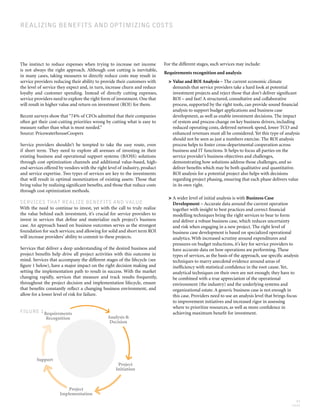
mind. Services that accompany the different stages of the lifecycle (see         techniques to marry anecdotal evidence around areas of
figure 1 below), have a major impact on the right decision making and            inefficiency with statistical confidence in the root cause. Yet,
setting the implementation path to result in success. With the market            analytical techniques on their own are not enough; they have to
changing rapidly, services that measure and track results frequently,            be combined with a true appreciation of the operational
throughout the project decision and implementation lifecycle, ensure             environment (the industry) and the underlying systems and
that benefits constantly reflect a changing business environment, and            organizational estate. A generic business case is not enough in
allow for a lower level of risk for failure.                                     this case. Providers need to use an analysis level that brings focus
                                                                                 to improvement initiatives and increased rigor in assessing
                                                                                 where to prioritize resources, as well as more confidence in
FIGURE 1 Requirements                                                            achieving maximum benefit for investment.
             Recognition                       Analysis &
                                                Decision


        Support
                                                    Project
                                                   Initiation


                         Project
                     Implementation
                                                                                                                                                     03
                                                                                                                                                   PAGE
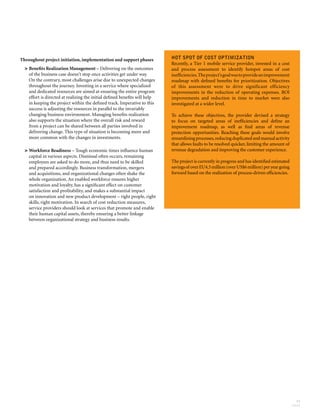
Throughout project initiation, implementation and support phases             HOT SPOT OF COST OPTIMIZATION
                                                                             Recently, a Tier 1 mobile service provider, invested in a cost
  >	Benefits Realization Management – Delivering on the outcomes             and process assessment to identify hotspot areas of cost
    of the business case doesn’t stop once activities get under way.         inefficiencies. The project’s goal was to provide an improvement
    On the contrary, most challenges arise due to unexpected changes         roadmap with defined benefits for prioritization. Objectives
    throughout the journey. Investing in a service where specialized         of this assessment were to drive significant efficiency
    and dedicated resources are aimed at ensuring the entire program         improvements in the reduction of operating expenses. ROI
    effort is directed at realizing the initial defined benefits will help   improvements and reduction in time to market were also
    in keeping the project within the defined track. Imperative to this      investigated at a wider level.
    success is adjusting the resources in parallel to the invariably
    changing business environment. Managing benefits realization             To achieve these objectives, the provider devised a strategy
    also supports the situation where the overall risk and reward            to focus on targeted areas of inefficiencies and define an
    from a project can be shared between all parties involved in             improvement roadmap, as well as find areas of revenue
    delivering change. This type of situation is becoming more and           protection opportunities. Reaching these goals would involve
    more common with the changes in investments.                             streamlining processes, reducing duplicated and manual activity
                                                                             that allows faults to be resolved quicker, limiting the amount of
  >	Workforce Readiness – Tough economic times influence human               revenue degradation and improving the customer experience.
    capital in various aspects. Dismissal often occurs, remaining
    employees are asked to do more, and thus need to be skilled              The project is currently in progress and has identified estimated
    and prepared accordingly. Business transformation, mergers               savings of over EU4.5 million (over US$6 million) per year going
    and acquisitions, and organizational changes often shake the             forward based on the realization of process-driven efficiencies.
    whole organization. An enabled workforce ensures higher
    motivation and loyalty, has a significant effect on customer
    satisfaction and profitability, and makes a substantial impact
    on innovation and new product development – right people, right
    skills, right motivation. In search of cost reduction measures,
    service providers should look at services that promote and enable
    their human capital assets, thereby ensuring a better linkage
    between organizational strategy and business results.


                                                                                                                                                   0ִ 4
                                                                                                                                                 PAGE
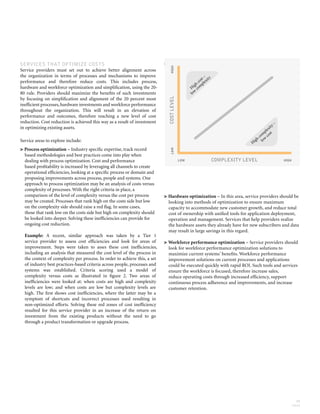
SERVICES THAT OPTIMIZE COSTS                                               COST / COMPLEXITY LEVEL                                                    FIGURE 2


                                                                               HIGH
Service providers must set out to achieve better alignment across
the organization in terms of processes and mechanisms to improve                                           –
                                                                                                         st ity
performance and therefore reduce costs. This includes process,                                         co ex
                                                                                                   ig h pl
hardware and workforce optimization and simplification, using the 20-                           H com
80 rule. Providers should maximize the benefits of such investments                             l ow


                                                                             COST LEVEL
by focusing on simplification and alignment of the 20 percent most
inefficient processes, hardware investments and workforce performance
throughout the organization. This will result in an elevation of
performance and outcomes, therefore reaching a new level of cost
reduction. Cost reduction is achieved this way as a result of investment                                                                          –
in optimizing existing assets.                                                                                                                ity
                                                                                                                                        p lex
                                                                                                                                      m st
                                                                                                                                    co w co
Service areas to explore include:                                                                                                igh lo
                                                                                                                                H
>	Process optimization – Industry specific expertise, track record


                                                                               LOW
  based methodologies and best practices come into play when
  dealing with process optimization. Cost and performance                                 LOW                     COMPLEXITY LEVEL                      HIGH

  based profitability is increased by leveraging all channels to create
  operational efficiencies, looking at a specific process or domain and
  proposing improvements across process, people and systems. One
  approach to process optimization may be an analysis of costs versus
  complexity of processes. With the right criteria in place, a
  comparison of the level of complexity versus the cost per process        >	Hardware optimization – In this area, service providers should be
  may be created. Processes that rank high on the costs side but low         looking into methods of optimization to ensure maximum
  on the complexity side should raise a red flag. In some cases,             capacity to accommodate new customer growth, and reduce total
  those that rank low on the costs side but high on complexity should        cost of ownership with unified tools for application deployment,
  be looked into deeper. Solving these inefficiencies can provide for        operation and management. Services that help providers realize
  ongoing cost reduction.                                                    the hardware assets they already have for new subscribers and data
                                                                             may result in large savings in this regard.
  Example: A recent, similar approach was taken by a Tier 1
  service provider to assess cost efficiencies and look for areas of       >	Workforce performance optimization – Service providers should
  improvement. Steps were taken to asses these cost inefficiencies,          look for workforce performance optimization solutions to
  including an analysis that measured the cost level of the process in       maximize current systems’ benefits. Workforce performance
  the context of complexity per process. In order to achieve this, a set     improvement solutions on current processes and applications
  of industry best practices-based criteria across people, processes and     could be executed quickly with rapid ROI. Such tools and services
  systems was established. Criteria scoring used a model of                  ensure the workforce is focused, therefore increase sales,
  complexity versus costs as illustrated in figure 2. Two areas of           reduce operating costs through increased efficiency, support
  inefficiencies were looked at: when costs are high and complexity          continuous process adherence and improvements, and increase
  levels are low; and when costs are low but complexity levels are           customer retention.
  high. The first shows cost inefficiencies, where the latter may be a
  symptom of shortcuts and incorrect processes used resulting in
  non-optimized efforts. Solving these red zones of cost inefficiency
  resulted for this service provider in an increase of the return on
  investment from the existing products without the need to go
  through a product transformation or upgrade process.


                                                                                                                                                                 05
                                                                                                                                                               PAGE
CONCLUSIONS AND RECOMMENDATIONS


The real challenge is not to succumb to simply reducing measurable
expenses in tough economic times but to be bold enough to invest in
areas that will realize value and ROI, and explore and capitalize on cost
optimization channels. Service providers should also carefully evaluate
the necessity of new product and product upgrade investments to avoid
lagging behind competitors once the financial downturn terminates.

As providers look into the opportunities of outcome-based services,
they should keep in mind the following:
>	Service providers should explore services that assist them in
  improving their business results by increasing the value of their
  existing assets and optimizing costs.
>	In order to maximize the business results of any investment in
  services and reduce the risk of failure, service providers should select
  vendors with deep and focused industry knowledge and a proven
  track record.
>	Vendors that can also support product-related activities with deep
  and specific product knowledge are the right choice for these types
  of projects as they can commit to lower risk and full accountability.
>	A well planned investment in services can significantly improve a
  service provider’s competitive positioning.


“CARRIERS NEED TO FOCUS ON BOTH SIMULTANEOUSLY GROWING VALUE WHILE
 OPTIMIZING COSTS.”


  (GARTNER, DATAQUEST INSIGHT: IMMEDIATE CARRIER COST SAVING STRATEGIES IN THE CURRENT
  ECONOMIC CLIMATE, MARCH, 2009)


                                                                                           06
                                                                                         PAGE
ABOUT	AMDOCS
Amdocs is the market leader in customer experience systems
innovation, enabling world-leading service providers to deliver an
integrated, innovative and intentional customer experience™ at every
point of service. Amdocs provides solutions that deliver customer
experience excellence, combining the software, services and expertise
to help its customers execute their strategies and achieve service,
operational and financial excellence.

A global company with revenue of $3.16 billion in fiscal 2008, Amdocs
serves customers in more than 50 countries around the world.

For more information, visit Amdocs at www.amdocs.com.


For the most up-to-date contact information for all Amdocs offices worldwide,
please visit our website at www.amdocs.com/corporate.asp

Amdocs has offices, development and support centers worldwide, including sites in:


THE	AM E R I C A S :                          A S I A	 P A C I F I C :                               EUROPE,	MIDDLE 	 EAST 	&	AFRICA:

BRAZIL                                        AUSTRALIA                                              CYPRUS                                                   IRELAND                                              SOUTH AFRICA


CANADA                                        CHINA                                                  CZECH REPUBLIC                                           ISRAEL                                               SPAIN


MEXICO                                        INDIA                                                  FRANCE                                                   ITALY                                                SWEDEN


UNITED STATES                                 JAPAN                                                  GERMANY                                                  NETHERLANDS                                          TURKEY


                                              THAILAND                                               HUNGARY                                                  POLAND                                               UNITED KINGDOM


                                                                                                                                                              RUSSIA


                   Copyright © Amdocs 2009. All Rights Reserved. Reproduction or distribution other than for intended purposes is prohibited, without the prior written consent of Amdocs. Amdocs reserves the right to revise this document and to make
                   changes in the content from time to time without notice. Amdocs may make improvements and/or changes to the product(s) and/or programs described in this document any time. The trademarks and service marks of Amdocs, including the
                   Amdocs mark and logo, Ensemble, Enabler, Clarify, Return on Relationship, Intelecable, Collabrent, Intentional Customer Experience, CES, Cramer, Qpass, SigValue, DST Innovis, JacobsRimell, and ChangingWorlds are the exclusive property
                   of Amdocs, and may not be used without permission. All other marks are the property of their respective owners. WP_INVSTNG_VALUBASD_SRVCS_0809

Amdocs Value Based Services Wp

  • 1.
    WHITE PAPER BRINGING OUTREAL VALUE INVESTING IN THE RIGHT OUTCOME-BASED SERVICES TO INCREASE VALUE OF EXISTING ASSETS AND OPTIMIZE COSTS
  • 2.
    CONTENTS EXECUTIVE SUMMARY 1 INTRODUCTION: THE CHALLENGE TO INCREASE VALUE FROM EXISTING ASSETS 2 REALIZING BENEFITS AND OPTIMIZING COST CHANNELS 3 SERVICES THAT REALIZE BENEFITS AND VALUE 3 SERVICES THAT OPTIMIZE COSTS 5 CONCLUSIONS AND RECOMMENDATIONS 6
  • 3.
    EXECUTIVE SUMMARY The economicdownturn has prompted service providers to look for measures of reducing costs – which is compounded by a competitive landscape that is getting tougher every day. Providers are now aiming to “do more with less” – improve the customer experience and explore new growth engines while constantly looking at ways to save. In many cases, direct cost reduction measures result in lowering the level of service that providers offer which in turn reduce loyalty and customer spending. Therefore, instead of directly cutting expenses, service providers should explore other investment approaches – that will result in higher value and return on investment (ROI). This white paper focuses on two types of services that should be explored. Those that: 1. Bring in value through better realization of benefits 2. Take measures to reduce costs through optimization channels Investing in such services, especially during these times, will allow service providers to better position themselves in the challenging competitive arena. 01 PAGE
  • 4.
    INTRODUCTION: THE CHALLENGETO INCREASE VALUE FROM EXISTING ASSETS For service providers, times couldn’t be more challenging. On one hand, economic pressures prompt them to massively reduce and reconsider large investments such as product transformations. On the other hand, the competitive arena couldn’t be tougher. More than ever, providers need to offer the best service to their customers – personalized, focused and efficient, with attractive pricing. They must keep up if they don’t want to lose the race. To achieve this, service providers must offer their customers a high scale of customer experience, position themselves for innovation and explore new growth engines. The major challenge is to accomplish all this without expanding costs, reducing revenue options or delaying programs. So how can service providers overcome this challenge? How can they bridge through these times of uncertainty? Is it just about reducing expenses or can providers pull out more value from their assets? “Do more with less” has become a common phrase. But what does it really mean? How do service providers get more from what they have? 02 PAGE
  • 5.
    REALIZING BENEFITS ANDOPTIMIZING COSTS The instinct to reduce expenses when trying to increase net income For the different stages, such services may include: is not always the right approach. Although cost cutting is inevitable, Requirements recognition and analysis in many cases, taking measures to directly reduce costs may result in service providers reducing their ability to provide their customers with > Value and ROI Analysis – The current economic climate the level of service they expect and, in turn, increase churn and reduce demands that service providers take a hard look at potential loyalty and customer spending. Instead of directly cutting expenses, investment projects and reject those that don’t deliver significant service providers need to explore the right form of investment. One that ROI – and fast! A structured, consultative and collaborative will result in higher value and return on investment (ROI) for them. process, supported by the right tools, can provide sound financial analysis to support budget applications and business case Recent surveys show that “74% of CFOs admitted that their companies development, as well as enable investment decisions. The impact often get their cost-cutting priorities wrong by cutting what is easy to of system and process change on key business drivers, including measure rather than what is most needed.” reduced operating costs, deferred network spend, lower TCO and Source: PricewaterhouseCoopers enhanced revenues must all be considered. Yet this type of analysis should not be seen as just a numbers exercise. The ROI analysis Service providers shouldn’t be tempted to take the easy route, even process helps to foster cross-departmental cooperation across if short term. They need to explore all avenues of investing in their business and IT functions. It helps to focus all parties on the existing business and operational support systems (B/OSS) solutions service provider’s business objectives and challenges, through cost optimization channels and additional value-based, high- demonstrating how solutions address those challenges, and so end services offered by vendors with the right level of industry, product deliver benefits which may be both qualitative and quantitative. and service expertise. Two types of services are key to the investments ROI analysis for a potential project also helps with decisions that will result in optimal monetization of existing assets: Those that regarding project phasing, ensuring that each phase delivers value bring value by realizing significant benefits, and those that reduce costs in its own right. through cost optimization methods. > A wider level of initial analysis is with Business Case SERVICES THAT REALIZE BENEFITS AND VALUE Development – Accurate data around the current operation With the need to continue to invest, yet with the call to truly realize together with insight to best practices and correct financial the value behind each investment, it’s crucial for service providers to modelling techniques bring the right services to bear to form invest in services that define and materialize each project’s business and deliver a robust business case, which reduces uncertainty case. An approach based on business outcomes serves as the strongest and risk when engaging in a new project. The right level of foundation for such services; and allowing for solid and short term ROI business case development is based on specialized operational will increase providers’ ability to commit to these projects. analytics. With increased scrutiny around expenditures and pressures on budget reductions, it’s key for service providers to Services that deliver a deep understanding of the desired business and have accurate data on how operations are performing. These project benefits help drive all project activities with this outcome in types of services, as the basis of the approach, use specific analysis mind. Services that accompany the different stages of the lifecycle (see techniques to marry anecdotal evidence around areas of figure 1 below), have a major impact on the right decision making and inefficiency with statistical confidence in the root cause. Yet, setting the implementation path to result in success. With the market analytical techniques on their own are not enough; they have to changing rapidly, services that measure and track results frequently, be combined with a true appreciation of the operational throughout the project decision and implementation lifecycle, ensure environment (the industry) and the underlying systems and that benefits constantly reflect a changing business environment, and organizational estate. A generic business case is not enough in allow for a lower level of risk for failure. this case. Providers need to use an analysis level that brings focus to improvement initiatives and increased rigor in assessing where to prioritize resources, as well as more confidence in FIGURE 1 Requirements achieving maximum benefit for investment. Recognition Analysis & Decision Support Project Initiation Project Implementation 03 PAGE
  • 6.
    Throughout project initiation,implementation and support phases HOT SPOT OF COST OPTIMIZATION Recently, a Tier 1 mobile service provider, invested in a cost > Benefits Realization Management – Delivering on the outcomes and process assessment to identify hotspot areas of cost of the business case doesn’t stop once activities get under way. inefficiencies. The project’s goal was to provide an improvement On the contrary, most challenges arise due to unexpected changes roadmap with defined benefits for prioritization. Objectives throughout the journey. Investing in a service where specialized of this assessment were to drive significant efficiency and dedicated resources are aimed at ensuring the entire program improvements in the reduction of operating expenses. ROI effort is directed at realizing the initial defined benefits will help improvements and reduction in time to market were also in keeping the project within the defined track. Imperative to this investigated at a wider level. success is adjusting the resources in parallel to the invariably changing business environment. Managing benefits realization To achieve these objectives, the provider devised a strategy also supports the situation where the overall risk and reward to focus on targeted areas of inefficiencies and define an from a project can be shared between all parties involved in improvement roadmap, as well as find areas of revenue delivering change. This type of situation is becoming more and protection opportunities. Reaching these goals would involve more common with the changes in investments. streamlining processes, reducing duplicated and manual activity that allows faults to be resolved quicker, limiting the amount of > Workforce Readiness – Tough economic times influence human revenue degradation and improving the customer experience. capital in various aspects. Dismissal often occurs, remaining employees are asked to do more, and thus need to be skilled The project is currently in progress and has identified estimated and prepared accordingly. Business transformation, mergers savings of over EU4.5 million (over US$6 million) per year going and acquisitions, and organizational changes often shake the forward based on the realization of process-driven efficiencies. whole organization. An enabled workforce ensures higher motivation and loyalty, has a significant effect on customer satisfaction and profitability, and makes a substantial impact on innovation and new product development – right people, right skills, right motivation. In search of cost reduction measures, service providers should look at services that promote and enable their human capital assets, thereby ensuring a better linkage between organizational strategy and business results. 0ִ 4 PAGE
  • 7.
    SERVICES THAT OPTIMIZECOSTS COST / COMPLEXITY LEVEL FIGURE 2 HIGH Service providers must set out to achieve better alignment across the organization in terms of processes and mechanisms to improve – st ity performance and therefore reduce costs. This includes process, co ex ig h pl hardware and workforce optimization and simplification, using the 20- H com 80 rule. Providers should maximize the benefits of such investments l ow COST LEVEL by focusing on simplification and alignment of the 20 percent most inefficient processes, hardware investments and workforce performance throughout the organization. This will result in an elevation of performance and outcomes, therefore reaching a new level of cost reduction. Cost reduction is achieved this way as a result of investment – in optimizing existing assets. ity p lex m st co w co Service areas to explore include: igh lo H > Process optimization – Industry specific expertise, track record LOW based methodologies and best practices come into play when dealing with process optimization. Cost and performance LOW COMPLEXITY LEVEL HIGH based profitability is increased by leveraging all channels to create operational efficiencies, looking at a specific process or domain and proposing improvements across process, people and systems. One approach to process optimization may be an analysis of costs versus complexity of processes. With the right criteria in place, a comparison of the level of complexity versus the cost per process > Hardware optimization – In this area, service providers should be may be created. Processes that rank high on the costs side but low looking into methods of optimization to ensure maximum on the complexity side should raise a red flag. In some cases, capacity to accommodate new customer growth, and reduce total those that rank low on the costs side but high on complexity should cost of ownership with unified tools for application deployment, be looked into deeper. Solving these inefficiencies can provide for operation and management. Services that help providers realize ongoing cost reduction. the hardware assets they already have for new subscribers and data may result in large savings in this regard. Example: A recent, similar approach was taken by a Tier 1 service provider to assess cost efficiencies and look for areas of > Workforce performance optimization – Service providers should improvement. Steps were taken to asses these cost inefficiencies, look for workforce performance optimization solutions to including an analysis that measured the cost level of the process in maximize current systems’ benefits. Workforce performance the context of complexity per process. In order to achieve this, a set improvement solutions on current processes and applications of industry best practices-based criteria across people, processes and could be executed quickly with rapid ROI. Such tools and services systems was established. Criteria scoring used a model of ensure the workforce is focused, therefore increase sales, complexity versus costs as illustrated in figure 2. Two areas of reduce operating costs through increased efficiency, support inefficiencies were looked at: when costs are high and complexity continuous process adherence and improvements, and increase levels are low; and when costs are low but complexity levels are customer retention. high. The first shows cost inefficiencies, where the latter may be a symptom of shortcuts and incorrect processes used resulting in non-optimized efforts. Solving these red zones of cost inefficiency resulted for this service provider in an increase of the return on investment from the existing products without the need to go through a product transformation or upgrade process. 05 PAGE
  • 8.
    CONCLUSIONS AND RECOMMENDATIONS Thereal challenge is not to succumb to simply reducing measurable expenses in tough economic times but to be bold enough to invest in areas that will realize value and ROI, and explore and capitalize on cost optimization channels. Service providers should also carefully evaluate the necessity of new product and product upgrade investments to avoid lagging behind competitors once the financial downturn terminates. As providers look into the opportunities of outcome-based services, they should keep in mind the following: > Service providers should explore services that assist them in improving their business results by increasing the value of their existing assets and optimizing costs. > In order to maximize the business results of any investment in services and reduce the risk of failure, service providers should select vendors with deep and focused industry knowledge and a proven track record. > Vendors that can also support product-related activities with deep and specific product knowledge are the right choice for these types of projects as they can commit to lower risk and full accountability. > A well planned investment in services can significantly improve a service provider’s competitive positioning. “CARRIERS NEED TO FOCUS ON BOTH SIMULTANEOUSLY GROWING VALUE WHILE OPTIMIZING COSTS.” (GARTNER, DATAQUEST INSIGHT: IMMEDIATE CARRIER COST SAVING STRATEGIES IN THE CURRENT ECONOMIC CLIMATE, MARCH, 2009) 06 PAGE
  • 9.
    ABOUT AMDOCS Amdocs is themarket leader in customer experience systems innovation, enabling world-leading service providers to deliver an integrated, innovative and intentional customer experience™ at every point of service. Amdocs provides solutions that deliver customer experience excellence, combining the software, services and expertise to help its customers execute their strategies and achieve service, operational and financial excellence. A global company with revenue of $3.16 billion in fiscal 2008, Amdocs serves customers in more than 50 countries around the world. For more information, visit Amdocs at www.amdocs.com. For the most up-to-date contact information for all Amdocs offices worldwide, please visit our website at www.amdocs.com/corporate.asp Amdocs has offices, development and support centers worldwide, including sites in: THE AM E R I C A S : A S I A P A C I F I C : EUROPE, MIDDLE EAST & AFRICA: BRAZIL AUSTRALIA CYPRUS IRELAND SOUTH AFRICA CANADA CHINA CZECH REPUBLIC ISRAEL SPAIN MEXICO INDIA FRANCE ITALY SWEDEN UNITED STATES JAPAN GERMANY NETHERLANDS TURKEY THAILAND HUNGARY POLAND UNITED KINGDOM RUSSIA Copyright © Amdocs 2009. All Rights Reserved. Reproduction or distribution other than for intended purposes is prohibited, without the prior written consent of Amdocs. Amdocs reserves the right to revise this document and to make changes in the content from time to time without notice. Amdocs may make improvements and/or changes to the product(s) and/or programs described in this document any time. The trademarks and service marks of Amdocs, including the Amdocs mark and logo, Ensemble, Enabler, Clarify, Return on Relationship, Intelecable, Collabrent, Intentional Customer Experience, CES, Cramer, Qpass, SigValue, DST Innovis, JacobsRimell, and ChangingWorlds are the exclusive property of Amdocs, and may not be used without permission. All other marks are the property of their respective owners. WP_INVSTNG_VALUBASD_SRVCS_0809