1
Business Process
Improvement
A strategy for
productivity and
competitiveness
Business Process
Improvement
2
Objectives
3
Objectives
4
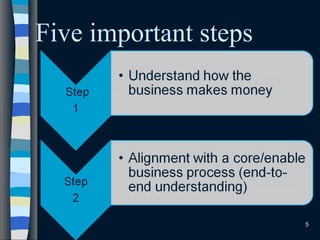
Five important steps
5
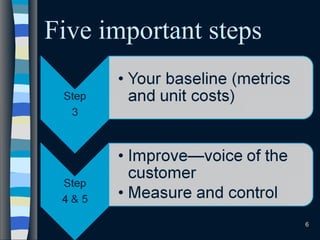
Five important steps
6
7
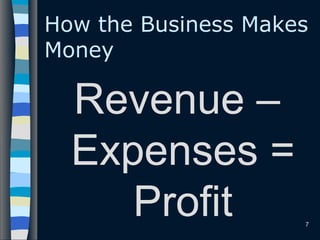
How the Business Makes
Money
Revenue –
Expenses =
Profit
8
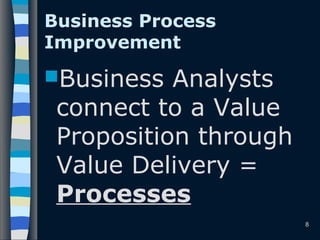
Business Process
Improvement
Business Analysts
connect to a Value
Proposition through
Value Delivery =
Processes
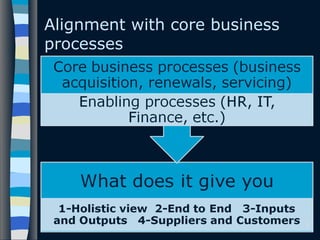
Alignment with core business
processes
9
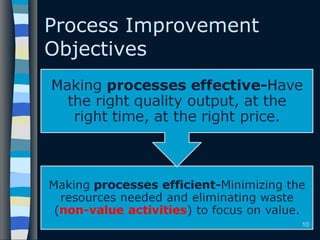
Process Improvement
Objectives
10
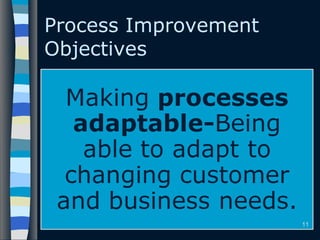
Process Improvement
Objectives
11
12
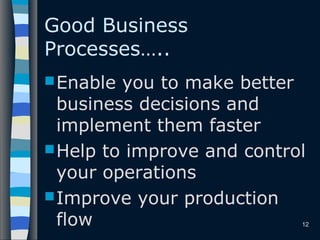
Good Business
Processes…..
Enable you to make better
business decisions and
implement them faster
Help to improve and control
your operations
Improve your production
flow
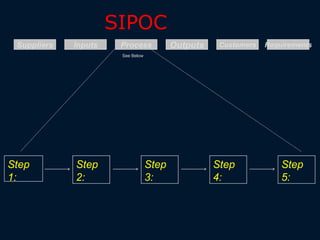
Suppliers Inputs Process Customers Requirements
Step
1:
Outputs
Step
2:
Step
3:
Step
4:
See Below
Step
5:
SIPOC
14
15
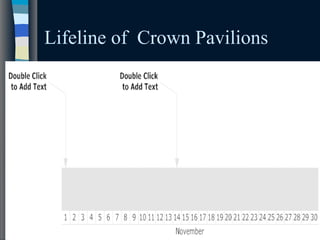
Lifeline of Crown Pavilions
16
17
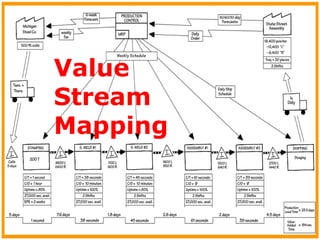
Value
Stream
Mapping
18
19
20
21
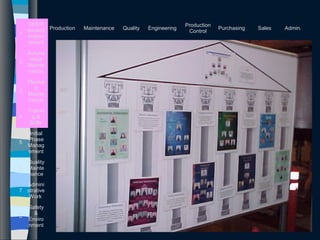
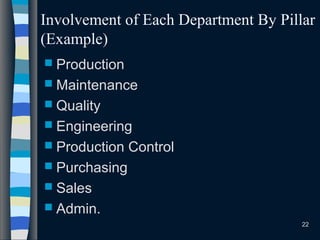
Production Maintenance Quality Engineering
Production
Control
Purchasing Sales Admin.
1
OEE/F
ocused
Improv
ement
2
Autono
mous
Mainte
nance
3
Planne
d
Mainte
nance
4
Trainin
g &
Skills
5
Initial
Phase
Manag
ement
6
Quality
Mainte
nance
7
Admini
strative
Work
8
Safety
&
Enviro
nment
 Production
 Maintenance
 Quality
 Engineering
 Production Control
 Purchasing
 Sales
 Admin.
22
Involvement of Each Department By Pillar
(Example)
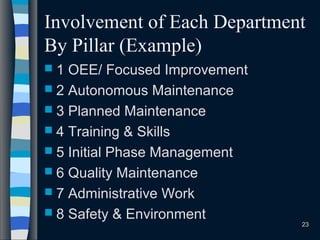
Involvement of Each Department
By Pillar (Example)
 1 OEE/ Focused Improvement
 2 Autonomous Maintenance
 3 Planned Maintenance
 4 Training & Skills
 5 Initial Phase Management
 6 Quality Maintenance
 7 Administrative Work
 8 Safety & Environment
23
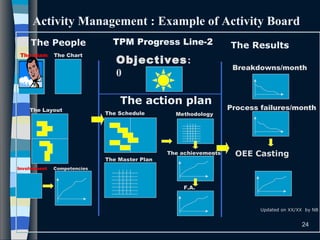
Activity Management : Example of Activity Board
24
Objectives:
0
TPM Progress Line-2The People
The action plan
The Results
OEE Casting
Updated on XX/XX by NB
Breakdowns/month
Process failures/month
The Schedule
The achievements
The Master Plan
Methodology
F.A.
The team The Chart
The Layout
Involvement Competencies
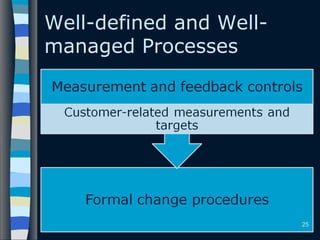
Well-defined and Well-
managed Processes
25
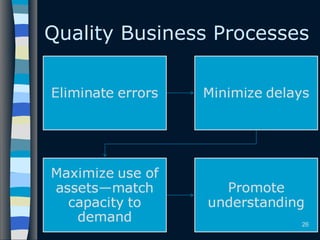
Quality Business Processes
26
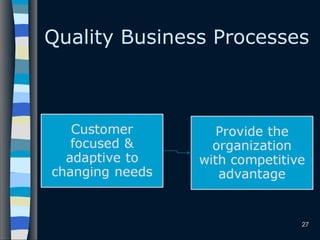
Quality Business Processes
27
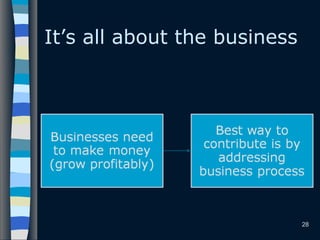
It’s all about the business
28
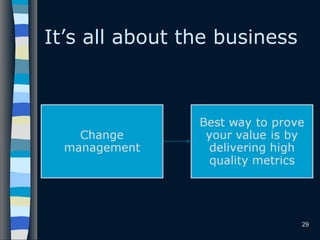
It’s all about the business
29
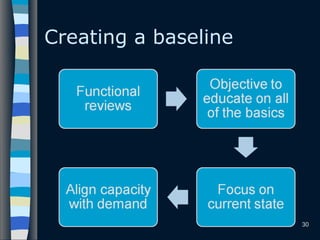
Creating a baseline
30
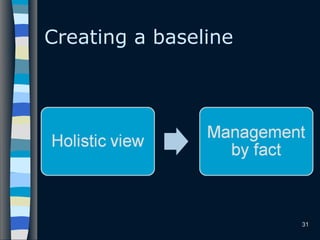
Creating a baseline
31
32
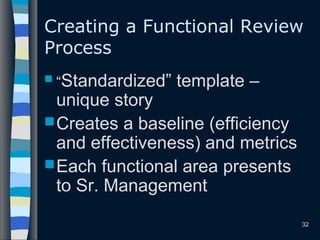
Creating a Functional Review
Process
 “Standardized” template –
unique story
Creates a baseline (efficiency
and effectiveness) and metrics
Each functional area presents
to Sr. Management
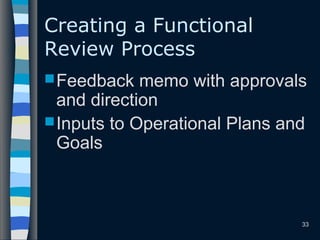
Creating a Functional
Review Process
Feedback memo with approvals
and direction
Inputs to Operational Plans and
Goals
33
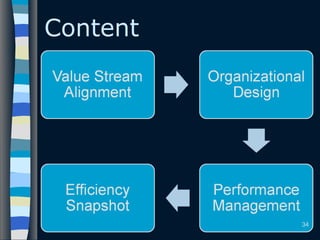
Content
34
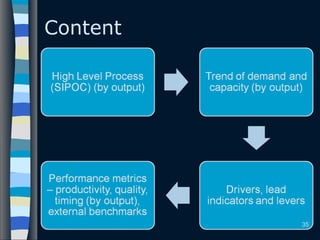
Content
35
Content
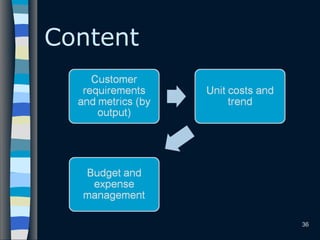
36
Content
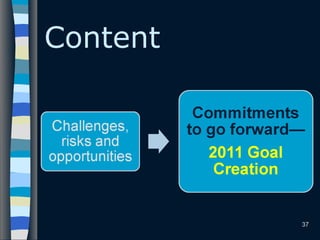
37
38
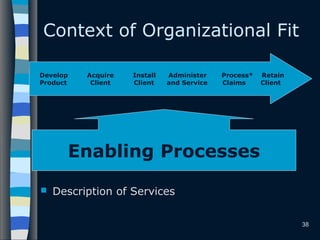
Context of Organizational Fit
 Description of Services
Develop Acquire Install Administer Process* Retain
Product Client Client and Service Claims Client
Enabling Processes
39
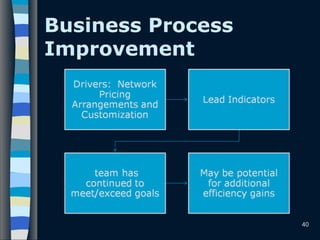
Business Process
Improvement
40
Business Process
Improvement
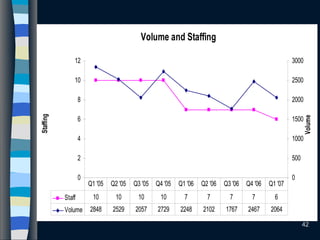
2010 - a capacity review
of this team will begin –
metrics, skill set,
tracking of time &
volumes – to right size
team
41
42
Volume and Staffing
0
2
4
6
8
10
12
Staffing
0
500
1000
1500
2000
2500
3000
Volume
Staff 10 10 10 10 7 7 7 7 6
Volume 2848 2529 2057 2729 2248 2102 1767 2467 2064
Q1 '05 Q2 '05 Q3 '05 Q4 '05 Q1 '06 Q2 '06 Q3 '06 Q4 '06 Q1 '07
43
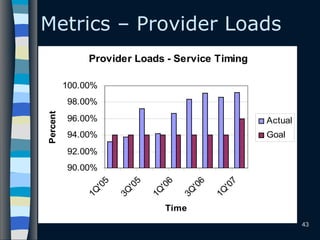
Metrics – Provider Loads
Provider Loads - Service Timing
90.00%
92.00%
94.00%
96.00%
98.00%
100.00%1Q
'05
3Q
'05
1Q
'06
3Q
'06
1Q
'07
Time
Percent
Actual
Goal
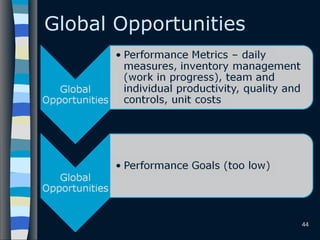
Global Opportunities
44
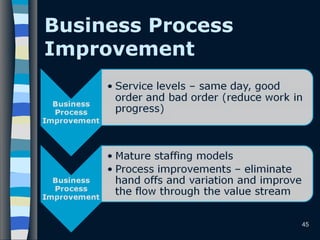
Business Process
Improvement
45
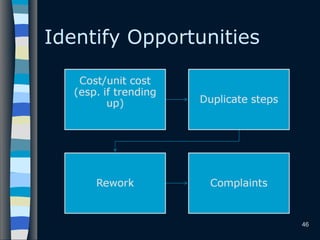
Identify Opportunities
46
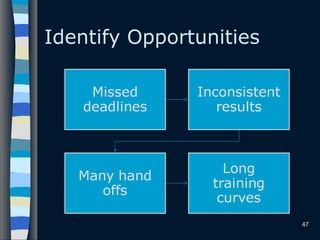
Identify Opportunities
47
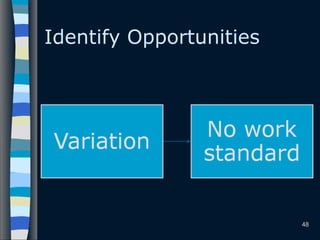
Identify Opportunities
48
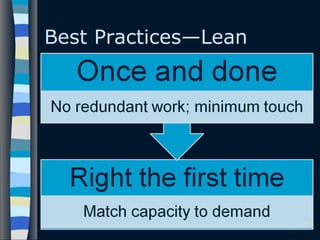
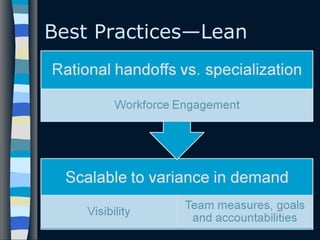
Best Practices—Lean
49
Best Practices—Lean
50
51
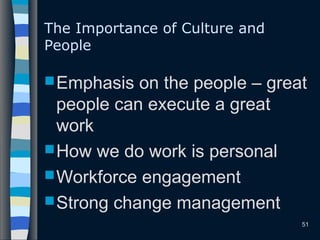
The Importance of Culture and
People
Emphasis on the people – great
people can execute a great
work
How we do work is personal
Workforce engagement
Strong change management
52
Sustainable Operational
Excellence Culture
It’s all about the people
soft V hard stuff
Top down and bottom up
Quick wins
53
Sustainable Operational
Excellence—Culture Shift
 “Learning to see”
– New thinking
– New skills
– New tools, sources of knowledge
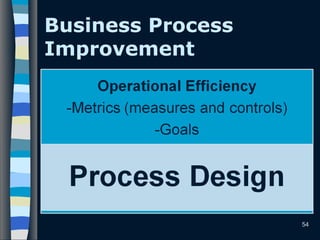
Business Process
Improvement
54
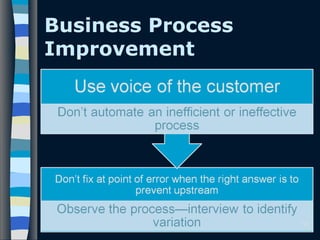
Business Process
Improvement
55
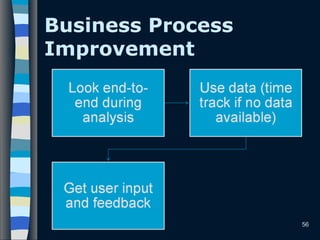
Business Process
Improvement
56
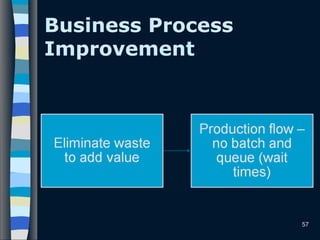
Business Process
Improvement
57
58
Resources
 www.bptrends.com
 “Lean Enterprise Value,” Murman et. Al
 “Business Process Change,” Paul
Harmon
 “Business Process Management,
Profiting from Process,” Roger T.
Burlton
 http://lean.mit.edu

001 a strategy for productivity

Editor's Notes

  • #14 SIPOC stands for suppliers, inputs, process, output, and customers. You obtain inputs from suppliers, add value through your process, and provide an output that meets or exceeds your customer's requirements.Supplier-Input-Process-Output-Customer: Method that helps you not to forget something when mapping processes.
  • #18 1-corner braces 2-post 3-hand rail 4-uper rail 4- 5-
  • #21 Materials Available-No Design Foundation Order Item 01-Curtains Order Item 02-Curtains Order Item 03-Roof tile Item 04-cushions Item 06-Pillows Task-shop floor Task-shop floor Task Task Task Installation Task Task
  • #36 SIPOC stands for suppliers, inputs, process, output, and customers. You obtain inputs from suppliers, add value through your process, and provide an output that meets or exceeds your customer's requirements.
  • #39 Fit into enterprise value streams (also know as core business processes).
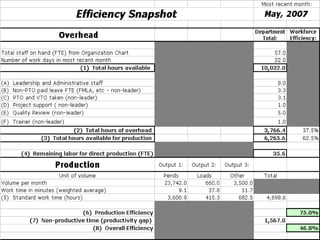
  • #40 Every story is unique. Business rational for decisions. Staffing models don’t count—bottom up numbers. Time studies. Discussion points for the example: Overall mgmt to producer ratio 1:6; Quality review to producer 1:7; Productivity gap = 9.7 FTE Total hours available in most recent month = Total staff x Work days x 8 hrs/day Total hours of overhead = (A+B+C+D+E+F) x Work days x 8 hrs/day Total hours available for production = Total hours available – Total hours of overhead Remaining labor for direct production (FTE) = Total staff – (A+B+C+D+E+F) Standard work time (hours) = (Volume per month x Work time in minutes) / 60 Production Efficiency = Total standard work time / Total hours available for production Non-productive time (productivity gap) = Total hours available for production – Total standard work time Overall Efficiency = Total standard work time / Total hours available
  • #47 1-variation 2-Waste