
Chapter 26
WORKING CAPITAL
MANAGEMENT
© Centre for Financial Management , Bangalore
OUTLINE
• Characteristics of Current Assets
• Factors Influencing Working Capital Requirements
• Level of Current Assets
• Current Assets Financing Policy
• Profit Criterion for Current Assets
• Operating Cycle Analysis
• Cash Requirement for Working Capital
© Centre for Financial Management , Bangalore
CHARACTERISTICS OF CURRENT ASSETS
• Short life span
• Swift transformation into other asset forms
Current Assets Cycle
Accounts
receivable
Finished
goods
Wages, salaries,
factory overheads
Work-in-
process
Raw materials
Cash Suppliers
© Centre for Financial Management , Bangalore
FACTORS INFLUENCING WORKING
CAPITAL REQUIREMENTS
• Nature of Business
• Seasonality of Operations
• Production Policy
• Market Conditions
• Conditions of Supply
© Centre for Financial Management , Bangalore
WORKING CAPITAL POLICY
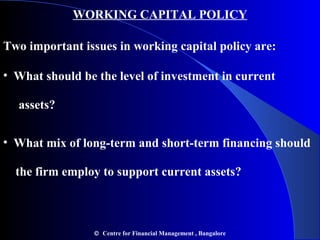
Two important issues in working capital policy are:
• What should be the level of investment in current
assets?
• What mix of long-term and short-term financing should
the firm employ to support current assets?
© Centre for Financial Management , Bangalore
LEVEL OF CURRENT ASSETS
Flexible Restrictive
(Conservative) (Aggressive)
Policy Policy
Liquidity High Low
Inventories Large Small
Debtors High Low
A flexible policy results in fewer production stoppages, ensures
quicker deliveries to customers, and stimulates sales .. but
HIGHER INVESTMENT IN CURRENT ASSETS
A restrictive policy leads to more production stoppages, delayed
deliveries to customers, and lost sales … but
LOWER INVESTMENT IN CURRENT ASSETS
© Centre for Financial Management , Bangalore
CAPITAL REQUIREMENTS
AND THEIR FINANCING
Capital
requirements
Fluctuating current
asset requirement
Permanent current
asset-requirement
Fixed asset
requirement
Time
A
B
C
© Centre for Financial Management , Bangalore
CURRENT ASSETS FINANCING
POLICY
According to the matching principle, fixed assets and
permanent current assets should be supported by long-
term sources of finance whereas fluctuating current assets
must be supported by short-term sources of finance.
© Centre for Financial Management , Bangalore
PROFIT CRITERION FOR
WORKING CAPITAL
• Investment in current assets is easily reversible.
• For reversible investments, the criterion of net profit per
period (which here means residual income) is equivalent
to the criterion of net present value
© Centre for Financial Management , Bangalore
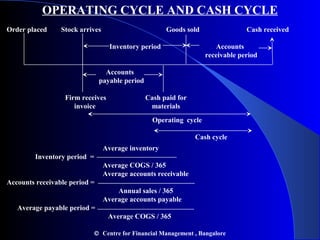
OPERATING CYCLE AND CASH CYCLE
Order placed Stock arrives Goods sold Cash received
Inventory period Accounts
receivable period
Accounts
payable period
Firm receives Cash paid for
invoice materials
Operating cycle
Cash cycle
Average inventory
Inventory period =
Average COGS / 365
Average accounts receivable
Accounts receivable period =
Annual sales / 365
Average accounts payable
Average payable period =
Average COGS / 365
© Centre for Financial Management , Bangalore
ILLUSTRATION
Financial Information for Horizon Limited
Balance Sheet Data
Profit and Loss Beginning of End of
Account Data 20X0 20X0
Sales 800 Inventory 96 102
Cost of goods 720 Accounts receivable 86 90
Sold Accounts payable 56 60
(96 + 102) / 2
Inventory period = = 50.1 days
720 / 365
© Centre for Financial Management , Bangalore
(86 + 90) / 2
Accounts receivable period = = 40.2 days
800 / 365
(56 + 60) / 2
Accounts payable period = = 29.4 days
720 / 365
Operating cycle = 50.1 + 40.2 = 90.3 days
Inventory Accounts
period receivable
period
Cash cycle = 90.3 - 29.4 = 60.9 days
Operating Accounts
cycle payable period
© Centre for Financial Management , Bangalore
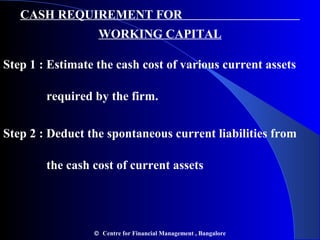
CASH REQUIREMENT FOR
WORKING CAPITAL
Step 1 : Estimate the cash cost of various current assets
required by the firm.
Step 2 : Deduct the spontaneous current liabilities from
the cash cost of current assets
© Centre for Financial Management , Bangalore
SUMMING UP
• Current assets have a short life span and are swiftly
transformed into other asset forms.
• The working capital needs of a firm are influenced by
numerous factors : nature of business, seasonality of
operations, production policy, market conditions, and
supply conditions.
• Determining the optimal level of current assets involves
a tradeoff between carrying costs and shortage costs.
• According to the matching principle, the maturity of the
sources of finance should match the maturity of assets
being financed.
© Centre for Financial Management , Bangalore
• The operating cycle of a firm begins with the acquisition
of raw materials and ends with the collection of
receivables.
• The cash requirement of working capital is calculated by
estimating the cash cost of various current assets
required by the firm and deducting the spontaneous
current liabilities from the cash cost of current assets.
© Centre for Financial Management , Bangalore

Chapter26 working capital_management

  • 1.
    Chapter 26 WORKING CAPITAL MANAGEMENT ©Centre for Financial Management , Bangalore
  • 2.
    OUTLINE • Characteristics ofCurrent Assets • Factors Influencing Working Capital Requirements • Level of Current Assets • Current Assets Financing Policy • Profit Criterion for Current Assets • Operating Cycle Analysis • Cash Requirement for Working Capital © Centre for Financial Management , Bangalore
  • 3.
    CHARACTERISTICS OF CURRENTASSETS • Short life span • Swift transformation into other asset forms Current Assets Cycle Accounts receivable Finished goods Wages, salaries, factory overheads Work-in- process Raw materials Cash Suppliers © Centre for Financial Management , Bangalore
  • 4.
    FACTORS INFLUENCING WORKING CAPITALREQUIREMENTS • Nature of Business • Seasonality of Operations • Production Policy • Market Conditions • Conditions of Supply © Centre for Financial Management , Bangalore
  • 5.
    WORKING CAPITAL POLICY Twoimportant issues in working capital policy are: • What should be the level of investment in current assets? • What mix of long-term and short-term financing should the firm employ to support current assets? © Centre for Financial Management , Bangalore
  • 6.
    LEVEL OF CURRENTASSETS Flexible Restrictive (Conservative) (Aggressive) Policy Policy Liquidity High Low Inventories Large Small Debtors High Low A flexible policy results in fewer production stoppages, ensures quicker deliveries to customers, and stimulates sales .. but HIGHER INVESTMENT IN CURRENT ASSETS A restrictive policy leads to more production stoppages, delayed deliveries to customers, and lost sales … but LOWER INVESTMENT IN CURRENT ASSETS © Centre for Financial Management , Bangalore
  • 7.
    CAPITAL REQUIREMENTS AND THEIRFINANCING Capital requirements Fluctuating current asset requirement Permanent current asset-requirement Fixed asset requirement Time A B C © Centre for Financial Management , Bangalore
  • 8.
    CURRENT ASSETS FINANCING POLICY Accordingto the matching principle, fixed assets and permanent current assets should be supported by long- term sources of finance whereas fluctuating current assets must be supported by short-term sources of finance. © Centre for Financial Management , Bangalore
  • 9.
    PROFIT CRITERION FOR WORKINGCAPITAL • Investment in current assets is easily reversible. • For reversible investments, the criterion of net profit per period (which here means residual income) is equivalent to the criterion of net present value © Centre for Financial Management , Bangalore
  • 10.
    OPERATING CYCLE ANDCASH CYCLE Order placed Stock arrives Goods sold Cash received Inventory period Accounts receivable period Accounts payable period Firm receives Cash paid for invoice materials Operating cycle Cash cycle Average inventory Inventory period = Average COGS / 365 Average accounts receivable Accounts receivable period = Annual sales / 365 Average accounts payable Average payable period = Average COGS / 365 © Centre for Financial Management , Bangalore
  • 11.
    ILLUSTRATION Financial Information forHorizon Limited Balance Sheet Data Profit and Loss Beginning of End of Account Data 20X0 20X0 Sales 800 Inventory 96 102 Cost of goods 720 Accounts receivable 86 90 Sold Accounts payable 56 60 (96 + 102) / 2 Inventory period = = 50.1 days 720 / 365 © Centre for Financial Management , Bangalore
  • 12.
    (86 + 90)/ 2 Accounts receivable period = = 40.2 days 800 / 365 (56 + 60) / 2 Accounts payable period = = 29.4 days 720 / 365 Operating cycle = 50.1 + 40.2 = 90.3 days Inventory Accounts period receivable period Cash cycle = 90.3 - 29.4 = 60.9 days Operating Accounts cycle payable period © Centre for Financial Management , Bangalore
  • 13.
    CASH REQUIREMENT FOR WORKINGCAPITAL Step 1 : Estimate the cash cost of various current assets required by the firm. Step 2 : Deduct the spontaneous current liabilities from the cash cost of current assets © Centre for Financial Management , Bangalore
  • 14.
    SUMMING UP • Currentassets have a short life span and are swiftly transformed into other asset forms. • The working capital needs of a firm are influenced by numerous factors : nature of business, seasonality of operations, production policy, market conditions, and supply conditions. • Determining the optimal level of current assets involves a tradeoff between carrying costs and shortage costs. • According to the matching principle, the maturity of the sources of finance should match the maturity of assets being financed. © Centre for Financial Management , Bangalore
  • 15.
    • The operatingcycle of a firm begins with the acquisition of raw materials and ends with the collection of receivables. • The cash requirement of working capital is calculated by estimating the cash cost of various current assets required by the firm and deducting the spontaneous current liabilities from the cash cost of current assets. © Centre for Financial Management , Bangalore