Costs in the short run
Learning outcomes
Understand the
economist’s
concepts of the
short and long
run
Understand the law of
diminishing returns
Explain what is
meant by fixed
and variable
costs
Time periods
The long run
that period of time when firms are
able to vary all their factor inputs
The short run
that period of time when firms face the
problem that some of their factor inputs
cannot be changed (fixed)
Types of short run costs
Transport examples include:
Cost of leasing aircraft, maintenance of
track (Network Rail), vehicle insurance,
depreciation and maintenance (bus &
train operators, haulage firms)
Fixed costs
Costs which are independent of the
level of output produced
Types of short run costs
Transport examples include:
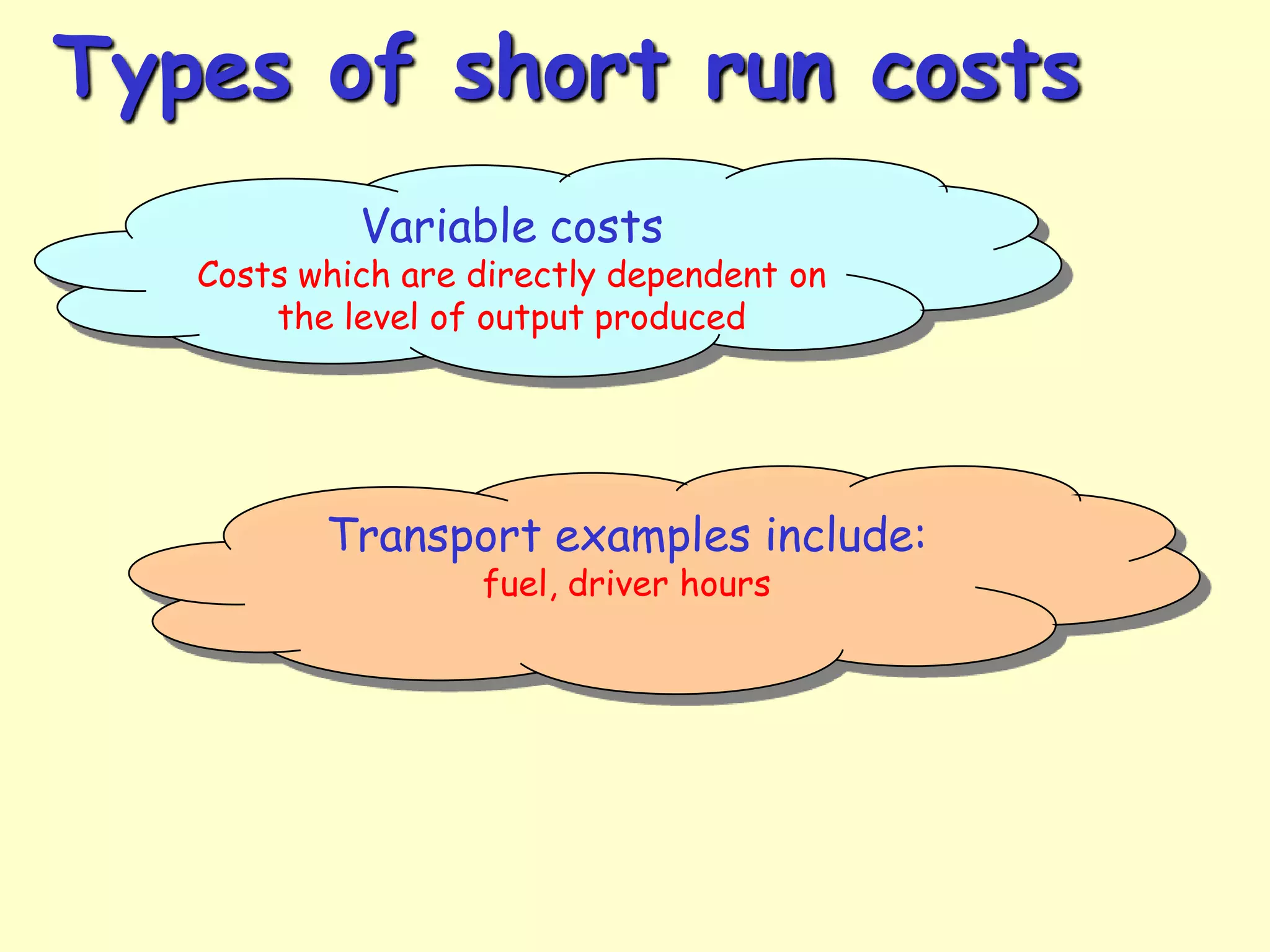
fuel, driver hours
Variable costs
Costs which are directly dependent on
the level of output produced
Law of diminishing returns
The more of a variable input that
is added to a fixed input,
eventually the smaller will be the
additional output produced
‘too many cooks spoil the broth’
This causes the ‘marginal product’ to
decline followed by the ‘average product’
 Note that before diminishing returns sets in,
a firm will experience increasing returns
Task 1: physical product
 Calculate the total, marginal and average
product from the information given on the
task sheet
 Draw graphs of these relationships on your
task sheet
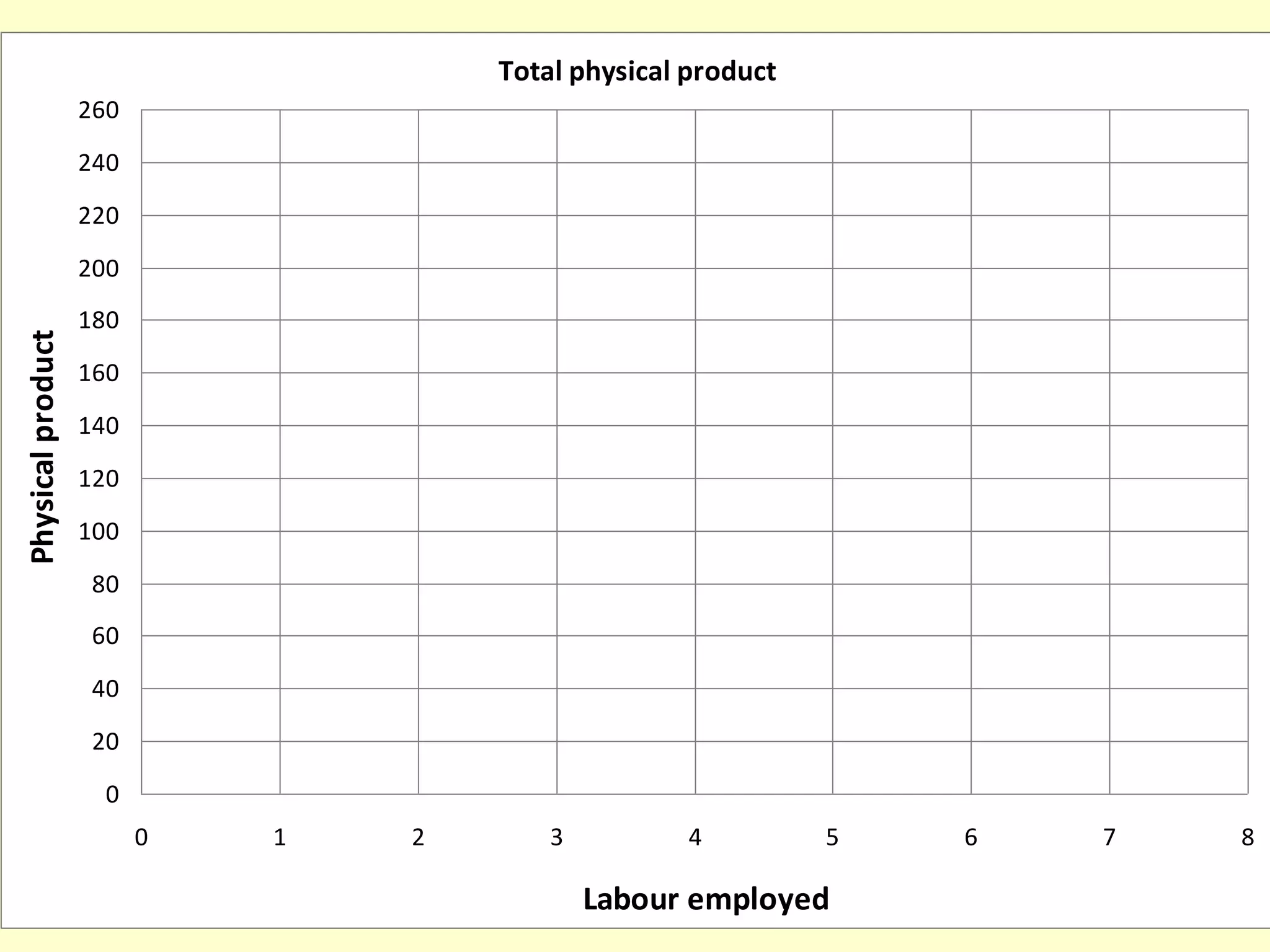
Total physical product
0
20
40
60
80
100
120
140
160
180
200
220
240
260
0 1 2 3 4 5 6 7 8
Labour employed
Physicalproduct
Average and marginal physical product
-25
-20
-15
-10
-5
0
5
10
15
20
25
30
35
40
45
50
55
0 1 2 3 4 5 6 7 8
Labour employed
Physicalproduct
Task 2: costs
 The variable and total costs of a firm will be
affected by increasing and diminishing
returns
 Calculate the total cost, average variable,
average fixed, average total and marginal
cost on the task sheet
 Important formula:
TC = TFC + TVC
ATC = TC / Q
AVC = TVC / Q
AFC = TFC / Q
MC = TC / Q
Fixed, variable and average costs
0
200
400
600
800
1000
1200
1400
1600
1800
2000
2200
2400
0 1 2 3 4 5
Output
Cost(£)
Average fixed costs
0
20
40
60
80
100
120
140
160
180
200
220
0 1 2 3 4 5
Output
Cost(£)
Average variable, average total and marginal costs
0
50
100
150
200
250
300
350
400
450
500
550
600
0 1 2 3 4 5
Output
Cost(£)

Costs in the short run

  • 1.
    Costs in theshort run
  • 2.
    Learning outcomes Understand the economist’s conceptsof the short and long run Understand the law of diminishing returns Explain what is meant by fixed and variable costs
  • 3.
    Time periods The longrun that period of time when firms are able to vary all their factor inputs The short run that period of time when firms face the problem that some of their factor inputs cannot be changed (fixed)
  • 4.
    Types of shortrun costs Transport examples include: Cost of leasing aircraft, maintenance of track (Network Rail), vehicle insurance, depreciation and maintenance (bus & train operators, haulage firms) Fixed costs Costs which are independent of the level of output produced
  • 5.
    Types of shortrun costs Transport examples include: fuel, driver hours Variable costs Costs which are directly dependent on the level of output produced
  • 6.
    Law of diminishingreturns The more of a variable input that is added to a fixed input, eventually the smaller will be the additional output produced ‘too many cooks spoil the broth’ This causes the ‘marginal product’ to decline followed by the ‘average product’  Note that before diminishing returns sets in, a firm will experience increasing returns
  • 7.
    Task 1: physicalproduct  Calculate the total, marginal and average product from the information given on the task sheet  Draw graphs of these relationships on your task sheet
  • 8.
  • 9.
    Average and marginalphysical product -25 -20 -15 -10 -5 0 5 10 15 20 25 30 35 40 45 50 55 0 1 2 3 4 5 6 7 8 Labour employed Physicalproduct
  • 10.
    Task 2: costs The variable and total costs of a firm will be affected by increasing and diminishing returns  Calculate the total cost, average variable, average fixed, average total and marginal cost on the task sheet  Important formula: TC = TFC + TVC ATC = TC / Q AVC = TVC / Q AFC = TFC / Q MC = TC / Q
  • 11.
    Fixed, variable andaverage costs 0 200 400 600 800 1000 1200 1400 1600 1800 2000 2200 2400 0 1 2 3 4 5 Output Cost(£)
  • 12.
  • 13.
    Average variable, averagetotal and marginal costs 0 50 100 150 200 250 300 350 400 450 500 550 600 0 1 2 3 4 5 Output Cost(£)