Managerial Accounting for IE
Cost Estimation
Association with Cost Object
• Direct
• Indirect
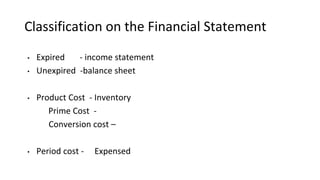
Classification on the Financial Statement
• Expired - income statement
• Unexpired -balance sheet
• Product Cost - Inventory
Prime Cost -
Conversion cost –
• Period cost - Expensed
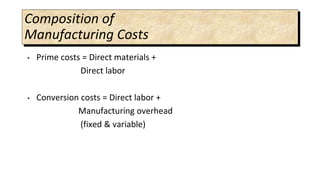
• Prime costs = Direct materials +
Direct labor
• Conversion costs = Direct labor +
Manufacturing overhead
(fixed & variable)
Composition of
Manufacturing Costs
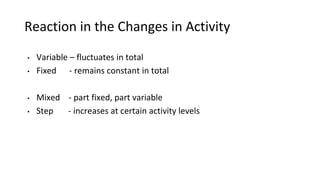
Reaction in the Changes in Activity
• Variable – fluctuates in total
• Fixed - remains constant in total
• Mixed - part fixed, part variable
• Step - increases at certain activity levels
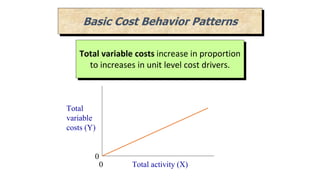
Total variable costs increase in proportion
to increases in unit level cost drivers.
Total
variable
costs (Y)
Total activity (X)
0
0
Basic Cost Behavior Patterns
Cost Concepts - 7
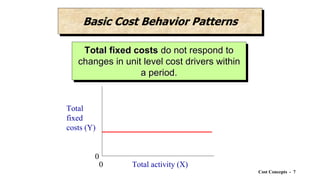
Total fixed costs do not respond to
changes in unit level cost drivers within
a period.
Total
fixed
costs (Y)
Total activity (X)
0
0
Basic Cost Behavior Patterns
Cost Concepts - 8
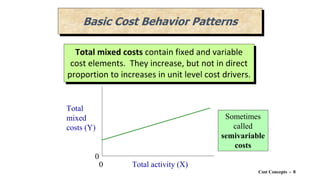
Total mixed costs contain fixed and variable
cost elements. They increase, but not in direct
proportion to increases in unit level cost drivers.
Total
mixed
costs (Y)
Total activity (X)
0
0
Sometimes
called
semivariable
costs
Basic Cost Behavior Patterns
Cost Concepts - 9
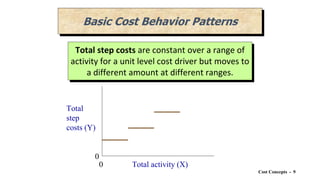
Total step costs are constant over a range of
activity for a unit level cost driver but moves to
a different amount at different ranges.
Total
step
costs (Y)
Total activity (X)
0
0
Basic Cost Behavior Patterns
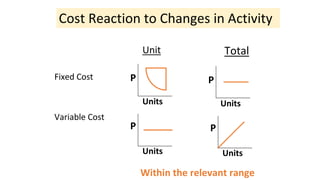
Fixed Cost
Variable Cost
Cost Reaction to Changes in Activity
Unit Total
P
Units
P
P
P
Units
Units Units
Within the relevant range
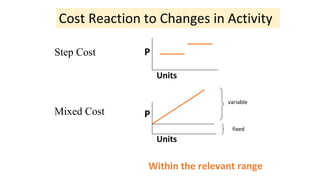
Step Cost
Mixed Cost
Cost Reaction to Changes in Activity
P
P
Units
Units
fixed
Within the relevant range
variable
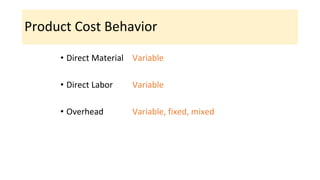
Product Cost Behavior
• Direct Material Variable
• Direct Labor Variable
• Overhead Variable, fixed, mixed
Cost Concepts - 13
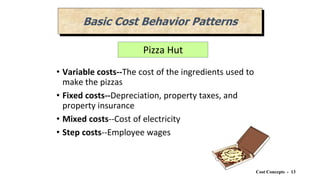
• Variable costs--The cost of the ingredients used to
make the pizzas
• Fixed costs--Depreciation, property taxes, and
property insurance
• Mixed costs--Cost of electricity
• Step costs--Employee wages
Basic Cost Behavior Patterns
Pizza Hut
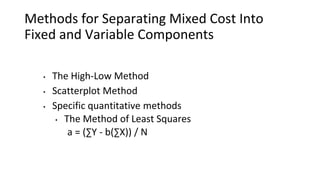
Methods for Separating Mixed Cost Into
Fixed and Variable Components
• The High-Low Method
• Scatterplot Method
• Specific quantitative methods
• The Method of Least Squares
a = (∑Y - b(∑X)) / N
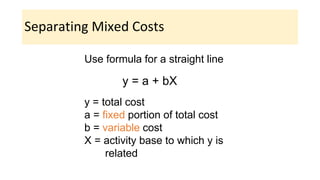
Separating Mixed Costs
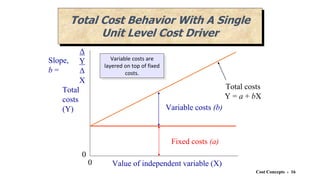
y = a + bX
y = total cost
a = fixed portion of total cost
b = variable cost
X = activity base to which y is
related
Use formula for a straight line
Cost Concepts - 16
Total
costs
(Y)
Value of independent variable (X)
0
0
Fixed costs (a)
Variable costs (b)
Total costs
Y = a + bX
Variable costs are
layered on top of fixed
costs.
Slope,
b =
Δ
Y
Δ
X
Total Cost Behavior With A Single
Unit Level Cost Driver
Separating Mixed Costs
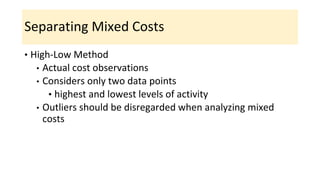
• High-Low Method
• Actual cost observations
• Considers only two data points
• highest and lowest levels of activity
• Outliers should be disregarded when analyzing mixed
costs
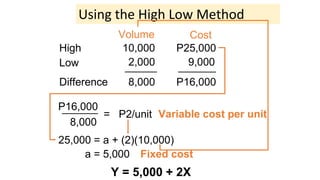
Cost
Volume
High
Low
10,000
2,000
P25,000
9,000
Difference 8,000 P16,000
= P2/unit Variable cost per unit
P16,000
8,000
25,000 = a + (2)(10,000)
a = 5,000 Fixed cost
Y = 5,000 + 2X
Using the High Low Method
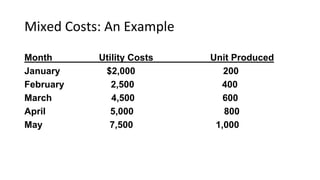
Month Utility Costs Unit Produced
January $2,000 200
February 2,500 400
March 4,500 600
April 5,000 800
May 7,500 1,000
Mixed Costs: An Example
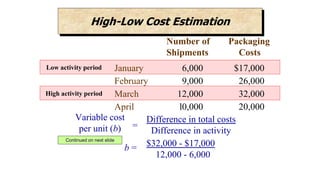
High activity period
Low activity period
Number of Packaging
Shipments Costs
January 6,000 $17,000
February 9,000 26,000
March 12,000 32,000
April l0,000 20,000
Variable cost
per unit (b) =
Difference in total costs
Difference in activity
b = $32,000 - $17,000
12,000 - 6,000
Continued on next slide
High-Low Cost Estimation
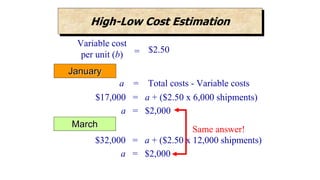
Variable cost
per unit (b) = $2.50
January
a = Total costs - Variable costs
$17,000 = a + ($2.50 x 6,000 shipments)
a = $2,000
March
$32,000 = a + ($2.50 x 12,000 shipments)
a = $2,000
Same answer!
High-Low Cost Estimation
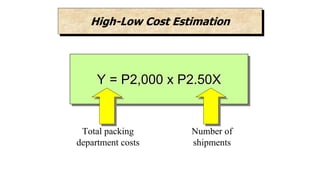
Y = P2,000 x P2.50X
Total packing
department costs
Number of
shipments
High-Low Cost Estimation
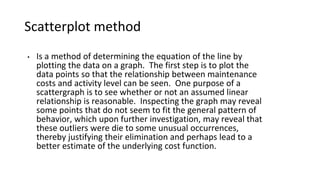
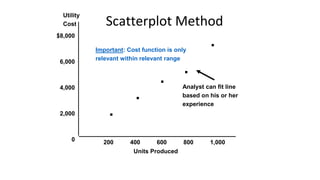
Scatterplot method
• Is a method of determining the equation of the line by
plotting the data on a graph. The first step is to plot the
data points so that the relationship between maintenance
costs and activity level can be seen. One purpose of a
scattergraph is to see whether or not an assumed linear
relationship is reasonable. Inspecting the graph may reveal
some points that do not seem to fit the general pattern of
behavior, which upon further investigation, may reveal that
these outliers were die to some unusual occurrences,
thereby justifying their elimination and perhaps lead to a
better estimate of the underlying cost function.
Units Produced
Utility
Cost
$8,000
6,000
4,000
2,000
0 200 400 600 800 1,000
.
Scatterplot Method
.
.
.
.
Analyst can fit line
based on his or her
experience
Important: Cost function is only
relevant within relevant range
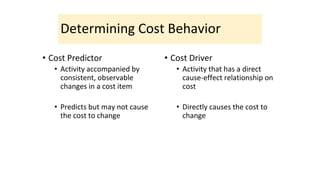
Determining Cost Behavior
• Cost Predictor
• Activity accompanied by
consistent, observable
changes in a cost item
• Predicts but may not cause
the cost to change
• Cost Driver
• Activity that has a direct
cause-effect relationship on
cost
• Directly causes the cost to
change
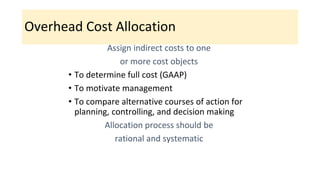
Overhead Cost Allocation
Assign indirect costs to one
or more cost objects
• To determine full cost (GAAP)
• To motivate management
• To compare alternative courses of action for
planning, controlling, and decision making
Allocation process should be
rational and systematic

Managerial-Accounting-Cost-Estimation.pptx

  • 1.
    Managerial Accounting forIE Cost Estimation
  • 2.
    Association with CostObject • Direct • Indirect
  • 3.
    Classification on theFinancial Statement • Expired - income statement • Unexpired -balance sheet • Product Cost - Inventory Prime Cost - Conversion cost – • Period cost - Expensed
  • 4.
    • Prime costs= Direct materials + Direct labor • Conversion costs = Direct labor + Manufacturing overhead (fixed & variable) Composition of Manufacturing Costs
  • 5.
    Reaction in theChanges in Activity • Variable – fluctuates in total • Fixed - remains constant in total • Mixed - part fixed, part variable • Step - increases at certain activity levels
  • 6.
    Total variable costsincrease in proportion to increases in unit level cost drivers. Total variable costs (Y) Total activity (X) 0 0 Basic Cost Behavior Patterns
  • 7.
    Cost Concepts -7 Total fixed costs do not respond to changes in unit level cost drivers within a period. Total fixed costs (Y) Total activity (X) 0 0 Basic Cost Behavior Patterns
  • 8.
    Cost Concepts -8 Total mixed costs contain fixed and variable cost elements. They increase, but not in direct proportion to increases in unit level cost drivers. Total mixed costs (Y) Total activity (X) 0 0 Sometimes called semivariable costs Basic Cost Behavior Patterns
  • 9.
    Cost Concepts -9 Total step costs are constant over a range of activity for a unit level cost driver but moves to a different amount at different ranges. Total step costs (Y) Total activity (X) 0 0 Basic Cost Behavior Patterns
  • 10.
    Fixed Cost Variable Cost CostReaction to Changes in Activity Unit Total P Units P P P Units Units Units Within the relevant range
  • 11.
    Step Cost Mixed Cost CostReaction to Changes in Activity P P Units Units fixed Within the relevant range variable
  • 12.
    Product Cost Behavior •Direct Material Variable • Direct Labor Variable • Overhead Variable, fixed, mixed
  • 13.
    Cost Concepts -13 • Variable costs--The cost of the ingredients used to make the pizzas • Fixed costs--Depreciation, property taxes, and property insurance • Mixed costs--Cost of electricity • Step costs--Employee wages Basic Cost Behavior Patterns Pizza Hut
  • 14.
    Methods for SeparatingMixed Cost Into Fixed and Variable Components • The High-Low Method • Scatterplot Method • Specific quantitative methods • The Method of Least Squares a = (∑Y - b(∑X)) / N
  • 15.
    Separating Mixed Costs y= a + bX y = total cost a = fixed portion of total cost b = variable cost X = activity base to which y is related Use formula for a straight line
  • 16.
    Cost Concepts -16 Total costs (Y) Value of independent variable (X) 0 0 Fixed costs (a) Variable costs (b) Total costs Y = a + bX Variable costs are layered on top of fixed costs. Slope, b = Δ Y Δ X Total Cost Behavior With A Single Unit Level Cost Driver
  • 17.
    Separating Mixed Costs •High-Low Method • Actual cost observations • Considers only two data points • highest and lowest levels of activity • Outliers should be disregarded when analyzing mixed costs
  • 18.
    Cost Volume High Low 10,000 2,000 P25,000 9,000 Difference 8,000 P16,000 =P2/unit Variable cost per unit P16,000 8,000 25,000 = a + (2)(10,000) a = 5,000 Fixed cost Y = 5,000 + 2X Using the High Low Method
  • 19.
    Month Utility CostsUnit Produced January $2,000 200 February 2,500 400 March 4,500 600 April 5,000 800 May 7,500 1,000 Mixed Costs: An Example
  • 20.
    High activity period Lowactivity period Number of Packaging Shipments Costs January 6,000 $17,000 February 9,000 26,000 March 12,000 32,000 April l0,000 20,000 Variable cost per unit (b) = Difference in total costs Difference in activity b = $32,000 - $17,000 12,000 - 6,000 Continued on next slide High-Low Cost Estimation
  • 21.
    Variable cost per unit(b) = $2.50 January a = Total costs - Variable costs $17,000 = a + ($2.50 x 6,000 shipments) a = $2,000 March $32,000 = a + ($2.50 x 12,000 shipments) a = $2,000 Same answer! High-Low Cost Estimation
  • 22.
    Y = P2,000x P2.50X Total packing department costs Number of shipments High-Low Cost Estimation
  • 23.
    Scatterplot method • Isa method of determining the equation of the line by plotting the data on a graph. The first step is to plot the data points so that the relationship between maintenance costs and activity level can be seen. One purpose of a scattergraph is to see whether or not an assumed linear relationship is reasonable. Inspecting the graph may reveal some points that do not seem to fit the general pattern of behavior, which upon further investigation, may reveal that these outliers were die to some unusual occurrences, thereby justifying their elimination and perhaps lead to a better estimate of the underlying cost function.
  • 24.
    Units Produced Utility Cost $8,000 6,000 4,000 2,000 0 200400 600 800 1,000 . Scatterplot Method . . . . Analyst can fit line based on his or her experience Important: Cost function is only relevant within relevant range
  • 25.
    Determining Cost Behavior •Cost Predictor • Activity accompanied by consistent, observable changes in a cost item • Predicts but may not cause the cost to change • Cost Driver • Activity that has a direct cause-effect relationship on cost • Directly causes the cost to change
  • 26.
    Overhead Cost Allocation Assignindirect costs to one or more cost objects • To determine full cost (GAAP) • To motivate management • To compare alternative courses of action for planning, controlling, and decision making Allocation process should be rational and systematic