INDIAN FINANCIAL
SYSTEM
PREPARED BY:
-VANSHIKA AGRAWAL
-SHIKHA AGRAWAL
-PRACHI DUA
-PRIYANKA SHARMA
-PRINCE GUPTA
GROUP 1,BBA 5TH SEM
FINANCIAL SYSTEM
 An institutional framework existing in a country to enable
financial transactions
 Three main parts
-Financial assets (loans, deposits, bonds, equities, etc.)
-Financial institutions (banks, mutual funds, insurance
companies, etc.)
-Financial markets (money market, capital market, forex
market, etc.)
• Regulation is another aspect of the financial system (RBI,
SEBI, IRDA,)
FUNCTIONS OF FINANCIAL
SYSTEM
 The financial system transfer resources across time,
sectors, and regions.
 The financial system manages risks for the
economy-(Fire Insurance)
 The financial system pools and subdivides funds
depending upon the need of the individual saver or
investor.
 Performs an important clearinghouse function, which
facilitates transactions between payers and payees.
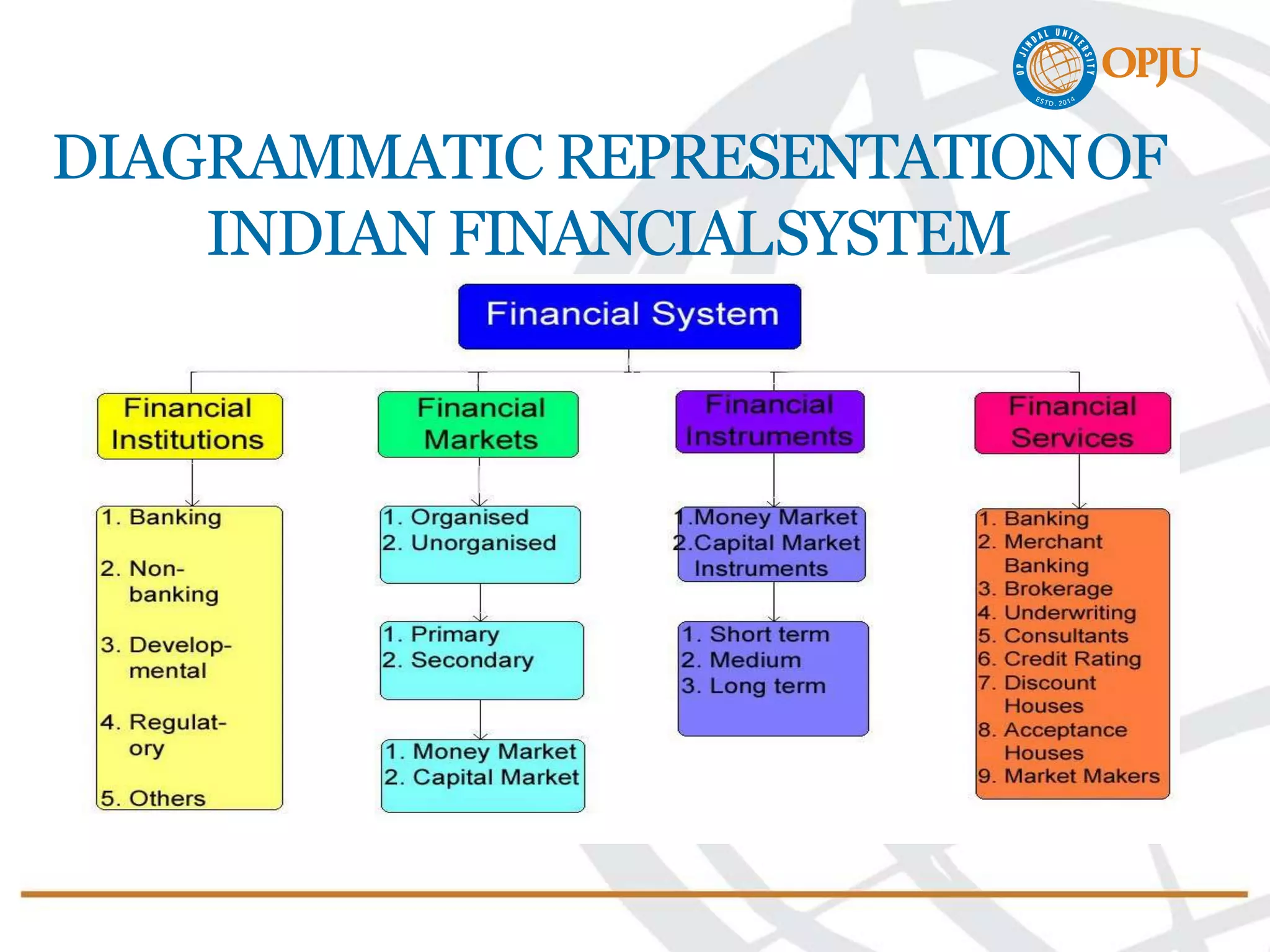
DIAGRAMMATIC REPRESENTATIONOF
INDIAN FINANCIALSYSTEM
FINANCIAL INSTITUTIONS
• Includes institutions and mechanisms which
-Affect generation of savings by the community
-Mobilisation of savings
-Effective distribution of savings
 Institutions are banks, insurance companies,
mutual funds- promote/mobilise savings
 Individual investors, industrial and trading
companies- borrowers
Financialinstitutionsclassifiedas:-
a) Regulatory and financial institutions :
 The two major Regulatory and Promotional Institutions in
India are Reserve Bank of India (RBI) and Securities Exchange
Board of India(SEBI).
 Both RBI and SEBI administer, legislate, supervise, monitor,
control and discipline the entire financialsystem.
 RBI is the apex of all financial institutions in India.
All financial institutions are under the control ofRBI.
 Thefinancial markets are under the control ofSEBI.
b)Banking institutions:-
-Banking institutions mobilizethesavingsof thepeople.
-Theyprovide amechanism forthesmooth exchangeof
goods andservices.
-Basiccategoriesof banking institutionsare
commercialbanks,co-operativebanks, developmen
talbanks
c)Non bankingfinancialinstitutions:-
- Nonbankingfinancialinstitutionsalsomobilizefinancial resources
directlyorindirectlyfromthepeople.
-Theylendfundsbutnotcreatecredit
-Companies likeLIC,GIC,UTI,Development Financial Institutions,Or
ganisationo Fundsetc.fallinthiscategory.
-Nonbankingfinancialinstitutionscanbecategorizedas
investment companies, housing companies, leasing companies,hire
purchasecompanies,specializedfinancial institutions(EXIMBanketc.
)investmentinstitutions,state levelinstitutionsetc
FINANCIAL ASSETS/INSTRUMENTS
• Enable channelising funds from surplus units to
deficit units
• There are instruments for savers such as deposits,
equities, mutual fund units, etc.
• There are instruments for borrowers such as loans,
overdrafts, etc.
• Like businesses, governments too raise funds
through issuing of bonds, Treasury bills, etc.
• Instruments like PPF, KVP, etc. are available to savers
who wish to lend money to the government
MAJOR FINANCIAL INSTRUMENTS
 Money
 Savings account
 Credit market Instruments-bonds, mortgages
 Common Stocks
 Money market funds and mutual funds
 Pension funds
 Financial Derivatives
FINANCIAL INTERMEDIARIES
 Mutual Funds- Promote savings and mobilise funds
which are invested in the stock market and bond market
• Indirect source of finance to companies
• Pool funds of savers and invest in the stock market/
bond market
• Their instruments at saver’s end are called units
• Offer many types of schemes: growth fund, income
fund, balanced fund
• Regulated by SEBI
• Merchant banking- manage and underwrite new issues,
undertake syndication of credit, advise corporate clients on fund
raising
• Subject to regulation by SEBI and RBI
• SEBI regulates them on issue activity and portfolio management of
their business.
• RBI supervises those merchant banks which are subsidiaries or
affiliates of commercial banks
• Have to adopt stipulated capital adequacy norms and abide by a
code of conduct
 There are other financial intermediaries such as
NBFCs, Venture Capital Funds, Hire and Leasing
Companies, etc.
 India’s financial system is quite huge and cate
rs to every kind of demand for funds
 Banks are at the core of our financial system and t
herefore, there is greater expectation from them in
terms of reaching out to the vast populace as well
as being competitive.
FINANCIAL MARKET
• Financial market deals in financial securities (or financial
instruments) and financial services.
• Financial markets are the centers or arrangements that
provide facilities for buying and selling of financial claims and
services.
• These are the markets in which money as well as monetary
claims is traded in.
• Financial markets exist wherever financial transactions take
place.
• Financial transactions include issue of equity stock by a
company, purchase of bonds in the secondary market, deposit
of money in a bank account, transfer of funds from a current
account to asavings accountetc.
FUNCTIONS OF FINANCIAL
MARKETS
•To facilitate creation and allocation of credit and
liquidity.
• Toserve asintermediaries for mobilization ofsavings
• Tohelp in the process of balanced economicgrowth
• Toprovide financialconvenience
•Tocater to the various credits needs of thebusiness
organizations.
•Toprovide information and facilitate transactions at low
cost
• Financialmarketcanbe classifiedin 2on basisof maturity of claims
1. Money Marketand
2. CapitalMarket
1. Money Market:
• Amarket where short term funds are borrowed and lend is called
moneymarket.It dealsin short term monetary assetswith a maturity period
of one year or less.Liquid funds aswell ashighly liquid securities aretraded in
the moneymarket.
• Examplesof money market areTreasurybillmarket, call money market,
commercial bill marketetc.
2. CapitalMarket:
• Capital market isthe market for long term funds. Thismarket dealsin the
long term claims,securities and stockswith amaturity period of more than
one year.Thestock market, the government bond market and derivatives
market are examplesofcapital market.
• Financial market canbe classified in 2 on basisofseasoningof
claim
1. Primary Marketand
2. SecondaryMarket
1. Primary Market:
Primary markets are those markets which deal in the new securities. Therefore
, they are alsoknown asnew issuemarkets. Theseare markets where securities are is
suedfor the first time. In other words, these arethe marketsfor the securities issued
directly by the companies.
2. SecondaryMarket:
Secondarymarkets are those markets which deal in existing securities. Existing
securities are those securities that havealready been issuedand are already outstandi
ng. Secondarymarketconsists of stockexchanges.
• Financial market can be classified in 2 on basisof timingof
delivery:
1. Cash/ Spot market
2. Forward/Future market
Cash/ Spotmarket:
Thisis the market where the buying and sellingof commodities
happens or stocks are sold forcashand delivered immediately
after the purchase or sale of commodities or securities.
Forward/Future market:
Thisis the market where participants buy and sell
stocks/commodities, contracts and the delivery ofcommodities or
securities occurs at apre-determined time infuture.
• Financial Market is further classified into2.
1. Foreign exchange market:
Foreign exchangemarket is simply defined asamarket in
which one country’s currency is traded for another country’s
currency. It is amarket for the purchase and sale of foreign
currencies.
2. Derivatives market:
Thederivatives are most modern financial instruments in
hedging risk. Theindividuals and firms who wish to avoid or
reduce risk can deal with the others who are willing to accept
the risk for aprice. Acommon place where suchtransactions
take place is called the derivativemarket.
Theimportant types of derivatives are forwards,futures,
options, swaps,etc.
FINANCIALINSTRUMENTS
• Financial instruments are the financial assets,securitiesand
claims.
• Theymay be viewed asfinancial assetsand financial liabilities.
1. Financial assets:
represent claims for the payment of asum of money so
metime in the future (repayment of principal) and/or a p
eriodic payment in the form of interest or dividend.
2. Financial liabilities:
are the counterparts of financial assets. They represent
promise to pay some portion of prospective income and
wealth to others.
TYPESOF FINANCIAL
INSTRUMENTS
• Thefinancial instruments maybe capital market instrumentsor money market
instruments or hybridinstruments.
• Capital MarketInstruments:
Financial instruments that are usedfor raisingcapital through the capital
market. It includes include equity shares, preference shares,warrants,
debentures andbonds.
• Money MarketInstruments:
Financial instruments that are usedfor raising and supplying money in a
short period not exceedingone year through money market are called
money marketinstruments.
•It includes treasury bills, commercial paper,call money,short notice money,
certificates of deposits, commercial bills,money market mutualfunds.
MONEY MARKET INSTRUMENTS
1. Calland Short NoticeMoney
• Theseare short term loans.Their maturity variesbetween one dayto fourteen days.If
money isborrowed or lent for adayit is called call money or overnight money. When
moneyisborrowed or lent for more than adayandup to fourteen days,it iscalled short
noticemoney.
2. CommercialBills
• Abill of exchangecontains awritten order from the creditor (seller) to the debtor
(buyer) to payacertain sum,to acertain person after acertainperiod.
• Accordingto Negotiable instrumentsAct,1881,abill of exchange is‘an instrument in
writing containing anunconditional order, signed by the maker,directing acertain person
to payacertain sumof moneyonly to, or to the order of acertain person or to the bearer
of theinstrument’.
3.Treasury Bill
Treasury bills are credit instruments used by the Govt. to
raise short term funds to meet the budgetary deficit. Treasury
bills are popularly calledTbills.
Theseare negotiable instruments. Hence, these arefreely
transferable.
4.Certificate Of Deposit
CDis acertificate in the form of promissory note issuedby
banks against the short term deposits of companies and institut
ions, received by the bank.
It is payable on afixed date. It has amaturity period ranging from
three to twelvemonths.
5.Commercial Paper
•It is afinance paper like Treasury bill. Itis an
unsecured, negotiable promissory note.
•It hasafixed maturity period ranging from three to s
ix months. It is generally issued by leading,nationally
reputed credit worthy and highly ratedcorporations.
•It is quite safeand highlyliquid.
•It is issued in bearer form and on discount. Itis also
known asindustrial paper or corporatepaper.
THANKYOU

Indian financial system

  • 1.
    INDIAN FINANCIAL SYSTEM PREPARED BY: -VANSHIKAAGRAWAL -SHIKHA AGRAWAL -PRACHI DUA -PRIYANKA SHARMA -PRINCE GUPTA GROUP 1,BBA 5TH SEM
  • 2.
    FINANCIAL SYSTEM  Aninstitutional framework existing in a country to enable financial transactions  Three main parts -Financial assets (loans, deposits, bonds, equities, etc.) -Financial institutions (banks, mutual funds, insurance companies, etc.) -Financial markets (money market, capital market, forex market, etc.) • Regulation is another aspect of the financial system (RBI, SEBI, IRDA,)
  • 3.
    FUNCTIONS OF FINANCIAL SYSTEM The financial system transfer resources across time, sectors, and regions.  The financial system manages risks for the economy-(Fire Insurance)  The financial system pools and subdivides funds depending upon the need of the individual saver or investor.  Performs an important clearinghouse function, which facilitates transactions between payers and payees.
  • 4.
  • 5.
    FINANCIAL INSTITUTIONS • Includesinstitutions and mechanisms which -Affect generation of savings by the community -Mobilisation of savings -Effective distribution of savings  Institutions are banks, insurance companies, mutual funds- promote/mobilise savings  Individual investors, industrial and trading companies- borrowers
  • 6.
    Financialinstitutionsclassifiedas:- a) Regulatory andfinancial institutions :  The two major Regulatory and Promotional Institutions in India are Reserve Bank of India (RBI) and Securities Exchange Board of India(SEBI).  Both RBI and SEBI administer, legislate, supervise, monitor, control and discipline the entire financialsystem.  RBI is the apex of all financial institutions in India. All financial institutions are under the control ofRBI.  Thefinancial markets are under the control ofSEBI.
  • 7.
    b)Banking institutions:- -Banking institutionsmobilizethesavingsof thepeople. -Theyprovide amechanism forthesmooth exchangeof goods andservices. -Basiccategoriesof banking institutionsare commercialbanks,co-operativebanks, developmen talbanks
  • 8.
    c)Non bankingfinancialinstitutions:- - Nonbankingfinancialinstitutionsalsomobilizefinancialresources directlyorindirectlyfromthepeople. -Theylendfundsbutnotcreatecredit -Companies likeLIC,GIC,UTI,Development Financial Institutions,Or ganisationo Fundsetc.fallinthiscategory. -Nonbankingfinancialinstitutionscanbecategorizedas investment companies, housing companies, leasing companies,hire purchasecompanies,specializedfinancial institutions(EXIMBanketc. )investmentinstitutions,state levelinstitutionsetc
  • 9.
    FINANCIAL ASSETS/INSTRUMENTS • Enablechannelising funds from surplus units to deficit units • There are instruments for savers such as deposits, equities, mutual fund units, etc. • There are instruments for borrowers such as loans, overdrafts, etc. • Like businesses, governments too raise funds through issuing of bonds, Treasury bills, etc. • Instruments like PPF, KVP, etc. are available to savers who wish to lend money to the government
  • 10.
    MAJOR FINANCIAL INSTRUMENTS Money  Savings account  Credit market Instruments-bonds, mortgages  Common Stocks  Money market funds and mutual funds  Pension funds  Financial Derivatives
  • 11.
    FINANCIAL INTERMEDIARIES  MutualFunds- Promote savings and mobilise funds which are invested in the stock market and bond market • Indirect source of finance to companies • Pool funds of savers and invest in the stock market/ bond market • Their instruments at saver’s end are called units • Offer many types of schemes: growth fund, income fund, balanced fund • Regulated by SEBI
  • 12.
    • Merchant banking-manage and underwrite new issues, undertake syndication of credit, advise corporate clients on fund raising • Subject to regulation by SEBI and RBI • SEBI regulates them on issue activity and portfolio management of their business. • RBI supervises those merchant banks which are subsidiaries or affiliates of commercial banks • Have to adopt stipulated capital adequacy norms and abide by a code of conduct
  • 13.
     There areother financial intermediaries such as NBFCs, Venture Capital Funds, Hire and Leasing Companies, etc.  India’s financial system is quite huge and cate rs to every kind of demand for funds  Banks are at the core of our financial system and t herefore, there is greater expectation from them in terms of reaching out to the vast populace as well as being competitive.
  • 14.
    FINANCIAL MARKET • Financialmarket deals in financial securities (or financial instruments) and financial services. • Financial markets are the centers or arrangements that provide facilities for buying and selling of financial claims and services. • These are the markets in which money as well as monetary claims is traded in. • Financial markets exist wherever financial transactions take place. • Financial transactions include issue of equity stock by a company, purchase of bonds in the secondary market, deposit of money in a bank account, transfer of funds from a current account to asavings accountetc.
  • 15.
    FUNCTIONS OF FINANCIAL MARKETS •Tofacilitate creation and allocation of credit and liquidity. • Toserve asintermediaries for mobilization ofsavings • Tohelp in the process of balanced economicgrowth • Toprovide financialconvenience •Tocater to the various credits needs of thebusiness organizations. •Toprovide information and facilitate transactions at low cost
  • 16.
    • Financialmarketcanbe classifiedin2on basisof maturity of claims 1. Money Marketand 2. CapitalMarket 1. Money Market: • Amarket where short term funds are borrowed and lend is called moneymarket.It dealsin short term monetary assetswith a maturity period of one year or less.Liquid funds aswell ashighly liquid securities aretraded in the moneymarket. • Examplesof money market areTreasurybillmarket, call money market, commercial bill marketetc. 2. CapitalMarket: • Capital market isthe market for long term funds. Thismarket dealsin the long term claims,securities and stockswith amaturity period of more than one year.Thestock market, the government bond market and derivatives market are examplesofcapital market.
  • 17.
    • Financial marketcanbe classified in 2 on basisofseasoningof claim 1. Primary Marketand 2. SecondaryMarket 1. Primary Market: Primary markets are those markets which deal in the new securities. Therefore , they are alsoknown asnew issuemarkets. Theseare markets where securities are is suedfor the first time. In other words, these arethe marketsfor the securities issued directly by the companies. 2. SecondaryMarket: Secondarymarkets are those markets which deal in existing securities. Existing securities are those securities that havealready been issuedand are already outstandi ng. Secondarymarketconsists of stockexchanges.
  • 18.
    • Financial marketcan be classified in 2 on basisof timingof delivery: 1. Cash/ Spot market 2. Forward/Future market Cash/ Spotmarket: Thisis the market where the buying and sellingof commodities happens or stocks are sold forcashand delivered immediately after the purchase or sale of commodities or securities. Forward/Future market: Thisis the market where participants buy and sell stocks/commodities, contracts and the delivery ofcommodities or securities occurs at apre-determined time infuture.
  • 19.
    • Financial Marketis further classified into2. 1. Foreign exchange market: Foreign exchangemarket is simply defined asamarket in which one country’s currency is traded for another country’s currency. It is amarket for the purchase and sale of foreign currencies. 2. Derivatives market: Thederivatives are most modern financial instruments in hedging risk. Theindividuals and firms who wish to avoid or reduce risk can deal with the others who are willing to accept the risk for aprice. Acommon place where suchtransactions take place is called the derivativemarket. Theimportant types of derivatives are forwards,futures, options, swaps,etc.
  • 20.
    FINANCIALINSTRUMENTS • Financial instrumentsare the financial assets,securitiesand claims. • Theymay be viewed asfinancial assetsand financial liabilities. 1. Financial assets: represent claims for the payment of asum of money so metime in the future (repayment of principal) and/or a p eriodic payment in the form of interest or dividend. 2. Financial liabilities: are the counterparts of financial assets. They represent promise to pay some portion of prospective income and wealth to others.
  • 21.
    TYPESOF FINANCIAL INSTRUMENTS • Thefinancialinstruments maybe capital market instrumentsor money market instruments or hybridinstruments. • Capital MarketInstruments: Financial instruments that are usedfor raisingcapital through the capital market. It includes include equity shares, preference shares,warrants, debentures andbonds. • Money MarketInstruments: Financial instruments that are usedfor raising and supplying money in a short period not exceedingone year through money market are called money marketinstruments. •It includes treasury bills, commercial paper,call money,short notice money, certificates of deposits, commercial bills,money market mutualfunds.
  • 22.
    MONEY MARKET INSTRUMENTS 1.Calland Short NoticeMoney • Theseare short term loans.Their maturity variesbetween one dayto fourteen days.If money isborrowed or lent for adayit is called call money or overnight money. When moneyisborrowed or lent for more than adayandup to fourteen days,it iscalled short noticemoney. 2. CommercialBills • Abill of exchangecontains awritten order from the creditor (seller) to the debtor (buyer) to payacertain sum,to acertain person after acertainperiod. • Accordingto Negotiable instrumentsAct,1881,abill of exchange is‘an instrument in writing containing anunconditional order, signed by the maker,directing acertain person to payacertain sumof moneyonly to, or to the order of acertain person or to the bearer of theinstrument’.
  • 23.
    3.Treasury Bill Treasury billsare credit instruments used by the Govt. to raise short term funds to meet the budgetary deficit. Treasury bills are popularly calledTbills. Theseare negotiable instruments. Hence, these arefreely transferable. 4.Certificate Of Deposit CDis acertificate in the form of promissory note issuedby banks against the short term deposits of companies and institut ions, received by the bank. It is payable on afixed date. It has amaturity period ranging from three to twelvemonths.
  • 24.
    5.Commercial Paper •It isafinance paper like Treasury bill. Itis an unsecured, negotiable promissory note. •It hasafixed maturity period ranging from three to s ix months. It is generally issued by leading,nationally reputed credit worthy and highly ratedcorporations. •It is quite safeand highlyliquid. •It is issued in bearer form and on discount. Itis also known asindustrial paper or corporatepaper.
  • 25.