


A Presentation on Depository
Receipts
Presented By:
Jyoti Agrawal
Puneet Agrawal
Riya Chhabra
Jagriti Singh
Ashish Jaiswal
Nikahat Nisha
Depository Receipts
• A DR is a type of negotiable (transferable)
financial security traded on a local stock
exchange but represents a security, usually in
the form of equity, issued by a foreign,
publicly-listed company.
• The DR is a physical certificate that allows
investors to hold shares in equity of other
countries.
Types Of Depository Receipts
1. American Depository Receipt:
One of the most common types of DRs is the
American depository receipt (ADR), which has been
offering companies, investors and traders global
investment opportunities since the1920s.
2. Global Depository Receipt:
Since then, DRs have spread to other parts of the
globe in the form of global depository receipts
(GDRs).
• ADRs are typically traded on a US national stock
exchange, such as the New York Stock Exchange
(NYSE) or the American Stock Exchange.
• GDRs are commonly listed on European stock
exchanges such as the London Stock Exchange.
• Both ADRs and GDRs are usually denominated
in US dollars, but can also be denominated in
Euros.
3. Indian Depository Receipt:
• IDRs are transferable securities to be listed on Indian stock
exchanges in the form of depository receipts.
• The Securities and Exchange Board of India (SEBI), has
introduced guidelines for foreign companies to raise capital
here by issuing Indian depository receipts.
• It has set a minimum size of the IDR float at Rs 50 crore and
the minimum investment limit at Rs 2 lakh per investor.
How Depository Receipts Work
A depositary receipt typically requires a company to meet a stock exchange’s
specific rules before listing its stock for sale. For example, a company must transfer
shares to a brokerage house in its home country. Upon receipt, the brokerage uses
a custodian connected to the international stock exchange for selling the
depositary receipts. This connection ensures that the shares of stock actually exist
and no manipulation occurs between the foreign company and the international
brokerage house.
A typical ADR goes through the following steps before it is issued:
• The issuing bank in the U.S. studies the financials of the foreign company in detail
to assess the strength of its stock.
• The bank buys shares of the foreign company.
• The shares are grouped into packets.
• Each packet is issued as an ADR through an American stock exchange.
• The ADR is priced in dollars, and the dividends are paid out in dollars as well,
making it as simple for an American investor to buy as the stock of a U.S.-based
company.
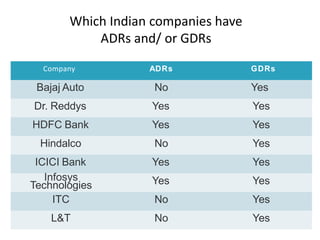
Company ADRs GDRs
Bajaj Auto No Yes
Dr. Reddys Yes Yes
HDFC Bank Yes Yes
Hindalco No Yes
ICICI Bank Yes Yes
Yes YesInfosys
Technologies
ITC No Yes
L&T No Yes
Which Indian companies have
ADRs and/ or GDRs
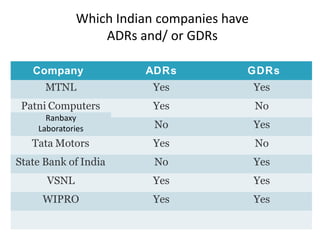
Company ADRs GDRs
MTNL Yes Yes
Patni Computers Yes No
Ranbaxy
Laboratories No Yes
Tata Motors Yes No
State Bank of India No Yes
VSNL Yes Yes
WIPRO Yes Yes
Which Indian companies have
ADRs and/ or GDRs
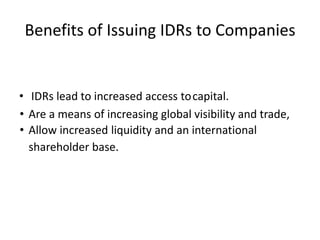
Benefits of Issuing IDRs to Companies
• IDRs lead to increased access tocapital.
• Are a means of increasing global visibility and trade,
• Allow increased liquidity and an international
shareholder base.
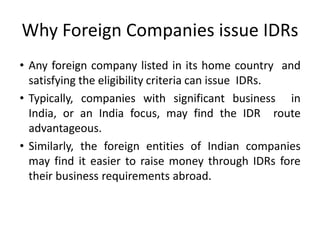
Why Foreign Companies issue IDRs
• Any foreign company listed in its home country and
satisfying the eligibility criteria can issue IDRs.
• Typically, companies with significant business in
India, or an India focus, may find the IDR route
advantageous.
• Similarly, the foreign entities of Indian companies
may find it easier to raise money through IDRs fore
their business requirements abroad.
How are IDRs different from GDRs
• GDRs and ADRs area among the most commonly
used DRs.
• When the depository bank creating the
depository recipt in the US, the instruments are
known as ADRs.
• Similarly,other depository Receipts, based on the
location of the depository bank creating them,
have come into existence, such as the GDR , the
European depository Receipts, International
depository Receipts & Indian depository Receipts.
THANK YOU

depository receipts

  • 1.
    A Presentation onDepository Receipts Presented By: Jyoti Agrawal Puneet Agrawal Riya Chhabra Jagriti Singh Ashish Jaiswal Nikahat Nisha
  • 2.
    Depository Receipts • ADR is a type of negotiable (transferable) financial security traded on a local stock exchange but represents a security, usually in the form of equity, issued by a foreign, publicly-listed company. • The DR is a physical certificate that allows investors to hold shares in equity of other countries.
  • 3.
    Types Of DepositoryReceipts 1. American Depository Receipt: One of the most common types of DRs is the American depository receipt (ADR), which has been offering companies, investors and traders global investment opportunities since the1920s. 2. Global Depository Receipt: Since then, DRs have spread to other parts of the globe in the form of global depository receipts (GDRs).
  • 4.
    • ADRs aretypically traded on a US national stock exchange, such as the New York Stock Exchange (NYSE) or the American Stock Exchange. • GDRs are commonly listed on European stock exchanges such as the London Stock Exchange. • Both ADRs and GDRs are usually denominated in US dollars, but can also be denominated in Euros.
  • 5.
    3. Indian DepositoryReceipt: • IDRs are transferable securities to be listed on Indian stock exchanges in the form of depository receipts. • The Securities and Exchange Board of India (SEBI), has introduced guidelines for foreign companies to raise capital here by issuing Indian depository receipts. • It has set a minimum size of the IDR float at Rs 50 crore and the minimum investment limit at Rs 2 lakh per investor.
  • 6.
    How Depository ReceiptsWork A depositary receipt typically requires a company to meet a stock exchange’s specific rules before listing its stock for sale. For example, a company must transfer shares to a brokerage house in its home country. Upon receipt, the brokerage uses a custodian connected to the international stock exchange for selling the depositary receipts. This connection ensures that the shares of stock actually exist and no manipulation occurs between the foreign company and the international brokerage house. A typical ADR goes through the following steps before it is issued: • The issuing bank in the U.S. studies the financials of the foreign company in detail to assess the strength of its stock. • The bank buys shares of the foreign company. • The shares are grouped into packets. • Each packet is issued as an ADR through an American stock exchange. • The ADR is priced in dollars, and the dividends are paid out in dollars as well, making it as simple for an American investor to buy as the stock of a U.S.-based company.
  • 7.
    Company ADRs GDRs BajajAuto No Yes Dr. Reddys Yes Yes HDFC Bank Yes Yes Hindalco No Yes ICICI Bank Yes Yes Yes YesInfosys Technologies ITC No Yes L&T No Yes Which Indian companies have ADRs and/ or GDRs
  • 8.
    Company ADRs GDRs MTNLYes Yes Patni Computers Yes No Ranbaxy Laboratories No Yes Tata Motors Yes No State Bank of India No Yes VSNL Yes Yes WIPRO Yes Yes Which Indian companies have ADRs and/ or GDRs
  • 9.
    Benefits of IssuingIDRs to Companies • IDRs lead to increased access tocapital. • Are a means of increasing global visibility and trade, • Allow increased liquidity and an international shareholder base.
  • 10.
    Why Foreign Companiesissue IDRs • Any foreign company listed in its home country and satisfying the eligibility criteria can issue IDRs. • Typically, companies with significant business in India, or an India focus, may find the IDR route advantageous. • Similarly, the foreign entities of Indian companies may find it easier to raise money through IDRs fore their business requirements abroad.
  • 11.
    How are IDRsdifferent from GDRs • GDRs and ADRs area among the most commonly used DRs. • When the depository bank creating the depository recipt in the US, the instruments are known as ADRs. • Similarly,other depository Receipts, based on the location of the depository bank creating them, have come into existence, such as the GDR , the European depository Receipts, International depository Receipts & Indian depository Receipts.
  • 12.