By
Washington Dengu (BPharm, BCom)
Protecting Your Right to Quality Medicines and
Medical Devices
Definition.
• Departure from approved procedure or process or the
result thereof.
• Can be planned (seen before it happens) or unplanned
(realised after it has happened already).
• Unplanned deviations also termed incidents.
Protecting Your Right to Quality Medicines and Medical Devices
Why bother about sound deviation
management?
a. Product Quality Assurance
b. Source of continuous improvement.
c. Good business sense. Less rejections/recalls/complaints.
d. Regulatory requirement
Protecting Your Right to Quality Medicines and Medical Devices
Guideline (WHO TRS986 Annex2)
16.3 Deviation from instructions or procedures should be
avoided as far as possible. If deviations occur, they should be
in accordance with an approved procedure. The authorization
of the deviation should be approved in writing by a
designated person, with the involvement of the QC
department, when appropriate.
 Also sections 16.20; 17.3d, f, m & s; 9.14e; 15.27i; 15.30h;
Protecting Your Right to Quality Medicines and Medical Devices
Pre-requisites for successful
deviation management.
1. Validated processes.
2. Consultatively written procedures.
3. Integrated organisation in harmony
4. Understanding the idea and significance behind the effort, to
product quality & to the business.
Protecting Your Right to Quality Medicines and Medical Devices
When faced with a deviation
Protecting Your Right to Quality Medicines and Medical Devices
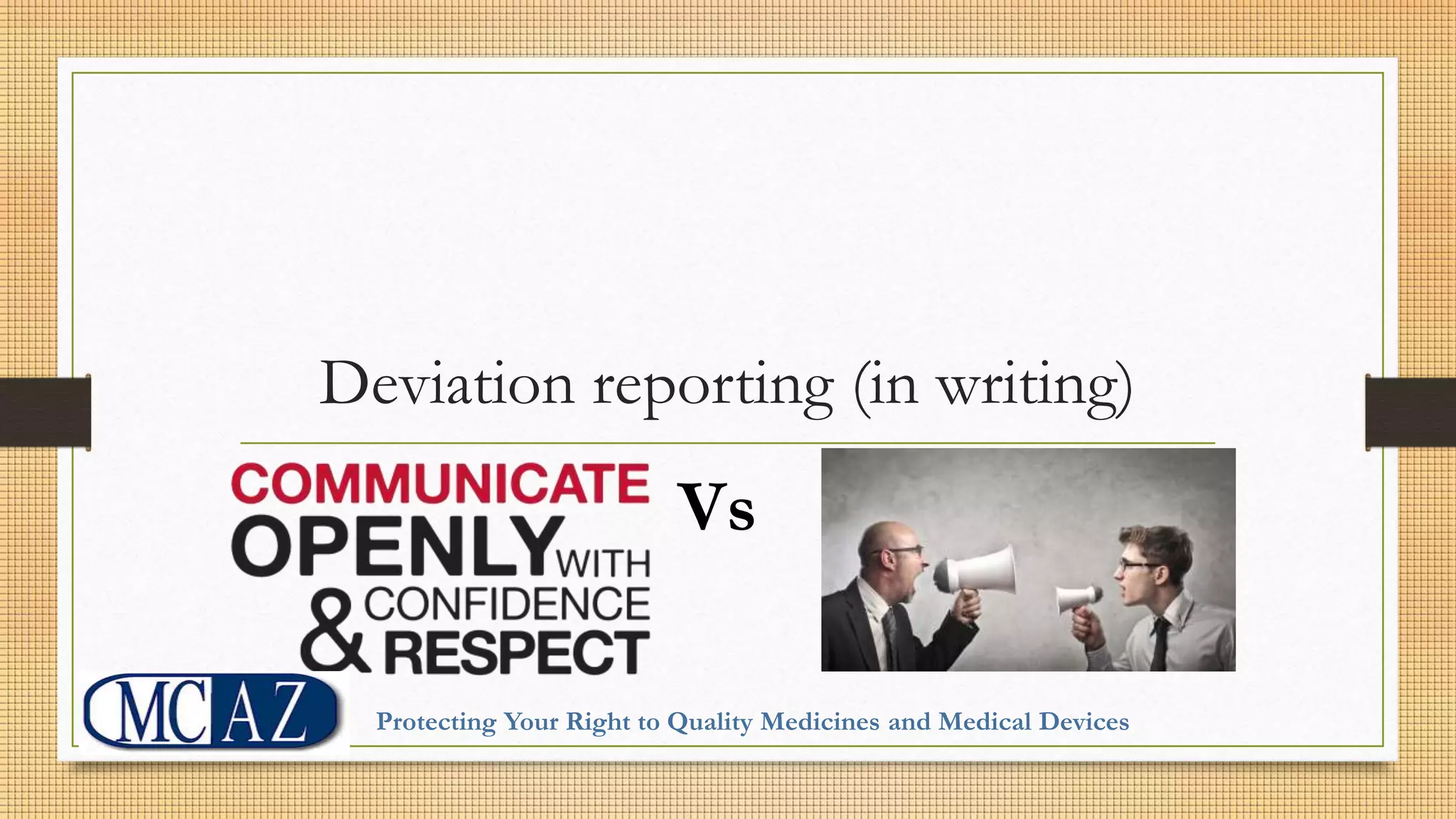
Deviation reporting (in writing)
Vs
Protecting Your Right to Quality Medicines and Medical Devices
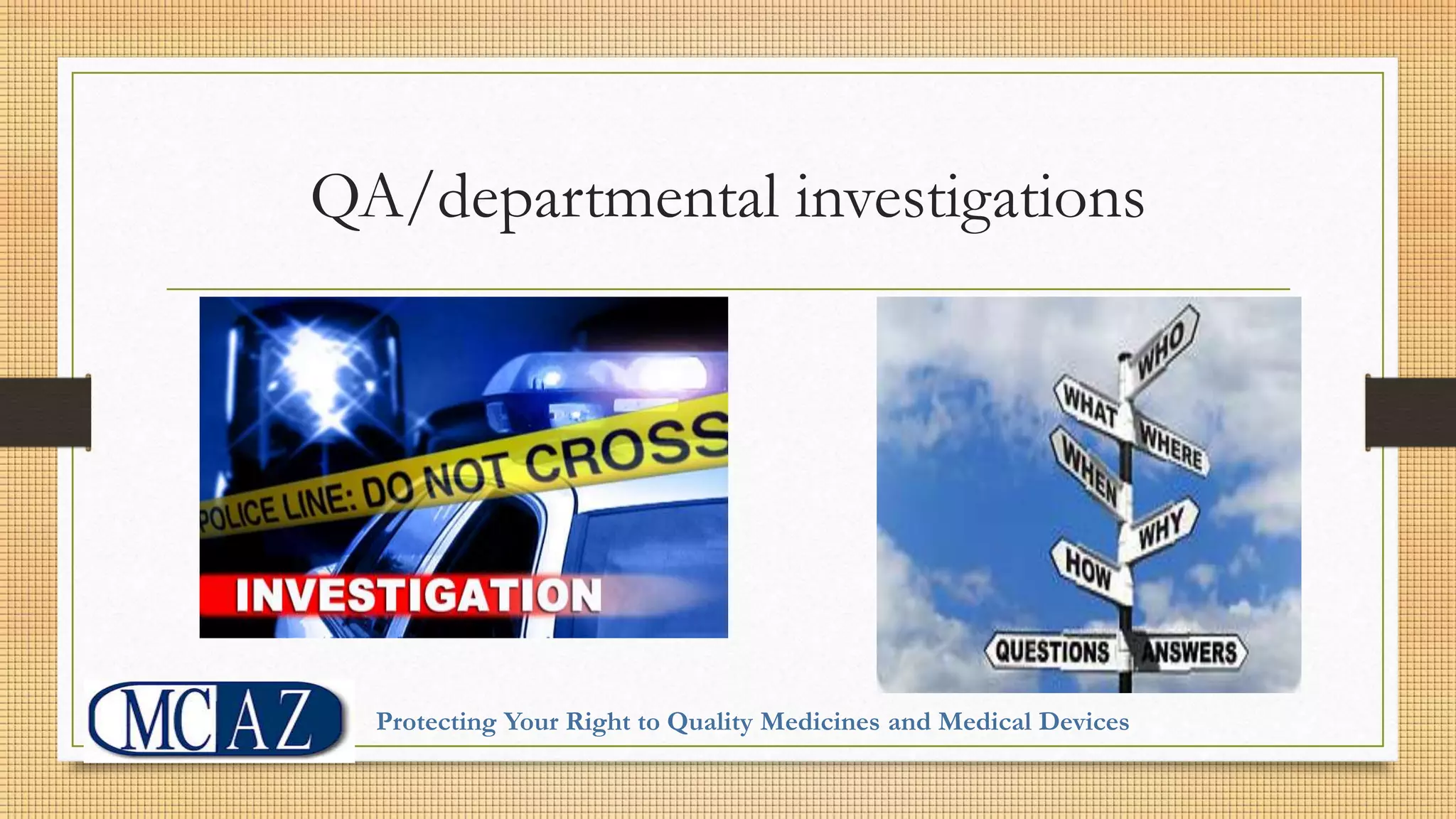
QA/departmental investigations
Protecting Your Right to Quality Medicines and Medical Devices
Risk & impact assessment
Protecting Your Right to Quality Medicines and Medical Devices
Classification of deviations
• Based on risk and impact to product quality.
• Critical, major and minor deviations.
• Level of investigation depends on the classification.
• All must be recorded and numbered.
• A bound register (logbook) preferable.
Protecting Your Right to Quality Medicines and Medical Devices
Approval
• Based on outcome of risk/impact assessment.
• QA decision.
• Implementation ONLY after approval for planned deviations.
• Batch disposition. (proceed to next stage or reject).
• TIMELY.
• Repetitive deviations
• Change control
Protecting Your Right to Quality Medicines and Medical Devices
Post implementation,
deviations must be;
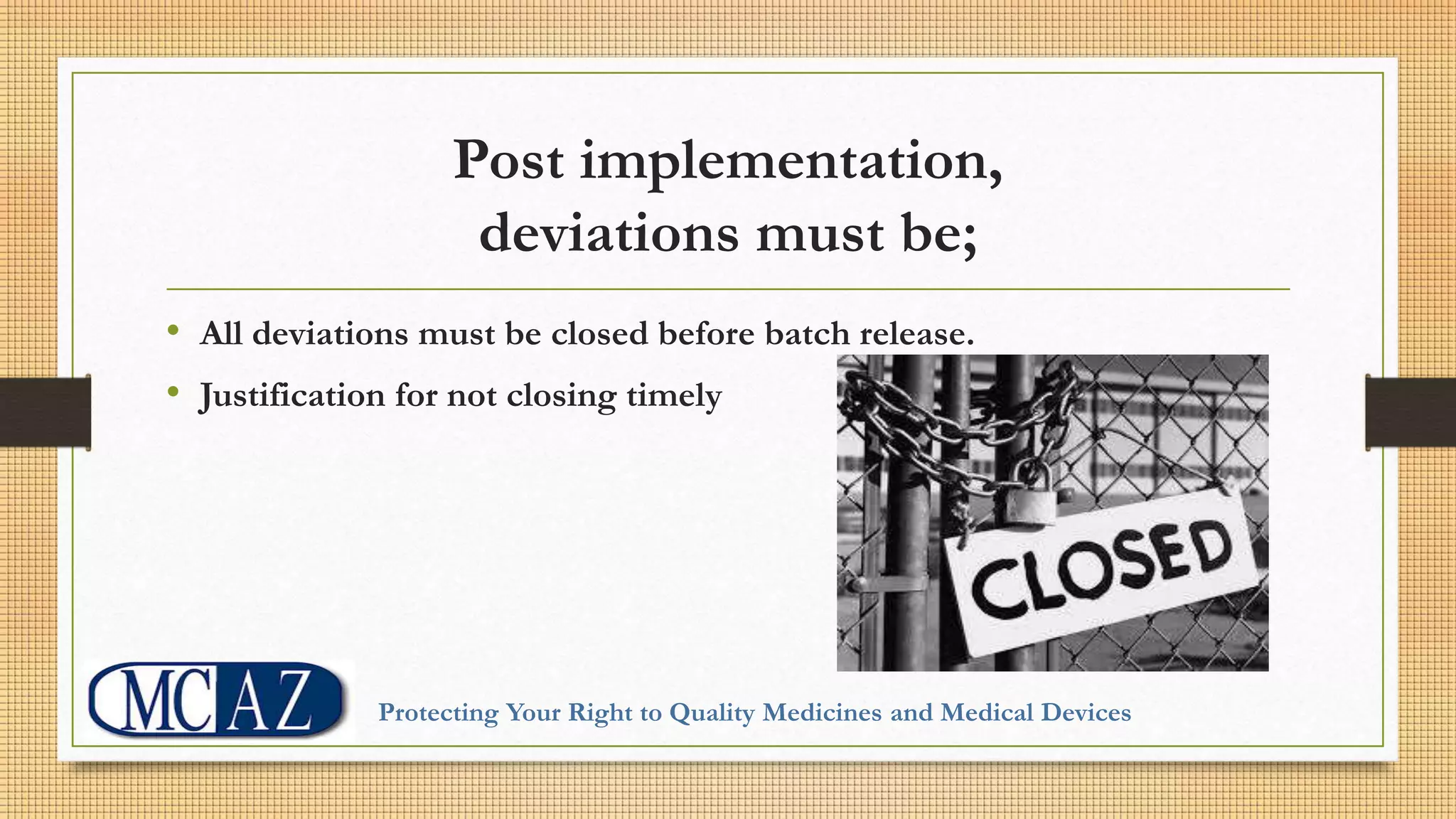
• All deviations must be closed before batch release.
• Justification for not closing timely
Protecting Your Right to Quality Medicines and Medical Devices
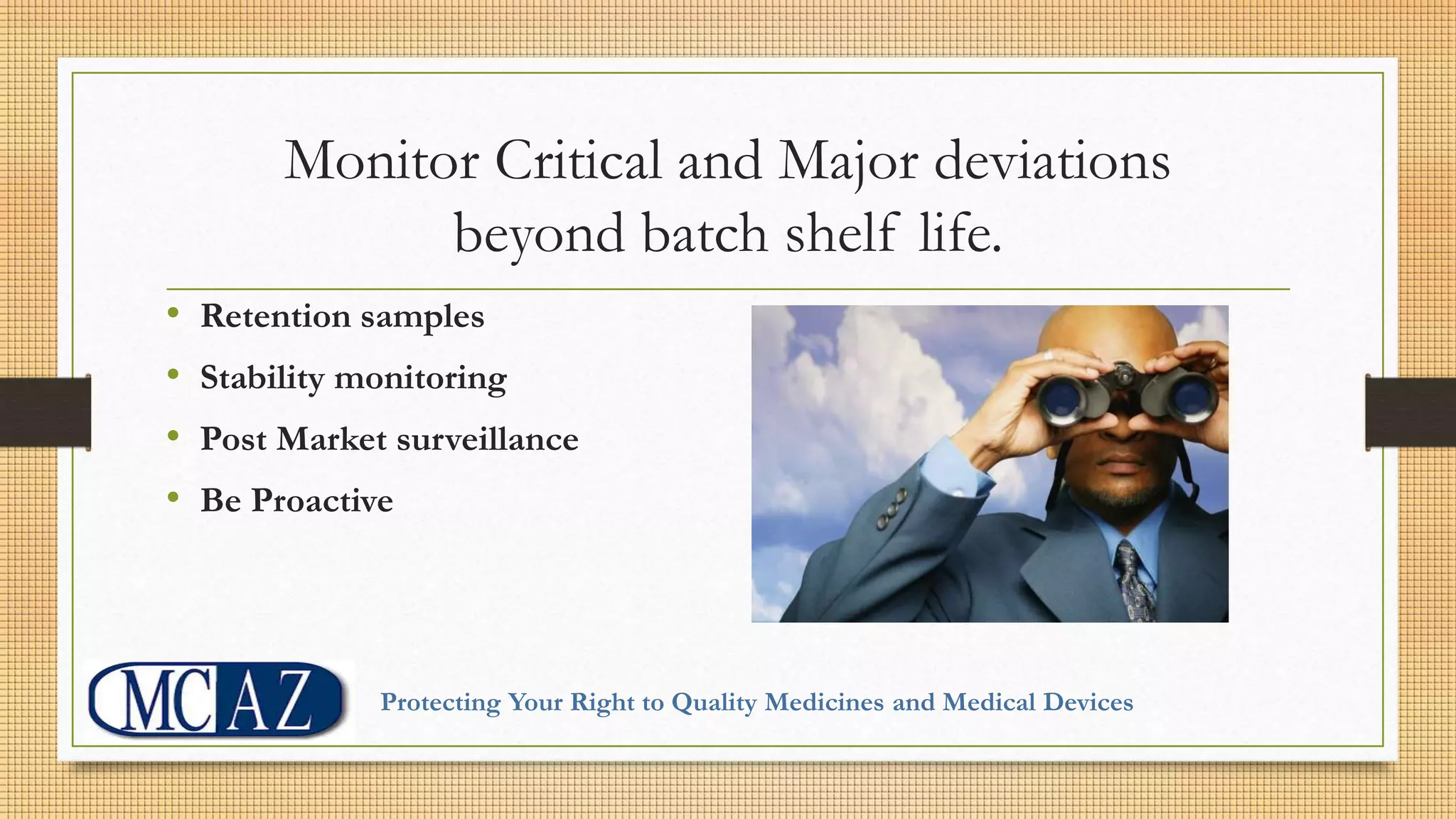
Monitor Critical and Major deviations
beyond batch shelf life.
• Retention samples
• Stability monitoring
• Post Market surveillance
• Be Proactive
Protecting Your Right to Quality Medicines and Medical Devices
Annual trending
• How many planned deviations
• How many incidents
• How many in production, QC, QA, Engineering etc
• How many critical/majors/minor
• How many repetitive deviations
• How many are still open/ closed in time
Protecting Your Right to Quality Medicines and Medical Devices
Common Inspection observations
• No deviation register/ log book
• Approvals not based on risk/impact assessment
• SOP in place but not being actioned.
• SOP not being trained to all relevant people
• Suspicious Zero-deviations for years
• Deviations not being investigated
• Lack of trending & the resultant recommendations
• No way of dealing with repeated deviations
Protecting Your Right to Quality Medicines and Medical Devices
Group 1
• During the manufacture of 300kg batch size of Digoxin 0.25ug tablets by
World Pharma Ltd, the following was observed at blending stage. After wet
granulation, drying & particle size reduction, the operators added the
lubricants and blended the mixture. They obtained a yield of 302kg against
acceptable range of 296kg-299kg. Immediately after offloading they
proceeded for compression.
• Question. Comment. How would you have handled the situation, as
the QA manager of World Pharma Ltd, clearly indicating the problem,
what could be the root cause, the risk and impact etc.
Protecting Your Right to Quality Medicines and Medical Devices
Group 2
• During the manufacture of a 100L batch of Ciprofloxacillin suspension, the volume
100L is obtained by topping up the mixture to the 100L mark with Purified Water
BP. The operator overshoot the mark. He then took a clean stainless steel bucket
and scooped off the excess. More careful now, he slowly made upto the exact mark
of 100L. The production supervisor immediately came, checked the 100L mark, the
reconciliation and released the bulk suspension for packing.
• Question. Comment. How would you have handled the situation, as the QA
manager of World Pharma Ltd, clearly indicating the problem, the risk and
impact, preventive action etc.
Protecting Your Right to Quality Medicines and Medical Devices
Group 3.
• During an internal audit of the Quality assurance department, the inspectors
found that no single deviation had been recorded in the last 12months. The
deviation register was an uncontrolled counter book. 3 market complaints
had been recorded in the 12 months. One batch had been reprocessed
successfully.
• Question. Discuss. How would you have handled the situation if you
were the internal auditor?
Protecting Your Right to Quality Medicines and Medical Devices

Deviation management

  • 1.
    By Washington Dengu (BPharm,BCom) Protecting Your Right to Quality Medicines and Medical Devices
  • 2.
    Definition. • Departure fromapproved procedure or process or the result thereof. • Can be planned (seen before it happens) or unplanned (realised after it has happened already). • Unplanned deviations also termed incidents. Protecting Your Right to Quality Medicines and Medical Devices
  • 3.
    Why bother aboutsound deviation management? a. Product Quality Assurance b. Source of continuous improvement. c. Good business sense. Less rejections/recalls/complaints. d. Regulatory requirement Protecting Your Right to Quality Medicines and Medical Devices
  • 4.
    Guideline (WHO TRS986Annex2) 16.3 Deviation from instructions or procedures should be avoided as far as possible. If deviations occur, they should be in accordance with an approved procedure. The authorization of the deviation should be approved in writing by a designated person, with the involvement of the QC department, when appropriate.  Also sections 16.20; 17.3d, f, m & s; 9.14e; 15.27i; 15.30h; Protecting Your Right to Quality Medicines and Medical Devices
  • 5.
    Pre-requisites for successful deviationmanagement. 1. Validated processes. 2. Consultatively written procedures. 3. Integrated organisation in harmony 4. Understanding the idea and significance behind the effort, to product quality & to the business. Protecting Your Right to Quality Medicines and Medical Devices
  • 6.
    When faced witha deviation Protecting Your Right to Quality Medicines and Medical Devices
  • 7.
    Deviation reporting (inwriting) Vs Protecting Your Right to Quality Medicines and Medical Devices
  • 8.
    QA/departmental investigations Protecting YourRight to Quality Medicines and Medical Devices
  • 9.
    Risk & impactassessment Protecting Your Right to Quality Medicines and Medical Devices
  • 10.
    Classification of deviations •Based on risk and impact to product quality. • Critical, major and minor deviations. • Level of investigation depends on the classification. • All must be recorded and numbered. • A bound register (logbook) preferable. Protecting Your Right to Quality Medicines and Medical Devices
  • 11.
    Approval • Based onoutcome of risk/impact assessment. • QA decision. • Implementation ONLY after approval for planned deviations. • Batch disposition. (proceed to next stage or reject). • TIMELY. • Repetitive deviations • Change control Protecting Your Right to Quality Medicines and Medical Devices
  • 12.
    Post implementation, deviations mustbe; • All deviations must be closed before batch release. • Justification for not closing timely Protecting Your Right to Quality Medicines and Medical Devices
  • 13.
    Monitor Critical andMajor deviations beyond batch shelf life. • Retention samples • Stability monitoring • Post Market surveillance • Be Proactive Protecting Your Right to Quality Medicines and Medical Devices
  • 14.
    Annual trending • Howmany planned deviations • How many incidents • How many in production, QC, QA, Engineering etc • How many critical/majors/minor • How many repetitive deviations • How many are still open/ closed in time Protecting Your Right to Quality Medicines and Medical Devices
  • 15.
    Common Inspection observations •No deviation register/ log book • Approvals not based on risk/impact assessment • SOP in place but not being actioned. • SOP not being trained to all relevant people • Suspicious Zero-deviations for years • Deviations not being investigated • Lack of trending & the resultant recommendations • No way of dealing with repeated deviations
  • 17.
    Protecting Your Rightto Quality Medicines and Medical Devices
  • 18.
    Group 1 • Duringthe manufacture of 300kg batch size of Digoxin 0.25ug tablets by World Pharma Ltd, the following was observed at blending stage. After wet granulation, drying & particle size reduction, the operators added the lubricants and blended the mixture. They obtained a yield of 302kg against acceptable range of 296kg-299kg. Immediately after offloading they proceeded for compression. • Question. Comment. How would you have handled the situation, as the QA manager of World Pharma Ltd, clearly indicating the problem, what could be the root cause, the risk and impact etc. Protecting Your Right to Quality Medicines and Medical Devices
  • 19.
    Group 2 • Duringthe manufacture of a 100L batch of Ciprofloxacillin suspension, the volume 100L is obtained by topping up the mixture to the 100L mark with Purified Water BP. The operator overshoot the mark. He then took a clean stainless steel bucket and scooped off the excess. More careful now, he slowly made upto the exact mark of 100L. The production supervisor immediately came, checked the 100L mark, the reconciliation and released the bulk suspension for packing. • Question. Comment. How would you have handled the situation, as the QA manager of World Pharma Ltd, clearly indicating the problem, the risk and impact, preventive action etc. Protecting Your Right to Quality Medicines and Medical Devices
  • 20.
    Group 3. • Duringan internal audit of the Quality assurance department, the inspectors found that no single deviation had been recorded in the last 12months. The deviation register was an uncontrolled counter book. 3 market complaints had been recorded in the 12 months. One batch had been reprocessed successfully. • Question. Discuss. How would you have handled the situation if you were the internal auditor? Protecting Your Right to Quality Medicines and Medical Devices