Presented by
Rasika .Walunj
M.Pharm (III SEM)
Guided by
Prof.S.V. Joshi
PE Society’s
Modern College Of Pharmacy (For Ladies),
Moshi, Pune . 412105 13/7/2016
1. What is quality matrices...?
2. Why use of matrices……?
3. How does industry use Metrics..?
4. USFDA Challenges and Requirements
5. Next Steps
6. References
23/7/2016
Performance of metrics are an essential element of
the quality management review process.
Quality metrics may include elements such as
customer satisfaction, supplier performance,
manufacturing defects, complaints, cycle times
and many other internal or external processes.
This presentation provides a framework for
establishing right quality indicators for
evaluating the performance of the quality system
33/7/2016
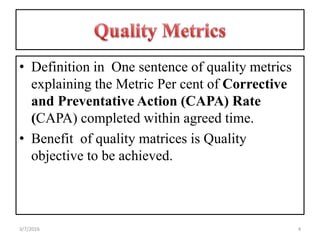
• Definition in One sentence of quality metrics
explaining the Metric Per cent of Corrective
and Preventative Action (CAPA) Rate
(CAPA) completed within agreed time.
• Benefit of quality matrices is Quality
objective to be achieved.
43/7/2016
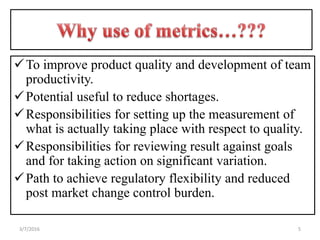
To improve product quality and development of team
productivity.
Potential useful to reduce shortages.
Responsibilities for setting up the measurement of
what is actually taking place with respect to quality.
Responsibilities for reviewing result against goals
and for taking action on significant variation.
Path to achieve regulatory flexibility and reduced
post market change control burden.
53/7/2016
What about Quality?
What about flexibility?
What about focus?
What about workload?
63/7/2016
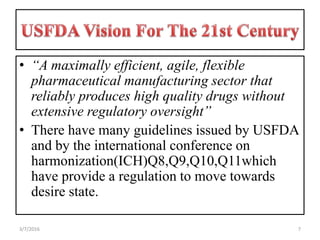
• “A maximally efficient, agile, flexible
pharmaceutical manufacturing sector that
reliably produces high quality drugs without
extensive regulatory oversight”
• There have many guidelines issued by USFDA
and by the international conference on
harmonization(ICH)Q8,Q9,Q10,Q11which
have provide a regulation to move towards
desire state.
73/7/2016
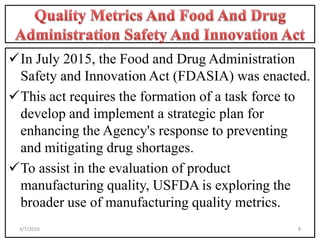
In July 2015, the Food and Drug Administration
Safety and Innovation Act (FDASIA) was enacted.
This act requires the formation of a task force to
develop and implement a strategic plan for
enhancing the Agency's response to preventing
and mitigating drug shortages.
To assist in the evaluation of product
manufacturing quality, USFDA is exploring the
broader use of manufacturing quality metrics.
83/7/2016
Risk identification – systematic use of
information to identify potential sources of harm
(hazards) referring to the risk question or problem
description [ICH Q9 ]
Enables the detection of potential problems as
early as possible to plan corrective and preventive
actions
Important in achieving problem resolution and
problem prevention
93/7/2016
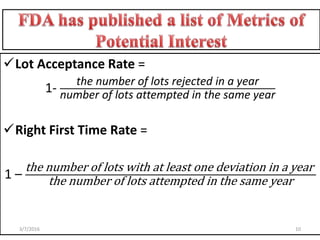
Lot Acceptance Rate =
1-
the number of lots rejected in a year
number of lots attempted in the same year
Right First Time Rate =
1 –
the number of lots with at least one deviation in a year
the number of lots attempted in the same year
103/7/2016
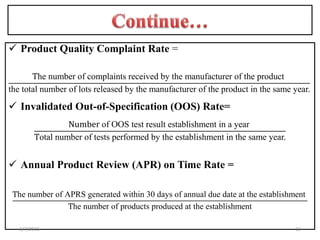
 Product Quality Complaint Rate =
The number of complaints received by the manufacturer of the product
the total number of lots released by the manufacturer of the product in the same year.
 Invalidated Out-of-Specification (OOS) Rate=
Number of OOS test result establishment in a year
Total number of tests performed by the establishment in the same year.
 Annual Product Review (APR) on Time Rate =
The number of APRS generated within 30 days of annual due date at the establishment
The number of products produced at the establishment
113/7/2016
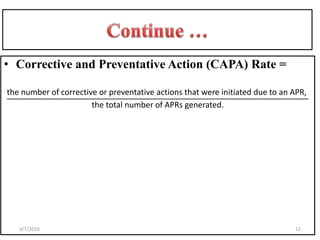
• Corrective and Preventative Action (CAPA) Rate =
the number of corrective or preventative actions that were initiated due to an APR,
the total number of APRs generated.
123/7/2016
• Management Engagement – The most senior
manager that signed each annual product
review, reported as one of the following:
(1) None specified,
(2) Line quality manager,
(3) Site operations manager, or
(4) Corporate executive manager.
133/7/2016
1. Accountability
2. Alignment.
3. Attention
4. Behaviors
5. Expectations
6. Feedback
7. Motivation
8. Problem Solving
9. Visibility
143/7/2016
• Good metrics system consists of leading and
lagging indicators.
• Lagging indicators measure the outcomes of
what already happened.
• Leading indicators provide information that
may be able to predict future outcomes.
• More mature organizations will typically have
a greater ratio of leading to lagging metrics
153/7/2016
Keep it simple
Improve the objectivity
Potential for regular flexibility
Build consensus
Promote the right behaviors ( design metrics
carefully to avoid unintended consensus)
163/7/2016
• FDA is currently evaluating feedback.
• Anticipate more information in Q2 of this year
• ISPE (International Society for Pharmaceutical
Engineering) participating in a pilot with FDA and
small subset of companies discussions to occur at
June ISPE/PDA(Personal digital assistant)
meeting.
173/7/2016
1. International conference of harmonization of
technical requirement for registration of
pharmaceutical for human use, ICH harmonization
tripartite guideline pharmaceutical development-98,
August 2009
2. Food and drug administration safety and innovation
act July 9,2012.
3. http://www.drugregulations.org
4. www.ispe.org
5. www.ich.org
183/7/2016
193/7/2016

Quality metrices

  • 1.
    Presented by Rasika .Walunj M.Pharm(III SEM) Guided by Prof.S.V. Joshi PE Society’s Modern College Of Pharmacy (For Ladies), Moshi, Pune . 412105 13/7/2016
  • 2.
    1. What isquality matrices...? 2. Why use of matrices……? 3. How does industry use Metrics..? 4. USFDA Challenges and Requirements 5. Next Steps 6. References 23/7/2016
  • 3.
    Performance of metricsare an essential element of the quality management review process. Quality metrics may include elements such as customer satisfaction, supplier performance, manufacturing defects, complaints, cycle times and many other internal or external processes. This presentation provides a framework for establishing right quality indicators for evaluating the performance of the quality system 33/7/2016
  • 4.
    • Definition inOne sentence of quality metrics explaining the Metric Per cent of Corrective and Preventative Action (CAPA) Rate (CAPA) completed within agreed time. • Benefit of quality matrices is Quality objective to be achieved. 43/7/2016
  • 5.
    To improve productquality and development of team productivity. Potential useful to reduce shortages. Responsibilities for setting up the measurement of what is actually taking place with respect to quality. Responsibilities for reviewing result against goals and for taking action on significant variation. Path to achieve regulatory flexibility and reduced post market change control burden. 53/7/2016
  • 6.
    What about Quality? Whatabout flexibility? What about focus? What about workload? 63/7/2016
  • 7.
    • “A maximallyefficient, agile, flexible pharmaceutical manufacturing sector that reliably produces high quality drugs without extensive regulatory oversight” • There have many guidelines issued by USFDA and by the international conference on harmonization(ICH)Q8,Q9,Q10,Q11which have provide a regulation to move towards desire state. 73/7/2016
  • 8.
    In July 2015,the Food and Drug Administration Safety and Innovation Act (FDASIA) was enacted. This act requires the formation of a task force to develop and implement a strategic plan for enhancing the Agency's response to preventing and mitigating drug shortages. To assist in the evaluation of product manufacturing quality, USFDA is exploring the broader use of manufacturing quality metrics. 83/7/2016
  • 9.
    Risk identification –systematic use of information to identify potential sources of harm (hazards) referring to the risk question or problem description [ICH Q9 ] Enables the detection of potential problems as early as possible to plan corrective and preventive actions Important in achieving problem resolution and problem prevention 93/7/2016
  • 10.
    Lot Acceptance Rate= 1- the number of lots rejected in a year number of lots attempted in the same year Right First Time Rate = 1 – the number of lots with at least one deviation in a year the number of lots attempted in the same year 103/7/2016
  • 11.
     Product QualityComplaint Rate = The number of complaints received by the manufacturer of the product the total number of lots released by the manufacturer of the product in the same year.  Invalidated Out-of-Specification (OOS) Rate= Number of OOS test result establishment in a year Total number of tests performed by the establishment in the same year.  Annual Product Review (APR) on Time Rate = The number of APRS generated within 30 days of annual due date at the establishment The number of products produced at the establishment 113/7/2016
  • 12.
    • Corrective andPreventative Action (CAPA) Rate = the number of corrective or preventative actions that were initiated due to an APR, the total number of APRs generated. 123/7/2016
  • 13.
    • Management Engagement– The most senior manager that signed each annual product review, reported as one of the following: (1) None specified, (2) Line quality manager, (3) Site operations manager, or (4) Corporate executive manager. 133/7/2016
  • 14.
    1. Accountability 2. Alignment. 3.Attention 4. Behaviors 5. Expectations 6. Feedback 7. Motivation 8. Problem Solving 9. Visibility 143/7/2016
  • 15.
    • Good metricssystem consists of leading and lagging indicators. • Lagging indicators measure the outcomes of what already happened. • Leading indicators provide information that may be able to predict future outcomes. • More mature organizations will typically have a greater ratio of leading to lagging metrics 153/7/2016
  • 16.
    Keep it simple Improvethe objectivity Potential for regular flexibility Build consensus Promote the right behaviors ( design metrics carefully to avoid unintended consensus) 163/7/2016
  • 17.
    • FDA iscurrently evaluating feedback. • Anticipate more information in Q2 of this year • ISPE (International Society for Pharmaceutical Engineering) participating in a pilot with FDA and small subset of companies discussions to occur at June ISPE/PDA(Personal digital assistant) meeting. 173/7/2016
  • 18.
    1. International conferenceof harmonization of technical requirement for registration of pharmaceutical for human use, ICH harmonization tripartite guideline pharmaceutical development-98, August 2009 2. Food and drug administration safety and innovation act July 9,2012. 3. http://www.drugregulations.org 4. www.ispe.org 5. www.ich.org 183/7/2016
  • 19.