LEARNING OBJECTIVES
• Introduction of Social Accounting
• Meaning and Definition of Social Accounting
• Features of Social Accounting
• Components & Presentation of Social Accounting
• Objectives of Social Accounting
• Needs/ Benefits of Social Accounting
• Scope and Measurement of Social Accounting
• Social Responsibilities of Business/ Corporate Social Responsibility
and towards different group
• Kinds, Needs, Case Against & Reality of Social Responsibilities
MEANING OF SOCIAL ACCOUNTING
The term “Social Accounting” was first introduced into Economics by
J.R. Hicks in 1942.
“The measurement and reporting, internal and external, of
information concerning the impact of an entity and its activities on
society”.
“Social Accounting is the application of double entry bookkeeping to
social economic analysis.” —Kohler.
Social Accounting / Social responsibility accounting aims to measure
and inform the general public about the social welfare activities
undertaken by an organization and its impact on the society.
FEATURES OF SOCIAL ACCOUNTING
• An expression of a company’s social responsibilities.
• Related to the use of social resources.
• Emphasize the relationship between the firm and society.

• Determines the desirability of the firm in society.
• Application of accounting on social sciences, and.
• Emphasizes social costs as well as social benefits.
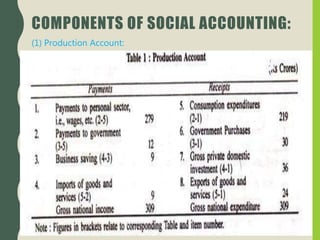
COMPONENTS OF SOCIAL ACCOUNTING:
(1) Production Account:
CONT.
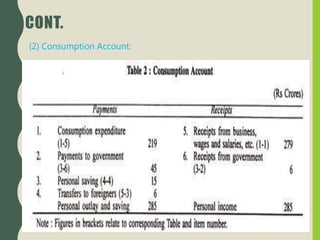
(2) Consumption Account:
CONT.
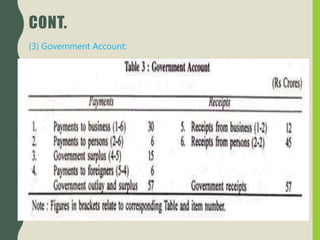
(3) Government Account:
CONT.
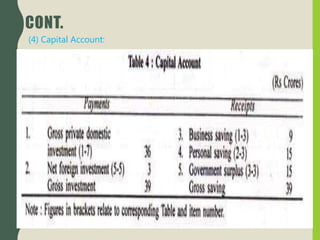
(4) Capital Account:
CONT.
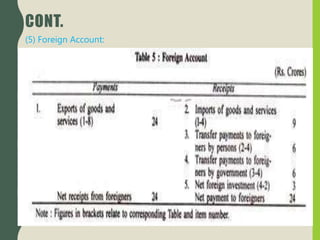
(5) Foreign Account:
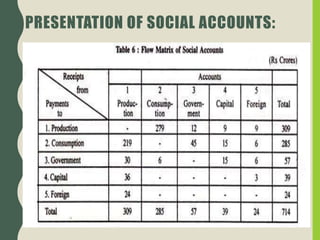
PRESENTATION OF SOCIAL ACCOUNTS:
OBJECTIVES OF SOCIAL ACCOUNTING
The objective of social accounting is to inform the general public
about social welfare measures taken by the enterprise, and their
effects on the society. How far the enterprise is successful in
fulfilling the social obligations, also comes to light through social
accounting.
The eminent objectives of social accounting are as follows :
1. To identify and measure the contribution of a firm towards the
society.
2. To determine if the firm’s strategies are consistent with social
priorities.
3. To make available, relevant information about the firm's goals,
programmes,
performances, use of scare resources.
4. To Quantify and properly present the social costs and benefits of
an enterprise.
NEED/BENEFITS OF SOCIAL ACCOUNTING
1. It improves the image of the firm.
2. It helps in marketing through greater customer support.
3. It acts as an evidence of social commitment..
4. A firm fulfills it’s social obligations and informs its members ,the govt
and the general public to enable everybody to form a correct opinion.
5. It counters the adverse publicity or criticism by hostile media.
Social responsibility information about business enterprises is mainly
useful to internal users (management), external users (shareholders and
other investors), and in influencing the share prices of a company
CONT.
• The management fulfils its social obligations and informs its
members, the government and the general public.
• The management responds through social accounting to the
criticisms leveled by hostile media and voluntary social organizations.
• There are certain legal obligations that have to be fulfilled by the
business, such as social security obligations and welfare measures etc.
• The management informs the public and government about its
efforts in this regard through social accounting.
• The management gets feedback on its efforts and policies aimed at
the welfare of the society.
• Social accounting is necessary from the view point of public interest
groups, social organizations and government bodies.
• Through social accounting the company proves itself that it is not a
society unethical in view of moral cultures and environment
degradation
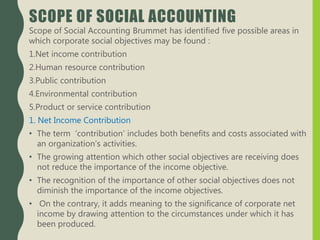
SCOPE OF SOCIAL ACCOUNTING
Scope of Social Accounting Brummet has identified five possible areas in
which corporate social objectives may be found :
1.Net income contribution
2.Human resource contribution
3.Public contribution
4.Environmental contribution
5.Product or service contribution
1. Net Income Contribution
• The term ‘contribution’ includes both benefits and costs associated with
an organization’s activities.
• The growing attention which other social objectives are receiving does
not reduce the importance of the income objective.
• The recognition of the importance of other social objectives does not
diminish the importance of the income objectives.
• On the contrary, it adds meaning to the significance of corporate net
income by drawing attention to the circumstances under which it has
been produced.
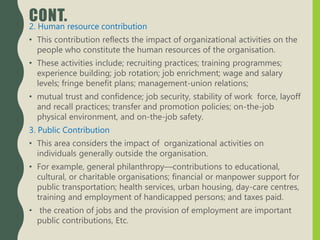
CONT.2. Human resource contribution
• This contribution reflects the impact of organizational activities on the
people who constitute the human resources of the organisation.
• These activities include; recruiting practices; training programmes;
experience building; job rotation; job enrichment; wage and salary
levels; fringe benefit plans; management-union relations;
• mutual trust and confidence; job security, stability of work force, layoff
and recall practices; transfer and promotion policies; on-the-job
physical environment, and on-the-job safety.
3. Public Contribution
• This area considers the impact of organizational activities on
individuals generally outside the organisation.
• For example, general philanthropy—contributions to educational,
cultural, or charitable organisations; financial or manpower support for
public transportation; health services, urban housing, day-care centres,
training and employment of handicapped persons; and taxes paid.
• the creation of jobs and the provision of employment are important
public contributions, Etc.
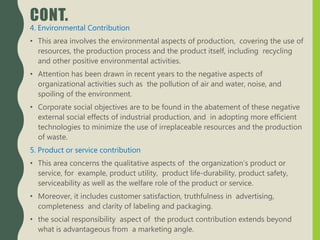
CONT.
4. Environmental Contribution
• This area involves the environmental aspects of production, covering the use of
resources, the production process and the product itself, including recycling
and other positive environmental activities.
• Attention has been drawn in recent years to the negative aspects of
organizational activities such as the pollution of air and water, noise, and
spoiling of the environment.
• Corporate social objectives are to be found in the abatement of these negative
external social effects of industrial production, and in adopting more efficient
technologies to minimize the use of irreplaceable resources and the production
of waste.
5. Product or service contribution
• This area concerns the qualitative aspects of the organization’s product or
service, for example, product utility, product life-durability, product safety,
serviceability as well as the welfare role of the product or service.
• Moreover, it includes customer satisfaction, truthfulness in advertising,
completeness and clarity of labeling and packaging.
• the social responsibility aspect of the product contribution extends beyond
what is advantageous from a marketing angle.
SOCIAL RESPONSIBILTY OF BUSINESS
Social Responsibility
“If you are in the luckiest of 1% of humanity, you owe it to the rest of
humanity to think about the other 99%,” said Warren Buffett.
Mr. Buffett understood that the purpose of any business is not only to
make a profit but also to be responsible for its actions and decisions.
Social responsibility is the duty of businesses towards society.
Businessmen must review their impact of decisions and actions on the
different sections of society.
According to Peter F Druker, “Social responsibility requires managers to
consider whether their action is likely to promote the public good, to
advance the basic beliefs of our society, to contribute to its stability,
strength and harmony.”
CORPORATE SOCIAL RESPONSIBILTY
Corporate Social Responsibility (also known as Corporate Citizenship) means the
responsibility taken by the companies or the corporates towards the betterment of
society as a whole.
Companies undertake these activities for upgradation in the lives of the people.
A large number of activities are undertaken by the companies under the umbrella
of CSR. Few of these activities are:
• To promote education in society.
• Promote training for sports.
• To promote health care and sanitation.
• To contribute during the times of natural calamities like earthquakes, droughts
and floods.
• To promote programmes and schemes for poverty alleviation, eradication of
hunger, providing safe drinking water, health care measures, rural development
programs
EX: PMCARES,PMNRF,Swach Bharat Kosh
CSR incorporated Companies are Tata, Infosys, ITC, Mahindra and Mahindra,
UltraTech Etc
CSR, (CONT.)
As per section 135 of the Companies Act, 2013, every Company,
including its holding or subsidiary whose :
"Net worth is Rs 500 crore or more" OR
"Is having a turnover of Rs 1000 crore or more" OR
"Whose Net Profit is Rs 5 crore or more",
during the immediately preceding financial year, have to contribute
towards CSR activities mandatorily.
To ensure that at least 2% of the average profits of the Company, made
during the three immediately preceding financial years are spent in CSR
Activities, in every financial year.
KINDS OF SOCIAL RESPONSIBILITIES
(i) Economic Responsibility
In an economic responsibility, business is expected to produce goods and
services that are beneficial for society and society which wants and sell
them at a profit.
(ii) Legal Responsibility
Every business enterprise is expected to operate within the legal frame
work of our society. A law abiding enterprise gets no interference of
government and is considered as a socially responsible enterprise.
(iii) Ethical Responsibilities
Ethics is much more than law, while behaving ethically businessmen should
not be involved in adulteration, black marketing, etc.
(iv) Discretionary Responsibilities
This responsibility is purely voluntary. This includes contribution in charity.
Participation in social service projects, setting up educational and training
institutions etc. helping people affected by flood, earthquake etc.
NEED FOR SOCIAL RESPONSIBILITIES
A businessman must perform social responsibilities because of the
following reasons
• (i) Self interest
• (ii) Better environment for business
• (iii) Public image
• (iv) Avoidance of government interference
• (v) Social power
• (vi) Resources used for moral justification
• (vii) Contribution to social problems
THE CASE AGAINST SOCIAL
RESPONSIBILITY
Some experts criticise the concept of social responsibility, some of
the arguments given against social responsibilities are given below
(i) Motive of earning profit
(ii) Lack of social skill
(iii) Social responsibility involves cost
(iv) Dilution of basic goal of business
(v) Business are not moral agents
(vi) Reduction in competitiveness
REALITY OF SOCIAL RESPONSIBILITY
After learning the case for and against social responsibilities, we can
conclude that business is no longer a mere economic institution but it is
also a social institution and businessmen are the trustees of different
social groups.
The main reasons and factors which have forced businessmen to
consider their responsibilities towards society
(i) Threat of public regulation
(ii) Pressure of labour movements
(iii) Impact of consumer consciousness
(iv) Development of social standard for business
(v) Relationship between social interest and business interest
(vi) Development of professional managerial Class
SOCIAL RESPONSIBILITY TOWARDS
DIFFERENT INTEREST GROUPS
(i) Responsibilities towards Consumers
(a) Production of safe items by maintaining quality standards
(b) Being truthful in advertising
(c) To follow fair trade practices.
(ii) Responsibilities towards Employee
(a) Providing fair compensation and benefits
(b) Providing good and safe working conditions
(c) To give them opportunities to participate in decision making
(iii) Responsibilities towards the Owners / Shareholders / Investors
(a) To ensure safety of investment
(b) To ensure fair and regular return on investment
(c) To ensure appreciation of investment by proper utilisation of resources
CONT.
(iv) Responsibilities towards the Government
(a) To abide by rules, regulations and laws
(b) To pay taxes and duties on time
(c) To help in solving social problem
(v) Responsibilities towards the Community
(a) To protect the environment from all types of pollution
(b) To provide more employment opportunities
(c) To help the weaker section of the society
(vi) Responsibilities towards Suppliers
(a) To ensure regular payment to the supplier
(b) To adopt fair dealing with the suppliers
(c) To protect and assist small scale suppliers by placing order with them
MEASUREMENT OF SOCIAL ACCOUNTING
Main problem which is being faced by business enterprises is to
measure social benefits and social costs. It is a practical problem
being faced by all of reporting entities.
For example how damage of air and water is to be shown in social
impact statement, how to evaluate social cost arisen due to external
and internal discrimination. Number of methods has been suggested
for measurement some of them are discussed as under.
1. Surrogate Valuation:
• The first method available with us to determine surrogate values of
social cost and social benefits for example an enterprise has a big
hall and suppose if that hall facility is donated to some cultural
organisation for holding one cultural event in that hall.
• In this case a surrogate value can be determined on the basis of the
amount of rent; cultural organisation would have to pay if they
rented same hall facilities somewhere else.
CONT.
2. Survey Techniques
• In this approach is to do a survey for the same item about the worth of
the item to different individuals.
• A special care must be taken while using this technique. The individual
must have clear cut understanding of impact on him of the item for
which valuation is to be done.
• That individual must have ability to relate that impact to monetary units
may be either directly or indirectly and he must be willing to give
truthful reply to the questions set in the survey being conducted.
3. Restoration or Avoidance Cost
• Some of the social costs can be valued by determining the monetary
value to prevent the particular damage.
• For example A delivery van is damaged from roads during monsoon
season. This damage can be avoided if proper care is taken.
• Suppose damages to delivery van due to damage road are Rs 6,000 but
the cost of preventive measure would have been only Rs 4,000.
Therefore Rs 2,000 is the value to be assigned to that social cost.
CONT.
4. Appraisal Value:
For valuation of certain goods and building, an independent appraisal
value can be useful and helpful. This is done by experts by estimating
market value of those items.
5. Analysis
Many times an economic and statistical analysis of available data
produces a valid and reliable measure of value. Estimates of the
increased earnings value of education have relied on present value
analysis of comparative earnings rates and life expectancies.
REFERENCES
• Shodaganga.Inflibnet.ac.in
• Lovely professional University, KK Varma Contemporary Accounting
2012
• S. N. Maheshwari, Vikasa publishers Adavanced Accounts volume-II
• Www.Researchgate.net ( Research Articles)
• Volume 6 Issue II, February 2018- Available at www.ijraset.com
• Sustainability ISSN 2071-1050 www.mdpi.com/journal/sustainability
• Business and The Environment with ISO 14000 Updates. (2007), Vol.
18 Issue 7. CERES.(2002)
• Www. Scrip.org/ journal/ Ojacct ( open journal accounting)
• UGC NTA, ICAI, Study Materials
• e PGpatashala.inflibnet. ac. In
HAPPY LEARNING
THANK YOU

Corporate Social Accounting-1

  • 3.
    LEARNING OBJECTIVES • Introductionof Social Accounting • Meaning and Definition of Social Accounting • Features of Social Accounting • Components & Presentation of Social Accounting • Objectives of Social Accounting • Needs/ Benefits of Social Accounting • Scope and Measurement of Social Accounting • Social Responsibilities of Business/ Corporate Social Responsibility and towards different group • Kinds, Needs, Case Against & Reality of Social Responsibilities
  • 4.
    MEANING OF SOCIALACCOUNTING The term “Social Accounting” was first introduced into Economics by J.R. Hicks in 1942. “The measurement and reporting, internal and external, of information concerning the impact of an entity and its activities on society”. “Social Accounting is the application of double entry bookkeeping to social economic analysis.” —Kohler. Social Accounting / Social responsibility accounting aims to measure and inform the general public about the social welfare activities undertaken by an organization and its impact on the society.
  • 5.
    FEATURES OF SOCIALACCOUNTING • An expression of a company’s social responsibilities. • Related to the use of social resources. • Emphasize the relationship between the firm and society. • Determines the desirability of the firm in society. • Application of accounting on social sciences, and. • Emphasizes social costs as well as social benefits.
  • 6.
    COMPONENTS OF SOCIALACCOUNTING: (1) Production Account:
  • 7.
  • 8.
  • 9.
  • 10.
  • 11.
  • 12.
    OBJECTIVES OF SOCIALACCOUNTING The objective of social accounting is to inform the general public about social welfare measures taken by the enterprise, and their effects on the society. How far the enterprise is successful in fulfilling the social obligations, also comes to light through social accounting. The eminent objectives of social accounting are as follows : 1. To identify and measure the contribution of a firm towards the society. 2. To determine if the firm’s strategies are consistent with social priorities. 3. To make available, relevant information about the firm's goals, programmes, performances, use of scare resources. 4. To Quantify and properly present the social costs and benefits of an enterprise.
  • 13.
    NEED/BENEFITS OF SOCIALACCOUNTING 1. It improves the image of the firm. 2. It helps in marketing through greater customer support. 3. It acts as an evidence of social commitment.. 4. A firm fulfills it’s social obligations and informs its members ,the govt and the general public to enable everybody to form a correct opinion. 5. It counters the adverse publicity or criticism by hostile media. Social responsibility information about business enterprises is mainly useful to internal users (management), external users (shareholders and other investors), and in influencing the share prices of a company
  • 14.
    CONT. • The managementfulfils its social obligations and informs its members, the government and the general public. • The management responds through social accounting to the criticisms leveled by hostile media and voluntary social organizations. • There are certain legal obligations that have to be fulfilled by the business, such as social security obligations and welfare measures etc. • The management informs the public and government about its efforts in this regard through social accounting. • The management gets feedback on its efforts and policies aimed at the welfare of the society. • Social accounting is necessary from the view point of public interest groups, social organizations and government bodies. • Through social accounting the company proves itself that it is not a society unethical in view of moral cultures and environment degradation
  • 15.
    SCOPE OF SOCIALACCOUNTING Scope of Social Accounting Brummet has identified five possible areas in which corporate social objectives may be found : 1.Net income contribution 2.Human resource contribution 3.Public contribution 4.Environmental contribution 5.Product or service contribution 1. Net Income Contribution • The term ‘contribution’ includes both benefits and costs associated with an organization’s activities. • The growing attention which other social objectives are receiving does not reduce the importance of the income objective. • The recognition of the importance of other social objectives does not diminish the importance of the income objectives. • On the contrary, it adds meaning to the significance of corporate net income by drawing attention to the circumstances under which it has been produced.
  • 16.
    CONT.2. Human resourcecontribution • This contribution reflects the impact of organizational activities on the people who constitute the human resources of the organisation. • These activities include; recruiting practices; training programmes; experience building; job rotation; job enrichment; wage and salary levels; fringe benefit plans; management-union relations; • mutual trust and confidence; job security, stability of work force, layoff and recall practices; transfer and promotion policies; on-the-job physical environment, and on-the-job safety. 3. Public Contribution • This area considers the impact of organizational activities on individuals generally outside the organisation. • For example, general philanthropy—contributions to educational, cultural, or charitable organisations; financial or manpower support for public transportation; health services, urban housing, day-care centres, training and employment of handicapped persons; and taxes paid. • the creation of jobs and the provision of employment are important public contributions, Etc.
  • 17.
    CONT. 4. Environmental Contribution •This area involves the environmental aspects of production, covering the use of resources, the production process and the product itself, including recycling and other positive environmental activities. • Attention has been drawn in recent years to the negative aspects of organizational activities such as the pollution of air and water, noise, and spoiling of the environment. • Corporate social objectives are to be found in the abatement of these negative external social effects of industrial production, and in adopting more efficient technologies to minimize the use of irreplaceable resources and the production of waste. 5. Product or service contribution • This area concerns the qualitative aspects of the organization’s product or service, for example, product utility, product life-durability, product safety, serviceability as well as the welfare role of the product or service. • Moreover, it includes customer satisfaction, truthfulness in advertising, completeness and clarity of labeling and packaging. • the social responsibility aspect of the product contribution extends beyond what is advantageous from a marketing angle.
  • 18.
    SOCIAL RESPONSIBILTY OFBUSINESS Social Responsibility “If you are in the luckiest of 1% of humanity, you owe it to the rest of humanity to think about the other 99%,” said Warren Buffett. Mr. Buffett understood that the purpose of any business is not only to make a profit but also to be responsible for its actions and decisions. Social responsibility is the duty of businesses towards society. Businessmen must review their impact of decisions and actions on the different sections of society. According to Peter F Druker, “Social responsibility requires managers to consider whether their action is likely to promote the public good, to advance the basic beliefs of our society, to contribute to its stability, strength and harmony.”
  • 19.
    CORPORATE SOCIAL RESPONSIBILTY CorporateSocial Responsibility (also known as Corporate Citizenship) means the responsibility taken by the companies or the corporates towards the betterment of society as a whole. Companies undertake these activities for upgradation in the lives of the people. A large number of activities are undertaken by the companies under the umbrella of CSR. Few of these activities are: • To promote education in society. • Promote training for sports. • To promote health care and sanitation. • To contribute during the times of natural calamities like earthquakes, droughts and floods. • To promote programmes and schemes for poverty alleviation, eradication of hunger, providing safe drinking water, health care measures, rural development programs EX: PMCARES,PMNRF,Swach Bharat Kosh CSR incorporated Companies are Tata, Infosys, ITC, Mahindra and Mahindra, UltraTech Etc
  • 20.
    CSR, (CONT.) As persection 135 of the Companies Act, 2013, every Company, including its holding or subsidiary whose : "Net worth is Rs 500 crore or more" OR "Is having a turnover of Rs 1000 crore or more" OR "Whose Net Profit is Rs 5 crore or more", during the immediately preceding financial year, have to contribute towards CSR activities mandatorily. To ensure that at least 2% of the average profits of the Company, made during the three immediately preceding financial years are spent in CSR Activities, in every financial year.
  • 21.
    KINDS OF SOCIALRESPONSIBILITIES (i) Economic Responsibility In an economic responsibility, business is expected to produce goods and services that are beneficial for society and society which wants and sell them at a profit. (ii) Legal Responsibility Every business enterprise is expected to operate within the legal frame work of our society. A law abiding enterprise gets no interference of government and is considered as a socially responsible enterprise. (iii) Ethical Responsibilities Ethics is much more than law, while behaving ethically businessmen should not be involved in adulteration, black marketing, etc. (iv) Discretionary Responsibilities This responsibility is purely voluntary. This includes contribution in charity. Participation in social service projects, setting up educational and training institutions etc. helping people affected by flood, earthquake etc.
  • 22.
    NEED FOR SOCIALRESPONSIBILITIES A businessman must perform social responsibilities because of the following reasons • (i) Self interest • (ii) Better environment for business • (iii) Public image • (iv) Avoidance of government interference • (v) Social power • (vi) Resources used for moral justification • (vii) Contribution to social problems
  • 23.
    THE CASE AGAINSTSOCIAL RESPONSIBILITY Some experts criticise the concept of social responsibility, some of the arguments given against social responsibilities are given below (i) Motive of earning profit (ii) Lack of social skill (iii) Social responsibility involves cost (iv) Dilution of basic goal of business (v) Business are not moral agents (vi) Reduction in competitiveness
  • 24.
    REALITY OF SOCIALRESPONSIBILITY After learning the case for and against social responsibilities, we can conclude that business is no longer a mere economic institution but it is also a social institution and businessmen are the trustees of different social groups. The main reasons and factors which have forced businessmen to consider their responsibilities towards society (i) Threat of public regulation (ii) Pressure of labour movements (iii) Impact of consumer consciousness (iv) Development of social standard for business (v) Relationship between social interest and business interest (vi) Development of professional managerial Class
  • 25.
    SOCIAL RESPONSIBILITY TOWARDS DIFFERENTINTEREST GROUPS (i) Responsibilities towards Consumers (a) Production of safe items by maintaining quality standards (b) Being truthful in advertising (c) To follow fair trade practices. (ii) Responsibilities towards Employee (a) Providing fair compensation and benefits (b) Providing good and safe working conditions (c) To give them opportunities to participate in decision making (iii) Responsibilities towards the Owners / Shareholders / Investors (a) To ensure safety of investment (b) To ensure fair and regular return on investment (c) To ensure appreciation of investment by proper utilisation of resources
  • 26.
    CONT. (iv) Responsibilities towardsthe Government (a) To abide by rules, regulations and laws (b) To pay taxes and duties on time (c) To help in solving social problem (v) Responsibilities towards the Community (a) To protect the environment from all types of pollution (b) To provide more employment opportunities (c) To help the weaker section of the society (vi) Responsibilities towards Suppliers (a) To ensure regular payment to the supplier (b) To adopt fair dealing with the suppliers (c) To protect and assist small scale suppliers by placing order with them
  • 27.
    MEASUREMENT OF SOCIALACCOUNTING Main problem which is being faced by business enterprises is to measure social benefits and social costs. It is a practical problem being faced by all of reporting entities. For example how damage of air and water is to be shown in social impact statement, how to evaluate social cost arisen due to external and internal discrimination. Number of methods has been suggested for measurement some of them are discussed as under. 1. Surrogate Valuation: • The first method available with us to determine surrogate values of social cost and social benefits for example an enterprise has a big hall and suppose if that hall facility is donated to some cultural organisation for holding one cultural event in that hall. • In this case a surrogate value can be determined on the basis of the amount of rent; cultural organisation would have to pay if they rented same hall facilities somewhere else.
  • 28.
    CONT. 2. Survey Techniques •In this approach is to do a survey for the same item about the worth of the item to different individuals. • A special care must be taken while using this technique. The individual must have clear cut understanding of impact on him of the item for which valuation is to be done. • That individual must have ability to relate that impact to monetary units may be either directly or indirectly and he must be willing to give truthful reply to the questions set in the survey being conducted. 3. Restoration or Avoidance Cost • Some of the social costs can be valued by determining the monetary value to prevent the particular damage. • For example A delivery van is damaged from roads during monsoon season. This damage can be avoided if proper care is taken. • Suppose damages to delivery van due to damage road are Rs 6,000 but the cost of preventive measure would have been only Rs 4,000. Therefore Rs 2,000 is the value to be assigned to that social cost.
  • 29.
    CONT. 4. Appraisal Value: Forvaluation of certain goods and building, an independent appraisal value can be useful and helpful. This is done by experts by estimating market value of those items. 5. Analysis Many times an economic and statistical analysis of available data produces a valid and reliable measure of value. Estimates of the increased earnings value of education have relied on present value analysis of comparative earnings rates and life expectancies.
  • 30.
    REFERENCES • Shodaganga.Inflibnet.ac.in • Lovelyprofessional University, KK Varma Contemporary Accounting 2012 • S. N. Maheshwari, Vikasa publishers Adavanced Accounts volume-II • Www.Researchgate.net ( Research Articles) • Volume 6 Issue II, February 2018- Available at www.ijraset.com • Sustainability ISSN 2071-1050 www.mdpi.com/journal/sustainability • Business and The Environment with ISO 14000 Updates. (2007), Vol. 18 Issue 7. CERES.(2002) • Www. Scrip.org/ journal/ Ojacct ( open journal accounting) • UGC NTA, ICAI, Study Materials • e PGpatashala.inflibnet. ac. In
  • 31.