LESSON 5
Corporate social responsibility
“The fundamental idea of corporate social responsibility is that business
corporations have an obligation to work for social betterment
. The Classical View
passage from Capitalism and Freedom
In such an economy, there is one and only one social responsibility of
business - to use its resources and engage in activities designed to increase
its profits so long as its stays within the rules of the game, which is to say,
engages in open and free competition without deception or fraud.
Peter Drucker -Business have a role in society which is "to supply goods and
services to customers and an economic surplus to society...rather than to supply
jobs to workers and managers, or even dividends to shareholders"
" The Contemporary View
The contemporary view is that business, as important and influential members of
society, are responsible to help maintain and improve the society's overall welfare.
Kenneth Dayton argues, that:
“To maintain that business must change its priorities. We are not in
business to make maximum profit for our shareholders. We are in business
for only one reason - to serve society. Profit is our reward for doing it well.
If business does not serve society, society will not tolerate our profits or
even our existence”.
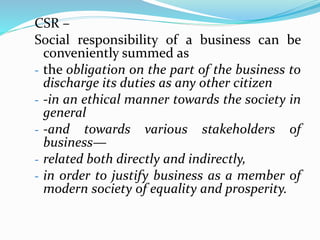
CSR –
Social responsibility of a business can be
conveniently summed as
- the obligation on the part of the business to
discharge its duties as any other citizen
- -in an ethical manner towards the society in
general
- -and towards various stakeholders of
business—
- related both directly and indirectly,
- in order to justify business as a member of
modern society of equality and prosperity.
A Heap of used Water Bottles
CSR and accountability to
stakeholders
Business enterprises are primarily accountable to six
major interest groups:
These groups are also known as stakeholders
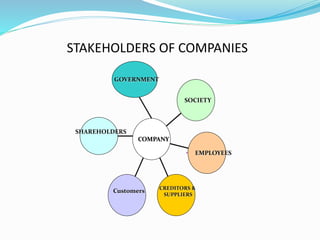
STAKEHOLDERS OF COMPANIES
SHAREHOLDERS
Customers CREDITORS &
SUPPLIERS
• EMPLOYEES
SOCIETY
GOVERNMENT
COMPANY
CSR and accountability to stakeholders
Shareholders
 The primary responsibility of a business
 to protect the interests of its shareholders.
 To use the capital properly and operate the business in a way that
ensures a good return on their investment (through dividends and
through increase in stock value)
 adequate and timely information about the functioning of the
organization.

 Employees
 it is the management's responsibility
 to protect the interest of workers in the organization.
 Laws and government regulations now define the responsibilities of
the employer:
 ensuring equal employment for men and women,
 offering pensions and other retirement benefits,
 providing a safe and healthy work environment
Customers
 Customers should be
 charged a fair and reasonable price.
 uniform standard and of reasonable quality.
 The distribution be widespread so that customers do not face any
problems in procuring them.
 Unethical practices like profiteering, hoarding, or creating artificial
scarcity should be avoided.
 should not mislead the customers by false, misleading and exaggerated
advertisements
 Creditors and Suppliers
 Creditors and suppliers are responsible for providing inputs for
production process in the form of raw materials and capital.
 Management is responsible for fulfilling its obligations to its creditors
and suppliers.
 Creating a long-term and healthy business relationship with them.
 Making prompt payments to creditors and suppliers
.
Society
 The management of business organizations can fulfill their
obligations toward society
 by preserving and enhancing the well-being of the
members of society.
 establishing development programmers for the benefit
of economically weaker sections of society like providing
basic amenities, healthcare and education facilities, creating
better living conditions.
Government
 The government of a country provides the basic facilities
required for the survival and growth of businesses.
 Be law-abiding.
Pay taxes and other dues fully, timely and honestly.
 Not to bribe government servants to obtain favors for the
company.
 Not try to use political influence in its favor.
 Social responsiveness (SR) is the ability of an organization to relate its
operations and policies to the social environment in ways that are mutually
beneficial to the company and to society .
 The various categories for measuring the social responsiveness of
organizations.
 Companies make direct financial contributions to charitable and civic
(PUBLIC OR COMMUNITY) projects
 fund-raising for a social cause, either by the organization itself or by
assisting voluntary social organizations in fund-raising.
 Volunteerism refers to the involvement of employees in civic activities.
 To conserve the environment, materials like plastic, paper etc. should be
recycled into useful products.
 Often, companies make direct investments to provide facilities for a
locality or a community.
 Pollution is a major problem. Increasing public awareness and government
pressure have made corporations more environment conscious.
Measuring Social Responsibility
Corporate Social Responsibility-Strategies:

 1. Proactive Strategy: Take initiative in social programs(procative)
 Meet economical, legal, ethical and discretionary responsibilities

 2. Accommodative Strategy: Do what is ethically required
 Meet economic, legal and ethical responsibilities

 3. Defensive Strategy: Do minimum legally required
 Meet economical and legal responsibilities

 4. Obstructional Strategy: Avoids CSR; in fact opposes the business
role in CSR and reflects mainly economic priorities.
 Fight social demands but meet economic responsibilities
Do you know that….
• A paper company manufactures paper from waste cloth to reduce the use of
pulp from trees
• An FMCG company is working to protect and conserve endangered plant
species in India through re-forestation programmes
• A construction company (in Mumbai) posted a 60 % profit in 2010 amounting
to Rs.1400 cr. and did not do any activity to benefit society
• A power generating company is the highest CO2 emitter in Asia
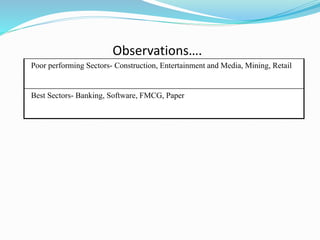
Observations….
Poor performing Sectors- Construction, Entertainment and Media, Mining, Retail
Best Sectors- Banking, Software, FMCG, Paper
Lesson 5
Lesson 5

Lesson 5

  • 1.
  • 3.
    “The fundamental ideaof corporate social responsibility is that business corporations have an obligation to work for social betterment . The Classical View passage from Capitalism and Freedom In such an economy, there is one and only one social responsibility of business - to use its resources and engage in activities designed to increase its profits so long as its stays within the rules of the game, which is to say, engages in open and free competition without deception or fraud. Peter Drucker -Business have a role in society which is "to supply goods and services to customers and an economic surplus to society...rather than to supply jobs to workers and managers, or even dividends to shareholders" " The Contemporary View The contemporary view is that business, as important and influential members of society, are responsible to help maintain and improve the society's overall welfare. Kenneth Dayton argues, that: “To maintain that business must change its priorities. We are not in business to make maximum profit for our shareholders. We are in business for only one reason - to serve society. Profit is our reward for doing it well. If business does not serve society, society will not tolerate our profits or even our existence”.
  • 5.
    CSR – Social responsibilityof a business can be conveniently summed as - the obligation on the part of the business to discharge its duties as any other citizen - -in an ethical manner towards the society in general - -and towards various stakeholders of business— - related both directly and indirectly, - in order to justify business as a member of modern society of equality and prosperity.
  • 8.
    A Heap ofused Water Bottles
  • 9.
    CSR and accountabilityto stakeholders Business enterprises are primarily accountable to six major interest groups: These groups are also known as stakeholders
  • 10.
    STAKEHOLDERS OF COMPANIES SHAREHOLDERS CustomersCREDITORS & SUPPLIERS • EMPLOYEES SOCIETY GOVERNMENT COMPANY
  • 11.
    CSR and accountabilityto stakeholders Shareholders  The primary responsibility of a business  to protect the interests of its shareholders.  To use the capital properly and operate the business in a way that ensures a good return on their investment (through dividends and through increase in stock value)  adequate and timely information about the functioning of the organization.   Employees  it is the management's responsibility  to protect the interest of workers in the organization.  Laws and government regulations now define the responsibilities of the employer:  ensuring equal employment for men and women,  offering pensions and other retirement benefits,  providing a safe and healthy work environment
  • 12.
    Customers  Customers shouldbe  charged a fair and reasonable price.  uniform standard and of reasonable quality.  The distribution be widespread so that customers do not face any problems in procuring them.  Unethical practices like profiteering, hoarding, or creating artificial scarcity should be avoided.  should not mislead the customers by false, misleading and exaggerated advertisements  Creditors and Suppliers  Creditors and suppliers are responsible for providing inputs for production process in the form of raw materials and capital.  Management is responsible for fulfilling its obligations to its creditors and suppliers.  Creating a long-term and healthy business relationship with them.  Making prompt payments to creditors and suppliers
  • 13.
    . Society  The managementof business organizations can fulfill their obligations toward society  by preserving and enhancing the well-being of the members of society.  establishing development programmers for the benefit of economically weaker sections of society like providing basic amenities, healthcare and education facilities, creating better living conditions. Government  The government of a country provides the basic facilities required for the survival and growth of businesses.  Be law-abiding. Pay taxes and other dues fully, timely and honestly.  Not to bribe government servants to obtain favors for the company.  Not try to use political influence in its favor.
  • 14.
     Social responsiveness(SR) is the ability of an organization to relate its operations and policies to the social environment in ways that are mutually beneficial to the company and to society .  The various categories for measuring the social responsiveness of organizations.  Companies make direct financial contributions to charitable and civic (PUBLIC OR COMMUNITY) projects  fund-raising for a social cause, either by the organization itself or by assisting voluntary social organizations in fund-raising.  Volunteerism refers to the involvement of employees in civic activities.  To conserve the environment, materials like plastic, paper etc. should be recycled into useful products.  Often, companies make direct investments to provide facilities for a locality or a community.  Pollution is a major problem. Increasing public awareness and government pressure have made corporations more environment conscious. Measuring Social Responsibility
  • 15.
    Corporate Social Responsibility-Strategies:  1. Proactive Strategy: Take initiative in social programs(procative)  Meet economical, legal, ethical and discretionary responsibilities   2. Accommodative Strategy: Do what is ethically required  Meet economic, legal and ethical responsibilities   3. Defensive Strategy: Do minimum legally required  Meet economical and legal responsibilities   4. Obstructional Strategy: Avoids CSR; in fact opposes the business role in CSR and reflects mainly economic priorities.  Fight social demands but meet economic responsibilities
  • 16.
    Do you knowthat…. • A paper company manufactures paper from waste cloth to reduce the use of pulp from trees • An FMCG company is working to protect and conserve endangered plant species in India through re-forestation programmes • A construction company (in Mumbai) posted a 60 % profit in 2010 amounting to Rs.1400 cr. and did not do any activity to benefit society • A power generating company is the highest CO2 emitter in Asia
  • 17.
    Observations…. Poor performing Sectors-Construction, Entertainment and Media, Mining, Retail Best Sectors- Banking, Software, FMCG, Paper