CHALLENGES FOR
CORPORATE COMMUNICATIONS
IN THE DIGTAL AGE
PROF. DR. ANSGAR ZERFASS
CONTENT STRATEGY FORUM CONFERENCE 2014
What I would like to
share with you today.
A simple question.
Some empirical insights.
The big picture.
Inspirations for thoughts and discussions.
A simple question.
1
Why should a corporation
invest into communication
and content?
Why should a corporation invest
into communication and content?
Strategic communication
“… the purposeful use of communication by an organization
to fulfill its mission” (Hallahan et al., 2007)
However:
§  Communicate with whom? How? How much?
§  To which specific end?
§  Who shall take care, with which responsibilities?
§  Why produce content, if you are specialized in other goods?
Communication spendings reduce cash flow and revenues.
But most results are long-term and immaterial;
they do not enter the balance sheet and cannot be depreciated.
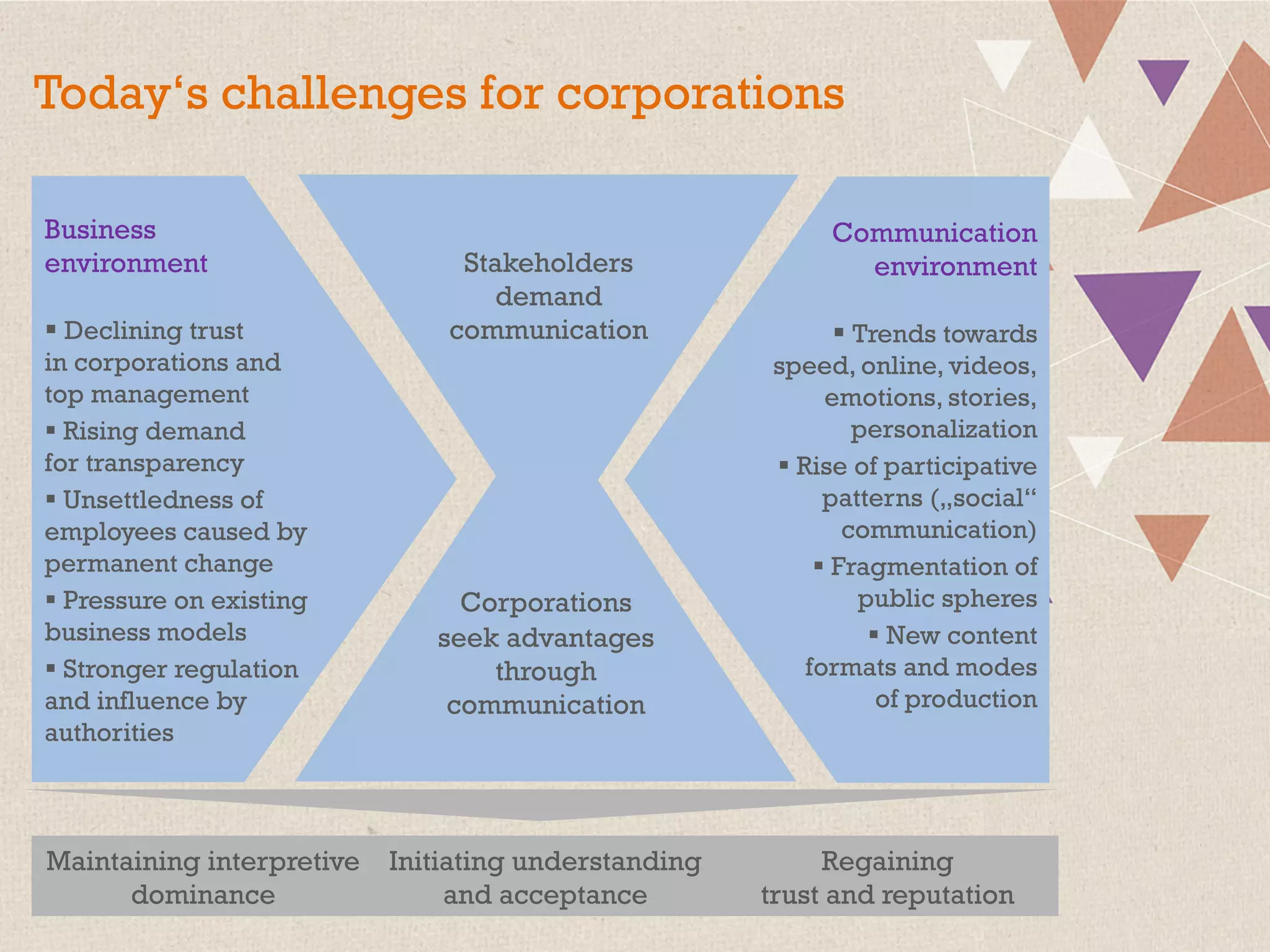
Today‘s challenges for corporations
Business
environment
§ Declining trust
in corporations and
top management
§ Rising demand
for transparency
§ Unsettledness of
employees caused by
permanent change
§ Pressure on existing
business models
§ Stronger regulation
and influence by
authorities
Communication
environment
§ Trends towards
speed, online, videos,
emotions, stories,
personalization
§ Rise of participative
patterns („social“
communication)
§ Fragmentation of
public spheres
§ New content
formats and modes
of production
"
"
"
Stakeholders
demand
communication
"
"
"
"
Corporations
seek advantages
through
communication
Maintaining interpretive
dominance
Initiating understanding
and acceptance
Regaining
trust and reputation
The wrong answer.
2
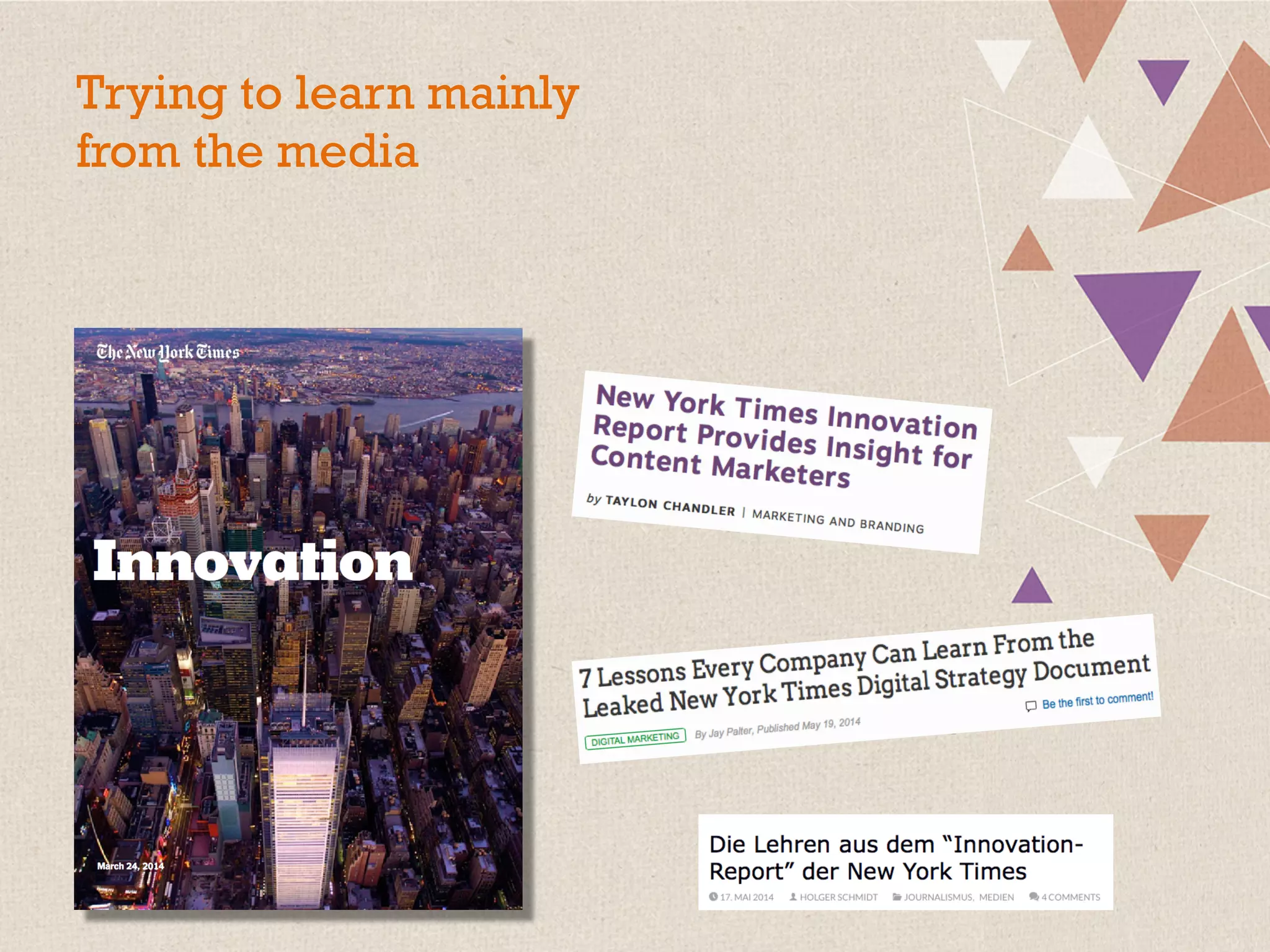
Trying to learn mainly
from the media
Empirical insights.
3
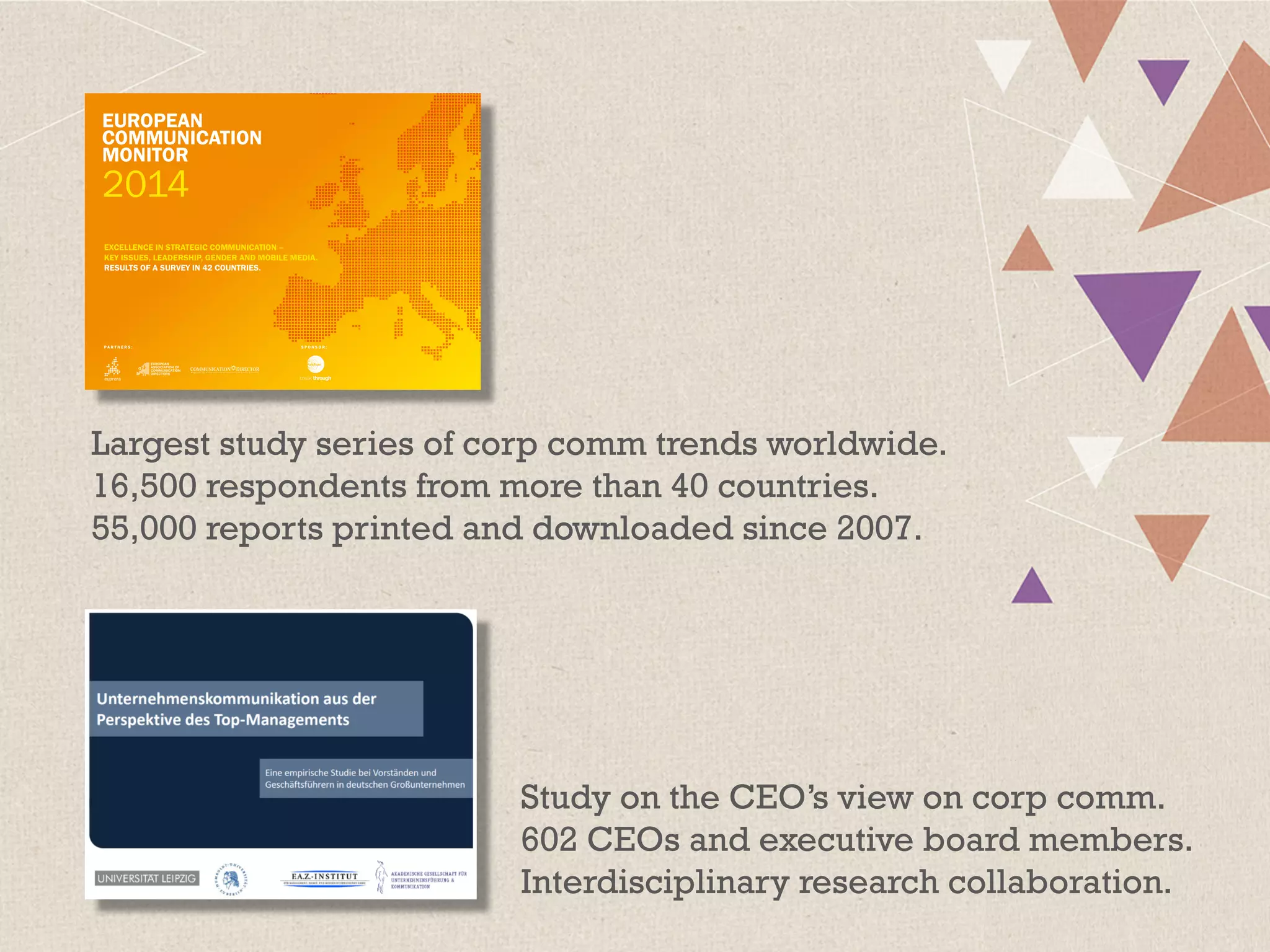
Largest study series of corp comm trends worldwide.
16,500 respondents from more than 40 countries.
55,000 reports printed and downloaded since 2007.
Study on the CEO’s view on corp comm.
602 CEOs and executive board members.
Interdisciplinary research collaboration.
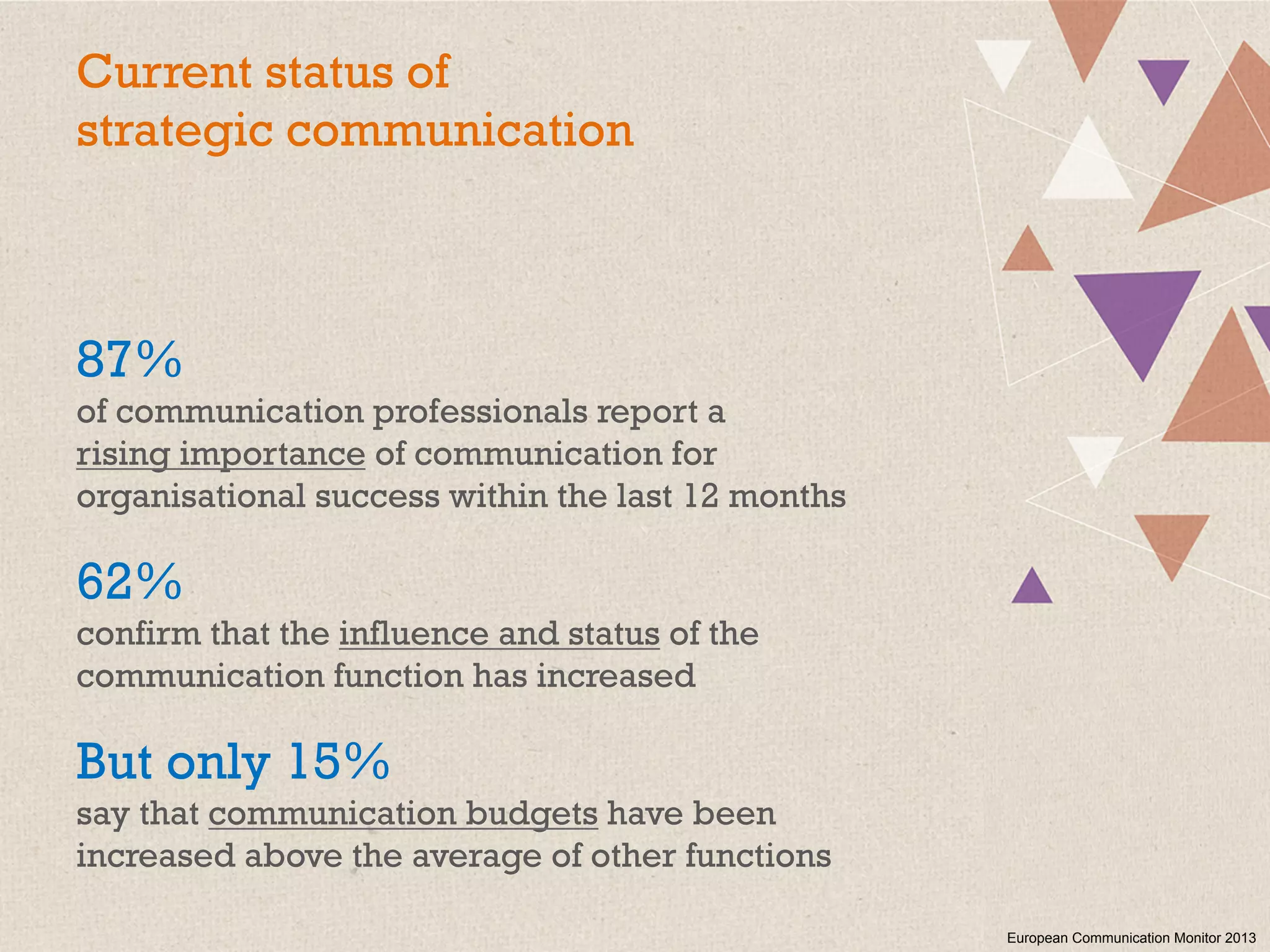
Current status of
strategic communication
87%
of communication professionals report a
rising importance of communication for
organisational success within the last 12 months
62%
confirm that the influence and status of the
communication function has increased
But only 15%
say that communication budgets have been
increased above the average of other functions
European Communication Monitor 2013
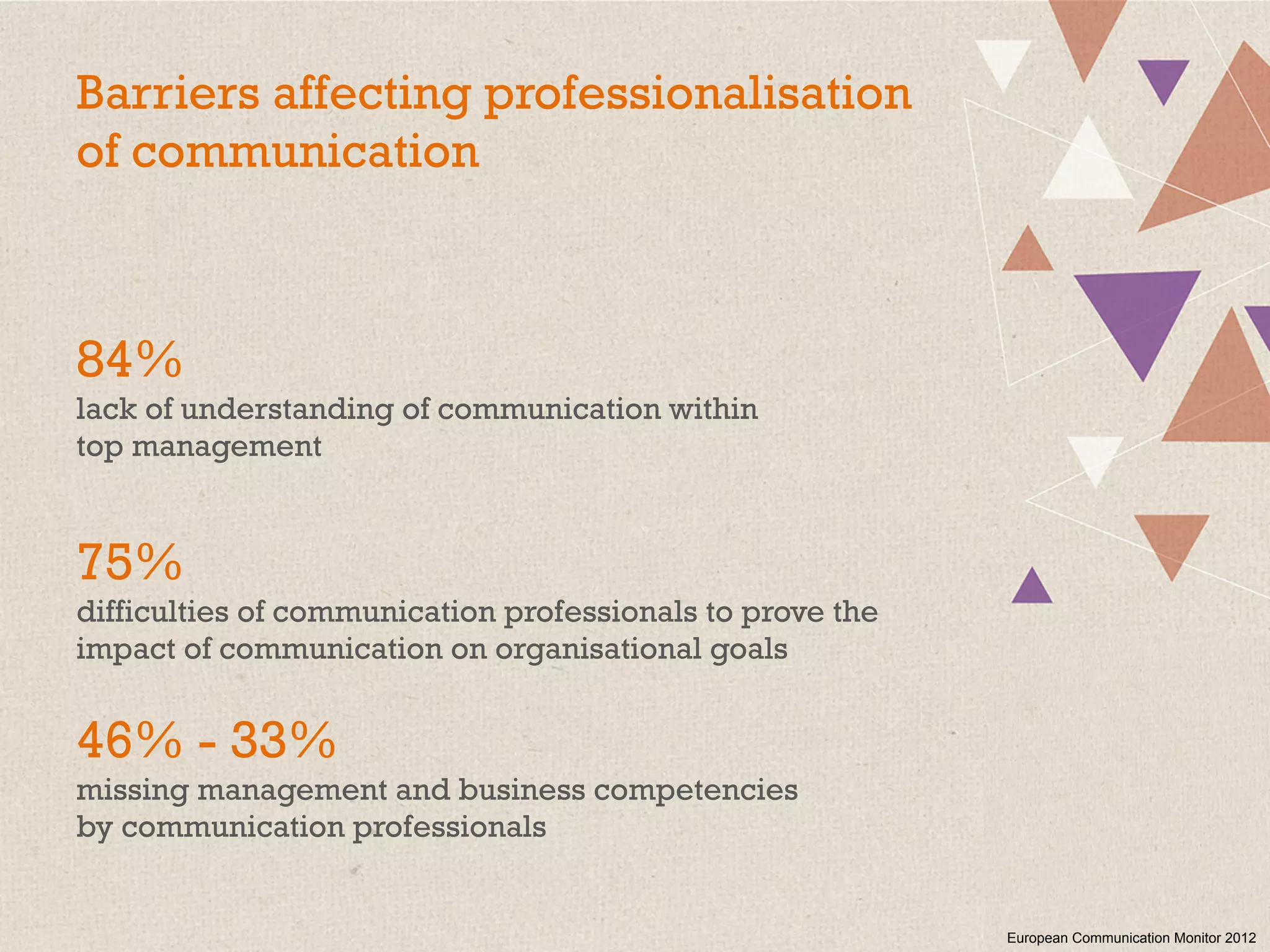
Barriers affecting professionalisation
of communication
84%
lack of understanding of communication within
top management
75%
difficulties of communication professionals to prove the
impact of communication on organisational goals
46% - 33%
missing management and business competencies
by communication professionals
European Communication Monitor 2012
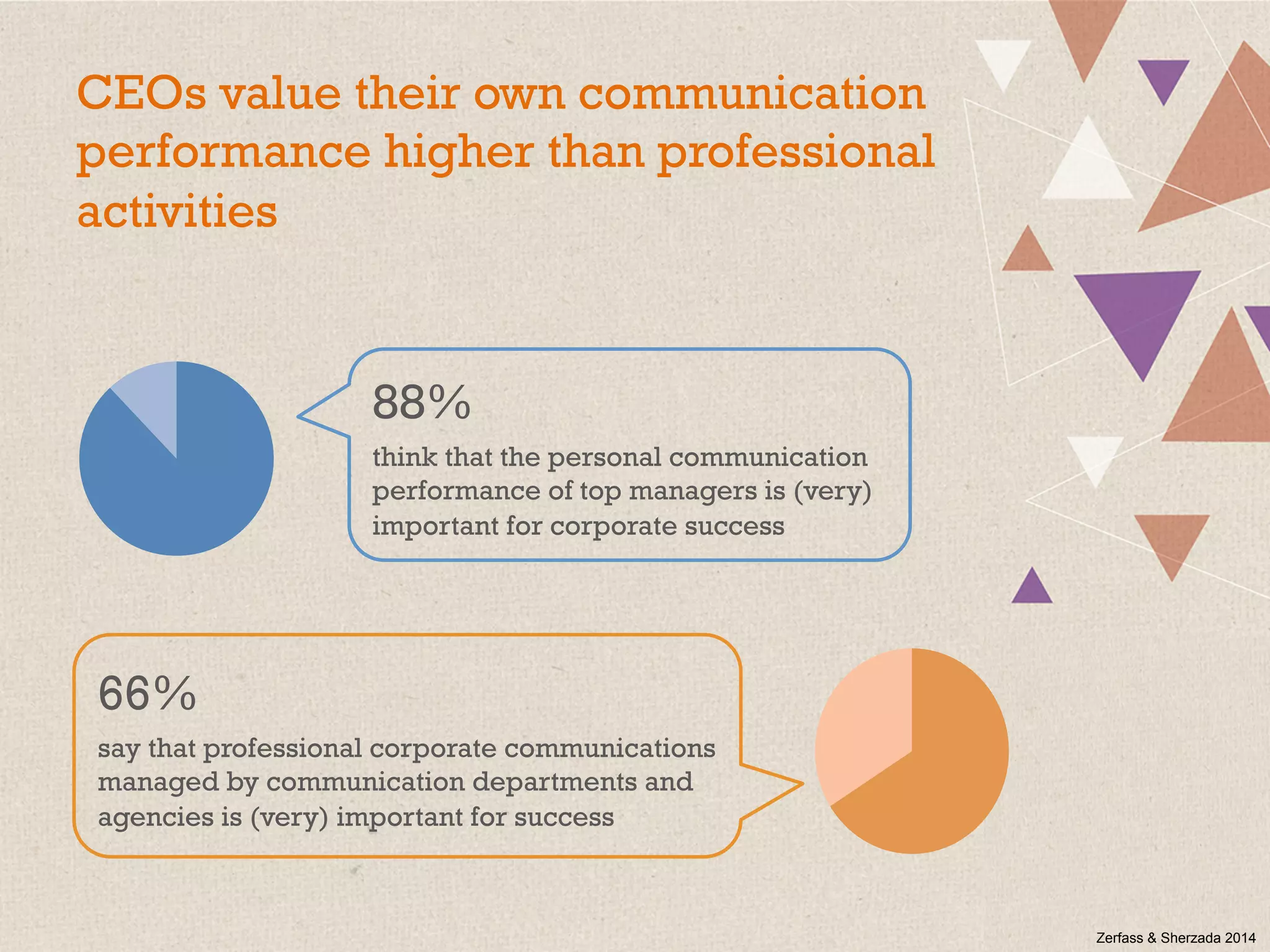
CEOs value their own communication
performance higher than professional
activities
66%"
say that professional corporate communications
managed by communication departments and
agencies is (very) important for success
88%"
think that the personal communication
performance of top managers is (very)
important for corporate success
Zerfass & Sherzada 2014
Reasons why.
4
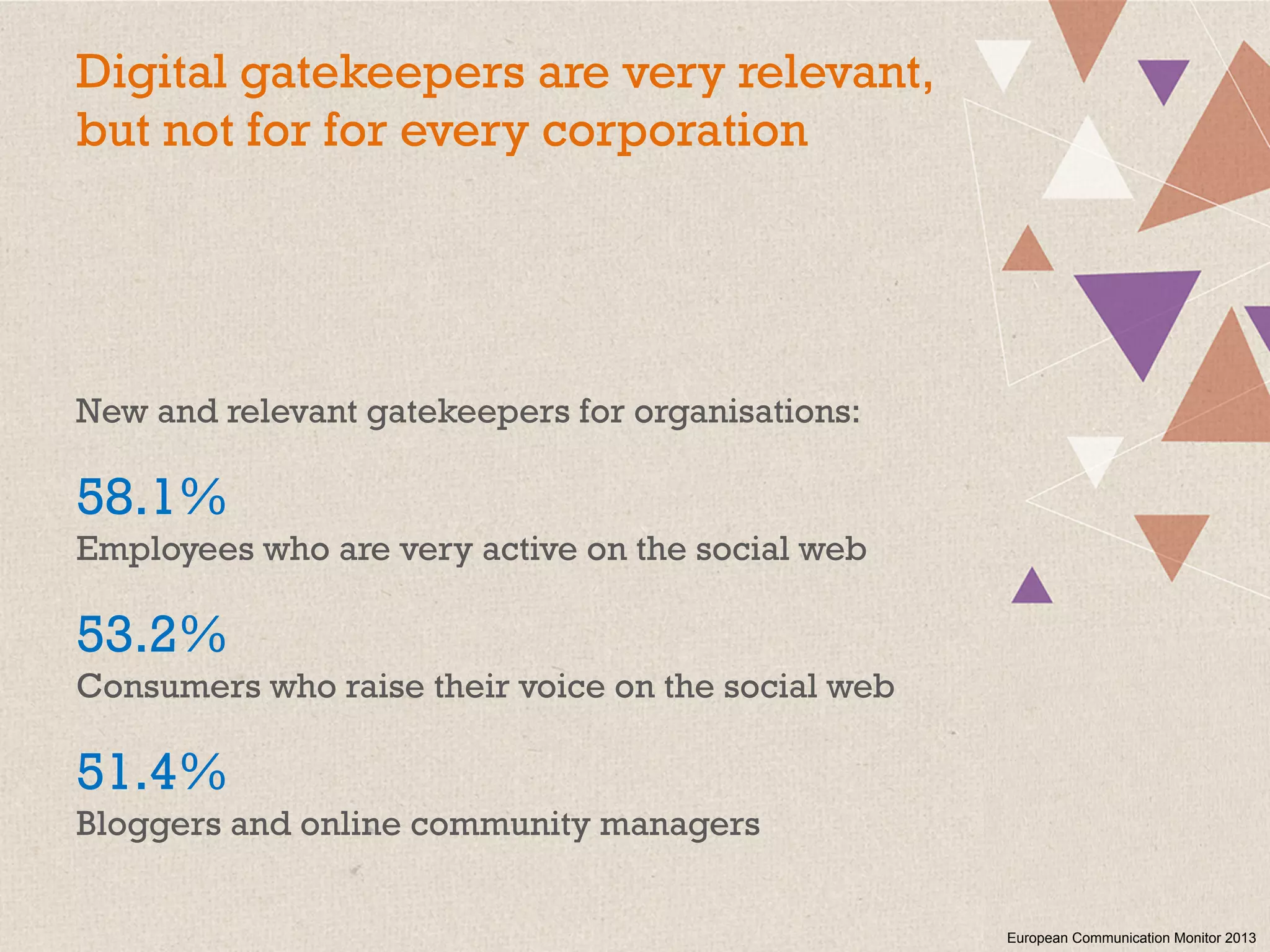
Digital gatekeepers are very relevant,
but not for for every corporation
New and relevant gatekeepers for organisations:
58.1%
Employees who are very active on the social web
53.2%
Consumers who raise their voice on the social web
51.4%
Bloggers and online community managers
European Communication Monitor 2013
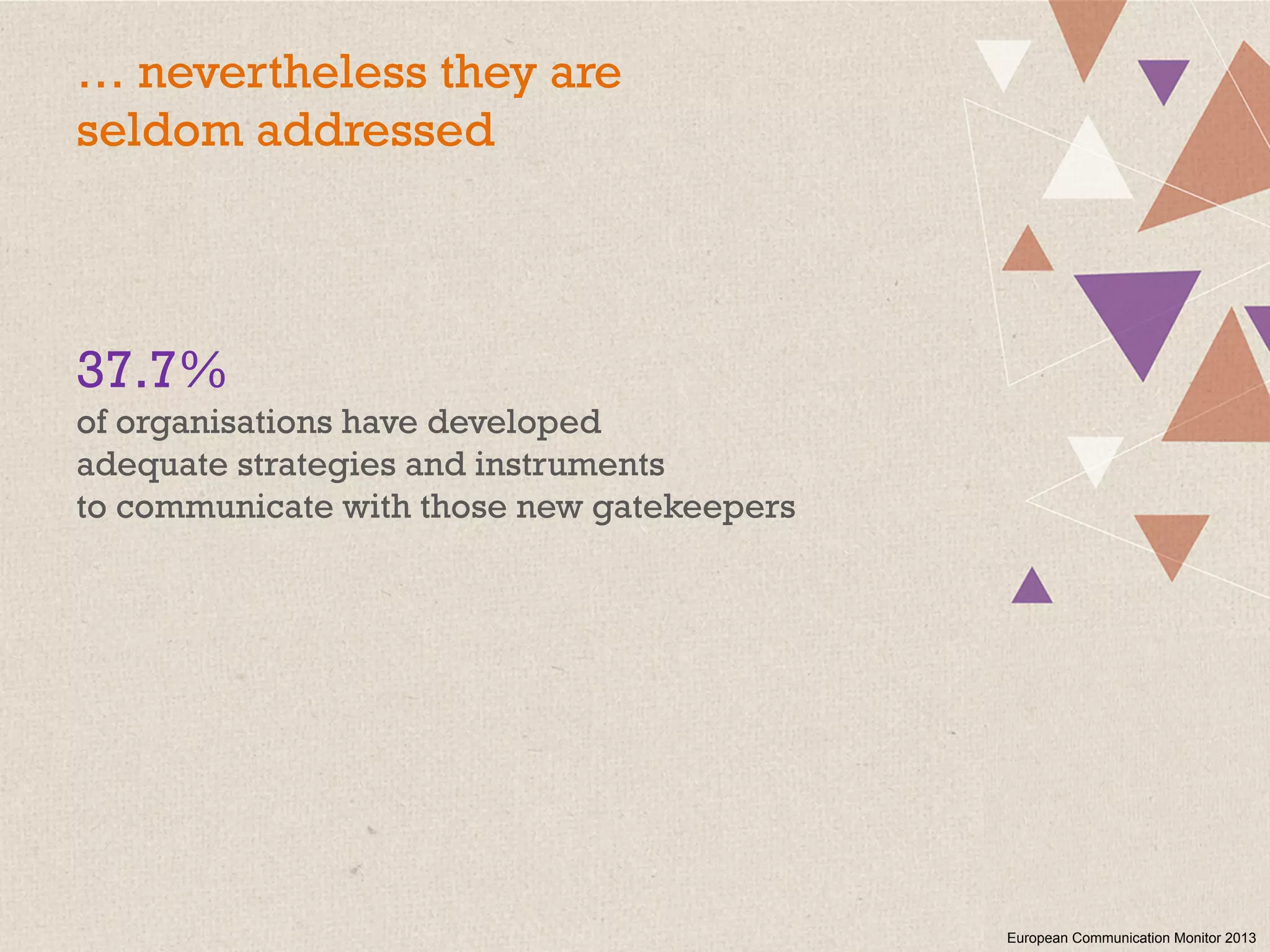
… nevertheless they are
seldom addressed
37.7%
of organisations have developed
adequate strategies and instruments
to communicate with those new gatekeepers
European Communication Monitor 2013
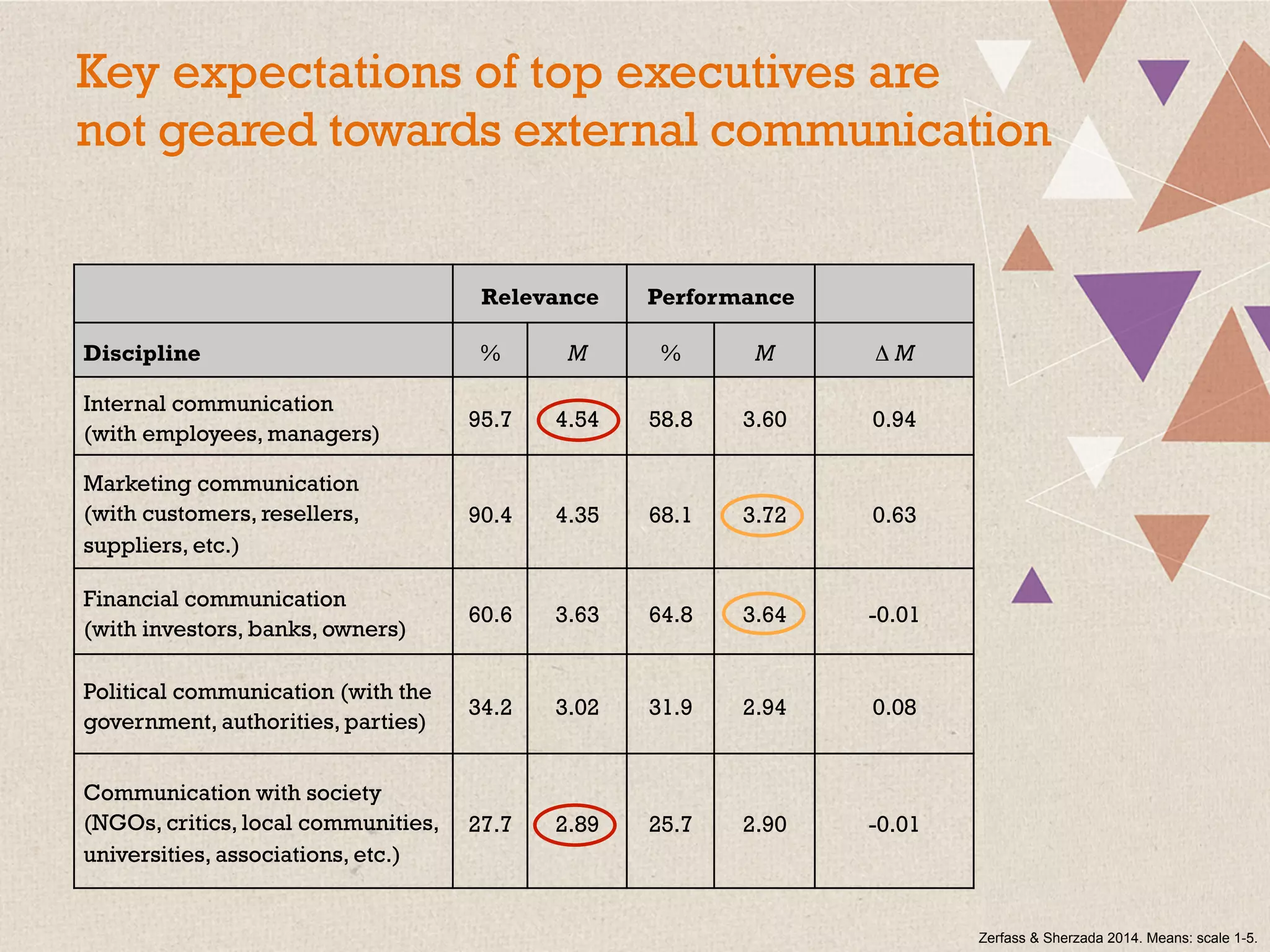
Key expectations of top executives are
not geared towards external communication
Relevance Performance
Discipline % M % M Δ M
Internal communication
(with employees, managers)
95.7 4.54 58.8 3.60 0.94
Marketing communication
(with customers, resellers,
suppliers, etc.)
90.4 4.35 68.1 3.72 0.63
Financial communication
(with investors, banks, owners)
60.6 3.63 64.8 3.64 -0.01
Political communication (with the
government, authorities, parties)
34.2 3.02 31.9 2.94 0.08
Communication with society
(NGOs, critics, local communities,
universities, associations, etc.)
27.7 2.89 25.7 2.90 -0.01
"
Zerfass & Sherzada 2014. Means: scale 1-5.
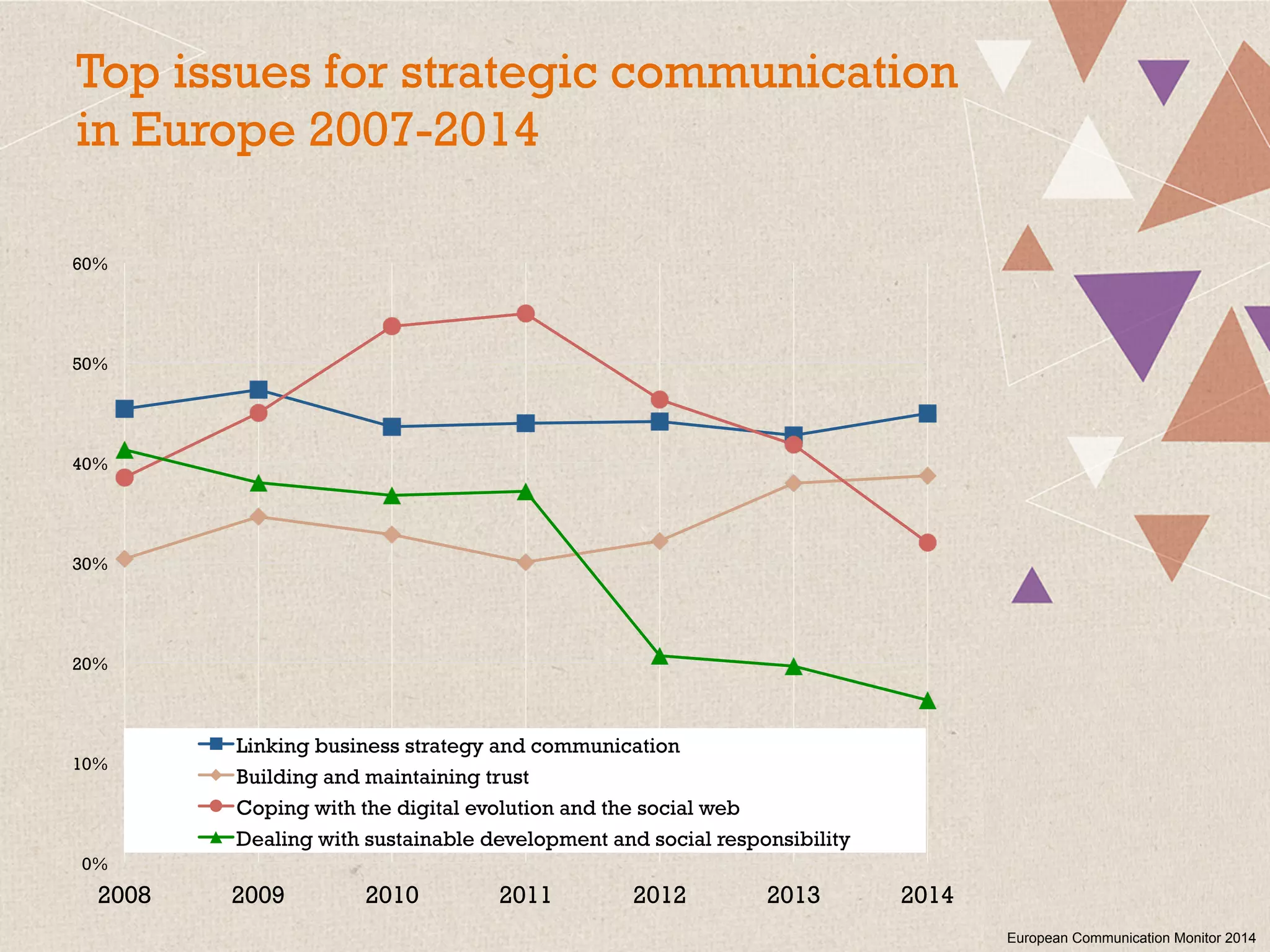
0%
10%
20%
30%
40%
50%
60%
2008 2009 2010 2011 2012 2013 2014
Linking business strategy and communication
Building and maintaining trust
Coping with the digital evolution and the social web
Dealing with sustainable development and social responsibility
Top issues for strategic communication
in Europe 2007-2014
European Communication Monitor 2014
The big picture.
5
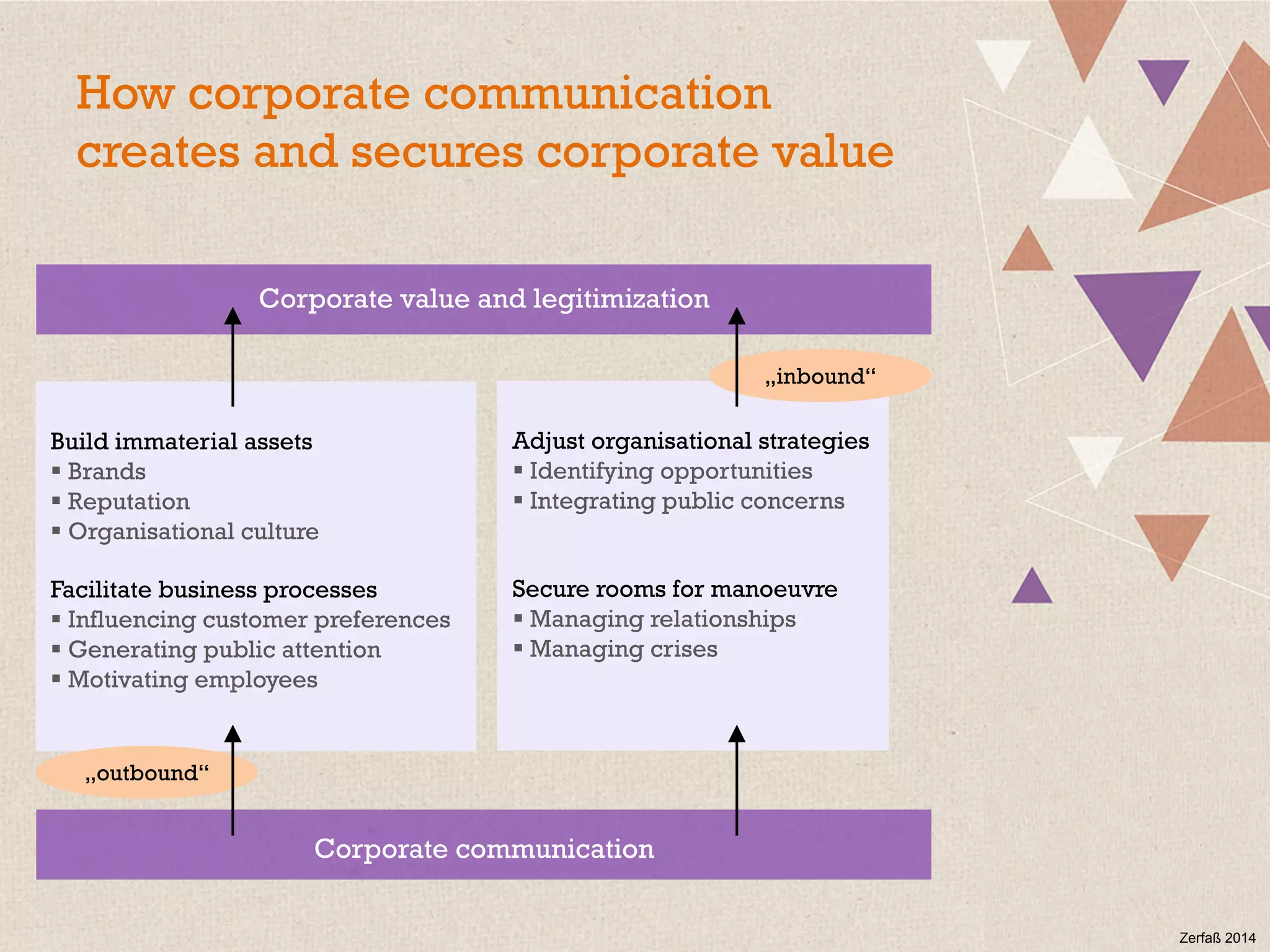
Build immaterial assets
§ Brands
§ Reputation
§ Organisational culture
Facilitate business processes
§ Influencing customer preferences
§ Generating public attention
§ Motivating employees
Adjust organisational strategies
§ Identifying opportunities
§ Integrating public concerns
Secure rooms for manoeuvre
§ Managing relationships
§ Managing crises
Corporate communication
Corporate value and legitimization
„inbound“
„outbound“
How corporate communication
creates and secures corporate value
Zerfaß 2014
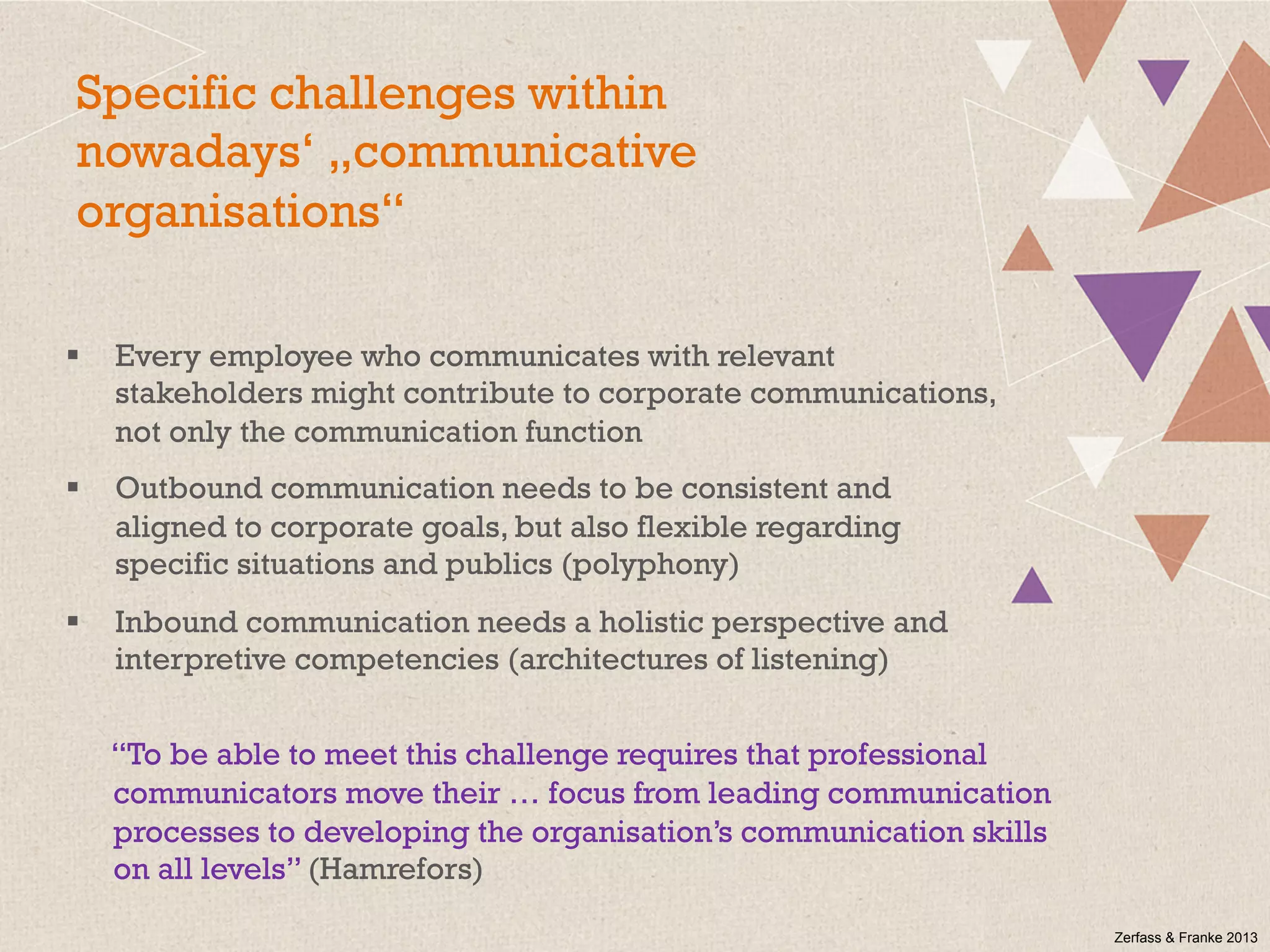
§  Every employee who communicates with relevant
stakeholders might contribute to corporate communications,
not only the communication function
§  Outbound communication needs to be consistent and
aligned to corporate goals, but also flexible regarding
specific situations and publics (polyphony)
§  Inbound communication needs a holistic perspective and
interpretive competencies (architectures of listening)
“To be able to meet this challenge requires that professional
communicators move their … focus from leading communication
processes to developing the organisation’s communication skills
on all levels” (Hamrefors)
Zerfass & Franke 2013
Specific challenges within
nowadays‘ „communicative
organisations“
European Communication Monitor 2012
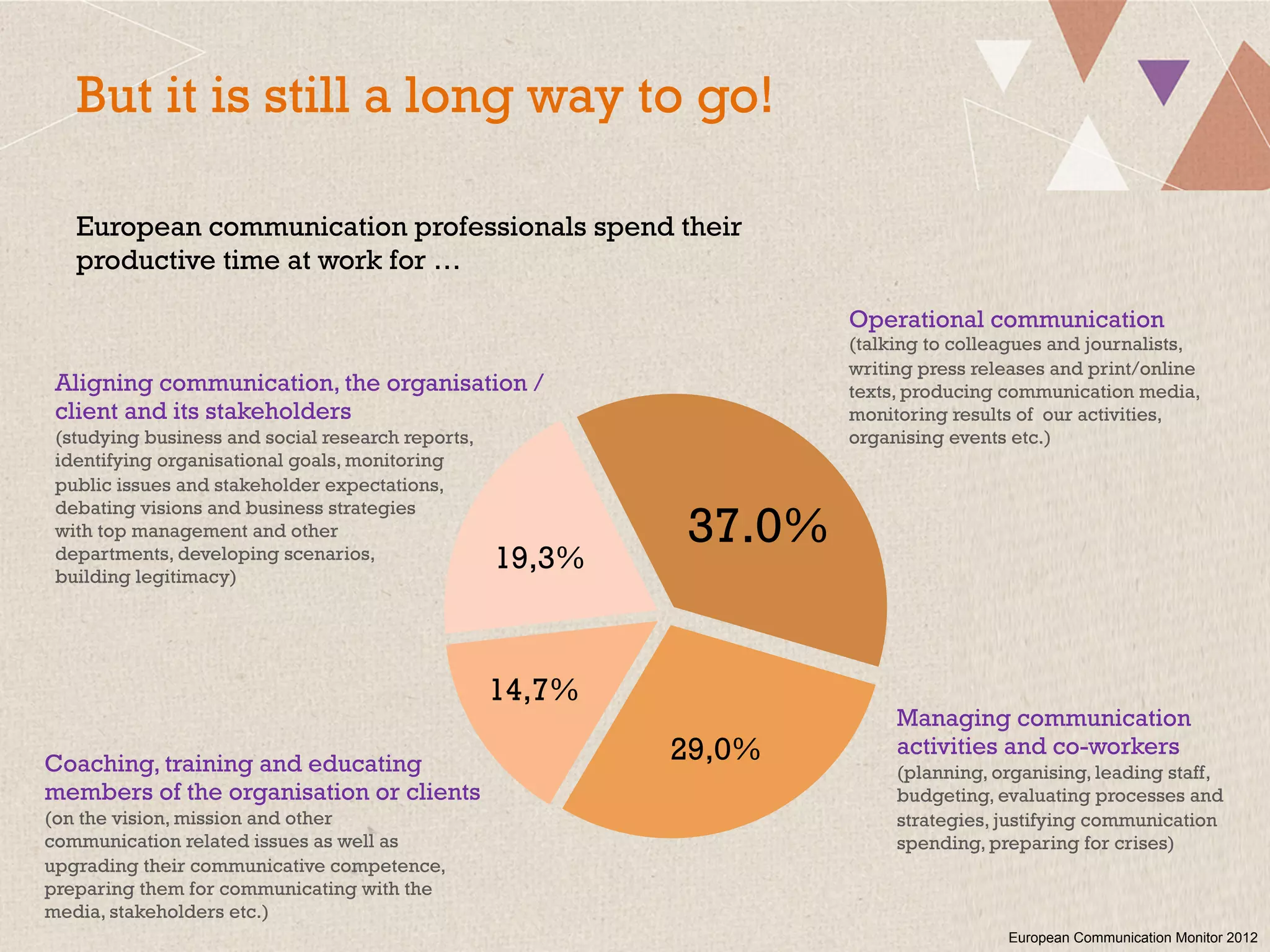
But it is still a long way to go!
37.0%
29,0%
14,7%
19,3%
Managing communication
activities and co-workers
(planning, organising, leading staff,
budgeting, evaluating processes and
strategies, justifying communication
spending, preparing for crises)
Operational communication
(talking to colleagues and journalists,
writing press releases and print/online
texts, producing communication media,
monitoring results of our activities,
organising events etc.)
Coaching, training and educating
members of the organisation or clients
(on the vision, mission and other
communication related issues as well as
upgrading their communicative competence,
preparing them for communicating with the
media, stakeholders etc.)
Aligning communication, the organisation /
client and its stakeholders
(studying business and social research reports,
identifying organisational goals, monitoring
public issues and stakeholder expectations,
debating visions and business strategies
with top management and other
departments, developing scenarios,
building legitimacy)
European communication professionals spend their
productive time at work for …
Questions.
Comments.
Ideas.
© July 2014
Prof. Dr. Ansgar Zerfaß
Professor of Communication Management
University of Leipzig, Germany
Professor in Communication and Leadership
BI Norwegian Business School, Oslo, Norway
zerfass@uni-leipzig.de
www.communicationmanagement.de

Challenges for Corporate Communications in the Digital Age

  • 1.
    CHALLENGES FOR CORPORATE COMMUNICATIONS INTHE DIGTAL AGE PROF. DR. ANSGAR ZERFASS CONTENT STRATEGY FORUM CONFERENCE 2014
  • 2.
    What I wouldlike to share with you today. A simple question. Some empirical insights. The big picture. Inspirations for thoughts and discussions.
  • 3.
  • 4.
    Why should acorporation invest into communication and content?
  • 5.
    Why should acorporation invest into communication and content? Strategic communication “… the purposeful use of communication by an organization to fulfill its mission” (Hallahan et al., 2007) However: §  Communicate with whom? How? How much? §  To which specific end? §  Who shall take care, with which responsibilities? §  Why produce content, if you are specialized in other goods? Communication spendings reduce cash flow and revenues. But most results are long-term and immaterial; they do not enter the balance sheet and cannot be depreciated.
  • 6.
    Today‘s challenges forcorporations Business environment § Declining trust in corporations and top management § Rising demand for transparency § Unsettledness of employees caused by permanent change § Pressure on existing business models § Stronger regulation and influence by authorities Communication environment § Trends towards speed, online, videos, emotions, stories, personalization § Rise of participative patterns („social“ communication) § Fragmentation of public spheres § New content formats and modes of production " " " Stakeholders demand communication " " " " Corporations seek advantages through communication Maintaining interpretive dominance Initiating understanding and acceptance Regaining trust and reputation
  • 7.
  • 8.
    Trying to learnmainly from the media
  • 9.
  • 10.
    Largest study seriesof corp comm trends worldwide. 16,500 respondents from more than 40 countries. 55,000 reports printed and downloaded since 2007. Study on the CEO’s view on corp comm. 602 CEOs and executive board members. Interdisciplinary research collaboration.
  • 11.
    Current status of strategiccommunication 87% of communication professionals report a rising importance of communication for organisational success within the last 12 months 62% confirm that the influence and status of the communication function has increased But only 15% say that communication budgets have been increased above the average of other functions European Communication Monitor 2013
  • 12.
    Barriers affecting professionalisation ofcommunication 84% lack of understanding of communication within top management 75% difficulties of communication professionals to prove the impact of communication on organisational goals 46% - 33% missing management and business competencies by communication professionals European Communication Monitor 2012
  • 13.
    CEOs value theirown communication performance higher than professional activities 66%" say that professional corporate communications managed by communication departments and agencies is (very) important for success 88%" think that the personal communication performance of top managers is (very) important for corporate success Zerfass & Sherzada 2014
  • 14.
  • 15.
    Digital gatekeepers arevery relevant, but not for for every corporation New and relevant gatekeepers for organisations: 58.1% Employees who are very active on the social web 53.2% Consumers who raise their voice on the social web 51.4% Bloggers and online community managers European Communication Monitor 2013
  • 16.
    … nevertheless theyare seldom addressed 37.7% of organisations have developed adequate strategies and instruments to communicate with those new gatekeepers European Communication Monitor 2013
  • 17.
    Key expectations oftop executives are not geared towards external communication Relevance Performance Discipline % M % M Δ M Internal communication (with employees, managers) 95.7 4.54 58.8 3.60 0.94 Marketing communication (with customers, resellers, suppliers, etc.) 90.4 4.35 68.1 3.72 0.63 Financial communication (with investors, banks, owners) 60.6 3.63 64.8 3.64 -0.01 Political communication (with the government, authorities, parties) 34.2 3.02 31.9 2.94 0.08 Communication with society (NGOs, critics, local communities, universities, associations, etc.) 27.7 2.89 25.7 2.90 -0.01 " Zerfass & Sherzada 2014. Means: scale 1-5.
  • 18.
    0% 10% 20% 30% 40% 50% 60% 2008 2009 20102011 2012 2013 2014 Linking business strategy and communication Building and maintaining trust Coping with the digital evolution and the social web Dealing with sustainable development and social responsibility Top issues for strategic communication in Europe 2007-2014 European Communication Monitor 2014
  • 19.
  • 20.
    Build immaterial assets § Brands § Reputation § Organisationalculture Facilitate business processes § Influencing customer preferences § Generating public attention § Motivating employees Adjust organisational strategies § Identifying opportunities § Integrating public concerns Secure rooms for manoeuvre § Managing relationships § Managing crises Corporate communication Corporate value and legitimization „inbound“ „outbound“ How corporate communication creates and secures corporate value Zerfaß 2014
  • 21.
    §  Every employeewho communicates with relevant stakeholders might contribute to corporate communications, not only the communication function §  Outbound communication needs to be consistent and aligned to corporate goals, but also flexible regarding specific situations and publics (polyphony) §  Inbound communication needs a holistic perspective and interpretive competencies (architectures of listening) “To be able to meet this challenge requires that professional communicators move their … focus from leading communication processes to developing the organisation’s communication skills on all levels” (Hamrefors) Zerfass & Franke 2013 Specific challenges within nowadays‘ „communicative organisations“
  • 22.
    European Communication Monitor2012 But it is still a long way to go! 37.0% 29,0% 14,7% 19,3% Managing communication activities and co-workers (planning, organising, leading staff, budgeting, evaluating processes and strategies, justifying communication spending, preparing for crises) Operational communication (talking to colleagues and journalists, writing press releases and print/online texts, producing communication media, monitoring results of our activities, organising events etc.) Coaching, training and educating members of the organisation or clients (on the vision, mission and other communication related issues as well as upgrading their communicative competence, preparing them for communicating with the media, stakeholders etc.) Aligning communication, the organisation / client and its stakeholders (studying business and social research reports, identifying organisational goals, monitoring public issues and stakeholder expectations, debating visions and business strategies with top management and other departments, developing scenarios, building legitimacy) European communication professionals spend their productive time at work for …
  • 23.
  • 24.
    © July 2014 Prof.Dr. Ansgar Zerfaß Professor of Communication Management University of Leipzig, Germany Professor in Communication and Leadership BI Norwegian Business School, Oslo, Norway zerfass@uni-leipzig.de www.communicationmanagement.de