Software piracy involves the illegal distribution and copying of copyrighted software. It can take various forms such as end user duplication, commercial reproduction, or using software cracks. While it provides free access that may help develop skills, it financially harms software companies and is considered a crime. Different perspectives see piracy either as sharing or as theft. While some cultures view copying as respectful, international law protects intellectual property rights. Alternatives like open source software aim to freely share benefits while respecting ethical concerns.
What is SoftwarePiracy ?Adobe: Software piracy is the illegal distribution and/or reproduction of Adobe software applications or fonts for business or personal use. The unauthorized use, reproduction, distribution, or transmission of copyrighted material.Illegal copying of programs, counterfeiting and distributing software, purchasing pirated software and renting unauthorized software.
3.
PIRACY METHOSLicensed userduplication for unlicensed usersCommercial reproduction Software Cracks/Key generator
4.
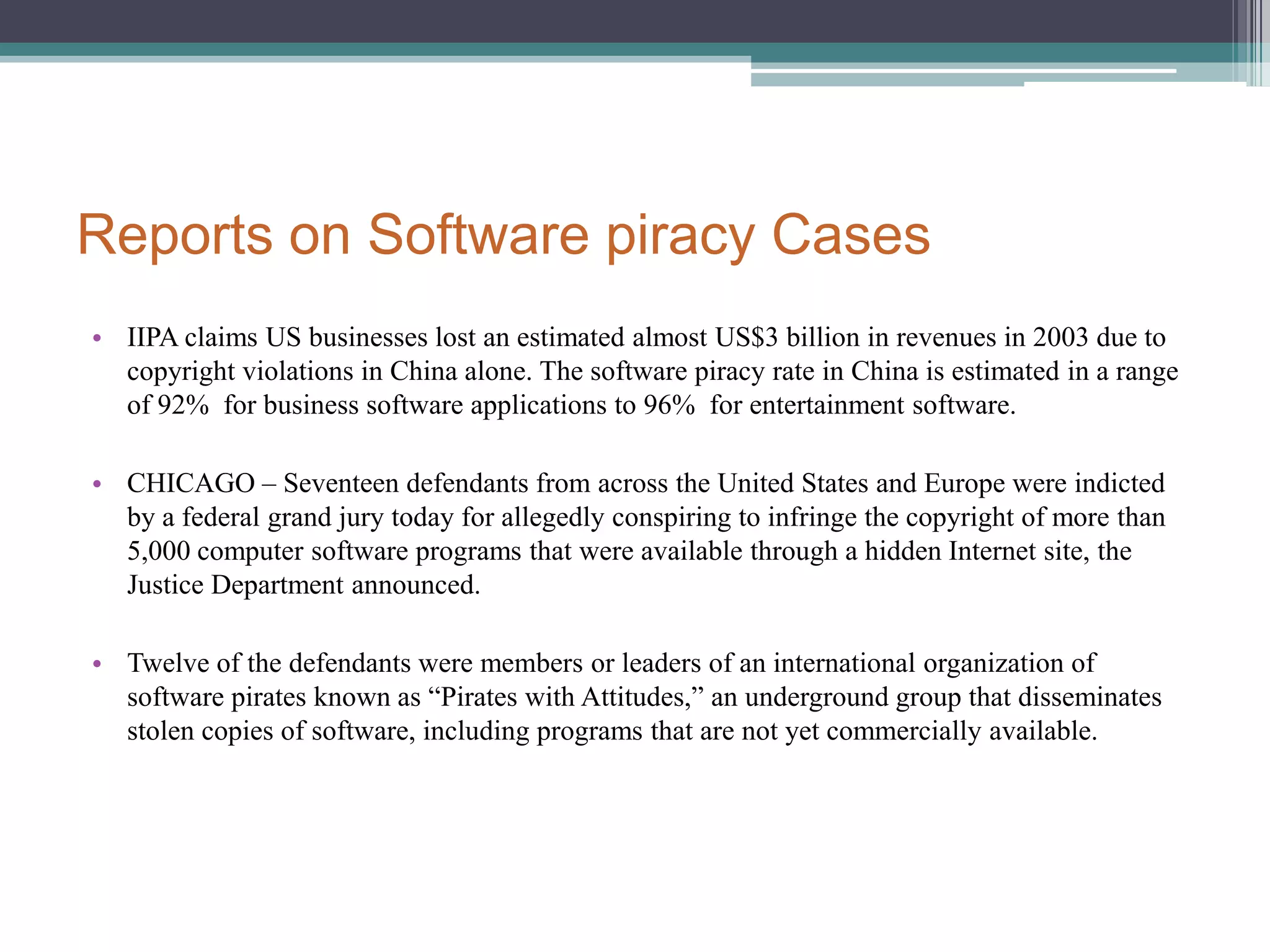
Reports on Softwarepiracy CasesIIPA claims US businesses lost an estimated almost US$3 billion in revenues in 2003 due to copyright violations in China alone. The software piracy rate in China is estimated in a range of 92% for business software applications to 96% for entertainment software.CHICAGO – Seventeen defendants from across the United States and Europe were indicted by a federal grand jury today for allegedly conspiring to infringe the copyright of more than 5,000 computer software programs that were available through a hidden Internet site, the Justice Department announced. Twelve of the defendants were members or leaders of an international organization of software pirates known as “Pirates with Attitudes,” an underground group that disseminates stolen copies of software, including programs that are not yet commercially available.
5.
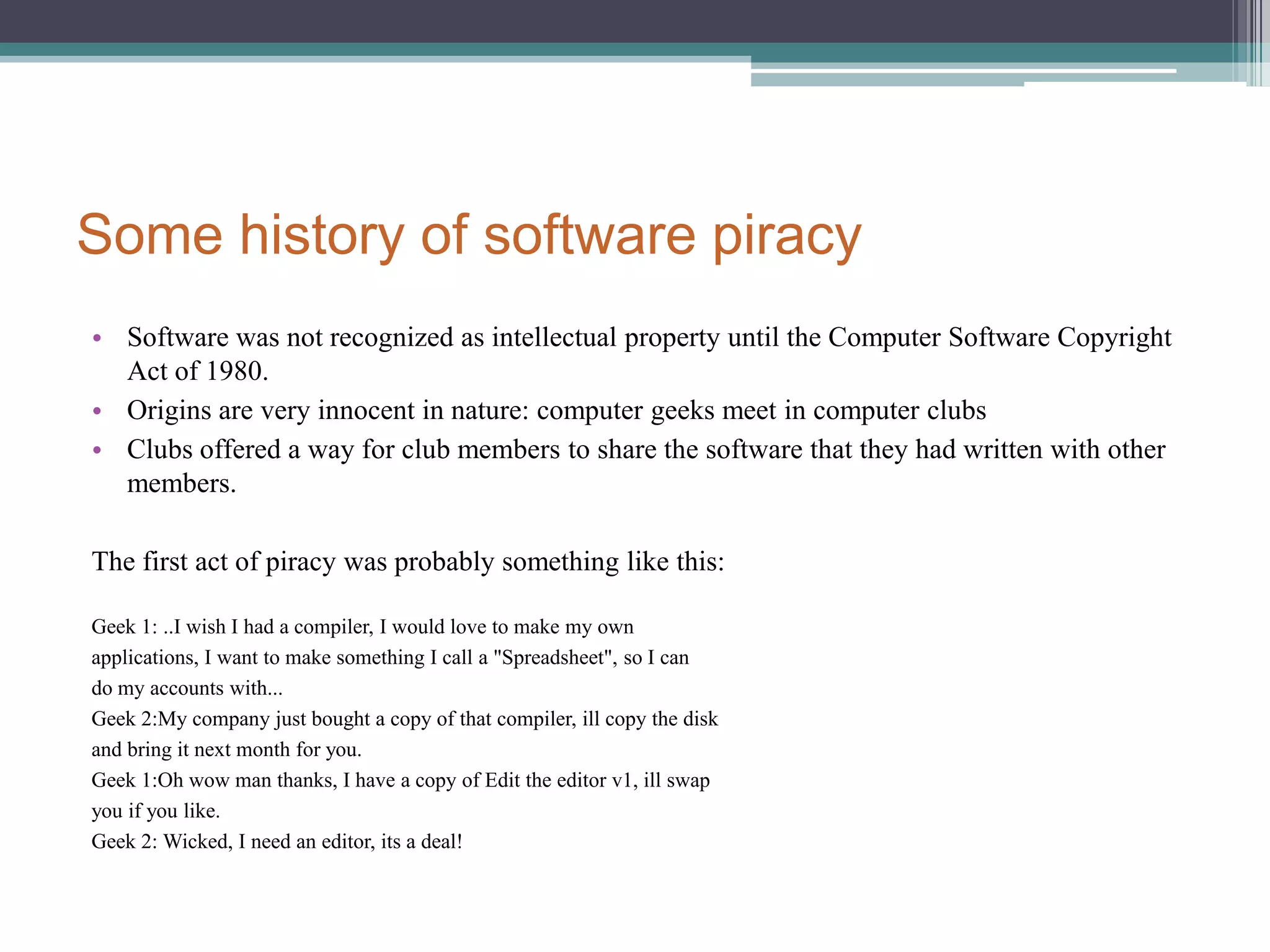
Some history ofsoftware piracySoftware was not recognized as intellectual property until the Computer Software Copyright Act of 1980.Origins are very innocent in nature: computer geeks meet in computer clubsClubs offered a way for club members to share the software that they had written with other members. The first act of piracy was probably something like this:Geek 1: ..I wish I had a compiler, I would love to make my ownapplications, I want to make something I call a "Spreadsheet", so I cando my accounts with...Geek 2:My company just bought a copy of that compiler, ill copy the diskand bring it next month for you.Geek 1:Oh wow man thanks, I have a copy of Edit the editor v1, ill swapyou if you like.Geek 2: Wicked, I need an editor, its a deal!
6.
Some history ofsoftware piracyDesign games many of these early software pirates went on to start some of the most successful game development companies in the world.Bulletin Board Systems(BBS) groups that would race to crack and upload the latest software to their affiliated BBSAccess all over the world The first patent issued for a piece of software in 1983 acts of copyright infringement could be tried in court.
7.
THE DIFFERENCE BETWEENSTEALINGVirtual vs. physical sharing and curiosity vs benefit of money or powerBenefit the community vs benefit themselves
8.
Commercial reproduction Piracycase Eleven individuals were convicted in a southern China court of participating in a sophisticated counterfeiting ring that enabled them to mass-produce and distribute pirated Microsoft software globally. The group reportedly operated like an international corporation that produced and sold CDs an DVD that were not only of high quality, but packaged nearly identically to real products despite the high level of anti-piracy security measures taken by Microsoft.
9.
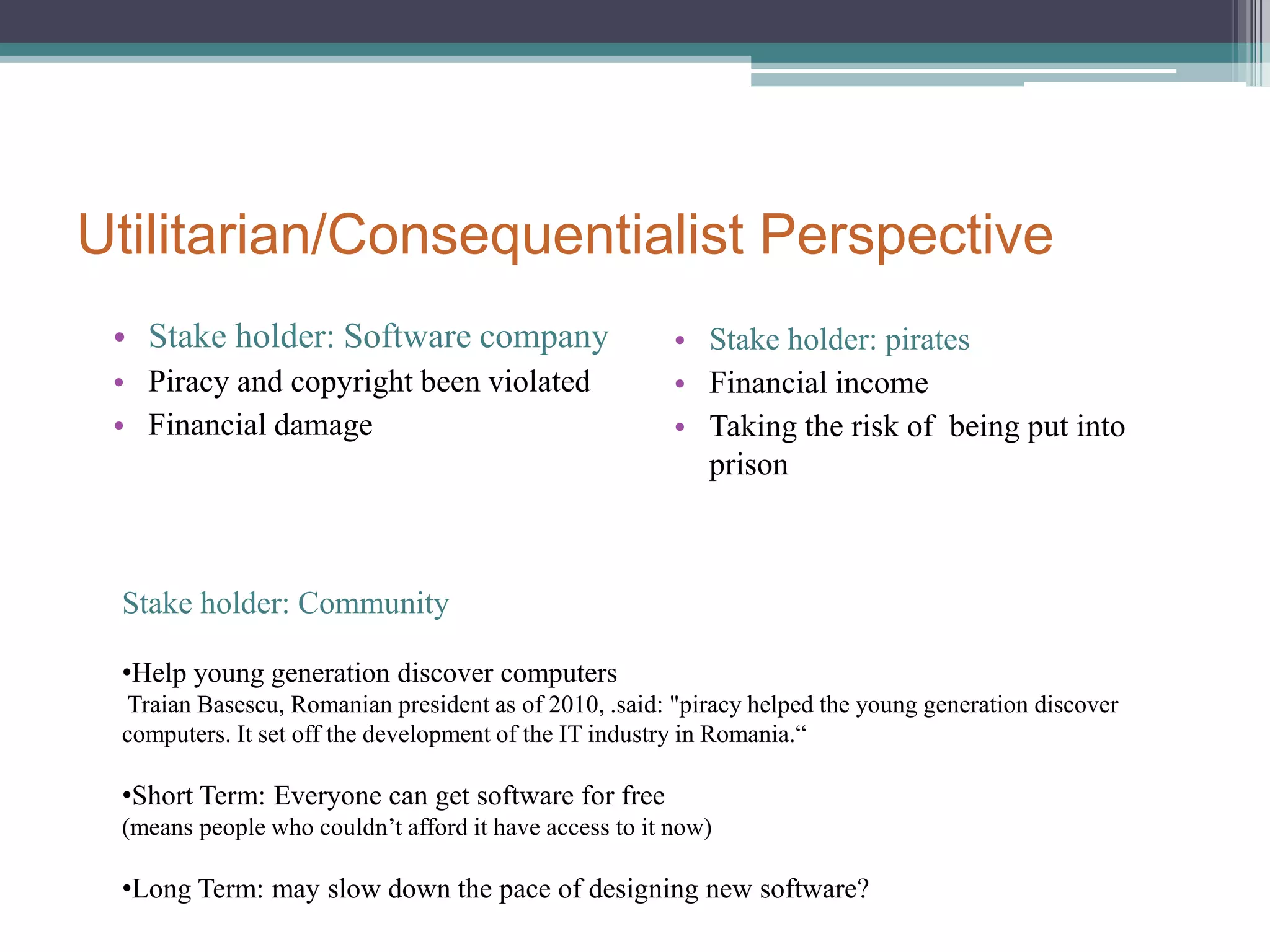
Utilitarian/Consequentialist PerspectiveStake holder:Software companyPiracy and copyright been violatedFinancial damageStake holder: piratesFinancial incomeTaking the risk of being put into prisonStake holder: CommunityHelp young generation discover computers Traian Basescu, Romanian president as of 2010, .said: "piracy helped the young generation discover computers. It set off the development of the IT industry in Romania.“Short Term: Everyone can get software for free(means people who couldn’t afford it have access to it now)Long Term: may slow down the pace of designing new software?Deontological PerspectiveDefine the issuesPeople participating in a counterfeiting ring that enabled them to mass-produce and distribute pirated.The purpose of piratesFinancial income
10.
Software Cracks+ORC“ ... Cracking it's not just about software, it's about information, about all patterns of life. To crack is to refuse to be controlled and used by others, to crack is to be free...”
11.
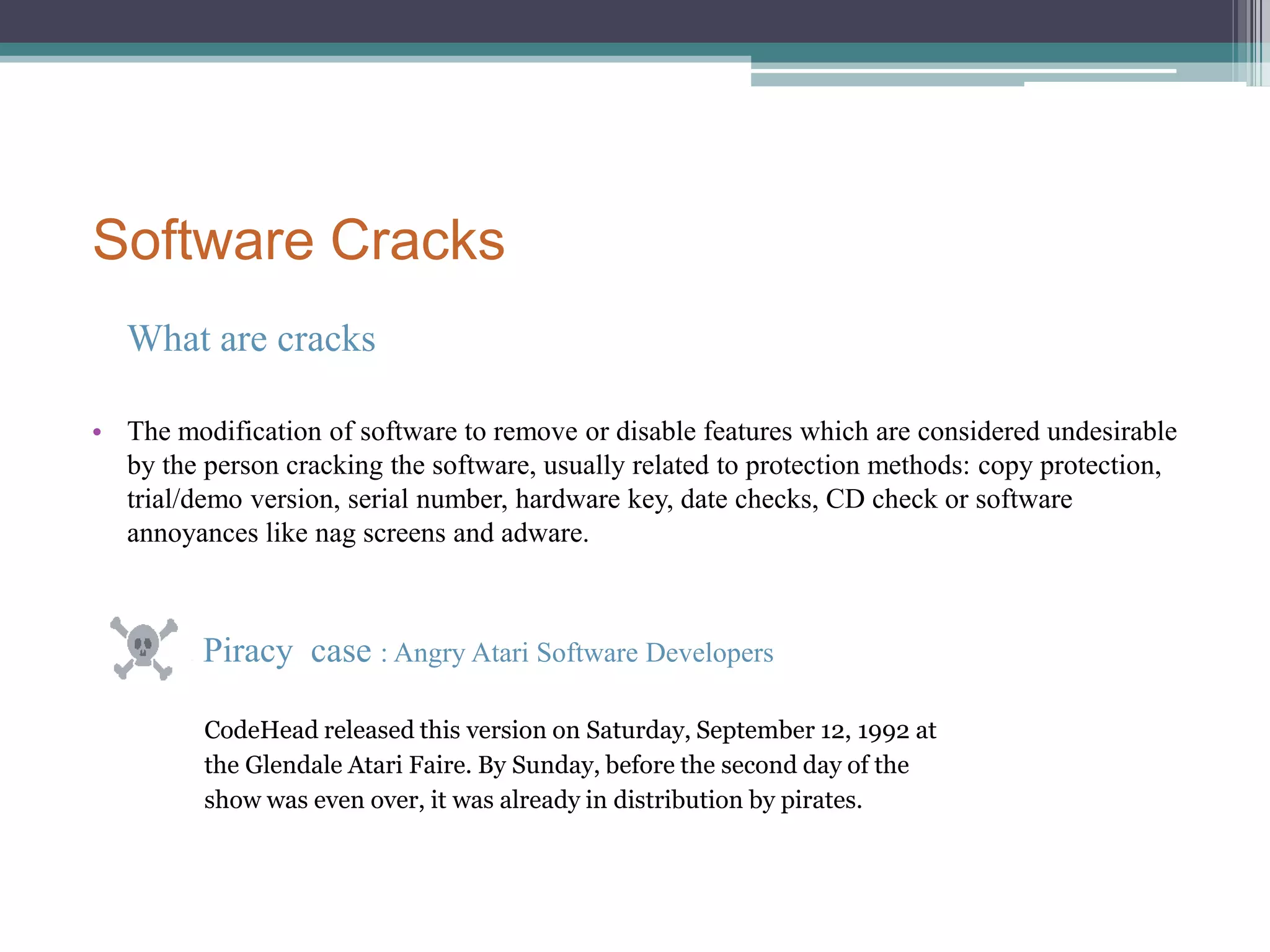
Software CracksWhat arecracksThe modification of software to remove or disable features which are considered undesirable by the person cracking the software, usually related to protection methods: copy protection, trial/demo version, serial number, hardware key, date checks, CD check or software annoyances like nag screens and adware. Piracy case : Angry Atari Software DevelopersCodeHead released this version on Saturday, September 12, 1992 at the Glendale Atari Faire. By Sunday, before the second day of the show was even over, it was already in distribution by pirates.
12.
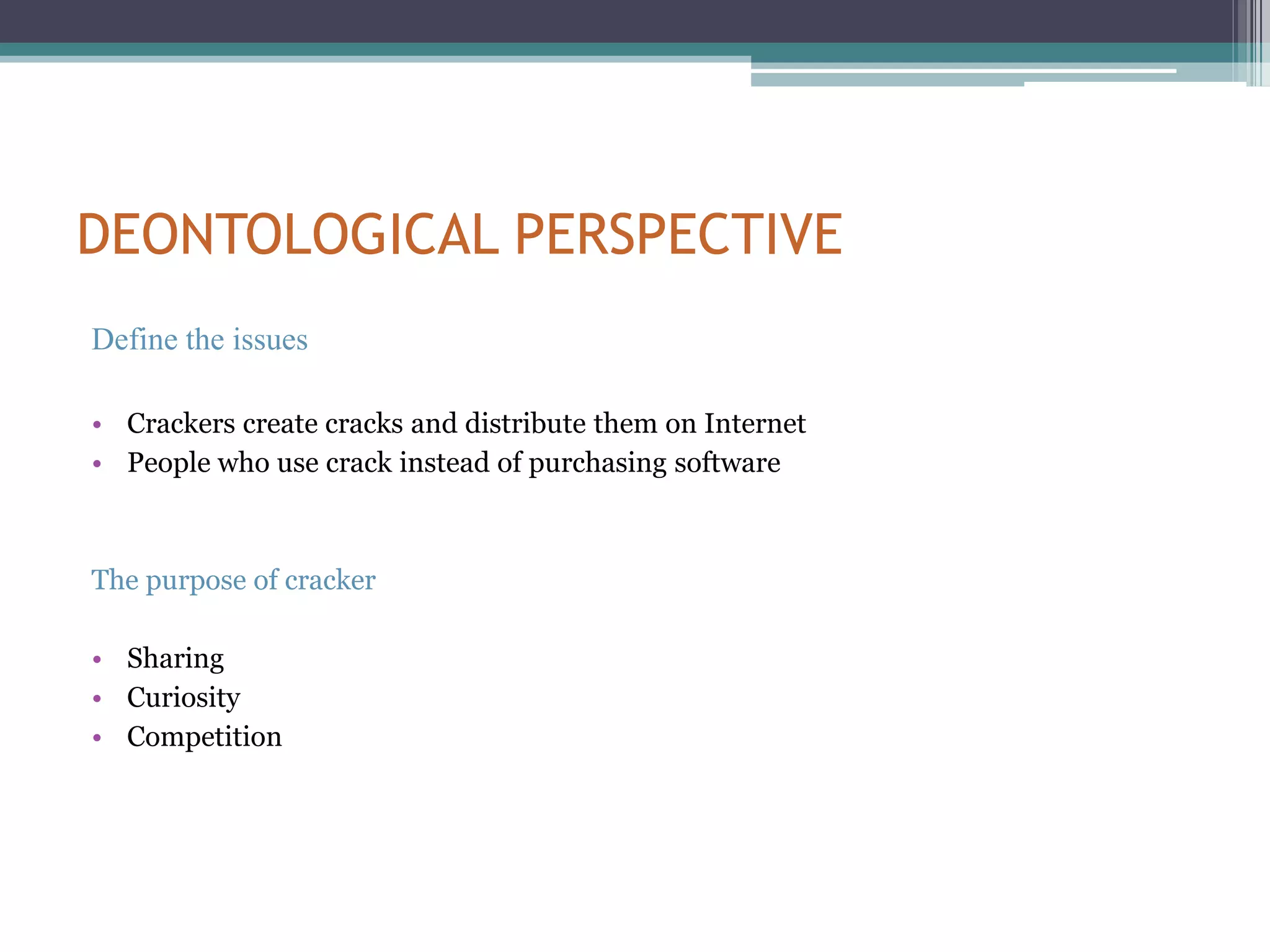
Utilitarian/Consequentialist PerspectiveStake holder:Software companyPiracy and copyright been violatedFinancial damageStake holder: crackerSelf contentTaking the risk of being put into prisonStake holder: CommunityHelp young generation discover computers Traian Basescu, Romanian president as of 2010, .said: "piracy helped the young generation discover computers. It set off the development of the IT industry in Romania.“Short Term: Everyone can get software for free(means people who couldn’t afford it have access to it now)Long Term: may slow down the pace of designing new softwareDEONTOLOGICAL PERSPECTIVEDefine the issuesCrackers create cracks and distribute them on InternetPeople who use crack instead of purchasing software The purpose of crackerSharingCuriosityCompetition
13.
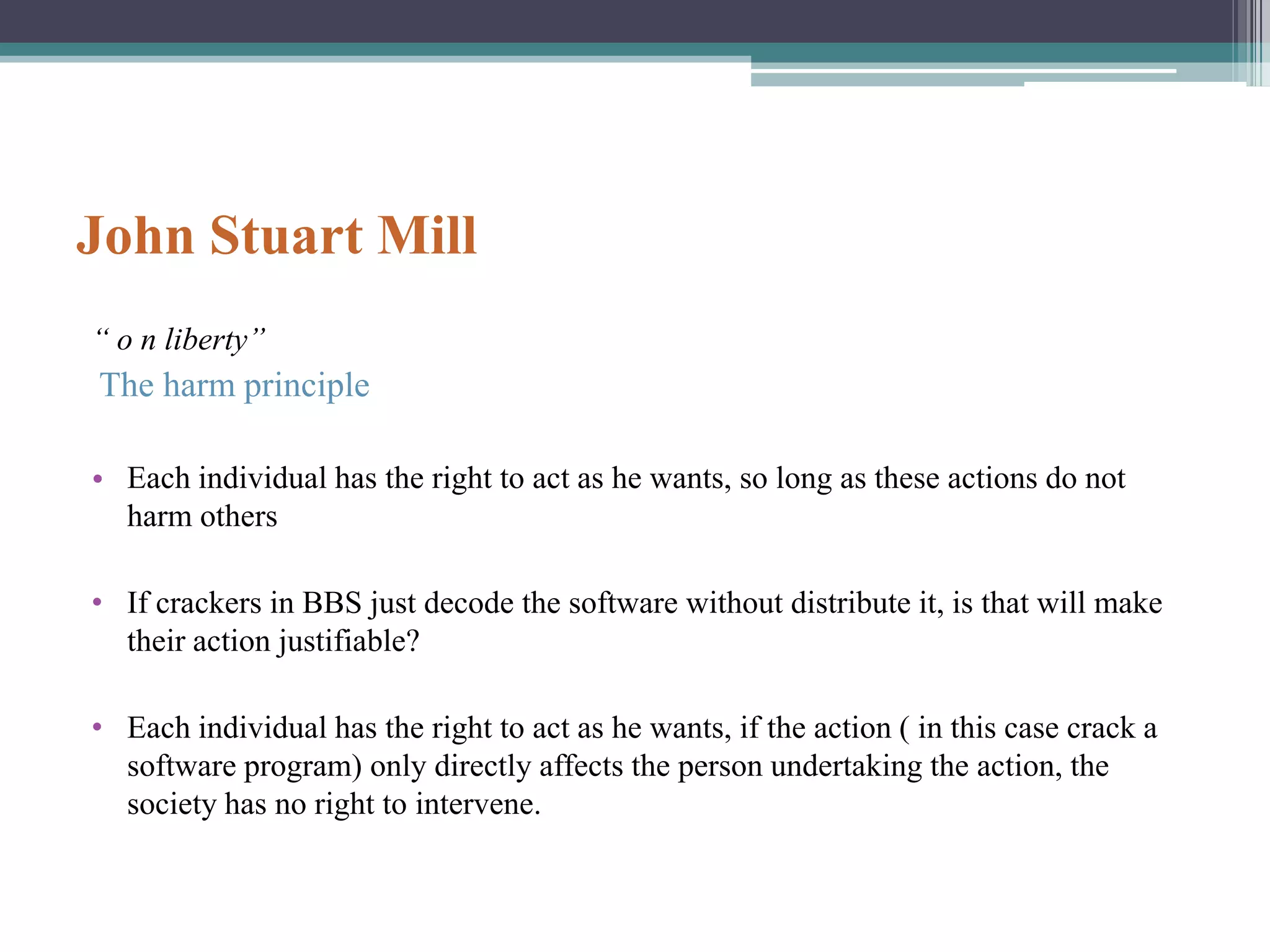
John Stuart Mill“o n liberty”The harm principleEach individual has the right to act as he wants, so long as these actions do not harm othersIf crackers in BBS just decode the software without distribute it, is that will make their action justifiable?
14.
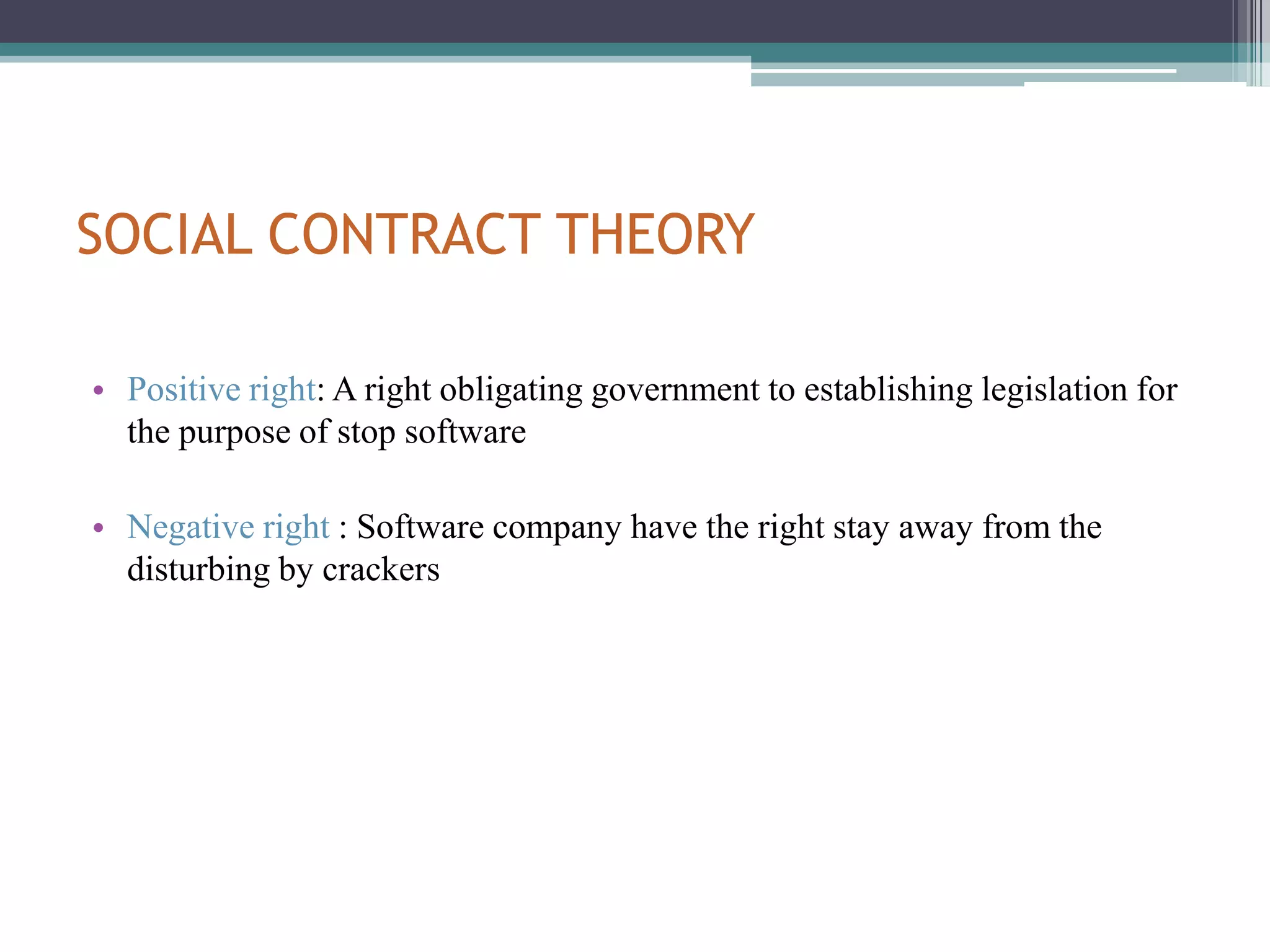
Each individual hasthe right to act as he wants, if the action ( in this case crack a software program) only directly affects the person undertaking the action, the society has no right to intervene.SOCIAL CONTRACT THEORYPositive right: A right obligating government to establishing legislation for the purpose of stop softwareNegative right : Software company have the right stay away from the disturbing by crackers
15.
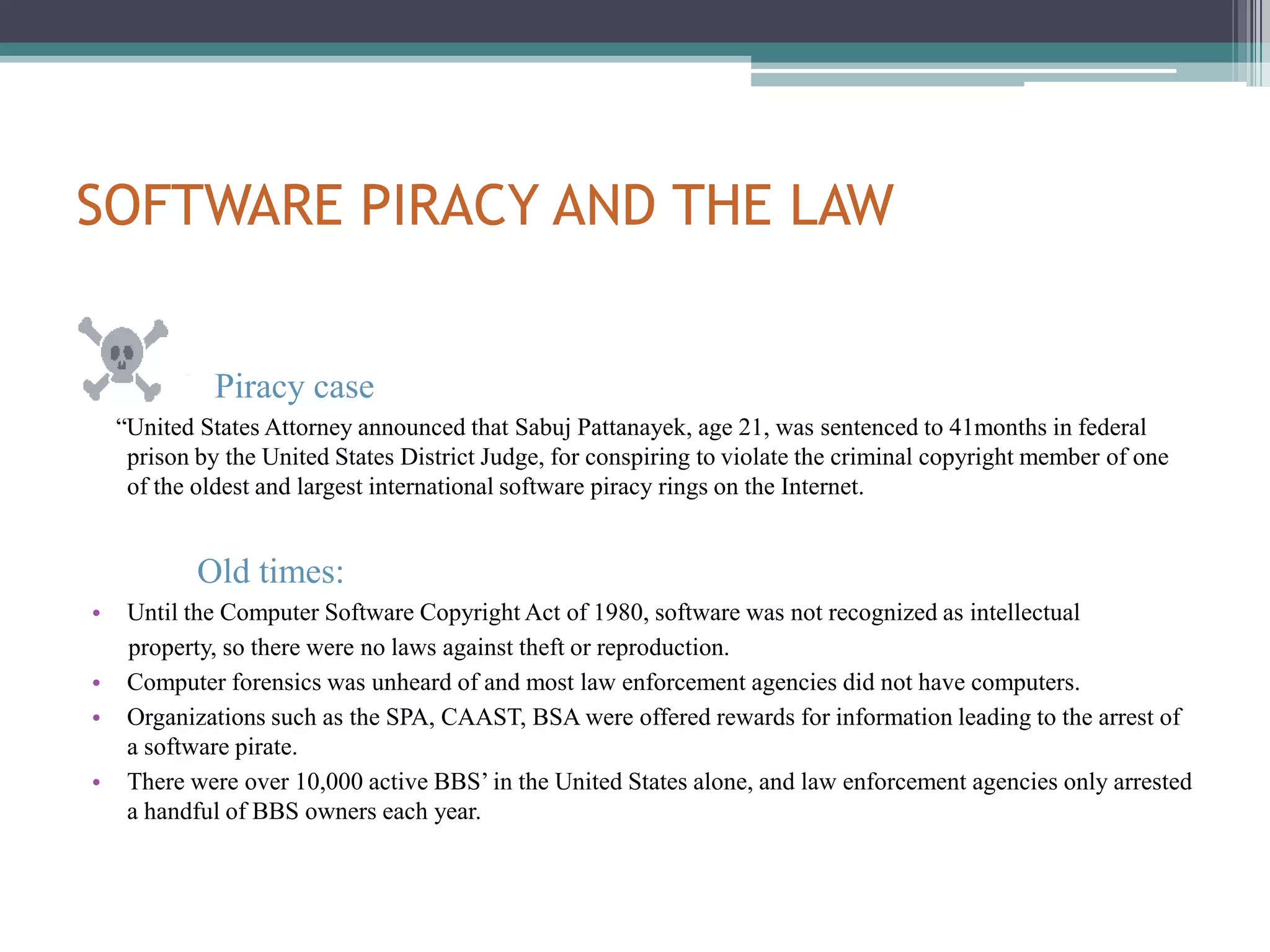
SOFTWARE PIRACY ANDTHE LAWPiracy case “United States Attorney announced that SabujPattanayek, age 21, was sentenced to 41months in federal prison by the United States District Judge, for conspiring to violate the criminal copyright member of one of the oldest and largest international software piracy rings on the Internet. Old times: Until the Computer Software Copyright Act of 1980, software was not recognized as intellectual property, so there were no laws against theft or reproduction.Computer forensics was unheard of and most law enforcement agencies did not have computers. Organizations such as the SPA, CAAST, BSA were offered rewards for information leading to the arrest of a software pirate. There were over 10,000 active BBS’ in the United States alone, and law enforcement agencies only arrested a handful of BBS owners each year.
16.
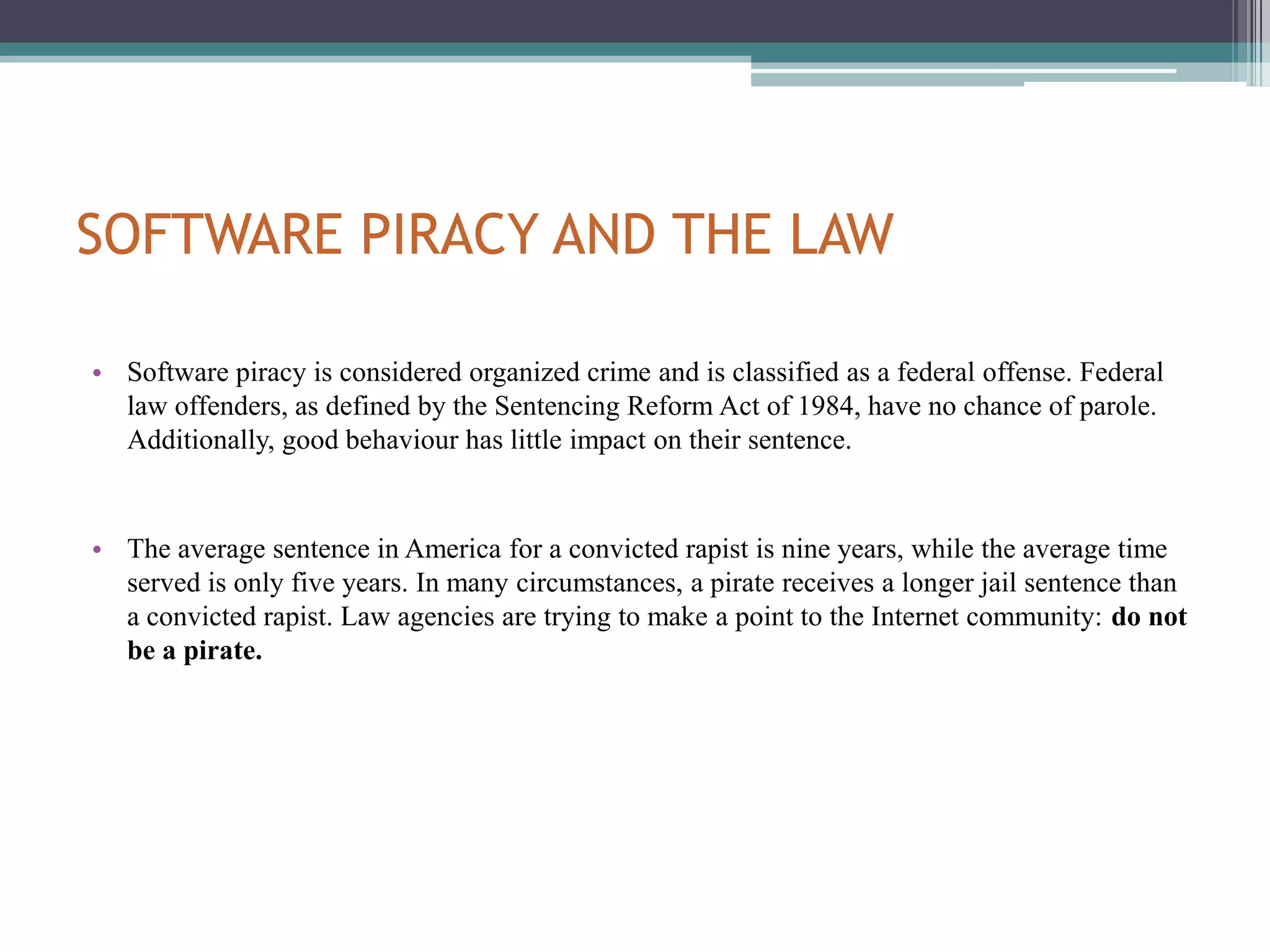
SOFTWARE PIRACY ANDTHE LAWSoftware piracy is considered organized crime and is classified as a federal offense. Federal law offenders, as defined by the Sentencing Reform Act of 1984, have no chance of parole. Additionally, good behaviour has little impact on their sentence.The average sentence in America for a convicted rapist is nine years, while the average time served is only five years. In many circumstances, a pirate receives a longer jail sentence than a convicted rapist. Law agencies are trying to make a point to the Internet community: do not be a pirate.
17.
What's the Alternative?FLOSS(Free/Libre/Open/Source Software)Is software that is liberally licensed to grant the right of users to use, study, change, and improve its design through the availability of its source code. Goal: fostering the development of software to be made freely available for others to copy ,use, modify , and then redistribute.
18.
FLOSS In Practice:the linux operation systemEarly 1990s, developed LinusTorvalds UNIX systemFLOSS work focused on the development and distribution of the linux operation system of linux that can be freely download,t he Ubunutu distribution is one of the most popular one.“Our work is driven by a philosophy on software freedom that aims to spread and bring the benefits of software to all parts of the world”
19.
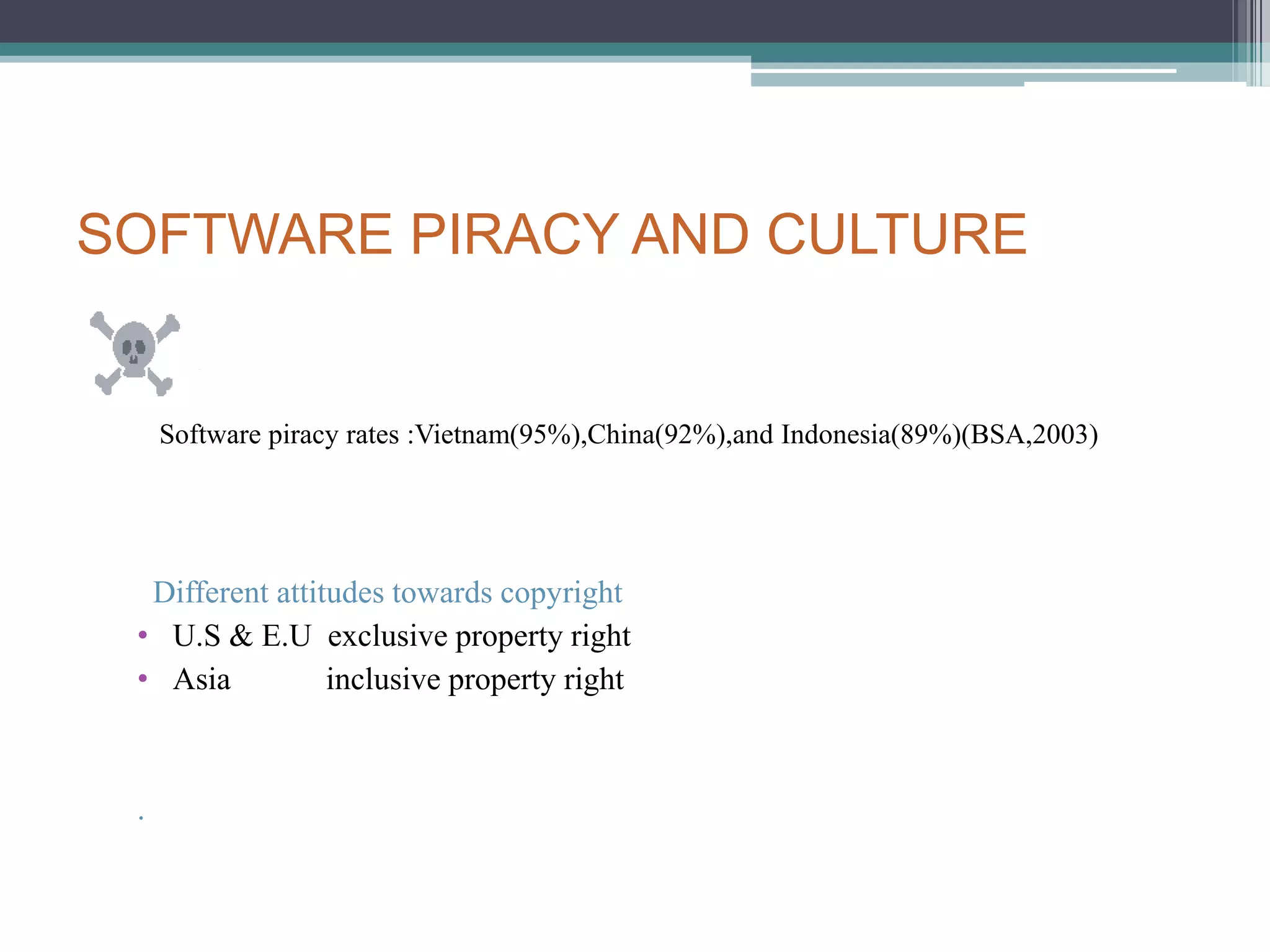
SOFTWARE PIRACY ANDCULTURESoftware piracy rates :Vietnam(95%),China(92%),and Indonesia(89%)(BSA,2003) Different attitudes towards copyrightU.S & E.U exclusive property right
SOFTWARE PIRACY ANDCULTUREConfucianConfucian tradition emphasizes emulation of revered classics-and in this way, copying expresses highest respect for the work of author( Dan Burk,2007:IOI)(southern)African cultural tradition UbuntuThey share the sense that individuals are relational being, ones centrally interdependent with larger community for their very existence and sense of meaning as human being.
#6 Software piracy’s origins are very innocent in nature. Before pirated material became hot property, before the widespread use of the Internet,and even before laptops and CDs, there were computer geeks.Computer geeks are the forefathers of software piracy. Piracy began in the 1980s when computer technology was still new. They flocked to local universities, which held monthly computer clubs which offered a way for them to share the software that they had written with other members. Some of the first games ever developed were first shown off in computer clubs
#7 Computer geeks were curious about what their computers coulddo.Without piracy, they could never have experimented with technology and never written their own applications. It is important to note that many of these early software pirates went on to start some of the most successful game development companies in the world. Experimentation with software and the availability of software piracy was essential to the success of computers and software.Many of these early software pirates went on to start some of the most successful game development companies in the worldAround this time, a new era of computer club called Bulletin BoardSystems (BBS’) was almost entirely digital.Users of itcould connect a modem and soon have access to a text-based, menu-driven interface.BBS’ were very popular; pirates from all over the world wanted to callthem to access their often massive repositories of data.the software industry began to feel the burn of piracy.
#8 No costs, without “ using up” any of the original version.So,while software piracy t is quite different in nature than the stealing of material item
#9 If the organization was not going to purchase the software under any circumstance,it is difficult to claim that the company is financially damagedhttp://www.tgdaily.com/business-and-law-features/40786-eleven-jailed-in-2-billion-software-piracy-case
#10 the greatest goods for the greatest amount of people
#11 What if everyone pirated software instead of just one individual?Kant categorical imperative:so act of your will could always hold at the same time as a principle establishing universal law”Use software company as a mean to a end
#12 Old Red Cracker Old Red Cracker (abbreviate +ORC) is a screenname for a cracker that wrote the now famous +ORC "how to crack" lessons. He was one of the pioneers of publishing cracking lessons on the Internet and therefore very well known among thereverser scene. Not much is known about +ORC since he has never revealed his identity but he has left clues and puzzles on how to reach him[1]. This has led to so called "+ORC Stalking" where individuals have tried to find out who he really is.
#13 25 pafeThe BBS referred to here,“The Rats Nest,” was located IN, California, and in its day, was one of the largest Atari pirate BBS’ on the west coast
#14 If the organization was not going to purchase the software under any circumstance,it is difficult to claim that the company is financially damaged, While the creator of the software is not sianificantly harmed , The orangzation,and even society, may also benefit as the individual . Take photoshop for example.Software licenses cost the same wherever in the world you buy them, but wages vary greatly over the world. People in countries will therefore find it harder to buy software, which can be considered to be unfair to them and emerging market economies.Some researchers have claimd that software piracy ,ay even benefit software companies, as individuals who would never have been exposed to a software product are given the opportunity to try the software at no cost , which may lead to future purchases of the product if it benefits the user(Givon,Mahajan,&Muller,1995) From the utilitarian viewpoint, the benefits of this single case of piracy may outweigh the costs, implying that the act is ethical in nature
#15 What if everyone pirated software instead of just one individual?Kant categorical imperative:so act of your will could always hold at the same time as a principle establishing universal law”The software corporation has expended its research and development to create the software, usually for the purpose of recouping the development money to costs and creating an income stream.Nearly all cracls originate from a relatively small number of very knowledgeable computer enthusiasts who post them on the internet for all the see anf use
#16 <<on liberty>>he harm principle holds that each individual has the right to act as he wants, so long as these actions do not harm others.
#17 The notion of the social contract is that individuals unite into a society by a process of mutual consent, agreeing to abide by certain rules and to accept duties to protect one another from violence, fraud, or negligence. Negative right: A right that another can guarantee by leaving you alonePositive right: A right obligating others to do something on your behalfNegative right The theory of the social contract focuses on people’s social right, This weighs up the software computer ‘s copyright to be protected
#18 Software Publisher’s Association (SPA), the Canadian Alliance Against Software Theft (CAAST), and the Business Software Alliance BSA
#20 In the context of free and open-source software, free refers to the freedom to copy and re-use the software, rather than to the price of the software]
#21 LinusTorvalds developed a variant of the UNIX operating system in the eraly 1990s that was intented for free distribution from the outsetSubsequently, a great deal of FLOSS work focused on the development and distribution of the linux operation system of linux that can be freely downloadThe clear intersection between free software sensibilities and the ubuntutradition,then is emphasis on inclusive rather than exclisive right
#22 751 As the example of Ubuntu and the differences between US and EU approaches to copyright suggest that our attitudes and approaches to matters of intellectual property and how far and under what circumstances such materials may be justifiably shared with others are strongly shaped by culture.The US and European copyright apparoaches tend to start with the favor exclusive property rights. That is ,property rights (of access and use) belong exclusively to the individual owner.Copyleft/FLOSS approaches,by contrast,include notions of inclusive property right.so ,in Richard Stallman’s definition of free software .the starting point is users freedom---a community of software users-not the individual’s right ti exclude others from use and access.
#23 79a master philosopher or thinker is motivated primarily by the desire to benefit others with his or her work- rather than say, personally profit through the sale of that work- and so he would want to see that work copied and distribution .2 Both confucian and southern)African cultural tradition , stressing instead the importance of individual and individual interests, stressing instead the importance of contributing to and maintaining the harmony and well-being of the larger community3Ubuntu as a free software project hence directly reflects the greater emphasis on community well-being that charactrizesindigeousafrican culture values.
#24 Moral relativism may be any of several descriptive, meta-ethical, or normative positions. Each of them is concerned with the differences in moral judgments across different people and cultures:value pluralism is the idea that there are several values which may be equally correct and fundamental, and yet in conflict with each other. In addition, value-pluralism postulates that in many cases, such incompatible values may be incommensurable, in the sense that there is no objective ordering of them in terms of importance.



![Vibe Coding vs. Spec-Driven Development [Free Meetup]](https://cdn.slidesharecdn.com/ss_thumbnails/vibecodingvsspecdrivendevelopment-251209105622-43f455e7-thumbnail.jpg?width=640&height=640&fit=bounds)


