Media Management
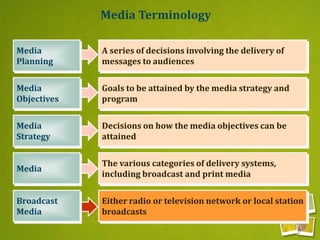
A series of decisions involving the delivery of
messages to audiences
Goals to be attained by the media strategy and
program
Decisions on how the media objectives can be
attained
The various categories of delivery systems, including
broadcast and print media
Either radio or television network or local station
broadcasts
A series of decisions involving the delivery of
messages to audiences
Goals to be attained by the media strategy and
program
Decisions on how the media objectives can be
attained
The various categories of delivery systems,
including broadcast and print media
Media Terminology
Media
Planning
Media
Objectives
Media
Strategy
Media
Broadcast
Media
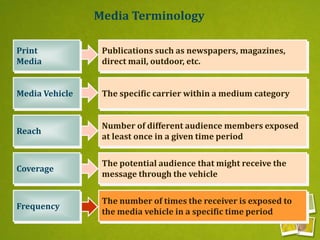
Publications such as newspapers, magazines, direct
mail, outdoor, etc.
The specific carrier within a medium category
Number of different audience members exposed at
least once in a given time period
The potential audience that might receive the
message through the vehicle
The number of times the receiver is exposed to
the media vehicle in a specific time period
The potential audience that might receive the
message through the vehicle
Number of different audience members exposed
at least once in a given time period
The specific carrier within a medium category
Publications such as newspapers, magazines,
direct mail, outdoor, etc.
Media Terminology
Print
Media
Media Vehicle
Reach
Coverage
Frequency
Media Management Simply Defined
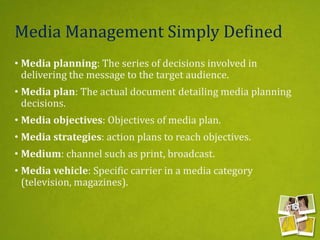
• Media planning: The series of decisions involved in
delivering the message to the target audience.
• Media plan: The actual document detailing media planning
decisions.
• Media objectives: Objectives of media plan.
• Media strategies: action plans to reach objectives.
• Medium: channel such as print, broadcast.
• Media vehicle: Specific carrier in a media category
(television, magazines).
Types of
Media
Media : agencies, means, or
instrument used to convey message
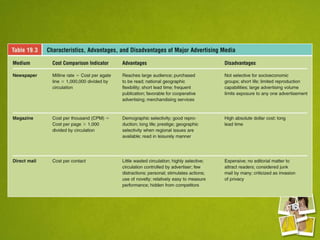
Newspaper
Advantages
• High readership
• Relatively cheap
• Timely
• Easily changed
Disadvantages
• Wasted circulation
• Short life span
• Less appealing format
Magazine
Advantages
• Know your audience
• Higher print quality
• Longer life span
• Variety of formats
Disadvantages
• More expensive
• Longer deadlines
Direct Mail
Advantages
• Selective about receivers
• Control timing
• Wide variety of formats
Disadvantages
• Low level of response
• “junk mail”
• Dated customer lists
• Higher costs
Directory
• Relatively inexpensive
• Found in 98% of households
• Kept
• Can’t adjust or change until next year
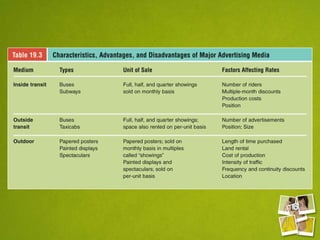
Outdoor
• Nonstandardized
• Used by local firms at their place or in other locations
• Pay rent to owners
• Standardized (posters, painted bulletins, and spectaculars)
• Billboards
• Placed near highly travels roads
• Owned by an ad company
Transit
• Uses public transportation
• Includes
• Business and commuter trains
• Taxis and buses
• Located in railroad, bus, or airplane terminals
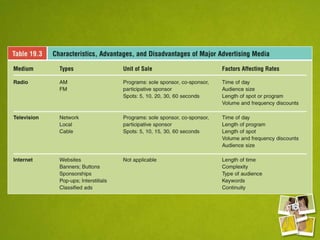
Broadcast Media
• TV
• Radio
People spend:
• 10 years watching TV
• 6 years listening to radio
There are:
• Approximately 10,000 radio stations
• 11,600 Cable channels
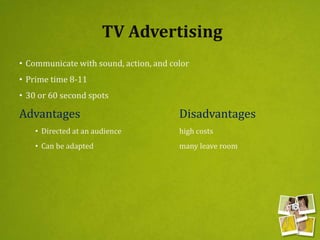
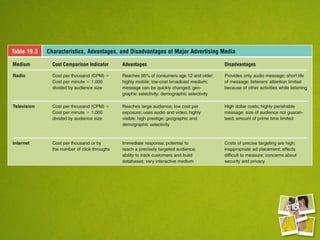
TV Advertising
• Communicate with sound, action, and color
• Prime time 8-11
• 30 or 60 second spots
Advantages Disadvantages
• Directed at an audience high costs
• Can be adapted many leave room
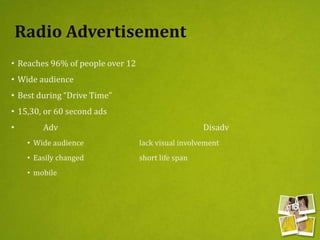
Radio Advertisement
• Reaches 96% of people over 12
• Wide audience
• Best during “Drive Time”
• 15,30, or 60 second ads
• Adv Disadv
• Wide audience lack visual involvement
• Easily changed short life span
• mobile
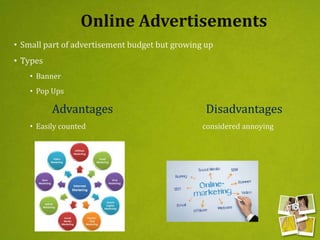
Online Advertisements
• Small part of advertisement budget but growing up
• Types
• Banner
• Pop Ups
Advantages Disadvantages
• Easily counted considered annoying
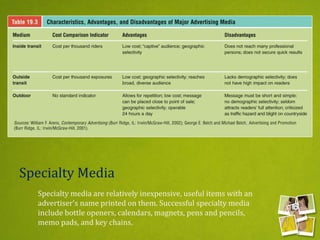
Specialty media are relatively inexpensive, useful items with an
advertiser's name printed on them. Successful specialty media
include bottle openers, calendars, magnets, pens and pencils,
memo pads, and key chains.
Specialty Media
Media
Planning
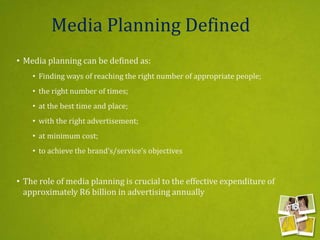
Media Planning Defined
• Media planning can be defined as:
• Finding ways of reaching the right number of appropriate people;
• the right number of times;
• at the best time and place;
• with the right advertisement;
• at minimum cost;
• to achieve the brand’s/service’s objectives
• The role of media planning is crucial to the effective expenditure of
approximately R6 billion in advertising annually
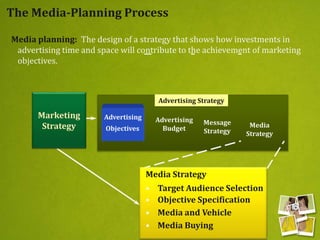
The Media-Planning Process
Media planning: The design of a strategy that shows how investments in
advertising time and space will contribute to the achievement of marketing
objectives.
Advertising Strategy
Advertising
Objectives
Advertising
Budget
Message
Strategy
Media
Strategy
Media Strategy
• Target Audience Selection
• Objective Specification
• Media and Vehicle
• Media Buying
Marketing
Strategy
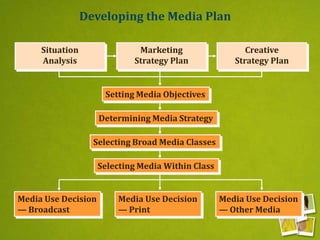
Selecting Media Within Class
Selecting Broad Media Classes
Determining Media Strategy
Media Use Decision
— Print
Media Use Decision
— Broadcast
Media Use Decision
— Other Media
Developing the Media Plan
Setting Media Objectives
Marketing
Strategy Plan
Creative
Strategy Plan
Marketing
Strategy Plan
Situation
Analysis
Creative
Strategy Plan
Situation
Analysis
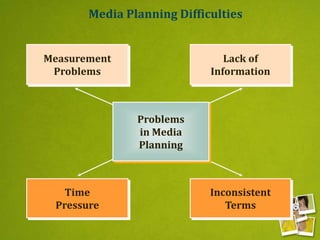
Measurement
Problems
Lack of Information
Inconsistent
Terms
Time
Pressure
Lack of
Information
Measurement
Problems
Media Planning Difficulties
Problems
in Media
Planning
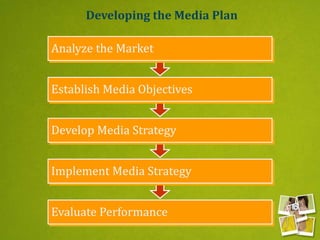
Evaluate Performance
Implement Media Strategy
Develop Media Strategy
Establish Media Objectives
Analyze the Market
Developing the Media Plan
Setting
Media
Objectives
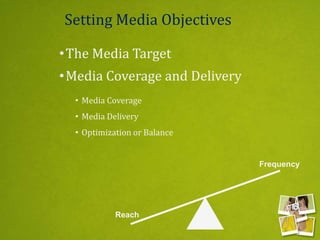
Setting Media Objectives
•The Media Target
•Media Coverage and Delivery
• Media Coverage
• Media Delivery
• Optimization or Balance
Reach
Frequency
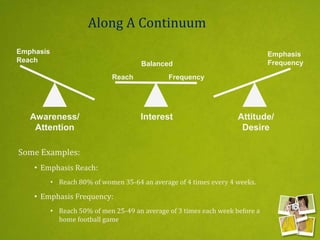
Along A Continuum
Reach Frequency
Emphasis
Frequency
Emphasis
Reach
Balanced
Awareness/
Attention
Interest Attitude/
Desire
Some Examples:
• Emphasis Reach:
• Reach 80% of women 35-64 an average of 4 times every 4 weeks.
• Emphasis Frequency:
• Reach 50% of men 25-49 an average of 3 times each week before a
home football game
Example: Axe Body Spray
• Brand Planning Target:
• “Contemporary, cool young men looking for an edge in the
dating game”
• Media Planning Target:
• Profile of “Contemporary, cool
young men” based on usage of
contemporary, cool products
• Media Measurement Target:
• Simple demographic like “men
aged 18-24
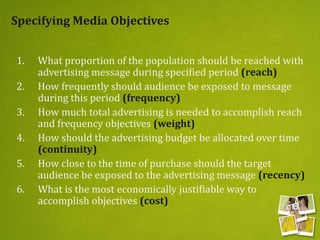
Specifying Media Objectives
1. What proportion of the population should be reached with
advertising message during specified period (reach)
2. How frequently should audience be exposed to message
during this period (frequency)
3. How much total advertising is needed to accomplish reach
and frequency objectives (weight)
4. How should the advertising budget be allocated over time
(continuity)
5. How close to the time of purchase should the target
audience be exposed to the advertising message (recency)
6. What is the most economically justifiable way to
accomplish objectives (cost)
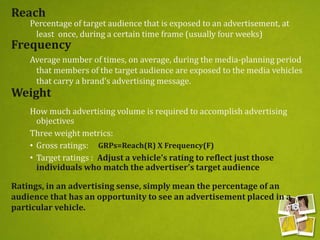
Reach
Percentage of target audience that is exposed to an advertisement, at
least once, during a certain time frame (usually four weeks)
Average number of times, on average, during the media-planning period
that members of the target audience are exposed to the media vehicles
that carry a brand’s advertising message.
How much advertising volume is required to accomplish advertising
objectives
Three weight metrics:
• Gross ratings:
• Target ratings : Adjust a vehicle’s rating to reflect just those
individuals who match the advertiser’s target audience
Frequency
Weight
Ratings, in an advertising sense, simply mean the percentage of an
audience that has an opportunity to see an advertisement placed in a
particular vehicle.
GRPs=Reach(R) X Frequency(F)
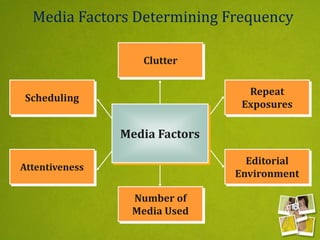
Clutter
Number of
Media Used
Repeat
Exposures
Editorial
Environment
Scheduling
Attentiveness
Media Factors Determining Frequency
Media Factors
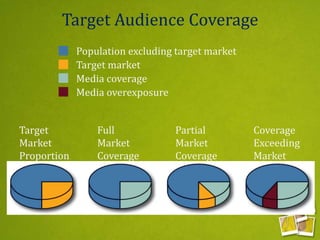
Target
Market
Proportion
Full
Market
Coverage
Partial
Market
Coverage
Coverage
Exceeding
Market
Target Audience Coverage
Population excluding target market
Target market
Media coverage
Media overexposure
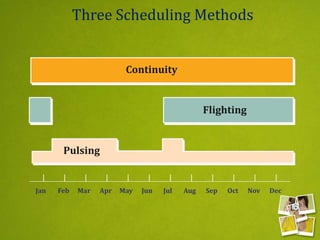
Three Scheduling Methods
Continuity
Pulsing
Flighting
Jan Feb Mar Apr May Jun Jul Aug Sep Oct Nov Dec
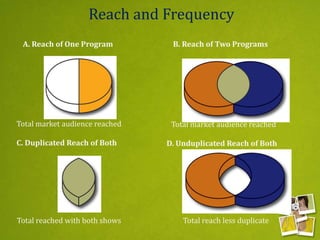
Reach and Frequency
A. Reach of One Program
Total market audience reached
B. Reach of Two Programs
Total market audience reached
C. Duplicated Reach of Both
Total reached with both shows
D. Unduplicated Reach of Both
Total reach less duplicate
Media Versus Vehicles
• Media are the general communication methods that carry
advertising messages—television, magazines, newspapers, and so
on.
• Vehicles are the specific broadcast programs or print choices in
which advertisements are placed.
For example, television is the media, and American Idol is the
vehicle.
Each medium and vehicle has a unique set of characteristics and
virtues.
• Advertisers are placing more emphasis than ever on media
planning.
• The choice of media and vehicles can be the most complicated
of marcom decisions.
Media
Strategy
The Development of the Media Strategy
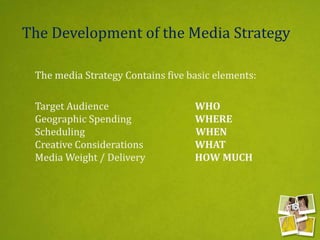
The media Strategy Contains five basic elements:
Target Audience WHO
Geographic Spending WHERE
Scheduling WHEN
Creative Considerations WHAT
Media Weight / Delivery HOW MUCH
The Development of the Media Strategy
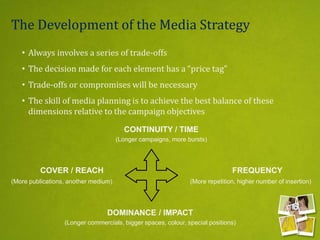
• Always involves a series of trade-offs
• The decision made for each element has a “price tag”
• Trade-offs or compromises will be necessary
• The skill of media planning is to achieve the best balance of these
dimensions relative to the campaign objectives
CONTINUITY / TIME
(Longer campaigns, more bursts)
COVER / REACH FREQUENCY
(More publications, another medium) (More repetition, higher number of insertion)
DOMINANCE / IMPACT
(Longer commercials, bigger spaces, colour, special positions)
Offensive or Defensive Approach
• Defensive as in protection of the current business
• Offensive as in opportunistic
• In Reference to ALL strategic decisions
Deciding Media Strategies
• Offensive or Defensive Approach
• Setting a Media Budget
• Strategies to Accomplish the Objective
Setting a Media Budget
• Objective/Task
• Affordability
• Percentage of Sales
• Competitive Spending
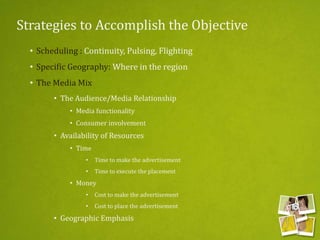
Strategies to Accomplish the Objective
• Scheduling : Continuity, Pulsing, Flighting
• Specific Geography: Where in the region
• The Media Mix
• The Audience/Media Relationship
• Media functionality
• Consumer involvement
• Availability of Resources
• Time
• Time to make the advertisement
• Time to execute the placement
• Money
• Cost to make the advertisement
• Cost to place the advertisement
• Geographic Emphasis
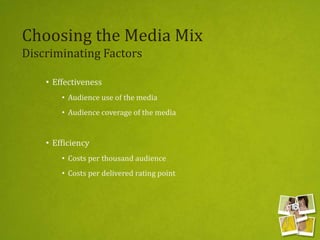
Choosing the Media Mix
Discriminating Factors
• Effectiveness
• Audience use of the media
• Audience coverage of the media
• Efficiency
• Costs per thousand audience
• Costs per delivered rating point
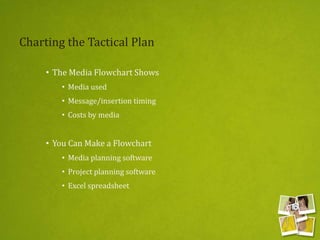
Charting the Tactical Plan
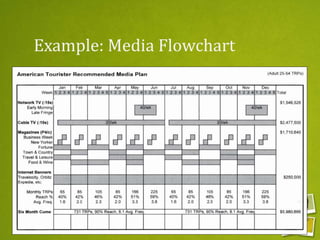
• The Media Flowchart Shows
• Media used
• Message/insertion timing
• Costs by media
• You Can Make a Flowchart
• Media planning software
• Project planning software
• Excel spreadsheet
Example: Media Flowchart
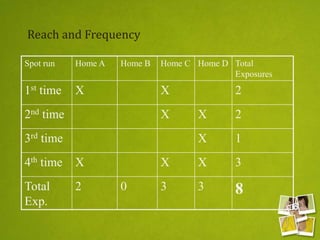
Reach and Frequency
Spot run Home A Home B Home C Home D Total
Exposures
1st time X X 2
2nd time X X 2
3rd time X 1
4th time X X X 3
Total
Exp.
2 0 3 3 8
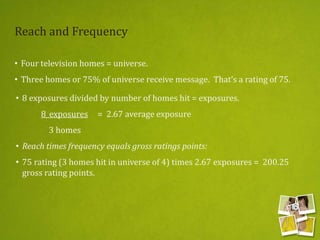
Reach and Frequency
• Four television homes = universe.
• Three homes or 75% of universe receive message. That’s a rating of 75.
• 8 exposures divided by number of homes hit = exposures.
8_exposures = 2.67 average exposure
3 homes
• Reach times frequency equals gross ratings points:
• 75 rating (3 homes hit in universe of 4) times 2.67 exposures = 200.25
gross rating points.
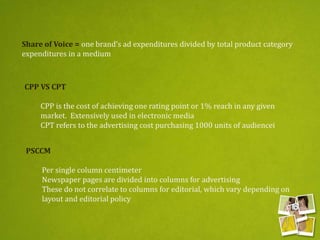
CPP VS CPT
CPP is the cost of achieving one rating point or 1% reach in any given
market. Extensively used in electronic media
CPT refers to the advertising cost purchasing 1000 units of audiencei
PSCCM
Per single column centimeter
Newspaper pages are divided into columns for advertising
These do not correlate to columns for editorial, which vary depending on
layout and editorial policy
Share of Voice = one brand’s ad expenditures divided by total product category
expenditures in a medium
Selecting Media
•Appropriate image
•Target audience
•Obtain desired response
Modern Media Planning
• Setting Media Objectives
• Deciding Media Strategies
• Choosing the Media Mix
• Charting the Tactical Plan
Media Alternatives
• Media available by media class
• Media spending by retail category
• Retail spending by media
• Media audience measures and rankings by class
• Special geographic media alternatives available
Media
Research
Market Research:
How do you find this stuff?
• Primary Research
• Store or customer research
• Media research
• Secondary Research
• Government reports
• Industry reports
• Syndicated research
• Surveys
• Focus Groups
• Mall Intercept questionnaires
• One-on-one Interviews
Primary Research Locally
Secondary Research Locally
• Government Reports
• Chamber of Commerce research
• Survey of Buying Power
• US Census data
• Government Studies
• Statistical Abstract
Secondary Research Locally
• Industry Reports
• Trade magazines
• Trade associations
• Specialized reports
• Syndicated Research
• Donnelly Demographics
• Regional/Market studies by Nielsen, Arbitron, Scarborough
• CD-ROM databases
• Published media reports
• Media associations
• Media services like SRDS
Media
Buying
Media Buying
• Buying is a complicated process
• The American Association of
Advertising Agencies (AAAA)
lists no fewer than 21 elements
in the authorization for a media
buy
Providing inside info
• Media buyers are important
information sources for media
planners
• Close enough to day-to-day
changes in media popularity
and pricing to be a constant
source of inside information
Selecting Media Vehicles
• Choose the best vehicles that fit
the target audience’s aperture
• The media planner lays out the
direction; the buyer is
responsible for choosing
specific vehicles
Negotiation
• Media buyers pursue special
advantages for clients
• Locate the desired vehicles and
negotiate and maintain
satisfactory schedule and rates
Preferred Positions
• Locations in print media that
offer readership advantages
• Preferred positions often carry
a premium surcharge
Extra Support Offers
• Value-added media services
• Contests
• Special events
• Merchandising space at stores
• Displays
• Trade-directed newsletters
Billing and Payment
• It is the responsibility of the
advertiser to make payments to
various media
• The agency is contractually
obligated to pay the invoice on
behalf of the client
Monitoring the Buy
• The media buyer tracks the
performance of the media plan
as it is implemented, as well as
afterward
• Poorly performing vehicles
must be replaced or costs must
be modified
Media Buying
Make-Goods
• A policy of compensating for
missed positions or errors in
handling the message
presentation
• Ensure that the advertiser is
compensated appropriately
when they occur
Post-campaign Eval
• Once a campaign is
completed, the planner
compares the plan’s
expectations and forecasts
with what actually
happened
• Provides guidance for
future media plans
Thank You !

Media Management

  • 1.
  • 2.
    A series ofdecisions involving the delivery of messages to audiences Goals to be attained by the media strategy and program Decisions on how the media objectives can be attained The various categories of delivery systems, including broadcast and print media Either radio or television network or local station broadcasts A series of decisions involving the delivery of messages to audiences Goals to be attained by the media strategy and program Decisions on how the media objectives can be attained The various categories of delivery systems, including broadcast and print media Media Terminology Media Planning Media Objectives Media Strategy Media Broadcast Media
  • 3.
    Publications such asnewspapers, magazines, direct mail, outdoor, etc. The specific carrier within a medium category Number of different audience members exposed at least once in a given time period The potential audience that might receive the message through the vehicle The number of times the receiver is exposed to the media vehicle in a specific time period The potential audience that might receive the message through the vehicle Number of different audience members exposed at least once in a given time period The specific carrier within a medium category Publications such as newspapers, magazines, direct mail, outdoor, etc. Media Terminology Print Media Media Vehicle Reach Coverage Frequency
  • 4.
    Media Management SimplyDefined • Media planning: The series of decisions involved in delivering the message to the target audience. • Media plan: The actual document detailing media planning decisions. • Media objectives: Objectives of media plan. • Media strategies: action plans to reach objectives. • Medium: channel such as print, broadcast. • Media vehicle: Specific carrier in a media category (television, magazines).
  • 5.
    Types of Media Media :agencies, means, or instrument used to convey message
  • 6.
    Newspaper Advantages • High readership •Relatively cheap • Timely • Easily changed Disadvantages • Wasted circulation • Short life span • Less appealing format Magazine Advantages • Know your audience • Higher print quality • Longer life span • Variety of formats Disadvantages • More expensive • Longer deadlines
  • 7.
    Direct Mail Advantages • Selectiveabout receivers • Control timing • Wide variety of formats Disadvantages • Low level of response • “junk mail” • Dated customer lists • Higher costs Directory • Relatively inexpensive • Found in 98% of households • Kept • Can’t adjust or change until next year
  • 8.
    Outdoor • Nonstandardized • Usedby local firms at their place or in other locations • Pay rent to owners • Standardized (posters, painted bulletins, and spectaculars) • Billboards • Placed near highly travels roads • Owned by an ad company Transit • Uses public transportation • Includes • Business and commuter trains • Taxis and buses • Located in railroad, bus, or airplane terminals
  • 9.
    Broadcast Media • TV •Radio People spend: • 10 years watching TV • 6 years listening to radio There are: • Approximately 10,000 radio stations • 11,600 Cable channels
  • 10.
    TV Advertising • Communicatewith sound, action, and color • Prime time 8-11 • 30 or 60 second spots Advantages Disadvantages • Directed at an audience high costs • Can be adapted many leave room
  • 11.
    Radio Advertisement • Reaches96% of people over 12 • Wide audience • Best during “Drive Time” • 15,30, or 60 second ads • Adv Disadv • Wide audience lack visual involvement • Easily changed short life span • mobile
  • 12.
    Online Advertisements • Smallpart of advertisement budget but growing up • Types • Banner • Pop Ups Advantages Disadvantages • Easily counted considered annoying
  • 18.
    Specialty media arerelatively inexpensive, useful items with an advertiser's name printed on them. Successful specialty media include bottle openers, calendars, magnets, pens and pencils, memo pads, and key chains. Specialty Media
  • 19.
  • 20.
    Media Planning Defined •Media planning can be defined as: • Finding ways of reaching the right number of appropriate people; • the right number of times; • at the best time and place; • with the right advertisement; • at minimum cost; • to achieve the brand’s/service’s objectives • The role of media planning is crucial to the effective expenditure of approximately R6 billion in advertising annually
  • 21.
    The Media-Planning Process Mediaplanning: The design of a strategy that shows how investments in advertising time and space will contribute to the achievement of marketing objectives. Advertising Strategy Advertising Objectives Advertising Budget Message Strategy Media Strategy Media Strategy • Target Audience Selection • Objective Specification • Media and Vehicle • Media Buying Marketing Strategy
  • 22.
    Selecting Media WithinClass Selecting Broad Media Classes Determining Media Strategy Media Use Decision — Print Media Use Decision — Broadcast Media Use Decision — Other Media Developing the Media Plan Setting Media Objectives Marketing Strategy Plan Creative Strategy Plan Marketing Strategy Plan Situation Analysis Creative Strategy Plan Situation Analysis
  • 23.
    Measurement Problems Lack of Information Inconsistent Terms Time Pressure Lackof Information Measurement Problems Media Planning Difficulties Problems in Media Planning
  • 24.
    Evaluate Performance Implement MediaStrategy Develop Media Strategy Establish Media Objectives Analyze the Market Developing the Media Plan
  • 25.
  • 26.
    Setting Media Objectives •TheMedia Target •Media Coverage and Delivery • Media Coverage • Media Delivery • Optimization or Balance Reach Frequency
  • 27.
    Along A Continuum ReachFrequency Emphasis Frequency Emphasis Reach Balanced Awareness/ Attention Interest Attitude/ Desire Some Examples: • Emphasis Reach: • Reach 80% of women 35-64 an average of 4 times every 4 weeks. • Emphasis Frequency: • Reach 50% of men 25-49 an average of 3 times each week before a home football game
  • 28.
    Example: Axe BodySpray • Brand Planning Target: • “Contemporary, cool young men looking for an edge in the dating game” • Media Planning Target: • Profile of “Contemporary, cool young men” based on usage of contemporary, cool products • Media Measurement Target: • Simple demographic like “men aged 18-24
  • 29.
    Specifying Media Objectives 1.What proportion of the population should be reached with advertising message during specified period (reach) 2. How frequently should audience be exposed to message during this period (frequency) 3. How much total advertising is needed to accomplish reach and frequency objectives (weight) 4. How should the advertising budget be allocated over time (continuity) 5. How close to the time of purchase should the target audience be exposed to the advertising message (recency) 6. What is the most economically justifiable way to accomplish objectives (cost)
  • 30.
    Reach Percentage of targetaudience that is exposed to an advertisement, at least once, during a certain time frame (usually four weeks) Average number of times, on average, during the media-planning period that members of the target audience are exposed to the media vehicles that carry a brand’s advertising message. How much advertising volume is required to accomplish advertising objectives Three weight metrics: • Gross ratings: • Target ratings : Adjust a vehicle’s rating to reflect just those individuals who match the advertiser’s target audience Frequency Weight Ratings, in an advertising sense, simply mean the percentage of an audience that has an opportunity to see an advertisement placed in a particular vehicle. GRPs=Reach(R) X Frequency(F)
  • 31.
  • 32.
  • 33.
    Three Scheduling Methods Continuity Pulsing Flighting JanFeb Mar Apr May Jun Jul Aug Sep Oct Nov Dec
  • 34.
    Reach and Frequency A.Reach of One Program Total market audience reached B. Reach of Two Programs Total market audience reached C. Duplicated Reach of Both Total reached with both shows D. Unduplicated Reach of Both Total reach less duplicate
  • 35.
    Media Versus Vehicles •Media are the general communication methods that carry advertising messages—television, magazines, newspapers, and so on. • Vehicles are the specific broadcast programs or print choices in which advertisements are placed. For example, television is the media, and American Idol is the vehicle. Each medium and vehicle has a unique set of characteristics and virtues. • Advertisers are placing more emphasis than ever on media planning. • The choice of media and vehicles can be the most complicated of marcom decisions.
  • 36.
  • 37.
    The Development ofthe Media Strategy The media Strategy Contains five basic elements: Target Audience WHO Geographic Spending WHERE Scheduling WHEN Creative Considerations WHAT Media Weight / Delivery HOW MUCH
  • 38.
    The Development ofthe Media Strategy • Always involves a series of trade-offs • The decision made for each element has a “price tag” • Trade-offs or compromises will be necessary • The skill of media planning is to achieve the best balance of these dimensions relative to the campaign objectives CONTINUITY / TIME (Longer campaigns, more bursts) COVER / REACH FREQUENCY (More publications, another medium) (More repetition, higher number of insertion) DOMINANCE / IMPACT (Longer commercials, bigger spaces, colour, special positions)
  • 39.
    Offensive or DefensiveApproach • Defensive as in protection of the current business • Offensive as in opportunistic • In Reference to ALL strategic decisions Deciding Media Strategies • Offensive or Defensive Approach • Setting a Media Budget • Strategies to Accomplish the Objective Setting a Media Budget • Objective/Task • Affordability • Percentage of Sales • Competitive Spending
  • 40.
    Strategies to Accomplishthe Objective • Scheduling : Continuity, Pulsing, Flighting • Specific Geography: Where in the region • The Media Mix • The Audience/Media Relationship • Media functionality • Consumer involvement • Availability of Resources • Time • Time to make the advertisement • Time to execute the placement • Money • Cost to make the advertisement • Cost to place the advertisement • Geographic Emphasis
  • 41.
    Choosing the MediaMix Discriminating Factors • Effectiveness • Audience use of the media • Audience coverage of the media • Efficiency • Costs per thousand audience • Costs per delivered rating point
  • 42.
    Charting the TacticalPlan • The Media Flowchart Shows • Media used • Message/insertion timing • Costs by media • You Can Make a Flowchart • Media planning software • Project planning software • Excel spreadsheet
  • 43.
  • 44.
    Reach and Frequency Spotrun Home A Home B Home C Home D Total Exposures 1st time X X 2 2nd time X X 2 3rd time X 1 4th time X X X 3 Total Exp. 2 0 3 3 8
  • 45.
    Reach and Frequency •Four television homes = universe. • Three homes or 75% of universe receive message. That’s a rating of 75. • 8 exposures divided by number of homes hit = exposures. 8_exposures = 2.67 average exposure 3 homes • Reach times frequency equals gross ratings points: • 75 rating (3 homes hit in universe of 4) times 2.67 exposures = 200.25 gross rating points.
  • 46.
    CPP VS CPT CPPis the cost of achieving one rating point or 1% reach in any given market. Extensively used in electronic media CPT refers to the advertising cost purchasing 1000 units of audiencei PSCCM Per single column centimeter Newspaper pages are divided into columns for advertising These do not correlate to columns for editorial, which vary depending on layout and editorial policy Share of Voice = one brand’s ad expenditures divided by total product category expenditures in a medium
  • 47.
    Selecting Media •Appropriate image •Targetaudience •Obtain desired response
  • 48.
    Modern Media Planning •Setting Media Objectives • Deciding Media Strategies • Choosing the Media Mix • Charting the Tactical Plan
  • 49.
    Media Alternatives • Mediaavailable by media class • Media spending by retail category • Retail spending by media • Media audience measures and rankings by class • Special geographic media alternatives available
  • 50.
  • 51.
    Market Research: How doyou find this stuff? • Primary Research • Store or customer research • Media research • Secondary Research • Government reports • Industry reports • Syndicated research
  • 52.
    • Surveys • FocusGroups • Mall Intercept questionnaires • One-on-one Interviews Primary Research Locally Secondary Research Locally • Government Reports • Chamber of Commerce research • Survey of Buying Power • US Census data • Government Studies • Statistical Abstract
  • 53.
    Secondary Research Locally •Industry Reports • Trade magazines • Trade associations • Specialized reports • Syndicated Research • Donnelly Demographics • Regional/Market studies by Nielsen, Arbitron, Scarborough • CD-ROM databases • Published media reports • Media associations • Media services like SRDS
  • 54.
  • 55.
    Media Buying • Buyingis a complicated process • The American Association of Advertising Agencies (AAAA) lists no fewer than 21 elements in the authorization for a media buy Providing inside info • Media buyers are important information sources for media planners • Close enough to day-to-day changes in media popularity and pricing to be a constant source of inside information Selecting Media Vehicles • Choose the best vehicles that fit the target audience’s aperture • The media planner lays out the direction; the buyer is responsible for choosing specific vehicles Negotiation • Media buyers pursue special advantages for clients • Locate the desired vehicles and negotiate and maintain satisfactory schedule and rates
  • 56.
    Preferred Positions • Locationsin print media that offer readership advantages • Preferred positions often carry a premium surcharge Extra Support Offers • Value-added media services • Contests • Special events • Merchandising space at stores • Displays • Trade-directed newsletters Billing and Payment • It is the responsibility of the advertiser to make payments to various media • The agency is contractually obligated to pay the invoice on behalf of the client Monitoring the Buy • The media buyer tracks the performance of the media plan as it is implemented, as well as afterward • Poorly performing vehicles must be replaced or costs must be modified
  • 57.
    Media Buying Make-Goods • Apolicy of compensating for missed positions or errors in handling the message presentation • Ensure that the advertiser is compensated appropriately when they occur Post-campaign Eval • Once a campaign is completed, the planner compares the plan’s expectations and forecasts with what actually happened • Provides guidance for future media plans
  • 58.