The document discusses three models of strategic communication: linear, adaptive, and interpretive. The linear model views strategy as long-term planning by top managers to achieve goals through rational decision making. The adaptive model focuses on continuously adjusting the organization to its dynamic environment through co-alignment. The interpretive model views strategy as managing meanings and symbols to legitimize the organization through shared understandings. It then covers characteristics like public communication, the communication source, and a transactional approach. Finally, it discusses the traditional perspective on internal communication topics like orientation, morale, and change, and external communication topics like public relations, issues management, and advocacy.
![Models of Strategy
• Linear
• Adaptive
• Interpretive [Chafee, 1985]](https://image.slidesharecdn.com/chapter-13-powerpoint-160218213444/85/LS-603-Chapter-13-Strategic-Communication-4-320.jpg)
![Organizational Change
and Development
• Strategic change depends on backing from those
who authorize change, accessibility in the sense
that managers understand what they are working
toward, specificity in terms of the detailed
planning, and cultural receptivity, i.e., those
affected by change are receptive enough to
facilitate it. [Miller, 1997]
• Successful change also depends on
propitiousness. Simply stated, accomplishing
major change also requires some luck.](https://image.slidesharecdn.com/chapter-13-powerpoint-160218213444/85/LS-603-Chapter-13-Strategic-Communication-23-320.jpg)
![Public Relations and
Image Building
• Image building is a process of creating the identity
an organization wants its relevant publics to
perceive.
• Image building involves an organization's attempt
to cultivate a public impression that a set of
positively valued features defines the essential
character of the organization. [Goldhaber, 1993]
• Changing a corporate image requires developing
and publicizing specific organizational
characteristics and behaviors that are consistent
with the image being cultivated.](https://image.slidesharecdn.com/chapter-13-powerpoint-160218213444/85/LS-603-Chapter-13-Strategic-Communication-27-320.jpg)
![Public Relations and
Image Building
• The art of image building is associated with the field
of public relations.
• Public relations has been defined as the
management function which evaluates public
attitudes, identifies the policies and procedures of an
individual or an organization with the public interest,
and executes a program of action to earn public
understanding and acceptance.
• Farsighted, contemporary public relations practice is
concerned with developing public appreciation of
good organizational performance [Cutlip & Center,
1964]](https://image.slidesharecdn.com/chapter-13-powerpoint-160218213444/85/LS-603-Chapter-13-Strategic-Communication-28-320.jpg)
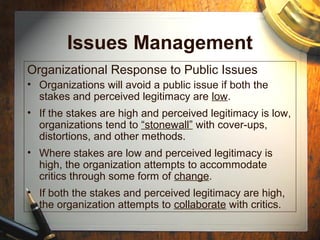
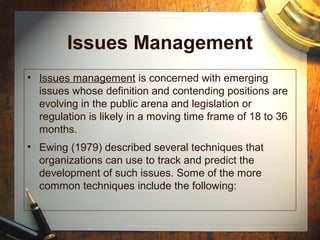
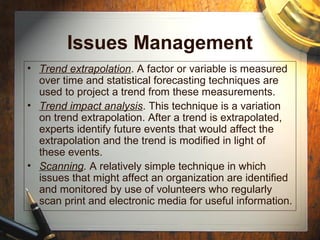
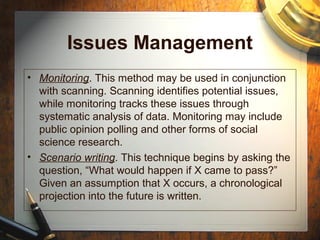
![Issues Management
• The organized activity of identifying emerging
trends, concerns, or issues likely to affect an
organization in the next few years and developing a
wider and more positive range of organizational
responses [Coates, Coates, Jarratt, and Heinz, 1986]
• Issues management in business emerged largely as
a response to the activism of public interest and
special interest groups and as a means of
identifying, understanding, tracking, and acting on
issues before they are subjected to public policy
deliberations and decision making [Jones & Chase,
1979]](https://image.slidesharecdn.com/chapter-13-powerpoint-160218213444/85/LS-603-Chapter-13-Strategic-Communication-29-320.jpg)
![Image Management and
Issues Advocacy
• Issues advocacy addresses itself to specific
controversial issues, presenting facts and arguments
that project the sponsor’s viewpoint to try to influence
political decisions by molding public opinion [Sethi,
1982]
• Pfizer advertised its Access program to help uninsured
persons obtain free prescription drugs when politicians
were debating addition of drug coverage to Medicare,
an action opposed by Pfizer.
• The message was an image ad in appearance, but it
functioned as an advocacy ad by implying that the
Medicare drug program was unnecessary.](https://image.slidesharecdn.com/chapter-13-powerpoint-160218213444/85/LS-603-Chapter-13-Strategic-Communication-36-320.jpg)
![Risk Communication
• Risk communication is the process of
communicating responsibly and effectively about
the risk factors associated with industrial
technologies, natural hazards, and human
activities.
• Risk communication is not about managing risks,
per se; it is about managing the divide between
the expert and the non-expert to achieve an
informed understanding of risks and benefits
[Leiss, 2004]](https://image.slidesharecdn.com/chapter-13-powerpoint-160218213444/85/LS-603-Chapter-13-Strategic-Communication-37-320.jpg)
![Risk Communication
• The basic responsibility of risk communication
practitioners is promotion of reasoned dialogue
among stakeholders on the nature of the relevant
risk factors and on acceptable risk management
strategies.
• In order to fulfill this purpose, practitioners must
understand how risks are perceived by relevant
publics, be able to present expert risk assessments
in ways that non-experts can understand, and help
interested parties reach a shared understanding of
risk [Leiss, 2004]](https://image.slidesharecdn.com/chapter-13-powerpoint-160218213444/85/LS-603-Chapter-13-Strategic-Communication-38-320.jpg)
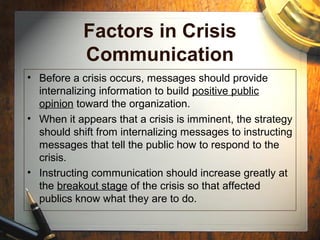
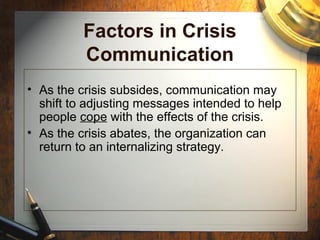
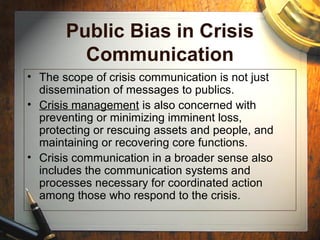
![Crisis Communication
• Crisis: a major, unpredictable event that has
potentially negative results and may
significantly damage the organization [Barton,
1993]
• The purpose of crisis communication is to
respond appropriately in such situations to
minimize damage and maintain public
confidence](https://image.slidesharecdn.com/chapter-13-powerpoint-160218213444/85/LS-603-Chapter-13-Strategic-Communication-39-320.jpg)
![Crisis and Stakeholder
Relationships
• Crisis communication in situations that affect the
organization’s relationships with stakeholders,
especially those that draw mass media attention,
requires management of those relationships
• If you begin with the value of an organization and
subtract from it the organization's material
assets, what you have left is the value that
perception creates
• You can lose that value in a nano-second in a
crisis [Englehart, 1995]](https://image.slidesharecdn.com/chapter-13-powerpoint-160218213444/85/LS-603-Chapter-13-Strategic-Communication-41-320.jpg)
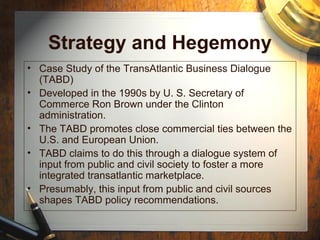
![Strategy and Hegemony
• Increased economic and political tension between
the European Union and United States in recent
years has pushed the TABD into a dual rhetorical
challenge
• Promoting its success to business and government
participants to further its agenda while
encountering a small but growing activist
community protesting TABD's influence as an
example of corporate hegemony [Zoller, 2004]](https://image.slidesharecdn.com/chapter-13-powerpoint-160218213444/85/LS-603-Chapter-13-Strategic-Communication-54-320.jpg)
![Strategy and Hegemony
• TABD links dialogue with the public good and denies any
aims to weaken regulations on business, yet deregulatory
goals are apparent in its public communication.
• TABD represents dialogue as civil participation and its
own role as advisory and nongovernmental, but its goal is
incorporation of its expert group recommendations into
government policy.
• The effect of TABD’s strategy actually is to exclude
multiple viewpoints from dialogue on trade and business
policies: “Rather than contributing to increased public
debate, the process forwards only business interests and
only one version of those interests” [Zoller, 2004]](https://image.slidesharecdn.com/chapter-13-powerpoint-160218213444/85/LS-603-Chapter-13-Strategic-Communication-55-320.jpg)