CORPORATE
COMMUNICATION
DEFINITION
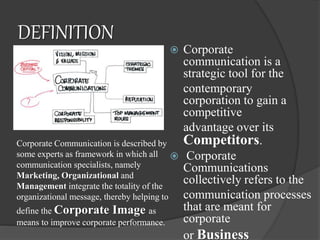
 Corporate
communication is a
strategic tool for the
contemporary
corporation to gain a
competitive
advantage over its
Competitors.
 Corporate
Communications
collectively refers to the
communication processes
that are meant for
corporate
or Business
Corporate Communication is described by
some experts as framework in which all
communication specialists, namely
Marketing, Organizational and
Management integrate the totality of the
organizational message, thereby helping to
define the Corporate Image as
means to improve corporate performance.
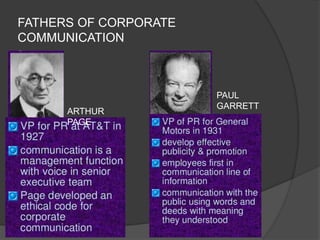
FATHERS OF CORPORATE
COMMUNICATION
ARTHUR
PAGE
PAUL
GARRETT
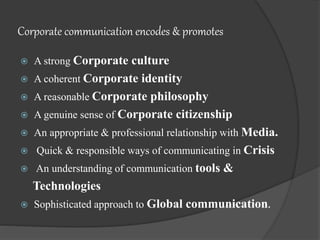
Corporate communication encodes & promotes
 A strong Corporate culture
 A coherent Corporate identity
 A reasonable Corporate philosophy
 A genuine sense of Corporate citizenship
 An appropriate & professional relationship with Media.
 Quick & responsible ways of communicating in Crisis
 An understanding of communication tools &
Technologies
 Sophisticated approach to Global communication.
Corporate Culture
Corporate identity
Corporate philosophy
Corporate citizenship
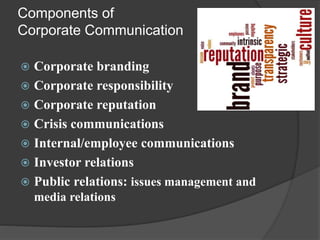
Components of
Corporate Communication
 Corporate branding
 Corporate responsibility
 Corporate reputation
 Crisis communications
 Internal/employee communications
 Investor relations
 Public relations: issues management and
media relations
Corporate Branding
 A corporate brand is the
perception of a
company that unites a
group of products or
services for the public
under a single name, a
shared visual identity,
and a common set of
symbols. The process of
corporate branding
consists creating
favorable associations
and positive reputation
with both internal and
external stakeholders.
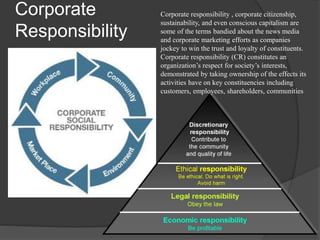
Corporate
Responsibility
Corporate responsibility , corporate citizenship,
sustainability, and even conscious capitalism are
some of the terms bandied about the news media
and corporate marketing efforts as companies
jockey to win the trust and loyalty of constituents.
Corporate responsibility (CR) constitutes an
organization’s respect for society’s interests,
demonstrated by taking ownership of the effects its
activities have on key constituencies including
customers, employees, shareholders, communities
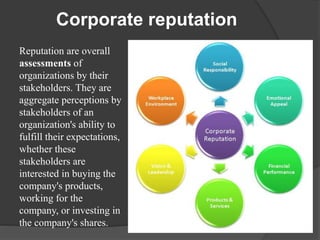
Corporate reputation
Reputation are overall
assessments of
organizations by their
stakeholders. They are
aggregate perceptions by
stakeholders of an
organization's ability to
fulfill their expectations,
whether these
stakeholders are
interested in buying the
company's products,
working for the
company, or investing in
the company's shares.
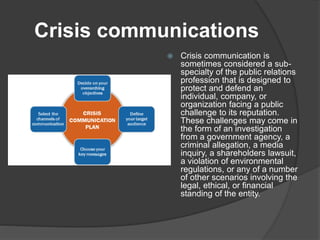
Crisis communications
 Crisis communication is
sometimes considered a sub-
specialty of the public relations
profession that is designed to
protect and defend an
individual, company, or
organization facing a public
challenge to its reputation.
These challenges may come in
the form of an investigation
from a government agency, a
criminal allegation, a media
inquiry, a shareholders lawsuit,
a violation of environmental
regulations, or any of a number
of other scenarios involving the
legal, ethical, or financial
standing of the entity.
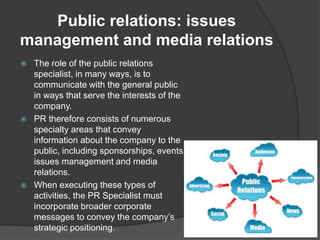
Public relations: issues
management and media relations
 The role of the public relations
specialist, in many ways, is to
communicate with the general public
in ways that serve the interests of the
company.
 PR therefore consists of numerous
specialty areas that convey
information about the company to the
public, including sponsorships, events,
issues management and media
relations.
 When executing these types of
activities, the PR Specialist must
incorporate broader corporate
messages to convey the company’s
strategic positioning.
THANK YOU
Titly Chatterjee
Love Solanki
Mehak Bhaiye
Akshay Aneja

Corporate Communication - Important Facts

  • 1.
  • 3.
    DEFINITION  Corporate communication isa strategic tool for the contemporary corporation to gain a competitive advantage over its Competitors.  Corporate Communications collectively refers to the communication processes that are meant for corporate or Business Corporate Communication is described by some experts as framework in which all communication specialists, namely Marketing, Organizational and Management integrate the totality of the organizational message, thereby helping to define the Corporate Image as means to improve corporate performance.
  • 4.
  • 5.
    Corporate communication encodes& promotes  A strong Corporate culture  A coherent Corporate identity  A reasonable Corporate philosophy  A genuine sense of Corporate citizenship  An appropriate & professional relationship with Media.  Quick & responsible ways of communicating in Crisis  An understanding of communication tools & Technologies  Sophisticated approach to Global communication.
  • 6.
  • 7.
  • 8.
  • 9.
  • 10.
    Components of Corporate Communication Corporate branding  Corporate responsibility  Corporate reputation  Crisis communications  Internal/employee communications  Investor relations  Public relations: issues management and media relations
  • 11.
    Corporate Branding  Acorporate brand is the perception of a company that unites a group of products or services for the public under a single name, a shared visual identity, and a common set of symbols. The process of corporate branding consists creating favorable associations and positive reputation with both internal and external stakeholders.
  • 12.
    Corporate Responsibility Corporate responsibility ,corporate citizenship, sustainability, and even conscious capitalism are some of the terms bandied about the news media and corporate marketing efforts as companies jockey to win the trust and loyalty of constituents. Corporate responsibility (CR) constitutes an organization’s respect for society’s interests, demonstrated by taking ownership of the effects its activities have on key constituencies including customers, employees, shareholders, communities
  • 13.
    Corporate reputation Reputation areoverall assessments of organizations by their stakeholders. They are aggregate perceptions by stakeholders of an organization's ability to fulfill their expectations, whether these stakeholders are interested in buying the company's products, working for the company, or investing in the company's shares.
  • 14.
    Crisis communications  Crisiscommunication is sometimes considered a sub- specialty of the public relations profession that is designed to protect and defend an individual, company, or organization facing a public challenge to its reputation. These challenges may come in the form of an investigation from a government agency, a criminal allegation, a media inquiry, a shareholders lawsuit, a violation of environmental regulations, or any of a number of other scenarios involving the legal, ethical, or financial standing of the entity.
  • 15.
    Public relations: issues managementand media relations  The role of the public relations specialist, in many ways, is to communicate with the general public in ways that serve the interests of the company.  PR therefore consists of numerous specialty areas that convey information about the company to the public, including sponsorships, events, issues management and media relations.  When executing these types of activities, the PR Specialist must incorporate broader corporate messages to convey the company’s strategic positioning.
  • 17.
    THANK YOU Titly Chatterjee LoveSolanki Mehak Bhaiye Akshay Aneja