CTO Fundamental:
Understanding of Wire Structure
For appropriate GW selection and exchange
Etsuo Tsuchikane, MD, PhD
Toyohashi Heart center, Japan
Toyohashi Heart CenterEURO CTO CLUB
Toulouse 2018
Becoming a CTO expert
In order to become a CTO expert, it is essential
to understand the fundamentals of guide wires
– Basic structure
– Attributes and performance
– New technologies
– Optimization of guide wires
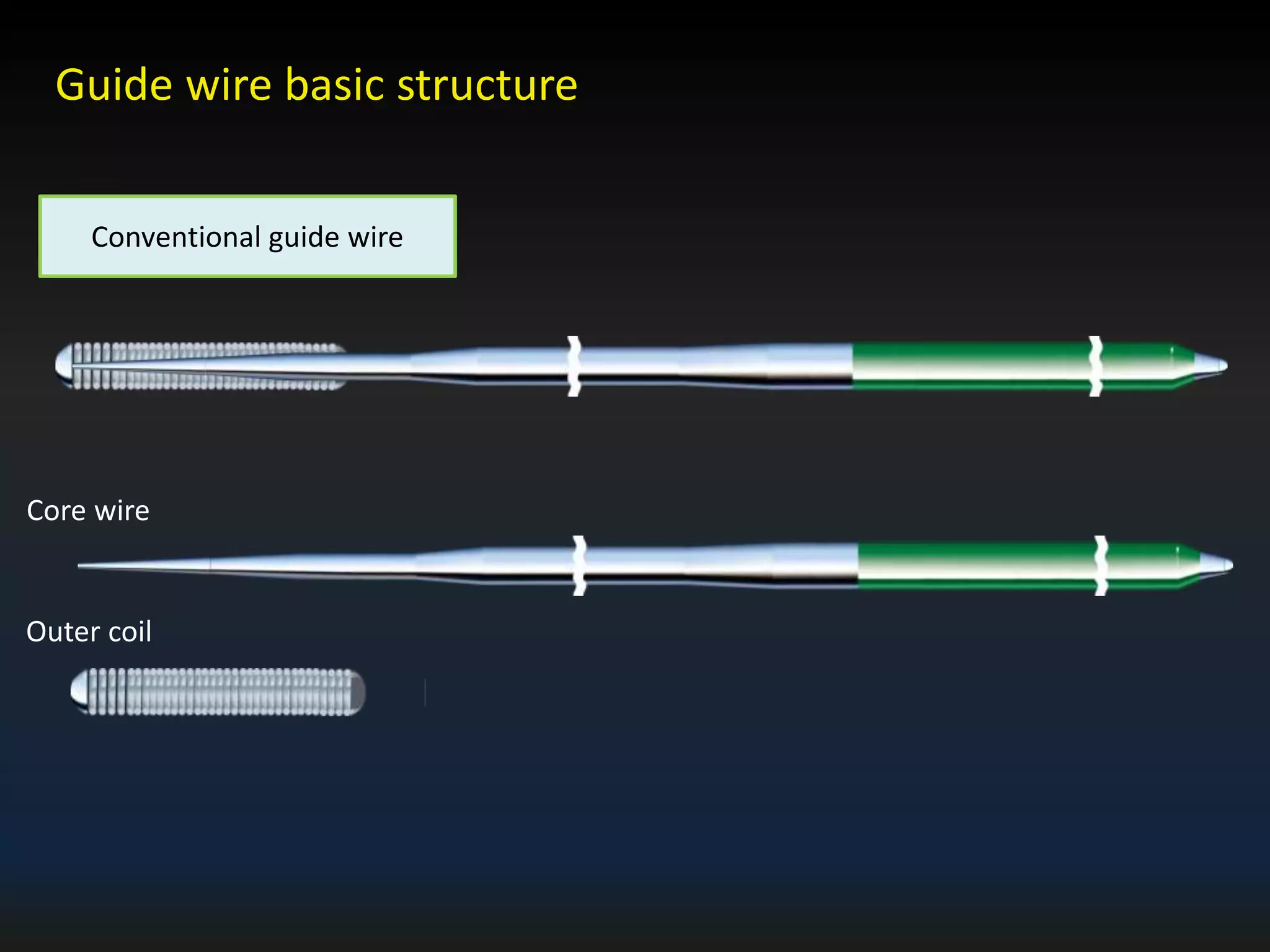
Guide wire basic structure
Conventional guide wire
Outer coil
Core wire
ASAHI’s composite guide wire definition
ASAHI’s composite guide wire
Products developed with
ASAHI’s composite technology
Guide wire that is
composed of more than
“core wire” and “outer coil”
Primary wire
Name Definition / Explanation Illustration image Flexibility
Wire Single wire
+
Wire rope Wire rope made of several single
wires that are roped together + +
Primary wire
Single wire Single wire ropeFlexibility
<
* When it has same outer diameter
1 2 3 4 5 … 1 2 3 4 5 … 1 2 3 4 5 ..
1 2 3 4 5 … 1 2 3 4 5 … 1 2 3 4 5 ..
Coil formation image
Primary Wire
Wire
Wire rope
Coil formation
XTRAND
Single wire coil
Multi wire coil
ACT ONE
Multi wire rope coil
Single wire rope coil
Note:
ACT ONE is placed inside guide wires,
and the direction of the
coil strand is different.
※The standing direction of this image does not matter
Guide wire basic structure
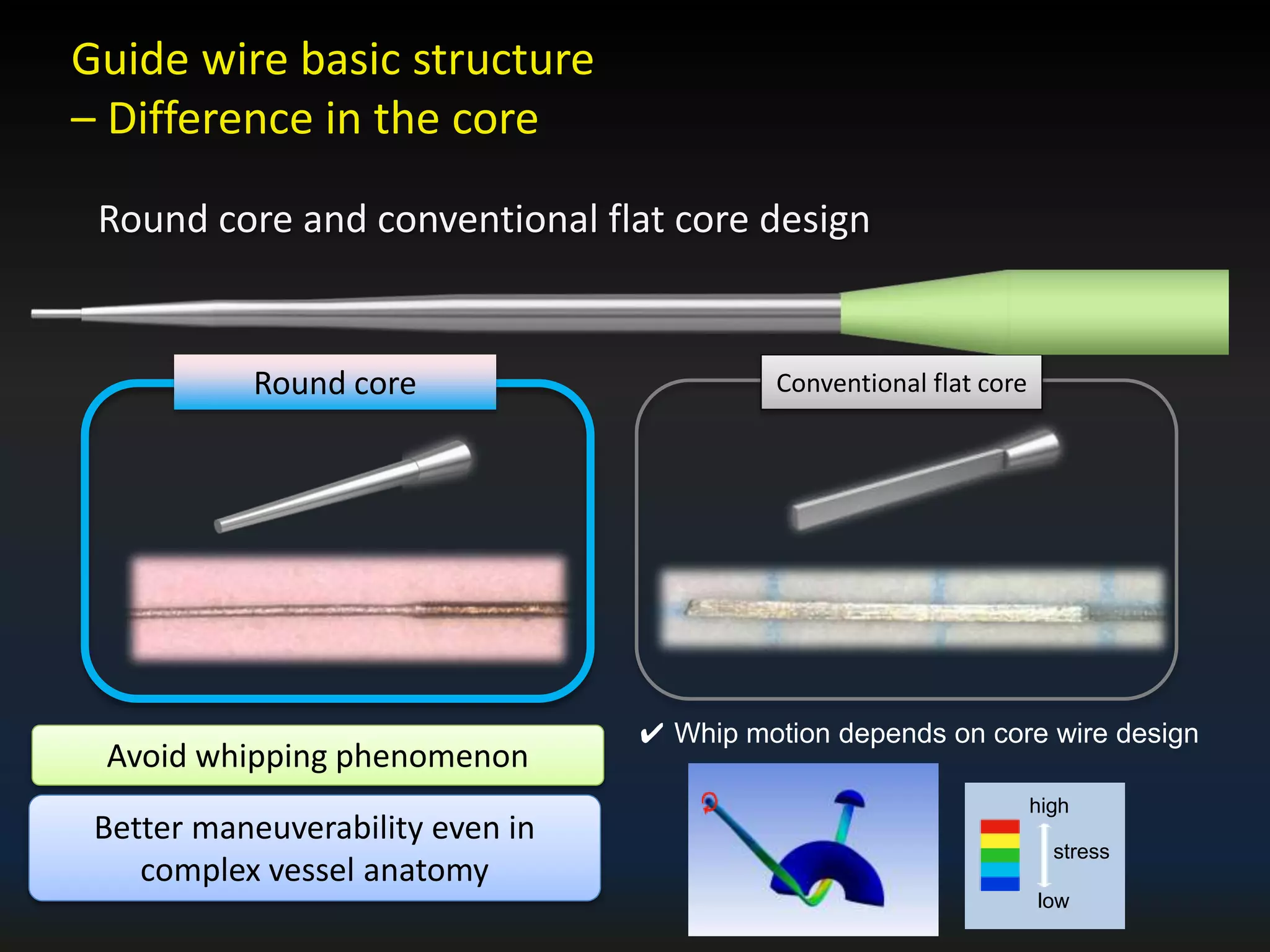
– Difference in the core
Round core and conventional flat core design
Avoid whipping phenomenon
Conventional flat core
Better maneuverability even in
complex vessel anatomy
Round core
✔ Whip motion depends on core wire design
stress
high
low
Challenges to overcome the trade-off
Torque forceFlexibility
Trade-off
No compromise of flexibility or torque force
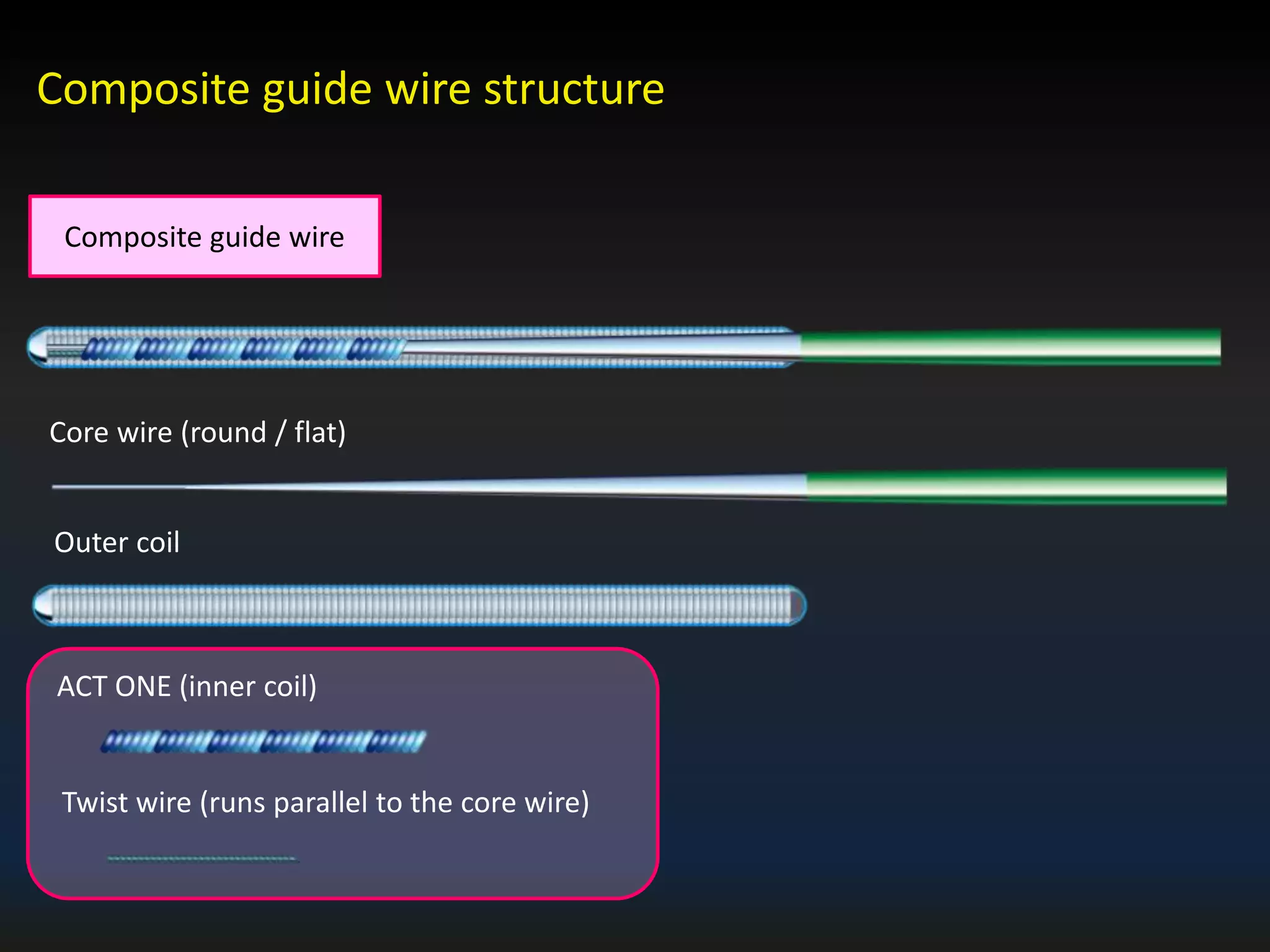
Composite guide wire structure
Composite guide wire
Outer coil
Core wire (round / flat)
ACT ONE (inner coil)
Twist wire (runs parallel to the core wire)
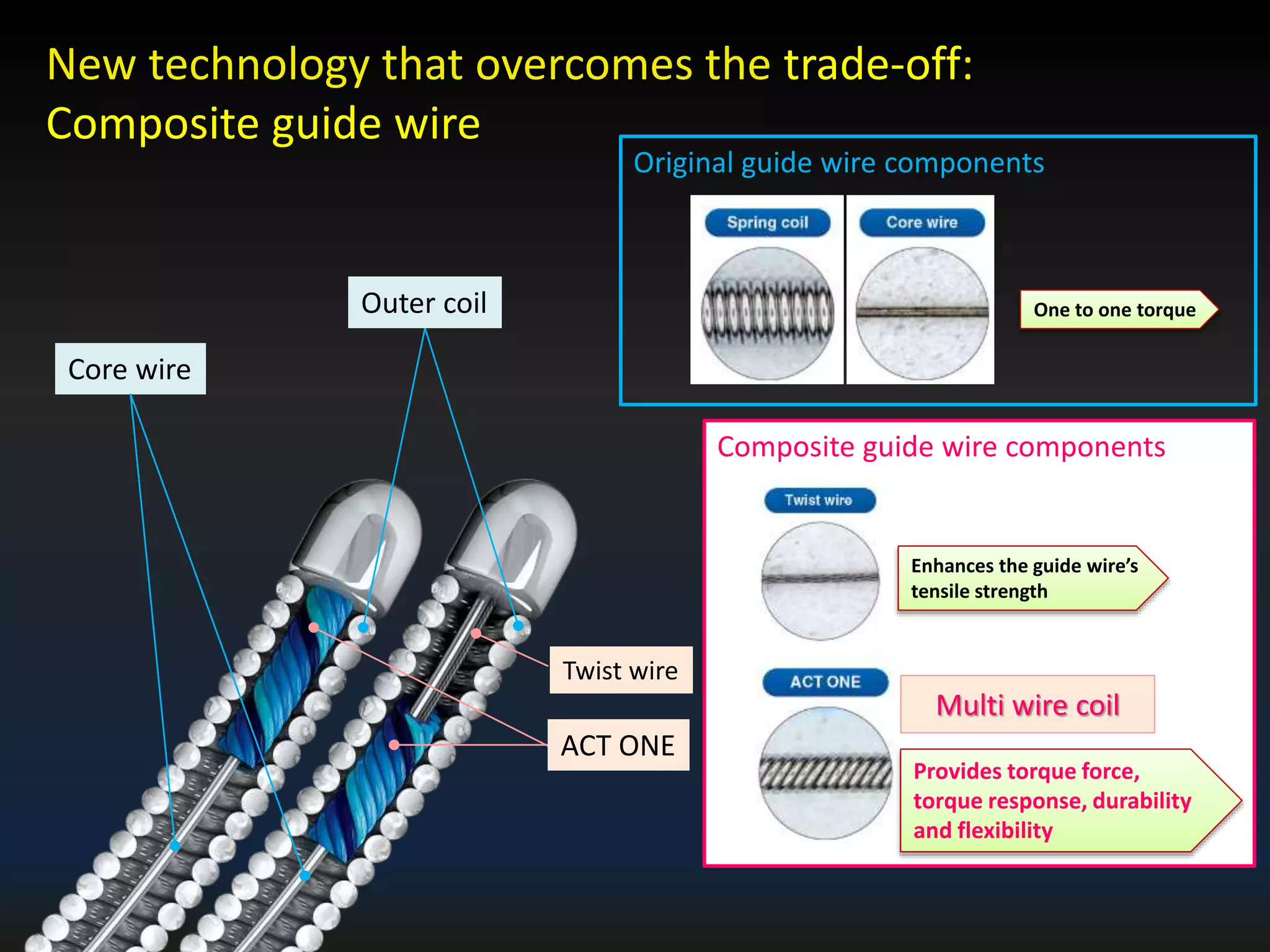
Composite guide wire components
New technology that overcomes the trade-off:
Composite guide wire
Enhances the guide wire’s
tensile strength
One to one torque
Original guide wire components
Outer coil
Core wire
ACT ONE
Twist wire
Multi wire coil
Provides torque force,
torque response, durability
and flexibility
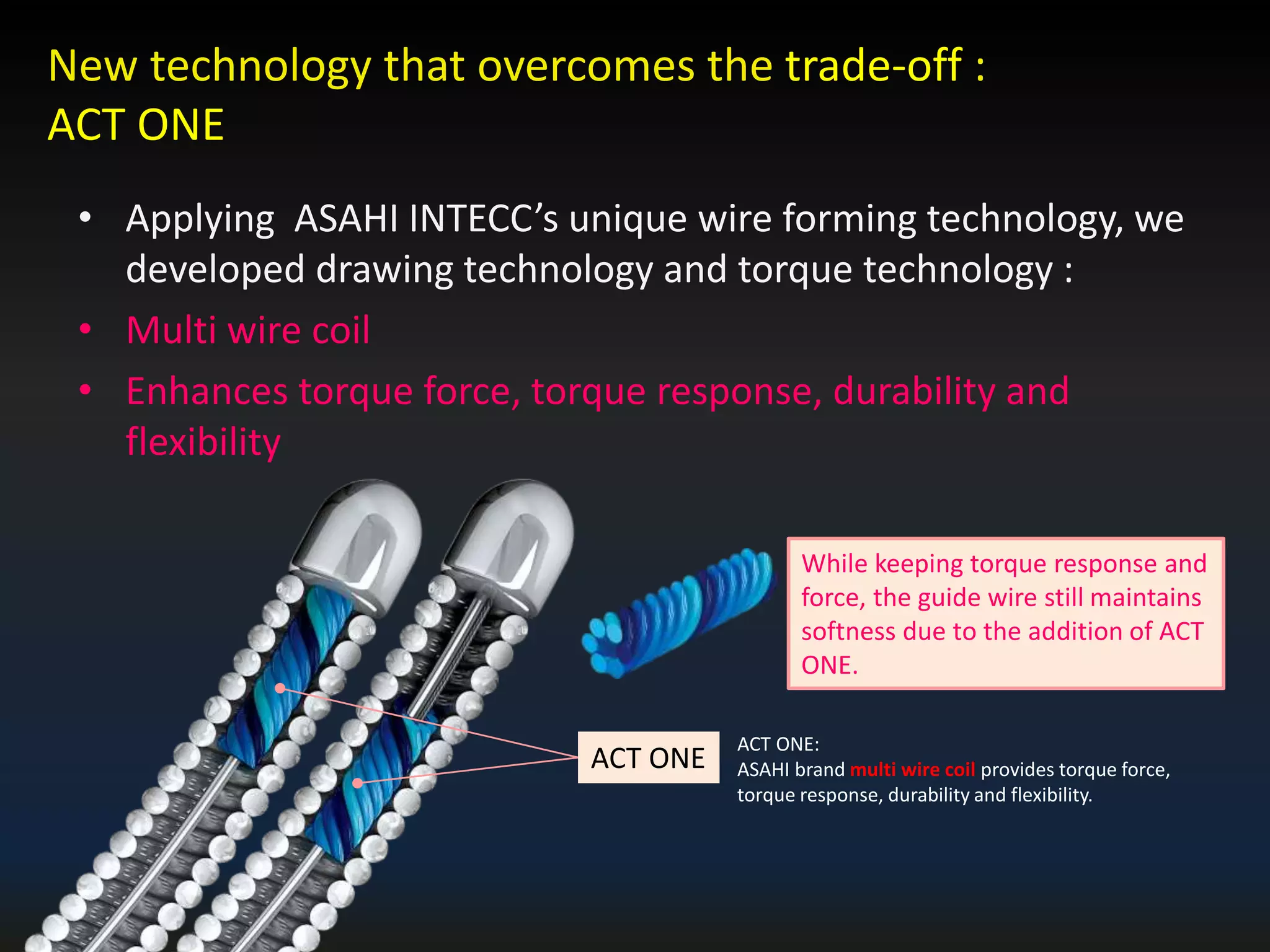
• Applying ASAHI INTECC’s unique wire forming technology, we
developed drawing technology and torque technology :
• Multi wire coil
• Enhances torque force, torque response, durability and
flexibility
ACT ONE:
ASAHI brand multi wire coil provides torque force,
torque response, durability and flexibility.
ACT ONE
While keeping torque response and
force, the guide wire still maintains
softness due to the addition of ACT
ONE.
New technology that overcomes the trade-off :
ACT ONE
The above data was obtained by company standardized test, which may differ from industry standardized tests.
The above data does not prove that all devices have exactly the same performance with the samples used for these tests.
Conventional coil
(single wire coil)
ACT ONE
(Multi wire coil)
Same torque force input by hand, but
different output at the wire tip.
* ACT ONE
*Compared to our company’s coil
New technology that overcomes the trade-off:
ACT ONE
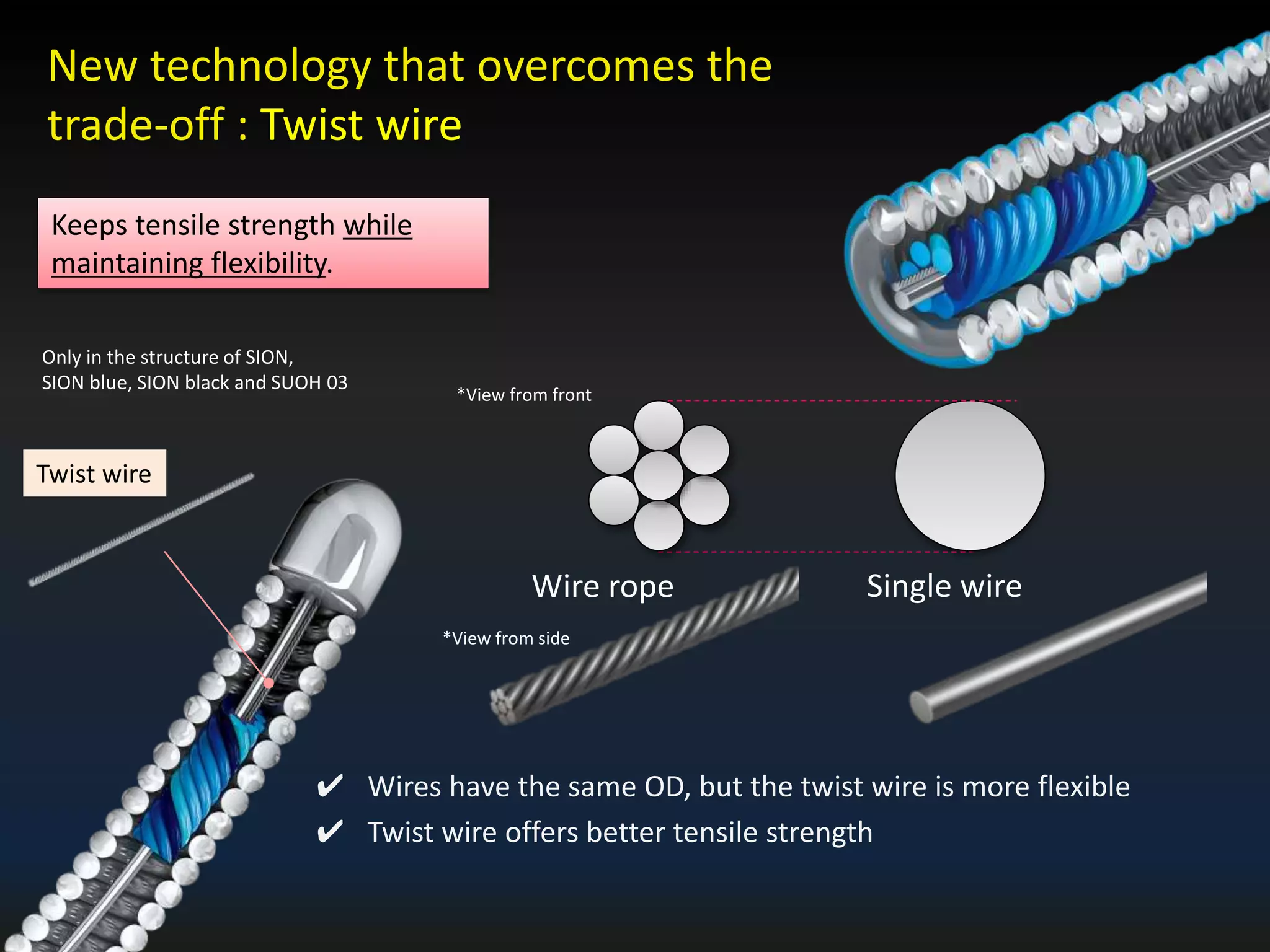
✔ Wires have the same OD, but the twist wire is more flexible
✔ Twist wire offers better tensile strength
Keeps tensile strength while
maintaining flexibility.
Wire rope Single wire
Only in the structure of SION,
SION blue, SION black and SUOH 03
*View from side
*View from front
Twist wire
New technology that overcomes the
trade-off : Twist wire
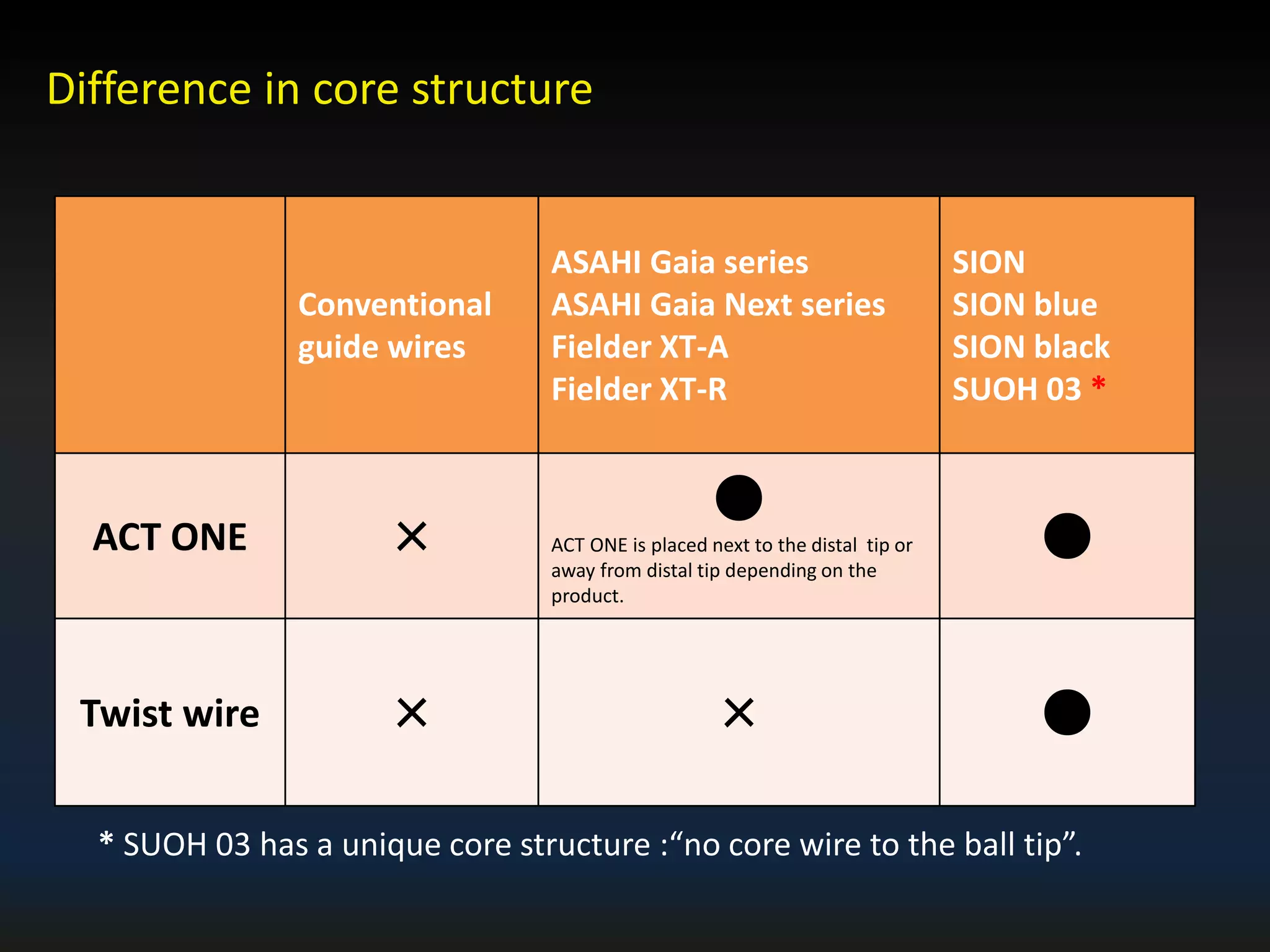
Difference in core structure
Conventional
guide wires
ASAHI Gaia series
ASAHI Gaia Next series
Fielder XT-A
Fielder XT-R
SION
SION blue
SION black
SUOH 03 *
ACT ONE ×
●
ACT ONE is placed next to the distal tip or
away from distal tip depending on the
product.
●
Twist wire × × ●
* SUOH 03 has a unique core structure :“no core wire to the ball tip”.
Terminology & Definition summary
<Primary wires & Coils>
Primary wire
Coil formation
(General name)
Coil name
(ASAHI original name)
Picture
Wire type
Amount of
wires
Wire
Single
Single wire coil
Multi
Multi wire coil
ACT ONE
construction
Wire rope
Single
Single wire rope coil
Multi
Multi wire rope coil
XTRAND
Benefit of each coil
Definition and name Flexibility
Torque
force
Single wire coil
i.x) Same as the outer coil of
conventional guide wires 2nd 3rd
Multi wire coil
i.x) Same as the inner coil, ACT ONE,
in composite guide wires 4th 1st
Single wire rope coil
i.x) Same as the outer coil of SUOH 03
1st 4th
Multi wire rope coil
i.x) Same as the outer coil of Gaia Next
3rd 2nd
Ranking shows the
comparison of 4 kinds
of coils with 2
different features
Condition:
Outer diameter of the
primary wire (wire /
wire rope) is the same.
Same amount of wires
in multiple numbers.
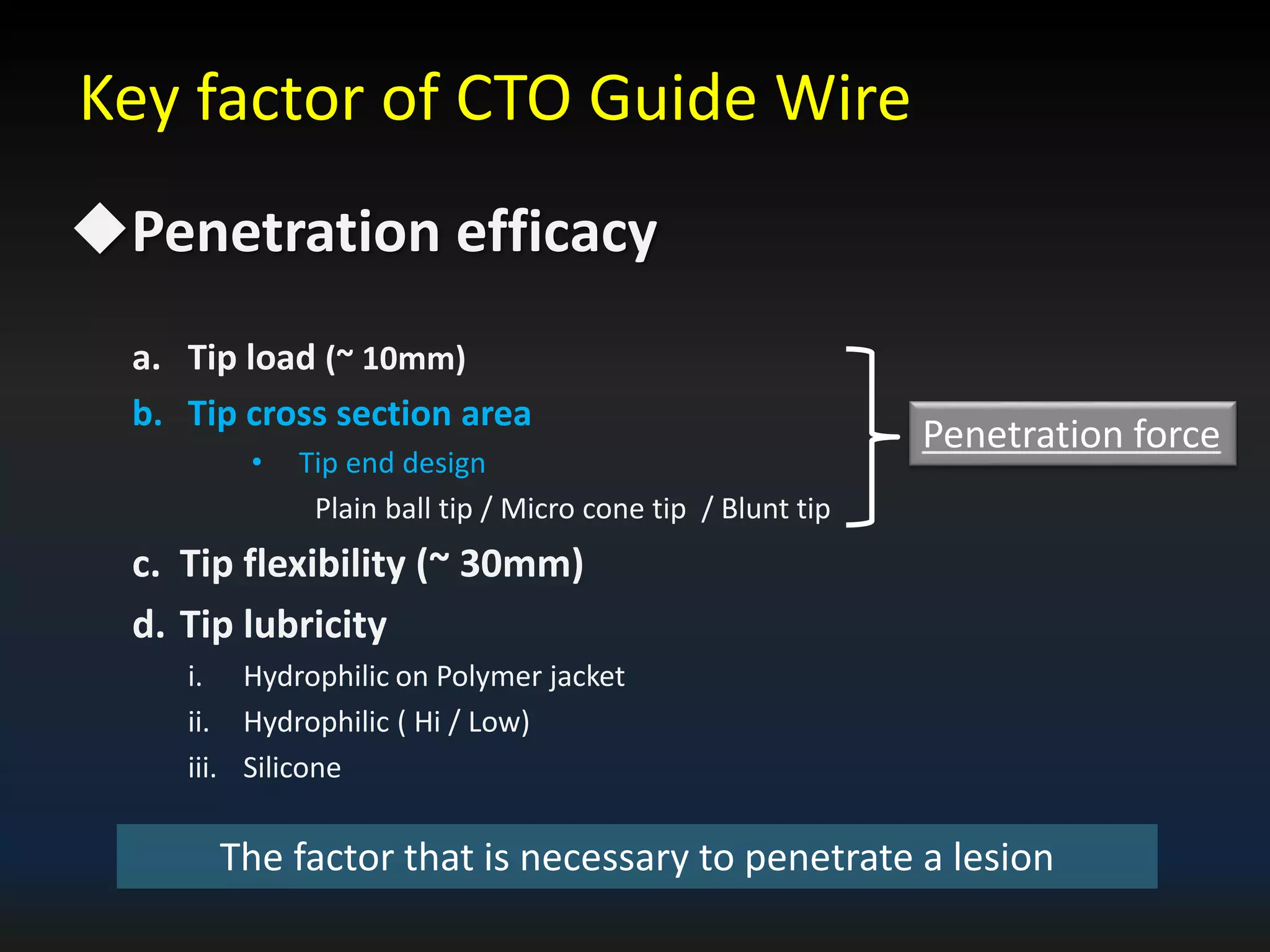
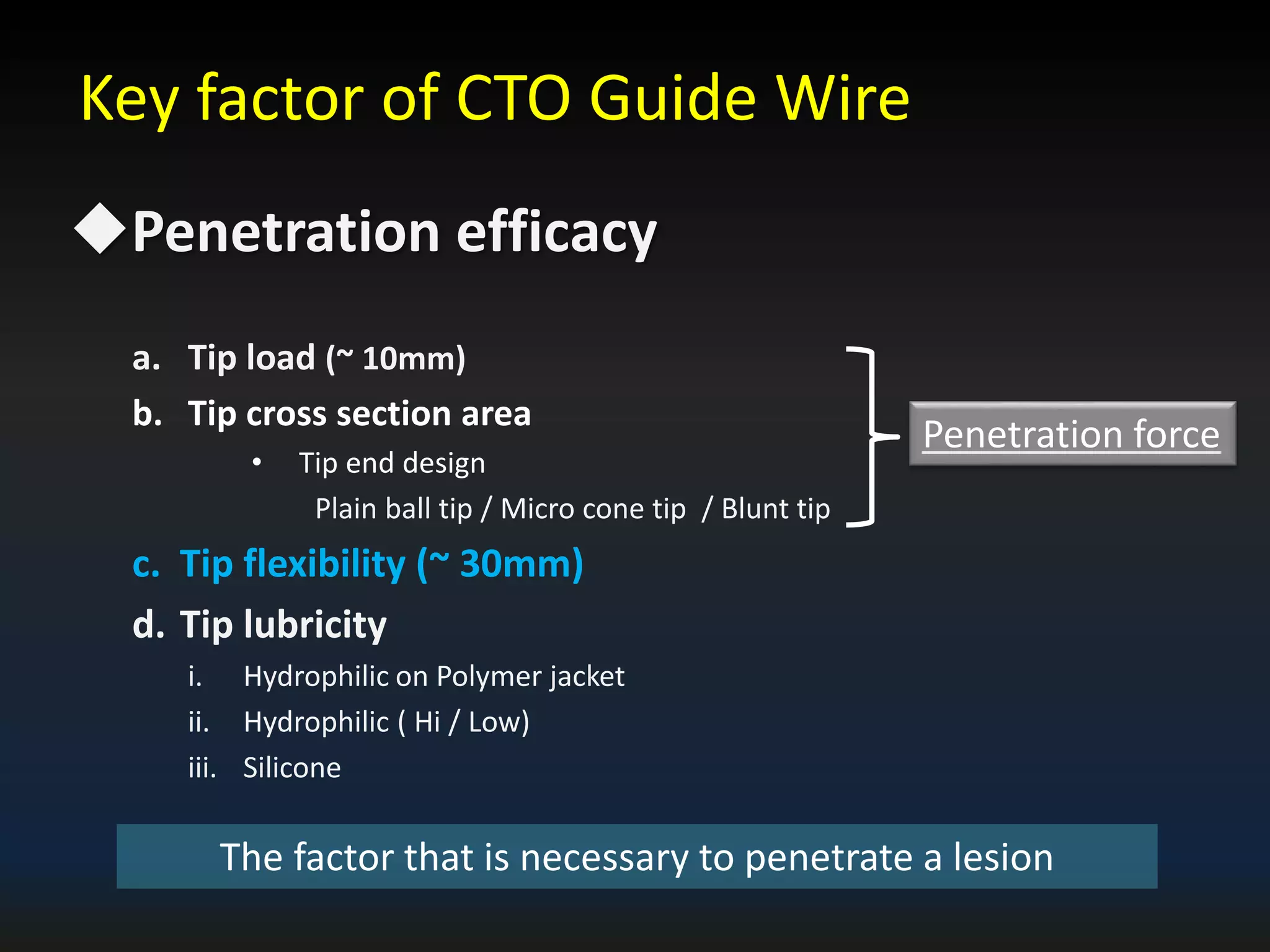
Penetration efficacy
a. Tip load (~ 10mm)
b. Tip cross section area
• Tip end design
Plain ball tip / Micro cone tip / Blunt tip
c. Tip flexibility (~ 30mm)
d. Tip lubricity
i. Hydrophilic on Polymer jacket
ii. Hydrophilic ( Hi / Low)
iii. Silicone
The factor that is necessary to penetrate a lesion
Key factor of CTO Guide Wire
Penetration force
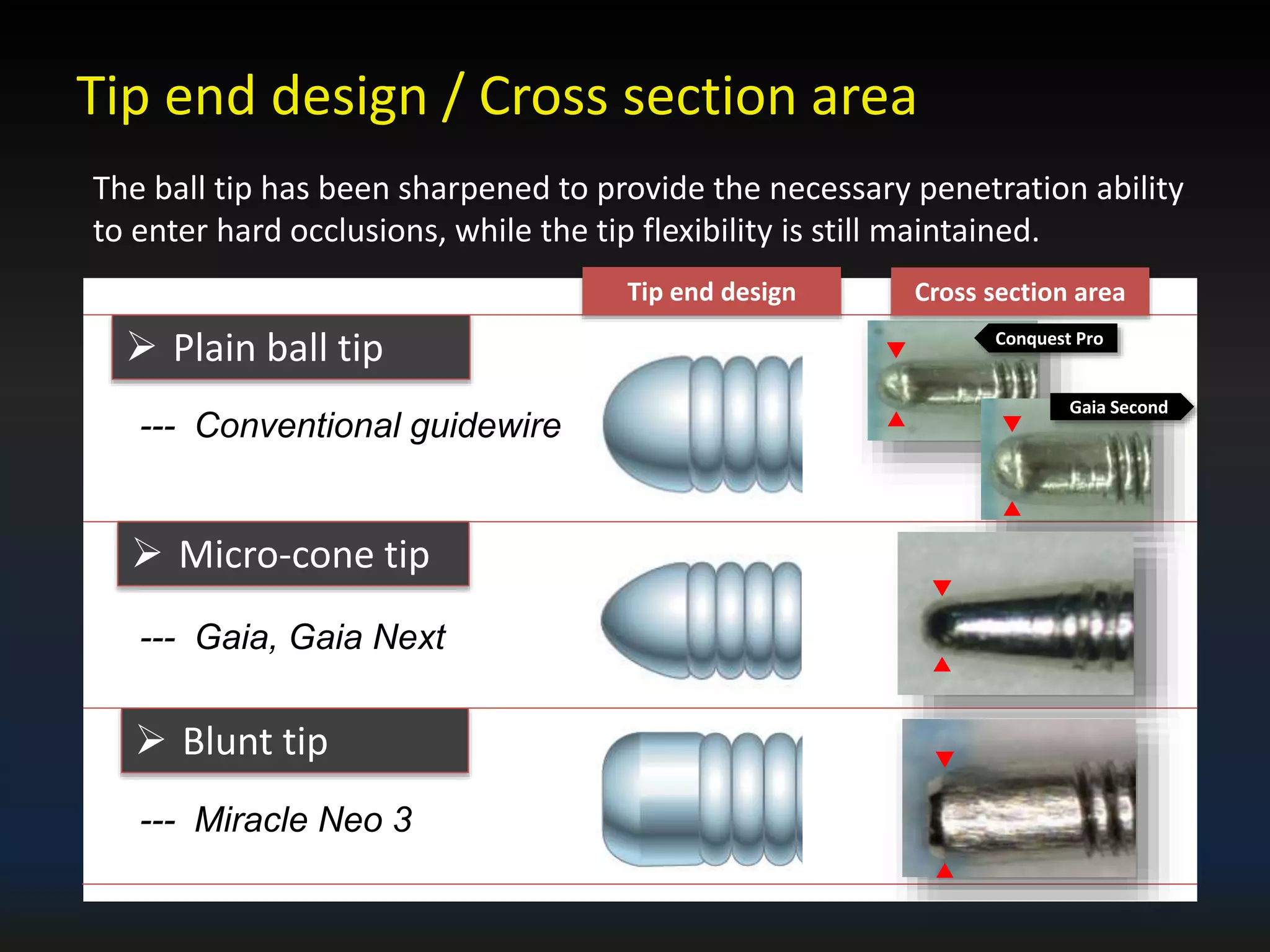
The ball tip has been sharpened to provide the necessary penetration ability
to enter hard occlusions, while the tip flexibility is still maintained.
Tip end design / Cross section area
 Blunt tip
 Plain ball tip
 Micro-cone tip
--- Conventional guidewire
--- Gaia, Gaia Next
--- Miracle Neo 3
Gaia Second
Conquest Pro
Tip end design Cross section area
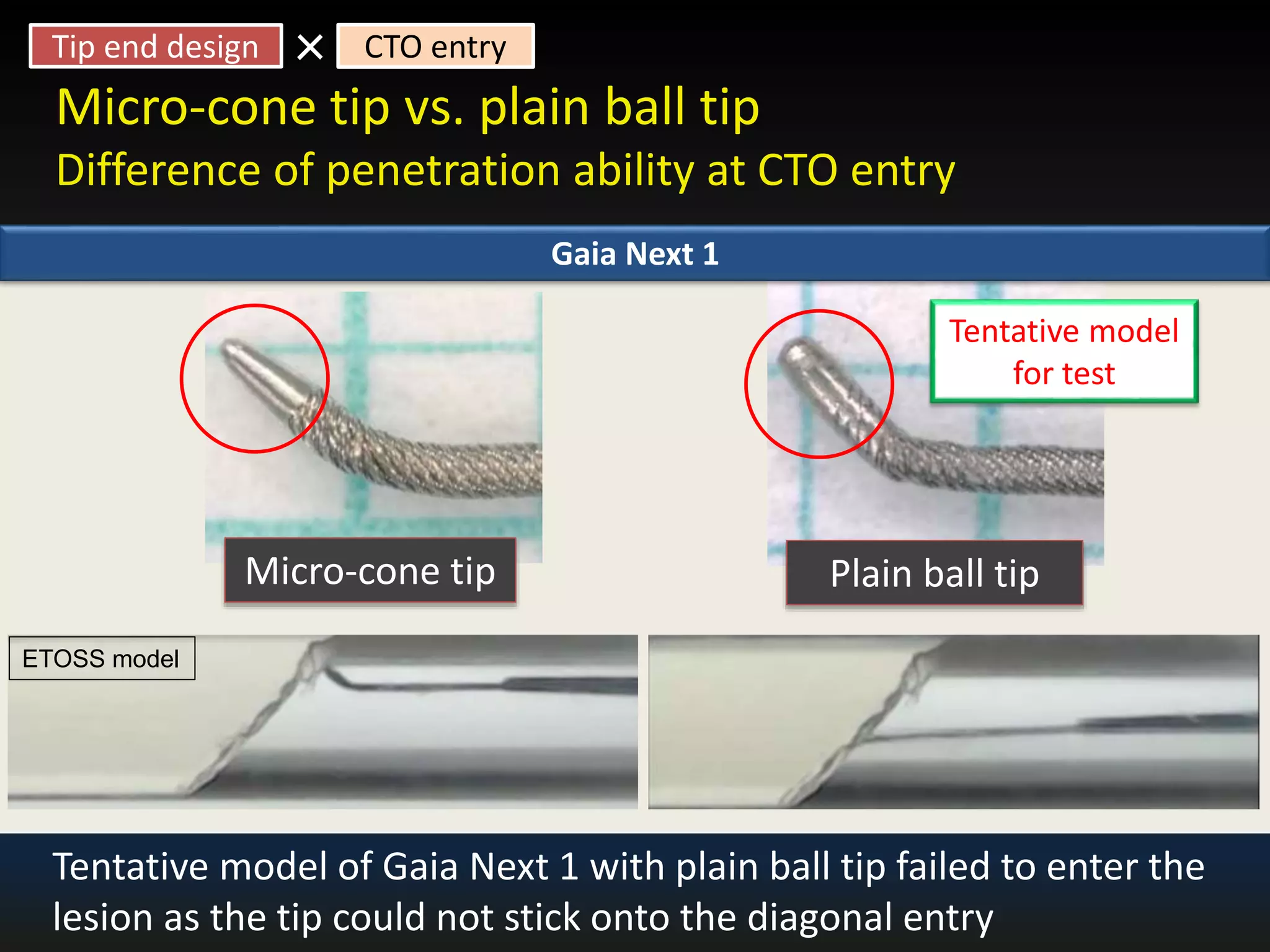
Micro-cone tip vs. plain ball tip
Difference of penetration ability at CTO entry
Gaia Next 1
Plain ball tipMicro-cone tip
Tentative model
for test
Tentative model of Gaia Next 1 with plain ball tip failed to enter the
lesion as the tip could not stick onto the diagonal entry
ETOSS model
Tip end design CTO entry×
Gaia Next 3
with Micro cone tip
Miracle 6
with plain ball tip
Miracle 6 vs. Gaia Next 3 (ETOSS 6000)
CTO body×Tip end design
Although these two have the same tip load, they show different movement when
trying to change routes within the CTO body. It was easy to re-direct GN3 as the
sharp micro cone tip caught easily on the space wall, then changed direction
using deflection created by the wire .
Penetration efficacy
a. Tip load (~ 10mm)
b. Tip cross section area
• Tip end design
Plain ball tip / Micro cone tip / Blunt tip
c. Tip flexibility (~ 30mm)
d. Tip lubricity
i. Hydrophilic on Polymer jacket
ii. Hydrophilic ( Hi / Low)
iii. Silicone
The factor that is necessary to penetrate a lesion
Key factor of CTO Guide Wire
Penetration force
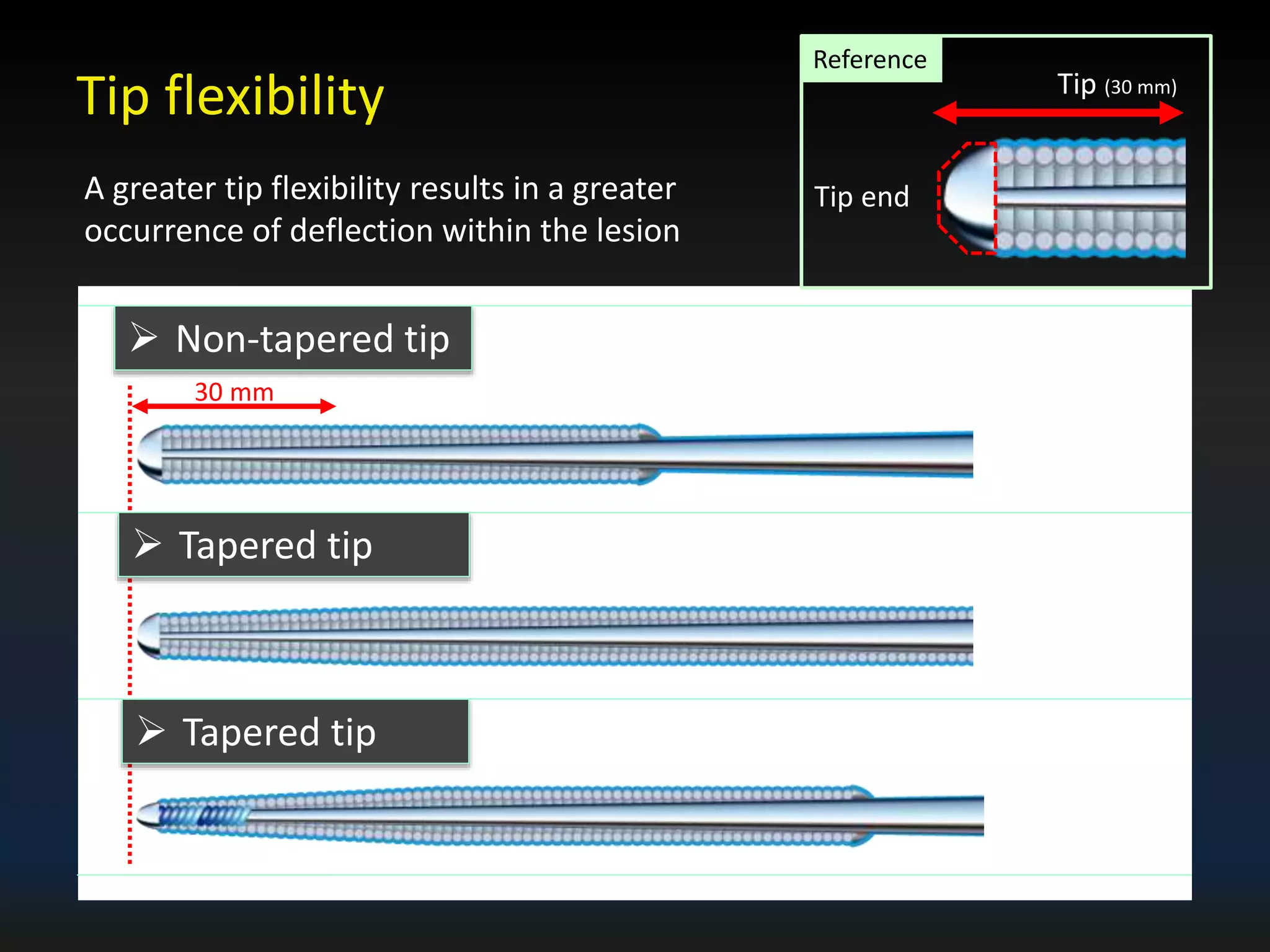
A greater tip flexibility results in a greater
occurrence of deflection within the lesion
Tip flexibility
30 mm
 Non-tapered tip
Reference
Tip end
Tip (30 mm)
 Tapered tip
 Tapered tip
30 mm
Lesion diameter 4mm vs 6mm with XT-A
(ETOSS 8000)
Tip flexibility CTO entry×
25 mm
25 mmXT-A:
Lesion diameter: 6mm
XT-A:
Lesion diameter: 4mm
It is more difficult for flexible wires to penetrate the CTO entry when there is a bigger
open space. Push force could not be transmitted to the tip due to loss of force because
the tip was bent severely.
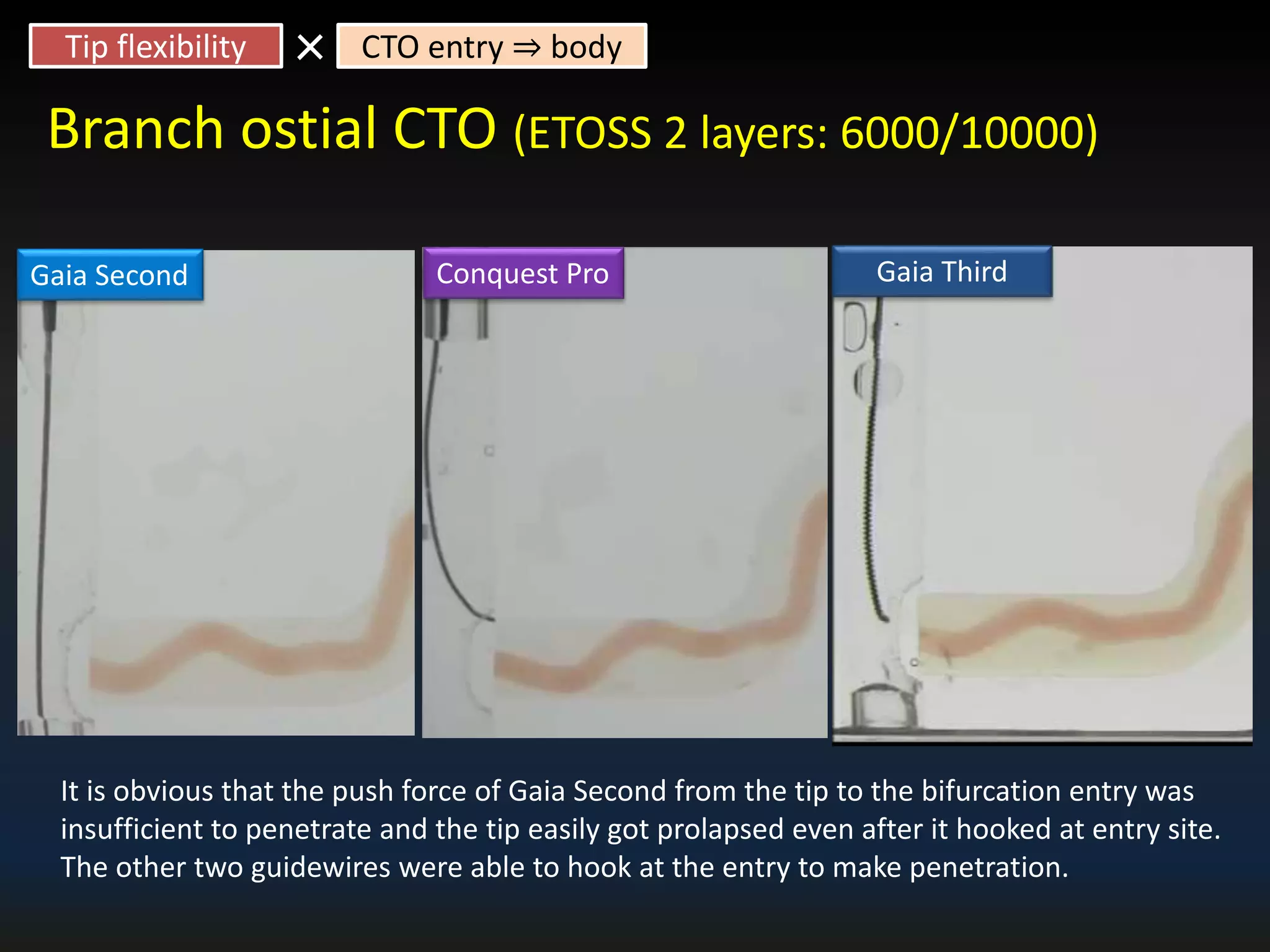
Gaia ThirdGaia Second Conquest Pro
Branch ostial CTO (ETOSS 2 layers: 6000/10000)
Tip flexibility CTO entry ⇒ body×
It is obvious that the push force of Gaia Second from the tip to the bifurcation entry was
insufficient to penetrate and the tip easily got prolapsed even after it hooked at entry site.
The other two guidewires were able to hook at the entry to make penetration.
Penetration efficacy
a. Tip load (~ 10mm)
b. Tip cross section area
• Tip end design
Plain ball tip / Micro cone tip / Blunt tip
c. Tip flexibility (~ 30mm)
d. Tip lubricity
i. Hydrophilic on Polymer jacket
ii. Hydrophilic ( Hi / Low)
iii. Silicone
The factor that is necessary to penetrate a lesion
Key factor of CTO Guide Wire
Penetration force
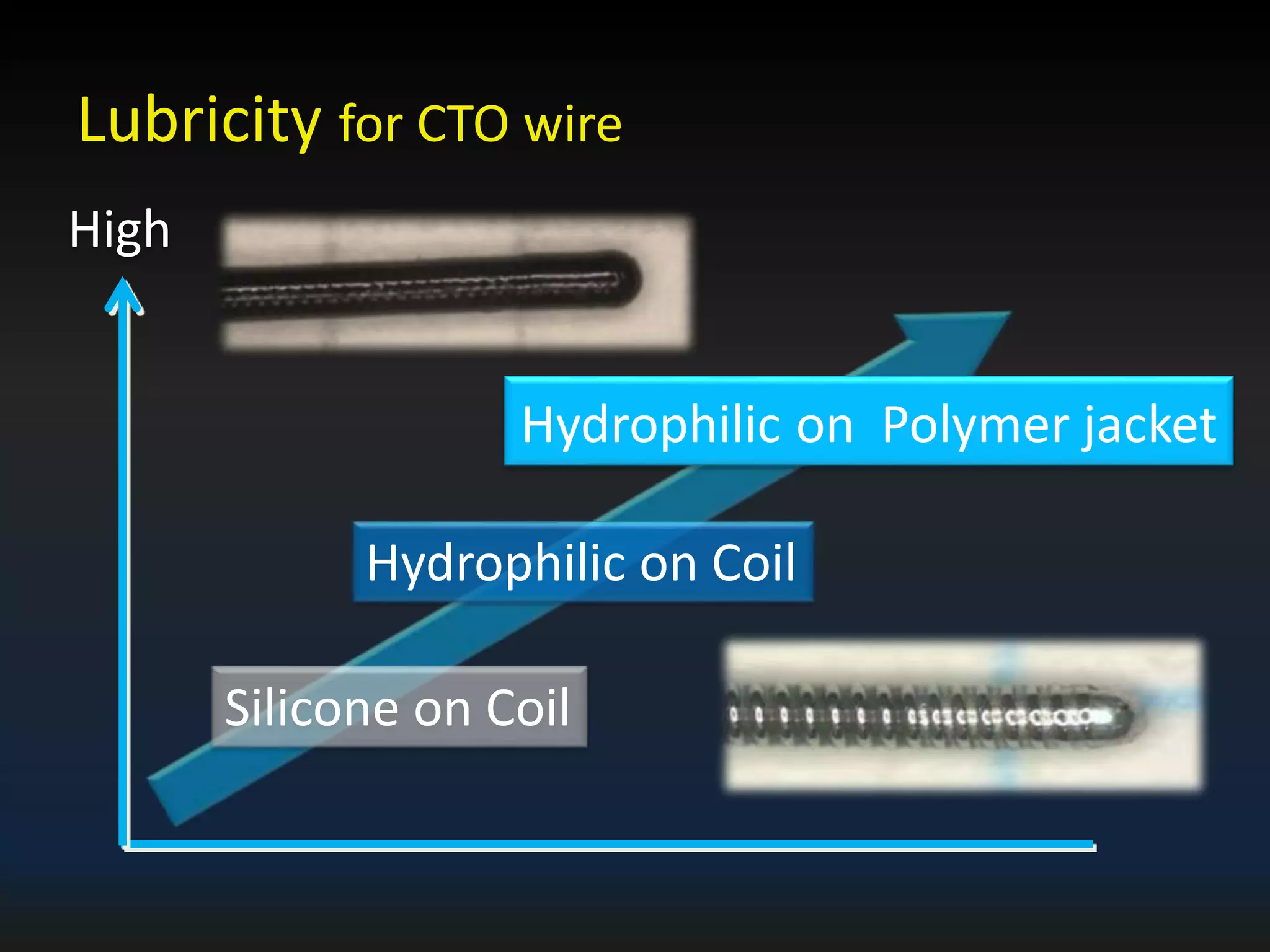
High
Silicone on Coil
Hydrophilic on Coil
Hydrophilic on Polymer jacket
Lubricity for CTO wire
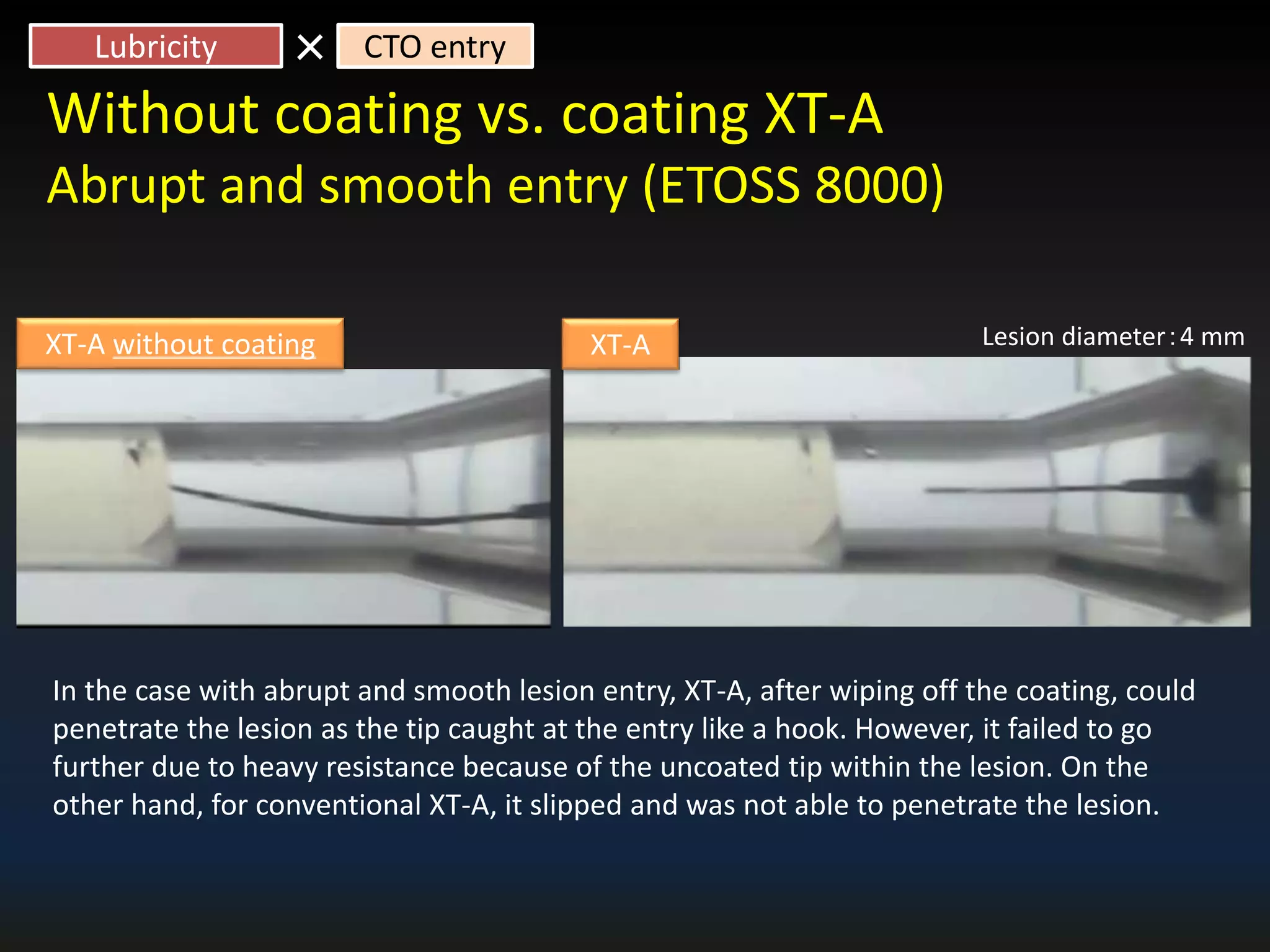
Lesion diameter:4 mm
Without coating vs. coating XT-A
Abrupt and smooth entry (ETOSS 8000)
Lubricity × CTO entry
XT-A without coating XT-A
In the case with abrupt and smooth lesion entry, XT-A, after wiping off the coating, could
penetrate the lesion as the tip caught at the entry like a hook. However, it failed to go
further due to heavy resistance because of the uncoated tip within the lesion. On the
other hand, for conventional XT-A, it slipped and was not able to penetrate the lesion.
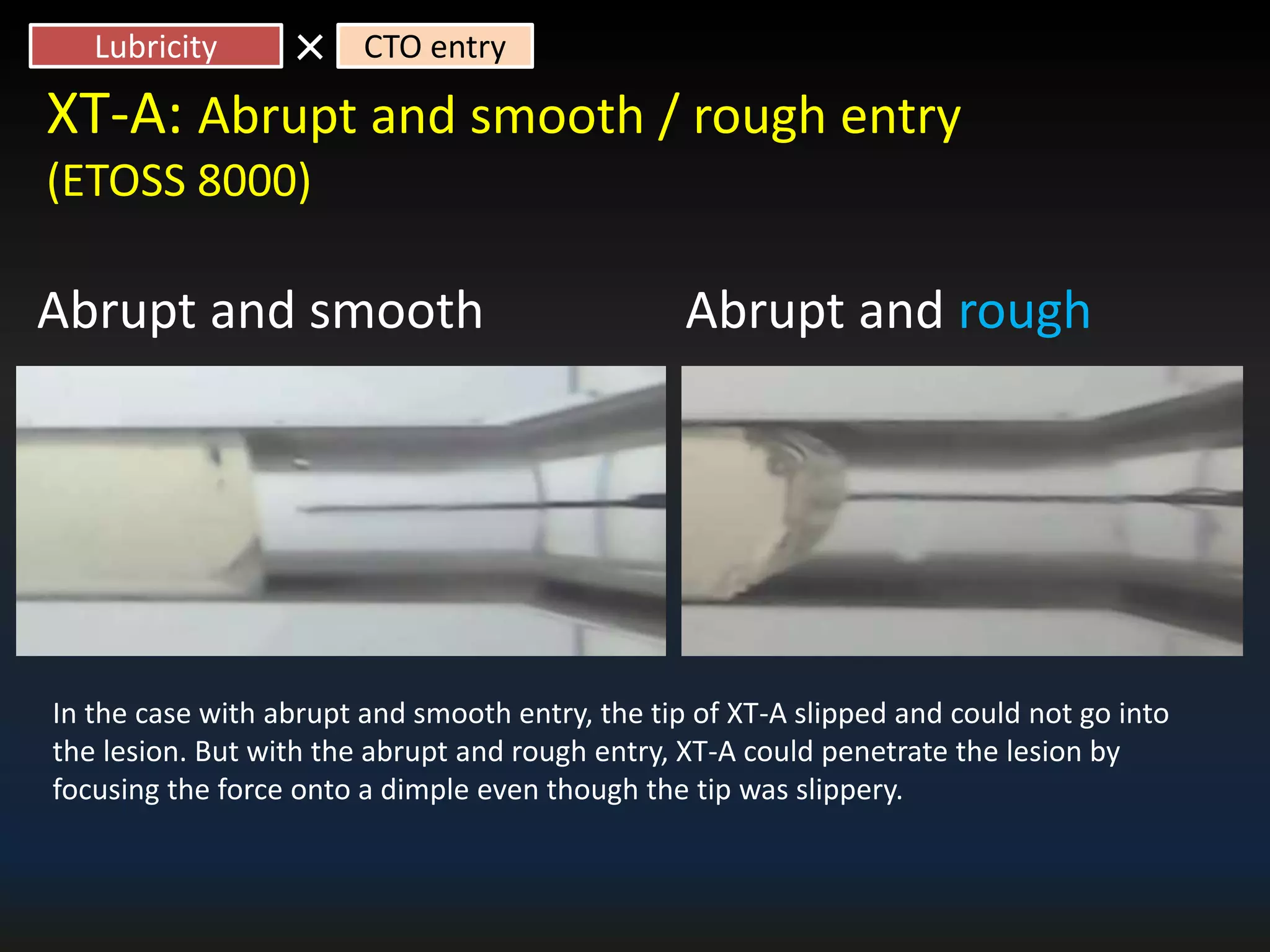
Abrupt and smooth Abrupt and rough
XT-A: Abrupt and smooth / rough entry
(ETOSS 8000)
Lubricity × CTO entry
In the case with abrupt and smooth entry, the tip of XT-A slipped and could not go into
the lesion. But with the abrupt and rough entry, XT-A could penetrate the lesion by
focusing the force onto a dimple even though the tip was slippery.
Coating vs without coating Gaia Next 2
(ETOSS 10000)
Lubricity × CTO body
Gaia Next 2
Gaia Next 2 without coating
When lubricity was lost in the CTO body, the longer the wire’s distance inside the body,
the more difficult it was to advance due to increased sliding resistance.
Appropriate Guide Wire
Selection and Exchange
Case Presentations
Case 1: RCA CTO
collateral from LAD apical channel
Case 1: Bilateral angiography
Case 1: Retrograde wiring; Corsair + XTR
Case 1: Retrograde wiring; SASUKE + XTA
Case 1: Retrograde wiring; SASUKE + UB3
Penetration efficacy
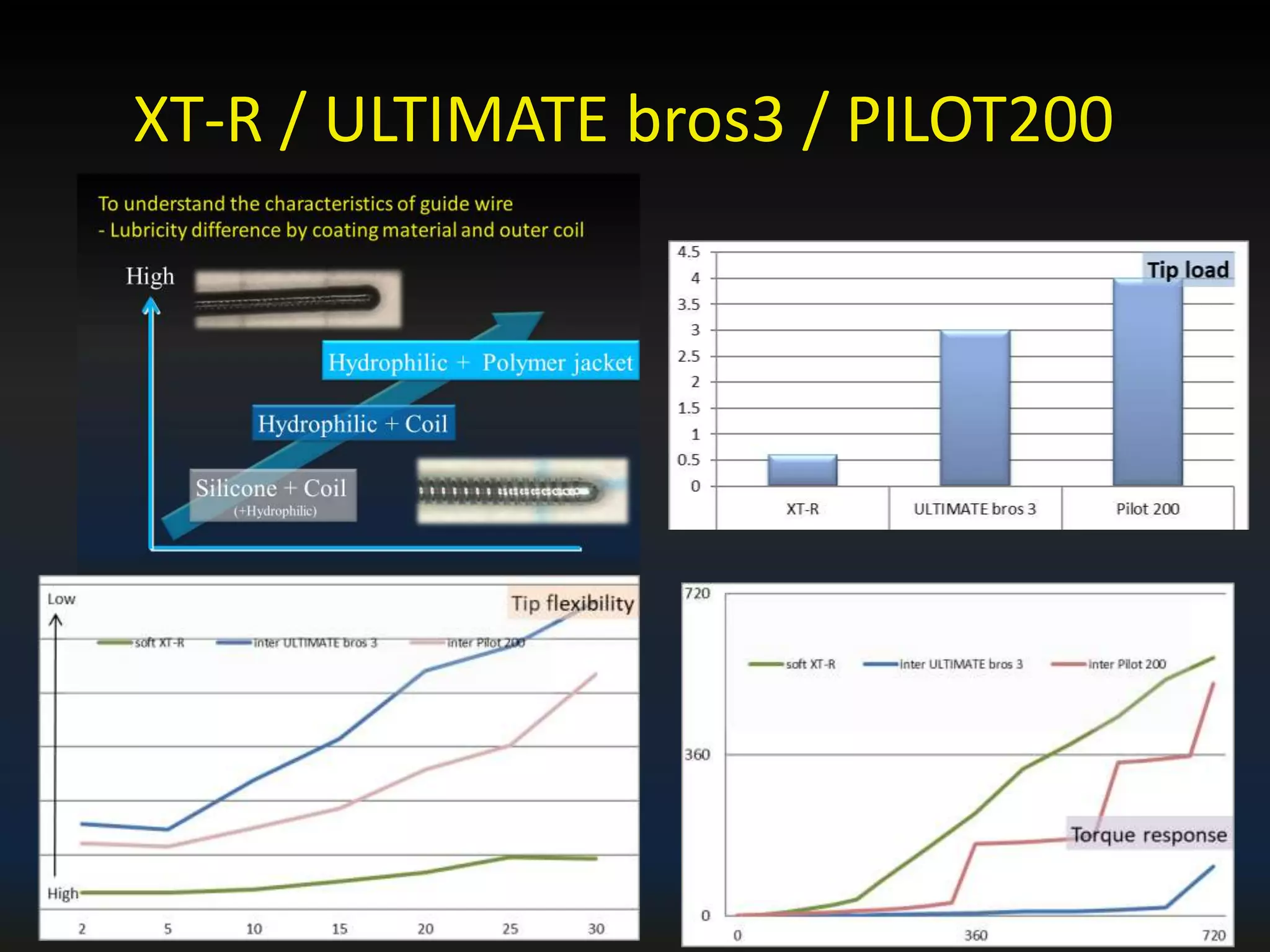
a. Tip load (~ 10mm) ☛ 0.6f
b. Tip cross section area ☛ Tip end design : Plain ball tip
c. Tip flexibility (~ 30mm)
d. Tip lubricity ☛ Hydrophilic with polymer
Manipulation capability
a. Torque force
b. Torque response
XT-R
Asahi composite guide wire
Penetration efficacy
a. Tip load (~ 10mm) ☛ 3.0gf
b. Tip cross section area ☛ Tip end design : Plain ball tip
c. Tip flexibility (~ 30mm)
d. Tip lubricity ☛ Hydrophilic
Manipulation capability
a. Torque force
b. Torque response
ULTIMATE bros3
Conventional structure guide wire
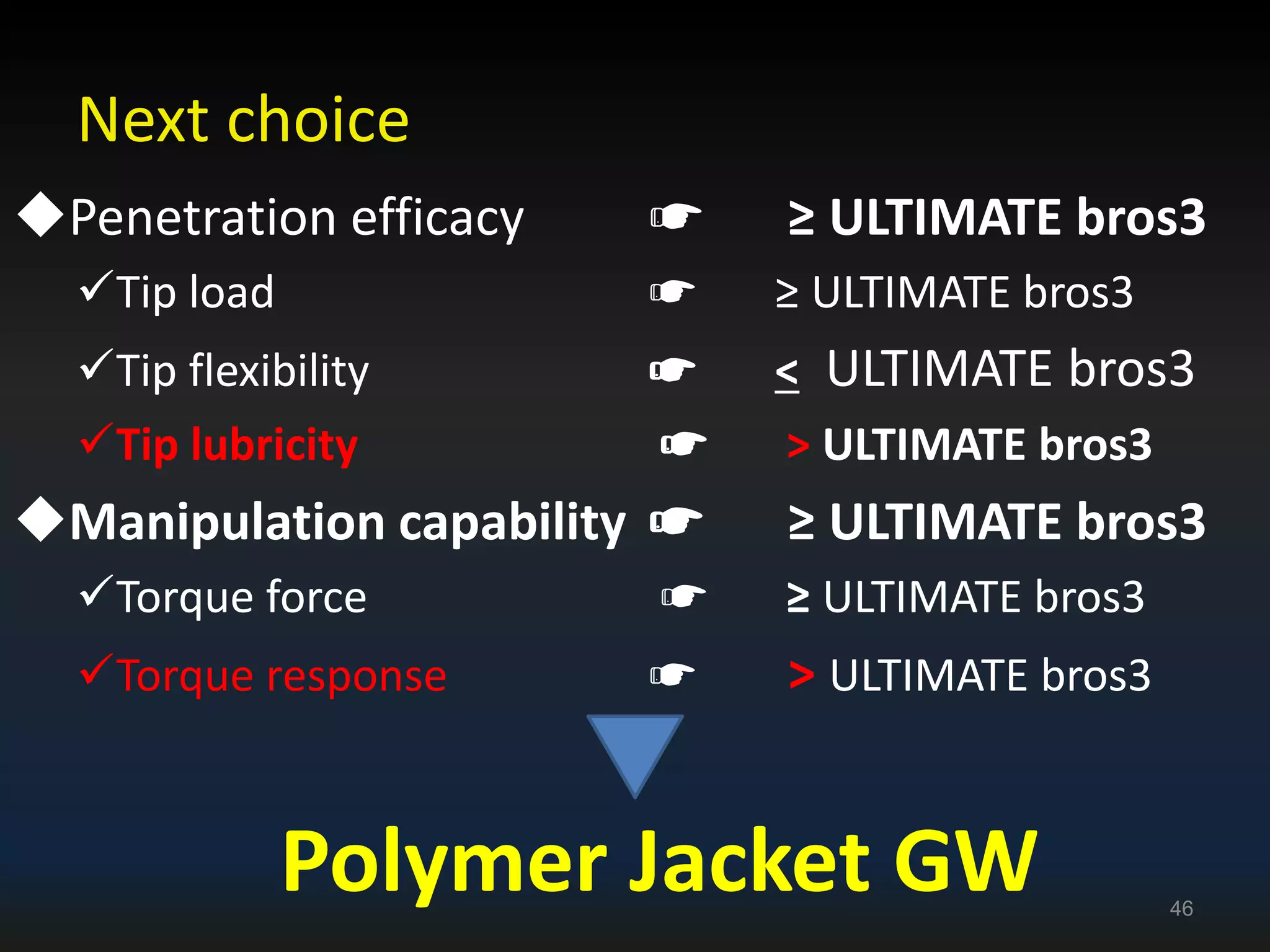
Next choice
Penetration efficacy ☛ ≥ ULTIMATE bros3
Tip load ☛ ≥ ULTIMATE bros3
Tip flexibility ☛ < ULTIMATE bros3
Tip lubricity ☛ ˃ ULTIMATE bros3
Manipulation capability ☛ ≥ ULTIMATE bros3
Torque force ☛ ≥ ULTIMATE bros3
Torque response ☛ > ULTIMATE bros3
46
Polymer Jacket GW
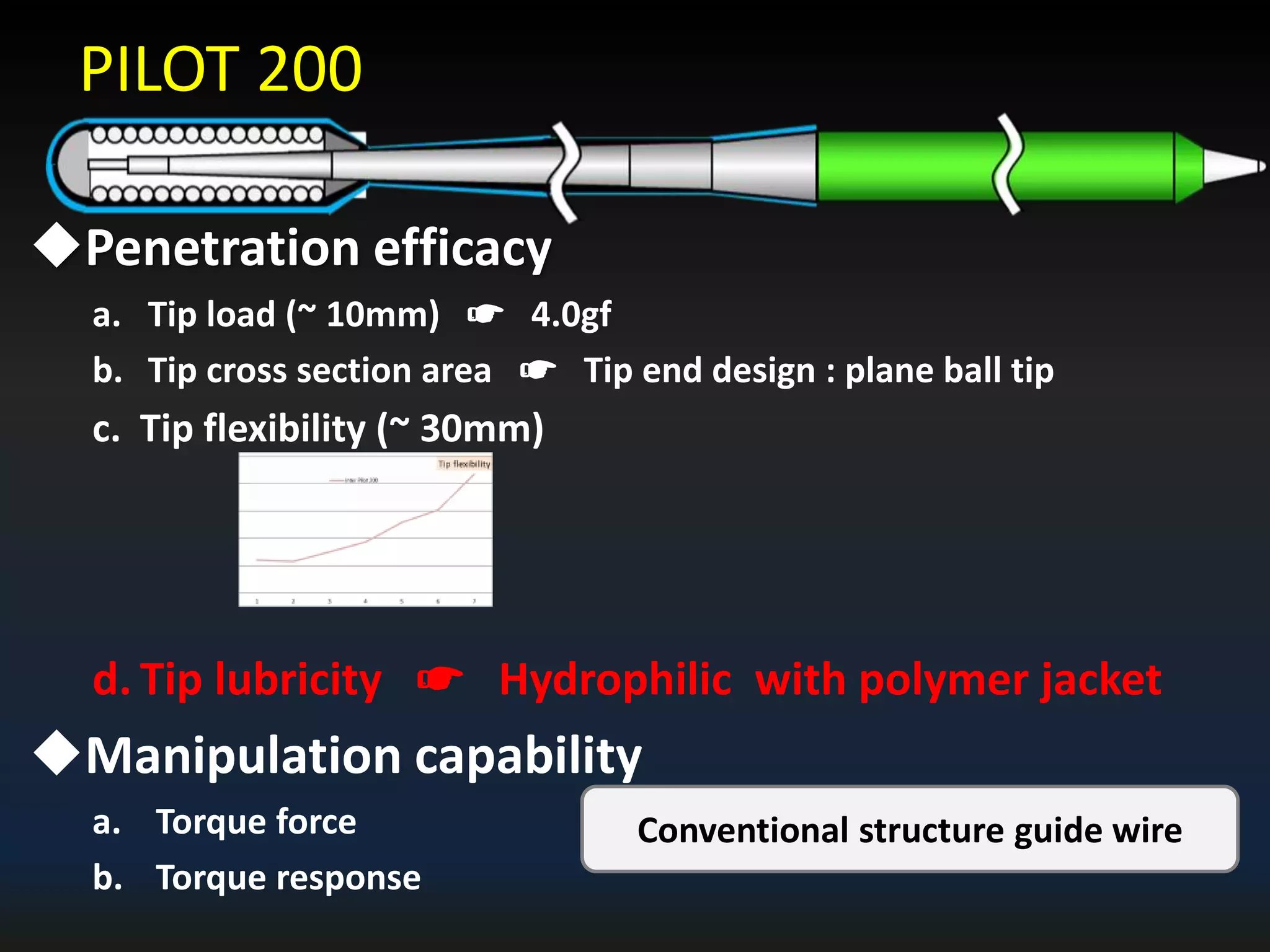
Penetration efficacy
a. Tip load (~ 10mm) ☛ 4.0gf
b. Tip cross section area ☛ Tip end design : plane ball tip
c. Tip flexibility (~ 30mm)
d. Tip lubricity ☛ Hydrophilic with polymer jacket
Manipulation capability
a. Torque force
b. Torque response
PILOT 200
Conventional structure guide wire
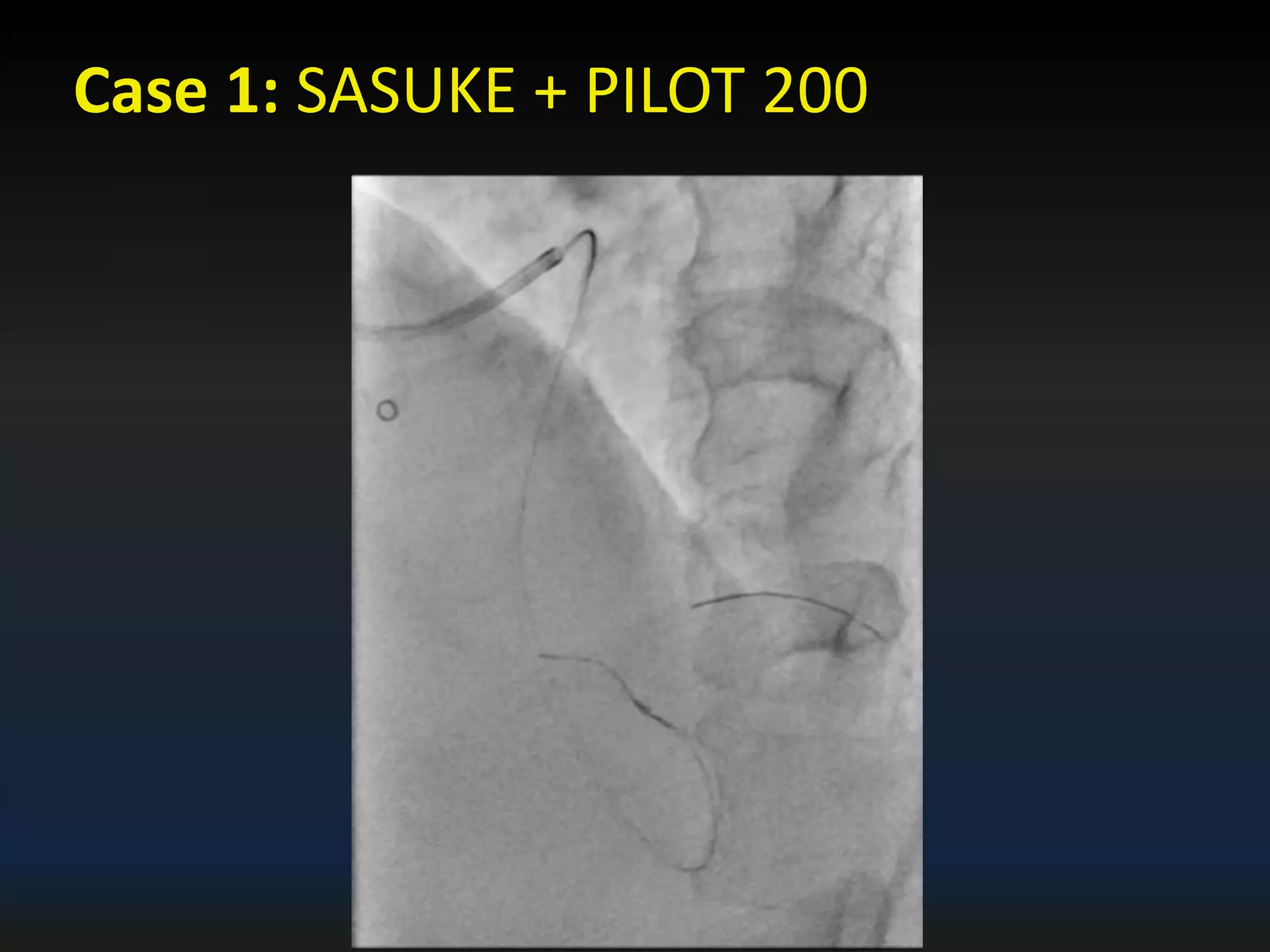
Case 1: SASUKE + PILOT 200
XT-R / ULTIMATE bros3 / PILOT200
49
Case 2: RCA ISO : Control angiography
50
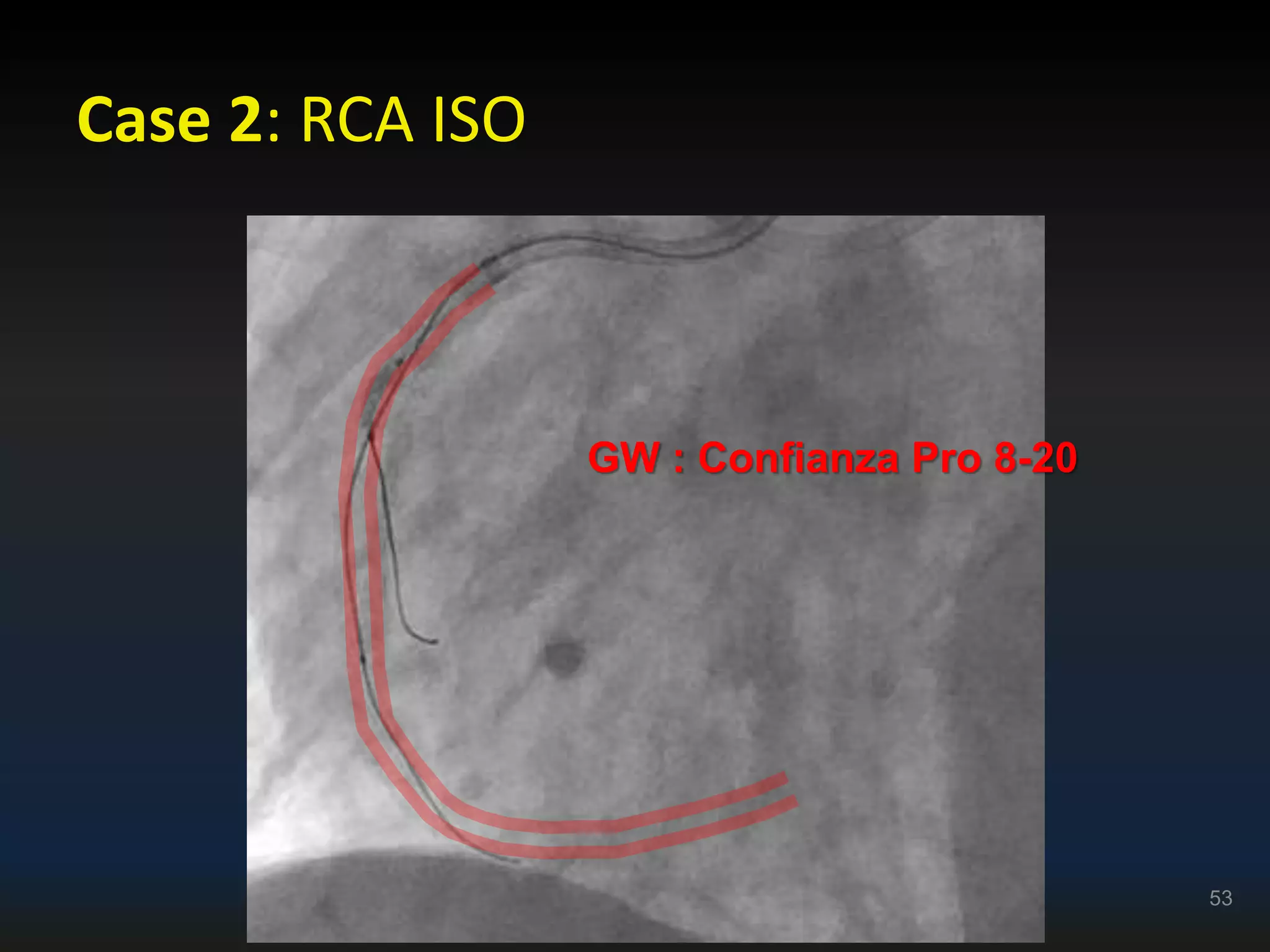
Case 2: RCA ISO
Proximal lesion cross
51
GW : GAIA Next2
MC : Mogul Thinner
GW : Gradius 14
MC : Finecross GT
Case 2: RCA ISO
52
GW : Confianza Pro 8-20
53
GW : Confianza Pro 8-20
Case 2: RCA ISO
Penetration efficacy
a. Tip load (~ 10mm) ☛ 20.0gf
b. Tip cross section area ☛ Tip end design : Plane ball tip with tapered coil
c. Tip flexibility (~ 30mm)
d. Tip lubricity ☛ Hydrophilic
Manipulation capability
a. Torque force
b. Torque response
Conventional structure guide wire
with round core
Confianza (Conquest) Pro 8-20
0.20mm (0.008inch) 0.36mm (0.014inch)
Penetration efficacy
a. Tip load (~ 10mm) ☛ 12.0gf
b. Tip cross section area ☛ Tip end design : Plane ball tip with tapered coil
c. Tip flexibility (~ 30mm)
d. Tip lubricity ☛ Hydrophilic
Manipulation capability
a. Torque force
b. Torque response
Conventional structure guide wire
with round core
Confianza (Conquest) Pro 12
Differences between
Confianza Pro 12 and Pro 8-20
Next choice
Penetration efficacy
Tip load ☛ ≦ Confianza Pro 8-20
Tip flexibility ☛ > Confianza Pro 8-20
Tip end design
Tip lubricity
Manipulation capability ☛ ≧ Confianza Pro 8-20
Torque force
Torque response
GAIA Next 3
Penetration efficacy
a. Tip load (~ 10mm) ☛ 6.0gf
b. Tip cross section area ☛ Tip end design : Micro cone tip
c. Tip flexibility (~ 30mm)
d. Tip lubricity ☛ Hydrophilic
Manipulation capability
a. Torque force
b. Torque response
GAIA Next 3
ASAHI composite guide wire
Confianza Pro 8-20 vs GAIA Next 3
ETOSS lesion : 8000gf
Guidewire : Confianza Pro 8-20
ETOSS lesion : 8000gf
Guidewire : GAIA Next 3
Comparison of deflection
Confianza Pro8-20 & GAIA Next 3
Case 2: RCA ISO body re-route
61
GW : GAIA Next 3
Target : LAD #6 CTO
Case 3
CTO body
 GAIA Next 2 was selected for an initial wire,
however the CTO entry could not be
penetrated.
 So that GAIA Next 3 was selected as the
second wire.
63
Target : LAD #6 CTO
Case 3
GW : GAIA Next 3
MC : Corsair pro
Target : LAD #6 CTO
Case 3
GW : GAIA Next3
MC : Corsair pro
GW : GAIA Next 3
MC : Corsair pro
Target : LAD #6 CTO
Case 3
GW : GAIA Next3
MC : Corsair pro
GW : GAIA Next 3
Target : LAD #6 CTO
Case 3
GW : GAIA Next 3
MC : Corsair pro
Target : LAD #6 CTO
Case 3
GW : GAIA Next 3
MC : Corsair pro
Penetration efficacy
a. Tip load (~ 10mm) ☛ 6.0gf
b. Tip cross section area ☛ Tip end design : Micro cone tip
c. Tip flexibility (~ 30mm)
d. Tip lubricity ☛ Hydrophilic
Manipulation capability
a. Torque force
b. Torque response
GAIA Next 3
ASAHI composite guide wire
Penetration efficacy
a. Tip load (~ 10mm) ☛ 6.0gf
b. Tip cross section area ☛ Tip end design : Micro cone tip
c. Tip flexibility (~ 30mm)
d. Tip lubricity ☛ Hydrophilic
Manipulation capability
a. Torque force
b. Torque response
GAIA Next 3
ASAHI composite guide wire
Penetration efficacy
a. Tip load (~ 10mm) ☛ 6.0gf up or down ?
b. Tip flexibility (~ 30mm) up or down ?
Others up or down ?
GAIA Next 3
Stiff guide wire
Gaia Third
Gaia Next 3
Conquest pro
Miracle 12
Conquest pro 12
Conquest 8-20
Stiff
> 4g
Role of stiff CTO guide wire
Relation of tip load and penetration force
73
0 100 200 300 400 500 600 700 800 900 1000
Gaia Next 3
Gaia 3rd
Conquest Pro
Miracle 12
Conquest Pro 8-20
Conqeust Pro 12
Penetration force [gf/mm2]
0 5 10 15 20 25
Gaia Next 3
Gaia 3rd
Conquest Pro
Miracle 12
Conquest Pro 8-20
Conqeust Pro 12
Tip load
0.0
200.0
400.0
2 5 10 15 20 25 30
Gaia Third Gaia next 3rd
Conquest Pro Conquest Pro12
Conquest Pro8-20 Miracle 12
74
Stiff
- Tip flexibility
[mm]
Guide wire
[mN]
Next choice
Tip flexibility ☛
GAIA Next 2
> GAIA Next 3
More deflectable wire is required!
Target : LAD #6 CTO
Case 3
GW : GAIA Next 2
MC : SASUKE
Target : LAD #6 CTO
Case 3
GW : GAIA Next 2
MC : SASUKE
GAIA Next 2 vs GAIA Next 3
79
Message to Take Home
Please understand the wire structure in
detail which provide wire attributes and
performance in each procedural situation.
20th CTO Club
June 14-15, 2019, Nagoya, Japan
www.cct.gr.jp/ctoclub

CTO fundamental: Understanding of Wire Structure

  • 1.
    CTO Fundamental: Understanding ofWire Structure For appropriate GW selection and exchange Etsuo Tsuchikane, MD, PhD Toyohashi Heart center, Japan Toyohashi Heart CenterEURO CTO CLUB Toulouse 2018
  • 2.
    Becoming a CTOexpert In order to become a CTO expert, it is essential to understand the fundamentals of guide wires – Basic structure – Attributes and performance – New technologies – Optimization of guide wires
  • 3.
    Guide wire basicstructure Conventional guide wire Outer coil Core wire
  • 4.
    ASAHI’s composite guidewire definition ASAHI’s composite guide wire Products developed with ASAHI’s composite technology Guide wire that is composed of more than “core wire” and “outer coil”
  • 5.
    Primary wire Name Definition/ Explanation Illustration image Flexibility Wire Single wire + Wire rope Wire rope made of several single wires that are roped together + + Primary wire Single wire Single wire ropeFlexibility < * When it has same outer diameter
  • 6.
    1 2 34 5 … 1 2 3 4 5 … 1 2 3 4 5 .. 1 2 3 4 5 … 1 2 3 4 5 … 1 2 3 4 5 .. Coil formation image Primary Wire Wire Wire rope Coil formation XTRAND Single wire coil Multi wire coil ACT ONE Multi wire rope coil Single wire rope coil Note: ACT ONE is placed inside guide wires, and the direction of the coil strand is different. ※The standing direction of this image does not matter
  • 7.
    Guide wire basicstructure – Difference in the core Round core and conventional flat core design Avoid whipping phenomenon Conventional flat core Better maneuverability even in complex vessel anatomy Round core ✔ Whip motion depends on core wire design stress high low
  • 8.
    Challenges to overcomethe trade-off Torque forceFlexibility Trade-off No compromise of flexibility or torque force
  • 9.
    Composite guide wirestructure Composite guide wire Outer coil Core wire (round / flat) ACT ONE (inner coil) Twist wire (runs parallel to the core wire)
  • 10.
    Composite guide wirecomponents New technology that overcomes the trade-off: Composite guide wire Enhances the guide wire’s tensile strength One to one torque Original guide wire components Outer coil Core wire ACT ONE Twist wire Multi wire coil Provides torque force, torque response, durability and flexibility
  • 11.
    • Applying ASAHIINTECC’s unique wire forming technology, we developed drawing technology and torque technology : • Multi wire coil • Enhances torque force, torque response, durability and flexibility ACT ONE: ASAHI brand multi wire coil provides torque force, torque response, durability and flexibility. ACT ONE While keeping torque response and force, the guide wire still maintains softness due to the addition of ACT ONE. New technology that overcomes the trade-off : ACT ONE
  • 12.
    The above datawas obtained by company standardized test, which may differ from industry standardized tests. The above data does not prove that all devices have exactly the same performance with the samples used for these tests. Conventional coil (single wire coil) ACT ONE (Multi wire coil) Same torque force input by hand, but different output at the wire tip. * ACT ONE *Compared to our company’s coil New technology that overcomes the trade-off: ACT ONE
  • 13.
    ✔ Wires havethe same OD, but the twist wire is more flexible ✔ Twist wire offers better tensile strength Keeps tensile strength while maintaining flexibility. Wire rope Single wire Only in the structure of SION, SION blue, SION black and SUOH 03 *View from side *View from front Twist wire New technology that overcomes the trade-off : Twist wire
  • 14.
    Difference in corestructure Conventional guide wires ASAHI Gaia series ASAHI Gaia Next series Fielder XT-A Fielder XT-R SION SION blue SION black SUOH 03 * ACT ONE × ● ACT ONE is placed next to the distal tip or away from distal tip depending on the product. ● Twist wire × × ● * SUOH 03 has a unique core structure :“no core wire to the ball tip”.
  • 15.
    Terminology & Definitionsummary <Primary wires & Coils> Primary wire Coil formation (General name) Coil name (ASAHI original name) Picture Wire type Amount of wires Wire Single Single wire coil Multi Multi wire coil ACT ONE construction Wire rope Single Single wire rope coil Multi Multi wire rope coil XTRAND
  • 16.
    Benefit of eachcoil Definition and name Flexibility Torque force Single wire coil i.x) Same as the outer coil of conventional guide wires 2nd 3rd Multi wire coil i.x) Same as the inner coil, ACT ONE, in composite guide wires 4th 1st Single wire rope coil i.x) Same as the outer coil of SUOH 03 1st 4th Multi wire rope coil i.x) Same as the outer coil of Gaia Next 3rd 2nd Ranking shows the comparison of 4 kinds of coils with 2 different features Condition: Outer diameter of the primary wire (wire / wire rope) is the same. Same amount of wires in multiple numbers.
  • 17.
    Penetration efficacy a. Tipload (~ 10mm) b. Tip cross section area • Tip end design Plain ball tip / Micro cone tip / Blunt tip c. Tip flexibility (~ 30mm) d. Tip lubricity i. Hydrophilic on Polymer jacket ii. Hydrophilic ( Hi / Low) iii. Silicone The factor that is necessary to penetrate a lesion Key factor of CTO Guide Wire Penetration force
  • 18.
    The ball tiphas been sharpened to provide the necessary penetration ability to enter hard occlusions, while the tip flexibility is still maintained. Tip end design / Cross section area  Blunt tip  Plain ball tip  Micro-cone tip --- Conventional guidewire --- Gaia, Gaia Next --- Miracle Neo 3 Gaia Second Conquest Pro Tip end design Cross section area
  • 19.
    Micro-cone tip vs.plain ball tip Difference of penetration ability at CTO entry Gaia Next 1 Plain ball tipMicro-cone tip Tentative model for test Tentative model of Gaia Next 1 with plain ball tip failed to enter the lesion as the tip could not stick onto the diagonal entry ETOSS model Tip end design CTO entry×
  • 20.
    Gaia Next 3 withMicro cone tip Miracle 6 with plain ball tip Miracle 6 vs. Gaia Next 3 (ETOSS 6000) CTO body×Tip end design Although these two have the same tip load, they show different movement when trying to change routes within the CTO body. It was easy to re-direct GN3 as the sharp micro cone tip caught easily on the space wall, then changed direction using deflection created by the wire .
  • 21.
    Penetration efficacy a. Tipload (~ 10mm) b. Tip cross section area • Tip end design Plain ball tip / Micro cone tip / Blunt tip c. Tip flexibility (~ 30mm) d. Tip lubricity i. Hydrophilic on Polymer jacket ii. Hydrophilic ( Hi / Low) iii. Silicone The factor that is necessary to penetrate a lesion Key factor of CTO Guide Wire Penetration force
  • 22.
    A greater tipflexibility results in a greater occurrence of deflection within the lesion Tip flexibility 30 mm  Non-tapered tip Reference Tip end Tip (30 mm)  Tapered tip  Tapered tip 30 mm
  • 23.
    Lesion diameter 4mmvs 6mm with XT-A (ETOSS 8000) Tip flexibility CTO entry× 25 mm 25 mmXT-A: Lesion diameter: 6mm XT-A: Lesion diameter: 4mm It is more difficult for flexible wires to penetrate the CTO entry when there is a bigger open space. Push force could not be transmitted to the tip due to loss of force because the tip was bent severely.
  • 24.
    Gaia ThirdGaia SecondConquest Pro Branch ostial CTO (ETOSS 2 layers: 6000/10000) Tip flexibility CTO entry ⇒ body× It is obvious that the push force of Gaia Second from the tip to the bifurcation entry was insufficient to penetrate and the tip easily got prolapsed even after it hooked at entry site. The other two guidewires were able to hook at the entry to make penetration.
  • 25.
    Penetration efficacy a. Tipload (~ 10mm) b. Tip cross section area • Tip end design Plain ball tip / Micro cone tip / Blunt tip c. Tip flexibility (~ 30mm) d. Tip lubricity i. Hydrophilic on Polymer jacket ii. Hydrophilic ( Hi / Low) iii. Silicone The factor that is necessary to penetrate a lesion Key factor of CTO Guide Wire Penetration force
  • 26.
    High Silicone on Coil Hydrophilicon Coil Hydrophilic on Polymer jacket Lubricity for CTO wire
  • 27.
    Lesion diameter:4 mm Withoutcoating vs. coating XT-A Abrupt and smooth entry (ETOSS 8000) Lubricity × CTO entry XT-A without coating XT-A In the case with abrupt and smooth lesion entry, XT-A, after wiping off the coating, could penetrate the lesion as the tip caught at the entry like a hook. However, it failed to go further due to heavy resistance because of the uncoated tip within the lesion. On the other hand, for conventional XT-A, it slipped and was not able to penetrate the lesion.
  • 28.
    Abrupt and smoothAbrupt and rough XT-A: Abrupt and smooth / rough entry (ETOSS 8000) Lubricity × CTO entry In the case with abrupt and smooth entry, the tip of XT-A slipped and could not go into the lesion. But with the abrupt and rough entry, XT-A could penetrate the lesion by focusing the force onto a dimple even though the tip was slippery.
  • 29.
    Coating vs withoutcoating Gaia Next 2 (ETOSS 10000) Lubricity × CTO body Gaia Next 2 Gaia Next 2 without coating When lubricity was lost in the CTO body, the longer the wire’s distance inside the body, the more difficult it was to advance due to increased sliding resistance.
  • 30.
    Appropriate Guide Wire Selectionand Exchange Case Presentations
  • 31.
    Case 1: RCACTO collateral from LAD apical channel
  • 32.
    Case 1: Bilateralangiography
  • 33.
    Case 1: Retrogradewiring; Corsair + XTR
  • 34.
    Case 1: Retrogradewiring; SASUKE + XTA
  • 35.
    Case 1: Retrogradewiring; SASUKE + UB3
  • 36.
    Penetration efficacy a. Tipload (~ 10mm) ☛ 0.6f b. Tip cross section area ☛ Tip end design : Plain ball tip c. Tip flexibility (~ 30mm) d. Tip lubricity ☛ Hydrophilic with polymer Manipulation capability a. Torque force b. Torque response XT-R Asahi composite guide wire
  • 37.
    Penetration efficacy a. Tipload (~ 10mm) ☛ 3.0gf b. Tip cross section area ☛ Tip end design : Plain ball tip c. Tip flexibility (~ 30mm) d. Tip lubricity ☛ Hydrophilic Manipulation capability a. Torque force b. Torque response ULTIMATE bros3 Conventional structure guide wire
  • 38.
    Next choice Penetration efficacy☛ ≥ ULTIMATE bros3 Tip load ☛ ≥ ULTIMATE bros3 Tip flexibility ☛ < ULTIMATE bros3 Tip lubricity ☛ ˃ ULTIMATE bros3 Manipulation capability ☛ ≥ ULTIMATE bros3 Torque force ☛ ≥ ULTIMATE bros3 Torque response ☛ > ULTIMATE bros3 46 Polymer Jacket GW
  • 39.
    Penetration efficacy a. Tipload (~ 10mm) ☛ 4.0gf b. Tip cross section area ☛ Tip end design : plane ball tip c. Tip flexibility (~ 30mm) d. Tip lubricity ☛ Hydrophilic with polymer jacket Manipulation capability a. Torque force b. Torque response PILOT 200 Conventional structure guide wire
  • 40.
    Case 1: SASUKE+ PILOT 200
  • 41.
    XT-R / ULTIMATEbros3 / PILOT200 49
  • 42.
    Case 2: RCAISO : Control angiography 50
  • 43.
    Case 2: RCAISO Proximal lesion cross 51 GW : GAIA Next2 MC : Mogul Thinner GW : Gradius 14 MC : Finecross GT
  • 44.
    Case 2: RCAISO 52 GW : Confianza Pro 8-20
  • 45.
    53 GW : ConfianzaPro 8-20 Case 2: RCA ISO
  • 46.
    Penetration efficacy a. Tipload (~ 10mm) ☛ 20.0gf b. Tip cross section area ☛ Tip end design : Plane ball tip with tapered coil c. Tip flexibility (~ 30mm) d. Tip lubricity ☛ Hydrophilic Manipulation capability a. Torque force b. Torque response Conventional structure guide wire with round core Confianza (Conquest) Pro 8-20 0.20mm (0.008inch) 0.36mm (0.014inch)
  • 47.
    Penetration efficacy a. Tipload (~ 10mm) ☛ 12.0gf b. Tip cross section area ☛ Tip end design : Plane ball tip with tapered coil c. Tip flexibility (~ 30mm) d. Tip lubricity ☛ Hydrophilic Manipulation capability a. Torque force b. Torque response Conventional structure guide wire with round core Confianza (Conquest) Pro 12
  • 48.
  • 49.
    Next choice Penetration efficacy Tipload ☛ ≦ Confianza Pro 8-20 Tip flexibility ☛ > Confianza Pro 8-20 Tip end design Tip lubricity Manipulation capability ☛ ≧ Confianza Pro 8-20 Torque force Torque response GAIA Next 3
  • 50.
    Penetration efficacy a. Tipload (~ 10mm) ☛ 6.0gf b. Tip cross section area ☛ Tip end design : Micro cone tip c. Tip flexibility (~ 30mm) d. Tip lubricity ☛ Hydrophilic Manipulation capability a. Torque force b. Torque response GAIA Next 3 ASAHI composite guide wire
  • 51.
    Confianza Pro 8-20vs GAIA Next 3
  • 52.
    ETOSS lesion :8000gf Guidewire : Confianza Pro 8-20 ETOSS lesion : 8000gf Guidewire : GAIA Next 3 Comparison of deflection Confianza Pro8-20 & GAIA Next 3
  • 53.
    Case 2: RCAISO body re-route 61 GW : GAIA Next 3
  • 54.
    Target : LAD#6 CTO Case 3
  • 55.
    CTO body  GAIANext 2 was selected for an initial wire, however the CTO entry could not be penetrated.  So that GAIA Next 3 was selected as the second wire. 63
  • 56.
    Target : LAD#6 CTO Case 3 GW : GAIA Next 3 MC : Corsair pro
  • 57.
    Target : LAD#6 CTO Case 3 GW : GAIA Next3 MC : Corsair pro GW : GAIA Next 3 MC : Corsair pro
  • 58.
    Target : LAD#6 CTO Case 3 GW : GAIA Next3 MC : Corsair pro GW : GAIA Next 3
  • 59.
    Target : LAD#6 CTO Case 3 GW : GAIA Next 3 MC : Corsair pro
  • 60.
    Target : LAD#6 CTO Case 3 GW : GAIA Next 3 MC : Corsair pro
  • 61.
    Penetration efficacy a. Tipload (~ 10mm) ☛ 6.0gf b. Tip cross section area ☛ Tip end design : Micro cone tip c. Tip flexibility (~ 30mm) d. Tip lubricity ☛ Hydrophilic Manipulation capability a. Torque force b. Torque response GAIA Next 3 ASAHI composite guide wire
  • 62.
    Penetration efficacy a. Tipload (~ 10mm) ☛ 6.0gf b. Tip cross section area ☛ Tip end design : Micro cone tip c. Tip flexibility (~ 30mm) d. Tip lubricity ☛ Hydrophilic Manipulation capability a. Torque force b. Torque response GAIA Next 3 ASAHI composite guide wire
  • 63.
    Penetration efficacy a. Tipload (~ 10mm) ☛ 6.0gf up or down ? b. Tip flexibility (~ 30mm) up or down ? Others up or down ? GAIA Next 3
  • 64.
    Stiff guide wire GaiaThird Gaia Next 3 Conquest pro Miracle 12 Conquest pro 12 Conquest 8-20 Stiff > 4g Role of stiff CTO guide wire
  • 65.
    Relation of tipload and penetration force 73 0 100 200 300 400 500 600 700 800 900 1000 Gaia Next 3 Gaia 3rd Conquest Pro Miracle 12 Conquest Pro 8-20 Conqeust Pro 12 Penetration force [gf/mm2] 0 5 10 15 20 25 Gaia Next 3 Gaia 3rd Conquest Pro Miracle 12 Conquest Pro 8-20 Conqeust Pro 12 Tip load
  • 66.
    0.0 200.0 400.0 2 5 1015 20 25 30 Gaia Third Gaia next 3rd Conquest Pro Conquest Pro12 Conquest Pro8-20 Miracle 12 74 Stiff - Tip flexibility [mm] Guide wire [mN]
  • 67.
    Next choice Tip flexibility☛ GAIA Next 2 > GAIA Next 3 More deflectable wire is required!
  • 68.
    Target : LAD#6 CTO Case 3 GW : GAIA Next 2 MC : SASUKE
  • 69.
    Target : LAD#6 CTO Case 3 GW : GAIA Next 2 MC : SASUKE
  • 70.
    GAIA Next 2vs GAIA Next 3 79
  • 71.
    Message to TakeHome Please understand the wire structure in detail which provide wire attributes and performance in each procedural situation.
  • 72.
    20th CTO Club June14-15, 2019, Nagoya, Japan www.cct.gr.jp/ctoclub