Core stability
By:-
Dr. Poonam Kalavadiya (MPT, CardioPulmonary)
Core stability
Muscle active contraction
stability
core stability
core stability
Core stability
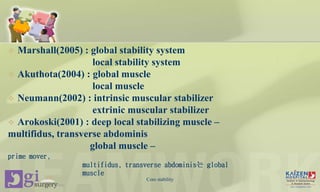
 Marshall(2005) : global stability system
local stability system
 Akuthota(2004) : global muscle
local muscle
 Neumann(2002) : intrinsic muscular stabilizer
extrinic muscular stabilizer
 Arokoski(2001) : deep local stabilizing muscle –
multifidus, transverse abdominis
global muscle –
prime mover,
multifidus, transverse abdominis는 global
muscle
Core stability
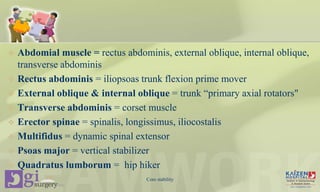
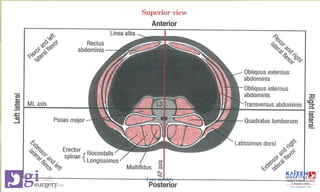
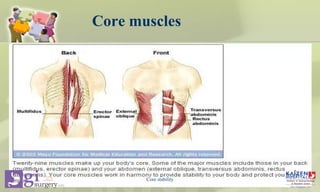
 Abdomial muscle = rectus abdominis, external oblique, internal oblique,
transverse abdominis
 Rectus abdominis = iliopsoas trunk flexion prime mover
 External oblique & internal oblique = trunk “primary axial rotators"
 Transverse abdominis = corset muscle
 Erector spinae = spinalis, longissimus, iliocostalis
 Multifidus = dynamic spinal extensor
 Psoas major = vertical stabilizer
 Quadratus lumborum = hip hiker
Core stability
Core stability
Core stability
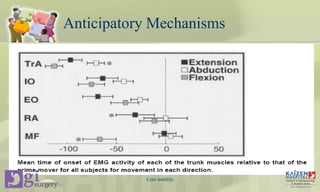
 “feedforward postural response”
 “anticipatory mechanism”
 3 major parts of core stability
1. Muscle performance
2. CARDIO PULMONARY ENDURENCE
3. FUNCTIONAL ACTIVITY
Core stability
 Lumbar spine stability & postural control
 Muscle movement perturbation
activation spine
Core stability
Core stability
Anticipatory Mechanisms
Core stability
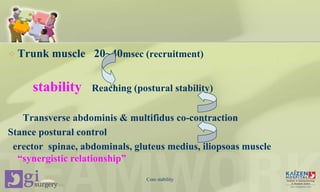
 Trunk muscle 20~40msec (recruitment)
stability Reaching (postural stability)
Transverse abdominis & multifidus co-contraction
Stance postural control
erector spinae, abdominals, gluteus medius, iliopsoas muscle
“synergistic relationship”
Core stability
Core muscles
Core stability
 Core stabilization
Kinesthetic training
Spinal stabiliation exercise
Functional activities
Core stability
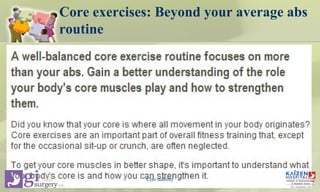
Core exercises: Beyond your average abs
routine
Core stability
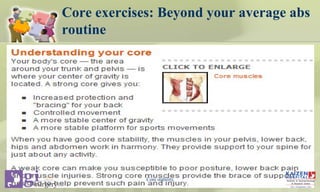
Core exercises: Beyond your average abs
routine
Core stability
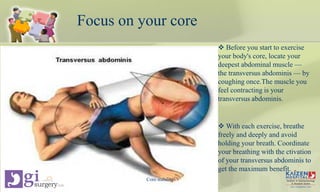
Focus on your core
 Before you start to exercise
your body's core, locate your
deepest abdominal muscle —
the transversus abdominis — by
coughing once.The muscle you
feel contracting is your
transversus abdominis.
 With each exercise, breathe
freely and deeply and avoid
holding your breath. Coordinate
your breathing with the ctivation
of your transversus abdominis to
get the maximum benefit.
Core stability
Core stability
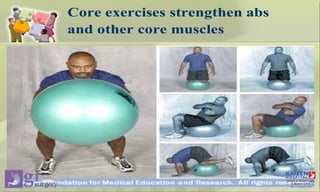
Core exercises strengthen abs
and other core muscles
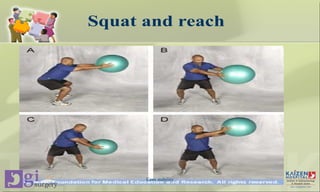
Squat and reach
Core stability
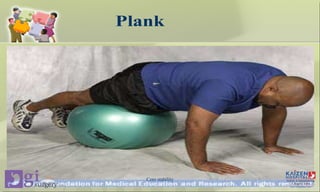
Plank
Core stability
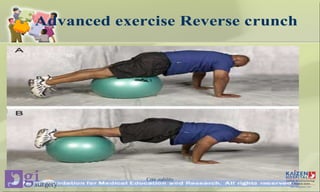
Advanced exercise Reverse crunch
Core stability
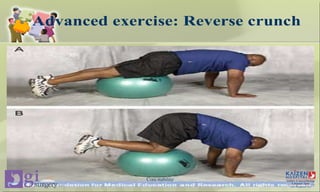
Advanced exercise: Reverse crunch
Core stability
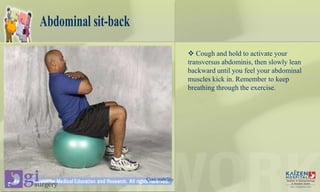
Abdominal sit-back
 Cough and hold to activate your
transversus abdominis, then slowly lean
backward until you feel your abdominal
muscles kick in. Remember to keep
breathing through the exercise.
Core stability
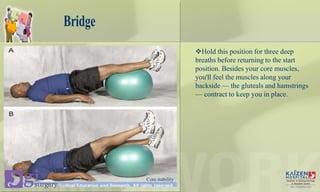
Bridge
Hold this position for three deep
breaths before returning to the start
position. Besides your core muscles,
you'll feel the muscles along your
backside — the gluteals and hamstrings
— contract to keep you in place.
Core stability
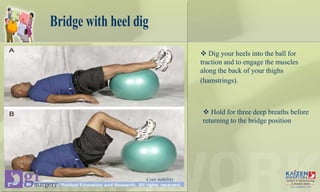
Bridge with heel dig
 Dig your heels into the ball for
traction and to engage the muscles
along the back of your thighs
(hamstrings).
 Hold for three deep breaths before
returning to the bridge position
Core stability
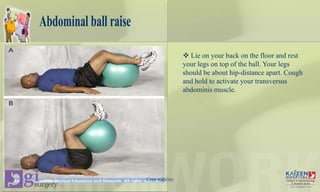
Abdominal ball raise
 Lie on your back on the floor and rest
your legs on top of the ball. Your legs
should be about hip-distance apart. Cough
and hold to activate your transversus
abdominis muscle.
Core stability
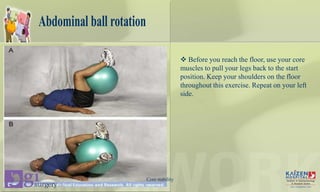
Abdominal ball rotation
 Before you reach the floor, use your core
muscles to pull your legs back to the start
position. Keep your shoulders on the floor
throughout this exercise. Repeat on your left
side.
Core stability
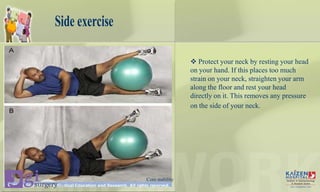
Side exercise
 Protect your neck by resting your head
on your hand. If this places too much
strain on your neck, straighten your arm
along the floor and rest your head
directly on it. This removes any pressure
on the side of your neck.
Core stability
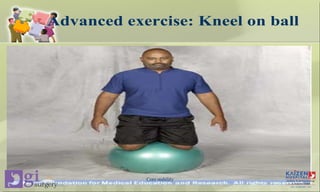
Advanced exercise: Kneel on ball
Core stability
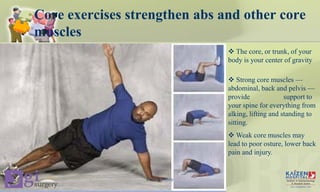
Core exercises strengthen abs and other core
muscles
 The core, or trunk, of your
body is your center of gravity
 Strong core muscles —
abdominal, back and pelvis —
provide support to
your spine for everything from
alking, lifting and standing to
sitting.
 Weak core muscles may
lead to poor osture, lower back
pain and injury.
Core stability
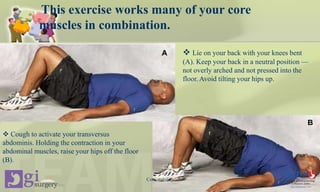
 Lie on your back with your knees bent
(A). Keep your back in a neutral position —
not overly arched and not pressed into the
floor. Avoid tilting your hips up.
This exercise works many of your core
muscles in combination.
 Cough to activate your transversus
abdominis. Holding the contraction in your
abdominal muscles, raise your hips off the floor
(B).
Core stability
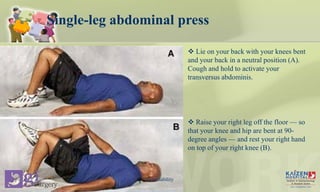
Single-leg abdominal press
 Lie on your back with your knees bent
and your back in a neutral position (A).
Cough and hold to activate your
transversus abdominis.
 Raise your right leg off the floor — so
that your knee and hip are bent at 90-
degree angles — and rest your right hand
on top of your right knee (B).
Core stability
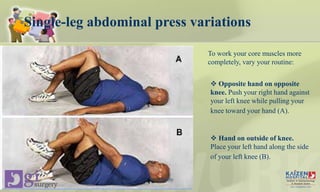
Single-leg abdominal press variations
To work your core muscles more
completely, vary your routine:
 Opposite hand on opposite
knee. Push your right hand against
your left knee while pulling your
knee toward your hand (A).
 Hand on outside of knee.
Place your left hand along the side
of your left knee (B).
Core stability
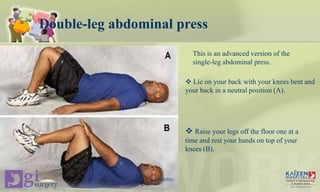
Double-leg abdominal press
This is an advanced version of the
single-leg abdominal press.
 Lie on your back with your knees bent and
your back in a neutral position (A).
 Raise your legs off the floor one at a
time and rest your hands on top of your
knees (B).
Core stability
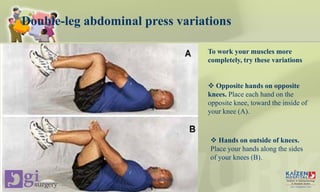
Double-leg abdominal press variations
To work your muscles more
completely, try these variations
 Opposite hands on opposite
knees. Place each hand on the
opposite knee, toward the inside of
your knee (A).
 Hands on outside of knees.
Place your hands along the sides
of your knees (B).
Core stability
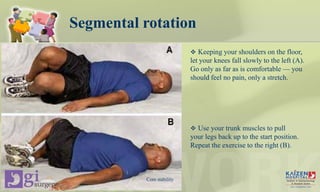
Segmental rotation
 Keeping your shoulders on the floor,
let your knees fall slowly to the left (A).
Go only as far as is comfortable — you
should feel no pain, only a stretch.
 Use your trunk muscles to pull
your legs back up to the start position.
Repeat the exercise to the right (B).
Core stability
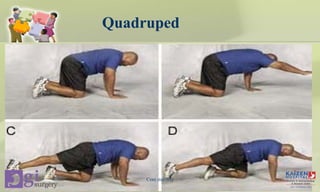
Quadruped
Core stability
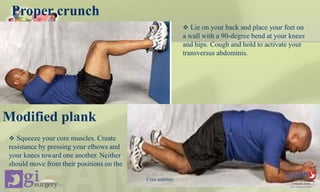
Proper crunch
 Lie on your back and place your feet on
a wall with a 90-degree bend at your knees
and hips. Cough and hold to activate your
transversus abdominis.
Modified plank
 Squeeze your core muscles. Create
resistance by pressing your elbows and
your knees toward one another. Neither
should move from their positions on the
floor.
Core stability
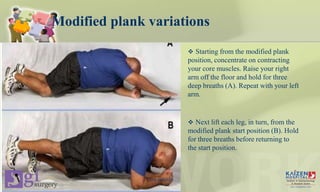
Modified plank variations
 Starting from the modified plank
position, concentrate on contracting
your core muscles. Raise your right
arm off the floor and hold for three
deep breaths (A). Repeat with your left
arm.
 Next lift each leg, in turn, from the
modified plank start position (B). Hold
for three breaths before returning to
the start position.
Core stability
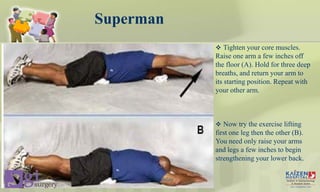
Superman
 Tighten your core muscles.
Raise one arm a few inches off
the floor (A). Hold for three deep
breaths, and return your arm to
its starting position. Repeat with
your other arm.
 Now try the exercise lifting
first one leg then the other (B).
You need only raise your arms
and legs a few inches to begin
strengthening your lower back.
Core stability
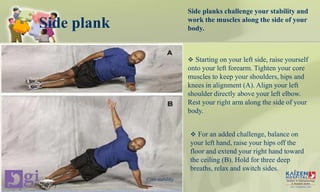
Side plank
Side planks challenge your stability and
work the muscles along the side of your
body.
 Starting on your left side, raise yourself
onto your left forearm. Tighten your core
muscles to keep your shoulders, hips and
knees in alignment (A). Align your left
shoulder directly above your left elbow.
Rest your right arm along the side of your
body.
 For an added challenge, balance on
your left hand, raise your hips off the
floor and extend your right hand toward
the ceiling (B). Hold for three deep
breaths, relax and switch sides.
Core stability

Core exercises: Beyond your average abs routine

  • 1.
    Core stability By:- Dr. PoonamKalavadiya (MPT, CardioPulmonary)
  • 2.
  • 3.
    Muscle active contraction stability corestability core stability Core stability
  • 4.
     Marshall(2005) :global stability system local stability system  Akuthota(2004) : global muscle local muscle  Neumann(2002) : intrinsic muscular stabilizer extrinic muscular stabilizer  Arokoski(2001) : deep local stabilizing muscle – multifidus, transverse abdominis global muscle – prime mover, multifidus, transverse abdominis는 global muscle Core stability
  • 5.
     Abdomial muscle= rectus abdominis, external oblique, internal oblique, transverse abdominis  Rectus abdominis = iliopsoas trunk flexion prime mover  External oblique & internal oblique = trunk “primary axial rotators"  Transverse abdominis = corset muscle  Erector spinae = spinalis, longissimus, iliocostalis  Multifidus = dynamic spinal extensor  Psoas major = vertical stabilizer  Quadratus lumborum = hip hiker Core stability
  • 6.
  • 7.
    Core stability  “feedforwardpostural response”  “anticipatory mechanism”  3 major parts of core stability 1. Muscle performance 2. CARDIO PULMONARY ENDURENCE 3. FUNCTIONAL ACTIVITY Core stability
  • 8.
     Lumbar spinestability & postural control  Muscle movement perturbation activation spine Core stability Core stability
  • 9.
  • 10.
     Trunk muscle20~40msec (recruitment) stability Reaching (postural stability) Transverse abdominis & multifidus co-contraction Stance postural control erector spinae, abdominals, gluteus medius, iliopsoas muscle “synergistic relationship” Core stability
  • 11.
  • 12.
     Core stabilization Kinesthetictraining Spinal stabiliation exercise Functional activities Core stability
  • 13.
    Core exercises: Beyondyour average abs routine Core stability
  • 14.
    Core exercises: Beyondyour average abs routine Core stability
  • 15.
    Focus on yourcore  Before you start to exercise your body's core, locate your deepest abdominal muscle — the transversus abdominis — by coughing once.The muscle you feel contracting is your transversus abdominis.  With each exercise, breathe freely and deeply and avoid holding your breath. Coordinate your breathing with the ctivation of your transversus abdominis to get the maximum benefit. Core stability
  • 16.
  • 17.
    Core exercises strengthenabs and other core muscles
  • 18.
  • 19.
  • 20.
    Advanced exercise Reversecrunch Core stability
  • 21.
    Advanced exercise: Reversecrunch Core stability
  • 22.
    Abdominal sit-back  Coughand hold to activate your transversus abdominis, then slowly lean backward until you feel your abdominal muscles kick in. Remember to keep breathing through the exercise. Core stability
  • 23.
    Bridge Hold this positionfor three deep breaths before returning to the start position. Besides your core muscles, you'll feel the muscles along your backside — the gluteals and hamstrings — contract to keep you in place. Core stability
  • 24.
    Bridge with heeldig  Dig your heels into the ball for traction and to engage the muscles along the back of your thighs (hamstrings).  Hold for three deep breaths before returning to the bridge position Core stability
  • 25.
    Abdominal ball raise Lie on your back on the floor and rest your legs on top of the ball. Your legs should be about hip-distance apart. Cough and hold to activate your transversus abdominis muscle. Core stability
  • 26.
    Abdominal ball rotation Before you reach the floor, use your core muscles to pull your legs back to the start position. Keep your shoulders on the floor throughout this exercise. Repeat on your left side. Core stability
  • 27.
    Side exercise  Protectyour neck by resting your head on your hand. If this places too much strain on your neck, straighten your arm along the floor and rest your head directly on it. This removes any pressure on the side of your neck. Core stability
  • 28.
    Advanced exercise: Kneelon ball Core stability
  • 29.
    Core exercises strengthenabs and other core muscles  The core, or trunk, of your body is your center of gravity  Strong core muscles — abdominal, back and pelvis — provide support to your spine for everything from alking, lifting and standing to sitting.  Weak core muscles may lead to poor osture, lower back pain and injury. Core stability
  • 30.
     Lie onyour back with your knees bent (A). Keep your back in a neutral position — not overly arched and not pressed into the floor. Avoid tilting your hips up. This exercise works many of your core muscles in combination.  Cough to activate your transversus abdominis. Holding the contraction in your abdominal muscles, raise your hips off the floor (B). Core stability
  • 31.
    Single-leg abdominal press Lie on your back with your knees bent and your back in a neutral position (A). Cough and hold to activate your transversus abdominis.  Raise your right leg off the floor — so that your knee and hip are bent at 90- degree angles — and rest your right hand on top of your right knee (B). Core stability
  • 32.
    Single-leg abdominal pressvariations To work your core muscles more completely, vary your routine:  Opposite hand on opposite knee. Push your right hand against your left knee while pulling your knee toward your hand (A).  Hand on outside of knee. Place your left hand along the side of your left knee (B). Core stability
  • 33.
    Double-leg abdominal press Thisis an advanced version of the single-leg abdominal press.  Lie on your back with your knees bent and your back in a neutral position (A).  Raise your legs off the floor one at a time and rest your hands on top of your knees (B). Core stability
  • 34.
    Double-leg abdominal pressvariations To work your muscles more completely, try these variations  Opposite hands on opposite knees. Place each hand on the opposite knee, toward the inside of your knee (A).  Hands on outside of knees. Place your hands along the sides of your knees (B). Core stability
  • 35.
    Segmental rotation  Keepingyour shoulders on the floor, let your knees fall slowly to the left (A). Go only as far as is comfortable — you should feel no pain, only a stretch.  Use your trunk muscles to pull your legs back up to the start position. Repeat the exercise to the right (B). Core stability
  • 36.
  • 37.
    Proper crunch  Lieon your back and place your feet on a wall with a 90-degree bend at your knees and hips. Cough and hold to activate your transversus abdominis. Modified plank  Squeeze your core muscles. Create resistance by pressing your elbows and your knees toward one another. Neither should move from their positions on the floor. Core stability
  • 38.
    Modified plank variations Starting from the modified plank position, concentrate on contracting your core muscles. Raise your right arm off the floor and hold for three deep breaths (A). Repeat with your left arm.  Next lift each leg, in turn, from the modified plank start position (B). Hold for three breaths before returning to the start position. Core stability
  • 39.
    Superman  Tighten yourcore muscles. Raise one arm a few inches off the floor (A). Hold for three deep breaths, and return your arm to its starting position. Repeat with your other arm.  Now try the exercise lifting first one leg then the other (B). You need only raise your arms and legs a few inches to begin strengthening your lower back. Core stability
  • 40.
    Side plank Side plankschallenge your stability and work the muscles along the side of your body.  Starting on your left side, raise yourself onto your left forearm. Tighten your core muscles to keep your shoulders, hips and knees in alignment (A). Align your left shoulder directly above your left elbow. Rest your right arm along the side of your body.  For an added challenge, balance on your left hand, raise your hips off the floor and extend your right hand toward the ceiling (B). Hold for three deep breaths, relax and switch sides. Core stability