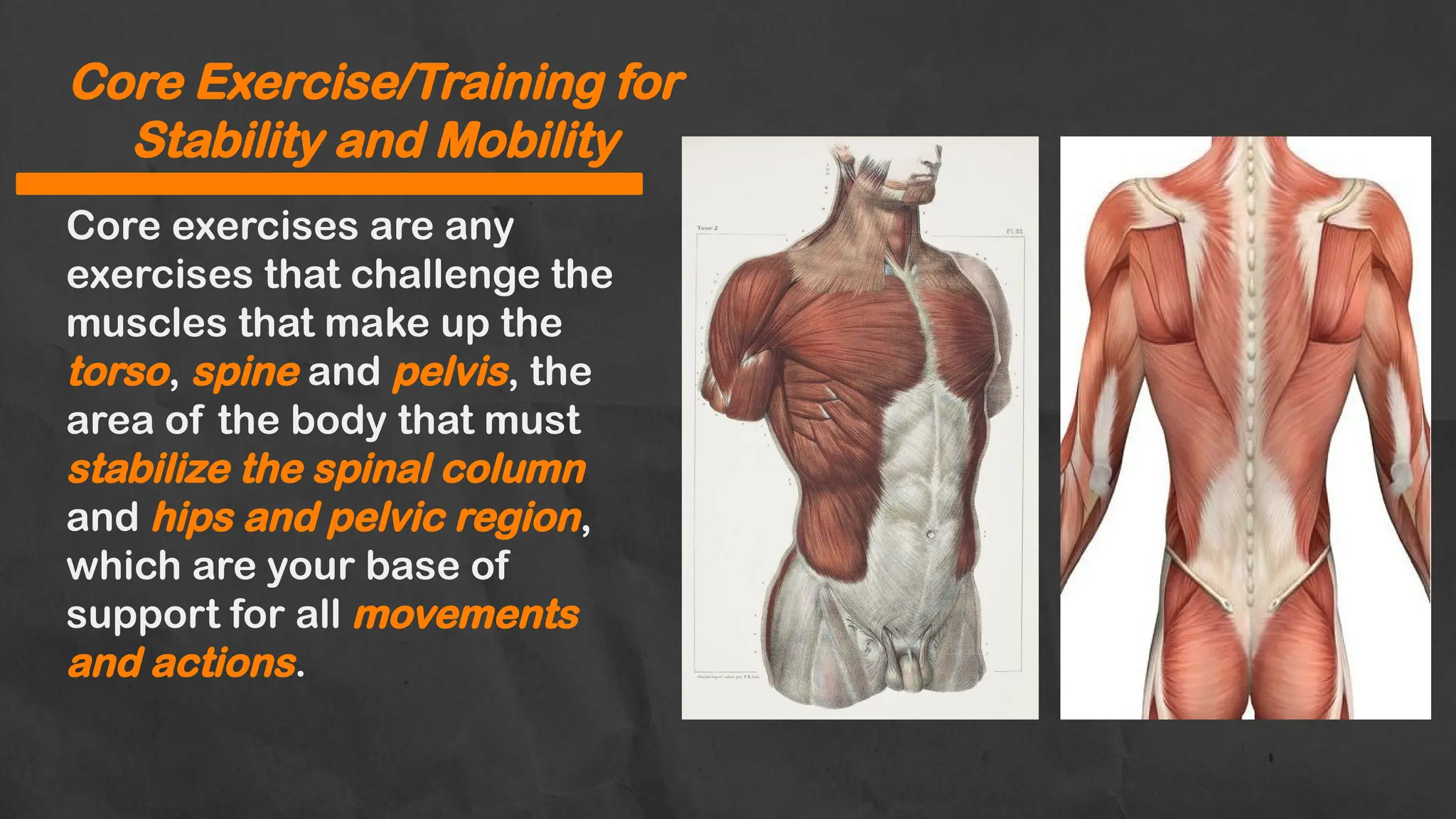
Core exercises areany
exercises that challenge the
muscles that make up the
torso, spine and pelvis, the
area of the body that must
stabilize the spinal column
and hips and pelvic region,
which are your base of
support for all movements
and actions.
Core Exercise/Training for
Stability and Mobility
3.
Core exercises canand should be incorporated into every
workout you perform each time you exercise. This can be
accomplished by performing as many exercises as possible
while having your spine and pelvis unsupported by a bench
or seat. This will require the core muscles to engage to
stabilize the body. (National Academy of Sports Medicine)
Core Exercise/Training for
Stability and Mobility
The point of core exercises is to train the many large and
small muscles that help control and stabilize the spinal
column and pelvis to build endurance and strength and be
better able to control the spine and pelvis when forces are
applied to it during daily activities and physical activities.
Core stability refersto the stability of
the spine, which enables it to stay
intact during the forces exerted on it
by everyday movement. Core stability
does not refer to the stability of the
muscles themselves.
The core muscles are the muscles
around the spine which help to
stabilize,protect the spine and help
provide a solid base from which
movement can take place.
Core stability Neck muscles keep the
head stable and upright
Back muscles keep the
spine erect and stable
Abdominal muscles
stabilize the lower back
and pelvis
In addition, the pelvic floor
muscles and diaphragm
are also considered to be
part of the core
6.
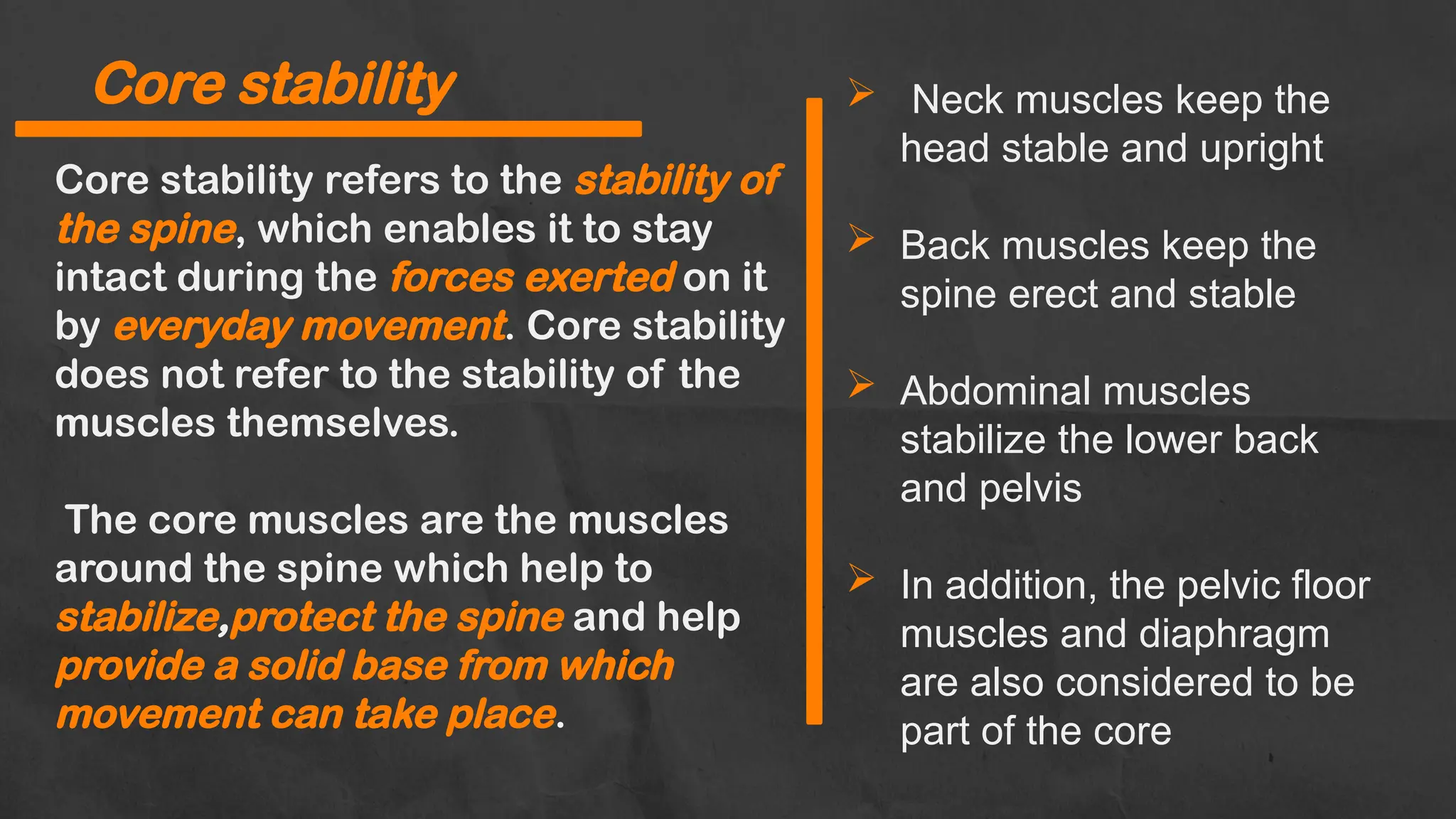
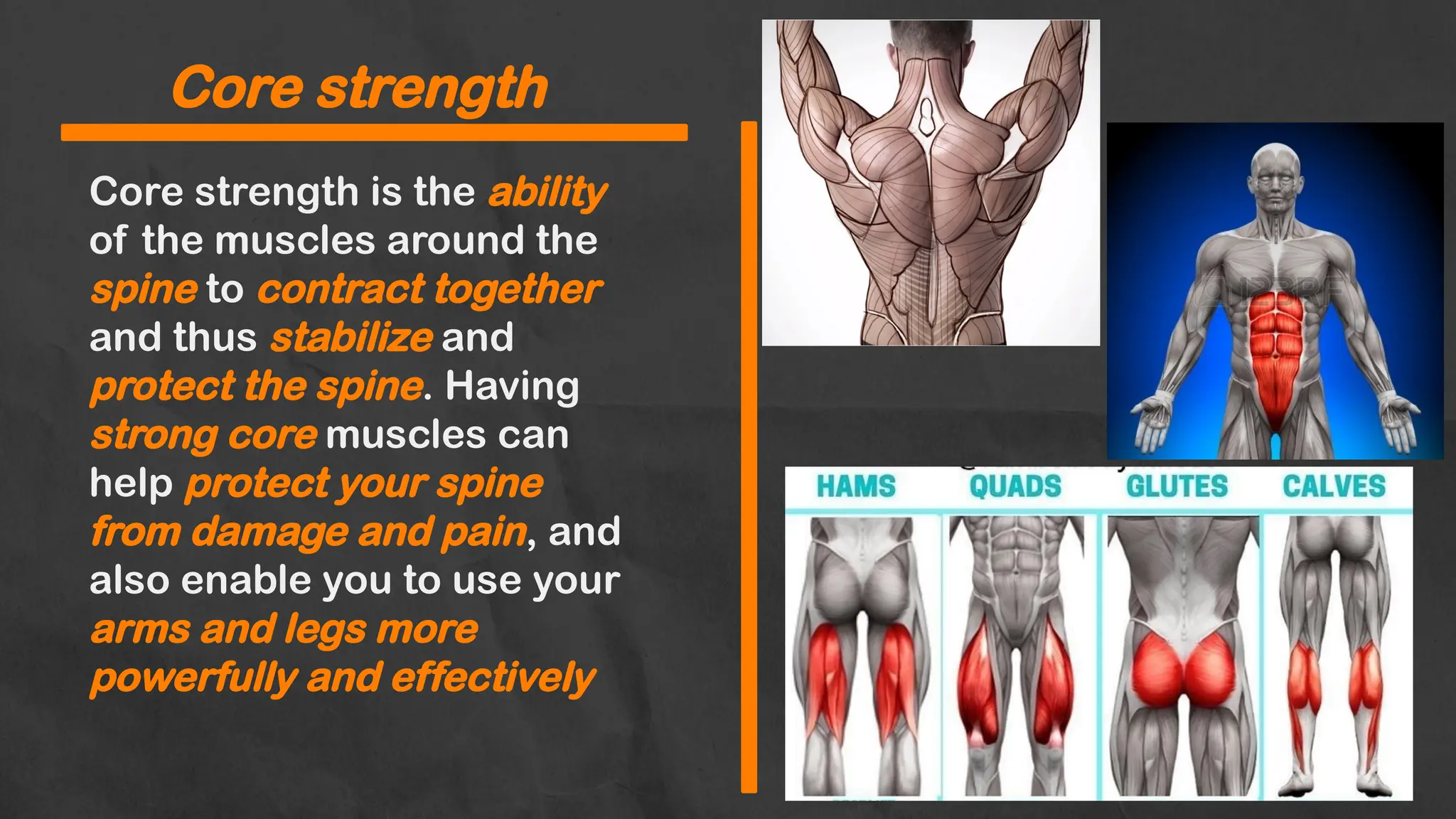
Core strength isthe ability
of the muscles around the
spine to contract together
and thus stabilize and
protect the spine. Having
strong core muscles can
help protect your spine
from damage and pain, and
also enable you to use your
arms and legs more
powerfully and effectively
Core strength
7.
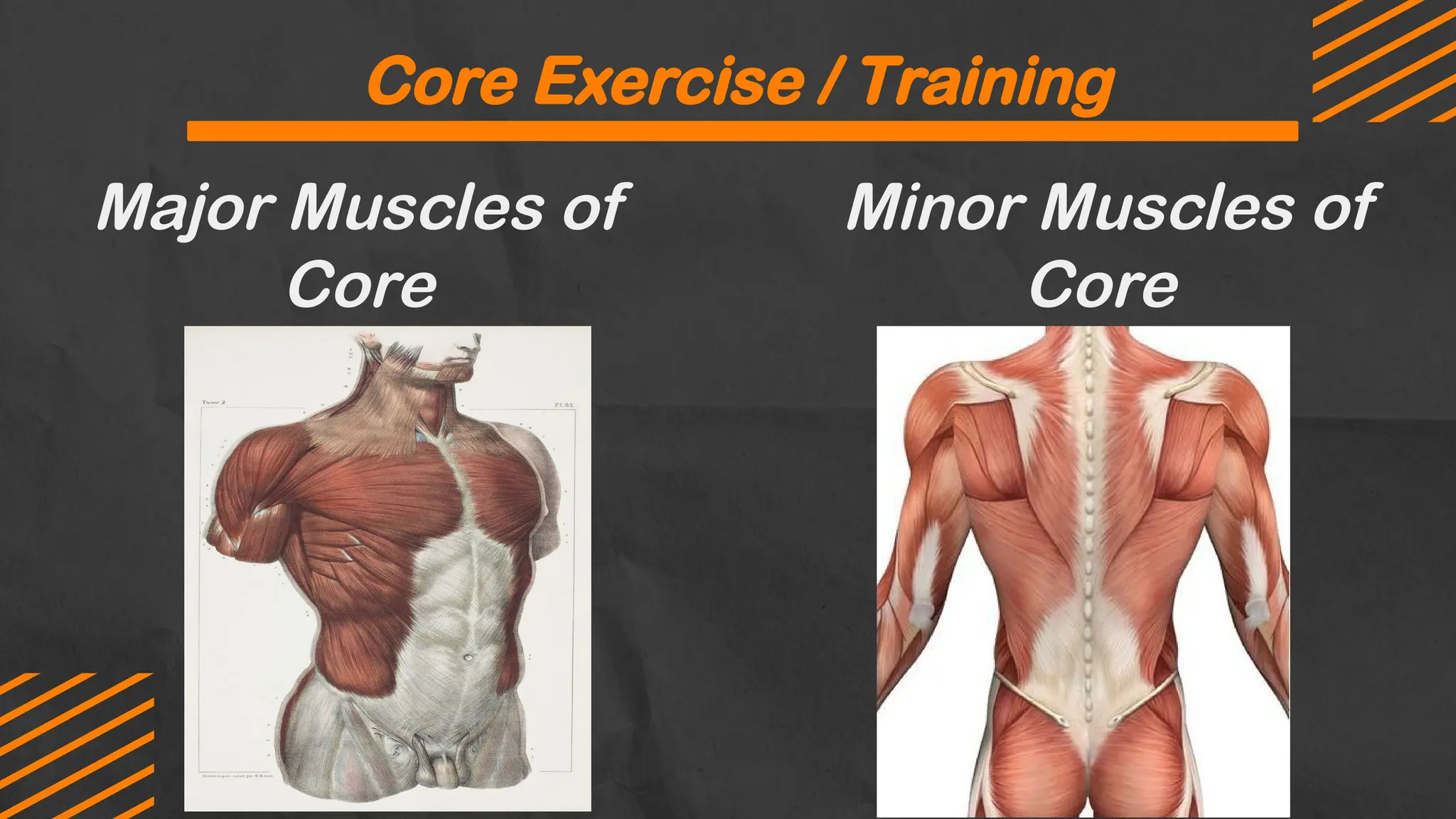
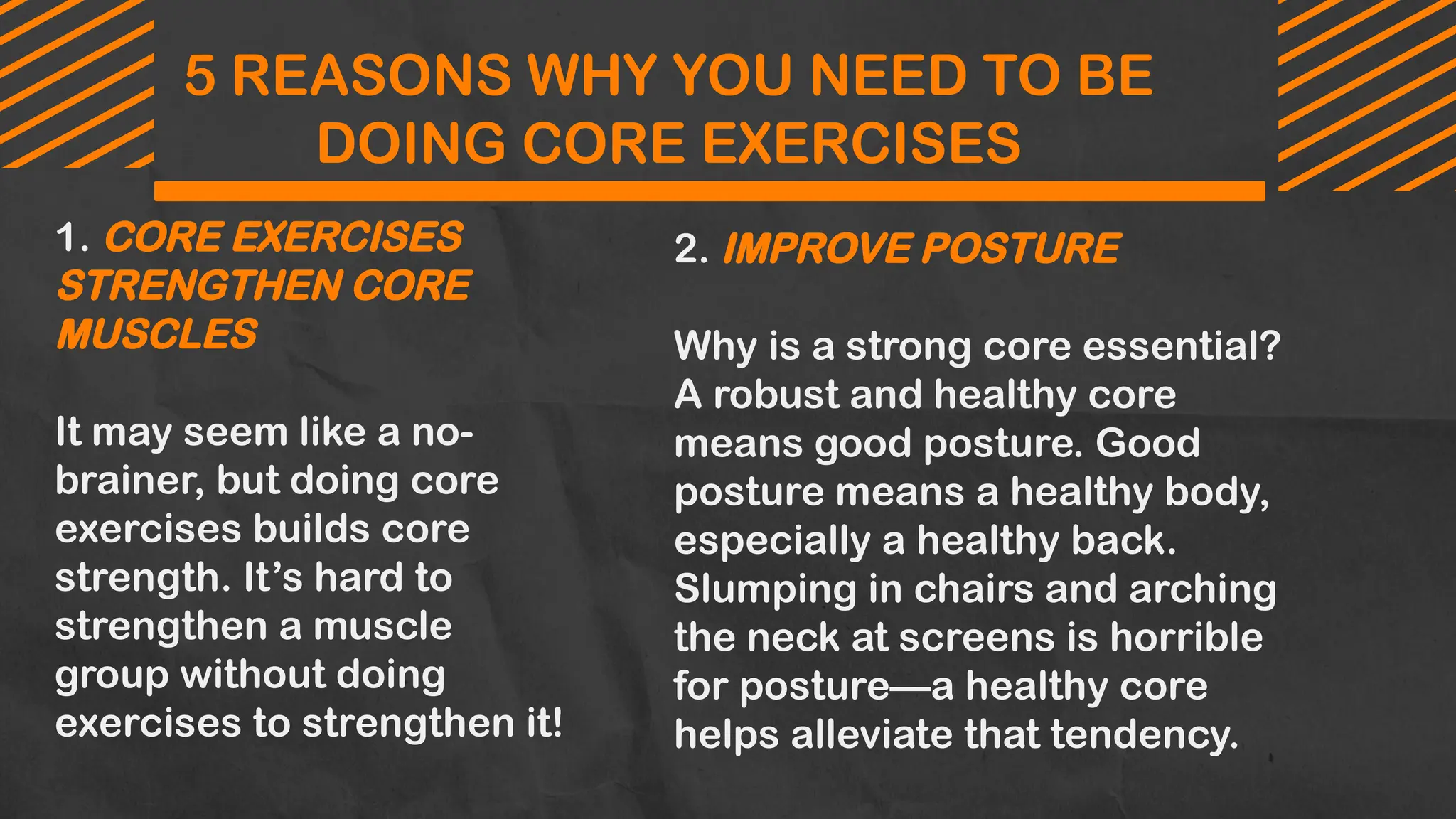
Core Exercise /Training
Major Muscles of
Core
Minor Muscles of
Core
8.
5 REASONS WHYYOU NEED TO BE
DOING CORE EXERCISES
1. CORE EXERCISES
STRENGTHEN CORE
MUSCLES
It may seem like a no-
brainer, but doing core
exercises builds core
strength. It’s hard to
strengthen a muscle
group without doing
exercises to strengthen it!
2. IMPROVE POSTURE
Why is a strong core essential?
A robust and healthy core
means good posture. Good
posture means a healthy body,
especially a healthy back.
Slumping in chairs and arching
the neck at screens is horrible
for posture—a healthy core
helps alleviate that tendency.
9.
3. MAY IMPROVERUNNING/TRAINING PERFORMANCE AND
BALANCE
Core exercises don’t just help tone and sculpt six-pack abs! Core
exercises are great for improving overall balance. Running and
training require a solid foundation. A strong core helps build and
maintain that foundation. The core is used in virtually every
movement so it makes sense to strengthen it!
4. CORE EXERCISES HELP REDUCE INJURY WHEN COMBINED WITH
FULL-BODY STRENGTH TRAINING
A strong core doesn’t just improve running and other training; it can
help decrease the risk of injury. Ultimately, this improves athletic
performance since less time injured means more time and energy for
safe training. A holistic training plan that includes full-body strength
training is a great way to bulletproof the body.
10.
5. REDUCE LOWERBACK PAIN AND STIFFNESS
Most people suffer from lower back pain and stiffness. Core
strengthening can help alleviate that pain. As mentioned above, it
also decreases the risk of getting injured again.
11.
Core Exercise/Training ForBeginner
The following are the exercise/training to stabilize and mobilize
the core muscles. If you’re new to exercise or if you haven’t
exercised in a long time, start with these beginner moves. It may
also be a good idea to determine your physical fitness prior to
perform the following exercise so that you will know the right
number of reps and sets for your personal fitness level and goals.
12.
Neutral, Brace, Breathe
Trainingcore stability has more benefits and practical carryover to
functional movement and spine/back health. Before we do any core
training, it is helpful to learn these three things:
To learn what a neutral spine feels like – most people need to
learn to keep the head, ribcage and pelvis aligned. ‘Locking down
the ribs’ is a common coaching cue – puffing the chest up can
actually misalign your body out of optimal positioning for core
stability and optimal breathing.
To learn to brace, just imagine someone is about to punch you in
the stomach, you should intuitively ‘tense up’ your midsection.
How hard you brace, or your effort, should correspond with the
difficulty of the task at hand.
13.
To learn tobreathe properly, we first need to be in neutral spine,
so our diaphragm is in a good position. Whilst deserving of its
own article (or book!) in itself, it’s important to learn how to ‘belly
breathe’ and use our diaphragm. (which is a big contributor to
core stability). Breathe out, into the belly region all the way
around, not up into the chest and shoulders.
Before performing any of the core stability exercises below, first
learn to integrate neutral spine, bracing and breathing, so you
can do these three things at the same time, from varying
positions.
14.
Core Exercise/Training ForBeginner
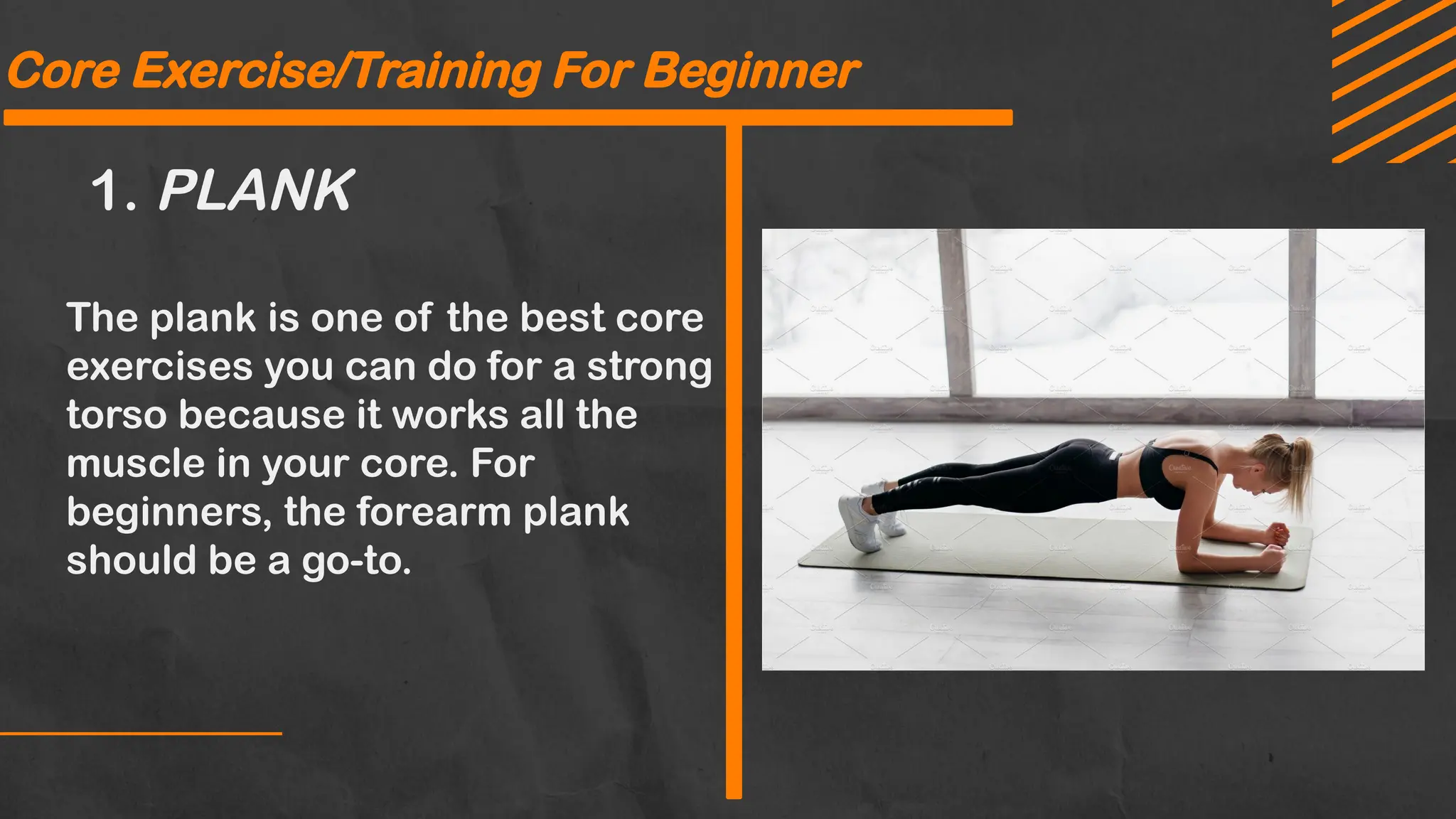
1. PLANK
The plank is one of the best core
exercises you can do for a strong
torso because it works all the
muscle in your core. For
beginners, the forearm plank
should be a go-to.
15.
How To DoPlanks:
1. Place your forearms on the floor with
your elbows aligned below your
shoulders and your arms parallel to
your body at about shoulder width.
2. Feet should be hip width apart.
3. Keep a neutral spine. As you hold,
keep your hips up, don’t let them start
to fall to the floor.
4. Maintain a tight core and keep your
legs and glutes squeezed tight at all
times.
5. Focus on keeping everything tight for
the allotted time.
Muscles worked:
Rectus Abdominis,
Transverse
Abdominis, Internal
Obliques,
External Obliques,
Hips,
Erector Spinae,
Multifidus,
Quadratus
Lumborum, and
Glutes.
16.
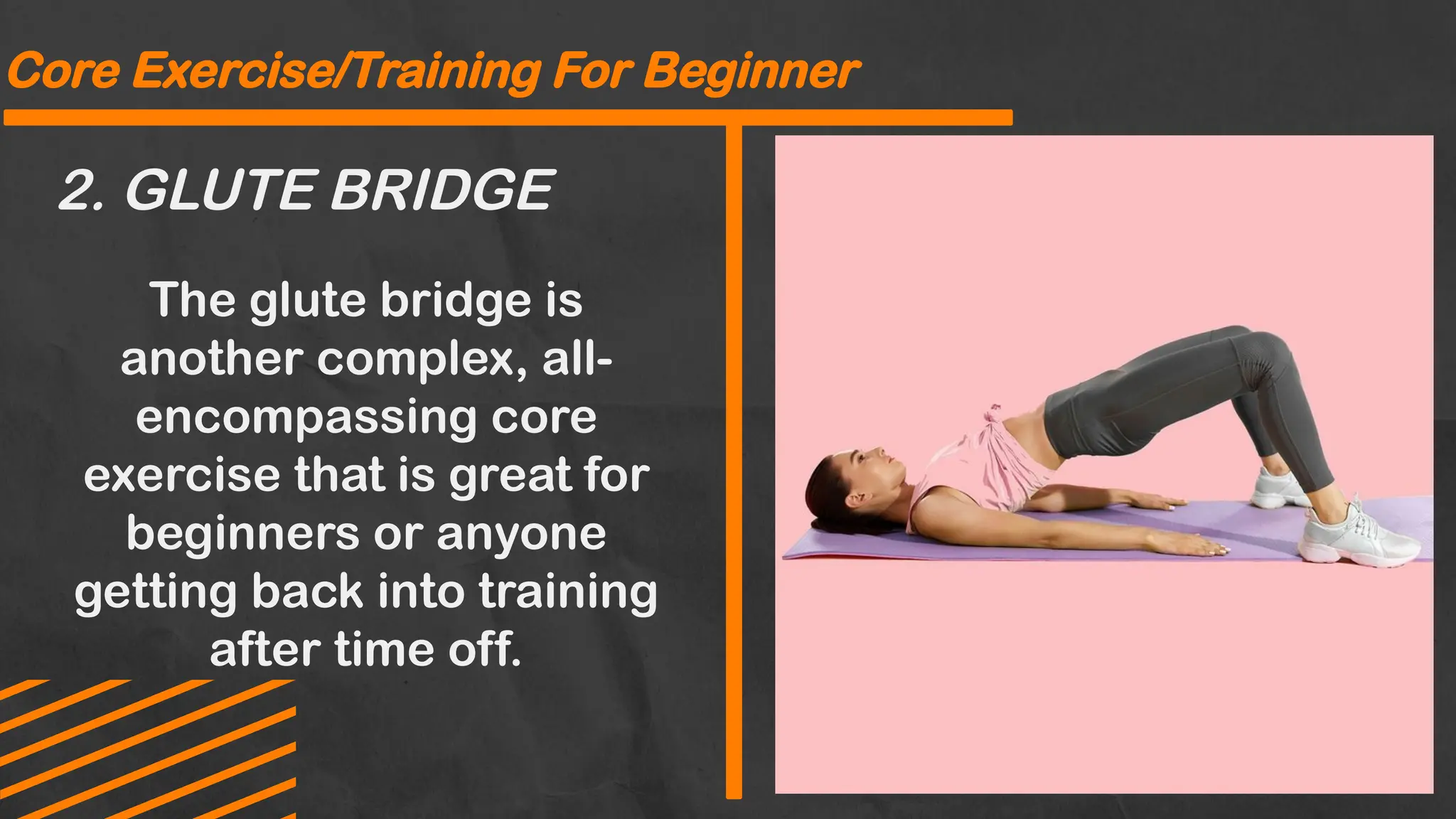
2. GLUTE BRIDGE
CoreExercise/Training For Beginner
The glute bridge is
another complex, all-
encompassing core
exercise that is great for
beginners or anyone
getting back into training
after time off.
17.
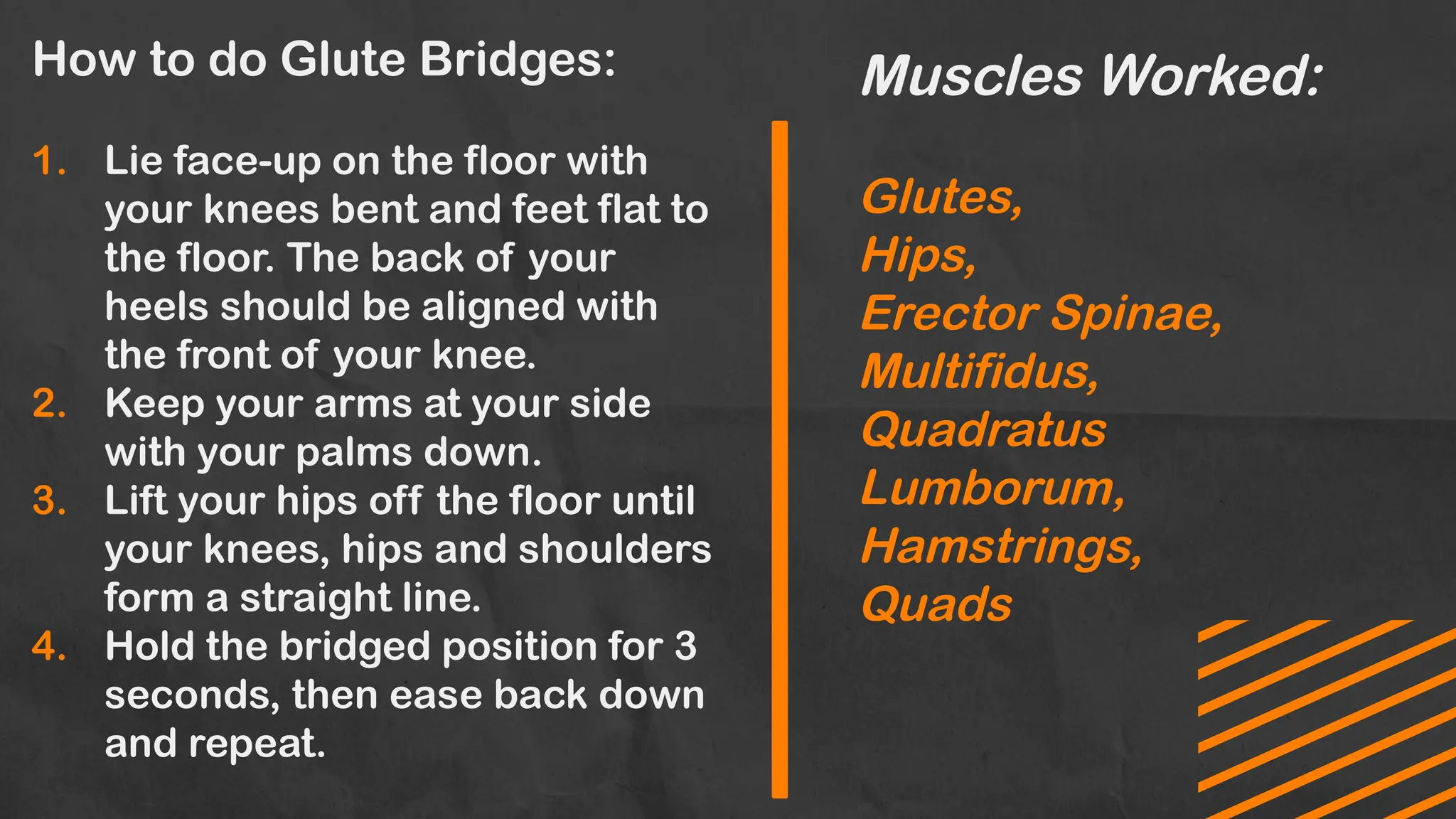
How to doGlute Bridges:
1. Lie face-up on the floor with
your knees bent and feet flat to
the floor. The back of your
heels should be aligned with
the front of your knee.
2. Keep your arms at your side
with your palms down.
3. Lift your hips off the floor until
your knees, hips and shoulders
form a straight line.
4. Hold the bridged position for 3
seconds, then ease back down
and repeat.
Muscles Worked:
Glutes,
Hips,
Erector Spinae,
Multifidus,
Quadratus
Lumborum,
Hamstrings,
Quads
18.
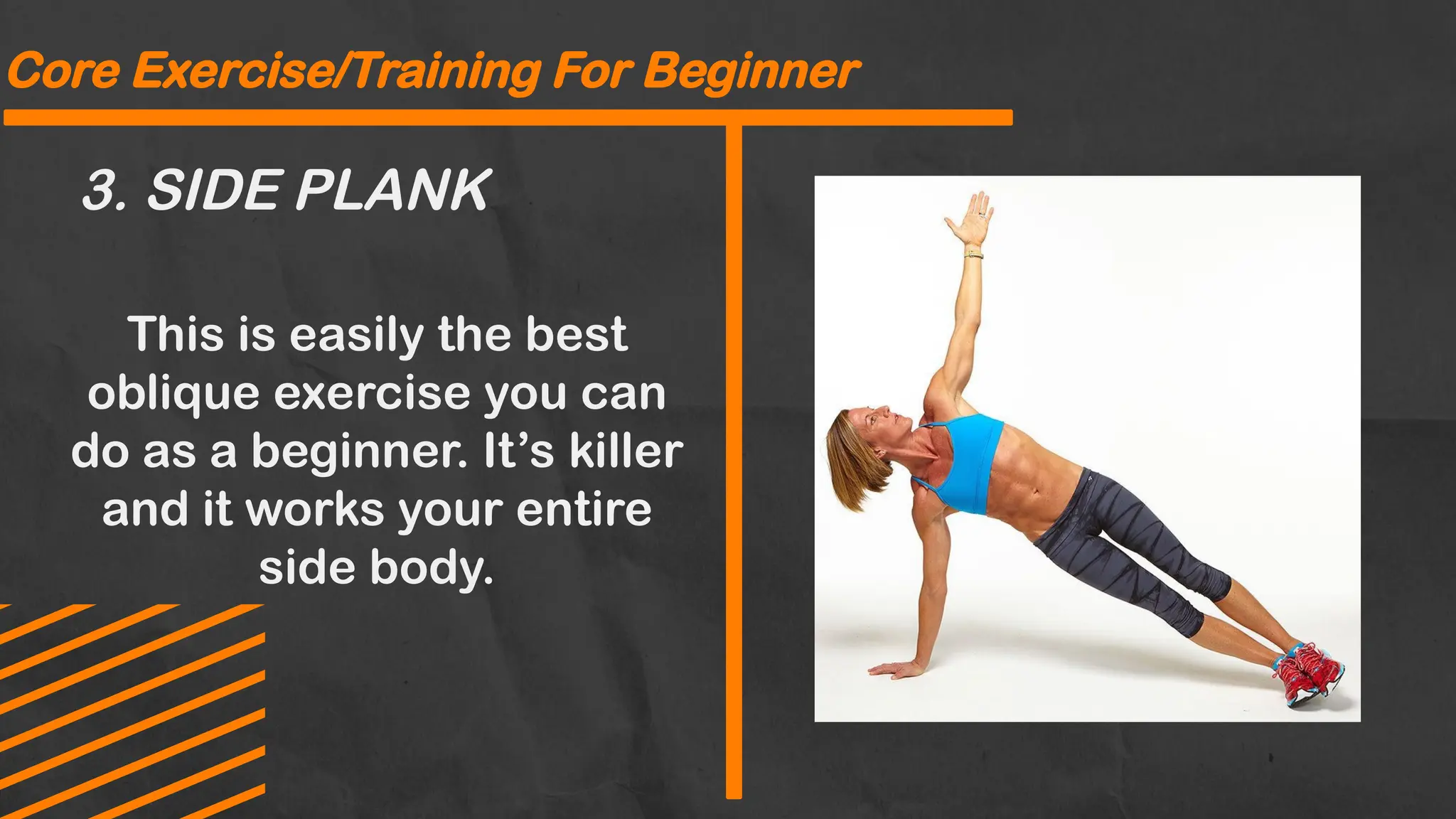
3. SIDE PLANK
CoreExercise/Training For Beginner
This is easily the best
oblique exercise you can
do as a beginner. It’s killer
and it works your entire
side body.
19.
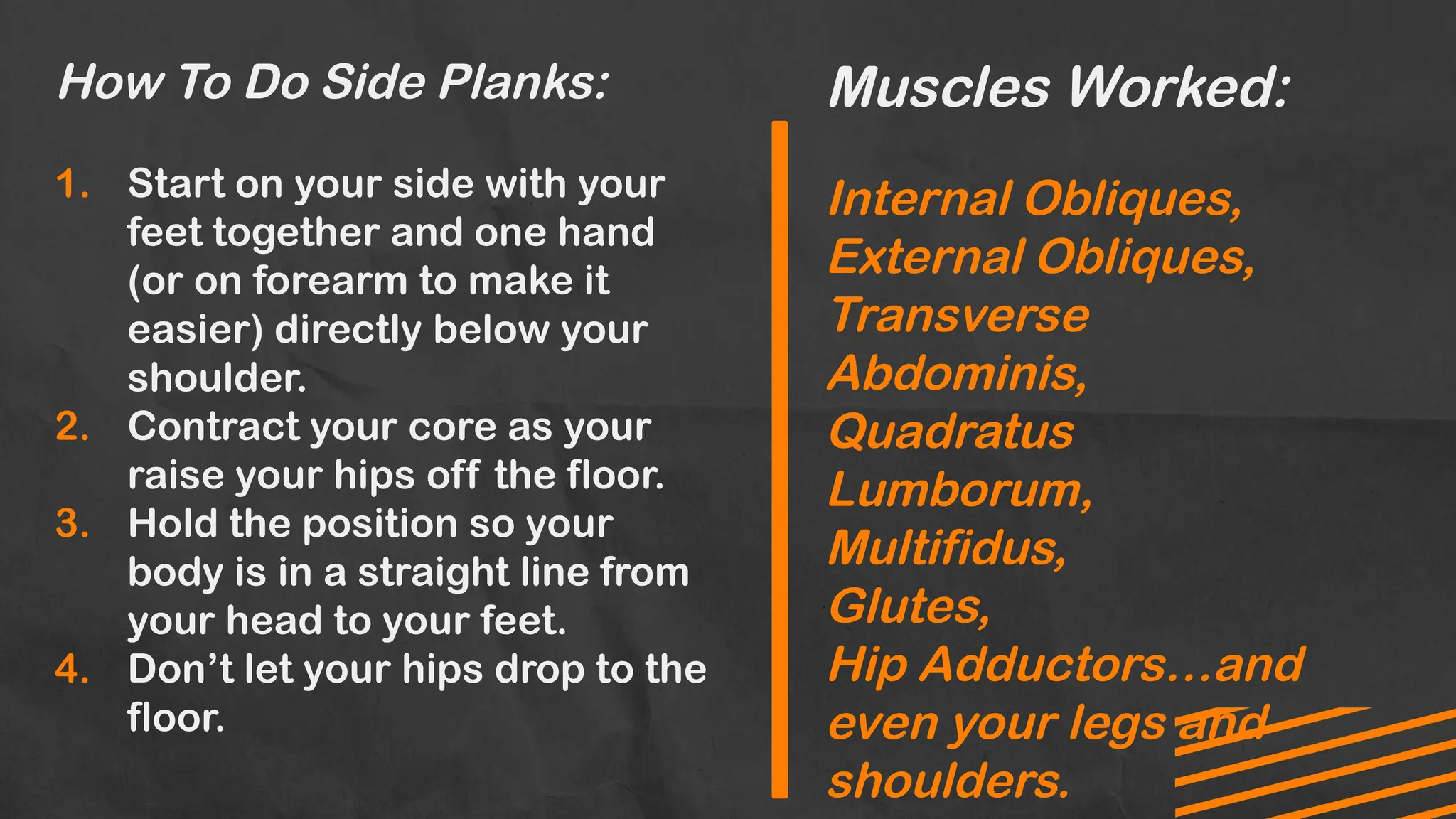
How To DoSide Planks:
1. Start on your side with your
feet together and one hand
(or on forearm to make it
easier) directly below your
shoulder.
2. Contract your core as your
raise your hips off the floor.
3. Hold the position so your
body is in a straight line from
your head to your feet.
4. Don’t let your hips drop to the
floor.
Muscles Worked:
Internal Obliques,
External Obliques,
Transverse
Abdominis,
Quadratus
Lumborum,
Multifidus,
Glutes,
Hip Adductors…and
even your legs and
shoulders.
20.
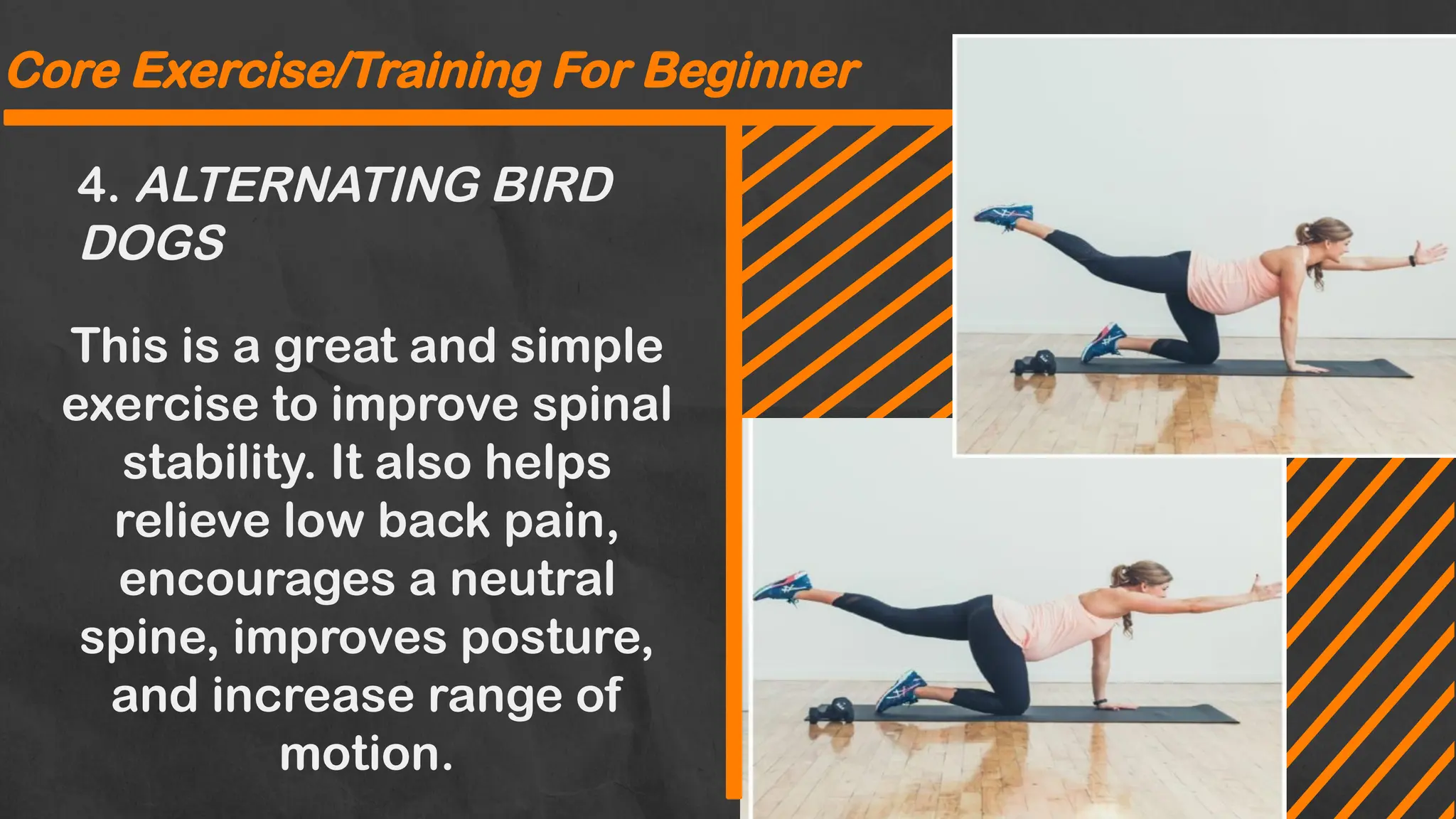
4. ALTERNATING BIRD
DOGS
CoreExercise/Training For Beginner
This is a great and simple
exercise to improve spinal
stability. It also helps
relieve low back pain,
encourages a neutral
spine, improves posture,
and increase range of
motion.
21.
How To DoAlt. Bird Dogs:
1. Get down onto your hands and knees. Place
your hands on the floor directly under your
shoulders, and knees on the floor under your
hips.
2. Extend your right arm in front of you and your
left leg straight back so they are parallel with
the floor. Hold the position for a couple seconds.
3. Return back to the starting position and then
extend your left arm in front of you and your
right leg straight back. Hold the position for a
couple seconds.
4. Return back to starting position and repeat on
the other side. Continue alternating sides for a
set number of reps.
22.
Muscles Worked:
This isgreat for reciprocal muscle
activation. It prevents rotation, so
it’s a great exercise for the Lumbar
Stabilizer Muscles -
Erector Spinae,
Multifidus,
Quadratus Lumborum,
Glutes,
Hips.
You will also work your upper back
and shoulders.
23.
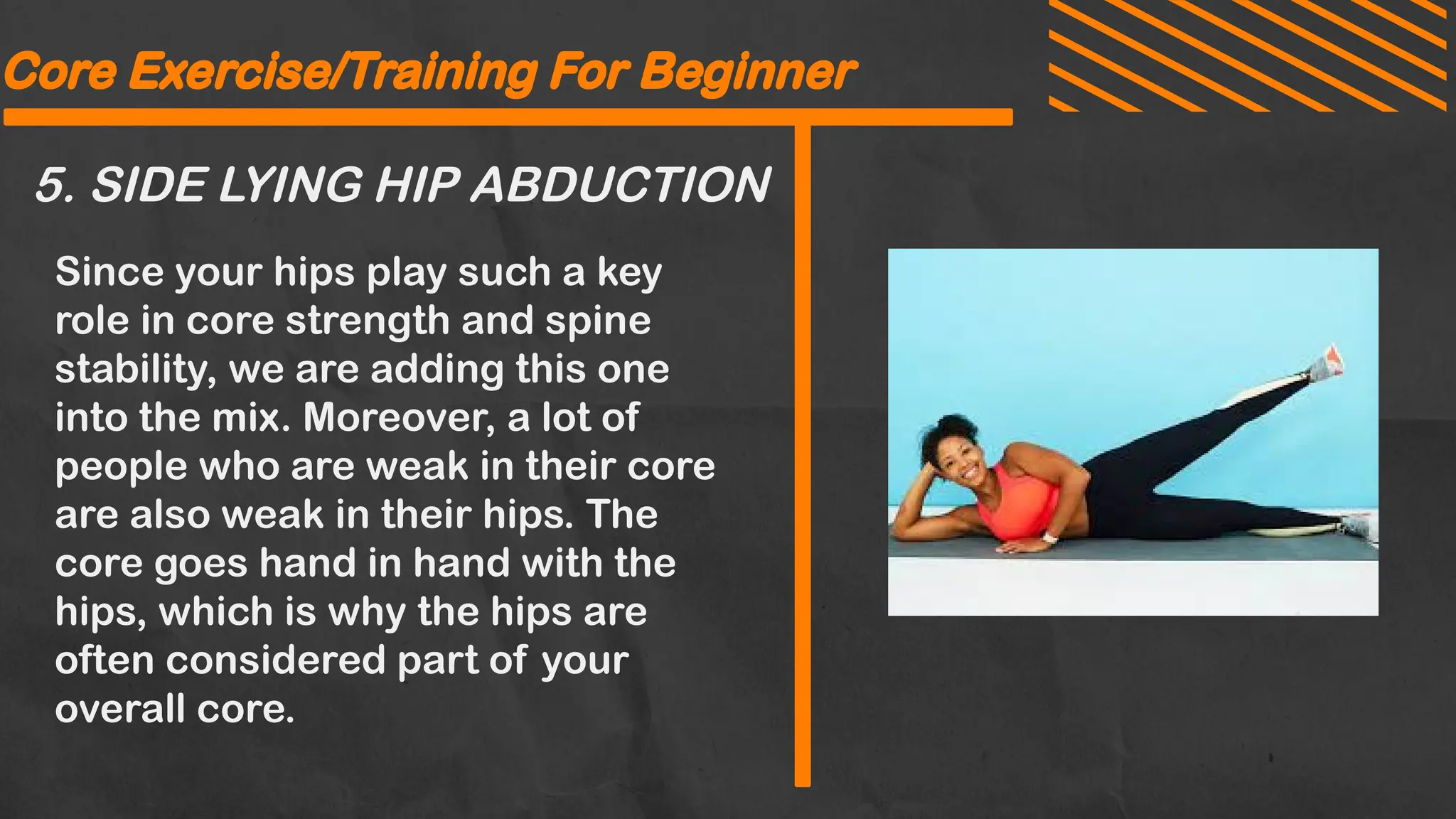
5. SIDE LYINGHIP ABDUCTION
Core Exercise/Training For Beginner
Since your hips play such a key
role in core strength and spine
stability, we are adding this one
into the mix. Moreover, a lot of
people who are weak in their core
are also weak in their hips. The
core goes hand in hand with the
hips, which is why the hips are
often considered part of your
overall core.
Core Exercise/Training For Beginner
24.
How To DoSide Lying Hip Abductions:
1. Lay down on your side, with your under leg
bent at 90 degrees behind you. Your top leg is
out extended straight, aligned with your
body.
2. Your forearm should be on the floor, aligned
with your shoulder.
3. Use the muscles on the sides of your hip and
your glute to raise your leg up. Keep your leg
straight.
4. Bring it back down. And repeat
5. Focus on pushing your hip slightly forward as
you do this exercise so you feel it working
your outer hips and glutes more than your hip
flexors.
Muscles Worked:
Hip
Abductors,
Glutes
25.
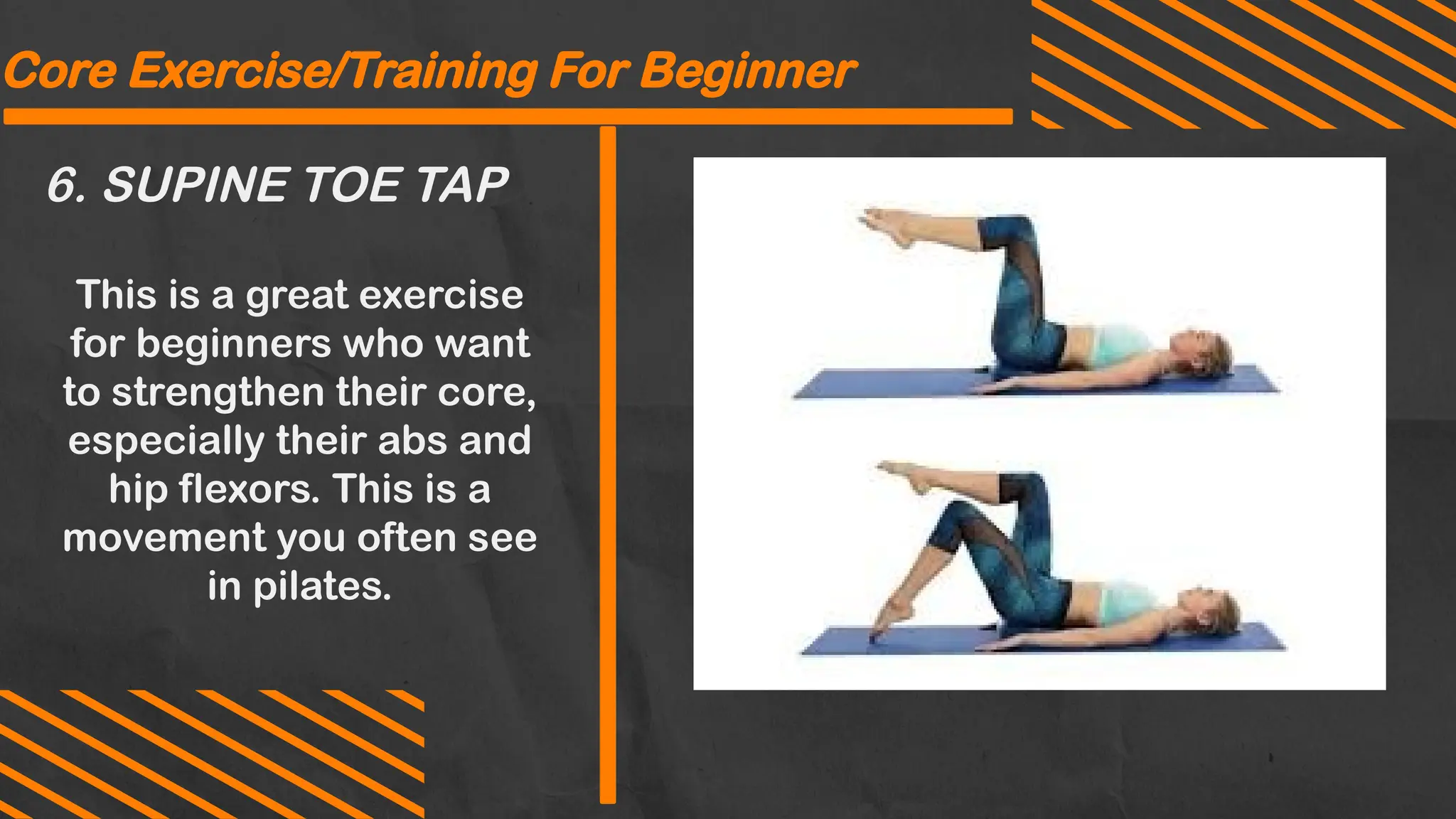
6. SUPINE TOETAP
Core Exercise/Training For Beginner
This is a great exercise
for beginners who want
to strengthen their core,
especially their abs and
hip flexors. This is a
movement you often see
in pilates.
26.
How To DoSupine Toe Taps:
1. Lie down on your back. Lift your
legs up with your knees bent at
90 degrees. Hands to your side,
palms down.
2. While keeping your core tight,
lower your right foot down and
gently tap the floor. Make sure
you keep your back flat at all
times.
3. Raise your right foot back up to
the starting position and repeat
with your left leg.
Muscles Worked:
Rectus Abdominis,
Transverse Abdominis,
Hip Flexors
27.
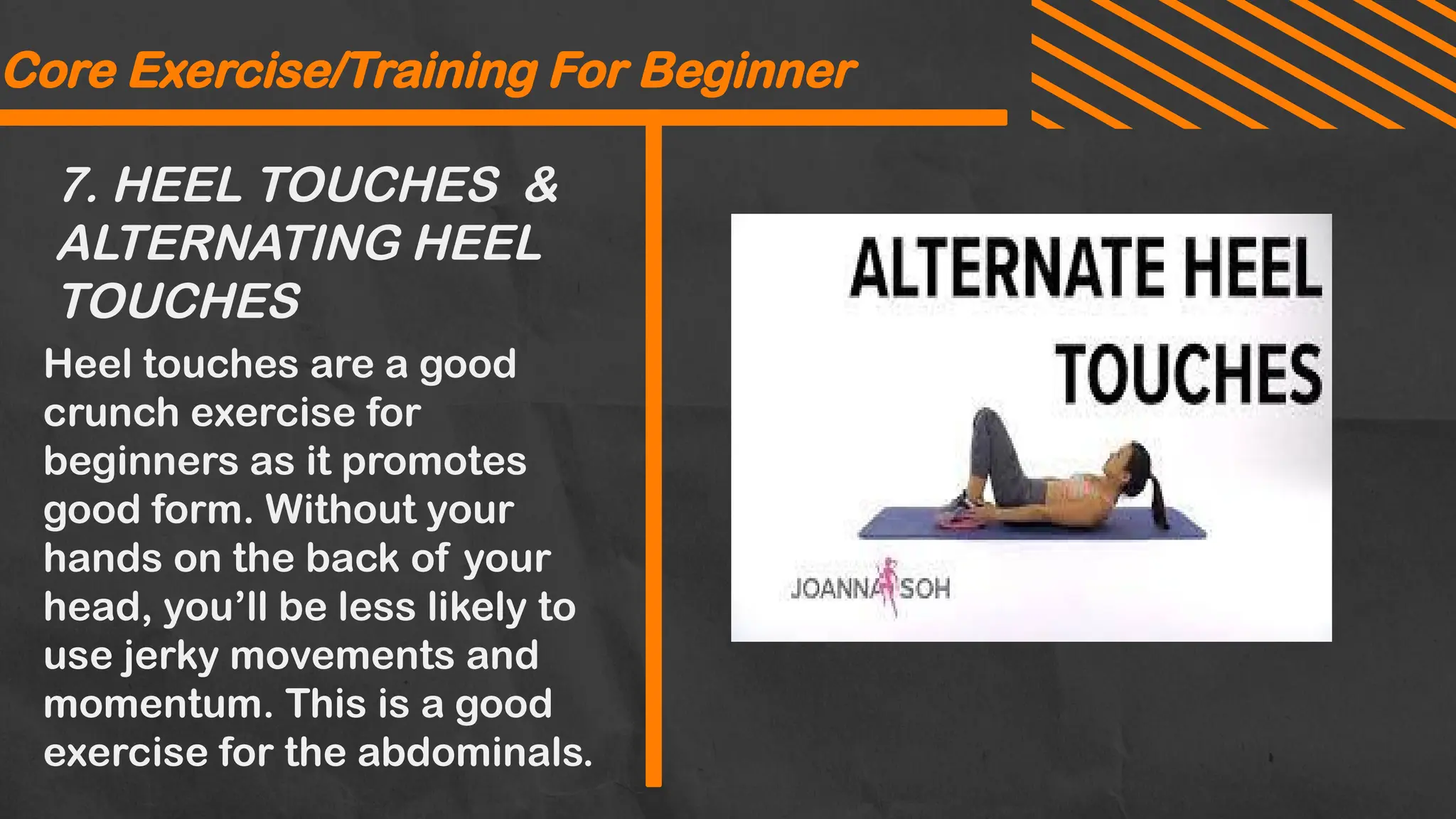
7. HEEL TOUCHES&
ALTERNATING HEEL
TOUCHES
Core Exercise/Training For Beginner
Heel touches are a good
crunch exercise for
beginners as it promotes
good form. Without your
hands on the back of your
head, you’ll be less likely to
use jerky movements and
momentum. This is a good
exercise for the abdominals.
28.
How To DoHeel Touches:
1. Lie down on the floor face up.
2. Your feet should be flat on the
floor, heels aligned with the
front of your knees.
3. Keeping your core tight and
your low back to the floor at all
times, crunch up and tap the
back of your heels with your
hands.
4. Move slowly back down and
repeat.
5. Keep your core engaged the
entire set.
Muscles Worked:
Rectus Abdominis,
Transverse Abdominis
29.
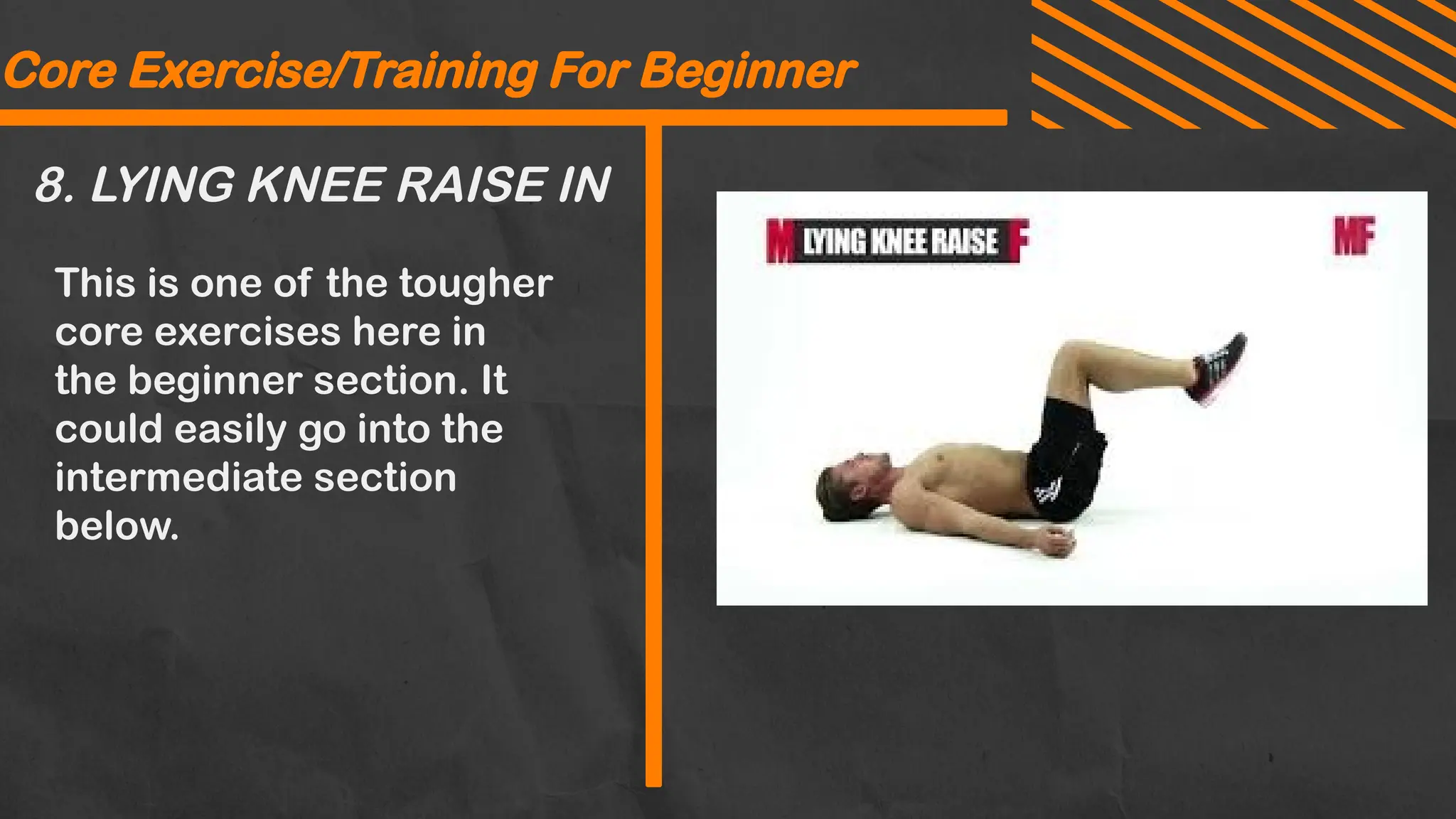
8. LYING KNEERAISE IN
Core Exercise/Training For Beginner
This is one of the tougher
core exercises here in
the beginner section. It
could easily go into the
intermediate section
below.
Core Exercise/Training For Beginner
30.
How To DoLying Knee Raises:
1. Lie down face up with your legs
extended together and your arms at
your side palms down (place your
hands under your butt to make it
easier).
2. Bring your legs in until your knees are
past your belly button (your legs
should be at about 90 degrees), the
slowly bring them back to extended.
Keep your feet together and don’t let
your feet rest on the floor during the
entire set.
3. Repeat for allotted time or reps.
Muscles Worked:
Rectus Abdominis,
Transverse
Abdominis, Hip
Flexors.
31.
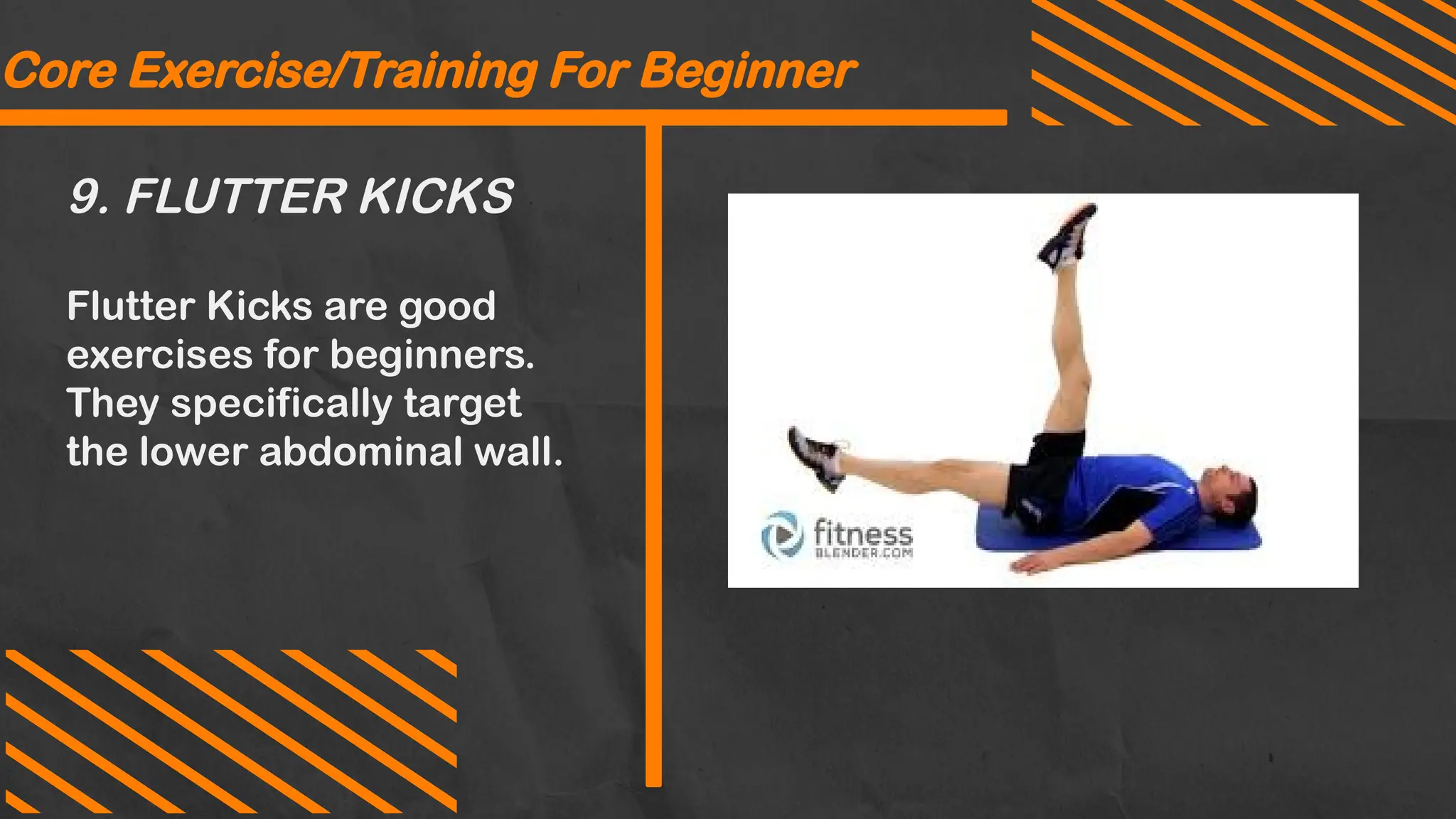
9. FLUTTER KICKS
CoreExercise/Training For Beginner
Flutter Kicks are good
exercises for beginners.
They specifically target
the lower abdominal wall.
32.
How to doFlutter Kicks:
1. Lie down face up with your legs
extended and your arms at your
side palms down (place your hands
under your butt to make it easier).
2. Keeping your legs extended, and a
few inches apart, bring your legs
up and down in an alternating
fashion for an allotted time or
number of reps.
33.
Muscles Worked:
Lower Rectus
Abdominis,
TraverseAbdominis,
Hip Flexors.
3. Try to keep your toes pointing slightly
forward and your leg completely
straight. Don’t let them touch the
ground at any time. Also, only raise
them to a maximum of a foot off the
ground. Around 8-10 inches off the
ground when up is perfect and a
couple inches when down. The
higher you keep your legs, the easier
it will be.
Note: If you bring your shoulder blades
off the ground, you should feel it more in
your hip flexors.