Charlie Hoolihan, CSCS*D, NASM-PES, CES
Personal Training Director, Pelican Athletic Club
Opening thought
 When the human body is concerned, we are dealing
with a system that is so complex with som many
interrelated variables, we can do nothing but be
humble about our beliefs and recommendations.”
 Chris Beardsley – Strength and Conditioning Research
Review
What is the core?
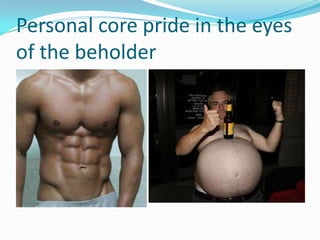
Personal core pride in the eyes
of the beholder
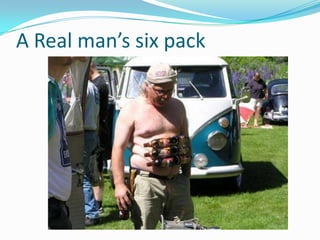
A Real man’s six pack
Definitions of Core muscles
 “The body minus the arms and legs” Wikipedia
 Fig describes the core as all the anatomy between the sternum and the knees with a
focus on the abdominal region, low back, and hips (Schoenfeld and Contreras)
 Tse et al. states that the core musculature includes muscles of the trunk and pelvis
that are responsible for maintaining the stability of the spine and pelvis and are
critical for the transfer of energy from larger torso to smaller extremities during
many sports activities – (Schoenfeld and Contreras)
 “Balanced development of deep and superficial muscles that stabilize, align and
move the trunk of the body, especially the abdominals and muscles of the back.”
Pilates
 “My washboard road to paradise” – Guy in bar with shirt off.
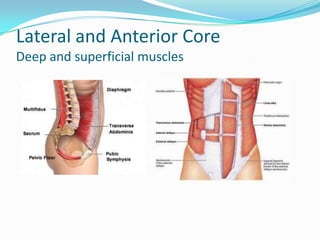
Lateral and Anterior Core
Deep and superficial muscles
Why core training
 To enhance the various force couples that surround the
joints associated with the core.
 To provide training environments that come close to
movement specific ones found in life.
 To help train as many of the muscles as we can within
movement sequences and systems in order to help
provide an efficient conduit between upper and lower
extremities.
 Support
 Movement economy
 Transfer of power
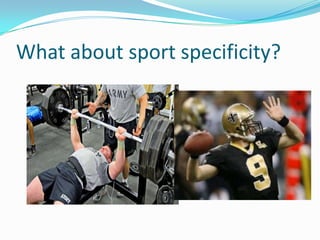
What about sport specificity?
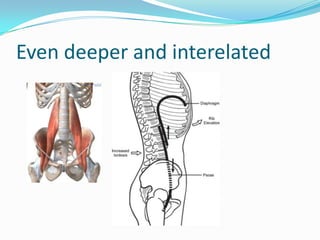
Even deeper and interelated
Sports specificity is the sport
“No exercise in the weight room is sport specific.
Training in the weight room enhances physical
qualities associated with athleticism which is different
from skill. The repetition of the sport’s skill is what
allows the strength aspect to transfer.”
Rob Panariello
“There are reams of research showing improved
performance and transference into sporting actions.”
Bret Contreras
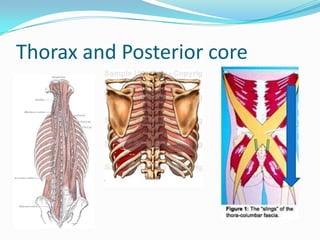
Thorax and Posterior core
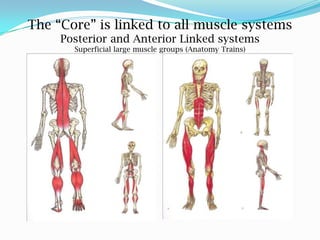
The “Core” is linked to all muscle systems
Posterior and Anterior Linked systems
Superficial large muscle groups (Anatomy Trains)
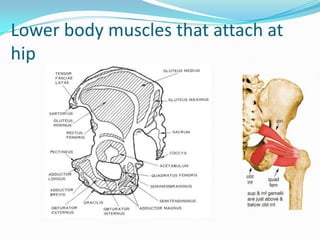
Lower body muscles that attach at
hip
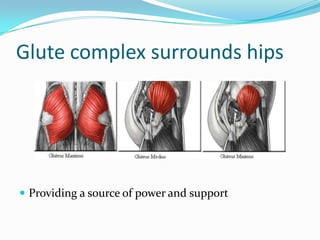
Glute complex surrounds hips
 Providing a source of power and support
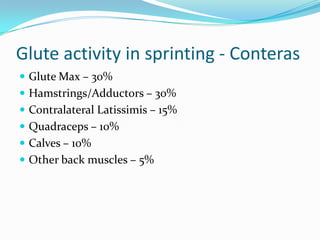
Glute activity in sprinting - Conteras
 Glute Max – 30%
 Hamstrings/Adductors – 30%
 Contralateral Latissimis – 15%
 Quadraceps – 10%
 Calves – 10%
 Other back muscles – 5%
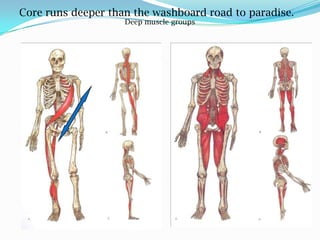
Core runs deeper than the washboard road to paradise.
Deep muscle groups
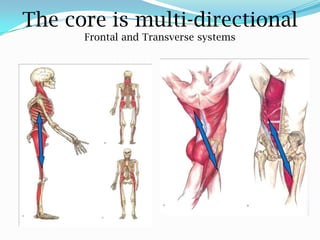
The core is multi-directional
Frontal and Transverse systems
 Color of Text
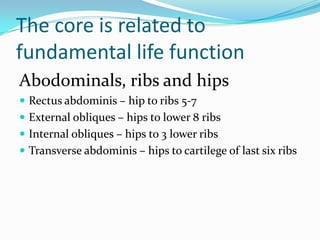
The core is related to
fundamental life function
Abodominals, ribs and hips
 Rectus abdominis – hip to ribs 5-7
 External obliques – hips to lower 8 ribs
 Internal obliques – hips to 3 lower ribs
 Transverse abdominis – hips to cartilege of last six ribs
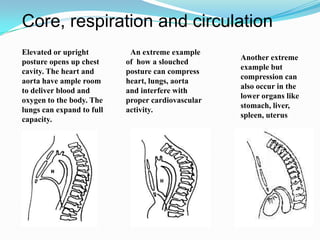
Elevated or upright
posture opens up chest
cavity. The heart and
aorta have ample room
to deliver blood and
oxygen to the body. The
lungs can expand to full
capacity.
An extreme example
of how a slouched
posture can compress
heart, lungs, aorta
and interfere with
proper cardiovascular
activity.
Another extreme
example but
compression can
also occur in the
lower organs like
stomach, liver,
spleen, uterus
Core, respiration and circulation
Lymphatic system and hip
flexors
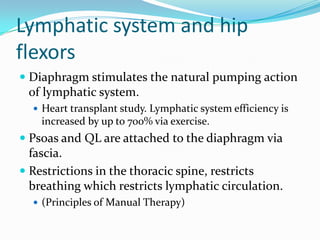
 Diaphragm stimulates the natural pumping action
of lymphatic system.
 Heart transplant study. Lymphatic system efficiency is
increased by up to 700% via exercise.
 Psoas and QL are attached to the diaphragm via
fascia.
 Restrictions in the thoracic spine, restricts
breathing which restricts lymphatic circulation.
 (Principles of Manual Therapy)
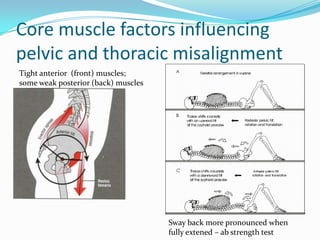
Core muscle factors influencing
pelvic and thoracic misalignment
Tight anterior (front) muscles;
some weak posterior (back) muscles
Sway back more pronounced when
fully extened – ab strength test
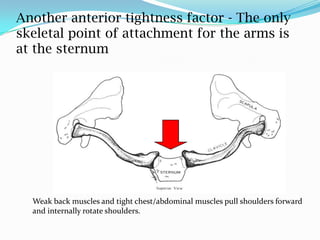
Another anterior tightness factor - The only
skeletal point of attachment for the arms is
at the sternum
Weak back muscles and tight chest/abdominal muscles pull shoulders forward
and internally rotate shoulders.
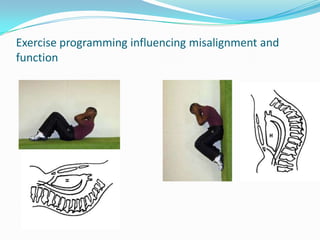
Exercise programming influencing misalignment and
function
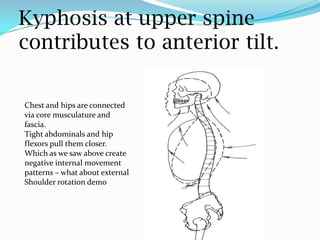
Kyphosis at upper spine
contributes to anterior tilt.
Chest and hips are connected
via core musculature and
fascia.
Tight abdominals and hip
flexors pull them closer.
Which as we saw above create
negative internal movement
patterns – what about external
Shoulder rotation demo
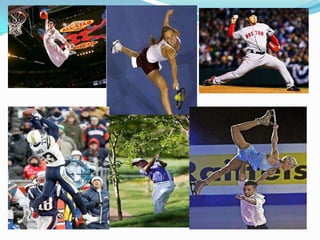
We live in a movement rich
enviornment
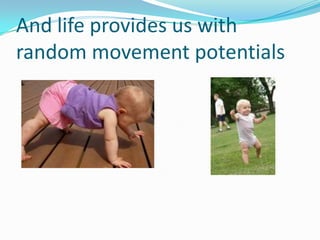
And life provides us with
random movement potentials
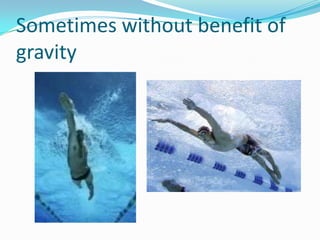
Sometimes without benefit of
gravity
So core training must be
movement rich and random
 We have to contend with providing support against a
wide variety of influences, movement vectors and
environment.
 We have to create central stability that is fluid.
 Our training needs to be proprioceptively stimulating
to account for the variety we face.
 Our instruction needs to emphasize core technique
without creating rigid reactions. Pre-tension before
movement isn’t natural
 Bracing demo
What are our primary
considerations
 Establishing three dimensional movement patterns
that are easy to reinforce through repetition without
invasive instruction.
 Establishing symmetrical lateral strength and support.
 Establishing symmetrical rotation strength and
support.
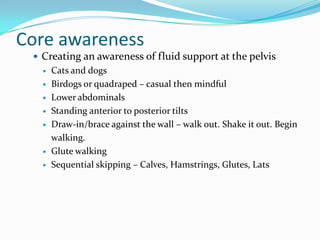
Core awareness
 Creating an awareness of fluid support at the pelvis
 Cats and dogs
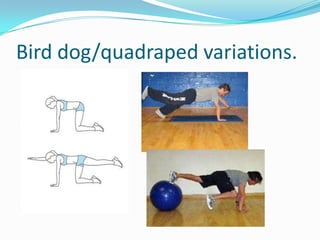
 Birdogs or quadraped – casual then mindful
 Lower abdominals
 Standing anterior to posterior tilts
 Draw-in/brace against the wall – walk out. Shake it out. Begin
walking.
 Glute walking
 Sequential skipping – Calves, Hamstrings, Glutes, Lats
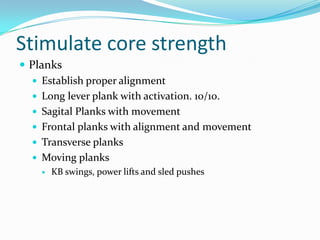
Stimulate core strength
 Planks
 Establish proper alignment
 Long lever plank with activation. 10/10.
 Sagital Planks with movement
 Frontal planks with alignment and movement
 Transverse planks
 Moving planks
 KB swings, power lifts and sled pushes
Precursor movements
 Glutes – activation cues till it because natural
 Hamstring and back extensor dominance.
 Hip bridge from floor/single hip bridge on floor
 Hip thrust – shoulders on hair, feet on chair
 Lateral and Diagonal band sequence
 Primary exercises w bands
 Squats, Deadlifts, Jumps, Hip Thrusts
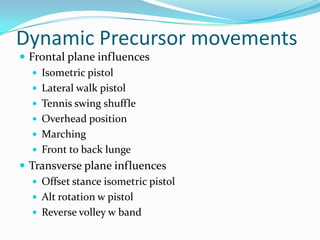
Dynamic Precursor movements
 Frontal plane influences
 Isometric pistol
 Lateral walk pistol
 Tennis swing shuffle
 Overhead position
 Marching
 Front to back lunge
 Transverse plane influences
 Offset stance isometric pistol
 Alt rotation w pistol
 Reverse volley w band
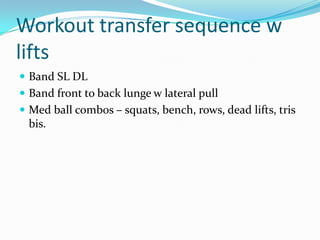
Workout transfer sequence w
lifts
 Band SL DL
 Band front to back lunge w lateral pull
 Med ball combos – squats, bench, rows, dead lifts, tris
bis.
Workout transfer sequence
 Frontal plane (Lateral)workout
 Side hops
 Vipr lateral lunges with reach
 Kettlebell lateral skips
 MB overhead reach to wall
 Side planks
 Transverse plane (rotary workout)
 Rotation hops
 Vipr rotation lunge
 KB rotation skips
 Rotation planks
 MB rotation throws
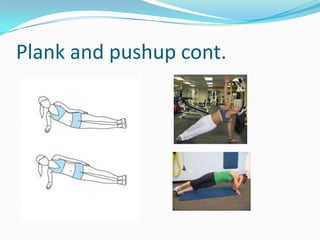
Plank and push-up position
exercises – stability first
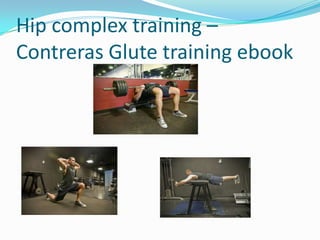
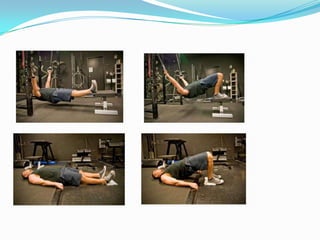
Hip complex training –
Contreras Glute training ebook
Plank and pushup cont.
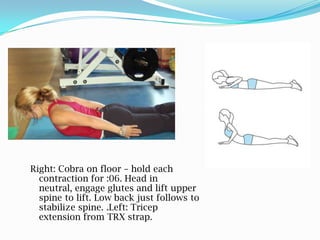
Right: Cobra on floor – hold each
contraction for :06. Head in
neutral, engage glutes and lift upper
spine to lift. Low back just follows to
stabilize spine. .Left: Tricep
extension from TRX strap.
Bird dog/quadraped variations.
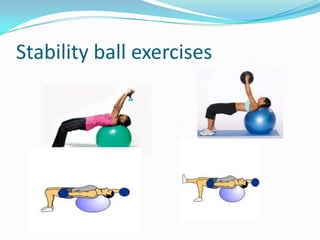
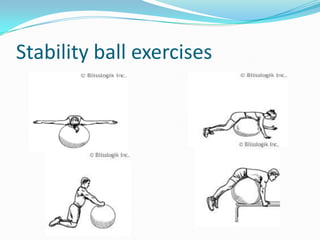
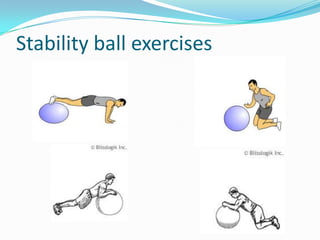
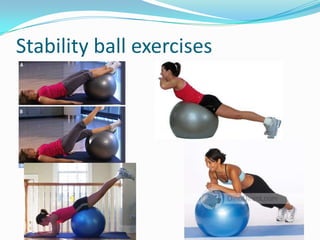
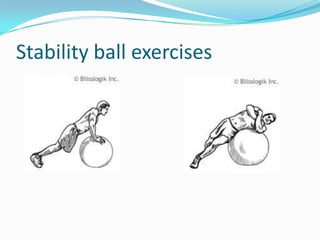
Stability ball exercises
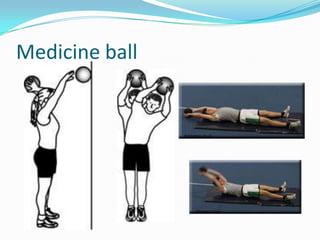
Medicine ball
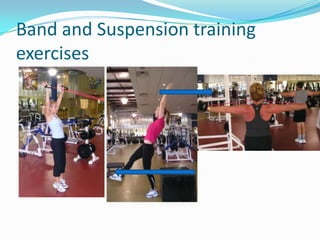
Band and Suspension training
exercises
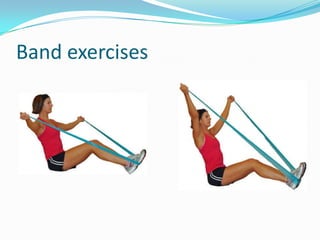
Band exercises
Stability ball exercises
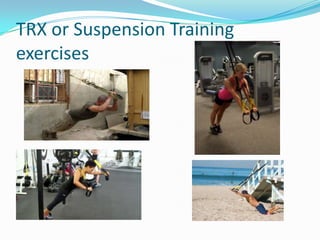
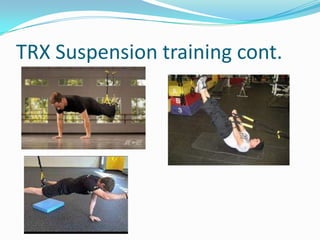
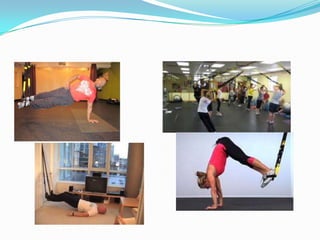
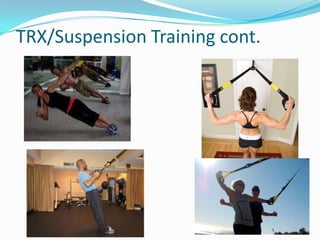
TRX or Suspension Training
exercises
TRX Suspension training cont.
TRX/Suspension Training cont.
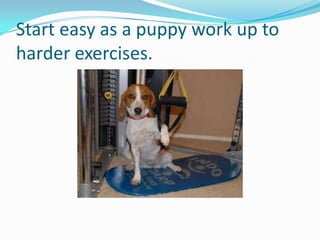
Start easy as a puppy work up to
harder exercises.
Resources and references
 Brett Contreras – FB and website
 Advanced techniques in glutei maximi strengthening ebook
 Strength and Conditioning Reviews – with Chris Beardsley
 Eric Cressey, CSCS – FB and website
 Mike Reinold, DPT – FB and website
 Michol Dalcort – Vipr/IOS training
 Chris Severs – band training – anchor point training
 Carlos Santana – band training – books/videos
 Fitness Anywhere/TRX and Rip Training
 The value of blowing up a balloon – Kyndall Boyle DPT
 The Myth of Core Stability – Eyal Lederman
 Strategies for optimal core training program design – Schoenfeld and
Contreras – NSCA’s Performance Training Journal vol 10 issue 5
My email
 Charlie@thepac.com
 Slideshare.net
 Search Charlie Hoolihan

Nsca core and hip activation

  • 1.
    Charlie Hoolihan, CSCS*D,NASM-PES, CES Personal Training Director, Pelican Athletic Club
  • 2.
    Opening thought  Whenthe human body is concerned, we are dealing with a system that is so complex with som many interrelated variables, we can do nothing but be humble about our beliefs and recommendations.”  Chris Beardsley – Strength and Conditioning Research Review
  • 3.
  • 4.
    Personal core pridein the eyes of the beholder
  • 5.
  • 6.
    Definitions of Coremuscles  “The body minus the arms and legs” Wikipedia  Fig describes the core as all the anatomy between the sternum and the knees with a focus on the abdominal region, low back, and hips (Schoenfeld and Contreras)  Tse et al. states that the core musculature includes muscles of the trunk and pelvis that are responsible for maintaining the stability of the spine and pelvis and are critical for the transfer of energy from larger torso to smaller extremities during many sports activities – (Schoenfeld and Contreras)  “Balanced development of deep and superficial muscles that stabilize, align and move the trunk of the body, especially the abdominals and muscles of the back.” Pilates  “My washboard road to paradise” – Guy in bar with shirt off.
  • 7.
    Lateral and AnteriorCore Deep and superficial muscles
  • 8.
    Why core training To enhance the various force couples that surround the joints associated with the core.  To provide training environments that come close to movement specific ones found in life.  To help train as many of the muscles as we can within movement sequences and systems in order to help provide an efficient conduit between upper and lower extremities.  Support  Movement economy  Transfer of power
  • 9.
    What about sportspecificity?
  • 10.
    Even deeper andinterelated
  • 11.
    Sports specificity isthe sport “No exercise in the weight room is sport specific. Training in the weight room enhances physical qualities associated with athleticism which is different from skill. The repetition of the sport’s skill is what allows the strength aspect to transfer.” Rob Panariello “There are reams of research showing improved performance and transference into sporting actions.” Bret Contreras
  • 12.
  • 13.
    The “Core” islinked to all muscle systems Posterior and Anterior Linked systems Superficial large muscle groups (Anatomy Trains)
  • 14.
    Lower body musclesthat attach at hip
  • 15.
    Glute complex surroundships  Providing a source of power and support
  • 16.
    Glute activity insprinting - Conteras  Glute Max – 30%  Hamstrings/Adductors – 30%  Contralateral Latissimis – 15%  Quadraceps – 10%  Calves – 10%  Other back muscles – 5%
  • 17.
    Core runs deeperthan the washboard road to paradise. Deep muscle groups
  • 18.
    The core ismulti-directional Frontal and Transverse systems  Color of Text
  • 19.
    The core isrelated to fundamental life function Abodominals, ribs and hips  Rectus abdominis – hip to ribs 5-7  External obliques – hips to lower 8 ribs  Internal obliques – hips to 3 lower ribs  Transverse abdominis – hips to cartilege of last six ribs
  • 20.
    Elevated or upright postureopens up chest cavity. The heart and aorta have ample room to deliver blood and oxygen to the body. The lungs can expand to full capacity. An extreme example of how a slouched posture can compress heart, lungs, aorta and interfere with proper cardiovascular activity. Another extreme example but compression can also occur in the lower organs like stomach, liver, spleen, uterus Core, respiration and circulation
  • 21.
    Lymphatic system andhip flexors  Diaphragm stimulates the natural pumping action of lymphatic system.  Heart transplant study. Lymphatic system efficiency is increased by up to 700% via exercise.  Psoas and QL are attached to the diaphragm via fascia.  Restrictions in the thoracic spine, restricts breathing which restricts lymphatic circulation.  (Principles of Manual Therapy)
  • 22.
    Core muscle factorsinfluencing pelvic and thoracic misalignment Tight anterior (front) muscles; some weak posterior (back) muscles Sway back more pronounced when fully extened – ab strength test
  • 23.
    Another anterior tightnessfactor - The only skeletal point of attachment for the arms is at the sternum Weak back muscles and tight chest/abdominal muscles pull shoulders forward and internally rotate shoulders.
  • 24.
    Exercise programming influencingmisalignment and function
  • 25.
    Kyphosis at upperspine contributes to anterior tilt. Chest and hips are connected via core musculature and fascia. Tight abdominals and hip flexors pull them closer. Which as we saw above create negative internal movement patterns – what about external Shoulder rotation demo
  • 26.
    We live ina movement rich enviornment
  • 27.
    And life providesus with random movement potentials
  • 29.
  • 30.
    So core trainingmust be movement rich and random  We have to contend with providing support against a wide variety of influences, movement vectors and environment.  We have to create central stability that is fluid.  Our training needs to be proprioceptively stimulating to account for the variety we face.  Our instruction needs to emphasize core technique without creating rigid reactions. Pre-tension before movement isn’t natural  Bracing demo
  • 31.
    What are ourprimary considerations  Establishing three dimensional movement patterns that are easy to reinforce through repetition without invasive instruction.  Establishing symmetrical lateral strength and support.  Establishing symmetrical rotation strength and support.
  • 32.
    Core awareness  Creatingan awareness of fluid support at the pelvis  Cats and dogs  Birdogs or quadraped – casual then mindful  Lower abdominals  Standing anterior to posterior tilts  Draw-in/brace against the wall – walk out. Shake it out. Begin walking.  Glute walking  Sequential skipping – Calves, Hamstrings, Glutes, Lats
  • 33.
    Stimulate core strength Planks  Establish proper alignment  Long lever plank with activation. 10/10.  Sagital Planks with movement  Frontal planks with alignment and movement  Transverse planks  Moving planks  KB swings, power lifts and sled pushes
  • 34.
    Precursor movements  Glutes– activation cues till it because natural  Hamstring and back extensor dominance.  Hip bridge from floor/single hip bridge on floor  Hip thrust – shoulders on hair, feet on chair  Lateral and Diagonal band sequence  Primary exercises w bands  Squats, Deadlifts, Jumps, Hip Thrusts
  • 35.
    Dynamic Precursor movements Frontal plane influences  Isometric pistol  Lateral walk pistol  Tennis swing shuffle  Overhead position  Marching  Front to back lunge  Transverse plane influences  Offset stance isometric pistol  Alt rotation w pistol  Reverse volley w band
  • 36.
    Workout transfer sequencew lifts  Band SL DL  Band front to back lunge w lateral pull  Med ball combos – squats, bench, rows, dead lifts, tris bis.
  • 37.
    Workout transfer sequence Frontal plane (Lateral)workout  Side hops  Vipr lateral lunges with reach  Kettlebell lateral skips  MB overhead reach to wall  Side planks  Transverse plane (rotary workout)  Rotation hops  Vipr rotation lunge  KB rotation skips  Rotation planks  MB rotation throws
  • 38.
    Plank and push-upposition exercises – stability first
  • 39.
    Hip complex training– Contreras Glute training ebook
  • 43.
  • 44.
    Right: Cobra onfloor – hold each contraction for :06. Head in neutral, engage glutes and lift upper spine to lift. Low back just follows to stabilize spine. .Left: Tricep extension from TRX strap.
  • 45.
  • 46.
  • 47.
  • 48.
    Band and Suspensiontraining exercises
  • 49.
  • 50.
  • 51.
  • 52.
  • 53.
  • 54.
    TRX or SuspensionTraining exercises
  • 55.
  • 57.
  • 58.
    Start easy asa puppy work up to harder exercises.
  • 59.
    Resources and references Brett Contreras – FB and website  Advanced techniques in glutei maximi strengthening ebook  Strength and Conditioning Reviews – with Chris Beardsley  Eric Cressey, CSCS – FB and website  Mike Reinold, DPT – FB and website  Michol Dalcort – Vipr/IOS training  Chris Severs – band training – anchor point training  Carlos Santana – band training – books/videos  Fitness Anywhere/TRX and Rip Training  The value of blowing up a balloon – Kyndall Boyle DPT  The Myth of Core Stability – Eyal Lederman  Strategies for optimal core training program design – Schoenfeld and Contreras – NSCA’s Performance Training Journal vol 10 issue 5
  • 60.
    My email  Charlie@thepac.com Slideshare.net  Search Charlie Hoolihan