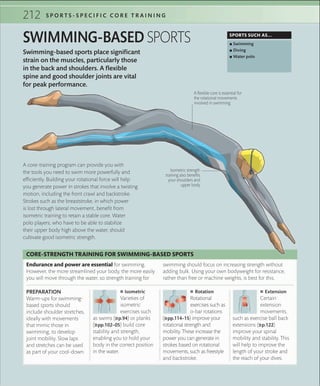
The complete Step-by-step Guide to a Stronger
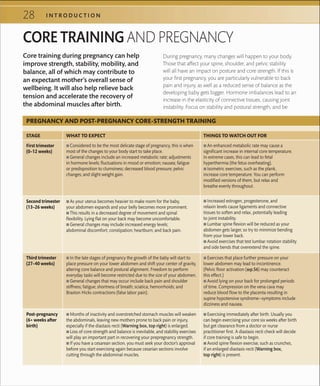
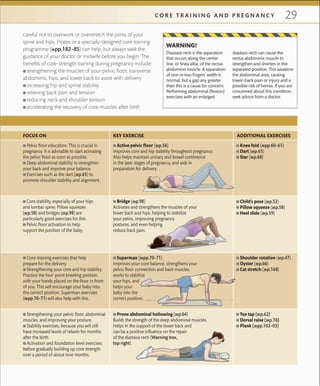
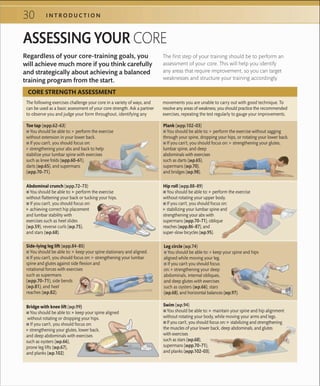
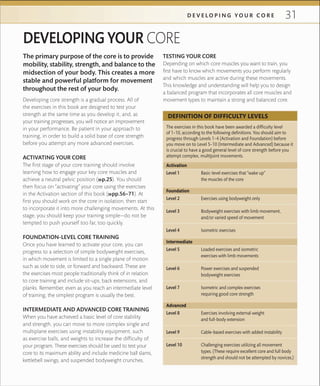
Body and Better Posture for men and women
training
STRENGTH
CORE
MORE THAN
150BODY-SCULPTING
EXERCISES
The Complete Step-by-Step Guide
to a stronger body and better posture for
men and women
LONDON, NEW YORK, MUNICH,
MELBOURNE, DELHI
First American Edition, 2013
Published in the United States by
DK Publishing
375 Hudson Street
New York, New York 10014
13 14 15 16 17 10 9 8 7 6 5 4 3 2 1
001–187948–Jan/2013
Copyright © 2013 Dorling Kindersley Limited
All rights reserved.
Without limiting the rights under copyright
reserved above, no part of this publication may be
reproduced, stored in or introduced into a retrieval
system, or transmitted, in any form, or by any
means (electronic, mechanical, photocopying,
recording, or otherwise), without the prior written
permission of both the copyright owner and
the above publisher of this book.
Published in Great Britain by
Dorling Kindersley Limited
A catalog record for this book is available from the
Library of Congress
ISBN 978-1-4654-0220-2
Printed and bound in China by South China
Printing Company
Discover more at
www.dk.com
DK US
Senior Editor
Editor
Shannon Beatty
Jill Hamilton
Senior Editor
Editorial team
Project Art Editor
Design team
Illustrators
Production Editor
Production Controller
Cover Designer
Managing Editor
Managing Art Editor
Gareth Jones
Andy Szudek, Hugo Wilkinson,
Kajal Mistry, Peter Preston,
Chris Stone, Satu Fox
Katie Cavanagh
Keith Davis, Sharon Spencer,
Phil Gamble, Michael Duffy,
Joanne Clark
Mike Garland, Mark Walker,
Darren R. Awuah, Debajyoti
Dutta, Richard Tibbits,
Phil Gamble, Peter Bull,
Phil Wilson, Debbie Maizels
Nikoleta Parasaki
Mandy Inness
Mark Cavanagh
Stephanie Farrow
Lee Griffiths
DK INDIA
Managing Editor
Editorial Team
Managing Art Editor
Design Team
Pakshalika Jayaprakash
Neha Gupta, Antara Moitra
Arunesh Talapatra
Anis Sayyed, Pooja Pipil,
Supriya Mahajan, Swati
Katyal, Aanchal Singal, Astha
Singh, Namita, Niyati Gosain,
Payal Rosalind Malik
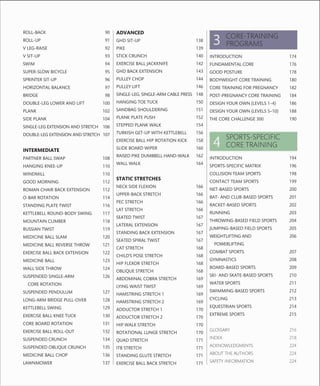
HOW TO USE THIS BOOK 6
INTRODUCTION
WHAT IS THE CORE? 10
THE SPINE 12
THE ANTERIOR CORE MUSCLES 14
THE POSTERIOR CORE MUSCLES 16
WHAT IS CORE TRAINING? 18
CORE TRAINING AND 20
EVERYDAY ACTIVITIES
CORE TRAINING AND POSTURE 22
CORE TRAINING AND SPORT 26
CORE TRAINING AND PREGNANCY 28
ASSESSING YOUR CORE 30
DEVELOPING YOUR CORE 31
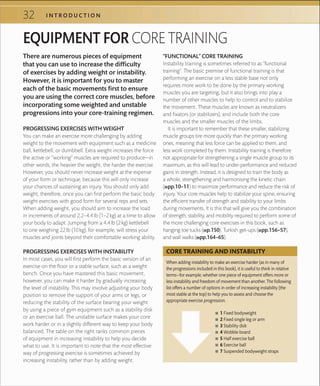
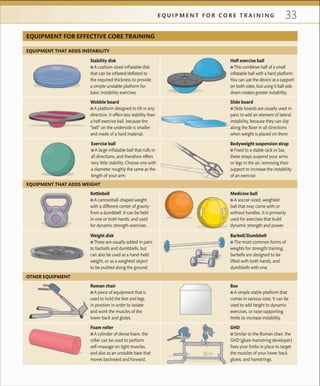
EQUIPMENT FOR CORE TRAINING 32
CORE-TRAINING
EXERCISES
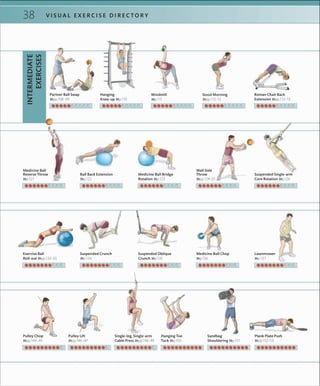
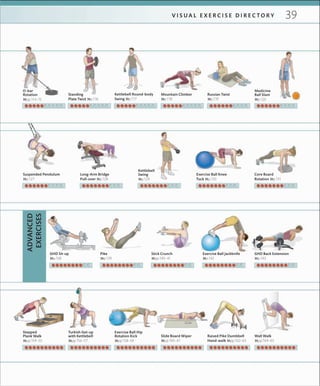
VISUAL EXERCISE DIRECTORY 36
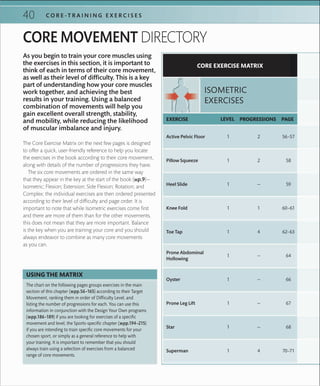
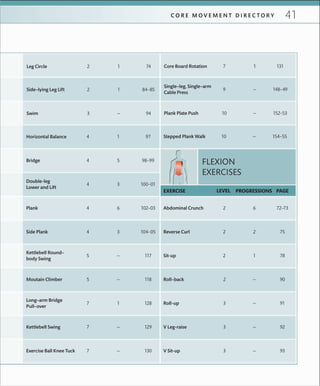
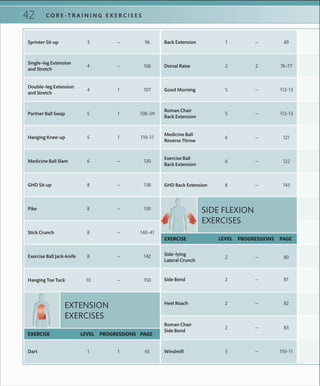
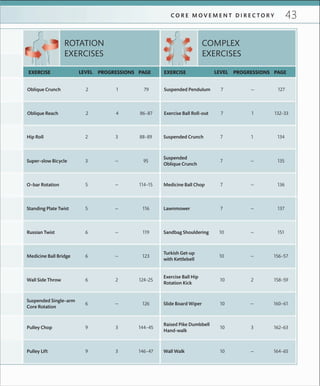
CORE MOVEMENT DIRECTORY 40
MOBILIZATION
THORACIC ROLLER 44
LAT ROLLER 44
GLUTE/PIRIFORMIS ROLLER 44
LUMBAR ROLLER 45
TFL/ITB ROLLER 45
NECK ROTATION 46
NECK EXTENSION AND FLEXION 46
NECK SIDE FLEXION 47
SHOULDER ROTATION 47
TORSO ROTATION 48
TORSO SIDE FLEXION 48
LYING TRUNK ROTATION 49
LYING WAIST TWIST 50
CAT AND CAMEL 50
THREADING THE NEEDLE 51
HIP FLEXOR STRETCH 51
HIP CIRCLE 52
CHILD’S POSE 52
COBRA EXTENSION 53
SCORPION STRETCH 53
BACK ROLL 54
SKIER 54
STANDING ROLL-DOWN 55
ACTIVATION
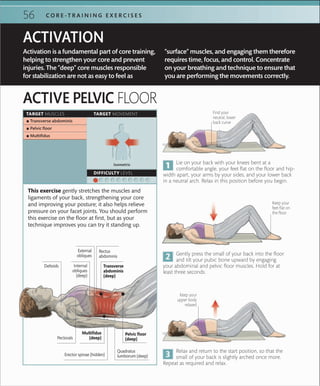
ACTIVE PELVIC FLOOR 56
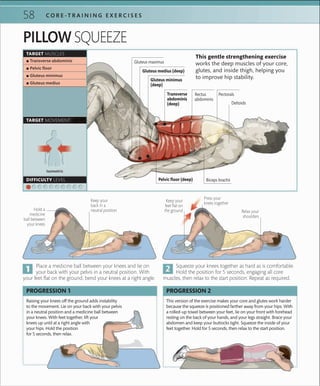
PILLOW SQUEEZE 58
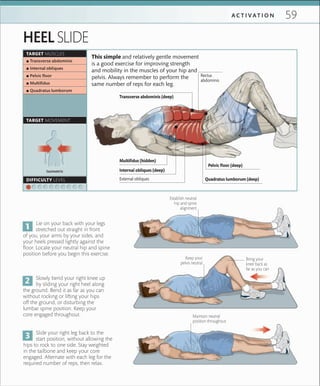
HEEL SLIDE 59
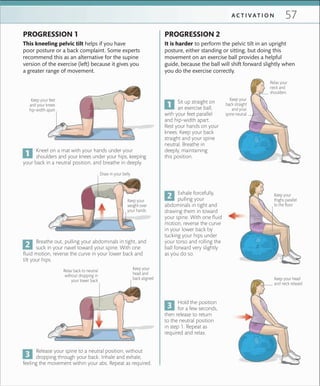
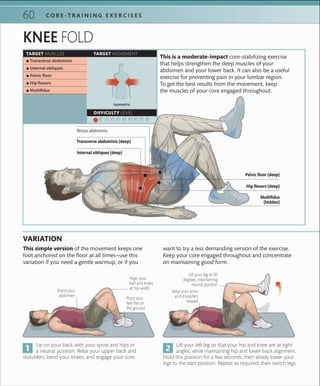
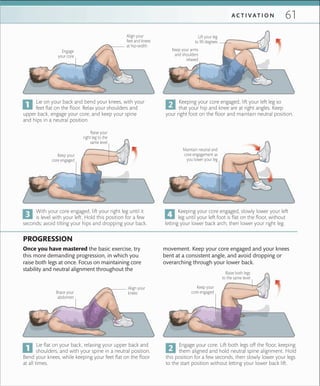
KNEE FOLD 60
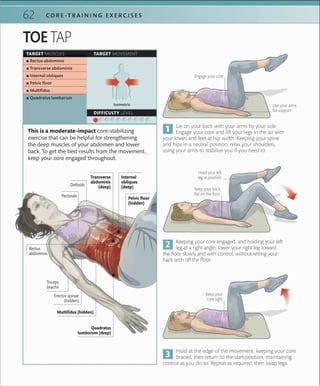
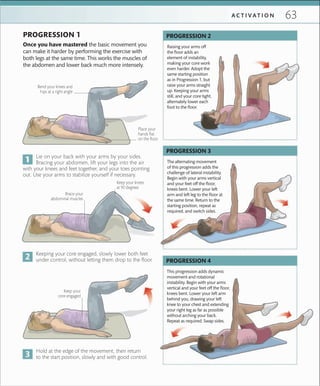
TOE TAP 62
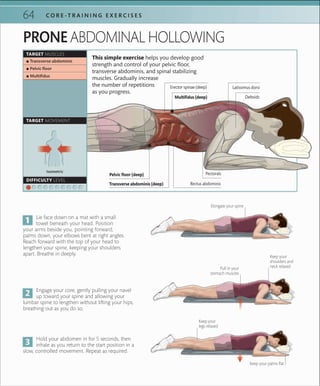
PRONE ABDOMINAL HOLLOWING 64
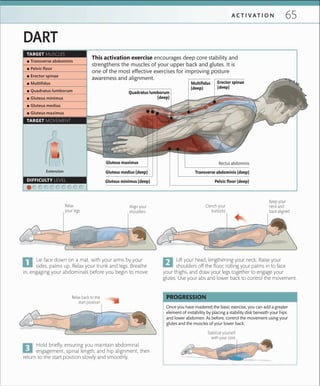
DART 65
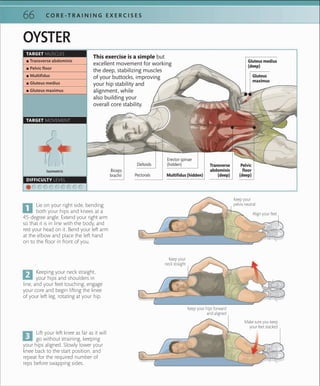
OYSTER 66
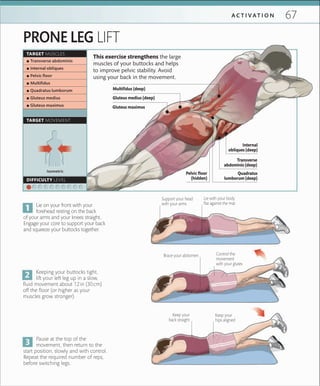
PRONE LEG LIFT 67
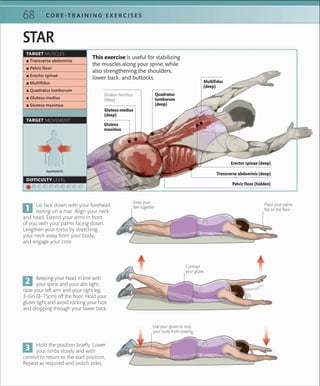
STAR 68
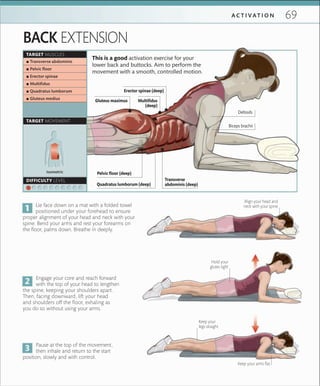
BACK EXTENSION 69
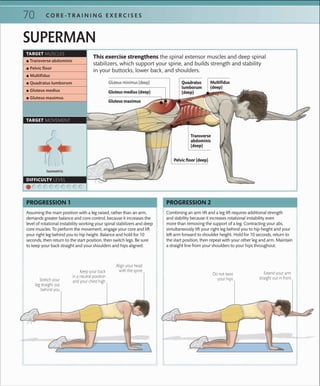
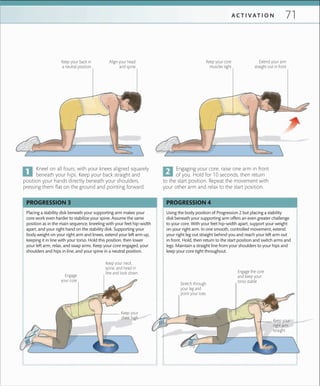
SUPERMAN 70
FOUNDATION
ABDOMINAL CRUNCH 72
LEG CIRCLE 74
REVERSE CURL 75
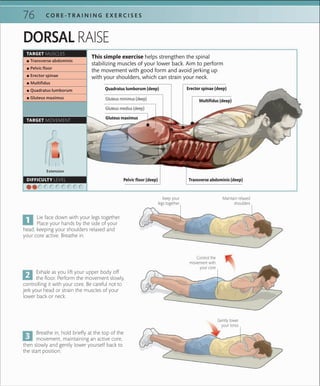
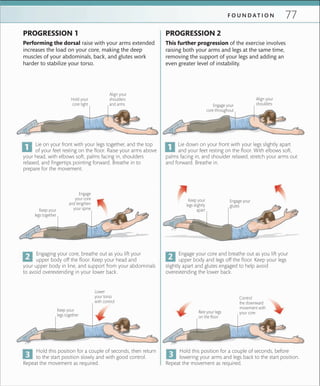
DORSAL RAISE 76
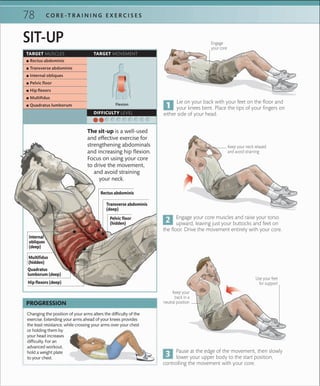
SIT-UP 78
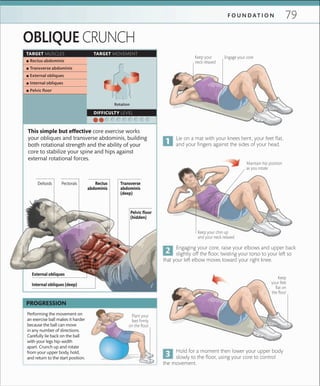
OBLIQUE CRUNCH 79
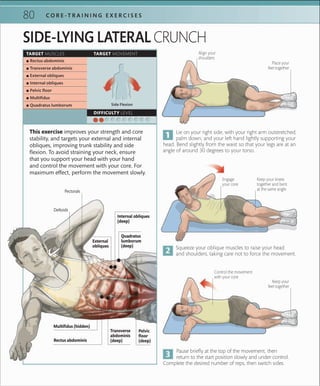
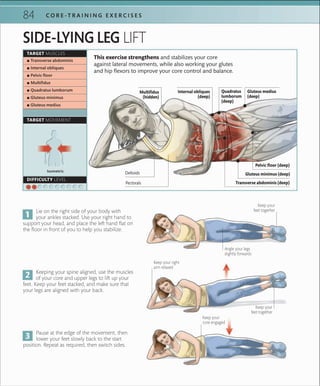
SIDE-LYING LATERAL CRUNCH 80
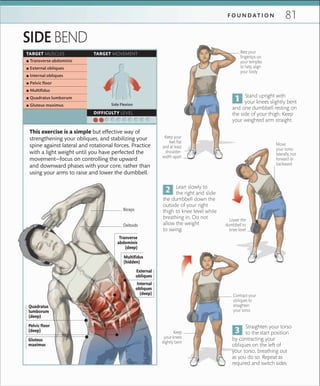
SIDE BEND 81
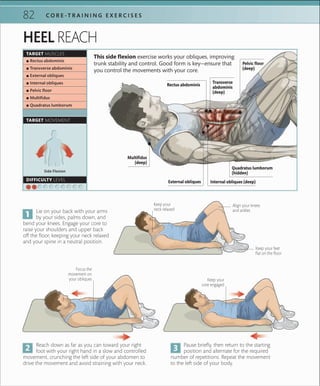
HEEL REACH 82
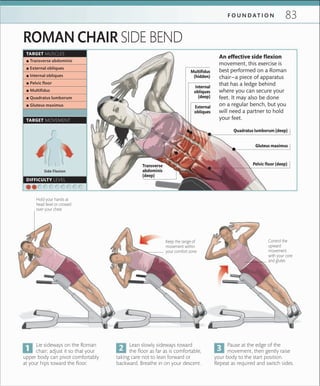
ROMAN CHAIR SIDE-BEND 83
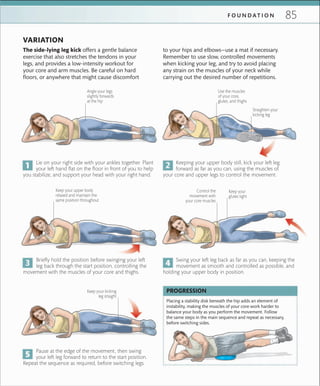
SIDE-LYING LEG-LIFT 84
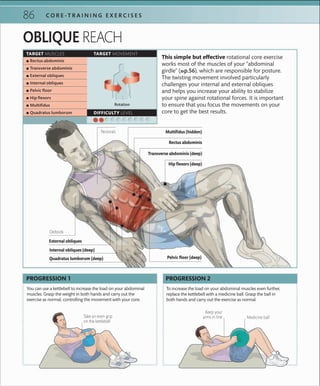
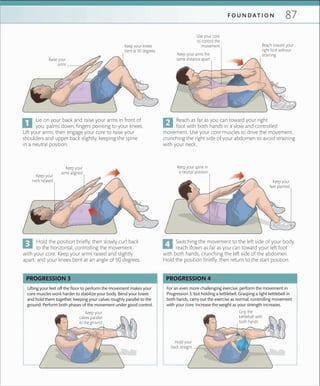
OBLIQUE REACH 86
HIP ROLL 88
CONTENTS
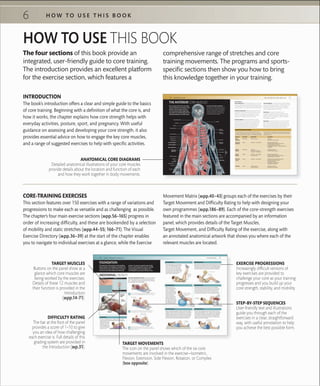
ROLL-BACK 90
ROLL-UP 91
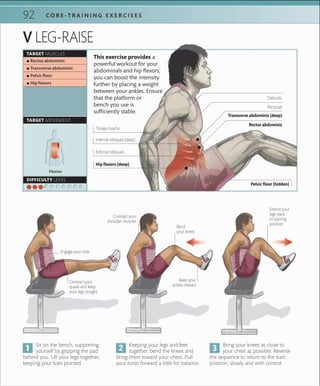
V LEG-RAISE 92
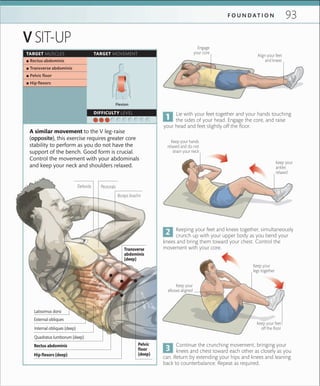
V SIT-UP 93
SWIM 94
SUPER-SLOW BICYCLE 95
SPRINTER SIT-UP 96
HORIZONTAL BALANCE 97
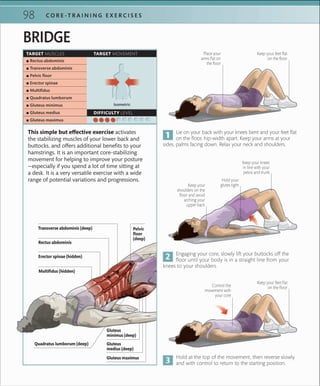
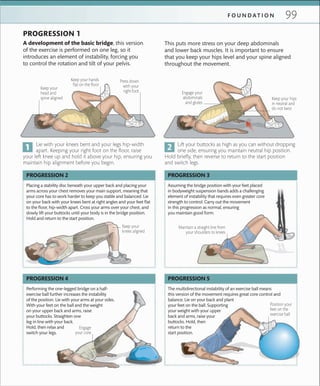
BRIDGE 98
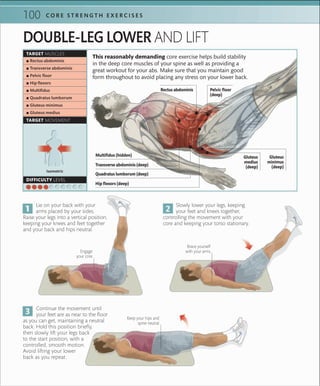
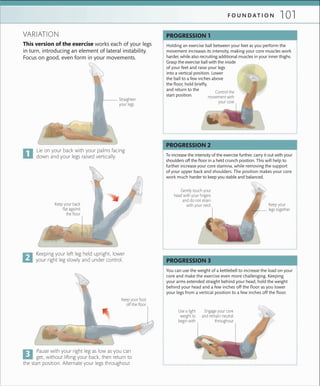
DOUBLE-LEG LOWER AND LIFT 100
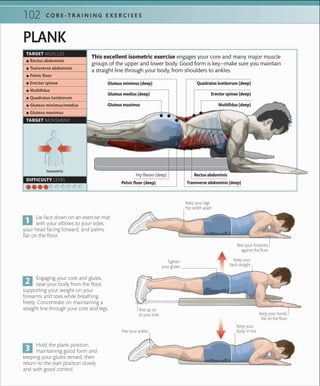
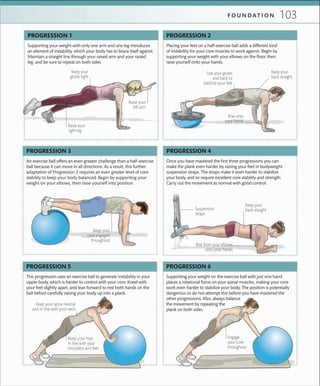
PLANK 102
SIDE PLANK 104
SINGLE-LEG EXTENSION AND STRETCH 106
DOUBLE-LEG EXTENSION AND STRETCH 107
INTERMEDIATE
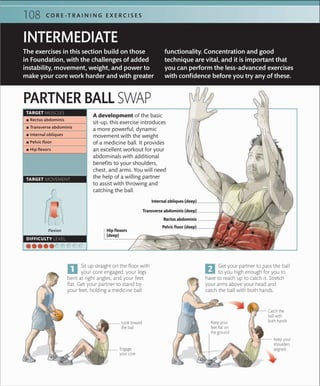
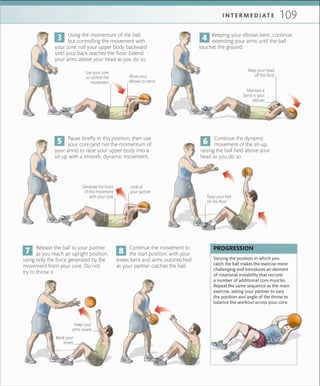
PARTNER BALL SWAP 108
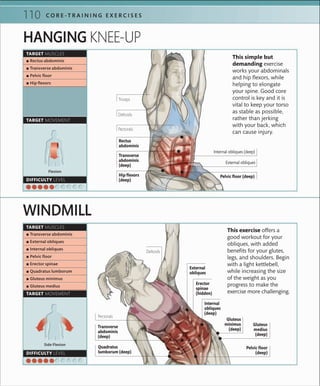
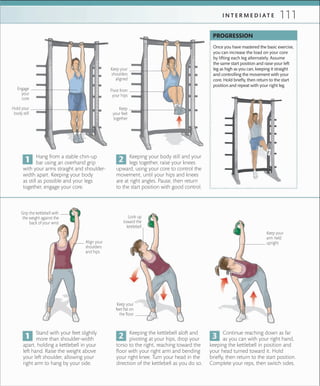
HANGING KNEE-UP 110
WINDMILL 110
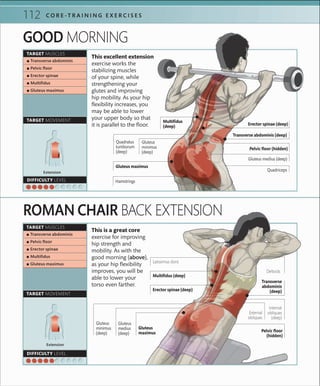
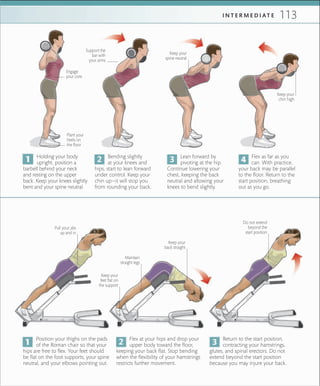
GOOD MORNING 112
ROMAN CHAIR BACK EXTENSION 112
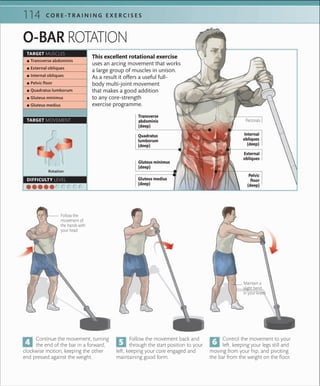
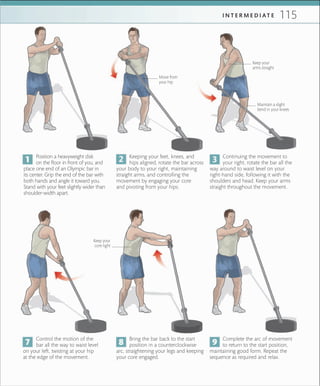
O-BAR ROTATION 114
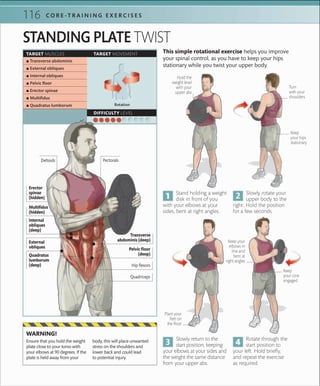
STANDING PLATE TWIST 116
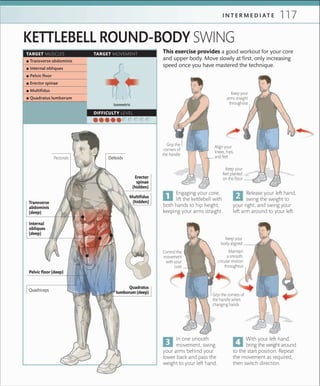
KETTLEBELL ROUND-BODY SWING 117
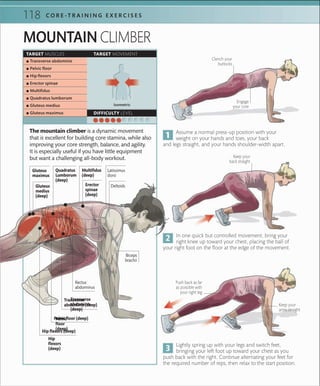
MOUNTAIN CLIMBER 118
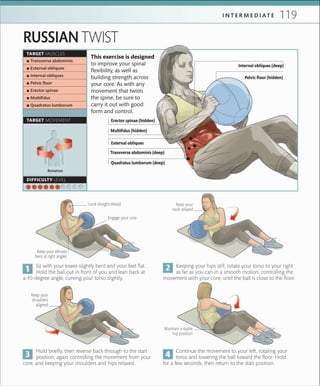
RUSSIAN TWIST 119
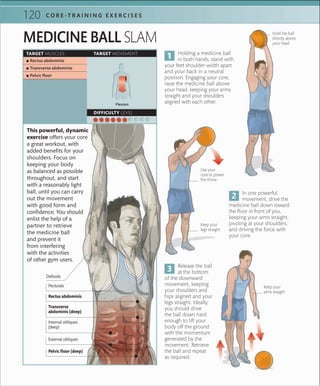
MEDICINE BALL SLAM 120
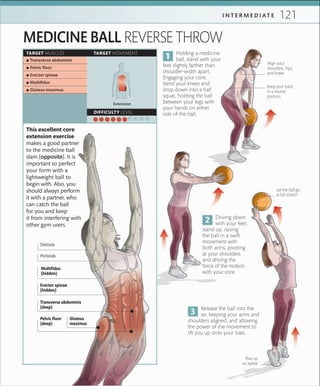
MEDICINE BALL REVERSE THROW 121
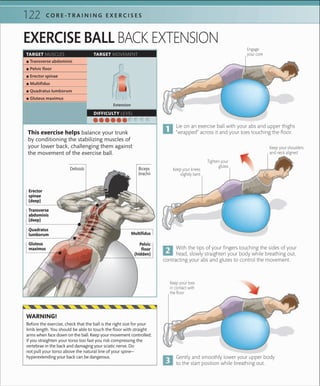
EXERCISE BALL BACK EXTENSION 122
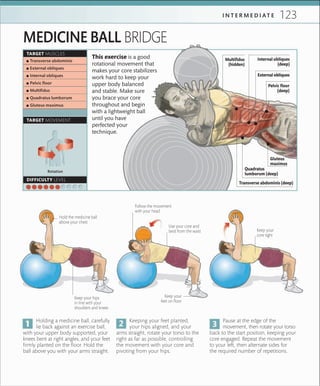
MEDICINE BALL 123
WALL SIDE THROW 124
SUSPENDED SINGLE-ARM 126
CORE ROTATION
SUSPENDED PENDULUM 127
LONG-ARM BRIDGE PULL-OVER 128
KETTLEBELL SWING 129
EXERCISE BALL KNEE TUCK 130
CORE BOARD ROTATION 131
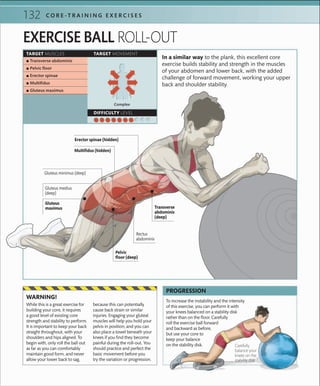
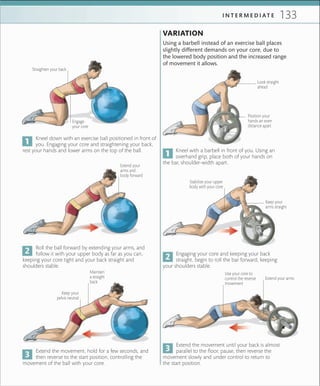
EXERCISE BALL ROLL-OUT 132
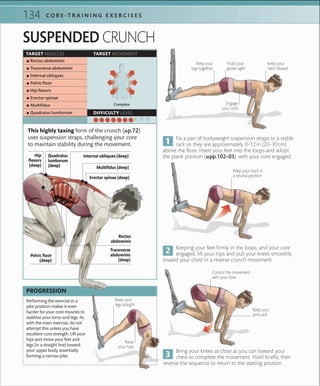
SUSPENDED CRUNCH 134
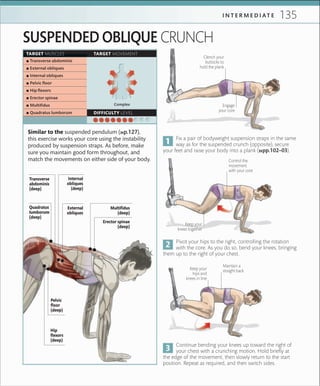
SUSPENDED OBLIQUE CRUNCH 135
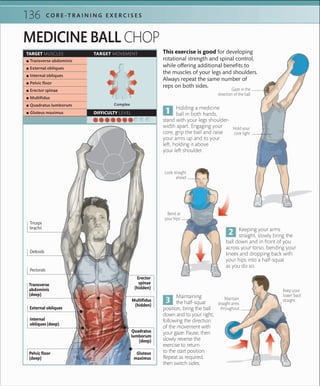
MEDICINE BALL CHOP 136
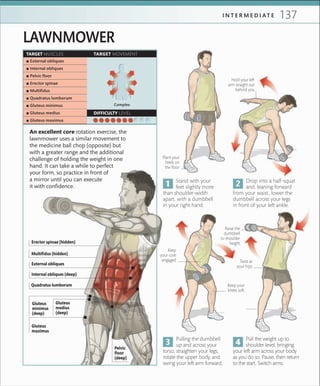
LAWNMOWER 137
ADVANCED
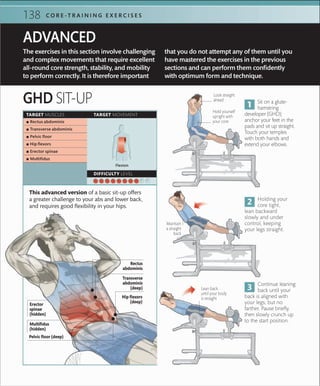
GHD SIT-UP 138
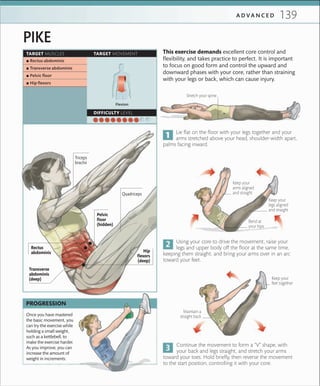
PIKE 139
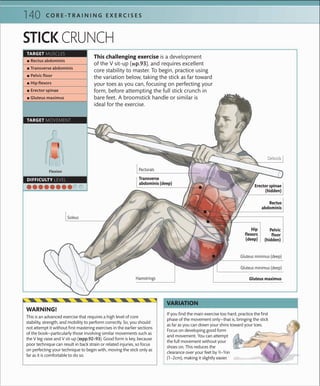
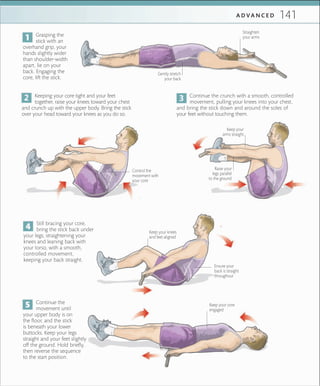
STICK CRUNCH 140
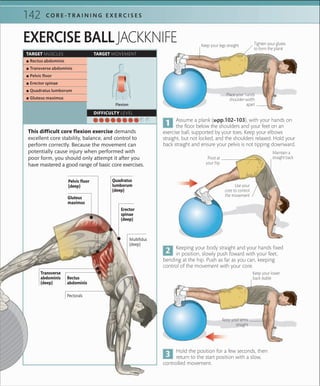
EXERCISE BALL JACKKNIFE 142
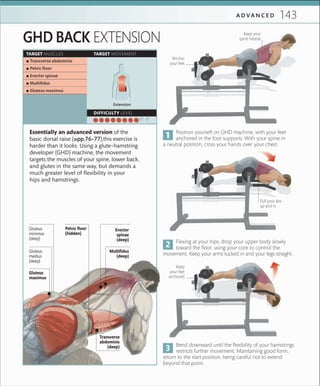
GHD BACK EXTENSION 143
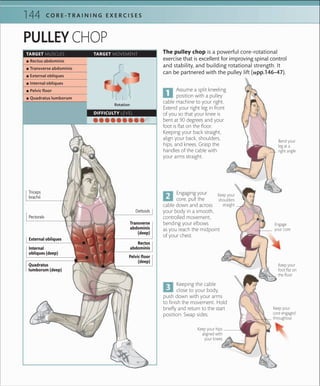
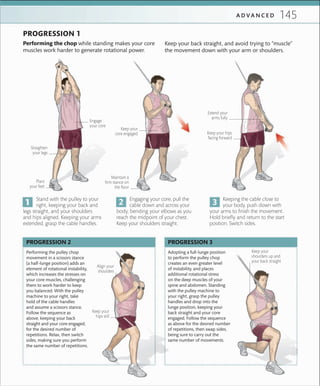
PULLEY CHOP 144
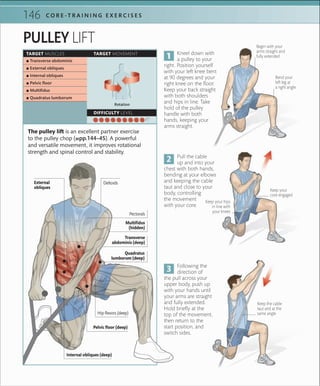
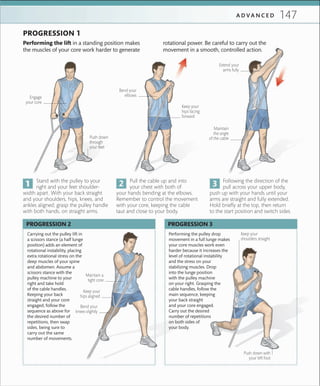
PULLEY LIFT 146
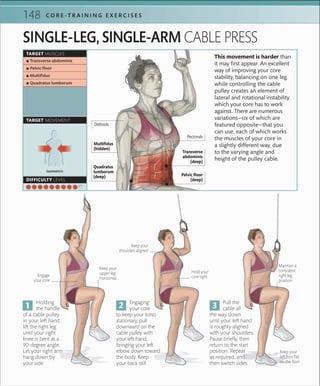
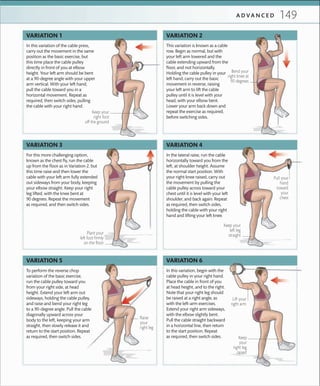
SINGLE-LEG, SINGLE-ARM CABLE PRESS 148
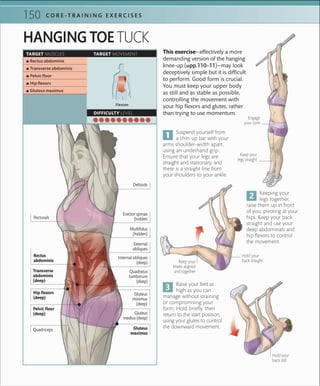
HANGING TOE TUCK 150
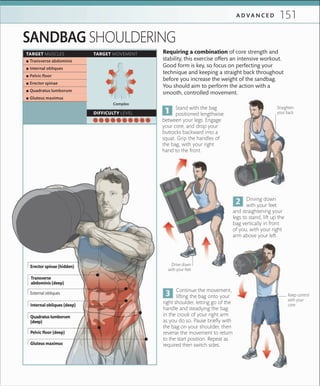
SANDBAG SHOULDERING 151
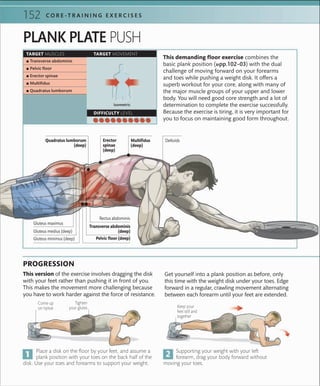
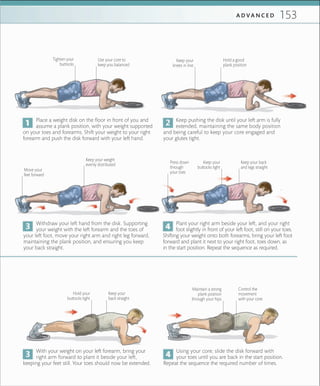
PLANK PLATE PUSH 152
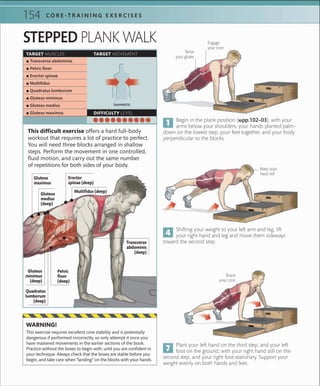
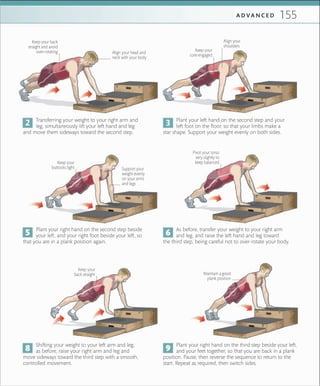
STEPPED PLANK WALK 154
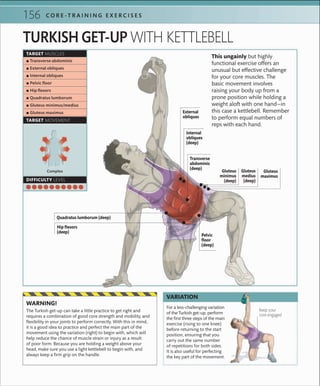
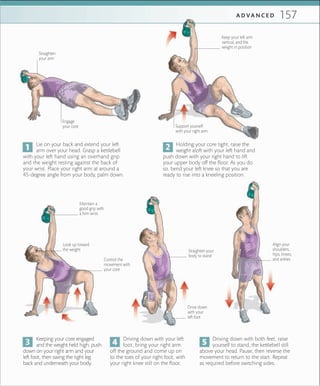
TURKISH GET-UP WITH KETTLEBELL 156
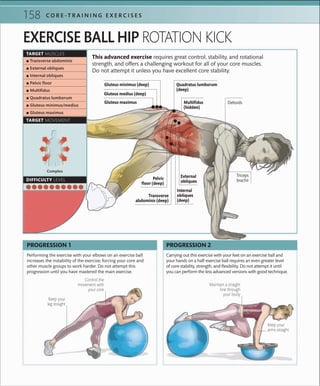
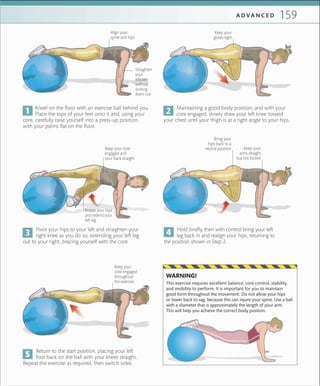
EXERCISE BALL HIP ROTATION KICK 158
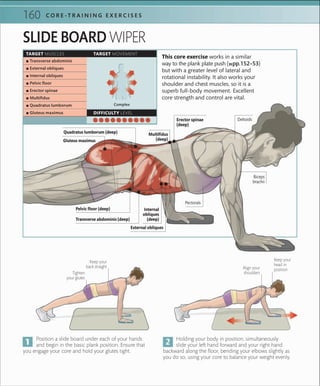
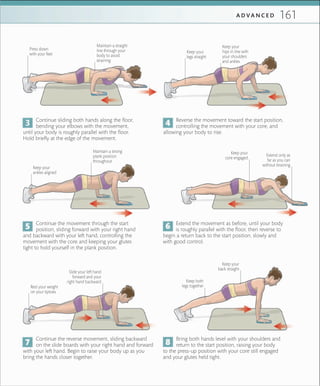
SLIDE BOARD WIPER 160
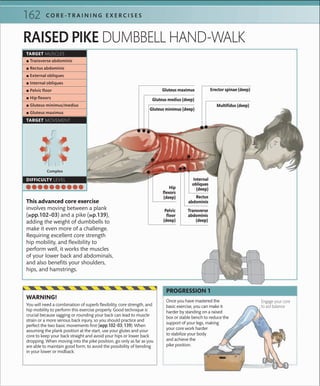
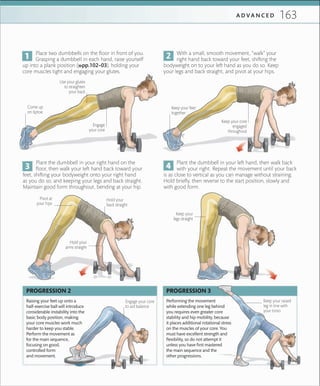
RAISED PIKE DUMBBELL HAND-WALK 162
WALL WALK 164
STATIC STRETCHES
NECK SIDE FLEXION 166
UPPER-BACK STRETCH 166
PEC STRETCH 166
LAT STRETCH 166
SEATED TWIST 167
LATERAL EXTENSION 167
STANDING BACK EXTENSION 167
SEATED SPIRAL TWIST 167
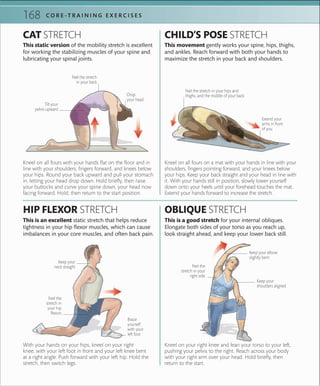
CAT STRETCH 168
CHILD’S POSE STRETCH 168
HIP FLEXOR STRETCH 168
OBLIQUE STRETCH 168
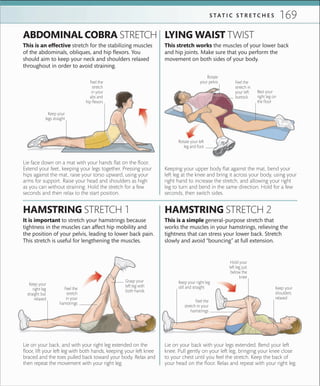
ABDOMINAL COBRA STRETCH 169
LYING WAIST TWIST 169
HAMSTRING STRETCH 1 169
HAMSTRING STRETCH 2 169
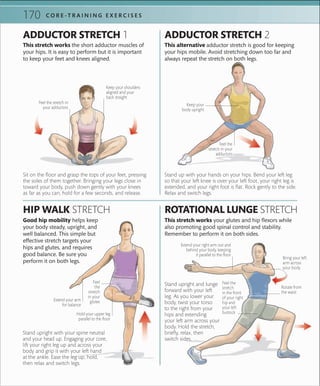
ADDUCTOR STRETCH 1 170
ADDUCTOR STRETCH 2 170
HIP WALK STRETCH 170
ROTATIONAL LUNGE STRETCH 170
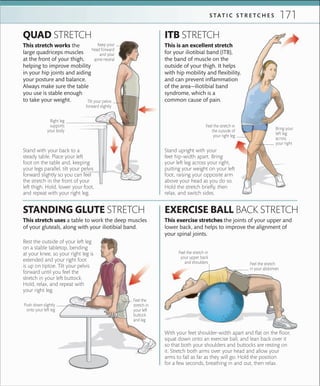
QUAD STRETCH 171
ITB STRETCH 171
STANDING GLUTE STRETCH 171
EXERCISE BALL BACK STRETCH 171
CORE-TRAINING
PROGRAMS
INTRODUCTION 174
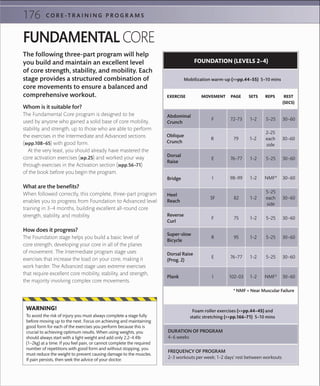
FUNDAMENTAL CORE 176
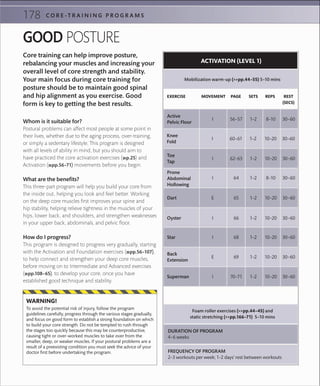
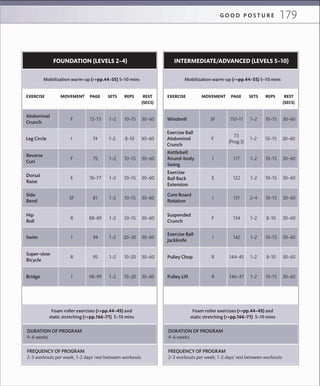
GOOD POSTURE 178
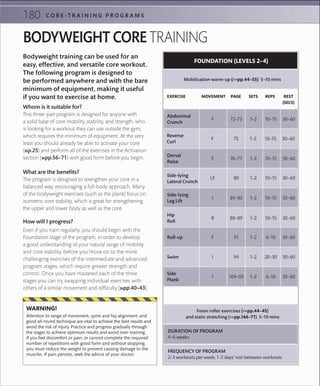
BODYWEIGHT CORE TRAINING 180
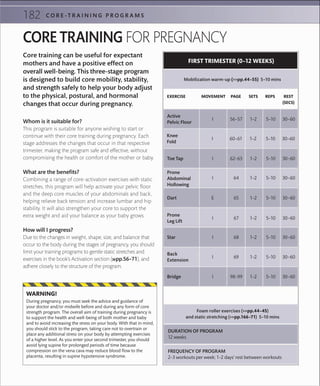
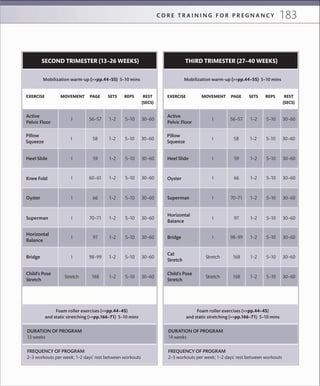
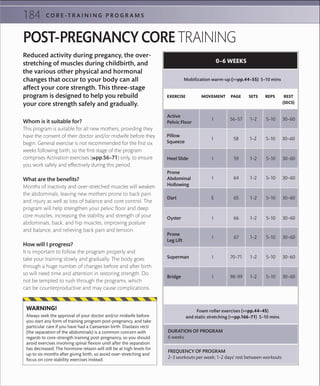
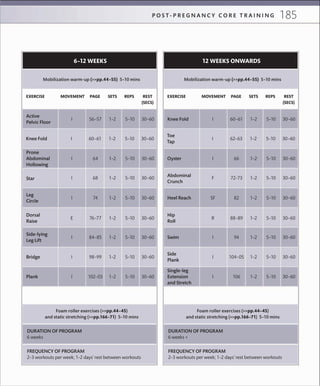
CORE TRAINING FOR PREGNANCY 182
POST-PREGNANCY CORE TRAINING 184
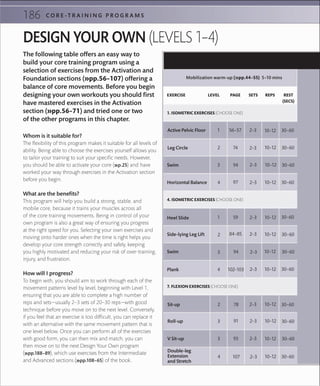
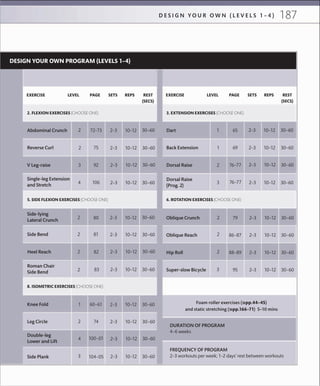
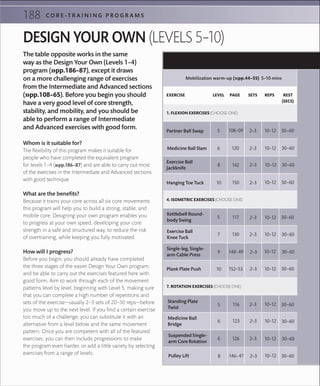
DESIGN YOUR OWN (LEVELS 1–4) 186
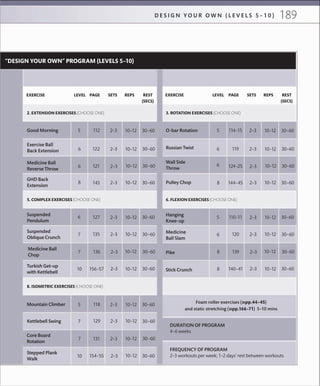
DESIGN YOUR OWN (LEVELS 5–10) 188
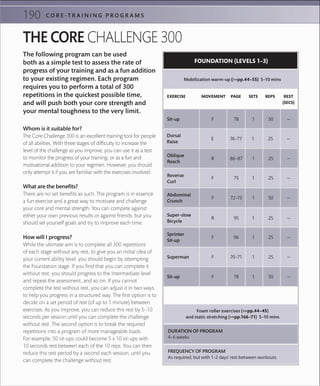
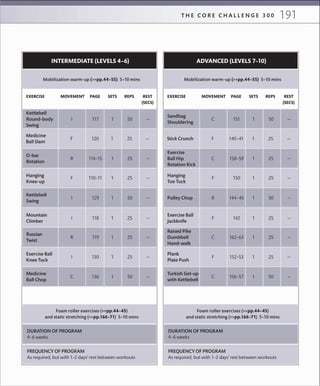
THE CORE CHALLENGE 300 190
SPORTS-SPECIFIC
CORE TRAINING
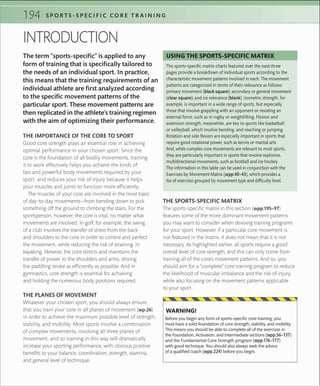
INTRODUCTION 194
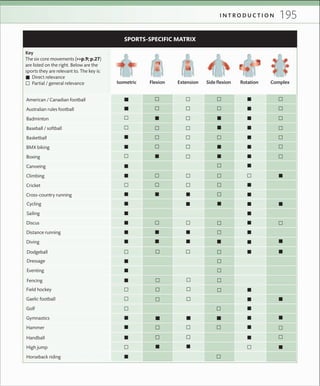
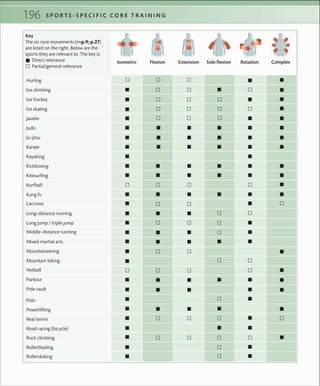
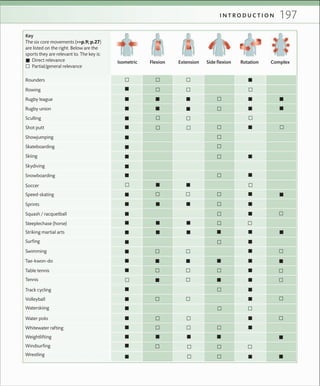
SPORTS-SPECIFIC MATRIX 196
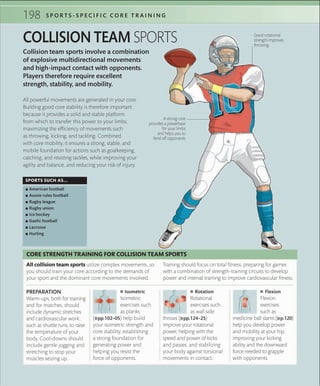
COLLISION TEAM SPORTS 198
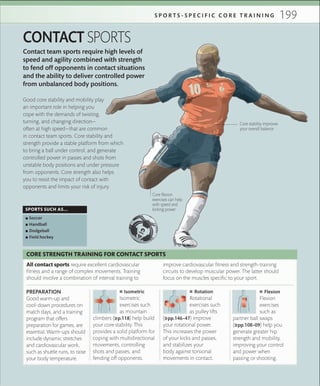
CONTACT TEAM SPORTS 199
NET-BASED SPORTS 200
BAT- AND CLUB-BASED SPORTS 201
RACKET-BASED SPORTS 202
RUNNING 203
THROWING-BASED FIELD SPORTS 204
JUMPING-BASED FIELD SPORTS 205
WEIGHTLIFTING AND 206
POWERLIFTING
COMBAT SPORTS 207
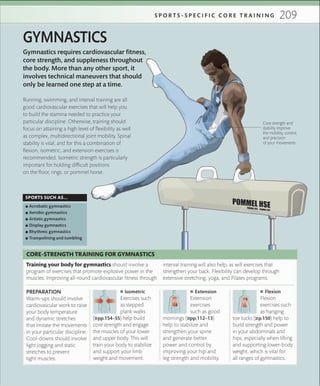
GYMNASTICS 208
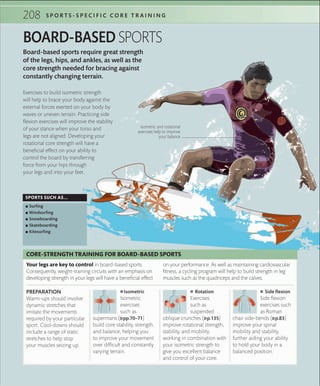
BOARD-BASED SPORTS 209
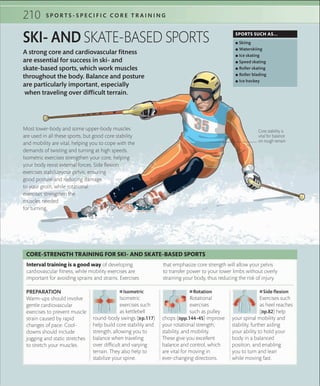
SKI- AND SKATE-BASED SPORTS 210
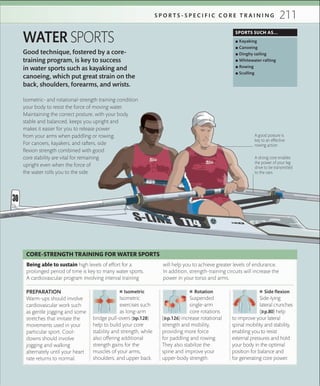
WATER SPORTS 211
SWIMMING-BASED SPORTS 212
CYCLING 213
EQUESTRIAN SPORTS 214
EXTREME SPORTS 215
GLOSSARY 216
INDEX 218
ACKNOWLEDGMENTS 224
ABOUT THE AUTHORS 224
SAFETY INFORMATION 224
6 H O W T O U S E T H I S B O O K
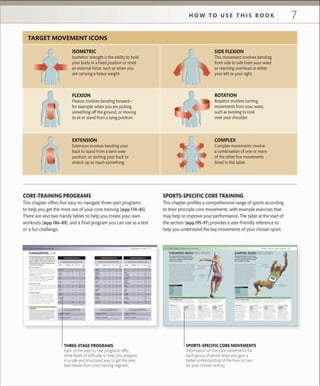
HOW TO USE THIS BOOK
The four sections of this book provide an
integrated, user-friendly guide to core training.
The introduction provides an excellent platform
for the exercise section, which features a
INTRODUCTION
The book’s introduction offers a clear and simple guide to the basics
of core training. Beginning with a definition of what the core is, and
how it works, the chapter explains how core strength helps with
everyday activities, posture, sport, and pregnancy. With useful
guidance on assessing and developing your core strength, it also
provides essential advice on how to engage the key core muscles,
and a range of suggested exercises to help with specific activities.
ANATOMICAL CORE DIAGRAMS
Detailed anatomical illustrations of your core muscles
provide details about the location and function of each
and how they work together in body movements.
comprehensive range of stretches and core
training movements. The programs and sports-
specific sections then show you how to bring
this knowledge together in your training.
CORE-TRAINING EXERCISES
This section features over 150 exercises with a range of variations and
progressions to make each as versatile and as challenging as possible.
The chapter’s four main exercise sections (»pp.56–165) progress in
order of increasing difficulty, and these are bookended by a selection
of mobility and static stretches (»pp.44–55; 166–71). The Visual
Exercise Directory (»pp.36–39) at the start of the chapter enables
you to navigate to individual exercises at a glance, while the Exercise
TARGET MUSCLES
Buttons on the panel show at a
glance which core muscles are
being worked by the exercises.
Details of these 12 muscles and
their function is provided in the
Introduction
(»pp.14-71).
TARGET MOVEMENTS
The icon on the panel shows which of the six core
movements are involved in the exercise—Isometric,
Flexion, Extension, Side Flexion, Rotation, or Complex
(box opposite).
DIFFICULTY RATING
The bar at the foot of the panel
provides a score of 1–10 to give
you an idea of how challenging
each exercise is. Full details of this
grading system are provided in
the Introduction (»p.31).
14 I N T R O D U C T I O N 15T H E A N T E R I O R C O R E M U S C L E S
THE MUSCLES
Rectus abdominis The rectus abdominis is the “six-pack”
muscle, its appearance caused by the three fibrous bands
running across it and the vertical band (the linea alba) running
down the middle. It is mainly involved in flexion (bending).
Transverse abdominis A deep muscle that runs around
the abdomen, the transverse abdominis acts like a girdle,
holding the muscles of your core together. It is key to
isometric core strength (resisting external forces) and
stability, and is involved in all core movements.
External obliques The external obliques are surface
muscles located on either side of your rectus abdominis.
They are important to rotational core movements and
side flexion (bending from side to side). Together with
the internal obliques (right), the muscles also help to
stabilize the spine against lateral (sideways) forces.
Internal obliques Located beneath the external obliques,
these muscles help you to perform movements that involve
the rotation and side flexion of your core. As with the
external obliques they are also important in stabilizing
the spine against forces from either side.
Pelvic floor Running from the pubic bone to
the tailbone, this group of small but important muscles
provides a support structure for the organs inside your
abdomen. As a result, they play a crucial role in effective
core strength and stability.
Hip flexors Located within the hip joint, the hip flexors
(psoas muscle group) control flexion movements in the
hips – that is, when you bend from the hip or raise your
legs. It is important to keep these muscles mobile, as they
can often be overworked, leading to lower-back pain.
The muscles to the front and sides
of your abdomen are known as the
anterior core muscles and drive
core movement while supporting
your spine by maintaining pressure
inside the abdomen and the chest.
Scalenes
Sternocleidomastoid
Deltoid
THE ANTERIOR CORE MUSCLES
Trapezius
HOW THE MUSCLES WORK
The muscles of your core are key to the efficient functioning of
your body – they affect posture, balance, co-ordination, and mobility,
and stabilize your trunk during movements. This table provides details
of your anterior core muscles (those of your abdomen, hips, and groin)
– their location, their main functions, and how they contribute to basic
everyday movements.
Pectoralis major
Coracobrachialis
Serratus anterior
Latissimus dorsi
Biceps brachii
External obliques
Internal obliques
Transverse
abdominis
Tensor
fasciae latae
External
intercostals
Internal
intercostals
Linea alba
Quadratus
lumborum
Psoas minor
Psoas major
Iliacus
Piriformis
Pelvic floor
Adductor longus
Pectineus
Rectus femoris
Sartorius
Gracilis
MUSCLES LOCATION
Rectus
abdominis
Transverse
abdominis
External
obliques
Internal
obliques
Pelvic floor
muscles
Hip flexors
 ■ Superficial
 ■ Deep
 ■ Superficial
 ■ Deep
 ■ Deep
 ■ Deep
 ■ Bending
 ■ Moving from lying to sitting
 ■ Maintaining good posture
 ■ Maintaining internal abdominal pressure
 ■ Supporting the internal organs
 ■ Helping forced expiration – coughing, sneezing,
and laughing
 ■ Twisting and rotation
 ■ Maintaining good posture
 ■ Maintaining good posture
 ■ Maintaining internal abdominal pressure
 ■ Supporting the internal organs
 ■ Maintaining internal abdominal pressure
 ■ Supporting the internal organs
 ■ Assisting when lifting
 ■ Helping to control urination
 ■ Assisting with childbirth
 ■ Walking and running
 ■ Going up and down stairs
FUNCTION
Hip
flexors
 ■ Flexion of spine
 ■ Isometric – trunk stability
 ■ Rotation
 ■ Some sideways flexion
 ■ Isometric – trunk stability
 ■ Isometric – trunk stability
 ■ Sideways flexion
 ■ Isometric – trunk stability
 ■ Flexion of the hip
 ■ Lifting of the legs
MOVEMENT
The muscles of the hips and abdomen
The anterior core muscles work with those of the
back and buttocks in supporting and stabilizing
the spine, and are important in driving rotational
movement and hip flexion. Together with the
lumbar region of the back, these muscles play
a vital role in building core strength.
Rectus abdominis
72 C O R E S T R E N G T H E X E R C I S E S 73F O U N D A T I O N
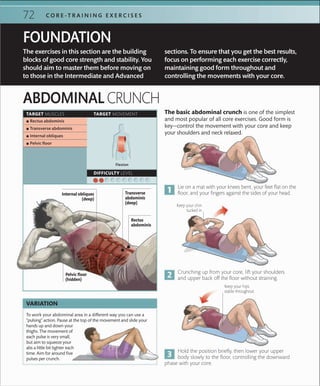
TARGET MUSCLES TARGET MOVEMENT
DIFFICULTY LEVEL
 ▪ Rectus abdominis
 ▪ Transverse abdominis
 ▪ Internal obliques
 ▪ Pelvic floor
The exercises in this section are the building
blocks of good core strength and stability. You
should aim to master them before moving on
to those in the Intermediate and Advanced
sections. To ensure you get the best results,
focus on performing each exercise correctly,
maintaining good form throughout and
controlling the movements with your core.
FOUNDATION
To work your abdominal area in a different way you can use a
“pulsing” action. Pause at the top of the movement and slide your
hands up and down your
thighs. The movement of
each pulse is very small,
but aim to squeeze your
abs a little bit tighter each
time. Aim for around five
pulses per crunch.
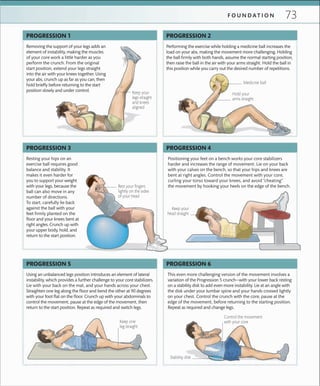
Performing the exercise while holding a medicine ball increases the
load on your abs, making the movement more challenging. Holding
the ball firmly with both hands, assume the normal starting position,
then raise the ball in the air with your arms straight. Hold the ball in
this position while you carry out the desired number of repetitions.
Positioning your feet on a bench works your core stabilizers
harder and increases the range of movement. Lie on your back
with your calves on the bench, so that your hips and knees are
bent at right angles. Control the movement with your core,
curling your torso towards your knees, and avoid “cheating”
the movement by hooking your heels on the edge of the bench.
Removing the support of your legs adds an
element of instability, making the muscles
of your core work a little harder as you
perform the crunch. From the original
start position, extend your legs straight
into the air with your knees together. Using
your abs, crunch up as far as you can, then
hold briefly before returning to the start
position slowly and under control.
Resting your hips on an
exercise ball requires good
balance and stability. It
makes it even harder for
you to support your weight
with your legs, because the
ball can also move in any
number of directions.
To start, carefully lie back
against the ball with your
feet firmly planted on the
floor and your knees bent at
right angles. Crunch up with
your upper body, hold, and
return to the start position.
Using an unbalanced legs position introduces an element of lateral
instability, which provides a further challenge to your core stabilizers.
Lie with your back on the mat, and your hands across your chest.
Straighten one leg along the floor and bend the other at 90 degrees
with your foot flat on the floor. Crunch up with your abdominals to
control the movement, pause at the edge of the movement, then
return to the start position. Repeat as required and switch legs.
This even more challenging version of the movement involves a
variation of the Progression 5 crunch – with your lower back resting
on a stability disc to add even more instability. Lie at an angle with
the disc under your lumbar spine and your hands crossed lightly
on your chest. Control the crunch with your core, pause at the
edge of the movement, before returning to the starting position.
Repeat as required and change legs.
VARIATION
PROGRESSION 1
PROGRESSION 3
PROGRESSION 5 PROGRESSION 6
PROGRESSION 2
PROGRESSION 4
The basic abdominal crunch is one of the simplest
and most popular of all core exercises. Good form is
key – control the movement with your core and keep
your shoulders and neck relaxed.
Hold the position briefly, then lower your upper
body slowly to the floor, controlling the downward
phase with your core.
Crunching up from your core, lift your shoulders
and upper back off the floor without straining.
Lie on a mat with your knees bent, your feet flat on the
floor, and your fingers against the sides of your head.Internal obliques
(deep)
Rectus
abdominis
ABDOMINAL CRUNCH
Keep your chin
tucked in
Keep your hips
stable throughout
Keep your
head straight
Rest your fingers
lightly on the sides
of your head
Pelvic floor
(hidden)
Flexion
Transverse
abdominis
(deep)
Keep one
leg straight
Control the movement
with your core
Hold your
arms straight
Keep your
legs straight
and knees
aligned
Stability disc
Medicine ball
STEP-BY-STEP SEQUENCES
User-friendly text and illustrations
guide you through each of the
exercises in a clear, straightforward
way, with useful annotation to help
you achieve the best possible form.
EXERCISE PROGRESSIONS
Increasingly difficult versions of
key exercises are provided to
challenge your core as your training
progresses and you build up your
core strength, stability, and mobility.
Movement Matrix (»pp.40–43) groups each of the exercises by their
Target Movement and Difficulty Rating to help with designing your
own programmes (»pp.186–89). Each of the core-strength exercises
featured in the main sections are accompanied by an information
panel, which provides details of the Target Muscles,
Target Movement, and Difficulty Rating of the exercise, along with
an annotated anatomical artwork that shows you where each of the
relevant muscles are located.
7H O W T O U S E T H I S B O O K
TARGET MOVEMENT ICONS
CORE-TRAINING PROGRAMS
This chapter offers five easy-to-navigate three-part programs
to help you get the most out of your core training (»pp.174–85).
There are also two handy tables to help you create your own
workouts (»pp.186–89), and a final program you can use as a test
or a fun challenge.
SPORTS-SPECIFIC CORE TRAINING
This chapter profiles a comprehensive range of sports according
to their principle core movements, with example exercises that
may help to improve your performance. The table at the start of
the section (»pp.195–97) provides a user-friendly reference to
help you understand the key movements of your chosen sport.
ISOMETRIC
Isometric strength is the ability to hold
your body in a fixed position or resist
an external force, such as when you
are carrying a heavy weight.
FLEXION
Flexion involves bending forward—
for example, when you are picking
something off the ground, or moving
to sit or stand from a lying position.
EXTENSION
Extension involves bending your
back to stand from a bent-over
position, or arching your back to
stretch up to reach something.
SIDE FLEXION
This movement involves bending
from side to side from your waist
or reaching overhead to either
your left or your right.
ROTATION
Rotation involves turning
movements from your waist,
such as twisting to look
over your shoulder.
COMPLEX
Complex movements involve
a combination of one or more
of the other five movements
listed in this table.
176 C O R E -T R A I N I N G P R O G R A M S 177F U N D A M E N TA L C O R E
EXERCISE MOVEMENT PAGE SETS REPS REST
(SECS)
Dorsal Raise
(Prog. 2)
Plank
Mobilization warm-up (»pp.44–55) 5–10 mins
FOUNDATION (LEVELS 2–4)
Abdominal
Crunch
72–73 1–2 5–25 30–60F
Oblique
Crunch
79 1–2
2–25
each
side
30–60R
Dorsal
Raise
76–77 1–2 5–25 30–60E
Bridge 98–99 1–2 NMF* 30–60I
Heel
Reach
82 1–2
5–25
each
side
30–60SF
Reverse
Curl
75 1–2 5–25 30–60F
Super-slow
Bicycle
95 1–2 5–25 30–60R
* NMF = Near Muscular Failure
DURATION OF PROGRAM
4–6 weeks
FREQUENCY OF PROGRAM
2–3 workouts per week; 1–2 days’ rest between workouts
Foam roller exercises (»pp.44–45) and
static stretching (»pp.166–71) 5–10 mins
76–77 1–2 5–25 30–60E
102–03 1–2 NMF* 30–60I
FUNDAMENTAL CORE
The following three-part program will help
you build and maintain an excellent level
of core strength, stability, and mobility. Each
stage provides a structured combination of
core movements to ensure a balanced and
comprehensive workout.
Whom is it suitable for?
The Fundamental Core program is designed to be
used by anyone who gained a solid base of core mobility,
stability, and strength, up to those who are able to perform
the exercises in the Intermediate and Advanced sections
(»pp.108–65) with good form.
At the very least, you should already have mastered the
core activation exercises (»p.25) and worked your way
through exercises in the Activation section (»pp.56–71)
of the book before you begin the program.
What are the benefits?
When followed correctly, this complete, three-part program
enables you to progress from Foundation to Advanced level
training in 3–4 months, building excellent all-round core
strength, stability, and mobility.
How does it progress?
The Foundation stage helps you build a basic level of
core strength, developing your core in all of the planes
of movement. The Intermediate program stage uses
exercises that increase the load on your core, making it
work harder. The Advanced stage uses extreme exercises
that require excellent core mobility, stability, and strength,
the majority involving complex core movements.
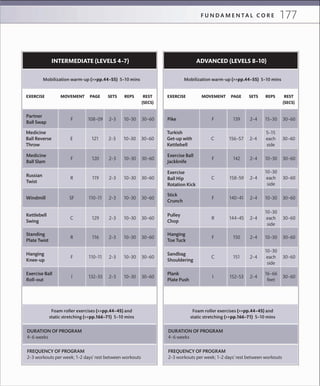
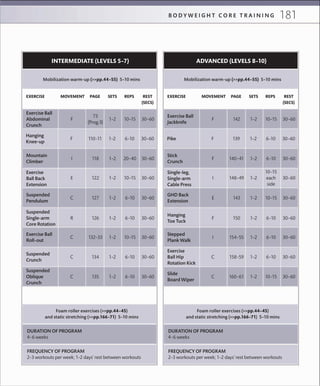
EXERCISE MOVEMENT PAGE SETS REPS REST
(SECS)
Hanging
Knee-up
Exercise Ball
Roll-out
Mobilization warm-up (»pp.44–55) 5–10 mins
INTERMEDIATE (LEVELS 4–7)
Partner
Ball Swap
108–09 2–3 10–30 30–60F
Medicine
Ball Reverse
Throw
121 2–3 10–30 30–60E
Medicine
Ball Slam
120 2–3 10–30 30–60F
Russian
Twist
119 2–3 10–30 30–60R
Windmill 110–11 2–3 10–30 30–60SF
Kettlebell
Swing
129 2–3 10–30 30–60C
Standing
Plate Twist
116 2–3 10–30 30–60R
DURATION OF PROGRAM
4–6 weeks
FREQUENCY OF PROGRAM
2–3 workouts per week; 1–2 days’ rest between workouts
Foam roller exercises (»pp.44–45) and
static stretching (»pp.166–71) 5–10 mins
110–11 2–3 10–30 30–60F
132–33 2–3 10–30 30–60I
EXERCISE MOVEMENT PAGE SETS REPS REST
(SECS)
Sandbag
Shouldering
Plank
Plate Push
Mobilization warm-up (»pp.44–55) 5–10 mins
ADVANCED (LEVELS 8–10)
Pike 139 2–4 15–30 30–60F
Turkish
Get-up with
Kettlebell
156–57 2–4
5–15
each
side
30–60C
Exercise Ball
Jackknife
142 2–4 10–30 30–60F
Exercise
Ball Hip
Rotation Kick
158–59 2–4
10–30
each
side
30–60C
Stick
Crunch
140–41 2–4 10–30 30–60F
Pulley
Chop
144–45 2–4
10–30
each
side
30–60R
Hanging
Toe Tuck
150 2–4 10–30 30–60F
DURATION OF PROGRAM
4–6 weeks
FREQUENCY OF PROGRAM
2–3 workouts per week; 1–2 days’ rest between workouts
Foam roller exercises (»pp.44–45) and
static stretching (»pp.166–71) 5–10 mins
151 2–4
10–30
each
side
30–60C
152–53 2–4
16–66
feet
30–60I
To avoid the risk of injury you must always complete a stage fully
before moving up to the next. Focus on achieving and maintaining
good form for each of the exercises you perform because this is
crucial to achieving optimum results. When using weights, you
should always start with a light weight and add only 2.2–4.4lb
(1–2kg) at a time. If you feel pain, or cannot complete the required
number of repetitions with good form and without stopping, you
must reduce the weight to prevent causing damage to the muscles.
If pain persists, then seek the advice of your doctor.
WARNING!
204 S P O R T S - S P E C I F I C C O R E T R A I N I N G 205S P O R T S - S P E C I F I C C O R E T R A I N I N G
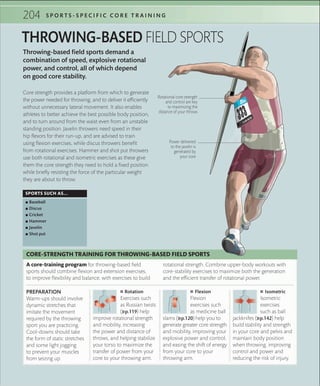
Throwing-based field sports demand a
combination of speed, explosive rotational
power, and control, all of which depend
on good core stability.
THROWING-BASED FIELD SPORTS
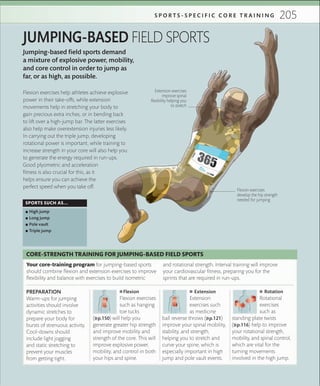
Jumping-based field sports demand
a mixture of explosive power, mobility,
and core control in order to jump as
far, or as high, as possible.
JUMPING-BASED FIELD SPORTS
SPORTS SUCH AS...
 ▪ Baseball
 ▪ Discus
 ▪ Cricket
 ▪ Hammer
 ▪ Javelin
 ▪ Shot put
Core strength provides a platform from which to generate
the power needed for throwing, and to deliver it efficiently
without unnecessary lateral movement. It also enables
athletes to better achieve the best possible body position,
and to turn around from the waist even from an unstable
standing position. Javelin throwers need speed in their
hip flexors for their run-up, and are advised to train
using flexion exercises, while discus throwers benefit
from rotational exercises. Hammer and shot put throwers
use both rotational and isometric exercises as these give
them the core strength they need to hold a fixed position
while briefly resisting the force of the particular weight
they are about to throw.
Flexion exercises help athletes achieve explosive
power in their take-offs, while extension
movements help in stretching your body to
gain precious extra inches, or in bending back
to lift over a high-jump bar. The latter exercises
also help make overextension injuries less likely.
In carrying out the triple jump, developing
rotational power is important, while training to
increase strength in your core will also help you
to generate the energy required in run-ups.
Good plyometric and acceleration
fitness is also crucial for this, as it
helps ensure you can achieve the
perfect speed when you take off.
SPORTS SUCH AS...
 ▪ High jump
 ▪ Long jump
 ▪ Pole vault
 ▪ Triple jump
Flexion exercises
develop the hip strength
needed for jumping
Power delivered
to the javelin is
generated by
your core
PREPARATION
Warm-ups for jumping
activities should involve
dynamic stretches to
prepare your body for
bursts of strenuous activity.
Cool-downs should
include light jogging
and static stretching to
prevent your muscles
from getting tight.
 ■ Flexion
Flexion exercises
such as hanging
toe tucks
(»p.150) will help you
generate greater hip strength
and improve mobility and
strength of the core. This will
improve explosive power,
mobility, and control in both
your hips and spine.
 ■ Extension
Extension
exercises such
as medicine
ball reverse throws (»p.121)
improve your spinal mobility,
stability, and strength,
helping you to stretch and
curve your spine, which is
especially important in high
jump and pole vault events.
 ■ Rotation
Rotational
exercises
such as
standing plate twists
(»p.116) help to improve
your rotational strength,
mobility, and spinal control,
which are vital for the
turning movements
involved in the high jump.
 ■ Rotation
Exercises such
as Russian twists
(»p.119) help
improve rotational strength
and mobility, increasing
the power and distance of
throws, and helping stabilize
your torso to maximize the
transfer of power from your
core to your throwing arm.
PREPARATION
Warm-ups should involve
dynamic stretches that
imitate the movement
required by the throwing
sport you are practicing.
Cool-downs should take
the form of static stretches
and some light jogging
to prevent your muscles
from seizing up.
 ■ Flexion
Flexion
exercises such
as medicine ball
slams (»p.120) help you to
generate greater core strength
and mobility, improving your
explosive power and control,
and easing the shift of energy
from your core to your
throwing arm.
 ■ Isometric
Isometric
exercises
such as ball
jackknifes (»p.142) help
build stability and strength
in your core and pelvis and
maintain body position
when throwing, improving
control and power and
reducing the risk of injury.
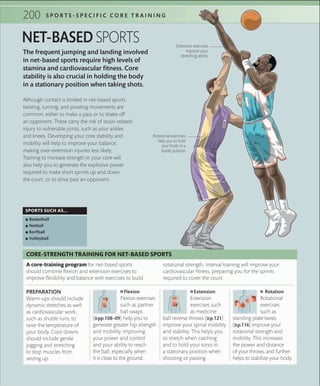
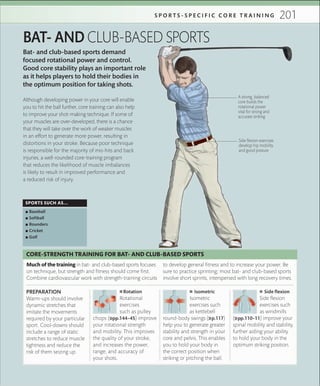
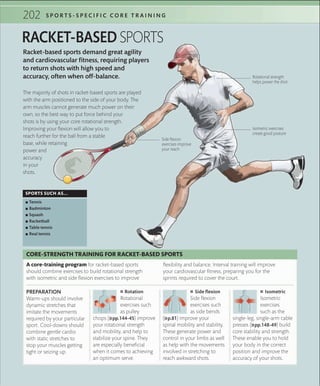
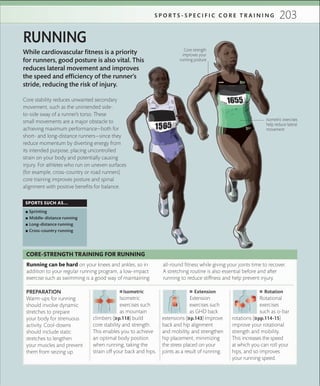
A core-training program for throwing-based field
sports should combine flexion and extension exercises,
to improve flexibility and balance, with exercises to build
rotational strength. Combine upper-body workouts with
core-stability exercises to maximize both the generation
and the efficient transfer of rotational power.
Your core-training program for jumping-based sports
should combine flexion and extension exercises to improve
flexibility and balance with exercises to build isometric
and rotational strength. Interval training will improve
your cardiovascular fitness, preparing you for the
sprints that are required in run-ups.
CORE-STRENGTH TRAINING FOR THROWING-BASED FIELD SPORTS CORE-STRENGTH TRAINING FOR JUMPING-BASED FIELD SPORTS
Rotational core strength
and control are key
to maximizing the
distance of your throws
Extension exercises
improve spinal
flexibility helping you
to stretch
THREE-STAGE PROGRAMS
Each of the easy-to-use programs offer
three levels of difficulty to help you progress
in a safe and structured way to get the very
best results from your training regimen.
SPORTS-SPECIFIC CORE MOVEMENTS
Information on the core movements for
each group of sports helps you gain a
better understanding of the how to train
for your chosen activity.
INTRODUCTION
10 I N T R O D U C T I O N
WHAT IS THE CORE?
The core plays a key role in everyday biological functions.
It creates internal pressure within the abdominal cavity,
holding the internal organs in place, and helping with
the expulsion of air from the lungs and of bodily waste.
The core muscles, in particular the transverse abdominis
and pelvic floor (»p.15), are also active during childbirth.
AN INACTIVE CORE
Modern lifestyles are highly sedentary, meaning certain core
muscles may become inactive. If you do not exercise your
core muscles regularly, you will lose the ability to engage them
instinctively while performing everyday movements such as
bending and lifting. When this happens, other muscles may
take over from them, which can lead to muscular imbalances—
where one muscle is stronger than its opposing muscle—and,
possibly, injury in the longer run. A common example of this
is poor posture (»pp.22–25), which can cause imbalance in
your hip and buttock muscles, resulting in lower back pain.
Core training helps improve strength, stability, and mobility,
reducing the likelihood of such imbalances developing.
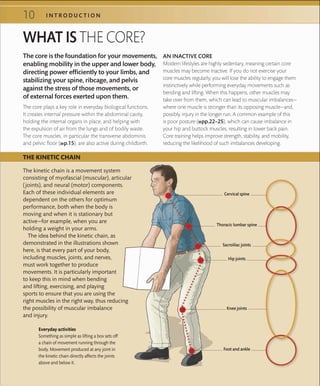
THE KINETIC CHAIN
Everyday activities
Something as simple as lifting a box sets off
a chain of movement running through the
body. Movement produced at any joint in
the kinetic chain directly affects the joints
above and below it.
The kinetic chain is a movement system
consisting of myofascial (muscular), articular
(joints), and neural (motor) components.
Each of these individual elements are
dependent on the others for optimum
performance, both when the body is
moving and when it is stationary but
active—for example, when you are
holding a weight in your arms.
The idea behind the kinetic chain, as
demonstrated in the illustrations shown
here, is that every part of your body,
including muscles, joints, and nerves,
must work together to produce
movements. It is particularly important
to keep this in mind when bending
and lifting, exercising, and playing
sports to ensure that you are using the
right muscles in the right way, thus reducing
the possibility of muscular imbalance
and injury.
The core is the foundation for your movements,
enabling mobility in the upper and lower body,
directing power efficiently to your limbs, and
stabilizing your spine, ribcage, and pelvis
against the stress of those movements, or
of external forces exerted upon them.
Thoracic lumbar spine
Hip joints
Knee joints
Foot and ankle
Cervical spine
Sacroiliac joints
11W H A T I S T H E C O R E ?
THE IMPORTANCE OF THE CORE
Your core acts as an axis along which the muscles of
the hips, abdomen, and back interact to support and
stabilize the spine, providing a solid base for movement
in the legs and arms. It is a key part of your body’s support
structure—if you were to strip the spine of all muscle,
leaving just bones and ligaments, it would collapse under
20lb (9kg) of load. Strong core muscles generate the
strength, stability, and mobility needed to carry out
everyday activities such as carrying shopping, climbing
the stairs, and getting into a car. They also play a crucial
role in more demanding dynamic sports, helping to
transmit increased power and stability, and performance,
while also reducing the risk of sustaining injury. As a
result, core development is a key objective of elite
athletes and their coaches.
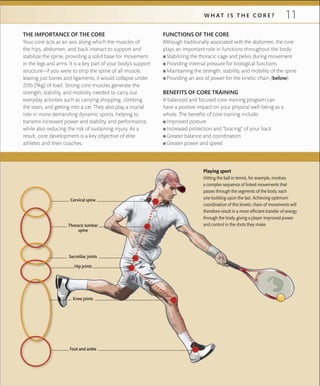
Playing sport
Hitting the ball in tennis, for example, involves
a complex sequence of linked movements that
passes through the segments of the body, each
one building upon the last. Achieving optimum
coordination of this kinetic chain of movements will
therefore result in a more efficient transfer of energy
through the body, giving a player improved power
and control in the shots they make.
FUNCTIONS OF THE CORE
Although traditionally associated with the abdomen, the core
plays an important role in functions throughout the body:
 ■ Stabilizing the thoracic cage and pelvis during movement
 ■ Providing internal pressure for biological functions
 ■ Maintaining the strength, stability, and mobility of the spine
 ■ Providing an axis of power for the kinetic chain (below)
BENEFITS OF CORE TRAINING
A balanced and focused core-training program can
have a positive impact on your physical well-being as a
whole. The benefits of core training include:
 ■ Improved posture
 ■ Increased protection and “bracing” of your back
 ■ Greater balance and coordination
 ■ Greater power and speed
Thoracic lumbar
spine
Hip joints
Knee joints
Foot and ankle
Cervical spine
Sacroiliac joints
12 I N T R O D U C T I O N
Your spine is the central support
system for your entire body, assisting
with nearly all movement, while
supporting and protecting your
spinal cord. It must be firm enough
to hold your body weight when
standing, yet flexible and strong
enough to anchor your body and
allow your upper and lower limbs
to move smoothly.
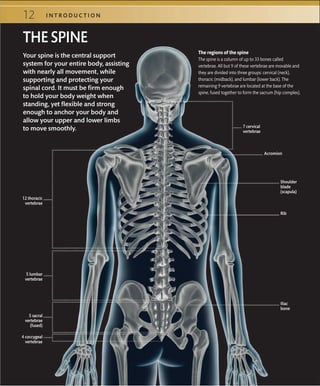
The regions of the spine
The spine is a column of up to 33 bones called
vertebrae. All but 9 of these vertebrae are movable and
they are divided into three groups: cervical (neck),
thoracic (midback), and lumbar (lower back). The
remaining 9 vertebrae are located at the base of the
spine, fused together to form the sacrum (hip complex).
THE SPINE
Rib
Shoulder
blade
(scapula)
Acromion
Iliac
bone
7 cervical
vertebrae
12 thoracic
vertebrae
5 lumbar
vertebrae
5 sacral
vertebrae
(fused)
4 coccygeal
vertebrae
13T H E S P I N E
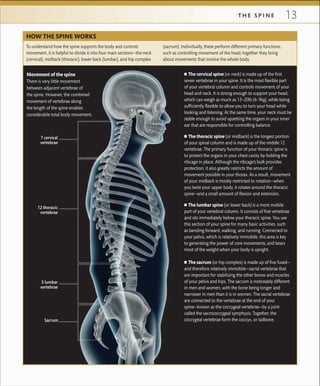
■ The cervical spine (or neck) is made up of the first
seven vertebrae in your spine. It is the most flexible part
of your vertebral column and controls movement of your
head and neck. It is strong enough to support your head,
which can weigh as much as 13–20lb (6–9kg), while being
sufficiently flexible to allow you to turn your head while
looking and listening. At the same time, your neck must be
stable enough to avoid upsetting the organs in your inner
ear that are responsible for controlling balance.
■ The thoracic spine (or midback) is the longest portion
of your spinal column and is made up of the middle 12
vertebrae. The primary function of your thoracic spine is
to protect the organs in your chest cavity by holding the
ribcage in place. Although the ribcage’s bulk provides
protection, it also greatly restricts the amount of
movement possible in your thorax. As a result, movement
of your midback is mostly restricted to rotation—when
you twist your upper body, it rotates around the thoracic
spine—and a small amount of flexion and extension.
■ The lumbar spine (or lower back) is a more mobile
part of your vertebral column. It consists of five vertebrae
and sits immediately below your thoracic spine. You use
this section of your spine for many basic activities, such
as bending forward, walking, and running. Connected to
your pelvis, which is relatively immobile, this area is key
to generating the power of core movements, and bears
most of the weight when your body is upright.
■ The sacrum (or hip complex) is made up of five fused—
and therefore relatively immobile—sacral vertebrae that
are important for stabilizing the other bones and muscles
of your pelvis and hips. The sacrum is noticeably different
in men and women, with the bone being longer and
narrower in men than it is in women. The sacral vertebrae
are connected to the vertebrae at the end of your
spine—known as the coccygeal vertebrae—by a joint
called the sacrococcygeal symphysis. Together, the
coccygeal vertebrae form the coccyx, or tailbone.
To understand how the spine supports the body and controls
movement, it is helpful to divide it into four main sections—the neck
(cervical), midback (thoracic), lower back (lumbar), and hip complex
(sacrum). Individually, these perform different primary functions,
such as controlling movement of the head; together they bring
about movements that involve the whole body.
HOW THE SPINE WORKS
7 cervical
vertebrae
12 thoracic
vertebrae
5 lumbar
vertebrae
Sacrum
Movement of the spine
There is very little movement
between adjacent vertebrae of
the spine. However, the combined
movement of vertebrae along
the length of the spine enables
considerable total body movement.
14 I N T R O D U C T I O N
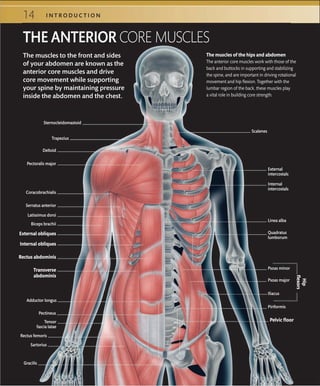
The muscles to the front and sides
of your abdomen are known as the
anterior core muscles and drive
core movement while supporting
your spine by maintaining pressure
inside the abdomen and the chest.
Scalenes
Sternocleidomastoid
Deltoid
THE ANTERIOR CORE MUSCLES
Trapezius
Pectoralis major
Coracobrachialis
Serratus anterior
Latissimus dorsi
Biceps brachii
External obliques
Internal obliques
Transverse
abdominis
Tensor
fascia latae
External
intercostals
Internal
intercostals
Linea alba
Quadratus
lumborum
Psoas minor
Psoas major
Iliacus
Piriformis
Pelvic floor
Adductor longus
Pectineus
Rectus femoris
Sartorius
Gracilis
Hip
flexors
The muscles of the hips and abdomen
The anterior core muscles work with those of the
back and buttocks in supporting and stabilizing
the spine, and are important in driving rotational
movement and hip flexion. Together with the
lumbar region of the back, these muscles play
a vital role in building core strength.
Rectus abdominis
15T H E A N T E R I O R C O R E M U S C L E S
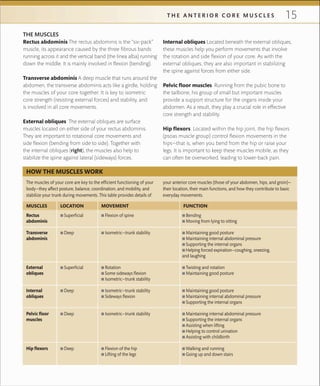
THE MUSCLES
Rectus abdominis The rectus abdominis is the “six-pack”
muscle, its appearance caused by the three fibrous bands
running across it and the vertical band (the linea alba) running
down the middle. It is mainly involved in flexion (bending).
Transverse abdominis A deep muscle that runs around the
abdomen, the transverse abdominis acts like a girdle, holding
the muscles of your core together. It is key to isometric
core strength (resisting external forces) and stability, and
is involved in all core movements.
External obliques The external obliques are surface
muscles located on either side of your rectus abdominis.
They are important to rotational core movements and
side flexion (bending from side to side). Together with
the internal obliques (right), the muscles also help to
stabilize the spine against lateral (sideways) forces.
Internal obliques Located beneath the external obliques,
these muscles help you perform movements that involve
the rotation and side flexion of your core. As with the
external obliques, they are also important in stabilizing
the spine against forces from either side.
Pelvic floor muscles Running from the pubic bone to
the tailbone, his group of small but important muscles
provide a support structure for the organs inside your
abdomen. As a result, they play a crucial role in effective
core strength and stability.
Hip flexors Located within the hip joint, the hip flexors
(psoas muscle group) control flexion movements in the
hips—that is, when you bend from the hip or raise your
legs. It is important to keep these muscles mobile, as they
can often be overworked, leading to lower-back pain.
HOW THE MUSCLES WORK
The muscles of your core are key to the efficient functioning of your
body—they affect posture, balance, coordination, and mobility, and
stabilize your trunk during movements. This table provides details of
your anterior core muscles (those of your abdomen, hips, and groin)—
their location, their main functions, and how they contribute to basic
everyday movements.
MUSCLES LOCATION
Rectus
abdominis
Transverse
abdominis
External
obliques
Internal
obliques
Pelvic floor
muscles
Hip flexors
 ■ Superficial
 ■ Deep
 ■ Superficial
 ■ Deep
 ■ Deep
 ■ Deep
 ■ Bending
 ■ Moving from lying to sitting
 ■ Maintaining good posture
 ■ Maintaining internal abdominal pressure
 ■ Supporting the internal organs
 ■ Helping forced expiration—coughing, sneezing,
and laughing
 ■ Twisting and rotation
 ■ Maintaining good posture
 ■ Maintaining good posture
 ■ Maintaining internal abdominal pressure
 ■ Supporting the internal organs
 ■ Maintaining internal abdominal pressure
 ■ Supporting the internal organs
 ■ Assisting when lifting
 ■ Helping to control urination
 ■ Assisting with childbirth
 ■ Walking and running
 ■ Going up and down stairs
FUNCTION
 ■ Flexion of spine
 ■ Isometric—trunk stability
 ■ Rotation
 ■ Some sideways flexion
 ■ Isometric—trunk stability
 ■ Isometric—trunk stability
 ■ Sideways flexion
 ■ Isometric—trunk stability
 ■ Flexion of the hip
 ■ Lifting of the legs
MOVEMENT
16 I N T R O D U C T I O N
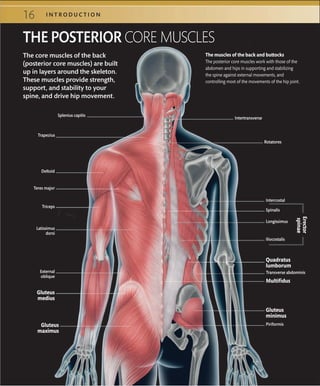
The core muscles of the back
(posterior core muscles) are built
up in layers around the skeleton.
These muscles provide strength,
support, and stability to your
spine, and drive hip movement.
Rotatores
Intertransverse
Latissimus
dorsi
Deltoid
THE POSTERIOR CORE MUSCLES
Splenius capitis
Trapezius
Teres major
Triceps
External
oblique
Gluteus
medius
Gluteus
maximus
Intercostal
Spinalis
Longissimus
Iliocostalis
Quadratus
lumborum
Multifidus
Transverse abdominis
Gluteus
minimus
Erector
spinae
The muscles of the back and buttocks
The posterior core muscles work with those of the
abdomen and hips in supporting and stabilizing
the spine against external movements, and
controlling most of the movements of the hip joint.
Piriformis
17T H E P O S T E R I O R C O R E M U S C L E S
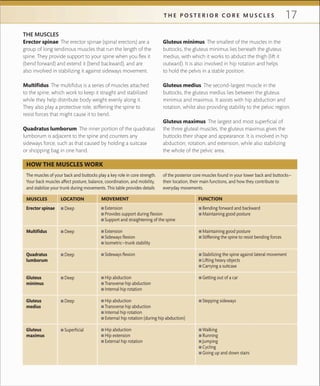
THE MUSCLES
Erector spinae The erector spinae (spinal erectors) are a
group of long tendinous muscles that run the length of the
spine. They provide support to your spine when you flex it
(bend forward) and extend it (bend backward), and are
also involved in stabilizing it against sideways movement.
Multifidus The multifidus is a series of muscles attached
to the spine, which work to keep it straight and stabilized
while they help distribute body weight evenly along it.
They also play a protective role, stiffening the spine to
resist forces that might cause it to bend.
Quadratus lumborum The inner portion of the quadratus
lumborum is adjacent to the spine and counters any
sideways force, such as that caused by holding a suitcase
or shopping bag in one hand.
Gluteus minimus The smallest of the muscles in the
buttocks, the gluteus minimus lies beneath the gluteus
medius, with which it works to abduct the thigh (lift it
outward). It is also involved in hip rotation and helps
to hold the pelvis in a stable position.
Gluteus medius The second-largest muscle in the
buttocks, the gluteus medius lies between the gluteus
minimus and maximus. It assists with hip abduction and
rotation, whilst also providing stability to the pelvic region.
Gluteus maximus The largest and most superficial of
the three gluteal muscles, the gluteus maximus gives the
buttocks their shape and appearance. It is involved in hip
abduction, rotation, and extension, while also stabilizing
the whole of the pelvic area.
MUSCLES LOCATION FUNCTION
The muscles of your back and buttocks play a key role in core strength.
Your back muscles affect posture, balance, coordination, and mobility,
and stabilize your trunk during movements. This table provides details
of the posterior core muscles found in your lower back and buttocks—
their location, their main functions, and how they contribute to
everyday movements.
HOW THE MUSCLES WORK
Erector spinae
Multifidus
Quadratus
lumborum
Gluteus
minimus
Gluteus
medius
Gluteus
maximus
 ■ Deep
 ■ Deep
 ■ Deep
 ■ Deep
 ■ Deep
 ■ Superficial
 ■ Bending forward and backward
 ■ Maintaining good posture
 ■ Maintaining good posture
 ■ Stiffening the spine to resist bending forces
 ■ Stabilizing the spine against lateral movement
 ■ Lifting heavy objects
 ■ Carrying a suitcase
 ■ Getting out of a car
 ■ Stepping sideways
 ■ Walking
 ■ Running
 ■ Jumping
 ■ Cycling
 ■ Going up and down stairs
 ■ Extension
 ■ Provides support during flexion
 ■ Support and straightening of the spine
 ■ Extension
 ■ Sideways flexion
 ■ Isometric—trunk stability
 ■ Sideways flexion
 ■ Hip abduction
 ■ Transverse hip abduction
 ■ Internal hip rotation
 ■ Hip abduction
 ■ Transverse hip abduction
 ■ Internal hip rotation
 ■ ExternaI hip rotation (during hip abduction)
 ■ Hip abduction
 ■ Hip extension
 ■ ExternaI hip rotation
MOVEMENT
18 I N T R O D U C T I O N
WHAT IS CORE TRAINING?
WHAT IS CORE MOBILITY?
Core mobility refers to the movement of your spine and
hips. There are five main movement patterns involved:
isometric, flexion, extension, side flexion, and rotation. It
is vital to mobilize your spine and hips before exercise, to
loosen tight muscles and encourage weaker, under-used
muscles to function correctly. This helps to balance the
relationship between muscle length and movement
patterns, and allows for deeper muscle activation,
improving your core stability and strength. It is best to
maintain a full, natural range of motion to keep your
body functioning properly. Joints and muscles that are
hypomobile (stiff) or hypermobile (too mobile) will
inevitably lead to imbalances. When this happens,
one area of the body is forced to compensate for
the lack, or greater range, of movement in another—
increasing your chances of injury.
WHAT IS CORE STABILITY?
Core stability is the ability to control the position and
movement of your midsection (trunk), in order to improve
your posture and improve the efficiency of your limb
movement. Core stability training targets the deep muscles
of your abdomen, hips, and spine to create a base for
support. The main deep muscles are the multifidus,
transverse abdominis, and pelvic floor, which form a
“cylinder” around the lower torso, with the transverse
abdominis to the front, the multifidus to the back, and
the pelvic floor forming the base. During most types of
body movement—lifting, bending, sitting, twisting, walking,
running, or jumping—these three muscles work to stabilize
your lumbar spine, while your gluteus and quadratus
lumborum muscles work to stabilize your pelvis.
The stability of your back depends on all of these muscles
being strong and working together effectively. Because of the
complex network of muscles and fascia (connective tissues)
involved in this structure, activating or “waking up” your core
is a key part of training. You may find it hard to activate the
deeper core muscles to start with, so you should begin by
following the basic exercises in Activating Your Core (»p.25),
before you move on to those in the Activation section of
Core-Training Exercises (»pp.56–71).
WHAT IS CORE STRENGTH?
Core strength is the ability to perform challenging physical
tasks that demand good form and control. As it involves all
of the muscles of your core—both deep and superficial—
it has a key role in core training, but it is important to
remember that good core strength requires a foundation
of good core stability first. Core-strength training works by
pushing your core muscles beyond their normal demands
or by holding positions to increase endurance strength.
The greater the force exerted upon the body, the greater the
amount of core muscle engagement, and thus the degree of
core muscle activation and strength required. As you develop
core strength through exercise, your movements will become
adapted to a higher level of skill and performance.
CORE TRAINING AND THE PELVIC FLOOR
The pelvic floor is the group of muscles and fascia that
form the base of your abdominal cylinder. These muscles
and fascia have a number of functions—holding your pelvis
together; maintaining the position of the pelvic organs, and
supporting them against gravity; and helping to control the
flow of urine from your bladder and waste from your rectum.
Poor physical fitness, as well as pregnancy, aging, and injury,
can cause a weakening of the muscles in this area, so it is
important to keep them as strong as possible.
These muscles also play a key role in effective core strength
because they help to activate the transverse abdominis,
along with the other stabilizing muscles of your core. It is
therefore important to learn how to control and activate
your pelvic floor muscles (»p.25), possibly with Kegel
exercises (the conscious engagement and contraction of
your pelvic floor muscles), before attempting any of the
movements in the exercise sections (»pp.34–171).
Core training focuses on three areas: core
mobility, core stability, and core strength.
Each of these plays an important role in the
health, support, and function of your body,
so achieving a balance between them is vital.
The starting point of this process lies in
learning how to activate, strengthen, and
control the muscles of your pelvic floor.
19W H A T I S C O R E T R A I N I N G ?
V leg-raise
 ■ (»p.92)
O-bar rotation
 ■ (»pp.114–15)
Sandbag shouldering
 ■ (»p.151)
Exercise ball hip
rotation kick
 ■ (»pp.158–59)
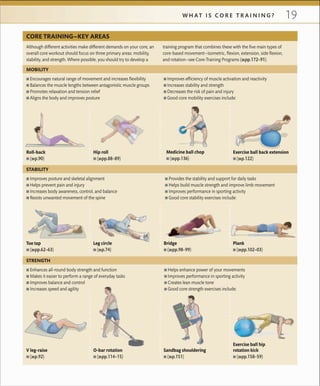
CORE TRAINING—KEY AREAS
 ■ Encourages natural range of movement and increases flexibility
 ■ Balances the muscle lengths between antagonistic muscle groups
 ■ Promotes relaxation and tension relief
 ■ Aligns the body and improves posture
 ■ Improves efficiency of muscle activation and reactivity
 ■ Increases stability and strength
 ■ Decreases the risk of pain and injury
 ■ Good core mobility exercises include:
 ■ Enhances all-round body strength and function
 ■ Makes it easier to perform a range of everyday tasks
 ■ Improves balance and control
 ■ Increases speed and agility
 ■ Helps enhance power of your movements
 ■ Improves performance in sporting activity
 ■ Creates lean muscle tone
 ■ Good core strength exercises include:
MOBILITY
STRENGTH
Although different activities make different demands on your core, an
overall core workout should focus on three primary areas: mobility,
stability, and strength. Where possible, you should try to develop a
training program that combines these with the five main types of
core-based movement—isometric, flexion, extension, side flexion,
and rotation—see Core-Training Programs (»pp.172–91).
Toe tap
 ■ (»pp.62–63)
Leg circle
 ■ (»p.74)
Bridge
 ■ (»pp.98–99)
Medicine ball chop
 ■ (»pp.136)
Exercise ball back extension
 ■ (»p.122)
Hip roll
 ■ (»pp.88–89)
Roll-back
 ■ (»p.90)
 ■ Improves posture and skeletal alignment
 ■ Helps prevent pain and injury
 ■ Increases body awareness, control, and balance
 ■ Resists unwanted movement of the spine
 ■ Provides the stability and support for daily tasks
 ■ Helps build muscle strength and improve limb movement
 ■ Improves performance in sporting activity
 ■ Good core stability exercises include:
STABILITY
Plank
 ■ (»pp.102–03)
20 I N T R O D U C T I O N
CORE TRAINING AND EVERYDAY ACTIVITIES
Learning correct postural alignment and how to stabilize
your spine can help ease the strain of everyday activities,
prevent pain and injury, and make you feel stronger and more
confident. Whether you are digging in the garden, lifting heavy
objects, or carrying your child, it is the strength from the deep
centering muscles of your abdomen and lower back (lumbar
spine) that will enable you to perform these tasks safely.
THE BODY’S “POWERHOUSE”
Your core is often referred to as the body’s “powerhouse,” a
central region providing a girdle of strength and connecting
the abdomen with the lower back and hips. The abdominal
area, in conjunction with the deep spinal muscles, creates a
stable base for generating strength and providing support
for all movement. As a result, it is important to understand
the concepts behind core strength and train correctly. Pushing
your body too far or too fast, without the support of your
core, can cause you to use the wrong muscles and ingraining
poor movement patterns, which, over time, may lead to
muscular imbalance, reduced power, and possibly even injury.
However, while it is important to practise core activation,
constantly holding your deep abdominals in a braced
contraction may potentially interfere with the pumplike
motion of your diaphragm, restricting the efficiency of your
breathing. You should therefore look to engage your core as
part of a fitness program, or before attempting to lift a load,
rather than on a moment-to-moment basis.
Many of us are not used to training the deep muscles of
the core, often focusing instead on the more visible outer
muscles of the torso such as the rectus abdominus. These
large muscles, known as primary movers, can be felt when
performing everyday activities and training for fitness. Due
to their size and power they can often take over the work
of the stabilizing muscles, leaving the body less supported
and vulnerable to strain. For this reason, a balanced and
comprehensive approach to core training is vital.
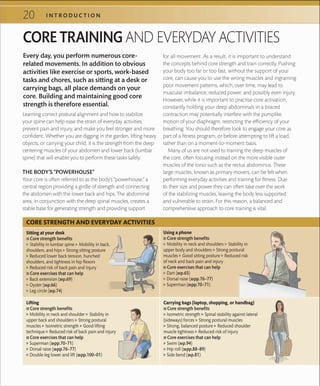
Every day, you perform numerous core-
related movements. In addition to obvious
activities like exercise or sports, work-based
tasks and chores, such as sitting at a desk or
carrying bags, all place demands on your
core. Building and maintaining good core
strength is therefore essential.
Sitting at your desk
 ■ Core strength benefits
▶ Stability in lumbar spine ▶ Mobility in back,
shoulders, and hips ▶ Strong sitting posture
▶ Reduced lower back tension, hunched
shoulders, and tightness in hip flexors
▶ Reduced risk of back pain and injury
 ■ Core exercises that can help
▶ Back extension (»p.69)
▶ Oyster (»p.66)
▶ Leg circle (»p.74)
Using a phone
 ■ Core strength benefits
▶ Mobility in neck and shoulders ▶ Stability in
upper body and shoulders ▶ Strong postural
muscles ▶ Good sitting posture ▶ Reduced risk
of neck and back pain and injury
 ■ Core exercises that can help
▶ Dart (»p.65)
▶ Dorsal raise (»pp.76–77)
▶ Superman (»pp.70–71)
Lifting
 ■ Core strength benefits
▶ Mobility in neck and shoulder ▶ Stability in
upper back and shoulders ▶ Strong postural
muscles ▶ Isometric strength ▶ Good lifting
technique ▶ Reduced risk of back pain and injury
 ■ Core exercises that can help
▶ Superman (»pp.70–71)
▶ Dorsal raise (»pp.76–77)
▶ Double leg lower and lift (»pp.100–01)
Carrying bags (laptop, shopping, or handbag)
 ■ Core strength benefits
▶ Isometric strength ▶ Spinal stability against lateral
(sideways) forces ▶ Strong postural muscles
▶ Strong, balanced posture ▶ Reduced shoulder
muscle tightness ▶ Reduced risk of injury
 ■ Core exercises that can help
▶ Swim (»p.94)
▶ Hip roll (»pp.88–89)
▶ Side bend (»p.81)
CORE STRENGTH AND EVERYDAY ACTIVITIES
21C O R E T R A I N I N G A N D E V E R Y D A Y A C T I V I T I E S
Doing housework
 ■ Core strength benefits
▶ Stability and strength in all movements
▶ Stability in upper back and lumbar spine
against lateral (sideways) and rotational forces
▶ Reduced lower back pain and stiff shoulders,
and risk of injury
 ■ Core exercises that can help
▶ Oblique reach (»pp.86–87)
▶ Dart (»p.65)
▶ Side-lying leg lift (»pp.84–85)
Lifting your baby
 ■ Core strength benefits
▶ Strong postural muscles ▶ Stability in lumbar
spine against lateral (sideways) and rotational
forces ▶ Lateral, rotational, and isometric strength
▶ Good posture ▶ Reduced lower back tension,
and risk of injury
 ■ Core exercises that can help
▶ Star (»p.68)
▶ Super-slow bicycle (»p.95)
▶ Bridge (»p.98)
Driving your car
 ■ Core strength benefits
▶ Mobility in neck, shoulders, and lumbar
spine ▶ Lumbar stability and strength
▶ Isometric and extension strength
▶ Strong posture ▶ Reduced lower back,
shoulders, and hip flexor pain
 ■ Core exercises that can help
▶ Dorsal raise (»pp.76–77)
▶ Oyster (»p.66)
▶ Horizontal balance (»p.97)
Gardening
 ■ Core strength benefits
▶ Spinal mobility ▶ Isometric, lateral (sideways),
and rotational strength ▶ Spinal stability against
lateral and rotational forces ▶ Reduced
tension in lower back and shoulders
 ■ Core exercises that can help
▶ Oblique crunch (»p.79)
▶ Back extension (»p.69)
▶ Plank (»pp.102–03)
EXERCISE BENEFITS BENEFITS
EXERCISES FOR EVERYDAY ACTIVITIES
Active pelvic
floor (»p.56)
Pillow squeeze
(»p.58)
Oyster
(»p.66)
Dart
(»p.65)
Toe tap
(»p.62)
Prone leg lift
(»p.67)
Star
(»p.68)
Abdominal
crunch (»p.72)
 ■ Activation of deep abdominals. Improves
posture; helps with lifting and carrying.
 ■ Hip stability. Aids lateral (sideways)
movements, such as getting in and out of a car.
 ■ Hip stability. Assists lateral movements,
such as getting in and out of a car.
 ■ Spinal and shoulder alignment. Improves
posture; helps with lifting and carrying.
 ■ Lumbar and thoracic stability. Helps
with lifting and maintaining good posture.
 ■ Glute and hamstring strength. Improves
posture; can ease lumbar pain from sitting.
 ■ Spinal stability; hip and shoulder alignment.
Aids posture, and lifting and carrying.
 ■ Cervical and thoracic mobility and strength.
Assists bending and climbing the stairs.
 ■ Hip and lumbar stability. Helps with
sideways movement, and lifting uneven loads.
 ■ Thoracic mobility and strength; shoulder
alignment. Improves posture.
 ■ Spinal alignment; hip and lumbar stability
and strength. Assists lifting and carrying.
 ■ Lumbar rotation, mobility, stability, and
strength. Improving seated posture.
 ■ Mobility and strength in muscles of spine,
deep core, and hip flexors. Aids posture.
 ■ Spinal stability and strength. Assists with
lifting and carrying uneven loads.
 ■ Hip and spinal mobility and strength. Aids
sideways movements, and lifting and carrying.
 ■ Spinal alignment and strength. Improves
posture; helps with lifting and carrying.
Leg circle
(»p.74)
Dorsal raise
(»p.76)
Side-lying
leg lift (»p.84)
Hip roll
(»p.88)
Roll-back
(»p.90)
Swim
(»p.94)
Bridge
(»p.98)
Plank
(»p.102)
EXERCISE
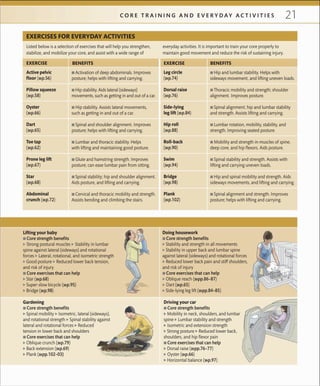
Listed below is a selection of exercises that will help you strengthen,
stabilize, and mobilize your core, and assist with a wide range of
everyday activities. It is important to train your core properly to
maintain good movement and reduce the risk of sustaining injury.
22 I N T R O D U C T I O N
CORE TRAINING AND POSTURE
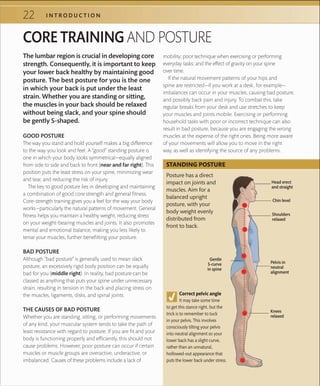
GOOD POSTURE
The way you stand and hold yourself makes a big difference
to the way you look and feel. A “good” standing posture is
one in which your body looks symmetrical—equally aligned
from side to side and back to front (near and far right). This
position puts the least stress on your spine, minimizing wear
and tear, and reducing the risk of injury.
The key to good posture lies in developing and maintaining
a combination of good core strength and general fitness.
Core-strength training gives you a feel for the way your body
works—particularly the natural patterns of movement. General
fitness helps you maintain a healthy weight, reducing stress
on your weight-bearing muscles and joints. It also promotes
mental and emotional balance, making you less likely to
tense your muscles, further benefitting your posture.
BAD POSTURE
Although “bad posture” is generally used to mean slack
posture, an excessively rigid body position can be equally
bad for you (middle right). In reality, bad posture can be
classed as anything that puts your spine under unnecessary
strain, resulting in tension in the back and placing stress on
the muscles, ligaments, disks, and spinal joints.
THE CAUSES OF BAD POSTURE
Whether you are standing, sitting, or performing movements
of any kind, your muscular system tends to take the path of
least resistance with regard to posture. If you are fit and your
body is functioning properly and efficiently, this should not
cause problems. However, poor posture can occur if certain
muscles or muscle groups are overactive, underactive, or
imbalanced. Causes of these problems include a lack of
mobility; poor technique when exercising or performing
everyday tasks; and the effect of gravity on your spine
over time.
If the natural movement patterns of your hips and
spine are restricted—if you work at a desk, for example—
imbalances can occur in your muscles, causing bad posture,
and possibly back pain and injury. To combat this, take
regular breaks from your desk and use stretches to keep
your muscles and joints mobile. Exercising or performing
household tasks with poor or incorrect technique can also
result in bad posture, because you are engaging the wrong
muscles at the expense of the right ones. Being more aware
of your movements will allow you to move in the right
way, as well as identifying the source of any problems.
The lumbar region is crucial in developing core
strength. Consequently, it is important to keep
your lower back healthy by maintaining good
posture. The best posture for you is the one
in which your back is put under the least
strain. Whether you are standing or sitting,
the muscles in your back should be relaxed
without being slack, and your spine should
be gently S-shaped.
Shoulders
relaxed
Pelvis in
neutral
alignment
Head erect
and straight
Correct pelvic angle
It may take some time
to get this stance right, but the
trick is to remember to tuck
in your pelvis. This involves
consciously tilting your pelvis
into neutral alignment so your
lower back has a slight curve,
rather than an unnatural,
hollowed-out appearance that
puts the lower back under stress.
Chin level
Knees
relaxed
Posture has a direct
impact on joints and
muscles. Aim for a
balanced upright
posture, with your
body weight evenly
distributed from
front to back.
STANDING POSTURE
Gentle
S-curve
in spine
23C O R E T R A I N I N G A N D P O S T U R E
The day-to-day compressional pressure of gravity on your
spine can affect posture in the long term, which is why it is
important to use your core to stand tall and sit up straight.
GOOD SITTING POSTURE
Sitting for prolonged periods of time can trigger pain in
your lower back because sitting places a greater strain
on your spine than standing or walking. Adopting a good
sitting position is not difficult and will reduce the stress
you place on your back.
A good sitting position does not require you to sit up
straight for long periods—you must relax in order to avoid
straining your muscles. Anyone attempting to sit bolt
upright will gradually slip into a relaxed, slouched position.
Practitioners of postural education methods such as the
Alexander Technique encourage people to find just the right
amount of curve in their neck, midback, and lower-back.
If you use a desk for long periods of time, sit in a well-
designed chair, set up your workstation to avoid stretching
or straining, and try to take regular breaks. At home, choose
a comfortable chair with enough space to let you change
your position and move around while watching television
or reading. You can also place cushions behind your lower
back to support your spine.
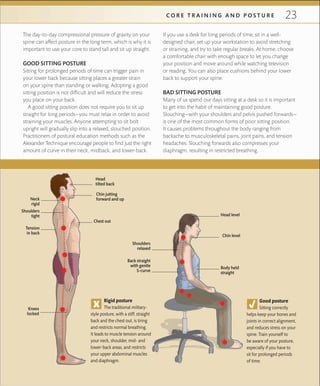
BAD SITTING POSTURE
Many of us spend our days sitting at a desk so it is important
to get into the habit of maintaining good posture.
Slouching—with your shoulders and pelvis pushed forwards—
is one of the most common forms of poor sitting position.
It causes problems throughout the body ranging from
backache to musculoskeletal pains, joint pains, and tension
headaches. Slouching forwards also compresses your
diaphragm, resulting in restricted breathing.
Chest out
Tension
in back
Shoulders
tight
Knees
locked
Head
tilted back
Chin jutting
forward and upNeck
rigid
Good posture
Sitting correctly
helps keep your bones and
joints in correct alignment,
and reduces stress on your
spine. Train yourself to
be aware of your posture,
especially if you have to
sit for prolonged periods
of time.
Chin level
Head level
Shoulders
relaxed
Back straight
with gentle
S-curve
Body held
straight
Rigid posture
The traditional military-
style posture, with a stiff, straight
back and the chest out, is tiring
and restricts normal breathing.
It leads to muscle tension around
your neck, shoulder, mid- and
lower-back areas, and restricts
your upper abdominal muscles
and diaphragm.
24 I N T R O D U C T I O N
THE IMPORTANCE OF CORRECT HIP PLACEMENT
The pelvis is the key weight-bearing center of your body.
Not only does it support your spine and head but it is also
the vital link between your upper body and your legs. Any
movements you make with your pelvis trigger movements
in your spine: tilting your pelvis backward and forward
creates spinal flexion and extension, while moving from side
to side and twisting causes side flexion and spinal rotation.
Establishing and maintaining correct hip placement are
therefore important to the alignment of your spine as well
as to your overall core strength. Most everyday activities
and sports involve a combination of movements across
your body and maintaining correct hip placement will
enable you to perform these with good posture and form,
thus reducing pressure on your spine and your risk of injury.
NEUTRAL HIP AND SPINAL ALIGNMENT
When your pelvis is in a “neutral” position, the front hip
bones are horizontally aligned to one another and vertically
aligned with the pubic bone, so the pelvis should neither be
tilted forward or backward, nor rotated. This is the most even
balanced position for the pelvis, in relation to your spine
and thigh bones, providing a stable base for your body to
move. This is therefore an ideal starting position for most
movements that will encourage correct spinal alignment and
balance the joints and muscles that support it.
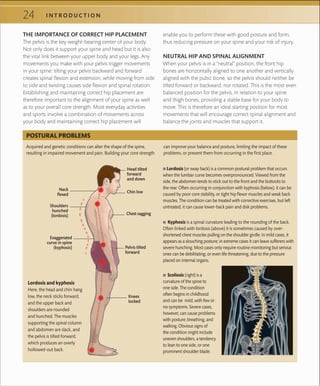
Exaggerated
curve in spine
(kyphosis)
Head tilted
forward
and down
Neck
flexed
Pelvis tilted
forward
Chest sagging
Knees
locked
 ■ Lordosis (or sway back) is a common postural problem that occurs
when the lumbar curve becomes overpronounced. Viewed from the
side, the abdomen tends to stick out to the front and the buttocks to
the rear. Often occurring in conjunction with kyphosis (below), it can be
caused by poor core stability, or tight hip flexor muscles and weak back
muscles. The condition can be treated with corrective exercises, but left
untreated, it can cause lower-back pain and disk problems.
 ■ Kyphosis is a spinal curvature leading to the rounding of the back.
Often linked with lordosis (above) it is sometimes caused by over-
shortened chest muscles pulling on the shoulder girdle. In mild cases, it
appears as a slouching posture; in extreme cases it can leave sufferers with
severe hunching. Most cases only require routine monitoring but serious
ones can be debilitating, or even life threatening, due to the pressure
placed on internal organs.
 ■ Scoliosis (right) is a
curvature of the spine to
one side. The condition
often begins in childhood
and can be mild, with few or
no symptoms. Severe cases,
however, can cause problems
with posture, breathing, and
walking. Obvious signs of
the condition might include
uneven shoulders, a tendency
to lean to one side, or one
prominent shoulder blade.
Shoulders
hunched
(lordosis)
Chin low
Acquired and genetic conditions can alter the shape of the spine,
resulting in impaired movement and pain. Building your core strength
can improve your balance and posture, limiting the impact of these
problems, or prevent them from occurring in the first place.
POSTURAL PROBLEMS
Lordosis and kyphosis
Here, the head and chin hang
low, the neck sticks forward,
and the upper back and
shoulders are rounded
and hunched. The muscles
supporting the spinal column
and abdomen are slack, and
the pelvis is tilted forward,
which produces an overly
hollowed-out back.
25C O R E T R A I N I N G A N D P O S T U R E
ACTIVATING YOUR CORE
Learning how to achieve a neutral hip and spinal alignment, and to
engage or “switch on” the muscles of your core, are crucial first steps to
developing a strong and stable foundation for core training. Engaging
your core effectively means activating and controlling the muscles that
make up your “abdominal cylinder.” The two key muscles to learn to
control are your pelvic floor and your transverse abdominis.
Lie on your back with your hands on your lower stomach, making
the shape of a triangle with your thumbs and index fingers. Allow your
weight to press down through your tailbone. When your pelvis is in
neutral, your hands will be level and the lumbar spine in a neutral curve.
The pelvis is the base support of your body and supports your
spine. For optimum movement your pelvis should be in a “neutral”
position—that is the most balanced position possible. A neutral
pelvis will help to align your spine, improve posture, and provide
a stable platform for all of your body’s movements.
Your transverse abdominis muscle is the deepest
layer of your abdominals. Wrapping around your
midsection like a corset, it forms the front wall of
of your abdominal cylinder, stabilizing your lower
back and pulling in the lower abdominal wall.
Learning to activate and control your transverse
abdominis is a vital component of good core
strength. The first step in this process is to
learn how to locate, or feel, where it is.
Once you have located your transverse abdominis muscles (left),
the next stage involves learning to activate and control it, in order
to give you a good base for all other core strength exercises. The key
is to focus on drawing your navel toward your spine, hollowing your
stomach and tightening your waistline. You should aim to contract
the muscle so that it feels solid and stable, but not overly tensed.
Stand up straight with your back in a neutral
position, with your hands forming a triangle
over the front of your pelvis. Cough strongly.
You will feel your transverse abdominis move
beneath your fingers. Next, breath in and out.
You will feel the muscle contract as you do so.
ACTIVATING YOUR TRANSVERSE ABDOMINISLOCATING YOUR TRANSVERSE ABDOMINIS
Your pelvic floor muscles form the base of your abdominal cylinder.
In addition to their primary role in controlling urination and
elimination of feces from your body, they also help you activate
your transverse abdominis and other core stabilizers. Learning to
control these muscles is therefore key to core strength.
ACHIEVING NEUTRAL PELVIS AND SPINAL ALIGNMENT
Lie on your back with your spine in a neutral position. Gently press
the small of your back into the floor and tilt your pubic bone upward.
Contract the muscles that help you control the flow of passing urine.
Repeatedly tense and release these muscles 10–20 times then relax.
ACTIVATING YOUR PELVIC FLOOR MUSCLES
Point your fingers
toward your
pubic bone
Place your hands
in a triangle
Aim for around 10–20
pelvic floor contractions
Lie facedown on a mat with a rolled-up towel beneath your head,
arms beside you, pointing forward, palms down, your elbows bent
at right angles. Draw your abdomen toward your spine in a slow
controlled movement, hollowing your middle while keeping your
hips and legs relaxed. Aim to contract your transverse abdominis
around a third of the way in, so that it feels strong and stable.
Draw your abdomen
in and upwards
towards your spine
26 I N T R O D U C T I O N
CORE TRAINING AND SPORTS
Core training is important for sports, because
all sports involve core-based movements of
one form or another. Because training your
core helps your mobility, stability, and strength
(»pp.18–19), it will increase the power,
efficiency, and consistency of the movements
you make, while improving your stability and
balance, and reducing your chances of injury.
Strengthening your core helps stabilize your spine and pelvis.
This provides a stronger platform for all of the movements
you make, increasing your body’s efficiency in transferring
power to your limbs. In running, for example, it can help
prevent the forward or backward rotation of your pelvis,
which is important because an awkward running gait will
cost you speed and increase the chances of injury.
Meanwhile, in sports that involve throwing movements, such
as hammer, shot put, discus, javelin, and fielding in baseball
or cricket, the efficient transfer of power to your throwing
arm is especially important. Core strength also improves the
consistency of your movements because it gives your limbs a
stable base from which to work. This is particularly important
in sports such as golf and tennis, in which the ability to
repeat a movement consistently over the course of a match
has a direct bearing on the outcome.
CORE STRENGTH AND BALANCE
Training your core also improves your balance. Most
sports—especially team sports that involve running on an
uneven pitch—involve movements that are unbalanced. To
combat this, sports coaches will use a range of drills and
exercises that combine unexpected and varying levels of
resistance, with different directions of movement—forward,
backward, lateral, and vertical. They may also incorporate
unstable surfaces in training, using equipment such as
stability disks or suspension bodyweight straps (»pp.32–33).
CORE STRENGTH AND INJURY
Ensuring you have a well developed and balanced core will
help create a strong kinetic chain (»pp.10–11), resulting
in all parts of your body working in harmony to improve
your performance and achieve your desired goals, while
also reducing your chances of muscular imbalances, which
can cause both little twinges and more serious injuries.
WHICH CORE EXERCISES ARE BEST FOR MY SPORT?
All sports are different and when designing your own core-
training program, you should first analyze the movements
that occur in your sport and train your core accordingly.
Sports that require a lot of agility, such as soccer, gymnastics,
or snowboarding, will require multiplane core exercises,
whereas sports such as cycling, kayaking, or bobsled will not.
However, most athletes will benefit from training the core in
all planes of motion to some degree, which helps stabilize
the pelvis and spine, which is important for all sports. The
extent to which you train these planes is dependent on
program design and the amount of time you are able to
train. For more information see the sports-specific section
(»pp.194–97).
All body movements occur along three planes—sagittal
(vertically forward and backward), frontal (vertically side to
side), and transverse (horizontally)—with stabilization used
to describe a stationary position.
PLANES OF MOVEMENT
Sagittal plane
Frontal plane
Transverse
plane
27C O R E T R A I N I N G A N D S P O R T
 ■ Plane of movement: Stabilization
 ■ Typical movements: Holding yourself in a fixed position;
resisting an external force, such as a weight or an opponent
 ■ Example exercises: Plank-based exercises
 ■ Exercise benefits: Strengthens and stabilizes your whole core
 ■ Plane of movement: Sagittal
 ■ Typical movements: Bending back to straighten the back
from a bent-over position; the arching of the back
 ■ Example exercises: Back extensions; good mornings
 ■ Exercise benefits: Strengthens and stabilizes your back
 ■ Plane of movement: Sagittal
 ■ Typical movements: Bending forward or bending over;
moving to sit or stand from a prone position
 ■ Example exercises: Sit-ups and crunches
 ■ Exercise benefits: Strengthens and stabilizes your
ribcage and pelvis
 ■ Plane of movement: Transverse
 ■ Typical movements: Turning movements; rotating from the waist
 ■ Example exercises: Pulley chops and lifts; super-slow bicycles
 ■ Exercise benefits: Improves your rotational strength and your
ability to resist external rotational forces
In this book we have divided core-based movements into five main
categories: isometric; flexion; extension; side flexion; and rotation.
A sixth type, known as complex, represents a movement combining
two or more of the other movements. Movements in most sports
could be described as complex, but some examples of the main ones
are listed below.
CORE MOVEMENTS AND SPORT
MOVEMENT CHARACTERISTICS
 ■ Plane of movement: Frontal
 ■ Typical movements: Bending from side to side from the waist;
reaching overhead to either side
 ■ Example exercises: Windmills; side bends
 ■ Exercise benefits: Stabilizes your pelvis and improves posture
 ■ Movement plane: Multiplane
 ■ Typical movements: Combination actions that include
two or more of those core movements detailed above
 ■ Example exercises: Medicine ball chops; Turkish get-ups
 ■ Exercise benefits: Combines the benefits of the movements
Isometric
Flexion
Extension
Side Flexion
Rotation
Complex
SPORTS SUCH AS…
 ■ Boxing
 ■ Soccer
 ■ Wrestling
 ■ Gymnastics
 ■ Ice hockey
 ■ Rowing
 ■ Rugby
 ■ American football
 ■ Netball
 ■ Judo
 ■ Football
 ■ Bicycling
 ■ Volleyball
 ■ Wrestling
 ■ High jump
 ■ Gymnastics
 ■ Swimming
 ■ Weightlifting
 ■ Basketball
 ■ Pole vaulting
 ■ Climbing
 ■ Skiing
 ■ Snowboarding
 ■ Martial arts
 ■ Squash
 ■ Golf
 ■ Baseball
 ■ Softball
 ■ Shot put
 ■ Badminton
 ■ Hammer
 ■ Canoeing
 ■ American football
 ■ Basketball
 ■ Tennis
 ■ Skiing
 ■ Soccer
 ■ Martial arts
28 I N T R O D U C T I O N
CORE TRAINING AND PREGNANCY
During pregnancy, many changes will happen to your body.
Those that affect your spine, shoulder, and pelvic stability
will all have an impact on posture and core strength. If this is
your first pregnancy, you are particularly vulnerable to back
pain and injury, as well as a reduced sense of balance as the
developing baby gets bigger. Hormone imbalances lead to an
increase in the elasticity of connective tissues, causing joint
instability. Focus on stability and postural strength, and be
Core training during pregnancy can help
improve strength, stability, mobility, and
balance, all of which may contribute to
an expectant mother’s overall sense of
wellbeing. It will also help relieve back
tension and accelerate the recovery of
the abdominal muscles after birth.
PREGNANCY AND POST-PREGNANCY CORE-STRENGTH TRAINING
 ■ In the late stages of pregnancy the growth of the baby will start to
place pressure on your lower abdomen and shift your center of gravity,
altering core balance and postural alignment. Freedom to perform
everyday tasks will become restricted due to the size of your abdomen.
 ■ General changes that may occur include back pain and shoulder
stiffness; fatigue; shortness of breath; sciatica; hemorrhoids; and
Braxton Hicks contractions (false labor pain).
 ■ As your uterus becomes heavier to make room for the baby,
your abdomen expands and your belly becomes more prominent.
 ■ This results in a decreased degree of movement and spinal
flexibility. Lying flat on your back may become uncomfortable.
 ■ General changes may include increased energy levels;
abdominal discomfort; constipation; heartburn; and back pain.
 ■ Months of inactivity and overstretched stomach muscles will weaken
the abdominals, leaving new mothers prone to back pain or injury,
especially if the diastasis recti (Warning box, top right) is enlarged.
 ■ Loss of core strength and balance is inevitable, and stability exercises
will play an important part in recovering your prepregnancy strength.
 ■ If you have a cesarean section, you must seek your doctor’s approval
before you start exercising again because cesarian sections involve
cutting through the abdominal muscles.
 ■ Considered to be the most delicate stage of pregnancy, this is when
most of the changes to your body start to take place.
 ■ General changes include an increased metabolic rate; adjustments
in hormone levels; fluctuations in mood or emotion; nausea; fatigue
or predisposition to clumsiness; decreased blood pressure; pelvic
changes; and slight weight gain.
 ■ Exercises that place further pressure on your
lower abdomen may lead to incontinence.
(Pelvic floor activation (»p.56) may counteract
this effect.)
 ■ Avoid lying on your back for prolonged periods
of time. Compression on the vena cava may
reduce blood flow to the placenta resulting in
supine hypotensive syndrome—symptoms include
dizziness and nausea.
 ■ Increased estrogen, progesterone, and
relaxin levels cause ligaments and connective
tissues to soften and relax, potentially leading
to joint instability.
 ■ Lumbar spine flexion will be reduced as your
abdomen gets larger, so try to minimize bending
from your lower back.
 ■ Avoid exercises that test lumbar rotation stability
and side bends that overextend the spine.
 ■ Exercising immediately after birth. Usually you
can begin exercising your core six weeks after birth
but get clearance from a doctor or nurse
practitioner first. A diastasis recti check will decide
if core training is safe to begin.
 ■ Avoid spine flexion exercise, such as crunches,
if an enlarged diastasis recti (Warning box,
top right) is present.
 ■ An enhanced metabolic rate may cause a
significant increase in internal core temperature.
In extreme cases, this can lead to fetal
hyperthermia (the fetus overheating).
 ■ Isometric exercises, such as the plank,
increase core temperature. You can perform
modified versions of them, but relax and
breathe evenly throughout.
STAGE WHAT TO EXPECT
First trimester
(0–12 weeks)
Second trimester
(13–26 weeks)
Third trimester
(27–40 weeks)
Post-pregnancy
(6+ weeks after
birth)
THINGS TO WATCH OUT FOR
29C O R E T R A I N I N G A N D P R E G N A N C Y
careful not to overwork or overstretch the joints of your
spine and hips. Pilates or a specially-designed core training
programme (»pp.182–85) can help, but always seek the
guidance of your doctor or midwife before you begin. The
benefits of core-strength training during pregnancy include:
 ■ strengthening the muscles of your pelvic floor, transverse
abdominis, hips, and lower back to assist with delivery
 ■ increasing hip and spinal stability
 ■ relieving back pain and tension
 ■ reducing neck and shoulder tension
 ■ accelerating the recovery of core muscles after birth
 ■ Knee fold (»pp.60–61)
 ■ Dart (»p.65)
 ■ Star (»p.68)
 ■ Child’s pose (»p.52)
 ■ Pillow squeeze (»p.58)
 ■ Heel slide (»p.59)
 ■ Shoulder rotation (»p.47)
 ■ Oyster (»p.66)
 ■ Cat stretch (»p.168)
 ■ Toe tap (»p.62)
 ■ Dorsal raise (»p.76)
 ■ Plank (»pp.102–03)
ADDITIONAL EXERCISES
 ■ Core-training exercises that help
prepare for the delivery.
 ■ Strengthening your core and hip stability.
Practice the four-point kneeling position,
with your hands placed on the floor in front
of you. This will encourage your baby into
the correct position. Superman exercises
(»pp.70–71) will also help with this.
 ■ Core stability, especially of your hips
and lumbar spine. Pillow squeezes
(»p.58) and bridges (»p.98) are
particularly good exercises for this.
 ■ Pelvic floor activation to help
support the position of the baby.
 ■ Strengthening your pelvic floor, abdominal
muscles, and improving your posture.
 ■ Stability exercises, because you will still
have increased levels of relaxin for months
after the birth.
 ■ Activation and foundation level exercises,
before gradually building up core strength
over a period of about nine months.
 ■ Pelvic floor education. This is crucial in
pregnancy. It is advisable to start activating
the pelvic floor as soon as possible.
 ■ Deep abdominal stability to strengthen
your back and improve your balance.
 ■ Exercises such as the dart (»p.65) to
promote shoulder stability and alignment.
FOCUS ON
 ■ Active pelvic floor (»p.56)
Improves core and hip stability throughout pregnancy.
Also helps maintain urinary and bowel continence
in the later stages of pregnancy, and aids in
preparation for delivery.
 ■ Bridge (»p.98)
Activates and strengthens the muscles of your
lower back and hips, helping to stabilize
your pelvis, improving pregnancy
postures, and even helping
reduce back pain.
 ■ Superman (»pp.70–71)
Improves your core balance, strengthens your
pelvic floor connection and back muscles,
works to stabilize
your hips, and
helps your
baby into the
correct position.
 ■ Prone abdominal hollowing (»p.64)
Builds the strength of the deep abdominal muscles.
Helps in the support of the lower back and
can be a positive influence on the repair
of the diastasis recti (Warning box,
top right).
KEY EXERCISE
Diastasis recti is the separation
that occurs along the center
line, or linea alba, of the rectus
abdominis muscle. A separation
of one or two fingers’ width is
normal, but a gap any greater
than this is a cause for concern.
Performing abdominal (flexion)
exercises with an enlarged
diastasis recti can cause the
rectus abdominis muscle to
strengthen and shorten in the
separated position. This weakens
the abdominal area, causing
lower-back pain or injury and a
possible risk of hernia. If you are
concerned about this condition,
seek advice from a doctor.
WARNING!
30 I N T R O D U C T I O N
ASSESSING YOUR CORE
Regardless of your core-training goals, you
will achieve much more if you think carefully
and strategically about achieving a balanced
training program from the start.
Toe tap (»pp.62–63)
 ■ You should be able to: ▶ perform the exercise
without extension in your lower back.
 ■ If you can’t, you should focus on:
▶ strengthening your abs and back to help
stabilize your lumbar spine with exercises
such as knee folds (»pp.60–61),
darts (»p.65), and supermans
(»pp.70–71).
Abdominal crunch (»pp.72–73)
 ■ You should be able to: ▶ perform the exercise
without flattening your back or tucking your hips.
 ■ If you can’t, you should focus on:
▶ achieving correct hip placement
and lumbar stability with
exercises such as heel slides
(»p.59), reverse curls (»p.75),
and stars (»p.68).
Plank (»pp.102–03)
 ■ You should be able to: ▶ perform the exercise without sagging
through your spine, dropping your hips, or rotating your lower back.
 ■ If you can’t, you should focus on: ▶ strengthening your glutes,
lumbar spine, and deep
abdominals with exercises
such as darts (»p.65),
supermans (»p.70),
and bridges (»p.98).
Swim (»p.94)
 ■ You should be able to: ▶ maintain your spine and hip alignment
without rotating your body, while moving your arms and legs.
 ■ If you can’t, you should focus on: ▶ stabilizing and strengthening
the muscles of your lower back, deep abdominals, and glutes
with exercises
such as stars (»p.68),
supermans (»pp.70–71),
and planks (»pp.102–03).
Side-lying leg lift (»pp.84–85)
 ■ You should be able to: ▶ keep your spine stationary and aligned.
 ■ If you can’t, you should focus on: ▶ strengthening your lumbar
spine and glutes against side flexion and
rotational forces with exercises
such as supermans
(»pp.70–71), side bends
(»p.81), and heel
reaches (»p.82).
Hip roll (»pp.88–89)
 ■ You should be able to: ▶ perform the exercise
without rotating your upper body.
 ■ If you can’t, you should focus on:
▶ stabilizing your lumbar spine and
strengthening your abs with
supermans (»pp.70–71), oblique
reaches (»pp.86–87), and
super-slow bicycles (»p.95).
Bridge with knee lift (»p.99)
 ■ You should be able to: ▶ keep your spine aligned
without rotating or dropping your hips.
 ■ If you can’t, you should focus on:
▶ strengthening your glutes, lower back,
and deep abdominals with exercises
such as oysters (»p.66),
prone leg lifts (»p.67),
and planks (»p.102).
Leg circle (»p.74)
 ■ You should be able to: ▶ keep your spine and hips
aligned while moving your leg.
 ■ If you can’t you should focus
on: ▶ strengthening your deep
abdominals, internal obliques,
and deep glutes with exercises
such as oysters (»p.66), stars
(»p.68), and horizontal balances (»p.97).
The following exercises challenge your core in a variety of ways, and
can be used as a basic assessment of your core strength. Ask a partner
to observe you and judge your form throughout, identifying any
movements you are unable to carry out with good technique. To
resolve any areas of weakness, you should practice the recommended
exercises, repeating the test regularly to gauge your improvements.
The first step of your training should be to perform an
assessment of your core. This will help you identify
any areas that require improvement, so you can target
weaknesses and structure your training accordingly.
CORE STRENGTH ASSESSMENT
31D E V E L O P I N G Y O U R C O R E
The primary purpose of the core is to provide
mobility, stability, strength, and balance to the
midsection of your body. This creates a more
stable and powerful platform for movement
throughout the rest of your body.
DEVELOPING YOUR CORE
Developing core strength is a gradual process. All of
the exercises in this book are designed to test your
strength at the same time as you develop it, and, as
your training progresses, you will notice an improvement
in your performance. Be patient in your approach to
training, in order to build a solid base of core strength
before you attempt any more advanced exercises.
ACTIVATING YOUR CORE
The first stage of your core training should involve
learning how to engage your key core muscles and
achieve a neutral pelvic position (»p.25). You should
then focus on “activating” your core using the exercises
in the Activation section of this book (»pp.56–71). At
first you should work on the core in isolation, then start
to incorporate it into more challenging movements. At this
stage, you should keep your training simple—do not be
tempted to push yourself too far, too quickly.
FOUNDATION-LEVEL CORE TRAINING
Once you have learned to activate your core, you can
progress to a selection of simple bodyweight exercises,
in which movement is limited to a single plane of motion
such as side to side, or forward and backward. These are
the exercises most people traditionally think of in relation
to core training and include sit-ups, back extensions, and
planks. Remember, even as you reach an intermediate level
of training, the simplest program is usually the best.
INTERMEDIATE AND ADVANCED CORE TRAINING
When you have achieved a basic level of core stability
and strength, you can move to more complex single and
multiplane exercises using instability equipment, such
as exercise balls, and weights to increase the difficulty of
your program. These exercises should be used to test your
core to its maximum ability and include medicine ball slams,
kettlebell swings, and suspended bodyweight crunches.
TESTING YOUR CORE
Depending on which core muscles you want to train, you
first have to know which movements you perform regularly
and which muscles are active during these movements.
This knowledge and understanding will help you to design
a balanced program that incorporates all core muscles and
movement types to maintain a strong and balanced core.
The exercises in this book have been awarded a difficulty level
of 1–10, according to the following definitions. You should aim to
progress through Levels 1–4 (Activation and Foundation) before
you move on to Level 5–10 (Intermediate and Advanced) because it
is crucial to have a good general level of core strength before you
attempt complex, multtjoint movements.
Basic-level exercises that ”wake up”
the muscles of the core
Exercises using bodyweight only
Bodyweight exercises with limb movement,
and/or varied speed of movement
Isometric exercises
Loaded exercises and isometric
exercises with limb movements
Power exercises and suspended
bodyweight exercises
Isometric and complex exercises
requiring good core strength
Exercises involving external weight
and full-body extension
Cable-based exercises with added instability
Challenging exercises utilizing all movement
types. (These require excellent core and full body
strength and should not be attempted by novices.)
Activation
Level 1
Foundation
Level 2
Level 3
Level 4
Intermediate
Level 5
Level 6
Level 7
Advanced
Level 8
Level 9
Level 10
DEFINITION OF DIFFICULTY LEVELS
32 I N T R O D U C T I O N
PROGRESSING EXERCISES WITH WEIGHT
You can make an exercise more challenging by adding
weight to the movement with equipment such as a medicine
ball, kettlebell, or dumbbell. Extra weight increases the force
the active or “working” muscles are required to produce—in
other words, the heavier the weight, the harder the exercise.
However, you should never increase weight at the expense
of your form or technique, because this will only increase
your chances of sustaining an injury. You should only add
weight, therefore, once you can first perform the basic body
weight exercises with good form for several reps and sets.
When adding weight, you should aim to increase the load
in increments of around 2.2–4.4lb (1–2kg) at a time to allow
your body to adapt. Jumping from a 4.4lb (2kg) kettlebell
to one weighing 22lb (10kg), for example, will stress your
muscles and joints beyond their comfortable working ability.
PROGRESSING EXERCISES WITH INSTABILITY
In most cases, you will first perform the basic version of an
exercise on the floor or a stable surface, such as a weight
bench. Once you have mastered this basic movement,
however, you can make it harder by gradually increasing
the level of instability. This may involve adjusting your body
position to remove the support of your arms or legs, or
reducing the stability of the surface bearing your weight
by using a piece of gym equipment such as a stability disk
or an exercise ball. The unstable surface makes your core
work harder or in a slightly different way to keep your body
balanced. The table on the right ranks common pieces
of equipment in increasing instability to help you decide
what to use. It is important to note that the most effective
way of progressing exercise is sometimes achieved by
increasing instability, rather than by adding weight.
When adding instability to make an exercise harder (as in many of
the progressions included in this book), it is useful to think in relative
terms—for example, whether one piece of equipment offers more or
less instability and freedom of movement than another. The following
list offers a number of options in order of increasing instability (the
most stable at the top) to help you to assess and choose the
appropriate exercise progression.
CORE TRAINING AND INSTABILITY
 ■ 1 Fixed bodyweight
 ■ 2 Fixed single leg or arm
 ■ 3 Stability disk
 ■ 4 Wobble board
 ■ 5 Half exercise ball
 ■ 6 Exercise ball
 ■ 7 Suspended bodyweight straps
“FUNCTIONAL” CORE TRAINING
Instability training is sometimes referred to as “functional
training”. The basic premise of functional training is that
performing an exercise on a less stable base not only
requires more work to be done by the primary working
muscles you are targeting, but it also brings into play a
number of other muscles to help to control and to stabilize
the movement. These muscles are known as neutralizers
and fixators (or stabilizers), and include both the core
muscles and the smaller muscles of the limbs.
It is important to remember that these smaller, stabilizing
muscle groups tire more quickly than the primary working
ones, meaning that less force can be applied to them, and
less work completed by them. Instability training is therefore
not appropriate for strengthening a single muscle group to its
maximum, as this will lead to under-performance and reduced
gains in strength. Instead, it is designed to train the body as
a whole, strengthening and harmonising the kinetic chain
(»pp.10–11) to maximize performance and reduce the risk of
injury. Your core muscles help to stabilize your spine, ensuring
the efficient transfer of strength and stability to your limbs
during movements. It is this that will give you the combination
of strength, stability, and mobility required to perform some of
the more challenging core exercises in this book, such as
hanging toe tucks (»p.150), Turkish get-ups (»pp.156–57),
and wall walks (»pp.164–65).
EQUIPMENT FOR CORE TRAINING
There are numerous pieces of equipment
that you can use to increase the difficulty
of exercises by adding weight or instability.
However, it is important for you to master
each of the basic movements first to ensure
you are using the correct core muscles, before
incorporating some weighted and unstable
progressions into your core-training regimen.
33E Q U I P M E N T F O R C O R E T R A I N I N G
Wobble board
 ■ A platform designed to tilt in any
direction. It offers less stability than
a half exercise ball, because the
“ball” on the underside is smaller
and made of a hard material.
Stability disk
 ■ A cushion-sized inflatable disk
that can be inflated/deflated to
the required thickness to provide
a simple unstable platform for
basic instability exercises.
Half exercise ball
 ■ This combines half of a small
inflatable ball with a hard platform.
You can use the device as a support
on both sides, but using it ball side
down creates greater instability.
Exercise ball
 ■ A large inflatable ball that rolls in
all directions, and therefore offers
very little stability. Choose one with
a diameter roughly the same as the
length of your arm.
Box
 ■ A simple stable platform that
comes in various sizes. It can be
used to add height to dynamic
exercises, or raise supporting
limbs to increase instability.
Foam roller
 ■ A cylinder of dense foam, the
roller can be used to perform
self-massage on tight muscles,
and also as an unstable base that
moves backward and forward.
Kettlebell
 ■ A cannonball-shaped weight
with a different center of gravity
from a dumbbell. It can be held
in one or both hands, and used
for dynamic strength exercises.
Weight disk
 ■ These are usually added in pairs
to barbells and dumbbells, but
can also be used as a hand-held
weight, or as a weighted object
to be pushed along the ground.
Medicine ball
 ■ A soccer-sized, weighted
ball that may come with or
without handles. It is primarily
used for exercises that build
dynamic strength and power.
Barbell/Dumbbell
 ■ The most common forms of
weights for strength training,
barbells are designed to be
lifted with both hands, and
dumbbells with one.
Roman chair
 ■ A piece of equipment that is
used to hold the feet and legs
in position in order to isolate
and work the muscles of the
lower back and glutes.
GHD
 ■ Similar to the Roman chair, the
GHD (glute-hamstring developer)
fixes your limbs in place to target
the muscles of your lower back,
glutes, and hamstrings.
Slide board
 ■ Slide boards are usually used in
pairs to add an element of lateral
instability, because they can slip
along the floor in all directions
when weight is placed on them.
Bodyweight suspension strap
 ■ Fixed to a stable rack or bar,
these straps suspend your arms
or legs in the air, removing their
support to increase the instability
of an exercise.
EQUIPMENT THAT ADDS WEIGHT
OTHER EQUIPMENT
EQUIPMENT FOR EFFECTIVE CORE TRAINING
EQUIPMENT THAT ADDS INSTABILITY
CORE-TRAINING
EXERCISES
V I S U A L E X E R C I S E D I R E C T O R Y36
VISUAL EXERCISE DIRECTORY
ACTIVATION
EXERCISES
Active Pelvic Floor
»pp.56–57
Pillow Squeeze
»p.58
Knee Fold
»pp.60–61
Heel Slide
»p.59
FOUNDATION
EXERCISES
Star
»p.68
Back Extension
»p.69
Superman
»pp.70–71
Abdominal Crunch
»pp.72–73
Leg Circle
»p.74
Side Bend
»p.81
Heel Reach
»p.82
Roman Chair Side Bend
»p.83
Side-lying Leg Lift
»pp.84–85
Oblique Reach
»pp.86–87
Swim
»p.94
Super-slow Bicycle
»p.95
Sprinter Sit-up
»p.96
Horizontal Balance
»p.97
Bridge
»pp.98–99
V I S U A L E X E R C I S E D I R E C T O R Y 37
Toe Tap
»pp.62–63
Prone Abdominal
Hollowing »p.64
Oyster
»p.66
Dart
»p.65
Prone Leg Lift
»p.67
Reverse Curl
»p.75
Dorsal Raise
»p.76–77
Oblique Crunch
»p.79
Sit-up
»p.78
Side-lying Lateral Crunch
»p.80
Hip Roll
»pp.88–89
Roll-back
»p.90
V Leg Raise
»p.92
Roll-up
»p.91
V Sit-up
»p.93
Double Leg Lower
and Lift »pp.100–01
Plank
»pp.102–03
Single-leg Extension
and Stretch »p.106
Side Plank
»pp.104–05
Double-leg Extension
and Stretch »p.107
V I S U A L E X E R C I S E D I R E C T O R Y38
INTERMEDIATE
EXERCISES
Exercise Ball
Roll-out »pp.132–33
Suspended Crunch
»p.134
Suspended Oblique
Crunch »p.135
Medicine Ball Chop
»p.136
Lawnmower
»p.137
Medicine Ball
Reverse Throw
»p.121
Ball Back Extension
»p.122
Medicine Ball Bridge
Rotation »p.123
Wall Side
Throw
»pp.124–25
Suspended Single-arm
Core Rotation »p.126
Pulley Chop
»pp.144–45
Pulley Lift
»pp.146–47
Single-leg, Single-arm
Cable Press »pp.148–49
Hanging Toe
Tuck »p.150
Sandbag
Shouldering »p.151
Plank Plate Push
»pp.152–53
Partner Ball Swap
»pp.108–09
Hanging
Knee-up »p.110
Windmill
»p.111
Good Morning
»pp.112–13
Roman Chair Back
Extension »pp.112–13
V I S U A L E X E R C I S E D I R E C T O R Y 39
ADVANCED
EXERCISES
O-bar
Rotation
»pp.114–15
Standing
Plate Twist »p.116
Kettlebell Round-body
Swing »p.117
Mountain Climber
»p.118
Russian Twist
»p.119
Medicine
Ball Slam
»p.120
Suspended Pendulum
»p.127
Long-Arm Bridge
Pull-over »p.128
Kettlebell
Swing
»p.129
Exercise Ball Knee
Tuck »p.130
Core Board
Rotation »p.131
Stepped
Plank Walk
»pp.154–55
Turkish Get-up
with Kettlebell
»pp.156–57
Exercise Ball Hip
Rotation Kick
»pp.158–59
Slide Board Wiper
»pp.160–61
Raised Pike Dumbbell
Hand-walk »pp.162–63
Wall Walk
»pp.164–65
GHD Sit-up
»p.138
Pike
»p.139
Stick Crunch
»pp.140–41
Exercise Ball Jackknife
»p.142
GHD Back Extension
»p.143
40 C O R E -T R A I N I N G E X E R C I S E S
CORE MOVEMENT DIRECTORY
The chart on the following pages groups exercises in the main
section of this chapter (»pp.56–165) according to their Target
Movement, ranking them in order of Difficulty Level, and
listing the number of progressions for each. You can use this
information in conjunction with the Design Your Own programs
(»pp.186–189) if you are looking for exercises of a specific
movement and level, the Sports-specific chapter (»pp.194–215)
if you are intending to train specific core movements for your
chosen sport, or simply as a general reference to help with
your training. It is important to remember that you should
always train using a selection of exercises from a balanced
range of core movements.
USING THE MATRIX
As you begin to train your core muscles using
the exercises in this section, it is important to
think of each in terms of their core movement,
as well as their level of difficulty. This is a key
part of understanding how your core muscles
work together, and achieving the best
results in your training. Using a balanced
combination of movements will help you
gain excellent overall strength, stability,
and mobility, while reducing the likelihood
of muscular imbalance and injury.
The Core Exercise Matrix on the next few pages is designed
to offer a quick, user-friendly reference to help you locate
the exercises in the book according to their core movement,
along with details of the number of progressions they have.
The six core movements are ordered in the same way
that they appear in the key at the start of the book (»p.9)—
Isometric; Flexion; Extension; Side Flexion; Rotation; and
Complex; the individual exercises are then ordered presented
according to their level of difficulty and page order. It is
important to note that while Isometric exercises come first
and there are more of them than for the other movements,
this does not mean that they are more important. Balance
is the key when you are training your core and you should
always endeavor to combine as many core movements
as you can.
ISOMETRIC
EXERCISES
LEVEL PAGEEXERCISE PROGRESSIONS
1
1
1
1
1
1
1
1
1
1
58
56–57
60–61
59
64
62–63
67
66
70–71
68
2
2
1
—
—
4
—
—
4
—
Pillow Squeeze
Active Pelvic Floor
Knee Fold
Heel Slide
Prone Abdominal
Hollowing
Toe Tap
Prone Leg Lift
Oyster
Superman
Star
CORE EXERCISE MATRIX
41C O R E M O V E M E N T D I R E C T O R Y
98–995Bridge 4
971Horizontal Balance 4
102–036Plank 4
100–013
Double-leg
Lower and Lift
4
117—
Kettlebell Round–
body Swing
5
104–053Side Plank 4
1281
Long–arm Bridge
Pull–over
7
118—Moutain Climber 5
130—Exercise Ball Knee Tuck 7
129—Kettlebell Swing 7
84–851Side–lying Leg Lift 2
741Leg Circle 2
94—Swim 3
154–55—Stepped Plank Walk 10
148–49—
Single–leg, Single–arm
Cable Press
9
1311Core Board Rotation 7
152–53—Plank Plate Push 10
72–736Abdominal Crunch 2
781Sit-up 2
752Reverse Curl 2
91—Roll-up 3
90—Roll–back 2
93—V Sit-up 3
92—V Leg-raise 3
FLEXION
EXERCISES
LEVEL PAGEEXERCISE PROGRESSIONS
42 C O R E -T R A I N I N G E X E R C I S E S
6 120—Medicine Ball Slam
5 110–111Hanging Knee-up
8 139—Pike
8 138—GHD Sit-up
8 142—Exercise Ball Jack-knife
8 140–41—Stick Crunch
10 150—Hanging Toe Tuck
1 651Dart
4 106—
Single–leg Extension
and Stretch
3 96—Sprinter Sit-up
5 108–091Partner Ball Swap
4 1071
Double–leg Extension
and Stretch
LEVEL PAGEEXERCISE PROGRESSIONS
EXTENSION
EXERCISES
6 122—
Exercise Ball
Back Extension
6 121—
Medicine Ball
Reverse Throw
8 143—GHD Back Extension
2 76–772Dorsal Raise
1 69—Back Extension
5 112–13—
Roman Chair
Back Extension
5 112–13—Good Morning
SIDE FLEXION
EXERCISES
LEVEL PAGEEXERCISE PROGRESSIONS
2 82—Heel Reach
2 81—Side Bend
5 110–11—Windmill
2 83—
Roman Chair
Side Bend
2 80—
Side–lying
Lateral Crunch
43C O R E M O V E M E N T D I R E C T O R Y
95—Super–slow Bicycle 3
88–893Hip Roll 2
116—Standing Plate Twist 5
114–15—O–bar Rotation 5
123—Medicine Ball Bridge 6
119—Russian Twist 6
126—
Suspended Single–arm
Core Rotation
6
124–252Wall Side Throw 6
146–473Pulley Lift 9
144–453Pulley Chop 9
791Oblique Crunch 2
86–874Oblique Reach 2
135—
Suspended
Oblique Crunch
7
1341Suspended Crunch 7
137—Lawnmower 7
136—Medicine Ball Chop 7
156–57—
Turkish Get-up
with Kettlebell
10
151—Sandbag Shouldering 10
160–61—Slide Board Wiper 10
158–592
Exercise Ball Hip
Rotation Kick
10
164–65—Wall Walk 10
162–633
Raised Pike Dumbbell
Hand-walk
10
127—Suspended Pendulum 7
132–331Exercise Ball Roll-out 7
COMPLEX
EXERCISES
LEVEL PAGEEXERCISE PROGRESSIONS
ROTATION
EXERCISES
LEVEL PAGEEXERCISE PROGRESSIONS
44 C O R E -T R A I N I N G E X E R C I S E S
Lie on your right side with the roller positioned beneath
your armpit, and place your hands behind your head for
stability. Use your back muscles to roll down from your
armpit to the base of your shoulder blade. Roll back up
and repeat for at least 30 seconds, then switch sides.
Sit on the roller with your right buttock and cross
your right leg over the left leg. Rolling backward and
forward, work on the outside of your buttock before
shifting your weight to the middle of the buttock. Repeat
for at least 30 seconds before switching sides.
Support your
head with
your hands
Keep your
feet flat on
the floor
Feel the stretch
in your right side
Feel the stretch
in your buttock
Cross your
left foot
over your
right foot
Feel the
stretch in your
upper back
With your chin tucked in, slide up and down the
roller, from your neck down to the level of your lowest
ribs, but do not go too low into your lumbar spine. Repeat
the exercise for at least 30 seconds.
Sit with your heels planted on the floor and the roller
beneath the middle of your back. Lie back onto the
roller so that it is just below your shoulder blades. Clasp
your hands together and lightly cradle your head.
LAT ROLLER GLUTE/PIRIFORMIS ROLLER
This exercise helps loosen up the large muscles
of your middle and upper back, reducing tightness,
tension, and muscular pain.
This exercise loosens up the gluteals at the outside
of your buttocks and the piriformis toward the
middle of them.
THORACIC ROLLER
In this exercise, the foam roller acts as a hinge to help
improve the range of motion in your middle and upper
back. It is a good movement to mobilize the muscles
of your neck and back.
Mobility stretches are a key part of any exercise
routine, helping you get the best results and
reducing your risk of injury. They lengthen and
loosen your muscles, increasing your range of
movement and flexibility, and reducing stiffness
and pressure on your disks, ligaments, and facet
joints. When performing the movements, relax
your body, and breathe deeply and rhythmically.
MOBILIZATION
45M O B I L I Z A T I O N
Plant your
feet on
the floor
Support your head
with your hands
Keep your
elbows aligned
Look straight
ahead
Feel the stretch
in your ITB
Feel the
stretch in your
lower back
Use your
forearm
for balance
Sit with your heels planted on the floor and the
roller positioned beneath your lower back. Place
your hands on either side of your head and cradle it
lightly, without putting any strain on your neck.
Lie on your right side with the roller positioned
beneath the outside of your thigh, just below your
hip. Propping yourself up on the right forearm, with
your left hand on your hip, cross your left leg over the
right, placing your left foot flat on the floor for support.
Keeping your head stable, slowly and carefully
slide up and down on the roller, from the
bottom of your ribcage to the top of your pelvis.
Repeat for at least 30 seconds.
Using your right forearm, gently push your body
over the roller so that the outside of your right
thigh slides up and down the roller, as far as your knee.
Slide back the opposite way to your hip. Repeat for at
least 30 seconds, then swap sides.
This exercise loosens your iliotibial band (ITB), the
band of muscular tissue on the outside of your upper
leg, and helps general mobility in your glutes and
TFL/ITB ROLLER
In this exercise, the foam roller works the muscles
of your lumbar spine, helping mobilize your
lower back. A strong lower back is essential for
LUMBAR ROLLER
hip muscles. It also loosens your tensor fasciae
lata (TFL), a muscle in the thigh that is utilized
in sports from hurdling to horseback riding.
all sports, from running to weight lifting, and is
important for anyone who spends a lot of time
working at a desk.
Feel the stretch
in your TFL
C O R E -T R A I N I N G E X E R C I S E S46
Keep your
chin level
Look straight
ahead
Raise your chin
without forcing
it upward
Engage
your core
Look straight
ahead
Keep your
shoulders
and upper
body relaxed
Look straight ahead, keeping
your spine in a neutral position.
Keep the upper body relaxed and
your arms loose by your sides.
Stand upright with your arms by
your sides in a relaxed posture.
Look straight ahead and keep your
spine in a neutral position.
Move your head slowly toward
your right shoulder, without
straining. Turn it as far as is comfortable
and hold for a few seconds.
Extend your neck as far as is
comfortable by slowly raising
your chin so you are looking directly
upward. Hold for a few seconds.
Move your head back through
the starting position toward your
left shoulder, without straining. Return
to the start position.
Flex your neck by letting your
head drop forward without
straining. Hold for a few seconds
and return to the start position.
NECK ROTATION
NECK EXTENSION AND FLEXION
This very simple movement can help ease neck
aches. After a little practice, you should be able to
This simple dynamic stretch, which can be carried
out standing or seated, will help prevent general neck
rotate your neck through at least 70 degrees to each
side without feeling “pulls” or hearing cracking sounds.
stiffness and is useful for sports in which head position
and movement are important.
47M O B I L I Z A T I O N
Keep your
chin raised
Keep your
core tight
throughout
Keep your
chest high
Relax your
shoulders as you
flex your neck
Let your arms
hang loose
Stand upright, holding your
body in a relaxed posture, with
your shoulders loose and your eyes
looking straight ahead.
Let your arms hang loose
by the sides and relax your
shoulders. Keep your head level
and your spine in a neutral position.
Tilt your head so that your
right ear moves toward your right
shoulder as far as is comfortable. Hold
for a few seconds.
Rotate your shoulders forward
and up, raising them slowly
toward your ears.
Flex your neck in the opposite
direction as far as you can go.
Hold for a few seconds and return
to the start position.
Hold the position for a
few seconds, then reverse
the movement backward.
NECK SIDE FLEXION
SHOULDER ROTATION
This is a useful mobility stretch for the muscles of your
shoulders and neck, helping to ease tightness and tension.
This exercise provides an excellent way of freeing up the
muscles and ligaments around your shoulder joints, and
It is also good for mobilizing your spine, and so for
improving your posture.
of warming your trapezius muscles. This is particularly
important before beginning a resistance training session.
48 C O R E -T R A I N I N G E X E R C I S E S
This exercise is a useful rotational
dynamic stretch for mobilizing your
core muscles. Be sure that you keep
your hips stationary throughout.
This is a great mobilizing stretch for
the muscles of your obliques and upper
back. To get the full benefit of the
movement, elongate both sides of
your torso as you reach up, and
avoid leaning forward.
TORSO ROTATION TORSO SIDE FLEXION
Look
straight ahead
Stand with your
feet shoulder-width
apart. Reach up with
your left hand, palm up,
keeping your elbows soft.
Keeping your hips
straight and aligned,
rotate your upper body with a
smooth motion to your right.
Pause at
the edge
of the movement,
then rotate back
through the start
position, keeping
your movement
fluid, not jerky.
Keeping your
back straight and
your core engaged,
stretch your left hand
up and over your
head, reaching down
toward your right foot
with your right hand.
Hold briefly, then
release to return to
the start position.
Repeat as required,
before switching arms.
Keep your
shoulders
relaxed
Stand with
your feet
shoulder-width apart
and your elbows
raised to each side.
Keep
your elbow
slightly bent
Keep your
shoulders aligned
Engage
your core
Continue the movement to
your left side, keeping your hips
and your elbows raised to each side.
Pause at the edge of the movement,
then rotate to the start position.
Feel the stretch in
your left arm and
left side
Maintain hip
position
Rotate from
the hip
49M O B I L I Z A T I O N
This exercise helps improve the rotational mobility of
your upper-back muscles and your thoracic spine,
while also stretching the muscles of your chest.
LYING TRUNK ROTATION
Lie on your left side with your hips,
knees, and feet stacked one above
the other, and your hips and knees
bent at right angles. Extend your arms
straight in front of you, pressing your
palms together.
Keeping your knees and feet together and your hips
stacked, breathe in, brace your abdomen, and reach
upward and back with your right hand, while keeping
your left arm straight and resting on the floor.
Breathing out, rotate your
upper body to face the
ceiling, keeping your hips stacked
and your right arm extended.
Continue the movement until you
are as far back as possible, with your
chest facing upward and your hips still stacked.
Hold the movement briefly, keeping your
shoulders stable and level. Breathe in.
Breathing out, reach back toward the ceiling
with your right arm, while rotating your torso back
toward the start position slowly and under control.
Continue the movement toward the start position
and touch the palms of your hands together.
Repeat the movement as required, then switch sides.
Press your
palms togetherBend your legs
to 90 degrees
Keep your right
arm straight as you
reach upward
Keep your left
hand on the floor
Bring your arm
backwardKeep your hips
stacked throughout
Bring your
palms together
Rotate your
head at the
same time
Rotate your torso
Keep your
feet together
Bring your torso back
to the start position
Keep your
core engaged
Keep your arm aligned
with your shoulders
50 C O R E -T R A I N I N G E X E R C I S E S
LYING WAIST TWIST
This exercise increases the mobility of the
joints and muscles in your lower and upper
back. Perform the same number of repetitions
on both sides of your body.
Placing a folded towel under your head for
extra support, lie on your back with your
body relaxed and your arms loose but extended
at a 90-degree angle from your upper body. Keep
your legs and feet together.
Kneel on all fours with your hands flat on the floor
and in line with your shoulders, your fingers pointing
forward, and your knees below your hips.
Keeping your upper body flat against the mat,
bend your left leg at the knee and bring it
across your body, using your right hand to increase
the stretch, and allowing the right leg to turn and
bend in the same direction.
Round the back upward and pull in your stomach,
letting your head drop down as you do so. Hold
the stretch for a few seconds at the top of the movement.
Relax
your torso
Rotate
your pelvis
Rest your
right leg on
the floor
Keep your
feet together
Keep your
palms flat
on the floor
A great muscle-releasing exercise, this stretch
helps lubricate your spine and get your spinal
disks moving. It is one of the best exercises you
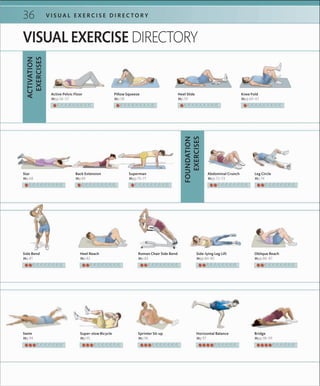
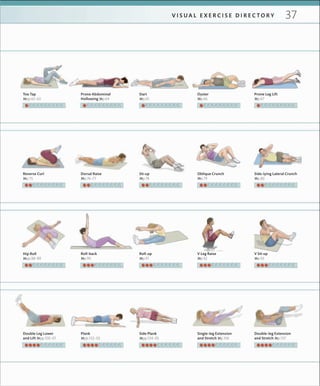
can do as part of a general warm-up.
Bend your
elbows
slightly
Drop
your head
CAT AND CAMEL
In one fluid movement, raise your buttocks and curve
your spine downward while lifting your head so that
you are looking straight ahead. Hold the stretch for a few
seconds, then return to the start position.
Feel the stretch
in your back
Tilt your
pelvis upward
Lift your
head upward
Bend and rotate
your left leg
Hold the stretch for a few seconds, return
to the start position, and switch sides.
51M O B I L I Z A T I O N
Keep your
head upright
Kneel on all fours with your back flat and your neck
in a relaxed position. Position your arms directly
under your shoulders, and bend your hips and knees
at right angles, keeping your feet together.
Supporting your weight with your right hand, reach
under and across your chest with your left hand,
turning your head to look to the right.
THREADING THE NEEDLE
This dynamic stretch is good for mobilizing the
spine and improving your spinal flexibility while
warming up the muscles of your shoulders and
lower back.
Keep your
head in line
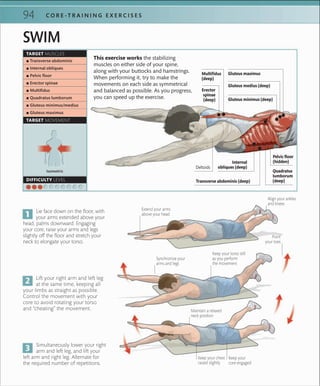
with your back
HIP FLEXOR STRETCH
This stretch is an excellent movement for your hip
flexors, which may be particularly tight if you spend
a lot of time sitting down. Good hip mobility is vital
for balance and posture.
Placing your hands
on your hips, kneel
on your right knee, with
your left foot out in front
of you and your left knee
bent at a right angle,
so that your head is in
line with your right knee.
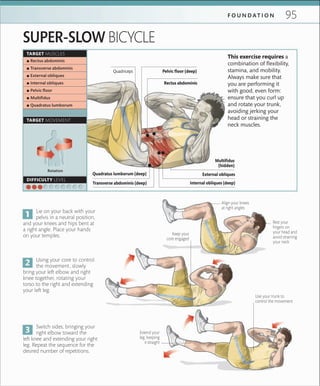
Lean forward,
putting your weight
on your left leg. Feel the
stretch in your right
thigh, and hold briefly
at the edge of the
movement.
Keep your
neck straight
Bend your hips
and knees at
right angles
Keep your
palms flat
on the floor
Push your
pelvis forward
Hold the stretch for a few seconds then reverse
the movement to the start position. Repeat as
required and switch sides.
Release and
reverse the
movement back
to the start position.
Repeat the stretch
with your right leg.
Brace
yourself
with your
left foot
Return to an
upright position
Maintain the
angle in your
hips and knees
C O R E S T R E N G T H E X E R C I S E S52
Kneel on all fours with your hands in line
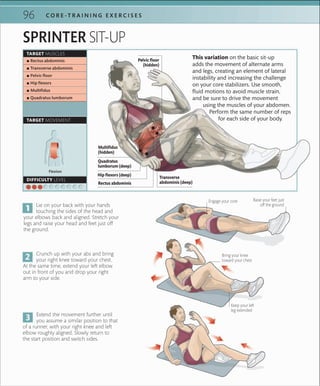
with your shoulders, the fingers pointing
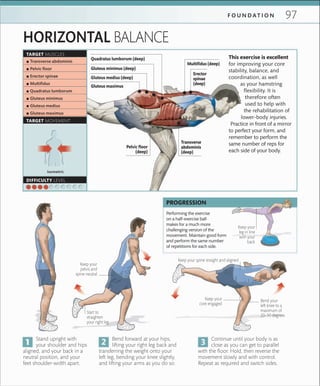
forward, and your knees directly below your hips.
Keep your back and neck straight.
Stand upright
with your hands
on your hips, your
legs straight, and feet
shoulder-width apart.
Keeping your hands in position, slowly lower
yourself down onto your heels until your
forehead touches the mat. Extend your hands
in front of you as far as is comfortable.
Start to
rotate your
hips slowly in
a clockwise
direction. Keep
your back straight.
HIP CIRCLE
CHILD’S POSE
This movement gently mobilizes your spine and hips
while also working your shoulders and upper back. If
you find the exercise uncomfortable, you can place a
rolled-up towel between the back of your thighs
and calves. To increase the stretch, reach your
hands in front of you as far as you can.
Continue
the rotation
back toward the
start position with a
smooth, controlled
movement.
Keep your
feet hip-
width apart
Place your
hands under
your shoulders
Position your
hips over
your knees
Relax your
shoulders
Extend your
arms out in
front of you
Feel the stretch in your hips
and thighs, and the middle
of your back
This rotational dynamic
stretch offers a useful
warm-up for your core
muscles. In contrast
to the torso rotation
(»p.48), you should
keep your upper
body stationary
while rotating
your hips.
Stand tall
with your
back straight
Rotate from
your hips
Look straight
ahead
Keep your
shoulders
aligned
53M O B I L I Z A T I O N
COBRA EXTENSION
This simple exercise is designed to stretch and
strengthen your lower back muscles and improve
your spinal flexibility. You should aim to perform
the movement with a slow, fluid motion, keeping
your neck and shoulders relaxed throughout.
Keep your arms
close to your
body and your
shoulders relaxed
Press your
body flat on
the floor
Keep your
legs straight
Feel the
stretch in your
lower back
Pause briefly at the top of the movement, then lower
your torso back to the start position with a smooth,
controlled movement, and using your arms for support.
Lie face down on a mat with your hands flat on the
floor and roughly level with your chin. Extend your
feet, keeping your legs together. Breathe in.
Pressing your hips against the mat and breathing
out, lift your torso upward slowly, using your arms
for support. Raise your head and shoulders as high as
you can, keeping the lower back relaxed.
SCORPION STRETCH
This is an excellent all-body stretch that improves
your spinal flexibility. The movement can take some
practice, but good technique is key, so focus on
achieving the correct position rather than trying
to push the stretch too far.
Keeping your hands flat on
the floor, raise your left hip
off the floor, and bring the left foot
up toward your right hand, twisting
your lower back and bending your
left knee as you do so.
Hold the stretch for a few
seconds, then return to the
start position. Switch sides and
repeat the movement.
Lie face down on a mat with
your knees in line and your
arms stretched out to your sides,
at right angles to your body.
Align your shoulders,
hips, and knees
Feel the stretch in
the front of your left
leg and along the
sides of your body.
Keep your
hands flat
Keep your
leg straight
Position your
legs together
Keep your
legs together
54 C O R E -T R A I N I N G E X E R C I S E S
This excellent mobilizing
stretch works your spine
and shoulder joints in
one fluid movement.
It also encourages your
upper and lower body
to function as a unit. The
exercise requires good
coordination and range
of motion, so it may take
some practice to perfect.
SKIER
Stand with your
legs hip-width apart
and your arms raised above
your head, shoulder-width
apart and slightly bent.
Engage your core.
Bending your knees and
dropping your buttocks back
into a half squat, swing your upper
body down and forward, keeping
your arms straight, your
core engaged, and
your back in a
neutral position.
Sit upright on a mat with
your knees drawn up to your
chest and your feet lifted off the
floor. Engage your core, grip your
ankles, and relax your neck, keeping
your head facing forward.
Gently roll backward until
your shoulderblades are
resting on the floor, with your
knees tucked up to your chest.
Keep your core engaged and be
careful not to roll onto your neck.
This dynamic stretch is an excellent way of
mobilizing the muscles of your spine, lower back,
and buttocks. Aim to perform the movement
BACK ROLL
Tuck your
knees into
your chest
Feel the
stretch in
your back
Engage your core
with a slow, controlled movement, and use a mat
to cushion your spine as you roll. Be careful not to
place strain on your neck.
Plant your feet
on the floor
Keep your
arms straight
and your
elbows soft
Hold the stretch for
a few seconds, then
reverse the movement with
a smooth, controlled motion,
rolling forward to return to
the start position.
Keep hold of
your ankles
Raise your
arms above
your head
55M O B I L I Z A T I O N
Stand tall with your feet
shoulder-width apart
and your knees slightly bent.
Engaging your core, raise
your arms above your head,
keeping your elbows soft.
Begin to roll down
through the spine,
initiating the movement from
the head and upper back.
Drop the arms forward and
below your shoulders in a
smooth controlled motion.
Continue the movement
until you are as fully folded
through the spine and hips as
possible without straining. Relax
your head, neck, and shoulders.
Hold briefly, then return to start
position in a slow, fluid motion.
Remaining in the half-
squat position, continue
the swinging movement with
your arms outside your legs,
keeping your arms straight
and your elbows soft.
Keeping your arms
straight, continue the
swinging movement of your
arms hands past your knees
and toward your hips.
Extend the swing back
and upward, rotating at
your shoulders until your arms
are roughly parallel with your
thighs. Pause briefly at the edge
of the movement, then reverse
the sequence to the start position.
STANDING ROLL-DOWN
This dynamic stretch
helps mobilize the
muscles of your lower
back, while providing
additional benefits
to your hamstrings
and shoulders. You
should perform the
exercise with a smooth,
fluid movement.
Look
straight
ahead
Keep your
core engaged
Rotate at
your shoulders
Allow a gentle
arch in the middle
of your back
Keep your
core muscles
engaged
Keep your feet
flat on the floor
Keep your head
down and your
neck relaxed
Support your back
using your core
Keep your head
down and your
shoulders
relaxed
Maintain the
half-squat
position
C O R E -T R A I N I N G E X E R C I S E S56
ACTIVE PELVIC FLOOR
Gently press the small of your back into the floor
and tilt your pubic bone upward by engaging
your abdominal and pelvic floor muscles. Hold for at
least three seconds.
Lie on your back with your knees bent at a
comfortable angle, your feet flat on the floor and hip-
width apart, your arms by your sides, and your lower back
in a neutral arch. Relax in this position before you begin.
Activation is a fundamental part of core training,
helping to strengthen your core and prevent
injuries. The “deep” core muscles responsible
for stabilization are not as easy to feel as
“surface” muscles, and engaging them therefore
requires time, focus, and control. Concentrate
on your breathing and technique to ensure that
you are performing the movements correctly.
ACTIVATION
This exercise gently stretches the muscles and
ligaments of your back, strengthening your core
and improving your posture; it also helps relieve
pressure on your facet joints. You should perform
this exercise on the floor at first, but as your
technique improves you can try it standing up.
Relax and return to the start position, so that the
small of your back is slightly arched once more.
Repeat as required and relax.
Find your
neutral, lower
back curve
Keep your
upper body
relaxed
Keep your
feet flat on
the floor
TARGET MUSCLES TARGET MOVEMENT
DIFFICULTY LEVEL
 ▪ Transverse abdominis
 ▪ Pelvic floor
 ▪ Multifidus
Isometric
Transverse
abdominis
(deep)
Rectus
abdominis
Pelvic floor
(deep)
Quadratus
lumborum (deep)
Multifidus
(deep)
External
obliques
Internal
obliques
(deep)
Deltoids
Pectorals
Erector spinae (hidden)
57A C T I V A T I O N
Sit up straight on
an exercise ball,
with your feet parallel
and hip-width apart.
Rest your hands on your
knees. Keep your back
straight and your spine
neutral. Breathe in
deeply, maintaining
this position.
Exhale forcefully,
pulling your
abdominals in tight and
drawing them in toward
your spine. With one fluid
motion, reverse the curve
in your lower back by
tucking your hips under
your torso and rolling the
ball forward very slightly
as you do so.
Hold the position
for a few seconds,
then release to return
to the neutral position
in step 1. Repeat as
required and relax.
Release your spine to a neutral position, without
dropping through your back. Inhale and exhale,
feeling the movement within your abs. Repeat as required.
Breathe out, pulling your abdominals in tight, and
suck in your navel toward your spine. With one
fluid motion, reverse the curve in your lower back and
tilt your hips.
PROGRESSION 1 PROGRESSION 2
Keep your feet
and your knees
hip-width apart
Keep your
thighs parallel
to the floor
Draw in your belly
Relax back to neutral
without dropping in
your lower back
Keep your
weight over
your hands
Keep your
head and
back aligned
Relax your
neck and
shoulders
Keep your head
and neck relaxed
Keep your
back straight
and your
spine neutral
This kneeling pelvic tilt helps if you have
poor posture or a back complaint. Some experts
recommend this as an alternative for the supine
version of the exercise (left) because it gives you
a greater range of movement.
It is harder to perform the pelvic tilt in an upright
posture, either standing or sitting, but doing this
movement on an exercise ball provides a helpful
guide, because the ball will shift forward slightly when
you do the exercise correctly.
Kneel on a mat with your hands under your
shoulders and your knees under your hips, keeping
your back in a neutral position, and breathe in deeply.
58 C O R E -T R A I N I N G E X E R C I S E S
Isometric
TARGET MUSCLES
TARGET MOVEMENT
DIFFICULTY LEVEL
 ▪ Transverse abdominis
 ▪ Pelvic floor
 ▪ Gluteus minimus
 ▪ Gluteus medius
This version of the exercise makes your core and glutes work harder
because the squeeze is positioned farther away from your hips. With
a rolled-up towel between your feet, lie on your front with forehead
resting on the back of your hands, and your legs straight. Brace your
abdomen and keep your buttocks tight. Squeeze the inside of your
feet together. Hold for 5 seconds, then relax to the start position.
Raising your knees off the ground adds instability
to the movement. Lie on your back with your pelvis
in a neutral position and a medicine ball between
your knees. With feet together, lift your
knees up until at a right angle with
your hips. Hold the position
for 5 seconds, then relax.
PROGRESSION 2PROGRESSION 1
PILLOW SQUEEZE
This gentle strengthening exercise
works the deep muscles of your core,
glutes, and inside thigh, helping you
to improve hip stability.
Place a medicine ball between your knees and lie on
your back with your pelvis in a neutral position. With
your feet flat on the ground, bend your knees at a right angle.
Squeeze your knees together as hard as is comfortable.
Hold the position for 5 seconds, engaging all core
muscles, then relax to the start position. Repeat as required.
Keep your
back in a
neutral position Relax your
shoulders
Keep your
feet flat on
the groundHold a
medicine
ball between
your knees
Press your
knees together
Transverse
abdominis
(deep)
Pelvic floor (deep)
Deltoids
Pectorals
Gluteus medius (deep)
Gluteus maximus
Biceps brachii
Rectus
abdominis
Gluteus minimus
(deep)
59A C T I V A T I O N
Bring your
knee back as
far as you can
Maintain neutral
position throughout
Keep your
pelvis neutral
HEEL SLIDE
This simple and relatively gentle movement
is a good exercise for improving strength
and mobility in the muscles of your hip and
pelvis. Always remember to perform the
same number of reps for each leg.
Slowly bend your right knee up
by sliding your right heel along
the ground. Bend it as far as you can
without rocking or lifting your hips
off the ground, or disturbing the
lumbar spine position. Keep your
core engaged throughout.
Lie on your back with your legs
stretched out straight in front
of you, your arms by your sides, and
your heels pressed lightly against the
floor. Locate your neutral hip and spine
position before you begin this exercise.
Slide your right leg back to the
start position, without allowing the
hips to rock to one side. Stay weighted
in the tailbone and keep your core
engaged. Alternate with each leg for the
required number of reps, then relax.
Establish neutral
hip and spine
alignment
TARGET MUSCLES
 ▪ Transverse abdominis
 ▪ Internal obliques
 ▪ Pelvic floor
 ▪ Multifidus
 ▪ Quadratus lumborum
TARGET MOVEMENT
Isometric
DIFFICULTY LEVEL Quadratus lumborum (deep)
Internal obliques (deep)
Multifidus (hidden)
Transverse abdominis (deep)
External obliques
Pelvic floor (deep)
Rectus
abdominis
C O R E -T R A I N I N G E X E R C I S E S60
KNEE FOLD
Lie on your back with your spine and hips in
a neutral position. Relax your upper back and
shoulders, bend your knees, and engage your core.
Align your
feet and knees
at hip-width
Brace your
abdomen
Lift your leg to 90
degrees, maintaining
neutral position
Lift your left leg so that your hip and knee are at right
angles, while maintaining hip and lower-back alignment.
Hold this position for a few seconds, then slowly lower your
legs to the start position. Repeat as required, then switch legs.
Keep your arms
and shoulders
relaxed
This is a moderate-impact core-stabilizing exercise
that helps strengthen the deep muscles of your
abdomen and your lower back. It can also be a useful
exercise for preventing pain in your lumbar region.
To get the best results from the movement, keep
the muscles of your core engaged throughout.
VARIATION
This simple version of the movement keeps one
foot anchored on the floor at all times—use this
variation if you need a gentle warmup, or if you
want to try a less demanding version of the exercise.
Keep your core engaged throughout and concentrate
on maintaining good form.
TARGET MUSCLES TARGET MOVEMENT
 ▪ Transverse abdominis
 ▪ Internal obliques
 ▪ Pelvic floor
 ▪ Hip flexors
 ▪ Multifidus
DIFFICULTY LEVEL
Isometric
Plant your
feet flat on
the ground
Internal obliques (deep)
Pelvic floor (deep)
Rectus abdominis
Transverse abdominis (deep)
Multifidus
(hidden)
Hip flexors (deep)
61A C T I V A T I O N
Lie on your back and bend your knees, with your
feet flat on the floor. Relax your shoulders and
upper back, engage your core, and keep your spine
and hips in a neutral position.
Lie flat on your back, relaxing your upper back and
shoulders, and with your spine in a neutral position.
Bend your knees, while keeping your feet flat on the floor
at all times.
Align your
feet and knees
at hip-width
Align your
knees
Engage
your core
Brace your
abdomen
Lift your leg
to 90 degrees
Keeping your core engaged, lift your left leg so
that your hip and knee are at right angles. Keep
your right foot on the floor and maintain neutral position.
Keep your arms
and shoulders
relaxed
Keep your
core engaged
Keep your
core engaged
Maintain neutral and
core engagement as
you lower your leg
Raise your
right leg to the
same level
Raise both legs
to the same level
With your core engaged, lift your right leg until it
is level with your left. Hold this position for a few
seconds; avoid tilting your hips and dropping your back.
Engage your core. Lift both legs off the floor, keeping
them aligned and hold neutral spine alignment. Hold
this position for a few seconds, then slowly lower your legs
to the start position without letting your lower back lift.
Keeping your core engaged, slowly lower your left
leg until your left foot is flat on the floor, without
letting your lower back arch, then lower your right leg.
PROGRESSION
Once you have mastered the basic exercise, try
this more demanding progression, in which you
raise both legs at once. Focus on maintaining core
stability and neutral alignment throughout the
movement. Keep your core engaged and your knees
bent at a consistent angle, and avoid dropping or
overarching through your lower back.
C O R E -T R A I N I N G E X E R C I S E S62
 ▪ Rectus abdominis
 ▪ Transverse abdominis
 ▪ Internal obliques
 ▪ Pelvic floor
 ▪ Multifidus
 ▪ Quadratus lumborum
TOE TAP
This is a moderate-impact core-stabilizing
exercise that can be helpful for strengthening
the deep muscles of your abdomen and lower
back. To get the best results from the movement,
keep your core engaged throughout.
Hold your left
leg in position
Keeping your core engaged, and holding your left
leg at a right angle, lower your right leg toward
the floor slowly and with control, without letting your
back arch off the floor.
Lie on your back with your arms by your side.
Engage your core and lift your legs in the air with
your knees and feet at hip width. Keeping your spine
and hips in a neutral position, relax your shoulders,
using your arms to stabilize you if you need to.
Hold at the edge of the movement, keeping your core
braced, then return to the start position, maintaining
control as you do so. Repeat as required, then swap legs.
Engage your core
Keep your back
flat on the floor
Keep your
core tight
Use your arms
for support
TARGET MUSCLES TARGET MOVEMENT
Isometric
DIFFICULTY LEVEL
Pectorals
Deltoids
Quadratus
lumborum (deep)
Transverse
abdominis
(deep)
Pelvic floor
(hidden)
Multifidus (hidden)
Internal
obliques
(deep)
Triceps
brachii
Erector spinae
(hidden)
Rectus
abdominis
63A C T I V A T I O N
Brace your
abdominal muscles
Keep your
core engaged
Lie on your back with your arms by your sides.
Bracing your abdomen, lift your legs into the air
with your knees and feet together, and your toes pointing
out. Use your arms to stabilize yourself if necessary.
Keeping your core engaged, slowly lower both feet
under control, without letting them drop to the floor.
Hold at the edge of the movement, then return
to the start position, slowly and with good control.
Place your
hands flat
on the floor
Bend your knees and
hips at a right angle
Keep your knees
at 90 degrees
This progression adds dynamic
movement and rotational
instability. Begin with your arms
vertical and your feet off the floor,
knees bent. Lower your left arm
behind you, drawing your left
knee to your chest and extending
your right leg as far as possible
without arching your back.
Repeat as required. Swap sides.
PROGRESSION 4
Once you have mastered the basic movement you
can make it harder by performing the exercise with
both legs at the same time. This works the muscles of
the abdomen and lower back much more intensely.
PROGRESSION 1
Raising your arms off
the floor adds an
element of instability,
making your core work
even harder. Adopt the
same starting position
as in Progression 1, but
raise your arms straight
up. Keeping your arms
still, and your core tight,
alternately lower each
foot to the floor.
The alternating movement
of this progression adds the
challenge of lateral instability.
Begin with your arms vertical
and your feet off the floor,
knees bent. Lower your left
arm and left leg to the floor at
the same time. Return to the
starting position, repeat as
required, and switch sides.
PROGRESSION 2
PROGRESSION 3
C O R E -T R A I N I N G E X E R C I S E S64
Elongate your spine
Keep your
legs relaxed
Keep your palms flat
This simple exercise helps you develop good
strength and control of your pelvic floor,
transverse abdominis, and spinal stabilizing
muscles. Gradually increase
the number of repetitions
as you progress.
PRONE ABDOMINAL HOLLOWING
Isometric
TARGET MUSCLES
TARGET MOVEMENT
DIFFICULTY LEVEL
 ▪ Transverse abdominis
 ▪ Pelvic floor
 ▪ Multifidus
Lie face down on a mat with a small
towel beneath your head. Position
your arms beside you, pointing forward,
palms down, your elbows bent at right angles.
Reach forward with the top of your head to
lengthen your spine, keeping your shoulders
apart. Breathe in deeply.
Engage your core, gently pulling your navel
up toward your spine and allowing your
lumbar spine to lengthen without lifting your hips,
breathing out as you do so.
Hold your abdomen in for 5 seconds, then
inhale as you return to the start position in a
slow, controlled movement. Repeat as required.
Pull in your
stomach muscles
Keep your
shoulders and
neck relaxed
Latissimus dorsi
DeltoidsMultifidus (deep)
Pelvic floor (deep)
Transverse abdominis (deep) Rectus abdominis
Erector spinae (deep)
Pectorals
65A C T I V A T I O N
Hold briefly, ensuring you maintain abdominal
engagement, spinal length, and hip alignment, then
return to the start position slowly and smoothly.
Lie face down on a mat, with your arms by your
sides, palms up. Relax your trunk and legs. Breathe
in, engaging your abdominals before you begin to move.
Lift your head, lengthening your neck. Raise your
shoulders off the floor, rolling your palms in to face
your thighs, and draw your legs together to engage your
glutes. Use your abs and lower back to control the movement.
DART
Keep your
neck and
back aligned
Align your
shoulders
Relax back to the
start position
This activation exercise encourages deep core stability and
strengthens the muscles of your upper back and glutes. It is
one of the most effective exercises for improving posture
awareness and alignment.
Clench your
buttocks
Relax
your legs
Once you have mastered the basic exercise, you can add a greater
element of instability by placing a stability disk beneath your hips
and lower abdomen. As before, control the movement using your
glutes and the muscles of your lower back.
PROGRESSION
TARGET MUSCLES
 ▪ Transverse abdominis
 ▪ Pelvic floor
 ▪ Erector spinae
 ▪ Multifidus
 ▪ Quadratus lumborum
 ▪ Gluteus minimus
 ▪ Gluteus medius
 ▪ Gluteus maximus
TARGET MOVEMENT
DIFFICULTY LEVEL
Stabilize yourself
with your core
Extension
Quadratus lumborum
(deep)
Multifidus
(deep)
Erector spinae
(deep)
Pelvic floor (deep)
 Gluteus maximus
Gluteus medius (deep)
Gluteus minimus (deep)
Transverse abdominis (deep)
Rectus abdominis
66 C O R E -T R A I N I N G E X E R C I S E S
Isometric
TARGET MUSCLES
TARGET MOVEMENT
DIFFICULTY LEVEL
 ▪ Transverse abdominis
 ▪ Pelvic floor
 ▪ Multifidus
 ▪ Gluteus medius
 ▪ Gluteus maximus
OYSTER
Lie on your right side, bending
both your hips and knees at a
45-degree angle. Extend your right arm
so that it is in line with the body, and
rest your head on it. Bend your left arm
at the elbow and place the left hand
on to the floor in front of you.
Keeping your neck straight,
your hips and shoulders in
line, and your feet touching, engage
your core and begin lifting the knee
of your left leg, rotating at your hip.
Lift your left knee as far as it will
go without straining, keeping
your hips aligned. Slowly lower your
knee back to the start position, and
repeat for the required number of
reps before swapping sides.
Keep your
neck straight
Make sure you keep
your feet stacked
Align your feet
Keep your hips forward
and aligned
This exercise is a simple but
excellent movement for working
the deep, stabilizing muscles
of your buttocks, improving
your hip stability and
alignment, while
also building your
overall core stability.
Keep your
pelvis neutral
Transverse
abdominis
(deep)
Biceps
brachii Pectorals
Pelvic
floor
(deep)
Gluteus medius
(deep)
Gluteus
maximus
Multifidus (hidden)
Deltoids
Erector spinae
(hidden)
67A C T I V A T I O N
Isometric
TARGET MUSCLES
TARGET MOVEMENT
DIFFICULTY LEVEL
 ▪ Transverse abdominis
 ▪ Internal obliques
 ▪ Pelvic floor
 ▪ Multifidus
 ▪ Quadratus lumborum
 ▪ Gluteus medius
 ▪ Gluteus maximus
PRONE LEG LIFT
Lie on your front with your
forehead resting on the back
of your arms and your knees straight.
Engage your core to support your back
and squeeze your buttocks together.
Keeping your buttocks tight,
lift your left leg up in a slow,
fluid movement about 12in (30cm)
off the floor (or higher as your
muscles grow stronger).
Pause at the top of the
movement, then return to the
start position, slowly and with control.
Repeat the required number of reps,
before switching legs.
Brace your abdomen
Support your head
with your arms
Keep your
hips aligned
This exercise strengthens the large
muscles of your buttocks and helps
to improve pelvic stability. Avoid
using your back in the movement.
Lie with your body
flat against the mat
Keep your
back straight
Control the
movement
with your glutes
Pelvic floor
(hidden)
Gluteus medius (deep)
Gluteus maximus
Internal
obliques (deep)
Quadratus
lumborum (deep)
Transverse
abdominis (deep)
Multifidus (deep)
C O R E -T R A I N I N G E X E R C I S E S68
STAR
This exercise is useful for stabilizing
the muscles along your spine, while
also strengthening the shoulders,
lower back, and buttocks.
Place your palms
flat on the floor
Lie face down with your forehead
resting on a mat. Align your neck
and head. Extend your arms in front
of you with your palms facing down.
Lengthen your torso by stretching
your neck away from your body,
and engage your core.
Hold the position briefly. Lower
your limbs slowly and with
control to return to the start position.
Repeat as required and switch sides.
Keeping your head in line with
your spine and your abs tight,
raise your left arm and your right leg
3–6in (8–15cm) off the floor. Hold your
glutes tight and avoid rocking your hips
and dropping through your lower back.
Keep your
feet together
 ▪ Transverse abdominis
 ▪ Pelvic floor
 ▪ Erector spinae
 ▪ Multifidus
 ▪ Quadratus lumborum
 ▪ Gluteus medius
 ▪ Gluteus maximus
TARGET MUSCLES
TARGET MOVEMENT
Isometric
DIFFICULTY LEVEL
Contract
your glutes
Use your glutes to stop
your body from rotating
Multifidus
(deep)
Pelvic floor (hidden)
Transverse abdominis (deep)
Erector spinae (deep)
Gluteus medius
(deep)
Gluteus minimus
(deep)
Quadratus
lumborum
(deep)
Gluteus
maximus
69A C T I V A T I O N
Align your head and
neck with your spine
Keep your
legs straight
Keep your arms flat
This is a good activation exercise for your
lower back and buttocks. Aim to perform the
movement with a smooth, controlled motion.
BACK EXTENSION
Isometric
TARGET MUSCLES
TARGET MOVEMENT
DIFFICULTY LEVEL
 ▪ Transverse abdominis
 ▪ Pelvic floor
 ▪ Erector spinae
 ▪ Multifidus
 ▪ Quadratus lumborum
 ▪ Gluteus medius
Lie face down on a mat with a folded towel
positioned under your forehead to ensure
proper alignment of your head and neck with your
spine. Bend your arms and rest your forearms on
the floor, palms down. Breathe in deeply.
Engage your core and reach forward
with the top of your head to lengthen
the spine, keeping your shoulders apart.
Then, facing downward, lift your head
and shoulders off the floor, exhaling as
you do so without using your arms.
Pause at the top of the movement,
then inhale and return to the start
position, slowly and with control.
Hold your
glutes tight
Pelvic floor (deep)
Quadratus lumborum (deep)
Transverse
abdominis (deep)
Deltoids
Biceps brachii
Multifidus
(deep)
Gluteus maximus
Erector spinae (deep)
70 C O R E -T R A I N I N G E X E R C I S E S
Isometric
TARGET MUSCLES
TARGET MOVEMENT
DIFFICULTY LEVEL
 ▪ Transverse abdominis
 ▪ Pelvic floor
 ▪ Multifidus
 ▪ Quadratus lumborum
 ▪ Gluteus medius
 ▪ Gluteus maximus
SUPERMAN
This exercise strengthens the spinal extensor muscles and deep spinal
stabilizers, which support your spine, and builds strength and stability
in your buttocks, lower back, and shoulders.
Combining an arm lift and a leg lift requires additional strength
and stability because it increases rotational instability even
more than removing the support of a leg. Contracting your abs,
simultaneously lift your right leg behind you to hip height and your
left arm forward to shoulder height. Hold for 10 seconds, return to
the start position, then repeat with your other leg and arm. Maintain
a straight line from your shoulders to your hips throughout.
Assuming the main position with a leg raised, rather than an arm,
demands greater balance and core control, because it increases the
level of rotational instability working your spinal stabilizers and deep
core muscles. To perform the movement, engage your core and lift
your right leg behind you to hip height. Balance and hold for 10
seconds, then return to the start position, then switch legs. Be sure
to keep your back straight and your shoulders and hips aligned.
PROGRESSION 2PROGRESSION 1
Keep your back
in a neutral position
and your chest high
Align your head
with the spine
Stretch your
leg straight out
behind you
Do not twist
your hips
Extend your arm
straight out in front
Multifidus
(deep)
Pelvic floor (deep)
Quadratus
lumborum
(deep)
Transverse
abdominis
(deep)
Gluteus minimus (deep)
Gluteus maximus
Gluteus medius (deep)
71A C T I V A T I O N
Kneel on all fours, with your knees aligned squarely
beneath your hips. Keep your back straight and
position your hands directly beneath your shoulders,
pressing them flat on the ground and pointing forward.
Engaging your core, raise one arm in front
of you. Hold for 10 seconds, then return
to the start position. Repeat the movement with
your other arm and relax to the start position.
Align your head
and spine
Keep your back in
a neutral position
Using the body position of Progression 2 but placing a stability
disk beneath your supporting arm offers an even greater challenge
to your core. With your feet hip-width apart, support your weight
on your right arm. In one smooth, controlled movement, extend
your right leg out straight behind you and reach your left arm out
in front. Hold, then return to the start position and switch arms and
legs. Maintain a straight line from your shoulders to your hips and
keep your core tight throughout.
Placing a stability disk beneath your supporting arm makes your
core work even harder to stabilize your spine. Assume the same
position as in the main sequence, kneeling with your feet hip-width
apart, and your right hand on the stability disk. Supporting your
body weight on your right arm and knees, extend your left arm up,
keeping it in line with your torso. Hold this position, then lower
your left arm, relax, and swap arms. Keep your core engaged, your
shoulders and hips in line, and your spine in a neutral position.
PROGRESSION 4PROGRESSION 3
Keep your core
muscles tight
Extend your arm
straight out in front
Keep your
right arm
straight
Keep your
chest high
Engage the core
and keep your
torso stable
Keep your neck,
spine, and head in
line and look down
Engage
your core
Stretch through
your leg and
point your toes
72 C O R E -T R A I N I N G E X E R C I S E S
TARGET MUSCLES TARGET MOVEMENT
DIFFICULTY LEVEL
 ▪ Rectus abdominis
 ▪ Transverse abdominis
 ▪ Internal obliques
 ▪ Pelvic floor
The exercises in this section are the building
blocks of good core strength and stability. You
should aim to master them before moving on
to those in the Intermediate and Advanced
sections. To ensure that you get the best results,
focus on performing each exercise correctly,
maintaining good form throughout and
controlling the movements with your core.
FOUNDATION
To work your abdominal area in a different way you can use a
“pulsing” action. Pause at the top of the movement and slide your
hands up and down your
thighs. The movement of
each pulse is very small,
but aim to squeeze your
abs a little bit tighter each
time. Aim for around five
pulses per crunch.
VARIATION
The basic abdominal crunch is one of the simplest
and most popular of all core exercises. Good form is
key—control the movement with your core and keep
your shoulders and neck relaxed.
Hold the position briefly, then lower your upper
body slowly to the floor, controlling the downward
phase with your core.
Crunching up from your core, lift your shoulders
and upper back off the floor without straining.
Lie on a mat with your knees bent, your feet flat on the
floor, and your fingers against the sides of your head.
ABDOMINAL CRUNCH
Keep your chin
tucked in
Keep your hips
stable throughout
Flexion
Internal obliques
(deep)
Rectus
abdominis
Pelvic floor
(hidden)
Transverse
abdominis
(deep)
73F O U N D A T I O N
Performing the exercise while holding a medicine ball increases the
load on your abs, making the movement more challenging. Holding
the ball firmly with both hands, assume the normal starting position,
then raise the ball in the air with your arms straight. Hold the ball in
this position while you carry out the desired number of repetitions.
Positioning your feet on a bench works your core stabilizers
harder and increases the range of movement. Lie on your back
with your calves on the bench, so that your hips and knees are
bent at right angles. Control the movement with your core,
curling your torso toward your knees, and avoid “cheating”
the movement by hooking your heels on the edge of the bench.
Removing the support of your legs adds an
element of instability, making the muscles
of your core work a little harder as you
perform the crunch. From the original
start position, extend your legs straight
into the air with your knees together. Using
your abs, crunch up as far as you can, then
hold briefly before returning to the start
position slowly and under control.
Resting your hips on an
exercise ball requires good
balance and stability. It
makes it even harder for
you to support your weight
with your legs, because the
ball can also move in any
number of directions.
To start, carefully lie back
against the ball with your
feet firmly planted on the
floor and your knees bent at
right angles. Crunch up with
your upper body, hold, and
return to the start position.
Using an unbalanced legs position introduces an element of lateral
instability, which provides a further challenge to your core stabilizers.
Lie with your back on the mat, and your hands across your chest.
Straighten one leg along the floor and bend the other at 90 degrees
with your foot flat on the floor. Crunch up with your abdominals to
control the movement, pause at the edge of the movement, then
return to the start position. Repeat as required and switch legs.
This even more challenging version of the movement involves a
variation of the Progression 5 crunch—with your lower back resting
on a stability disk to add even more instability. Lie at an angle with
the disk under your lumbar spine and your hands crossed lightly
on your chest. Control the crunch with the core, pause at the
edge of the movement, before returning to the starting position.
Repeat as required and change legs.
PROGRESSION 1
PROGRESSION 3
PROGRESSION 5 PROGRESSION 6
PROGRESSION 2
PROGRESSION 4
Keep your
head straight
Rest your fingers
lightly on the sides
of your head
Keep one
leg straight
Control the movement
with your core
Hold your
arms straight
Keep your
legs straight
and knees
aligned
Stability disk
Medicine ball
74 C O R E -T R A I N I N G E X E R C I S E S
LEG CIRCLE
Place your
arms by
your sides
Keep your
leg still
Lie on your back with your palms on
the floor. Raise your left leg with the
knee bent at a 90-degree angle.
Rotate your left leg in a clockwise circle
down and to the left, keeping your core
engaged and your pelvis firmly anchored.
Follow the clockwise movement
down to the bottom of the circle,
keeping your left knee bent. Continue the
movement around to the start position,
repeat, and switch sides.
Keep your
leg flat on
the floor
Keep your
core engaged
Follow
the circular
movement
with your leg
TARGET MUSCLES TARGET MOVEMENT
DIFFICULTY LEVEL
 ▪ Transverse abdominis
 ▪ Internal obliques
 ▪ Pelvic floor
 ▪ Multifidus
 ▪ Quadratus lumborum
 ▪ Gluteus minimus
 ▪ Gluteus medius Isometric
This activation exercise is simple but demands
good form and hip flexibility. Keep your pelvis
and core stationary, and avoid rocking from side
to side. Use your palms to brace yourself against
the floor, and keep your head as still as possible.
Carrying out the movement with a
straight leg introduces an element of
instability, making your core muscles work
harder. Lie on your back in the start
position and raise your left leg, keeping
it straight. Rotate it in a clockwise circle,
keeping your
pelvis anchored.
Repeat and
switch sides.
PROGRESSION 1
Fuse your pelvis
in place
Transverse
abdominis
(deep)
Multifidus
(hidden)
Pelvic
floor
(deep)
Internal obliques
(deep)
Gluteus
minimus (deep)
Gluteus
medius (deep)
Quadratus
lumborum
(deep)
75F O U N D A T I O N
TARGET MUSCLES TARGET MOVEMENT
DIFFICULTY LEVEL
 ▪ Rectus abdominis
 ▪ Transverse abdominis
 ▪ Pelvic floor
Flexion
REVERSE CURL
This exercise works in a similar way to the
crunch, but involves you moving your legs rather
than your torso. It works your lower abs, without
placing stress on your shoulders and neck, which
are resting on the floor.
Lie down with your arms by
your sides, palms up, and draw
your knees up toward your chest,
keeping your lower back flat and your
shoulders relaxed. Engage your core.
Resting your head on the floor and
keeping your back in a neutral position,
draw your knees further in toward your
chest in a crunching movement. Repeat this
movement the desired number of times.
Keep your arms
flat on the floor
Keep your
feet together
Hold your knees
together
Once you have mastered this progression
you can make it even more challenging
by holding an exercise ball between
your legs. Perform the exercise in the
same way as Progression 1, using your
arms for support.
PROGRESSION 2
This progression of the basic exercise involves
extending the movement to raise your legs and
your torso off the ground. Because you have
removed the support of your lower back,
your core muscles have to work even
harder to stabilize your body. Begin
by lying on your back with your
arms by your sides, palms
pressed down for stability.
PROGRESSION 1
Transverse
abdominis
(deep)
Pelvic floor
(deep)
Rectus
abdominis
Pectorals
Deltoids
Internal obliques (deep)
External obliques
C O R E -T R A I N I N G E X E R C I S E S76
Extension
TARGET MUSCLES
TARGET MOVEMENT
DIFFICULTY LEVEL
 ▪ Transverse abdominis
 ▪ Pelvic floor
 ▪ Erector spinae
 ▪ Multifidus
 ▪ Quadratus lumborum
 ▪ Gluteus maximus
This simple exercise helps strengthen the spinal
stabilizing muscles of your lower back. Aim to perform
the movement with good form and avoid jerking up
with your shoulders, which can strain your neck.
Maintain relaxed
shoulders
Exhale as you lift your upper body off
the floor. Perform the movement slowly,
controlling it with your core. Be careful not to
jerk your head or strain the muscles of your
lower back or neck.
Lie face down with your legs together.
Place your hands by the side of your
head, keeping your shoulders relaxed and
your core active. Breathe in.
Breathe in, hold briefly at the top of the
movement, maintaining an active core,
then slowly and gently lower yourself back to
the start position.
Control the
movement with
your core
Gently lower
your torso
Keep your
legs together
DORSAL RAISE
Erector spinae (deep)
Multifidus (deep)
Quadratus lumborum (deep)
Pelvic floor (deep) Transverse abdominis (deep)
Gluteus minimus (deep)
Gluteus maximus
Gluteus medius (deep)
77F O U N D A T I O N
Performing the dorsal raise with your arms extended
increases the load on your core, making the deep
muscles of your abdominals, back, and glutes work
harder to stabilize your torso.
This further progression of the exercise involves
raising both your arms and legs at the same time,
removing the support of your legs and adding an
even greater level of instability.
Align your
shoulders
and arms
Keep your
legs together
Control
the downward
movement with
your core
Lower
your torso
with control
Engage
your core
and lengthen
your spine
Hold your
core tight Engage your
core throughout
Rest your legs
on the floor
Keep your
legs together
Lie on your front with your legs together, and the top
of your feet resting on the floor. Raise your arms above
your head, with elbows soft, palms facing in, shoulders
relaxed, and fingertips pointing forward. Breathe in to
prepare for the movement.
Lie down on your front with your legs slightly apart
and your feet resting on the floor. With elbows soft,
palms facing in, and shoulder relaxed, stretch your arms out
and forward. Breathe in.
Hold this position for a couple of seconds, then return
to the start position slowly and with good control.
Repeat the movement as required.
Hold this position for a couple of seconds, before
lowering your arms and legs back to the start position.
Repeat the movement as required.
Engaging your core, breathe out as you lift your
upper body off the floor. Keep your head and
your upper body in line, and support from your abdominals
to avoid overextending in your lower back.
Engage your core and breathe out as you lift your
upper body and legs off the floor. Keep your legs
slightly apart and glutes engaged to help avoid
overextending the lower back.
PROGRESSION 1 PROGRESSION 2
Engage your
glutes
Keep your
legs slightly
apart
Align your
shoulders
78 C O R E -T R A I N I N G E X E R C I S E S
SIT-UP
The sit-up is a well-used
and effective exercise for
strengthening abdominals
and increasing hip flexion.
Focus on using your core
to drive the movement,
and avoid straining
your neck.
Pause at the edge of the movement, then slowly
lower your upper body to the start position,
controlling the movement with your core.
Engage your core muscles and raise your torso
upward, leaving just your buttocks and feet on
the floor. Drive the movement entirely with your core.
Lie on your back with your feet on the floor and
your knees bent. Place the tips of your fingers on
either side of your head.
Changing the position of your arms alters the difficulty of the
exercise. Extending your arms ahead of your knees provides
the least resistance, while crossing your arms over your chest
or holding them by
your head increases
difficulty. For an
advanced workout,
hold a weight plate
to your chest.
PROGRESSION
Keep your neck relaxed
and avoid straining
TARGET MUSCLES TARGET MOVEMENT
 ▪ Rectus abdominis
 ▪ Transverse abdominis
 ▪ Internal obliques
 ▪ Pelvic floor
 ▪ Hip flexors
 ▪ Multifidus
 ▪ Quadratus lumborum
DIFFICULTY LEVEL
Flexion
Use your feet
for support
Keep your
back in a
neutral position
Engage
your core
Transverse abdominis
(deep)
Pelvic floor
(hidden)
Hip flexors (deep)
Rectus abdominis
Multifidus
(hidden)
Quadratus
lumborum (deep)
Internal
obliques
(deep)
79F O U N D A T I O N
OBLIQUE CRUNCH
This simple but effective core exercise works
your obliques and transverse abdominis, building
both rotational strength and the ability of your
core to stabilize your spine and hips against
external rotational forces.
Hold for a moment then lower your upper body
slowly to the floor, using your core to control
the movement.
Engaging your core, raise your elbows and upper back
slightly off the floor, twisting your torso to your left so
that your left elbow moves toward your right knee.
Lie on a mat with your knees bent, your feet flat,
and your fingers against the sides of your head.
Engage your core
Keep
your feet
flat on
the floor
Performing the movement on
an exercise ball makes it harder
because the ball can move
in any number of directions.
Carefully lie back on the ball
with your legs hip-width
apart. Crunch up and rotate
from your upper body, hold,
and return to the start position.
PROGRESSION
Keep your chin up
and your neck relaxed
TARGET MUSCLES TARGET MOVEMENT
 ▪ Rectus abdominis
 ▪ Transverse abdominis
 ▪ External obliques
 ▪ Internal obliques
 ▪ Pelvic floor
DIFFICULTY LEVEL
Plant your
feet firmly
on the floor
Keep your
neck relaxed
Maintain hip position
as you rotate
Rotation
Transverse
abdominis
(deep)
External obliques
Pelvic floor
(hidden)
Rectus
abdominis
Internal obliques (deep)
PectoralsDeltoids
80 C O R E -T R A I N I N G E X E R C I S E S
TARGET MUSCLES TARGET MOVEMENT
DIFFICULTY LEVEL
 ▪ Rectus abdominis
 ▪ Transverse abdominis
 ▪ External obliques
 ▪ Internal obliques
 ▪ Pelvic floor
 ▪ Multifidus
 ▪ Quadratus lumborum Side Flexion
SIDE-LYING LATERAL CRUNCH
Engage
your core
Place your
feet together
Keep your
feet together
Keep your knees
together and bent
at the same angle
Align your
shoulders
Squeeze your oblique muscles to raise your head
and shoulders, taking care not to force the movement.
Pause briefly at the top of the movement, then
return to the start position slowly and under control.
Complete the desired number of reps, then switch sides.
This exercise improves your strength and core
stability, and targets your external and internal
obliques, improving trunk stability and side
flexion. To avoid straining your neck, ensure
that you support your head with your hand
and control the movement with your core. For
maximum effect, perform the movement slowly.
Lie on your right side, with your right arm outstretched,
palm down, and your left hand lightly supporting your
head. Bend slightly from the waist so that your legs are at an
angle of around 30 degrees to your torso.
Control the movement
with your core
Internal obliques
(deep)
Quadratus
lumborum
(deep)
Multifidus (hidden)
Rectus abdominis
Pelvic
floor
(deep)
Deltoids
Pectorals
Transverse
abdominis
(deep)
External
obliques
81F O U N D A T I O N
TARGET MUSCLES TARGET MOVEMENT
DIFFICULTY LEVEL
 ▪ Transverse abdominis
 ▪ External obliques
 ▪ Internal obliques
 ▪ Pelvic floor
 ▪ Multifidus
 ▪ Quadratus lumborum
 ▪ Gluteus maximus Side Flexion
Lower the
dumbbell to
knee level
Contract your
obliques to
straighten
your torso
Keep
your knees
slightly bent
Keep your
feet flat
and at least
shoulder-
width apart
Rest your
fingertips on
your temples
to help align
your body
SIDE BEND
Move
your torso
laterally, not
forward or
backward
Lean slowly to
the right and slide
the dumbbell down the
outside of your right
thigh to knee level while
breathing in. Do not
allow the weight
to swing.
Stand upright with
your knees slightly bent
and one dumbbell resting on
the side of your thigh. Keep
your weighted arm straight.
Straighten your torso
to the start position
by contracting your
obliques on the left of
your torso, breathing out
as you do so. Repeat as
required and switch sides
This exercise is a simple but effective way of
strengthening your obliques, and stabilizing your
spine against lateral and rotational forces. Practice
with a light weight until you have perfected the
movement—focus on controlling the upward
and downward phases with your core, rather than
using your arms to raise and lower the dumbbell.
External
obliques
Internal
obliques
(deep)
Tranverse
abdominis
(deep)
Quadratus
lumborum
(deep)
Pelvic floor
(deep)
Deltoids
Biceps
Gluteus
maximus
Multifidus
(hidden)
C O R E -T R A I N I N G E X E R C I S E S82
Side Flexion
TARGET MUSCLES
TARGET MOVEMENT
DIFFICULTY LEVEL
 ▪ Rectus abdominis
 ▪ Transverse abdominis
 ▪ External obliques
 ▪ Internal obliques
 ▪ Pelvic floor
 ▪ Multifidus
 ▪ Quadratus lumborum
HEEL REACH
Focus the
movement on
your obliques Keep your
core engaged
Align your knees
and ankles
Keep your feet
flat on the floor
Reach down as far as you can toward your right
foot with your right hand in a slow and controlled
movement, crunching the left side of your abdomen to
drive the movement and avoid straining with your neck.
Lie on your back with your arms
by your sides, palms down, and
bend your knees. Engage your core to
raise your shoulders and upper back
off the floor, keeping your neck relaxed
and your spine in a neutral position.
Pause briefly, then return to the starting
position and alternate for the required
number of repetitions. Repeat the movement
to the left side of your body.
This side flexion exercise works your obliques, improving
trunk stability and control. Good form is key—ensure that
you control the movements with your core.
Keep your
neck relaxed
Internal obliques (deep)
Multifidus
(deep)
Pelvic floor
(deep)
External obliques
Rectus abdominis
Quadratus lumborum
(hidden)
Transverse
abdominis
(deep)
83F O U N D A T I O N
Side Flexion
TARGET MUSCLES
TARGET MOVEMENT
DIFFICULTY LEVEL
 ▪ Transverse abdominis
 ▪ External obliques
 ▪ Internal obliques
 ▪ Pelvic floor
 ▪ Multifidus
 ▪ Quadratus lumborum
 ▪ Gluteus maximus
ROMAN CHAIR SIDE BEND
An effective side flexion
movement, this exercise is
best performed on a Roman
chair—a piece of apparatus
that has a ledge behind
where you can secure your
feet. It may also be done
on a regular bench, but you
will need a partner to hold
your feet.
Control the
upward
movement
with your core
and glutes
Hold your hands at
head level or crossed
over your chest
Lean slowly sideways toward
the floor as far as is comfortable,
taking care not to lean forward or
backward. Breathe in on your descent.
Lie sideways on the Roman
chair; adjust it so that your
upper body can pivot comfortably
at your hips toward the floor.
Pause at the edge of the
movement, then gently raise
your body to the start position.
Repeat as required and switch sides.
Keep the range of
movement within
your comfort zone
External
obliques
Internal
obliques
(deep)
Multifidus
(hidden)
Pelvic floor (deep)Transverse
abdominis
(deep)
Quadratus lumborum (deep)
Gluteus maximus
84 C O R E -T R A I N I N G E X E R C I S E S
Isometric
TARGET MUSCLES
TARGET MOVEMENT
DIFFICULTY LEVEL
 ▪ Transverse abdominis
 ▪ Internal obliques
 ▪ Pelvic floor
 ▪ Multifidus
 ▪ Quadratus lumborum
 ▪ Gluteus minimus
 ▪ Gluteus medius
SIDE-LYING LEG LIFT
Keeping your spine aligned, use the muscles
of your core and upper legs to lift up your
feet. Keep your feet stacked, and make sure that
your legs are aligned with your back.
Lie on the right side of your body with
your ankles stacked. Use your right hand to
support your head, and place the left hand flat on
the floor in front of you to help you stabilize.
Pause at the edge of the movement, then
lower your feet slowly back to the start
position. Repeat as required, then switch sides.
This exercise strengthens and stabilizes your core
against lateral movements, while also working your glutes
and hip flexors to improve your core control and balance.
Angle your legs
slightly forwards
Keep your right
arm relaxed
Keep your
feet together
Keep your
feet together
Keep your
core engaged
Transverse abdominis (deep)
Quadratus
lumborum
(deep)
Internal obliques
(deep)
Pectorals
Deltoids
Gluteus medius
(deep)
Multifidus
(hidden)
Pelvic floor (deep)
Gluteus minimus (deep)
85F O U N D A T I O N
VARIATION
Straighten your
kicking leg
Keep your upper body
relaxed and maintain the
same position throughout
Control the
movement with
your core muscles
Keep your
glutes tight
Angle your legs
slightly forwards
at the hip
Lie on your right side with your ankles together. Plant
your left hand flat on the floor in front of you to help
you stabilize, and support your head with your right hand.
The side-lying leg kick offers a gentle balance
exercise that also stretches the tendons in your
legs, and provides a low-intensity workout for
your core and arm muscles. Be careful on hard
floors, or anywhere that might cause discomfort
Placing a stability disk beneath the hip adds an element of
instability, making the muscles of your core work harder to
balance your body as you perform the movement. Follow
the same steps in the main sequence and repeat as necessary,
before switching sides.
PROGRESSION
Keeping your upper body still, kick your left leg
forward as far as you can, using the muscles of
your core and upper legs to control the movement.
Briefly hold the position before swinging your left
leg back through the start position, controlling the
movement with the muscles of your core and thighs.
Swing your left leg back as far as you can, keeping the
movement as smooth and controlled as possible, and
holding your upper body in position.
Pause at the edge of the movement, then swing
your left leg forward to return to the start position.
Repeat the sequence as required, before switching legs.
Keep your kicking
leg straight
Use the muscles
of your core,
glutes, and thighs
to your hips and elbows—use a mat if necessary.
Remember to use slow, controlled movements
when kicking your leg, and try to avoid placing
any strain on the muscles of your neck while
carrying out the desired number of repetitions.
86 C O R E -T R A I N I N G E X E R C I S E S
TARGET MUSCLES TARGET MOVEMENT
DIFFICULTY LEVEL
 ▪ Rectus abdominis
 ▪ Transverse abdominis
 ▪ External obliques
 ▪ Internal obliques
 ▪ Pelvic floor
 ▪ Hip flexors
 ▪ Multifidus
 ▪ Quadratus lumborum
Rotation
OBLIQUE REACH
This simple but effective rotational core exercise
works most of the muscles of your “abdominal
girdle” (»p.56), which are responsible for posture.
The twisting movement involved particularly
challenges your internal and external obliques
and helps you increase your ability to stabilize
your spine against rotational forces. It is important
to ensure that you focus the movements on your
core to get the best results.
Medicine ball
To increase the load on your abdominal muscles even further,
replace the kettlebell with a medicine ball. Grasp the ball in
both hands and carry out the exercise as normal.
PROGRESSION 2
You can use a kettlebell to increase the load on your abdominal
muscles. Grasp the weight in both hands and carry out the
exercise as normal, controlling the movement with your core.
PROGRESSION 1
Take an even grip
on the kettlebell
Keep your
arms in line
Rectus abdominis
Hip flexors (deep)
External obliques
Internal obliques (deep)
Transverse abdominis (deep)
Pelvic floor (deep)
Deltoids
Pectorals Multifidus (hidden)
Quadratus lumborum (deep)
87F O U N D A T I O N
Reach as far as you can toward your right
foot with both hands in a slow and controlled
movement. Use your core muscles to drive the movement,
crunching the right side of your abdomen to avoid straining
with your neck.
Switching the movement to the left side of your body,
reach down as far as you can toward your left foot
with both hands, crunching the left side of the abdomen.
Hold the position briefly, then return to the start position.
Keep your
neck relaxed
Reach toward your
right foot without
straining
Keep your spine in
a neutral position
Hold the position briefly, then slowly curl back
to the horizontal, controlling the movement
with your core. Keep your arms raised and slightly
apart, and your knees bent at an angle of 90 degrees.
Keep your
arms aligned
Lie on your back and raise your arms in front of
you, palms down, fingers pointing to your knees.
Lift your arms, then engage your core to raise your
shoulders and upper back slightly, keeping the spine
in a neutral position.
Keep your knees
bent at 90 degrees
Raise your
arms
Keep your
calves parallel
to the ground
Lifting your feet off the floor to perform the movement makes your
core muscles work harder to stabilize your body. Bend your knees
and hold them together, keeping your calves roughly parallel to the
ground. Perform both phases of the movement under good control.
PROGRESSION 3
For an even more challenging exercise, perform the movement in
Progression 3, but holding a kettlebell. Grasping a light kettlebell in
both hands, carry out the exercise as normal, controlling movement
with your core. Increase the weight as your strength increases.
PROGRESSION 4
Grip the
kettlebell with
both hands
Keep your
feet planted
Hold your
back straight
Keep your arms the
same distance apart
Use your core
to control the
movement
88 C O R E -T R A I N I N G E X E R C I S E S
HIP ROLL
This exercise strengthens your abdominals and
lower back, as well as improving the general mobility
of your lower and midback. While carrying out the
movement, it is important to focus on keeping your
upper back and shoulders in a consistent, stable
position, in order to avoid rolling your whole
body from side to side when you move your legs
and hips. To begin with, you may find it helpful to
use your outstretched arms to brace against the
floor, and to find a point on the ceiling on which
to fix your gaze to avoid moving your head.
This progression makes your glutes
and hip flexors work harder because
it requires you to keep your legs straight
throughout. In the start position,
raise your legs straight up in
the air and, keeping your
lower back in neutral,
roll your hips to your
left and right, controlling
the movement from
your core.
This easier version of the exercise
improves the mobility of your hips
in a less challenging way. Bend your
knees and place your feet on the floor,
then gently roll your hips to the left
and to the right,
keeping your upper
back flat. Repeat
as needed, then
return to the
start position.
PROGRESSION 1VARIATION
TARGET MUSCLES TARGET MOVEMENT
DIFFICULTY LEVEL
 ▪ Transverse abdominis
 ▪ External obliques
 ▪ Internal obliques
 ▪ Pelvic floor
 ▪ Hip flexors
 ▪ Multifidus
 ▪ Quadratus lumborum
 ▪ Gluteus minimus
 ▪ Gluteus medius
Rotation
Engage
your core
Engage
your core
Keep your
knees bent Keep your
legs straight
Pelvic floor
(hidden)
Internal obliques (deep)
Transverse abdominis
(deep)
Hip flexors (deep)
Pectorals
External obliques
Gluteus minimus (deep)
Gluteus medius (deep)
Multifidus (hidden)
Quadratus lumborum (hidden)
Deltoids
89F O U N D A T I O N
Keep your back flat
Introducing a medicine ball increases the
work on your glutes and hip flexors, and
engages the hip adductor and the
muscles of your inner thigh.
In the start position,
grip a medicine
ball with your
knees, and
roll your hips
to the left
and right.
This progression removes the support
of your arms, increasing the demands
on the core, because you have to
work harder to stabilize your body.
Lie on your back, then raise your
legs and arms straight up into
the air. Roll your hips to your
left and right, controlling
the movement from
your core. Repeat as
required, then relax.
PROGRESSION 3PROGRESSION 2
Lie on your back with arms outstretched,
palms up. Raise your legs to 90 degrees,
with knees together. Keep your core engaged
and your lower back in a neutral position.
With arms flat on the floor and knees
together, lift your right hip and roll your
hips and legs to the left. Stop before your upper
back begins to lift. Hold for a few seconds.
Initiating from your core, roll your hips
and legs back to the center, regaining
your neutral position.
Keep your
arms braced
on the floor
In the same way, roll your hips to the right,
keeping your core engaged and using your
arm for stability. Hold briefly, then return to start.
Keep your torso
as still as possible
Use your core to
control the movement
Keep your
arms still
Engage
your core
Keep your
shoulders flat
Keep your head still
Relax your
head, neck,
and shoulders
C O R E -T R A I N I N G E X E R C I S E S90
ROLL-BACK
This exercise is excellent
for spinal mobility, and for
improving the stability, control,
and strength of your abdominals
and lower back. Aim for smooth
movements, using the muscles
of your core to control the
downward roll.
Roll down all the way, elongating your spine as you do
so. Find a neutral spine position, pause, then return to
the start position. Control the movement with your core, rather
than allowing your arms or the momentum to jerk you up.
Tilt your hips, tucking in your tailbone, and begin to
roll slowly backward, using your abs to control the
movement. Keeping your arms straight, continue rolling
back, until the back of your hips and lower back are on the
floor, encouraging your hip flexors and lower back to release.
Start seated, contracting your abdominals and gently
rounding your spine. Keep your feet flat on the floor,
with your arms out in front of you and your shoulders relaxed.
Find a neutral
spine position
This easier version of the exercise uses the same basic starting
position, but reduces the range of movement. Hold your
thighs for support, as shown,
and roll back so that only
the small of your back
lies flat against the floor.
Hold the position before
drawing yourself
upright again.
VARIATION
TARGET MUSCLES TARGET MOVEMENT
 ▪ Rectus abdominis
 ▪ Transverse abdominis
 ▪ Internal obliques
 ▪ Pelvic floor
 ▪ Gluteus minimus
 ▪ Gluteus medius
DIFFICULTY LEVEL
Flexion
Keep your elbows wide
and your hips tucked
Keep your
shoulders and
neck relaxed
Keep your
knees bent
and together
Start with your
core engaged
and your back
rounded
Tilt your hips
and work from
the core
Gluteus
minimus (deep)
Internal obliques (deep)
Rectus abdominis
Transverse abdominis (deep)
Pelvic floor (deep)
Gluteus
medius (deep)
91F O U N D A T I O N
ROLL-UP
This exercise—a reverse of the roll-back (left)—helps to
build strength in your core and requires good control
of your abdominals and hip stabilizers. Avoid the
temptation to “swing” yourself up with your upper
body, and focus on using your core muscles.
Continue the movement, stretching your fingertips
toward your toes. Hold for a few seconds, then
slowly lower yourself back to the starting position.
Draw in your abdominals and nod your head to
initiate the movement. Use the muscles of your core
to roll you up slowly and with control. Keep your legs flat
together and avoid pulling from your hip flexors.
Lie on your back in a neutral hip and spine position,
with your legs flat against the floor and your arms
stretched out straight above your head. Engage your core
to begin the movement.
Align your hips,
shoulders, and ankles
This easier version of the exercise
uses a half-sitting position to reduce
the range of movement. Holding
the back of your thighs, draw
yourself into an upright
position, controlling the
movement with your
core. Hold and return
to the start position.
VARIATION
Keep your
elbows soft
Engage your core
throughout the
movement
TARGET MUSCLES TARGET MOVEMENT
 ▪ Rectus abdominis
 ▪ Transverse abdominis
 ▪ Internal obliques
 ▪ Pelvic floor
 ▪ Gluteus minimus
 ▪ Gluteus medius
DIFFICULTY LEVEL
Flexion
Keep your
legs relaxed
Keep your abdominals
contracted and your
back rounded
Hold your elbows wide
and draw in your navel
Internal obliques (deep)
Transverse abdominis (deep)
Rectus abdominis
Pelvic floor (deep)
Gluteus
minimus
(deep)
Gluteus
medius
(deep)
92 C O R E -T R A I N I N G E X E R C I S E S
Bend
your knees
Keep your
ankles relaxed
V LEG-RAISE
Keeping your legs and feet
together, bend the knees and
bring them toward your chest. Pull
your torso forward a little for balance.
Sit on the bench, supporting
yourself by gripping the pad
behind you. Lift your legs together,
keeping your toes pointed.
Bring your knees as close to
your chest as possible. Reverse
the sequence to return to the start
position, slowly and with control.
This exercise provides a
powerful workout for your
abdominals and hip flexors;
you can boost the intensity
further by placing a weight
between your ankles. Ensure
that the platform or
bench you use is
sufficiently stable.
Engage your core
Contract your
quads and keep
your legs straight
Flexion
TARGET MUSCLES
TARGET MOVEMENT
DIFFICULTY LEVEL
 ▪ Rectus abdominis
 ▪ Transverse abdominis
 ▪ Pelvic floor
 ▪ Hip flexors
Extend your
legs back
to starting
position
Contract your
shoulder muscles
Rectus abdominis
Transverse abdominis (deep)
Pelvic floor (hidden)
Hip flexors (deep)
Pectorals
Deltoids
Internal obliques (deep)
External obliques
Triceps brachii
93F O U N D A T I O N
A similar movement to the V leg-raise
(opposite), this exercise requires greater core
stability to perform as you do not have the
support of the bench. Good form is crucial.
Control the movement with your abdominals
and keep your neck and shoulders relaxed.
Keeping your feet and knees together, simultaneously
crunch up with your upper body as you bend your
knees and bring them toward your chest. Control the
movement with your core.
Lie with your feet together and your hands touching
the sides of your head. Engage the core, and raise
your head and feet slightly off the floor.
Continue the crunching movement, bringing your
knees and chest toward each other as closely as you
can. Return by extending your hips and knees and leaning
back to counterbalance. Repeat as required.
Align your feet
and knees
Keep your
elbows aligned
Keep your hands
relaxed and do not
strain your neck
Keep your
legs together
Engage
your core
V SIT-UP
TARGET MUSCLES TARGET MOVEMENT
DIFFICULTY LEVEL
 ▪ Rectus abdominis
 ▪ Transverse abdominis
 ▪ Pelvic floor
 ▪ Hip flexors
Flexion
Keep your feet
off the floor
Keep your
ankles
relaxed
Transverse
abdominis
(deep)
Pelvic
floor
(deep)
Rectus abdominis
Hip flexors (deep)
Pectorals
Biceps brachii
Latissimus dorsi
Deltoids
Quadratus lumborum (deep)
External obliques
Internal obliques (deep)
94 C O R E -T R A I N I N G E X E R C I S E S
Lie face down on the floor, with
your arms extended above your
head, palms downward. Engaging
your core, raise your arms and legs
slightly off the floor and stretch your
neck to elongate your torso.
Lift your right arm and left leg
at the same time, keeping all
your limbs as straight as possible.
Control the movement with your
core to avoid rotating your torso
and “cheating” the movement.
Simultaneously lower your right
arm and left leg, and lift your
left arm and right leg. Alternate for
the required number of repetitions.
Extend your arms
above your head
Synchronize your
arms and legs
Maintain a relaxed
neck position
Keep your chest
raised slightly
Point
your toes
Align your ankles
and knees
Keep your torso still
as you perform
the movement
This exercise works the stabilizing
muscles on either side of your spine,
along with your buttocks and hamstrings.
When performing it, try to make the
movements on each side as symmetrical
and balanced as possible. As you progress,
you can speed up the exercise.
Keep your
core engaged
TARGET MUSCLES
TARGET MOVEMENT
Isometric
DIFFICULTY LEVEL
SWIM
 ▪ Transverse abdominis
 ▪ Internal obliques
 ▪ Pelvic floor
 ▪ Erector spinae
 ▪ Multifidus
 ▪ Quadratus lumborum
 ▪ Gluteus minimus/medius
 ▪ Gluteus maximus
Erector
spinae
(deep)
Multifidus
(deep)
Quadratus
lumborum
(deep)Transverse abdominis (deep)
Internal
obliques (deep)
Gluteus maximus
Gluteus medius (deep)
Gluteus minimus (deep)
Pelvic floor
(hidden)
Deltoids
95F O U N D A T I O N
TARGET MUSCLES
TARGET MOVEMENT
DIFFICULTY LEVEL
 ▪ Rectus abdominis
 ▪ Transverse abdominis
 ▪ External obliques
 ▪ Internal obliques
 ▪ Pelvic floor
 ▪ Multifidus
 ▪ Quadratus lumborum
SUPER-SLOW BICYCLE
Lie on your back with your
pelvis in a neutral position,
and your knees and hips bent at
a right angle. Place your hands
on your temples.
Using your core to control
the movement, slowly
bring your left elbow and right
knee together, rotating your
torso to the right and extending
your left leg.
Switch sides, bringing your
right elbow toward the
left knee and extending your right
leg. Repeat the sequence for the
desired number of repetitions.
This exercise requires a
combination of flexibility,
stamina, and mobility.
Always make sure that
you are performing it
with good, even form:
ensure that you curl up
and rotate your trunk,
avoiding jerking your
head or straining the
neck muscles.
Rest your
fingers on
your head and
avoid straining
your neck
Keep your
core engaged
Align your knees
at right angles
Extend your
leg, keeping
it straight
Use your trunk to
control the movement
Rotation
Internal obliques (deep)Transverse abdominis (deep)
Quadratus lumborum (deep)
Rectus abdominis
Quadriceps Pelvic floor (deep)
External obliques
Multifidus
(hidden)
96 C O R E -T R A I N I N G E X E R C I S E S
Engage your core
Bring your knee
toward your chest
Crunch up with your abs and bring
your right knee toward your chest.
At the same time, extend your left elbow
out in front of you and drop your right
arm to your side.
Extend the movement further until
you assume a similar position to that
of a runner, with your right knee and left
elbow roughly aligned. Slowly return to
the start position and switch sides.
Lie on your back with your hands
touching the sides of the head and
your elbows back and aligned. Stretch your
legs and raise your head and feet just off
the ground.
This variation on the basic sit-up
adds the movement of alternate arms
and legs, creating an element of lateral
instability and increasing the challenge
on your core stabilizers. Use smooth,
fluid motions to avoid muscle strain,
and be sure to drive the movement
using the muscles of your abdomen.
Perform the same number of reps
for each side of your body.
Flexion
TARGET MUSCLES
TARGET MOVEMENT
DIFFICULTY LEVEL
 ▪ Rectus abdominis
 ▪ Transverse abdominis
 ▪ Pelvic floor
 ▪ Hip flexors
 ▪ Multifidus
 ▪ Quadratus lumborum
SPRINTER SIT-UP
Raise your feet just
off the ground
Keep your left
leg extended
Hip flexors (deep)
Transverse
abdominis (deep)
Pelvic floor
(hidden)
Rectus abdominis
Quadratus
lumborum (deep)
Multifidus
(hidden)
97F O U N D A T I O N
HORIZONTAL BALANCE
Continue until your body is as
close as you can get to parallel
with the floor. Hold, then reverse the
movement slowly and with control.
Repeat as required and switch sides.
Stand upright with
your shoulder and hips
aligned, and your back in a
neutral position, and your
feet shoulder-width apart.
Bend forward at your hips,
lifting your right leg back and
transferring the weight onto your
left leg, bending your knee slightly,
and lifting your arms as you do so.
Keep your
pelvis and
spine neutral
Start to
straighten
your right leg
Bend your
left knee to a
maximum of
20–30 degrees
Performing the exercise
on a half-exercise ball
makes for a much more
challenging version of the
movement. Maintain good form
and perform the same number
of repetitions for each side.
PROGRESSION
Keep your spine straight and aligned
This exercise is excellent
for improving your core
stability, balance, and
coordination, as well
as your hamstring
flexibility. It is
therefore often
used to help with
the rehabilitation of
lower-body injuries.
Practice in front of a mirror
to perfect your form, and
remember to perform the
same number of reps for
each side of your body.
Isometric
TARGET MUSCLES
TARGET MOVEMENT
DIFFICULTY LEVEL
 ▪ Transverse abdominis
 ▪ Pelvic floor
 ▪ Erector spinae
 ▪ Multifidus
 ▪ Quadratus lumborum
 ▪ Gluteus minimus
 ▪ Gluteus medius
 ▪ Gluteus maximus
Keep your
leg in line
with your
back
Keep your
core engaged
Pelvic floor
(deep)
Transverse
abdominis
(deep)
Erector
spinae
(deep)
Multifidus (deep)
Gluteus maximus
Quadratus lumborum (deep)
Gluteus minimus (deep)
Gluteus medius (deep)
C O R E -T R A I N I N G E X E R C I S E S98
BRIDGE
This simple but effective exercise activates
the stabilizing muscles of your lower back and
buttocks, and offers additional benefits to your
hamstrings. It is an important core-stabilizing
movement for helping to improve your posture
—especially if you spend a lot of time sitting at
a desk. It is a very versatile exercise with a wide
range of potential variations and progressions.
Engaging your core, slowly lift your buttocks off the
floor until your body is in a straight line from your
knees to your shoulders.
Lie on your back with your knees bent and your feet flat
on the floor, hip-width apart. Keep your arms at your
sides, palms facing down. Relax your neck and shoulders.
Hold at the top of the movement, then reverse slowly
and with control to return to the starting position.
Keep your knees
in line with your
pelvis and trunk
Place your
arms flat on
the floor
Keep your feet flat
on the floor
Keep your feet flat
on the floor
Hold your
glutes tight
TARGET MUSCLES TARGET MOVEMENT
DIFFICULTY LEVEL
 ▪ Rectus abdominis
 ▪ Transverse abdominis
 ▪ Pelvic floor
 ▪ Erector spinae
 ▪ Multifidus
 ▪ Quadratus lumborum
 ▪ Gluteus minimus
 ▪ Gluteus medius
 ▪ Gluteus maximus
Isometric
Keep your
shoulders on the
floor and avoid
arching your
upper back
Control the
movement with
your core
Gluteus maximus
Erector spinae (hidden)
Transverse abdominis (deep) Pelvic
floor
(deep)
Rectus abdominis
Multifidus (hidden)
Quadratus lumborum (deep)
Gluteus
minimus (deep)
Gluteus
medius (deep)
99F O U N D A T I O N
Performing the one-legged bridge on a half-
exercise ball further increases the instability
of the position. Lie with your arms at your sides.
With your feet on the ball and the weight
on your upper back and arms, raise
your buttocks. Straighten one
leg in line with your back.
Hold, then relax and
switch your legs.
Placing a stability disc beneath your upper back and placing your
arms across your chest removes your main support, meaning that
your core has to work harder to keep you stable and balanced. Lie
on your back with your knees bent at right angles and your feet flat
to the floor, hip-width apart. Cross your arms over your chest, and
slowly lift your buttocks until your body is in the bridge position.
Hold and return to the start position.
PROGRESSION 1
A development of the basic bridge, this version
of the exercise is performed on one leg, so it
introduces an element of instability, forcing you
to control the rotation and tilt of your pelvis.
Lift your buttocks as high as you can without dropping
one side, ensuring you maintain neutral hip position.
Hold briefly, then reverse to return to the start position
and switch legs.
Lie with your knees bent and your legs hip-width
apart. Keeping your right foot on the floor, raise
your left knee up and hold it above your hip, ensuring you
maintain hip alignment before you begin.
Keep your hands
flat on the floor
Keep your
head and
spine aligned
Engage your
abdominals
and glutes
Keep your hips
in neutral and
do not twist
Assuming the bridge position with your feet placed
in bodyweight suspension bands adds a challenging
element of instability that requires even greater core
strength to control. Carry out the movement
in this progression as normal, ensuring
you maintain good form.
The multidirectional instability of an exercise ball means
this version of the movement requires great core control and
balance. Lie on your back and plant
your feet on the ball. Supporting
your weight with your upper
back and arms, raise your
buttocks. Hold, then
return to the
start position.
PROGRESSION 4
PROGRESSION 2 PROGRESSION 3
PROGRESSION 5
This puts more stress on your deep abdominals
and lower back muscles. It is important to ensure
that you keep your hips level and your spine aligned
throughout the movement.
Press down
with your
right foot
Maintain a straight line from
your shoulders to knees
Engage
your core
Keep your
knees aligned
Position your
feet on the
exercise ball
100 C O R E S T R E N G T H E X E R C I S E S100
DOUBLE-LEG LOWER AND LIFT
This reasonably demanding core exercise helps build stability
in the deep core muscles of your spine as well as providing a
great workout for your abs. Make sure that you maintain good
form throughout to avoid placing any stress on your lower back.
Brace yourself
with your arms
Slowly lower your legs, keeping
your feet and knees together,
controlling the movement with your
core and keeping your torso stationary.
Lie on your back with your
arms placed by your sides.
Raise your legs into a vertical position,
keeping your knees and feet together
and your back and hips neutral.
Continue the movement until
your feet are as near to the floor
as you can get, maintaining a neutral
back. Hold this position briefly,
then slowly lift your legs back
to the start position, with a
controlled, smooth motion.
Avoid lifting your lower
back as you repeat.
Engage
your core
Isometric
DIFFICULTY LEVEL
Isometric
TARGET MUSCLES
TARGET MOVEMENT
DIFFICULTY LEVEL
 ▪ Rectus abdominis
 ▪ Transverse abdominis
 ▪ Pelvic floor
 ▪ Hip flexors
 ▪ Multifidus
 ▪ Quadratus lumborum
 ▪ Gluteus minimus
 ▪ Gluteus medius
Keep your hips and
spine neutral
Transverse abdominis (deep)
Gluteus
minimus
(deep)
Hip flexors (deep)
Multifidus (hidden) Gluteus
medius
(deep)
Pelvic floor
(deep)
Quadratus lumborum (deep)
Rectus abdominis
101F O U N D A T I O N 101
VARIATION
Keeping your left leg held upright, lower
your right leg slowly and under control.
Pause with your right leg as low as you can
get, without lifting your back, then return to
the start position. Alternate your legs throughout
Lie on your back with your palms facing
down and your legs raised vertically.
Keep your back
flat against
the floor
Keep your foot
off the floor
Straighten
your legs
This version of the exercise works each of your legs
in turn, introducing an element of lateral instability.
Focus on good, even form in your movements.
PROGRESSION 1
Holding an exercise ball between your feet as you perform the
movement increases its intensity, making your core muscles work
harder, while also recruiting additional muscles in your inner thighs.
Grasp the exercise ball with the inside
of your feet and raise your legs
into a vertical position. Lower
the ball to a few inches above
the floor, hold briefly,
and return to the
start position.
To increase the intensity of the exercise further, carry it out with your
shoulders off the floor in a held crunch position. This will help to
further increase your core stamina, while removing the support
of your upper back and shoulders. The position makes your core
work much harder to keep you stable and balanced.
PROGRESSION 2
Gently touch your
head with your fingers
and do not strain
with your neck
Use a light
weight to
begin with
Control the
movement with
your core
You can use the weight of a kettlebell to increase the load on your
core and make the exercise even more challenging. Keeping
your arms extended straight behind your head, hold the weight
behind your head and a few inches off the floor as you lower
your legs from a vertical position to a few inches off the floor.
PROGRESSION 3
Keep your
legs together
Engage your core
and remain neutral
throughout
102 C O R E -T R A I N I N G E X E R C I S E S
PLANK
This excellent isometric exercise engages your core and many major muscle
groups of the upper and lower body. Good form is key—make sure you maintain
a straight line through your body, from shoulders to ankles.
Keep your legs
hip-width apart
Keep your
body in line
Rest your forearms
against the floor
Keep your hands
flat on the floor
Engaging your core and glutes,
raise your body from the floor,
supporting your weight on your
forearms and toes while breathing
freely. Concentrate on maintaining a
straight line through your core and legs.
Lie face down on an exercise mat
with your elbows to your sides,
your head facing forward, and palms
flat on the floor.
Hold the plank position,
maintaining good form and
keeping your glutes tensed, then
return to the start position slowly
and with good control.
Keep your
back straight
Flex your ankles
Rise up on
to your toes
TARGET MUSCLES
TARGET MOVEMENT
DIFFICULTY LEVEL
 ▪ Rectus abdominis
 ▪ Transverse abdominis
 ▪ Pelvic floor
 ▪ Erector spinae
 ▪ Multifidus
 ▪ Quadratus lumborum
 ▪ Gluteus minimus/medius
 ▪ Gluteus maximus
Isometric
Tighten
your glutes
Transverse abdominis (deep)
Gluteus minimus (deep) Quadratus lumborum (deep)
Multifidus (deep)
Pelvic floor (deep)
Erector spinae (deep)Gluteus medius (deep)
Gluteus maximus
Rectus abdominisHip flexors (deep)
103F O U N D A T I O N
This progression uses an exercise ball to generate instability in your
upper body, which is harder to control with your core. Kneel with
your feet slightly apart, and lean forward to rest both hands on the
ball before carefully raising your body up into a plank.
Supporting your weight on the exercise ball with just one hand
places a rotational force on your spinal muscles, making your core
work even harder to stabilize your body. The position is potentially
dangerous so do not attempt this before you have mastered the
other progressions. Also, always balance
the movement by repeating the
plank on both sides.
PROGRESSION 2
Placing your feet on a half-exercise ball adds a different kind
of instability for your core muscles to work against. Begin by
supporting your weight with your elbows on the floor, then
raise yourself onto your hands.
PROGRESSION 5 PROGRESSION 6
Use your glutes
and back to
stabilize your feet
Keep your
back straight
Engage
your core
throughout
Rise onto
your hands
Keep your spine neutral
and in line with your neck
Keep your
core engaged
throughout
An exercise ball offers an even greater challenge than a half-exercise
ball because it can move in all directions. As a result, this further
adaptation of Progression 2 requires an even greater level of core
stability to keep your body balanced. Begin by supporting your
weight on your elbows, then raise yourself into position.
Once you have mastered the first three progressions you can
make the plank even harder by raising your feet in bodyweight
suspension straps. The straps make it even harder to stabilize
your body, and so require excellent core stability and strength.
Carry out the movement as normal with good control.
Suspension
straps
Keep your
back straight
PROGRESSION 4PROGRESSION 3
Supporting your weight with only one arm and one leg introduces
an element of instability, which your body has to brace itself against.
Maintain a straight line through your raised arm and your raised
leg, and be sure to repeat on both sides.
Keep your
glutes tight
Raise your
left arm
Rise from your elbows
onto your hands
Raise your
right leg
PROGRESSION 1
Keep your hips
in line with your
shoulders and feet
104 C O R E -T R A I N I N G E X E R C I S E S
TARGET MUSCLES TARGET MOVEMENT
DIFFICULTY LEVEL
 ▪ Transverse abdominis
 ▪ External obliques
 ▪ Internal obliques
 ▪ Pelvic floor
 ▪ Multifidus
 ▪ Quadratus lumborum
 ▪ Gluteus minimus
 ▪ Gluteus medius
 ▪ Gluteus maximus
Isometric
Lying on your right side, prop yourself up on your right
forearm. Extend your legs and keep your feet together.
Make sure that your right elbow is directly under your shoulder
and in line with the hips. Rest your left arm along your side.
Engage your abdominals and push downward
through the right elbow to raise your hips off
the ground, making sure that you keep your ribcage
elevated and your shoulders in line with each other.
This excellent core exercise strengthens the
stabilizing muscles of your spine, lower back, and
glutes. While the basic position is relatively simple
to achieve, maintaining good form is crucial to
working your core in the right way. It is also
important to ensure that you aim
to hold the position for the
same length of time on both
sides of your body, in order
to prevent imbalance.
Keep your
feet aligned
Avoid letting your upper
shoulder drop forward
Make sure your hips
are aligned and do not
drop back
Keep your
core engaged
Align your elbow with
your hips and feet
SIDE PLANK
Hold the position for eight seconds, then return to
the start position for a further two seconds. Repeat
as required, then switch sides.
Keep your core tight
and your hips lifted
105F O U N D A T I O N
Keep your hips
and shoulders
in line
This further progression involves placing your feet in bodyweight
suspension straps to increase the level of instability even further. Do
not attempt this unless you have excellent core stability and strength.
Raise your resting
arm vertically
PROGRESSION 3
Lie on your right side supported by your forearm,
with the right elbow directly under your shoulder
and in line with your hips, as in the original movement.
Raise your left arm until it is at a 90-degree angle
to your torso, keeping your ribcage elevated and
your shoulders aligned.
Lying on your right side, prop yourself up on your right
forearm. Extend your legs and keep your feet together.
Position your supporting elbow under your shoulder and
aligned with your hips. Rest your left arm on your side.
As you lift your hips into the plank position, raise your
left arm and leg until you make a star shape, keeping
your shoulders and hips aligned. Hold, then return to the
start position. Repeat as required, then switch sides.
This progression of the basic side plank adds an element of
instability because of the raised arm. This makes your core
work harder to keep your body stable and balanced.
A development of Progression 1, this position involves
raising both your free arm and leg, requiring even greater
core stability and control to keep your body balanced.
Balance on
the side of
your foot
Lift your arm to
make a right angle
with your torso
Keep your
hips aligned
Keep your
hips aligned
with your
shoulders
PROGRESSION 1 PROGRESSION 2
Keep your
shoulder
and elbow
aligned
Hold
your core tight
Hold for eight seconds, and then return to
the start position for two seconds. Repeat
as required, before switching sides.
Keep your feet
in position
Ensure your
hips are in lineStack
your feet
Position your left
arm by the side
106 C O R E -T R A I N I N G E X E R C I S E S
Performing the exercise with your head and shoulders resting on
the floor helps ease possible strain on the neck and shoulders,
while enabling a greater range of movement for your legs and
hips. This would be a great place to start, before progressing and
adding the curl up.
SINGLE-LEG EXTENSION AND STRETCH
This core flexion movement is a good exercise for
strengthening a number of your core muscles, and
helps to improve your core stability and stamina,
especially against lumbar extension and rotation.
Lying on your back, bring both knees over your hips
and reach your hands to your shins. Lift your head and
shoulders slightly off the floor, look toward your feet, and use
your core to hold the position to avoid straining your neck.
Pull your right leg toward your body as you slowly
extend your left leg out to 45 degrees. Keep your
glutes and abdominals engaged to control the movement,
and stay still and centered in your hips.
VARIATION
Return to the start position, maintaining your
curl up and then switch to the other leg.
Repeat as required.
Maintain the
curl in your back
Keep your
glutes tight
and hips still
Extend your left leg
as far as you can
without straining
TARGET MUSCLES TARGET MOVEMENT
DIFFICULTY LEVEL
 ▪ Rectus abdominis
 ▪ Transverse abdominis
 ▪ Internal obliques
 ▪ Pelvic floor
 ▪ Multifidus
 ▪ Quadratus lumborum
 ▪ Gluteus minimus
 ▪ Gluteus medius
Flexion
Raise your shoulders off
the floor with your core
Keep your eyes
focused toward
your feet
Transverse
abdominis
(deep)
Rectus
abdominis
Pelvic floor
(deep)Gluteus medius (deep)
Internal obliques
(deep)
Multifidus
(hidden)
Quadratus
lumborum (deep)
Gluteus minimus (deep)
107F O U N D A T I O N
TARGET MUSCLES TARGET MOVEMENT
DIFFICULTY LEVEL
 ▪ Rectus abdominis
 ▪ Transverse abdominis
 ▪ Internal obliques
 ▪ Pelvic floor
 ▪ Multifidus
 ▪ Quadratus lumborum
 ▪ Gluteus minimus
 ▪ Gluteus medius
Flexion
DOUBLE-LEG EXTENSION AND STRETCH
If you are concerned about placing strain on your neck to
begin with, try a variation of the exercise with your head
resting flat on the floor. Extend your legs
and arms outward at the same angle,
then return to the start position.
VARIATION
This exercise works in a similar way to the single-
leg extension and stretch (opposite), but adds load on
your lower abs. Ensure that your neck and shoulders
are relaxed throughout to avoid straining.
Once you have mastered the basic exercise, try as before but now
extending your arms above your head at the same time as stretching
your legs outward to increase the level of instability. Keep
your head off the floor and then return
to the start position.
Fully straighten your legs without letting your back
arch off the floor, keeping your core engaged and
your head raised. Hold briefly, then return to the start.
Holding your core and glutes tight, extend your
legs forward with control, without tilting your hips.
Keep your head and shoulders raised slightly and your
neck relaxed.
PROGRESSION
Lying on your back, bring both knees over your hips
and reach your hands to your shins. Lift your head
and shoulders slightly off the floor, look toward your
feet, and use your core to hold the position to avoid
straining your neck.
Keep your
ankles, knees,
and hips
aligned
Engage your
core to control
upper body lift
Maintain your
spine curl and
hip position
Use your core to prevent
you from arching your
lower back
Pelvic floor (deep)
Internal obliques
(deep)
Transverse
abdominis
(deep)
Rectus abdominis
Multifidus
(hidden)
Quadratus
lumborum (deep)
Gluteus minimus
and medius
(hidden)
108 C O R E -T R A I N I N G E X E R C I S E S
Flexion
TARGET MUSCLES
TARGET MOVEMENT
DIFFICULTY LEVEL
 ▪ Rectus abdominis
 ▪ Transverse abdominis
 ▪ Internal obliques
 ▪ Pelvic floor
 ▪ Hip flexors
The exercises in this section build on those
in Foundation, with the challenges of added
instability, movement, weight, and power to
make your core work harder and with greater
functionality. Concentration and good
technique are vital, and it is important that
you can perform the less-advanced exercises
with confidence before you try any of these.
INTERMEDIATE
Sit up straight on the floor with
your core engaged, your legs
bent at right angles, and your feet
flat. Get your partner to stand by
your feet, holding a medicine ball.
Keep your
feet flat on
the ground
Get your partner to pass the ball
to you high enough for you to
have to reach up to catch it. Stretch
your arms above your head and
catch the ball with both hands.
Engage
your core
A development of the basic
sit-up, this exercise introduces
a more powerful, dynamic
movement with the weight
of a medicine ball. It provides
an excellent workout for your
abdominals with additional
benefits to your shoulders,
chest, and arms. You will need
the help of a willing partner
to assist with throwing and
catching the ball.
Look toward
the ball
PARTNER BALL SWAP
Catch the
ball with
both hands
Keep your
shoulders
aligned
Pelvic floor (deep)
Hip flexors
(deep)
Transverse abdominis (deep)
Internal obliques (deep)
Rectus abdominis
109I N T E R M E D I A T E
Continue the movement to
the start position, with your
knees bent and arms outstretched
as your partner catches the ball.
Using the momentum of the ball,
but controlling the movement with
your core, roll your upper body backward
until your back reaches the floor. Extend
your arms above your head as you do so.
Use your core
to control the
movement
Keeping your elbows bent, continue
extending your arms until the ball
touches the ground.
Keep your head
off the floor
Continue the dynamic
movement of the sit-up,
raising the ball held above your
head as you do so.
Bend your
knees
Keep your feet
on the floor
Keep your
arms raised
Release the ball to your partner
as you reach an upright position,
using only the force generated by the
movement from your core. Do not
try to throw it.
Look at
your partner
Pause briefly in this position, then use
your core (and not the momentum of
your arms) to raise your upper body into a
sit-up with a smooth, dynamic movement.
Generate the force
of the movement
with your core
Maintain a
bend in your
elbows
Varying the position in which you
catch the ball makes the exercise more
challenging and introduces an element
of rotational instability that recruits
a number of additional core muscles.
Repeat the same sequence as the main
exercise, asking your partner to vary
the position and angle of the throw to
balance the workout across your core.
PROGRESSION
Allow your
elbows to bend
C O R E -T R A I N I N G E X E R C I S E S110
This exercise offers a
good workout for your
obliques, with added
benefits for your glutes,
legs, and shoulders. Begin
with a light kettlebell,
while increasing the size
of the weight as you
progress to make the
exercise more challenging.
WINDMILL
HANGING KNEE-UP
Flexion
TARGET MUSCLES
TARGET MOVEMENT
DIFFICULTY LEVEL
 ▪ Rectus abdominis
 ▪ Transverse abdominis
 ▪ Pelvic floor
 ▪ Hip flexors
Side Flexion
TARGET MUSCLES
TARGET MOVEMENT
DIFFICULTY LEVEL
 ▪ Transverse abdominis
 ▪ External obliques
 ▪ Internal obliques
 ▪ Pelvic floor
 ▪ Erector spinae
 ▪ Quadratus lumborum
 ▪ Gluteus minimus
 ▪ Gluteus medius
This simple but
demanding exercise
works your abdominals
and hip flexors, while
helping to elongate
your spine. Good core
control is key and it is
vital to keep your torso
as stable as possible,
rather than jerking
with your back, which
can cause injury.
Pelvic floor (deep)
Deltoids
Triceps
Pectorals
Rectus
abdominis
Transverse
abdominis
(deep)
External obliques
Internal obliques (deep)
Hip flexors
(deep)
Deltoids
Pectorals
Gluteus
minimus
(deep)
Quadratus
lumborum (deep)
Pelvic floor
(deep)
Transverse
abdominis
(deep)
Gluteus
medius
(deep)
Internal
obliques
(deep)
External
obliques
Erector
spinae
(hidden)
111I N T E R M E D I A T E
Once you have mastered the basic exercise,
you can increase the load on your core
by lifting each leg alternately. Assume
the same start position and raise your left
leg as high as you can, keeping it straight
and controlling the movement with your
core. Hold briefly, then return to the start
position and repeat with your right leg.
PROGRESSION
Engage
your
core
Hang from a stable chin-up
bar using an overhand grip
with your arms straight and shoulder-
width apart. Keeping your body
as still as possible and your legs
together, engage your core.
Keeping your body still and your
legs together, raise your knees
upward, using your core to control the
movement, until your hips and knees
are at right angles. Pause, then return
to the start position with good control.
Keep your
shoulders
aligned
Align your
shoulders
and hips
Stand with your feet slightly
more than shoulder-width
apart, holding a kettlebell in your
left hand. Raise the weight above
your left shoulder, allowing your
right arm to hang by your side.
Keep your
feet flat on
the floor
Grip the kettlebell with
the weight against the
back of your wrist
Look up
toward the
kettlebell
Keeping the kettlebell aloft and
pivoting at your hips, drop your
torso to the right, reaching toward the
floor with your right arm and bending
your right knee. Turn your head in the
direction of the kettlebell as you do so.
Continue reaching down as far
as you can with your right hand,
keeping the kettlebell in position and
your head turned toward it. Hold
briefly, then return to the start position.
Complete your reps, then switch sides.
Keep your
arm held
upright
Hold your
body still
Keep
your feet
together
Pivot from
your hips
112 C O R E -T R A I N I N G E X E R C I S E S
DIFFICULTY LEVEL
Extension
TARGET MOVEMENT
 ▪ Transverse abdominis
 ▪ Pelvic floor
 ▪ Erector spinae
 ▪ Multifidus
 ▪ Gluteus maximus
GOOD MORNING
ROMAN CHAIR BACK EXTENSION
This excellent extension
exercise works the
stabilizing muscles
of your spine, while
strengthening your
glutes and improving
hip mobility. As your hip
flexibility increases, you
may be able to lower
your upper body so that
it is parallel to the floor.
This is a great core
exercise for improving
hip strength and
mobility. As with the
good morning (above),
as your hip flexibility
improves, you will be
able to lower your
torso even farther.
 ▪ Transverse abdominis
 ▪ Pelvic floor
 ▪ Erector spinae
 ▪ Multifidus
 ▪ Gluteus maximus
TARGET MOVEMENT
TARGET MUSCLES
DIFFICULTY LEVEL
Extension
TARGET MUSCLES
Gluteus maximus
Erector spinae (deep)
Pelvic floor (hidden)
Multifidus
(deep)
Transverse abdominis (deep)
Gluteus medius (deep)
Quadratus
lumborum
(deep)
Gluteus
minimus
(deep)
Quadriceps
Hamstrings
Transverse
abdominis
(deep)
Gluteus
maximus Pelvic floor
(hidden)
Multifidus (deep)
Latissimus dorsi
Gluteus
minimus
(deep)
Gluteus
medius
(deep)
Deltoids
Internal
obliques
(deep)
External
obliques
Erector spinae (deep)
113I N T E R M E D I A T E
Support the
bar with
your arms
Keep your
spine neutral
Keep your
chin high
Plant your
heels on
the floor
Holding your body
upright, position a
barbell behind your neck
and resting on the upper
back. Keep your knees slightly
bent and your spine neutral.
Bending slightly
at your knees and
hips, start to lean forward
under control. Keep your
chin up—it will stop you
from rounding your back.
Lean forward by
pivoting at the hip.
Continue lowering your
chest, keeping the back
neutral and allowing your
knees to bend slightly.
Flex as far as you
can. With practice,
your back may be parallel
to the floor. Return to the
start position, breathing
out as you go.
Position your thighs on the pads
of the Roman chair so that your
hips are free to flex. Your feet should
be flat on the foot supports, your spine
neutral, and your elbows pointing out.
Flex at your hips and drop your
upper body toward the floor,
keeping your back flat. Stop bending
when the flexibility of your hamstrings
restricts further movement.
Return to the start position,
contracting your hamstrings,
glutes, and spinal erectors. Do not
extend beyond the start position
because you may injure your back.
Pull your abs
up and in
Keep your
feet flat on
the support
Keep your
back straight
Do not extend
beyond the
start position
Maintain
straight legs
Engage
your core
114 C O R E -T R A I N I N G E X E R C I S E S
O-BAR ROTATION
Maintain a
slight bend
in your knees
Follow the movement back and
through the start position to your
left, keeping your core engaged and
maintaining good form.
Control the movement to your
left, keeping your legs still and
moving from your hip, and pivoting
the bar from the weight on the floor.
Continue the movement, turning
the end of the bar in a forward,
clockwise motion, keeping the other
end pressed against the weight.
Follow the
movement of
the hands with
your head
TARGET MUSCLES
 ▪ Transverse abdominis
 ▪ External obliques
 ▪ Internal obliques
 ▪ Pelvic floor
 ▪ Quadratus lumborum
 ▪ Gluteus minimus
 ▪ Gluteus medius
TARGET MOVEMENT
Rotation
DIFFICULTY LEVEL
This excellent rotational exercise
uses an arcing movement that works
a large group of muscles in unison.
As a result it offers a useful full-
body multi-joint movement
that makes a good addition
to any core-strength
exercise programme.
Pelvic
floor
(deep)
Pectorals
Transverse
abdominis
(deep)
Internal
obliques
(deep)
External
obliques
Quadratus
lumborum
(deep)
Gluteus minimus
(deep)
Gluteus medius
(deep)
115I N T E R M E D I A T E
Control the motion of the
bar all the way to waist level
on your left, twisting at your hip
at the edge of the movement.
Complete the arc of movement
to return to the start position,
maintaining good form. Repeat the
sequence as required and relax.
Bring the bar back to the start
position in a counterclockwise
arc, straightening your legs and keeping
your core engaged.
Keep your
core tight
Position a heavyweight disk
on the floor in front of you, and
place one end of an Olympic bar in
its center. Grip the end of the bar with
both hands and angle it toward you.
Stand with your feet slightly wider than
shoulder-width apart.
Keeping your feet, knees, and
hips aligned, rotate the bar across
your body to your right, maintaining
straight arms, and controlling the
movement by engaging your core
and pivoting from your hips.
Continuing the movement to
your right, rotate the bar all the
way around to waist level on your
right-hand side, following it with the
shoulders and head. Keep your arms
straight throughout the movement.
Move from
your hip
Maintain a slight
bend in your knees
Keep your
arms straight
116 C O R E -T R A I N I N G E X E R C I S E S
TARGET MUSCLES TARGET MOVEMENT
DIFFICULTY LEVEL
 ▪ Transverse abdominis
 ▪ External obliques
 ▪ Internal obliques
 ▪ Pelvic floor
 ▪ Erector spinae
 ▪ Multifidus
 ▪ Quadratus lumborum Rotation
This simple rotational exercise helps you improve
your spinal control, as you have to keep your hips
stationary while you twist your upper body.
STANDING PLATE TWIST
Hold the
weight level
with your
upper abs
Keep
your core
engaged
Keep
your hips
stationary
Turn
with your
shoulders
Keep your
elbows in
line and
bent at
right angles
Slowly rotate your
upper body to the
right. Hold the position
for a few seconds.
Stand holding a weight
disk in front of you
with your elbows at your
sides, bent at right angles.
Plant your
feet on
the floor
Slowly return to the
start position, keeping
your elbows at your sides and
the weight the same distance
from your upper abs.
Rotate through the
start position to
your left. Hold briefly,
and repeat the exercise
as required.
Ensure that you hold the weight
plate close to your torso with
your elbows at 90 degrees. If the
plate is held away from your
body, this will place unwanted
stress on the shoulders and
lower back and could lead
to potential injury.
WARNING!
Transverse
abdominis (deep)
Quadratus
lumborum
(deep)
Pelvic floor
(deep)
External
obliques
Deltoids Pectorals
Hip flexors
Erector
spinae
(hidden)
Internal
obliques
(deep)
Multifidus
(hidden)
Quadriceps
117I N T E R M E D I A T E
TARGET MUSCLES TARGET MOVEMENT
DIFFICULTY LEVEL
 ▪ Transverse abdominis
 ▪ Internal obliques
 ▪ Pelvic floor
 ▪ Erector spinae
 ▪ Multifidus
 ▪ Quadratus lumborum
Isometric
KETTLEBELL ROUND-BODY SWING
This exercise provides a good workout for your core
and upper body. Move slowly at first, only increasing
speed once you have mastered the technique.
In one smooth
movement, swing
your arms behind your
lower back and pass the
weight to your left hand.
Release your left hand,
swing the weight to
your right, and swing your
left arm around to your left.
Engaging your core,
lift the kettlebell with
both hands to hip height,
keeping your arms straight.
With your left hand,
bring the weight around
to the start position. Repeat
the movement as required,
then switch direction.
Keep your
arms straight
throughout
Grip the
corners of
the handle
Grip the corners of
the handle when
changing hands
Maintain
a smooth,
circular motion
throughout
Control the
movement
with your
core
Align your
knees, hips,
and feet
Keep your
feet planted
on the floor
Keep your
body aligned
Transverse
abdominis
(deep)
Erector
spinae
(hidden)
Multifidus
(hidden)
Deltoids
Internal
obliques
(deep)
Quadratus
lumborum (deep)
Pelvic floor (deep)
Pectorals
Quadriceps
118 C O R E -T R A I N I N G E X E R C I S E S
MOUNTAIN CLIMBER
Lightly spring up with your legs and switch feet,
bringing your left foot up toward your chest as you
push back with the right. Continue alternating your feet for
the required number of reps, then relax to the start position.
In one quick but controlled movement, bring your
right knee up toward your chest, placing the ball of
your right foot on the floor at the edge of the movement.
Assume a normal press-up position with your
weight on your hands and toes, your back
and legs straight, and your hands shoulder-width apart.
The mountain climber is a dynamic movement
that is excellent for building core stamina, while also
improving your core strength, balance, and agility.
It is especially useful if you have little equipment
but want a challenging all-body workout.
Clench your
buttocks
Keep your
back straight
Keep your
arms straight
Engage
your core
Push back as far
as possible with
your right leg
TARGET MUSCLES TARGET MOVEMENT
DIFFICULTY LEVEL
 ▪ Transverse abdominis
 ▪ Pelvic floor
 ▪ Hip flexors
 ▪ Erector spinae
 ▪ Multifidus
 ▪ Quadratus lumborum
 ▪ Gluteus medius
 ▪ Gluteus maximus
Isometric
Transverse
abdominis
(deep)
Pelvic
floor
(deep)
Hip
flexors
(deep)
Transverse
abdominis (deep)
Gluteus
maximus
Multifidus
(deep)
Erector
spinae
(deep)
Quadratus
Lumborum
(deep)
Pelvic floor (deep)
Hip flexors (deep)
Rectus
abdominus
Biceps
brachii
DeltoidsGluteus
medius
(deep)
Latissimus
dorsi
119I N T E R M E D I A T E
Rotation
TARGET MUSCLES
TARGET MOVEMENT
DIFFICULTY LEVEL
 ▪ Transverse abdominis
 ▪ External obliques
 ▪ Internal obliques
 ▪ Pelvic floor
 ▪ Erector spinae
 ▪ Multifidus
 ▪ Quadratus lumborum
Continue the movement to your left, rotating your
torso and lowering the ball toward the floor. Hold
for a few seconds, then return to the start position.
Keeping your hips still, rotate your torso to your right
as far as you can in a smooth motion, controlling the
movement with your core, until the ball is close to the floor.
Sit with your knees slightly bent and your feet flat.
Hold the ball out in front of you and lean back at
a 45-degree angle, curving your torso slightly.
Look straight ahead
Engage your core
RUSSIAN TWIST
Hold briefly, then reverse back through to the start
position, again controlling the movement from your
core, and keeping your shoulders and hips relaxed.
Keep your elbows
bent at right angles
Maintain a stable
hip position
This exercise is designed
to improve your spinal
flexibility, as well as
building strength across
your core. As with any
movement that twists
the spine, be sure to
carry it out with good
form and control.
Keep your
neck relaxed
Keep your
shoulders
aligned
Internal obliques (deep)
External obliques
Transverse abdominis (deep)
Pelvic floor (hidden)
Erector spinae (hidden)
Multifidus (hidden)
Quadratus lumborum (deep)
120 C O R E -T R A I N I N G E X E R C I S E S
In one powerful
movement, drive the
medicine ball down toward
the floor in front of you,
keeping your arms straight,
pivoting at your shoulders,
and driving the force with
your core.
Holding a medicine ball
in both hands, stand with
your feet shoulder-width apart
and your back in a neutral
position. Engaging your core,
raise the medicine ball above
your head, keeping your arms
straight and your shoulders
aligned with each other.
Hold the ball
directly above
your head
Use your
core to power
the throw
MEDICINE BALL SLAM
This powerful, dynamic
exercise offers your core
a great workout, with
added benefits for your
shoulders. Focus on
keeping your body
as balanced as possible
throughout, and start
with a reasonably light
ball, until you can carry
out the movement
with good form and
confidence. You should
enlist the help of a
partner to retrieve
the medicine ball
and prevent it
from interfering
with the activities
of other gym users.
Release the ball
at the bottom
of the downward
movement, keeping
your shoulders and
hips aligned and your
legs straight. Ideally,
you should drive
the ball down hard
enough to lift your
body off the ground
with the momentum
generated by the
movement. Retrieve
the ball and repeat
as required.
Keep your
arms straight
Keep your
legs straight
TARGET MUSCLES TARGET MOVEMENT
DIFFICULTY LEVEL
 ▪ Rectus abdominis
 ▪ Transverse abdominis
 ▪ Pelvic floor
Flexion
Pelvic floor (deep)
Transverse
abdominis (deep)
Rectus abdominis
Deltoids
Pectorals
Internal obliques
(deep)
External obliques
121I N T E R M E D I A T E
Driving down
with your feet,
stand up, raising
the ball in a swift
movement with
both arms, pivoting
at your shoulders
and driving the
force of the motion
with your core.
Release the ball into the
air, keeping your arms and
shoulders aligned, and allowing
the power of the movement to
lift you up onto your toes.
Let the ball go
at full stretch
Holding a medicine
ball, stand with your
feet slightly farther than
shoulder-width apart.
Engaging your core,
bend your knees and
drop down into a half
squat, holding the ball
between your legs with
your hands on either
side of the ball.
Align your
shoulders, hips,
and knees
Keep your back
in a neutral
position
MEDICINE BALL REVERSE THROW
This excellent core
extension exercise
makes a good partner
to the medicine ball
slam (opposite). It is
important to perfect
your form with a
lightweight ball to
begin with. Also, you
should always perform
it with a partner, who
can catch the ball
for you and keep
it from interfering with
other gym users.
Rise up
on tiptoe
TARGET MUSCLES TARGET MOVEMENT
DIFFICULTY LEVEL
 ▪ Transverse abdominis
 ▪ Pelvic floor
 ▪ Erector spinae
 ▪ Multifidus
 ▪ Gluteus maximus
Extension
Gluteus
maximus
Transverse abdominis
(deep)
Multifidus
(hidden)
Erector spinae
(hidden)
Pelvic floor
(deep)
Deltoids
Pectorals
122 C O R E -T R A I N I N G E X E R C I S E S
This exercise helps balance your trunk
by conditioning the stabilizing muscles of
your lower back, challenging them against
the movement of the exercise ball.
EXERCISE BALL BACK EXTENSION
Keep your knees
slightly bent
Lie on an exercise ball with your abs and upper thighs
“wrapped” across it and your toes touching the floor.
Gently and smoothly lower your upper body
to the start position while breathing out.
With the tips of your fingers touching the sides of your
head, slowly straighten your body while breathing out,
contracting your abs and glutes to control the movement.
Before the exercise, check that the ball is the right size for your
limb length. You should be able to touch the floor with straight
arms when face down on the ball. Keep your movement controlled;
if you straighten your torso too fast you risk compressing the
vertebrae in the back and damaging your sciatic nerve. Do
not pull your torso above the natural line of your spine—
hyperextending your back can be dangerous.
WARNING!
TARGET MUSCLES TARGET MOVEMENT
 ▪ Transverse abdominis
 ▪ Pelvic floor
 ▪ Erector spinae
 ▪ Multifidus
 ▪ Quadratus lumborum
 ▪ Gluteus maximus
Extension
DIFFICULTY LEVEL
Keep your toes
in contact with
the floor
Engage
your core
Tighten your
glutes
Pelvic
floor
(hidden)
Multifidus
Biceps
brachii
Gluteus
maximus
Quadratus
lumborum
Transverse
abdominis
(deep)
Erector
spinae
(deep)
Deltoids
Keep your shoulders
and neck aligned
123I N T E R M E D I A T E
MEDICINE BALL BRIDGE
 ▪ Transverse abdominis
 ▪ External obliques
 ▪ Internal obliques
 ▪ Pelvic floor
 ▪ Multifidus
 ▪ Quadratus lumborum
 ▪ Gluteus maximus
TARGET MUSCLES
This exercise is a good
rotational movement that
makes your core stabilizers
work hard to keep your
upper body balanced
and stable. Make sure
you brace your core
throughout and begin
with a lightweight ball
until you have
perfected your
technique.
Hold the medicine ball
above your chest
Keep your hips
in line with your
shoulders and knees
Keep your
core tight
Follow the movement
with your head
Use your core and
twist from the waist
Holding a medicine ball, carefully
lie back against an exercise ball,
with your upper body supported, your
knees bent at right angles, and your feet
firmly planted on the floor. Hold the
ball above you with your arms straight.
Pause at the edge of the
movement, then rotate your torso
back to the start position, keeping your
core engaged. Repeat the movement
to your left, then alternate sides for
the required number of repetitions.
Keeping your feet planted,
your hips aligned, and your
arms straight, rotate your torso to the
right as far as possible, controlling
the movement with your core and
pivoting from your hips.
Keep your
feet on floor
DIFFICULTY LEVEL
TARGET MOVEMENT
Rotation
Transverse abdominis (deep)
Internal obliques
(deep)
Multifidus
(hidden)
External obliques
Quadratus
lumborum (deep)
Gluteus
maximus
Pelvic floor
(deep)
C O R E - S T R E N G T H T R A I N I N G124
WALL SIDE THROW
Stand perpendicular
to a wall around
3–5ft (1–1.5m) away,
with your left foot
closest to it. Grip
the medicine ball at
waist level and turn
your torso to the right,
keeping your hips,
knees, and feet aligned.
Stand facing a wall, around
3–5ft (1–1.5m) away. Hold
the medicine ball at waist level
and turn your torso to your
right, pivoting from the hips.
Stand with
your feet
shoulder-
width apart
Catch the ball
with both hands
as it bounces back
towards you and begin
rotating back around
to your right, keeping
your hips aligned.
Removing the support of your feet
focuses the movement on the hips,
and makes the muscles work harder
to stabilize your spine. Assume an
upright kneeling position, and carry
out the movement as in the main
sequence, matching the number
of repetitions for each side of
your body.
PROGRESSION 1
Keep your
back straight
This further progression
introduces more of a
lateral movement to the
arc of the ball, increasing
the rotational stress on
your body to make your
core work even harder.
PROGRESSION 2
This powerful, dynamic exercise helps build
good rotational stability and control in your core,
while also giving your upper body a good workout.
Keep your
hips aligned
TARGET MUSCLES TARGET MOVEMENT
DIFFICULTY LEVEL
 ▪ Transverse abdominis
 ▪ External obliques
 ▪ Internal obliques
 ▪ Pelvic floor
 ▪ Quadratus lumborum
Rotation
Transverse
abdominis (deep)
Internal obliques (deep)
External obliques
Quadratus
lumborum
(deep)
Pelvic floor (deep)
Deltoids
Biceps
brachii
125I N T E R M E D I A T E
In one quick but
smooth motion,
rotate your torso to
the left, controlling the
movement with your
hips, and throw the
ball underarm against
the wall, aiming for the
area of the wall directly
in front of you.
Continue rotating
your torso around
to the left, and catch
the ball as you turn,
following the movement
through. Repeat the
sequence in the
opposite direction.
Complete the desired
number of repetitions
and relax.
Continue the
rotation around
to your left, then throw
the ball underarm
against the wall, aiming
for around chest level.
Move the ball
back around
to the right in an arc,
pivoting your torso
from your hips.
Return to the
start position.
Pause briefly, then
repeat as required
before switching sides.
In one quick
but controlled
motion, rotate
your torso to your
left, controlling the
movement with your
hips, and holding
the ball in front
of you with your
elbows aligned.
Follow the
movement
with your head
Keep your
knees soft
throughout
Pivot at
your hips
Keep your
core engaged
Keep your
back straight
Keep your
elbows
slightly bent
Aim to hit
the wall at
chest height
Keep your
hips aligned
Pivot from
your hips
126 C O R E -T R A I N I N G E X E R C I S E S
TARGET MUSCLES TARGET MOVEMENT
DIFFICULTY LEVEL
 ▪ Transverse abdominis
 ▪ External obliques
 ▪ Internal obliques
 ▪ Pelvic floor
 ▪ Erector spinae
 ▪ Multifidus
 ▪ Quadratus lumborum Rotation
Keep your hips
facing forward
Bend your
left elbow
Balance on the
outside edge of
your right foot
Align your
right arm
with your left
Keeping your hips
straight and your legs
together, twist from your
core, pivoting at your hips to
bring your right arm around
in front of you in an arc.
Fix a pair of bodyweight
suspension straps above head
height to a stable pulley rack. Holding
on to them with one hand, suspend
your body at a 45-degree angle,
with your weight supported by the
straps. Keep your legs and torso
straight, and extend your right arm.
Maintaining the position
of your hips, continue the
movement around until you can
touch the strap above your left
hand with your right. Hold briefly,
then return to the start position
slowly and with control. Repeat as
required, then switch sides.
SUSPENDEDSINGLE-ARMCORE ROTATION
Control
the reverse
movement
with your core
This rotational movement works the muscles
of your lower back, while offering additional
benefits to your shoulders and arms. It is important
to keep your body aligned throughout
and to repeat the same number of reps on
both sides of your body.
Engage your
core to ensure
your body
does not sag
Maintain a
straight line
through
your body
Pelvic floor (deep)
Quadratus
lumborum
(deep)
Erector
spinae
(hidden)
Internal obliques
(deep)
Multifidus
(hidden)
External
obliques
Transverse
abdominis
(deep)
127I N T E R M E D I A T E
This challenging core exercise employs the
resistance and instability of bodyweight suspension
straps to rotate your core from a plank position
(»pp.102–03). Good form is key, as is ensuring
that you balance your movements on both sides.
TARGET MUSCLES TARGET MOVEMENT
DIFFICULTY LEVEL
 ▪ Transverse abdominis
 ▪ External obliques
 ▪ Internal obliques
 ▪ Pelvic floor
 ▪ Quadratus lumborum
 ▪ Gluteus maximus
Complex
Keep your
spine neutral
Keep your
hips aligned
Keep your
head still
Place both feet into the
loops of a pair of suspension
straps—fixed so that they are
roughly 8–12in (20–30cm) off
the floor—and raise yourself
into a basic plank position.
Pivot your hips to the
left, swinging your feet
outward. Keep your shoulders
in the same position and
control the rotation with
your core. Pause at the
edge of the movement,
then reverse to the start
position, maintaining
good form throughout.
From the start position, repeat
the movement to your right,
rotating your core and pivoting at
your hips. Pause, then return to the
start position and repeat as required.
Tighten
your glutes
Suspension-strap-based
exercises can be potentially
dangerous if performed without
sufficient core control, so do
not attempt them until you
are sufficiently competent.
Before you perform any
suspension-strap exercises,
you must always make sure
that they are fixed properly to
a frame that is stable enough
to take your bodyweight.
WARNING!
SUSPENDED PENDULUM
Keep your back
straight throughout
Hold your
glutes tight
Engage
your core
Deltoids
Erector spinae
(deep)
Pelvic floor (deep)
Quadratus lumborum
(deep)
Multifidus (deep)
Internal obliques
(deep)
Transverse
abdominis
(deep)
External obliques
Gluteus maximus
Gluteus medius (deep)
Gluteus minimus (deep)
128 C O R E -T R A I N I N G E X E R C I S E S
TARGET MUSCLES TARGET MOVEMENT
DIFFICULTY LEVEL
 ▪ Transverse abdominis
 ▪ Pelvic floor
 ▪ Multifidus
 ▪ Quadratus lumborum
 ▪ Gluteus maximus
Isometric
LONG-ARM BRIDGE PULL-OVER
This is an effective, although underused,
core exercise. Good form is crucial to avoid
straining the muscles of your shoulders and
neck, so make sure you start with a weight you
are comfortable with and focus on controlling
the movement with your core.
Continue the
movement so
that your arms are
almost in line with
your body, but avoid
straining. Pause briefly,
then reverse the
movement to the start
position with a slow,
controlled motion.
Holding your
core tight
and keeping your
arms straight and
elbows aligned,
lift the weight
disk over your
head with a slow
and controlled
movement.
Lie back against a
weights bench so
that it supports your
shoulders. Position your
feet flat on the floor and
hip-width apart, and
bend your knees at
90 degrees. Keep
your hips up and
aligned with the spine.
Grip a weight disk
and raise your arms
above your chest.
Use your feet
for support
Contract your
glutes to stabilize
your pelvis
Control the
movement
with your core
Keep your
arms aligned
For a more challenging version of this
movement, replace the bench with an exercise
ball. This forces your core to work harder to
compensate for the lack of stability. Holding
the weight disk in front of you,
carefully lie back against the
exercise ball, keeping your
knees bent and your feet flat.
Perform the same movement
as in the main sequence
with good control.
PROGRESSION
Plant your feet
shoulder-
width apart
Brace your core
to maintain spine
alignmentTransverse
abdominis
(deep)
Quadratus
lumborum
(deep)
Multifidus
(deep)
Gluteus
maximus
Pelvic floor
(deep)
Quadriceps
Erector
spinae (deep)
129I N T E R M E D I A T E
VARIATION
TARGET MUSCLES TARGET MOVEMENT
DIFFICULTY LEVEL
 ▪ Rectus abdominis
 ▪ Transverse abdominis
 ▪ Pelvic floor
 ▪ Hip flexors
 ▪ Erector spinae
 ▪ Multifidus
 ▪ Quadratus lumborum
 ▪ Gluteus minimus/medius
 ▪ Gluteus maximus
Isometric
KETTLEBELL SWING
This whole-body exercise works
the muscles of your glutes, lower back,
and hips. Allow the kettlebell to hang
loosely from your arms
and generate the force
of the movement from
your hips, rather than
trying to “muscle” the
weight up with your
upper body.
Keep the
kettlebell
centred
Once you have mastered
the basic exercise, you can
increase the weight of the
kettlebell or introduce a
further element of instability
by performing the movement
holding the weight with one
hand. Repeat the sequence as
per the main exercise, carry
out the desired number of
reps, then switch hands.
Allow the kettlebell
to swing up as far as
momentum carries it, and then
back down toward the hips.
As it approaches, drop your hips
and lean your torso forwards,
and keeping your back straight,
to return to the start position.
Keeping your arms
straight but relaxed,
drive forward with your
hips to stand tall, so that
the kettlebell swings
forward and up.
Stand with your feet shoulder-
width apart and grip the kettlebell
with both hands, allowing it to hang
loosely. Bend your knees and drop
your buttocks backward slightly,
leaning your torso forward
from the hip and keeping
your back straight.
Power the
movement
from your hips
Keep your
core engaged
Keep your
arms relaxed
Allow the
kettlebell
to drop
Engage
your core
Hold the kettlebell
with an overhand grip
Transverse
abdominis
(deep)
Rectus
abdominis
Pelvic
floor
(deep)
Gluteus minimus (deep)
Gluteus medius (deep)
Gluteus maximus
Deltoids
Triceps
Multifidus (hidden)
Erector spinae (hidden)
Quadratus lumborum (deep)
Hip flexors (deep)
C O R E -T R A I N I N G E X E R C I S E S130
TARGET MUSCLES TARGET MOVEMENT
DIFFICULTY LEVEL
 ▪ Rectus abdominis
 ▪ Transverse abdominis
 ▪ Pelvic floor
 ▪ Erector spinae
 ▪ Multifidus
 ▪ Quadratus lumborum
 ▪ Gluteus medius
 ▪ Gluteus maximus
Isometric
Performing this exercise with good technique is important to avoid
injury. Never allow your hips or lower back to sag, as this will place
stress on your back—keeping your glutes tight will help to keep
your back straight. Choose a ball that has a diameter about the
same as the length of your arm. This should help ensure that your
back is parallel to the floor when you assume the press-up position.
EXERCISE BALL KNEE TUCK
This relatively advanced exercise demands great
balance and control. It works the core muscles that
flex your hips and also stresses your abdominals,
spinal stabilizers, and glutes.
Reverse the movement to return to the start
position, controlling the motion with your core
and keeping your back and neck in a neutral position.
Draw your knees toward your chest, keeping
your shoulders stable and your back straight as
the ball rolls forward.
Position the tops of your feet on an exercise ball
and assume a press-up position, keeping your
hands flat on the floor and your feet elevated on the
ball. Align your head with your spine.
Place your toes
on top of the ball
Maintain a line through
your spine and neck
to your head
Keep your
elbows straightWARNING!
Tighten your glutes
to hold position
Engage
your glutes
Keep your
spine neutral
Keep your
shoulders
relaxed
Quadratus
lumborum
(deep)
Multifidus (deep)
Erector spinae (deep)
Gluteus
maximus
Rectus
abdominis
Pelvic floor
(hidden)
Gluteus
medius
(deep)
Transverse
abdominis
(deep)
131I N T E R M E D I A T E
TARGET MUSCLES TARGET MOVEMENT
DIFFICULTY LEVEL
 ▪ Transverse abdominis
 ▪ Internal obliques
 ▪ Pelvic floor
 ▪ Erector spinae
 ▪ Multifidus
 ▪ Gluteus medius
 ▪ Gluteus maximus Isometric
PROGRESSION
CORE BOARD ROTATION
This challenging exercise is essentially a variation
on the plank, with the added difficulties of instability
and small rotational movements to make your core
work even harder. To begin with, you may find it easier
to get into position with your knees on the ground.
Pause, then rotate the board back to the start
position with a slow, controlled movement.
Repeat the sequence in the opposite direction.
Rotate the core board 90 degrees to the
right, keeping your shoulders aligned, and
holding your body in the plank position with
your core braced and your glutes tight.
Carefully gripping either side of a core board,
engage your core and assume a normal
plank position.
Tighten
your glutes
Keep your
arms straight
Keep your
core braced
Keep your
hips aligned
Maintain a
straight back
Keep your right
arm straight and
your right hand flat
Once you have mastered the basic
exercise, try tilting the board rather
than rotating it to increase the level
of instability and make your core
work harder. Lift with one hand and
place the other flat on
the upper surface
of the board,
rather than
gripping it, to
avoid crushing
your fingers.
Transverse
abdominis
(deep)
Multifidus
(deep)
Erector spinae
(deep)
Pelvic
floor
(deep)
Gluteus
maximus
Internal
obliques
(deep)
Gluteus medius
(deep)
C O R E -T R A I N I N G E X E R C I S E S132
To increase the instability and the intensity
of this exercise, you can perform it with
your knees balanced on a stability disk
rather than on the floor. Carefully
roll the exercise ball forward
and backward as before,
but use your core to
keep your balance
on the stability disk.
TARGET MUSCLES TARGET MOVEMENT
DIFFICULTY LEVEL
 ▪ Transverse abdominis
 ▪ Pelvic floor
 ▪ Erector spinae
 ▪ Multifidus
 ▪ Gluteus maximus
Complex
EXERCISE BALL ROLL-OUT
In a similar way to the plank, this excellent core
exercise builds stability and strength in the muscles
of your abdomen and lower back, with the added
challenge of forward movement, working your upper
back and shoulder stability.
While this is a great exercise for
building your core, it requires
a good level of existing core
strength and stability to perform.
It is important to keep your back
straight throughout, with your
shoulders and hips aligned. To
begin with, only roll the ball out
as far as you can comfortably
maintain good form, and never
allow your lower back to sag,
because this can potentially
cause back strain or similar
injuries. Engaging your gluteal
muscles will help you hold your
pelvis in position, and you can
also place a towel beneath your
knees if you find they become
painful during the roll-out. You
should practice and perfect the
basic movement before you
try the variation or progression.
Carefully
balance your
knees on the
stability disk
PROGRESSION
WARNING!
Pelvic
floor (deep)
Multifidus (hidden)
Erector spinae (hidden)
Gluteus minimus (deep)
Transverse
abdominis
(deep)
Rectus
abdominis
Gluteus
maximus
Gluteus medius
(deep)
133I N T E R M E D I A T E
Kneel down with an exercise ball positioned in front of
you. Engaging your core and straightening your back,
rest your hands and lower arms on the top of the ball. Kneel with a barbell in front of you. Using an
overhand grip, place both of your hands on
the bar, shoulder-width apart.
Roll the ball forward by extending your arms, and
follow it with your upper body as far as you can,
keeping your core tight and your back straight and
shoulders stable.
Engaging your core and keeping your back
straight, begin to roll the bar forward, keeping
your shoulders stable.
Extend the movement, hold for a few seconds, and
then reverse to the start position, controlling the
movement of the ball with your core.
Extend the movement until your back is almost
parallel to the floor, pause, then reverse the
movement slowly and under control to return to
the start position.
Straighten your back
Stabilize your upper
body with your core
Extend your arms
Use your core to
control the reverse
movement
Keep your
pelvis neutral
Maintain
a straight
back
Extend your
arms and
body forward
Look straight
ahead
Keep your
arms straight
VARIATION
Using a barbell instead of an exercise ball places
slightly different demands on your core, due to
the lowered body position and the increased range
of movement it allows.
Engage
your core
Position your
hands an even
distance apart
134 C O R E -T R A I N I N G E X E R C I S E S
This highly taxing form of the crunch (»p.72)
uses suspension straps, challenging your core
to maintain stability during the movement.
Fix a pair of bodyweight suspension straps to a stable
rack so they are approximately 8–12in (20–30cm)
above the floor. Insert your feet into the loops and adopt
the plank position (»pp.102–03), with your core engaged.
Keeping your feet firmly in the loops, and your core
engaged, lift your hips and pull your knees smoothly
toward your chest in a reverse crunch movement.
Bring your knees as close as you can toward your
chest to complete the movement. Hold briefly, then
reverse the sequence to return to the starting position.
Keep your back in
a neutral position
Keep your
legs straight
Keep your
arms still
TARGET MUSCLES TARGET MOVEMENT
DIFFICULTY LEVEL
 ▪ Rectus abdominis
 ▪ Transverse abdominis
 ▪ Internal obliques
 ▪ Pelvic floor
 ▪ Hip flexors
 ▪ Erector spinae
 ▪ Multifidus
 ▪ Quadratus lumborum
Complex
Performing the exercise in a
pike position makes it even
harder for your core muscles to
stabilize your torso and legs. As
with the main exercise, do not
attempt this unless you have
excellent core strength. Lift your
hips and move your feet and
legs (in a straight line) toward
your upper body, essentially
forming a narrow pike.
PROGRESSION
Keep your
legs together
Engage
your core
Keep your
neck relaxed
Raise
your hips
SUSPENDED CRUNCH
Hold your
glutes tight
Control the movement
with your core
Rectus
abdominis
Transverse
abdominis
(deep)
Pelvic floor
(deep)
Hip
flexors
(deep)
Erector spinae (deep)
Multifidus (deep)
Quadratus
lumborum
(deep)
Internal obliques (deep)
135I N T E R M E D I A T E
SUSPENDED OBLIQUE CRUNCH
Similar to the suspended pendulum (»p.127),
this exercise works your core using the instability
produced by suspension straps. As before, make
sure you maintain good form throughout, and
match the movements on either side of your body.
Fix a pair of bodyweight suspension straps in the same
way as for the suspended crunch (opposite), secure
your feet and raise your body into a plank (»pp.102–03).
Pivot your hips to the right, controlling the rotation
with the core. As you do so, bend your knees, bringing
them up to the right of your chest.
Continue bending your knees up toward the right of
your chest with a crunching motion. Hold briefly at
the edge of the movement, then slowly return to the start
position. Repeat as required, and then switch sides.
Keep your
knees together
Maintain a
straight back
Control the
movement
with your core
TARGET MUSCLES TARGET MOVEMENT
DIFFICULTY LEVEL
 ▪ Transverse abdominis
 ▪ External obliques
 ▪ Internal obliques
 ▪ Pelvic floor
 ▪ Hip flexors
 ▪ Erector spinae
 ▪ Multifidus
 ▪ Quadratus lumborum
Complex
Clench your
buttocks to
hold the plank
Engage
your core
Keep your
hips and
knees in line
Pelvic
floor
(deep)
Transverse
abdominis
(deep)
Quadratus
lumborum
(deep)
Internal
obliques
(deep)
Erector spinae
(deep)
Multifidus
(deep)
External
obliques
Hip
flexors
(deep)
136 C O R E -T R A I N I N G E X E R C I S E S
TARGET MUSCLES TARGET MOVEMENT
DIFFICULTY LEVEL
 ▪ Transverse abdominis
 ▪ External obliques
 ▪ Internal obliques
 ▪ Pelvic floor
 ▪ Erector spinae
 ▪ Multifidus
 ▪ Quadratus lumborum
 ▪ Gluteus maximus
Complex
MEDICINE BALL CHOP
Keep your
lower back
straight
This exercise is good for developing
rotational strength and spinal control,
while offering additional benefits to
the muscles of your legs and shoulders.
Always repeat the same number of
reps on both sides.
Maintaining
the half-squat
position, bring the ball
down and to your right,
following the direction
of the movement with
your gaze. Pause, then
slowly reverse the
exercise to return
to the start position.
Repeat as required,
then switch sides.
Keeping your arms
straight, slowly bring the
ball down and in front of you
across your torso, bending your
knees and dropping back with
your hips into a half-squat
as you do so.
Holding a medicine
ball in both hands,
stand with your legs shoulder-
width apart. Engaging your
core, grip the ball and raise
your arms up and to your
left, holding it above
your left shoulder.
Gaze in the
direction of the ball
Maintain
straight arms
throughout
Look straight
ahead
Bend at
your hips
Hold your
core tight
Internal
obliques (deep)
Pelvic floor
(deep)
External obliques
Multifidus
(hidden)
Quadratus
lumborum
(deep)
Erector
spinae
(hidden)
Deltoids
Triceps
brachii
Transverse
abdominis
(deep)
Gluteus
maximus
Pectorals
137I N T E R M E D I A T E
An excellent core rotation exercise, the
lawnmower uses a similar movement to
the medicine ball chop (opposite) but
with a greater range and the additional
challenge of holding the weight in one
hand. It can take a while to perfect
your form, so practice in front of
a mirror until you can execute
it with confidence.
Keep your
knees soft
Twist at
your hips
Raise the
dumbbell
to shoulder
height
Keep
your core
engaged
Stand with your
feet slightly more
than shoulder-width
apart, with a dumbbell
in your right hand.
Drop into a half-squat
and, leaning forward
from your waist, lower the
dumbbell across your legs
in front of your left ankle.
Pulling the dumbbell
up and across your
torso, straighten your legs,
rotate the upper body, and
swing your left arm forward.
Pull the weight up to
shoulder level, bringing
your left arm across your body
as you do so. Pause, then return
to the start. Switch arms.
Hold your left
arm straight out
behind you
Plant your
heels on
the floor
TARGET MUSCLES TARGET MOVEMENT
DIFFICULTY LEVEL
 ▪ External obliques
 ▪ Internal obliques
 ▪ Pelvic floor
 ▪ Erector spinae
 ▪ Multifidus
 ▪ Quadratus lumborum
 ▪ Gluteus minimus
 ▪ Gluteus medius
 ▪ Gluteus maximus
Complex
LAWNMOWER
Multifidus (hidden)
Pelvic
floor
(deep)
Quadratus lumborum
Erector spinae (hidden)
External obliques
Internal obliques (deep)
Gluteus
medius
(deep)
Gluteus
minimus
(deep)
Gluteus
maximus
138 C O R E -T R A I N I N G E X E R C I S E S
TARGET MUSCLES TARGET MOVEMENT
DIFFICULTY LEVEL
 ▪ Rectus abdominis
 ▪ Transverse abdominis
 ▪ Pelvic floor
 ▪ Hip flexors
 ▪ Erector spinae
 ▪ Multifidus
Flexion
The exercises in this section involve challenging
and complex movements that require excellent
all-round core strength, stability, and mobility
to perform correctly. It is therefore important
that you do not attempt any of them until you
have mastered the exercises in the previous
sections and can perform them confidently
with optimum form and technique.
ADVANCED
GHD SIT-UP
This advanced version of a basic sit-up offers
a greater challenge to your abs and lower back,
and requires good flexibility in your hips.
Hold yourself
upright with
your core
Sit on a glute-
hamstring
developer (GHD);
anchor your feet in the
pads and sit up straight.
Touch your temples
with both hands and
extend your elbows.
Maintain
a straight
back
Holding your
core tight,
lean backward
slowly and under
control, keeping
your legs straight.
Continue leaning
back until your
back is aligned with
your legs, but no
farther. Pause briefly,
then slowly crunch up
to the start position.
Lean back
until your body
is straight
Look straight
ahead
Hip flexors
(deep)
Rectus
abdominis
Erector
spinae
(hidden)
Pelvic floor (deep)
Transverse
abdominis
(deep)
Multifidus
(hidden)
139A D V A N C E D
TARGET MUSCLES TARGET MOVEMENT
DIFFICULTY LEVEL
 ▪ Rectus abdominis
 ▪ Transverse abdominis
 ▪ Pelvic floor
 ▪ Hip flexors
Flexion
PIKE
This exercise demands excellent core control and
flexibility, and takes practice to perfect. It is important
to focus on good form and control the upward and
downward phases with your core, rather than straining
with your legs or back, which can cause injury.
Once you have mastered
the basic movement, you
can try the exercise while
holding a small weight,
such as a kettlebell, to
make the exercise harder.
As you improve, you can
increase the amount of
weight in increments.
PROGRESSION
Stretch your spine
Lie flat on the floor with your legs together and your
arms stretched above your head, shoulder-width apart,
palms facing inward.
Using your core to drive the movement, raise your
legs and upper body off the floor at the same time,
keeping them straight, and bring your arms over in an arc
toward your feet.
Bend at
your hips
Keep your
arms aligned
and straight
Continue the movement to form a “V” shape, with
your back and legs straight, and stretch your arms
toward your toes. Hold briefly, then reverse the movement
to the start position, controlling it with your core.
Keep your
feet together
Keep your
legs aligned
and straight
Maintain a
straight back
Hip
flexors
(deep)
Pelvic
floor
(hidden)
Quadriceps
Triceps
brachii
Rectus
abdominis
Transverse
abdominis
(deep)
140 C O R E -T R A I N I N G E X E R C I S E S
STICK CRUNCH
If you find the main exercise too hard, practice the first
phase of the movement only—that is, bringing the stick
as far as you can down your shins toward your toes.
Focus on developing good form
and movement. You can attempt
the full movement without your
shoes on. This reduces the
clearance over your feet by 2
⁄5–4
⁄5in
(1–2cm), making it slightly easier.
VARIATION
This is an advanced exercise that requires a high level of core
stability, strength, and mobility to perform correctly. So, you should
not attempt it without first mastering exercises in the earlier sections
of the book—particularly those involving similar movements such as
the V leg-raise and V sit-up (»pp.92–93). Good form is key, because
poor technique can result in back strain or related injuries, so focus
on perfecting your technique to begin with, moving the stick only as
far as it is comfortable to do so.
WARNING!
Flexion
TARGET MUSCLES
TARGET MOVEMENT
DIFFICULTY LEVEL
 ▪ Rectus abdominis
 ▪ Transverse abdominis
 ▪ Pelvic floor
 ▪ Hip flexors
 ▪ Erector spinae
 ▪ Gluteus maximus
This challenging exercise is a development
of the V sit-up (»p.93), and requires excellent
core stability to master. To begin, practice using
the variation below, taking the stick as far toward
your toes as you can, focusing on perfecting your
form, before attempting the full stick crunch in
bare feet. A broomstick handle or similar is
ideal for the exercise.
Rectus
abdominis
Transverse
abdominis (deep)
Pectorals
Pelvic
floor
(hidden)
Hip
flexors
(deep)
Soleus
Deltoids
Erector spinae
(hidden)
Gluteus minimus (deep)
Gluteus maximusHamstrings
141A D V A N C E D
Still bracing your core,
bring the stick back under
your legs, straightening your
knees and leaning back with
your torso, with a smooth,
controlled movement,
keeping your back straight.
Continue the
movement until
your upper body is on
the floor, and the stick
is beneath your lower
buttocks. Keep your legs
straight and your feet slightly
off the ground. Hold briefly,
then reverse the sequence
to the start position.
Gently stretch
your back
Straighten
your arms
Raise your
legs parallel
to the ground
Keeping your core tight and your feet
together, raise your knees toward your chest
and crunch up with the upper body. Bring the stick
over your head toward your knees as you do so.
Grasping the
stick with an
overhand grip, your
hands slightly wider
than shoulder-width
apart, lie on your
back. Engaging the
core, lift the stick.
Continue the crunch with a smooth, controlled
movement, pulling your knees into your chest,
and bring the stick down and around the soles of
your feet without touching them.
Control the
movement with
your core
Keep your
arms straight
Keep your core
engaged
Keep your knees
and feet aligned
Ensure your
back is straight
throughout
142 C O R E -T R A I N I N G E X E R C I S E S
TARGET MUSCLES TARGET MOVEMENT
DIFFICULTY LEVEL
 ▪ Rectus abdominis
 ▪ Transverse abdominis
 ▪ Pelvic floor
 ▪ Erector spinae
 ▪ Quadratus lumborum
 ▪ Gluteus maximus
Flexion
This difficult core flexion exercise demands
excellent core stability, balance, and control to
perform correctly. Because the movement can
potentially cause injury when performed with
poor form, you should only attempt it after you
have mastered a good range of basic core exercises.
EXERCISE BALL JACKKNIFE
Keeping your body straight and your hands fixed
in position, slowly push foward with your feet,
bending at the hip. Push as far as you can, keeping
control of the movement with your core.
Assume a plank (»pp.102–103), with your hands on
the floor below the shoulders and your feet on an
exercise ball, supported by your toes. Keep your elbows
straight, but not locked, and the shoulders relaxed. Hold your
back straight and ensure your pelvis is not tipping downward.
Hold the position for a few seconds, then
return to the start position with a slow,
controlled movement.
Keep your legs straight
Keep your lower
back stable
Place your hands
shoulder-width
apart
Maintain a
straight backPivot at
your hip
Use your
core to control
the movement
Keep your arms
straight
Tighten your glutes
to form the plank
Gluteus
maximus
Erector
spinae
(deep)
Pelvic floor
(deep)
Transverse
abdominis
(deep)
Quadratus
lumborum
(deep)
Rectus
abdominis
Multifidus
(deep)
Pectorals
143A D V A N C E D
TARGET MUSCLES TARGET MOVEMENT
DIFFICULTY LEVEL
 ▪ Transverse abdominis
 ▪ Pelvic floor
 ▪ Erector spinae
 ▪ Multifidus
 ▪ Gluteus maximus
Extension
GHD BACK EXTENSION
Essentially an advanced version of the
basic dorsal raise (»pp.76–77),this exercise is
harder than it looks. Using a glute–hamstring
developer (GHD) machine, the movement
targets the muscles of your spine, lower back,
and glutes in the same way, but demands a
much greater level of flexibility in your
hips and hamstrings.
Pull your abs
up and in
Flexing at your hips, drop your upper body slowly
toward the floor, using your core to control the
movement. Keep your arms tucked in and your legs straight.
Position yourself on GHD machine, with your feet
anchored in the foot supports. With your spine in
a neutral position, cross your hands over your chest.
Bend downward until the flexibility of your hamstrings
restricts further movement. Maintaining good form,
return to the start position, being careful not to extend
beyond that point.
Anchor
your feet
Keep
your feet
anchored
Keep your
spine neutral
Multifidus
(deep)
Pelvic floor
(hidden)
Erector
spinae
(deep)
Gluteus
maximus
Transverse
abdominis
(deep)
Gluteus
medius
(deep)
Gluteus
minimus
(deep)
144 C O R E -T R A I N I N G E X E R C I S E S
 ▪ Rectus abdominis
 ▪ Transverse abdominis
 ▪ External obliques
 ▪ Internal obliques
 ▪ Pelvic floor
 ▪ Quadratus lumborum
TARGET MUSCLES TARGET MOVEMENT
DIFFICULTY LEVEL
PULLEY CHOP
Assume a split kneeling
position with a pulley
cable machine to your right.
Extend your right leg in front
of you so that your knee is
bent at 90 degrees and your
foot is flat on the floor.
Keeping your back straight,
align your back, shoulders,
hips, and knees. Grasp the
handles of the cable with
your arms straight.
Bend your
leg at a
right angle
Keep your
shoulders
straight
Keeping the cable
close to your body,
push down with your arms
to finish the movement. Hold
briefly and return to the start
position. Swap sides.
Keep your
core engaged
throughout
Rotation
The pulley chop is a powerful core-rotational
exercise that is excellent for improving spinal control
and stability, and building rotational strength. It
can be partnered with the pulley lift (»pp.146–47).
Keep your
foot flat on
the floor
Engage
your core
Keep your hips
aligned with
your knees
Engaging your
core, pull the
cable down and across
your body in a smooth,
controlled movement,
bending your elbows
as you reach the midpoint
of your chest.
Deltoids
Pelvic floor
(deep)
Transverse
abdominis
(deep)
Internal
obliques (deep)
External obliques
Pectorals
Rectus
abdominis
Quadratus
lumborum (deep)
Triceps
brachii
145A D V A N C E D
PROGRESSION 1
Performing the chop while standing makes your core
muscles work harder to generate rotational power.
Keep your back straight, and avoid trying to “muscle”
the movement down with your arm or shoulders.
Engage
your core
Straighten
your legs
Extend your
arms fully
Performing the pulley chop
movement in a scissors stance
(a half-lunge position) adds an
element of rotational instability,
which increases the stresses on
your core muscles, challenging
them to work harder to keep
you balanced. With the pulley
machine to your right, take
hold of the cable handles
and assume a scissors stance.
Follow the sequence as
above, keeping your back
straight and your core engaged,
for the desired number of
repetitions. Relax, then switch
sides, making sure you perform
the same number of repetitions.
Adopting a full-lunge position
to perform the pulley chop
creates an even greater level
of instability, and places
additional rotational stress
on the deep muscles of your
spine and abdomen. Standing
with the pulley machine to
your right, grasp the pulley
handles and drop into the
lunge position, keeping your
back straight and your core
engaged. Follow the sequence
as above for the desired number
of repetitions, then swap sides,
being sure to carry out the
same number of movements.
PROGRESSION 3PROGRESSION 2
Keep your
hips still
Keep your
shoulders up and
your back straight
Stand with the pulley to your
right, keeping your back and
legs straight, and your shoulders
and hips aligned. Keeping your arms
extended, grasp the cable handles.
Engaging your core, pull the
cable down and across your
body, bending your elbows as you
reach the midpoint of your chest.
Keep your shoulders straight.
Keeping the cable close to
your body, push down with
your arms to finish the movement.
Hold briefly and return to the start
position. Switch sides.
Keep your hips
facing forward
Keep your
core engaged
Maintain a
firm stance on
the floor
Plant
your feet
Align your
shoulders
146 C O R E -T R A I N I N G E X E R C I S E S
PULLEY LIFT
Keep your
core engaged
Keep the cable
taut and at the
same angle
Bend your
left leg at
a right angle
Following the
direction of
the pull across your
upper body, push up
with your hands until
your arms are straight
and fully extended.
Hold briefly at the
top of the movement,
then return to the
start position, and
switch sides.
The pulley lift is an excellent partner exercise
to the pulley chop (»pp.144–45). A powerful
and versatile movement, it improves rotational
strength and spinal control and stability.
Begin with your
arms straight and
fully extended
Pull the cable
up and into your
chest with both hands,
bending at your elbows
and keeping the cable
taut and close to your
body, controlling
the movement
with your core.
Kneel down with
a pulley to your
right. Position yourself
with your left knee bent
at 90 degrees and your
right knee on the floor.
Keep your back straight
with both shoulders
and hips in line. Take
hold of the pulley
handle with both
hands, keeping your
arms straight.
TARGET MUSCLES TARGET MOVEMENT
DIFFICULTY LEVEL
 ▪ Transverse abdominis
 ▪ External obliques
 ▪ Internal obliques
 ▪ Pelvic floor
 ▪ Multifidus
 ▪ Quadratus lumborum
Rotation
Keep your hips
in line with
your knees
Internal obliques (deep)
Quadratus
lumborum (deep)
Transverse
abdominis (deep)
Pectorals
Pelvic floor (deep)
DeltoidsExternal
obliques
Multifidus
(hidden)
Hip flexors (deep)
147A D V A N C E D
Performing the lift in a standing position makes
the muscles of your core work harder to generate
rotational power. Be careful to carry out the
movement in a smooth, controlled action.
PROGRESSION 1
Engage
your core
Push down
through
your feet
Bend your
elbows
Keep your
hips facing
forward
Extend your
arms fully
Maintain
the angle
of the cable
Following the direction of the
pull across your upper body,
push up with your hands until your
arms are straight and fully extended.
Hold briefly at the top, then return
to the start position and switch sides.
Pull the cable up and into
your chest with both of
your hands bending at the elbows.
Remember to control the movement
with your core, keeping the cable
taut and close to your body.
Stand with the pulley to your
right and your feet shoulder-
width apart. With your back straight
and your shoulders, hips, knees, and
ankles aligned, grasp the pulley handle
with both hands, on straight arms.
Carrying out the pulley lift in
a scissors stance (a half lunge
position) adds an element of
rotational instability, placing
extra rotational stress on the
deep muscles of your spine
and abdomen. Assume a
scissors stance with the
pulley machine to your
right and take hold
of the cable handles.
Keeping your back
straight and your core
engaged, follow the
sequence as above for
the desired number of
repetitions, then swap
sides, being sure to
carry out the same
number of movements.
Performing the pulley drop
movement in a full lunge makes
your core muscles work even
harder because it increases the
level of rotational instability
and the stress on your
stabilizing muscles. Drop
into the lunge position
with the pulley machine
on your right. Grasping the
cable handles, follow the
main sequence, keeping
your back straight
and your core engaged.
Carry out the desired
number of repetitions
on both sides of
your body.
PROGRESSION 3PROGRESSION 2
Keep your
hips aligned
Maintain a
tight core
Push down with
your left foot
Keep your
shoulders straight
Bend your
knees slightly
148 C O R E -T R A I N I N G E X E R C I S E S
Keep your
shoulders aligned
Hold your
core tight
Keep your
upper leg
horizontal
Keep your
left foot flat
on the floor
Engage
your core
Holding
the handle
of a cable pulley
in your left hand,
lift the right leg
until your right
knee is bent at a
90-degree angle.
Let your right arm
hang down by
your side.
Engaging
your core
to keep your torso
stationary, pull
downward on the
cable pulley with
your left hand,
bringing your left
elbow down toward
the body. Keep
your back still.
Pull the
cable all
the way down
until your left hand
is roughly aligned
with your shoulders.
Pause briefly, then
return to the start
position. Repeat
as required, and
then switch sides.
SINGLE-LEG, SINGLE-ARM CABLE PRESS
This movement is harder than
it may first appear. An excellent
way of improving your core
stability, balancing on one leg
while controlling the cable
pulley creates an element of
lateral and rotational instability
which your core has to work
against. There are numerous
variations—six of which are
featured opposite—that you
can use, each of which works
the muscles of your core in
a slightly different way, due
to the varying angle and
height of the pulley cable.
TARGET MUSCLES
 ▪ Transverse abdominis
 ▪ Pelvic floor
 ▪ Multifidus
 ▪ Quadratus lumborum
TARGET MOVEMENT
Isometric
DIFFICULTY LEVEL
Maintain a
consistent
right leg
position
Transverse
abdominis
(deep)
Pelvic floor
(deep)
Multifidus
(hidden)
Quadratus
lumborum
(deep)
Deltoids
Pectorals
149A D V A N C E D
In this variation of the cable press,
carry out the movement in the same
position as the basic exercise, but
this time place the cable pulley
directly in front of you at elbow
height. Your left arm should be bent
at a 90-degree angle with your upper
arm vertical. With your left hand,
pull the cable toward you in a
horizontal movement. Repeat as
required, then switch sides, pulling
the cable with your right hand.
This variation is known as a cable
row. Begin as normal, but with
your left arm lowered and the
cable extending upward from the
floor, and not horizontally.
Holding the cable pulley in your
left hand, carry out the basic
movement in reverse, raising
your left arm to lift the cable
pulley until it is level with your
head, with your elbow bent.
Lower your arm back down and
repeat the exercise as required,
before switching sides.
Keep your
right foot
off the ground
Bend your
right knee at
90 degrees
To perform the reverse chop
variation of the basic exercise,
run the cable pulley toward you
from your right side, at head
height. Extend your left arm out
sideways, holding the cable pulley,
and raise and bend your right leg
to a 90-degree angle. Pull the cable
diagonally upward across your
body to the left, keeping your arm
straight, then slowly release it and
return to the start position. Repeat
as required, then switch sides.
Raise
your
right leg
VARIATION 1 VARIATION 2
VARIATION 5
For this more challenging option,
known as the chest fly, run the cable
up from the floor as in Variation 2, but
this time raise and then lower the
cable with your left arm fully extended
out sideways from your body, keeping
your elbow straight. Keep your right
leg lifted, with the knee bent at
90 degrees. Repeat the movement
as required, and then switch sides.
VARIATION 3
Plant your
left foot firmly
on the floor
In the lateral raise, run the cable
horizontally toward you from the
left, at shoulder height. Assume
the normal start position. With
your right knee raised, carry out
the movement by pulling the
cable pulley across toward your
chest until it is level with your left
shoulder, and back again. Repeat
as required, then switch sides,
holding the cable with your right
hand and lifting your left knee.
VARIATION 4
Keep your
left leg
straight
Pull your
hand
toward
your
chest
In this variation, begin with the
cable pulley in your right hand.
Place the cable in front of you
at head height, and to the right.
Note that your right leg should
be raised at a right angle, as
with the left-arm exercises.
Extend your right arm sideways,
with the elbow slightly bent.
Pull the cable straight backward
in a horizontal line, then return
to the start position. Repeat
as required, then switch sides.
VARIATION 6
Keep
your
right leg
raised
Lift your
right arm
150 C O R E -T R A I N I N G E X E R C I S E S
Suspend yourself from
a chin-up bar with your
arms shoulder-width apart,
using an underhand grip.
Ensure that your legs are
straight and stationary, and
there is a straight line from
your shoulders to your ankle.
This exercise—effectively a more
demanding version of the hanging
knee-up (»pp.110–11)—may look
deceptively simple but it is difficult
to perform. Good form is crucial.
You must keep your upper body
as still and as stable as possible,
controlling the movement with
your hip flexors and glutes, rather
than trying to use momentum.
 ▪ Rectus abdominis
 ▪ Transverse abdominis
 ▪ Pelvic floor
 ▪ Hip flexors
 ▪ Gluteus maximus
TARGET MUSCLES TARGET MOVEMENT
DIFFICULTY LEVEL
Flexion
Engage
your core
Keep your
legs straight
Raise your feet as
high as you can
manage without straining
or compromising your
form. Hold briefly, then
return to the start position,
using your glutes to control
the downward movement.
Hold your
back still
HANGING TOE TUCK
Keeping your
legs together,
raise them up in front
of you, pivoting at your
hips. Keep your back
straight and use your
deep abdominals and
hip flexors to control
the movement.
Keep your
knees aligned
and together
Hold your
back straight
External
obliques
Pelvic floor
(deep)
Hip flexors
(deep)
Gluteus
maximus
Transverse
abdominis
(deep)
Internal obliques
(deep)
Rectus
abdominis
Gluteus
minimus
(deep)
Gluteus
medius (deep)
Quadratus
lumborum
(deep)
Quadriceps
Pectorals
Deltoids
Multifidus
(hidden)
Erector spinae
(hidden
151A D V A N C E D
SANDBAG SHOULDERING
Stand with the bag
positioned lengthwise
between your legs. Engage
your core, and drop your
buttocks backward into a
squat. Grip the handles of
the bag, with your right
hand to the front.
Requiring a combination of core strength and
stability, this exercise offers an intensive workout.
Good form is key, so focus on perfecting your
technique and keeping a straight back throughout
before you increase the weight of the sandbag.
You should aim to perform the action with a
smooth, controlled movement.
Straighten
your back
Drive down
with your feet
Keep control
with your
core
Driving down
with your feet
and straightening your
legs to stand, lift up the
bag vertically in front
of you, with your right
arm above your left.
Continue the movement,
lifting the bag onto your
right shoulder, letting go of the
handle and steadying the bag
in the crook of your right arm
as you do so. Pause briefly with
the bag on your shoulder, then
reverse the movement to return
to the start position. Repeat as
required then switch sides.
DIFFICULTY LEVEL
Complex
TARGET MOVEMENTTARGET MUSCLES
 ▪ Transverse abdominis
 ▪ Internal obliques
 ▪ Pelvic floor
 ▪ Erector spinae
 ▪ Quadratus lumborum
 ▪ Gluteus maximus
Transverse
abdominis (deep)
Erector spinae (hidden)
Pelvic floor (deep)
Internal obliques (deep)
Gluteus maximus
Quadratus lumborum
(deep)
External obliques
152 C O R E -T R A I N I N G E X E R C I S E S
 ▪ Transverse abdominis
 ▪ Pelvic floor
 ▪ Erector spinae
 ▪ Multifidus
 ▪ Quadratus lumborum
TARGET MUSCLES
PLANK PLATE PUSH
This demanding floor exercise combines the
basic plank position (»pp.102–03) with the dual
challenge of moving forward on your forearms
and toes while pushing a weight disk. It offers a
superb workout for your core, along with many of
the major muscle groups of your upper and lower
body. You will need good core strength and a lot of
determination to complete the exercise successfully.
Because the exercise is tiring, it is very important for
you to focus on maintaining good form throughout.
Keep your
feet still and
together
PROGRESSION
Supporting your weight with your left
forearm, drag your body forward without
moving your toes.
This version of the exercise involves dragging the disk
with your feet rather than pushing it in front of you.
This makes the movement more challenging because
you have to work harder against the force of resistance.
Get yourself into a plank position as before, only
this time with the weight disk under your toes. Edge
forward in a regular, crawling movement alternating
between each forearm until your feet are extended.
TARGET MOVEMENT
DIFFICULTY LEVEL
Isometric
Place a disk on the floor by your feet, and assume a
plank position with your toes on the back half of the
disk. Use your toes and forearms to support your weight.
Tighten
your glutes
Come up
on tiptoe
Quadratus lumborum
(deep)
Erector
spinae
(deep)
Pelvic floor (deep)
Transverse abdominis
(deep)
Multifidus
(deep)
Deltoids
Gluteus maximus
Gluteus minimus (deep)
Gluteus medius (deep)
Rectus abdominis
153A D V A N C E D
Place a weight disk on the floor in front of you and
assume a plank position, with your weight supported
on your toes and forearms. Shift your weight to your right
forearm and push the disk forward with your left hand.
Keep pushing the disk until your left arm is fully
extended, maintaining the same body position
and being careful to keep your core engaged and
your glutes tight.
Use your core to
keep you balanced
Hold a good
plank position
Withdraw your left hand from the disk. Supporting
your weight with the left forearm and the toes of
your left foot, move your right arm and right leg forward,
maintaining the plank position, and ensuring you keep
your back straight.
Tighten your
buttocks
Keep your
back straight
Control the
movement
with your core
Plant your right arm beside your left, and your right
foot slightly in front of your left foot, still on your toes.
Shifting your weight onto both forearms, bring your left foot
forward and plant it next to your right foot, toes down, as
in the start position. Repeat the sequence as required.
With your weight on your left forearm, bring your
right arm forward to plant it beside your left,
keeping your feet still. Your toes should now be extended.
Using your core, slide the disk forward with
your toes until you are back in the start position.
Repeat the sequence the required number of times.
Keep your back
and legs straight
Keep your weight
evenly distributed
Hold your
buttocks tight
Move your
feet forward
Keep your
buttocks tight
Press down
through
your toes
Maintain a strong
plank position
through your hips
Keep your
knees in line
C O R E -T R A I N I N G E X E R C I S E S154
STEPPED PLANK WALK
Begin in the plank position (»pp.102–03), with your
arms below your shoulders, your hands planted palm-
down on the lowest step, your feet together, and your body
perpendicular to the blocks.
Shifting your weight to your left arm and leg, lift
your right hand and leg and move them sideways
toward the second step.
Plant your left hand on the third step, and your left
foot on the ground, with your right hand still on the
second step, and your right foot stationary. Support your
weight evenly on both hands and feet.
Brace
your core
TARGET MUSCLES TARGET MOVEMENT
DIFFICULTY LEVEL
 ▪ Transverse abdominis
 ▪ Pelvic floor
 ▪ Erector spinae
 ▪ Multifidus
 ▪ Quadratus lumborum
 ▪ Gluteus minimus
 ▪ Gluteus medius
 ▪ Gluteus maximus
This difficult exercise offers a hard full-body
workout that requires a lot of practice to perfect.
You will need three blocks arranged in shallow
steps. Perform the movement in one controlled,
fluid motion, and carry out the same number
of repetitions for both sides of your body.
This exercise requires excellent core stability and is potentially
dangerous if performed incorrectly, so only attempt it once you
have mastered movements in the earlier sections of the book.
Practice without the boxes to begin with, until you are confident in
your technique. Always check that the boxes are stable before you
begin, and take care when “landing” on the blocks with your hands.
WARNING!
Engage
your core
Keep your
head still
Tense
your glutes
Isometric
Gluteus
maximus
Transverse
abdominis
(deep)
Pelvic
floor
(deep)
Erector
spinae (deep)
Quadratus
lumborum
(deep)
Multifidus (deep)
Gluteus
medius
(deep)
Gluteus
minimus
(deep)
155A D V A N C E D
Pivot your torso
very slightly to
keep balancedKeep your
buttocks tight
As before, transfer your weight to your right arm
and leg, and raise the left hand and leg toward
the third step, being careful not to over-rotate your body.
Shifting your weight to your left arm and leg,
as before, raise your right arm and leg and
move sideways toward the third step with a smooth,
controlled movement.
Transferring your weight to your right arm and
leg, simultaneously lift your left hand and leg
and move them sideways toward the second step.
Plant your right hand on the second step beside
your left, and your right foot beside your left, so
that you are in a plank position again.
Plant your right hand on the third step beside your left,
and your feet together, so that you are back in a plank
position. Pause, then reverse the sequence to return to the
start. Repeat as required, then switch sides.
Plant your left hand on the second step and your
left foot on the floor, so that your limbs make a
star shape. Support your weight evenly on both sides.
Keep your back
straight and avoid
over-rotating Keep your
core engaged
Align your
shoulders
Support your
weight evenly
on your arms
and legs
Keep your
back straight
Align your head and
neck with your body
Maintain a good
plank position
156 C O R E -T R A I N I N G E X E R C I S E S
TARGET MUSCLES
TARGET MOVEMENT
DIFFICULTY LEVEL
 ▪ Transverse abdominis
 ▪ External obliques
 ▪ Internal obliques
 ▪ Pelvic floor
 ▪ Hip flexors
 ▪ Quadratus lumborum
 ▪ Gluteus minimus/medius
 ▪ Gluteus maximus
TURKISH GET-UP WITH KETTLEBELL
Keep your
core engaged
For a less-challenging variation
of the Turkish get-up, perform
the first three steps of the main
exercise (rising to one knee)
before returning to the start
position, ensuring that you
carry out the same number
of repetitions for both sides.
It is also useful for perfecting
the key part of the movement.
VARIATION
This ungainly but highly
functional exercise offers an
unusual but effective challenge
for your core muscles. The
basic movement involves
raising your body up from a
prone position while holding a
weight aloft with one hand—in
this case a kettlebell. Remember
to perform equal numbers of
reps with each hand.
The Turkish get-up can take a little practice to get right and
requires a combination of good core strength and mobility, and
flexibility in your joints to perform correctly. With this in mind,
it is a good idea to practice and perfect the main part of the
movement using the variation (right) to begin with, which will
help reduce the chance of muscle strain or injury as a result
of poor form. Because you are holding a weight above your
head, make sure you use a light kettlebell to begin with, and
always keep a firm grip on the handle.
WARNING!
Complex Gluteus
medius
(deep)
Hip flexors
(deep)
Pelvic
floor
(deep)
External
obliques
Internal
obliques
(deep)
Transverse
abdominis
(deep)
Quadratus lumborum (deep)
Gluteus
maximus
Gluteus
minimus
(deep)
157A D V A N C E D
Holding your core tight, raise the
weight aloft with your left hand and
push down with your right hand to lift
your upper body off the floor. As you do
so, bend your left knee so that you are
ready to rise into a kneeling position.
Driving down with both feet, raise
yourself to stand, the kettlebell still
above your head. Pause, then reverse the
movement to return to the start. Repeat
as required before switching sides.
Driving down with your left
foot, bring your right arm
off the ground and come up on
to the toes of your right foot, with
your right knee still on the floor.
Keeping your core engaged
and the weight held high, push
down on your right arm and your
left foot, then swing the right leg
back and underneath your body.
Lie on your back and extend your left
arm over your head. Grasp a kettlebell
with your left hand using an overhand grip
and the weight resting against the back of
your wrist. Place your right arm at around a
45-degree angle from your body, palm down.
Align your
shoulders,
hips, knees,
and ankles
Straighten your
body to stand
Drive down
with your
left foot
Look up toward
the weight
Control the
movement with
your core
Maintain a
good grip with
a firm wrist
Support yourself
with your right arm
Keep your left arm
vertical, and the
weight in position
Straighten
your arm
Engage
your core
C O R E -T R A I N I N G E X E R C I S E S158
Performing the exercise with your elbows on an exercise ball
increases the instability of the exercise, forcing your core and
other muscle groups to work harder. Do not attempt this
progression until you have mastered the main exercise.
Carrying out this exercise with your feet on an exercise ball and
your hands on a half-exercise ball requires an even greater level
of core stability, strength, and flexibility. Do not attempt it until
you can perform the less advanced versions with good technique.
Keep your
arms straight
Keep your
leg straight
PROGRESSION 1 PROGRESSION 2
Control the
movement with
your core
Maintain a straight
line through
your body
EXERCISE BALL HIP ROTATION KICK
This advanced exercise requires great control, stability, and rotational
strength, and offers a challenging workout for all of your core muscles.
Do not attempt it unless you have excellent core stability.
Complex
TARGET MUSCLES
TARGET MOVEMENT
DIFFICULTY LEVEL
 ▪ Transverse abdominis
 ▪ External obliques
 ▪ Internal obliques
 ▪ Pelvic floor
 ▪ Multifidus
 ▪ Quadratus lumborum
 ▪ Gluteus minimus/medius
 ▪ Gluteus maximus
Pelvic
floor (deep)
Quadratus lumborum
(deep)
Transverse
abdominis (deep)
DeltoidsGluteus maximus
Internal
obliques
(deep)
Triceps
brachii
External
obliques
Gluteus minimus (deep)
Gluteus medius (deep)
Multifidus
(hidden)
159A D V A N C E D
Straighten
your
elbows
without
locking
them out
Align your
spine and hips
Keep your
core engaged
throughout
the exercise
Kneel on the floor with an exercise ball behind you.
Place the tops of your feet onto it and, using your
core, carefully raise yourself into a press-up position,
with your palms flat on the floor.
Pivot your hips to your left and straighten your
right knee as you do so, extending your left leg
out to your right, bracing yourself with the core.
Return to the start position, placing your left
foot back on the ball with your knees straight.
Repeat the exercise as required, then switch sides.
Maintaining a good body position, and with your
core engaged, slowly draw your left knee toward
your chest until your thigh is at a right angle to your hips.
Hold briefly, then with control bring your left
leg back in and realign your hips, returning to
the position shown in Step 2.
Keep your
glutes tight
Keep your
arms straight
but not locked
Rotate your hips
and extend your
left leg
Keep your core
engaged and
your back straight
This exercise requires excellent balance, core control, stability,
and mobility to perform. It is important for you to maintain
good form throughout the movement. Do not allow your hips
or lower back to sag, because this can injure your spine. Use a ball
with a diameter that is approximately the length of your arm.
This will help you achieve the correct body position.
WARNING!
Bring your
hips back to a
neutral position
160 C O R E -T R A I N I N G E X E R C I S E S
SLIDE BOARD WIPER
Holding your body in position, simultaneously
slide your left hand forward and your right hand
backward along the floor, bending your elbows slightly as
you do so, using your core to balance your weight evenly.
This core exercise works in a similar
way to the plank plate push (»pp.152–53)
but with a greater level of lateral and
rotational instability. It also works your
shoulder and chest muscles, so it is a
superb full-body movement. Excellent
core strength and control are vital.
Keep your
back straight
Position a slide board under each of your hands
and begin in the basic plank position. Ensure that
you engage your core and hold your glutes tight.
Tighten
your glutes
Keep your
head in
positionAlign your
shoulders
TARGET MUSCLES TARGET MOVEMENT
DIFFICULTY LEVEL
 ▪ Transverse abdominis
 ▪ External obliques
 ▪ Internal obliques
 ▪ Pelvic floor
 ▪ Erector spinae
 ▪ Multifidus
 ▪ Quadratus lumborum
 ▪ Gluteus maximus
Complex
Transverse abdominis (deep)
Pelvic floor (deep) Internal
obliques
(deep)
External obliques
Erector spinae
(deep)
Multifidus
(deep)
Deltoids
Pectorals
Biceps
brachii
Quadratus lumborum (deep)
Gluteus maximus
161A D V A N C E D
Maintain a strong
plank position
throughout
Keep your
ankles aligned
Keep your
core engaged
Keep your
legs straight
Keep your
hips in line with
your shoulders
and ankles
Maintain a straight
line through your
body to avoid
straining
Press down
with your feet
Extend only as
far as you can
without straining
Keep your
back straight
Keep both
legs together
Slide your left hand
forward and your
right hand backward
Continue sliding both hands along the floor,
bending your elbows with the movement,
until your body is roughly parallel with the floor.
Hold briefly at the edge of the movement.
Reverse the movement toward the start position,
controlling the movement with your core, and
allowing your body to rise.
Extend the movement as before, until your body
is roughly parallel with the floor, then reverse to
begin a return back to the start position, slowly and
with good control.
Continue the movement through the start
position, sliding forward with your right hand
and backward with your left hand, controlling the
movement with the core and keeping your glutes
tight to hold yourself in the plank position.
Bring both hands level with your shoulders and
return to the start position, raising your body
to the press-up position with your core still engaged
and your glutes held tight.
Continue the reverse movement, sliding backward
on the slide boards with your right hand and forward
with your left hand. Begin to raise your body up as you
bring the hands closer together.
Rest your weight
on your tiptoes
162 C O R E -T R A I N I N G E X E R C I S E S
This advanced core exercise
involves moving between a plank
(»pp.102–03) and a pike (»p.139),
adding the weight of dumbbells to
make it even more of a challenge.
Requiring excellent core strength
hip mobility, and flexibility to
perform well, it works the muscles
of your lower back and abdominals,
and also benefits your shoulders,
hips, and hamstrings.
RAISED PIKE DUMBBELL HAND-WALK
Once you have mastered the
basic exercise, you can make it
harder by standing on a raised
box or stable bench to reduce the
support of your legs, making
your core work harder
to stabilize your body
and achieve the
pike position.
Engage your core
to aid balance
PROGRESSION 1
You will need a combination of superb flexibility, core strength, and
hip mobility to perform this exercise properly. Good technique is
crucial because sagging or rounding your back can lead to muscle
strain or a more serious back injury, so you should practice and
perfect the two basic movements first (»pp.102–03; 139). When
assuming the plank position at the start, use your glutes and your
core to keep your back straight and avoid your hips or lower back
dropping. When moving into the pike position, go only as far as you
are able to maintain good form, to avoid the possibility of bending
in your lower or midback.
WARNING!
Complex
TARGET MUSCLES
TARGET MOVEMENT
DIFFICULTY LEVEL
 ▪ Transverse abdominis
 ▪ Rectus abdominis
 ▪ External obliques
 ▪ Internal obliques
 ▪ Pelvic floor
 ▪ Hip flexors
 ▪ Gluteus minimus/medius
 ▪ Gluteus maximus
Transverse
abdominis
(deep)
Hip
flexors
(deep)
Pelvic
floor
(deep)
Gluteus minimus (deep)
Gluteus medius (deep)
Gluteus maximus Erector spinae (deep)
Multifidus (deep)
Rectus
abdominis
Internal
obliques
(deep)
163A D V A N C E D
Place two dumbbells on the floor in front of you.
Grasping a dumbbell in each hand, raise yourself
up into a plank position (»pp.102–03), holding your
core muscles tight and engaging your glutes.
With a small, smooth movement, “walk” your
right hand back toward your feet, shifting the
bodyweight on to your left hand as you do so. Keep
your legs and back straight, and pivot at your hips.
Plant the dumbbell in your right hand on the
floor, then walk your left hand back toward your
feet, shifting your bodyweight onto your right hand
as you do so, and keeping your legs and back straight.
Maintain good form throughout, bending at your hip.
Plant the dumbbell in your left hand, then walk back
with your right. Repeat the movement until your back
is as close to vertical as you can manage without straining.
Hold briefly, then reverse to the start position, slowly and
with good form.
Keep your
legs straight
Keep your feet
together
Use your glutes
to straighten
your back
Engage
your core
Raising your feet up onto a
half-exercise ball will introduce
considerable instability into the
basic body position, making
your core muscles work much
harder to keep you stable.
Perform the movement as
for the main sequence,
focusing on good,
controlled form
and movement.
Performing the movement
while extending one leg behind
you requires even greater core
stability and hip mobility, because
it places additional rotational stress
on the muscles of your core. You
must have excellent strength and
flexibility, so do not attempt it
unless you have first mastered
the main sequence and the
other progressions.
Engage your core
to aid balance
PROGRESSION 2 PROGRESSION 3
Keep your core
engaged
throughout
Keep your raised
leg in line with
your torso
Hold your
arms straight
Come up
on tiptoe
Pivot at
your hips
Hold your
back straight
164 C O R E -T R A I N I N G E X E R C I S E S
TARGET MUSCLES TARGET MOVEMENT
DIFFICULTY LEVEL
 ▪ Transverse abdominis
 ▪ Pelvic floor
 ▪ Hip flexors
 ▪ Erector spinae
 ▪ Multifidus
 ▪ Quadratus lumborum
 ▪ Gluteus minimus
 ▪ Gluteus medius
 ▪ Gluteus maximus
WALL WALK
This fun but challenging
exercise helps improve
both your core stability and
balance, while also offering
an excellent upper-body
workout. Given the obvious
risks of performing the wall
walk, however, you should
only attempt it once you
have developed excellent
core control and stability.
Press your feet against the base
of a wall, and raise yourself up
into a plank position (»pp.102–03),
engaging your core as you do so.
Align your
shoulders
Keep your
core tight
Pull in your glutes
to straighten
your back
Planting the toes
of your right foot
against the wall, and
supporting your weight
evenly on both hands,
walk your left foot up
the wall, controlling the
movement with your
glutes and your core.
Press your
feet against
the wall
Complex
Press back
against the wall
with the toes of your
left foot and press
downward with both
hands. Keeping your
core engaged, slowly
walk down the wall
with your right foot in
a smooth, controlled
movement.
Drive the
movement
with your
glutes
Maintain a
straight back
Support your
weight on
your hands
Hip flexors
(deep)
Pelvic floor
(deep)
Gluteus minimus
(deep)
Gluteus medius
(deep)
Gluteus maximus
Multifidus
(deep)
Erector
spinae
(deep)Transverse
abdominis
(deep)
Quadratus
lumborum (deep)
Rectus
abdominis
Pectorals
Deltoids
Latissimus
dorsi
165A D V A N C E D
Press your toes
against the wall
Bracing yourself
against the wall
with your left foot,
and against the floor
with your left hand,
carefully walk your
right foot up the wall,
moving your right
hand back along the
floor at the same time.
Keeping your
core tight,
“walk” your left hand
backward along the
floor toward the wall
and your left foot up
the wall, with a slow,
controlled movement.
Plant your foot midway
up the wall.
Keep your
core engaged
Supporting your
weight on both
hands, push against the wall
with the toes of your left
foot. Raise your right foot
and plant it beside your left,
then straighten your legs so
you are in a plank position
at an angle to the wall.
Straighten
at your hips,
aligning them
with your ankles
and shoulders
Hold the plank for
a few seconds, then,
bracing yourself against
the wall with your right
foot, and against the floor
with both hands, carefully
walk down the wall with
your left foot, and plant
it against the wall.
Carefully walk
forward with
your right hand as
you lower your right
foot into position at
the foot of the wall,
keeping your core
engaged and pushing
back with the toes
of your left foot and
down with your left
arm for support.
Bracing yourself with your right foot against
the wall and your right hand on the floor,
lower your left foot into position beside your right
and walk forward with your left hand to return to
the start position.
Support your
weight on
your hands
Hold your
back straight
Control the
movement
with your
glutes and
abdominals
Pivot at
your hips
Keep your
core engaged
Assume a strong
plank position
166 C O R E -T R A I N I N G E X E R C I S E S
Static stretches should always be performed
after exercise to help your muscles relax and
prevent them from becoming shortened,
which can lead to injury. Try to combine a
Stand facing an upright
support that will take
your weight. Grip the
support with both hands
and lean back, bending
your knees. Push with your legs
and pull with your arms. Hold the
stretch for a few seconds, then relax.
range of seated and standing stretches to work
a full range of muscles, and be sure to breathe
deeply and rhythmically, inhaling before each
stretch and exhaling during the movement.
STATIC STRETCHES
Stand sideways to a solid
vertical support. Rest one arm
behind the upright support,
keeping your upper arm in
line with the shoulder. Rock
your body gently forward
until you can feel the
stretch in your chest.
Hold briefly, then relax.
LAT STRETCH
UPPER-BACK STRETCH
PEC STRETCH
NECK SIDE FLEXION
As you flex
your neck relax
the shoulders
Tilt your head toward your left shoulder as far as is
comfortable. Hold the stretch briefly, then repeat in
the opposite direction.
Interlocking your fingers, palms facing out, raise your hands
up to chest level, and extend your arms. Locking out your
elbows, push your shoulders forward. Hold briefly and relax.
This stretch targets the
pectoral muscles of your
upper chest, easing any
tightness and increasing
flexibility. It is also helpful
if you train for sports
that involve throwing.
Rest your free
hand on your hip
Keep your
chest out
Feel the
stretch in
your pecs
This static stretch is
useful for the muscles
of your shoulders
and neck. Perform
the movement with
good control and
ensure you repeat
it in both directions.
This easy stretch
works the muscles
in your upper back,
making it useful for
most sports, but
particularly those that
involve throwing.
Specifically targeting the latissimus dorsi muscles,
this stretch is useful for a number of sports, including
weight lifting, rowing, and field athletics.
Feel the stretch
in your lats
Keep a slight
bend in
your knees
Push forward
with your
palms out
Feel the
stretch in
your upper back
and shouldersAllow your
arms to hang
by your sides
167S TA T I C S T R E T C H E S
Sit on the edge of a box, your feet flat on the floor.
Twist to the left, pulling your left shoulder back with
your right hand, pushing against the box with your left
hand. Hold the stretch briefly, then relax and swap sides.
Stand upright with your spine
in a neutral position and
your hands on your hips for
support. Raising your chin
upward, extend the back
with a slow and controlled
movement. Hold the stretch
for a few seconds, then relax.
This simple but effective
stretch targets your
abdominals, obliques,
and hip flexors and helps
to improve posture, chest,
and neck stiffness.
STANDING BACK EXTENSION
This exercise works the muscles around your spine
and improves the rotational mobility of the upper
back. It is important to keep your lower back
straight and twist from your shoulders.
SEATED TWIST
Stand with your feet
shoulder-width apart.
Engaging your core and
keeping the back straight,
stretch your left hand
up and over the head,
reaching down toward
your right foot with your
right hand. Hold briefly,
then switch sides.
This is a great stretch
for the muscles of your
obliques and upper back.
Try to lengthen both sides
of your upper body as
you reach up, and avoid
leaning forward.
LATERAL EXTENSION
Rotate your
head and upper
body to the left
Keep your
back straight
Keep
your elbow
slightly bent
Keep both
shoulders
in line
Feel the
stretch in
your left side
Relax your
shoulders
and chest
SEATED SPIRAL TWIST
Sit on the floor with your legs extended and your right hand
behind you. Bend your right leg over your left leg and plant
your right foot on the floor. Gently press on your right knee
with your left hand until you can feel the stretch in the
outside of your right leg. Hold briefly, then switch sides.
This stretch works your glutes and iliotibial band
(ITB), the muscular tissue on the outside of your upper
leg. It is important for hip mobility and flexibility, and
is especially useful for runners and cyclists.
Feel the stretch
in the outside of
your right thigh
and glutes
Feel the
stretch in your
upper back
Feel the stretch in
your abdominals
Keep your
shoulders
aligned
168 C O R E -T R A I N I N G E X E R C I S E S
STATIC STRETCHES
Kneel on your right knee and lean your torso to your left,
pushing your pelvis to the right. Reach across your body
with your right arm over your head. Hold briefly, then
return to the start.
Kneel on all fours on a mat with your hands in line with your
shoulders, fingers pointing forward, and your knees below
your hips. Keep your back straight and your head in line with
it. With your hands still in position, slowly lower yourself
down onto your heels until your forehead touches the mat.
Extend your hands forward to increase the stretch.
With your hands on your hips, kneel on your right
knee, with your left foot in front and your left knee bent
at a right angle. Push forward with your left hip. Hold the
stretch, then switch legs.
Kneel on all fours with your hands flat on the floor and in
line with your shoulders, fingers forward, and knees below
your hips. Round your back upward and pull your stomach
in, letting your head drop down. Hold briefly, then raise
your buttocks and curve your spine down, your head now
facing forward. Hold, then return to the start position.
This is a good stretch for your internal obliques.
Elongate both sides of your torso as you reach up,
look straight ahead, and keep your lower back still.
This movement gently works your spine, hips, thighs,
and ankles. Reach forward with both your hands to
maximize the stretch in your back and shoulders.
OBLIQUE STRETCH
CHILD’S POSE STRETCH
This is an excellent static stretch that helps reduce
tightness in your hip flexor muscles, which can cause
imbalances in your core muscles, and often back pain.
This static version of the mobility stretch is excellent
for working the stabilizing muscles of your spine and
lubricating your spinal joints.
HIP FLEXOR STRETCH
CAT STRETCH
Drop
your head
Feel the stretch
in your back
Tilt your
pelvis upward
Keep your elbow
slightly bent
Feel the
stretch in your
right side
Keep your
shoulders aligned
Keep your
neck straight
Brace
yourself
with your
left foot
Extend your
arms in front
of you
Feel the stretch in your hips and
thighs, and the middle of your back
Feel the
stretch in
your hip
flexors
169S TA T I C S T R E T C H E S
Keep your
legs straight
Lie face down on a mat with your hands flat on the floor.
Extend your feet, keeping your legs together. Pressing your
hips against the mat, raise your torso upward, using your
arms for support. Raise your head and shoulders as high
as you can without straining. Hold the stretch for a few
seconds and then relax to the start position.
Lie on your back, and with your right leg extended on the
floor, lift your left leg with both hands, keeping your left knee
braced and the toes pulled back toward your body. Relax and
then repeat the movement with your right leg.
It is important to stretch your hamstrings because
tightness in the muscles can affect hip mobility and
the position of your pelvis, leading to lower back pain.
This stretch is useful for lengthening the muscles.
HAMSTRING STRETCH 1
This is an effective stretch for the stabilizing muscles
of the abdominals, obliques, and hip flexors. You
should aim to keep your neck and shoulders relaxed
throughout in order to avoid straining.
ABDOMINAL COBRA STRETCH LYING WAIST TWIST
HAMSTRING STRETCH 2
Lie on your back with your legs extended. Bend your left
knee. Pull gently on your left leg, bringing your knee close
to your chest until you feel the stretch. Keep the back of
your head on the floor. Relax and repeat with your right leg.
This is a simple general-purpose stretch that
works the muscles in your hamstrings, relieving the
tightness that can stress your lower back. Stretch
slowly and avoid “bouncing” at full extension.
Rotate
your pelvis
Rest your
right leg on
the floor
Rotate your left
leg and foot
This stretch works the muscles of your lower back
and hip joints. Make sure that you perform the
movement on both sides of your body.
Keeping your upper body flat against the mat, bend your
left leg at the knee and bring it across your body, using your
right hand to increase the stretch, and allowing your right
leg to turn and bend in the same direction. Hold for a few
seconds, then switch sides.
Feel the
stretch
in your
hamstrings
Keep your
right leg
straight but
relaxed
Grasp your
left leg with
both hands
Feel the
stretch in your
hamstrings
Hold your
left leg just
below the
knee
Keep your right leg
still and straight
Feel the
stretch
in your
abs and
hip flexors
Feel the
stretch in
your left
buttock
Keep your
shoulders
relaxed
C O R E -T R A I N I N G E X E R C I S E S170
Stand upright and lunge
forward with your left
leg. As you lower your
body, twist your torso
to the right from your
hips and extending
your left arm across your
body. Hold the stretch,
briefly, relax, then
switch sides.
Stand upright with your spine neutral
and your head up. Engaging your core,
lift your right leg up and across your
body and grip it with your left hand
at the ankle. Ease the leg up, hold,
then relax and switch legs.
This stretch works your glutes and hip flexors while
also promoting good spinal control and stability.
Remember to perform it on both sides.
ROTATIONAL LUNGE STRETCH
ADDUCTOR STRETCH 1
Sit on the floor and grasp the tops of your feet, pressing
the soles of them together. Bringing your legs close in
toward your body, push down gently with your knees
as far as you can, hold for a few seconds, and release.
This stretch works the short adductor muscles of
your hips. It is easy to perform but it is important
to keep your feet and knees aligned.
Stand up with your hands on your hips. Bend your left leg
so that your left knee is over your left foot, your right leg is
extended, and your right foot is flat. Rock gently to the side.
Relax and switch legs.
This alternative adductor stretch is good for keeping
your hips mobile. Avoid stretching down too far and
always repeat the stretch on both legs.
ADDUCTOR STRETCH 2
Keep your
body upright
Extend your arm
for balance
Hold your upper leg
parallel to the floor
HIP WALK STRETCH
Good hip mobility helps keep
your body steady, upright, and
well balanced. This simple but
effective stretch targets your
hips and glutes, and requires
good balance. Be sure you
perform it on both legs.
Extend your right arm out and
behind your body, keeping
it parallel to the floor
Bring your left
arm across
your body
Rotate from
the waist
Feel the
stretch
in the front
of your right
hip and
your left
buttock
Feel
the
stretch
in your
glutes
Keep your shoulders
aligned and your
back straight
Feel the stretch in
your adductors
Feel the
stretch in your
adductors
171S TA T I C S T R E T C H E S
Stand with your back to a
steady table. Place your left
foot on the table and, keeping
your legs parallel, tilt your pelvis
forward slightly so you can feel
the stretch in the front of your
left thigh. Hold, lower your foot,
and repeat with your right leg.
Rest the outside of your left leg
on a stable tabletop, bending
at your knee, so your right leg is
extended and your right foot
is up on tiptoe. Tilt your pelvis
forward until you feel the
stretch in your left buttock.
Hold, relax, and repeat with
your right leg.
This stretch uses a table to work the deep muscles
of your gluteals, along with your iliotibial band.
STANDING GLUTE STRETCH
This stretch works the
large quadriceps muscles
at the front of your thigh,
helping to improve mobility
in your hip joints and aiding
your posture and balance.
Always make sure the table
you use is stable enough
to take your weight.
QUAD STRETCH ITB STRETCH
EXERCISE BALL BACK STRETCH
With your feet shoulder-width apart and flat on the floor,
squat down onto an exercise ball, and lean back over it
so that both your shoulders and buttocks are resting on
it. Stretch both arms over your head and allow your
arms to fall as far as they will go. Hold the position
for a few seconds, breathing in and out, then relax.
This exercise stretches the joints of your upper and
lower back, and helps to improve the alignment of
your spinal joints.
This is an excellent stretch
for your iliotibial band (ITB),
the band of muscle on the
outside of your thigh. It helps
with hip mobility and flexibility,
and can prevent inflammation
of the area—iliotibial band
syndrome, which is a
common cause of pain.
Stand upright with your
feet hip-width apart. Bring
your left leg across your right,
putting your weight on your left
foot, raising your opposite arm
above your head as you do so.
Hold the stretch briefly, then
relax, and switch sides.
Keep your
head forward
and your
spine neutral
Tilt your pelvis
forward slightly
Feel the
stretch in
your left
buttock
and leg
Push down slightly
onto your left leg
Feel the stretch in
the outside of
your right leg
Bring your
left leg
across
your right
Feel the stretch
in your abdomen
Feel the stretch in
your upper back
and shoulders
Right leg
supports
your body
CORE-TRAINING
PROGRAMS
174 C O R E -T R A I N I N G P R O G R A M S
The core-training programs in this section are
designed to help you get the very best out of
your workouts, whatever your gender, age,
experience, or existing level of core strength,
stability, and mobility. Using a small number
of targeted exercises, each of the programs
will allow you to complete your training
session in around 30–40 minutes (the core
300 challenges can be completed as quickly
as possible, but remember to maintain
good form). All of the featured exercises
are covered in more detail in the main
exercise section of the book (»pp.42–171).
INTRODUCTION
Which program is right for me?
The first two programs in this section are designed
with the two common core-training goals in mind—
developing good overall core strength (»pp.176–77)
and improving your posture (»pp.178–79). The third
program is designed specifically for training with
bodyweight only (»pp.180–81). The fourth and fifth
programs are designed for training during and after
pregnancy (»pp.182–85), with a particular focus on safely
targeting the areas of the core most affected by pregnancy.
However, before undertaking any form of training while
pregnant, you should first seek the advice and guidance
of your doctor or equivalent healthcare professional.
Each of the sample programs is split into three stages of
difficulty, and comes complete with a recommended
number of sets and repetitions, recovery times between
sets, and suggestions on the ideal duration and frequency
of the programs. This is to help you avoid the risk of
overtraining, and enable you to progress your training
in a sensible, structured way. You should always begin with
the most basic of the programs, and work your way up
to the second and the third as you progress.
The Design Your Own (»pp.186–89) and Challenge 300
(»pp.190–91) programs pave the way for the next step in
training: equipping you with the tools you need to build
your own individually tailored programs, and set yourself
challenges and tests to monitor your progress. If you are
developing your core strength to meet the needs of a specific
sport, you should also refer to the sports-specific section
of the book (»pp.192–215) for more information on the
primary core movements involved, enabling you to tailor
your training program effectively.
How long should I follow a program?
Each of the programs has a predetermined duration
of around 4–14 weeks. If you follow a program for longer
than recommended, your body will adapt to it and plateau,
often resulting in a lapse or possible results being be less
than expected. Generally speaking, it is advisable to change,
progress or even regress your program every 4–6 weeks.
This will help to keep the body challenged and progression
consistent, allowing you to gain the most effective results.
Before you attempt any of the training programmes in this section,
you should also ensure that you have a good base level of core
strength: you should be able to achieve a neutral hip position, and
to activate your pelvic floor and transverse abdominis muscles
(»p.25), and be able to carry out the basic exercises in the
Activation and Foundation sections (»pp.56–107). Developing
good control of your core muscles and a better understanding of
how they work together is vital because it will give you the best
possible results from your training while reducing your risk of
injury. Do not be tempted to attempt the more advanced exercises
and programs too soon, because good technique is essential to
avoiding injury. If you are carrying, or have recently recovered from
an injury, then consult your doctor before you begin (»p.224).
WARNING!
Regardless of the program you follow, some basic training
principles always apply:
 ■ OVERLOAD: Your training should demand more of your
muscles than would normally be the case for everyday activity.
 ■ RECOVERY: An essential component in any training regimen,
recovery literally means rest. It is while your body is resting that
it adapts and strengthens, preparing to be overloaded again during
the next training session.
 ■ PROGRESSION: Your body becomes used to the demands
being placed on it. If you do not place extra demands on it,
your training results will reach a plateau. With this in mind, most
of the exercises in the book come with progressions, which you
can move on to once you have mastered the main movement.
BASIC PRINCIPLES
175I N T R O D U C T I O N
Why should I warm up and cool down?
Far too often, warming up before and cooling down after
exercise is a rushed, or completely neglected, part of
a training regimen. However, both are essential for getting
the best results from training and reducing the risk of injury.
Warming up your muscles before you begin to exercise is
essential because it gets your body ready for your workout.
Mobilizing your muscles properly gets your joints moving
in the correct way, helping you perform exercises with the
best possible form, and reducing the risk of muscular
imbalances occuring. Cooling down your muscles after
exercise is equally important because it returns your
body to a resting state in a controlled manner.
Stretching can be time-consuming, but you should
never be tempted to skip your warm-up before your
training session or your cool-down at the end of the
session. Doing so will increase your risk of injury and
hinder your ability to complete your next workout.
How do I warm up and cool down?
For a good basic warm-up, you should begin with 5–10
minutes of light cardiovascular work, such as skipping
or jogging, followed by around 10 minutes of dynamic
mobility work, ensuring that you work through all of your
major muscle groups and joints—see Mobilization for a
selection of useful mobility stretches (»pp.44–55). You
can also tailor your warm-up to your training activity if you
need something more specific. A qualified coach or fitness
instructor can advise you on this. For a good cool-down
session, you should aim to carry out 5–10 minutes of gentle
jogging or walking, which decreases both your heart rate
and your body temperature, as well as helping your muscles
get rid of any waste products that have built up, such
as lactic acid. You should follow this with a further 5–10
minutes of static stretches (»pp.166–71) to help your muscles
relax and your muscle fibres to re-align and reestablish their
normal resting length and ranges of movement. As for the
mobility stretches, aim to work through all of your major
muscle groups and joints.
What results should I expect?
If you follow the training programs properly, you
should expect to see results after 4–6 weeks. However,
this will vary from person to person because no two people
are exactly the same. There are a range of factors that
will affect the speed of your progress:
Age: As well as your age in years, “age” refers to your
emotional and biological maturity and the number of
years of “training history” you have.
Gender: Men and women have different physiologies
and capabilities.
Heredity: This is your innate fitness and ability, which
is determined by your genetics.
Physical capability: This is made up of two factors—
your heredity and your training history.
Lifestyle: This relates to how well you look after yourself
in between training sessions. It can be affected by factors
such as diet, rest, and the kind of job you do.
These are the terms you need to understand to use the charts
effectively and to get the best out of each program:
 ■ MOBILIZATION WARM-UP: This should be a combination of
light cardiovascular work and dynamic stretches (»pp.44–55) to
activate your core muscles before you begin your training session.
 ■ MOVEMENT: The primary core movement involved in an
individual exercise (»pp.6–7; pp.26–27) – I = Isometric; F = Flexion;
E = Extension; SF = Side Flexion; R = Rotation; C = Complex.
 ■ SETS: A pre-defined group of repetitions separated by a short
period of rest—for example, two sets of five repetitions.
 ■ REPETITION: The number of times a weight should be lifted,
usually within a single set—“reps” for short.
 ■ REST: The suggested length of the break between individual sets.
 ■ MUSCULAR FAILURE: The point at which you cannot perform
another repetition of an exercise within a set.
 ■ DURATION OF PROGRAM: The range given for the number
of weeks a program should be followed. You should not exceed
this number.
 ■ FREQUENCY OF PROGRAM: The number of workouts you
should do per week, with the number of rest days you should
take between workouts. You should not exceed this number.
 ■ RECOVERY TIME: The ideal amount of rest time in seconds
or minutes that you should take between exercises.
UNDERSTANDING THE CHARTS
The programs in this section have all been designed to provide the
correct amount of exercise at the correct level of difficulty to
challenge your core without overworking it. You should thus never
attempt more than the programs suggest, as this may cause you to
overtrain, which can lead to injury. Always build in time either
side of each session to carry out a full warm-up and cool-down,
and never attempt to perform a weighted movement with too
much weight, or force one if it feels painful.
WARNING!
176 C O R E -T R A I N I N G P R O G R A M S
EXERCISE MOVEMENT PAGE SETS REPS REST
(SECS)
Dorsal Raise
(Prog. 2)
Plank
Mobilization warm-up (>>pp.44–55) 5–10 mins
FOUNDATION (LEVELS 2–4)
Abdominal
Crunch
72–73 1–2 5–25 30–60F
Oblique
Crunch
79 1–2
2–25
each
side
30–60R
Dorsal
Raise
76–77 1–2 5–25 30–60E
Bridge 98–99 1–2 NMF* 30–60I
Heel
Reach
82 1–2
5–25
each
side
30–60SF
Reverse
Curl
75 1–2 5–25 30–60F
Super-slow
Bicycle
95 1–2 5–25 30–60R
* NMF = Near Muscular Failure
DURATION OF PROGRAM
4–6 weeks
FREQUENCY OF PROGRAM
2–3 workouts per week; 1–2 days’ rest between workouts
Foam roller exercises (>>pp.44–45) and
static stretching (>>pp.166–71) 5–10 mins
76–77 1–2 5–25 30–60E
102–03 1–2 NMF* 30–60I
FUNDAMENTAL CORE
The following three-part program will help
you build and maintain an excellent level
of core strength, stability, and mobility. Each
stage provides a structured combination of
core movements to ensure a balanced and
comprehensive workout.
Whom is it suitable for?
The Fundamental Core program is designed to be
used by anyone who gained a solid base of core mobility,
stability, and strength, up to those who are able to perform
the exercises in the Intermediate and Advanced sections
(»pp.108–65) with good form.
At the very least, you should already have mastered the
core activation exercises (»p.25) and worked your way
through exercises in the Activation section (»pp.56–71)
of the book before you begin the program.
What are the benefits?
When followed correctly, this complete, three-part program
enables you to progress from Foundation to Advanced level
training in 3–4 months, building excellent all-round core
strength, stability, and mobility.
How does it progress?
The Foundation stage helps you build a basic level of
core strength, developing your core in all of the planes
of movement. The Intermediate program stage uses
exercises that increase the load on your core, making it
work harder. The Advanced stage uses extreme exercises
that require excellent core mobility, stability, and strength,
the majority involving complex core movements.
To avoid the risk of injury you must always complete a stage fully
before moving up to the next. Focus on achieving and maintaining
good form for each of the exercises you perform because this is
crucial to achieving optimum results. When using weights, you
should always start with a light weight and add only 2.2–4.4lb
(1–2kg) at a time. If you feel pain, or cannot complete the required
number of repetitions with good form and without stopping, you
must reduce the weight to prevent causing damage to the muscles.
If pain persists, then seek the advice of your doctor.
WARNING!
177F U N D A M E N TA L C O R E
EXERCISE MOVEMENT PAGE SETS REPS REST
(SECS)
Hanging
Knee-up
Exercise Ball
Roll-out
Mobilization warm-up (>>pp.44–55) 5–10 mins
INTERMEDIATE (LEVELS 4–7)
Partner
Ball Swap
108–09 2–3 10–30 30–60F
Medicine
Ball Reverse
Throw
121 2–3 10–30 30–60E
Medicine
Ball Slam
120 2–3 10–30 30–60F
Russian
Twist
119 2–3 10–30 30–60R
Windmill 110–11 2–3 10–30 30–60SF
Kettlebell
Swing
129 2–3 10–30 30–60C
Standing
Plate Twist
116 2–3 10–30 30–60R
DURATION OF PROGRAM
4–6 weeks
FREQUENCY OF PROGRAM
2–3 workouts per week; 1–2 days’ rest between workouts
Foam roller exercises (>>pp.44–45) and
static stretching (>>pp.166–71) 5–10 mins
110–11 2–3 10–30 30–60F
132–33 2–3 10–30 30–60I
EXERCISE MOVEMENT PAGE SETS REPS REST
(SECS)
Sandbag
Shouldering
Plank
Plate Push
Mobilization warm-up (>>pp.44–55) 5–10 mins
ADVANCED (LEVELS 8–10)
Pike 139 2–4 15–30 30–60F
Turkish
Get-up with
Kettlebell
156–57 2–4
5–15
each
side
30–60C
Exercise Ball
Jackknife
142 2–4 10–30 30–60F
Exercise
Ball Hip
Rotation Kick
158–59 2–4
10–30
each
side
30–60C
Stick
Crunch
140–41 2–4 10–30 30–60F
Pulley
Chop
144–45 2–4
10–30
each
side
30–60R
Hanging
Toe Tuck
150 2–4 10–30 30–60F
DURATION OF PROGRAM
4–6 weeks
FREQUENCY OF PROGRAM
2–3 workouts per week; 1–2 days’ rest between workouts
Foam roller exercises (>>pp.44–45) and
static stretching (>>pp.166–71) 5–10 mins
151 2–4
10–30
each
side
30–60C
152–53 2–4
16–66
feet
30–60I
178 C O R E -T R A I N I N G P R O G R A M S
EXERCISE MOVEMENT PAGE SETS REPS REST
(SECS)
Back
Extension
Superman
Mobilization warm-up (>>pp.44–55) 5–10 mins
ACTIVATION (LEVEL 1)
Active
Pelvic Floor
56–57 1–2 8–10 30–60I
Knee
Fold
60–61 1–2 10–20 30–60I
Toe
Tap
62–63 1–2 10–20 30–60I
Prone
Abdominal
Hollowing
64 1–2 8–10 30–60I
Dart 65 1–2 10–20 30–60E
Oyster 66 1–2 10–20 30–60I
Star 68 1–2 10–20 30–60I
DURATION OF PROGRAM
4–6 weeks
FREQUENCY OF PROGRAM
2–3 workouts per week; 1–2 days’ rest between workouts
Foam roller exercises (>>pp.44–45) and
static stretching (>>pp.166–71) 5–10 mins
69 1–2 10–20 30–60E
70–71 1–2 10–20 30–60I
GOOD POSTURE
Core training can help improve posture,
rebalancing your muscles and increasing your
overall level of core strength and stability.
Your main focus during core training for
posture should be to maintain good spinal
and hip alignment as you exercise. Good
form is key to getting the best results.
Whom is it suitable for?
Postural problems can affect most people at some point in
their lives, whether due to the aging process, over-training,
or simply a sedentary lifestyle. This program is designed
with all levels of ability in mind, but you should aim to
have practiced the core activation exercises (»p.25) and
Activation (»pp.56–71) movements before you begin.
What are the benefits?
This three-part program will help you build your core from
the inside out, helping you look and feel better. Working
on the deep core muscles first improves your spine and
hip stability, helping relieve tightness in the muscles of your
hips, lower back, and shoulders, and strengthen weaknesses
in your upper back, abdominals, and pelvic floor.
How do I progress?
This program is designed to progress very gradually, starting
with the Activation and Foundation exercises (»pp.56–107),
to help connect and strengthen your deep core muscles,
before moving on to Intermediate and Advanced exercises
(»pp.108–65), to develop your core, once you have
established good technique and stability.
To avoid the potential risk of injury, follow the program
guidelines carefully, progress through the various stages gradually,
and focus on good form to establish a strong foundation on which
to build your core strength. Do not be tempted to rush through
the stages too quickly because this may be counterproductive,
causing tight or over-worked muscles to take over from the
smaller, deep, or weaker muscles. If your postural problems are a
result of a preexisting condition you must seek the advice of your
doctor first before undertaking the program.
WARNING!
179G O O D P O S T U R E
EXERCISE MOVEMENT PAGE SETS REPS REST
(SECS)
Super-slow
Bicycle
Bridge
Mobilization warm-up (>>pp.44–55) 5–10 mins
FOUNDATION (LEVELS 2–4)
Abdominal
Crunch
72–73 1–2 10–15 30–60F
Leg Circle 74 1–2 8–10 30–60I
Reverse
Curl
75 1–2 10–15 30–60F
Dorsal
Raise
76–77 1–2 10–15 30–60E
Side
Bend
81 1–2 10–15 30–60SF
Hip
Roll
88–89 1–2 10–15 30–60R
Swim 94 1–2 20–30 30–60I
DURATION OF PROGRAM
4–6 weeks
FREQUENCY OF PROGRAM
2–3 workouts per week; 1–2 days’ rest between workouts
Foam roller exercises (>>pp.44–45) and
static stretching (>>pp.166–71) 5–10 mins
95 1–2 10–20 30–60R
98–99 1–2 10–20 30–60I
EXERCISE MOVEMENT PAGE SETS REPS REST
(SECS)
Pulley Chop
Pulley Lift
Mobilization warm-up (>>pp.44–55) 5–10 mins
INTERMEDIATE/ADVANCED (LEVELS 5–10)
Windmill 110–11 1–2 10–15 30–60SF
Exercise Ball
Abdominal
Crunch
73
(Prog.3)
1–2 10–15 30–60F
Kettlebell
Round-body
Swing
117 1–2 10–15 30–60I
Exercise
Ball Back
Extension
122 1–2 10–15 30–60E
Core Board
Rotation
131 2–4 10–15 30–60I
Suspended
Crunch
134 1–2 8–10 30–60F
Exercise Ball
Jackknife
142 1–2 10–15 30–60I
DURATION OF PROGRAM
4–6 weeks
FREQUENCY OF PROGRAM
2–3 workouts per week; 1–2 days’ rest between workouts
Foam roller exercises (>>pp.44–45) and
static stretching (>>pp.166–71) 5–10 mins
144–45 1–2 8–10 30–60R
146–47 1–2 10–15 30–60R
180 C O R E -T R A I N I N G P R O G R A M S
EXERCISE MOVEMENT PAGE SETS REPS REST
(SECS)
Swim
Side
Plank
Mobilization warm-up (>>pp.44–55) 5–10 mins
FOUNDATION (LEVELS 2–4)
Abdominal
Crunch
72–73 1–2 10–15 30–60F
Reverse
Curl
75 1–2 10–15 30–60F
Dorsal
Raise
76–77 1–2 10–15 30–60E
Side-lying
Lateral Crunch
80 1–2 10–15 30–60LF
Side-lying
Leg Lift
84–85 1–2 10–15 30–60I
Hip
Roll
88–89 1–2 10–15 30–60R
Roll-up 91 1–2 6–10 30–60F
DURATION OF PROGRAM
4–6 weeks
FREQUENCY OF PROGRAM
2–3 workouts per week; 1–2 days’ rest between workouts
Foam roller exercises (>>pp.44–45)
and static stretching (>>pp.166–71) 5–10 mins
94 1–2 20–30 30–60I
104–05 1–2 6–10 30–60I
BODYWEIGHT CORE TRAINING
Bodyweight training can be used for an
easy, effective, and versatile core workout.
The following program is designed to
be performed anywhere and with the bare
minimum of equipment, making it useful
if you want to exercise at home.
Whom is it suitable for?
This three-part program is designed for anyone with
a solid base of core mobility, stability, and strength, who
is looking for a workout they can use outside the gym,
which requires the minimum of equipment. At the very
least you should already be able to activate your core
(»p.25) and perform all of the exercises in the Activation
section (»pp.56–71) with good form before you begin.
What are the benefits?
The program is designed to strengthen your core in a
balanced way, encouraging a full-body approach. Many
of the bodyweight exercises (such as the plank) focus on
isometric core stability, which is great for strengthening
the upper and lower body as well as the core.
How will I progress?
Even if you train regularly, you should begin with the
Foundation stage of the program, in order to develop
a good understanding of your natural range of mobility
and core stability, before you move on to the more
challenging exercises of the intermediate and advanced
program stages, which require greater strength and
control. Once you have mastered each of the three
stages you can try swapping individual exercises with
others of a similar movement and difficulty (»pp.40–43).
Attention to range of movement, spine and hip alignment, and
good all-round technique are vital to achieve the best results and
avoid the risk of injury. Practice and progress gradually through
the stages to achieve optimum results and avoid over-training.
If you feel discomfort or pain, or cannot complete the required
number of repetitions with good form and without stopping,
you must reduce the weight to prevent causing damage to the
muscles. If pain persists, seek the advice of your doctor.
WARNING!
181B O D Y W E I G H T C O R E T R A I N I N G
EXERCISE MOVEMENT PAGE SETS REPS REST
(SECS)
Suspended
Crunch
Suspended
Oblique
Crunch
Mobilization warm-up (>>pp.44–55) 5–10 mins
INTERMEDIATE (LEVELS 5–7)
Exercise Ball
Abdominal
Crunch
73
(Prog.3)
1–2 10–15 30–60F
Hanging
Knee-up
110–11 1–2 6–10 30–60F
Mountain
Climber
118 1–2 20–40 30–60I
Exercise
Ball Back
Extension
122 1–2 10–15 30–60E
Suspended
Pendulum
127 1–2 6–10 30–60C
Suspended
Single-arm
Core Rotation
126 1–2 6–10 30–60R
Exercise Ball
Roll-out
132–33 1–2 10–15 30–60C
DURATION OF PROGRAM
4–6 weeks
FREQUENCY OF PROGRAM
2–3 workouts per week; 1–2 days’ rest between workouts
Foam roller exercises (>>pp.44–45)
and static stretching (>>pp.166–71) 5–10 mins
134 1–2 6–10 30–60C
135 1–2 6–10 30–60C
EXERCISE MOVEMENT PAGE SETS REPS REST
(SECS)
Exercise
Ball Hip
Rotation Kick
Slide
Board Wiper
Mobilization warm-up (>>pp.44–55) 5–10 mins
ADVANCED (LEVELS 8–10)
Exercise Ball
Jackknife
142 1–2 10–15 30–60F
Pike 139 1–2 6–10 30–60F
Stick
Crunch
140–41 1–2 6–10 30–60F
Single-leg,
Single-arm
Cable Press
148–49 1–2
10–15
each
side
30–60I
GHD Back
Extension
143 1–2 10–15 30–60E
Hanging
Toe Tuck
150 1–2 6–10 30–60F
Stepped
Plank Walk
154–55 1–2 6–10 30–60I
DURATION OF PROGRAM
4–6 weeks
FREQUENCY OF PROGRAM
2–3 workouts per week; 1–2 days’ rest between workouts
Foam roller exercises (>>pp.44–45)
and static stretching (>>pp.166–71) 5–10 mins
158–59 1–2 6–10 30–60C
160–61 1–2 10–15 30–60C
182 C O R E -T R A I N I N G P R O G R A M S
EXERCISE MOVEMENT PAGE SETS REPS REST
(SECS)
Back
Extension
Bridge
Mobilization warm-up (>>pp.44–55) 5–10 mins
FIRST TRIMESTER (0–12 WEEKS)
Active
Pelvic Floor
56–57 1–2 5–10 30–60I
Knee
Fold
60–61 1–2 5–10 30–60I
Toe Tap 62–63 1–2 5–10 30–60I
Prone
Abdominal
Hollowing
64 1–2 5–10 30–60I
Dart 65 1–2 5–10 30–60E
Prone
Leg Lift
67 1–2 5–10 30–60I
Star 68 1–2 5–10 30–60I
DURATION OF PROGRAM
12 weeks
FREQUENCY OF PROGRAM
2–3 workouts per week; 1–2 days’ rest between workouts
Foam roller exercises (>>pp.44–45)
and static stretching (>>pp.166–71) 5–10 mins
69 1–2 5–10 30–60I
98–99 1–2 5–10 30–60I
CORE TRAINING FOR PREGNANCY
Core training can be useful for expectant
mothers and have a positive effect on
overall well-being. This three-stage program
is designed to build core mobility, stability,
and strength safely to help your body adjust
to the physical, postural, and hormonal
changes that occur during pregnancy.
Whom is it suitable for?
This program is suitable for anyone wishing to start or
continue with their core training during pregnancy. Each
stage addresses the changes that occur in that respective
trimester, making the program safe and effective, without
compromising the health or comfort of the mother or baby.
What are the benefits?
Combining a range of core-activation exercises with static
stretches, this program will help activate your pelvic floor
and the deep core muscles of your abdominals and back,
helping relieve back tension and increase lumbar and hip
stability. It will also strengthen your core to support the
extra weight and aid your balance as your baby grows.
How will I progress?
Due to the changes in weight, shape, size, and balance that
occur to the body during the stages of pregnancy, you should
limit your training programs to gentle static stretches and
exercises in the book’s Activation section (»pp.56–71), and
adhere closely to the structure of the program.
During pregnancy, you must seek the advice and guidance of
your doctor and/or midwife before and during any form of core
strength program. The overall aim of training during pregnancy is
to support the health and well-being of both mother and baby
and to avoid increasing the stress on your body. With that in mind,
you should stick to the program, taking care not to overtrain or
place any additional stress on your body by attempting exercises
of a higher level. As you enter your second trimester, you should
avoid lying supine for prolonged periods of time because
compression on the vena cava may reduce blood flow to the
placenta, resulting in supine hypotensive syndrome.
WARNING!
183C O R E T R A I N I N G F O R P R E G N A N C Y
EXERCISE MOVEMENT PAGE SETS REPS REST
(SECS)
Bridge
Child’s Pose
Stretch
Mobilization warm-up (>>pp.44–55) 5–10 mins
SECOND TRIMESTER (13–26 WEEKS)
Active
Pelvic Floor
56–57 1–2 5–10 30–60I
Pillow
Squeeze
58 1–2 5–10 30–60I
Heel Slide 59 1–2 5–10 30–60I
Knee Fold 60–61 1–2 5–10 30–60I
Oyster 66 1–2 5–10 30–60I
Superman 70–71 1–2 5–10 30–60I
Horizontal
Balance
97 1–2 5–10 30–60I
DURATION OF PROGRAM
13 weeks
FREQUENCY OF PROGRAM
2–3 workouts per week; 1–2 days’ rest between workouts
Foam roller exercises (>>pp.44–45)
and static stretching (>>pp.166–71) 5–10 mins
98–99 1–2 5–10 30–60I
168 1–2 5–10 30–60Stretch
EXERCISE MOVEMENT PAGE SETS REPS REST
(SECS)
Cat
Stretch
Child’s Pose
Stretch
Mobilization warm-up (>>pp.44–55) 5–10 mins
THIRD TRIMESTER (27–40 WEEKS)
Active
Pelvic Floor
56–57 1–2 5–10 30–60I
Pillow
Squeeze
58 1–2 5–10 30–60I
Heel Slide 59 1–2 5–10 30–60I
Oyster 66 1–2 5–10 30–60I
Superman 70–71 1–2 5–10 30–60I
Horizontal
Balance
97 1–2 5–10 30–60I
Bridge 98–99 1–2 5–10 30–60I
DURATION OF PROGRAM
14 weeks
FREQUENCY OF PROGRAM
2–3 workouts per week; 1–2 days’ rest between workouts
Foam roller exercises (>>pp.44–45)
and static stretching (>>pp.166–71) 5–10 mins
168 1–2 5–10 30–60Stretch
184 C O R E -T R A I N I N G P R O G R A M S
EXERCISE MOVEMENT PAGE SETS REPS REST
(SECS)
Superman
Bridge
Mobilization warm-up (>>pp.44–55) 5–10 mins
0–6 WEEKS
Active
Pelvic Floor
56–57 1–2 5–10 30–60I
Pillow
Squeeze
58 1–2 5–10 30–60I
Heel Slide 59 1–2 5–10 30–60I
Prone
Abdominal
Hollowing
64 1–2 5–10 30–60I
Dart 65 1–2 5–10 30–60E
Oyster 66 1–2 5–10 30–60I
Prone
Leg Lift
67 1–2 5–10 30–60I
DURATION OF PROGRAM
6 weeks
FREQUENCY OF PROGRAM
2–3 workouts per week; 1–2 days’ rest between workouts
Foam roller exercises (>>pp.44–45)
and static stretching (>>pp.166–71) 5–10 mins
70–71 1–2 5–10 30–60I
98–99 1–2 5–10 30–60I
POST-PREGNANCY CORE TRAINING
Reduced activity during pregancy, the over-
stretching of muscles during childbirth, and
the various other physical and hormonal
changes that occur to your body can all
affect your core strength. This three-stage
program is designed to help you rebuild
your core strength safely and gradually.
Whom is it suitable for?
This program is suitable for all new mothers, providing they
have the consent of their doctor and/or midwife before they
begin. General exercise is not recommended for the first six
weeks following birth, so the first stage of the program
comprises Activation exercises (»pp.56–71) only, to ensure
you work safely and effectively during this period.
What are the benefits?
Months of inactivity and over-stretched muscles will weaken
the abdominals, leaving new mothers prone to back pain
and injury as well as loss of balance and core control. The
program will help strengthen your pelvic floor and deep
core muscles, increasing the stability and strength of your
abdominals, back, and hip muscles, improving posture
and balance, and relieving back pain and tension.
How will I progress?
It is important to follow the program properly and
take your training slowly and gradually. The body goes
through a huge number of changes before and after birth
so will need time and attention in restoring strength. Do
not be tempted to rush through the programs, which
can be counterproductive and may cause complications.
Always seek the approval of your doctor and/or midwife before
you start any form of training program post-pregnancy, and take
particular care if you have had a Caesarean birth. Diastasis recti
(the separation of the abdominals) is a common concern with
regards to core-strength training post-pregnancy, so you should
avoid exercises involving spinal flexion until after the separation
has decreased. The hormone relaxin will still be at high levels for
up to six months after giving birth, so avoid over-stretching and
focus on core stability exercises instead.
WARNING!
185P O S T- P R E G N A N C Y C O R E T R A I N I N G
EXERCISE MOVEMENT PAGE SETS REPS REST
(SECS)
Bridge
Plank
Mobilization warm-up (>>pp.44–55) 5–10 mins
6–12 WEEKS
Active
Pelvic Floor
56–57 1–2 5–10 30–60I
Knee Fold 60–61 1–2 5–10 30–60I
Prone
Abdominal
Hollowing
64 1–2 5–10 30–60I
Star 68 1–2 5–10 30–60I
Leg
Circle
74 1–2 5–10 30–60I
Dorsal
Raise
76–77 1–2 5–10 30–60E
Side-lying
Leg Lift
84–85 1–2 5–10 30–60I
DURATION OF PROGRAM
6 weeks
FREQUENCY OF PROGRAM
2–3 workouts per week; 1–2 days’ rest between workouts
Foam roller exercises (>>pp.44–45)
and static stretching (>>pp.166–71) 5–10 mins
98–99 1–2 5–10 30–60I
102–03 1–2 5–10 30–60I
EXERCISE MOVEMENT PAGE SETS REPS REST
(SECS)
Side
Plank
Single-leg
Extension
and Stretch
Mobilization warm-up (>>pp.44–55) 5–10 mins
12 WEEKS ONWARDS
Knee Fold 60–61 1–2 5–10 30–60I
Toe
Tap
62–63 1–2 5–10 30–60I
Oyster 66 1–2 5–10 30–60I
Abdominal
Crunch
72–73 1–2 5–10 30–60F
Heel Reach 82 1–2 5–10 30–60SF
Hip
Roll
88–89 1–2 5–10 30–60R
Swim 94 1–2 5–10 30–60I
DURATION OF PROGRAM
6 weeks +
FREQUENCY OF PROGRAM
2–3 workouts per week; 1–2 days’ rest between workouts
Foam roller exercises (>>pp.44–45)
and static stretching (>>pp.166–71) 5–10 mins
104–05 1–2 5–10 30–60I
106 1–2 5–10 30–60I
186 C O R E -T R A I N I N G P R O G R A M S
Mobilization warm-up (»pp.44–55) 5–10 mins
Active Pelvic Floor
Leg Circle
Swim
Horizontal Balance
4. ISOMETRIC EXERCISES (CHOOSE ONE)
Heel Slide
Side-lying Leg Lift
Swim
Plank
7. FLEXION EXERCISES (CHOOSE ONE)
Sit-up
Roll-up
V Sit-up
EXERCISE LEVEL PAGE SETS REPS REST
(SECS)
1. ISOMETRIC EXERCISES (CHOOSE ONE)
DESIGN YOUR OWN (LEVELS 1–4)
The following table offers an easy way to
build your core training program using a
selection of exercises from the Activation and
Foundation sections (»pp.56–107) offering a
balance of core movements. Before you begin
designing your own workouts you should first
have mastered exercises in the Activation
section (»pp.56–71) and tried one or two
of the other programs in this chapter.
Whom is it suitable for?
The flexibility of this program makes it suitable for all levels of
ability. Being able to choose the exercises yourself allows you
to tailor your training to suit your specific needs. However,
you should be able to activate your core (»p.25) and have
worked your way through exercises in the Activation section
before you begin.
What are the benefits?
This program will help you build a strong, stable, and
mobile core, because it trains your muscles across all
of the core training movements. Being in control of your
own program is also a great way of ensuring you progress
at the right speed for you. Selecting your own exercises and
moving onto harder ones when the time is right helps you
develop your core strength correctly and safely, keeping
you highly motivated and reducing your risk of over-training,
injury, and frustration.
How will I progress?
To begin with, you should aim to work through each of the
movement patterns level by level, beginning with Level 1,
ensuring that you are able to complete a high number of
reps and sets—usually 2–3 sets of 20–30 reps—with good
technique before you move on to the next level. Conversely,
if you feel that an exercise is too difficult, you can replace it
with an alternative with the same movement pattern that is
one level below. Once you can perform all of the exercises
with good form, you can then mix and match, you can
then move on to the next Design Your Own program
(»pp.188–89), which use exercises from the Intermediate
and Advanced sections (»pp.108–65) of the book.
30–60
30–60
30–60
30–60
30–60
30–60
30–60
30–60
30–60
30–60
30–60
30–60
10–12
10–12
10–12
10–12
10–12
10–12
10–12
10–12
10–12
10–12
10–12
10–12
2–3
2–3
2–3
2–3
2–3
2–3
2–3
2–3
2–3
2–3
2–3
2–3107
93
91
78
56–57
74
94
97
59
84–85
94
102–103
1
2
3
4
1
2
3
4
2
3
3
4
Double-leg
Extension
and Stretch
187D E S I G N Y O U R O W N ( L E V E L S 1 – 4 )
3. EXTENSION EXERCISES (CHOOSE ONE)
Dart 65
Back Extension 69
Dorsal Raise 76–77
Abdominal Crunch 72–73
Reverse Curl 75
V Leg-raise 92
Dorsal Raise
(Prog. 2)
5. SIDE FLEXION EXERCISES (CHOOSE ONE) 6. ROTATION EXERCISES (CHOOSE ONE)
Side-lying
Lateral Crunch 80
Side Bend 81
Roman Chair
Side Bend
Foam roller exercises (»pp.44–45)
and static stretching (»pp.166–71) 5–10 mins
8. ISOMETRIC EXERCISES (CHOOSE ONE)
Knee Fold 60–61
Leg Circle 74
Double-leg
Lower and Lift
100–01
Side Plank 104–05
DURATION OF PROGRAM
4–6 weeks
FREQUENCY OF PROGRAM
2–3 workouts per week; 1–2 days’ rest between workouts
EXERCISE LEVEL PAGE SETS REPS REST
(SECS)
2. FLEXION EXERCISES (CHOOSE ONE)
EXERCISE LEVEL PAGE SETS REPS REST
(SECS)
DESIGN YOUR OWN PROGRAM (LEVELS 1–4)
Heel Reach 82
Oblique Crunch 79 2–3 10–12 30–60
Oblique Reach 86–87 2–3 10–12 30–60
Hip Roll 88–89 2–3 10–12 30–60
Super-slow Bicycle 95 2–3 10–12 30–60
30–60
30–60
30–60
30–60
10–12
10–12
10–12
10–12
2–3
2–3
2–3
2–3
30–60
30–60
30–60
30–60
10–12
10–12
10–12
10–12
2–3
2–3
2–3
2–383
30–60
30–60
30–60
30–60
10–12
10–12
10–12
10–12
2–3
2–3
2–3
2–3
30–60
30–60
30–60
30–60
10–12
10–12
10–12
10–12
2–3
2–3
2–3
2–3
2
2
3
4
2
2
2
2
1
2
4
3
1
1
2
3
2
2
2
3
76–77
Single-leg Extension
and Stretch
106
188 C O R E -T R A I N I N G P R O G R A M S
Mobilization warm-up (»pp.44–55) 5–10 mins
Partner Ball Swap
Medicine Ball Slam
Exercise Ball
Jackknife
Hanging Toe Tuck
4. ISOMETRIC EXERCISES (CHOOSE ONE)
Kettlebell Round-
body Swing
Exercise Ball
Knee Tuck
Single-leg, Single-
arm Cable Press
Plank Plate Push
7. ROTATION EXERCISES (CHOOSE ONE)
Standing Plate
Twist
Medicine Ball
Bridge
Suspended Single-
arm Core Rotation
Pulley Lift
EXERCISE LEVEL PAGE SETS REPS REST
(SECS)
1. FLEXION EXERCISES (CHOOSE ONE)
DESIGN YOUR OWN (LEVELS 5–10)
The table opposite works in the same
way as the Design Your Own (Levels 1–4)
program (»pp.186–87), except it draws
on a more challenging range of exercises
from the Intermediate and Advanced sections
(»pp.108–65). Before you begin you should
have a very good level of core strength,
stability, and mobility, and you should be
able to perform a range of Intermediate
and Advanced exercises with good form.
Whom is it suitable for?
The flexibility of this program makes it suitable for
people who have completed the equivalent program
for levels 1–4 (»pp.186–87) and are able to carry out most
of the exercises in the Intermediate and Advanced sections
with good technique.
What are the benefits?
Because it trains your core across all six core movements
this program will help you to build a strong, stable, and
mobile core. Designing your own program enables you
to progress at your own speed, developing your core
strength in a safe and structured way, to reduce the risk
of overtraining, while keeping you fully motivated.
How will I progress?
Before you begin, you should already have completed
the three stages of the easier Design Your Own program,
and be able to carry out the exercises featured here with
good form. Aim to work through each of the movement
patterns level by level, beginning with Level 5, making sure
that you can complete a high number of repetitions and
sets of the exercise—usually 2–3 sets of 20–30 reps—before
you move up to the next level. If you find a certain exercise
too much of a challenge, you can substitute it with an
alternative from a level below and the same movement
pattern. Once you are competent with all of the featured
exercises, you can then include progressions to make
the program even harder, or add a little variety by selecting
exercises from a range of levels.
30–60
30–60
30–60
30–60
30–60
30–60
30–60
30–60
30–60
30–60
30–60
30–60
10–12
10–12
10–12
10–12
10–12
10–12
10–12
10–12
10–12
10–12
10–12
10–12
2–3
2–3
2–3
2–3
2–3
2–3
2–3
2–3
2–3
2–3
2–3
2–3146–47
126
123
116
108–09
120
142
150
117
130
148–49
152–53
5
6
8
10
5
7
9
10
5
6
6
8
189D E S I G N Y O U R O W N ( L E V E L S 5 – 1 0 )
3. ROTATION EXERCISES (CHOOSE ONE)
O-bar Rotation
Russian Twist
Wall Side
Throw
Good Morning
Exercise Ball
Back Extension
Medicine Ball
Reverse Throw
GHD Back
Extension
Pulley Chop
5. COMPLEX EXERCISES (CHOOSE ONE) 6. FLEXION EXERCISES (CHOOSE ONE)
Suspended
Pendulum
Suspended
Oblique Crunch
Turkish Get-up
with Kettlebell
Foam roller exercises (»pp.44–45)
and static stretching (»pp.166–71) 5–10 mins
8. ISOMETRIC EXERCISES (CHOOSE ONE)
Mountain Climber
Kettlebell Swing
Core Board
Rotation
Stepped Plank
Walk
DURATION OF PROGRAM
4–6 weeks
FREQUENCY OF PROGRAM
2–3 workouts per week; 1–2 days’ rest between workouts
EXERCISE LEVEL PAGE SETS REPS REST
(SECS)
2. EXTENSION EXERCISES (CHOOSE ONE)
EXERCISE LEVEL PAGE SETS REPS REST
(SECS)
“DESIGN YOUR OWN” PROGRAM (LEVELS 5–10)
Medicine Ball
Chop
Hanging
Knee-up
Medicine
Ball Slam
Pike
Stick Crunch
30–60
30–60
30–60
30–60
10–12
10–12
10–12
10–12
2–3
2–3
2–3
2–3154–55
131
129
118
30–60
30–60
30–60
30–60
30–60
30–60
30–60
30–60
10–12
10–12
10–12
10–12
10–12
10–12
10–12
10–12
2–3
2–3
2–3
2–3
2–3
2–3
2–3
2–3
112
122
121
143
127
135
136
156–57
30–60
30–60
30–60
30–60
30–60
30–60
30–60
30–60
10–12
10–12
10–12
10–12
10–12
10–12
10–12
10–12
2–3
2–3
2–3
2–3
2–3
2–3
2–3
2–3
114–15
119
124–25
144–45
110–11
120
139
140–41
5
6
6
8
6
7
7
10
5
7
7
10
5
6
8
8
5
6
6
8
190 C O R E -T R A I N I N G P R O G R A M S
EXERCISE MOVEMENT PAGE SETS REPS REST
(SECS)
Superman
Sit-up
Mobilization warm-up (>>pp.44–55) 5–10 mins
FOUNDATION (LEVELS 1–3)
Sit-up 78 1 50 —F
Dorsal
Raise
76–77 1 25 —E
Oblique
Reach
86–87 1 25 —R
Reverse
Curl
75 1 25 —F
Abdominal
Crunch
72–73 1 50 —F
Super-slow
Bicycle
95 1 25 —R
Sprinter
Sit-up
96 1 25 —F
DURATION OF PROGRAM
4–6 weeks
FREQUENCY OF PROGRAM
As required, but with 1–2 days‘ rest between workouts
Foam roller exercises (>>pp.44–45)
and static stretching (>>pp.166–71) 5–10 mins
70–71 1 25 —F
78 1 50 —F
THE CORE CHALLENGE 300
The following program can be used
both as a simple test to assess the rate of
progress of your training and as a fun addition
to your existing regimen. Each program
requires you to perform a total of 300
repetitions in the quickest possible time,
and will push both your core strength and
your mental toughness to the very limit.
Whom is it suitable for?
The Core Challenge 300 is an excellent training tool for people
of all abilities. With three stages of difficulty to increase the
level of the challenge as you improve, you can use it as a test
to monitor the progress of your training, or as a fun and
motivational addition to your regimen. However, you should
only attempt it if you are familiar with the exercises involved.
What are the benefits?
There are no set benefits as such. The program is in essence
a fun exercise and a great way to motivate and challenge
your core and mental strength. You can compete against
either your own previous results or against friends, but you
should set yourself goals and try to improve each time.
How will I progress?
While the ultimate aim is to complete all 300 repetitions
of each stage without any rest, to give you an initial idea of
your current ability level, you should begin by attempting
the Foundation stage. If you find that you can complete it
without rest, you should progress to the Intermediate level
and repeat the assessment, and so on. If you cannot
complete the test without rest, you can adjust it in two ways
to help you progress in a structured way. The first option is to
decide on a set period of rest (of up to 1 minute) between
exercises. As you improve, you can reduce this rest by 5–10
seconds per session until you can complete the challenge
without rest. The second option is to break the required
repetitions into a program of more manageable loads.
For example, 50 sit-ups could become 5 x 10 sit-ups with
10 seconds rest between each of the 10 reps. You can then
reduce this rest period by a second each session, until you
can complete the challenge without rest.
191T H E C O R E C H A L L E N G E 3 0 0
EXERCISE MOVEMENT PAGE SETS REPS REST
(SECS)
Exercise Ball
Knee Tuck
Medicine
Ball Chop
Mobilization warm-up (>>pp.44–55) 5–10 mins
INTERMEDIATE (LEVELS 4–6)
Kettlebell
Round-body
Swing
117 1 50 —I
Medicine
Ball Slam
120 1 25 —F
O-bar
Rotation
114–15 1 25 —R
Hanging
Knee-up
110–11 1 25 —F
Kettlebell
Swing
129 1 50 —I
Mountain
Climber
118 1 25 —I
Russian
Twist
119 1 25 —R
DURATION OF PROGRAM
4–6 weeks
FREQUENCY OF PROGRAM
As required, but with 1–2 days‘ rest between workouts
Foam roller exercises (>>pp.44–45)
and static stretching (>>pp.166–71) 5–10 mins
130 1 25 —I
136 1 50 —C
EXERCISE MOVEMENT PAGE SETS REPS REST
(SECS)
Plank
Plate Push
Turkish Get-up
with Kettlebell
Mobilization warm-up (>>pp.44–55) 5–10 mins
ADVANCED (LEVELS 7–10)
Sandbag
Shouldering
151 1 50 —C
Stick Crunch 140–41 1 25 —F
Exercise
Ball Hip
Rotation Kick
158–59 1 25 —C
Hanging
Toe Tuck
150 1 25 —F
Pulley Chop 144–45 1 50 —R
Exercise Ball
Jackknife
142 1 25 —F
Raised Pike
Dumbbell
Hand-walk
162–63 1 25 —C
DURATION OF PROGRAM
4–6 weeks
FREQUENCY OF PROGRAM
As required, but with 1–2 days‘ rest between workouts
Foam roller exercises (>>pp.44–45)
and static stretching (>>pp.166–71) 5–10 mins
152–53 1 25 —F
156–57 1 50 —C
SPORTS-SPECIFIC
CORE TRAINING
194 S P O R T S - S P E C I F I C C O R E T R A I N I N G
The term “sports-specific” is applied to any
form of training that is specifically tailored to
the needs of an individual sport. In practice,
this means that the training requirements of an
individual athlete are first analyzed according
to the specific movement patterns of the
particular sport. These movement patterns are
then replicated in the athlete’s training regimen
with the aim of optimizing their performance.
INTRODUCTION
THE IMPORTANCE OF THE CORE TO SPORT
Good core strength plays an essential role in achieving
optimal performance in your chosen sport. Since the
core is the foundation of all bodily movements, training
it to work effectively helps you achieve the kinds of
fast and powerful body movements required by your
sport, and reduces your risk of injury because it helps
your muscles and joints to function more efficiently.
The muscles of your core are involved in the most basic
of day-to-day movements—from bending down to pick
something off the ground to climbing the stairs. For the
sportsperson, however, the core is vital, no matter what
movements are involved. In golf, for example, the swing
of a club involves the transfer of stress from the back
and shoulders to the core in order to control and perfect
the movement, while reducing the risk of straining. In
kayaking, likewise, the core directs and maintains the
transfer of power to the shoulders and arms, driving
the paddling stroke as efficiently as possible. And in
gymnastics, core strength is essential for achieving
and holding the numerous body positions required.
THE PLANES OF MOVEMENT
Whatever your chosen sport, you should always ensure
that you train your core in all planes of movement (»p.26)
in order to achieve the maximum possible level of strength,
stability, and mobility. Most sports involve a combination
of complex movements, involving all three planes of
movement, and so training in this way will dramatically
increase your sporting performance, with obvious positive
benefits to your balance, coordination, strength, stamina,
and general level of technique.
THE SPORTS-SPECIFIC MATRIX
The sports-specific matrix in this section (»pp.195–97)
features some of the more dominant movement patterns
you may want to consider when devising training programs
for your sport. However, if a particular core movement is
not featured in the matrix, it does not mean that it is not
necessary. As highlighted earlier, all sports require a good
overall level of core strength, and this can only come from
training all of the core’s movement patterns. And so, you
should aim for a “complete” core training program to reduce
the likelihood of muscular imbalance and the risk of injury,
while also focusing on the movement patterns applicable
to your sport.
The sports-specific matrix charts featured over the next three
pages provide a breakdown of individual sports according to the
characteristic movement patterns involved in each. The movement
patterns are categorized in terms of their relevance as follows:
primary movement (black square); secondary or general movement
(clear square); and no relevance (blank). Isometric strength, for
example, is important in a wide range of sports, but especially
those that involve grappling with an opponent or resisting an
external force, such as in rugby or weightlifting. Flexion and
extension strength, meanwhile, are key to sports like basketball
or volleyball, which involve bending, and reaching or jumping.
Rotation and side flexion are especially important in sports that
require good rotational power, such as tennis or martial arts.
And, while complex core movements are relevant to most sports,
they are particularly important in sports that involve explosive,
multidirectional movements, such as football and ice hockey.
The information in this table can be used in conjunction with the
Exercises by Movement Matrix (»pp.40–43), which provides a
list of exercises grouped by movement type and difficulty level.
USING THE SPORTS-SPECIFIC MATRIX
Before you begin any form of sports-specific core training, you
must have a solid foundation of core strength, stability, and mobility.
This means you should be able to complete all of the exercises in
the Foundation, Activation, and Intermediate sections (»pp.56–137)
and the Fundamental Core Strength program (»pp.176–177)
with good technique. You should also always seek the advice
of a qualified coach (»pp.224) before you begin.
WARNING!
195I N T R O D U C T I O N
American / Canadian football
Australian rules football
Basketball
Baseball / softball
Badminton
Canoeing
Climbing
Cricket
Cross-country running
Cycling
Distance running
Hammer
Key
The six core movements (>>p.9; p.27)
are listed on the right. Below are the
sports they are relevant to. The key is:
Direct relevance
Partial / general relevance
BMX biking
Boxing
Sailing
Discus
Dressage
Eventing
Fencing
Diving
Handball
High jump
Dodgeball
Field hockey
Gaelic football
Golf
Gymnastics
Isometric Flexion Extension Side flexion Rotation Complex
SPORTS-SPECIFIC MATRIX
Horseback riding
196 S P O R T S - S P E C I F I C C O R E T R A I N I N G
Isometric Flexion Extension Side flexion Rotation Complex
Ice climbing
Hurling
Ice hockey
Ice skating
Judo
Javelin
Ju-jitsu
Karate
Kayaking
Kickboxing
Kitesurfing
Korfball
Kung fu
Long-distance running
Long jump / triple jump
Lacrosse
Mixed martial arts
Middle-distance running
Mountaineering
Mountain biking
Netball
Parkour
Pole vault
Polo
Powerlifting
Real tennis
Road racing (bicycle)
Rock climbing
Rollerblading
Rollerskating
Key
The six core movements (>>p.9; p.27)
are listed on the right. Below are the
sports they are relevant to. The key is:
Direct relevance
Partial/general relevance
197I N T R O D U C T I O N
Isometric Flexion Extension Side flexion Rotation Complex
Table tennis
Tennis
Waterskiing
Weightlifting
Windsurfing
Wrestling
Surfing
Swimming
Shot putt
Sprints
Volleyball
Water polo
Soccer
Rowing
Rugby league
Rugby union
Skiing
Squash / racquetball
Striking martial arts
Rounders
Sculling
Tae-kwon-do
Showjumping
Skateboarding
Skydiving
Snowboarding
Speed-skating
Steeplechase (horse)
Track cycling
Whitewater rafting
Key
The six core movements (>>p.9; p.27)
are listed on the right. Below are the
sports they are relevant to. The key is:
Direct relevance
Partial/general relevance
198 S P O R T S - S P E C I F I C C O R E T R A I N I N G
 ■ Isometric
Isometric
exercises such
as planks
(»pp.102–05) help build
your isometric strength and
core stability, establishing
a strong foundation for
generating power and
helping you resist the
force of opponents.
PREPARATION
Warm-ups, both for training
and for matches, should
include dynamic stretches
and cardiovascular work,
such as shuttle runs, to raise
the temperature of your
body. Cool-downs should
include gentle jogging and
stretching to stop your
muscles seizing up.
All collision team sports utilize complex movements, so
you should train your core according to the demands of
your sport and the dominant core movements involved.
CORE STRENGTH TRAINING FOR COLLISION TEAM SPORTS
Training should focus on total fitness, preparing for games
with a combination of strength-training circuits to develop
power and interval training to improve cardiovascular fitness.
 ■ Rotation
Rotational
exercises such
as wall side
throws (»pp.124–25)
improve your rotational
power, helping with the
speed and power of kicks
and passes, and stabilizing
your body against torsional
movements in contact.
 ■ Flexion
Flexion
exercises
such as
medicine ball slams (»p.120)
help you develop power
and mobility at your hip,
improving your kicking
ability and the downward
force needed to grapple
with opponents.
Collision team sports involve a combination
of explosive multidirectional movements
and high-impact contact with opponents.
Players therefore require excellent
strength, stability, and mobility.
COLLISION TEAM SPORTS
SPORTS SUCH AS...
 ▪ American football
 ▪ Aussie rules football
 ▪ Rugby league
 ▪ Rugby union
 ▪ Ice hockey
 ▪ Gaelic football
 ▪ Lacrosse
 ▪ Hurling
All powerful movements are generated in your core.
Building good core stability is therefore important
because it provides a solid and stable platform
from which to transfer this power to your limbs,
maximizing the efficiency of movements such
as throwing, kicking, and tackling. Combined
with core mobility, it ensures a strong, stable, and
mobile foundation for actions such as goalkeeping,
catching, and resisting tackles, while improving your
agility and balance, and reducing your risk of injury.
A strong core
provides a powerbase
for your limbs
and helps you to
fend off opponents
Good rotational
strength improves
throwing
199S P O R T S - S P E C I F I C C O R E T R A I N I N G
Contact team sports require high levels of
speed and agility combined with strength
to fend off opponents in contact situations
and the ability to deliver controlled power
from unbalanced body positions.
CONTACT SPORTS
All contact sports require excellent cardiovascular
fitness and a range of complex movements. Training
should involve a combination of interval training to
CORE STRENGTH TRAINING FOR CONTACT SPORTS
improve cardiovascular fitness and strength-training
circuits to develop muscular power. The latter should
focus on the muscles specific to your sport.
SPORTS SUCH AS...
 ▪ Soccer
 ▪ Handball
 ▪ Dodgeball
 ▪ Field hockey
Core stability improves
your overall balance
Good core stability and mobility play
an important role in helping you
cope with the demands of twisting,
turning, and changing direction—
often at high speed—that are common
in contact team sports. Core stability and
strength provide a stable platform from which
to bring a ball under control, and generate
controlled power in passes and shots from
unstable body positions and under pressure
from opponents. Core strength also helps
you to resist the impact of contact with
opponents and limits your risk of injury.
 ■ Isometric
Isometric
exercises such
as mountain
climbers (»p.118) help build
your core stability. This
provides a solid platform for
coping with multidirectional
movements, controlling
shots and passes, and
fending off opponents.
 ■ Rotation
Rotational
exercises such
as pulley lifts
(»pp.146–47) improve
your rotational power.
This increases the power
of your kicks and passes,
and stabilizes your
body against torsional
movements in contact.
 ■ Flexion
Flexion
exercises
such as
partner ball swaps
(»pp.108–09) help you
generate greater hip
strength and mobility,
improving your control
and power when
passing or shooting.
PREPARATION
Good warm-up and
cool-down procedures on
match days, and a training
program that offers
preparation for games, are
essential. Warm-ups should
include dynamic stretches
and cardiovascular work,
such as shuttle runs, to raise
your body temperature.
Core flexion
exercises can help
with speed and
kicking power
200 S P O R T S - S P E C I F I C C O R E T R A I N I N G
The frequent jumping and landing involved
in net-based sports require high levels of
stamina and cardiovascular fitness. Core
stability is also crucial in holding the body
in a stationary position when taking shots.
NET-BASED SPORTS
SPORTS SUCH AS...
 ▪ Basketball
 ▪ Netball
 ▪ Korfball
 ▪ Volleyball
Although contact is limited in net-based sports,
twisting, turning, and pivoting movements are
common, either to make a pass or to shake off
an opponent. These carry the risk of strain-related
injury to vulnerable joints, such as your ankles
and knees. Developing your core stability and
mobility will help to improve your balance,
making over-extension injuries less likely.
Training to increase strength in your core will
also help you to generate the explosive power
required to make short sprints up and down
the court, or to drive past an opponent.
Extension exercises
improve your
stretching ability
Rotational exercises
help you to hold
your body in a
stable position
 ■ Flexion
Flexion exercises
such as partner
ball swaps
(»pp.108–09) help you to
generate greater hip strength
and mobility, improving
your power and control
and your ability to reach
the ball, especially when
it is close to the ground.
PREPARATION
Warm-ups should include
dynamic stretches as well
as cardiovascular work,
such as shuttle runs, to
raise the temperature of
your body. Cool-downs
should include gentle
jogging and stretching
to stop muscles from
seizing up.
 ■ Extension
Extension
exercises such
as medicine
ball reverse throws (»p.121)
improve your spinal mobility
and stability. This helps you
to stretch when catching
and to hold your torso in
a stationary position when
shooting or passing.
 ■ Rotation
Rotational
exercises
such as
standing plate twists
(»p.116) improve your
rotational strength and
mobility. This increases
the power and distance
of your throws, and further
helps to stabilize your body.
A core-training program for net-based sports
should combine flexion and extension exercises to
improve flexibility and balance with exercises to build
rotational strength. Interval training will improve your
cardiovascular fitness, preparing you for the sprints
required to cover the court.
CORE-STRENGTH TRAINING FOR NET-BASED SPORTS
201S P O R T S - S P E C I F I C C O R E T R A I N I N G
Bat- and club-based sports demand
focused rotational power and control.
Good core stability plays an important role
as it helps players to hold their bodies in
the optimum position for taking shots.
BAT- AND CLUB-BASED SPORTS
SPORTS SUCH AS...
 ▪ Baseball
 ▪ Softball
 ▪ Rounders
 ▪ Cricket
 ▪ Golf
A strong, balanced
core builds the
rotational power
vital for strong and
accurate striking
Side flexion exercises
develop hip mobility
and good posture
Although developing power in your core will enable
you to hit the ball further, core training can also help
to improve your shot-making technique. If some of
your muscles are over-developed, there is a chance
that they will take over the work of weaker muscles
in an effort to generate more power, resulting in
distortions in your stroke. Because poor technique
is responsible for the majority of mis-hits and back
injuries, a well-rounded core-training program
that reduces the likelihood of muscle imbalances
is likely to result in improved performance and
a reduced risk of injury.
 ■ Rotation
Rotational
exercises
such as pulley
chops (»pp.144–45) improve
your rotational strength
and mobility. This improves
the quality of your stroke,
and increases the power,
range, and accuracy of
your shots.
 ■ Isometric
Isometric
exercises such
as kettlebell
round-body swings (»p.117)
help you to generate greater
stability and strength in your
core and pelvis. This enables
you to hold your body in
the correct position when
striking or pitching the ball.
 ■ Side flexion
Side flexion
exercises such
as windmills
(»pp.110–11) improve your
spinal mobility and stability,
further aiding your ability
to hold your body in the
optimum striking position.
PREPARATION
Warm-ups should involve
dynamic stretches that
imitate the movements
required by your particular
sport. Cool-downs should
include a range of static
stretches to reduce muscle
tightness and reduce the
risk of them seizing up.
Much of the training in bat- and club-based sports focuses
on technique, but strength and fitness should come first.
Combine cardiovascular work with strength-training circuits
to develop general fitness and to increase your power. Be
sure to practice sprinting; most bat- and club-based sports
involve short sprints, interspersed with long recovery times.
CORE-STRENGTH TRAINING FOR BAT- AND CLUB-BASED SPORTS
202 S P O R T S - S P E C I F I C C O R E T R A I N I N G
Racket-based sports demand great agility
and cardiovascular fitness, requiring players
to return shots with high speed and
accuracy, often when off-balance.
RACKET-BASED SPORTS
SPORTS SUCH AS...
 ▪ Tennis
 ▪ Badminton
 ▪ Squash
 ▪ Racketball
 ▪ Table tennis
 ▪ Real tennis
The majority of shots in racket-based sports are played
with the arm positioned to the side of your body. The
arm muscles cannot generate much power on their
own, so the best way to put force behind your
shots is by using your core rotational strength.
Improving your flexion will allow you to
reach further for the ball from a stable
base, while retaining
power and
accuracy
in your
shots.
Isometric exercises
create good posture
Rotational strength
helps power the shot
Side flexion
exercises improve
your reach
 ■ Rotation
Rotational
exercises such
as pulley
chops (»pp.144-45) improve
your rotational strength
and mobility, and help to
stabilize your spine. They
are especially beneficial
when it comes to achieving
an optimum serve.
PREPARATION
Warm-ups should involve
dynamic stretches that
imitate the movements
required by your particular
sport. Cool-downs should
combine gentle cardio
with static stretches to
stop your muscles getting
tight or seizing up.
 ■ Side flexion
Side flexion
exercises such
as side bends
(»p.81) improve your
spinal mobility and stability.
These generate power and
control in your limbs as well
as help with the movements
involved in stretching to
reach awkward shots.
 ■ Isometric
Isometric
exercises
such as the
single-leg, single-arm cable
presses (»pp.148-49) build
core stability and strength.
These enable you to hold
your body in the correct
position and improve the
accuracy of your shots.
A core-training program for racket-based sports
should combine exercises to build rotational strength
with isometric and side flexion exercises to improve
flexibility and balance. Interval training will improve
your cardiovascular fitness, preparing you for the
sprints required to cover the court.
CORE-STRENGTH TRAINING FOR RACKET-BASED SPORTS
203S P O R T S - S P E C I F I C C O R E T R A I N I N G
While cardiovascular fitness is a priority
for runners, good posture is also vital. This
reduces lateral movement and improves
the speed and efficiency of the runner’s
stride, reducing the risk of injury.
RUNNING
Core stability reduces unwanted secondary
movement, such as the unintended side-
to-side sway of a runner’s torso. These
small movements are a major obstacle to
achieving maximum performance—both for
short- and long-distance runners—since they
reduce momentum by diverting energy from
its intended purpose, placing uncontrolled
strain on your body and potentially causing
injury. For athletes who run on uneven surfaces
(for example, cross-country or road runners)
core training improves posture and spinal
alignment with positive benefits for balance.
SPORTS SUCH AS...
 ▪ Sprinting
 ▪ Middle-distance running
 ▪ Long-distance running
 ▪ Cross-country running
Isometric exercises
help reduce lateral
movement
PREPARATION
Warm-ups for running
should involve dynamic
stretches to prepare
your body for strenuous
activity. Cool-downs
should include static
stretches to lengthen
your muscles and prevent
them from seizing up.
 ■ Isometric
Isometric
exercises such
as mountain
climbers (»p.118) build
core stability and strength.
This enables you to achieve
an optimal body position
when running, taking the
strain off your back and hips.
 ■ Extension
Extension
exercises such
as GHD back
extensions (»p.143) improve
back and hip alignment
and mobility, and strengthen
hip placement, minimizing
the stress placed on your
joints as a result of running.
 ■ Rotation
Rotational
exercises
such as o-bar
rotations (»pp.114-15)
improve your rotational
strength and mobility.
This increases the speed
at which you can roll your
hips, and so improves
your running speed.
Running can be hard on your knees and ankles, so in
addition to your regular running program, a low-impact
exercise such as swimming is a good way of maintaining
all-round fitness while giving your joints time to recover.
A stretching routine is also essential before and after
running to reduce stiffness and help prevent injury.
CORE-STRENGTH TRAINING FOR RUNNING
Core strength
improves your
running posture
204 S P O R T S - S P E C I F I C C O R E T R A I N I N G
Throwing-based field sports demand a
combination of speed, explosive rotational
power, and control, all of which depend
on good core stability.
THROWING-BASED FIELD SPORTS
SPORTS SUCH AS...
 ▪ Baseball
 ▪ Discus
 ▪ Cricket
 ▪ Hammer
 ▪ Javelin
 ▪ Shot put
Core strength provides a platform from which to generate
the power needed for throwing, and to deliver it efficiently
without unnecessary lateral movement. It also enables
athletes to better achieve the best possible body position,
and to turn around from the waist even from an unstable
standing position. Javelin throwers need speed in their
hip flexors for their run-up, and are advised to train
using flexion exercises, while discus throwers benefit
from rotational exercises. Hammer and shot put throwers
use both rotational and isometric exercises as these give
them the core strength they need to hold a fixed position
while briefly resisting the force of the particular weight
they are about to throw.
Power delivered
to the javelin is
generated by
your core
 ■ Rotation
Exercises such
as Russian twists
(»p.119) help
improve rotational strength
and mobility, increasing
the power and distance of
throws, and helping stabilize
your torso to maximize the
transfer of power from your
core to your throwing arm.
PREPARATION
Warm-ups should involve
dynamic stretches that
imitate the movement
required by the throwing
sport you are practicing.
Cool-downs should take
the form of static stretches
and some light jogging
to prevent your muscles
from seizing up.
 ■ Flexion
Flexion
exercises such
as medicine ball
slams (»p.120) help you to
generate greater core strength
and mobility, improving your
explosive power and control,
and easing the shift of energy
from your core to your
throwing arm.
 ■ Isometric
Isometric
exercises
such as ball
jackknifes (»p.142) help
build stability and strength
in your core and pelvis and
maintain body position
when throwing, improving
control and power and
reducing the risk of injury.
A core-training program for throwing-based field
sports should combine flexion and extension exercises,
to improve flexibility and balance, with exercises to build
rotational strength. Combine upper-body workouts with
core-stability exercises to maximize both the generation
and the efficient transfer of rotational power.
CORE-STRENGTH TRAINING FOR THROWING-BASED FIELD SPORTS
Rotational core strength
and control are key
to maximizing the
distance of your throws
205S P O R T S - S P E C I F I C C O R E T R A I N I N G
Jumping-based field sports demand
a mixture of explosive power, mobility,
and core control in order to jump as
far, or as high, as possible.
JUMPING-BASED FIELD SPORTS
Flexion exercises help athletes achieve explosive
power in their take-offs, while extension
movements help in stretching your body to
gain precious extra inches, or in bending back
to lift over a high-jump bar. The latter exercises
also help make overextension injuries less likely.
In carrying out the triple jump, developing
rotational power is important, while training to
increase strength in your core will also help you
to generate the energy required in run-ups.
Good plyometric and acceleration
fitness is also crucial for this, as it
helps ensure you can achieve the
perfect speed when you take off.
SPORTS SUCH AS...
 ▪ High jump
 ▪ Long jump
 ▪ Pole vault
 ▪ Triple jump
Flexion exercises
develop the hip strength
needed for jumping
PREPARATION
Warm-ups for jumping
activities should involve
dynamic stretches to
prepare your body for
bursts of strenuous activity.
Cool-downs should
include light jogging
and static stretching to
prevent your muscles
from getting tight.
 ■ Flexion
Flexion exercises
such as hanging
toe tucks
(»p.150) will help you
generate greater hip strength
and improve mobility and
strength of the core. This will
improve explosive power,
mobility, and control in both
your hips and spine.
 ■ Extension
Extension
exercises such
as medicine
ball reverse throws (»p.121)
improve your spinal mobility,
stability, and strength,
helping you to stretch and
curve your spine, which is
especially important in high
jump and pole vault events.
 ■ Rotation
Rotational
exercises
such as
standing plate twists
(»p.116) help to improve
your rotational strength,
mobility, and spinal control,
which are vital for the
turning movements
involved in the high jump.
Your core-training program for jumping-based sports
should combine flexion and extension exercises to improve
flexibility and balance with exercises to build isometric
and rotational strength. Interval training will improve
your cardiovascular fitness, preparing you for the
sprints that are required in run-ups.
CORE-STRENGTH TRAINING FOR JUMPING-BASED FIELD SPORTS
Extension exercises
improve spinal
flexibility helping you
to stretch
206 S P O R T S - S P E C I F I C C O R E T R A I N I N G
Weightlifting and powerlifting put huge
amounts of stress on the joints and work
muscles to their limit. Excellent core stability
is crucial to generate the power, speed, and
control needed for a successful lift.
WEIGHTLIFTING AND POWERLIFTING
SPORTS SUCH AS...
 ▪ Weightlifting
 ▪ Powerlifting
Flexion and extension exercises should be the focus
of any good core-strength training program for
weightlifters. Improving the flexion of your lumbar
spine will make bending to pick up the weight easier,
while performing extension exercises will improve
your final locking-out movement. Isometric exercises
will increase your ability to brace your
body against the weight of a load
and hold the weight in a static
position once you have lifted
it above your head.
Isometric exercises
build the core
strength needed
to hold position
 ■ Extension
Using extension
exercises
such as good
mornings (»pp.112–13)
improve your spinal
stability and strength,
elping you to hold a lift
with good form when
you raise the weight
above your head.
PREPARATION
Warm-ups for weightlifting
and powerlifting should
involve dynamic stretches
that imitate the movements
required and prepare your
body for strenuous activity.
Cool-downs should feature
static stretches to prevent
muscles from seizing up.
 ■ Flexion
Flexion
exercises such
as double-leg
extension and stretches
(»p.107) help you to generate
greater hip strength and
mobility, improving your
power and stability in the
crouching and standing
phases of a lift.
 ■ Isometric
Isometric
exercises such
as exercise ball
roll-outs (»pp.132–33) build
core stability and strength.
These enable you to hold
your body in the correct
position during the
acceleration and standing
phases of the lift.
Intersperse your strength training with light
cardiovascular exercise, such as gentle jogging or swimming,
which will help to stretch and lengthen your muscles.
CORE-STRENGTH TRAINING FOR WEIGHTLIFTING AND POWERLIFTING
Dynamic stretches, in which you complete a full range
of motion without stopping, will mobilize your muscles,
minimizing stiffness and reducing the risk of injury.
207S P O R T S - S P E C I F I C C O R E T R A I N I N G
Combat sports require a combination of
speed, strength, stamina, explosive power,
and agility, all of which can be improved
through a core-training program.
COMBAT SPORTS Rotational exercises create
explosive power
Side-flexion exercises
improve your balance
SPORTS SUCH AS...
 ▪ Boxing
 ▪ Fencing
 ▪ Karate
 ▪ Kung fu
 ▪ Judo
 ▪ Ju-jitsu
 ▪ Kickboxing
 ▪ Mixed martial arts
 ▪ Wrestling
 ▪ Taekwondo
Building your core rotational strength will increase
the power of your punches, kicks, and throws, as
well as enhancing your ability to withstand blows
to your body. Working on side flexion will make
it easier for you to evade blows by ducking and
weaving, and will improve your pelvic and spinal
alignment. Good alignment will make it harder
for you to be caught off balance.
Dynamic stretches
loosen the muscles
PREPARATION
Warm-ups for combat
sports should involve
dynamic stretches that
imitate the movements
required and prepare
your body for strenuous
activity. Cool-downs
should include static
stretches to prevent
tight muscles.
 ■ Isometric
Isometric
exercises such
as side planks
(»pp.104–05) build core
stability, enabling you to
hold your body in a fixed
position despite external
force. This is useful for
resisting being knocked
off balance, for example.
 ■ Rotation
Rotational
exercises such
as medicine ball
bridges (»p.123) improve
your rotational mobility. This
increases both the power
in your punches and your
ability to throw an opponent,
and helps you to resist your
opponent’s blows.
 ■ Side flexion
Side flexion
exercises such
as windmills
(»pp.110–11) improve
your spinal mobility and
stability. This benefits your
balance and increases
your skill at ducking
and weaving to evade
your opponents.
Meeting the range of demands made by combat sports
requires a varied training program that builds strength and
develops cardiovascular fitness. Draw up a program of
CORE-STRENGTH TRAINING FOR COMBAT SPORTS
strength-training circuits to increase your explosive power
and endurance, and plan a course of dynamic stretches to
lengthen and loosen the muscles.
208 S P O R T S - S P E C I F I C C O R E T R A I N I N G
Board-based sports require great strength
of the legs, hips, and ankles, as well as the
core strength needed for bracing against
constantly changing terrain.
BOARD-BASED SPORTS
Exercises to build isometric strength
will help to brace your body against the
external forces exerted on your body by
waves or uneven terrain. Practicing side
flexion exercises will improve the stability
of your stance when your torso and
legs are not aligned. Developing your
rotational core strength will have a
beneficial effect on your ability to
control the board by transferring
force from your hips through
your legs and into your feet.
Isometric and rotational
exercises help to improve
your balance
SPORTS SUCH AS...
 ▪ Surfing
 ▪ Windsurfing
 ▪ Snowboarding
 ▪ Skateboarding
 ▪ Kitesurfing
 ■ Isometric
Isometric
exercises
such as
supermans (»pp.70–71)
build core stability, strength,
and balance, helping you
to improve your movement
over difficult and constantly
varying terrain.
PREPARATION
Warm-ups should involve
dynamic stretches that
imitate the movements
required by your particular
sport. Cool-downs should
include a range of static
stretches to help stop
your muscles seizing up.
 ■ Rotation
Exercises
such as
suspended
oblique crunches (»p.135)
improve rotational strength,
stability, and mobility,
working in combination with
your isometric strength to
give you excellent balance
and control of your core.
 ■ Side flexion
Side flexion
exercises such
as Roman
chair side-bends (»p.83)
improve your spinal
mobility and stability,
further aiding your ability
to hold your body in a
balanced position.
Your legs are key to control in board-based sports.
Consequently, weight-training circuits with an emphasis on
developing strength in your legs will have a beneficial effect
on your performance. As well as maintaining cardiovascular
fitness, a cycling program will help to build strength in leg
muscles such as the quadriceps and the calves.
CORE-STRENGTH TRAINING FOR BOARD-BASED SPORTS
209S P O R T S - S P E C I F I C C O R E T R A I N I N G
Gymnastics requires cardiovascular fitness,
core strength, and suppleness throughout
the body. More than any other sport, it
involves technical maneuvers that should
only be learned one step at a time.
GYMNASTICS
Running, swimming, and interval training are all
good cardiovascular exercises that will help you
to build the stamina needed to practice your
particular discipline. Otherwise, training should
focus on attaining a high level of flexibility as well
as complex, multidirectional joint mobility. Spinal
stability is vital, and for this a combination of
flexion, isometric, and extension exercises is
recommended. Isometric strength is particularly
important for holding difficult positions
on the floor, rings, or pommel horse.
SPORTS SUCH AS...
 ▪ Acrobatic gymnastics
 ▪ Aerobic gymnastics
 ▪ Artistic gymnastics
 ▪ Display gymnastics
 ▪ Rhythmic gymnastics
 ▪ Trampolining and tumbling
 ■ Isometric
Exercises such
as stepped
plank walks
(»pp.154–55) help build
core strength and engage
the muscles of your lower
and upper body. This will
train your body to stabilize
and support your limb
weight and movement.
PREPARATION
Warm-ups should involve
cardiovascular work to raise
your body temperature
and dynamic stretches
that imitate the movements
in your particular discipline.
Cool-downs should involve
light jogging and static
stretches to prevent
tight muscles.
 ■ Extension
Extension
exercises
such as good
mornings (»pp.112–13)
help to stabilize and
strengthen your spine
and generate better
power and control by
improving your hip and
leg strength and mobility.
 ■ Flexion
Flexion
exercises such
as hanging
toe tucks (»p.150) help to
build strength and power
in your abdominals and
hips, especially when lifting
and supporting lower-body
weight, which is vital for
all ranges of gymnastics.
Training your body for gymnastics should involve a
program of exercises that promote explosive power in the
muscles. Improving all-round cardiovascular fitness through
interval training will also help, as will exercises that
strengthen your back. Flexibility can develop through
extensive stretching, yoga, and Pilates programs.
CORE-STRENGTH TRAINING FOR GYMNASTICS
Core strength and
stability improve
the mobility, control,
and precision
of your movements
210 S P O R T S - S P E C I F I C C O R E T R A I N I N G
A strong core and cardiovascular fitness
are essential for success in ski- and
skate-based sports, which work muscles
throughout the body. Balance and posture
are particularly important, especially
when traveling over difficult terrain.
SKI- AND SKATE-BASED SPORTS
Most lower-body and some upper-body muscles
are used in all these sports, but good core stability
and mobility are vital, helping you to cope with the
demands of twisting and turning at high speeds.
Isometric exercises strengthen your core, helping
your body resist external forces. Side flexion
exercises stabilizeyour pelvis, ensuring
good posture and reducing damage
to your groin, while rotational
exercises strengthen the
muscles needed
for turning.
SPORTS SUCH AS...
 ▪ Skiing
 ▪ Waterskiing
 ▪ Ice skating
 ▪ Speed skating
 ▪ Roller skating
 ▪ Roller blading
 ▪ Ice hockey
Core stability is
vital for balance
on rough terrain
PREPARATION
Warm-ups should involve
gentle cardiovascular
exercises to prevent muscle
strain caused by rapid
changes of pace. Cool-
downs should include
jogging and static stretches
to stretch your muscles.
 ■ Isometric
Isometric
exercises such
as kettlebell
round-body swings (»p.117)
help build core stability and
strength, allowing you to
balance when traveling
over difficult and varying
terrain. They also help to
stabilize your spine.
 ■ Rotation
Rotational
exercises
such as pulley
chops (»pp.144–45) improve
your rotational strength,
stability, and mobility.
These give you excellent
balance and control, which
are vital for moving in
ever-changing directions.
 ■ Side flexion
Exercises such
as heel reaches
(»p.82) help
your spinal mobility and
stability, further aiding
your ability to hold your
body in a balanced
position, and enabling
you to turn and lean
while moving fast.
Interval training is a good way of developing
cardiovascular fitness, while mobility exercises are
important for avoiding sprains and strains. Exercises
that emphasize core strength will allow your pelvis
to transfer power to your lower limbs without overly
straining your body, thus reducing the risk of injury.
CORE-STRENGTH TRAINING FOR SKI- AND SKATE-BASED SPORTS
211S P O R T S - S P E C I F I C C O R E T R A I N I N G
Good technique, fostered by a core-
training program, is key to success
in water sports such as kayaking and
canoeing, which put great strain on the
back, shoulders, forearms, and wrists.
WATER SPORTS
Isometric- and rotational-strength training condition
your body to resist the force of moving water.
Maintaining the correct posture, with your body
stable and balanced, keeps you upright and
makes it easier for you to release power
from your arms when paddling or rowing.
For canoers, kayakers, and rafters, side
flexion strength combined with good
core stability are vital for remaining
upright even when the force of
the water rolls you to the side.
SPORTS SUCH AS...
 ▪ Kayaking
 ▪ Canoeing
 ▪ Dinghy sailing
 ▪ Whitewater rafting
 ▪ Rowing
 ▪ Sculling
A good posture is
key to an effective
rowing action
PREPARATION
Warm-ups should involve
cardiovascular work such
as gentle jogging and some
stretches that imitate the
movements used in your
particular sport. Cool-
downs should involve
jogging and walking
alternately until your heart
rate returns to normal.
 ■ Isometric
Isometric
exercises such
as long-arm
bridge pull-overs (»p.128)
help to build your core
stability and strength, while
also offering additional
strength gains for the
muscles of your arms,
shoulders, and upper back.
 ■ Rotation
Suspended
single-arm
core rotations
(»p.126) increase rotational
strength and mobility,
providing more force
for paddling and rowing.
They also stabilize the
spine and improve your
upper-body strength.
 ■ Side flexion
Side-lying
lateral crunches
(»p.80) help
to improve your lateral
spinal mobility and stability,
enabling you to resist
external pressures and hold
your body in the optimal
position for balance and
for generating core power.
Being able to sustain high levels of effort for a
prolonged period of time is key to many water sports.
A cardiovascular program involving interval training
will help you to achieve greater levels of endurance.
In addition, strength-training circuits will increase the
power in your torso and arms.
CORE-STRENGTH TRAINING FOR WATER SPORTS
A strong core enables
the power of your leg
drive to be transmitted
to the oars
212 S P O R T S - S P E C I F I C C O R E T R A I N I N G
Swimming-based sports place significant
strain on the muscles, particularly those
in the back and shoulders. A flexible
spine and good shoulder joints are vital
for peak performance.
SWIMMING-BASED SPORTS SPORTS SUCH AS...
 ▪ Swimming
 ▪ Diving
 ▪ Water polo
A core-training program can provide you with
the tools you need to swim more powerfully and
efficiently. Building your rotational force will help
you generate power in strokes that involve a twisting
motion, including the front crawl and backstroke.
Strokes such as the breaststroke, in which power
is lost through lateral movement, benefit from
isometric training to retain a stable core. Water
polo players, who have to be able to stabilize
their upper body high above the water, should
cultivate good isometric strength.
Isometric strength
training also benefits
your shoulders and
upper body
A flexible core is essential for
the rotational movements
involved in swimming
 ■ Isometric
Varieties of
isometric
exercises such
as swims (»p.94) or planks
(»pp.102–05) build core
stability and strength,
enabling you to hold your
body in the correct position
in the water.
PREPARATION
Warm-ups for swimming-
based sports should
include shoulder stretches,
ideally with movements
that mimic those in
swimming, to develop
joint mobility. Slow laps
and stretches can be used
as part of your cool-down.
 ■ Rotation
Rotational
exercises such as
o-bar rotations
(»pp.114–15) improve your
rotational strength and
mobility. These increase the
power you can generate in
strokes based on rotational
movements, such as freestyle
and backstroke.
 ■ Extension
Certain
extension
movements,
such as exercise ball back
extensions (»p.122)
improve your spinal
mobility and stability. This
will help to improve the
length of your stroke and
the reach of your dives.
Endurance and power are essential for swimming.
However, the more streamlined your body, the more easily
you will move through the water, so strength training for
swimming should focus on increasing strength without
adding bulk. Using your own bodyweight for resistance,
rather than free or machine weights, is best for this.
CORE-STRENGTH TRAINING FOR SWIMMING-BASED SPORTS
213S P O R T S - S P E C I F I C C O R E T R A I N I N G
Long-distance cycling, sprinting, and
stunt cycling, such as BMX biking, all
require good balance and an ability
to transfer explosive force to the legs
from the powerhouse of the core.
CYCLING
Building isometric strength will prepare
you for bracing your body against the
forces exerted by the varying, uneven
terrain you may encounter when cycling.
It will also allow you to hold a braced
position when going over jumps, increase
overall balance, and reduce unwanted
sideways movement in your torso
when pedalling. Improving your
side flexion will help you to lean
into corners on the bicycle in
situations where you are trying
to maximize speed.
SPORTS SUCH AS...
 ▪ Track cycling
 ▪ Road racing
 ▪ Mountain biking
 ▪ BMX biking
A strong core helps you
to maintain a good
posture when cycling
PREPARATION
Warm-ups for cycling
should involve dynamic
stretches that imitate the
movements required and
to prepare your body for
strenuous activity. Cool-
downs should involve
static stretches to stop
your muscles seizing up.
 ■ Isometric
Isometric
exercises
such as planks
(»pp.102–05) build core
stability, enabling you to hold
the correct posture when
cycling. These will also help
your balance and strength
against external forces.
 ■ Extension
Extension
exercises such
as GHD back
extensions (»p.143) target
your spine, lower back, and
glutes. These create a core
base for driving the pedalling
motion, and help rebalance
muscles after periods of
fixed flexion.
 ■ Side flexion
Side flexion
exercises,
such as heel
reaches (»p.82), improve
your spinal strength and
flexibility. This will further
improve your posture
and pedalling ability.
Perform strength-training circuits, with an emphasis
on leg exercises, to develop your explosive power; the
more these mimic the types of movement frequently used
in cycling, the better. Tightness of the leg muscles is an
occupational hazard for cyclists, so make sure you include
a comprehensive stretching program in your training.
CORE-STRENGTH TRAINING FOR CYCLING
214 S P O R T S - S P E C I F I C C O R E T R A I N I N G
Training for equestrian sports, such as horse
racing and showjumping, should concentrate
on core strength and spinal agility. Stretching
the knees, hips, and back is also vital before
spending any time in the saddle.
EQUESTRIAN SPORTS
SPORTS SUCH AS...
 ▪ Dressage
 ▪ Showjumping
 ▪ Polo
 ▪ Eventing
 ▪ Horse racing
 ▪ Steeplechase
Like cycling, being able to brace your body
in a balanced position while jumping over
an obstacle or riding across uneven terrain
is fundamental to good form. Developing
isometric strength to promote core stability
will help you to achieve this. Working
on your side flexion will allow you to
move with the motion of the horse
while retaining a strong, stable
position in the saddle.
Riding requires
good stability and
flexibility in your
core muscles
 ■ Isometric
Isometric
exercises such
as supermans
(»pp.70–71) train your
body to stabilize and resist
the forces generated by
constantly changing
direction and hurdling
obstacles of varying size.
PREPARATION
Warm-ups for equestrian
sports should involve
dynamic stretches that
imitate the movements
required and to prepare
you for strenuous activity.
Cool-downs should involve
a range of static stretches
to reduce muscle tightness.
 ■ Rotation
Rotation
exercises such
as hip rolls
(»pp.88–89) improve spinal
mobility and gives you the
core strength needed to stay
in a stable position in the
saddle while constantly
changing direction.
 ■ Side flexion
Side flexion
exercises such
as side bends
(»p.81) improve your spinal
strength and flexibility.
These help your posture
and further brace your body
against the demands of
multidirectional movement.
Training for equestrian activities benefits from the
use of strength-training circuits geared toward building
your isometric strength. However, other exercise systems
with an emphasis on flexibility and core strength, such as
yoga or Pilates, can also be incorporated into a training
program for equestrian activities.
CORE-STRENGTH TRAINING FOR EQUESTRIAN SPORTS
215S P O R T S - S P E C I F I C C O R E T R A I N I N G
Extreme sports, such as rock climbing,
parkour, and skydiving, involve a range
of complex, multi-joint movements that
exert pressure on a variety of joints
and muscles throughout the body.
EXTREME SPORTS
These activities require excellent mobility
and the ability to generate power from
a stable position. Improving your side
flexion will make it easier for you to
reach out to grab awkwardly positioned
handholds without compromising your
stability. Building your isometric strength will
help you to cut out inessential movements,
which in turn conserves energy and makes
your technique more efficient.
SPORTS SUCH AS...
 ▪ Rock climbing
 ▪ Parkour
 ▪ Skydiving
 ▪ Ice climbing
 ▪ Mountaineering
Good flexibility is needed
to perform the demanding
movements required
by extreme sports
PREPARATION
Warm-ups for extreme
sports should involve
dynamic stretches that
imitate the movements
required by your particular
sport. Cool-downs should
involve static stretches to
prevent your muscles from
seizing up.
 ■ Rotation
Rotation
exercises such
as suspended
single-arm core rotations
(»p.126) give you the core
mobility and strength needed
to repeatedly stretch for
handholds, and additional
arm and shoulder strength.
 ■ Isometric
Isometric
exercises such
as core board
rotations (»p.131) train your
body to brace itself against
the changing shape of the
environment, whether in
the air, on the mountainside,
or in the skate park.
 ■ Flexion
Flexion
exercises
such as
pikes (»p.139) help you
to develop your core and
hip stamina and strength,
increasing your ability
to walk, run, or climb.
Strength-training circuits for extreme sports should
exercise most of the major muscle groups. Activities such
as rock climbing place a heavier demand on your forearms
than most other sports, so pay attention to developing
their load-bearing capacity. Incorporating a comprehensive
stretching routine into your training program is essential.
CORE-STRENGTH TRAINING FOR EXTREME SPORTS
G L O S S A R Y216
GLOSSARY
Abdominal cylinder A girdle of muscle and fascia
around the lower torso comprising the multifidus,
transverse abdominis, diaphragm, and pelvic floor.
Abduction A movement that involves pushing
a limb away from the body.
Abductor A muscle that functions to push a
limb away from the body.
Adduction A movement that involves pulling
a limb toward the body.
Adductor A muscle that functions to pull a
limb toward the body.
Antagonistic muscles Muscles that are arranged
in pairs to carry out flexion and extension of a joint:
one of the pair usually contracts to bend the
joint, the other to straighten it.
Anterior The front part or surface, as opposed
to the posterior (rear).
Barbell A type of free weight comprising a bar
with weight disks at each end, long enough to
be held with a shoulder-width grip. The disks
may be fixed, or movable to allow variable weight.
BMI (Body Mass Index) A measure of body fat
based on height and weight. It is a useful measure
for “average” people but should be used with
caution, especially when applied to athletes and
other people with considerable muscle bulk.
Box A piece of equipment that can be used to
add height to exercises, engaging the core on
a more advanced level.
Bridge A common isometric core strength
exercise, which involves raising the body upward
into a straight line from shoulders to knees, while
keeping the feet and shoulders flat on the ground.
Cervical Relating to the neck area.
Cervical spine The first seven vertebrae in the
spine, located immediately below the head.
Conditioning A program of exercise
designed to improve performance or prepare
for a sporting event.
Cool-down A period of gentle exercise and
stretching after a training session, designed to
help return the body to its preexercise state.
Core The area of the body between the base of
the ribs and the hips and buttocks. It stabilizes
the thoracic cage and pelvis and maintains spinal
strength, stability, and mobility. The foundation
for all body movement, it provides an axis of
power for the kinetic chain, and helps
maintain good posture.
Core activation The process of “waking up”
the core, to ensure that the core muscles are
working together properly, and that the correct
muscles are being used for each movement.
Core board A piece of equipment used in
stability training that is used to promote good
core stability and balance.
Core mobility Movement of the spine and hips.
Core stability Control of the position and
movement of the midsection (trunk).
Crunch A common flexion exercise similar to
a sit-up that involves raising the upper body
off the floor toward the lower body.
Deep muscles Muscles that are located
beneath the superficial muscles.
Diaphragm The muscle that separates the
chest cavity from the abdomen.
Diastasis recti A medical condition that can
affect pregnant women, during which the
muscles of the rectus abdominis begin to
separate along the central fascia.
Drill A practice version of a movement or skill
required in sport or activity, usually undertaken
as part of training to improve technique.
Dumbbell A type of free weight comprising a
short bar with a weight disk at each end designed
to be lifted with one hand. The weight disks may
be fixed or movable to allow variable weight.
Dynamic exercise Any activity in which the
joints and muscles are moving.
Erector A muscle that raises a body part.
Erector spinae A group of muscles that run
the length of the spine, providing support when
you flex and extend. They are also involved in
stabilizing the spine against sideways movement.
Exercise ball A large, inflatable ball that is used
in stability exercises.
Extensor A muscle that works to increase the
angle at a joint—for example straightening the
elbow. It usually works in tandem with a flexor.
Extension A straightening action. The opposite
of flexion.
External obliques Surface muscles located
on either side of the rectus abdominis. They are
important to rotational core movements and side
flexion. Together with the internal obliques, the
muscles also help to stabilize the spine against
lateral forces.
Facet joint A small joint that connects each
vertebra with the vertebra directly above and
below it, providing stability to the spine.
Fascia A piece of connective tissue between
different muscles.
Fixator muscles See Neutralizers.
Flexion Occurs when a muscle is tightened
and a limb bends; the opposite of extension.
Flexor A muscle that works to decrease the
angle at a joint—for example bending the elbow.
It usually works in tandem with an extensor.
Foam roller A cylindrical piece of equipment
made of dense foam used for mobility exercises—
especially the self-massage of tight muscles.
Free weight A weight—usually a barbell or dumbbell
that is not tethered to a cable or machine.
Frontal plane Also known as the “coronal plane,”
this divides the body vertically into front and back.
Form The posture or stance used when performing
exercises. Good—or correct—form ensures that
the exercise is as effective as possible, and helps
to prevent injury.
GHD (Glute Hamstring Developer) A piece
of exercise equipment designed to work the
gluteals and hamstrings.
Gluteals The three muscles that make up the
buttocks: the gluteus maximus, gluteus medius,
and gluteus minimus.
Gluteus maximus The largest and most
superficial of the three gluteal muscles.
Gluteus medius The second-largest muscle in
the buttocks, the gluteus medius lies between
the gluteus maximus, and the gluteus minimus,
with which it works to abduct the thigh.
Gluteus minimus The smallest of the muscles
in the buttocks, the gluteus minimus lies beneath
the gluteus medius, with which it works to abduct
the thigh.
Half exercise ball A piece of equipment for
instability training exercises that comprises
half an exercise ball and a stable platform.
Hip flexors Located within the hip joint,
the hip flexors (psoas muscle group) control
flexion movements in the hips.
Homeostasis The processes by which the
body regulates its internal environment to
keep conditions stable and constant.
Hypermobile joint A joint that is loosely
held together because the ligaments are
either naturally lax or have been overstrained.
Hypomobile joint A joint that moves less than
it should. This can be caused by shortening of the
muscles attached to, or crossing over, the joint.
Interval training A form of training in which
short periods of work at near maximal intensity
are alternated with periods of rest or lighter
exercise, such as brisk walking or jogging.
Isometric A term applied to actions during which
the muscles work but do not contract significantly—
for example, when pushing against an immovable
object, or resisting an external force.
217G L O S S A R Y
Isotonic Training in which muscles work against
a constant resistance, so that they contract while
the resistance remains the same.
ITB (Iliotibial Band) A tough group of fibres
running along the outside of the thigh that
primarily works as a stabilizer during running.
Kegel exercises Exercises aimed at improving
muscle strength to prevent or remedy problems
such as incontinence. Exercises usually involve
repeatedly contracting and relaxing the muscles
of the pelvic floor.
Kettlebell A hand-held metal free weight
resembling a ball with a handle often used in
plyometric strength training
Kinetic chain A movement system consisting of
myofascial (muscular), articular (joints), and neural
(motor) components. Each of these individual
components are dependent on the others.
Kyphosis A curvature of the spine that results in
bowing or rounding of the back. It often occurs
in conjunction with lordosis.
Lateral Positioned toward the outside of the body.
Lateral flexion See side flexion.
Lateral plane Side-to-side movement.
Lactic acid A waste product of anaerobic
respiration. It accumulates in the muscles
during intense exercise and is involved in the
chemical processes that cause muscular cramp.
Ligament A tough and fibrous connective tissue
that connects the bones together at the joints.
Lumbar Relating to the lower back.
Lumbar spine The five vertebrae of the lower back.
Lordosis A common postural problem that
occurs when the lumbar curve becomes over-
pronounced. Also known as “sway back.” It
often occurs in conjunction with kyphosis.
Medicine ball A weighted ball often used
in plyometric strength training to build
explosive power.
Metabolism The sum of all the body’s
chemical processes: it comprises anabolism
(building up compounds) and catabolism
(breaking down compounds).
Mobility exercise An exercise that helps to
ease the movement of the joints, or assists a
physiotherapist to assess the level of rehabilitation.
Multifidus Muscles in the spine that stabilize
the joints.
Neutralizers Also known as synergist or fixator
muscles, these help cancel out any extra movement
from other muscles to make sure they move in the
correct way.
Neutral hip/pelvis A pelvic position important for
good posture that involves it being evenly balanced
in relation to the spine and thigh bones.
Neutral spine A position of the spine important
for good posture, in which the spine is not
completely straight, but has slight curves in the
upper and lower regions.
Pelvic floor The area of muscle located in the
lower part of the abdomen and attached to
the pelvis.
Pike A common flexion exercise, which involves
bending the body at the hips while keeping the
legs and upper body straight.
Plank An isometric core strength exercise, which
involves holding the body in a straight, immobile
position. The most common form is the front plank
in which the body is held horizontally with the
weight borne on the forearms, elbows, and toes.
Plyometrics Exercises that aim to improve
the explosive speed and power of movements
by training muscles to contract more quickly
and powerfully.
Posterior The back part or surface, as opposed
to anterior, or front.
Proprioception The term used to describe the
information originating in muscles, ligaments,
tendons, and joints sent to the brain via the
nervous system to provide information about
the position and movement of the body.
Quadratus lumborum A core muscle at the
base of the trunk involved in side flexion.
Rectus abdominis The “six-pack” muscle
located at the front of the abdomen, which
is involved in flexion movements
Rehabilitation The process of recovering from
an injury, often with the assistance of sports-
medicine professionals such as physiotherapists.
Roman chair A piece of exercise equipment
that enables the body to flex at the hips with
the feet supported.
Rotation A circular or semicircular movement
around a center point. Many sports feature
significant rotation of body parts including
golf, boxing, discus, and hammer.
Sacroiliac joints The two joints located at
the base of the back on either side of the spine
between the sacrum and the ilia (hip bones).
Sacrum A triangular-shaped bone made up
of five fused vertebrae, it connects the lumbar
spine to the coccyx (tailbone).
Sagittal plane A plane that bisects the body
down the middle. Moving along the sagittal
plane means moving left and right.
Scapula Another term for the shoulder blade.
Scoliosis A medical condition involving the
curvature of the spine to one side. It may cause
problems with posture, breathing, and walking.
Sensorimotor Relating to processes and
activities involving the communication between
the brain and the muscles via the nerves.
Set A defined number of repetitions of an
exercise used in training.
Side flexion A sideways movement of the spine
and/or the core. Also known as lateral flexion.
Sit-up A common flexion exercise similar to a
crunch that involves raising the upper body off
the floor toward the lower body, usually with
both feet flat on the floor and the knees bent.
Slide board A smooth board with adjustable
bumpers at either end used in stability exercises.
Stabilizers Small muscles close to the spine
which hold the vertebrae of the spine in position.
Stability disk A simple inflatable disk that used
in stability exercises.
Stability exercise An exercise involving an
element of instability, such as an unstable
surface, to develop the core stabilizers.
Static exercise See Isometric.
Superficial muscles Muscles located near the
surface of the body, which can often be seen
through the skin in people with low body fat.
Suspension band A piece of stability exercise
training equipment that is suspended from a rack
or other stable piece of gym equipment, and
suspends one or more limbs in the air to make
the exercise more challenging.
Thoracic Relating to the area of the chest
and back positioned between the neck and
lumbar regions.
Thoracic spine The longest portion of the spinal
column, made up of the middle 12 vertebrae.
Tendon A type of connective tissue that joins
the muscles to the bones, and transmits the
force of muscle contraction to the bones.
Transverse abdominis A deep muscle that
runs around the abdomen, acting like a girdle
to hold the muscles of the core together.
Transverse plane A plane bisecting the body
horizontally through the abdomen.
Warm-up A series of low-intensity exercises
used to prepare the body for a workout by
moderately stimulating the heart, lungs, and
muscles. These normally involve a combination
of dynamic exercises and low-intensity
cardiovascular work.
218 I N D E X
INDEX
A
abdomen
exercise ball roll-out 38, 132–33,
177, 181, 206
knee fold see knee fold
partner ball swap see partner
ball swap
pillow squeeze see pillow squeeze
reverse curl see reverse curl
toe tap see toe tap
abdominal crunch 20, 21, 30, 36,
41, 72–73
exercise programs 176,
179–81, 185, 187, 190
activation stretches
active pelvic floor see active pelvic
floor
back extension see back extension
dart see dart
heel slide see heel slide
knee fold see knee fold
oyster see oyster
pillow squeeze see pillow squeeze
posture 178
prone abdominal hollowing see
prone abdominal hollowing
prone leg lift see prone leg lift
star see star
superman see superman
toe tap see toe tap
active pelvic floor 21, 25, 36, 40,
56–57
exercise programs 178,
182–85, 186
adductor stretches 170
advanced exercises
exercise ball hip rotation kick 19,
39, 158–59, 177, 181, 191
exercise ball jackknife see exercise
ball jackknife
exercise programs 176, 177,
179, 180, 181, 191
GHD back extension see GHD
back extension
GHD sit-up 39, 42, 138
hanging toe tuck see hanging toe
tuck
pike see pike
plank plate push 38, 41, 152–53,
177, 188, 191
pulley chop see pulley chop
pulley lift see pulley lift
sandbag shouldering 19, 38, 151,
177, 191
single-leg, single-arm cable press
38, 41, 148–49, 181, 188, 202
slide board wiper 39, 160–61, 181
stick crunch see stick crunch
Turkish get-up with kettlebell 39,
156–57, 177, 189, 191
wall walk 39, 164–65
B
back see lower back; upper back
back extension 20, 27, 36, 42,
69, 167
exercise ball see exercise ball
back extension
exercise programs 178, 182, 187
GHD see GHD back extension
Roman chair 38, 42, 112–13
back roll 54
see also roll-back
balance 26, 170, 171
exercise ball jackknife see exercise
ball jackknife
horizontal see horizontal balance
wall walk 39, 164–65
barbell, exercise ball roll-out 32–33,
38, 132–33, 177, 181, 206
bat- and club-based sports 27, 195,
196, 197, 201
board-based sports 196, 197, 208
bridge 19, 21, 29, 30, 36, 41, 98–99
exercise programs 176, 179,
182–85
long-arm bridge pull-over 39, 41,
128, 211
medicine ball bridge 43, 123,
188, 207
C
cat and camel 29, 50, 168, 183
child’s pose 29, 52, 168, 183
cobra 53, 169
collision team sports 195, 196,
197, 198
combat sports 27, 195, 196, 197,
199, 207
complex movement
exercise ball hip rotation kick 19,
39, 158–59, 177, 181, 191
exercise ball roll-out 38, 132–33,
177, 181, 206
lawnmower 38, 137
medicine ball chop 19, 38, 136,
189, 191
raised pike dumbbell hand-walk
39, 162–63
sandbag shouldering 19, 38, 151,
177, 191
slide board wiper 39, 160–61, 181
sports-specific matrix 195–97
suspended crunch 38, 134–35,
179, 181, 189
suspended pendulum 39, 127,
181, 189, 191
Turkish get-up with kettlebell 39,
156–57, 177, 189, 191
wall walk 39, 164–65
contact sports 27, 195, 197, 199
core board rotation 39, 41, 131,
179, 189, 215
core definitions 10–11, 18–19
core training programs
bodyweight core training 180–81
Challenge 300 program
190–91
design your own 186–89
pregnancy 182–85
program choice 174–75
warming up and cooling down 175
cycling 16, 17, 167, 195, 196,
197, 213
D
dart 20, 21, 30, 37, 42, 65
exercise programs 178, 182,
184, 187
dorsal raise 20, 21, 29, 37, 42,
76–77
exercise programs 176, 179,
180, 185, 187, 190
double-leg lower and lift 37, 41,
100–01, 187
double-leg extension and stretch
37, 42, 107, 186, 206
dumbbells 32, 33
raised pike dumbbell hand-walk
39, 162–63
E
erector spinae muscles 16, 17
back extension see back extension
bridge see bridge
core board rotation 39, 41, 131,
179, 189, 215
dart see dart
dorsal raise see dorsal raise
exercise ball jackknife see exercise
ball jackknife
exercise ball knee tuck 39, 41,
130, 188, 191
exercise ball roll-out 38, 132–33,
177, 181, 206
GHD sit-up 39, 42, 138
horizontal balance see
horizontal balance
kettlebell round-body swing see
kettlebell round-body swing
kettlebell swing 39, 41, 129, 177,
189, 191
medicine ball chop 19, 38, 136,
189, 191
medicine ball reverse throw see
medicine ball reverse throw
mountain climber see
mountain climber
plank see plank
Russian twist see Russian twist
sandbag shouldering 19, 38, 151,
177, 191
slide board wiper 39, 160–61, 181
standing plate twist see standing
plate twist
star see star
stick crunch see stick crunch
suspended crunch 38, 134–35,
179, 181, 189
suspended single-arm core
rotation see suspended
single-arm core rotation
swim stretch see swim stretch
wall walk 39, 164–65
exercise ball 32, 33
abdominal crunch see
abdominal crunch
active pelvic floor see active
pelvic floor
bridge see bridge
oblique crunch see
oblique crunch
plank see plank
reverse curl see reverse curl
exercise ball back extension 19, 38,
42, 122, 171, 212
exercise programs 179, 181,
189
exercise ball hip rotation kick 19, 39,
158–59, 177, 181, 191
exercise ball jackknife 39, 42,
142, 204
exercise ball knee tuck 39, 41, 130,
188, 191
exercise ball roll-out 38, 132–33,
177, 181, 206
exercise programs 177, 179, 181,
188, 191
extension 16, 17
back extension see back extension
dart see dart
dorsal raise see dorsal raise
good morning see good morning
219I N D E X
medicine ball reverse throw see
medicine ball reverse throw
sports associated with 27,
195–97, 200, 203, 205–06,
209, 212–13
extreme sports 196, 197, 215
F
field sports 16, 17, 166, 195, 196, 205
flexion
abdominal crunch see
abdominal crunch
double-leg extension and stretch
37, 42, 107, 186, 206
exercise ball jackknife see exercise
ball jackknife
hanging knee-up see hanging
knee-up
hanging toe tuck see hanging
toe tuck
medicine ball slam see medicine
ball slam
oblique crunch see
oblique crunch
pike see pike
reverse curl see reverse curl
roll-back 19, 21, 37, 41, 90
roll-up 37, 41, 91, 180, 186
single-leg extension and stretch
37, 42, 106, 185, 187
sit-up see sit-up
sports associated with 27,
195–200, 204–06, 209, 215
stick crunch see stick crunch
V leg-raise 19, 37, 41, 92, 187
foundation exercises
abdominal crunch see
abdominal crunch
bridge see bridge
dorsal raise see dorsal raise
double-leg lower and lift 37, 41,
100–01, 187
double-leg extension and stretch
37, 42, 107, 186, 206
exercise programs 176, 180, 190
heel reach see heel reach
hip roll see hip roll
horizontal balance see
horizontal balance
leg circle see leg circle
oblique crunch see
oblique crunch
oblique reach see oblique reach
plank see plank
posture 179
reverse curl see reverse curl
roll-back 19, 21, 37, 41, 90
roll-up 37, 41, 91, 180, 186
side bend see side bend
side-lying lateral crunch 37, 42,
80, 180, 187, 211
side-lying leg lift see side-lying
leg lift
single-leg extension and stretch
37, 42, 106, 185, 187
sit-up see sit-up
super-slow bicycle see
super-slow bicycle
swim stretch see swim stretch
V leg-raise 19, 37, 41, 92, 187
G
GHD back extension 32–33, 39, 42,
143, 203, 213
exercise programs 181, 189
GHD sit-up 32–33, 39, 42, 138
gluteus muscles 16, 17, 167,
170, 171
back extension see back extension
bridge see bridge
cobra 53, 169
core board rotation 39, 41, 131,
179, 189, 215
dart see dart
double-leg lower and lift 37, 41,
100–01, 187
double-leg extension and stretch
37, 42, 107, 186, 206
exercise ball hip rotation kick 19,
39, 158–59, 177, 181, 191
exercise ball jackknife see exercise
ball jackknife
exercise ball knee tuck 39, 41,
130, 188, 191
exercise ball roll-out 38, 132–33,
177, 181, 206
glute/piriformis roller 44
hanging toe tuck see hanging
toe tuck
hip roll see hip roll
horizontal balance see
horizontal balance
kettlebell swing 39, 41, 129, 177,
189, 191
lawnmower 38, 137
leg circle see leg circle
medicine ball chop 19, 38, 136,
189, 191
medicine ball reverse throw see
medicine ball reverse throw
mountain climber see
mountain climber
oyster see oyster
pillow squeeze see pillow squeeze
plank see plank
prone leg lift see prone leg lift
raised pike dumbbell hand-walk
39, 162–63
roll-back 19, 21, 37, 41, 90
roll-up 37, 41, 91, 180, 186
sandbag shouldering 19, 38, 151,
177, 191
side bend see side bend
side-lying leg lift see side-lying
leg lift
single-leg extension and stretch
37, 42, 106, 185, 187
star see star
stick crunch see stick crunch
superman see superman
suspended pendulum 39, 127,
181, 189, 191
swim stretch see swim stretch
Turkish get-up with kettlebell 39,
156–57, 177, 189, 191
wall walk 39, 164–65
windmill see windmill
good morning 38, 42, 112–13, 189
sports associated with 27, 206, 209
gymnastics 27, 195, 209
H
hamstrings 169
bridge see bridge
horizontal balance see horizontal
balance
prone leg lift see prone leg lift
raised pike dumbbell hand-walk
39, 162–63
standing roll-down 55
swim see swim
hanging knee-up 38, 42, 110–11
exercise programs 177, 181,
189, 191
hanging toe tuck 38, 42, 150,
205, 209
exercise programs 177, 181,
188, 191
heel reach 21, 30, 36, 42, 82
exercise programs 176, 185, 187
sports associated with 210, 213
heel slide 30, 36, 40, 59
exercise programs 183, 184, 186
hip flexibility 16, 17, 51, 52
bridge see bridge
exercise ball knee tuck 39, 41,
130, 188, 191
good morning see good morning
heel slide see heel slide
leg circle see leg circle
Roman chair back extension 38,
42, 112–13
side-lying leg lift see side-lying
leg lift
star see star
static exercises 167, 168, 169,
170, 171
hip flexor muscles 14, 15, 21
double-leg lower and lift 37, 41,
100–01, 187
hanging knee-up see hanging
knee-up
hanging toe tuck see hanging
toe tuck
hip flexor stretch 51, 168
hip roll see hip roll
knee fold see knee fold
mountain climber see
mountain climber
oblique reach see oblique reach
pike see pike
sit-up see sit-up
stick crunch see stick crunch
suspended crunch 38, 134–35,
179, 181, 189
Turkish get-up with kettlebell 39,
156–57, 177, 189, 191
V leg-raise 19, 37, 41, 92, 187
wall walk 39, 164–65
hip roll 21, 30, 37, 43, 88–89, 214
exercise programs 179, 180,
185, 187
hip stability
leg circle see leg circle
oyster see oyster
pillow squeeze see pillow squeeze
side-lying leg lift see side-lying
leg lift
hip strength
back extension see back extension
back roll 54
bridge see bridge
child’s pose 29, 52, 168, 183
kettlebell swing 39, 41, 129, 177,
189, 191
lying waist twist 50, 169
prone leg lift see prone leg lift
star see star
superman see superman
swim see swim
horizontal balance 21, 30, 36, 41, 97
exercise programs 183, 186
horseback riding 195, 196, 197, 214
I
intermediate exercises
core board rotation 39, 41, 131,
179, 189, 215
exercise ball abdominal crunch
see abdominal crunch
exercise ball back extension see
exercise ball back extension
exercise ball knee tuck 39, 41,
130, 188, 191
exercise ball roll-out 38, 132–33,
177, 181, 206
220 I N D E X
exercise programs 176, 177,
180, 181, 191
good morning see good morning
hanging knee-up see hanging
knee-up
kettlebell round-body swing see
kettlebell round-body swing
kettlebell swing 39, 41, 129, 177,
189, 191
lawnmower 38, 137
long-arm bridge pull-over 39, 41,
128, 211
medicine ball bridge 43, 123,
188, 207
medicine ball chop 19, 38, 136,
189, 191
medicine ball reverse throw see
medicine ball reverse throw
medicine ball slam see medicine
ball slam
mountain climber see
mountain climber
O-bar rotation see O-bar rotation
partner ball swap see partner
ball swap
posture 179
Roman chair back extension 38,
42, 112–13
Russian twist see Russian twist
standing plate twist see standing
plate twist
suspended crunch 38, 134–35,
179, 181, 189
suspended pendulum 39, 127,
181, 189, 191
suspended single-arm core
rotation see suspended
single-arm core rotation
wall side throw 38, 43, 124–25,
189, 198
windmill see windmill
isometric movement 14, 15
active pelvic floor see active
pelvic floor
back extension see back extension
bridge see bridge
core board rotation 39, 41, 131,
179, 189, 215
double-leg lower and lift 37, 41,
100–01, 187
exercise ball knee tuck 39, 41,
130, 188, 191
heel slide see heel slide
horizontal balance see horizontal
balance
kettlebell round-body swing see
kettlebell round-body swing
kettlebell swing 39, 41, 129, 177,
189, 191
knee fold see knee fold
leg circle see leg circle
mountain climber see mountain
climber
oyster see oyster
pillow squeeze see pillow squeeze
plank see plank
prone abdominal hollowing see
prone abdominal hollowing
prone leg lift see prone leg lift
side-lying leg lift see side-lying
leg lift
single-leg, single-arm cable press
38, 41, 148–49, 181, 188, 202
sports associated with 27,
195–99, 201–04, 206–15
star see star
superman see superman
swim see swim
toe tap see toe tap
ITB 45, 167, 171
K
kettlebell 32, 33
oblique reach see oblique reach
Turkish get-up with kettlebell 39,
156–57, 177, 189, 191
windmill see windmill
kettlebell round-body swing 39, 41,
117, 201, 210
exercise programs 179,
181, 191
kettlebell swing 39, 41, 129, 177,
189, 191
knee fold 29, 30, 36, 40, 60–61
exercise programs 178,
182–84, 187
L
lat stretch 44, 166
lawnmower 38, 137
leg circle 19, 20, 21, 30, 36, 41, 74
exercise programs 179, 185,
186, 187
legs 14, 15
medicine ball chop 19, 38, 136,
189, 191
windmill see windmill
long-arm bridge pull-over 39, 41,
128, 211
lower back 12–13, 23–24, 51, 55
back extension see back extension
bridge see bridge
cobra 53, 169
dorsal raise see dorsal raise
exercise ball roll-out 38, 132–33,
177, 181, 206
GHD sit-up 39, 42, 138
hip roll see hip roll
kettlebell swing 39, 41, 129, 177,
189, 191
knee fold see knee fold
leg circle see leg circle
lying waist twist 50, 169
raised pike dumbbell hand-walk
39, 162–63
roll-back 19, 21, 37, 41, 90
roll-up 37, 41, 91, 180, 186
side plank see side plank
side-lying leg lift see side-lying
leg lift
star see star
static exercises 167, 169, 171
superman see superman
suspended single-arm core
rotation see suspended
single-arm core rotation
toe tap see toe tap see also
upper back
M
medicine ball 32, 33
abdominal crunch see
abdominal crunch
hip roll see hip roll
partner ball swap see partner
ball swap
wall side throw 38, 43, 124–25,
189, 198
medicine ball bridge 43, 123, 188, 207
medicine ball chop 19, 38, 136,
189, 191
medicine ball reverse throw 38, 42,
121, 200, 205
exercise programs 177, 189
medicine ball slam 39, 42, 120,
198, 204
exercise programs 177, 188,
189, 191
mobilization stretches
back rolls 45, 54
cat and camel 29, 50, 168, 183
child’s pose 29, 52, 168, 183
cobra 53, 169
glute/piriformis roller 44
hip stretches 51, 52, 168
lat roller 44
lying twists 49, 50
neck extension and flexion 44,
46, 47
scorpion stretch 53
shoulder rotation 47
skier stretch 54
standing roll-down 55
threading the needle 51
torso flexion and rotation 48
mountain climber 39, 41, 118,
199, 203
exercise programs 181, 189, 191
multifidus muscles 16, 17
active pelvic floor see active
pelvic floor
back extension see back extension
bridge see bridge
core board rotation 39, 41, 131,
179, 189, 215
dart see dart
dorsal raise see dorsal raise
double-leg lower and lift 37, 41,
100–01, 187
double-leg extension and stretch
37, 42, 107, 186, 206
exercise ball back extension see
exercise ball back extension
exercise ball knee tuck 39, 41,
130, 188, 191
exercise ball roll-out 38, 132–33,
177, 181, 206
heel reach see heel reach
heel slide see heel slide
hip roll see hip roll
horizontal balance see
horizontal balance
kettlebell round-body swing see
kettlebell round-body swing
kettlebell swing 39, 41, 129, 177,
189, 191
knee fold see knee fold
lawnmower 38, 137
leg circle see leg circle
medicine ball chop 19, 38, 136,
189, 191
medicine ball reverse throw see
medicine ball reverse throw
mountain climber see
mountain climber
oblique reach see oblique reach
oyster see oyster
plank see plank
prone abdominal hollowing see
prone abdominal hollowing
prone leg lift see prone leg lift
pulley lift see pulley lift
Russian twist see Russian twist
side bend see side bend
side-lying lateral crunch 37, 42,
80, 180, 187, 211
side-lying leg lift see side-lying
leg lift
single-leg extension and stretch
37, 42, 106, 185, 187
single-leg, single-arm cable press
38, 41, 148–49, 181, 188, 202
sit-up see sit-up
slide board wiper 39, 160–61, 181
standing plate twist see standing
plate twist
star see star
221I N D E X
super-slow bicycle see
super-slow bicycle
superman see superman
suspended crunch 38, 134–35,
179, 181, 189
suspended single-arm core
rotation see suspended
single-arm core rotation
swim stretch see swim stretch
toe tap see toe tap
wall walk 39, 164–65
N
neck 12, 13, 46, 47, 166, 167
net-based sports 196, 197, 200
O
O-bar rotation 39, 43, 114–15,
203, 212
exercise programs 189, 191
oblique crunch 21, 37, 43, 79,
176, 187
suspended 38, 135, 181, 189
oblique muscles 14, 15, 16,
167, 168
abdominal crunch see
abdominal crunch
core board rotation 39, 41, 131,
179, 189, 215
double-leg extension and stretch
37, 42, 107, 186, 206
exercise ball hip rotation kick 19,
39, 158–59, 177, 181, 191
hanging toe tuck see hanging
toe tuck
heel reach see heel reach
heel slide see heel slide
hip roll see hip roll
kettlebell round-body swing see
kettlebell round-body swing
knee fold see knee fold
lawnmower 38, 137
leg circle see leg circle
medicine ball bridge 43, 123,
188, 207
medicine ball chop 19, 38, 136,
189, 191
oblique crunch see oblique
crunch
oblique reach see oblique reach
prone leg lift see prone leg lift
pulley chop see pulley chop
pulley lift see pulley lift
roll-back 19, 21, 37, 41, 90
roll-up 37, 41, 91, 180, 186
Russian twist see Russian twist
sandbag shouldering 19, 38,
151, 177, 191
side bend see side bend
side plank see side plank
side-lying lateral crunch 37, 42,
80, 180, 187, 211
side-lying leg lifts see side-lying
leg lift
single-leg extension and stretch
37, 42, 106, 185, 187
sit-up see sit-up
slide board wiper 39, 160–61, 181
standing plate twist see standing
plate twist
super-slow bicycle see
super-slow bicycle
suspended crunch 38, 134–35,
179, 181, 189
suspended pendulum 39, 127,
181, 189, 191
suspended single-arm core
rotation see suspended
single-arm core rotation
swim stretch see swim stretch
toe tap see toe tap
torso lateral flexion 167
Turkish get-up with kettlebell 39,
156–57, 177, 189, 191
wall side throw 38, 43, 124–25,
189, 198
windmill see windmill
oblique reach 20, 21, 30, 36, 43,
86–87
exercise programs 187, 190
oyster 20–21, 29, 30, 37, 40, 66
exercise programs 178,
183–85
P
partner ball swap 38, 42, 108–09,
199, 200
exercise programs 177, 188
pelvic floor muscles 14, 15, 18
abdominal crunch see
abdominal crunch
active pelvic floor see active
pelvic floor
back extension see back extension
bridge see bridge
core board rotation 39, 41, 131,
179, 189, 215
dart see dart
dorsal raise see dorsal raise
double-leg lower and lift 37, 41,
100–01, 187
double-leg extension and stretch
37, 42, 107, 186, 206
exercise ball hip rotation kick 19,
39, 158–59, 177, 181, 191
exercise ball jackknife see exercise
ball jackknife
exercise ball knee tuck 39, 41,
130, 188, 191
exercise ball roll-out 38, 132–33,
177, 181, 206
hanging knee-up see
hanging knee-up
hanging toe tuck see hanging
toe tuck
heel reach see heel reach
heel slide see heel slide
hip roll see hip roll
horizontal balance see
horizontal balance
kettlebell round-body swing see
kettlebell round-body swing
kettlebell swing 39, 41, 129, 177,
189, 191
knee fold see knee fold
lawnmower 38, 137
leg circle see leg circle
medicine ball chop 19, 38, 136,
189, 191
medicine ball reverse throw see
medicine ball reverse throw
medicine ball slam see medicine
ball slam
mountain climber see
mountain climber
oblique crunch see
oblique crunch
oblique reach see oblique reach
oyster see oyster
pike see pike
pillow squeeze see pillow squeeze
plank see plank
prone abdominal hollowing see
prone abdominal hollowing
prone leg lift see prone leg lift
pulley chop see pulley chop
pulley lift see pulley lift
reverse curl see reverse curl
roll-back 19, 21, 37, 41, 90
roll-up 37, 41, 91, 180, 186
Russian twist see Russian twist
sandbag shouldering 19, 38, 151,
177, 191
side bend see side bend
side-lying lateral crunch 37, 42,
80, 180, 187, 211
side-lying leg lifts see side-lying
leg lift
single-leg extension and stretch
37, 42, 106, 185, 187
single-leg, single-arm cable press
38, 41, 148–49, 181, 188, 202
sit-up see sit-up
slide board wiper 39, 160–61,
181
standing plate twist see standing
plate twist
star see star
stick crunch see stick crunch
super-slow bicycle see
super-slow bicycle
superman see superman
suspended crunch 38, 134–35,
179, 181, 189
suspended pendulum 39, 127,
181, 189, 191
suspended single-arm core
rotation see suspended
single-arm core rotation
swim stretch see swim stretch
toe tap see toe tap
Turkish get-up with kettlebell 39,
156–57, 177, 189, 191
V leg-raise 19, 37, 41, 92, 187
wall side throw 38, 43, 124–25,
189, 198
wall walk 39, 164–65
windmill see windmill
pike 39, 42, 139, 215
exercise programs 177, 181, 189
raised pike dumbbell hand-walk
39, 162–63
pillow squeeze 21, 29, 36, 40, 58
exercise programs 183, 184
plank 19, 21, 28, 30, 37, 41, 102–03
exercise programs 176,
185, 186
side plank see side plank
sports associated with 27, 198,
212, 213
stepped plank walk 39, 41,
154–55, 181, 189, 209
plank plate push 38, 41, 152–53,
177, 188, 191
posture 10, 14, 15, 16, 17, 22–25
active pelvic floor see active
pelvic floor
bridge see bridge
neck side flexion 47
oblique reach see oblique reach
prone abdominal hollowing see
prone abdominal hollowing
static exercises 167, 170, 171
pregnancy 21, 28, 29, 182–85
prone abdominal hollowing 29, 37,
40, 64
exercise programs 178, 182,
184–85
prone leg lift 21, 30, 37, 40, 67
exercise programs 182, 184
pulley chop 19, 38, 43, 144–45
exercise programs 177, 179,
189, 191
sports associated with 27, 201,
202, 210
pulley lift 27, 38, 43, 146–47, 199
exercise programs 179, 188
222 I N D E X
Q
quadratus lumborum muscle 14, 16,
17, 171
back extension see back extension
bridge see bridge
dart see dart
dorsal raise see dorsal raise
double-leg lower and lift 37, 41,
100–01, 187
double-leg extension and stretch
37, 42, 107, 186, 206
exercise ball hip rotation kick 19,
39, 158–59, 177, 181, 191
exercise ball jackknife see exercise
ball jackknife
exercise ball knee tuck 39, 41,
130, 188, 191
heel reach see heel reach
heel slide see heel slide
hip roll see hip roll
horizontal balance see horizontal
balance
kettlebell round-body swing see
kettlebell round-body swing
kettlebell swing 39, 41, 129, 177,
189, 191
lawnmower 38, 137
leg circle see leg circle
medicine ball chop 19, 38, 136,
189, 191
mountain climber see
mountain climber
oblique reach see oblique reach
plank see plank
prone leg lift see prone leg lift
pulley chop see pulley chop
pulley lift see pulley lift
Russian twist see Russian twist
sandbag shouldering 19, 38,
151, 177, 191
side bend see side bend
side-lying lateral crunch 37, 42,
80, 180, 187, 211
side-lying leg lift see side-lying
leg lift
single-leg extension and stretch
37, 42, 106, 185, 187
single-leg, single-arm cable press
38, 41, 148–49, 181, 188,
202
sit-up see sit-up
slide board wiper 39, 160–61,
181
standing plate twist see standing
plate twist
star see star
super-slow bicycle see
super-slow bicycle
superman see superman
suspended oblique crunch 38,
135, 181, 189
suspended single-arm core
rotation see suspended
single-arm core rotation
swim stretch see swim stretch
toe tap see toe tap
Turkish get-up with kettlebell
39, 156–57, 177, 189, 191
wall side throw 38, 43, 124–25,
189, 198
wall walk 39, 164–65
windmill see windmill
R
racket-based sports 11, 27,
196, 202
raised pike dumbbell hand-walk
39, 162–63
rectus abdominis muscle 14, 15
abdominal crunch see
abdominal crunch
bridge see bridge
double-leg lower and lift 37, 41,
100–01, 187
double-leg extension and stretch
37, 42, 107, 186, 206
exercise ball jackknife see
exercise ball jackknife
exercise ball knee tuck 39, 41,
130, 188, 191
hanging knee-up see
hanging knee-up
hanging toe tuck see hanging
toe tuck
heel reach see heel reach
kettlebell swing 39, 41, 129, 177,
189, 191
medicine ball slam see medicine
ball slam
oblique crunch see oblique
crunch
oblique reach see oblique reach
pike see pike
plank see plank
pulley chop see pulley chop
reverse curl see reverse curl
roll-back 19, 21, 37, 41, 90
roll-up 37, 41, 91, 180, 186
side-lying lateral crunch 37, 42,
80, 180, 187, 211
single-leg extension and stretch
37, 42, 106, 185, 187
sit-up see sit-up
stick crunch see stick crunch
super-slow bicycle see
super-slow
bicycle
suspended crunch 38, 134,
179, 181
toe tap see toe tap
V leg-raise 19, 37, 41, 92, 187
reverse curl 30, 37, 41, 75
exercise programs 176, 179,
180, 187, 190
roll-back 19, 21, 37, 41, 90
see also back roll
roll-up 37, 41, 91, 180, 186
Roman chair back extension 32–33,
38, 42, 112–13
Roman chair side bend 32–33, 36,
42, 83, 187
rotation 13, 14, 15, 16, 167, 170
core board rotation 39, 41, 131,
179, 189, 215
exercise ball hip rotation kick 19,
39, 158–59, 177, 181, 191
hip roll see hip roll
lawnmower 38, 137
medicine ball bridge 43, 123,
188, 207
medicine ball chop 19, 38, 136,
189, 191
O-bar rotation see O-bar rotation
oblique crunch see
oblique crunch
oblique reach see oblique reach
pulley chop see pulley chop
pulley lift see pulley lift
Russian twist see Russian twist
sports associated with 27,
195–205, 207–08, 210–11,
212, 214–15
standing plate twist see standing
plate twist
super-slow bicycle see
super-slow bicycle
suspended single-arm core
rotation see suspended
single-arm core rotation
wall side throw 38, 43, 124–25,
189, 198
running 27, 167, 195, 196, 197,
203
Russian twist 39, 43, 119, 204
exercise programs 177, 189,
191
S
sandbag shouldering 19, 38, 151,
177, 191
scorpion stretch 53
shoulders 12, 29, 47, 51, 54, 55, 166
child’s pose 29, 52, 168, 183
dart see dart
dorsal raise see dorsal raise
medicine ball chop 19, 38, 136,
189, 191
medicine ball slam see medicine
ball slam
partner ball swap see partner
ball swap
raised pike dumbbell hand-walk
39, 162–63
star see star
superman see superman
suspended single-arm core
rotation see suspended
single-arm core rotation
windmill see windmill
side bend 20, 30, 36, 42, 81
exercise programs 179, 187
Roman chair 36, 42, 83, 187
sports associated with 27, 202,
214
side flexion 14, 15, 16, 17
heel reach see heel reach
Roman chair side bend 36, 42,
83, 187
side bend see side bend
side-lying lateral crunch 37, 42,
80, 180, 187, 211
sports associated with 27,
195–97, 201–02, 207–08,
210–11, 213–14
windmill see windmill
side plank 37, 41, 104–05, 207
exercise programs 180, 185, 187
side-lying lateral crunch 37, 42, 80,
180, 187, 211
side-lying leg lift 21, 30, 36, 41,
84–85
exercise programs 180, 185, 186
single-leg extension and stretch 37,
42, 106, 185, 187
single-leg, single-arm cable press
38, 41, 148–49, 181, 188, 202
sit-up 27, 37, 41, 78
exercise programs 186, 190
GHD sit-up 39, 42, 138
partner ball swap see partner
ball swap
sprinter sit-up 36, 42, 96, 190
V sit-up 37, 41, 93, 186
ski- and skate-based sports 27, 196,
197, 208, 210
skier stretch 54
slide board 32, 33
slide board wiper 39, 160–61,
181
spinal flexibility 12, 13, 14, 15,
16, 17
bridge see bridge
cat and camel 29, 50, 168,
183
child’s pose 29, 52, 168, 183
cobra 53, 169
double-leg lower and lift 37, 41,
223I N D E X
100–01, 187
Russian twist see Russian twist
stretches 51, 53, 54
superman see superman
spinal stability 167, 170, 171
cat and camel 29, 50, 168,
183
cobra 53, 169
dart see dart
dorsal raise see dorsal raise
double-leg lower and lift 37, 41,
100–01, 187
exercise ball knee tuck 39, 41,
130, 188, 191
good morning see
good morning
hanging knee-up see
hanging knee-up
oblique crunch see
oblique crunch
oblique reach see oblique reach
plank see plank
prone abdominal hollowing see
prone abdominal hollowing
pulley chop see pulley chop
pulley lift see pulley lift
side plank see side plank
side-lying leg lift see side-lying
leg lift
star see star
swim see swim
sports-specific matrix 194–97
see also individual types
of sports
sprinter sit-up 36, 42, 96, 190
standing back extension 167
standing glute stretch 171
standing plate twist 39, 43, 116,
200, 205
exercise programs 177, 188
standing roll-down 55
star 21, 29, 30, 36, 40, 68
exercise programs 178, 182,
185
static stretches
cat and camel 29, 50, 168, 183
child’s pose 29, 52, 168, 183
cobra 53, 169
exercises 166, 167, 168, 169,
170, 171
hip flexor stretch 51, 168
lying waist twist 50, 169
neck side flexion 47, 166
stepped plank walk 39, 41, 154–55,
181, 189, 209
stick crunch 39, 42, 140–41
exercise programs 177, 181,
189, 191
super-slow bicycle 19, 21, 27,
30–31, 36, 43, 95
exercise programs 176, 179,
187, 190
superman 20, 29, 30, 36, 40, 70–71
exercise programs 178, 183,
184, 190
sports associated with 214
suspended crunch 38, 134–35, 179,
181, 189
suspended pendulum 39, 127, 181,
189, 191
suspended single-arm core rotation
38, 43, 126, 211, 215
exercise programs 181, 188
swim 20–21, 30, 36, 41, 94,
212
exercise programs 179, 180,
185, 186
T
threading the needle 51
throwing sports 166, 204
toe tap 19, 21, 30, 37, 40,
62–63
exercise programs 178,
182, 185
torso rotation and flexion 48, 167
transverse abdominis muscle 14,
15
abdominal crunch see
abdominal crunch
active pelvic floor see active
pelvic floor
back extension see back extension
bridge see bridge
core board rotation 39, 41, 131,
179, 189, 215
dart see dart
dorsal raise see dorsal raise
double-leg lower and lift 37, 41,
100–01, 187
double-leg extension and stretch
37, 42, 107, 186, 206
exercise ball hip rotation kick 19,
39, 158–59, 177, 181, 191
exercise ball jackknife see exercise
ball jackknife
exercise ball knee tuck 39, 41,
130, 188, 191
exercise ball roll-out 38, 132–33,
177, 181, 206
hanging knee-up see
hanging knee-up
hanging toe tuck see hanging
toe tuck
heel reach see heel reach
heel slide see heel slide
hip roll see hip roll
horizontal balance see
horizontal balance
kettlebell round-body swing
see kettlebell round-body swing
kettlebell swing 39, 41, 129, 177,
189, 191
knee fold see knee fold
leg circle see leg circle
medicine ball chop 19, 38, 136,
189, 191
medicine ball reverse throw see
medicine ball reverse throw
medicine ball slam see
medicine ball slam
mountain climber see
mountain climber
oblique crunch see
oblique crunch
oblique reach see
oblique reach
oyster see oyster
partner ball swap see partner
ball swap
pike see pike
pillow squeeze see pillow squeeze
plank see plank
prone abdominal hollowing see
prone abdominal hollowing
prone leg lift see
prone leg lift
pulley chop see pulley chop
pulley lift see pulley lift
reverse curl see reverse curl
roll-back 19, 21, 37, 41, 90
roll-up 37, 41, 91, 180, 186
Russian twist see Russian twist
sandbag shouldering 19, 38, 151,
177, 191
side bend see side bend
side-lying lateral crunch 37, 42,
80, 180, 187, 211
side-lying leg lift see side-lying
leg lift
single-leg extension and stretch
37, 42, 106, 185, 187
single-leg, single-arm cable press
38, 41, 148–49, 181, 188,
202
sit-up see sit-up
slide board wiper 39,
160–61, 181
standing plate twist see standing
plate twist
star see star
stick crunch see stick crunch
super-slow bicycle see
super-slow bicycle
superman see superman
suspended crunch 38, 134–35,
179, 181, 189
suspended pendulum 39, 127,
181, 189, 191
suspended single-arm core
rotation see suspended
single-arm core rotation
swim stretch see swim stretch
toe tap see toe tap
Turkish get-up with kettlebell 39,
156–57, 177, 189, 191
V leg-raise 19, 37, 41, 92, 187
wall side throw 38, 43, 124–25,
189, 198
wall walk 39, 164–65
windmill see windmill
trunk stability 14, 15, 16, 17
heel reach see heel reach
partner ball swap see partner
ball swap
side-lying lateral crunch 37, 42,
80, 180, 187, 211
Turkish get-up with kettlebell 39,
156–57, 177, 189, 191
U
upper back 44, 49, 50
child’s pose 29, 52, 168, 183
static exercises 166, 167,
169, 171
see also lower back
V
V leg-raise 19, 37, 41, 92, 187
V sit-up 37, 41, 93, 186
W
wall side throw 38, 43, 124–25,
189, 198
wall walk 39, 164–65
water sports 195, 196, 197, 211,
212
weightlifting 27, 166, 196, 197,
206
weights 32, 33
lawnmower 38, 137
long-arm bridge pull-over 39, 41,
128, 211
sandbag shouldering 19, 38, 151,
177, 191
side bend see side bend
V leg-raise 19, 37, 41, 92, 187
windmill see windmill
whole-body exercise
kettlebell swing 39, 41, 129, 177,
189, 191
mountain climber see mountain
climber
windmill 27, 38, 42, 110–11,
201, 207
exercise programs 177, 179
224 A C K N O W L E D G M E N T S
About the authors
Glen Thurgood MSc is Head of Athletic Performance
at The Rugby Football Club, based in the UK, and the owner
of GTSportsPerformance (www.gtsportsperformance.com).
With over 12 years’ combined experience as an elite
athlete and coach, he has worked with rugby union,
soccer, and baseball teams at university, professional,
and national levels.
Mary Paternoster is an established Pilates teacher and has
trained with some of the world’s leading professionals. She is
the owner of Infinite Conditioning (www.infiniteconditioning.
com) a Pilates personal training company based in the UK.
With over 12 years’ professional dance, personal training
and Pilates coaching experience, she also runs educational
workshops for independent wellness companies and advises
corporate coaching companies in the UK and Europe.
Author and publisher
acknowledgments
The authors and publishers would like to thank the
following people and organizations for their generous
help in producing this book.
For modeling:
Mary Paternoster; Glen Thurgood; Ben Gollings; Lauren
Gollings; Gareth Saptead; Gareth Jones; Scott Tindall;
Chris Chea; Michelle Grey; Anouska Hipperson;
Megan Lols; Juan King; Albert Raper; Rufus Shosman.
For use of facilities:
Tom Haynes, Becky Littlewood and Sian Bates at The
Training Shed (www.trainingshed.com), Daventry, UK,
for use of their fantastic facilities; Phil Littlewodd at
indigo23 (www.indigo23.co.uk) for use of their superb
training equipment.
For reference photography:
Cobalt ID; Phil Gamble
For illustrations:
Philip Wilson; Debbie Maizels; Phil Gamble; Mark Walker;
Debajyoti Dutta; Mike Garland; Darren R. Awuah; Jon Rogers.
For additional materials and assistance:
Phil Gamble (additional work on illustrations); Margaret
McCormack (Indexing); Priyanka Singh, Vidit Vashisht
(Design); Suparna Sengupta, Pallavi Singh (Editorial);
Balwant Singh, Bimlesh Tiwary (DTP).
SAFETY INFORMATION
All physical activity involves a potential risk of injury.
Participants must therefore take all reasonable care
during exercise. Any training program should be carried
out under the guidance of the appropriate professionals,
and participants should also seek the advice of their
doctor, or equivalent healthcare professional, before
beginning any form of exercise.
The publishers of this book and its contributors
are confident that the exercises described herein,
when performed correctly, with gradual increases
in resistance and proper supervision, are safe.
However, readers of this book must ensure that the
equipment and facilities they use for their training
are fit for the purpose, and they should adhere to safety
guidelines at times, including both those outlined in
this book and any required by the manufactures and/
or the owners of the facilities. They should also ensure
that supervisors have adequate insurance and relevant
up-to-date accreditations and qualifications, including
emergency first aid.
The publishers, consultant editors, and contributing
authors of this book take no responsibility for injury
to persons or property consequent on embarking
upon the advice and guidelines included herein.
ACKNOWLEDGMENTS

Core strengthtraining

  • 1.
    The complete Step-by-stepGuide to a Stronger Body and Better Posture for men and women training STRENGTH CORE MORE THAN 150BODY-SCULPTING EXERCISES
  • 5.
    The Complete Step-by-StepGuide to a stronger body and better posture for men and women
  • 6.
    LONDON, NEW YORK,MUNICH, MELBOURNE, DELHI First American Edition, 2013 Published in the United States by DK Publishing 375 Hudson Street New York, New York 10014 13 14 15 16 17 10 9 8 7 6 5 4 3 2 1 001–187948–Jan/2013 Copyright © 2013 Dorling Kindersley Limited All rights reserved. Without limiting the rights under copyright reserved above, no part of this publication may be reproduced, stored in or introduced into a retrieval system, or transmitted, in any form, or by any means (electronic, mechanical, photocopying, recording, or otherwise), without the prior written permission of both the copyright owner and the above publisher of this book. Published in Great Britain by Dorling Kindersley Limited A catalog record for this book is available from the Library of Congress ISBN 978-1-4654-0220-2 Printed and bound in China by South China Printing Company Discover more at www.dk.com DK US Senior Editor Editor Shannon Beatty Jill Hamilton Senior Editor Editorial team Project Art Editor Design team Illustrators Production Editor Production Controller Cover Designer Managing Editor Managing Art Editor Gareth Jones Andy Szudek, Hugo Wilkinson, Kajal Mistry, Peter Preston, Chris Stone, Satu Fox Katie Cavanagh Keith Davis, Sharon Spencer, Phil Gamble, Michael Duffy, Joanne Clark Mike Garland, Mark Walker, Darren R. Awuah, Debajyoti Dutta, Richard Tibbits, Phil Gamble, Peter Bull, Phil Wilson, Debbie Maizels Nikoleta Parasaki Mandy Inness Mark Cavanagh Stephanie Farrow Lee Griffiths DK INDIA Managing Editor Editorial Team Managing Art Editor Design Team Pakshalika Jayaprakash Neha Gupta, Antara Moitra Arunesh Talapatra Anis Sayyed, Pooja Pipil, Supriya Mahajan, Swati Katyal, Aanchal Singal, Astha Singh, Namita, Niyati Gosain, Payal Rosalind Malik HOW TO USE THIS BOOK 6 INTRODUCTION WHAT IS THE CORE? 10 THE SPINE 12 THE ANTERIOR CORE MUSCLES 14 THE POSTERIOR CORE MUSCLES 16 WHAT IS CORE TRAINING? 18 CORE TRAINING AND 20 EVERYDAY ACTIVITIES CORE TRAINING AND POSTURE 22 CORE TRAINING AND SPORT 26 CORE TRAINING AND PREGNANCY 28 ASSESSING YOUR CORE 30 DEVELOPING YOUR CORE 31 EQUIPMENT FOR CORE TRAINING 32 CORE-TRAINING EXERCISES VISUAL EXERCISE DIRECTORY 36 CORE MOVEMENT DIRECTORY 40 MOBILIZATION THORACIC ROLLER 44 LAT ROLLER 44 GLUTE/PIRIFORMIS ROLLER 44 LUMBAR ROLLER 45 TFL/ITB ROLLER 45 NECK ROTATION 46 NECK EXTENSION AND FLEXION 46 NECK SIDE FLEXION 47 SHOULDER ROTATION 47 TORSO ROTATION 48 TORSO SIDE FLEXION 48 LYING TRUNK ROTATION 49 LYING WAIST TWIST 50 CAT AND CAMEL 50 THREADING THE NEEDLE 51 HIP FLEXOR STRETCH 51 HIP CIRCLE 52 CHILD’S POSE 52 COBRA EXTENSION 53 SCORPION STRETCH 53 BACK ROLL 54 SKIER 54 STANDING ROLL-DOWN 55 ACTIVATION ACTIVE PELVIC FLOOR 56 PILLOW SQUEEZE 58 HEEL SLIDE 59 KNEE FOLD 60 TOE TAP 62 PRONE ABDOMINAL HOLLOWING 64 DART 65 OYSTER 66 PRONE LEG LIFT 67 STAR 68 BACK EXTENSION 69 SUPERMAN 70 FOUNDATION ABDOMINAL CRUNCH 72 LEG CIRCLE 74 REVERSE CURL 75 DORSAL RAISE 76 SIT-UP 78 OBLIQUE CRUNCH 79 SIDE-LYING LATERAL CRUNCH 80 SIDE BEND 81 HEEL REACH 82 ROMAN CHAIR SIDE-BEND 83 SIDE-LYING LEG-LIFT 84 OBLIQUE REACH 86 HIP ROLL 88 CONTENTS
  • 7.
    ROLL-BACK 90 ROLL-UP 91 VLEG-RAISE 92 V SIT-UP 93 SWIM 94 SUPER-SLOW BICYCLE 95 SPRINTER SIT-UP 96 HORIZONTAL BALANCE 97 BRIDGE 98 DOUBLE-LEG LOWER AND LIFT 100 PLANK 102 SIDE PLANK 104 SINGLE-LEG EXTENSION AND STRETCH 106 DOUBLE-LEG EXTENSION AND STRETCH 107 INTERMEDIATE PARTNER BALL SWAP 108 HANGING KNEE-UP 110 WINDMILL 110 GOOD MORNING 112 ROMAN CHAIR BACK EXTENSION 112 O-BAR ROTATION 114 STANDING PLATE TWIST 116 KETTLEBELL ROUND-BODY SWING 117 MOUNTAIN CLIMBER 118 RUSSIAN TWIST 119 MEDICINE BALL SLAM 120 MEDICINE BALL REVERSE THROW 121 EXERCISE BALL BACK EXTENSION 122 MEDICINE BALL 123 WALL SIDE THROW 124 SUSPENDED SINGLE-ARM 126 CORE ROTATION SUSPENDED PENDULUM 127 LONG-ARM BRIDGE PULL-OVER 128 KETTLEBELL SWING 129 EXERCISE BALL KNEE TUCK 130 CORE BOARD ROTATION 131 EXERCISE BALL ROLL-OUT 132 SUSPENDED CRUNCH 134 SUSPENDED OBLIQUE CRUNCH 135 MEDICINE BALL CHOP 136 LAWNMOWER 137 ADVANCED GHD SIT-UP 138 PIKE 139 STICK CRUNCH 140 EXERCISE BALL JACKKNIFE 142 GHD BACK EXTENSION 143 PULLEY CHOP 144 PULLEY LIFT 146 SINGLE-LEG, SINGLE-ARM CABLE PRESS 148 HANGING TOE TUCK 150 SANDBAG SHOULDERING 151 PLANK PLATE PUSH 152 STEPPED PLANK WALK 154 TURKISH GET-UP WITH KETTLEBELL 156 EXERCISE BALL HIP ROTATION KICK 158 SLIDE BOARD WIPER 160 RAISED PIKE DUMBBELL HAND-WALK 162 WALL WALK 164 STATIC STRETCHES NECK SIDE FLEXION 166 UPPER-BACK STRETCH 166 PEC STRETCH 166 LAT STRETCH 166 SEATED TWIST 167 LATERAL EXTENSION 167 STANDING BACK EXTENSION 167 SEATED SPIRAL TWIST 167 CAT STRETCH 168 CHILD’S POSE STRETCH 168 HIP FLEXOR STRETCH 168 OBLIQUE STRETCH 168 ABDOMINAL COBRA STRETCH 169 LYING WAIST TWIST 169 HAMSTRING STRETCH 1 169 HAMSTRING STRETCH 2 169 ADDUCTOR STRETCH 1 170 ADDUCTOR STRETCH 2 170 HIP WALK STRETCH 170 ROTATIONAL LUNGE STRETCH 170 QUAD STRETCH 171 ITB STRETCH 171 STANDING GLUTE STRETCH 171 EXERCISE BALL BACK STRETCH 171 CORE-TRAINING PROGRAMS INTRODUCTION 174 FUNDAMENTAL CORE 176 GOOD POSTURE 178 BODYWEIGHT CORE TRAINING 180 CORE TRAINING FOR PREGNANCY 182 POST-PREGNANCY CORE TRAINING 184 DESIGN YOUR OWN (LEVELS 1–4) 186 DESIGN YOUR OWN (LEVELS 5–10) 188 THE CORE CHALLENGE 300 190 SPORTS-SPECIFIC CORE TRAINING INTRODUCTION 194 SPORTS-SPECIFIC MATRIX 196 COLLISION TEAM SPORTS 198 CONTACT TEAM SPORTS 199 NET-BASED SPORTS 200 BAT- AND CLUB-BASED SPORTS 201 RACKET-BASED SPORTS 202 RUNNING 203 THROWING-BASED FIELD SPORTS 204 JUMPING-BASED FIELD SPORTS 205 WEIGHTLIFTING AND 206 POWERLIFTING COMBAT SPORTS 207 GYMNASTICS 208 BOARD-BASED SPORTS 209 SKI- AND SKATE-BASED SPORTS 210 WATER SPORTS 211 SWIMMING-BASED SPORTS 212 CYCLING 213 EQUESTRIAN SPORTS 214 EXTREME SPORTS 215 GLOSSARY 216 INDEX 218 ACKNOWLEDGMENTS 224 ABOUT THE AUTHORS 224 SAFETY INFORMATION 224
  • 8.
    6 H OW T O U S E T H I S B O O K HOW TO USE THIS BOOK The four sections of this book provide an integrated, user-friendly guide to core training. The introduction provides an excellent platform for the exercise section, which features a INTRODUCTION The book’s introduction offers a clear and simple guide to the basics of core training. Beginning with a definition of what the core is, and how it works, the chapter explains how core strength helps with everyday activities, posture, sport, and pregnancy. With useful guidance on assessing and developing your core strength, it also provides essential advice on how to engage the key core muscles, and a range of suggested exercises to help with specific activities. ANATOMICAL CORE DIAGRAMS Detailed anatomical illustrations of your core muscles provide details about the location and function of each and how they work together in body movements. comprehensive range of stretches and core training movements. The programs and sports- specific sections then show you how to bring this knowledge together in your training. CORE-TRAINING EXERCISES This section features over 150 exercises with a range of variations and progressions to make each as versatile and as challenging as possible. The chapter’s four main exercise sections (»pp.56–165) progress in order of increasing difficulty, and these are bookended by a selection of mobility and static stretches (»pp.44–55; 166–71). The Visual Exercise Directory (»pp.36–39) at the start of the chapter enables you to navigate to individual exercises at a glance, while the Exercise TARGET MUSCLES Buttons on the panel show at a glance which core muscles are being worked by the exercises. Details of these 12 muscles and their function is provided in the Introduction (»pp.14-71). TARGET MOVEMENTS The icon on the panel shows which of the six core movements are involved in the exercise—Isometric, Flexion, Extension, Side Flexion, Rotation, or Complex (box opposite). DIFFICULTY RATING The bar at the foot of the panel provides a score of 1–10 to give you an idea of how challenging each exercise is. Full details of this grading system are provided in the Introduction (»p.31). 14 I N T R O D U C T I O N 15T H E A N T E R I O R C O R E M U S C L E S THE MUSCLES Rectus abdominis The rectus abdominis is the “six-pack” muscle, its appearance caused by the three fibrous bands running across it and the vertical band (the linea alba) running down the middle. It is mainly involved in flexion (bending). Transverse abdominis A deep muscle that runs around the abdomen, the transverse abdominis acts like a girdle, holding the muscles of your core together. It is key to isometric core strength (resisting external forces) and stability, and is involved in all core movements. External obliques The external obliques are surface muscles located on either side of your rectus abdominis. They are important to rotational core movements and side flexion (bending from side to side). Together with the internal obliques (right), the muscles also help to stabilize the spine against lateral (sideways) forces. Internal obliques Located beneath the external obliques, these muscles help you to perform movements that involve the rotation and side flexion of your core. As with the external obliques they are also important in stabilizing the spine against forces from either side. Pelvic floor Running from the pubic bone to the tailbone, this group of small but important muscles provides a support structure for the organs inside your abdomen. As a result, they play a crucial role in effective core strength and stability. Hip flexors Located within the hip joint, the hip flexors (psoas muscle group) control flexion movements in the hips – that is, when you bend from the hip or raise your legs. It is important to keep these muscles mobile, as they can often be overworked, leading to lower-back pain. The muscles to the front and sides of your abdomen are known as the anterior core muscles and drive core movement while supporting your spine by maintaining pressure inside the abdomen and the chest. Scalenes Sternocleidomastoid Deltoid THE ANTERIOR CORE MUSCLES Trapezius HOW THE MUSCLES WORK The muscles of your core are key to the efficient functioning of your body – they affect posture, balance, co-ordination, and mobility, and stabilize your trunk during movements. This table provides details of your anterior core muscles (those of your abdomen, hips, and groin) – their location, their main functions, and how they contribute to basic everyday movements. Pectoralis major Coracobrachialis Serratus anterior Latissimus dorsi Biceps brachii External obliques Internal obliques Transverse abdominis Tensor fasciae latae External intercostals Internal intercostals Linea alba Quadratus lumborum Psoas minor Psoas major Iliacus Piriformis Pelvic floor Adductor longus Pectineus Rectus femoris Sartorius Gracilis MUSCLES LOCATION Rectus abdominis Transverse abdominis External obliques Internal obliques Pelvic floor muscles Hip flexors  ■ Superficial  ■ Deep  ■ Superficial  ■ Deep  ■ Deep  ■ Deep  ■ Bending  ■ Moving from lying to sitting  ■ Maintaining good posture  ■ Maintaining internal abdominal pressure  ■ Supporting the internal organs  ■ Helping forced expiration – coughing, sneezing, and laughing  ■ Twisting and rotation  ■ Maintaining good posture  ■ Maintaining good posture  ■ Maintaining internal abdominal pressure  ■ Supporting the internal organs  ■ Maintaining internal abdominal pressure  ■ Supporting the internal organs  ■ Assisting when lifting  ■ Helping to control urination  ■ Assisting with childbirth  ■ Walking and running  ■ Going up and down stairs FUNCTION Hip flexors  ■ Flexion of spine  ■ Isometric – trunk stability  ■ Rotation  ■ Some sideways flexion  ■ Isometric – trunk stability  ■ Isometric – trunk stability  ■ Sideways flexion  ■ Isometric – trunk stability  ■ Flexion of the hip  ■ Lifting of the legs MOVEMENT The muscles of the hips and abdomen The anterior core muscles work with those of the back and buttocks in supporting and stabilizing the spine, and are important in driving rotational movement and hip flexion. Together with the lumbar region of the back, these muscles play a vital role in building core strength. Rectus abdominis 72 C O R E S T R E N G T H E X E R C I S E S 73F O U N D A T I O N TARGET MUSCLES TARGET MOVEMENT DIFFICULTY LEVEL  ▪ Rectus abdominis  ▪ Transverse abdominis  ▪ Internal obliques  ▪ Pelvic floor The exercises in this section are the building blocks of good core strength and stability. You should aim to master them before moving on to those in the Intermediate and Advanced sections. To ensure you get the best results, focus on performing each exercise correctly, maintaining good form throughout and controlling the movements with your core. FOUNDATION To work your abdominal area in a different way you can use a “pulsing” action. Pause at the top of the movement and slide your hands up and down your thighs. The movement of each pulse is very small, but aim to squeeze your abs a little bit tighter each time. Aim for around five pulses per crunch. Performing the exercise while holding a medicine ball increases the load on your abs, making the movement more challenging. Holding the ball firmly with both hands, assume the normal starting position, then raise the ball in the air with your arms straight. Hold the ball in this position while you carry out the desired number of repetitions. Positioning your feet on a bench works your core stabilizers harder and increases the range of movement. Lie on your back with your calves on the bench, so that your hips and knees are bent at right angles. Control the movement with your core, curling your torso towards your knees, and avoid “cheating” the movement by hooking your heels on the edge of the bench. Removing the support of your legs adds an element of instability, making the muscles of your core work a little harder as you perform the crunch. From the original start position, extend your legs straight into the air with your knees together. Using your abs, crunch up as far as you can, then hold briefly before returning to the start position slowly and under control. Resting your hips on an exercise ball requires good balance and stability. It makes it even harder for you to support your weight with your legs, because the ball can also move in any number of directions. To start, carefully lie back against the ball with your feet firmly planted on the floor and your knees bent at right angles. Crunch up with your upper body, hold, and return to the start position. Using an unbalanced legs position introduces an element of lateral instability, which provides a further challenge to your core stabilizers. Lie with your back on the mat, and your hands across your chest. Straighten one leg along the floor and bend the other at 90 degrees with your foot flat on the floor. Crunch up with your abdominals to control the movement, pause at the edge of the movement, then return to the start position. Repeat as required and switch legs. This even more challenging version of the movement involves a variation of the Progression 5 crunch – with your lower back resting on a stability disc to add even more instability. Lie at an angle with the disc under your lumbar spine and your hands crossed lightly on your chest. Control the crunch with your core, pause at the edge of the movement, before returning to the starting position. Repeat as required and change legs. VARIATION PROGRESSION 1 PROGRESSION 3 PROGRESSION 5 PROGRESSION 6 PROGRESSION 2 PROGRESSION 4 The basic abdominal crunch is one of the simplest and most popular of all core exercises. Good form is key – control the movement with your core and keep your shoulders and neck relaxed. Hold the position briefly, then lower your upper body slowly to the floor, controlling the downward phase with your core. Crunching up from your core, lift your shoulders and upper back off the floor without straining. Lie on a mat with your knees bent, your feet flat on the floor, and your fingers against the sides of your head.Internal obliques (deep) Rectus abdominis ABDOMINAL CRUNCH Keep your chin tucked in Keep your hips stable throughout Keep your head straight Rest your fingers lightly on the sides of your head Pelvic floor (hidden) Flexion Transverse abdominis (deep) Keep one leg straight Control the movement with your core Hold your arms straight Keep your legs straight and knees aligned Stability disc Medicine ball STEP-BY-STEP SEQUENCES User-friendly text and illustrations guide you through each of the exercises in a clear, straightforward way, with useful annotation to help you achieve the best possible form. EXERCISE PROGRESSIONS Increasingly difficult versions of key exercises are provided to challenge your core as your training progresses and you build up your core strength, stability, and mobility. Movement Matrix (»pp.40–43) groups each of the exercises by their Target Movement and Difficulty Rating to help with designing your own programmes (»pp.186–89). Each of the core-strength exercises featured in the main sections are accompanied by an information panel, which provides details of the Target Muscles, Target Movement, and Difficulty Rating of the exercise, along with an annotated anatomical artwork that shows you where each of the relevant muscles are located.
  • 9.
    7H O WT O U S E T H I S B O O K TARGET MOVEMENT ICONS CORE-TRAINING PROGRAMS This chapter offers five easy-to-navigate three-part programs to help you get the most out of your core training (»pp.174–85). There are also two handy tables to help you create your own workouts (»pp.186–89), and a final program you can use as a test or a fun challenge. SPORTS-SPECIFIC CORE TRAINING This chapter profiles a comprehensive range of sports according to their principle core movements, with example exercises that may help to improve your performance. The table at the start of the section (»pp.195–97) provides a user-friendly reference to help you understand the key movements of your chosen sport. ISOMETRIC Isometric strength is the ability to hold your body in a fixed position or resist an external force, such as when you are carrying a heavy weight. FLEXION Flexion involves bending forward— for example, when you are picking something off the ground, or moving to sit or stand from a lying position. EXTENSION Extension involves bending your back to stand from a bent-over position, or arching your back to stretch up to reach something. SIDE FLEXION This movement involves bending from side to side from your waist or reaching overhead to either your left or your right. ROTATION Rotation involves turning movements from your waist, such as twisting to look over your shoulder. COMPLEX Complex movements involve a combination of one or more of the other five movements listed in this table. 176 C O R E -T R A I N I N G P R O G R A M S 177F U N D A M E N TA L C O R E EXERCISE MOVEMENT PAGE SETS REPS REST (SECS) Dorsal Raise (Prog. 2) Plank Mobilization warm-up (»pp.44–55) 5–10 mins FOUNDATION (LEVELS 2–4) Abdominal Crunch 72–73 1–2 5–25 30–60F Oblique Crunch 79 1–2 2–25 each side 30–60R Dorsal Raise 76–77 1–2 5–25 30–60E Bridge 98–99 1–2 NMF* 30–60I Heel Reach 82 1–2 5–25 each side 30–60SF Reverse Curl 75 1–2 5–25 30–60F Super-slow Bicycle 95 1–2 5–25 30–60R * NMF = Near Muscular Failure DURATION OF PROGRAM 4–6 weeks FREQUENCY OF PROGRAM 2–3 workouts per week; 1–2 days’ rest between workouts Foam roller exercises (»pp.44–45) and static stretching (»pp.166–71) 5–10 mins 76–77 1–2 5–25 30–60E 102–03 1–2 NMF* 30–60I FUNDAMENTAL CORE The following three-part program will help you build and maintain an excellent level of core strength, stability, and mobility. Each stage provides a structured combination of core movements to ensure a balanced and comprehensive workout. Whom is it suitable for? The Fundamental Core program is designed to be used by anyone who gained a solid base of core mobility, stability, and strength, up to those who are able to perform the exercises in the Intermediate and Advanced sections (»pp.108–65) with good form. At the very least, you should already have mastered the core activation exercises (»p.25) and worked your way through exercises in the Activation section (»pp.56–71) of the book before you begin the program. What are the benefits? When followed correctly, this complete, three-part program enables you to progress from Foundation to Advanced level training in 3–4 months, building excellent all-round core strength, stability, and mobility. How does it progress? The Foundation stage helps you build a basic level of core strength, developing your core in all of the planes of movement. The Intermediate program stage uses exercises that increase the load on your core, making it work harder. The Advanced stage uses extreme exercises that require excellent core mobility, stability, and strength, the majority involving complex core movements. EXERCISE MOVEMENT PAGE SETS REPS REST (SECS) Hanging Knee-up Exercise Ball Roll-out Mobilization warm-up (»pp.44–55) 5–10 mins INTERMEDIATE (LEVELS 4–7) Partner Ball Swap 108–09 2–3 10–30 30–60F Medicine Ball Reverse Throw 121 2–3 10–30 30–60E Medicine Ball Slam 120 2–3 10–30 30–60F Russian Twist 119 2–3 10–30 30–60R Windmill 110–11 2–3 10–30 30–60SF Kettlebell Swing 129 2–3 10–30 30–60C Standing Plate Twist 116 2–3 10–30 30–60R DURATION OF PROGRAM 4–6 weeks FREQUENCY OF PROGRAM 2–3 workouts per week; 1–2 days’ rest between workouts Foam roller exercises (»pp.44–45) and static stretching (»pp.166–71) 5–10 mins 110–11 2–3 10–30 30–60F 132–33 2–3 10–30 30–60I EXERCISE MOVEMENT PAGE SETS REPS REST (SECS) Sandbag Shouldering Plank Plate Push Mobilization warm-up (»pp.44–55) 5–10 mins ADVANCED (LEVELS 8–10) Pike 139 2–4 15–30 30–60F Turkish Get-up with Kettlebell 156–57 2–4 5–15 each side 30–60C Exercise Ball Jackknife 142 2–4 10–30 30–60F Exercise Ball Hip Rotation Kick 158–59 2–4 10–30 each side 30–60C Stick Crunch 140–41 2–4 10–30 30–60F Pulley Chop 144–45 2–4 10–30 each side 30–60R Hanging Toe Tuck 150 2–4 10–30 30–60F DURATION OF PROGRAM 4–6 weeks FREQUENCY OF PROGRAM 2–3 workouts per week; 1–2 days’ rest between workouts Foam roller exercises (»pp.44–45) and static stretching (»pp.166–71) 5–10 mins 151 2–4 10–30 each side 30–60C 152–53 2–4 16–66 feet 30–60I To avoid the risk of injury you must always complete a stage fully before moving up to the next. Focus on achieving and maintaining good form for each of the exercises you perform because this is crucial to achieving optimum results. When using weights, you should always start with a light weight and add only 2.2–4.4lb (1–2kg) at a time. If you feel pain, or cannot complete the required number of repetitions with good form and without stopping, you must reduce the weight to prevent causing damage to the muscles. If pain persists, then seek the advice of your doctor. WARNING! 204 S P O R T S - S P E C I F I C C O R E T R A I N I N G 205S P O R T S - S P E C I F I C C O R E T R A I N I N G Throwing-based field sports demand a combination of speed, explosive rotational power, and control, all of which depend on good core stability. THROWING-BASED FIELD SPORTS Jumping-based field sports demand a mixture of explosive power, mobility, and core control in order to jump as far, or as high, as possible. JUMPING-BASED FIELD SPORTS SPORTS SUCH AS...  ▪ Baseball  ▪ Discus  ▪ Cricket  ▪ Hammer  ▪ Javelin  ▪ Shot put Core strength provides a platform from which to generate the power needed for throwing, and to deliver it efficiently without unnecessary lateral movement. It also enables athletes to better achieve the best possible body position, and to turn around from the waist even from an unstable standing position. Javelin throwers need speed in their hip flexors for their run-up, and are advised to train using flexion exercises, while discus throwers benefit from rotational exercises. Hammer and shot put throwers use both rotational and isometric exercises as these give them the core strength they need to hold a fixed position while briefly resisting the force of the particular weight they are about to throw. Flexion exercises help athletes achieve explosive power in their take-offs, while extension movements help in stretching your body to gain precious extra inches, or in bending back to lift over a high-jump bar. The latter exercises also help make overextension injuries less likely. In carrying out the triple jump, developing rotational power is important, while training to increase strength in your core will also help you to generate the energy required in run-ups. Good plyometric and acceleration fitness is also crucial for this, as it helps ensure you can achieve the perfect speed when you take off. SPORTS SUCH AS...  ▪ High jump  ▪ Long jump  ▪ Pole vault  ▪ Triple jump Flexion exercises develop the hip strength needed for jumping Power delivered to the javelin is generated by your core PREPARATION Warm-ups for jumping activities should involve dynamic stretches to prepare your body for bursts of strenuous activity. Cool-downs should include light jogging and static stretching to prevent your muscles from getting tight.  ■ Flexion Flexion exercises such as hanging toe tucks (»p.150) will help you generate greater hip strength and improve mobility and strength of the core. This will improve explosive power, mobility, and control in both your hips and spine.  ■ Extension Extension exercises such as medicine ball reverse throws (»p.121) improve your spinal mobility, stability, and strength, helping you to stretch and curve your spine, which is especially important in high jump and pole vault events.  ■ Rotation Rotational exercises such as standing plate twists (»p.116) help to improve your rotational strength, mobility, and spinal control, which are vital for the turning movements involved in the high jump.  ■ Rotation Exercises such as Russian twists (»p.119) help improve rotational strength and mobility, increasing the power and distance of throws, and helping stabilize your torso to maximize the transfer of power from your core to your throwing arm. PREPARATION Warm-ups should involve dynamic stretches that imitate the movement required by the throwing sport you are practicing. Cool-downs should take the form of static stretches and some light jogging to prevent your muscles from seizing up.  ■ Flexion Flexion exercises such as medicine ball slams (»p.120) help you to generate greater core strength and mobility, improving your explosive power and control, and easing the shift of energy from your core to your throwing arm.  ■ Isometric Isometric exercises such as ball jackknifes (»p.142) help build stability and strength in your core and pelvis and maintain body position when throwing, improving control and power and reducing the risk of injury. A core-training program for throwing-based field sports should combine flexion and extension exercises, to improve flexibility and balance, with exercises to build rotational strength. Combine upper-body workouts with core-stability exercises to maximize both the generation and the efficient transfer of rotational power. Your core-training program for jumping-based sports should combine flexion and extension exercises to improve flexibility and balance with exercises to build isometric and rotational strength. Interval training will improve your cardiovascular fitness, preparing you for the sprints that are required in run-ups. CORE-STRENGTH TRAINING FOR THROWING-BASED FIELD SPORTS CORE-STRENGTH TRAINING FOR JUMPING-BASED FIELD SPORTS Rotational core strength and control are key to maximizing the distance of your throws Extension exercises improve spinal flexibility helping you to stretch THREE-STAGE PROGRAMS Each of the easy-to-use programs offer three levels of difficulty to help you progress in a safe and structured way to get the very best results from your training regimen. SPORTS-SPECIFIC CORE MOVEMENTS Information on the core movements for each group of sports helps you gain a better understanding of the how to train for your chosen activity.
  • 11.
  • 12.
    10 I NT R O D U C T I O N WHAT IS THE CORE? The core plays a key role in everyday biological functions. It creates internal pressure within the abdominal cavity, holding the internal organs in place, and helping with the expulsion of air from the lungs and of bodily waste. The core muscles, in particular the transverse abdominis and pelvic floor (»p.15), are also active during childbirth. AN INACTIVE CORE Modern lifestyles are highly sedentary, meaning certain core muscles may become inactive. If you do not exercise your core muscles regularly, you will lose the ability to engage them instinctively while performing everyday movements such as bending and lifting. When this happens, other muscles may take over from them, which can lead to muscular imbalances— where one muscle is stronger than its opposing muscle—and, possibly, injury in the longer run. A common example of this is poor posture (»pp.22–25), which can cause imbalance in your hip and buttock muscles, resulting in lower back pain. Core training helps improve strength, stability, and mobility, reducing the likelihood of such imbalances developing. THE KINETIC CHAIN Everyday activities Something as simple as lifting a box sets off a chain of movement running through the body. Movement produced at any joint in the kinetic chain directly affects the joints above and below it. The kinetic chain is a movement system consisting of myofascial (muscular), articular (joints), and neural (motor) components. Each of these individual elements are dependent on the others for optimum performance, both when the body is moving and when it is stationary but active—for example, when you are holding a weight in your arms. The idea behind the kinetic chain, as demonstrated in the illustrations shown here, is that every part of your body, including muscles, joints, and nerves, must work together to produce movements. It is particularly important to keep this in mind when bending and lifting, exercising, and playing sports to ensure that you are using the right muscles in the right way, thus reducing the possibility of muscular imbalance and injury. The core is the foundation for your movements, enabling mobility in the upper and lower body, directing power efficiently to your limbs, and stabilizing your spine, ribcage, and pelvis against the stress of those movements, or of external forces exerted upon them. Thoracic lumbar spine Hip joints Knee joints Foot and ankle Cervical spine Sacroiliac joints
  • 13.
    11W H AT I S T H E C O R E ? THE IMPORTANCE OF THE CORE Your core acts as an axis along which the muscles of the hips, abdomen, and back interact to support and stabilize the spine, providing a solid base for movement in the legs and arms. It is a key part of your body’s support structure—if you were to strip the spine of all muscle, leaving just bones and ligaments, it would collapse under 20lb (9kg) of load. Strong core muscles generate the strength, stability, and mobility needed to carry out everyday activities such as carrying shopping, climbing the stairs, and getting into a car. They also play a crucial role in more demanding dynamic sports, helping to transmit increased power and stability, and performance, while also reducing the risk of sustaining injury. As a result, core development is a key objective of elite athletes and their coaches. Playing sport Hitting the ball in tennis, for example, involves a complex sequence of linked movements that passes through the segments of the body, each one building upon the last. Achieving optimum coordination of this kinetic chain of movements will therefore result in a more efficient transfer of energy through the body, giving a player improved power and control in the shots they make. FUNCTIONS OF THE CORE Although traditionally associated with the abdomen, the core plays an important role in functions throughout the body:  ■ Stabilizing the thoracic cage and pelvis during movement  ■ Providing internal pressure for biological functions  ■ Maintaining the strength, stability, and mobility of the spine  ■ Providing an axis of power for the kinetic chain (below) BENEFITS OF CORE TRAINING A balanced and focused core-training program can have a positive impact on your physical well-being as a whole. The benefits of core training include:  ■ Improved posture  ■ Increased protection and “bracing” of your back  ■ Greater balance and coordination  ■ Greater power and speed Thoracic lumbar spine Hip joints Knee joints Foot and ankle Cervical spine Sacroiliac joints
  • 14.
    12 I NT R O D U C T I O N Your spine is the central support system for your entire body, assisting with nearly all movement, while supporting and protecting your spinal cord. It must be firm enough to hold your body weight when standing, yet flexible and strong enough to anchor your body and allow your upper and lower limbs to move smoothly. The regions of the spine The spine is a column of up to 33 bones called vertebrae. All but 9 of these vertebrae are movable and they are divided into three groups: cervical (neck), thoracic (midback), and lumbar (lower back). The remaining 9 vertebrae are located at the base of the spine, fused together to form the sacrum (hip complex). THE SPINE Rib Shoulder blade (scapula) Acromion Iliac bone 7 cervical vertebrae 12 thoracic vertebrae 5 lumbar vertebrae 5 sacral vertebrae (fused) 4 coccygeal vertebrae
  • 15.
    13T H ES P I N E ■ The cervical spine (or neck) is made up of the first seven vertebrae in your spine. It is the most flexible part of your vertebral column and controls movement of your head and neck. It is strong enough to support your head, which can weigh as much as 13–20lb (6–9kg), while being sufficiently flexible to allow you to turn your head while looking and listening. At the same time, your neck must be stable enough to avoid upsetting the organs in your inner ear that are responsible for controlling balance. ■ The thoracic spine (or midback) is the longest portion of your spinal column and is made up of the middle 12 vertebrae. The primary function of your thoracic spine is to protect the organs in your chest cavity by holding the ribcage in place. Although the ribcage’s bulk provides protection, it also greatly restricts the amount of movement possible in your thorax. As a result, movement of your midback is mostly restricted to rotation—when you twist your upper body, it rotates around the thoracic spine—and a small amount of flexion and extension. ■ The lumbar spine (or lower back) is a more mobile part of your vertebral column. It consists of five vertebrae and sits immediately below your thoracic spine. You use this section of your spine for many basic activities, such as bending forward, walking, and running. Connected to your pelvis, which is relatively immobile, this area is key to generating the power of core movements, and bears most of the weight when your body is upright. ■ The sacrum (or hip complex) is made up of five fused— and therefore relatively immobile—sacral vertebrae that are important for stabilizing the other bones and muscles of your pelvis and hips. The sacrum is noticeably different in men and women, with the bone being longer and narrower in men than it is in women. The sacral vertebrae are connected to the vertebrae at the end of your spine—known as the coccygeal vertebrae—by a joint called the sacrococcygeal symphysis. Together, the coccygeal vertebrae form the coccyx, or tailbone. To understand how the spine supports the body and controls movement, it is helpful to divide it into four main sections—the neck (cervical), midback (thoracic), lower back (lumbar), and hip complex (sacrum). Individually, these perform different primary functions, such as controlling movement of the head; together they bring about movements that involve the whole body. HOW THE SPINE WORKS 7 cervical vertebrae 12 thoracic vertebrae 5 lumbar vertebrae Sacrum Movement of the spine There is very little movement between adjacent vertebrae of the spine. However, the combined movement of vertebrae along the length of the spine enables considerable total body movement.
  • 16.
    14 I NT R O D U C T I O N The muscles to the front and sides of your abdomen are known as the anterior core muscles and drive core movement while supporting your spine by maintaining pressure inside the abdomen and the chest. Scalenes Sternocleidomastoid Deltoid THE ANTERIOR CORE MUSCLES Trapezius Pectoralis major Coracobrachialis Serratus anterior Latissimus dorsi Biceps brachii External obliques Internal obliques Transverse abdominis Tensor fascia latae External intercostals Internal intercostals Linea alba Quadratus lumborum Psoas minor Psoas major Iliacus Piriformis Pelvic floor Adductor longus Pectineus Rectus femoris Sartorius Gracilis Hip flexors The muscles of the hips and abdomen The anterior core muscles work with those of the back and buttocks in supporting and stabilizing the spine, and are important in driving rotational movement and hip flexion. Together with the lumbar region of the back, these muscles play a vital role in building core strength. Rectus abdominis
  • 17.
    15T H EA N T E R I O R C O R E M U S C L E S THE MUSCLES Rectus abdominis The rectus abdominis is the “six-pack” muscle, its appearance caused by the three fibrous bands running across it and the vertical band (the linea alba) running down the middle. It is mainly involved in flexion (bending). Transverse abdominis A deep muscle that runs around the abdomen, the transverse abdominis acts like a girdle, holding the muscles of your core together. It is key to isometric core strength (resisting external forces) and stability, and is involved in all core movements. External obliques The external obliques are surface muscles located on either side of your rectus abdominis. They are important to rotational core movements and side flexion (bending from side to side). Together with the internal obliques (right), the muscles also help to stabilize the spine against lateral (sideways) forces. Internal obliques Located beneath the external obliques, these muscles help you perform movements that involve the rotation and side flexion of your core. As with the external obliques, they are also important in stabilizing the spine against forces from either side. Pelvic floor muscles Running from the pubic bone to the tailbone, his group of small but important muscles provide a support structure for the organs inside your abdomen. As a result, they play a crucial role in effective core strength and stability. Hip flexors Located within the hip joint, the hip flexors (psoas muscle group) control flexion movements in the hips—that is, when you bend from the hip or raise your legs. It is important to keep these muscles mobile, as they can often be overworked, leading to lower-back pain. HOW THE MUSCLES WORK The muscles of your core are key to the efficient functioning of your body—they affect posture, balance, coordination, and mobility, and stabilize your trunk during movements. This table provides details of your anterior core muscles (those of your abdomen, hips, and groin)— their location, their main functions, and how they contribute to basic everyday movements. MUSCLES LOCATION Rectus abdominis Transverse abdominis External obliques Internal obliques Pelvic floor muscles Hip flexors  ■ Superficial  ■ Deep  ■ Superficial  ■ Deep  ■ Deep  ■ Deep  ■ Bending  ■ Moving from lying to sitting  ■ Maintaining good posture  ■ Maintaining internal abdominal pressure  ■ Supporting the internal organs  ■ Helping forced expiration—coughing, sneezing, and laughing  ■ Twisting and rotation  ■ Maintaining good posture  ■ Maintaining good posture  ■ Maintaining internal abdominal pressure  ■ Supporting the internal organs  ■ Maintaining internal abdominal pressure  ■ Supporting the internal organs  ■ Assisting when lifting  ■ Helping to control urination  ■ Assisting with childbirth  ■ Walking and running  ■ Going up and down stairs FUNCTION  ■ Flexion of spine  ■ Isometric—trunk stability  ■ Rotation  ■ Some sideways flexion  ■ Isometric—trunk stability  ■ Isometric—trunk stability  ■ Sideways flexion  ■ Isometric—trunk stability  ■ Flexion of the hip  ■ Lifting of the legs MOVEMENT
  • 18.
    16 I NT R O D U C T I O N The core muscles of the back (posterior core muscles) are built up in layers around the skeleton. These muscles provide strength, support, and stability to your spine, and drive hip movement. Rotatores Intertransverse Latissimus dorsi Deltoid THE POSTERIOR CORE MUSCLES Splenius capitis Trapezius Teres major Triceps External oblique Gluteus medius Gluteus maximus Intercostal Spinalis Longissimus Iliocostalis Quadratus lumborum Multifidus Transverse abdominis Gluteus minimus Erector spinae The muscles of the back and buttocks The posterior core muscles work with those of the abdomen and hips in supporting and stabilizing the spine against external movements, and controlling most of the movements of the hip joint. Piriformis
  • 19.
    17T H EP O S T E R I O R C O R E M U S C L E S THE MUSCLES Erector spinae The erector spinae (spinal erectors) are a group of long tendinous muscles that run the length of the spine. They provide support to your spine when you flex it (bend forward) and extend it (bend backward), and are also involved in stabilizing it against sideways movement. Multifidus The multifidus is a series of muscles attached to the spine, which work to keep it straight and stabilized while they help distribute body weight evenly along it. They also play a protective role, stiffening the spine to resist forces that might cause it to bend. Quadratus lumborum The inner portion of the quadratus lumborum is adjacent to the spine and counters any sideways force, such as that caused by holding a suitcase or shopping bag in one hand. Gluteus minimus The smallest of the muscles in the buttocks, the gluteus minimus lies beneath the gluteus medius, with which it works to abduct the thigh (lift it outward). It is also involved in hip rotation and helps to hold the pelvis in a stable position. Gluteus medius The second-largest muscle in the buttocks, the gluteus medius lies between the gluteus minimus and maximus. It assists with hip abduction and rotation, whilst also providing stability to the pelvic region. Gluteus maximus The largest and most superficial of the three gluteal muscles, the gluteus maximus gives the buttocks their shape and appearance. It is involved in hip abduction, rotation, and extension, while also stabilizing the whole of the pelvic area. MUSCLES LOCATION FUNCTION The muscles of your back and buttocks play a key role in core strength. Your back muscles affect posture, balance, coordination, and mobility, and stabilize your trunk during movements. This table provides details of the posterior core muscles found in your lower back and buttocks— their location, their main functions, and how they contribute to everyday movements. HOW THE MUSCLES WORK Erector spinae Multifidus Quadratus lumborum Gluteus minimus Gluteus medius Gluteus maximus  ■ Deep  ■ Deep  ■ Deep  ■ Deep  ■ Deep  ■ Superficial  ■ Bending forward and backward  ■ Maintaining good posture  ■ Maintaining good posture  ■ Stiffening the spine to resist bending forces  ■ Stabilizing the spine against lateral movement  ■ Lifting heavy objects  ■ Carrying a suitcase  ■ Getting out of a car  ■ Stepping sideways  ■ Walking  ■ Running  ■ Jumping  ■ Cycling  ■ Going up and down stairs  ■ Extension  ■ Provides support during flexion  ■ Support and straightening of the spine  ■ Extension  ■ Sideways flexion  ■ Isometric—trunk stability  ■ Sideways flexion  ■ Hip abduction  ■ Transverse hip abduction  ■ Internal hip rotation  ■ Hip abduction  ■ Transverse hip abduction  ■ Internal hip rotation  ■ ExternaI hip rotation (during hip abduction)  ■ Hip abduction  ■ Hip extension  ■ ExternaI hip rotation MOVEMENT
  • 20.
    18 I NT R O D U C T I O N WHAT IS CORE TRAINING? WHAT IS CORE MOBILITY? Core mobility refers to the movement of your spine and hips. There are five main movement patterns involved: isometric, flexion, extension, side flexion, and rotation. It is vital to mobilize your spine and hips before exercise, to loosen tight muscles and encourage weaker, under-used muscles to function correctly. This helps to balance the relationship between muscle length and movement patterns, and allows for deeper muscle activation, improving your core stability and strength. It is best to maintain a full, natural range of motion to keep your body functioning properly. Joints and muscles that are hypomobile (stiff) or hypermobile (too mobile) will inevitably lead to imbalances. When this happens, one area of the body is forced to compensate for the lack, or greater range, of movement in another— increasing your chances of injury. WHAT IS CORE STABILITY? Core stability is the ability to control the position and movement of your midsection (trunk), in order to improve your posture and improve the efficiency of your limb movement. Core stability training targets the deep muscles of your abdomen, hips, and spine to create a base for support. The main deep muscles are the multifidus, transverse abdominis, and pelvic floor, which form a “cylinder” around the lower torso, with the transverse abdominis to the front, the multifidus to the back, and the pelvic floor forming the base. During most types of body movement—lifting, bending, sitting, twisting, walking, running, or jumping—these three muscles work to stabilize your lumbar spine, while your gluteus and quadratus lumborum muscles work to stabilize your pelvis. The stability of your back depends on all of these muscles being strong and working together effectively. Because of the complex network of muscles and fascia (connective tissues) involved in this structure, activating or “waking up” your core is a key part of training. You may find it hard to activate the deeper core muscles to start with, so you should begin by following the basic exercises in Activating Your Core (»p.25), before you move on to those in the Activation section of Core-Training Exercises (»pp.56–71). WHAT IS CORE STRENGTH? Core strength is the ability to perform challenging physical tasks that demand good form and control. As it involves all of the muscles of your core—both deep and superficial— it has a key role in core training, but it is important to remember that good core strength requires a foundation of good core stability first. Core-strength training works by pushing your core muscles beyond their normal demands or by holding positions to increase endurance strength. The greater the force exerted upon the body, the greater the amount of core muscle engagement, and thus the degree of core muscle activation and strength required. As you develop core strength through exercise, your movements will become adapted to a higher level of skill and performance. CORE TRAINING AND THE PELVIC FLOOR The pelvic floor is the group of muscles and fascia that form the base of your abdominal cylinder. These muscles and fascia have a number of functions—holding your pelvis together; maintaining the position of the pelvic organs, and supporting them against gravity; and helping to control the flow of urine from your bladder and waste from your rectum. Poor physical fitness, as well as pregnancy, aging, and injury, can cause a weakening of the muscles in this area, so it is important to keep them as strong as possible. These muscles also play a key role in effective core strength because they help to activate the transverse abdominis, along with the other stabilizing muscles of your core. It is therefore important to learn how to control and activate your pelvic floor muscles (»p.25), possibly with Kegel exercises (the conscious engagement and contraction of your pelvic floor muscles), before attempting any of the movements in the exercise sections (»pp.34–171). Core training focuses on three areas: core mobility, core stability, and core strength. Each of these plays an important role in the health, support, and function of your body, so achieving a balance between them is vital. The starting point of this process lies in learning how to activate, strengthen, and control the muscles of your pelvic floor.
  • 21.
    19W H AT I S C O R E T R A I N I N G ? V leg-raise  ■ (»p.92) O-bar rotation  ■ (»pp.114–15) Sandbag shouldering  ■ (»p.151) Exercise ball hip rotation kick  ■ (»pp.158–59) CORE TRAINING—KEY AREAS  ■ Encourages natural range of movement and increases flexibility  ■ Balances the muscle lengths between antagonistic muscle groups  ■ Promotes relaxation and tension relief  ■ Aligns the body and improves posture  ■ Improves efficiency of muscle activation and reactivity  ■ Increases stability and strength  ■ Decreases the risk of pain and injury  ■ Good core mobility exercises include:  ■ Enhances all-round body strength and function  ■ Makes it easier to perform a range of everyday tasks  ■ Improves balance and control  ■ Increases speed and agility  ■ Helps enhance power of your movements  ■ Improves performance in sporting activity  ■ Creates lean muscle tone  ■ Good core strength exercises include: MOBILITY STRENGTH Although different activities make different demands on your core, an overall core workout should focus on three primary areas: mobility, stability, and strength. Where possible, you should try to develop a training program that combines these with the five main types of core-based movement—isometric, flexion, extension, side flexion, and rotation—see Core-Training Programs (»pp.172–91). Toe tap  ■ (»pp.62–63) Leg circle  ■ (»p.74) Bridge  ■ (»pp.98–99) Medicine ball chop  ■ (»pp.136) Exercise ball back extension  ■ (»p.122) Hip roll  ■ (»pp.88–89) Roll-back  ■ (»p.90)  ■ Improves posture and skeletal alignment  ■ Helps prevent pain and injury  ■ Increases body awareness, control, and balance  ■ Resists unwanted movement of the spine  ■ Provides the stability and support for daily tasks  ■ Helps build muscle strength and improve limb movement  ■ Improves performance in sporting activity  ■ Good core stability exercises include: STABILITY Plank  ■ (»pp.102–03)
  • 22.
    20 I NT R O D U C T I O N CORE TRAINING AND EVERYDAY ACTIVITIES Learning correct postural alignment and how to stabilize your spine can help ease the strain of everyday activities, prevent pain and injury, and make you feel stronger and more confident. Whether you are digging in the garden, lifting heavy objects, or carrying your child, it is the strength from the deep centering muscles of your abdomen and lower back (lumbar spine) that will enable you to perform these tasks safely. THE BODY’S “POWERHOUSE” Your core is often referred to as the body’s “powerhouse,” a central region providing a girdle of strength and connecting the abdomen with the lower back and hips. The abdominal area, in conjunction with the deep spinal muscles, creates a stable base for generating strength and providing support for all movement. As a result, it is important to understand the concepts behind core strength and train correctly. Pushing your body too far or too fast, without the support of your core, can cause you to use the wrong muscles and ingraining poor movement patterns, which, over time, may lead to muscular imbalance, reduced power, and possibly even injury. However, while it is important to practise core activation, constantly holding your deep abdominals in a braced contraction may potentially interfere with the pumplike motion of your diaphragm, restricting the efficiency of your breathing. You should therefore look to engage your core as part of a fitness program, or before attempting to lift a load, rather than on a moment-to-moment basis. Many of us are not used to training the deep muscles of the core, often focusing instead on the more visible outer muscles of the torso such as the rectus abdominus. These large muscles, known as primary movers, can be felt when performing everyday activities and training for fitness. Due to their size and power they can often take over the work of the stabilizing muscles, leaving the body less supported and vulnerable to strain. For this reason, a balanced and comprehensive approach to core training is vital. Every day, you perform numerous core- related movements. In addition to obvious activities like exercise or sports, work-based tasks and chores, such as sitting at a desk or carrying bags, all place demands on your core. Building and maintaining good core strength is therefore essential. Sitting at your desk  ■ Core strength benefits ▶ Stability in lumbar spine ▶ Mobility in back, shoulders, and hips ▶ Strong sitting posture ▶ Reduced lower back tension, hunched shoulders, and tightness in hip flexors ▶ Reduced risk of back pain and injury  ■ Core exercises that can help ▶ Back extension (»p.69) ▶ Oyster (»p.66) ▶ Leg circle (»p.74) Using a phone  ■ Core strength benefits ▶ Mobility in neck and shoulders ▶ Stability in upper body and shoulders ▶ Strong postural muscles ▶ Good sitting posture ▶ Reduced risk of neck and back pain and injury  ■ Core exercises that can help ▶ Dart (»p.65) ▶ Dorsal raise (»pp.76–77) ▶ Superman (»pp.70–71) Lifting  ■ Core strength benefits ▶ Mobility in neck and shoulder ▶ Stability in upper back and shoulders ▶ Strong postural muscles ▶ Isometric strength ▶ Good lifting technique ▶ Reduced risk of back pain and injury  ■ Core exercises that can help ▶ Superman (»pp.70–71) ▶ Dorsal raise (»pp.76–77) ▶ Double leg lower and lift (»pp.100–01) Carrying bags (laptop, shopping, or handbag)  ■ Core strength benefits ▶ Isometric strength ▶ Spinal stability against lateral (sideways) forces ▶ Strong postural muscles ▶ Strong, balanced posture ▶ Reduced shoulder muscle tightness ▶ Reduced risk of injury  ■ Core exercises that can help ▶ Swim (»p.94) ▶ Hip roll (»pp.88–89) ▶ Side bend (»p.81) CORE STRENGTH AND EVERYDAY ACTIVITIES
  • 23.
    21C O RE T R A I N I N G A N D E V E R Y D A Y A C T I V I T I E S Doing housework  ■ Core strength benefits ▶ Stability and strength in all movements ▶ Stability in upper back and lumbar spine against lateral (sideways) and rotational forces ▶ Reduced lower back pain and stiff shoulders, and risk of injury  ■ Core exercises that can help ▶ Oblique reach (»pp.86–87) ▶ Dart (»p.65) ▶ Side-lying leg lift (»pp.84–85) Lifting your baby  ■ Core strength benefits ▶ Strong postural muscles ▶ Stability in lumbar spine against lateral (sideways) and rotational forces ▶ Lateral, rotational, and isometric strength ▶ Good posture ▶ Reduced lower back tension, and risk of injury  ■ Core exercises that can help ▶ Star (»p.68) ▶ Super-slow bicycle (»p.95) ▶ Bridge (»p.98) Driving your car  ■ Core strength benefits ▶ Mobility in neck, shoulders, and lumbar spine ▶ Lumbar stability and strength ▶ Isometric and extension strength ▶ Strong posture ▶ Reduced lower back, shoulders, and hip flexor pain  ■ Core exercises that can help ▶ Dorsal raise (»pp.76–77) ▶ Oyster (»p.66) ▶ Horizontal balance (»p.97) Gardening  ■ Core strength benefits ▶ Spinal mobility ▶ Isometric, lateral (sideways), and rotational strength ▶ Spinal stability against lateral and rotational forces ▶ Reduced tension in lower back and shoulders  ■ Core exercises that can help ▶ Oblique crunch (»p.79) ▶ Back extension (»p.69) ▶ Plank (»pp.102–03) EXERCISE BENEFITS BENEFITS EXERCISES FOR EVERYDAY ACTIVITIES Active pelvic floor (»p.56) Pillow squeeze (»p.58) Oyster (»p.66) Dart (»p.65) Toe tap (»p.62) Prone leg lift (»p.67) Star (»p.68) Abdominal crunch (»p.72)  ■ Activation of deep abdominals. Improves posture; helps with lifting and carrying.  ■ Hip stability. Aids lateral (sideways) movements, such as getting in and out of a car.  ■ Hip stability. Assists lateral movements, such as getting in and out of a car.  ■ Spinal and shoulder alignment. Improves posture; helps with lifting and carrying.  ■ Lumbar and thoracic stability. Helps with lifting and maintaining good posture.  ■ Glute and hamstring strength. Improves posture; can ease lumbar pain from sitting.  ■ Spinal stability; hip and shoulder alignment. Aids posture, and lifting and carrying.  ■ Cervical and thoracic mobility and strength. Assists bending and climbing the stairs.  ■ Hip and lumbar stability. Helps with sideways movement, and lifting uneven loads.  ■ Thoracic mobility and strength; shoulder alignment. Improves posture.  ■ Spinal alignment; hip and lumbar stability and strength. Assists lifting and carrying.  ■ Lumbar rotation, mobility, stability, and strength. Improving seated posture.  ■ Mobility and strength in muscles of spine, deep core, and hip flexors. Aids posture.  ■ Spinal stability and strength. Assists with lifting and carrying uneven loads.  ■ Hip and spinal mobility and strength. Aids sideways movements, and lifting and carrying.  ■ Spinal alignment and strength. Improves posture; helps with lifting and carrying. Leg circle (»p.74) Dorsal raise (»p.76) Side-lying leg lift (»p.84) Hip roll (»p.88) Roll-back (»p.90) Swim (»p.94) Bridge (»p.98) Plank (»p.102) EXERCISE Listed below is a selection of exercises that will help you strengthen, stabilize, and mobilize your core, and assist with a wide range of everyday activities. It is important to train your core properly to maintain good movement and reduce the risk of sustaining injury.
  • 24.
    22 I NT R O D U C T I O N CORE TRAINING AND POSTURE GOOD POSTURE The way you stand and hold yourself makes a big difference to the way you look and feel. A “good” standing posture is one in which your body looks symmetrical—equally aligned from side to side and back to front (near and far right). This position puts the least stress on your spine, minimizing wear and tear, and reducing the risk of injury. The key to good posture lies in developing and maintaining a combination of good core strength and general fitness. Core-strength training gives you a feel for the way your body works—particularly the natural patterns of movement. General fitness helps you maintain a healthy weight, reducing stress on your weight-bearing muscles and joints. It also promotes mental and emotional balance, making you less likely to tense your muscles, further benefitting your posture. BAD POSTURE Although “bad posture” is generally used to mean slack posture, an excessively rigid body position can be equally bad for you (middle right). In reality, bad posture can be classed as anything that puts your spine under unnecessary strain, resulting in tension in the back and placing stress on the muscles, ligaments, disks, and spinal joints. THE CAUSES OF BAD POSTURE Whether you are standing, sitting, or performing movements of any kind, your muscular system tends to take the path of least resistance with regard to posture. If you are fit and your body is functioning properly and efficiently, this should not cause problems. However, poor posture can occur if certain muscles or muscle groups are overactive, underactive, or imbalanced. Causes of these problems include a lack of mobility; poor technique when exercising or performing everyday tasks; and the effect of gravity on your spine over time. If the natural movement patterns of your hips and spine are restricted—if you work at a desk, for example— imbalances can occur in your muscles, causing bad posture, and possibly back pain and injury. To combat this, take regular breaks from your desk and use stretches to keep your muscles and joints mobile. Exercising or performing household tasks with poor or incorrect technique can also result in bad posture, because you are engaging the wrong muscles at the expense of the right ones. Being more aware of your movements will allow you to move in the right way, as well as identifying the source of any problems. The lumbar region is crucial in developing core strength. Consequently, it is important to keep your lower back healthy by maintaining good posture. The best posture for you is the one in which your back is put under the least strain. Whether you are standing or sitting, the muscles in your back should be relaxed without being slack, and your spine should be gently S-shaped. Shoulders relaxed Pelvis in neutral alignment Head erect and straight Correct pelvic angle It may take some time to get this stance right, but the trick is to remember to tuck in your pelvis. This involves consciously tilting your pelvis into neutral alignment so your lower back has a slight curve, rather than an unnatural, hollowed-out appearance that puts the lower back under stress. Chin level Knees relaxed Posture has a direct impact on joints and muscles. Aim for a balanced upright posture, with your body weight evenly distributed from front to back. STANDING POSTURE Gentle S-curve in spine
  • 25.
    23C O RE T R A I N I N G A N D P O S T U R E The day-to-day compressional pressure of gravity on your spine can affect posture in the long term, which is why it is important to use your core to stand tall and sit up straight. GOOD SITTING POSTURE Sitting for prolonged periods of time can trigger pain in your lower back because sitting places a greater strain on your spine than standing or walking. Adopting a good sitting position is not difficult and will reduce the stress you place on your back. A good sitting position does not require you to sit up straight for long periods—you must relax in order to avoid straining your muscles. Anyone attempting to sit bolt upright will gradually slip into a relaxed, slouched position. Practitioners of postural education methods such as the Alexander Technique encourage people to find just the right amount of curve in their neck, midback, and lower-back. If you use a desk for long periods of time, sit in a well- designed chair, set up your workstation to avoid stretching or straining, and try to take regular breaks. At home, choose a comfortable chair with enough space to let you change your position and move around while watching television or reading. You can also place cushions behind your lower back to support your spine. BAD SITTING POSTURE Many of us spend our days sitting at a desk so it is important to get into the habit of maintaining good posture. Slouching—with your shoulders and pelvis pushed forwards— is one of the most common forms of poor sitting position. It causes problems throughout the body ranging from backache to musculoskeletal pains, joint pains, and tension headaches. Slouching forwards also compresses your diaphragm, resulting in restricted breathing. Chest out Tension in back Shoulders tight Knees locked Head tilted back Chin jutting forward and upNeck rigid Good posture Sitting correctly helps keep your bones and joints in correct alignment, and reduces stress on your spine. Train yourself to be aware of your posture, especially if you have to sit for prolonged periods of time. Chin level Head level Shoulders relaxed Back straight with gentle S-curve Body held straight Rigid posture The traditional military- style posture, with a stiff, straight back and the chest out, is tiring and restricts normal breathing. It leads to muscle tension around your neck, shoulder, mid- and lower-back areas, and restricts your upper abdominal muscles and diaphragm.
  • 26.
    24 I NT R O D U C T I O N THE IMPORTANCE OF CORRECT HIP PLACEMENT The pelvis is the key weight-bearing center of your body. Not only does it support your spine and head but it is also the vital link between your upper body and your legs. Any movements you make with your pelvis trigger movements in your spine: tilting your pelvis backward and forward creates spinal flexion and extension, while moving from side to side and twisting causes side flexion and spinal rotation. Establishing and maintaining correct hip placement are therefore important to the alignment of your spine as well as to your overall core strength. Most everyday activities and sports involve a combination of movements across your body and maintaining correct hip placement will enable you to perform these with good posture and form, thus reducing pressure on your spine and your risk of injury. NEUTRAL HIP AND SPINAL ALIGNMENT When your pelvis is in a “neutral” position, the front hip bones are horizontally aligned to one another and vertically aligned with the pubic bone, so the pelvis should neither be tilted forward or backward, nor rotated. This is the most even balanced position for the pelvis, in relation to your spine and thigh bones, providing a stable base for your body to move. This is therefore an ideal starting position for most movements that will encourage correct spinal alignment and balance the joints and muscles that support it. Exaggerated curve in spine (kyphosis) Head tilted forward and down Neck flexed Pelvis tilted forward Chest sagging Knees locked  ■ Lordosis (or sway back) is a common postural problem that occurs when the lumbar curve becomes overpronounced. Viewed from the side, the abdomen tends to stick out to the front and the buttocks to the rear. Often occurring in conjunction with kyphosis (below), it can be caused by poor core stability, or tight hip flexor muscles and weak back muscles. The condition can be treated with corrective exercises, but left untreated, it can cause lower-back pain and disk problems.  ■ Kyphosis is a spinal curvature leading to the rounding of the back. Often linked with lordosis (above) it is sometimes caused by over- shortened chest muscles pulling on the shoulder girdle. In mild cases, it appears as a slouching posture; in extreme cases it can leave sufferers with severe hunching. Most cases only require routine monitoring but serious ones can be debilitating, or even life threatening, due to the pressure placed on internal organs.  ■ Scoliosis (right) is a curvature of the spine to one side. The condition often begins in childhood and can be mild, with few or no symptoms. Severe cases, however, can cause problems with posture, breathing, and walking. Obvious signs of the condition might include uneven shoulders, a tendency to lean to one side, or one prominent shoulder blade. Shoulders hunched (lordosis) Chin low Acquired and genetic conditions can alter the shape of the spine, resulting in impaired movement and pain. Building your core strength can improve your balance and posture, limiting the impact of these problems, or prevent them from occurring in the first place. POSTURAL PROBLEMS Lordosis and kyphosis Here, the head and chin hang low, the neck sticks forward, and the upper back and shoulders are rounded and hunched. The muscles supporting the spinal column and abdomen are slack, and the pelvis is tilted forward, which produces an overly hollowed-out back.
  • 27.
    25C O RE T R A I N I N G A N D P O S T U R E ACTIVATING YOUR CORE Learning how to achieve a neutral hip and spinal alignment, and to engage or “switch on” the muscles of your core, are crucial first steps to developing a strong and stable foundation for core training. Engaging your core effectively means activating and controlling the muscles that make up your “abdominal cylinder.” The two key muscles to learn to control are your pelvic floor and your transverse abdominis. Lie on your back with your hands on your lower stomach, making the shape of a triangle with your thumbs and index fingers. Allow your weight to press down through your tailbone. When your pelvis is in neutral, your hands will be level and the lumbar spine in a neutral curve. The pelvis is the base support of your body and supports your spine. For optimum movement your pelvis should be in a “neutral” position—that is the most balanced position possible. A neutral pelvis will help to align your spine, improve posture, and provide a stable platform for all of your body’s movements. Your transverse abdominis muscle is the deepest layer of your abdominals. Wrapping around your midsection like a corset, it forms the front wall of of your abdominal cylinder, stabilizing your lower back and pulling in the lower abdominal wall. Learning to activate and control your transverse abdominis is a vital component of good core strength. The first step in this process is to learn how to locate, or feel, where it is. Once you have located your transverse abdominis muscles (left), the next stage involves learning to activate and control it, in order to give you a good base for all other core strength exercises. The key is to focus on drawing your navel toward your spine, hollowing your stomach and tightening your waistline. You should aim to contract the muscle so that it feels solid and stable, but not overly tensed. Stand up straight with your back in a neutral position, with your hands forming a triangle over the front of your pelvis. Cough strongly. You will feel your transverse abdominis move beneath your fingers. Next, breath in and out. You will feel the muscle contract as you do so. ACTIVATING YOUR TRANSVERSE ABDOMINISLOCATING YOUR TRANSVERSE ABDOMINIS Your pelvic floor muscles form the base of your abdominal cylinder. In addition to their primary role in controlling urination and elimination of feces from your body, they also help you activate your transverse abdominis and other core stabilizers. Learning to control these muscles is therefore key to core strength. ACHIEVING NEUTRAL PELVIS AND SPINAL ALIGNMENT Lie on your back with your spine in a neutral position. Gently press the small of your back into the floor and tilt your pubic bone upward. Contract the muscles that help you control the flow of passing urine. Repeatedly tense and release these muscles 10–20 times then relax. ACTIVATING YOUR PELVIC FLOOR MUSCLES Point your fingers toward your pubic bone Place your hands in a triangle Aim for around 10–20 pelvic floor contractions Lie facedown on a mat with a rolled-up towel beneath your head, arms beside you, pointing forward, palms down, your elbows bent at right angles. Draw your abdomen toward your spine in a slow controlled movement, hollowing your middle while keeping your hips and legs relaxed. Aim to contract your transverse abdominis around a third of the way in, so that it feels strong and stable. Draw your abdomen in and upwards towards your spine
  • 28.
    26 I NT R O D U C T I O N CORE TRAINING AND SPORTS Core training is important for sports, because all sports involve core-based movements of one form or another. Because training your core helps your mobility, stability, and strength (»pp.18–19), it will increase the power, efficiency, and consistency of the movements you make, while improving your stability and balance, and reducing your chances of injury. Strengthening your core helps stabilize your spine and pelvis. This provides a stronger platform for all of the movements you make, increasing your body’s efficiency in transferring power to your limbs. In running, for example, it can help prevent the forward or backward rotation of your pelvis, which is important because an awkward running gait will cost you speed and increase the chances of injury. Meanwhile, in sports that involve throwing movements, such as hammer, shot put, discus, javelin, and fielding in baseball or cricket, the efficient transfer of power to your throwing arm is especially important. Core strength also improves the consistency of your movements because it gives your limbs a stable base from which to work. This is particularly important in sports such as golf and tennis, in which the ability to repeat a movement consistently over the course of a match has a direct bearing on the outcome. CORE STRENGTH AND BALANCE Training your core also improves your balance. Most sports—especially team sports that involve running on an uneven pitch—involve movements that are unbalanced. To combat this, sports coaches will use a range of drills and exercises that combine unexpected and varying levels of resistance, with different directions of movement—forward, backward, lateral, and vertical. They may also incorporate unstable surfaces in training, using equipment such as stability disks or suspension bodyweight straps (»pp.32–33). CORE STRENGTH AND INJURY Ensuring you have a well developed and balanced core will help create a strong kinetic chain (»pp.10–11), resulting in all parts of your body working in harmony to improve your performance and achieve your desired goals, while also reducing your chances of muscular imbalances, which can cause both little twinges and more serious injuries. WHICH CORE EXERCISES ARE BEST FOR MY SPORT? All sports are different and when designing your own core- training program, you should first analyze the movements that occur in your sport and train your core accordingly. Sports that require a lot of agility, such as soccer, gymnastics, or snowboarding, will require multiplane core exercises, whereas sports such as cycling, kayaking, or bobsled will not. However, most athletes will benefit from training the core in all planes of motion to some degree, which helps stabilize the pelvis and spine, which is important for all sports. The extent to which you train these planes is dependent on program design and the amount of time you are able to train. For more information see the sports-specific section (»pp.194–97). All body movements occur along three planes—sagittal (vertically forward and backward), frontal (vertically side to side), and transverse (horizontally)—with stabilization used to describe a stationary position. PLANES OF MOVEMENT Sagittal plane Frontal plane Transverse plane
  • 29.
    27C O RE T R A I N I N G A N D S P O R T  ■ Plane of movement: Stabilization  ■ Typical movements: Holding yourself in a fixed position; resisting an external force, such as a weight or an opponent  ■ Example exercises: Plank-based exercises  ■ Exercise benefits: Strengthens and stabilizes your whole core  ■ Plane of movement: Sagittal  ■ Typical movements: Bending back to straighten the back from a bent-over position; the arching of the back  ■ Example exercises: Back extensions; good mornings  ■ Exercise benefits: Strengthens and stabilizes your back  ■ Plane of movement: Sagittal  ■ Typical movements: Bending forward or bending over; moving to sit or stand from a prone position  ■ Example exercises: Sit-ups and crunches  ■ Exercise benefits: Strengthens and stabilizes your ribcage and pelvis  ■ Plane of movement: Transverse  ■ Typical movements: Turning movements; rotating from the waist  ■ Example exercises: Pulley chops and lifts; super-slow bicycles  ■ Exercise benefits: Improves your rotational strength and your ability to resist external rotational forces In this book we have divided core-based movements into five main categories: isometric; flexion; extension; side flexion; and rotation. A sixth type, known as complex, represents a movement combining two or more of the other movements. Movements in most sports could be described as complex, but some examples of the main ones are listed below. CORE MOVEMENTS AND SPORT MOVEMENT CHARACTERISTICS  ■ Plane of movement: Frontal  ■ Typical movements: Bending from side to side from the waist; reaching overhead to either side  ■ Example exercises: Windmills; side bends  ■ Exercise benefits: Stabilizes your pelvis and improves posture  ■ Movement plane: Multiplane  ■ Typical movements: Combination actions that include two or more of those core movements detailed above  ■ Example exercises: Medicine ball chops; Turkish get-ups  ■ Exercise benefits: Combines the benefits of the movements Isometric Flexion Extension Side Flexion Rotation Complex SPORTS SUCH AS…  ■ Boxing  ■ Soccer  ■ Wrestling  ■ Gymnastics  ■ Ice hockey  ■ Rowing  ■ Rugby  ■ American football  ■ Netball  ■ Judo  ■ Football  ■ Bicycling  ■ Volleyball  ■ Wrestling  ■ High jump  ■ Gymnastics  ■ Swimming  ■ Weightlifting  ■ Basketball  ■ Pole vaulting  ■ Climbing  ■ Skiing  ■ Snowboarding  ■ Martial arts  ■ Squash  ■ Golf  ■ Baseball  ■ Softball  ■ Shot put  ■ Badminton  ■ Hammer  ■ Canoeing  ■ American football  ■ Basketball  ■ Tennis  ■ Skiing  ■ Soccer  ■ Martial arts
  • 30.
    28 I NT R O D U C T I O N CORE TRAINING AND PREGNANCY During pregnancy, many changes will happen to your body. Those that affect your spine, shoulder, and pelvic stability will all have an impact on posture and core strength. If this is your first pregnancy, you are particularly vulnerable to back pain and injury, as well as a reduced sense of balance as the developing baby gets bigger. Hormone imbalances lead to an increase in the elasticity of connective tissues, causing joint instability. Focus on stability and postural strength, and be Core training during pregnancy can help improve strength, stability, mobility, and balance, all of which may contribute to an expectant mother’s overall sense of wellbeing. It will also help relieve back tension and accelerate the recovery of the abdominal muscles after birth. PREGNANCY AND POST-PREGNANCY CORE-STRENGTH TRAINING  ■ In the late stages of pregnancy the growth of the baby will start to place pressure on your lower abdomen and shift your center of gravity, altering core balance and postural alignment. Freedom to perform everyday tasks will become restricted due to the size of your abdomen.  ■ General changes that may occur include back pain and shoulder stiffness; fatigue; shortness of breath; sciatica; hemorrhoids; and Braxton Hicks contractions (false labor pain).  ■ As your uterus becomes heavier to make room for the baby, your abdomen expands and your belly becomes more prominent.  ■ This results in a decreased degree of movement and spinal flexibility. Lying flat on your back may become uncomfortable.  ■ General changes may include increased energy levels; abdominal discomfort; constipation; heartburn; and back pain.  ■ Months of inactivity and overstretched stomach muscles will weaken the abdominals, leaving new mothers prone to back pain or injury, especially if the diastasis recti (Warning box, top right) is enlarged.  ■ Loss of core strength and balance is inevitable, and stability exercises will play an important part in recovering your prepregnancy strength.  ■ If you have a cesarean section, you must seek your doctor’s approval before you start exercising again because cesarian sections involve cutting through the abdominal muscles.  ■ Considered to be the most delicate stage of pregnancy, this is when most of the changes to your body start to take place.  ■ General changes include an increased metabolic rate; adjustments in hormone levels; fluctuations in mood or emotion; nausea; fatigue or predisposition to clumsiness; decreased blood pressure; pelvic changes; and slight weight gain.  ■ Exercises that place further pressure on your lower abdomen may lead to incontinence. (Pelvic floor activation (»p.56) may counteract this effect.)  ■ Avoid lying on your back for prolonged periods of time. Compression on the vena cava may reduce blood flow to the placenta resulting in supine hypotensive syndrome—symptoms include dizziness and nausea.  ■ Increased estrogen, progesterone, and relaxin levels cause ligaments and connective tissues to soften and relax, potentially leading to joint instability.  ■ Lumbar spine flexion will be reduced as your abdomen gets larger, so try to minimize bending from your lower back.  ■ Avoid exercises that test lumbar rotation stability and side bends that overextend the spine.  ■ Exercising immediately after birth. Usually you can begin exercising your core six weeks after birth but get clearance from a doctor or nurse practitioner first. A diastasis recti check will decide if core training is safe to begin.  ■ Avoid spine flexion exercise, such as crunches, if an enlarged diastasis recti (Warning box, top right) is present.  ■ An enhanced metabolic rate may cause a significant increase in internal core temperature. In extreme cases, this can lead to fetal hyperthermia (the fetus overheating).  ■ Isometric exercises, such as the plank, increase core temperature. You can perform modified versions of them, but relax and breathe evenly throughout. STAGE WHAT TO EXPECT First trimester (0–12 weeks) Second trimester (13–26 weeks) Third trimester (27–40 weeks) Post-pregnancy (6+ weeks after birth) THINGS TO WATCH OUT FOR
  • 31.
    29C O RE T R A I N I N G A N D P R E G N A N C Y careful not to overwork or overstretch the joints of your spine and hips. Pilates or a specially-designed core training programme (»pp.182–85) can help, but always seek the guidance of your doctor or midwife before you begin. The benefits of core-strength training during pregnancy include:  ■ strengthening the muscles of your pelvic floor, transverse abdominis, hips, and lower back to assist with delivery  ■ increasing hip and spinal stability  ■ relieving back pain and tension  ■ reducing neck and shoulder tension  ■ accelerating the recovery of core muscles after birth  ■ Knee fold (»pp.60–61)  ■ Dart (»p.65)  ■ Star (»p.68)  ■ Child’s pose (»p.52)  ■ Pillow squeeze (»p.58)  ■ Heel slide (»p.59)  ■ Shoulder rotation (»p.47)  ■ Oyster (»p.66)  ■ Cat stretch (»p.168)  ■ Toe tap (»p.62)  ■ Dorsal raise (»p.76)  ■ Plank (»pp.102–03) ADDITIONAL EXERCISES  ■ Core-training exercises that help prepare for the delivery.  ■ Strengthening your core and hip stability. Practice the four-point kneeling position, with your hands placed on the floor in front of you. This will encourage your baby into the correct position. Superman exercises (»pp.70–71) will also help with this.  ■ Core stability, especially of your hips and lumbar spine. Pillow squeezes (»p.58) and bridges (»p.98) are particularly good exercises for this.  ■ Pelvic floor activation to help support the position of the baby.  ■ Strengthening your pelvic floor, abdominal muscles, and improving your posture.  ■ Stability exercises, because you will still have increased levels of relaxin for months after the birth.  ■ Activation and foundation level exercises, before gradually building up core strength over a period of about nine months.  ■ Pelvic floor education. This is crucial in pregnancy. It is advisable to start activating the pelvic floor as soon as possible.  ■ Deep abdominal stability to strengthen your back and improve your balance.  ■ Exercises such as the dart (»p.65) to promote shoulder stability and alignment. FOCUS ON  ■ Active pelvic floor (»p.56) Improves core and hip stability throughout pregnancy. Also helps maintain urinary and bowel continence in the later stages of pregnancy, and aids in preparation for delivery.  ■ Bridge (»p.98) Activates and strengthens the muscles of your lower back and hips, helping to stabilize your pelvis, improving pregnancy postures, and even helping reduce back pain.  ■ Superman (»pp.70–71) Improves your core balance, strengthens your pelvic floor connection and back muscles, works to stabilize your hips, and helps your baby into the correct position.  ■ Prone abdominal hollowing (»p.64) Builds the strength of the deep abdominal muscles. Helps in the support of the lower back and can be a positive influence on the repair of the diastasis recti (Warning box, top right). KEY EXERCISE Diastasis recti is the separation that occurs along the center line, or linea alba, of the rectus abdominis muscle. A separation of one or two fingers’ width is normal, but a gap any greater than this is a cause for concern. Performing abdominal (flexion) exercises with an enlarged diastasis recti can cause the rectus abdominis muscle to strengthen and shorten in the separated position. This weakens the abdominal area, causing lower-back pain or injury and a possible risk of hernia. If you are concerned about this condition, seek advice from a doctor. WARNING!
  • 32.
    30 I NT R O D U C T I O N ASSESSING YOUR CORE Regardless of your core-training goals, you will achieve much more if you think carefully and strategically about achieving a balanced training program from the start. Toe tap (»pp.62–63)  ■ You should be able to: ▶ perform the exercise without extension in your lower back.  ■ If you can’t, you should focus on: ▶ strengthening your abs and back to help stabilize your lumbar spine with exercises such as knee folds (»pp.60–61), darts (»p.65), and supermans (»pp.70–71). Abdominal crunch (»pp.72–73)  ■ You should be able to: ▶ perform the exercise without flattening your back or tucking your hips.  ■ If you can’t, you should focus on: ▶ achieving correct hip placement and lumbar stability with exercises such as heel slides (»p.59), reverse curls (»p.75), and stars (»p.68). Plank (»pp.102–03)  ■ You should be able to: ▶ perform the exercise without sagging through your spine, dropping your hips, or rotating your lower back.  ■ If you can’t, you should focus on: ▶ strengthening your glutes, lumbar spine, and deep abdominals with exercises such as darts (»p.65), supermans (»p.70), and bridges (»p.98). Swim (»p.94)  ■ You should be able to: ▶ maintain your spine and hip alignment without rotating your body, while moving your arms and legs.  ■ If you can’t, you should focus on: ▶ stabilizing and strengthening the muscles of your lower back, deep abdominals, and glutes with exercises such as stars (»p.68), supermans (»pp.70–71), and planks (»pp.102–03). Side-lying leg lift (»pp.84–85)  ■ You should be able to: ▶ keep your spine stationary and aligned.  ■ If you can’t, you should focus on: ▶ strengthening your lumbar spine and glutes against side flexion and rotational forces with exercises such as supermans (»pp.70–71), side bends (»p.81), and heel reaches (»p.82). Hip roll (»pp.88–89)  ■ You should be able to: ▶ perform the exercise without rotating your upper body.  ■ If you can’t, you should focus on: ▶ stabilizing your lumbar spine and strengthening your abs with supermans (»pp.70–71), oblique reaches (»pp.86–87), and super-slow bicycles (»p.95). Bridge with knee lift (»p.99)  ■ You should be able to: ▶ keep your spine aligned without rotating or dropping your hips.  ■ If you can’t, you should focus on: ▶ strengthening your glutes, lower back, and deep abdominals with exercises such as oysters (»p.66), prone leg lifts (»p.67), and planks (»p.102). Leg circle (»p.74)  ■ You should be able to: ▶ keep your spine and hips aligned while moving your leg.  ■ If you can’t you should focus on: ▶ strengthening your deep abdominals, internal obliques, and deep glutes with exercises such as oysters (»p.66), stars (»p.68), and horizontal balances (»p.97). The following exercises challenge your core in a variety of ways, and can be used as a basic assessment of your core strength. Ask a partner to observe you and judge your form throughout, identifying any movements you are unable to carry out with good technique. To resolve any areas of weakness, you should practice the recommended exercises, repeating the test regularly to gauge your improvements. The first step of your training should be to perform an assessment of your core. This will help you identify any areas that require improvement, so you can target weaknesses and structure your training accordingly. CORE STRENGTH ASSESSMENT
  • 33.
    31D E VE L O P I N G Y O U R C O R E The primary purpose of the core is to provide mobility, stability, strength, and balance to the midsection of your body. This creates a more stable and powerful platform for movement throughout the rest of your body. DEVELOPING YOUR CORE Developing core strength is a gradual process. All of the exercises in this book are designed to test your strength at the same time as you develop it, and, as your training progresses, you will notice an improvement in your performance. Be patient in your approach to training, in order to build a solid base of core strength before you attempt any more advanced exercises. ACTIVATING YOUR CORE The first stage of your core training should involve learning how to engage your key core muscles and achieve a neutral pelvic position (»p.25). You should then focus on “activating” your core using the exercises in the Activation section of this book (»pp.56–71). At first you should work on the core in isolation, then start to incorporate it into more challenging movements. At this stage, you should keep your training simple—do not be tempted to push yourself too far, too quickly. FOUNDATION-LEVEL CORE TRAINING Once you have learned to activate your core, you can progress to a selection of simple bodyweight exercises, in which movement is limited to a single plane of motion such as side to side, or forward and backward. These are the exercises most people traditionally think of in relation to core training and include sit-ups, back extensions, and planks. Remember, even as you reach an intermediate level of training, the simplest program is usually the best. INTERMEDIATE AND ADVANCED CORE TRAINING When you have achieved a basic level of core stability and strength, you can move to more complex single and multiplane exercises using instability equipment, such as exercise balls, and weights to increase the difficulty of your program. These exercises should be used to test your core to its maximum ability and include medicine ball slams, kettlebell swings, and suspended bodyweight crunches. TESTING YOUR CORE Depending on which core muscles you want to train, you first have to know which movements you perform regularly and which muscles are active during these movements. This knowledge and understanding will help you to design a balanced program that incorporates all core muscles and movement types to maintain a strong and balanced core. The exercises in this book have been awarded a difficulty level of 1–10, according to the following definitions. You should aim to progress through Levels 1–4 (Activation and Foundation) before you move on to Level 5–10 (Intermediate and Advanced) because it is crucial to have a good general level of core strength before you attempt complex, multtjoint movements. Basic-level exercises that ”wake up” the muscles of the core Exercises using bodyweight only Bodyweight exercises with limb movement, and/or varied speed of movement Isometric exercises Loaded exercises and isometric exercises with limb movements Power exercises and suspended bodyweight exercises Isometric and complex exercises requiring good core strength Exercises involving external weight and full-body extension Cable-based exercises with added instability Challenging exercises utilizing all movement types. (These require excellent core and full body strength and should not be attempted by novices.) Activation Level 1 Foundation Level 2 Level 3 Level 4 Intermediate Level 5 Level 6 Level 7 Advanced Level 8 Level 9 Level 10 DEFINITION OF DIFFICULTY LEVELS
  • 34.
    32 I NT R O D U C T I O N PROGRESSING EXERCISES WITH WEIGHT You can make an exercise more challenging by adding weight to the movement with equipment such as a medicine ball, kettlebell, or dumbbell. Extra weight increases the force the active or “working” muscles are required to produce—in other words, the heavier the weight, the harder the exercise. However, you should never increase weight at the expense of your form or technique, because this will only increase your chances of sustaining an injury. You should only add weight, therefore, once you can first perform the basic body weight exercises with good form for several reps and sets. When adding weight, you should aim to increase the load in increments of around 2.2–4.4lb (1–2kg) at a time to allow your body to adapt. Jumping from a 4.4lb (2kg) kettlebell to one weighing 22lb (10kg), for example, will stress your muscles and joints beyond their comfortable working ability. PROGRESSING EXERCISES WITH INSTABILITY In most cases, you will first perform the basic version of an exercise on the floor or a stable surface, such as a weight bench. Once you have mastered this basic movement, however, you can make it harder by gradually increasing the level of instability. This may involve adjusting your body position to remove the support of your arms or legs, or reducing the stability of the surface bearing your weight by using a piece of gym equipment such as a stability disk or an exercise ball. The unstable surface makes your core work harder or in a slightly different way to keep your body balanced. The table on the right ranks common pieces of equipment in increasing instability to help you decide what to use. It is important to note that the most effective way of progressing exercise is sometimes achieved by increasing instability, rather than by adding weight. When adding instability to make an exercise harder (as in many of the progressions included in this book), it is useful to think in relative terms—for example, whether one piece of equipment offers more or less instability and freedom of movement than another. The following list offers a number of options in order of increasing instability (the most stable at the top) to help you to assess and choose the appropriate exercise progression. CORE TRAINING AND INSTABILITY  ■ 1 Fixed bodyweight  ■ 2 Fixed single leg or arm  ■ 3 Stability disk  ■ 4 Wobble board  ■ 5 Half exercise ball  ■ 6 Exercise ball  ■ 7 Suspended bodyweight straps “FUNCTIONAL” CORE TRAINING Instability training is sometimes referred to as “functional training”. The basic premise of functional training is that performing an exercise on a less stable base not only requires more work to be done by the primary working muscles you are targeting, but it also brings into play a number of other muscles to help to control and to stabilize the movement. These muscles are known as neutralizers and fixators (or stabilizers), and include both the core muscles and the smaller muscles of the limbs. It is important to remember that these smaller, stabilizing muscle groups tire more quickly than the primary working ones, meaning that less force can be applied to them, and less work completed by them. Instability training is therefore not appropriate for strengthening a single muscle group to its maximum, as this will lead to under-performance and reduced gains in strength. Instead, it is designed to train the body as a whole, strengthening and harmonising the kinetic chain (»pp.10–11) to maximize performance and reduce the risk of injury. Your core muscles help to stabilize your spine, ensuring the efficient transfer of strength and stability to your limbs during movements. It is this that will give you the combination of strength, stability, and mobility required to perform some of the more challenging core exercises in this book, such as hanging toe tucks (»p.150), Turkish get-ups (»pp.156–57), and wall walks (»pp.164–65). EQUIPMENT FOR CORE TRAINING There are numerous pieces of equipment that you can use to increase the difficulty of exercises by adding weight or instability. However, it is important for you to master each of the basic movements first to ensure you are using the correct core muscles, before incorporating some weighted and unstable progressions into your core-training regimen.
  • 35.
    33E Q UI P M E N T F O R C O R E T R A I N I N G Wobble board  ■ A platform designed to tilt in any direction. It offers less stability than a half exercise ball, because the “ball” on the underside is smaller and made of a hard material. Stability disk  ■ A cushion-sized inflatable disk that can be inflated/deflated to the required thickness to provide a simple unstable platform for basic instability exercises. Half exercise ball  ■ This combines half of a small inflatable ball with a hard platform. You can use the device as a support on both sides, but using it ball side down creates greater instability. Exercise ball  ■ A large inflatable ball that rolls in all directions, and therefore offers very little stability. Choose one with a diameter roughly the same as the length of your arm. Box  ■ A simple stable platform that comes in various sizes. It can be used to add height to dynamic exercises, or raise supporting limbs to increase instability. Foam roller  ■ A cylinder of dense foam, the roller can be used to perform self-massage on tight muscles, and also as an unstable base that moves backward and forward. Kettlebell  ■ A cannonball-shaped weight with a different center of gravity from a dumbbell. It can be held in one or both hands, and used for dynamic strength exercises. Weight disk  ■ These are usually added in pairs to barbells and dumbbells, but can also be used as a hand-held weight, or as a weighted object to be pushed along the ground. Medicine ball  ■ A soccer-sized, weighted ball that may come with or without handles. It is primarily used for exercises that build dynamic strength and power. Barbell/Dumbbell  ■ The most common forms of weights for strength training, barbells are designed to be lifted with both hands, and dumbbells with one. Roman chair  ■ A piece of equipment that is used to hold the feet and legs in position in order to isolate and work the muscles of the lower back and glutes. GHD  ■ Similar to the Roman chair, the GHD (glute-hamstring developer) fixes your limbs in place to target the muscles of your lower back, glutes, and hamstrings. Slide board  ■ Slide boards are usually used in pairs to add an element of lateral instability, because they can slip along the floor in all directions when weight is placed on them. Bodyweight suspension strap  ■ Fixed to a stable rack or bar, these straps suspend your arms or legs in the air, removing their support to increase the instability of an exercise. EQUIPMENT THAT ADDS WEIGHT OTHER EQUIPMENT EQUIPMENT FOR EFFECTIVE CORE TRAINING EQUIPMENT THAT ADDS INSTABILITY
  • 37.
  • 38.
    V I SU A L E X E R C I S E D I R E C T O R Y36 VISUAL EXERCISE DIRECTORY ACTIVATION EXERCISES Active Pelvic Floor »pp.56–57 Pillow Squeeze »p.58 Knee Fold »pp.60–61 Heel Slide »p.59 FOUNDATION EXERCISES Star »p.68 Back Extension »p.69 Superman »pp.70–71 Abdominal Crunch »pp.72–73 Leg Circle »p.74 Side Bend »p.81 Heel Reach »p.82 Roman Chair Side Bend »p.83 Side-lying Leg Lift »pp.84–85 Oblique Reach »pp.86–87 Swim »p.94 Super-slow Bicycle »p.95 Sprinter Sit-up »p.96 Horizontal Balance »p.97 Bridge »pp.98–99
  • 39.
    V I SU A L E X E R C I S E D I R E C T O R Y 37 Toe Tap »pp.62–63 Prone Abdominal Hollowing »p.64 Oyster »p.66 Dart »p.65 Prone Leg Lift »p.67 Reverse Curl »p.75 Dorsal Raise »p.76–77 Oblique Crunch »p.79 Sit-up »p.78 Side-lying Lateral Crunch »p.80 Hip Roll »pp.88–89 Roll-back »p.90 V Leg Raise »p.92 Roll-up »p.91 V Sit-up »p.93 Double Leg Lower and Lift »pp.100–01 Plank »pp.102–03 Single-leg Extension and Stretch »p.106 Side Plank »pp.104–05 Double-leg Extension and Stretch »p.107
  • 40.
    V I SU A L E X E R C I S E D I R E C T O R Y38 INTERMEDIATE EXERCISES Exercise Ball Roll-out »pp.132–33 Suspended Crunch »p.134 Suspended Oblique Crunch »p.135 Medicine Ball Chop »p.136 Lawnmower »p.137 Medicine Ball Reverse Throw »p.121 Ball Back Extension »p.122 Medicine Ball Bridge Rotation »p.123 Wall Side Throw »pp.124–25 Suspended Single-arm Core Rotation »p.126 Pulley Chop »pp.144–45 Pulley Lift »pp.146–47 Single-leg, Single-arm Cable Press »pp.148–49 Hanging Toe Tuck »p.150 Sandbag Shouldering »p.151 Plank Plate Push »pp.152–53 Partner Ball Swap »pp.108–09 Hanging Knee-up »p.110 Windmill »p.111 Good Morning »pp.112–13 Roman Chair Back Extension »pp.112–13
  • 41.
    V I SU A L E X E R C I S E D I R E C T O R Y 39 ADVANCED EXERCISES O-bar Rotation »pp.114–15 Standing Plate Twist »p.116 Kettlebell Round-body Swing »p.117 Mountain Climber »p.118 Russian Twist »p.119 Medicine Ball Slam »p.120 Suspended Pendulum »p.127 Long-Arm Bridge Pull-over »p.128 Kettlebell Swing »p.129 Exercise Ball Knee Tuck »p.130 Core Board Rotation »p.131 Stepped Plank Walk »pp.154–55 Turkish Get-up with Kettlebell »pp.156–57 Exercise Ball Hip Rotation Kick »pp.158–59 Slide Board Wiper »pp.160–61 Raised Pike Dumbbell Hand-walk »pp.162–63 Wall Walk »pp.164–65 GHD Sit-up »p.138 Pike »p.139 Stick Crunch »pp.140–41 Exercise Ball Jackknife »p.142 GHD Back Extension »p.143
  • 42.
    40 C OR E -T R A I N I N G E X E R C I S E S CORE MOVEMENT DIRECTORY The chart on the following pages groups exercises in the main section of this chapter (»pp.56–165) according to their Target Movement, ranking them in order of Difficulty Level, and listing the number of progressions for each. You can use this information in conjunction with the Design Your Own programs (»pp.186–189) if you are looking for exercises of a specific movement and level, the Sports-specific chapter (»pp.194–215) if you are intending to train specific core movements for your chosen sport, or simply as a general reference to help with your training. It is important to remember that you should always train using a selection of exercises from a balanced range of core movements. USING THE MATRIX As you begin to train your core muscles using the exercises in this section, it is important to think of each in terms of their core movement, as well as their level of difficulty. This is a key part of understanding how your core muscles work together, and achieving the best results in your training. Using a balanced combination of movements will help you gain excellent overall strength, stability, and mobility, while reducing the likelihood of muscular imbalance and injury. The Core Exercise Matrix on the next few pages is designed to offer a quick, user-friendly reference to help you locate the exercises in the book according to their core movement, along with details of the number of progressions they have. The six core movements are ordered in the same way that they appear in the key at the start of the book (»p.9)— Isometric; Flexion; Extension; Side Flexion; Rotation; and Complex; the individual exercises are then ordered presented according to their level of difficulty and page order. It is important to note that while Isometric exercises come first and there are more of them than for the other movements, this does not mean that they are more important. Balance is the key when you are training your core and you should always endeavor to combine as many core movements as you can. ISOMETRIC EXERCISES LEVEL PAGEEXERCISE PROGRESSIONS 1 1 1 1 1 1 1 1 1 1 58 56–57 60–61 59 64 62–63 67 66 70–71 68 2 2 1 — — 4 — — 4 — Pillow Squeeze Active Pelvic Floor Knee Fold Heel Slide Prone Abdominal Hollowing Toe Tap Prone Leg Lift Oyster Superman Star CORE EXERCISE MATRIX
  • 43.
    41C O RE M O V E M E N T D I R E C T O R Y 98–995Bridge 4 971Horizontal Balance 4 102–036Plank 4 100–013 Double-leg Lower and Lift 4 117— Kettlebell Round– body Swing 5 104–053Side Plank 4 1281 Long–arm Bridge Pull–over 7 118—Moutain Climber 5 130—Exercise Ball Knee Tuck 7 129—Kettlebell Swing 7 84–851Side–lying Leg Lift 2 741Leg Circle 2 94—Swim 3 154–55—Stepped Plank Walk 10 148–49— Single–leg, Single–arm Cable Press 9 1311Core Board Rotation 7 152–53—Plank Plate Push 10 72–736Abdominal Crunch 2 781Sit-up 2 752Reverse Curl 2 91—Roll-up 3 90—Roll–back 2 93—V Sit-up 3 92—V Leg-raise 3 FLEXION EXERCISES LEVEL PAGEEXERCISE PROGRESSIONS
  • 44.
    42 C OR E -T R A I N I N G E X E R C I S E S 6 120—Medicine Ball Slam 5 110–111Hanging Knee-up 8 139—Pike 8 138—GHD Sit-up 8 142—Exercise Ball Jack-knife 8 140–41—Stick Crunch 10 150—Hanging Toe Tuck 1 651Dart 4 106— Single–leg Extension and Stretch 3 96—Sprinter Sit-up 5 108–091Partner Ball Swap 4 1071 Double–leg Extension and Stretch LEVEL PAGEEXERCISE PROGRESSIONS EXTENSION EXERCISES 6 122— Exercise Ball Back Extension 6 121— Medicine Ball Reverse Throw 8 143—GHD Back Extension 2 76–772Dorsal Raise 1 69—Back Extension 5 112–13— Roman Chair Back Extension 5 112–13—Good Morning SIDE FLEXION EXERCISES LEVEL PAGEEXERCISE PROGRESSIONS 2 82—Heel Reach 2 81—Side Bend 5 110–11—Windmill 2 83— Roman Chair Side Bend 2 80— Side–lying Lateral Crunch
  • 45.
    43C O RE M O V E M E N T D I R E C T O R Y 95—Super–slow Bicycle 3 88–893Hip Roll 2 116—Standing Plate Twist 5 114–15—O–bar Rotation 5 123—Medicine Ball Bridge 6 119—Russian Twist 6 126— Suspended Single–arm Core Rotation 6 124–252Wall Side Throw 6 146–473Pulley Lift 9 144–453Pulley Chop 9 791Oblique Crunch 2 86–874Oblique Reach 2 135— Suspended Oblique Crunch 7 1341Suspended Crunch 7 137—Lawnmower 7 136—Medicine Ball Chop 7 156–57— Turkish Get-up with Kettlebell 10 151—Sandbag Shouldering 10 160–61—Slide Board Wiper 10 158–592 Exercise Ball Hip Rotation Kick 10 164–65—Wall Walk 10 162–633 Raised Pike Dumbbell Hand-walk 10 127—Suspended Pendulum 7 132–331Exercise Ball Roll-out 7 COMPLEX EXERCISES LEVEL PAGEEXERCISE PROGRESSIONS ROTATION EXERCISES LEVEL PAGEEXERCISE PROGRESSIONS
  • 46.
    44 C OR E -T R A I N I N G E X E R C I S E S Lie on your right side with the roller positioned beneath your armpit, and place your hands behind your head for stability. Use your back muscles to roll down from your armpit to the base of your shoulder blade. Roll back up and repeat for at least 30 seconds, then switch sides. Sit on the roller with your right buttock and cross your right leg over the left leg. Rolling backward and forward, work on the outside of your buttock before shifting your weight to the middle of the buttock. Repeat for at least 30 seconds before switching sides. Support your head with your hands Keep your feet flat on the floor Feel the stretch in your right side Feel the stretch in your buttock Cross your left foot over your right foot Feel the stretch in your upper back With your chin tucked in, slide up and down the roller, from your neck down to the level of your lowest ribs, but do not go too low into your lumbar spine. Repeat the exercise for at least 30 seconds. Sit with your heels planted on the floor and the roller beneath the middle of your back. Lie back onto the roller so that it is just below your shoulder blades. Clasp your hands together and lightly cradle your head. LAT ROLLER GLUTE/PIRIFORMIS ROLLER This exercise helps loosen up the large muscles of your middle and upper back, reducing tightness, tension, and muscular pain. This exercise loosens up the gluteals at the outside of your buttocks and the piriformis toward the middle of them. THORACIC ROLLER In this exercise, the foam roller acts as a hinge to help improve the range of motion in your middle and upper back. It is a good movement to mobilize the muscles of your neck and back. Mobility stretches are a key part of any exercise routine, helping you get the best results and reducing your risk of injury. They lengthen and loosen your muscles, increasing your range of movement and flexibility, and reducing stiffness and pressure on your disks, ligaments, and facet joints. When performing the movements, relax your body, and breathe deeply and rhythmically. MOBILIZATION
  • 47.
    45M O BI L I Z A T I O N Plant your feet on the floor Support your head with your hands Keep your elbows aligned Look straight ahead Feel the stretch in your ITB Feel the stretch in your lower back Use your forearm for balance Sit with your heels planted on the floor and the roller positioned beneath your lower back. Place your hands on either side of your head and cradle it lightly, without putting any strain on your neck. Lie on your right side with the roller positioned beneath the outside of your thigh, just below your hip. Propping yourself up on the right forearm, with your left hand on your hip, cross your left leg over the right, placing your left foot flat on the floor for support. Keeping your head stable, slowly and carefully slide up and down on the roller, from the bottom of your ribcage to the top of your pelvis. Repeat for at least 30 seconds. Using your right forearm, gently push your body over the roller so that the outside of your right thigh slides up and down the roller, as far as your knee. Slide back the opposite way to your hip. Repeat for at least 30 seconds, then swap sides. This exercise loosens your iliotibial band (ITB), the band of muscular tissue on the outside of your upper leg, and helps general mobility in your glutes and TFL/ITB ROLLER In this exercise, the foam roller works the muscles of your lumbar spine, helping mobilize your lower back. A strong lower back is essential for LUMBAR ROLLER hip muscles. It also loosens your tensor fasciae lata (TFL), a muscle in the thigh that is utilized in sports from hurdling to horseback riding. all sports, from running to weight lifting, and is important for anyone who spends a lot of time working at a desk. Feel the stretch in your TFL
  • 48.
    C O RE -T R A I N I N G E X E R C I S E S46 Keep your chin level Look straight ahead Raise your chin without forcing it upward Engage your core Look straight ahead Keep your shoulders and upper body relaxed Look straight ahead, keeping your spine in a neutral position. Keep the upper body relaxed and your arms loose by your sides. Stand upright with your arms by your sides in a relaxed posture. Look straight ahead and keep your spine in a neutral position. Move your head slowly toward your right shoulder, without straining. Turn it as far as is comfortable and hold for a few seconds. Extend your neck as far as is comfortable by slowly raising your chin so you are looking directly upward. Hold for a few seconds. Move your head back through the starting position toward your left shoulder, without straining. Return to the start position. Flex your neck by letting your head drop forward without straining. Hold for a few seconds and return to the start position. NECK ROTATION NECK EXTENSION AND FLEXION This very simple movement can help ease neck aches. After a little practice, you should be able to This simple dynamic stretch, which can be carried out standing or seated, will help prevent general neck rotate your neck through at least 70 degrees to each side without feeling “pulls” or hearing cracking sounds. stiffness and is useful for sports in which head position and movement are important.
  • 49.
    47M O BI L I Z A T I O N Keep your chin raised Keep your core tight throughout Keep your chest high Relax your shoulders as you flex your neck Let your arms hang loose Stand upright, holding your body in a relaxed posture, with your shoulders loose and your eyes looking straight ahead. Let your arms hang loose by the sides and relax your shoulders. Keep your head level and your spine in a neutral position. Tilt your head so that your right ear moves toward your right shoulder as far as is comfortable. Hold for a few seconds. Rotate your shoulders forward and up, raising them slowly toward your ears. Flex your neck in the opposite direction as far as you can go. Hold for a few seconds and return to the start position. Hold the position for a few seconds, then reverse the movement backward. NECK SIDE FLEXION SHOULDER ROTATION This is a useful mobility stretch for the muscles of your shoulders and neck, helping to ease tightness and tension. This exercise provides an excellent way of freeing up the muscles and ligaments around your shoulder joints, and It is also good for mobilizing your spine, and so for improving your posture. of warming your trapezius muscles. This is particularly important before beginning a resistance training session.
  • 50.
    48 C OR E -T R A I N I N G E X E R C I S E S This exercise is a useful rotational dynamic stretch for mobilizing your core muscles. Be sure that you keep your hips stationary throughout. This is a great mobilizing stretch for the muscles of your obliques and upper back. To get the full benefit of the movement, elongate both sides of your torso as you reach up, and avoid leaning forward. TORSO ROTATION TORSO SIDE FLEXION Look straight ahead Stand with your feet shoulder-width apart. Reach up with your left hand, palm up, keeping your elbows soft. Keeping your hips straight and aligned, rotate your upper body with a smooth motion to your right. Pause at the edge of the movement, then rotate back through the start position, keeping your movement fluid, not jerky. Keeping your back straight and your core engaged, stretch your left hand up and over your head, reaching down toward your right foot with your right hand. Hold briefly, then release to return to the start position. Repeat as required, before switching arms. Keep your shoulders relaxed Stand with your feet shoulder-width apart and your elbows raised to each side. Keep your elbow slightly bent Keep your shoulders aligned Engage your core Continue the movement to your left side, keeping your hips and your elbows raised to each side. Pause at the edge of the movement, then rotate to the start position. Feel the stretch in your left arm and left side Maintain hip position Rotate from the hip
  • 51.
    49M O BI L I Z A T I O N This exercise helps improve the rotational mobility of your upper-back muscles and your thoracic spine, while also stretching the muscles of your chest. LYING TRUNK ROTATION Lie on your left side with your hips, knees, and feet stacked one above the other, and your hips and knees bent at right angles. Extend your arms straight in front of you, pressing your palms together. Keeping your knees and feet together and your hips stacked, breathe in, brace your abdomen, and reach upward and back with your right hand, while keeping your left arm straight and resting on the floor. Breathing out, rotate your upper body to face the ceiling, keeping your hips stacked and your right arm extended. Continue the movement until you are as far back as possible, with your chest facing upward and your hips still stacked. Hold the movement briefly, keeping your shoulders stable and level. Breathe in. Breathing out, reach back toward the ceiling with your right arm, while rotating your torso back toward the start position slowly and under control. Continue the movement toward the start position and touch the palms of your hands together. Repeat the movement as required, then switch sides. Press your palms togetherBend your legs to 90 degrees Keep your right arm straight as you reach upward Keep your left hand on the floor Bring your arm backwardKeep your hips stacked throughout Bring your palms together Rotate your head at the same time Rotate your torso Keep your feet together Bring your torso back to the start position Keep your core engaged Keep your arm aligned with your shoulders
  • 52.
    50 C OR E -T R A I N I N G E X E R C I S E S LYING WAIST TWIST This exercise increases the mobility of the joints and muscles in your lower and upper back. Perform the same number of repetitions on both sides of your body. Placing a folded towel under your head for extra support, lie on your back with your body relaxed and your arms loose but extended at a 90-degree angle from your upper body. Keep your legs and feet together. Kneel on all fours with your hands flat on the floor and in line with your shoulders, your fingers pointing forward, and your knees below your hips. Keeping your upper body flat against the mat, bend your left leg at the knee and bring it across your body, using your right hand to increase the stretch, and allowing the right leg to turn and bend in the same direction. Round the back upward and pull in your stomach, letting your head drop down as you do so. Hold the stretch for a few seconds at the top of the movement. Relax your torso Rotate your pelvis Rest your right leg on the floor Keep your feet together Keep your palms flat on the floor A great muscle-releasing exercise, this stretch helps lubricate your spine and get your spinal disks moving. It is one of the best exercises you can do as part of a general warm-up. Bend your elbows slightly Drop your head CAT AND CAMEL In one fluid movement, raise your buttocks and curve your spine downward while lifting your head so that you are looking straight ahead. Hold the stretch for a few seconds, then return to the start position. Feel the stretch in your back Tilt your pelvis upward Lift your head upward Bend and rotate your left leg Hold the stretch for a few seconds, return to the start position, and switch sides.
  • 53.
    51M O BI L I Z A T I O N Keep your head upright Kneel on all fours with your back flat and your neck in a relaxed position. Position your arms directly under your shoulders, and bend your hips and knees at right angles, keeping your feet together. Supporting your weight with your right hand, reach under and across your chest with your left hand, turning your head to look to the right. THREADING THE NEEDLE This dynamic stretch is good for mobilizing the spine and improving your spinal flexibility while warming up the muscles of your shoulders and lower back. Keep your head in line with your back HIP FLEXOR STRETCH This stretch is an excellent movement for your hip flexors, which may be particularly tight if you spend a lot of time sitting down. Good hip mobility is vital for balance and posture. Placing your hands on your hips, kneel on your right knee, with your left foot out in front of you and your left knee bent at a right angle, so that your head is in line with your right knee. Lean forward, putting your weight on your left leg. Feel the stretch in your right thigh, and hold briefly at the edge of the movement. Keep your neck straight Bend your hips and knees at right angles Keep your palms flat on the floor Push your pelvis forward Hold the stretch for a few seconds then reverse the movement to the start position. Repeat as required and switch sides. Release and reverse the movement back to the start position. Repeat the stretch with your right leg. Brace yourself with your left foot Return to an upright position Maintain the angle in your hips and knees
  • 54.
    C O RE S T R E N G T H E X E R C I S E S52 Kneel on all fours with your hands in line with your shoulders, the fingers pointing forward, and your knees directly below your hips. Keep your back and neck straight. Stand upright with your hands on your hips, your legs straight, and feet shoulder-width apart. Keeping your hands in position, slowly lower yourself down onto your heels until your forehead touches the mat. Extend your hands in front of you as far as is comfortable. Start to rotate your hips slowly in a clockwise direction. Keep your back straight. HIP CIRCLE CHILD’S POSE This movement gently mobilizes your spine and hips while also working your shoulders and upper back. If you find the exercise uncomfortable, you can place a rolled-up towel between the back of your thighs and calves. To increase the stretch, reach your hands in front of you as far as you can. Continue the rotation back toward the start position with a smooth, controlled movement. Keep your feet hip- width apart Place your hands under your shoulders Position your hips over your knees Relax your shoulders Extend your arms out in front of you Feel the stretch in your hips and thighs, and the middle of your back This rotational dynamic stretch offers a useful warm-up for your core muscles. In contrast to the torso rotation (»p.48), you should keep your upper body stationary while rotating your hips. Stand tall with your back straight Rotate from your hips Look straight ahead Keep your shoulders aligned
  • 55.
    53M O BI L I Z A T I O N COBRA EXTENSION This simple exercise is designed to stretch and strengthen your lower back muscles and improve your spinal flexibility. You should aim to perform the movement with a slow, fluid motion, keeping your neck and shoulders relaxed throughout. Keep your arms close to your body and your shoulders relaxed Press your body flat on the floor Keep your legs straight Feel the stretch in your lower back Pause briefly at the top of the movement, then lower your torso back to the start position with a smooth, controlled movement, and using your arms for support. Lie face down on a mat with your hands flat on the floor and roughly level with your chin. Extend your feet, keeping your legs together. Breathe in. Pressing your hips against the mat and breathing out, lift your torso upward slowly, using your arms for support. Raise your head and shoulders as high as you can, keeping the lower back relaxed. SCORPION STRETCH This is an excellent all-body stretch that improves your spinal flexibility. The movement can take some practice, but good technique is key, so focus on achieving the correct position rather than trying to push the stretch too far. Keeping your hands flat on the floor, raise your left hip off the floor, and bring the left foot up toward your right hand, twisting your lower back and bending your left knee as you do so. Hold the stretch for a few seconds, then return to the start position. Switch sides and repeat the movement. Lie face down on a mat with your knees in line and your arms stretched out to your sides, at right angles to your body. Align your shoulders, hips, and knees Feel the stretch in the front of your left leg and along the sides of your body. Keep your hands flat Keep your leg straight Position your legs together Keep your legs together
  • 56.
    54 C OR E -T R A I N I N G E X E R C I S E S This excellent mobilizing stretch works your spine and shoulder joints in one fluid movement. It also encourages your upper and lower body to function as a unit. The exercise requires good coordination and range of motion, so it may take some practice to perfect. SKIER Stand with your legs hip-width apart and your arms raised above your head, shoulder-width apart and slightly bent. Engage your core. Bending your knees and dropping your buttocks back into a half squat, swing your upper body down and forward, keeping your arms straight, your core engaged, and your back in a neutral position. Sit upright on a mat with your knees drawn up to your chest and your feet lifted off the floor. Engage your core, grip your ankles, and relax your neck, keeping your head facing forward. Gently roll backward until your shoulderblades are resting on the floor, with your knees tucked up to your chest. Keep your core engaged and be careful not to roll onto your neck. This dynamic stretch is an excellent way of mobilizing the muscles of your spine, lower back, and buttocks. Aim to perform the movement BACK ROLL Tuck your knees into your chest Feel the stretch in your back Engage your core with a slow, controlled movement, and use a mat to cushion your spine as you roll. Be careful not to place strain on your neck. Plant your feet on the floor Keep your arms straight and your elbows soft Hold the stretch for a few seconds, then reverse the movement with a smooth, controlled motion, rolling forward to return to the start position. Keep hold of your ankles Raise your arms above your head
  • 57.
    55M O BI L I Z A T I O N Stand tall with your feet shoulder-width apart and your knees slightly bent. Engaging your core, raise your arms above your head, keeping your elbows soft. Begin to roll down through the spine, initiating the movement from the head and upper back. Drop the arms forward and below your shoulders in a smooth controlled motion. Continue the movement until you are as fully folded through the spine and hips as possible without straining. Relax your head, neck, and shoulders. Hold briefly, then return to start position in a slow, fluid motion. Remaining in the half- squat position, continue the swinging movement with your arms outside your legs, keeping your arms straight and your elbows soft. Keeping your arms straight, continue the swinging movement of your arms hands past your knees and toward your hips. Extend the swing back and upward, rotating at your shoulders until your arms are roughly parallel with your thighs. Pause briefly at the edge of the movement, then reverse the sequence to the start position. STANDING ROLL-DOWN This dynamic stretch helps mobilize the muscles of your lower back, while providing additional benefits to your hamstrings and shoulders. You should perform the exercise with a smooth, fluid movement. Look straight ahead Keep your core engaged Rotate at your shoulders Allow a gentle arch in the middle of your back Keep your core muscles engaged Keep your feet flat on the floor Keep your head down and your neck relaxed Support your back using your core Keep your head down and your shoulders relaxed Maintain the half-squat position
  • 58.
    C O RE -T R A I N I N G E X E R C I S E S56 ACTIVE PELVIC FLOOR Gently press the small of your back into the floor and tilt your pubic bone upward by engaging your abdominal and pelvic floor muscles. Hold for at least three seconds. Lie on your back with your knees bent at a comfortable angle, your feet flat on the floor and hip- width apart, your arms by your sides, and your lower back in a neutral arch. Relax in this position before you begin. Activation is a fundamental part of core training, helping to strengthen your core and prevent injuries. The “deep” core muscles responsible for stabilization are not as easy to feel as “surface” muscles, and engaging them therefore requires time, focus, and control. Concentrate on your breathing and technique to ensure that you are performing the movements correctly. ACTIVATION This exercise gently stretches the muscles and ligaments of your back, strengthening your core and improving your posture; it also helps relieve pressure on your facet joints. You should perform this exercise on the floor at first, but as your technique improves you can try it standing up. Relax and return to the start position, so that the small of your back is slightly arched once more. Repeat as required and relax. Find your neutral, lower back curve Keep your upper body relaxed Keep your feet flat on the floor TARGET MUSCLES TARGET MOVEMENT DIFFICULTY LEVEL  ▪ Transverse abdominis  ▪ Pelvic floor  ▪ Multifidus Isometric Transverse abdominis (deep) Rectus abdominis Pelvic floor (deep) Quadratus lumborum (deep) Multifidus (deep) External obliques Internal obliques (deep) Deltoids Pectorals Erector spinae (hidden)
  • 59.
    57A C TI V A T I O N Sit up straight on an exercise ball, with your feet parallel and hip-width apart. Rest your hands on your knees. Keep your back straight and your spine neutral. Breathe in deeply, maintaining this position. Exhale forcefully, pulling your abdominals in tight and drawing them in toward your spine. With one fluid motion, reverse the curve in your lower back by tucking your hips under your torso and rolling the ball forward very slightly as you do so. Hold the position for a few seconds, then release to return to the neutral position in step 1. Repeat as required and relax. Release your spine to a neutral position, without dropping through your back. Inhale and exhale, feeling the movement within your abs. Repeat as required. Breathe out, pulling your abdominals in tight, and suck in your navel toward your spine. With one fluid motion, reverse the curve in your lower back and tilt your hips. PROGRESSION 1 PROGRESSION 2 Keep your feet and your knees hip-width apart Keep your thighs parallel to the floor Draw in your belly Relax back to neutral without dropping in your lower back Keep your weight over your hands Keep your head and back aligned Relax your neck and shoulders Keep your head and neck relaxed Keep your back straight and your spine neutral This kneeling pelvic tilt helps if you have poor posture or a back complaint. Some experts recommend this as an alternative for the supine version of the exercise (left) because it gives you a greater range of movement. It is harder to perform the pelvic tilt in an upright posture, either standing or sitting, but doing this movement on an exercise ball provides a helpful guide, because the ball will shift forward slightly when you do the exercise correctly. Kneel on a mat with your hands under your shoulders and your knees under your hips, keeping your back in a neutral position, and breathe in deeply.
  • 60.
    58 C OR E -T R A I N I N G E X E R C I S E S Isometric TARGET MUSCLES TARGET MOVEMENT DIFFICULTY LEVEL  ▪ Transverse abdominis  ▪ Pelvic floor  ▪ Gluteus minimus  ▪ Gluteus medius This version of the exercise makes your core and glutes work harder because the squeeze is positioned farther away from your hips. With a rolled-up towel between your feet, lie on your front with forehead resting on the back of your hands, and your legs straight. Brace your abdomen and keep your buttocks tight. Squeeze the inside of your feet together. Hold for 5 seconds, then relax to the start position. Raising your knees off the ground adds instability to the movement. Lie on your back with your pelvis in a neutral position and a medicine ball between your knees. With feet together, lift your knees up until at a right angle with your hips. Hold the position for 5 seconds, then relax. PROGRESSION 2PROGRESSION 1 PILLOW SQUEEZE This gentle strengthening exercise works the deep muscles of your core, glutes, and inside thigh, helping you to improve hip stability. Place a medicine ball between your knees and lie on your back with your pelvis in a neutral position. With your feet flat on the ground, bend your knees at a right angle. Squeeze your knees together as hard as is comfortable. Hold the position for 5 seconds, engaging all core muscles, then relax to the start position. Repeat as required. Keep your back in a neutral position Relax your shoulders Keep your feet flat on the groundHold a medicine ball between your knees Press your knees together Transverse abdominis (deep) Pelvic floor (deep) Deltoids Pectorals Gluteus medius (deep) Gluteus maximus Biceps brachii Rectus abdominis Gluteus minimus (deep)
  • 61.
    59A C TI V A T I O N Bring your knee back as far as you can Maintain neutral position throughout Keep your pelvis neutral HEEL SLIDE This simple and relatively gentle movement is a good exercise for improving strength and mobility in the muscles of your hip and pelvis. Always remember to perform the same number of reps for each leg. Slowly bend your right knee up by sliding your right heel along the ground. Bend it as far as you can without rocking or lifting your hips off the ground, or disturbing the lumbar spine position. Keep your core engaged throughout. Lie on your back with your legs stretched out straight in front of you, your arms by your sides, and your heels pressed lightly against the floor. Locate your neutral hip and spine position before you begin this exercise. Slide your right leg back to the start position, without allowing the hips to rock to one side. Stay weighted in the tailbone and keep your core engaged. Alternate with each leg for the required number of reps, then relax. Establish neutral hip and spine alignment TARGET MUSCLES  ▪ Transverse abdominis  ▪ Internal obliques  ▪ Pelvic floor  ▪ Multifidus  ▪ Quadratus lumborum TARGET MOVEMENT Isometric DIFFICULTY LEVEL Quadratus lumborum (deep) Internal obliques (deep) Multifidus (hidden) Transverse abdominis (deep) External obliques Pelvic floor (deep) Rectus abdominis
  • 62.
    C O RE -T R A I N I N G E X E R C I S E S60 KNEE FOLD Lie on your back with your spine and hips in a neutral position. Relax your upper back and shoulders, bend your knees, and engage your core. Align your feet and knees at hip-width Brace your abdomen Lift your leg to 90 degrees, maintaining neutral position Lift your left leg so that your hip and knee are at right angles, while maintaining hip and lower-back alignment. Hold this position for a few seconds, then slowly lower your legs to the start position. Repeat as required, then switch legs. Keep your arms and shoulders relaxed This is a moderate-impact core-stabilizing exercise that helps strengthen the deep muscles of your abdomen and your lower back. It can also be a useful exercise for preventing pain in your lumbar region. To get the best results from the movement, keep the muscles of your core engaged throughout. VARIATION This simple version of the movement keeps one foot anchored on the floor at all times—use this variation if you need a gentle warmup, or if you want to try a less demanding version of the exercise. Keep your core engaged throughout and concentrate on maintaining good form. TARGET MUSCLES TARGET MOVEMENT  ▪ Transverse abdominis  ▪ Internal obliques  ▪ Pelvic floor  ▪ Hip flexors  ▪ Multifidus DIFFICULTY LEVEL Isometric Plant your feet flat on the ground Internal obliques (deep) Pelvic floor (deep) Rectus abdominis Transverse abdominis (deep) Multifidus (hidden) Hip flexors (deep)
  • 63.
    61A C TI V A T I O N Lie on your back and bend your knees, with your feet flat on the floor. Relax your shoulders and upper back, engage your core, and keep your spine and hips in a neutral position. Lie flat on your back, relaxing your upper back and shoulders, and with your spine in a neutral position. Bend your knees, while keeping your feet flat on the floor at all times. Align your feet and knees at hip-width Align your knees Engage your core Brace your abdomen Lift your leg to 90 degrees Keeping your core engaged, lift your left leg so that your hip and knee are at right angles. Keep your right foot on the floor and maintain neutral position. Keep your arms and shoulders relaxed Keep your core engaged Keep your core engaged Maintain neutral and core engagement as you lower your leg Raise your right leg to the same level Raise both legs to the same level With your core engaged, lift your right leg until it is level with your left. Hold this position for a few seconds; avoid tilting your hips and dropping your back. Engage your core. Lift both legs off the floor, keeping them aligned and hold neutral spine alignment. Hold this position for a few seconds, then slowly lower your legs to the start position without letting your lower back lift. Keeping your core engaged, slowly lower your left leg until your left foot is flat on the floor, without letting your lower back arch, then lower your right leg. PROGRESSION Once you have mastered the basic exercise, try this more demanding progression, in which you raise both legs at once. Focus on maintaining core stability and neutral alignment throughout the movement. Keep your core engaged and your knees bent at a consistent angle, and avoid dropping or overarching through your lower back.
  • 64.
    C O RE -T R A I N I N G E X E R C I S E S62  ▪ Rectus abdominis  ▪ Transverse abdominis  ▪ Internal obliques  ▪ Pelvic floor  ▪ Multifidus  ▪ Quadratus lumborum TOE TAP This is a moderate-impact core-stabilizing exercise that can be helpful for strengthening the deep muscles of your abdomen and lower back. To get the best results from the movement, keep your core engaged throughout. Hold your left leg in position Keeping your core engaged, and holding your left leg at a right angle, lower your right leg toward the floor slowly and with control, without letting your back arch off the floor. Lie on your back with your arms by your side. Engage your core and lift your legs in the air with your knees and feet at hip width. Keeping your spine and hips in a neutral position, relax your shoulders, using your arms to stabilize you if you need to. Hold at the edge of the movement, keeping your core braced, then return to the start position, maintaining control as you do so. Repeat as required, then swap legs. Engage your core Keep your back flat on the floor Keep your core tight Use your arms for support TARGET MUSCLES TARGET MOVEMENT Isometric DIFFICULTY LEVEL Pectorals Deltoids Quadratus lumborum (deep) Transverse abdominis (deep) Pelvic floor (hidden) Multifidus (hidden) Internal obliques (deep) Triceps brachii Erector spinae (hidden) Rectus abdominis
  • 65.
    63A C TI V A T I O N Brace your abdominal muscles Keep your core engaged Lie on your back with your arms by your sides. Bracing your abdomen, lift your legs into the air with your knees and feet together, and your toes pointing out. Use your arms to stabilize yourself if necessary. Keeping your core engaged, slowly lower both feet under control, without letting them drop to the floor. Hold at the edge of the movement, then return to the start position, slowly and with good control. Place your hands flat on the floor Bend your knees and hips at a right angle Keep your knees at 90 degrees This progression adds dynamic movement and rotational instability. Begin with your arms vertical and your feet off the floor, knees bent. Lower your left arm behind you, drawing your left knee to your chest and extending your right leg as far as possible without arching your back. Repeat as required. Swap sides. PROGRESSION 4 Once you have mastered the basic movement you can make it harder by performing the exercise with both legs at the same time. This works the muscles of the abdomen and lower back much more intensely. PROGRESSION 1 Raising your arms off the floor adds an element of instability, making your core work even harder. Adopt the same starting position as in Progression 1, but raise your arms straight up. Keeping your arms still, and your core tight, alternately lower each foot to the floor. The alternating movement of this progression adds the challenge of lateral instability. Begin with your arms vertical and your feet off the floor, knees bent. Lower your left arm and left leg to the floor at the same time. Return to the starting position, repeat as required, and switch sides. PROGRESSION 2 PROGRESSION 3
  • 66.
    C O RE -T R A I N I N G E X E R C I S E S64 Elongate your spine Keep your legs relaxed Keep your palms flat This simple exercise helps you develop good strength and control of your pelvic floor, transverse abdominis, and spinal stabilizing muscles. Gradually increase the number of repetitions as you progress. PRONE ABDOMINAL HOLLOWING Isometric TARGET MUSCLES TARGET MOVEMENT DIFFICULTY LEVEL  ▪ Transverse abdominis  ▪ Pelvic floor  ▪ Multifidus Lie face down on a mat with a small towel beneath your head. Position your arms beside you, pointing forward, palms down, your elbows bent at right angles. Reach forward with the top of your head to lengthen your spine, keeping your shoulders apart. Breathe in deeply. Engage your core, gently pulling your navel up toward your spine and allowing your lumbar spine to lengthen without lifting your hips, breathing out as you do so. Hold your abdomen in for 5 seconds, then inhale as you return to the start position in a slow, controlled movement. Repeat as required. Pull in your stomach muscles Keep your shoulders and neck relaxed Latissimus dorsi DeltoidsMultifidus (deep) Pelvic floor (deep) Transverse abdominis (deep) Rectus abdominis Erector spinae (deep) Pectorals
  • 67.
    65A C TI V A T I O N Hold briefly, ensuring you maintain abdominal engagement, spinal length, and hip alignment, then return to the start position slowly and smoothly. Lie face down on a mat, with your arms by your sides, palms up. Relax your trunk and legs. Breathe in, engaging your abdominals before you begin to move. Lift your head, lengthening your neck. Raise your shoulders off the floor, rolling your palms in to face your thighs, and draw your legs together to engage your glutes. Use your abs and lower back to control the movement. DART Keep your neck and back aligned Align your shoulders Relax back to the start position This activation exercise encourages deep core stability and strengthens the muscles of your upper back and glutes. It is one of the most effective exercises for improving posture awareness and alignment. Clench your buttocks Relax your legs Once you have mastered the basic exercise, you can add a greater element of instability by placing a stability disk beneath your hips and lower abdomen. As before, control the movement using your glutes and the muscles of your lower back. PROGRESSION TARGET MUSCLES  ▪ Transverse abdominis  ▪ Pelvic floor  ▪ Erector spinae  ▪ Multifidus  ▪ Quadratus lumborum  ▪ Gluteus minimus  ▪ Gluteus medius  ▪ Gluteus maximus TARGET MOVEMENT DIFFICULTY LEVEL Stabilize yourself with your core Extension Quadratus lumborum (deep) Multifidus (deep) Erector spinae (deep) Pelvic floor (deep)  Gluteus maximus Gluteus medius (deep) Gluteus minimus (deep) Transverse abdominis (deep) Rectus abdominis
  • 68.
    66 C OR E -T R A I N I N G E X E R C I S E S Isometric TARGET MUSCLES TARGET MOVEMENT DIFFICULTY LEVEL  ▪ Transverse abdominis  ▪ Pelvic floor  ▪ Multifidus  ▪ Gluteus medius  ▪ Gluteus maximus OYSTER Lie on your right side, bending both your hips and knees at a 45-degree angle. Extend your right arm so that it is in line with the body, and rest your head on it. Bend your left arm at the elbow and place the left hand on to the floor in front of you. Keeping your neck straight, your hips and shoulders in line, and your feet touching, engage your core and begin lifting the knee of your left leg, rotating at your hip. Lift your left knee as far as it will go without straining, keeping your hips aligned. Slowly lower your knee back to the start position, and repeat for the required number of reps before swapping sides. Keep your neck straight Make sure you keep your feet stacked Align your feet Keep your hips forward and aligned This exercise is a simple but excellent movement for working the deep, stabilizing muscles of your buttocks, improving your hip stability and alignment, while also building your overall core stability. Keep your pelvis neutral Transverse abdominis (deep) Biceps brachii Pectorals Pelvic floor (deep) Gluteus medius (deep) Gluteus maximus Multifidus (hidden) Deltoids Erector spinae (hidden)
  • 69.
    67A C TI V A T I O N Isometric TARGET MUSCLES TARGET MOVEMENT DIFFICULTY LEVEL  ▪ Transverse abdominis  ▪ Internal obliques  ▪ Pelvic floor  ▪ Multifidus  ▪ Quadratus lumborum  ▪ Gluteus medius  ▪ Gluteus maximus PRONE LEG LIFT Lie on your front with your forehead resting on the back of your arms and your knees straight. Engage your core to support your back and squeeze your buttocks together. Keeping your buttocks tight, lift your left leg up in a slow, fluid movement about 12in (30cm) off the floor (or higher as your muscles grow stronger). Pause at the top of the movement, then return to the start position, slowly and with control. Repeat the required number of reps, before switching legs. Brace your abdomen Support your head with your arms Keep your hips aligned This exercise strengthens the large muscles of your buttocks and helps to improve pelvic stability. Avoid using your back in the movement. Lie with your body flat against the mat Keep your back straight Control the movement with your glutes Pelvic floor (hidden) Gluteus medius (deep) Gluteus maximus Internal obliques (deep) Quadratus lumborum (deep) Transverse abdominis (deep) Multifidus (deep)
  • 70.
    C O RE -T R A I N I N G E X E R C I S E S68 STAR This exercise is useful for stabilizing the muscles along your spine, while also strengthening the shoulders, lower back, and buttocks. Place your palms flat on the floor Lie face down with your forehead resting on a mat. Align your neck and head. Extend your arms in front of you with your palms facing down. Lengthen your torso by stretching your neck away from your body, and engage your core. Hold the position briefly. Lower your limbs slowly and with control to return to the start position. Repeat as required and switch sides. Keeping your head in line with your spine and your abs tight, raise your left arm and your right leg 3–6in (8–15cm) off the floor. Hold your glutes tight and avoid rocking your hips and dropping through your lower back. Keep your feet together  ▪ Transverse abdominis  ▪ Pelvic floor  ▪ Erector spinae  ▪ Multifidus  ▪ Quadratus lumborum  ▪ Gluteus medius  ▪ Gluteus maximus TARGET MUSCLES TARGET MOVEMENT Isometric DIFFICULTY LEVEL Contract your glutes Use your glutes to stop your body from rotating Multifidus (deep) Pelvic floor (hidden) Transverse abdominis (deep) Erector spinae (deep) Gluteus medius (deep) Gluteus minimus (deep) Quadratus lumborum (deep) Gluteus maximus
  • 71.
    69A C TI V A T I O N Align your head and neck with your spine Keep your legs straight Keep your arms flat This is a good activation exercise for your lower back and buttocks. Aim to perform the movement with a smooth, controlled motion. BACK EXTENSION Isometric TARGET MUSCLES TARGET MOVEMENT DIFFICULTY LEVEL  ▪ Transverse abdominis  ▪ Pelvic floor  ▪ Erector spinae  ▪ Multifidus  ▪ Quadratus lumborum  ▪ Gluteus medius Lie face down on a mat with a folded towel positioned under your forehead to ensure proper alignment of your head and neck with your spine. Bend your arms and rest your forearms on the floor, palms down. Breathe in deeply. Engage your core and reach forward with the top of your head to lengthen the spine, keeping your shoulders apart. Then, facing downward, lift your head and shoulders off the floor, exhaling as you do so without using your arms. Pause at the top of the movement, then inhale and return to the start position, slowly and with control. Hold your glutes tight Pelvic floor (deep) Quadratus lumborum (deep) Transverse abdominis (deep) Deltoids Biceps brachii Multifidus (deep) Gluteus maximus Erector spinae (deep)
  • 72.
    70 C OR E -T R A I N I N G E X E R C I S E S Isometric TARGET MUSCLES TARGET MOVEMENT DIFFICULTY LEVEL  ▪ Transverse abdominis  ▪ Pelvic floor  ▪ Multifidus  ▪ Quadratus lumborum  ▪ Gluteus medius  ▪ Gluteus maximus SUPERMAN This exercise strengthens the spinal extensor muscles and deep spinal stabilizers, which support your spine, and builds strength and stability in your buttocks, lower back, and shoulders. Combining an arm lift and a leg lift requires additional strength and stability because it increases rotational instability even more than removing the support of a leg. Contracting your abs, simultaneously lift your right leg behind you to hip height and your left arm forward to shoulder height. Hold for 10 seconds, return to the start position, then repeat with your other leg and arm. Maintain a straight line from your shoulders to your hips throughout. Assuming the main position with a leg raised, rather than an arm, demands greater balance and core control, because it increases the level of rotational instability working your spinal stabilizers and deep core muscles. To perform the movement, engage your core and lift your right leg behind you to hip height. Balance and hold for 10 seconds, then return to the start position, then switch legs. Be sure to keep your back straight and your shoulders and hips aligned. PROGRESSION 2PROGRESSION 1 Keep your back in a neutral position and your chest high Align your head with the spine Stretch your leg straight out behind you Do not twist your hips Extend your arm straight out in front Multifidus (deep) Pelvic floor (deep) Quadratus lumborum (deep) Transverse abdominis (deep) Gluteus minimus (deep) Gluteus maximus Gluteus medius (deep)
  • 73.
    71A C TI V A T I O N Kneel on all fours, with your knees aligned squarely beneath your hips. Keep your back straight and position your hands directly beneath your shoulders, pressing them flat on the ground and pointing forward. Engaging your core, raise one arm in front of you. Hold for 10 seconds, then return to the start position. Repeat the movement with your other arm and relax to the start position. Align your head and spine Keep your back in a neutral position Using the body position of Progression 2 but placing a stability disk beneath your supporting arm offers an even greater challenge to your core. With your feet hip-width apart, support your weight on your right arm. In one smooth, controlled movement, extend your right leg out straight behind you and reach your left arm out in front. Hold, then return to the start position and switch arms and legs. Maintain a straight line from your shoulders to your hips and keep your core tight throughout. Placing a stability disk beneath your supporting arm makes your core work even harder to stabilize your spine. Assume the same position as in the main sequence, kneeling with your feet hip-width apart, and your right hand on the stability disk. Supporting your body weight on your right arm and knees, extend your left arm up, keeping it in line with your torso. Hold this position, then lower your left arm, relax, and swap arms. Keep your core engaged, your shoulders and hips in line, and your spine in a neutral position. PROGRESSION 4PROGRESSION 3 Keep your core muscles tight Extend your arm straight out in front Keep your right arm straight Keep your chest high Engage the core and keep your torso stable Keep your neck, spine, and head in line and look down Engage your core Stretch through your leg and point your toes
  • 74.
    72 C OR E -T R A I N I N G E X E R C I S E S TARGET MUSCLES TARGET MOVEMENT DIFFICULTY LEVEL  ▪ Rectus abdominis  ▪ Transverse abdominis  ▪ Internal obliques  ▪ Pelvic floor The exercises in this section are the building blocks of good core strength and stability. You should aim to master them before moving on to those in the Intermediate and Advanced sections. To ensure that you get the best results, focus on performing each exercise correctly, maintaining good form throughout and controlling the movements with your core. FOUNDATION To work your abdominal area in a different way you can use a “pulsing” action. Pause at the top of the movement and slide your hands up and down your thighs. The movement of each pulse is very small, but aim to squeeze your abs a little bit tighter each time. Aim for around five pulses per crunch. VARIATION The basic abdominal crunch is one of the simplest and most popular of all core exercises. Good form is key—control the movement with your core and keep your shoulders and neck relaxed. Hold the position briefly, then lower your upper body slowly to the floor, controlling the downward phase with your core. Crunching up from your core, lift your shoulders and upper back off the floor without straining. Lie on a mat with your knees bent, your feet flat on the floor, and your fingers against the sides of your head. ABDOMINAL CRUNCH Keep your chin tucked in Keep your hips stable throughout Flexion Internal obliques (deep) Rectus abdominis Pelvic floor (hidden) Transverse abdominis (deep)
  • 75.
    73F O UN D A T I O N Performing the exercise while holding a medicine ball increases the load on your abs, making the movement more challenging. Holding the ball firmly with both hands, assume the normal starting position, then raise the ball in the air with your arms straight. Hold the ball in this position while you carry out the desired number of repetitions. Positioning your feet on a bench works your core stabilizers harder and increases the range of movement. Lie on your back with your calves on the bench, so that your hips and knees are bent at right angles. Control the movement with your core, curling your torso toward your knees, and avoid “cheating” the movement by hooking your heels on the edge of the bench. Removing the support of your legs adds an element of instability, making the muscles of your core work a little harder as you perform the crunch. From the original start position, extend your legs straight into the air with your knees together. Using your abs, crunch up as far as you can, then hold briefly before returning to the start position slowly and under control. Resting your hips on an exercise ball requires good balance and stability. It makes it even harder for you to support your weight with your legs, because the ball can also move in any number of directions. To start, carefully lie back against the ball with your feet firmly planted on the floor and your knees bent at right angles. Crunch up with your upper body, hold, and return to the start position. Using an unbalanced legs position introduces an element of lateral instability, which provides a further challenge to your core stabilizers. Lie with your back on the mat, and your hands across your chest. Straighten one leg along the floor and bend the other at 90 degrees with your foot flat on the floor. Crunch up with your abdominals to control the movement, pause at the edge of the movement, then return to the start position. Repeat as required and switch legs. This even more challenging version of the movement involves a variation of the Progression 5 crunch—with your lower back resting on a stability disk to add even more instability. Lie at an angle with the disk under your lumbar spine and your hands crossed lightly on your chest. Control the crunch with the core, pause at the edge of the movement, before returning to the starting position. Repeat as required and change legs. PROGRESSION 1 PROGRESSION 3 PROGRESSION 5 PROGRESSION 6 PROGRESSION 2 PROGRESSION 4 Keep your head straight Rest your fingers lightly on the sides of your head Keep one leg straight Control the movement with your core Hold your arms straight Keep your legs straight and knees aligned Stability disk Medicine ball
  • 76.
    74 C OR E -T R A I N I N G E X E R C I S E S LEG CIRCLE Place your arms by your sides Keep your leg still Lie on your back with your palms on the floor. Raise your left leg with the knee bent at a 90-degree angle. Rotate your left leg in a clockwise circle down and to the left, keeping your core engaged and your pelvis firmly anchored. Follow the clockwise movement down to the bottom of the circle, keeping your left knee bent. Continue the movement around to the start position, repeat, and switch sides. Keep your leg flat on the floor Keep your core engaged Follow the circular movement with your leg TARGET MUSCLES TARGET MOVEMENT DIFFICULTY LEVEL  ▪ Transverse abdominis  ▪ Internal obliques  ▪ Pelvic floor  ▪ Multifidus  ▪ Quadratus lumborum  ▪ Gluteus minimus  ▪ Gluteus medius Isometric This activation exercise is simple but demands good form and hip flexibility. Keep your pelvis and core stationary, and avoid rocking from side to side. Use your palms to brace yourself against the floor, and keep your head as still as possible. Carrying out the movement with a straight leg introduces an element of instability, making your core muscles work harder. Lie on your back in the start position and raise your left leg, keeping it straight. Rotate it in a clockwise circle, keeping your pelvis anchored. Repeat and switch sides. PROGRESSION 1 Fuse your pelvis in place Transverse abdominis (deep) Multifidus (hidden) Pelvic floor (deep) Internal obliques (deep) Gluteus minimus (deep) Gluteus medius (deep) Quadratus lumborum (deep)
  • 77.
    75F O UN D A T I O N TARGET MUSCLES TARGET MOVEMENT DIFFICULTY LEVEL  ▪ Rectus abdominis  ▪ Transverse abdominis  ▪ Pelvic floor Flexion REVERSE CURL This exercise works in a similar way to the crunch, but involves you moving your legs rather than your torso. It works your lower abs, without placing stress on your shoulders and neck, which are resting on the floor. Lie down with your arms by your sides, palms up, and draw your knees up toward your chest, keeping your lower back flat and your shoulders relaxed. Engage your core. Resting your head on the floor and keeping your back in a neutral position, draw your knees further in toward your chest in a crunching movement. Repeat this movement the desired number of times. Keep your arms flat on the floor Keep your feet together Hold your knees together Once you have mastered this progression you can make it even more challenging by holding an exercise ball between your legs. Perform the exercise in the same way as Progression 1, using your arms for support. PROGRESSION 2 This progression of the basic exercise involves extending the movement to raise your legs and your torso off the ground. Because you have removed the support of your lower back, your core muscles have to work even harder to stabilize your body. Begin by lying on your back with your arms by your sides, palms pressed down for stability. PROGRESSION 1 Transverse abdominis (deep) Pelvic floor (deep) Rectus abdominis Pectorals Deltoids Internal obliques (deep) External obliques
  • 78.
    C O RE -T R A I N I N G E X E R C I S E S76 Extension TARGET MUSCLES TARGET MOVEMENT DIFFICULTY LEVEL  ▪ Transverse abdominis  ▪ Pelvic floor  ▪ Erector spinae  ▪ Multifidus  ▪ Quadratus lumborum  ▪ Gluteus maximus This simple exercise helps strengthen the spinal stabilizing muscles of your lower back. Aim to perform the movement with good form and avoid jerking up with your shoulders, which can strain your neck. Maintain relaxed shoulders Exhale as you lift your upper body off the floor. Perform the movement slowly, controlling it with your core. Be careful not to jerk your head or strain the muscles of your lower back or neck. Lie face down with your legs together. Place your hands by the side of your head, keeping your shoulders relaxed and your core active. Breathe in. Breathe in, hold briefly at the top of the movement, maintaining an active core, then slowly and gently lower yourself back to the start position. Control the movement with your core Gently lower your torso Keep your legs together DORSAL RAISE Erector spinae (deep) Multifidus (deep) Quadratus lumborum (deep) Pelvic floor (deep) Transverse abdominis (deep) Gluteus minimus (deep) Gluteus maximus Gluteus medius (deep)
  • 79.
    77F O UN D A T I O N Performing the dorsal raise with your arms extended increases the load on your core, making the deep muscles of your abdominals, back, and glutes work harder to stabilize your torso. This further progression of the exercise involves raising both your arms and legs at the same time, removing the support of your legs and adding an even greater level of instability. Align your shoulders and arms Keep your legs together Control the downward movement with your core Lower your torso with control Engage your core and lengthen your spine Hold your core tight Engage your core throughout Rest your legs on the floor Keep your legs together Lie on your front with your legs together, and the top of your feet resting on the floor. Raise your arms above your head, with elbows soft, palms facing in, shoulders relaxed, and fingertips pointing forward. Breathe in to prepare for the movement. Lie down on your front with your legs slightly apart and your feet resting on the floor. With elbows soft, palms facing in, and shoulder relaxed, stretch your arms out and forward. Breathe in. Hold this position for a couple of seconds, then return to the start position slowly and with good control. Repeat the movement as required. Hold this position for a couple of seconds, before lowering your arms and legs back to the start position. Repeat the movement as required. Engaging your core, breathe out as you lift your upper body off the floor. Keep your head and your upper body in line, and support from your abdominals to avoid overextending in your lower back. Engage your core and breathe out as you lift your upper body and legs off the floor. Keep your legs slightly apart and glutes engaged to help avoid overextending the lower back. PROGRESSION 1 PROGRESSION 2 Engage your glutes Keep your legs slightly apart Align your shoulders
  • 80.
    78 C OR E -T R A I N I N G E X E R C I S E S SIT-UP The sit-up is a well-used and effective exercise for strengthening abdominals and increasing hip flexion. Focus on using your core to drive the movement, and avoid straining your neck. Pause at the edge of the movement, then slowly lower your upper body to the start position, controlling the movement with your core. Engage your core muscles and raise your torso upward, leaving just your buttocks and feet on the floor. Drive the movement entirely with your core. Lie on your back with your feet on the floor and your knees bent. Place the tips of your fingers on either side of your head. Changing the position of your arms alters the difficulty of the exercise. Extending your arms ahead of your knees provides the least resistance, while crossing your arms over your chest or holding them by your head increases difficulty. For an advanced workout, hold a weight plate to your chest. PROGRESSION Keep your neck relaxed and avoid straining TARGET MUSCLES TARGET MOVEMENT  ▪ Rectus abdominis  ▪ Transverse abdominis  ▪ Internal obliques  ▪ Pelvic floor  ▪ Hip flexors  ▪ Multifidus  ▪ Quadratus lumborum DIFFICULTY LEVEL Flexion Use your feet for support Keep your back in a neutral position Engage your core Transverse abdominis (deep) Pelvic floor (hidden) Hip flexors (deep) Rectus abdominis Multifidus (hidden) Quadratus lumborum (deep) Internal obliques (deep)
  • 81.
    79F O UN D A T I O N OBLIQUE CRUNCH This simple but effective core exercise works your obliques and transverse abdominis, building both rotational strength and the ability of your core to stabilize your spine and hips against external rotational forces. Hold for a moment then lower your upper body slowly to the floor, using your core to control the movement. Engaging your core, raise your elbows and upper back slightly off the floor, twisting your torso to your left so that your left elbow moves toward your right knee. Lie on a mat with your knees bent, your feet flat, and your fingers against the sides of your head. Engage your core Keep your feet flat on the floor Performing the movement on an exercise ball makes it harder because the ball can move in any number of directions. Carefully lie back on the ball with your legs hip-width apart. Crunch up and rotate from your upper body, hold, and return to the start position. PROGRESSION Keep your chin up and your neck relaxed TARGET MUSCLES TARGET MOVEMENT  ▪ Rectus abdominis  ▪ Transverse abdominis  ▪ External obliques  ▪ Internal obliques  ▪ Pelvic floor DIFFICULTY LEVEL Plant your feet firmly on the floor Keep your neck relaxed Maintain hip position as you rotate Rotation Transverse abdominis (deep) External obliques Pelvic floor (hidden) Rectus abdominis Internal obliques (deep) PectoralsDeltoids
  • 82.
    80 C OR E -T R A I N I N G E X E R C I S E S TARGET MUSCLES TARGET MOVEMENT DIFFICULTY LEVEL  ▪ Rectus abdominis  ▪ Transverse abdominis  ▪ External obliques  ▪ Internal obliques  ▪ Pelvic floor  ▪ Multifidus  ▪ Quadratus lumborum Side Flexion SIDE-LYING LATERAL CRUNCH Engage your core Place your feet together Keep your feet together Keep your knees together and bent at the same angle Align your shoulders Squeeze your oblique muscles to raise your head and shoulders, taking care not to force the movement. Pause briefly at the top of the movement, then return to the start position slowly and under control. Complete the desired number of reps, then switch sides. This exercise improves your strength and core stability, and targets your external and internal obliques, improving trunk stability and side flexion. To avoid straining your neck, ensure that you support your head with your hand and control the movement with your core. For maximum effect, perform the movement slowly. Lie on your right side, with your right arm outstretched, palm down, and your left hand lightly supporting your head. Bend slightly from the waist so that your legs are at an angle of around 30 degrees to your torso. Control the movement with your core Internal obliques (deep) Quadratus lumborum (deep) Multifidus (hidden) Rectus abdominis Pelvic floor (deep) Deltoids Pectorals Transverse abdominis (deep) External obliques
  • 83.
    81F O UN D A T I O N TARGET MUSCLES TARGET MOVEMENT DIFFICULTY LEVEL  ▪ Transverse abdominis  ▪ External obliques  ▪ Internal obliques  ▪ Pelvic floor  ▪ Multifidus  ▪ Quadratus lumborum  ▪ Gluteus maximus Side Flexion Lower the dumbbell to knee level Contract your obliques to straighten your torso Keep your knees slightly bent Keep your feet flat and at least shoulder- width apart Rest your fingertips on your temples to help align your body SIDE BEND Move your torso laterally, not forward or backward Lean slowly to the right and slide the dumbbell down the outside of your right thigh to knee level while breathing in. Do not allow the weight to swing. Stand upright with your knees slightly bent and one dumbbell resting on the side of your thigh. Keep your weighted arm straight. Straighten your torso to the start position by contracting your obliques on the left of your torso, breathing out as you do so. Repeat as required and switch sides This exercise is a simple but effective way of strengthening your obliques, and stabilizing your spine against lateral and rotational forces. Practice with a light weight until you have perfected the movement—focus on controlling the upward and downward phases with your core, rather than using your arms to raise and lower the dumbbell. External obliques Internal obliques (deep) Tranverse abdominis (deep) Quadratus lumborum (deep) Pelvic floor (deep) Deltoids Biceps Gluteus maximus Multifidus (hidden)
  • 84.
    C O RE -T R A I N I N G E X E R C I S E S82 Side Flexion TARGET MUSCLES TARGET MOVEMENT DIFFICULTY LEVEL  ▪ Rectus abdominis  ▪ Transverse abdominis  ▪ External obliques  ▪ Internal obliques  ▪ Pelvic floor  ▪ Multifidus  ▪ Quadratus lumborum HEEL REACH Focus the movement on your obliques Keep your core engaged Align your knees and ankles Keep your feet flat on the floor Reach down as far as you can toward your right foot with your right hand in a slow and controlled movement, crunching the left side of your abdomen to drive the movement and avoid straining with your neck. Lie on your back with your arms by your sides, palms down, and bend your knees. Engage your core to raise your shoulders and upper back off the floor, keeping your neck relaxed and your spine in a neutral position. Pause briefly, then return to the starting position and alternate for the required number of repetitions. Repeat the movement to the left side of your body. This side flexion exercise works your obliques, improving trunk stability and control. Good form is key—ensure that you control the movements with your core. Keep your neck relaxed Internal obliques (deep) Multifidus (deep) Pelvic floor (deep) External obliques Rectus abdominis Quadratus lumborum (hidden) Transverse abdominis (deep)
  • 85.
    83F O UN D A T I O N Side Flexion TARGET MUSCLES TARGET MOVEMENT DIFFICULTY LEVEL  ▪ Transverse abdominis  ▪ External obliques  ▪ Internal obliques  ▪ Pelvic floor  ▪ Multifidus  ▪ Quadratus lumborum  ▪ Gluteus maximus ROMAN CHAIR SIDE BEND An effective side flexion movement, this exercise is best performed on a Roman chair—a piece of apparatus that has a ledge behind where you can secure your feet. It may also be done on a regular bench, but you will need a partner to hold your feet. Control the upward movement with your core and glutes Hold your hands at head level or crossed over your chest Lean slowly sideways toward the floor as far as is comfortable, taking care not to lean forward or backward. Breathe in on your descent. Lie sideways on the Roman chair; adjust it so that your upper body can pivot comfortably at your hips toward the floor. Pause at the edge of the movement, then gently raise your body to the start position. Repeat as required and switch sides. Keep the range of movement within your comfort zone External obliques Internal obliques (deep) Multifidus (hidden) Pelvic floor (deep)Transverse abdominis (deep) Quadratus lumborum (deep) Gluteus maximus
  • 86.
    84 C OR E -T R A I N I N G E X E R C I S E S Isometric TARGET MUSCLES TARGET MOVEMENT DIFFICULTY LEVEL  ▪ Transverse abdominis  ▪ Internal obliques  ▪ Pelvic floor  ▪ Multifidus  ▪ Quadratus lumborum  ▪ Gluteus minimus  ▪ Gluteus medius SIDE-LYING LEG LIFT Keeping your spine aligned, use the muscles of your core and upper legs to lift up your feet. Keep your feet stacked, and make sure that your legs are aligned with your back. Lie on the right side of your body with your ankles stacked. Use your right hand to support your head, and place the left hand flat on the floor in front of you to help you stabilize. Pause at the edge of the movement, then lower your feet slowly back to the start position. Repeat as required, then switch sides. This exercise strengthens and stabilizes your core against lateral movements, while also working your glutes and hip flexors to improve your core control and balance. Angle your legs slightly forwards Keep your right arm relaxed Keep your feet together Keep your feet together Keep your core engaged Transverse abdominis (deep) Quadratus lumborum (deep) Internal obliques (deep) Pectorals Deltoids Gluteus medius (deep) Multifidus (hidden) Pelvic floor (deep) Gluteus minimus (deep)
  • 87.
    85F O UN D A T I O N VARIATION Straighten your kicking leg Keep your upper body relaxed and maintain the same position throughout Control the movement with your core muscles Keep your glutes tight Angle your legs slightly forwards at the hip Lie on your right side with your ankles together. Plant your left hand flat on the floor in front of you to help you stabilize, and support your head with your right hand. The side-lying leg kick offers a gentle balance exercise that also stretches the tendons in your legs, and provides a low-intensity workout for your core and arm muscles. Be careful on hard floors, or anywhere that might cause discomfort Placing a stability disk beneath the hip adds an element of instability, making the muscles of your core work harder to balance your body as you perform the movement. Follow the same steps in the main sequence and repeat as necessary, before switching sides. PROGRESSION Keeping your upper body still, kick your left leg forward as far as you can, using the muscles of your core and upper legs to control the movement. Briefly hold the position before swinging your left leg back through the start position, controlling the movement with the muscles of your core and thighs. Swing your left leg back as far as you can, keeping the movement as smooth and controlled as possible, and holding your upper body in position. Pause at the edge of the movement, then swing your left leg forward to return to the start position. Repeat the sequence as required, before switching legs. Keep your kicking leg straight Use the muscles of your core, glutes, and thighs to your hips and elbows—use a mat if necessary. Remember to use slow, controlled movements when kicking your leg, and try to avoid placing any strain on the muscles of your neck while carrying out the desired number of repetitions.
  • 88.
    86 C OR E -T R A I N I N G E X E R C I S E S TARGET MUSCLES TARGET MOVEMENT DIFFICULTY LEVEL  ▪ Rectus abdominis  ▪ Transverse abdominis  ▪ External obliques  ▪ Internal obliques  ▪ Pelvic floor  ▪ Hip flexors  ▪ Multifidus  ▪ Quadratus lumborum Rotation OBLIQUE REACH This simple but effective rotational core exercise works most of the muscles of your “abdominal girdle” (»p.56), which are responsible for posture. The twisting movement involved particularly challenges your internal and external obliques and helps you increase your ability to stabilize your spine against rotational forces. It is important to ensure that you focus the movements on your core to get the best results. Medicine ball To increase the load on your abdominal muscles even further, replace the kettlebell with a medicine ball. Grasp the ball in both hands and carry out the exercise as normal. PROGRESSION 2 You can use a kettlebell to increase the load on your abdominal muscles. Grasp the weight in both hands and carry out the exercise as normal, controlling the movement with your core. PROGRESSION 1 Take an even grip on the kettlebell Keep your arms in line Rectus abdominis Hip flexors (deep) External obliques Internal obliques (deep) Transverse abdominis (deep) Pelvic floor (deep) Deltoids Pectorals Multifidus (hidden) Quadratus lumborum (deep)
  • 89.
    87F O UN D A T I O N Reach as far as you can toward your right foot with both hands in a slow and controlled movement. Use your core muscles to drive the movement, crunching the right side of your abdomen to avoid straining with your neck. Switching the movement to the left side of your body, reach down as far as you can toward your left foot with both hands, crunching the left side of the abdomen. Hold the position briefly, then return to the start position. Keep your neck relaxed Reach toward your right foot without straining Keep your spine in a neutral position Hold the position briefly, then slowly curl back to the horizontal, controlling the movement with your core. Keep your arms raised and slightly apart, and your knees bent at an angle of 90 degrees. Keep your arms aligned Lie on your back and raise your arms in front of you, palms down, fingers pointing to your knees. Lift your arms, then engage your core to raise your shoulders and upper back slightly, keeping the spine in a neutral position. Keep your knees bent at 90 degrees Raise your arms Keep your calves parallel to the ground Lifting your feet off the floor to perform the movement makes your core muscles work harder to stabilize your body. Bend your knees and hold them together, keeping your calves roughly parallel to the ground. Perform both phases of the movement under good control. PROGRESSION 3 For an even more challenging exercise, perform the movement in Progression 3, but holding a kettlebell. Grasping a light kettlebell in both hands, carry out the exercise as normal, controlling movement with your core. Increase the weight as your strength increases. PROGRESSION 4 Grip the kettlebell with both hands Keep your feet planted Hold your back straight Keep your arms the same distance apart Use your core to control the movement
  • 90.
    88 C OR E -T R A I N I N G E X E R C I S E S HIP ROLL This exercise strengthens your abdominals and lower back, as well as improving the general mobility of your lower and midback. While carrying out the movement, it is important to focus on keeping your upper back and shoulders in a consistent, stable position, in order to avoid rolling your whole body from side to side when you move your legs and hips. To begin with, you may find it helpful to use your outstretched arms to brace against the floor, and to find a point on the ceiling on which to fix your gaze to avoid moving your head. This progression makes your glutes and hip flexors work harder because it requires you to keep your legs straight throughout. In the start position, raise your legs straight up in the air and, keeping your lower back in neutral, roll your hips to your left and right, controlling the movement from your core. This easier version of the exercise improves the mobility of your hips in a less challenging way. Bend your knees and place your feet on the floor, then gently roll your hips to the left and to the right, keeping your upper back flat. Repeat as needed, then return to the start position. PROGRESSION 1VARIATION TARGET MUSCLES TARGET MOVEMENT DIFFICULTY LEVEL  ▪ Transverse abdominis  ▪ External obliques  ▪ Internal obliques  ▪ Pelvic floor  ▪ Hip flexors  ▪ Multifidus  ▪ Quadratus lumborum  ▪ Gluteus minimus  ▪ Gluteus medius Rotation Engage your core Engage your core Keep your knees bent Keep your legs straight Pelvic floor (hidden) Internal obliques (deep) Transverse abdominis (deep) Hip flexors (deep) Pectorals External obliques Gluteus minimus (deep) Gluteus medius (deep) Multifidus (hidden) Quadratus lumborum (hidden) Deltoids
  • 91.
    89F O UN D A T I O N Keep your back flat Introducing a medicine ball increases the work on your glutes and hip flexors, and engages the hip adductor and the muscles of your inner thigh. In the start position, grip a medicine ball with your knees, and roll your hips to the left and right. This progression removes the support of your arms, increasing the demands on the core, because you have to work harder to stabilize your body. Lie on your back, then raise your legs and arms straight up into the air. Roll your hips to your left and right, controlling the movement from your core. Repeat as required, then relax. PROGRESSION 3PROGRESSION 2 Lie on your back with arms outstretched, palms up. Raise your legs to 90 degrees, with knees together. Keep your core engaged and your lower back in a neutral position. With arms flat on the floor and knees together, lift your right hip and roll your hips and legs to the left. Stop before your upper back begins to lift. Hold for a few seconds. Initiating from your core, roll your hips and legs back to the center, regaining your neutral position. Keep your arms braced on the floor In the same way, roll your hips to the right, keeping your core engaged and using your arm for stability. Hold briefly, then return to start. Keep your torso as still as possible Use your core to control the movement Keep your arms still Engage your core Keep your shoulders flat Keep your head still Relax your head, neck, and shoulders
  • 92.
    C O RE -T R A I N I N G E X E R C I S E S90 ROLL-BACK This exercise is excellent for spinal mobility, and for improving the stability, control, and strength of your abdominals and lower back. Aim for smooth movements, using the muscles of your core to control the downward roll. Roll down all the way, elongating your spine as you do so. Find a neutral spine position, pause, then return to the start position. Control the movement with your core, rather than allowing your arms or the momentum to jerk you up. Tilt your hips, tucking in your tailbone, and begin to roll slowly backward, using your abs to control the movement. Keeping your arms straight, continue rolling back, until the back of your hips and lower back are on the floor, encouraging your hip flexors and lower back to release. Start seated, contracting your abdominals and gently rounding your spine. Keep your feet flat on the floor, with your arms out in front of you and your shoulders relaxed. Find a neutral spine position This easier version of the exercise uses the same basic starting position, but reduces the range of movement. Hold your thighs for support, as shown, and roll back so that only the small of your back lies flat against the floor. Hold the position before drawing yourself upright again. VARIATION TARGET MUSCLES TARGET MOVEMENT  ▪ Rectus abdominis  ▪ Transverse abdominis  ▪ Internal obliques  ▪ Pelvic floor  ▪ Gluteus minimus  ▪ Gluteus medius DIFFICULTY LEVEL Flexion Keep your elbows wide and your hips tucked Keep your shoulders and neck relaxed Keep your knees bent and together Start with your core engaged and your back rounded Tilt your hips and work from the core Gluteus minimus (deep) Internal obliques (deep) Rectus abdominis Transverse abdominis (deep) Pelvic floor (deep) Gluteus medius (deep)
  • 93.
    91F O UN D A T I O N ROLL-UP This exercise—a reverse of the roll-back (left)—helps to build strength in your core and requires good control of your abdominals and hip stabilizers. Avoid the temptation to “swing” yourself up with your upper body, and focus on using your core muscles. Continue the movement, stretching your fingertips toward your toes. Hold for a few seconds, then slowly lower yourself back to the starting position. Draw in your abdominals and nod your head to initiate the movement. Use the muscles of your core to roll you up slowly and with control. Keep your legs flat together and avoid pulling from your hip flexors. Lie on your back in a neutral hip and spine position, with your legs flat against the floor and your arms stretched out straight above your head. Engage your core to begin the movement. Align your hips, shoulders, and ankles This easier version of the exercise uses a half-sitting position to reduce the range of movement. Holding the back of your thighs, draw yourself into an upright position, controlling the movement with your core. Hold and return to the start position. VARIATION Keep your elbows soft Engage your core throughout the movement TARGET MUSCLES TARGET MOVEMENT  ▪ Rectus abdominis  ▪ Transverse abdominis  ▪ Internal obliques  ▪ Pelvic floor  ▪ Gluteus minimus  ▪ Gluteus medius DIFFICULTY LEVEL Flexion Keep your legs relaxed Keep your abdominals contracted and your back rounded Hold your elbows wide and draw in your navel Internal obliques (deep) Transverse abdominis (deep) Rectus abdominis Pelvic floor (deep) Gluteus minimus (deep) Gluteus medius (deep)
  • 94.
    92 C OR E -T R A I N I N G E X E R C I S E S Bend your knees Keep your ankles relaxed V LEG-RAISE Keeping your legs and feet together, bend the knees and bring them toward your chest. Pull your torso forward a little for balance. Sit on the bench, supporting yourself by gripping the pad behind you. Lift your legs together, keeping your toes pointed. Bring your knees as close to your chest as possible. Reverse the sequence to return to the start position, slowly and with control. This exercise provides a powerful workout for your abdominals and hip flexors; you can boost the intensity further by placing a weight between your ankles. Ensure that the platform or bench you use is sufficiently stable. Engage your core Contract your quads and keep your legs straight Flexion TARGET MUSCLES TARGET MOVEMENT DIFFICULTY LEVEL  ▪ Rectus abdominis  ▪ Transverse abdominis  ▪ Pelvic floor  ▪ Hip flexors Extend your legs back to starting position Contract your shoulder muscles Rectus abdominis Transverse abdominis (deep) Pelvic floor (hidden) Hip flexors (deep) Pectorals Deltoids Internal obliques (deep) External obliques Triceps brachii
  • 95.
    93F O UN D A T I O N A similar movement to the V leg-raise (opposite), this exercise requires greater core stability to perform as you do not have the support of the bench. Good form is crucial. Control the movement with your abdominals and keep your neck and shoulders relaxed. Keeping your feet and knees together, simultaneously crunch up with your upper body as you bend your knees and bring them toward your chest. Control the movement with your core. Lie with your feet together and your hands touching the sides of your head. Engage the core, and raise your head and feet slightly off the floor. Continue the crunching movement, bringing your knees and chest toward each other as closely as you can. Return by extending your hips and knees and leaning back to counterbalance. Repeat as required. Align your feet and knees Keep your elbows aligned Keep your hands relaxed and do not strain your neck Keep your legs together Engage your core V SIT-UP TARGET MUSCLES TARGET MOVEMENT DIFFICULTY LEVEL  ▪ Rectus abdominis  ▪ Transverse abdominis  ▪ Pelvic floor  ▪ Hip flexors Flexion Keep your feet off the floor Keep your ankles relaxed Transverse abdominis (deep) Pelvic floor (deep) Rectus abdominis Hip flexors (deep) Pectorals Biceps brachii Latissimus dorsi Deltoids Quadratus lumborum (deep) External obliques Internal obliques (deep)
  • 96.
    94 C OR E -T R A I N I N G E X E R C I S E S Lie face down on the floor, with your arms extended above your head, palms downward. Engaging your core, raise your arms and legs slightly off the floor and stretch your neck to elongate your torso. Lift your right arm and left leg at the same time, keeping all your limbs as straight as possible. Control the movement with your core to avoid rotating your torso and “cheating” the movement. Simultaneously lower your right arm and left leg, and lift your left arm and right leg. Alternate for the required number of repetitions. Extend your arms above your head Synchronize your arms and legs Maintain a relaxed neck position Keep your chest raised slightly Point your toes Align your ankles and knees Keep your torso still as you perform the movement This exercise works the stabilizing muscles on either side of your spine, along with your buttocks and hamstrings. When performing it, try to make the movements on each side as symmetrical and balanced as possible. As you progress, you can speed up the exercise. Keep your core engaged TARGET MUSCLES TARGET MOVEMENT Isometric DIFFICULTY LEVEL SWIM  ▪ Transverse abdominis  ▪ Internal obliques  ▪ Pelvic floor  ▪ Erector spinae  ▪ Multifidus  ▪ Quadratus lumborum  ▪ Gluteus minimus/medius  ▪ Gluteus maximus Erector spinae (deep) Multifidus (deep) Quadratus lumborum (deep)Transverse abdominis (deep) Internal obliques (deep) Gluteus maximus Gluteus medius (deep) Gluteus minimus (deep) Pelvic floor (hidden) Deltoids
  • 97.
    95F O UN D A T I O N TARGET MUSCLES TARGET MOVEMENT DIFFICULTY LEVEL  ▪ Rectus abdominis  ▪ Transverse abdominis  ▪ External obliques  ▪ Internal obliques  ▪ Pelvic floor  ▪ Multifidus  ▪ Quadratus lumborum SUPER-SLOW BICYCLE Lie on your back with your pelvis in a neutral position, and your knees and hips bent at a right angle. Place your hands on your temples. Using your core to control the movement, slowly bring your left elbow and right knee together, rotating your torso to the right and extending your left leg. Switch sides, bringing your right elbow toward the left knee and extending your right leg. Repeat the sequence for the desired number of repetitions. This exercise requires a combination of flexibility, stamina, and mobility. Always make sure that you are performing it with good, even form: ensure that you curl up and rotate your trunk, avoiding jerking your head or straining the neck muscles. Rest your fingers on your head and avoid straining your neck Keep your core engaged Align your knees at right angles Extend your leg, keeping it straight Use your trunk to control the movement Rotation Internal obliques (deep)Transverse abdominis (deep) Quadratus lumborum (deep) Rectus abdominis Quadriceps Pelvic floor (deep) External obliques Multifidus (hidden)
  • 98.
    96 C OR E -T R A I N I N G E X E R C I S E S Engage your core Bring your knee toward your chest Crunch up with your abs and bring your right knee toward your chest. At the same time, extend your left elbow out in front of you and drop your right arm to your side. Extend the movement further until you assume a similar position to that of a runner, with your right knee and left elbow roughly aligned. Slowly return to the start position and switch sides. Lie on your back with your hands touching the sides of the head and your elbows back and aligned. Stretch your legs and raise your head and feet just off the ground. This variation on the basic sit-up adds the movement of alternate arms and legs, creating an element of lateral instability and increasing the challenge on your core stabilizers. Use smooth, fluid motions to avoid muscle strain, and be sure to drive the movement using the muscles of your abdomen. Perform the same number of reps for each side of your body. Flexion TARGET MUSCLES TARGET MOVEMENT DIFFICULTY LEVEL  ▪ Rectus abdominis  ▪ Transverse abdominis  ▪ Pelvic floor  ▪ Hip flexors  ▪ Multifidus  ▪ Quadratus lumborum SPRINTER SIT-UP Raise your feet just off the ground Keep your left leg extended Hip flexors (deep) Transverse abdominis (deep) Pelvic floor (hidden) Rectus abdominis Quadratus lumborum (deep) Multifidus (hidden)
  • 99.
    97F O UN D A T I O N HORIZONTAL BALANCE Continue until your body is as close as you can get to parallel with the floor. Hold, then reverse the movement slowly and with control. Repeat as required and switch sides. Stand upright with your shoulder and hips aligned, and your back in a neutral position, and your feet shoulder-width apart. Bend forward at your hips, lifting your right leg back and transferring the weight onto your left leg, bending your knee slightly, and lifting your arms as you do so. Keep your pelvis and spine neutral Start to straighten your right leg Bend your left knee to a maximum of 20–30 degrees Performing the exercise on a half-exercise ball makes for a much more challenging version of the movement. Maintain good form and perform the same number of repetitions for each side. PROGRESSION Keep your spine straight and aligned This exercise is excellent for improving your core stability, balance, and coordination, as well as your hamstring flexibility. It is therefore often used to help with the rehabilitation of lower-body injuries. Practice in front of a mirror to perfect your form, and remember to perform the same number of reps for each side of your body. Isometric TARGET MUSCLES TARGET MOVEMENT DIFFICULTY LEVEL  ▪ Transverse abdominis  ▪ Pelvic floor  ▪ Erector spinae  ▪ Multifidus  ▪ Quadratus lumborum  ▪ Gluteus minimus  ▪ Gluteus medius  ▪ Gluteus maximus Keep your leg in line with your back Keep your core engaged Pelvic floor (deep) Transverse abdominis (deep) Erector spinae (deep) Multifidus (deep) Gluteus maximus Quadratus lumborum (deep) Gluteus minimus (deep) Gluteus medius (deep)
  • 100.
    C O RE -T R A I N I N G E X E R C I S E S98 BRIDGE This simple but effective exercise activates the stabilizing muscles of your lower back and buttocks, and offers additional benefits to your hamstrings. It is an important core-stabilizing movement for helping to improve your posture —especially if you spend a lot of time sitting at a desk. It is a very versatile exercise with a wide range of potential variations and progressions. Engaging your core, slowly lift your buttocks off the floor until your body is in a straight line from your knees to your shoulders. Lie on your back with your knees bent and your feet flat on the floor, hip-width apart. Keep your arms at your sides, palms facing down. Relax your neck and shoulders. Hold at the top of the movement, then reverse slowly and with control to return to the starting position. Keep your knees in line with your pelvis and trunk Place your arms flat on the floor Keep your feet flat on the floor Keep your feet flat on the floor Hold your glutes tight TARGET MUSCLES TARGET MOVEMENT DIFFICULTY LEVEL  ▪ Rectus abdominis  ▪ Transverse abdominis  ▪ Pelvic floor  ▪ Erector spinae  ▪ Multifidus  ▪ Quadratus lumborum  ▪ Gluteus minimus  ▪ Gluteus medius  ▪ Gluteus maximus Isometric Keep your shoulders on the floor and avoid arching your upper back Control the movement with your core Gluteus maximus Erector spinae (hidden) Transverse abdominis (deep) Pelvic floor (deep) Rectus abdominis Multifidus (hidden) Quadratus lumborum (deep) Gluteus minimus (deep) Gluteus medius (deep)
  • 101.
    99F O UN D A T I O N Performing the one-legged bridge on a half- exercise ball further increases the instability of the position. Lie with your arms at your sides. With your feet on the ball and the weight on your upper back and arms, raise your buttocks. Straighten one leg in line with your back. Hold, then relax and switch your legs. Placing a stability disc beneath your upper back and placing your arms across your chest removes your main support, meaning that your core has to work harder to keep you stable and balanced. Lie on your back with your knees bent at right angles and your feet flat to the floor, hip-width apart. Cross your arms over your chest, and slowly lift your buttocks until your body is in the bridge position. Hold and return to the start position. PROGRESSION 1 A development of the basic bridge, this version of the exercise is performed on one leg, so it introduces an element of instability, forcing you to control the rotation and tilt of your pelvis. Lift your buttocks as high as you can without dropping one side, ensuring you maintain neutral hip position. Hold briefly, then reverse to return to the start position and switch legs. Lie with your knees bent and your legs hip-width apart. Keeping your right foot on the floor, raise your left knee up and hold it above your hip, ensuring you maintain hip alignment before you begin. Keep your hands flat on the floor Keep your head and spine aligned Engage your abdominals and glutes Keep your hips in neutral and do not twist Assuming the bridge position with your feet placed in bodyweight suspension bands adds a challenging element of instability that requires even greater core strength to control. Carry out the movement in this progression as normal, ensuring you maintain good form. The multidirectional instability of an exercise ball means this version of the movement requires great core control and balance. Lie on your back and plant your feet on the ball. Supporting your weight with your upper back and arms, raise your buttocks. Hold, then return to the start position. PROGRESSION 4 PROGRESSION 2 PROGRESSION 3 PROGRESSION 5 This puts more stress on your deep abdominals and lower back muscles. It is important to ensure that you keep your hips level and your spine aligned throughout the movement. Press down with your right foot Maintain a straight line from your shoulders to knees Engage your core Keep your knees aligned Position your feet on the exercise ball
  • 102.
    100 C OR E S T R E N G T H E X E R C I S E S100 DOUBLE-LEG LOWER AND LIFT This reasonably demanding core exercise helps build stability in the deep core muscles of your spine as well as providing a great workout for your abs. Make sure that you maintain good form throughout to avoid placing any stress on your lower back. Brace yourself with your arms Slowly lower your legs, keeping your feet and knees together, controlling the movement with your core and keeping your torso stationary. Lie on your back with your arms placed by your sides. Raise your legs into a vertical position, keeping your knees and feet together and your back and hips neutral. Continue the movement until your feet are as near to the floor as you can get, maintaining a neutral back. Hold this position briefly, then slowly lift your legs back to the start position, with a controlled, smooth motion. Avoid lifting your lower back as you repeat. Engage your core Isometric DIFFICULTY LEVEL Isometric TARGET MUSCLES TARGET MOVEMENT DIFFICULTY LEVEL  ▪ Rectus abdominis  ▪ Transverse abdominis  ▪ Pelvic floor  ▪ Hip flexors  ▪ Multifidus  ▪ Quadratus lumborum  ▪ Gluteus minimus  ▪ Gluteus medius Keep your hips and spine neutral Transverse abdominis (deep) Gluteus minimus (deep) Hip flexors (deep) Multifidus (hidden) Gluteus medius (deep) Pelvic floor (deep) Quadratus lumborum (deep) Rectus abdominis
  • 103.
    101F O UN D A T I O N 101 VARIATION Keeping your left leg held upright, lower your right leg slowly and under control. Pause with your right leg as low as you can get, without lifting your back, then return to the start position. Alternate your legs throughout Lie on your back with your palms facing down and your legs raised vertically. Keep your back flat against the floor Keep your foot off the floor Straighten your legs This version of the exercise works each of your legs in turn, introducing an element of lateral instability. Focus on good, even form in your movements. PROGRESSION 1 Holding an exercise ball between your feet as you perform the movement increases its intensity, making your core muscles work harder, while also recruiting additional muscles in your inner thighs. Grasp the exercise ball with the inside of your feet and raise your legs into a vertical position. Lower the ball to a few inches above the floor, hold briefly, and return to the start position. To increase the intensity of the exercise further, carry it out with your shoulders off the floor in a held crunch position. This will help to further increase your core stamina, while removing the support of your upper back and shoulders. The position makes your core work much harder to keep you stable and balanced. PROGRESSION 2 Gently touch your head with your fingers and do not strain with your neck Use a light weight to begin with Control the movement with your core You can use the weight of a kettlebell to increase the load on your core and make the exercise even more challenging. Keeping your arms extended straight behind your head, hold the weight behind your head and a few inches off the floor as you lower your legs from a vertical position to a few inches off the floor. PROGRESSION 3 Keep your legs together Engage your core and remain neutral throughout
  • 104.
    102 C OR E -T R A I N I N G E X E R C I S E S PLANK This excellent isometric exercise engages your core and many major muscle groups of the upper and lower body. Good form is key—make sure you maintain a straight line through your body, from shoulders to ankles. Keep your legs hip-width apart Keep your body in line Rest your forearms against the floor Keep your hands flat on the floor Engaging your core and glutes, raise your body from the floor, supporting your weight on your forearms and toes while breathing freely. Concentrate on maintaining a straight line through your core and legs. Lie face down on an exercise mat with your elbows to your sides, your head facing forward, and palms flat on the floor. Hold the plank position, maintaining good form and keeping your glutes tensed, then return to the start position slowly and with good control. Keep your back straight Flex your ankles Rise up on to your toes TARGET MUSCLES TARGET MOVEMENT DIFFICULTY LEVEL  ▪ Rectus abdominis  ▪ Transverse abdominis  ▪ Pelvic floor  ▪ Erector spinae  ▪ Multifidus  ▪ Quadratus lumborum  ▪ Gluteus minimus/medius  ▪ Gluteus maximus Isometric Tighten your glutes Transverse abdominis (deep) Gluteus minimus (deep) Quadratus lumborum (deep) Multifidus (deep) Pelvic floor (deep) Erector spinae (deep)Gluteus medius (deep) Gluteus maximus Rectus abdominisHip flexors (deep)
  • 105.
    103F O UN D A T I O N This progression uses an exercise ball to generate instability in your upper body, which is harder to control with your core. Kneel with your feet slightly apart, and lean forward to rest both hands on the ball before carefully raising your body up into a plank. Supporting your weight on the exercise ball with just one hand places a rotational force on your spinal muscles, making your core work even harder to stabilize your body. The position is potentially dangerous so do not attempt this before you have mastered the other progressions. Also, always balance the movement by repeating the plank on both sides. PROGRESSION 2 Placing your feet on a half-exercise ball adds a different kind of instability for your core muscles to work against. Begin by supporting your weight with your elbows on the floor, then raise yourself onto your hands. PROGRESSION 5 PROGRESSION 6 Use your glutes and back to stabilize your feet Keep your back straight Engage your core throughout Rise onto your hands Keep your spine neutral and in line with your neck Keep your core engaged throughout An exercise ball offers an even greater challenge than a half-exercise ball because it can move in all directions. As a result, this further adaptation of Progression 2 requires an even greater level of core stability to keep your body balanced. Begin by supporting your weight on your elbows, then raise yourself into position. Once you have mastered the first three progressions you can make the plank even harder by raising your feet in bodyweight suspension straps. The straps make it even harder to stabilize your body, and so require excellent core stability and strength. Carry out the movement as normal with good control. Suspension straps Keep your back straight PROGRESSION 4PROGRESSION 3 Supporting your weight with only one arm and one leg introduces an element of instability, which your body has to brace itself against. Maintain a straight line through your raised arm and your raised leg, and be sure to repeat on both sides. Keep your glutes tight Raise your left arm Rise from your elbows onto your hands Raise your right leg PROGRESSION 1 Keep your hips in line with your shoulders and feet
  • 106.
    104 C OR E -T R A I N I N G E X E R C I S E S TARGET MUSCLES TARGET MOVEMENT DIFFICULTY LEVEL  ▪ Transverse abdominis  ▪ External obliques  ▪ Internal obliques  ▪ Pelvic floor  ▪ Multifidus  ▪ Quadratus lumborum  ▪ Gluteus minimus  ▪ Gluteus medius  ▪ Gluteus maximus Isometric Lying on your right side, prop yourself up on your right forearm. Extend your legs and keep your feet together. Make sure that your right elbow is directly under your shoulder and in line with the hips. Rest your left arm along your side. Engage your abdominals and push downward through the right elbow to raise your hips off the ground, making sure that you keep your ribcage elevated and your shoulders in line with each other. This excellent core exercise strengthens the stabilizing muscles of your spine, lower back, and glutes. While the basic position is relatively simple to achieve, maintaining good form is crucial to working your core in the right way. It is also important to ensure that you aim to hold the position for the same length of time on both sides of your body, in order to prevent imbalance. Keep your feet aligned Avoid letting your upper shoulder drop forward Make sure your hips are aligned and do not drop back Keep your core engaged Align your elbow with your hips and feet SIDE PLANK Hold the position for eight seconds, then return to the start position for a further two seconds. Repeat as required, then switch sides. Keep your core tight and your hips lifted
  • 107.
    105F O UN D A T I O N Keep your hips and shoulders in line This further progression involves placing your feet in bodyweight suspension straps to increase the level of instability even further. Do not attempt this unless you have excellent core stability and strength. Raise your resting arm vertically PROGRESSION 3 Lie on your right side supported by your forearm, with the right elbow directly under your shoulder and in line with your hips, as in the original movement. Raise your left arm until it is at a 90-degree angle to your torso, keeping your ribcage elevated and your shoulders aligned. Lying on your right side, prop yourself up on your right forearm. Extend your legs and keep your feet together. Position your supporting elbow under your shoulder and aligned with your hips. Rest your left arm on your side. As you lift your hips into the plank position, raise your left arm and leg until you make a star shape, keeping your shoulders and hips aligned. Hold, then return to the start position. Repeat as required, then switch sides. This progression of the basic side plank adds an element of instability because of the raised arm. This makes your core work harder to keep your body stable and balanced. A development of Progression 1, this position involves raising both your free arm and leg, requiring even greater core stability and control to keep your body balanced. Balance on the side of your foot Lift your arm to make a right angle with your torso Keep your hips aligned Keep your hips aligned with your shoulders PROGRESSION 1 PROGRESSION 2 Keep your shoulder and elbow aligned Hold your core tight Hold for eight seconds, and then return to the start position for two seconds. Repeat as required, before switching sides. Keep your feet in position Ensure your hips are in lineStack your feet Position your left arm by the side
  • 108.
    106 C OR E -T R A I N I N G E X E R C I S E S Performing the exercise with your head and shoulders resting on the floor helps ease possible strain on the neck and shoulders, while enabling a greater range of movement for your legs and hips. This would be a great place to start, before progressing and adding the curl up. SINGLE-LEG EXTENSION AND STRETCH This core flexion movement is a good exercise for strengthening a number of your core muscles, and helps to improve your core stability and stamina, especially against lumbar extension and rotation. Lying on your back, bring both knees over your hips and reach your hands to your shins. Lift your head and shoulders slightly off the floor, look toward your feet, and use your core to hold the position to avoid straining your neck. Pull your right leg toward your body as you slowly extend your left leg out to 45 degrees. Keep your glutes and abdominals engaged to control the movement, and stay still and centered in your hips. VARIATION Return to the start position, maintaining your curl up and then switch to the other leg. Repeat as required. Maintain the curl in your back Keep your glutes tight and hips still Extend your left leg as far as you can without straining TARGET MUSCLES TARGET MOVEMENT DIFFICULTY LEVEL  ▪ Rectus abdominis  ▪ Transverse abdominis  ▪ Internal obliques  ▪ Pelvic floor  ▪ Multifidus  ▪ Quadratus lumborum  ▪ Gluteus minimus  ▪ Gluteus medius Flexion Raise your shoulders off the floor with your core Keep your eyes focused toward your feet Transverse abdominis (deep) Rectus abdominis Pelvic floor (deep)Gluteus medius (deep) Internal obliques (deep) Multifidus (hidden) Quadratus lumborum (deep) Gluteus minimus (deep)
  • 109.
    107F O UN D A T I O N TARGET MUSCLES TARGET MOVEMENT DIFFICULTY LEVEL  ▪ Rectus abdominis  ▪ Transverse abdominis  ▪ Internal obliques  ▪ Pelvic floor  ▪ Multifidus  ▪ Quadratus lumborum  ▪ Gluteus minimus  ▪ Gluteus medius Flexion DOUBLE-LEG EXTENSION AND STRETCH If you are concerned about placing strain on your neck to begin with, try a variation of the exercise with your head resting flat on the floor. Extend your legs and arms outward at the same angle, then return to the start position. VARIATION This exercise works in a similar way to the single- leg extension and stretch (opposite), but adds load on your lower abs. Ensure that your neck and shoulders are relaxed throughout to avoid straining. Once you have mastered the basic exercise, try as before but now extending your arms above your head at the same time as stretching your legs outward to increase the level of instability. Keep your head off the floor and then return to the start position. Fully straighten your legs without letting your back arch off the floor, keeping your core engaged and your head raised. Hold briefly, then return to the start. Holding your core and glutes tight, extend your legs forward with control, without tilting your hips. Keep your head and shoulders raised slightly and your neck relaxed. PROGRESSION Lying on your back, bring both knees over your hips and reach your hands to your shins. Lift your head and shoulders slightly off the floor, look toward your feet, and use your core to hold the position to avoid straining your neck. Keep your ankles, knees, and hips aligned Engage your core to control upper body lift Maintain your spine curl and hip position Use your core to prevent you from arching your lower back Pelvic floor (deep) Internal obliques (deep) Transverse abdominis (deep) Rectus abdominis Multifidus (hidden) Quadratus lumborum (deep) Gluteus minimus and medius (hidden)
  • 110.
    108 C OR E -T R A I N I N G E X E R C I S E S Flexion TARGET MUSCLES TARGET MOVEMENT DIFFICULTY LEVEL  ▪ Rectus abdominis  ▪ Transverse abdominis  ▪ Internal obliques  ▪ Pelvic floor  ▪ Hip flexors The exercises in this section build on those in Foundation, with the challenges of added instability, movement, weight, and power to make your core work harder and with greater functionality. Concentration and good technique are vital, and it is important that you can perform the less-advanced exercises with confidence before you try any of these. INTERMEDIATE Sit up straight on the floor with your core engaged, your legs bent at right angles, and your feet flat. Get your partner to stand by your feet, holding a medicine ball. Keep your feet flat on the ground Get your partner to pass the ball to you high enough for you to have to reach up to catch it. Stretch your arms above your head and catch the ball with both hands. Engage your core A development of the basic sit-up, this exercise introduces a more powerful, dynamic movement with the weight of a medicine ball. It provides an excellent workout for your abdominals with additional benefits to your shoulders, chest, and arms. You will need the help of a willing partner to assist with throwing and catching the ball. Look toward the ball PARTNER BALL SWAP Catch the ball with both hands Keep your shoulders aligned Pelvic floor (deep) Hip flexors (deep) Transverse abdominis (deep) Internal obliques (deep) Rectus abdominis
  • 111.
    109I N TE R M E D I A T E Continue the movement to the start position, with your knees bent and arms outstretched as your partner catches the ball. Using the momentum of the ball, but controlling the movement with your core, roll your upper body backward until your back reaches the floor. Extend your arms above your head as you do so. Use your core to control the movement Keeping your elbows bent, continue extending your arms until the ball touches the ground. Keep your head off the floor Continue the dynamic movement of the sit-up, raising the ball held above your head as you do so. Bend your knees Keep your feet on the floor Keep your arms raised Release the ball to your partner as you reach an upright position, using only the force generated by the movement from your core. Do not try to throw it. Look at your partner Pause briefly in this position, then use your core (and not the momentum of your arms) to raise your upper body into a sit-up with a smooth, dynamic movement. Generate the force of the movement with your core Maintain a bend in your elbows Varying the position in which you catch the ball makes the exercise more challenging and introduces an element of rotational instability that recruits a number of additional core muscles. Repeat the same sequence as the main exercise, asking your partner to vary the position and angle of the throw to balance the workout across your core. PROGRESSION Allow your elbows to bend
  • 112.
    C O RE -T R A I N I N G E X E R C I S E S110 This exercise offers a good workout for your obliques, with added benefits for your glutes, legs, and shoulders. Begin with a light kettlebell, while increasing the size of the weight as you progress to make the exercise more challenging. WINDMILL HANGING KNEE-UP Flexion TARGET MUSCLES TARGET MOVEMENT DIFFICULTY LEVEL  ▪ Rectus abdominis  ▪ Transverse abdominis  ▪ Pelvic floor  ▪ Hip flexors Side Flexion TARGET MUSCLES TARGET MOVEMENT DIFFICULTY LEVEL  ▪ Transverse abdominis  ▪ External obliques  ▪ Internal obliques  ▪ Pelvic floor  ▪ Erector spinae  ▪ Quadratus lumborum  ▪ Gluteus minimus  ▪ Gluteus medius This simple but demanding exercise works your abdominals and hip flexors, while helping to elongate your spine. Good core control is key and it is vital to keep your torso as stable as possible, rather than jerking with your back, which can cause injury. Pelvic floor (deep) Deltoids Triceps Pectorals Rectus abdominis Transverse abdominis (deep) External obliques Internal obliques (deep) Hip flexors (deep) Deltoids Pectorals Gluteus minimus (deep) Quadratus lumborum (deep) Pelvic floor (deep) Transverse abdominis (deep) Gluteus medius (deep) Internal obliques (deep) External obliques Erector spinae (hidden)
  • 113.
    111I N TE R M E D I A T E Once you have mastered the basic exercise, you can increase the load on your core by lifting each leg alternately. Assume the same start position and raise your left leg as high as you can, keeping it straight and controlling the movement with your core. Hold briefly, then return to the start position and repeat with your right leg. PROGRESSION Engage your core Hang from a stable chin-up bar using an overhand grip with your arms straight and shoulder- width apart. Keeping your body as still as possible and your legs together, engage your core. Keeping your body still and your legs together, raise your knees upward, using your core to control the movement, until your hips and knees are at right angles. Pause, then return to the start position with good control. Keep your shoulders aligned Align your shoulders and hips Stand with your feet slightly more than shoulder-width apart, holding a kettlebell in your left hand. Raise the weight above your left shoulder, allowing your right arm to hang by your side. Keep your feet flat on the floor Grip the kettlebell with the weight against the back of your wrist Look up toward the kettlebell Keeping the kettlebell aloft and pivoting at your hips, drop your torso to the right, reaching toward the floor with your right arm and bending your right knee. Turn your head in the direction of the kettlebell as you do so. Continue reaching down as far as you can with your right hand, keeping the kettlebell in position and your head turned toward it. Hold briefly, then return to the start position. Complete your reps, then switch sides. Keep your arm held upright Hold your body still Keep your feet together Pivot from your hips
  • 114.
    112 C OR E -T R A I N I N G E X E R C I S E S DIFFICULTY LEVEL Extension TARGET MOVEMENT  ▪ Transverse abdominis  ▪ Pelvic floor  ▪ Erector spinae  ▪ Multifidus  ▪ Gluteus maximus GOOD MORNING ROMAN CHAIR BACK EXTENSION This excellent extension exercise works the stabilizing muscles of your spine, while strengthening your glutes and improving hip mobility. As your hip flexibility increases, you may be able to lower your upper body so that it is parallel to the floor. This is a great core exercise for improving hip strength and mobility. As with the good morning (above), as your hip flexibility improves, you will be able to lower your torso even farther.  ▪ Transverse abdominis  ▪ Pelvic floor  ▪ Erector spinae  ▪ Multifidus  ▪ Gluteus maximus TARGET MOVEMENT TARGET MUSCLES DIFFICULTY LEVEL Extension TARGET MUSCLES Gluteus maximus Erector spinae (deep) Pelvic floor (hidden) Multifidus (deep) Transverse abdominis (deep) Gluteus medius (deep) Quadratus lumborum (deep) Gluteus minimus (deep) Quadriceps Hamstrings Transverse abdominis (deep) Gluteus maximus Pelvic floor (hidden) Multifidus (deep) Latissimus dorsi Gluteus minimus (deep) Gluteus medius (deep) Deltoids Internal obliques (deep) External obliques Erector spinae (deep)
  • 115.
    113I N TE R M E D I A T E Support the bar with your arms Keep your spine neutral Keep your chin high Plant your heels on the floor Holding your body upright, position a barbell behind your neck and resting on the upper back. Keep your knees slightly bent and your spine neutral. Bending slightly at your knees and hips, start to lean forward under control. Keep your chin up—it will stop you from rounding your back. Lean forward by pivoting at the hip. Continue lowering your chest, keeping the back neutral and allowing your knees to bend slightly. Flex as far as you can. With practice, your back may be parallel to the floor. Return to the start position, breathing out as you go. Position your thighs on the pads of the Roman chair so that your hips are free to flex. Your feet should be flat on the foot supports, your spine neutral, and your elbows pointing out. Flex at your hips and drop your upper body toward the floor, keeping your back flat. Stop bending when the flexibility of your hamstrings restricts further movement. Return to the start position, contracting your hamstrings, glutes, and spinal erectors. Do not extend beyond the start position because you may injure your back. Pull your abs up and in Keep your feet flat on the support Keep your back straight Do not extend beyond the start position Maintain straight legs Engage your core
  • 116.
    114 C OR E -T R A I N I N G E X E R C I S E S O-BAR ROTATION Maintain a slight bend in your knees Follow the movement back and through the start position to your left, keeping your core engaged and maintaining good form. Control the movement to your left, keeping your legs still and moving from your hip, and pivoting the bar from the weight on the floor. Continue the movement, turning the end of the bar in a forward, clockwise motion, keeping the other end pressed against the weight. Follow the movement of the hands with your head TARGET MUSCLES  ▪ Transverse abdominis  ▪ External obliques  ▪ Internal obliques  ▪ Pelvic floor  ▪ Quadratus lumborum  ▪ Gluteus minimus  ▪ Gluteus medius TARGET MOVEMENT Rotation DIFFICULTY LEVEL This excellent rotational exercise uses an arcing movement that works a large group of muscles in unison. As a result it offers a useful full- body multi-joint movement that makes a good addition to any core-strength exercise programme. Pelvic floor (deep) Pectorals Transverse abdominis (deep) Internal obliques (deep) External obliques Quadratus lumborum (deep) Gluteus minimus (deep) Gluteus medius (deep)
  • 117.
    115I N TE R M E D I A T E Control the motion of the bar all the way to waist level on your left, twisting at your hip at the edge of the movement. Complete the arc of movement to return to the start position, maintaining good form. Repeat the sequence as required and relax. Bring the bar back to the start position in a counterclockwise arc, straightening your legs and keeping your core engaged. Keep your core tight Position a heavyweight disk on the floor in front of you, and place one end of an Olympic bar in its center. Grip the end of the bar with both hands and angle it toward you. Stand with your feet slightly wider than shoulder-width apart. Keeping your feet, knees, and hips aligned, rotate the bar across your body to your right, maintaining straight arms, and controlling the movement by engaging your core and pivoting from your hips. Continuing the movement to your right, rotate the bar all the way around to waist level on your right-hand side, following it with the shoulders and head. Keep your arms straight throughout the movement. Move from your hip Maintain a slight bend in your knees Keep your arms straight
  • 118.
    116 C OR E -T R A I N I N G E X E R C I S E S TARGET MUSCLES TARGET MOVEMENT DIFFICULTY LEVEL  ▪ Transverse abdominis  ▪ External obliques  ▪ Internal obliques  ▪ Pelvic floor  ▪ Erector spinae  ▪ Multifidus  ▪ Quadratus lumborum Rotation This simple rotational exercise helps you improve your spinal control, as you have to keep your hips stationary while you twist your upper body. STANDING PLATE TWIST Hold the weight level with your upper abs Keep your core engaged Keep your hips stationary Turn with your shoulders Keep your elbows in line and bent at right angles Slowly rotate your upper body to the right. Hold the position for a few seconds. Stand holding a weight disk in front of you with your elbows at your sides, bent at right angles. Plant your feet on the floor Slowly return to the start position, keeping your elbows at your sides and the weight the same distance from your upper abs. Rotate through the start position to your left. Hold briefly, and repeat the exercise as required. Ensure that you hold the weight plate close to your torso with your elbows at 90 degrees. If the plate is held away from your body, this will place unwanted stress on the shoulders and lower back and could lead to potential injury. WARNING! Transverse abdominis (deep) Quadratus lumborum (deep) Pelvic floor (deep) External obliques Deltoids Pectorals Hip flexors Erector spinae (hidden) Internal obliques (deep) Multifidus (hidden) Quadriceps
  • 119.
    117I N TE R M E D I A T E TARGET MUSCLES TARGET MOVEMENT DIFFICULTY LEVEL  ▪ Transverse abdominis  ▪ Internal obliques  ▪ Pelvic floor  ▪ Erector spinae  ▪ Multifidus  ▪ Quadratus lumborum Isometric KETTLEBELL ROUND-BODY SWING This exercise provides a good workout for your core and upper body. Move slowly at first, only increasing speed once you have mastered the technique. In one smooth movement, swing your arms behind your lower back and pass the weight to your left hand. Release your left hand, swing the weight to your right, and swing your left arm around to your left. Engaging your core, lift the kettlebell with both hands to hip height, keeping your arms straight. With your left hand, bring the weight around to the start position. Repeat the movement as required, then switch direction. Keep your arms straight throughout Grip the corners of the handle Grip the corners of the handle when changing hands Maintain a smooth, circular motion throughout Control the movement with your core Align your knees, hips, and feet Keep your feet planted on the floor Keep your body aligned Transverse abdominis (deep) Erector spinae (hidden) Multifidus (hidden) Deltoids Internal obliques (deep) Quadratus lumborum (deep) Pelvic floor (deep) Pectorals Quadriceps
  • 120.
    118 C OR E -T R A I N I N G E X E R C I S E S MOUNTAIN CLIMBER Lightly spring up with your legs and switch feet, bringing your left foot up toward your chest as you push back with the right. Continue alternating your feet for the required number of reps, then relax to the start position. In one quick but controlled movement, bring your right knee up toward your chest, placing the ball of your right foot on the floor at the edge of the movement. Assume a normal press-up position with your weight on your hands and toes, your back and legs straight, and your hands shoulder-width apart. The mountain climber is a dynamic movement that is excellent for building core stamina, while also improving your core strength, balance, and agility. It is especially useful if you have little equipment but want a challenging all-body workout. Clench your buttocks Keep your back straight Keep your arms straight Engage your core Push back as far as possible with your right leg TARGET MUSCLES TARGET MOVEMENT DIFFICULTY LEVEL  ▪ Transverse abdominis  ▪ Pelvic floor  ▪ Hip flexors  ▪ Erector spinae  ▪ Multifidus  ▪ Quadratus lumborum  ▪ Gluteus medius  ▪ Gluteus maximus Isometric Transverse abdominis (deep) Pelvic floor (deep) Hip flexors (deep) Transverse abdominis (deep) Gluteus maximus Multifidus (deep) Erector spinae (deep) Quadratus Lumborum (deep) Pelvic floor (deep) Hip flexors (deep) Rectus abdominus Biceps brachii DeltoidsGluteus medius (deep) Latissimus dorsi
  • 121.
    119I N TE R M E D I A T E Rotation TARGET MUSCLES TARGET MOVEMENT DIFFICULTY LEVEL  ▪ Transverse abdominis  ▪ External obliques  ▪ Internal obliques  ▪ Pelvic floor  ▪ Erector spinae  ▪ Multifidus  ▪ Quadratus lumborum Continue the movement to your left, rotating your torso and lowering the ball toward the floor. Hold for a few seconds, then return to the start position. Keeping your hips still, rotate your torso to your right as far as you can in a smooth motion, controlling the movement with your core, until the ball is close to the floor. Sit with your knees slightly bent and your feet flat. Hold the ball out in front of you and lean back at a 45-degree angle, curving your torso slightly. Look straight ahead Engage your core RUSSIAN TWIST Hold briefly, then reverse back through to the start position, again controlling the movement from your core, and keeping your shoulders and hips relaxed. Keep your elbows bent at right angles Maintain a stable hip position This exercise is designed to improve your spinal flexibility, as well as building strength across your core. As with any movement that twists the spine, be sure to carry it out with good form and control. Keep your neck relaxed Keep your shoulders aligned Internal obliques (deep) External obliques Transverse abdominis (deep) Pelvic floor (hidden) Erector spinae (hidden) Multifidus (hidden) Quadratus lumborum (deep)
  • 122.
    120 C OR E -T R A I N I N G E X E R C I S E S In one powerful movement, drive the medicine ball down toward the floor in front of you, keeping your arms straight, pivoting at your shoulders, and driving the force with your core. Holding a medicine ball in both hands, stand with your feet shoulder-width apart and your back in a neutral position. Engaging your core, raise the medicine ball above your head, keeping your arms straight and your shoulders aligned with each other. Hold the ball directly above your head Use your core to power the throw MEDICINE BALL SLAM This powerful, dynamic exercise offers your core a great workout, with added benefits for your shoulders. Focus on keeping your body as balanced as possible throughout, and start with a reasonably light ball, until you can carry out the movement with good form and confidence. You should enlist the help of a partner to retrieve the medicine ball and prevent it from interfering with the activities of other gym users. Release the ball at the bottom of the downward movement, keeping your shoulders and hips aligned and your legs straight. Ideally, you should drive the ball down hard enough to lift your body off the ground with the momentum generated by the movement. Retrieve the ball and repeat as required. Keep your arms straight Keep your legs straight TARGET MUSCLES TARGET MOVEMENT DIFFICULTY LEVEL  ▪ Rectus abdominis  ▪ Transverse abdominis  ▪ Pelvic floor Flexion Pelvic floor (deep) Transverse abdominis (deep) Rectus abdominis Deltoids Pectorals Internal obliques (deep) External obliques
  • 123.
    121I N TE R M E D I A T E Driving down with your feet, stand up, raising the ball in a swift movement with both arms, pivoting at your shoulders and driving the force of the motion with your core. Release the ball into the air, keeping your arms and shoulders aligned, and allowing the power of the movement to lift you up onto your toes. Let the ball go at full stretch Holding a medicine ball, stand with your feet slightly farther than shoulder-width apart. Engaging your core, bend your knees and drop down into a half squat, holding the ball between your legs with your hands on either side of the ball. Align your shoulders, hips, and knees Keep your back in a neutral position MEDICINE BALL REVERSE THROW This excellent core extension exercise makes a good partner to the medicine ball slam (opposite). It is important to perfect your form with a lightweight ball to begin with. Also, you should always perform it with a partner, who can catch the ball for you and keep it from interfering with other gym users. Rise up on tiptoe TARGET MUSCLES TARGET MOVEMENT DIFFICULTY LEVEL  ▪ Transverse abdominis  ▪ Pelvic floor  ▪ Erector spinae  ▪ Multifidus  ▪ Gluteus maximus Extension Gluteus maximus Transverse abdominis (deep) Multifidus (hidden) Erector spinae (hidden) Pelvic floor (deep) Deltoids Pectorals
  • 124.
    122 C OR E -T R A I N I N G E X E R C I S E S This exercise helps balance your trunk by conditioning the stabilizing muscles of your lower back, challenging them against the movement of the exercise ball. EXERCISE BALL BACK EXTENSION Keep your knees slightly bent Lie on an exercise ball with your abs and upper thighs “wrapped” across it and your toes touching the floor. Gently and smoothly lower your upper body to the start position while breathing out. With the tips of your fingers touching the sides of your head, slowly straighten your body while breathing out, contracting your abs and glutes to control the movement. Before the exercise, check that the ball is the right size for your limb length. You should be able to touch the floor with straight arms when face down on the ball. Keep your movement controlled; if you straighten your torso too fast you risk compressing the vertebrae in the back and damaging your sciatic nerve. Do not pull your torso above the natural line of your spine— hyperextending your back can be dangerous. WARNING! TARGET MUSCLES TARGET MOVEMENT  ▪ Transverse abdominis  ▪ Pelvic floor  ▪ Erector spinae  ▪ Multifidus  ▪ Quadratus lumborum  ▪ Gluteus maximus Extension DIFFICULTY LEVEL Keep your toes in contact with the floor Engage your core Tighten your glutes Pelvic floor (hidden) Multifidus Biceps brachii Gluteus maximus Quadratus lumborum Transverse abdominis (deep) Erector spinae (deep) Deltoids Keep your shoulders and neck aligned
  • 125.
    123I N TE R M E D I A T E MEDICINE BALL BRIDGE  ▪ Transverse abdominis  ▪ External obliques  ▪ Internal obliques  ▪ Pelvic floor  ▪ Multifidus  ▪ Quadratus lumborum  ▪ Gluteus maximus TARGET MUSCLES This exercise is a good rotational movement that makes your core stabilizers work hard to keep your upper body balanced and stable. Make sure you brace your core throughout and begin with a lightweight ball until you have perfected your technique. Hold the medicine ball above your chest Keep your hips in line with your shoulders and knees Keep your core tight Follow the movement with your head Use your core and twist from the waist Holding a medicine ball, carefully lie back against an exercise ball, with your upper body supported, your knees bent at right angles, and your feet firmly planted on the floor. Hold the ball above you with your arms straight. Pause at the edge of the movement, then rotate your torso back to the start position, keeping your core engaged. Repeat the movement to your left, then alternate sides for the required number of repetitions. Keeping your feet planted, your hips aligned, and your arms straight, rotate your torso to the right as far as possible, controlling the movement with your core and pivoting from your hips. Keep your feet on floor DIFFICULTY LEVEL TARGET MOVEMENT Rotation Transverse abdominis (deep) Internal obliques (deep) Multifidus (hidden) External obliques Quadratus lumborum (deep) Gluteus maximus Pelvic floor (deep)
  • 126.
    C O RE - S T R E N G T H T R A I N I N G124 WALL SIDE THROW Stand perpendicular to a wall around 3–5ft (1–1.5m) away, with your left foot closest to it. Grip the medicine ball at waist level and turn your torso to the right, keeping your hips, knees, and feet aligned. Stand facing a wall, around 3–5ft (1–1.5m) away. Hold the medicine ball at waist level and turn your torso to your right, pivoting from the hips. Stand with your feet shoulder- width apart Catch the ball with both hands as it bounces back towards you and begin rotating back around to your right, keeping your hips aligned. Removing the support of your feet focuses the movement on the hips, and makes the muscles work harder to stabilize your spine. Assume an upright kneeling position, and carry out the movement as in the main sequence, matching the number of repetitions for each side of your body. PROGRESSION 1 Keep your back straight This further progression introduces more of a lateral movement to the arc of the ball, increasing the rotational stress on your body to make your core work even harder. PROGRESSION 2 This powerful, dynamic exercise helps build good rotational stability and control in your core, while also giving your upper body a good workout. Keep your hips aligned TARGET MUSCLES TARGET MOVEMENT DIFFICULTY LEVEL  ▪ Transverse abdominis  ▪ External obliques  ▪ Internal obliques  ▪ Pelvic floor  ▪ Quadratus lumborum Rotation Transverse abdominis (deep) Internal obliques (deep) External obliques Quadratus lumborum (deep) Pelvic floor (deep) Deltoids Biceps brachii
  • 127.
    125I N TE R M E D I A T E In one quick but smooth motion, rotate your torso to the left, controlling the movement with your hips, and throw the ball underarm against the wall, aiming for the area of the wall directly in front of you. Continue rotating your torso around to the left, and catch the ball as you turn, following the movement through. Repeat the sequence in the opposite direction. Complete the desired number of repetitions and relax. Continue the rotation around to your left, then throw the ball underarm against the wall, aiming for around chest level. Move the ball back around to the right in an arc, pivoting your torso from your hips. Return to the start position. Pause briefly, then repeat as required before switching sides. In one quick but controlled motion, rotate your torso to your left, controlling the movement with your hips, and holding the ball in front of you with your elbows aligned. Follow the movement with your head Keep your knees soft throughout Pivot at your hips Keep your core engaged Keep your back straight Keep your elbows slightly bent Aim to hit the wall at chest height Keep your hips aligned Pivot from your hips
  • 128.
    126 C OR E -T R A I N I N G E X E R C I S E S TARGET MUSCLES TARGET MOVEMENT DIFFICULTY LEVEL  ▪ Transverse abdominis  ▪ External obliques  ▪ Internal obliques  ▪ Pelvic floor  ▪ Erector spinae  ▪ Multifidus  ▪ Quadratus lumborum Rotation Keep your hips facing forward Bend your left elbow Balance on the outside edge of your right foot Align your right arm with your left Keeping your hips straight and your legs together, twist from your core, pivoting at your hips to bring your right arm around in front of you in an arc. Fix a pair of bodyweight suspension straps above head height to a stable pulley rack. Holding on to them with one hand, suspend your body at a 45-degree angle, with your weight supported by the straps. Keep your legs and torso straight, and extend your right arm. Maintaining the position of your hips, continue the movement around until you can touch the strap above your left hand with your right. Hold briefly, then return to the start position slowly and with control. Repeat as required, then switch sides. SUSPENDEDSINGLE-ARMCORE ROTATION Control the reverse movement with your core This rotational movement works the muscles of your lower back, while offering additional benefits to your shoulders and arms. It is important to keep your body aligned throughout and to repeat the same number of reps on both sides of your body. Engage your core to ensure your body does not sag Maintain a straight line through your body Pelvic floor (deep) Quadratus lumborum (deep) Erector spinae (hidden) Internal obliques (deep) Multifidus (hidden) External obliques Transverse abdominis (deep)
  • 129.
    127I N TE R M E D I A T E This challenging core exercise employs the resistance and instability of bodyweight suspension straps to rotate your core from a plank position (»pp.102–03). Good form is key, as is ensuring that you balance your movements on both sides. TARGET MUSCLES TARGET MOVEMENT DIFFICULTY LEVEL  ▪ Transverse abdominis  ▪ External obliques  ▪ Internal obliques  ▪ Pelvic floor  ▪ Quadratus lumborum  ▪ Gluteus maximus Complex Keep your spine neutral Keep your hips aligned Keep your head still Place both feet into the loops of a pair of suspension straps—fixed so that they are roughly 8–12in (20–30cm) off the floor—and raise yourself into a basic plank position. Pivot your hips to the left, swinging your feet outward. Keep your shoulders in the same position and control the rotation with your core. Pause at the edge of the movement, then reverse to the start position, maintaining good form throughout. From the start position, repeat the movement to your right, rotating your core and pivoting at your hips. Pause, then return to the start position and repeat as required. Tighten your glutes Suspension-strap-based exercises can be potentially dangerous if performed without sufficient core control, so do not attempt them until you are sufficiently competent. Before you perform any suspension-strap exercises, you must always make sure that they are fixed properly to a frame that is stable enough to take your bodyweight. WARNING! SUSPENDED PENDULUM Keep your back straight throughout Hold your glutes tight Engage your core Deltoids Erector spinae (deep) Pelvic floor (deep) Quadratus lumborum (deep) Multifidus (deep) Internal obliques (deep) Transverse abdominis (deep) External obliques Gluteus maximus Gluteus medius (deep) Gluteus minimus (deep)
  • 130.
    128 C OR E -T R A I N I N G E X E R C I S E S TARGET MUSCLES TARGET MOVEMENT DIFFICULTY LEVEL  ▪ Transverse abdominis  ▪ Pelvic floor  ▪ Multifidus  ▪ Quadratus lumborum  ▪ Gluteus maximus Isometric LONG-ARM BRIDGE PULL-OVER This is an effective, although underused, core exercise. Good form is crucial to avoid straining the muscles of your shoulders and neck, so make sure you start with a weight you are comfortable with and focus on controlling the movement with your core. Continue the movement so that your arms are almost in line with your body, but avoid straining. Pause briefly, then reverse the movement to the start position with a slow, controlled motion. Holding your core tight and keeping your arms straight and elbows aligned, lift the weight disk over your head with a slow and controlled movement. Lie back against a weights bench so that it supports your shoulders. Position your feet flat on the floor and hip-width apart, and bend your knees at 90 degrees. Keep your hips up and aligned with the spine. Grip a weight disk and raise your arms above your chest. Use your feet for support Contract your glutes to stabilize your pelvis Control the movement with your core Keep your arms aligned For a more challenging version of this movement, replace the bench with an exercise ball. This forces your core to work harder to compensate for the lack of stability. Holding the weight disk in front of you, carefully lie back against the exercise ball, keeping your knees bent and your feet flat. Perform the same movement as in the main sequence with good control. PROGRESSION Plant your feet shoulder- width apart Brace your core to maintain spine alignmentTransverse abdominis (deep) Quadratus lumborum (deep) Multifidus (deep) Gluteus maximus Pelvic floor (deep) Quadriceps Erector spinae (deep)
  • 131.
    129I N TE R M E D I A T E VARIATION TARGET MUSCLES TARGET MOVEMENT DIFFICULTY LEVEL  ▪ Rectus abdominis  ▪ Transverse abdominis  ▪ Pelvic floor  ▪ Hip flexors  ▪ Erector spinae  ▪ Multifidus  ▪ Quadratus lumborum  ▪ Gluteus minimus/medius  ▪ Gluteus maximus Isometric KETTLEBELL SWING This whole-body exercise works the muscles of your glutes, lower back, and hips. Allow the kettlebell to hang loosely from your arms and generate the force of the movement from your hips, rather than trying to “muscle” the weight up with your upper body. Keep the kettlebell centred Once you have mastered the basic exercise, you can increase the weight of the kettlebell or introduce a further element of instability by performing the movement holding the weight with one hand. Repeat the sequence as per the main exercise, carry out the desired number of reps, then switch hands. Allow the kettlebell to swing up as far as momentum carries it, and then back down toward the hips. As it approaches, drop your hips and lean your torso forwards, and keeping your back straight, to return to the start position. Keeping your arms straight but relaxed, drive forward with your hips to stand tall, so that the kettlebell swings forward and up. Stand with your feet shoulder- width apart and grip the kettlebell with both hands, allowing it to hang loosely. Bend your knees and drop your buttocks backward slightly, leaning your torso forward from the hip and keeping your back straight. Power the movement from your hips Keep your core engaged Keep your arms relaxed Allow the kettlebell to drop Engage your core Hold the kettlebell with an overhand grip Transverse abdominis (deep) Rectus abdominis Pelvic floor (deep) Gluteus minimus (deep) Gluteus medius (deep) Gluteus maximus Deltoids Triceps Multifidus (hidden) Erector spinae (hidden) Quadratus lumborum (deep) Hip flexors (deep)
  • 132.
    C O RE -T R A I N I N G E X E R C I S E S130 TARGET MUSCLES TARGET MOVEMENT DIFFICULTY LEVEL  ▪ Rectus abdominis  ▪ Transverse abdominis  ▪ Pelvic floor  ▪ Erector spinae  ▪ Multifidus  ▪ Quadratus lumborum  ▪ Gluteus medius  ▪ Gluteus maximus Isometric Performing this exercise with good technique is important to avoid injury. Never allow your hips or lower back to sag, as this will place stress on your back—keeping your glutes tight will help to keep your back straight. Choose a ball that has a diameter about the same as the length of your arm. This should help ensure that your back is parallel to the floor when you assume the press-up position. EXERCISE BALL KNEE TUCK This relatively advanced exercise demands great balance and control. It works the core muscles that flex your hips and also stresses your abdominals, spinal stabilizers, and glutes. Reverse the movement to return to the start position, controlling the motion with your core and keeping your back and neck in a neutral position. Draw your knees toward your chest, keeping your shoulders stable and your back straight as the ball rolls forward. Position the tops of your feet on an exercise ball and assume a press-up position, keeping your hands flat on the floor and your feet elevated on the ball. Align your head with your spine. Place your toes on top of the ball Maintain a line through your spine and neck to your head Keep your elbows straightWARNING! Tighten your glutes to hold position Engage your glutes Keep your spine neutral Keep your shoulders relaxed Quadratus lumborum (deep) Multifidus (deep) Erector spinae (deep) Gluteus maximus Rectus abdominis Pelvic floor (hidden) Gluteus medius (deep) Transverse abdominis (deep)
  • 133.
    131I N TE R M E D I A T E TARGET MUSCLES TARGET MOVEMENT DIFFICULTY LEVEL  ▪ Transverse abdominis  ▪ Internal obliques  ▪ Pelvic floor  ▪ Erector spinae  ▪ Multifidus  ▪ Gluteus medius  ▪ Gluteus maximus Isometric PROGRESSION CORE BOARD ROTATION This challenging exercise is essentially a variation on the plank, with the added difficulties of instability and small rotational movements to make your core work even harder. To begin with, you may find it easier to get into position with your knees on the ground. Pause, then rotate the board back to the start position with a slow, controlled movement. Repeat the sequence in the opposite direction. Rotate the core board 90 degrees to the right, keeping your shoulders aligned, and holding your body in the plank position with your core braced and your glutes tight. Carefully gripping either side of a core board, engage your core and assume a normal plank position. Tighten your glutes Keep your arms straight Keep your core braced Keep your hips aligned Maintain a straight back Keep your right arm straight and your right hand flat Once you have mastered the basic exercise, try tilting the board rather than rotating it to increase the level of instability and make your core work harder. Lift with one hand and place the other flat on the upper surface of the board, rather than gripping it, to avoid crushing your fingers. Transverse abdominis (deep) Multifidus (deep) Erector spinae (deep) Pelvic floor (deep) Gluteus maximus Internal obliques (deep) Gluteus medius (deep)
  • 134.
    C O RE -T R A I N I N G E X E R C I S E S132 To increase the instability and the intensity of this exercise, you can perform it with your knees balanced on a stability disk rather than on the floor. Carefully roll the exercise ball forward and backward as before, but use your core to keep your balance on the stability disk. TARGET MUSCLES TARGET MOVEMENT DIFFICULTY LEVEL  ▪ Transverse abdominis  ▪ Pelvic floor  ▪ Erector spinae  ▪ Multifidus  ▪ Gluteus maximus Complex EXERCISE BALL ROLL-OUT In a similar way to the plank, this excellent core exercise builds stability and strength in the muscles of your abdomen and lower back, with the added challenge of forward movement, working your upper back and shoulder stability. While this is a great exercise for building your core, it requires a good level of existing core strength and stability to perform. It is important to keep your back straight throughout, with your shoulders and hips aligned. To begin with, only roll the ball out as far as you can comfortably maintain good form, and never allow your lower back to sag, because this can potentially cause back strain or similar injuries. Engaging your gluteal muscles will help you hold your pelvis in position, and you can also place a towel beneath your knees if you find they become painful during the roll-out. You should practice and perfect the basic movement before you try the variation or progression. Carefully balance your knees on the stability disk PROGRESSION WARNING! Pelvic floor (deep) Multifidus (hidden) Erector spinae (hidden) Gluteus minimus (deep) Transverse abdominis (deep) Rectus abdominis Gluteus maximus Gluteus medius (deep)
  • 135.
    133I N TE R M E D I A T E Kneel down with an exercise ball positioned in front of you. Engaging your core and straightening your back, rest your hands and lower arms on the top of the ball. Kneel with a barbell in front of you. Using an overhand grip, place both of your hands on the bar, shoulder-width apart. Roll the ball forward by extending your arms, and follow it with your upper body as far as you can, keeping your core tight and your back straight and shoulders stable. Engaging your core and keeping your back straight, begin to roll the bar forward, keeping your shoulders stable. Extend the movement, hold for a few seconds, and then reverse to the start position, controlling the movement of the ball with your core. Extend the movement until your back is almost parallel to the floor, pause, then reverse the movement slowly and under control to return to the start position. Straighten your back Stabilize your upper body with your core Extend your arms Use your core to control the reverse movement Keep your pelvis neutral Maintain a straight back Extend your arms and body forward Look straight ahead Keep your arms straight VARIATION Using a barbell instead of an exercise ball places slightly different demands on your core, due to the lowered body position and the increased range of movement it allows. Engage your core Position your hands an even distance apart
  • 136.
    134 C OR E -T R A I N I N G E X E R C I S E S This highly taxing form of the crunch (»p.72) uses suspension straps, challenging your core to maintain stability during the movement. Fix a pair of bodyweight suspension straps to a stable rack so they are approximately 8–12in (20–30cm) above the floor. Insert your feet into the loops and adopt the plank position (»pp.102–03), with your core engaged. Keeping your feet firmly in the loops, and your core engaged, lift your hips and pull your knees smoothly toward your chest in a reverse crunch movement. Bring your knees as close as you can toward your chest to complete the movement. Hold briefly, then reverse the sequence to return to the starting position. Keep your back in a neutral position Keep your legs straight Keep your arms still TARGET MUSCLES TARGET MOVEMENT DIFFICULTY LEVEL  ▪ Rectus abdominis  ▪ Transverse abdominis  ▪ Internal obliques  ▪ Pelvic floor  ▪ Hip flexors  ▪ Erector spinae  ▪ Multifidus  ▪ Quadratus lumborum Complex Performing the exercise in a pike position makes it even harder for your core muscles to stabilize your torso and legs. As with the main exercise, do not attempt this unless you have excellent core strength. Lift your hips and move your feet and legs (in a straight line) toward your upper body, essentially forming a narrow pike. PROGRESSION Keep your legs together Engage your core Keep your neck relaxed Raise your hips SUSPENDED CRUNCH Hold your glutes tight Control the movement with your core Rectus abdominis Transverse abdominis (deep) Pelvic floor (deep) Hip flexors (deep) Erector spinae (deep) Multifidus (deep) Quadratus lumborum (deep) Internal obliques (deep)
  • 137.
    135I N TE R M E D I A T E SUSPENDED OBLIQUE CRUNCH Similar to the suspended pendulum (»p.127), this exercise works your core using the instability produced by suspension straps. As before, make sure you maintain good form throughout, and match the movements on either side of your body. Fix a pair of bodyweight suspension straps in the same way as for the suspended crunch (opposite), secure your feet and raise your body into a plank (»pp.102–03). Pivot your hips to the right, controlling the rotation with the core. As you do so, bend your knees, bringing them up to the right of your chest. Continue bending your knees up toward the right of your chest with a crunching motion. Hold briefly at the edge of the movement, then slowly return to the start position. Repeat as required, and then switch sides. Keep your knees together Maintain a straight back Control the movement with your core TARGET MUSCLES TARGET MOVEMENT DIFFICULTY LEVEL  ▪ Transverse abdominis  ▪ External obliques  ▪ Internal obliques  ▪ Pelvic floor  ▪ Hip flexors  ▪ Erector spinae  ▪ Multifidus  ▪ Quadratus lumborum Complex Clench your buttocks to hold the plank Engage your core Keep your hips and knees in line Pelvic floor (deep) Transverse abdominis (deep) Quadratus lumborum (deep) Internal obliques (deep) Erector spinae (deep) Multifidus (deep) External obliques Hip flexors (deep)
  • 138.
    136 C OR E -T R A I N I N G E X E R C I S E S TARGET MUSCLES TARGET MOVEMENT DIFFICULTY LEVEL  ▪ Transverse abdominis  ▪ External obliques  ▪ Internal obliques  ▪ Pelvic floor  ▪ Erector spinae  ▪ Multifidus  ▪ Quadratus lumborum  ▪ Gluteus maximus Complex MEDICINE BALL CHOP Keep your lower back straight This exercise is good for developing rotational strength and spinal control, while offering additional benefits to the muscles of your legs and shoulders. Always repeat the same number of reps on both sides. Maintaining the half-squat position, bring the ball down and to your right, following the direction of the movement with your gaze. Pause, then slowly reverse the exercise to return to the start position. Repeat as required, then switch sides. Keeping your arms straight, slowly bring the ball down and in front of you across your torso, bending your knees and dropping back with your hips into a half-squat as you do so. Holding a medicine ball in both hands, stand with your legs shoulder- width apart. Engaging your core, grip the ball and raise your arms up and to your left, holding it above your left shoulder. Gaze in the direction of the ball Maintain straight arms throughout Look straight ahead Bend at your hips Hold your core tight Internal obliques (deep) Pelvic floor (deep) External obliques Multifidus (hidden) Quadratus lumborum (deep) Erector spinae (hidden) Deltoids Triceps brachii Transverse abdominis (deep) Gluteus maximus Pectorals
  • 139.
    137I N TE R M E D I A T E An excellent core rotation exercise, the lawnmower uses a similar movement to the medicine ball chop (opposite) but with a greater range and the additional challenge of holding the weight in one hand. It can take a while to perfect your form, so practice in front of a mirror until you can execute it with confidence. Keep your knees soft Twist at your hips Raise the dumbbell to shoulder height Keep your core engaged Stand with your feet slightly more than shoulder-width apart, with a dumbbell in your right hand. Drop into a half-squat and, leaning forward from your waist, lower the dumbbell across your legs in front of your left ankle. Pulling the dumbbell up and across your torso, straighten your legs, rotate the upper body, and swing your left arm forward. Pull the weight up to shoulder level, bringing your left arm across your body as you do so. Pause, then return to the start. Switch arms. Hold your left arm straight out behind you Plant your heels on the floor TARGET MUSCLES TARGET MOVEMENT DIFFICULTY LEVEL  ▪ External obliques  ▪ Internal obliques  ▪ Pelvic floor  ▪ Erector spinae  ▪ Multifidus  ▪ Quadratus lumborum  ▪ Gluteus minimus  ▪ Gluteus medius  ▪ Gluteus maximus Complex LAWNMOWER Multifidus (hidden) Pelvic floor (deep) Quadratus lumborum Erector spinae (hidden) External obliques Internal obliques (deep) Gluteus medius (deep) Gluteus minimus (deep) Gluteus maximus
  • 140.
    138 C OR E -T R A I N I N G E X E R C I S E S TARGET MUSCLES TARGET MOVEMENT DIFFICULTY LEVEL  ▪ Rectus abdominis  ▪ Transverse abdominis  ▪ Pelvic floor  ▪ Hip flexors  ▪ Erector spinae  ▪ Multifidus Flexion The exercises in this section involve challenging and complex movements that require excellent all-round core strength, stability, and mobility to perform correctly. It is therefore important that you do not attempt any of them until you have mastered the exercises in the previous sections and can perform them confidently with optimum form and technique. ADVANCED GHD SIT-UP This advanced version of a basic sit-up offers a greater challenge to your abs and lower back, and requires good flexibility in your hips. Hold yourself upright with your core Sit on a glute- hamstring developer (GHD); anchor your feet in the pads and sit up straight. Touch your temples with both hands and extend your elbows. Maintain a straight back Holding your core tight, lean backward slowly and under control, keeping your legs straight. Continue leaning back until your back is aligned with your legs, but no farther. Pause briefly, then slowly crunch up to the start position. Lean back until your body is straight Look straight ahead Hip flexors (deep) Rectus abdominis Erector spinae (hidden) Pelvic floor (deep) Transverse abdominis (deep) Multifidus (hidden)
  • 141.
    139A D VA N C E D TARGET MUSCLES TARGET MOVEMENT DIFFICULTY LEVEL  ▪ Rectus abdominis  ▪ Transverse abdominis  ▪ Pelvic floor  ▪ Hip flexors Flexion PIKE This exercise demands excellent core control and flexibility, and takes practice to perfect. It is important to focus on good form and control the upward and downward phases with your core, rather than straining with your legs or back, which can cause injury. Once you have mastered the basic movement, you can try the exercise while holding a small weight, such as a kettlebell, to make the exercise harder. As you improve, you can increase the amount of weight in increments. PROGRESSION Stretch your spine Lie flat on the floor with your legs together and your arms stretched above your head, shoulder-width apart, palms facing inward. Using your core to drive the movement, raise your legs and upper body off the floor at the same time, keeping them straight, and bring your arms over in an arc toward your feet. Bend at your hips Keep your arms aligned and straight Continue the movement to form a “V” shape, with your back and legs straight, and stretch your arms toward your toes. Hold briefly, then reverse the movement to the start position, controlling it with your core. Keep your feet together Keep your legs aligned and straight Maintain a straight back Hip flexors (deep) Pelvic floor (hidden) Quadriceps Triceps brachii Rectus abdominis Transverse abdominis (deep)
  • 142.
    140 C OR E -T R A I N I N G E X E R C I S E S STICK CRUNCH If you find the main exercise too hard, practice the first phase of the movement only—that is, bringing the stick as far as you can down your shins toward your toes. Focus on developing good form and movement. You can attempt the full movement without your shoes on. This reduces the clearance over your feet by 2 ⁄5–4 ⁄5in (1–2cm), making it slightly easier. VARIATION This is an advanced exercise that requires a high level of core stability, strength, and mobility to perform correctly. So, you should not attempt it without first mastering exercises in the earlier sections of the book—particularly those involving similar movements such as the V leg-raise and V sit-up (»pp.92–93). Good form is key, because poor technique can result in back strain or related injuries, so focus on perfecting your technique to begin with, moving the stick only as far as it is comfortable to do so. WARNING! Flexion TARGET MUSCLES TARGET MOVEMENT DIFFICULTY LEVEL  ▪ Rectus abdominis  ▪ Transverse abdominis  ▪ Pelvic floor  ▪ Hip flexors  ▪ Erector spinae  ▪ Gluteus maximus This challenging exercise is a development of the V sit-up (»p.93), and requires excellent core stability to master. To begin, practice using the variation below, taking the stick as far toward your toes as you can, focusing on perfecting your form, before attempting the full stick crunch in bare feet. A broomstick handle or similar is ideal for the exercise. Rectus abdominis Transverse abdominis (deep) Pectorals Pelvic floor (hidden) Hip flexors (deep) Soleus Deltoids Erector spinae (hidden) Gluteus minimus (deep) Gluteus minimus (deep) Gluteus maximusHamstrings
  • 143.
    141A D VA N C E D Still bracing your core, bring the stick back under your legs, straightening your knees and leaning back with your torso, with a smooth, controlled movement, keeping your back straight. Continue the movement until your upper body is on the floor, and the stick is beneath your lower buttocks. Keep your legs straight and your feet slightly off the ground. Hold briefly, then reverse the sequence to the start position. Gently stretch your back Straighten your arms Raise your legs parallel to the ground Keeping your core tight and your feet together, raise your knees toward your chest and crunch up with the upper body. Bring the stick over your head toward your knees as you do so. Grasping the stick with an overhand grip, your hands slightly wider than shoulder-width apart, lie on your back. Engaging the core, lift the stick. Continue the crunch with a smooth, controlled movement, pulling your knees into your chest, and bring the stick down and around the soles of your feet without touching them. Control the movement with your core Keep your arms straight Keep your core engaged Keep your knees and feet aligned Ensure your back is straight throughout
  • 144.
    142 C OR E -T R A I N I N G E X E R C I S E S TARGET MUSCLES TARGET MOVEMENT DIFFICULTY LEVEL  ▪ Rectus abdominis  ▪ Transverse abdominis  ▪ Pelvic floor  ▪ Erector spinae  ▪ Quadratus lumborum  ▪ Gluteus maximus Flexion This difficult core flexion exercise demands excellent core stability, balance, and control to perform correctly. Because the movement can potentially cause injury when performed with poor form, you should only attempt it after you have mastered a good range of basic core exercises. EXERCISE BALL JACKKNIFE Keeping your body straight and your hands fixed in position, slowly push foward with your feet, bending at the hip. Push as far as you can, keeping control of the movement with your core. Assume a plank (»pp.102–103), with your hands on the floor below the shoulders and your feet on an exercise ball, supported by your toes. Keep your elbows straight, but not locked, and the shoulders relaxed. Hold your back straight and ensure your pelvis is not tipping downward. Hold the position for a few seconds, then return to the start position with a slow, controlled movement. Keep your legs straight Keep your lower back stable Place your hands shoulder-width apart Maintain a straight backPivot at your hip Use your core to control the movement Keep your arms straight Tighten your glutes to form the plank Gluteus maximus Erector spinae (deep) Pelvic floor (deep) Transverse abdominis (deep) Quadratus lumborum (deep) Rectus abdominis Multifidus (deep) Pectorals
  • 145.
    143A D VA N C E D TARGET MUSCLES TARGET MOVEMENT DIFFICULTY LEVEL  ▪ Transverse abdominis  ▪ Pelvic floor  ▪ Erector spinae  ▪ Multifidus  ▪ Gluteus maximus Extension GHD BACK EXTENSION Essentially an advanced version of the basic dorsal raise (»pp.76–77),this exercise is harder than it looks. Using a glute–hamstring developer (GHD) machine, the movement targets the muscles of your spine, lower back, and glutes in the same way, but demands a much greater level of flexibility in your hips and hamstrings. Pull your abs up and in Flexing at your hips, drop your upper body slowly toward the floor, using your core to control the movement. Keep your arms tucked in and your legs straight. Position yourself on GHD machine, with your feet anchored in the foot supports. With your spine in a neutral position, cross your hands over your chest. Bend downward until the flexibility of your hamstrings restricts further movement. Maintaining good form, return to the start position, being careful not to extend beyond that point. Anchor your feet Keep your feet anchored Keep your spine neutral Multifidus (deep) Pelvic floor (hidden) Erector spinae (deep) Gluteus maximus Transverse abdominis (deep) Gluteus medius (deep) Gluteus minimus (deep)
  • 146.
    144 C OR E -T R A I N I N G E X E R C I S E S  ▪ Rectus abdominis  ▪ Transverse abdominis  ▪ External obliques  ▪ Internal obliques  ▪ Pelvic floor  ▪ Quadratus lumborum TARGET MUSCLES TARGET MOVEMENT DIFFICULTY LEVEL PULLEY CHOP Assume a split kneeling position with a pulley cable machine to your right. Extend your right leg in front of you so that your knee is bent at 90 degrees and your foot is flat on the floor. Keeping your back straight, align your back, shoulders, hips, and knees. Grasp the handles of the cable with your arms straight. Bend your leg at a right angle Keep your shoulders straight Keeping the cable close to your body, push down with your arms to finish the movement. Hold briefly and return to the start position. Swap sides. Keep your core engaged throughout Rotation The pulley chop is a powerful core-rotational exercise that is excellent for improving spinal control and stability, and building rotational strength. It can be partnered with the pulley lift (»pp.146–47). Keep your foot flat on the floor Engage your core Keep your hips aligned with your knees Engaging your core, pull the cable down and across your body in a smooth, controlled movement, bending your elbows as you reach the midpoint of your chest. Deltoids Pelvic floor (deep) Transverse abdominis (deep) Internal obliques (deep) External obliques Pectorals Rectus abdominis Quadratus lumborum (deep) Triceps brachii
  • 147.
    145A D VA N C E D PROGRESSION 1 Performing the chop while standing makes your core muscles work harder to generate rotational power. Keep your back straight, and avoid trying to “muscle” the movement down with your arm or shoulders. Engage your core Straighten your legs Extend your arms fully Performing the pulley chop movement in a scissors stance (a half-lunge position) adds an element of rotational instability, which increases the stresses on your core muscles, challenging them to work harder to keep you balanced. With the pulley machine to your right, take hold of the cable handles and assume a scissors stance. Follow the sequence as above, keeping your back straight and your core engaged, for the desired number of repetitions. Relax, then switch sides, making sure you perform the same number of repetitions. Adopting a full-lunge position to perform the pulley chop creates an even greater level of instability, and places additional rotational stress on the deep muscles of your spine and abdomen. Standing with the pulley machine to your right, grasp the pulley handles and drop into the lunge position, keeping your back straight and your core engaged. Follow the sequence as above for the desired number of repetitions, then swap sides, being sure to carry out the same number of movements. PROGRESSION 3PROGRESSION 2 Keep your hips still Keep your shoulders up and your back straight Stand with the pulley to your right, keeping your back and legs straight, and your shoulders and hips aligned. Keeping your arms extended, grasp the cable handles. Engaging your core, pull the cable down and across your body, bending your elbows as you reach the midpoint of your chest. Keep your shoulders straight. Keeping the cable close to your body, push down with your arms to finish the movement. Hold briefly and return to the start position. Switch sides. Keep your hips facing forward Keep your core engaged Maintain a firm stance on the floor Plant your feet Align your shoulders
  • 148.
    146 C OR E -T R A I N I N G E X E R C I S E S PULLEY LIFT Keep your core engaged Keep the cable taut and at the same angle Bend your left leg at a right angle Following the direction of the pull across your upper body, push up with your hands until your arms are straight and fully extended. Hold briefly at the top of the movement, then return to the start position, and switch sides. The pulley lift is an excellent partner exercise to the pulley chop (»pp.144–45). A powerful and versatile movement, it improves rotational strength and spinal control and stability. Begin with your arms straight and fully extended Pull the cable up and into your chest with both hands, bending at your elbows and keeping the cable taut and close to your body, controlling the movement with your core. Kneel down with a pulley to your right. Position yourself with your left knee bent at 90 degrees and your right knee on the floor. Keep your back straight with both shoulders and hips in line. Take hold of the pulley handle with both hands, keeping your arms straight. TARGET MUSCLES TARGET MOVEMENT DIFFICULTY LEVEL  ▪ Transverse abdominis  ▪ External obliques  ▪ Internal obliques  ▪ Pelvic floor  ▪ Multifidus  ▪ Quadratus lumborum Rotation Keep your hips in line with your knees Internal obliques (deep) Quadratus lumborum (deep) Transverse abdominis (deep) Pectorals Pelvic floor (deep) DeltoidsExternal obliques Multifidus (hidden) Hip flexors (deep)
  • 149.
    147A D VA N C E D Performing the lift in a standing position makes the muscles of your core work harder to generate rotational power. Be careful to carry out the movement in a smooth, controlled action. PROGRESSION 1 Engage your core Push down through your feet Bend your elbows Keep your hips facing forward Extend your arms fully Maintain the angle of the cable Following the direction of the pull across your upper body, push up with your hands until your arms are straight and fully extended. Hold briefly at the top, then return to the start position and switch sides. Pull the cable up and into your chest with both of your hands bending at the elbows. Remember to control the movement with your core, keeping the cable taut and close to your body. Stand with the pulley to your right and your feet shoulder- width apart. With your back straight and your shoulders, hips, knees, and ankles aligned, grasp the pulley handle with both hands, on straight arms. Carrying out the pulley lift in a scissors stance (a half lunge position) adds an element of rotational instability, placing extra rotational stress on the deep muscles of your spine and abdomen. Assume a scissors stance with the pulley machine to your right and take hold of the cable handles. Keeping your back straight and your core engaged, follow the sequence as above for the desired number of repetitions, then swap sides, being sure to carry out the same number of movements. Performing the pulley drop movement in a full lunge makes your core muscles work even harder because it increases the level of rotational instability and the stress on your stabilizing muscles. Drop into the lunge position with the pulley machine on your right. Grasping the cable handles, follow the main sequence, keeping your back straight and your core engaged. Carry out the desired number of repetitions on both sides of your body. PROGRESSION 3PROGRESSION 2 Keep your hips aligned Maintain a tight core Push down with your left foot Keep your shoulders straight Bend your knees slightly
  • 150.
    148 C OR E -T R A I N I N G E X E R C I S E S Keep your shoulders aligned Hold your core tight Keep your upper leg horizontal Keep your left foot flat on the floor Engage your core Holding the handle of a cable pulley in your left hand, lift the right leg until your right knee is bent at a 90-degree angle. Let your right arm hang down by your side. Engaging your core to keep your torso stationary, pull downward on the cable pulley with your left hand, bringing your left elbow down toward the body. Keep your back still. Pull the cable all the way down until your left hand is roughly aligned with your shoulders. Pause briefly, then return to the start position. Repeat as required, and then switch sides. SINGLE-LEG, SINGLE-ARM CABLE PRESS This movement is harder than it may first appear. An excellent way of improving your core stability, balancing on one leg while controlling the cable pulley creates an element of lateral and rotational instability which your core has to work against. There are numerous variations—six of which are featured opposite—that you can use, each of which works the muscles of your core in a slightly different way, due to the varying angle and height of the pulley cable. TARGET MUSCLES  ▪ Transverse abdominis  ▪ Pelvic floor  ▪ Multifidus  ▪ Quadratus lumborum TARGET MOVEMENT Isometric DIFFICULTY LEVEL Maintain a consistent right leg position Transverse abdominis (deep) Pelvic floor (deep) Multifidus (hidden) Quadratus lumborum (deep) Deltoids Pectorals
  • 151.
    149A D VA N C E D In this variation of the cable press, carry out the movement in the same position as the basic exercise, but this time place the cable pulley directly in front of you at elbow height. Your left arm should be bent at a 90-degree angle with your upper arm vertical. With your left hand, pull the cable toward you in a horizontal movement. Repeat as required, then switch sides, pulling the cable with your right hand. This variation is known as a cable row. Begin as normal, but with your left arm lowered and the cable extending upward from the floor, and not horizontally. Holding the cable pulley in your left hand, carry out the basic movement in reverse, raising your left arm to lift the cable pulley until it is level with your head, with your elbow bent. Lower your arm back down and repeat the exercise as required, before switching sides. Keep your right foot off the ground Bend your right knee at 90 degrees To perform the reverse chop variation of the basic exercise, run the cable pulley toward you from your right side, at head height. Extend your left arm out sideways, holding the cable pulley, and raise and bend your right leg to a 90-degree angle. Pull the cable diagonally upward across your body to the left, keeping your arm straight, then slowly release it and return to the start position. Repeat as required, then switch sides. Raise your right leg VARIATION 1 VARIATION 2 VARIATION 5 For this more challenging option, known as the chest fly, run the cable up from the floor as in Variation 2, but this time raise and then lower the cable with your left arm fully extended out sideways from your body, keeping your elbow straight. Keep your right leg lifted, with the knee bent at 90 degrees. Repeat the movement as required, and then switch sides. VARIATION 3 Plant your left foot firmly on the floor In the lateral raise, run the cable horizontally toward you from the left, at shoulder height. Assume the normal start position. With your right knee raised, carry out the movement by pulling the cable pulley across toward your chest until it is level with your left shoulder, and back again. Repeat as required, then switch sides, holding the cable with your right hand and lifting your left knee. VARIATION 4 Keep your left leg straight Pull your hand toward your chest In this variation, begin with the cable pulley in your right hand. Place the cable in front of you at head height, and to the right. Note that your right leg should be raised at a right angle, as with the left-arm exercises. Extend your right arm sideways, with the elbow slightly bent. Pull the cable straight backward in a horizontal line, then return to the start position. Repeat as required, then switch sides. VARIATION 6 Keep your right leg raised Lift your right arm
  • 152.
    150 C OR E -T R A I N I N G E X E R C I S E S Suspend yourself from a chin-up bar with your arms shoulder-width apart, using an underhand grip. Ensure that your legs are straight and stationary, and there is a straight line from your shoulders to your ankle. This exercise—effectively a more demanding version of the hanging knee-up (»pp.110–11)—may look deceptively simple but it is difficult to perform. Good form is crucial. You must keep your upper body as still and as stable as possible, controlling the movement with your hip flexors and glutes, rather than trying to use momentum.  ▪ Rectus abdominis  ▪ Transverse abdominis  ▪ Pelvic floor  ▪ Hip flexors  ▪ Gluteus maximus TARGET MUSCLES TARGET MOVEMENT DIFFICULTY LEVEL Flexion Engage your core Keep your legs straight Raise your feet as high as you can manage without straining or compromising your form. Hold briefly, then return to the start position, using your glutes to control the downward movement. Hold your back still HANGING TOE TUCK Keeping your legs together, raise them up in front of you, pivoting at your hips. Keep your back straight and use your deep abdominals and hip flexors to control the movement. Keep your knees aligned and together Hold your back straight External obliques Pelvic floor (deep) Hip flexors (deep) Gluteus maximus Transverse abdominis (deep) Internal obliques (deep) Rectus abdominis Gluteus minimus (deep) Gluteus medius (deep) Quadratus lumborum (deep) Quadriceps Pectorals Deltoids Multifidus (hidden) Erector spinae (hidden
  • 153.
    151A D VA N C E D SANDBAG SHOULDERING Stand with the bag positioned lengthwise between your legs. Engage your core, and drop your buttocks backward into a squat. Grip the handles of the bag, with your right hand to the front. Requiring a combination of core strength and stability, this exercise offers an intensive workout. Good form is key, so focus on perfecting your technique and keeping a straight back throughout before you increase the weight of the sandbag. You should aim to perform the action with a smooth, controlled movement. Straighten your back Drive down with your feet Keep control with your core Driving down with your feet and straightening your legs to stand, lift up the bag vertically in front of you, with your right arm above your left. Continue the movement, lifting the bag onto your right shoulder, letting go of the handle and steadying the bag in the crook of your right arm as you do so. Pause briefly with the bag on your shoulder, then reverse the movement to return to the start position. Repeat as required then switch sides. DIFFICULTY LEVEL Complex TARGET MOVEMENTTARGET MUSCLES  ▪ Transverse abdominis  ▪ Internal obliques  ▪ Pelvic floor  ▪ Erector spinae  ▪ Quadratus lumborum  ▪ Gluteus maximus Transverse abdominis (deep) Erector spinae (hidden) Pelvic floor (deep) Internal obliques (deep) Gluteus maximus Quadratus lumborum (deep) External obliques
  • 154.
    152 C OR E -T R A I N I N G E X E R C I S E S  ▪ Transverse abdominis  ▪ Pelvic floor  ▪ Erector spinae  ▪ Multifidus  ▪ Quadratus lumborum TARGET MUSCLES PLANK PLATE PUSH This demanding floor exercise combines the basic plank position (»pp.102–03) with the dual challenge of moving forward on your forearms and toes while pushing a weight disk. It offers a superb workout for your core, along with many of the major muscle groups of your upper and lower body. You will need good core strength and a lot of determination to complete the exercise successfully. Because the exercise is tiring, it is very important for you to focus on maintaining good form throughout. Keep your feet still and together PROGRESSION Supporting your weight with your left forearm, drag your body forward without moving your toes. This version of the exercise involves dragging the disk with your feet rather than pushing it in front of you. This makes the movement more challenging because you have to work harder against the force of resistance. Get yourself into a plank position as before, only this time with the weight disk under your toes. Edge forward in a regular, crawling movement alternating between each forearm until your feet are extended. TARGET MOVEMENT DIFFICULTY LEVEL Isometric Place a disk on the floor by your feet, and assume a plank position with your toes on the back half of the disk. Use your toes and forearms to support your weight. Tighten your glutes Come up on tiptoe Quadratus lumborum (deep) Erector spinae (deep) Pelvic floor (deep) Transverse abdominis (deep) Multifidus (deep) Deltoids Gluteus maximus Gluteus minimus (deep) Gluteus medius (deep) Rectus abdominis
  • 155.
    153A D VA N C E D Place a weight disk on the floor in front of you and assume a plank position, with your weight supported on your toes and forearms. Shift your weight to your right forearm and push the disk forward with your left hand. Keep pushing the disk until your left arm is fully extended, maintaining the same body position and being careful to keep your core engaged and your glutes tight. Use your core to keep you balanced Hold a good plank position Withdraw your left hand from the disk. Supporting your weight with the left forearm and the toes of your left foot, move your right arm and right leg forward, maintaining the plank position, and ensuring you keep your back straight. Tighten your buttocks Keep your back straight Control the movement with your core Plant your right arm beside your left, and your right foot slightly in front of your left foot, still on your toes. Shifting your weight onto both forearms, bring your left foot forward and plant it next to your right foot, toes down, as in the start position. Repeat the sequence as required. With your weight on your left forearm, bring your right arm forward to plant it beside your left, keeping your feet still. Your toes should now be extended. Using your core, slide the disk forward with your toes until you are back in the start position. Repeat the sequence the required number of times. Keep your back and legs straight Keep your weight evenly distributed Hold your buttocks tight Move your feet forward Keep your buttocks tight Press down through your toes Maintain a strong plank position through your hips Keep your knees in line
  • 156.
    C O RE -T R A I N I N G E X E R C I S E S154 STEPPED PLANK WALK Begin in the plank position (»pp.102–03), with your arms below your shoulders, your hands planted palm- down on the lowest step, your feet together, and your body perpendicular to the blocks. Shifting your weight to your left arm and leg, lift your right hand and leg and move them sideways toward the second step. Plant your left hand on the third step, and your left foot on the ground, with your right hand still on the second step, and your right foot stationary. Support your weight evenly on both hands and feet. Brace your core TARGET MUSCLES TARGET MOVEMENT DIFFICULTY LEVEL  ▪ Transverse abdominis  ▪ Pelvic floor  ▪ Erector spinae  ▪ Multifidus  ▪ Quadratus lumborum  ▪ Gluteus minimus  ▪ Gluteus medius  ▪ Gluteus maximus This difficult exercise offers a hard full-body workout that requires a lot of practice to perfect. You will need three blocks arranged in shallow steps. Perform the movement in one controlled, fluid motion, and carry out the same number of repetitions for both sides of your body. This exercise requires excellent core stability and is potentially dangerous if performed incorrectly, so only attempt it once you have mastered movements in the earlier sections of the book. Practice without the boxes to begin with, until you are confident in your technique. Always check that the boxes are stable before you begin, and take care when “landing” on the blocks with your hands. WARNING! Engage your core Keep your head still Tense your glutes Isometric Gluteus maximus Transverse abdominis (deep) Pelvic floor (deep) Erector spinae (deep) Quadratus lumborum (deep) Multifidus (deep) Gluteus medius (deep) Gluteus minimus (deep)
  • 157.
    155A D VA N C E D Pivot your torso very slightly to keep balancedKeep your buttocks tight As before, transfer your weight to your right arm and leg, and raise the left hand and leg toward the third step, being careful not to over-rotate your body. Shifting your weight to your left arm and leg, as before, raise your right arm and leg and move sideways toward the third step with a smooth, controlled movement. Transferring your weight to your right arm and leg, simultaneously lift your left hand and leg and move them sideways toward the second step. Plant your right hand on the second step beside your left, and your right foot beside your left, so that you are in a plank position again. Plant your right hand on the third step beside your left, and your feet together, so that you are back in a plank position. Pause, then reverse the sequence to return to the start. Repeat as required, then switch sides. Plant your left hand on the second step and your left foot on the floor, so that your limbs make a star shape. Support your weight evenly on both sides. Keep your back straight and avoid over-rotating Keep your core engaged Align your shoulders Support your weight evenly on your arms and legs Keep your back straight Align your head and neck with your body Maintain a good plank position
  • 158.
    156 C OR E -T R A I N I N G E X E R C I S E S TARGET MUSCLES TARGET MOVEMENT DIFFICULTY LEVEL  ▪ Transverse abdominis  ▪ External obliques  ▪ Internal obliques  ▪ Pelvic floor  ▪ Hip flexors  ▪ Quadratus lumborum  ▪ Gluteus minimus/medius  ▪ Gluteus maximus TURKISH GET-UP WITH KETTLEBELL Keep your core engaged For a less-challenging variation of the Turkish get-up, perform the first three steps of the main exercise (rising to one knee) before returning to the start position, ensuring that you carry out the same number of repetitions for both sides. It is also useful for perfecting the key part of the movement. VARIATION This ungainly but highly functional exercise offers an unusual but effective challenge for your core muscles. The basic movement involves raising your body up from a prone position while holding a weight aloft with one hand—in this case a kettlebell. Remember to perform equal numbers of reps with each hand. The Turkish get-up can take a little practice to get right and requires a combination of good core strength and mobility, and flexibility in your joints to perform correctly. With this in mind, it is a good idea to practice and perfect the main part of the movement using the variation (right) to begin with, which will help reduce the chance of muscle strain or injury as a result of poor form. Because you are holding a weight above your head, make sure you use a light kettlebell to begin with, and always keep a firm grip on the handle. WARNING! Complex Gluteus medius (deep) Hip flexors (deep) Pelvic floor (deep) External obliques Internal obliques (deep) Transverse abdominis (deep) Quadratus lumborum (deep) Gluteus maximus Gluteus minimus (deep)
  • 159.
    157A D VA N C E D Holding your core tight, raise the weight aloft with your left hand and push down with your right hand to lift your upper body off the floor. As you do so, bend your left knee so that you are ready to rise into a kneeling position. Driving down with both feet, raise yourself to stand, the kettlebell still above your head. Pause, then reverse the movement to return to the start. Repeat as required before switching sides. Driving down with your left foot, bring your right arm off the ground and come up on to the toes of your right foot, with your right knee still on the floor. Keeping your core engaged and the weight held high, push down on your right arm and your left foot, then swing the right leg back and underneath your body. Lie on your back and extend your left arm over your head. Grasp a kettlebell with your left hand using an overhand grip and the weight resting against the back of your wrist. Place your right arm at around a 45-degree angle from your body, palm down. Align your shoulders, hips, knees, and ankles Straighten your body to stand Drive down with your left foot Look up toward the weight Control the movement with your core Maintain a good grip with a firm wrist Support yourself with your right arm Keep your left arm vertical, and the weight in position Straighten your arm Engage your core
  • 160.
    C O RE -T R A I N I N G E X E R C I S E S158 Performing the exercise with your elbows on an exercise ball increases the instability of the exercise, forcing your core and other muscle groups to work harder. Do not attempt this progression until you have mastered the main exercise. Carrying out this exercise with your feet on an exercise ball and your hands on a half-exercise ball requires an even greater level of core stability, strength, and flexibility. Do not attempt it until you can perform the less advanced versions with good technique. Keep your arms straight Keep your leg straight PROGRESSION 1 PROGRESSION 2 Control the movement with your core Maintain a straight line through your body EXERCISE BALL HIP ROTATION KICK This advanced exercise requires great control, stability, and rotational strength, and offers a challenging workout for all of your core muscles. Do not attempt it unless you have excellent core stability. Complex TARGET MUSCLES TARGET MOVEMENT DIFFICULTY LEVEL  ▪ Transverse abdominis  ▪ External obliques  ▪ Internal obliques  ▪ Pelvic floor  ▪ Multifidus  ▪ Quadratus lumborum  ▪ Gluteus minimus/medius  ▪ Gluteus maximus Pelvic floor (deep) Quadratus lumborum (deep) Transverse abdominis (deep) DeltoidsGluteus maximus Internal obliques (deep) Triceps brachii External obliques Gluteus minimus (deep) Gluteus medius (deep) Multifidus (hidden)
  • 161.
    159A D VA N C E D Straighten your elbows without locking them out Align your spine and hips Keep your core engaged throughout the exercise Kneel on the floor with an exercise ball behind you. Place the tops of your feet onto it and, using your core, carefully raise yourself into a press-up position, with your palms flat on the floor. Pivot your hips to your left and straighten your right knee as you do so, extending your left leg out to your right, bracing yourself with the core. Return to the start position, placing your left foot back on the ball with your knees straight. Repeat the exercise as required, then switch sides. Maintaining a good body position, and with your core engaged, slowly draw your left knee toward your chest until your thigh is at a right angle to your hips. Hold briefly, then with control bring your left leg back in and realign your hips, returning to the position shown in Step 2. Keep your glutes tight Keep your arms straight but not locked Rotate your hips and extend your left leg Keep your core engaged and your back straight This exercise requires excellent balance, core control, stability, and mobility to perform. It is important for you to maintain good form throughout the movement. Do not allow your hips or lower back to sag, because this can injure your spine. Use a ball with a diameter that is approximately the length of your arm. This will help you achieve the correct body position. WARNING! Bring your hips back to a neutral position
  • 162.
    160 C OR E -T R A I N I N G E X E R C I S E S SLIDE BOARD WIPER Holding your body in position, simultaneously slide your left hand forward and your right hand backward along the floor, bending your elbows slightly as you do so, using your core to balance your weight evenly. This core exercise works in a similar way to the plank plate push (»pp.152–53) but with a greater level of lateral and rotational instability. It also works your shoulder and chest muscles, so it is a superb full-body movement. Excellent core strength and control are vital. Keep your back straight Position a slide board under each of your hands and begin in the basic plank position. Ensure that you engage your core and hold your glutes tight. Tighten your glutes Keep your head in positionAlign your shoulders TARGET MUSCLES TARGET MOVEMENT DIFFICULTY LEVEL  ▪ Transverse abdominis  ▪ External obliques  ▪ Internal obliques  ▪ Pelvic floor  ▪ Erector spinae  ▪ Multifidus  ▪ Quadratus lumborum  ▪ Gluteus maximus Complex Transverse abdominis (deep) Pelvic floor (deep) Internal obliques (deep) External obliques Erector spinae (deep) Multifidus (deep) Deltoids Pectorals Biceps brachii Quadratus lumborum (deep) Gluteus maximus
  • 163.
    161A D VA N C E D Maintain a strong plank position throughout Keep your ankles aligned Keep your core engaged Keep your legs straight Keep your hips in line with your shoulders and ankles Maintain a straight line through your body to avoid straining Press down with your feet Extend only as far as you can without straining Keep your back straight Keep both legs together Slide your left hand forward and your right hand backward Continue sliding both hands along the floor, bending your elbows with the movement, until your body is roughly parallel with the floor. Hold briefly at the edge of the movement. Reverse the movement toward the start position, controlling the movement with your core, and allowing your body to rise. Extend the movement as before, until your body is roughly parallel with the floor, then reverse to begin a return back to the start position, slowly and with good control. Continue the movement through the start position, sliding forward with your right hand and backward with your left hand, controlling the movement with the core and keeping your glutes tight to hold yourself in the plank position. Bring both hands level with your shoulders and return to the start position, raising your body to the press-up position with your core still engaged and your glutes held tight. Continue the reverse movement, sliding backward on the slide boards with your right hand and forward with your left hand. Begin to raise your body up as you bring the hands closer together. Rest your weight on your tiptoes
  • 164.
    162 C OR E -T R A I N I N G E X E R C I S E S This advanced core exercise involves moving between a plank (»pp.102–03) and a pike (»p.139), adding the weight of dumbbells to make it even more of a challenge. Requiring excellent core strength hip mobility, and flexibility to perform well, it works the muscles of your lower back and abdominals, and also benefits your shoulders, hips, and hamstrings. RAISED PIKE DUMBBELL HAND-WALK Once you have mastered the basic exercise, you can make it harder by standing on a raised box or stable bench to reduce the support of your legs, making your core work harder to stabilize your body and achieve the pike position. Engage your core to aid balance PROGRESSION 1 You will need a combination of superb flexibility, core strength, and hip mobility to perform this exercise properly. Good technique is crucial because sagging or rounding your back can lead to muscle strain or a more serious back injury, so you should practice and perfect the two basic movements first (»pp.102–03; 139). When assuming the plank position at the start, use your glutes and your core to keep your back straight and avoid your hips or lower back dropping. When moving into the pike position, go only as far as you are able to maintain good form, to avoid the possibility of bending in your lower or midback. WARNING! Complex TARGET MUSCLES TARGET MOVEMENT DIFFICULTY LEVEL  ▪ Transverse abdominis  ▪ Rectus abdominis  ▪ External obliques  ▪ Internal obliques  ▪ Pelvic floor  ▪ Hip flexors  ▪ Gluteus minimus/medius  ▪ Gluteus maximus Transverse abdominis (deep) Hip flexors (deep) Pelvic floor (deep) Gluteus minimus (deep) Gluteus medius (deep) Gluteus maximus Erector spinae (deep) Multifidus (deep) Rectus abdominis Internal obliques (deep)
  • 165.
    163A D VA N C E D Place two dumbbells on the floor in front of you. Grasping a dumbbell in each hand, raise yourself up into a plank position (»pp.102–03), holding your core muscles tight and engaging your glutes. With a small, smooth movement, “walk” your right hand back toward your feet, shifting the bodyweight on to your left hand as you do so. Keep your legs and back straight, and pivot at your hips. Plant the dumbbell in your right hand on the floor, then walk your left hand back toward your feet, shifting your bodyweight onto your right hand as you do so, and keeping your legs and back straight. Maintain good form throughout, bending at your hip. Plant the dumbbell in your left hand, then walk back with your right. Repeat the movement until your back is as close to vertical as you can manage without straining. Hold briefly, then reverse to the start position, slowly and with good form. Keep your legs straight Keep your feet together Use your glutes to straighten your back Engage your core Raising your feet up onto a half-exercise ball will introduce considerable instability into the basic body position, making your core muscles work much harder to keep you stable. Perform the movement as for the main sequence, focusing on good, controlled form and movement. Performing the movement while extending one leg behind you requires even greater core stability and hip mobility, because it places additional rotational stress on the muscles of your core. You must have excellent strength and flexibility, so do not attempt it unless you have first mastered the main sequence and the other progressions. Engage your core to aid balance PROGRESSION 2 PROGRESSION 3 Keep your core engaged throughout Keep your raised leg in line with your torso Hold your arms straight Come up on tiptoe Pivot at your hips Hold your back straight
  • 166.
    164 C OR E -T R A I N I N G E X E R C I S E S TARGET MUSCLES TARGET MOVEMENT DIFFICULTY LEVEL  ▪ Transverse abdominis  ▪ Pelvic floor  ▪ Hip flexors  ▪ Erector spinae  ▪ Multifidus  ▪ Quadratus lumborum  ▪ Gluteus minimus  ▪ Gluteus medius  ▪ Gluteus maximus WALL WALK This fun but challenging exercise helps improve both your core stability and balance, while also offering an excellent upper-body workout. Given the obvious risks of performing the wall walk, however, you should only attempt it once you have developed excellent core control and stability. Press your feet against the base of a wall, and raise yourself up into a plank position (»pp.102–03), engaging your core as you do so. Align your shoulders Keep your core tight Pull in your glutes to straighten your back Planting the toes of your right foot against the wall, and supporting your weight evenly on both hands, walk your left foot up the wall, controlling the movement with your glutes and your core. Press your feet against the wall Complex Press back against the wall with the toes of your left foot and press downward with both hands. Keeping your core engaged, slowly walk down the wall with your right foot in a smooth, controlled movement. Drive the movement with your glutes Maintain a straight back Support your weight on your hands Hip flexors (deep) Pelvic floor (deep) Gluteus minimus (deep) Gluteus medius (deep) Gluteus maximus Multifidus (deep) Erector spinae (deep)Transverse abdominis (deep) Quadratus lumborum (deep) Rectus abdominis Pectorals Deltoids Latissimus dorsi
  • 167.
    165A D VA N C E D Press your toes against the wall Bracing yourself against the wall with your left foot, and against the floor with your left hand, carefully walk your right foot up the wall, moving your right hand back along the floor at the same time. Keeping your core tight, “walk” your left hand backward along the floor toward the wall and your left foot up the wall, with a slow, controlled movement. Plant your foot midway up the wall. Keep your core engaged Supporting your weight on both hands, push against the wall with the toes of your left foot. Raise your right foot and plant it beside your left, then straighten your legs so you are in a plank position at an angle to the wall. Straighten at your hips, aligning them with your ankles and shoulders Hold the plank for a few seconds, then, bracing yourself against the wall with your right foot, and against the floor with both hands, carefully walk down the wall with your left foot, and plant it against the wall. Carefully walk forward with your right hand as you lower your right foot into position at the foot of the wall, keeping your core engaged and pushing back with the toes of your left foot and down with your left arm for support. Bracing yourself with your right foot against the wall and your right hand on the floor, lower your left foot into position beside your right and walk forward with your left hand to return to the start position. Support your weight on your hands Hold your back straight Control the movement with your glutes and abdominals Pivot at your hips Keep your core engaged Assume a strong plank position
  • 168.
    166 C OR E -T R A I N I N G E X E R C I S E S Static stretches should always be performed after exercise to help your muscles relax and prevent them from becoming shortened, which can lead to injury. Try to combine a Stand facing an upright support that will take your weight. Grip the support with both hands and lean back, bending your knees. Push with your legs and pull with your arms. Hold the stretch for a few seconds, then relax. range of seated and standing stretches to work a full range of muscles, and be sure to breathe deeply and rhythmically, inhaling before each stretch and exhaling during the movement. STATIC STRETCHES Stand sideways to a solid vertical support. Rest one arm behind the upright support, keeping your upper arm in line with the shoulder. Rock your body gently forward until you can feel the stretch in your chest. Hold briefly, then relax. LAT STRETCH UPPER-BACK STRETCH PEC STRETCH NECK SIDE FLEXION As you flex your neck relax the shoulders Tilt your head toward your left shoulder as far as is comfortable. Hold the stretch briefly, then repeat in the opposite direction. Interlocking your fingers, palms facing out, raise your hands up to chest level, and extend your arms. Locking out your elbows, push your shoulders forward. Hold briefly and relax. This stretch targets the pectoral muscles of your upper chest, easing any tightness and increasing flexibility. It is also helpful if you train for sports that involve throwing. Rest your free hand on your hip Keep your chest out Feel the stretch in your pecs This static stretch is useful for the muscles of your shoulders and neck. Perform the movement with good control and ensure you repeat it in both directions. This easy stretch works the muscles in your upper back, making it useful for most sports, but particularly those that involve throwing. Specifically targeting the latissimus dorsi muscles, this stretch is useful for a number of sports, including weight lifting, rowing, and field athletics. Feel the stretch in your lats Keep a slight bend in your knees Push forward with your palms out Feel the stretch in your upper back and shouldersAllow your arms to hang by your sides
  • 169.
    167S TA TI C S T R E T C H E S Sit on the edge of a box, your feet flat on the floor. Twist to the left, pulling your left shoulder back with your right hand, pushing against the box with your left hand. Hold the stretch briefly, then relax and swap sides. Stand upright with your spine in a neutral position and your hands on your hips for support. Raising your chin upward, extend the back with a slow and controlled movement. Hold the stretch for a few seconds, then relax. This simple but effective stretch targets your abdominals, obliques, and hip flexors and helps to improve posture, chest, and neck stiffness. STANDING BACK EXTENSION This exercise works the muscles around your spine and improves the rotational mobility of the upper back. It is important to keep your lower back straight and twist from your shoulders. SEATED TWIST Stand with your feet shoulder-width apart. Engaging your core and keeping the back straight, stretch your left hand up and over the head, reaching down toward your right foot with your right hand. Hold briefly, then switch sides. This is a great stretch for the muscles of your obliques and upper back. Try to lengthen both sides of your upper body as you reach up, and avoid leaning forward. LATERAL EXTENSION Rotate your head and upper body to the left Keep your back straight Keep your elbow slightly bent Keep both shoulders in line Feel the stretch in your left side Relax your shoulders and chest SEATED SPIRAL TWIST Sit on the floor with your legs extended and your right hand behind you. Bend your right leg over your left leg and plant your right foot on the floor. Gently press on your right knee with your left hand until you can feel the stretch in the outside of your right leg. Hold briefly, then switch sides. This stretch works your glutes and iliotibial band (ITB), the muscular tissue on the outside of your upper leg. It is important for hip mobility and flexibility, and is especially useful for runners and cyclists. Feel the stretch in the outside of your right thigh and glutes Feel the stretch in your upper back Feel the stretch in your abdominals Keep your shoulders aligned
  • 170.
    168 C OR E -T R A I N I N G E X E R C I S E S STATIC STRETCHES Kneel on your right knee and lean your torso to your left, pushing your pelvis to the right. Reach across your body with your right arm over your head. Hold briefly, then return to the start. Kneel on all fours on a mat with your hands in line with your shoulders, fingers pointing forward, and your knees below your hips. Keep your back straight and your head in line with it. With your hands still in position, slowly lower yourself down onto your heels until your forehead touches the mat. Extend your hands forward to increase the stretch. With your hands on your hips, kneel on your right knee, with your left foot in front and your left knee bent at a right angle. Push forward with your left hip. Hold the stretch, then switch legs. Kneel on all fours with your hands flat on the floor and in line with your shoulders, fingers forward, and knees below your hips. Round your back upward and pull your stomach in, letting your head drop down. Hold briefly, then raise your buttocks and curve your spine down, your head now facing forward. Hold, then return to the start position. This is a good stretch for your internal obliques. Elongate both sides of your torso as you reach up, look straight ahead, and keep your lower back still. This movement gently works your spine, hips, thighs, and ankles. Reach forward with both your hands to maximize the stretch in your back and shoulders. OBLIQUE STRETCH CHILD’S POSE STRETCH This is an excellent static stretch that helps reduce tightness in your hip flexor muscles, which can cause imbalances in your core muscles, and often back pain. This static version of the mobility stretch is excellent for working the stabilizing muscles of your spine and lubricating your spinal joints. HIP FLEXOR STRETCH CAT STRETCH Drop your head Feel the stretch in your back Tilt your pelvis upward Keep your elbow slightly bent Feel the stretch in your right side Keep your shoulders aligned Keep your neck straight Brace yourself with your left foot Extend your arms in front of you Feel the stretch in your hips and thighs, and the middle of your back Feel the stretch in your hip flexors
  • 171.
    169S TA TI C S T R E T C H E S Keep your legs straight Lie face down on a mat with your hands flat on the floor. Extend your feet, keeping your legs together. Pressing your hips against the mat, raise your torso upward, using your arms for support. Raise your head and shoulders as high as you can without straining. Hold the stretch for a few seconds and then relax to the start position. Lie on your back, and with your right leg extended on the floor, lift your left leg with both hands, keeping your left knee braced and the toes pulled back toward your body. Relax and then repeat the movement with your right leg. It is important to stretch your hamstrings because tightness in the muscles can affect hip mobility and the position of your pelvis, leading to lower back pain. This stretch is useful for lengthening the muscles. HAMSTRING STRETCH 1 This is an effective stretch for the stabilizing muscles of the abdominals, obliques, and hip flexors. You should aim to keep your neck and shoulders relaxed throughout in order to avoid straining. ABDOMINAL COBRA STRETCH LYING WAIST TWIST HAMSTRING STRETCH 2 Lie on your back with your legs extended. Bend your left knee. Pull gently on your left leg, bringing your knee close to your chest until you feel the stretch. Keep the back of your head on the floor. Relax and repeat with your right leg. This is a simple general-purpose stretch that works the muscles in your hamstrings, relieving the tightness that can stress your lower back. Stretch slowly and avoid “bouncing” at full extension. Rotate your pelvis Rest your right leg on the floor Rotate your left leg and foot This stretch works the muscles of your lower back and hip joints. Make sure that you perform the movement on both sides of your body. Keeping your upper body flat against the mat, bend your left leg at the knee and bring it across your body, using your right hand to increase the stretch, and allowing your right leg to turn and bend in the same direction. Hold for a few seconds, then switch sides. Feel the stretch in your hamstrings Keep your right leg straight but relaxed Grasp your left leg with both hands Feel the stretch in your hamstrings Hold your left leg just below the knee Keep your right leg still and straight Feel the stretch in your abs and hip flexors Feel the stretch in your left buttock Keep your shoulders relaxed
  • 172.
    C O RE -T R A I N I N G E X E R C I S E S170 Stand upright and lunge forward with your left leg. As you lower your body, twist your torso to the right from your hips and extending your left arm across your body. Hold the stretch, briefly, relax, then switch sides. Stand upright with your spine neutral and your head up. Engaging your core, lift your right leg up and across your body and grip it with your left hand at the ankle. Ease the leg up, hold, then relax and switch legs. This stretch works your glutes and hip flexors while also promoting good spinal control and stability. Remember to perform it on both sides. ROTATIONAL LUNGE STRETCH ADDUCTOR STRETCH 1 Sit on the floor and grasp the tops of your feet, pressing the soles of them together. Bringing your legs close in toward your body, push down gently with your knees as far as you can, hold for a few seconds, and release. This stretch works the short adductor muscles of your hips. It is easy to perform but it is important to keep your feet and knees aligned. Stand up with your hands on your hips. Bend your left leg so that your left knee is over your left foot, your right leg is extended, and your right foot is flat. Rock gently to the side. Relax and switch legs. This alternative adductor stretch is good for keeping your hips mobile. Avoid stretching down too far and always repeat the stretch on both legs. ADDUCTOR STRETCH 2 Keep your body upright Extend your arm for balance Hold your upper leg parallel to the floor HIP WALK STRETCH Good hip mobility helps keep your body steady, upright, and well balanced. This simple but effective stretch targets your hips and glutes, and requires good balance. Be sure you perform it on both legs. Extend your right arm out and behind your body, keeping it parallel to the floor Bring your left arm across your body Rotate from the waist Feel the stretch in the front of your right hip and your left buttock Feel the stretch in your glutes Keep your shoulders aligned and your back straight Feel the stretch in your adductors Feel the stretch in your adductors
  • 173.
    171S TA TI C S T R E T C H E S Stand with your back to a steady table. Place your left foot on the table and, keeping your legs parallel, tilt your pelvis forward slightly so you can feel the stretch in the front of your left thigh. Hold, lower your foot, and repeat with your right leg. Rest the outside of your left leg on a stable tabletop, bending at your knee, so your right leg is extended and your right foot is up on tiptoe. Tilt your pelvis forward until you feel the stretch in your left buttock. Hold, relax, and repeat with your right leg. This stretch uses a table to work the deep muscles of your gluteals, along with your iliotibial band. STANDING GLUTE STRETCH This stretch works the large quadriceps muscles at the front of your thigh, helping to improve mobility in your hip joints and aiding your posture and balance. Always make sure the table you use is stable enough to take your weight. QUAD STRETCH ITB STRETCH EXERCISE BALL BACK STRETCH With your feet shoulder-width apart and flat on the floor, squat down onto an exercise ball, and lean back over it so that both your shoulders and buttocks are resting on it. Stretch both arms over your head and allow your arms to fall as far as they will go. Hold the position for a few seconds, breathing in and out, then relax. This exercise stretches the joints of your upper and lower back, and helps to improve the alignment of your spinal joints. This is an excellent stretch for your iliotibial band (ITB), the band of muscle on the outside of your thigh. It helps with hip mobility and flexibility, and can prevent inflammation of the area—iliotibial band syndrome, which is a common cause of pain. Stand upright with your feet hip-width apart. Bring your left leg across your right, putting your weight on your left foot, raising your opposite arm above your head as you do so. Hold the stretch briefly, then relax, and switch sides. Keep your head forward and your spine neutral Tilt your pelvis forward slightly Feel the stretch in your left buttock and leg Push down slightly onto your left leg Feel the stretch in the outside of your right leg Bring your left leg across your right Feel the stretch in your abdomen Feel the stretch in your upper back and shoulders Right leg supports your body
  • 175.
  • 176.
    174 C OR E -T R A I N I N G P R O G R A M S The core-training programs in this section are designed to help you get the very best out of your workouts, whatever your gender, age, experience, or existing level of core strength, stability, and mobility. Using a small number of targeted exercises, each of the programs will allow you to complete your training session in around 30–40 minutes (the core 300 challenges can be completed as quickly as possible, but remember to maintain good form). All of the featured exercises are covered in more detail in the main exercise section of the book (»pp.42–171). INTRODUCTION Which program is right for me? The first two programs in this section are designed with the two common core-training goals in mind— developing good overall core strength (»pp.176–77) and improving your posture (»pp.178–79). The third program is designed specifically for training with bodyweight only (»pp.180–81). The fourth and fifth programs are designed for training during and after pregnancy (»pp.182–85), with a particular focus on safely targeting the areas of the core most affected by pregnancy. However, before undertaking any form of training while pregnant, you should first seek the advice and guidance of your doctor or equivalent healthcare professional. Each of the sample programs is split into three stages of difficulty, and comes complete with a recommended number of sets and repetitions, recovery times between sets, and suggestions on the ideal duration and frequency of the programs. This is to help you avoid the risk of overtraining, and enable you to progress your training in a sensible, structured way. You should always begin with the most basic of the programs, and work your way up to the second and the third as you progress. The Design Your Own (»pp.186–89) and Challenge 300 (»pp.190–91) programs pave the way for the next step in training: equipping you with the tools you need to build your own individually tailored programs, and set yourself challenges and tests to monitor your progress. If you are developing your core strength to meet the needs of a specific sport, you should also refer to the sports-specific section of the book (»pp.192–215) for more information on the primary core movements involved, enabling you to tailor your training program effectively. How long should I follow a program? Each of the programs has a predetermined duration of around 4–14 weeks. If you follow a program for longer than recommended, your body will adapt to it and plateau, often resulting in a lapse or possible results being be less than expected. Generally speaking, it is advisable to change, progress or even regress your program every 4–6 weeks. This will help to keep the body challenged and progression consistent, allowing you to gain the most effective results. Before you attempt any of the training programmes in this section, you should also ensure that you have a good base level of core strength: you should be able to achieve a neutral hip position, and to activate your pelvic floor and transverse abdominis muscles (»p.25), and be able to carry out the basic exercises in the Activation and Foundation sections (»pp.56–107). Developing good control of your core muscles and a better understanding of how they work together is vital because it will give you the best possible results from your training while reducing your risk of injury. Do not be tempted to attempt the more advanced exercises and programs too soon, because good technique is essential to avoiding injury. If you are carrying, or have recently recovered from an injury, then consult your doctor before you begin (»p.224). WARNING! Regardless of the program you follow, some basic training principles always apply:  ■ OVERLOAD: Your training should demand more of your muscles than would normally be the case for everyday activity.  ■ RECOVERY: An essential component in any training regimen, recovery literally means rest. It is while your body is resting that it adapts and strengthens, preparing to be overloaded again during the next training session.  ■ PROGRESSION: Your body becomes used to the demands being placed on it. If you do not place extra demands on it, your training results will reach a plateau. With this in mind, most of the exercises in the book come with progressions, which you can move on to once you have mastered the main movement. BASIC PRINCIPLES
  • 177.
    175I N TR O D U C T I O N Why should I warm up and cool down? Far too often, warming up before and cooling down after exercise is a rushed, or completely neglected, part of a training regimen. However, both are essential for getting the best results from training and reducing the risk of injury. Warming up your muscles before you begin to exercise is essential because it gets your body ready for your workout. Mobilizing your muscles properly gets your joints moving in the correct way, helping you perform exercises with the best possible form, and reducing the risk of muscular imbalances occuring. Cooling down your muscles after exercise is equally important because it returns your body to a resting state in a controlled manner. Stretching can be time-consuming, but you should never be tempted to skip your warm-up before your training session or your cool-down at the end of the session. Doing so will increase your risk of injury and hinder your ability to complete your next workout. How do I warm up and cool down? For a good basic warm-up, you should begin with 5–10 minutes of light cardiovascular work, such as skipping or jogging, followed by around 10 minutes of dynamic mobility work, ensuring that you work through all of your major muscle groups and joints—see Mobilization for a selection of useful mobility stretches (»pp.44–55). You can also tailor your warm-up to your training activity if you need something more specific. A qualified coach or fitness instructor can advise you on this. For a good cool-down session, you should aim to carry out 5–10 minutes of gentle jogging or walking, which decreases both your heart rate and your body temperature, as well as helping your muscles get rid of any waste products that have built up, such as lactic acid. You should follow this with a further 5–10 minutes of static stretches (»pp.166–71) to help your muscles relax and your muscle fibres to re-align and reestablish their normal resting length and ranges of movement. As for the mobility stretches, aim to work through all of your major muscle groups and joints. What results should I expect? If you follow the training programs properly, you should expect to see results after 4–6 weeks. However, this will vary from person to person because no two people are exactly the same. There are a range of factors that will affect the speed of your progress: Age: As well as your age in years, “age” refers to your emotional and biological maturity and the number of years of “training history” you have. Gender: Men and women have different physiologies and capabilities. Heredity: This is your innate fitness and ability, which is determined by your genetics. Physical capability: This is made up of two factors— your heredity and your training history. Lifestyle: This relates to how well you look after yourself in between training sessions. It can be affected by factors such as diet, rest, and the kind of job you do. These are the terms you need to understand to use the charts effectively and to get the best out of each program:  ■ MOBILIZATION WARM-UP: This should be a combination of light cardiovascular work and dynamic stretches (»pp.44–55) to activate your core muscles before you begin your training session.  ■ MOVEMENT: The primary core movement involved in an individual exercise (»pp.6–7; pp.26–27) – I = Isometric; F = Flexion; E = Extension; SF = Side Flexion; R = Rotation; C = Complex.  ■ SETS: A pre-defined group of repetitions separated by a short period of rest—for example, two sets of five repetitions.  ■ REPETITION: The number of times a weight should be lifted, usually within a single set—“reps” for short.  ■ REST: The suggested length of the break between individual sets.  ■ MUSCULAR FAILURE: The point at which you cannot perform another repetition of an exercise within a set.  ■ DURATION OF PROGRAM: The range given for the number of weeks a program should be followed. You should not exceed this number.  ■ FREQUENCY OF PROGRAM: The number of workouts you should do per week, with the number of rest days you should take between workouts. You should not exceed this number.  ■ RECOVERY TIME: The ideal amount of rest time in seconds or minutes that you should take between exercises. UNDERSTANDING THE CHARTS The programs in this section have all been designed to provide the correct amount of exercise at the correct level of difficulty to challenge your core without overworking it. You should thus never attempt more than the programs suggest, as this may cause you to overtrain, which can lead to injury. Always build in time either side of each session to carry out a full warm-up and cool-down, and never attempt to perform a weighted movement with too much weight, or force one if it feels painful. WARNING!
  • 178.
    176 C OR E -T R A I N I N G P R O G R A M S EXERCISE MOVEMENT PAGE SETS REPS REST (SECS) Dorsal Raise (Prog. 2) Plank Mobilization warm-up (>>pp.44–55) 5–10 mins FOUNDATION (LEVELS 2–4) Abdominal Crunch 72–73 1–2 5–25 30–60F Oblique Crunch 79 1–2 2–25 each side 30–60R Dorsal Raise 76–77 1–2 5–25 30–60E Bridge 98–99 1–2 NMF* 30–60I Heel Reach 82 1–2 5–25 each side 30–60SF Reverse Curl 75 1–2 5–25 30–60F Super-slow Bicycle 95 1–2 5–25 30–60R * NMF = Near Muscular Failure DURATION OF PROGRAM 4–6 weeks FREQUENCY OF PROGRAM 2–3 workouts per week; 1–2 days’ rest between workouts Foam roller exercises (>>pp.44–45) and static stretching (>>pp.166–71) 5–10 mins 76–77 1–2 5–25 30–60E 102–03 1–2 NMF* 30–60I FUNDAMENTAL CORE The following three-part program will help you build and maintain an excellent level of core strength, stability, and mobility. Each stage provides a structured combination of core movements to ensure a balanced and comprehensive workout. Whom is it suitable for? The Fundamental Core program is designed to be used by anyone who gained a solid base of core mobility, stability, and strength, up to those who are able to perform the exercises in the Intermediate and Advanced sections (»pp.108–65) with good form. At the very least, you should already have mastered the core activation exercises (»p.25) and worked your way through exercises in the Activation section (»pp.56–71) of the book before you begin the program. What are the benefits? When followed correctly, this complete, three-part program enables you to progress from Foundation to Advanced level training in 3–4 months, building excellent all-round core strength, stability, and mobility. How does it progress? The Foundation stage helps you build a basic level of core strength, developing your core in all of the planes of movement. The Intermediate program stage uses exercises that increase the load on your core, making it work harder. The Advanced stage uses extreme exercises that require excellent core mobility, stability, and strength, the majority involving complex core movements. To avoid the risk of injury you must always complete a stage fully before moving up to the next. Focus on achieving and maintaining good form for each of the exercises you perform because this is crucial to achieving optimum results. When using weights, you should always start with a light weight and add only 2.2–4.4lb (1–2kg) at a time. If you feel pain, or cannot complete the required number of repetitions with good form and without stopping, you must reduce the weight to prevent causing damage to the muscles. If pain persists, then seek the advice of your doctor. WARNING!
  • 179.
    177F U ND A M E N TA L C O R E EXERCISE MOVEMENT PAGE SETS REPS REST (SECS) Hanging Knee-up Exercise Ball Roll-out Mobilization warm-up (>>pp.44–55) 5–10 mins INTERMEDIATE (LEVELS 4–7) Partner Ball Swap 108–09 2–3 10–30 30–60F Medicine Ball Reverse Throw 121 2–3 10–30 30–60E Medicine Ball Slam 120 2–3 10–30 30–60F Russian Twist 119 2–3 10–30 30–60R Windmill 110–11 2–3 10–30 30–60SF Kettlebell Swing 129 2–3 10–30 30–60C Standing Plate Twist 116 2–3 10–30 30–60R DURATION OF PROGRAM 4–6 weeks FREQUENCY OF PROGRAM 2–3 workouts per week; 1–2 days’ rest between workouts Foam roller exercises (>>pp.44–45) and static stretching (>>pp.166–71) 5–10 mins 110–11 2–3 10–30 30–60F 132–33 2–3 10–30 30–60I EXERCISE MOVEMENT PAGE SETS REPS REST (SECS) Sandbag Shouldering Plank Plate Push Mobilization warm-up (>>pp.44–55) 5–10 mins ADVANCED (LEVELS 8–10) Pike 139 2–4 15–30 30–60F Turkish Get-up with Kettlebell 156–57 2–4 5–15 each side 30–60C Exercise Ball Jackknife 142 2–4 10–30 30–60F Exercise Ball Hip Rotation Kick 158–59 2–4 10–30 each side 30–60C Stick Crunch 140–41 2–4 10–30 30–60F Pulley Chop 144–45 2–4 10–30 each side 30–60R Hanging Toe Tuck 150 2–4 10–30 30–60F DURATION OF PROGRAM 4–6 weeks FREQUENCY OF PROGRAM 2–3 workouts per week; 1–2 days’ rest between workouts Foam roller exercises (>>pp.44–45) and static stretching (>>pp.166–71) 5–10 mins 151 2–4 10–30 each side 30–60C 152–53 2–4 16–66 feet 30–60I
  • 180.
    178 C OR E -T R A I N I N G P R O G R A M S EXERCISE MOVEMENT PAGE SETS REPS REST (SECS) Back Extension Superman Mobilization warm-up (>>pp.44–55) 5–10 mins ACTIVATION (LEVEL 1) Active Pelvic Floor 56–57 1–2 8–10 30–60I Knee Fold 60–61 1–2 10–20 30–60I Toe Tap 62–63 1–2 10–20 30–60I Prone Abdominal Hollowing 64 1–2 8–10 30–60I Dart 65 1–2 10–20 30–60E Oyster 66 1–2 10–20 30–60I Star 68 1–2 10–20 30–60I DURATION OF PROGRAM 4–6 weeks FREQUENCY OF PROGRAM 2–3 workouts per week; 1–2 days’ rest between workouts Foam roller exercises (>>pp.44–45) and static stretching (>>pp.166–71) 5–10 mins 69 1–2 10–20 30–60E 70–71 1–2 10–20 30–60I GOOD POSTURE Core training can help improve posture, rebalancing your muscles and increasing your overall level of core strength and stability. Your main focus during core training for posture should be to maintain good spinal and hip alignment as you exercise. Good form is key to getting the best results. Whom is it suitable for? Postural problems can affect most people at some point in their lives, whether due to the aging process, over-training, or simply a sedentary lifestyle. This program is designed with all levels of ability in mind, but you should aim to have practiced the core activation exercises (»p.25) and Activation (»pp.56–71) movements before you begin. What are the benefits? This three-part program will help you build your core from the inside out, helping you look and feel better. Working on the deep core muscles first improves your spine and hip stability, helping relieve tightness in the muscles of your hips, lower back, and shoulders, and strengthen weaknesses in your upper back, abdominals, and pelvic floor. How do I progress? This program is designed to progress very gradually, starting with the Activation and Foundation exercises (»pp.56–107), to help connect and strengthen your deep core muscles, before moving on to Intermediate and Advanced exercises (»pp.108–65), to develop your core, once you have established good technique and stability. To avoid the potential risk of injury, follow the program guidelines carefully, progress through the various stages gradually, and focus on good form to establish a strong foundation on which to build your core strength. Do not be tempted to rush through the stages too quickly because this may be counterproductive, causing tight or over-worked muscles to take over from the smaller, deep, or weaker muscles. If your postural problems are a result of a preexisting condition you must seek the advice of your doctor first before undertaking the program. WARNING!
  • 181.
    179G O OD P O S T U R E EXERCISE MOVEMENT PAGE SETS REPS REST (SECS) Super-slow Bicycle Bridge Mobilization warm-up (>>pp.44–55) 5–10 mins FOUNDATION (LEVELS 2–4) Abdominal Crunch 72–73 1–2 10–15 30–60F Leg Circle 74 1–2 8–10 30–60I Reverse Curl 75 1–2 10–15 30–60F Dorsal Raise 76–77 1–2 10–15 30–60E Side Bend 81 1–2 10–15 30–60SF Hip Roll 88–89 1–2 10–15 30–60R Swim 94 1–2 20–30 30–60I DURATION OF PROGRAM 4–6 weeks FREQUENCY OF PROGRAM 2–3 workouts per week; 1–2 days’ rest between workouts Foam roller exercises (>>pp.44–45) and static stretching (>>pp.166–71) 5–10 mins 95 1–2 10–20 30–60R 98–99 1–2 10–20 30–60I EXERCISE MOVEMENT PAGE SETS REPS REST (SECS) Pulley Chop Pulley Lift Mobilization warm-up (>>pp.44–55) 5–10 mins INTERMEDIATE/ADVANCED (LEVELS 5–10) Windmill 110–11 1–2 10–15 30–60SF Exercise Ball Abdominal Crunch 73 (Prog.3) 1–2 10–15 30–60F Kettlebell Round-body Swing 117 1–2 10–15 30–60I Exercise Ball Back Extension 122 1–2 10–15 30–60E Core Board Rotation 131 2–4 10–15 30–60I Suspended Crunch 134 1–2 8–10 30–60F Exercise Ball Jackknife 142 1–2 10–15 30–60I DURATION OF PROGRAM 4–6 weeks FREQUENCY OF PROGRAM 2–3 workouts per week; 1–2 days’ rest between workouts Foam roller exercises (>>pp.44–45) and static stretching (>>pp.166–71) 5–10 mins 144–45 1–2 8–10 30–60R 146–47 1–2 10–15 30–60R
  • 182.
    180 C OR E -T R A I N I N G P R O G R A M S EXERCISE MOVEMENT PAGE SETS REPS REST (SECS) Swim Side Plank Mobilization warm-up (>>pp.44–55) 5–10 mins FOUNDATION (LEVELS 2–4) Abdominal Crunch 72–73 1–2 10–15 30–60F Reverse Curl 75 1–2 10–15 30–60F Dorsal Raise 76–77 1–2 10–15 30–60E Side-lying Lateral Crunch 80 1–2 10–15 30–60LF Side-lying Leg Lift 84–85 1–2 10–15 30–60I Hip Roll 88–89 1–2 10–15 30–60R Roll-up 91 1–2 6–10 30–60F DURATION OF PROGRAM 4–6 weeks FREQUENCY OF PROGRAM 2–3 workouts per week; 1–2 days’ rest between workouts Foam roller exercises (>>pp.44–45) and static stretching (>>pp.166–71) 5–10 mins 94 1–2 20–30 30–60I 104–05 1–2 6–10 30–60I BODYWEIGHT CORE TRAINING Bodyweight training can be used for an easy, effective, and versatile core workout. The following program is designed to be performed anywhere and with the bare minimum of equipment, making it useful if you want to exercise at home. Whom is it suitable for? This three-part program is designed for anyone with a solid base of core mobility, stability, and strength, who is looking for a workout they can use outside the gym, which requires the minimum of equipment. At the very least you should already be able to activate your core (»p.25) and perform all of the exercises in the Activation section (»pp.56–71) with good form before you begin. What are the benefits? The program is designed to strengthen your core in a balanced way, encouraging a full-body approach. Many of the bodyweight exercises (such as the plank) focus on isometric core stability, which is great for strengthening the upper and lower body as well as the core. How will I progress? Even if you train regularly, you should begin with the Foundation stage of the program, in order to develop a good understanding of your natural range of mobility and core stability, before you move on to the more challenging exercises of the intermediate and advanced program stages, which require greater strength and control. Once you have mastered each of the three stages you can try swapping individual exercises with others of a similar movement and difficulty (»pp.40–43). Attention to range of movement, spine and hip alignment, and good all-round technique are vital to achieve the best results and avoid the risk of injury. Practice and progress gradually through the stages to achieve optimum results and avoid over-training. If you feel discomfort or pain, or cannot complete the required number of repetitions with good form and without stopping, you must reduce the weight to prevent causing damage to the muscles. If pain persists, seek the advice of your doctor. WARNING!
  • 183.
    181B O DY W E I G H T C O R E T R A I N I N G EXERCISE MOVEMENT PAGE SETS REPS REST (SECS) Suspended Crunch Suspended Oblique Crunch Mobilization warm-up (>>pp.44–55) 5–10 mins INTERMEDIATE (LEVELS 5–7) Exercise Ball Abdominal Crunch 73 (Prog.3) 1–2 10–15 30–60F Hanging Knee-up 110–11 1–2 6–10 30–60F Mountain Climber 118 1–2 20–40 30–60I Exercise Ball Back Extension 122 1–2 10–15 30–60E Suspended Pendulum 127 1–2 6–10 30–60C Suspended Single-arm Core Rotation 126 1–2 6–10 30–60R Exercise Ball Roll-out 132–33 1–2 10–15 30–60C DURATION OF PROGRAM 4–6 weeks FREQUENCY OF PROGRAM 2–3 workouts per week; 1–2 days’ rest between workouts Foam roller exercises (>>pp.44–45) and static stretching (>>pp.166–71) 5–10 mins 134 1–2 6–10 30–60C 135 1–2 6–10 30–60C EXERCISE MOVEMENT PAGE SETS REPS REST (SECS) Exercise Ball Hip Rotation Kick Slide Board Wiper Mobilization warm-up (>>pp.44–55) 5–10 mins ADVANCED (LEVELS 8–10) Exercise Ball Jackknife 142 1–2 10–15 30–60F Pike 139 1–2 6–10 30–60F Stick Crunch 140–41 1–2 6–10 30–60F Single-leg, Single-arm Cable Press 148–49 1–2 10–15 each side 30–60I GHD Back Extension 143 1–2 10–15 30–60E Hanging Toe Tuck 150 1–2 6–10 30–60F Stepped Plank Walk 154–55 1–2 6–10 30–60I DURATION OF PROGRAM 4–6 weeks FREQUENCY OF PROGRAM 2–3 workouts per week; 1–2 days’ rest between workouts Foam roller exercises (>>pp.44–45) and static stretching (>>pp.166–71) 5–10 mins 158–59 1–2 6–10 30–60C 160–61 1–2 10–15 30–60C
  • 184.
    182 C OR E -T R A I N I N G P R O G R A M S EXERCISE MOVEMENT PAGE SETS REPS REST (SECS) Back Extension Bridge Mobilization warm-up (>>pp.44–55) 5–10 mins FIRST TRIMESTER (0–12 WEEKS) Active Pelvic Floor 56–57 1–2 5–10 30–60I Knee Fold 60–61 1–2 5–10 30–60I Toe Tap 62–63 1–2 5–10 30–60I Prone Abdominal Hollowing 64 1–2 5–10 30–60I Dart 65 1–2 5–10 30–60E Prone Leg Lift 67 1–2 5–10 30–60I Star 68 1–2 5–10 30–60I DURATION OF PROGRAM 12 weeks FREQUENCY OF PROGRAM 2–3 workouts per week; 1–2 days’ rest between workouts Foam roller exercises (>>pp.44–45) and static stretching (>>pp.166–71) 5–10 mins 69 1–2 5–10 30–60I 98–99 1–2 5–10 30–60I CORE TRAINING FOR PREGNANCY Core training can be useful for expectant mothers and have a positive effect on overall well-being. This three-stage program is designed to build core mobility, stability, and strength safely to help your body adjust to the physical, postural, and hormonal changes that occur during pregnancy. Whom is it suitable for? This program is suitable for anyone wishing to start or continue with their core training during pregnancy. Each stage addresses the changes that occur in that respective trimester, making the program safe and effective, without compromising the health or comfort of the mother or baby. What are the benefits? Combining a range of core-activation exercises with static stretches, this program will help activate your pelvic floor and the deep core muscles of your abdominals and back, helping relieve back tension and increase lumbar and hip stability. It will also strengthen your core to support the extra weight and aid your balance as your baby grows. How will I progress? Due to the changes in weight, shape, size, and balance that occur to the body during the stages of pregnancy, you should limit your training programs to gentle static stretches and exercises in the book’s Activation section (»pp.56–71), and adhere closely to the structure of the program. During pregnancy, you must seek the advice and guidance of your doctor and/or midwife before and during any form of core strength program. The overall aim of training during pregnancy is to support the health and well-being of both mother and baby and to avoid increasing the stress on your body. With that in mind, you should stick to the program, taking care not to overtrain or place any additional stress on your body by attempting exercises of a higher level. As you enter your second trimester, you should avoid lying supine for prolonged periods of time because compression on the vena cava may reduce blood flow to the placenta, resulting in supine hypotensive syndrome. WARNING!
  • 185.
    183C O RE T R A I N I N G F O R P R E G N A N C Y EXERCISE MOVEMENT PAGE SETS REPS REST (SECS) Bridge Child’s Pose Stretch Mobilization warm-up (>>pp.44–55) 5–10 mins SECOND TRIMESTER (13–26 WEEKS) Active Pelvic Floor 56–57 1–2 5–10 30–60I Pillow Squeeze 58 1–2 5–10 30–60I Heel Slide 59 1–2 5–10 30–60I Knee Fold 60–61 1–2 5–10 30–60I Oyster 66 1–2 5–10 30–60I Superman 70–71 1–2 5–10 30–60I Horizontal Balance 97 1–2 5–10 30–60I DURATION OF PROGRAM 13 weeks FREQUENCY OF PROGRAM 2–3 workouts per week; 1–2 days’ rest between workouts Foam roller exercises (>>pp.44–45) and static stretching (>>pp.166–71) 5–10 mins 98–99 1–2 5–10 30–60I 168 1–2 5–10 30–60Stretch EXERCISE MOVEMENT PAGE SETS REPS REST (SECS) Cat Stretch Child’s Pose Stretch Mobilization warm-up (>>pp.44–55) 5–10 mins THIRD TRIMESTER (27–40 WEEKS) Active Pelvic Floor 56–57 1–2 5–10 30–60I Pillow Squeeze 58 1–2 5–10 30–60I Heel Slide 59 1–2 5–10 30–60I Oyster 66 1–2 5–10 30–60I Superman 70–71 1–2 5–10 30–60I Horizontal Balance 97 1–2 5–10 30–60I Bridge 98–99 1–2 5–10 30–60I DURATION OF PROGRAM 14 weeks FREQUENCY OF PROGRAM 2–3 workouts per week; 1–2 days’ rest between workouts Foam roller exercises (>>pp.44–45) and static stretching (>>pp.166–71) 5–10 mins 168 1–2 5–10 30–60Stretch 168 1–2 5–10 30–60Stretch
  • 186.
    184 C OR E -T R A I N I N G P R O G R A M S EXERCISE MOVEMENT PAGE SETS REPS REST (SECS) Superman Bridge Mobilization warm-up (>>pp.44–55) 5–10 mins 0–6 WEEKS Active Pelvic Floor 56–57 1–2 5–10 30–60I Pillow Squeeze 58 1–2 5–10 30–60I Heel Slide 59 1–2 5–10 30–60I Prone Abdominal Hollowing 64 1–2 5–10 30–60I Dart 65 1–2 5–10 30–60E Oyster 66 1–2 5–10 30–60I Prone Leg Lift 67 1–2 5–10 30–60I DURATION OF PROGRAM 6 weeks FREQUENCY OF PROGRAM 2–3 workouts per week; 1–2 days’ rest between workouts Foam roller exercises (>>pp.44–45) and static stretching (>>pp.166–71) 5–10 mins 70–71 1–2 5–10 30–60I 98–99 1–2 5–10 30–60I POST-PREGNANCY CORE TRAINING Reduced activity during pregancy, the over- stretching of muscles during childbirth, and the various other physical and hormonal changes that occur to your body can all affect your core strength. This three-stage program is designed to help you rebuild your core strength safely and gradually. Whom is it suitable for? This program is suitable for all new mothers, providing they have the consent of their doctor and/or midwife before they begin. General exercise is not recommended for the first six weeks following birth, so the first stage of the program comprises Activation exercises (»pp.56–71) only, to ensure you work safely and effectively during this period. What are the benefits? Months of inactivity and over-stretched muscles will weaken the abdominals, leaving new mothers prone to back pain and injury as well as loss of balance and core control. The program will help strengthen your pelvic floor and deep core muscles, increasing the stability and strength of your abdominals, back, and hip muscles, improving posture and balance, and relieving back pain and tension. How will I progress? It is important to follow the program properly and take your training slowly and gradually. The body goes through a huge number of changes before and after birth so will need time and attention in restoring strength. Do not be tempted to rush through the programs, which can be counterproductive and may cause complications. Always seek the approval of your doctor and/or midwife before you start any form of training program post-pregnancy, and take particular care if you have had a Caesarean birth. Diastasis recti (the separation of the abdominals) is a common concern with regards to core-strength training post-pregnancy, so you should avoid exercises involving spinal flexion until after the separation has decreased. The hormone relaxin will still be at high levels for up to six months after giving birth, so avoid over-stretching and focus on core stability exercises instead. WARNING!
  • 187.
    185P O ST- P R E G N A N C Y C O R E T R A I N I N G EXERCISE MOVEMENT PAGE SETS REPS REST (SECS) Bridge Plank Mobilization warm-up (>>pp.44–55) 5–10 mins 6–12 WEEKS Active Pelvic Floor 56–57 1–2 5–10 30–60I Knee Fold 60–61 1–2 5–10 30–60I Prone Abdominal Hollowing 64 1–2 5–10 30–60I Star 68 1–2 5–10 30–60I Leg Circle 74 1–2 5–10 30–60I Dorsal Raise 76–77 1–2 5–10 30–60E Side-lying Leg Lift 84–85 1–2 5–10 30–60I DURATION OF PROGRAM 6 weeks FREQUENCY OF PROGRAM 2–3 workouts per week; 1–2 days’ rest between workouts Foam roller exercises (>>pp.44–45) and static stretching (>>pp.166–71) 5–10 mins 98–99 1–2 5–10 30–60I 102–03 1–2 5–10 30–60I EXERCISE MOVEMENT PAGE SETS REPS REST (SECS) Side Plank Single-leg Extension and Stretch Mobilization warm-up (>>pp.44–55) 5–10 mins 12 WEEKS ONWARDS Knee Fold 60–61 1–2 5–10 30–60I Toe Tap 62–63 1–2 5–10 30–60I Oyster 66 1–2 5–10 30–60I Abdominal Crunch 72–73 1–2 5–10 30–60F Heel Reach 82 1–2 5–10 30–60SF Hip Roll 88–89 1–2 5–10 30–60R Swim 94 1–2 5–10 30–60I DURATION OF PROGRAM 6 weeks + FREQUENCY OF PROGRAM 2–3 workouts per week; 1–2 days’ rest between workouts Foam roller exercises (>>pp.44–45) and static stretching (>>pp.166–71) 5–10 mins 104–05 1–2 5–10 30–60I 106 1–2 5–10 30–60I
  • 188.
    186 C OR E -T R A I N I N G P R O G R A M S Mobilization warm-up (»pp.44–55) 5–10 mins Active Pelvic Floor Leg Circle Swim Horizontal Balance 4. ISOMETRIC EXERCISES (CHOOSE ONE) Heel Slide Side-lying Leg Lift Swim Plank 7. FLEXION EXERCISES (CHOOSE ONE) Sit-up Roll-up V Sit-up EXERCISE LEVEL PAGE SETS REPS REST (SECS) 1. ISOMETRIC EXERCISES (CHOOSE ONE) DESIGN YOUR OWN (LEVELS 1–4) The following table offers an easy way to build your core training program using a selection of exercises from the Activation and Foundation sections (»pp.56–107) offering a balance of core movements. Before you begin designing your own workouts you should first have mastered exercises in the Activation section (»pp.56–71) and tried one or two of the other programs in this chapter. Whom is it suitable for? The flexibility of this program makes it suitable for all levels of ability. Being able to choose the exercises yourself allows you to tailor your training to suit your specific needs. However, you should be able to activate your core (»p.25) and have worked your way through exercises in the Activation section before you begin. What are the benefits? This program will help you build a strong, stable, and mobile core, because it trains your muscles across all of the core training movements. Being in control of your own program is also a great way of ensuring you progress at the right speed for you. Selecting your own exercises and moving onto harder ones when the time is right helps you develop your core strength correctly and safely, keeping you highly motivated and reducing your risk of over-training, injury, and frustration. How will I progress? To begin with, you should aim to work through each of the movement patterns level by level, beginning with Level 1, ensuring that you are able to complete a high number of reps and sets—usually 2–3 sets of 20–30 reps—with good technique before you move on to the next level. Conversely, if you feel that an exercise is too difficult, you can replace it with an alternative with the same movement pattern that is one level below. Once you can perform all of the exercises with good form, you can then mix and match, you can then move on to the next Design Your Own program (»pp.188–89), which use exercises from the Intermediate and Advanced sections (»pp.108–65) of the book. 30–60 30–60 30–60 30–60 30–60 30–60 30–60 30–60 30–60 30–60 30–60 30–60 10–12 10–12 10–12 10–12 10–12 10–12 10–12 10–12 10–12 10–12 10–12 10–12 2–3 2–3 2–3 2–3 2–3 2–3 2–3 2–3 2–3 2–3 2–3 2–3107 93 91 78 56–57 74 94 97 59 84–85 94 102–103 1 2 3 4 1 2 3 4 2 3 3 4 Double-leg Extension and Stretch
  • 189.
    187D E SI G N Y O U R O W N ( L E V E L S 1 – 4 ) 3. EXTENSION EXERCISES (CHOOSE ONE) Dart 65 Back Extension 69 Dorsal Raise 76–77 Abdominal Crunch 72–73 Reverse Curl 75 V Leg-raise 92 Dorsal Raise (Prog. 2) 5. SIDE FLEXION EXERCISES (CHOOSE ONE) 6. ROTATION EXERCISES (CHOOSE ONE) Side-lying Lateral Crunch 80 Side Bend 81 Roman Chair Side Bend Foam roller exercises (»pp.44–45) and static stretching (»pp.166–71) 5–10 mins 8. ISOMETRIC EXERCISES (CHOOSE ONE) Knee Fold 60–61 Leg Circle 74 Double-leg Lower and Lift 100–01 Side Plank 104–05 DURATION OF PROGRAM 4–6 weeks FREQUENCY OF PROGRAM 2–3 workouts per week; 1–2 days’ rest between workouts EXERCISE LEVEL PAGE SETS REPS REST (SECS) 2. FLEXION EXERCISES (CHOOSE ONE) EXERCISE LEVEL PAGE SETS REPS REST (SECS) DESIGN YOUR OWN PROGRAM (LEVELS 1–4) Heel Reach 82 Oblique Crunch 79 2–3 10–12 30–60 Oblique Reach 86–87 2–3 10–12 30–60 Hip Roll 88–89 2–3 10–12 30–60 Super-slow Bicycle 95 2–3 10–12 30–60 30–60 30–60 30–60 30–60 10–12 10–12 10–12 10–12 2–3 2–3 2–3 2–3 30–60 30–60 30–60 30–60 10–12 10–12 10–12 10–12 2–3 2–3 2–3 2–383 30–60 30–60 30–60 30–60 10–12 10–12 10–12 10–12 2–3 2–3 2–3 2–3 30–60 30–60 30–60 30–60 10–12 10–12 10–12 10–12 2–3 2–3 2–3 2–3 2 2 3 4 2 2 2 2 1 2 4 3 1 1 2 3 2 2 2 3 76–77 Single-leg Extension and Stretch 106
  • 190.
    188 C OR E -T R A I N I N G P R O G R A M S Mobilization warm-up (»pp.44–55) 5–10 mins Partner Ball Swap Medicine Ball Slam Exercise Ball Jackknife Hanging Toe Tuck 4. ISOMETRIC EXERCISES (CHOOSE ONE) Kettlebell Round- body Swing Exercise Ball Knee Tuck Single-leg, Single- arm Cable Press Plank Plate Push 7. ROTATION EXERCISES (CHOOSE ONE) Standing Plate Twist Medicine Ball Bridge Suspended Single- arm Core Rotation Pulley Lift EXERCISE LEVEL PAGE SETS REPS REST (SECS) 1. FLEXION EXERCISES (CHOOSE ONE) DESIGN YOUR OWN (LEVELS 5–10) The table opposite works in the same way as the Design Your Own (Levels 1–4) program (»pp.186–87), except it draws on a more challenging range of exercises from the Intermediate and Advanced sections (»pp.108–65). Before you begin you should have a very good level of core strength, stability, and mobility, and you should be able to perform a range of Intermediate and Advanced exercises with good form. Whom is it suitable for? The flexibility of this program makes it suitable for people who have completed the equivalent program for levels 1–4 (»pp.186–87) and are able to carry out most of the exercises in the Intermediate and Advanced sections with good technique. What are the benefits? Because it trains your core across all six core movements this program will help you to build a strong, stable, and mobile core. Designing your own program enables you to progress at your own speed, developing your core strength in a safe and structured way, to reduce the risk of overtraining, while keeping you fully motivated. How will I progress? Before you begin, you should already have completed the three stages of the easier Design Your Own program, and be able to carry out the exercises featured here with good form. Aim to work through each of the movement patterns level by level, beginning with Level 5, making sure that you can complete a high number of repetitions and sets of the exercise—usually 2–3 sets of 20–30 reps—before you move up to the next level. If you find a certain exercise too much of a challenge, you can substitute it with an alternative from a level below and the same movement pattern. Once you are competent with all of the featured exercises, you can then include progressions to make the program even harder, or add a little variety by selecting exercises from a range of levels. 30–60 30–60 30–60 30–60 30–60 30–60 30–60 30–60 30–60 30–60 30–60 30–60 10–12 10–12 10–12 10–12 10–12 10–12 10–12 10–12 10–12 10–12 10–12 10–12 2–3 2–3 2–3 2–3 2–3 2–3 2–3 2–3 2–3 2–3 2–3 2–3146–47 126 123 116 108–09 120 142 150 117 130 148–49 152–53 5 6 8 10 5 7 9 10 5 6 6 8
  • 191.
    189D E SI G N Y O U R O W N ( L E V E L S 5 – 1 0 ) 3. ROTATION EXERCISES (CHOOSE ONE) O-bar Rotation Russian Twist Wall Side Throw Good Morning Exercise Ball Back Extension Medicine Ball Reverse Throw GHD Back Extension Pulley Chop 5. COMPLEX EXERCISES (CHOOSE ONE) 6. FLEXION EXERCISES (CHOOSE ONE) Suspended Pendulum Suspended Oblique Crunch Turkish Get-up with Kettlebell Foam roller exercises (»pp.44–45) and static stretching (»pp.166–71) 5–10 mins 8. ISOMETRIC EXERCISES (CHOOSE ONE) Mountain Climber Kettlebell Swing Core Board Rotation Stepped Plank Walk DURATION OF PROGRAM 4–6 weeks FREQUENCY OF PROGRAM 2–3 workouts per week; 1–2 days’ rest between workouts EXERCISE LEVEL PAGE SETS REPS REST (SECS) 2. EXTENSION EXERCISES (CHOOSE ONE) EXERCISE LEVEL PAGE SETS REPS REST (SECS) “DESIGN YOUR OWN” PROGRAM (LEVELS 5–10) Medicine Ball Chop Hanging Knee-up Medicine Ball Slam Pike Stick Crunch 30–60 30–60 30–60 30–60 10–12 10–12 10–12 10–12 2–3 2–3 2–3 2–3154–55 131 129 118 30–60 30–60 30–60 30–60 30–60 30–60 30–60 30–60 10–12 10–12 10–12 10–12 10–12 10–12 10–12 10–12 2–3 2–3 2–3 2–3 2–3 2–3 2–3 2–3 112 122 121 143 127 135 136 156–57 30–60 30–60 30–60 30–60 30–60 30–60 30–60 30–60 10–12 10–12 10–12 10–12 10–12 10–12 10–12 10–12 2–3 2–3 2–3 2–3 2–3 2–3 2–3 2–3 114–15 119 124–25 144–45 110–11 120 139 140–41 5 6 6 8 6 7 7 10 5 7 7 10 5 6 8 8 5 6 6 8
  • 192.
    190 C OR E -T R A I N I N G P R O G R A M S EXERCISE MOVEMENT PAGE SETS REPS REST (SECS) Superman Sit-up Mobilization warm-up (>>pp.44–55) 5–10 mins FOUNDATION (LEVELS 1–3) Sit-up 78 1 50 —F Dorsal Raise 76–77 1 25 —E Oblique Reach 86–87 1 25 —R Reverse Curl 75 1 25 —F Abdominal Crunch 72–73 1 50 —F Super-slow Bicycle 95 1 25 —R Sprinter Sit-up 96 1 25 —F DURATION OF PROGRAM 4–6 weeks FREQUENCY OF PROGRAM As required, but with 1–2 days‘ rest between workouts Foam roller exercises (>>pp.44–45) and static stretching (>>pp.166–71) 5–10 mins 70–71 1 25 —F 78 1 50 —F THE CORE CHALLENGE 300 The following program can be used both as a simple test to assess the rate of progress of your training and as a fun addition to your existing regimen. Each program requires you to perform a total of 300 repetitions in the quickest possible time, and will push both your core strength and your mental toughness to the very limit. Whom is it suitable for? The Core Challenge 300 is an excellent training tool for people of all abilities. With three stages of difficulty to increase the level of the challenge as you improve, you can use it as a test to monitor the progress of your training, or as a fun and motivational addition to your regimen. However, you should only attempt it if you are familiar with the exercises involved. What are the benefits? There are no set benefits as such. The program is in essence a fun exercise and a great way to motivate and challenge your core and mental strength. You can compete against either your own previous results or against friends, but you should set yourself goals and try to improve each time. How will I progress? While the ultimate aim is to complete all 300 repetitions of each stage without any rest, to give you an initial idea of your current ability level, you should begin by attempting the Foundation stage. If you find that you can complete it without rest, you should progress to the Intermediate level and repeat the assessment, and so on. If you cannot complete the test without rest, you can adjust it in two ways to help you progress in a structured way. The first option is to decide on a set period of rest (of up to 1 minute) between exercises. As you improve, you can reduce this rest by 5–10 seconds per session until you can complete the challenge without rest. The second option is to break the required repetitions into a program of more manageable loads. For example, 50 sit-ups could become 5 x 10 sit-ups with 10 seconds rest between each of the 10 reps. You can then reduce this rest period by a second each session, until you can complete the challenge without rest.
  • 193.
    191T H EC O R E C H A L L E N G E 3 0 0 EXERCISE MOVEMENT PAGE SETS REPS REST (SECS) Exercise Ball Knee Tuck Medicine Ball Chop Mobilization warm-up (>>pp.44–55) 5–10 mins INTERMEDIATE (LEVELS 4–6) Kettlebell Round-body Swing 117 1 50 —I Medicine Ball Slam 120 1 25 —F O-bar Rotation 114–15 1 25 —R Hanging Knee-up 110–11 1 25 —F Kettlebell Swing 129 1 50 —I Mountain Climber 118 1 25 —I Russian Twist 119 1 25 —R DURATION OF PROGRAM 4–6 weeks FREQUENCY OF PROGRAM As required, but with 1–2 days‘ rest between workouts Foam roller exercises (>>pp.44–45) and static stretching (>>pp.166–71) 5–10 mins 130 1 25 —I 136 1 50 —C EXERCISE MOVEMENT PAGE SETS REPS REST (SECS) Plank Plate Push Turkish Get-up with Kettlebell Mobilization warm-up (>>pp.44–55) 5–10 mins ADVANCED (LEVELS 7–10) Sandbag Shouldering 151 1 50 —C Stick Crunch 140–41 1 25 —F Exercise Ball Hip Rotation Kick 158–59 1 25 —C Hanging Toe Tuck 150 1 25 —F Pulley Chop 144–45 1 50 —R Exercise Ball Jackknife 142 1 25 —F Raised Pike Dumbbell Hand-walk 162–63 1 25 —C DURATION OF PROGRAM 4–6 weeks FREQUENCY OF PROGRAM As required, but with 1–2 days‘ rest between workouts Foam roller exercises (>>pp.44–45) and static stretching (>>pp.166–71) 5–10 mins 152–53 1 25 —F 156–57 1 50 —C
  • 195.
  • 196.
    194 S PO R T S - S P E C I F I C C O R E T R A I N I N G The term “sports-specific” is applied to any form of training that is specifically tailored to the needs of an individual sport. In practice, this means that the training requirements of an individual athlete are first analyzed according to the specific movement patterns of the particular sport. These movement patterns are then replicated in the athlete’s training regimen with the aim of optimizing their performance. INTRODUCTION THE IMPORTANCE OF THE CORE TO SPORT Good core strength plays an essential role in achieving optimal performance in your chosen sport. Since the core is the foundation of all bodily movements, training it to work effectively helps you achieve the kinds of fast and powerful body movements required by your sport, and reduces your risk of injury because it helps your muscles and joints to function more efficiently. The muscles of your core are involved in the most basic of day-to-day movements—from bending down to pick something off the ground to climbing the stairs. For the sportsperson, however, the core is vital, no matter what movements are involved. In golf, for example, the swing of a club involves the transfer of stress from the back and shoulders to the core in order to control and perfect the movement, while reducing the risk of straining. In kayaking, likewise, the core directs and maintains the transfer of power to the shoulders and arms, driving the paddling stroke as efficiently as possible. And in gymnastics, core strength is essential for achieving and holding the numerous body positions required. THE PLANES OF MOVEMENT Whatever your chosen sport, you should always ensure that you train your core in all planes of movement (»p.26) in order to achieve the maximum possible level of strength, stability, and mobility. Most sports involve a combination of complex movements, involving all three planes of movement, and so training in this way will dramatically increase your sporting performance, with obvious positive benefits to your balance, coordination, strength, stamina, and general level of technique. THE SPORTS-SPECIFIC MATRIX The sports-specific matrix in this section (»pp.195–97) features some of the more dominant movement patterns you may want to consider when devising training programs for your sport. However, if a particular core movement is not featured in the matrix, it does not mean that it is not necessary. As highlighted earlier, all sports require a good overall level of core strength, and this can only come from training all of the core’s movement patterns. And so, you should aim for a “complete” core training program to reduce the likelihood of muscular imbalance and the risk of injury, while also focusing on the movement patterns applicable to your sport. The sports-specific matrix charts featured over the next three pages provide a breakdown of individual sports according to the characteristic movement patterns involved in each. The movement patterns are categorized in terms of their relevance as follows: primary movement (black square); secondary or general movement (clear square); and no relevance (blank). Isometric strength, for example, is important in a wide range of sports, but especially those that involve grappling with an opponent or resisting an external force, such as in rugby or weightlifting. Flexion and extension strength, meanwhile, are key to sports like basketball or volleyball, which involve bending, and reaching or jumping. Rotation and side flexion are especially important in sports that require good rotational power, such as tennis or martial arts. And, while complex core movements are relevant to most sports, they are particularly important in sports that involve explosive, multidirectional movements, such as football and ice hockey. The information in this table can be used in conjunction with the Exercises by Movement Matrix (»pp.40–43), which provides a list of exercises grouped by movement type and difficulty level. USING THE SPORTS-SPECIFIC MATRIX Before you begin any form of sports-specific core training, you must have a solid foundation of core strength, stability, and mobility. This means you should be able to complete all of the exercises in the Foundation, Activation, and Intermediate sections (»pp.56–137) and the Fundamental Core Strength program (»pp.176–177) with good technique. You should also always seek the advice of a qualified coach (»pp.224) before you begin. WARNING!
  • 197.
    195I N TR O D U C T I O N American / Canadian football Australian rules football Basketball Baseball / softball Badminton Canoeing Climbing Cricket Cross-country running Cycling Distance running Hammer Key The six core movements (>>p.9; p.27) are listed on the right. Below are the sports they are relevant to. The key is: Direct relevance Partial / general relevance BMX biking Boxing Sailing Discus Dressage Eventing Fencing Diving Handball High jump Dodgeball Field hockey Gaelic football Golf Gymnastics Isometric Flexion Extension Side flexion Rotation Complex SPORTS-SPECIFIC MATRIX Horseback riding
  • 198.
    196 S PO R T S - S P E C I F I C C O R E T R A I N I N G Isometric Flexion Extension Side flexion Rotation Complex Ice climbing Hurling Ice hockey Ice skating Judo Javelin Ju-jitsu Karate Kayaking Kickboxing Kitesurfing Korfball Kung fu Long-distance running Long jump / triple jump Lacrosse Mixed martial arts Middle-distance running Mountaineering Mountain biking Netball Parkour Pole vault Polo Powerlifting Real tennis Road racing (bicycle) Rock climbing Rollerblading Rollerskating Key The six core movements (>>p.9; p.27) are listed on the right. Below are the sports they are relevant to. The key is: Direct relevance Partial/general relevance
  • 199.
    197I N TR O D U C T I O N Isometric Flexion Extension Side flexion Rotation Complex Table tennis Tennis Waterskiing Weightlifting Windsurfing Wrestling Surfing Swimming Shot putt Sprints Volleyball Water polo Soccer Rowing Rugby league Rugby union Skiing Squash / racquetball Striking martial arts Rounders Sculling Tae-kwon-do Showjumping Skateboarding Skydiving Snowboarding Speed-skating Steeplechase (horse) Track cycling Whitewater rafting Key The six core movements (>>p.9; p.27) are listed on the right. Below are the sports they are relevant to. The key is: Direct relevance Partial/general relevance
  • 200.
    198 S PO R T S - S P E C I F I C C O R E T R A I N I N G  ■ Isometric Isometric exercises such as planks (»pp.102–05) help build your isometric strength and core stability, establishing a strong foundation for generating power and helping you resist the force of opponents. PREPARATION Warm-ups, both for training and for matches, should include dynamic stretches and cardiovascular work, such as shuttle runs, to raise the temperature of your body. Cool-downs should include gentle jogging and stretching to stop your muscles seizing up. All collision team sports utilize complex movements, so you should train your core according to the demands of your sport and the dominant core movements involved. CORE STRENGTH TRAINING FOR COLLISION TEAM SPORTS Training should focus on total fitness, preparing for games with a combination of strength-training circuits to develop power and interval training to improve cardiovascular fitness.  ■ Rotation Rotational exercises such as wall side throws (»pp.124–25) improve your rotational power, helping with the speed and power of kicks and passes, and stabilizing your body against torsional movements in contact.  ■ Flexion Flexion exercises such as medicine ball slams (»p.120) help you develop power and mobility at your hip, improving your kicking ability and the downward force needed to grapple with opponents. Collision team sports involve a combination of explosive multidirectional movements and high-impact contact with opponents. Players therefore require excellent strength, stability, and mobility. COLLISION TEAM SPORTS SPORTS SUCH AS...  ▪ American football  ▪ Aussie rules football  ▪ Rugby league  ▪ Rugby union  ▪ Ice hockey  ▪ Gaelic football  ▪ Lacrosse  ▪ Hurling All powerful movements are generated in your core. Building good core stability is therefore important because it provides a solid and stable platform from which to transfer this power to your limbs, maximizing the efficiency of movements such as throwing, kicking, and tackling. Combined with core mobility, it ensures a strong, stable, and mobile foundation for actions such as goalkeeping, catching, and resisting tackles, while improving your agility and balance, and reducing your risk of injury. A strong core provides a powerbase for your limbs and helps you to fend off opponents Good rotational strength improves throwing
  • 201.
    199S P OR T S - S P E C I F I C C O R E T R A I N I N G Contact team sports require high levels of speed and agility combined with strength to fend off opponents in contact situations and the ability to deliver controlled power from unbalanced body positions. CONTACT SPORTS All contact sports require excellent cardiovascular fitness and a range of complex movements. Training should involve a combination of interval training to CORE STRENGTH TRAINING FOR CONTACT SPORTS improve cardiovascular fitness and strength-training circuits to develop muscular power. The latter should focus on the muscles specific to your sport. SPORTS SUCH AS...  ▪ Soccer  ▪ Handball  ▪ Dodgeball  ▪ Field hockey Core stability improves your overall balance Good core stability and mobility play an important role in helping you cope with the demands of twisting, turning, and changing direction— often at high speed—that are common in contact team sports. Core stability and strength provide a stable platform from which to bring a ball under control, and generate controlled power in passes and shots from unstable body positions and under pressure from opponents. Core strength also helps you to resist the impact of contact with opponents and limits your risk of injury.  ■ Isometric Isometric exercises such as mountain climbers (»p.118) help build your core stability. This provides a solid platform for coping with multidirectional movements, controlling shots and passes, and fending off opponents.  ■ Rotation Rotational exercises such as pulley lifts (»pp.146–47) improve your rotational power. This increases the power of your kicks and passes, and stabilizes your body against torsional movements in contact.  ■ Flexion Flexion exercises such as partner ball swaps (»pp.108–09) help you generate greater hip strength and mobility, improving your control and power when passing or shooting. PREPARATION Good warm-up and cool-down procedures on match days, and a training program that offers preparation for games, are essential. Warm-ups should include dynamic stretches and cardiovascular work, such as shuttle runs, to raise your body temperature. Core flexion exercises can help with speed and kicking power
  • 202.
    200 S PO R T S - S P E C I F I C C O R E T R A I N I N G The frequent jumping and landing involved in net-based sports require high levels of stamina and cardiovascular fitness. Core stability is also crucial in holding the body in a stationary position when taking shots. NET-BASED SPORTS SPORTS SUCH AS...  ▪ Basketball  ▪ Netball  ▪ Korfball  ▪ Volleyball Although contact is limited in net-based sports, twisting, turning, and pivoting movements are common, either to make a pass or to shake off an opponent. These carry the risk of strain-related injury to vulnerable joints, such as your ankles and knees. Developing your core stability and mobility will help to improve your balance, making over-extension injuries less likely. Training to increase strength in your core will also help you to generate the explosive power required to make short sprints up and down the court, or to drive past an opponent. Extension exercises improve your stretching ability Rotational exercises help you to hold your body in a stable position  ■ Flexion Flexion exercises such as partner ball swaps (»pp.108–09) help you to generate greater hip strength and mobility, improving your power and control and your ability to reach the ball, especially when it is close to the ground. PREPARATION Warm-ups should include dynamic stretches as well as cardiovascular work, such as shuttle runs, to raise the temperature of your body. Cool-downs should include gentle jogging and stretching to stop muscles from seizing up.  ■ Extension Extension exercises such as medicine ball reverse throws (»p.121) improve your spinal mobility and stability. This helps you to stretch when catching and to hold your torso in a stationary position when shooting or passing.  ■ Rotation Rotational exercises such as standing plate twists (»p.116) improve your rotational strength and mobility. This increases the power and distance of your throws, and further helps to stabilize your body. A core-training program for net-based sports should combine flexion and extension exercises to improve flexibility and balance with exercises to build rotational strength. Interval training will improve your cardiovascular fitness, preparing you for the sprints required to cover the court. CORE-STRENGTH TRAINING FOR NET-BASED SPORTS
  • 203.
    201S P OR T S - S P E C I F I C C O R E T R A I N I N G Bat- and club-based sports demand focused rotational power and control. Good core stability plays an important role as it helps players to hold their bodies in the optimum position for taking shots. BAT- AND CLUB-BASED SPORTS SPORTS SUCH AS...  ▪ Baseball  ▪ Softball  ▪ Rounders  ▪ Cricket  ▪ Golf A strong, balanced core builds the rotational power vital for strong and accurate striking Side flexion exercises develop hip mobility and good posture Although developing power in your core will enable you to hit the ball further, core training can also help to improve your shot-making technique. If some of your muscles are over-developed, there is a chance that they will take over the work of weaker muscles in an effort to generate more power, resulting in distortions in your stroke. Because poor technique is responsible for the majority of mis-hits and back injuries, a well-rounded core-training program that reduces the likelihood of muscle imbalances is likely to result in improved performance and a reduced risk of injury.  ■ Rotation Rotational exercises such as pulley chops (»pp.144–45) improve your rotational strength and mobility. This improves the quality of your stroke, and increases the power, range, and accuracy of your shots.  ■ Isometric Isometric exercises such as kettlebell round-body swings (»p.117) help you to generate greater stability and strength in your core and pelvis. This enables you to hold your body in the correct position when striking or pitching the ball.  ■ Side flexion Side flexion exercises such as windmills (»pp.110–11) improve your spinal mobility and stability, further aiding your ability to hold your body in the optimum striking position. PREPARATION Warm-ups should involve dynamic stretches that imitate the movements required by your particular sport. Cool-downs should include a range of static stretches to reduce muscle tightness and reduce the risk of them seizing up. Much of the training in bat- and club-based sports focuses on technique, but strength and fitness should come first. Combine cardiovascular work with strength-training circuits to develop general fitness and to increase your power. Be sure to practice sprinting; most bat- and club-based sports involve short sprints, interspersed with long recovery times. CORE-STRENGTH TRAINING FOR BAT- AND CLUB-BASED SPORTS
  • 204.
    202 S PO R T S - S P E C I F I C C O R E T R A I N I N G Racket-based sports demand great agility and cardiovascular fitness, requiring players to return shots with high speed and accuracy, often when off-balance. RACKET-BASED SPORTS SPORTS SUCH AS...  ▪ Tennis  ▪ Badminton  ▪ Squash  ▪ Racketball  ▪ Table tennis  ▪ Real tennis The majority of shots in racket-based sports are played with the arm positioned to the side of your body. The arm muscles cannot generate much power on their own, so the best way to put force behind your shots is by using your core rotational strength. Improving your flexion will allow you to reach further for the ball from a stable base, while retaining power and accuracy in your shots. Isometric exercises create good posture Rotational strength helps power the shot Side flexion exercises improve your reach  ■ Rotation Rotational exercises such as pulley chops (»pp.144-45) improve your rotational strength and mobility, and help to stabilize your spine. They are especially beneficial when it comes to achieving an optimum serve. PREPARATION Warm-ups should involve dynamic stretches that imitate the movements required by your particular sport. Cool-downs should combine gentle cardio with static stretches to stop your muscles getting tight or seizing up.  ■ Side flexion Side flexion exercises such as side bends (»p.81) improve your spinal mobility and stability. These generate power and control in your limbs as well as help with the movements involved in stretching to reach awkward shots.  ■ Isometric Isometric exercises such as the single-leg, single-arm cable presses (»pp.148-49) build core stability and strength. These enable you to hold your body in the correct position and improve the accuracy of your shots. A core-training program for racket-based sports should combine exercises to build rotational strength with isometric and side flexion exercises to improve flexibility and balance. Interval training will improve your cardiovascular fitness, preparing you for the sprints required to cover the court. CORE-STRENGTH TRAINING FOR RACKET-BASED SPORTS
  • 205.
    203S P OR T S - S P E C I F I C C O R E T R A I N I N G While cardiovascular fitness is a priority for runners, good posture is also vital. This reduces lateral movement and improves the speed and efficiency of the runner’s stride, reducing the risk of injury. RUNNING Core stability reduces unwanted secondary movement, such as the unintended side- to-side sway of a runner’s torso. These small movements are a major obstacle to achieving maximum performance—both for short- and long-distance runners—since they reduce momentum by diverting energy from its intended purpose, placing uncontrolled strain on your body and potentially causing injury. For athletes who run on uneven surfaces (for example, cross-country or road runners) core training improves posture and spinal alignment with positive benefits for balance. SPORTS SUCH AS...  ▪ Sprinting  ▪ Middle-distance running  ▪ Long-distance running  ▪ Cross-country running Isometric exercises help reduce lateral movement PREPARATION Warm-ups for running should involve dynamic stretches to prepare your body for strenuous activity. Cool-downs should include static stretches to lengthen your muscles and prevent them from seizing up.  ■ Isometric Isometric exercises such as mountain climbers (»p.118) build core stability and strength. This enables you to achieve an optimal body position when running, taking the strain off your back and hips.  ■ Extension Extension exercises such as GHD back extensions (»p.143) improve back and hip alignment and mobility, and strengthen hip placement, minimizing the stress placed on your joints as a result of running.  ■ Rotation Rotational exercises such as o-bar rotations (»pp.114-15) improve your rotational strength and mobility. This increases the speed at which you can roll your hips, and so improves your running speed. Running can be hard on your knees and ankles, so in addition to your regular running program, a low-impact exercise such as swimming is a good way of maintaining all-round fitness while giving your joints time to recover. A stretching routine is also essential before and after running to reduce stiffness and help prevent injury. CORE-STRENGTH TRAINING FOR RUNNING Core strength improves your running posture
  • 206.
    204 S PO R T S - S P E C I F I C C O R E T R A I N I N G Throwing-based field sports demand a combination of speed, explosive rotational power, and control, all of which depend on good core stability. THROWING-BASED FIELD SPORTS SPORTS SUCH AS...  ▪ Baseball  ▪ Discus  ▪ Cricket  ▪ Hammer  ▪ Javelin  ▪ Shot put Core strength provides a platform from which to generate the power needed for throwing, and to deliver it efficiently without unnecessary lateral movement. It also enables athletes to better achieve the best possible body position, and to turn around from the waist even from an unstable standing position. Javelin throwers need speed in their hip flexors for their run-up, and are advised to train using flexion exercises, while discus throwers benefit from rotational exercises. Hammer and shot put throwers use both rotational and isometric exercises as these give them the core strength they need to hold a fixed position while briefly resisting the force of the particular weight they are about to throw. Power delivered to the javelin is generated by your core  ■ Rotation Exercises such as Russian twists (»p.119) help improve rotational strength and mobility, increasing the power and distance of throws, and helping stabilize your torso to maximize the transfer of power from your core to your throwing arm. PREPARATION Warm-ups should involve dynamic stretches that imitate the movement required by the throwing sport you are practicing. Cool-downs should take the form of static stretches and some light jogging to prevent your muscles from seizing up.  ■ Flexion Flexion exercises such as medicine ball slams (»p.120) help you to generate greater core strength and mobility, improving your explosive power and control, and easing the shift of energy from your core to your throwing arm.  ■ Isometric Isometric exercises such as ball jackknifes (»p.142) help build stability and strength in your core and pelvis and maintain body position when throwing, improving control and power and reducing the risk of injury. A core-training program for throwing-based field sports should combine flexion and extension exercises, to improve flexibility and balance, with exercises to build rotational strength. Combine upper-body workouts with core-stability exercises to maximize both the generation and the efficient transfer of rotational power. CORE-STRENGTH TRAINING FOR THROWING-BASED FIELD SPORTS Rotational core strength and control are key to maximizing the distance of your throws
  • 207.
    205S P OR T S - S P E C I F I C C O R E T R A I N I N G Jumping-based field sports demand a mixture of explosive power, mobility, and core control in order to jump as far, or as high, as possible. JUMPING-BASED FIELD SPORTS Flexion exercises help athletes achieve explosive power in their take-offs, while extension movements help in stretching your body to gain precious extra inches, or in bending back to lift over a high-jump bar. The latter exercises also help make overextension injuries less likely. In carrying out the triple jump, developing rotational power is important, while training to increase strength in your core will also help you to generate the energy required in run-ups. Good plyometric and acceleration fitness is also crucial for this, as it helps ensure you can achieve the perfect speed when you take off. SPORTS SUCH AS...  ▪ High jump  ▪ Long jump  ▪ Pole vault  ▪ Triple jump Flexion exercises develop the hip strength needed for jumping PREPARATION Warm-ups for jumping activities should involve dynamic stretches to prepare your body for bursts of strenuous activity. Cool-downs should include light jogging and static stretching to prevent your muscles from getting tight.  ■ Flexion Flexion exercises such as hanging toe tucks (»p.150) will help you generate greater hip strength and improve mobility and strength of the core. This will improve explosive power, mobility, and control in both your hips and spine.  ■ Extension Extension exercises such as medicine ball reverse throws (»p.121) improve your spinal mobility, stability, and strength, helping you to stretch and curve your spine, which is especially important in high jump and pole vault events.  ■ Rotation Rotational exercises such as standing plate twists (»p.116) help to improve your rotational strength, mobility, and spinal control, which are vital for the turning movements involved in the high jump. Your core-training program for jumping-based sports should combine flexion and extension exercises to improve flexibility and balance with exercises to build isometric and rotational strength. Interval training will improve your cardiovascular fitness, preparing you for the sprints that are required in run-ups. CORE-STRENGTH TRAINING FOR JUMPING-BASED FIELD SPORTS Extension exercises improve spinal flexibility helping you to stretch
  • 208.
    206 S PO R T S - S P E C I F I C C O R E T R A I N I N G Weightlifting and powerlifting put huge amounts of stress on the joints and work muscles to their limit. Excellent core stability is crucial to generate the power, speed, and control needed for a successful lift. WEIGHTLIFTING AND POWERLIFTING SPORTS SUCH AS...  ▪ Weightlifting  ▪ Powerlifting Flexion and extension exercises should be the focus of any good core-strength training program for weightlifters. Improving the flexion of your lumbar spine will make bending to pick up the weight easier, while performing extension exercises will improve your final locking-out movement. Isometric exercises will increase your ability to brace your body against the weight of a load and hold the weight in a static position once you have lifted it above your head. Isometric exercises build the core strength needed to hold position  ■ Extension Using extension exercises such as good mornings (»pp.112–13) improve your spinal stability and strength, elping you to hold a lift with good form when you raise the weight above your head. PREPARATION Warm-ups for weightlifting and powerlifting should involve dynamic stretches that imitate the movements required and prepare your body for strenuous activity. Cool-downs should feature static stretches to prevent muscles from seizing up.  ■ Flexion Flexion exercises such as double-leg extension and stretches (»p.107) help you to generate greater hip strength and mobility, improving your power and stability in the crouching and standing phases of a lift.  ■ Isometric Isometric exercises such as exercise ball roll-outs (»pp.132–33) build core stability and strength. These enable you to hold your body in the correct position during the acceleration and standing phases of the lift. Intersperse your strength training with light cardiovascular exercise, such as gentle jogging or swimming, which will help to stretch and lengthen your muscles. CORE-STRENGTH TRAINING FOR WEIGHTLIFTING AND POWERLIFTING Dynamic stretches, in which you complete a full range of motion without stopping, will mobilize your muscles, minimizing stiffness and reducing the risk of injury.
  • 209.
    207S P OR T S - S P E C I F I C C O R E T R A I N I N G Combat sports require a combination of speed, strength, stamina, explosive power, and agility, all of which can be improved through a core-training program. COMBAT SPORTS Rotational exercises create explosive power Side-flexion exercises improve your balance SPORTS SUCH AS...  ▪ Boxing  ▪ Fencing  ▪ Karate  ▪ Kung fu  ▪ Judo  ▪ Ju-jitsu  ▪ Kickboxing  ▪ Mixed martial arts  ▪ Wrestling  ▪ Taekwondo Building your core rotational strength will increase the power of your punches, kicks, and throws, as well as enhancing your ability to withstand blows to your body. Working on side flexion will make it easier for you to evade blows by ducking and weaving, and will improve your pelvic and spinal alignment. Good alignment will make it harder for you to be caught off balance. Dynamic stretches loosen the muscles PREPARATION Warm-ups for combat sports should involve dynamic stretches that imitate the movements required and prepare your body for strenuous activity. Cool-downs should include static stretches to prevent tight muscles.  ■ Isometric Isometric exercises such as side planks (»pp.104–05) build core stability, enabling you to hold your body in a fixed position despite external force. This is useful for resisting being knocked off balance, for example.  ■ Rotation Rotational exercises such as medicine ball bridges (»p.123) improve your rotational mobility. This increases both the power in your punches and your ability to throw an opponent, and helps you to resist your opponent’s blows.  ■ Side flexion Side flexion exercises such as windmills (»pp.110–11) improve your spinal mobility and stability. This benefits your balance and increases your skill at ducking and weaving to evade your opponents. Meeting the range of demands made by combat sports requires a varied training program that builds strength and develops cardiovascular fitness. Draw up a program of CORE-STRENGTH TRAINING FOR COMBAT SPORTS strength-training circuits to increase your explosive power and endurance, and plan a course of dynamic stretches to lengthen and loosen the muscles.
  • 210.
    208 S PO R T S - S P E C I F I C C O R E T R A I N I N G Board-based sports require great strength of the legs, hips, and ankles, as well as the core strength needed for bracing against constantly changing terrain. BOARD-BASED SPORTS Exercises to build isometric strength will help to brace your body against the external forces exerted on your body by waves or uneven terrain. Practicing side flexion exercises will improve the stability of your stance when your torso and legs are not aligned. Developing your rotational core strength will have a beneficial effect on your ability to control the board by transferring force from your hips through your legs and into your feet. Isometric and rotational exercises help to improve your balance SPORTS SUCH AS...  ▪ Surfing  ▪ Windsurfing  ▪ Snowboarding  ▪ Skateboarding  ▪ Kitesurfing  ■ Isometric Isometric exercises such as supermans (»pp.70–71) build core stability, strength, and balance, helping you to improve your movement over difficult and constantly varying terrain. PREPARATION Warm-ups should involve dynamic stretches that imitate the movements required by your particular sport. Cool-downs should include a range of static stretches to help stop your muscles seizing up.  ■ Rotation Exercises such as suspended oblique crunches (»p.135) improve rotational strength, stability, and mobility, working in combination with your isometric strength to give you excellent balance and control of your core.  ■ Side flexion Side flexion exercises such as Roman chair side-bends (»p.83) improve your spinal mobility and stability, further aiding your ability to hold your body in a balanced position. Your legs are key to control in board-based sports. Consequently, weight-training circuits with an emphasis on developing strength in your legs will have a beneficial effect on your performance. As well as maintaining cardiovascular fitness, a cycling program will help to build strength in leg muscles such as the quadriceps and the calves. CORE-STRENGTH TRAINING FOR BOARD-BASED SPORTS
  • 211.
    209S P OR T S - S P E C I F I C C O R E T R A I N I N G Gymnastics requires cardiovascular fitness, core strength, and suppleness throughout the body. More than any other sport, it involves technical maneuvers that should only be learned one step at a time. GYMNASTICS Running, swimming, and interval training are all good cardiovascular exercises that will help you to build the stamina needed to practice your particular discipline. Otherwise, training should focus on attaining a high level of flexibility as well as complex, multidirectional joint mobility. Spinal stability is vital, and for this a combination of flexion, isometric, and extension exercises is recommended. Isometric strength is particularly important for holding difficult positions on the floor, rings, or pommel horse. SPORTS SUCH AS...  ▪ Acrobatic gymnastics  ▪ Aerobic gymnastics  ▪ Artistic gymnastics  ▪ Display gymnastics  ▪ Rhythmic gymnastics  ▪ Trampolining and tumbling  ■ Isometric Exercises such as stepped plank walks (»pp.154–55) help build core strength and engage the muscles of your lower and upper body. This will train your body to stabilize and support your limb weight and movement. PREPARATION Warm-ups should involve cardiovascular work to raise your body temperature and dynamic stretches that imitate the movements in your particular discipline. Cool-downs should involve light jogging and static stretches to prevent tight muscles.  ■ Extension Extension exercises such as good mornings (»pp.112–13) help to stabilize and strengthen your spine and generate better power and control by improving your hip and leg strength and mobility.  ■ Flexion Flexion exercises such as hanging toe tucks (»p.150) help to build strength and power in your abdominals and hips, especially when lifting and supporting lower-body weight, which is vital for all ranges of gymnastics. Training your body for gymnastics should involve a program of exercises that promote explosive power in the muscles. Improving all-round cardiovascular fitness through interval training will also help, as will exercises that strengthen your back. Flexibility can develop through extensive stretching, yoga, and Pilates programs. CORE-STRENGTH TRAINING FOR GYMNASTICS Core strength and stability improve the mobility, control, and precision of your movements
  • 212.
    210 S PO R T S - S P E C I F I C C O R E T R A I N I N G A strong core and cardiovascular fitness are essential for success in ski- and skate-based sports, which work muscles throughout the body. Balance and posture are particularly important, especially when traveling over difficult terrain. SKI- AND SKATE-BASED SPORTS Most lower-body and some upper-body muscles are used in all these sports, but good core stability and mobility are vital, helping you to cope with the demands of twisting and turning at high speeds. Isometric exercises strengthen your core, helping your body resist external forces. Side flexion exercises stabilizeyour pelvis, ensuring good posture and reducing damage to your groin, while rotational exercises strengthen the muscles needed for turning. SPORTS SUCH AS...  ▪ Skiing  ▪ Waterskiing  ▪ Ice skating  ▪ Speed skating  ▪ Roller skating  ▪ Roller blading  ▪ Ice hockey Core stability is vital for balance on rough terrain PREPARATION Warm-ups should involve gentle cardiovascular exercises to prevent muscle strain caused by rapid changes of pace. Cool- downs should include jogging and static stretches to stretch your muscles.  ■ Isometric Isometric exercises such as kettlebell round-body swings (»p.117) help build core stability and strength, allowing you to balance when traveling over difficult and varying terrain. They also help to stabilize your spine.  ■ Rotation Rotational exercises such as pulley chops (»pp.144–45) improve your rotational strength, stability, and mobility. These give you excellent balance and control, which are vital for moving in ever-changing directions.  ■ Side flexion Exercises such as heel reaches (»p.82) help your spinal mobility and stability, further aiding your ability to hold your body in a balanced position, and enabling you to turn and lean while moving fast. Interval training is a good way of developing cardiovascular fitness, while mobility exercises are important for avoiding sprains and strains. Exercises that emphasize core strength will allow your pelvis to transfer power to your lower limbs without overly straining your body, thus reducing the risk of injury. CORE-STRENGTH TRAINING FOR SKI- AND SKATE-BASED SPORTS
  • 213.
    211S P OR T S - S P E C I F I C C O R E T R A I N I N G Good technique, fostered by a core- training program, is key to success in water sports such as kayaking and canoeing, which put great strain on the back, shoulders, forearms, and wrists. WATER SPORTS Isometric- and rotational-strength training condition your body to resist the force of moving water. Maintaining the correct posture, with your body stable and balanced, keeps you upright and makes it easier for you to release power from your arms when paddling or rowing. For canoers, kayakers, and rafters, side flexion strength combined with good core stability are vital for remaining upright even when the force of the water rolls you to the side. SPORTS SUCH AS...  ▪ Kayaking  ▪ Canoeing  ▪ Dinghy sailing  ▪ Whitewater rafting  ▪ Rowing  ▪ Sculling A good posture is key to an effective rowing action PREPARATION Warm-ups should involve cardiovascular work such as gentle jogging and some stretches that imitate the movements used in your particular sport. Cool- downs should involve jogging and walking alternately until your heart rate returns to normal.  ■ Isometric Isometric exercises such as long-arm bridge pull-overs (»p.128) help to build your core stability and strength, while also offering additional strength gains for the muscles of your arms, shoulders, and upper back.  ■ Rotation Suspended single-arm core rotations (»p.126) increase rotational strength and mobility, providing more force for paddling and rowing. They also stabilize the spine and improve your upper-body strength.  ■ Side flexion Side-lying lateral crunches (»p.80) help to improve your lateral spinal mobility and stability, enabling you to resist external pressures and hold your body in the optimal position for balance and for generating core power. Being able to sustain high levels of effort for a prolonged period of time is key to many water sports. A cardiovascular program involving interval training will help you to achieve greater levels of endurance. In addition, strength-training circuits will increase the power in your torso and arms. CORE-STRENGTH TRAINING FOR WATER SPORTS A strong core enables the power of your leg drive to be transmitted to the oars
  • 214.
    212 S PO R T S - S P E C I F I C C O R E T R A I N I N G Swimming-based sports place significant strain on the muscles, particularly those in the back and shoulders. A flexible spine and good shoulder joints are vital for peak performance. SWIMMING-BASED SPORTS SPORTS SUCH AS...  ▪ Swimming  ▪ Diving  ▪ Water polo A core-training program can provide you with the tools you need to swim more powerfully and efficiently. Building your rotational force will help you generate power in strokes that involve a twisting motion, including the front crawl and backstroke. Strokes such as the breaststroke, in which power is lost through lateral movement, benefit from isometric training to retain a stable core. Water polo players, who have to be able to stabilize their upper body high above the water, should cultivate good isometric strength. Isometric strength training also benefits your shoulders and upper body A flexible core is essential for the rotational movements involved in swimming  ■ Isometric Varieties of isometric exercises such as swims (»p.94) or planks (»pp.102–05) build core stability and strength, enabling you to hold your body in the correct position in the water. PREPARATION Warm-ups for swimming- based sports should include shoulder stretches, ideally with movements that mimic those in swimming, to develop joint mobility. Slow laps and stretches can be used as part of your cool-down.  ■ Rotation Rotational exercises such as o-bar rotations (»pp.114–15) improve your rotational strength and mobility. These increase the power you can generate in strokes based on rotational movements, such as freestyle and backstroke.  ■ Extension Certain extension movements, such as exercise ball back extensions (»p.122) improve your spinal mobility and stability. This will help to improve the length of your stroke and the reach of your dives. Endurance and power are essential for swimming. However, the more streamlined your body, the more easily you will move through the water, so strength training for swimming should focus on increasing strength without adding bulk. Using your own bodyweight for resistance, rather than free or machine weights, is best for this. CORE-STRENGTH TRAINING FOR SWIMMING-BASED SPORTS
  • 215.
    213S P OR T S - S P E C I F I C C O R E T R A I N I N G Long-distance cycling, sprinting, and stunt cycling, such as BMX biking, all require good balance and an ability to transfer explosive force to the legs from the powerhouse of the core. CYCLING Building isometric strength will prepare you for bracing your body against the forces exerted by the varying, uneven terrain you may encounter when cycling. It will also allow you to hold a braced position when going over jumps, increase overall balance, and reduce unwanted sideways movement in your torso when pedalling. Improving your side flexion will help you to lean into corners on the bicycle in situations where you are trying to maximize speed. SPORTS SUCH AS...  ▪ Track cycling  ▪ Road racing  ▪ Mountain biking  ▪ BMX biking A strong core helps you to maintain a good posture when cycling PREPARATION Warm-ups for cycling should involve dynamic stretches that imitate the movements required and to prepare your body for strenuous activity. Cool- downs should involve static stretches to stop your muscles seizing up.  ■ Isometric Isometric exercises such as planks (»pp.102–05) build core stability, enabling you to hold the correct posture when cycling. These will also help your balance and strength against external forces.  ■ Extension Extension exercises such as GHD back extensions (»p.143) target your spine, lower back, and glutes. These create a core base for driving the pedalling motion, and help rebalance muscles after periods of fixed flexion.  ■ Side flexion Side flexion exercises, such as heel reaches (»p.82), improve your spinal strength and flexibility. This will further improve your posture and pedalling ability. Perform strength-training circuits, with an emphasis on leg exercises, to develop your explosive power; the more these mimic the types of movement frequently used in cycling, the better. Tightness of the leg muscles is an occupational hazard for cyclists, so make sure you include a comprehensive stretching program in your training. CORE-STRENGTH TRAINING FOR CYCLING
  • 216.
    214 S PO R T S - S P E C I F I C C O R E T R A I N I N G Training for equestrian sports, such as horse racing and showjumping, should concentrate on core strength and spinal agility. Stretching the knees, hips, and back is also vital before spending any time in the saddle. EQUESTRIAN SPORTS SPORTS SUCH AS...  ▪ Dressage  ▪ Showjumping  ▪ Polo  ▪ Eventing  ▪ Horse racing  ▪ Steeplechase Like cycling, being able to brace your body in a balanced position while jumping over an obstacle or riding across uneven terrain is fundamental to good form. Developing isometric strength to promote core stability will help you to achieve this. Working on your side flexion will allow you to move with the motion of the horse while retaining a strong, stable position in the saddle. Riding requires good stability and flexibility in your core muscles  ■ Isometric Isometric exercises such as supermans (»pp.70–71) train your body to stabilize and resist the forces generated by constantly changing direction and hurdling obstacles of varying size. PREPARATION Warm-ups for equestrian sports should involve dynamic stretches that imitate the movements required and to prepare you for strenuous activity. Cool-downs should involve a range of static stretches to reduce muscle tightness.  ■ Rotation Rotation exercises such as hip rolls (»pp.88–89) improve spinal mobility and gives you the core strength needed to stay in a stable position in the saddle while constantly changing direction.  ■ Side flexion Side flexion exercises such as side bends (»p.81) improve your spinal strength and flexibility. These help your posture and further brace your body against the demands of multidirectional movement. Training for equestrian activities benefits from the use of strength-training circuits geared toward building your isometric strength. However, other exercise systems with an emphasis on flexibility and core strength, such as yoga or Pilates, can also be incorporated into a training program for equestrian activities. CORE-STRENGTH TRAINING FOR EQUESTRIAN SPORTS
  • 217.
    215S P OR T S - S P E C I F I C C O R E T R A I N I N G Extreme sports, such as rock climbing, parkour, and skydiving, involve a range of complex, multi-joint movements that exert pressure on a variety of joints and muscles throughout the body. EXTREME SPORTS These activities require excellent mobility and the ability to generate power from a stable position. Improving your side flexion will make it easier for you to reach out to grab awkwardly positioned handholds without compromising your stability. Building your isometric strength will help you to cut out inessential movements, which in turn conserves energy and makes your technique more efficient. SPORTS SUCH AS...  ▪ Rock climbing  ▪ Parkour  ▪ Skydiving  ▪ Ice climbing  ▪ Mountaineering Good flexibility is needed to perform the demanding movements required by extreme sports PREPARATION Warm-ups for extreme sports should involve dynamic stretches that imitate the movements required by your particular sport. Cool-downs should involve static stretches to prevent your muscles from seizing up.  ■ Rotation Rotation exercises such as suspended single-arm core rotations (»p.126) give you the core mobility and strength needed to repeatedly stretch for handholds, and additional arm and shoulder strength.  ■ Isometric Isometric exercises such as core board rotations (»p.131) train your body to brace itself against the changing shape of the environment, whether in the air, on the mountainside, or in the skate park.  ■ Flexion Flexion exercises such as pikes (»p.139) help you to develop your core and hip stamina and strength, increasing your ability to walk, run, or climb. Strength-training circuits for extreme sports should exercise most of the major muscle groups. Activities such as rock climbing place a heavier demand on your forearms than most other sports, so pay attention to developing their load-bearing capacity. Incorporating a comprehensive stretching routine into your training program is essential. CORE-STRENGTH TRAINING FOR EXTREME SPORTS
  • 218.
    G L OS S A R Y216 GLOSSARY Abdominal cylinder A girdle of muscle and fascia around the lower torso comprising the multifidus, transverse abdominis, diaphragm, and pelvic floor. Abduction A movement that involves pushing a limb away from the body. Abductor A muscle that functions to push a limb away from the body. Adduction A movement that involves pulling a limb toward the body. Adductor A muscle that functions to pull a limb toward the body. Antagonistic muscles Muscles that are arranged in pairs to carry out flexion and extension of a joint: one of the pair usually contracts to bend the joint, the other to straighten it. Anterior The front part or surface, as opposed to the posterior (rear). Barbell A type of free weight comprising a bar with weight disks at each end, long enough to be held with a shoulder-width grip. The disks may be fixed, or movable to allow variable weight. BMI (Body Mass Index) A measure of body fat based on height and weight. It is a useful measure for “average” people but should be used with caution, especially when applied to athletes and other people with considerable muscle bulk. Box A piece of equipment that can be used to add height to exercises, engaging the core on a more advanced level. Bridge A common isometric core strength exercise, which involves raising the body upward into a straight line from shoulders to knees, while keeping the feet and shoulders flat on the ground. Cervical Relating to the neck area. Cervical spine The first seven vertebrae in the spine, located immediately below the head. Conditioning A program of exercise designed to improve performance or prepare for a sporting event. Cool-down A period of gentle exercise and stretching after a training session, designed to help return the body to its preexercise state. Core The area of the body between the base of the ribs and the hips and buttocks. It stabilizes the thoracic cage and pelvis and maintains spinal strength, stability, and mobility. The foundation for all body movement, it provides an axis of power for the kinetic chain, and helps maintain good posture. Core activation The process of “waking up” the core, to ensure that the core muscles are working together properly, and that the correct muscles are being used for each movement. Core board A piece of equipment used in stability training that is used to promote good core stability and balance. Core mobility Movement of the spine and hips. Core stability Control of the position and movement of the midsection (trunk). Crunch A common flexion exercise similar to a sit-up that involves raising the upper body off the floor toward the lower body. Deep muscles Muscles that are located beneath the superficial muscles. Diaphragm The muscle that separates the chest cavity from the abdomen. Diastasis recti A medical condition that can affect pregnant women, during which the muscles of the rectus abdominis begin to separate along the central fascia. Drill A practice version of a movement or skill required in sport or activity, usually undertaken as part of training to improve technique. Dumbbell A type of free weight comprising a short bar with a weight disk at each end designed to be lifted with one hand. The weight disks may be fixed or movable to allow variable weight. Dynamic exercise Any activity in which the joints and muscles are moving. Erector A muscle that raises a body part. Erector spinae A group of muscles that run the length of the spine, providing support when you flex and extend. They are also involved in stabilizing the spine against sideways movement. Exercise ball A large, inflatable ball that is used in stability exercises. Extensor A muscle that works to increase the angle at a joint—for example straightening the elbow. It usually works in tandem with a flexor. Extension A straightening action. The opposite of flexion. External obliques Surface muscles located on either side of the rectus abdominis. They are important to rotational core movements and side flexion. Together with the internal obliques, the muscles also help to stabilize the spine against lateral forces. Facet joint A small joint that connects each vertebra with the vertebra directly above and below it, providing stability to the spine. Fascia A piece of connective tissue between different muscles. Fixator muscles See Neutralizers. Flexion Occurs when a muscle is tightened and a limb bends; the opposite of extension. Flexor A muscle that works to decrease the angle at a joint—for example bending the elbow. It usually works in tandem with an extensor. Foam roller A cylindrical piece of equipment made of dense foam used for mobility exercises— especially the self-massage of tight muscles. Free weight A weight—usually a barbell or dumbbell that is not tethered to a cable or machine. Frontal plane Also known as the “coronal plane,” this divides the body vertically into front and back. Form The posture or stance used when performing exercises. Good—or correct—form ensures that the exercise is as effective as possible, and helps to prevent injury. GHD (Glute Hamstring Developer) A piece of exercise equipment designed to work the gluteals and hamstrings. Gluteals The three muscles that make up the buttocks: the gluteus maximus, gluteus medius, and gluteus minimus. Gluteus maximus The largest and most superficial of the three gluteal muscles. Gluteus medius The second-largest muscle in the buttocks, the gluteus medius lies between the gluteus maximus, and the gluteus minimus, with which it works to abduct the thigh. Gluteus minimus The smallest of the muscles in the buttocks, the gluteus minimus lies beneath the gluteus medius, with which it works to abduct the thigh. Half exercise ball A piece of equipment for instability training exercises that comprises half an exercise ball and a stable platform. Hip flexors Located within the hip joint, the hip flexors (psoas muscle group) control flexion movements in the hips. Homeostasis The processes by which the body regulates its internal environment to keep conditions stable and constant. Hypermobile joint A joint that is loosely held together because the ligaments are either naturally lax or have been overstrained. Hypomobile joint A joint that moves less than it should. This can be caused by shortening of the muscles attached to, or crossing over, the joint. Interval training A form of training in which short periods of work at near maximal intensity are alternated with periods of rest or lighter exercise, such as brisk walking or jogging. Isometric A term applied to actions during which the muscles work but do not contract significantly— for example, when pushing against an immovable object, or resisting an external force.
  • 219.
    217G L OS S A R Y Isotonic Training in which muscles work against a constant resistance, so that they contract while the resistance remains the same. ITB (Iliotibial Band) A tough group of fibres running along the outside of the thigh that primarily works as a stabilizer during running. Kegel exercises Exercises aimed at improving muscle strength to prevent or remedy problems such as incontinence. Exercises usually involve repeatedly contracting and relaxing the muscles of the pelvic floor. Kettlebell A hand-held metal free weight resembling a ball with a handle often used in plyometric strength training Kinetic chain A movement system consisting of myofascial (muscular), articular (joints), and neural (motor) components. Each of these individual components are dependent on the others. Kyphosis A curvature of the spine that results in bowing or rounding of the back. It often occurs in conjunction with lordosis. Lateral Positioned toward the outside of the body. Lateral flexion See side flexion. Lateral plane Side-to-side movement. Lactic acid A waste product of anaerobic respiration. It accumulates in the muscles during intense exercise and is involved in the chemical processes that cause muscular cramp. Ligament A tough and fibrous connective tissue that connects the bones together at the joints. Lumbar Relating to the lower back. Lumbar spine The five vertebrae of the lower back. Lordosis A common postural problem that occurs when the lumbar curve becomes over- pronounced. Also known as “sway back.” It often occurs in conjunction with kyphosis. Medicine ball A weighted ball often used in plyometric strength training to build explosive power. Metabolism The sum of all the body’s chemical processes: it comprises anabolism (building up compounds) and catabolism (breaking down compounds). Mobility exercise An exercise that helps to ease the movement of the joints, or assists a physiotherapist to assess the level of rehabilitation. Multifidus Muscles in the spine that stabilize the joints. Neutralizers Also known as synergist or fixator muscles, these help cancel out any extra movement from other muscles to make sure they move in the correct way. Neutral hip/pelvis A pelvic position important for good posture that involves it being evenly balanced in relation to the spine and thigh bones. Neutral spine A position of the spine important for good posture, in which the spine is not completely straight, but has slight curves in the upper and lower regions. Pelvic floor The area of muscle located in the lower part of the abdomen and attached to the pelvis. Pike A common flexion exercise, which involves bending the body at the hips while keeping the legs and upper body straight. Plank An isometric core strength exercise, which involves holding the body in a straight, immobile position. The most common form is the front plank in which the body is held horizontally with the weight borne on the forearms, elbows, and toes. Plyometrics Exercises that aim to improve the explosive speed and power of movements by training muscles to contract more quickly and powerfully. Posterior The back part or surface, as opposed to anterior, or front. Proprioception The term used to describe the information originating in muscles, ligaments, tendons, and joints sent to the brain via the nervous system to provide information about the position and movement of the body. Quadratus lumborum A core muscle at the base of the trunk involved in side flexion. Rectus abdominis The “six-pack” muscle located at the front of the abdomen, which is involved in flexion movements Rehabilitation The process of recovering from an injury, often with the assistance of sports- medicine professionals such as physiotherapists. Roman chair A piece of exercise equipment that enables the body to flex at the hips with the feet supported. Rotation A circular or semicircular movement around a center point. Many sports feature significant rotation of body parts including golf, boxing, discus, and hammer. Sacroiliac joints The two joints located at the base of the back on either side of the spine between the sacrum and the ilia (hip bones). Sacrum A triangular-shaped bone made up of five fused vertebrae, it connects the lumbar spine to the coccyx (tailbone). Sagittal plane A plane that bisects the body down the middle. Moving along the sagittal plane means moving left and right. Scapula Another term for the shoulder blade. Scoliosis A medical condition involving the curvature of the spine to one side. It may cause problems with posture, breathing, and walking. Sensorimotor Relating to processes and activities involving the communication between the brain and the muscles via the nerves. Set A defined number of repetitions of an exercise used in training. Side flexion A sideways movement of the spine and/or the core. Also known as lateral flexion. Sit-up A common flexion exercise similar to a crunch that involves raising the upper body off the floor toward the lower body, usually with both feet flat on the floor and the knees bent. Slide board A smooth board with adjustable bumpers at either end used in stability exercises. Stabilizers Small muscles close to the spine which hold the vertebrae of the spine in position. Stability disk A simple inflatable disk that used in stability exercises. Stability exercise An exercise involving an element of instability, such as an unstable surface, to develop the core stabilizers. Static exercise See Isometric. Superficial muscles Muscles located near the surface of the body, which can often be seen through the skin in people with low body fat. Suspension band A piece of stability exercise training equipment that is suspended from a rack or other stable piece of gym equipment, and suspends one or more limbs in the air to make the exercise more challenging. Thoracic Relating to the area of the chest and back positioned between the neck and lumbar regions. Thoracic spine The longest portion of the spinal column, made up of the middle 12 vertebrae. Tendon A type of connective tissue that joins the muscles to the bones, and transmits the force of muscle contraction to the bones. Transverse abdominis A deep muscle that runs around the abdomen, acting like a girdle to hold the muscles of the core together. Transverse plane A plane bisecting the body horizontally through the abdomen. Warm-up A series of low-intensity exercises used to prepare the body for a workout by moderately stimulating the heart, lungs, and muscles. These normally involve a combination of dynamic exercises and low-intensity cardiovascular work.
  • 220.
    218 I ND E X INDEX A abdomen exercise ball roll-out 38, 132–33, 177, 181, 206 knee fold see knee fold partner ball swap see partner ball swap pillow squeeze see pillow squeeze reverse curl see reverse curl toe tap see toe tap abdominal crunch 20, 21, 30, 36, 41, 72–73 exercise programs 176, 179–81, 185, 187, 190 activation stretches active pelvic floor see active pelvic floor back extension see back extension dart see dart heel slide see heel slide knee fold see knee fold oyster see oyster pillow squeeze see pillow squeeze posture 178 prone abdominal hollowing see prone abdominal hollowing prone leg lift see prone leg lift star see star superman see superman toe tap see toe tap active pelvic floor 21, 25, 36, 40, 56–57 exercise programs 178, 182–85, 186 adductor stretches 170 advanced exercises exercise ball hip rotation kick 19, 39, 158–59, 177, 181, 191 exercise ball jackknife see exercise ball jackknife exercise programs 176, 177, 179, 180, 181, 191 GHD back extension see GHD back extension GHD sit-up 39, 42, 138 hanging toe tuck see hanging toe tuck pike see pike plank plate push 38, 41, 152–53, 177, 188, 191 pulley chop see pulley chop pulley lift see pulley lift sandbag shouldering 19, 38, 151, 177, 191 single-leg, single-arm cable press 38, 41, 148–49, 181, 188, 202 slide board wiper 39, 160–61, 181 stick crunch see stick crunch Turkish get-up with kettlebell 39, 156–57, 177, 189, 191 wall walk 39, 164–65 B back see lower back; upper back back extension 20, 27, 36, 42, 69, 167 exercise ball see exercise ball back extension exercise programs 178, 182, 187 GHD see GHD back extension Roman chair 38, 42, 112–13 back roll 54 see also roll-back balance 26, 170, 171 exercise ball jackknife see exercise ball jackknife horizontal see horizontal balance wall walk 39, 164–65 barbell, exercise ball roll-out 32–33, 38, 132–33, 177, 181, 206 bat- and club-based sports 27, 195, 196, 197, 201 board-based sports 196, 197, 208 bridge 19, 21, 29, 30, 36, 41, 98–99 exercise programs 176, 179, 182–85 long-arm bridge pull-over 39, 41, 128, 211 medicine ball bridge 43, 123, 188, 207 C cat and camel 29, 50, 168, 183 child’s pose 29, 52, 168, 183 cobra 53, 169 collision team sports 195, 196, 197, 198 combat sports 27, 195, 196, 197, 199, 207 complex movement exercise ball hip rotation kick 19, 39, 158–59, 177, 181, 191 exercise ball roll-out 38, 132–33, 177, 181, 206 lawnmower 38, 137 medicine ball chop 19, 38, 136, 189, 191 raised pike dumbbell hand-walk 39, 162–63 sandbag shouldering 19, 38, 151, 177, 191 slide board wiper 39, 160–61, 181 sports-specific matrix 195–97 suspended crunch 38, 134–35, 179, 181, 189 suspended pendulum 39, 127, 181, 189, 191 Turkish get-up with kettlebell 39, 156–57, 177, 189, 191 wall walk 39, 164–65 contact sports 27, 195, 197, 199 core board rotation 39, 41, 131, 179, 189, 215 core definitions 10–11, 18–19 core training programs bodyweight core training 180–81 Challenge 300 program 190–91 design your own 186–89 pregnancy 182–85 program choice 174–75 warming up and cooling down 175 cycling 16, 17, 167, 195, 196, 197, 213 D dart 20, 21, 30, 37, 42, 65 exercise programs 178, 182, 184, 187 dorsal raise 20, 21, 29, 37, 42, 76–77 exercise programs 176, 179, 180, 185, 187, 190 double-leg lower and lift 37, 41, 100–01, 187 double-leg extension and stretch 37, 42, 107, 186, 206 dumbbells 32, 33 raised pike dumbbell hand-walk 39, 162–63 E erector spinae muscles 16, 17 back extension see back extension bridge see bridge core board rotation 39, 41, 131, 179, 189, 215 dart see dart dorsal raise see dorsal raise exercise ball jackknife see exercise ball jackknife exercise ball knee tuck 39, 41, 130, 188, 191 exercise ball roll-out 38, 132–33, 177, 181, 206 GHD sit-up 39, 42, 138 horizontal balance see horizontal balance kettlebell round-body swing see kettlebell round-body swing kettlebell swing 39, 41, 129, 177, 189, 191 medicine ball chop 19, 38, 136, 189, 191 medicine ball reverse throw see medicine ball reverse throw mountain climber see mountain climber plank see plank Russian twist see Russian twist sandbag shouldering 19, 38, 151, 177, 191 slide board wiper 39, 160–61, 181 standing plate twist see standing plate twist star see star stick crunch see stick crunch suspended crunch 38, 134–35, 179, 181, 189 suspended single-arm core rotation see suspended single-arm core rotation swim stretch see swim stretch wall walk 39, 164–65 exercise ball 32, 33 abdominal crunch see abdominal crunch active pelvic floor see active pelvic floor bridge see bridge oblique crunch see oblique crunch plank see plank reverse curl see reverse curl exercise ball back extension 19, 38, 42, 122, 171, 212 exercise programs 179, 181, 189 exercise ball hip rotation kick 19, 39, 158–59, 177, 181, 191 exercise ball jackknife 39, 42, 142, 204 exercise ball knee tuck 39, 41, 130, 188, 191 exercise ball roll-out 38, 132–33, 177, 181, 206 exercise programs 177, 179, 181, 188, 191 extension 16, 17 back extension see back extension dart see dart dorsal raise see dorsal raise good morning see good morning
  • 221.
    219I N DE X medicine ball reverse throw see medicine ball reverse throw sports associated with 27, 195–97, 200, 203, 205–06, 209, 212–13 extreme sports 196, 197, 215 F field sports 16, 17, 166, 195, 196, 205 flexion abdominal crunch see abdominal crunch double-leg extension and stretch 37, 42, 107, 186, 206 exercise ball jackknife see exercise ball jackknife hanging knee-up see hanging knee-up hanging toe tuck see hanging toe tuck medicine ball slam see medicine ball slam oblique crunch see oblique crunch pike see pike reverse curl see reverse curl roll-back 19, 21, 37, 41, 90 roll-up 37, 41, 91, 180, 186 single-leg extension and stretch 37, 42, 106, 185, 187 sit-up see sit-up sports associated with 27, 195–200, 204–06, 209, 215 stick crunch see stick crunch V leg-raise 19, 37, 41, 92, 187 foundation exercises abdominal crunch see abdominal crunch bridge see bridge dorsal raise see dorsal raise double-leg lower and lift 37, 41, 100–01, 187 double-leg extension and stretch 37, 42, 107, 186, 206 exercise programs 176, 180, 190 heel reach see heel reach hip roll see hip roll horizontal balance see horizontal balance leg circle see leg circle oblique crunch see oblique crunch oblique reach see oblique reach plank see plank posture 179 reverse curl see reverse curl roll-back 19, 21, 37, 41, 90 roll-up 37, 41, 91, 180, 186 side bend see side bend side-lying lateral crunch 37, 42, 80, 180, 187, 211 side-lying leg lift see side-lying leg lift single-leg extension and stretch 37, 42, 106, 185, 187 sit-up see sit-up super-slow bicycle see super-slow bicycle swim stretch see swim stretch V leg-raise 19, 37, 41, 92, 187 G GHD back extension 32–33, 39, 42, 143, 203, 213 exercise programs 181, 189 GHD sit-up 32–33, 39, 42, 138 gluteus muscles 16, 17, 167, 170, 171 back extension see back extension bridge see bridge cobra 53, 169 core board rotation 39, 41, 131, 179, 189, 215 dart see dart double-leg lower and lift 37, 41, 100–01, 187 double-leg extension and stretch 37, 42, 107, 186, 206 exercise ball hip rotation kick 19, 39, 158–59, 177, 181, 191 exercise ball jackknife see exercise ball jackknife exercise ball knee tuck 39, 41, 130, 188, 191 exercise ball roll-out 38, 132–33, 177, 181, 206 glute/piriformis roller 44 hanging toe tuck see hanging toe tuck hip roll see hip roll horizontal balance see horizontal balance kettlebell swing 39, 41, 129, 177, 189, 191 lawnmower 38, 137 leg circle see leg circle medicine ball chop 19, 38, 136, 189, 191 medicine ball reverse throw see medicine ball reverse throw mountain climber see mountain climber oyster see oyster pillow squeeze see pillow squeeze plank see plank prone leg lift see prone leg lift raised pike dumbbell hand-walk 39, 162–63 roll-back 19, 21, 37, 41, 90 roll-up 37, 41, 91, 180, 186 sandbag shouldering 19, 38, 151, 177, 191 side bend see side bend side-lying leg lift see side-lying leg lift single-leg extension and stretch 37, 42, 106, 185, 187 star see star stick crunch see stick crunch superman see superman suspended pendulum 39, 127, 181, 189, 191 swim stretch see swim stretch Turkish get-up with kettlebell 39, 156–57, 177, 189, 191 wall walk 39, 164–65 windmill see windmill good morning 38, 42, 112–13, 189 sports associated with 27, 206, 209 gymnastics 27, 195, 209 H hamstrings 169 bridge see bridge horizontal balance see horizontal balance prone leg lift see prone leg lift raised pike dumbbell hand-walk 39, 162–63 standing roll-down 55 swim see swim hanging knee-up 38, 42, 110–11 exercise programs 177, 181, 189, 191 hanging toe tuck 38, 42, 150, 205, 209 exercise programs 177, 181, 188, 191 heel reach 21, 30, 36, 42, 82 exercise programs 176, 185, 187 sports associated with 210, 213 heel slide 30, 36, 40, 59 exercise programs 183, 184, 186 hip flexibility 16, 17, 51, 52 bridge see bridge exercise ball knee tuck 39, 41, 130, 188, 191 good morning see good morning heel slide see heel slide leg circle see leg circle Roman chair back extension 38, 42, 112–13 side-lying leg lift see side-lying leg lift star see star static exercises 167, 168, 169, 170, 171 hip flexor muscles 14, 15, 21 double-leg lower and lift 37, 41, 100–01, 187 hanging knee-up see hanging knee-up hanging toe tuck see hanging toe tuck hip flexor stretch 51, 168 hip roll see hip roll knee fold see knee fold mountain climber see mountain climber oblique reach see oblique reach pike see pike sit-up see sit-up stick crunch see stick crunch suspended crunch 38, 134–35, 179, 181, 189 Turkish get-up with kettlebell 39, 156–57, 177, 189, 191 V leg-raise 19, 37, 41, 92, 187 wall walk 39, 164–65 hip roll 21, 30, 37, 43, 88–89, 214 exercise programs 179, 180, 185, 187 hip stability leg circle see leg circle oyster see oyster pillow squeeze see pillow squeeze side-lying leg lift see side-lying leg lift hip strength back extension see back extension back roll 54 bridge see bridge child’s pose 29, 52, 168, 183 kettlebell swing 39, 41, 129, 177, 189, 191 lying waist twist 50, 169 prone leg lift see prone leg lift star see star superman see superman swim see swim horizontal balance 21, 30, 36, 41, 97 exercise programs 183, 186 horseback riding 195, 196, 197, 214 I intermediate exercises core board rotation 39, 41, 131, 179, 189, 215 exercise ball abdominal crunch see abdominal crunch exercise ball back extension see exercise ball back extension exercise ball knee tuck 39, 41, 130, 188, 191 exercise ball roll-out 38, 132–33, 177, 181, 206
  • 222.
    220 I ND E X exercise programs 176, 177, 180, 181, 191 good morning see good morning hanging knee-up see hanging knee-up kettlebell round-body swing see kettlebell round-body swing kettlebell swing 39, 41, 129, 177, 189, 191 lawnmower 38, 137 long-arm bridge pull-over 39, 41, 128, 211 medicine ball bridge 43, 123, 188, 207 medicine ball chop 19, 38, 136, 189, 191 medicine ball reverse throw see medicine ball reverse throw medicine ball slam see medicine ball slam mountain climber see mountain climber O-bar rotation see O-bar rotation partner ball swap see partner ball swap posture 179 Roman chair back extension 38, 42, 112–13 Russian twist see Russian twist standing plate twist see standing plate twist suspended crunch 38, 134–35, 179, 181, 189 suspended pendulum 39, 127, 181, 189, 191 suspended single-arm core rotation see suspended single-arm core rotation wall side throw 38, 43, 124–25, 189, 198 windmill see windmill isometric movement 14, 15 active pelvic floor see active pelvic floor back extension see back extension bridge see bridge core board rotation 39, 41, 131, 179, 189, 215 double-leg lower and lift 37, 41, 100–01, 187 exercise ball knee tuck 39, 41, 130, 188, 191 heel slide see heel slide horizontal balance see horizontal balance kettlebell round-body swing see kettlebell round-body swing kettlebell swing 39, 41, 129, 177, 189, 191 knee fold see knee fold leg circle see leg circle mountain climber see mountain climber oyster see oyster pillow squeeze see pillow squeeze plank see plank prone abdominal hollowing see prone abdominal hollowing prone leg lift see prone leg lift side-lying leg lift see side-lying leg lift single-leg, single-arm cable press 38, 41, 148–49, 181, 188, 202 sports associated with 27, 195–99, 201–04, 206–15 star see star superman see superman swim see swim toe tap see toe tap ITB 45, 167, 171 K kettlebell 32, 33 oblique reach see oblique reach Turkish get-up with kettlebell 39, 156–57, 177, 189, 191 windmill see windmill kettlebell round-body swing 39, 41, 117, 201, 210 exercise programs 179, 181, 191 kettlebell swing 39, 41, 129, 177, 189, 191 knee fold 29, 30, 36, 40, 60–61 exercise programs 178, 182–84, 187 L lat stretch 44, 166 lawnmower 38, 137 leg circle 19, 20, 21, 30, 36, 41, 74 exercise programs 179, 185, 186, 187 legs 14, 15 medicine ball chop 19, 38, 136, 189, 191 windmill see windmill long-arm bridge pull-over 39, 41, 128, 211 lower back 12–13, 23–24, 51, 55 back extension see back extension bridge see bridge cobra 53, 169 dorsal raise see dorsal raise exercise ball roll-out 38, 132–33, 177, 181, 206 GHD sit-up 39, 42, 138 hip roll see hip roll kettlebell swing 39, 41, 129, 177, 189, 191 knee fold see knee fold leg circle see leg circle lying waist twist 50, 169 raised pike dumbbell hand-walk 39, 162–63 roll-back 19, 21, 37, 41, 90 roll-up 37, 41, 91, 180, 186 side plank see side plank side-lying leg lift see side-lying leg lift star see star static exercises 167, 169, 171 superman see superman suspended single-arm core rotation see suspended single-arm core rotation toe tap see toe tap see also upper back M medicine ball 32, 33 abdominal crunch see abdominal crunch hip roll see hip roll partner ball swap see partner ball swap wall side throw 38, 43, 124–25, 189, 198 medicine ball bridge 43, 123, 188, 207 medicine ball chop 19, 38, 136, 189, 191 medicine ball reverse throw 38, 42, 121, 200, 205 exercise programs 177, 189 medicine ball slam 39, 42, 120, 198, 204 exercise programs 177, 188, 189, 191 mobilization stretches back rolls 45, 54 cat and camel 29, 50, 168, 183 child’s pose 29, 52, 168, 183 cobra 53, 169 glute/piriformis roller 44 hip stretches 51, 52, 168 lat roller 44 lying twists 49, 50 neck extension and flexion 44, 46, 47 scorpion stretch 53 shoulder rotation 47 skier stretch 54 standing roll-down 55 threading the needle 51 torso flexion and rotation 48 mountain climber 39, 41, 118, 199, 203 exercise programs 181, 189, 191 multifidus muscles 16, 17 active pelvic floor see active pelvic floor back extension see back extension bridge see bridge core board rotation 39, 41, 131, 179, 189, 215 dart see dart dorsal raise see dorsal raise double-leg lower and lift 37, 41, 100–01, 187 double-leg extension and stretch 37, 42, 107, 186, 206 exercise ball back extension see exercise ball back extension exercise ball knee tuck 39, 41, 130, 188, 191 exercise ball roll-out 38, 132–33, 177, 181, 206 heel reach see heel reach heel slide see heel slide hip roll see hip roll horizontal balance see horizontal balance kettlebell round-body swing see kettlebell round-body swing kettlebell swing 39, 41, 129, 177, 189, 191 knee fold see knee fold lawnmower 38, 137 leg circle see leg circle medicine ball chop 19, 38, 136, 189, 191 medicine ball reverse throw see medicine ball reverse throw mountain climber see mountain climber oblique reach see oblique reach oyster see oyster plank see plank prone abdominal hollowing see prone abdominal hollowing prone leg lift see prone leg lift pulley lift see pulley lift Russian twist see Russian twist side bend see side bend side-lying lateral crunch 37, 42, 80, 180, 187, 211 side-lying leg lift see side-lying leg lift single-leg extension and stretch 37, 42, 106, 185, 187 single-leg, single-arm cable press 38, 41, 148–49, 181, 188, 202 sit-up see sit-up slide board wiper 39, 160–61, 181 standing plate twist see standing plate twist star see star
  • 223.
    221I N DE X super-slow bicycle see super-slow bicycle superman see superman suspended crunch 38, 134–35, 179, 181, 189 suspended single-arm core rotation see suspended single-arm core rotation swim stretch see swim stretch toe tap see toe tap wall walk 39, 164–65 N neck 12, 13, 46, 47, 166, 167 net-based sports 196, 197, 200 O O-bar rotation 39, 43, 114–15, 203, 212 exercise programs 189, 191 oblique crunch 21, 37, 43, 79, 176, 187 suspended 38, 135, 181, 189 oblique muscles 14, 15, 16, 167, 168 abdominal crunch see abdominal crunch core board rotation 39, 41, 131, 179, 189, 215 double-leg extension and stretch 37, 42, 107, 186, 206 exercise ball hip rotation kick 19, 39, 158–59, 177, 181, 191 hanging toe tuck see hanging toe tuck heel reach see heel reach heel slide see heel slide hip roll see hip roll kettlebell round-body swing see kettlebell round-body swing knee fold see knee fold lawnmower 38, 137 leg circle see leg circle medicine ball bridge 43, 123, 188, 207 medicine ball chop 19, 38, 136, 189, 191 oblique crunch see oblique crunch oblique reach see oblique reach prone leg lift see prone leg lift pulley chop see pulley chop pulley lift see pulley lift roll-back 19, 21, 37, 41, 90 roll-up 37, 41, 91, 180, 186 Russian twist see Russian twist sandbag shouldering 19, 38, 151, 177, 191 side bend see side bend side plank see side plank side-lying lateral crunch 37, 42, 80, 180, 187, 211 side-lying leg lifts see side-lying leg lift single-leg extension and stretch 37, 42, 106, 185, 187 sit-up see sit-up slide board wiper 39, 160–61, 181 standing plate twist see standing plate twist super-slow bicycle see super-slow bicycle suspended crunch 38, 134–35, 179, 181, 189 suspended pendulum 39, 127, 181, 189, 191 suspended single-arm core rotation see suspended single-arm core rotation swim stretch see swim stretch toe tap see toe tap torso lateral flexion 167 Turkish get-up with kettlebell 39, 156–57, 177, 189, 191 wall side throw 38, 43, 124–25, 189, 198 windmill see windmill oblique reach 20, 21, 30, 36, 43, 86–87 exercise programs 187, 190 oyster 20–21, 29, 30, 37, 40, 66 exercise programs 178, 183–85 P partner ball swap 38, 42, 108–09, 199, 200 exercise programs 177, 188 pelvic floor muscles 14, 15, 18 abdominal crunch see abdominal crunch active pelvic floor see active pelvic floor back extension see back extension bridge see bridge core board rotation 39, 41, 131, 179, 189, 215 dart see dart dorsal raise see dorsal raise double-leg lower and lift 37, 41, 100–01, 187 double-leg extension and stretch 37, 42, 107, 186, 206 exercise ball hip rotation kick 19, 39, 158–59, 177, 181, 191 exercise ball jackknife see exercise ball jackknife exercise ball knee tuck 39, 41, 130, 188, 191 exercise ball roll-out 38, 132–33, 177, 181, 206 hanging knee-up see hanging knee-up hanging toe tuck see hanging toe tuck heel reach see heel reach heel slide see heel slide hip roll see hip roll horizontal balance see horizontal balance kettlebell round-body swing see kettlebell round-body swing kettlebell swing 39, 41, 129, 177, 189, 191 knee fold see knee fold lawnmower 38, 137 leg circle see leg circle medicine ball chop 19, 38, 136, 189, 191 medicine ball reverse throw see medicine ball reverse throw medicine ball slam see medicine ball slam mountain climber see mountain climber oblique crunch see oblique crunch oblique reach see oblique reach oyster see oyster pike see pike pillow squeeze see pillow squeeze plank see plank prone abdominal hollowing see prone abdominal hollowing prone leg lift see prone leg lift pulley chop see pulley chop pulley lift see pulley lift reverse curl see reverse curl roll-back 19, 21, 37, 41, 90 roll-up 37, 41, 91, 180, 186 Russian twist see Russian twist sandbag shouldering 19, 38, 151, 177, 191 side bend see side bend side-lying lateral crunch 37, 42, 80, 180, 187, 211 side-lying leg lifts see side-lying leg lift single-leg extension and stretch 37, 42, 106, 185, 187 single-leg, single-arm cable press 38, 41, 148–49, 181, 188, 202 sit-up see sit-up slide board wiper 39, 160–61, 181 standing plate twist see standing plate twist star see star stick crunch see stick crunch super-slow bicycle see super-slow bicycle superman see superman suspended crunch 38, 134–35, 179, 181, 189 suspended pendulum 39, 127, 181, 189, 191 suspended single-arm core rotation see suspended single-arm core rotation swim stretch see swim stretch toe tap see toe tap Turkish get-up with kettlebell 39, 156–57, 177, 189, 191 V leg-raise 19, 37, 41, 92, 187 wall side throw 38, 43, 124–25, 189, 198 wall walk 39, 164–65 windmill see windmill pike 39, 42, 139, 215 exercise programs 177, 181, 189 raised pike dumbbell hand-walk 39, 162–63 pillow squeeze 21, 29, 36, 40, 58 exercise programs 183, 184 plank 19, 21, 28, 30, 37, 41, 102–03 exercise programs 176, 185, 186 side plank see side plank sports associated with 27, 198, 212, 213 stepped plank walk 39, 41, 154–55, 181, 189, 209 plank plate push 38, 41, 152–53, 177, 188, 191 posture 10, 14, 15, 16, 17, 22–25 active pelvic floor see active pelvic floor bridge see bridge neck side flexion 47 oblique reach see oblique reach prone abdominal hollowing see prone abdominal hollowing static exercises 167, 170, 171 pregnancy 21, 28, 29, 182–85 prone abdominal hollowing 29, 37, 40, 64 exercise programs 178, 182, 184–85 prone leg lift 21, 30, 37, 40, 67 exercise programs 182, 184 pulley chop 19, 38, 43, 144–45 exercise programs 177, 179, 189, 191 sports associated with 27, 201, 202, 210 pulley lift 27, 38, 43, 146–47, 199 exercise programs 179, 188
  • 224.
    222 I ND E X Q quadratus lumborum muscle 14, 16, 17, 171 back extension see back extension bridge see bridge dart see dart dorsal raise see dorsal raise double-leg lower and lift 37, 41, 100–01, 187 double-leg extension and stretch 37, 42, 107, 186, 206 exercise ball hip rotation kick 19, 39, 158–59, 177, 181, 191 exercise ball jackknife see exercise ball jackknife exercise ball knee tuck 39, 41, 130, 188, 191 heel reach see heel reach heel slide see heel slide hip roll see hip roll horizontal balance see horizontal balance kettlebell round-body swing see kettlebell round-body swing kettlebell swing 39, 41, 129, 177, 189, 191 lawnmower 38, 137 leg circle see leg circle medicine ball chop 19, 38, 136, 189, 191 mountain climber see mountain climber oblique reach see oblique reach plank see plank prone leg lift see prone leg lift pulley chop see pulley chop pulley lift see pulley lift Russian twist see Russian twist sandbag shouldering 19, 38, 151, 177, 191 side bend see side bend side-lying lateral crunch 37, 42, 80, 180, 187, 211 side-lying leg lift see side-lying leg lift single-leg extension and stretch 37, 42, 106, 185, 187 single-leg, single-arm cable press 38, 41, 148–49, 181, 188, 202 sit-up see sit-up slide board wiper 39, 160–61, 181 standing plate twist see standing plate twist star see star super-slow bicycle see super-slow bicycle superman see superman suspended oblique crunch 38, 135, 181, 189 suspended single-arm core rotation see suspended single-arm core rotation swim stretch see swim stretch toe tap see toe tap Turkish get-up with kettlebell 39, 156–57, 177, 189, 191 wall side throw 38, 43, 124–25, 189, 198 wall walk 39, 164–65 windmill see windmill R racket-based sports 11, 27, 196, 202 raised pike dumbbell hand-walk 39, 162–63 rectus abdominis muscle 14, 15 abdominal crunch see abdominal crunch bridge see bridge double-leg lower and lift 37, 41, 100–01, 187 double-leg extension and stretch 37, 42, 107, 186, 206 exercise ball jackknife see exercise ball jackknife exercise ball knee tuck 39, 41, 130, 188, 191 hanging knee-up see hanging knee-up hanging toe tuck see hanging toe tuck heel reach see heel reach kettlebell swing 39, 41, 129, 177, 189, 191 medicine ball slam see medicine ball slam oblique crunch see oblique crunch oblique reach see oblique reach pike see pike plank see plank pulley chop see pulley chop reverse curl see reverse curl roll-back 19, 21, 37, 41, 90 roll-up 37, 41, 91, 180, 186 side-lying lateral crunch 37, 42, 80, 180, 187, 211 single-leg extension and stretch 37, 42, 106, 185, 187 sit-up see sit-up stick crunch see stick crunch super-slow bicycle see super-slow bicycle suspended crunch 38, 134, 179, 181 toe tap see toe tap V leg-raise 19, 37, 41, 92, 187 reverse curl 30, 37, 41, 75 exercise programs 176, 179, 180, 187, 190 roll-back 19, 21, 37, 41, 90 see also back roll roll-up 37, 41, 91, 180, 186 Roman chair back extension 32–33, 38, 42, 112–13 Roman chair side bend 32–33, 36, 42, 83, 187 rotation 13, 14, 15, 16, 167, 170 core board rotation 39, 41, 131, 179, 189, 215 exercise ball hip rotation kick 19, 39, 158–59, 177, 181, 191 hip roll see hip roll lawnmower 38, 137 medicine ball bridge 43, 123, 188, 207 medicine ball chop 19, 38, 136, 189, 191 O-bar rotation see O-bar rotation oblique crunch see oblique crunch oblique reach see oblique reach pulley chop see pulley chop pulley lift see pulley lift Russian twist see Russian twist sports associated with 27, 195–205, 207–08, 210–11, 212, 214–15 standing plate twist see standing plate twist super-slow bicycle see super-slow bicycle suspended single-arm core rotation see suspended single-arm core rotation wall side throw 38, 43, 124–25, 189, 198 running 27, 167, 195, 196, 197, 203 Russian twist 39, 43, 119, 204 exercise programs 177, 189, 191 S sandbag shouldering 19, 38, 151, 177, 191 scorpion stretch 53 shoulders 12, 29, 47, 51, 54, 55, 166 child’s pose 29, 52, 168, 183 dart see dart dorsal raise see dorsal raise medicine ball chop 19, 38, 136, 189, 191 medicine ball slam see medicine ball slam partner ball swap see partner ball swap raised pike dumbbell hand-walk 39, 162–63 star see star superman see superman suspended single-arm core rotation see suspended single-arm core rotation windmill see windmill side bend 20, 30, 36, 42, 81 exercise programs 179, 187 Roman chair 36, 42, 83, 187 sports associated with 27, 202, 214 side flexion 14, 15, 16, 17 heel reach see heel reach Roman chair side bend 36, 42, 83, 187 side bend see side bend side-lying lateral crunch 37, 42, 80, 180, 187, 211 sports associated with 27, 195–97, 201–02, 207–08, 210–11, 213–14 windmill see windmill side plank 37, 41, 104–05, 207 exercise programs 180, 185, 187 side-lying lateral crunch 37, 42, 80, 180, 187, 211 side-lying leg lift 21, 30, 36, 41, 84–85 exercise programs 180, 185, 186 single-leg extension and stretch 37, 42, 106, 185, 187 single-leg, single-arm cable press 38, 41, 148–49, 181, 188, 202 sit-up 27, 37, 41, 78 exercise programs 186, 190 GHD sit-up 39, 42, 138 partner ball swap see partner ball swap sprinter sit-up 36, 42, 96, 190 V sit-up 37, 41, 93, 186 ski- and skate-based sports 27, 196, 197, 208, 210 skier stretch 54 slide board 32, 33 slide board wiper 39, 160–61, 181 spinal flexibility 12, 13, 14, 15, 16, 17 bridge see bridge cat and camel 29, 50, 168, 183 child’s pose 29, 52, 168, 183 cobra 53, 169 double-leg lower and lift 37, 41,
  • 225.
    223I N DE X 100–01, 187 Russian twist see Russian twist stretches 51, 53, 54 superman see superman spinal stability 167, 170, 171 cat and camel 29, 50, 168, 183 cobra 53, 169 dart see dart dorsal raise see dorsal raise double-leg lower and lift 37, 41, 100–01, 187 exercise ball knee tuck 39, 41, 130, 188, 191 good morning see good morning hanging knee-up see hanging knee-up oblique crunch see oblique crunch oblique reach see oblique reach plank see plank prone abdominal hollowing see prone abdominal hollowing pulley chop see pulley chop pulley lift see pulley lift side plank see side plank side-lying leg lift see side-lying leg lift star see star swim see swim sports-specific matrix 194–97 see also individual types of sports sprinter sit-up 36, 42, 96, 190 standing back extension 167 standing glute stretch 171 standing plate twist 39, 43, 116, 200, 205 exercise programs 177, 188 standing roll-down 55 star 21, 29, 30, 36, 40, 68 exercise programs 178, 182, 185 static stretches cat and camel 29, 50, 168, 183 child’s pose 29, 52, 168, 183 cobra 53, 169 exercises 166, 167, 168, 169, 170, 171 hip flexor stretch 51, 168 lying waist twist 50, 169 neck side flexion 47, 166 stepped plank walk 39, 41, 154–55, 181, 189, 209 stick crunch 39, 42, 140–41 exercise programs 177, 181, 189, 191 super-slow bicycle 19, 21, 27, 30–31, 36, 43, 95 exercise programs 176, 179, 187, 190 superman 20, 29, 30, 36, 40, 70–71 exercise programs 178, 183, 184, 190 sports associated with 214 suspended crunch 38, 134–35, 179, 181, 189 suspended pendulum 39, 127, 181, 189, 191 suspended single-arm core rotation 38, 43, 126, 211, 215 exercise programs 181, 188 swim 20–21, 30, 36, 41, 94, 212 exercise programs 179, 180, 185, 186 T threading the needle 51 throwing sports 166, 204 toe tap 19, 21, 30, 37, 40, 62–63 exercise programs 178, 182, 185 torso rotation and flexion 48, 167 transverse abdominis muscle 14, 15 abdominal crunch see abdominal crunch active pelvic floor see active pelvic floor back extension see back extension bridge see bridge core board rotation 39, 41, 131, 179, 189, 215 dart see dart dorsal raise see dorsal raise double-leg lower and lift 37, 41, 100–01, 187 double-leg extension and stretch 37, 42, 107, 186, 206 exercise ball hip rotation kick 19, 39, 158–59, 177, 181, 191 exercise ball jackknife see exercise ball jackknife exercise ball knee tuck 39, 41, 130, 188, 191 exercise ball roll-out 38, 132–33, 177, 181, 206 hanging knee-up see hanging knee-up hanging toe tuck see hanging toe tuck heel reach see heel reach heel slide see heel slide hip roll see hip roll horizontal balance see horizontal balance kettlebell round-body swing see kettlebell round-body swing kettlebell swing 39, 41, 129, 177, 189, 191 knee fold see knee fold leg circle see leg circle medicine ball chop 19, 38, 136, 189, 191 medicine ball reverse throw see medicine ball reverse throw medicine ball slam see medicine ball slam mountain climber see mountain climber oblique crunch see oblique crunch oblique reach see oblique reach oyster see oyster partner ball swap see partner ball swap pike see pike pillow squeeze see pillow squeeze plank see plank prone abdominal hollowing see prone abdominal hollowing prone leg lift see prone leg lift pulley chop see pulley chop pulley lift see pulley lift reverse curl see reverse curl roll-back 19, 21, 37, 41, 90 roll-up 37, 41, 91, 180, 186 Russian twist see Russian twist sandbag shouldering 19, 38, 151, 177, 191 side bend see side bend side-lying lateral crunch 37, 42, 80, 180, 187, 211 side-lying leg lift see side-lying leg lift single-leg extension and stretch 37, 42, 106, 185, 187 single-leg, single-arm cable press 38, 41, 148–49, 181, 188, 202 sit-up see sit-up slide board wiper 39, 160–61, 181 standing plate twist see standing plate twist star see star stick crunch see stick crunch super-slow bicycle see super-slow bicycle superman see superman suspended crunch 38, 134–35, 179, 181, 189 suspended pendulum 39, 127, 181, 189, 191 suspended single-arm core rotation see suspended single-arm core rotation swim stretch see swim stretch toe tap see toe tap Turkish get-up with kettlebell 39, 156–57, 177, 189, 191 V leg-raise 19, 37, 41, 92, 187 wall side throw 38, 43, 124–25, 189, 198 wall walk 39, 164–65 windmill see windmill trunk stability 14, 15, 16, 17 heel reach see heel reach partner ball swap see partner ball swap side-lying lateral crunch 37, 42, 80, 180, 187, 211 Turkish get-up with kettlebell 39, 156–57, 177, 189, 191 U upper back 44, 49, 50 child’s pose 29, 52, 168, 183 static exercises 166, 167, 169, 171 see also lower back V V leg-raise 19, 37, 41, 92, 187 V sit-up 37, 41, 93, 186 W wall side throw 38, 43, 124–25, 189, 198 wall walk 39, 164–65 water sports 195, 196, 197, 211, 212 weightlifting 27, 166, 196, 197, 206 weights 32, 33 lawnmower 38, 137 long-arm bridge pull-over 39, 41, 128, 211 sandbag shouldering 19, 38, 151, 177, 191 side bend see side bend V leg-raise 19, 37, 41, 92, 187 windmill see windmill whole-body exercise kettlebell swing 39, 41, 129, 177, 189, 191 mountain climber see mountain climber windmill 27, 38, 42, 110–11, 201, 207 exercise programs 177, 179
  • 226.
    224 A CK N O W L E D G M E N T S About the authors Glen Thurgood MSc is Head of Athletic Performance at The Rugby Football Club, based in the UK, and the owner of GTSportsPerformance (www.gtsportsperformance.com). With over 12 years’ combined experience as an elite athlete and coach, he has worked with rugby union, soccer, and baseball teams at university, professional, and national levels. Mary Paternoster is an established Pilates teacher and has trained with some of the world’s leading professionals. She is the owner of Infinite Conditioning (www.infiniteconditioning. com) a Pilates personal training company based in the UK. With over 12 years’ professional dance, personal training and Pilates coaching experience, she also runs educational workshops for independent wellness companies and advises corporate coaching companies in the UK and Europe. Author and publisher acknowledgments The authors and publishers would like to thank the following people and organizations for their generous help in producing this book. For modeling: Mary Paternoster; Glen Thurgood; Ben Gollings; Lauren Gollings; Gareth Saptead; Gareth Jones; Scott Tindall; Chris Chea; Michelle Grey; Anouska Hipperson; Megan Lols; Juan King; Albert Raper; Rufus Shosman. For use of facilities: Tom Haynes, Becky Littlewood and Sian Bates at The Training Shed (www.trainingshed.com), Daventry, UK, for use of their fantastic facilities; Phil Littlewodd at indigo23 (www.indigo23.co.uk) for use of their superb training equipment. For reference photography: Cobalt ID; Phil Gamble For illustrations: Philip Wilson; Debbie Maizels; Phil Gamble; Mark Walker; Debajyoti Dutta; Mike Garland; Darren R. Awuah; Jon Rogers. For additional materials and assistance: Phil Gamble (additional work on illustrations); Margaret McCormack (Indexing); Priyanka Singh, Vidit Vashisht (Design); Suparna Sengupta, Pallavi Singh (Editorial); Balwant Singh, Bimlesh Tiwary (DTP). SAFETY INFORMATION All physical activity involves a potential risk of injury. Participants must therefore take all reasonable care during exercise. Any training program should be carried out under the guidance of the appropriate professionals, and participants should also seek the advice of their doctor, or equivalent healthcare professional, before beginning any form of exercise. The publishers of this book and its contributors are confident that the exercises described herein, when performed correctly, with gradual increases in resistance and proper supervision, are safe. However, readers of this book must ensure that the equipment and facilities they use for their training are fit for the purpose, and they should adhere to safety guidelines at times, including both those outlined in this book and any required by the manufactures and/ or the owners of the facilities. They should also ensure that supervisors have adequate insurance and relevant up-to-date accreditations and qualifications, including emergency first aid. The publishers, consultant editors, and contributing authors of this book take no responsibility for injury to persons or property consequent on embarking upon the advice and guidelines included herein. ACKNOWLEDGMENTS