AWESOME ABSTerry Ferebee Eckmann, Ph.D.Minot State University
Today We WillBriefly Review the Muscles of the CoreAnswer Common Questions About Core TrainingPerform a Series of Standing, Prone, Yoga, Supine Abdominal ExercisesFocus on Safety and Instructional Cues
Core “Awesome Ab”  ExercisesCore “Awesome Abdominals” ClassFitness Segment of PE Class“Tagged Activity”“Waiting” for a turn ActivitySegment of a Yoga ClassWarm-Up ActivitiesBest Ab Exercises for the Sport (vary with unit)IDEA PAIR AND SHARE!!!!
Key ConceptsNeutral Spine PositionChoose Level Appropriate for Participant Fitness LevelModeling is KeyConsistently Check for UnderstandingExhale on ExertionSlow Controlled Movement is More Effective
What is the Core?Core = The entire spineCore is the power center-the area that encircles your body from your lower ribs to the bottom of your butt (Joseph Pilates)Core includes the smaller inner muscles: the transverse abdominis and multifidus muscles (physical therapists)Core includes all the above area and the muscles that stabilize the shoulder blades (strength and conditioning coaches)
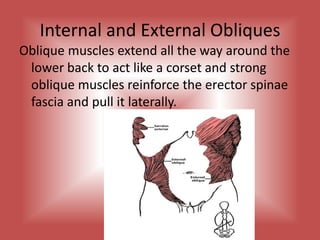
Internal and External ObliquesOblique muscles extend all the way around the lower back to act like a corset and strong oblique muscles reinforce the erector spinae fascia and pull it laterally.
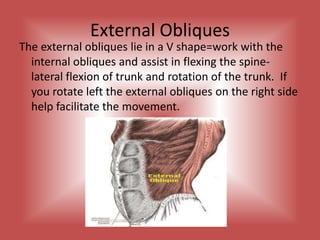
External ObliquesThe external obliques lie in a V shape=work with the internal obliques and assist in flexing the spine-lateral flexion of trunk and rotation of the trunk.  If you rotate left the external obliques on the right side help facilitate the movement.
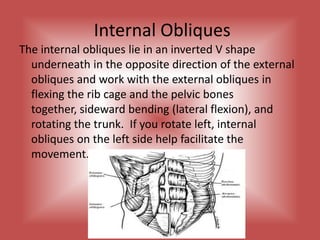
 Internal ObliquesThe internal obliques lie in an inverted V shape underneath in the opposite direction of the external obliques and work with the external obliques in flexing the rib cage and the pelvic bones together, sideward bending (lateral flexion), and rotating the trunk.  If you rotate left, internal obliques on the left side help facilitate the movement.
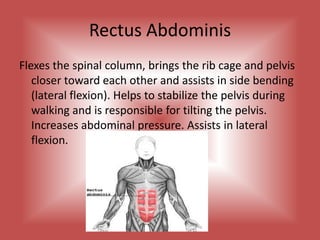
Rectus AbdominisFlexes the spinal column, brings the rib cage and pelvis closer toward each other and assists in side bending (lateral flexion). Helps to stabilize the pelvis during walking and is responsible for tilting the pelvis.  Increases abdominal pressure. Assists in lateral flexion.
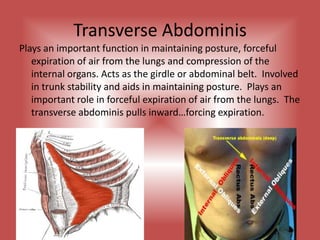
Transverse AbdominisPlays an important function in maintaining posture, forceful expiration of air from the lungs and compression of the internal organs. Acts as the girdle or abdominal belt.  Involved in trunk stability and aids in maintaining posture.  Plays an important role in forceful expiration of air from the lungs.  The transverse abdominis pulls inward…forcing expiration.
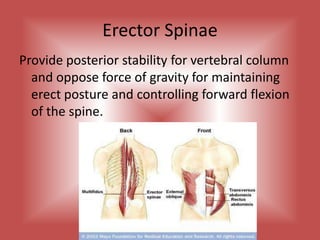
Erector SpinaeProvide posterior stability for vertebral column and oppose force of gravity for maintaining erect posture and controlling forward flexion of the spine.
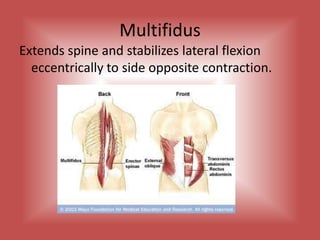
MultifidusExtends spine and stabilizes lateral flexion eccentrically to side opposite contraction.
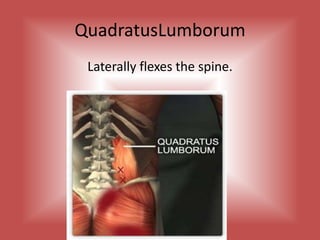
QuadratusLumborumLaterally flexes the spine.
Benefits of Developing Core and Abdominal Back MusclesFahey (2007) & Boettcher (2004)Prevents back pain and injury
Improves posture…helps to stabilize the spine
Increase in muscle density increases calorie burning
Core training gives more power to a swing or throw
Children can move dynamically
Enhance stability and balance…prevent falls
Stabilizes the spine during lifting and everyday activitiesCore FactsCore Muscles are Essential for Maintaining Body’s Equilibrium Performing Physical TasksProvide Intra-Abdominal Pressure that Supports the SpineEssential in Good PostureAssist in Breathing
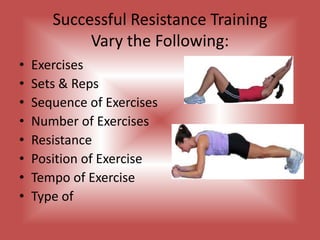
Successful Resistance TrainingVary the Following:ExercisesSets & RepsSequence of ExercisesNumber of ExercisesResistancePosition of ExerciseTempo of ExerciseType of
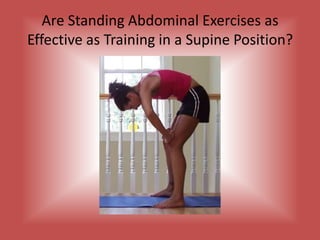
Are Standing Abdominal Exercises as Effective as Training in a Supine Position?
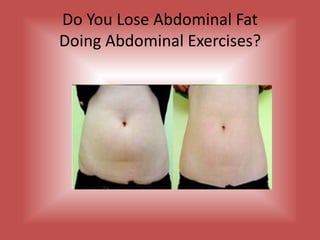
Do You Lose Abdominal FatDoing Abdominal Exercises?
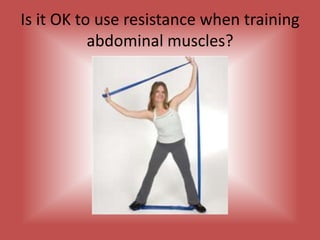
Is it OK to use resistance when training abdominal muscles?
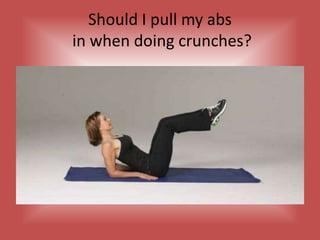
Should I pull my abs in when doing crunches?
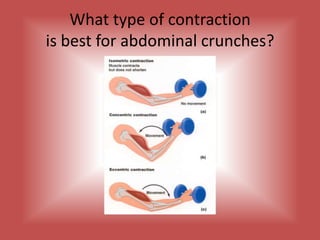
What type of contraction is best for abdominal crunches?
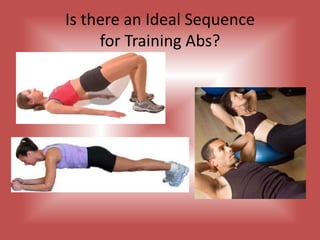
Is there an Ideal Sequence for Training Abs?
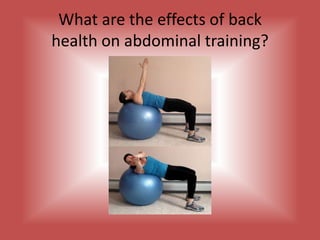
What are the effects of back health on abdominal training?
Standing Abs
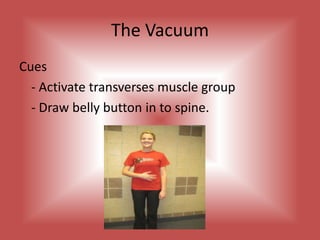
The VacuumCues	- Activate transverses muscle group	- Draw belly button in to spine.
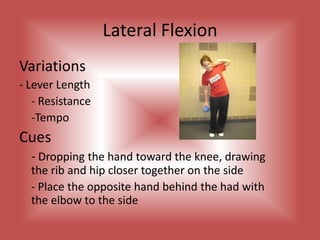
Lateral FlexionVariations- Lever Length	- Resistance	-TempoCues	- Dropping the hand toward the knee, drawing 	  	 the rib and hip closer together on the side	- Place the opposite hand behind the had with 	 	 the elbow to the side
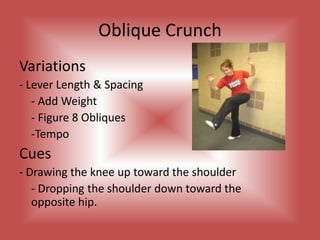
Oblique CrunchVariations- Lever Length & Spacing	- Add Weight	- Figure 8 Obliques	-TempoCues- Drawing the knee up toward the shoulder	- Dropping the shoulder down toward the 	 	  	 opposite hip.
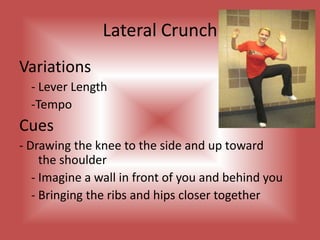
Lateral CrunchVariations	- Lever Length	-TempoCues- Drawing the knee to the side and up toward 	 	 	 the shoulder	- Imagine a wall in front of you and behind you	- Bringing the ribs and hips closer together
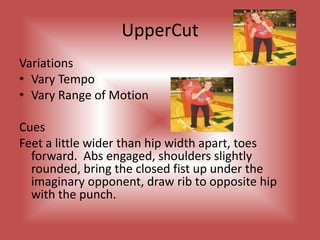
UpperCutVariationsVary TempoVary Range of MotionCuesFeet a little wider than hip width apart, toes forward.  Abs engaged, shoulders slightly rounded, bring the closed fist up under the imaginary opponent, draw rib to opposite hip with the punch.
One Leg Squat with Knee Lift
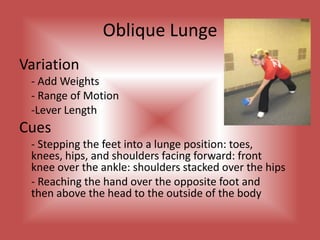
Oblique LungeVariation	- Add Weights	- Range of Motion	-Lever LengthCues	- Stepping the feet into a lunge position: toes, 	 	 	 knees, hips, and shoulders facing forward: front  	 knee over the ankle: shoulders stacked over the hips	- Reaching the hand over the opposite foot and  	 	 then above the head to the outside of the body
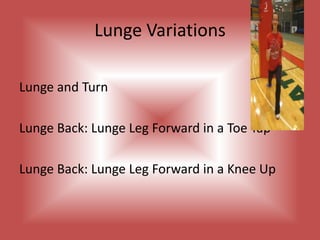
Lunge VariationsLunge and TurnLunge Back: Lunge Leg Forward in a Toe TapLunge Back: Lunge Leg Forward in a Knee Up
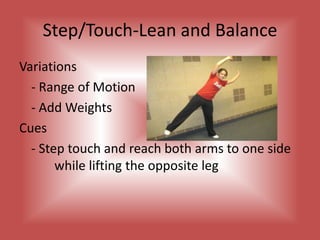
Step/Touch-Lean and BalanceVariations	- Range of Motion	- Add Weights Cues	- Step touch and reach both arms to one side 	 	 while lifting the opposite leg
Proud Warrior ThreeVariations	- Lever Length	-Duration of HoldCues	- engage abs, bending forward at the hips (90 	 	 degree angle)	- reaching the arms forward, extending one 	 	 leg back, parallel to the floor
Partner AbsOblique CrossStanding BraceBracing Lunge
Supine Abs
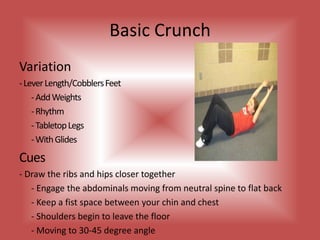
Basic CrunchVariation- Lever Length/Cobblers Feet	- Add Weights	- Rhythm	- Tabletop Legs	- With Glides Cues- Draw the ribs and hips closer together	- Engage the abdominals moving from neutral spine to flat back	- Keep a fist space between your chin and chest	- Shoulders begin to leave the floor	- Moving to 30-45 degree angle
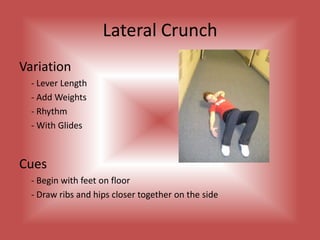
Lateral CrunchVariation	- Lever Length	- Add Weights	- Rhythm	- With Glides Cues	- Begin with feet on floor	- Draw ribs and hips closer together on the side
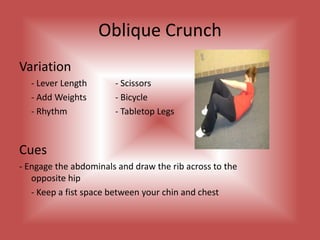
Oblique CrunchVariation	- Lever Length		- Scissors	- Add Weights		- Bicycle	- Rhythm			- Tabletop LegsCues- Engage the abdominals and draw the rib across to the 	 	 	 	 opposite hip	- Keep a fist space between your chin and chest
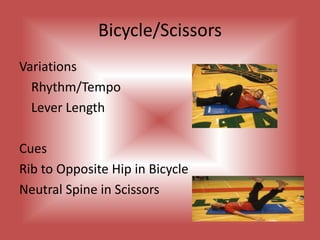
Bicycle/ScissorsVariations	Rhythm/Tempo	Lever LengthCuesRib to Opposite Hip in BicycleNeutral Spine in Scissors
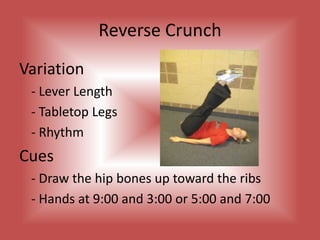
Reverse CrunchVariation	- Lever Length	- Tabletop Legs	- RhythmCues	- Draw the hip bones up toward the ribs	- Hands at 9:00 and 3:00 or 5:00 and 7:00
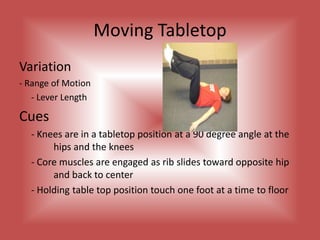
Moving TabletopVariation- Range of Motion	- Lever Length Cues	- Knees are in a tabletop position at a 90 degree angle at the 	 	 hips and the knees	- Core muscles are engaged as rib slides toward opposite hip 	 	 and back to center	- Holding table top position touch one foot at a time to floor
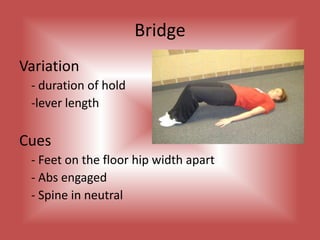
BridgeVariation	- duration of hold	-lever lengthCues	- Feet on the floor hip width apart	- Abs engaged	- Spine in neutral
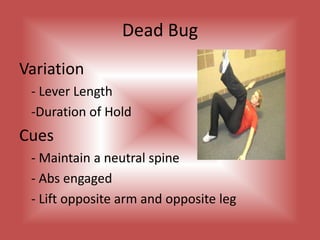
Dead BugVariation	- Lever Length	-Duration of HoldCues	- Maintain a neutral spine	- Abs engaged	- Lift opposite arm and opposite leg
Side Abs
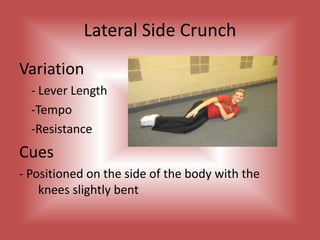
Lateral Side CrunchVariation	- Lever Length	-Tempo	-Resistance Cues- Positioned on the side of the body with the 	 	 	 knees slightly bent
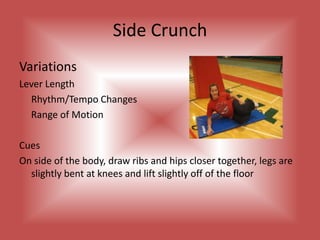
Side CrunchVariationsLever Length	Rhythm/Tempo Changes     Range of MotionCuesOn side of the body, draw ribs and hips closer together, legs are slightly bent at knees and lift slightly off of the floor
Yoga Abs
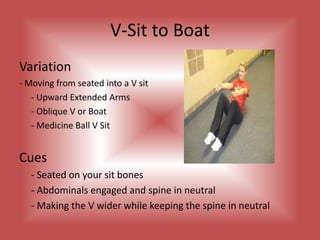
V-Sit to BoatVariation- Moving from seated into a V sit	- Upward Extended Arms	- Oblique V or Boat	- Medicine Ball V Sit Cues	- Seated on your sit bones	- Abdominals engaged and spine in neutral	- Making the V wider while keeping the spine in neutral
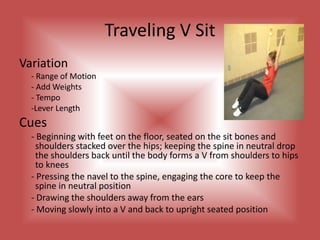
Traveling V SitVariation	- Range of Motion	- Add Weights	- Tempo 	-Lever LengthCues	- Beginning with feet on the floor, seated on the sit bones and 	shoulders stacked over the hips; keeping the spine in neutral drop 	the shoulders back until the body forms a V from shoulders to hips 	to knees	- Pressing the navel to the spine, engaging the core to keep the 	spine in neutral position	- Drawing the shoulders away from the ears	- Moving slowly into a V and back to upright seated position
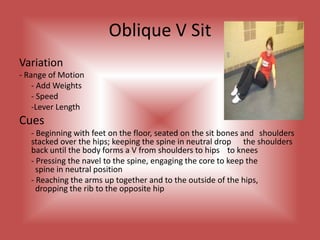
Oblique V SitVariation- Range of Motion	- Add Weights	- Speed 	-Lever LengthCues	- Beginning with feet on the floor, seated on the sit bones and 	shoulders stacked over the hips; keeping the spine in neutral drop 	the shoulders back until the body forms a V from shoulders to hips 	to knees	- Pressing the navel to the spine, engaging the core to keep the 	 	spine in neutral position	- Reaching the arms up together and to the outside of the hips, 	dropping the rib to the opposite hip
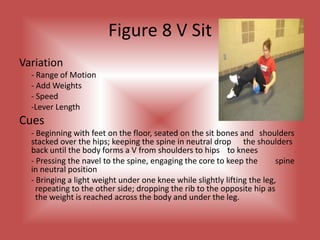
Figure 8 V SitVariation	- Range of Motion	- Add Weights	- Speed 	-Lever LengthCues	- Beginning with feet on the floor, seated on the sit bones and 	shoulders stacked over the hips; keeping the spine in neutral drop 	the shoulders back until the body forms a V from shoulders to hips 	to knees	- Pressing the navel to the spine, engaging the core to keep the 	spine in neutral position	- Bringing a light weight under one knee while slightly lifting the leg, 	repeating to the other side; dropping the rib to the opposite hip as 	the weight is reached across the body and under the leg.
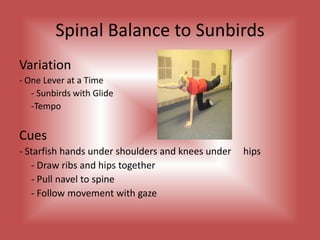
Spinal Balance to SunbirdsVariation- One Lever at a Time	- Sunbirds with Glide 	-TempoCues- Starfish hands under shoulders and knees under 	hips	- Draw ribs and hips together	- Pull navel to spine	- Follow movement with gaze
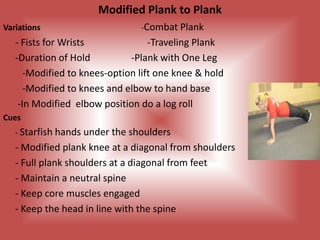
Modified Plank to PlankVariations						     -Combat Plank	- Fists for Wrists				-Traveling Plank				-Duration of Hold			-Plank with One Leg        -Modified to knees-option lift one knee & hold        -Modified to knees and elbow to hand base	 -In Modified  elbow position do a log rollCues	- Starfish hands under the shoulders	- Modified plank knee at a diagonal from shoulders	- Full plank shoulders at a diagonal from feet	- Maintain a neutral spine	- Keep core muscles engaged	- Keep the head in line with the spine
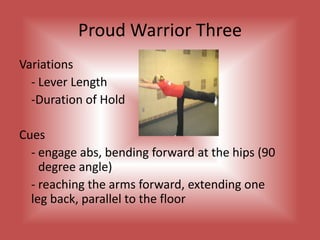
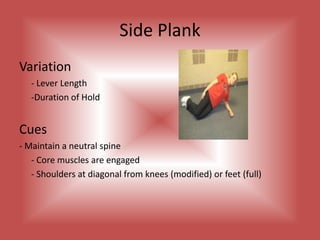
Side PlankVariation	- Lever Length 	-Duration of HoldCues- Maintain a neutral spine	- Core muscles are engaged	- Shoulders at diagonal from knees (modified) or feet (full)
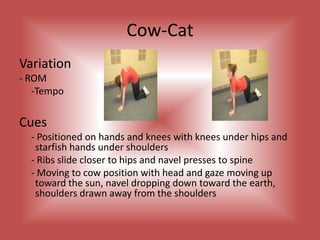
Cow-CatVariation- ROM	-TempoCues	- Positioned on hands and knees with knees under hips and 	starfish hands under shoulders	- Ribs slide closer to hips and navel presses to spine	- Moving to cow position with head and gaze moving up 	toward the sun, navel dropping down toward the earth, 	shoulders drawn away from the shoulders
Pilates Abs
Pilates BreathingCues	- Supine, knees bent, feet flat, arms at sides	- Pull abdominal muscles in and up to the diaphragm 	 	 on exhalation, lift and pull muscle tissue between the 	 pubic and tail bones upward as you exhale out the 	 	  mouth	- Engage pelvic floor and ribcage on inhalation, breath 	 	 in through the nose
The Roll UpCues	- Supine, arms overhead, legs extended, feet 	 	 	 flexed, raise arms up toward ceiling, curl 	 	 	  shoulder girdle off the mat roll up through  spine, roll back down to the mat, move one vertebra at a time.	- Control movement with breathing
The One Leg CircleCues	- Supine, arms at side, extended left leg on the 	 	 mat with foot flexed or knee bent toward ceiling 	 at a 90 degree angle to trunk, rotate leg in circular motion, keep pelvis anchored while working leg reaches the midline.	- Control movement with breathing
Prone Abs & Back
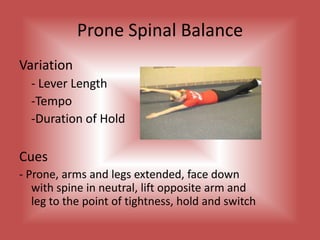
Prone Spinal BalanceVariation	- Lever Length	-Tempo	-Duration of HoldCues- Prone, arms and legs extended, face down  	 	 	 with spine in neutral, lift opposite arm and 	 	  	 leg to the point of tightness, hold and switch

Awesome_Abs_SDAHPERD

  • 1.
    AWESOME ABSTerry FerebeeEckmann, Ph.D.Minot State University
  • 2.
    Today We WillBrieflyReview the Muscles of the CoreAnswer Common Questions About Core TrainingPerform a Series of Standing, Prone, Yoga, Supine Abdominal ExercisesFocus on Safety and Instructional Cues
  • 3.
    Core “Awesome Ab” ExercisesCore “Awesome Abdominals” ClassFitness Segment of PE Class“Tagged Activity”“Waiting” for a turn ActivitySegment of a Yoga ClassWarm-Up ActivitiesBest Ab Exercises for the Sport (vary with unit)IDEA PAIR AND SHARE!!!!
  • 4.
    Key ConceptsNeutral SpinePositionChoose Level Appropriate for Participant Fitness LevelModeling is KeyConsistently Check for UnderstandingExhale on ExertionSlow Controlled Movement is More Effective
  • 5.
    What is theCore?Core = The entire spineCore is the power center-the area that encircles your body from your lower ribs to the bottom of your butt (Joseph Pilates)Core includes the smaller inner muscles: the transverse abdominis and multifidus muscles (physical therapists)Core includes all the above area and the muscles that stabilize the shoulder blades (strength and conditioning coaches)
  • 7.
    Internal and ExternalObliquesOblique muscles extend all the way around the lower back to act like a corset and strong oblique muscles reinforce the erector spinae fascia and pull it laterally.
  • 8.
    External ObliquesThe externalobliques lie in a V shape=work with the internal obliques and assist in flexing the spine-lateral flexion of trunk and rotation of the trunk. If you rotate left the external obliques on the right side help facilitate the movement.
  • 9.
    Internal ObliquesTheinternal obliques lie in an inverted V shape underneath in the opposite direction of the external obliques and work with the external obliques in flexing the rib cage and the pelvic bones together, sideward bending (lateral flexion), and rotating the trunk. If you rotate left, internal obliques on the left side help facilitate the movement.
  • 10.
    Rectus AbdominisFlexes thespinal column, brings the rib cage and pelvis closer toward each other and assists in side bending (lateral flexion). Helps to stabilize the pelvis during walking and is responsible for tilting the pelvis. Increases abdominal pressure. Assists in lateral flexion.
  • 11.
    Transverse AbdominisPlays animportant function in maintaining posture, forceful expiration of air from the lungs and compression of the internal organs. Acts as the girdle or abdominal belt. Involved in trunk stability and aids in maintaining posture. Plays an important role in forceful expiration of air from the lungs. The transverse abdominis pulls inward…forcing expiration.
  • 12.
    Erector SpinaeProvide posteriorstability for vertebral column and oppose force of gravity for maintaining erect posture and controlling forward flexion of the spine.
  • 13.
    MultifidusExtends spine andstabilizes lateral flexion eccentrically to side opposite contraction.
  • 14.
  • 15.
    Benefits of DevelopingCore and Abdominal Back MusclesFahey (2007) & Boettcher (2004)Prevents back pain and injury
  • 16.
    Improves posture…helps tostabilize the spine
  • 17.
    Increase in muscledensity increases calorie burning
  • 18.
    Core training givesmore power to a swing or throw
  • 19.
  • 20.
    Enhance stability andbalance…prevent falls
  • 21.
    Stabilizes the spineduring lifting and everyday activitiesCore FactsCore Muscles are Essential for Maintaining Body’s Equilibrium Performing Physical TasksProvide Intra-Abdominal Pressure that Supports the SpineEssential in Good PostureAssist in Breathing
  • 22.
    Successful Resistance TrainingVarythe Following:ExercisesSets & RepsSequence of ExercisesNumber of ExercisesResistancePosition of ExerciseTempo of ExerciseType of
  • 23.
    Are Standing AbdominalExercises as Effective as Training in a Supine Position?
  • 24.
    Do You LoseAbdominal FatDoing Abdominal Exercises?
  • 25.
    Is it OKto use resistance when training abdominal muscles?
  • 26.
    Should I pullmy abs in when doing crunches?
  • 27.
    What type ofcontraction is best for abdominal crunches?
  • 28.
    Is there anIdeal Sequence for Training Abs?
  • 29.
    What are theeffects of back health on abdominal training?
  • 30.
  • 31.
    The VacuumCues - Activatetransverses muscle group - Draw belly button in to spine.
  • 32.
    Lateral FlexionVariations- LeverLength - Resistance -TempoCues - Dropping the hand toward the knee, drawing the rib and hip closer together on the side - Place the opposite hand behind the had with the elbow to the side
  • 33.
    Oblique CrunchVariations- LeverLength & Spacing - Add Weight - Figure 8 Obliques -TempoCues- Drawing the knee up toward the shoulder - Dropping the shoulder down toward the opposite hip.
  • 34.
    Lateral CrunchVariations - LeverLength -TempoCues- Drawing the knee to the side and up toward the shoulder - Imagine a wall in front of you and behind you - Bringing the ribs and hips closer together
  • 35.
    UpperCutVariationsVary TempoVary Rangeof MotionCuesFeet a little wider than hip width apart, toes forward. Abs engaged, shoulders slightly rounded, bring the closed fist up under the imaginary opponent, draw rib to opposite hip with the punch.
  • 36.
    One Leg Squatwith Knee Lift
  • 37.
    Oblique LungeVariation - AddWeights - Range of Motion -Lever LengthCues - Stepping the feet into a lunge position: toes, knees, hips, and shoulders facing forward: front knee over the ankle: shoulders stacked over the hips - Reaching the hand over the opposite foot and then above the head to the outside of the body
  • 38.
    Lunge VariationsLunge andTurnLunge Back: Lunge Leg Forward in a Toe TapLunge Back: Lunge Leg Forward in a Knee Up
  • 39.
    Step/Touch-Lean and BalanceVariations -Range of Motion - Add Weights Cues - Step touch and reach both arms to one side while lifting the opposite leg
  • 40.
    Proud Warrior ThreeVariations -Lever Length -Duration of HoldCues - engage abs, bending forward at the hips (90 degree angle) - reaching the arms forward, extending one leg back, parallel to the floor
  • 41.
  • 42.
  • 43.
    Basic CrunchVariation- LeverLength/Cobblers Feet - Add Weights - Rhythm - Tabletop Legs - With Glides Cues- Draw the ribs and hips closer together - Engage the abdominals moving from neutral spine to flat back - Keep a fist space between your chin and chest - Shoulders begin to leave the floor - Moving to 30-45 degree angle
  • 44.
    Lateral CrunchVariation - LeverLength - Add Weights - Rhythm - With Glides Cues - Begin with feet on floor - Draw ribs and hips closer together on the side
  • 45.
    Oblique CrunchVariation - LeverLength - Scissors - Add Weights - Bicycle - Rhythm - Tabletop LegsCues- Engage the abdominals and draw the rib across to the opposite hip - Keep a fist space between your chin and chest
  • 46.
    Bicycle/ScissorsVariations Rhythm/Tempo Lever LengthCuesRib toOpposite Hip in BicycleNeutral Spine in Scissors
  • 47.
    Reverse CrunchVariation - LeverLength - Tabletop Legs - RhythmCues - Draw the hip bones up toward the ribs - Hands at 9:00 and 3:00 or 5:00 and 7:00
  • 48.
    Moving TabletopVariation- Rangeof Motion - Lever Length Cues - Knees are in a tabletop position at a 90 degree angle at the hips and the knees - Core muscles are engaged as rib slides toward opposite hip and back to center - Holding table top position touch one foot at a time to floor
  • 49.
    BridgeVariation - duration ofhold -lever lengthCues - Feet on the floor hip width apart - Abs engaged - Spine in neutral
  • 50.
    Dead BugVariation - LeverLength -Duration of HoldCues - Maintain a neutral spine - Abs engaged - Lift opposite arm and opposite leg
  • 51.
  • 52.
    Lateral Side CrunchVariation -Lever Length -Tempo -Resistance Cues- Positioned on the side of the body with the knees slightly bent
  • 53.
    Side CrunchVariationsLever Length Rhythm/TempoChanges Range of MotionCuesOn side of the body, draw ribs and hips closer together, legs are slightly bent at knees and lift slightly off of the floor
  • 54.
  • 55.
    V-Sit to BoatVariation-Moving from seated into a V sit - Upward Extended Arms - Oblique V or Boat - Medicine Ball V Sit Cues - Seated on your sit bones - Abdominals engaged and spine in neutral - Making the V wider while keeping the spine in neutral
  • 56.
    Traveling V SitVariation -Range of Motion - Add Weights - Tempo -Lever LengthCues - Beginning with feet on the floor, seated on the sit bones and shoulders stacked over the hips; keeping the spine in neutral drop the shoulders back until the body forms a V from shoulders to hips to knees - Pressing the navel to the spine, engaging the core to keep the spine in neutral position - Drawing the shoulders away from the ears - Moving slowly into a V and back to upright seated position
  • 57.
    Oblique V SitVariation-Range of Motion - Add Weights - Speed -Lever LengthCues - Beginning with feet on the floor, seated on the sit bones and shoulders stacked over the hips; keeping the spine in neutral drop the shoulders back until the body forms a V from shoulders to hips to knees - Pressing the navel to the spine, engaging the core to keep the spine in neutral position - Reaching the arms up together and to the outside of the hips, dropping the rib to the opposite hip
  • 58.
    Figure 8 VSitVariation - Range of Motion - Add Weights - Speed -Lever LengthCues - Beginning with feet on the floor, seated on the sit bones and shoulders stacked over the hips; keeping the spine in neutral drop the shoulders back until the body forms a V from shoulders to hips to knees - Pressing the navel to the spine, engaging the core to keep the spine in neutral position - Bringing a light weight under one knee while slightly lifting the leg, repeating to the other side; dropping the rib to the opposite hip as the weight is reached across the body and under the leg.
  • 59.
    Spinal Balance toSunbirdsVariation- One Lever at a Time - Sunbirds with Glide -TempoCues- Starfish hands under shoulders and knees under hips - Draw ribs and hips together - Pull navel to spine - Follow movement with gaze
  • 60.
    Modified Plank toPlankVariations -Combat Plank - Fists for Wrists -Traveling Plank -Duration of Hold -Plank with One Leg -Modified to knees-option lift one knee & hold -Modified to knees and elbow to hand base -In Modified elbow position do a log rollCues - Starfish hands under the shoulders - Modified plank knee at a diagonal from shoulders - Full plank shoulders at a diagonal from feet - Maintain a neutral spine - Keep core muscles engaged - Keep the head in line with the spine
  • 61.
    Side PlankVariation - LeverLength -Duration of HoldCues- Maintain a neutral spine - Core muscles are engaged - Shoulders at diagonal from knees (modified) or feet (full)
  • 62.
    Cow-CatVariation- ROM -TempoCues - Positionedon hands and knees with knees under hips and starfish hands under shoulders - Ribs slide closer to hips and navel presses to spine - Moving to cow position with head and gaze moving up toward the sun, navel dropping down toward the earth, shoulders drawn away from the shoulders
  • 63.
  • 64.
    Pilates BreathingCues - Supine,knees bent, feet flat, arms at sides - Pull abdominal muscles in and up to the diaphragm on exhalation, lift and pull muscle tissue between the pubic and tail bones upward as you exhale out the mouth - Engage pelvic floor and ribcage on inhalation, breath in through the nose
  • 65.
    The Roll UpCues -Supine, arms overhead, legs extended, feet flexed, raise arms up toward ceiling, curl shoulder girdle off the mat roll up through spine, roll back down to the mat, move one vertebra at a time. - Control movement with breathing
  • 66.
    The One LegCircleCues - Supine, arms at side, extended left leg on the mat with foot flexed or knee bent toward ceiling at a 90 degree angle to trunk, rotate leg in circular motion, keep pelvis anchored while working leg reaches the midline. - Control movement with breathing
  • 67.
  • 68.
    Prone Spinal BalanceVariation -Lever Length -Tempo -Duration of HoldCues- Prone, arms and legs extended, face down with spine in neutral, lift opposite arm and leg to the point of tightness, hold and switch